The Efficiency Mindset

‘The Future of Collaboration’


       25th November 2010
Introduction
• Kim Newman – Managing Director
  -   Partnering Advice
  -   Special purpose vehicle management
  -   Client side and Contractor Roles
  -   Cross sector collaborative working expertise


• Tyron Stalberg – Senior Consultant
  -   Client side and Contractor Roles
  -   Partnering best practice studies and case studies
  -   PPC/TPC Steering Group Member
  -   Procurement and bid support
Market Challenges
• Recession/Austerity
  Measures/CSR
• Reducing budgets
• ‘Protecting’ the Front Line
• Back Office ‘value’
• Political ‘will’ & traditional
  demarcation
 “Changing  the rules of the game requires alternative
 thinking that would usually be suppressed within the
 confines of current practice”
Market Challenges
• What does that mean?
• Alternative business models
• Supply chain is giving way to a more holistic
  value chain
• Its no longer about adding organisations
  together.....
• Its about multiplying combined capability for
  maximum value
• Constant factor = good relationships
Market Challenges
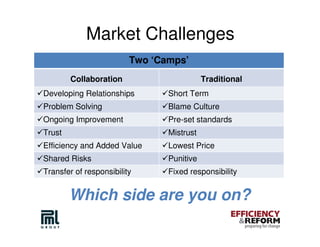
                         Two ‘Camps’
        Collaboration                      Traditional
Developing Relationships        Short Term
Problem Solving                 Blame Culture
Ongoing Improvement             Pre-set standards
Trust                           Mistrust
Efficiency and Added Value      Lowest Price
Shared Risks                    Punitive
Transfer of responsibility      Fixed responsibility


        Which side are you on?
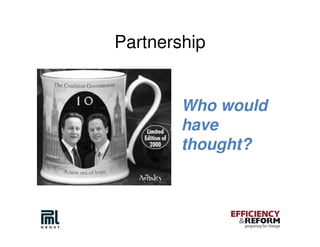
Partnership


        Who would
        have
        thought?
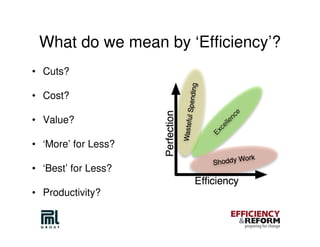
What do we mean by ‘Efficiency’?
• Cuts?

• Cost?

• Value?

• ‘More’ for Less?

• ‘Best’ for Less?

• Productivity?
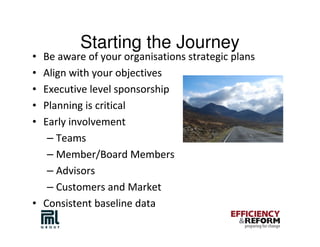
Starting the Journey
• Be aware of your organisations strategic plans
• Align with your objectives
• Executive level sponsorship
• Planning is critical
• Early involvement
   – Teams
   – Member/Board Members
   – Advisors
   – Customers and Market
• Consistent baseline data
Types of Relationship
• Informal                • How do you decide?

• SLA’s                   • What is ‘right’ for you?

• Traditional             • Is it ‘equal’?

• Partnering
                    BUT   • How long?

• Shared Services         • What are the ‘rules’

• JVCO’s/LLP’s            • What are the ‘success’
                            criteria
Options Appraisal
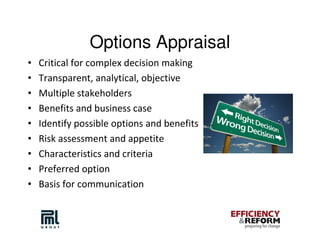
•   Critical for complex decision making
•   Transparent, analytical, objective
•   Multiple stakeholders
•   Benefits and business case
•   Identify possible options and benefits
•   Risk assessment and appetite
•   Characteristics and criteria
•   Preferred option
•   Basis for communication
Creating the Relationship
Specific strategies to
deliver outcomes
Consider your
collaborative profile
Resources
Working groups
Identify and remove
constraints
Creating the Relationship
Align behaviours to
objectives
Decide on a partner profile
Assess knowledge and skills
Apply partner selection
processes
Public tender?
Establish common
objectives and compatibility
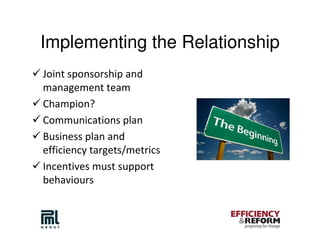
Implementing the Relationship
Joint sponsorship and
management team
Champion?
Communications plan
Business plan and
efficiency targets/metrics
Incentives must support
behaviours
Managing the Relationship
• Communicate (and at the
  right levels)

   How?

   Who?

   When?
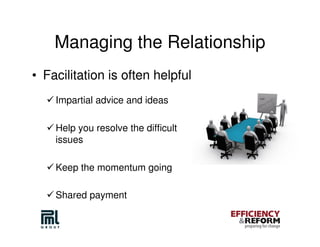
Managing the Relationship
• Facilitation is often helpful
    Impartial advice and ideas

    Help you resolve the difficult
    issues

    Keep the momentum going

    Shared payment
Managing the Relationship
• Use the contract or agreement
  properly

   Do what you say you will do

   When you will say you will

   Measure the KPI’s & Outputs
Managing the Relationship
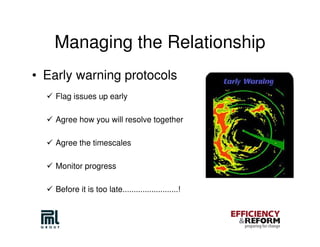
• Early warning protocols
    Flag issues up early

    Agree how you will resolve together

    Agree the timescales

    Monitor progress

    Before it is too late.........................!
Managing the Relationship
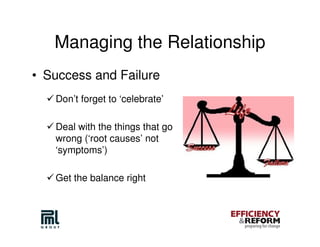
• Success and Failure
   Don’t forget to ‘celebrate’

   Deal with the things that go
   wrong (‘root causes’ not
   ‘symptoms’)

   Get the balance right
Realisation of Efficiencies
• What will be achieved?

• When?

• How will it be measured?

• Is there multi-party agreement?
Identifying & Capturing Efficiencies
• Beware of double counting!

• ‘Cashable’ or ‘non cashable’?

• Are there ‘hidden’ benefits?

• Does your efficiency add cost
  to your partner?
Identifying & Capturing Efficiencies
• Create an efficiency or VFM log

• Standardise your data capture

• Seek independent verification

• Share your successes!
Keeping the Momentum
• Relationships generally
  start off well

• ‘Tire’ over time!

• Loss of focus
Keeping the Momentum
• External facilitation

• Structured meeting schedule

• Agenda planning

• Annual Review

• Celebrate success

• Minutes!
End of the Relationship
• All relationships will come to
  an end!

• It is not a ‘taboo’ subject

• What will be next?

• What do you need to do to
  manage the transition?
Common Failings
• Do what we always do (only harder)!

• ‘Man marking’

• Do not include the ‘sum of all the parts’

• Don’t ‘do’ what you say you will do
Common Failings
• Buy the ‘wrong’ product (poor procurement)

• Don’t learn from the past

• Do not understand what your customers
  want

• Don’t listen to your partner(s)
Common Failings
• Preparing & training your team(s)

• Focus on the things that don’t count

• Make the same mistakes
Summary
• Move from ‘delivery’ to
  ‘commissioning’ services

• Strategic role

• Remove the ‘constraints’

• Time to be ‘brave’
Questions?

The efficiency mindset

  • 1.
    The Efficiency Mindset ‘TheFuture of Collaboration’ 25th November 2010
  • 2.
    Introduction • Kim Newman– Managing Director - Partnering Advice - Special purpose vehicle management - Client side and Contractor Roles - Cross sector collaborative working expertise • Tyron Stalberg – Senior Consultant - Client side and Contractor Roles - Partnering best practice studies and case studies - PPC/TPC Steering Group Member - Procurement and bid support
  • 3.
    Market Challenges • Recession/Austerity Measures/CSR • Reducing budgets • ‘Protecting’ the Front Line • Back Office ‘value’ • Political ‘will’ & traditional demarcation “Changing the rules of the game requires alternative thinking that would usually be suppressed within the confines of current practice”
  • 4.
    Market Challenges • Whatdoes that mean? • Alternative business models • Supply chain is giving way to a more holistic value chain • Its no longer about adding organisations together..... • Its about multiplying combined capability for maximum value • Constant factor = good relationships
  • 5.
    Market Challenges Two ‘Camps’ Collaboration Traditional Developing Relationships Short Term Problem Solving Blame Culture Ongoing Improvement Pre-set standards Trust Mistrust Efficiency and Added Value Lowest Price Shared Risks Punitive Transfer of responsibility Fixed responsibility Which side are you on?
  • 6.
    Partnership Who would have thought?
  • 7.
    What do wemean by ‘Efficiency’? • Cuts? • Cost? • Value? • ‘More’ for Less? • ‘Best’ for Less? • Productivity?
  • 8.
    Starting the Journey •Be aware of your organisations strategic plans • Align with your objectives • Executive level sponsorship • Planning is critical • Early involvement – Teams – Member/Board Members – Advisors – Customers and Market • Consistent baseline data
  • 9.
    Types of Relationship •Informal • How do you decide? • SLA’s • What is ‘right’ for you? • Traditional • Is it ‘equal’? • Partnering BUT • How long? • Shared Services • What are the ‘rules’ • JVCO’s/LLP’s • What are the ‘success’ criteria
  • 10.
    Options Appraisal • Critical for complex decision making • Transparent, analytical, objective • Multiple stakeholders • Benefits and business case • Identify possible options and benefits • Risk assessment and appetite • Characteristics and criteria • Preferred option • Basis for communication
  • 11.
    Creating the Relationship Specificstrategies to deliver outcomes Consider your collaborative profile Resources Working groups Identify and remove constraints
  • 12.
    Creating the Relationship Alignbehaviours to objectives Decide on a partner profile Assess knowledge and skills Apply partner selection processes Public tender? Establish common objectives and compatibility
  • 13.
    Implementing the Relationship Jointsponsorship and management team Champion? Communications plan Business plan and efficiency targets/metrics Incentives must support behaviours
  • 14.
    Managing the Relationship •Communicate (and at the right levels) How? Who? When?
  • 15.
    Managing the Relationship •Facilitation is often helpful Impartial advice and ideas Help you resolve the difficult issues Keep the momentum going Shared payment
  • 16.
    Managing the Relationship •Use the contract or agreement properly Do what you say you will do When you will say you will Measure the KPI’s & Outputs
  • 17.
    Managing the Relationship •Early warning protocols Flag issues up early Agree how you will resolve together Agree the timescales Monitor progress Before it is too late.........................!
  • 18.
    Managing the Relationship •Success and Failure Don’t forget to ‘celebrate’ Deal with the things that go wrong (‘root causes’ not ‘symptoms’) Get the balance right
  • 19.
    Realisation of Efficiencies •What will be achieved? • When? • How will it be measured? • Is there multi-party agreement?
  • 20.
    Identifying & CapturingEfficiencies • Beware of double counting! • ‘Cashable’ or ‘non cashable’? • Are there ‘hidden’ benefits? • Does your efficiency add cost to your partner?
  • 21.
    Identifying & CapturingEfficiencies • Create an efficiency or VFM log • Standardise your data capture • Seek independent verification • Share your successes!
  • 22.
    Keeping the Momentum •Relationships generally start off well • ‘Tire’ over time! • Loss of focus
  • 23.
    Keeping the Momentum •External facilitation • Structured meeting schedule • Agenda planning • Annual Review • Celebrate success • Minutes!
  • 24.
    End of theRelationship • All relationships will come to an end! • It is not a ‘taboo’ subject • What will be next? • What do you need to do to manage the transition?
  • 25.
    Common Failings • Dowhat we always do (only harder)! • ‘Man marking’ • Do not include the ‘sum of all the parts’ • Don’t ‘do’ what you say you will do
  • 26.
    Common Failings • Buythe ‘wrong’ product (poor procurement) • Don’t learn from the past • Do not understand what your customers want • Don’t listen to your partner(s)
  • 27.
    Common Failings • Preparing& training your team(s) • Focus on the things that don’t count • Make the same mistakes
  • 28.
    Summary • Move from‘delivery’ to ‘commissioning’ services • Strategic role • Remove the ‘constraints’ • Time to be ‘brave’
  • 29.