Chapter 3
Strategies for Safely Handling Industrial Azide
Reactions: The Three Traps
Thomas Archibald*
Technology Consultants, 1909 Beach Drive SE, St. Petersburg, Florida 33705
*E-mail: Archibaldmail@gmail.com
Industrial use of azides requires special care to avoid explosions
or poisonings. Life-cycle management of azide is discussed
from the time azide-containing material is received at the
front gate, sampled and stored, moved to the plant, placed in
reactors, and finally until all wastes are abated and all equipment
decontaminated. Key failure modes resulting from inadvertent
isolation of extremely dangerous hydrazoic acid or other azides
are described. Recommendations are made for control and
containment of azides in a multi-purpose plant. Operational
discipline, which includes operator training, plant maintenance
and change control, is highlighted as a critical safety element.
Introduction
This review offers guidelines for operating industrial azide reactions after the
safety of the reaction chemistry is understood (1–3). Reactions containing azides
need increased attention and skills, particularly on commercial scale. But azide
chemistry is not capricious, and its dangers can be readily understood and handled.
Azide’s notoriety comes from small-scale laboratory experiments whose safety
is often poorly understood. As a result, accidents occur and scientists hear only
about the deleterious results of using azide. Scientific safety studies have usually
been focused on reaction chemistry and product stability, issues that are rarely
troublesome in a manufacturing setting. Less attention has been paid to dangers
which arise from control and containment of azide. Clearly for industrial use, a
holistic approach to the procurement, use and disposal of azides is best. The focus
here will be on a life-cycle approach for large-scale operations.
© 2014 American Chemical Society
DownloadedbyVIKASNAGPALonDecember2,2014|http://pubs.acs.org
PublicationDate(Web):November20,2014|doi:10.1021/bk-2014-1181.ch003
In Managing Hazardous Reactions and Compounds in Process Chemistry; Pesti, et al.;
ACS Symposium Series; American Chemical Society: Washington, DC, 2014.
What follows is a compilation of the author’s personal experiences and
general knowledge, and is designed to illuminate the areas where workers have
traditionally run into difficulties. Unlike laboratory incidents which are often
published, manufacturing incidents are generally not reported outside of legally
mandated channels. Companies will investigate and remedy problems but will
rarely publish either the incident or its cause because its process may involve trade
secrets or confidentiality. Companies using azide chemistry will also not discuss
their practices because of liability concerns. As a result, information that could
prevent recurrences of hazardous operations and events is not disseminated. This
chapter has as a goal to cover as many of these potential problems as possible.
Sodium azide has a rich chemistry for introducing functionality into
molecules. With the advent of “Click” chemistry (4), the number of publications
using azide reactions has grown rapidly, and consequently so has the number of
laboratories. Annual scientific citations to azide has increased by 300% from
2000 to 2013 to over 4000 per year. Azide chemistry has also become an integral
part of pharmaceutical manufacture as shown by increased numbers of target
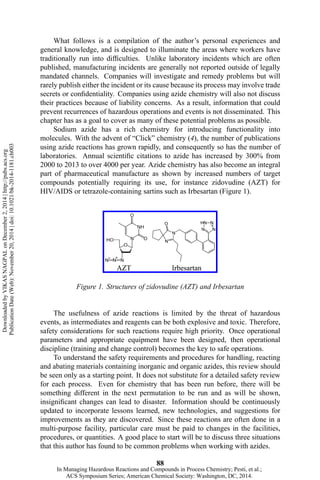
compounds potentially requiring its use, for instance zidovudine (AZT) for
HIV/AIDS or tetrazole-containing sartins such as Irbesartan (Figure 1).
Figure 1. Structures of zidovudine (AZT) and Irbesartan
The usefulness of azide reactions is limited by the threat of hazardous
events, as intermediates and reagents can be both explosive and toxic. Therefore,
safety considerations for such reactions require high priority. Once operational
parameters and appropriate equipment have been designed, then operational
discipline (training and change control) becomes the key to safe operations.
To understand the safety requirements and procedures for handling, reacting
and abating materials containing inorganic and organic azides, this review should
be seen only as a starting point. It does not substitute for a detailed safety review
for each process. Even for chemistry that has been run before, there will be
something different in the next permutation to be run and as will be shown,
insignificant changes can lead to disaster. Information should be continuously
updated to incorporate lessons learned, new technologies, and suggestions for
improvements as they are discovered. Since these reactions are often done in a
multi-purpose facility, particular care must be paid to changes in the facilities,
procedures, or quantities. A good place to start will be to discuss three situations
that this author has found to be common problems when working with azides.
88
DownloadedbyVIKASNAGPALonDecember2,2014|http://pubs.acs.org
PublicationDate(Web):November20,2014|doi:10.1021/bk-2014-1181.ch003
In Managing Hazardous Reactions and Compounds in Process Chemistry; Pesti, et al.;
ACS Symposium Series; American Chemical Society: Washington, DC, 2014.
Three Traps
Most incidents result from one of three “traps” inherent in the nature of
azide chemistry. These traps are well known to “specialist” companies working
with azides, but are often inadequately understood by scientists without extensive
experience with azides. Understanding the nature of each trap can help workers
understand and avoid them.
The three traps are:
(1) The ease of formation and accidental isolation of concentrated solutions
of hydrazoic acid.
(2) The uncontrolled handling of azides permitting formation of solid metal
azides.
(3) The unintended formation or isolation of low molecular weight organic
azides.
Each trap will be discussed in detail to show how sometimes traps can work in
combination.
Trap 1: Hydrazoic Acid
Hydrazoic acid is an extremely dangerous material both as a liquid and in
vapor phase; it is both highly toxic and explosive (5). Few compounds possess
such a combination of acute dangers as hydrazoic acid. Reactions involving
hydrazoic acid in the neat or concentrated form should be run remotely or in
specially constructed bunkers. But all reactions making or involving hydrazoic
acid require special precautions in reactor design and personal protection.
Hydrazoic acid is usually formed by the reaction of azide salts with acids.
Hydrazoic acid is a weak acid with a pKa of 4.6 (6). Therefore, hydrazoic acid will
form whenever any azide salt is dissolved in neutral water. For example, a 1 M
solution of sodium azide in water at pH 7 will contain hydrazoic acid. Hydrazoic
acid is quite soluble in water and strong acids, but it will partition into organic
solvents, such as dichloromethane and ether, with a ratio of about 5:1 in favor of
aqueous layer. Thus, it is possible to accidentally isolate and concentrate hydrazoic
acid by simple solvent extraction and fractional distillation. Industrial incidents
have occurred in this manner when solvents were not washed with base to remove
hydrazoic acid prior to distillation.
Hydrazoic acid has a boiling point of 37 °C (5) and a high vapor pressure at
room temperature leading to its high volatility. This means that hydrazoic acid can
distill from flasks and reactors under ambient conditions and collect in locations
such as the low spots and elbows in the overhead equipment of reactors or rotary
evaporators.
General properties for hydrazoic acid are available in published MSDSs
but data is often incomplete because its dangerous properties make it difficult to
test. Thus, MSDSs should be taken as a starting point for azide handling and not
a definitive document for safe handling of the compound. Hydrazoic acid is a
powerful explosive; even as a concentrated aqueous solution it can be similar in
89
DownloadedbyVIKASNAGPALonDecember2,2014|http://pubs.acs.org
PublicationDate(Web):November20,2014|doi:10.1021/bk-2014-1181.ch003
In Managing Hazardous Reactions and Compounds in Process Chemistry; Pesti, et al.;
ACS Symposium Series; American Chemical Society: Washington, DC, 2014.
energy to modern military explosives. The explosive limit in solvents, including
water, is approximately 15% (7), and over 10% in the gas phase (8). Surprisingly,
certain reactions, such as the cycloaddition of azide to form tetrazoles, are
routinely run at higher concentrations. (9, 10). While clearly most of such
reactions do not explode, the safety of each system should be studied individually.
Some reports suggest that hydrazoic acid is relatively insensitive to initiation
to explode, comparable to nitromethane (1, 5). But other reports suggest it is
highly sensitive and may spontaneously decompose on standing (7). While it
is not clear why the reports differ, it is likely small variations (e.g. impurities,
material of construction, concentration) may be responsible for the differences in
sensitivity for specific lots. There are examples of explosions where neat hydrazoic
acid accumulated and then detonated with minimal shock, perhaps from vibrations
due to the agitator or even the wind. Accordingly, hydrazoic acid should not be
allowed to accumulate in any form or solution, and consideration of conditions
and equipment should be completed before a reaction is run to ensure such events
will not happen spontaneously.
The detection of hydrazoic acid is an important component of safety on
large scale. FT-IR or NIR analysis allows for direct and continuous detection of
hydrazoic acid in vapors above reactors (11). As a practical matter, hydrazoic
acid vapor in head spaces will certainly be present during plant operations with
azides, but the threat of accumulation of liquid acid represents a greater danger.
When hydrazoic acid is present, it will condense beginning at 37 °C, and thus
temperature monitoring during operations near this temperature may be useful
for detection of hydrazoic acid condensation. Although analysis is available
for hydrazoic acid, the expense and potential false negatives that may result
reduce the value of process analytical technology. It is better to proceed on
the assumption that in all azide reactions, hydrazoic acid is present and to take
the correct precautions. Proper safety plans will ascertain that no condensed
hydrazoic acid will be allowed to form or collect, the head space in reactors will
be swept with nitrogen, and any hydrazoic acid vapor swept out of the reactor
will be neutralized in a caustic trap.
Hydrazoic acid also presents a worker safety issue as a toxic inhalant.
Fortunately, there is a warning to workers at low concentrations by its pungent
obnoxious odor. It also may cause severe headaches upon exposure and any
such observation should immediately lead to investigation. Workers should be
protected by engineering controls and personnel protective devices to prevent
exposure.
The silyl analog to hydrazoic acid, trimethylsilyl azide (TMS-azide), is often
offered as a safer alternative to hydrazoic acid (12). Nevertheless, great care should
be exercised with this material as it can readily generate hydrazoic acid under a
variety of conditions. Of most significance is hydrolysis, if water enters the reactor.
The use of TMS-azide is problematic as it can behave normally over many runs,
and then a new impurity in the starting material may catalyze its decomposition
to hydrazoic acid. A safety plan for reactions using TMS-azide should always
consider the possibility of hydrazoic acid formation.
90
DownloadedbyVIKASNAGPALonDecember2,2014|http://pubs.acs.org
PublicationDate(Web):November20,2014|doi:10.1021/bk-2014-1181.ch003
In Managing Hazardous Reactions and Compounds in Process Chemistry; Pesti, et al.;
ACS Symposium Series; American Chemical Society: Washington, DC, 2014.
In summary, most serious accidents involving azide reactions can be attributed
to inadvertent isolation of hydrazoic acid. Careful planning is required to avoid
explosions .
Trap 2: Handling of Sodium Azide
Sodium azide is the most common azide reagent, existing as a white solid
with the formula NaN3. It is highly soluble in water (> 30g/100 mL at 0 °C)
and decomposes above 275 °C. It is extremely toxic. The general characteristics
of sodium azide are available from manufacturers’ MSDS sheets (13). Some of
its large-scale uses include the gas-forming component of automobile airbags
and as preservatives in biological laboratories. It is also used in pharmaceutical
manufacturing for the preparation of intermediates and active drugs. Most
industrial processes uses sodium azide for the initial introduction of the azide
group that will eventually become a primary amine or part of a heterocycle.
Sodium azide is supplied commercially as a free-flowing white solid which
tends to agglomerate on standing to form a solid mass. When uncontained, solid
sodium azide tends to form powders and dusts that drift through the air to coat
surfaces. This dusting tendency allows sodium azide to penetrate air-handling
equipment and other locales where it may contact heavy metals such as lead
and copper to form shock-sensitive explosives. Thus, a second trap occurs
when sodium azide comes in contact with metals or metal salts during plant
operations, usually leading to the formation of unstable and sensitive metal azides.
The most common problems occur from coating of lead-containing drains and
copper-containing electric wires in switches or hood motors which may lead to
ignition or explosion during maintenance or repairs. Even the metal of common
explosion-proof bung wrenches can react with sodium azide dust to form coatings
of sensitive metal azides. When dropped, the wrenches then become a source of
ignition compromising the explosion-proof rating of a plant.
Sodium azide which has fused into a solid mass is best disposed of as
hazardous solid considering the low cost of the salt. Mechanical grinders or
blenders should never be used. Sodium azide decomposes by excessive heat or
spark, and any method that will generate either of these should be avoided.
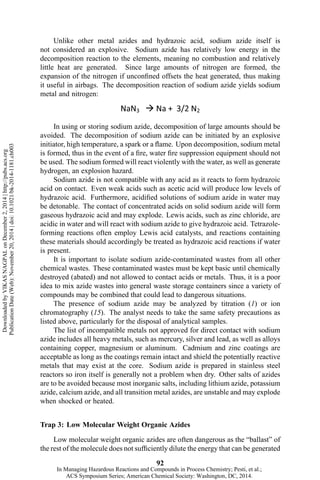
Most commercial sodium azide is prepared by the “Wislicenus” (14) process,
which proceeds in two steps from ammonia, sodium and nitrous oxide. The
method of preparation may be important to obtaining a free-flowing solid.
The addition of a compatible anti-caking agent can be useful in preventing
agglomeration of the azide.
91
DownloadedbyVIKASNAGPALonDecember2,2014|http://pubs.acs.org
PublicationDate(Web):November20,2014|doi:10.1021/bk-2014-1181.ch003
In Managing Hazardous Reactions and Compounds in Process Chemistry; Pesti, et al.;
ACS Symposium Series; American Chemical Society: Washington, DC, 2014.
Unlike other metal azides and hydrazoic acid, sodium azide itself is
not considered an explosive. Sodium azide has relatively low energy in the
decomposition reaction to the elements, meaning no combustion and relatively
little heat are generated. Since large amounts of nitrogen are formed, the
expansion of the nitrogen if unconfined offsets the heat generated, thus making
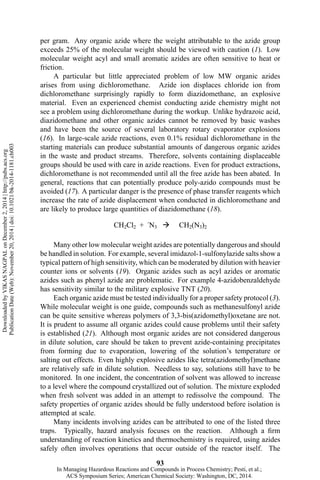
it useful in airbags. The decomposition reaction of sodium azide yields sodium
metal and nitrogen:
In using or storing sodium azide, decomposition of large amounts should be
avoided. The decomposition of sodium azide can be initiated by an explosive
initiator, high temperature, a spark or a flame. Upon decomposition, sodium metal
is formed, thus in the event of a fire, water fire suppression equipment should not
be used. The sodium formed will react violently with the water, as well as generate
hydrogen, an explosion hazard.
Sodium azide is not compatible with any acid as it reacts to form hydrazoic
acid on contact. Even weak acids such as acetic acid will produce low levels of
hydrazoic acid. Furthermore, acidified solutions of sodium azide in water may
be detonable. The contact of concentrated acids on solid sodium azide will form
gaseous hydrazoic acid and may explode. Lewis acids, such as zinc chloride, are
acidic in water and will react with sodium azide to give hydrazoic acid. Tetrazole-
forming reactions often employ Lewis acid catalysts, and reactions containing
these materials should accordingly be treated as hydrazoic acid reactions if water
is present.
It is important to isolate sodium azide-contaminated wastes from all other
chemical wastes. These contaminated wastes must be kept basic until chemically
destroyed (abated) and not allowed to contact acids or metals. Thus, it is a poor
idea to mix azide wastes into general waste storage containers since a variety of
compounds may be combined that could lead to dangerous situations.
The presence of sodium azide may be analyzed by titration (1) or ion
chromatography (15). The analyst needs to take the same safety precautions as
listed above, particularly for the disposal of analytical samples.
The list of incompatible metals not approved for direct contact with sodium
azide includes all heavy metals, such as mercury, silver and lead, as well as alloys
containing copper, magnesium or aluminum. Cadmium and zinc coatings are
acceptable as long as the coatings remain intact and shield the potentially reactive
metals that may exist at the core. Sodium azide is prepared in stainless steel
reactors so iron itself is generally not a problem when dry. Other salts of azides
are to be avoided because most inorganic salts, including lithium azide, potassium
azide, calcium azide, and all transition metal azides, are unstable and may explode
when shocked or heated.
Trap 3: Low Molecular Weight Organic Azides
Low molecular weight organic azides are often dangerous as the “ballast” of
the rest of the molecule does not sufficiently dilute the energy that can be generated
92
DownloadedbyVIKASNAGPALonDecember2,2014|http://pubs.acs.org
PublicationDate(Web):November20,2014|doi:10.1021/bk-2014-1181.ch003
In Managing Hazardous Reactions and Compounds in Process Chemistry; Pesti, et al.;
ACS Symposium Series; American Chemical Society: Washington, DC, 2014.
per gram. Any organic azide where the weight attributable to the azide group
exceeds 25% of the molecular weight should be viewed with caution (1). Low
molecular weight acyl and small aromatic azides are often sensitive to heat or
friction.
A particular but little appreciated problem of low MW organic azides
arises from using dichloromethane. Azide ion displaces chloride ion from
dichloromethane surprisingly rapidly to form diazidomethane, an explosive
material. Even an experienced chemist conducting azide chemistry might not
see a problem using dichloromethane during the workup. Unlike hydrazoic acid,
diazidomethane and other organic azides cannot be removed by basic washes
and have been the source of several laboratory rotary evaporator explosions
(16). In large-scale azide reactions, even 0.1% residual dichloromethane in the
starting materials can produce substantial amounts of dangerous organic azides
in the waste and product streams. Therefore, solvents containing displaceable
groups should be used with care in azide reactions. Even for product extractions,
dichloromethane is not recommended until all the free azide has been abated. In
general, reactions that can potentially produce poly-azido compounds must be
avoided (17). A particular danger is the presence of phase transfer reagents which
increase the rate of azide displacement when conducted in dichloromethane and
are likely to produce large quantities of diazidomethane (18).
Many other low molecular weight azides are potentially dangerous and should
be handled in solution. For example, several imidazol-1-sulfonylazide salts show a
typical pattern of high sensitivity, which can be moderated by dilution with heavier
counter ions or solvents (19). Organic azides such as acyl azides or aromatic
azides such as phenyl azide are problematic. For example 4-azidobenzaldehyde
has sensitivity similar to the military explosive TNT (20).
Each organic azide must be tested individually for a proper safety protocol (3).
While molecular weight is one guide, compounds such as methanesulfonyl azide
can be quite sensitive whereas polymers of 3,3-bis(azidomethyl)oxetane are not.
It is prudent to assume all organic azides could cause problems until their safety
is established (21). Although most organic azides are not considered dangerous
in dilute solution, care should be taken to prevent azide-containing precipitates
from forming due to evaporation, lowering of the solution’s temperature or
salting out effects. Even highly explosive azides like tetra(azidomethyl)methane
are relatively safe in dilute solution. Needless to say, solutions still have to be
monitored. In one incident, the concentration of solvent was allowed to increase
to a level where the compound crystallized out of solution. The mixture exploded
when fresh solvent was added in an attempt to redissolve the compound. The
safety properties of organic azides should be fully understood before isolation is
attempted at scale.
Many incidents involving azides can be attributed to one of the listed three
traps. Typically, hazard analysis focuses on the reaction. Although a firm
understanding of reaction kinetics and thermochemistry is required, using azides
safely often involves operations that occur outside of the reactor itself. The
93
DownloadedbyVIKASNAGPALonDecember2,2014|http://pubs.acs.org
PublicationDate(Web):November20,2014|doi:10.1021/bk-2014-1181.ch003
In Managing Hazardous Reactions and Compounds in Process Chemistry; Pesti, et al.;
ACS Symposium Series; American Chemical Society: Washington, DC, 2014.
common factor for safe processing is sodium azide containment to avoid contact
with workers or incompatible materials such as metals or acids. Small changes in
feed stock or equipment after the reaction has been run uneventfully many times
can cause problems when unappreciated new situations arise. Thus, containment,
change control and training are requirements. Life-cycle analysis is suggested to
ensure that containment is guaranteed and that all unused azide is destroyed at
the end of the campaign.
Life-Cycle Management of Azide
Most industrial operations involving azides begin with sodium azide. It is
recommended that a life-cycle approach to safety analysis be adopted such that all
azides are controlled from the moment these materials enter the gate until they are
used up, shipped out or destroyed by abatement. A cradle-to-grave approach for
an ordinary inorganic compound may seem superfluous but ultimately saves time,
money and probably lives.
Hazard Identification, Training, and Communication
The single most important aspect of the operation of an azide facility is
operational control. This requires proper managerial control, a disciplined
and well-trained workforce, and a robust change control culture. Before
beginning azide operations, managers should identify and maintain a list of all
azide-containing materials to be used; review the manufacturer’s Material Safety
Data Sheets (MSDS) or other informational sources; and consult with appropriate
facility safety staff and emergency personnel. Health hazard information and
other safety information should be communicated to employees who work with
azide materials. Applicable regulations concerning the use of azides, personnel
handling of these materials and environmental requirements should be consulted.
It is useful to keep a list of all the documentation associated with azide work
handy so that nothing is overlooked.
All azide operations should be treated as hazardous. This requires regular
training of all employees regarding the hazards and precautions for handling
azides. The goal of the training should be to develop a safe attitude towards
working with azides while understanding the potential hazards involved, learning
the correct skills to perform azide reactions safely and preparing for unexpected
hazardous conditions. It is important to treat sodium azide as a highly hazardous
material and to schedule frequent refresher courses to retrain employees involved
with its use and storage to fight complacency. A good schedule is to aim for
yearly training if azide chemistry is ongoing.
Azide storage facilities should be clearly marked and segregated from
facilities where people are working, tank farms and waste treatment areas.
Buildings should indicate with signs and warning lights when azide processes are
in operation. Although reactions can be run in a multi-purpose facility, it is a good
idea not to run other types of reactions simultaneously with azide operations.
Ideally, if a facility is dedicated to azide work, it is best not to introduce new
94
DownloadedbyVIKASNAGPALonDecember2,2014|http://pubs.acs.org
PublicationDate(Web):November20,2014|doi:10.1021/bk-2014-1181.ch003
In Managing Hazardous Reactions and Compounds in Process Chemistry; Pesti, et al.;
ACS Symposium Series; American Chemical Society: Washington, DC, 2014.
chemistry until it is clear the facility will not be further used for azide work in
the foreseeable future. It is safer to complete all azide chemistry and do a proper
cleaning rather than returning to it at irregular intervals.
A process hazard analysis (22) should be performed at the beginning of
any azide chemistry project. A “worst-case” scenario or “what if” process is
the basis for a hazard analysis in which sensitivity of the materials, quantities,
number of personnel potentially affected and impact on other operations should
be studied. This analysis is often done by a team consisting of an engineer, an
operator and a chemist. Standard corporate polices as to HAZOP, FMEA or other
safety protocols should be followed and the hazard analysis should be formally
documented. Process hazard analysis should be updated and revalidated at least
every three years or immediately when significant changes (e.g., new equipment,
modified process) occur.
Toxicity Hazards and Medical Oversight
Sodium azide is highly toxic with an LD50 variously reported from 27 to 50
mg/kg for rats (13). The potential consequences of azide poisoning can be similar
to some of the deadliest poisons: sodium cyanide or sodium arsenate. Exposure to
azides can occur when one ingests contaminated food or water or inhales the dust
or gas. Although sodium azide is not readily absorbed through the skin when dry, it
is highly soluble in water (including perspiration) and then becomes a concern for
skin absorption. Aqueous solutions of sodium azide form significant amounts of
hydrazoic acid which is probably the greater danger since it will penetrate the skin.
When spills or contact with azide occur, water for washing should be adjusted to
pH >9 to minimize the hydrazoic acid content in the solution.
A typical symptom (23) of sodium azide exposure is a headache lasting two
to four hours. Hydrazoic acid exposure may also be felt as pressure or sensation
in the back of the head over longer periods of time. Other symptoms include a
drop in blood pressure, dilation of pupils, bloodshot eyes, rapid pulse, nausea, and
vomiting. However, lower levels of exposure may not elicit any these responses,
thus any one is a signal to consider treatment. Exposure to a large amount of
sodium azide by any route may cause more serious health effects, including
convulsions, low blood pressure, loss of consciousness, and in the extreme,
respiratory failure leading to death. First-responders should be made aware of
the storage of azide (including waste storage) and have a plan in case of a spill
or emergency. They should also be aware that the victim may be contaminated
with azide as it could expose the emergency worker to danger. In case of a fire,
fire-fighters must be informed of the presence of azide solids, solutions or waste
to avoid exposing them to the danger of azide toxicity or detonation. Ideally,
fire chiefs will be aware of where azide is stored, used and processed, and the
expected amounts as a prudent safety practice.
In the event of ingestion, sodium azide will react with stomach acids to
generate hydrazoic acid. Therefore, inducing vomiting or giving fluids to drink is
not recommended. Direct CPR should not be used as the person giving CPR will
be exposed to hydrazoic acid. Treatment for azide exposure will depend on the
severity of the poisoning. For minor cases, workers should be removed to a safe
95
DownloadedbyVIKASNAGPALonDecember2,2014|http://pubs.acs.org
PublicationDate(Web):November20,2014|doi:10.1021/bk-2014-1181.ch003
In Managing Hazardous Reactions and Compounds in Process Chemistry; Pesti, et al.;
ACS Symposium Series; American Chemical Society: Washington, DC, 2014.
area with time to recover in fresh air. Symptoms may be relieved with a shower,
clean clothing, stimulants like caffeine, and food. Exposed employees should
not be left alone until treatment is complete. In all cases, victims should be kept
under medical attention until the exposed individuals recover completely.
Reaction to exposure may be worse when it occurs on an empty stomach, and
employees are encouraged to eat before the start of their shift. Any employees
showing signs of exposure must be removed immediately from the process area,
and their blood pressure monitored hourly until it is clear there is no concern for
exposure. In all cases of poisoning, medical help should be obtained rather than
treating the exposure based on information in this chapter. There is no antidote
to azide poisoning, but fatalities are extremely rare. Although sodium azide is in
wide-spread use in automobile airbags, the azide is contained and there have been
no reports of poisoning from airbags.
Special personnel training and procedures should be in place in the event that
someone ingests sodium azide. Because sodium azide is acidified by stomach
acid, the contents of the stomach will contain highly toxic hydrazoic acid. In the
event that vomiting has occurred, personnel should isolate the stomach contents
and neutralize them with basic water if possible. Any substance containing sodium
azide (including food, water or vomit) must be collected and sent for abatement.
Once the symptoms of exposure have dissipated, and a doctor finds no
lingering effects, employees can return to normal duties. There is currently no
medical evidence that exposure to hydrazoic acid or sodium azide causes chronic
illness. Employees who are exposed, or think they may have been exposed,
should follow the Center for Disease Control guidelines (23).
Persons involved routinely in azide operations should be monitored by
medical staff. A common effect of azide poisoning is low blood pressure. The use
of blood pressure monitoring devices in common areas is suggested to encourage
self-examination in case of concern.
In the event of symptoms of exposure, there should be a formal incident report
and investigation into the source of exposure. Then one must examine procedures
and personnel protection equipment to see if modifications are required. Another
process hazard analysis should be conducted to prevent a recurrence of the
problem. Should similar incidents be repeated, senior management must take
charge to understand why this is occurring and to initiate action before a serious
event happens. Azides must be contained at all times, and there should be no
worker exposure during normal operations.
Facilities
The danger of impact leading to azide explosions require unusual precautions
in facilities. Ideally, in work environments where solid azides are handled, the
floor and all hard objects within striking range of azides should be cushioned
to minimize energy transference from an inadvertent impact. Plexiglas barriers
where open vision lanes are important or foam insulation can be used. A procedure
should be established to account for and secure hand tools that may inadvertently
fall into an azide-processing operation.
96
DownloadedbyVIKASNAGPALonDecember2,2014|http://pubs.acs.org
PublicationDate(Web):November20,2014|doi:10.1021/bk-2014-1181.ch003
In Managing Hazardous Reactions and Compounds in Process Chemistry; Pesti, et al.;
ACS Symposium Series; American Chemical Society: Washington, DC, 2014.
Each worker’s location should be monitored frequently so that assistance
can be provided or aid summoned in the event of an emergency. Personnel
devices that sound an alarm if the person remains stationary too long or becomes
horizontal are one possibility. Electronic surveillance via security cameras also
provides rapid response as long as a worker is assigned to monitor the cameras.
Manufacturing areas containing azide should be controlled after the individual
features of each building have been analyzed and understood. Only necessary
personnel with proper training should be present and the presence of each worker
should be documented.
In the case of reactions capable of generating hydrazoic acid in high
concentration, the operations should be conducted remotely with barriers,
warning lights and other engineering controls to prevent entry during hazardous
operations.
Ideally, facilities that will handle azide in any manner are best designed for
the continuous presence of azide at all times. Such an “azide-proof” facility would
be housed in an enclosed azide-resistant area that provides for solid, liquid and
vapor azide containment. This allows the best design to be incorporated rather
than requiring compromises to be rigged later in non-dedicated facilities. For
instance, a design that allows the entire interior surface of a reaction bay to be
hosed down is a useful means to prevent azide dust from remaining on otherwise
difficult-to-clean surfaces. Provisions for inert gas tracing of conduits containing
copper wires and removal of metal bearings are also useful. The use of tracing
requires oxygen sensors and breathing air for worker protection. Co-location of
dedicated scrubbers with reactors and dedicated make-up rooms to allow contained
introduction of azide into the reactor are preferred. Air-handlers should be fitted
with filters and scrubbers to prevent azide from reacting in vents or motors. The
ability to run reactions remotely is always preferred when working with azide.
While few companies have large-scale equipment designed for dedicated azide
work, a conscientious team of workers and management will be able to devise a
work plan that still allows processing under safe conditions
Personal Protective Equipment (PPE) and Devices
The first thoughts for safe azide work start with facilities and training;
however, personal protective equipment provides what should be redundant
protection. Provision should be made to launder and disinfect protective garments
and devices. This is especially important for equipment worn about the face
where inhaling chemical dust or contact with mucous membranes can happen.
Coveralls may be washed in a laundry without special consideration so long
as the garments are not heavily contaminated. For small amounts of azide
contamination, treatment of wash waters from a laundry is not necessary as
cleaning solutions are typically basic. However, all water wastes generated within
the plant from the cleaning of any equipment, personnel or clothing must be
collected and sent for abatement.
Each operation should be analyzed to determine appropriate personnel
protection. This is, of course, in addition to the protective equipment that may be
97
DownloadedbyVIKASNAGPALonDecember2,2014|http://pubs.acs.org
PublicationDate(Web):November20,2014|doi:10.1021/bk-2014-1181.ch003
In Managing Hazardous Reactions and Compounds in Process Chemistry; Pesti, et al.;
ACS Symposium Series; American Chemical Society: Washington, DC, 2014.
required for typical plant hazards, such as hard hats, safety shoes, etc. For sodium
azide, this would include rubber boots, cotton coveralls or coats, gloves, safety
glasses and face shields. Coveralls should not have cuffs or ridges where solid
sodium azide may collect. The coveralls should not have metallic fasteners that
can react to form metal azides. Antistatic outer garments and footwear should be
used. If direct contact with sodium azide or hydrazoic acid is expected, a Tyvek
respirator hood, leather gloves and breathing air or respirators are recommended.
After contact, operators should shower and don clean coveralls. A small amount
of sodium azide on coveralls is not considered a hazard so long as it remains
dry. Therefore, removal of the soiled coveralls before the workers wash up is a
necessary consideration.
Footwear should be rinsed before leaving the operations area and the waters
collected and sent for abatement. In the event of localized contamination, washing
with water buffered to pH 9 is recommended. When contact with sodium azide is
expected to continue for a protracted period, operators should use only air-supplied
respirators as the multi-gas/acid vapor cartridges break down quickly and could
expose the user to hydrazoic acid fumes.
We have not spoken of personal protection against azide explosions since any
significant threat of a serious azide explosion should automatically bar the presence
of workers. If there is such a situation, processing must be conducted remotely. In
small reactions such as found in laboratories, use of blast shields and heavy leather
gloves in addition to regular safety equipment is recommended.
Proper protection of operators and other personnel present in azide handling
facilities requires preparation, thought, well-trained personnel and the use of
proper personal protective equipment. If a situation arises where explosions or
serious contamination may occur, then processing must be conducted remotely.
Preventive measures should be implemented to curtail danger to personnel.
Short-changing this safety measure can end in regret.
Transportation and Handling of Azide to and within the Facility
Generally sodium azide is shipped by truck without unusual precautions to
the plant location in 25 to 50 kg plastic bags inside fiberboard drums. The density
of sodium azide is high (1.84 g/cc) so the containers are relatively small. Sodium
azide has been given UN number 1687, Class 6.1 (toxic material). Care should be
taken during transportation to avoid excessive heat, fire or electrostatic discharge
(ESD). Sodium azide can be moved about the plant using standard trucks or
forklifts with the usual care taken to secure the containers on the pallets to avoid
spills. In the event of damage to a fiberboard container releasing sodium azide,
the spill must be cleaned up by a HAZMAT team and sent for abatement.
Sodium azide should not be allowed to become wet for both quality issues and
the danger of forming hydrazoic acid. For most operations, the plastic bags are
sufficient to protect the sodium azide, however, the fiberboard containers should
be protected from rain or water. Sodium azide which has become contaminated
by water, metals or either inorganic or organic materials should not be used.
Contaminated material may be returned to the vendor or sent for abatement. The
98
DownloadedbyVIKASNAGPALonDecember2,2014|http://pubs.acs.org
PublicationDate(Web):November20,2014|doi:10.1021/bk-2014-1181.ch003
In Managing Hazardous Reactions and Compounds in Process Chemistry; Pesti, et al.;
ACS Symposium Series; American Chemical Society: Washington, DC, 2014.
presence of foreign substances in sodium azide may make the material more
hazardous, and such material should be treated carefully after consideration of
the specific impurities.
Generally, sodium azide is accepted on certificates of analysis (CoA) from
vendors (usually of 95 to 105 wgt %). If analysis is required, the container must
be sampled in a special sampling room prepared for handling azide. Such a facility
should have the same characteristics as a plant designed for azide use, including
special hoods, drains and personnel protective devices.
Sampling and weighing of azides are not recommended in storage areas
or in general-purpose sampling or weighing rooms. Because of its dusting
characteristics and the increased chance of spillage, sodium azide sampling and
weighing require special controls. Samples of sodium azide should be sent to
analytical labs in specially designated or specially marked sample containers.
Analytical procedures have been performed by colorimetric analysis, nitrogen
evolution, and FT-IR or ion chromatography. All samples sent for analysis and
wastes from the analysis procedures should be collected and properly abated
following analysis. If samples are to be archived, they should be saved in special
storage containers isolated from other materials.
Storage Facilities
Due to the danger of an explosion or decomposition, sodium azide should
be stored in dedicated facilities. The storage buildings should not be made of
metal or contain metal shelving, and should have blow-out walls or roofs to
avoid over-pressurization in the event of azide decomposition in case of a fire.
Incompatible materials should not be present. The storage facility construction
should protect against sodium azide becoming wet under all weather conditions.
The building should not have water-based fire suppression equipment. Adequate
ventilation is required to prevent accumulation of azide vapors. The maximum
safe temperature for sodium azide storage has not been reported; however, sodium
azide in automobile airbags is routinely subjected to temperatures above 40 °C
suggesting that cooling is only required for the most extreme temperatures found
at industrial sites.
Operators who maintain the azide storage facility or transport azide should
be trained in azide handling and on specific aspects of the work at the facility,
depending upon their assignment. Special care in operating forklifts is required to
prevent damage to sodium azide containers. So long as the integrity of the sodium
azide containers is not compromised, no special personnel protective equipment
is required. Sodium azide containers should never be opened in the storage areas.
In general, storage facilities do not absolutely require special construction
or maintenance to be viable for azide storage. However, the immediate vicinity
should be free of metals, water and other incompatible materials to avoid possible
decomposition and/or explosion. There may, therefore, be advantages to designing
a dedicated facility for azide storage and handling.
99
DownloadedbyVIKASNAGPALonDecember2,2014|http://pubs.acs.org
PublicationDate(Web):November20,2014|doi:10.1021/bk-2014-1181.ch003
In Managing Hazardous Reactions and Compounds in Process Chemistry; Pesti, et al.;
ACS Symposium Series; American Chemical Society: Washington, DC, 2014.
Weighing
Sodium azide should be obtained from vendors in containers and sizes
appropriate to the batch size in the plant to avoid difficulties in weighing azide.
Ideally, pre-packaged quantities targeted for exactly the charge required will
significantly reduce hazards related to weighing out samples, storage of opened
containers and staging. In such cases, it may be best to accept the lot based
on CoA rather than sample for analytical clearance. If partial containers are to
be used, special weighing rooms should be used similar to the sampling rooms
described above. The unused portion must be carefully resealed to avoid contact
with incompatible materials or water, but in consideration of the relatively low
cost of NaN3 and the problems that can occur upon exposure to moisture, perhaps
disposal of unused small quantities is more cost effective and safer.
In the event that sodium azide is repackaged after weighing, only compatible
plastic containers should be used. Care must be taken to avoid contamination, and
the new containers must be marked with the appropriate labels and safety data.
Laboratory and Testing Operations
Because the quantities of azide used in laboratories are small, employees may
think of them as insignificant in regards to safety (16). Unfortunately, azide dust
and metal azides will build up over time to cause explosions in pipes and hoods
during maintenance operations and at other unexpected times. The requirements
for the use of azides in a laboratory setting should be nearly identical to those
found elsewhere in the facility. But since most laboratories employ open electrical
equipment and unprotected hoods, extra vigilance is required. Further, because
abatement is time-consuming, azide-containing wastes are typically poured into
laboratory sinks. In analytical labs associated with plants and in hospitals where
azide is used as an anti-bacterial, accidents are common because of this practice
which allows azide to react with the metals in drains.
For R&D labs, analytical chemists in particular should be trained in handling
azides since their training does not typically emphasize the hazards of compounds
like azides. Reactions involving azide should be enclosed and connected to caustic
water solution scrubbers in order to trap any hydrazoic acid vapor or azide dusts,
similar to the procedures used in the plant. All wastes from lab experiments should
be collected separately from other laboratory wastes, labeled appropriately, and
abated. All unused azide samples and azide contaminated materials in analytical
labs must be collected and properly abated.
Production Equipment
Two approaches to azide-compliant facilities have been used: azide-proof
and azide-resistant. Azide-proof means the plant is safe for azide use because all
potentially incompatible materials have been removed, and equipment is isolated,
remotely run and designed for azide use. These facilities are very safe but very
expensive and over-designed for non-azide chemistry in the future. The more
common approach is to make the facility azide-resistant, providing protection only
100
DownloadedbyVIKASNAGPALonDecember2,2014|http://pubs.acs.org
PublicationDate(Web):November20,2014|doi:10.1021/bk-2014-1181.ch003
In Managing Hazardous Reactions and Compounds in Process Chemistry; Pesti, et al.;
ACS Symposium Series; American Chemical Society: Washington, DC, 2014.
for the equipment expected to come into contact with azide. Since the rest of the
building is not protected, engineering and operational disciplines are required to
prevent unexpected contamination.
Most azide reactions are run in multi-purpose plants. Those involving
concentrated hydrazoic acid generally require isolation in bunkers and remote
control because of the danger of explosions, but not many reactions call for
this reagent. Reactions in which hydrazoic acid is generated in situ in dilute
solution and reacted without isolation, such as tetrazole forming reactions, are
often conducted in multi-purpose facilities. Safety hazards analysis should be
carefully performed to assure the facilities are appropriate to the chemistry being
conducted. Ideally, all azide reactions would be conducted in a separate building,
similar to the requirement for hydrogenations that take into account the possibility
of a large explosion due to gaseous reagents.
If it is necessary to use general purpose facilities, the reactors should be
positioned in a segregated and shielded area, preferably close to windows or
blow-out walls and away from other operations or personnel areas (break rooms,
changing areas, etc). Where possible, a partition wall (panels) is recommended
to direct the potential blast towards the outside so as to reduce the effect on
other equipment. Activity should be avoided that may trap operators in the area
between the reactor and the plant wall. Only employees who have been properly
trained and are necessary to the work should be admitted to the area.
Equipment must not contain incompatible materials such as copper or copper
alloys, lead, and aluminum. If bearings or exposed wire could come in contact with
sodium azide, compatible coatings, nitrogen tracing or other strategies should be
used to avoid direct contact. All reactions or isolations involving azides should be
in enclosed systems.
Sodium azide should not be stored or staged in process buildings for longer
than necessary to complete the operation. Hazards analysis of the quantities to
be stored should be undertaken to assure the quantities do not exceed acceptable
risks. When on the production floor, sodium azide in fiberboard containers should
be isolated from other incompatible materials and protected from water. The use
of glass-lined equipment is recommended for most azide applications. In some
cases, stainless steel can be used but its compatibility with the reaction mixture
must be determined before its use since iron azide is detonable in the dry form.
Stability of azide-containing products should be tested for stability to iron azide
(if stainless steel will be present) and other Lewis acids.
The reactor top (head) should have minimum piping, with the fewest
bends and loops in order to prevent accumulation or holdup of liquid hydrazoic
acid. Hydrazoic acid is a highly volatile liquid that may evaporate easily and
recondense in pipes due to relatively small temperature differentials. Piping
found in a multi-purpose environment that is not required for the azide reaction
should be dismantled or dead-headed.
A condenser should be installed above the reactor in a vertical position on
the vent riser pipe (closest to the reactor top) to prevent any liquid hydrazoic acid
from escaping into the overhead piping. Where reactions are run under reflux,
conditions should be used to avoid fractionation of the hydrazoic acid from the
solvent. Temperature monitors should be installed in the pipes before and above
101
DownloadedbyVIKASNAGPALonDecember2,2014|http://pubs.acs.org
PublicationDate(Web):November20,2014|doi:10.1021/bk-2014-1181.ch003
In Managing Hazardous Reactions and Compounds in Process Chemistry; Pesti, et al.;
ACS Symposium Series; American Chemical Society: Washington, DC, 2014.
the condenser. The presence of hydrazoic acid distillate can be inferred by a
temperature reading of 37 °C corresponding to the boiling point of hydrazoic acid.
An indication of accumulating hydrazoic acid should lead to immediate emergency
procedures to shut down the reaction and evacuate the area until the status of the
chemistry can be ascertained.
Where it is impractical to avoid metal surfaces or parts, encasement of units,
such as closets or glove boxes, with Plexiglas or other coatings is recommended.
PVC shrink-wrap coatings or dipped/sprayed epoxy paints are acceptable but
should be routinely inspected for cracks or breaks in the surfaces where metal
may be exposed to azide dusts.
Vent sizing for reactors should be engineered based on the stability data from
the individual reaction mixtures.
A highly reliable automated heating/cooling system should be provided for
the reactor jacket. Hot water circulation may be preferred to live steam in some
reactions where the azide product may be thermally unstable and accumulate on
walls above the reaction mixture. For certain reactions, hazardous conditions may
result if a hole in the reactor jacket allows water into the reaction mixture. Where
water is not compatible with the reaction mixture and the results of a leak would be
catastrophic, non-aqueous heating and cooling media should be used. Maintaining
a dry atmosphere in the reactor is always recommended. A method to detect the
presence of water, whether from failure of the condenser cooling system or from
undetected pitting of the reactor lining, is recommended.
A nitrogen purge system should be available to eliminate azide fumes from the
reactor before it is opened and to assure no hydrazoic acid remains in the system.
Reaction mixtures should be transferred from one reactor to another by gravity
flow through Teflon-coated pipes containing no holdups or low points. Pumping,
when required, should not use gear pumps if solid sodium azide is present. Piping
integrity should be verified periodically.
A dedicated scrubber containing water at pH >9 should be connected to all
reactors containing azide. The scrubber should be located as close as possible to
the reactors, and the vents connecting the reactor and the scrubber must have no
bends or low spots where hydrazoic acid may accumulate. The vent lines and
scrubber ideally should be made of plastic or glass. A pH monitoring device is
recommended to assure that the caustic is not exhausted during processing. The
scrubbers must be dedicated so that azide vapors cannot find their way into other
non-azide process equipment. During filtration or another isolation processes, the
equipment should be contained and vented to azide scrubbers. If air handlers are
used, the air should not be directly vented to the atmosphere and the air handlers
should be azide-compatible.
Introduction of sodium azide into the reactors should be contained, either
through glove boxes or separate isolation rooms. Ideally, a glove box attached
to a reactor port can be used. The glove box or other equipment for introducing
azide should be constructed from antistatic or non-metallic materials. The inside
of the box should be kept under negative pressure. The box can be charged with
bags of azide, closed and the reactor port opened. Introduction of one bag of azide
at a time is desirable. If sodium azide is to be placed into reactors directly through
hatches, provision should be made to contain spills and to clean the hatch area
102
DownloadedbyVIKASNAGPALonDecember2,2014|http://pubs.acs.org
PublicationDate(Web):November20,2014|doi:10.1021/bk-2014-1181.ch003
In Managing Hazardous Reactions and Compounds in Process Chemistry; Pesti, et al.;
ACS Symposium Series; American Chemical Society: Washington, DC, 2014.
to avoid the retention of sodium azide within the hatch assembly. Alternatively,
if solid addition is not practical, sodium azide can be slurried or dissolved in a
separate room and pumped into the reactors. Gear pumps are not recommended:
gravity feed is the safest.
Nitrogen inertization is not mandatory if the reactor does not contain
flammable solvents. All equipment should be cleaned and dried after each batch.
Because of the possibility of azide vapors or dust, air handlers should be
protected from contamination by the use of filters or in-line scrubbers to prevent
azide contamination of motors or wiring. Nitrogen tracing of electrical wiring or
analytical sensors may be necessary in some cases.
The rationale for the design of production equipment is the same as that for
designing facilities: it is best to consider azide use before fabrication so that the
equipment is constructed correctly from the start rather than requiring modification
afterwards. The more typical situation is the utilization of multi-functional
equipment; for this, careful consideration is needed before processing starts.
Cleaning
Facilities containing azides should be kept clean and orderly to simplify
detection of azide spills or other potentially hazardous conditions. Azide dust
should not be allowed to accumulate on structural members, heating coils, utility
lines, equipment, or electrical fixtures. A regular cleaning program for facility
interiors should be in place to prevent the accumulation of azide dust and waste.
In buildings containing azide, floors should be cleaned with basic water wherever
practical. Small spills should be swept up or dissolved in basic water. Reaction
bays with rounded corners that can be entirely hosed down reduce the chances of
azide dusts accumulating in odd places.
It is recommended that when mopping floors or wiping up spills with wet
rags, the water be buffered with potassium hydroxide, sodium carbonate, or
trisodium phosphate to a pH of 9. Non-abrasive sweeping compounds that are
compatible with the azides may be used when water is not practical. During
azide decontamination, activities involving large volumes of organic solvents
(generally over 1L), should be prohibited.
Cleaning protocols are more efficient and more easily implemented if cleaning
needs were taken into account during the design phase of a facility. Failing that,
extra care is needed during cleaning to maintain a safe operation.
Decontamination and Waste Collection
Azide-contaminated waste should be isolated from other plant wastes at all
times to prevent catalytic interactions that could lead to violent decomposition
or the formation of explosive metal azides. Process streams, cleaning solutions,
containers, scrubber solutions and any materials in contact with azide must be
treated to destroy the azide. Allowing azide-contaminated wastes to mix with
other plant wastes may create explosive or toxic mixtures, including metal azides
and hydrazoic acid. Since azides are routinely used to stop bacterial growth,
introduction of azide wastes into the waste treatment facility without prior
103
DownloadedbyVIKASNAGPALonDecember2,2014|http://pubs.acs.org
PublicationDate(Web):November20,2014|doi:10.1021/bk-2014-1181.ch003
In Managing Hazardous Reactions and Compounds in Process Chemistry; Pesti, et al.;
ACS Symposium Series; American Chemical Society: Washington, DC, 2014.
abatement may negatively affect the bacteria being used to treat the waste, even
at parts per million concentrations. Compromised bio-remediation facilities are
very expensive to recover.
During the design phase, plants operating azide processes should be fitted
with dedicated drains in which spills, waste waters and cleaning solutions can
be contained and separated from other plant wastes. This is very expensive to
incorporate into an existing plant. The pH of the waters in the drains should
be monitored to remain basic. Drains should be emptied and cleaned after azide
operations are complete and all liquids captured by the drains should be sent for
abatement. Employees involved in cleaning, decontamination or abatement should
have proper personnel protective equipment as detailed earlier.
Hydrazoic acid will partition (dissolve) into organic solvents. Cleaning
solvents such as acetone and methanol used for washing reactors should be treated
as azide-contaminated unless shown otherwise.
If azide solids or solutions have come into contact with metals, chemical
decontamination may be required. For water-insoluble heavy metal azides, such
as copper or lead, treatment with acid solutions of sodium nitrite will be required
to dissolve and neutralize the azides. Solid azide spills should be swept up before
the area is washed with basic water and sent for abatement.
Sodium azide-contaminated packing materials may be washed to remove
the azide component and disposed of in the normal trash. The washes from
packing materials, however, should be sent to abatement. The wash waters for
clothing, rags or other cleaning equipment may be disposed of normally if the
azide contamination is minor. Cleaned clothing and towels can then be reused
after normal washing. Alternatively, azide-contaminated boxes, bags or cloths
may be burned without washing.
Sodium azide is often shipped in fiberboard containers, double sealed in
plastic bags. These materials should be burned without cleaning and not reused.
Because the fiberboard container comes from an azide-contaminated factory, it
should be considered azide-contaminated. The plastic bags can be washed and
the washing solutions sent for abatement, or placed in uncontaminated bags and
sent for incineration.
Azide wastes should be isolated, clearly marked and the pH should be adjusted
to >9. They should not be stored for extended time periods. If such storage is
unavoidable, the pH of the waste should be monitored, and the waste should be
protected from evaporation and concentration. Azide waste will often generate
gases so waste containers should be vented and the emitted gases safely handled.
Lab-scale waste containers may be stored in the back of a hood. Larger containers
will need a dedicated venting system.
The collected wastes should be transported to the azide abatement facility
regularly and treated as soon as feasible thereafter. Transportation should be
in plastic containers or tanks made of or coated with compatible materials. All
containers should be properly marked as hazardous azide-containing wastes. All
azides must be destroyed chemically or by incineration and never commingled
with other plant wastes.
The complexity of waste handling and treatment can approach that of the use
of azides in production, but the associated hazards render such attention a good
104
DownloadedbyVIKASNAGPALonDecember2,2014|http://pubs.acs.org
PublicationDate(Web):November20,2014|doi:10.1021/bk-2014-1181.ch003
In Managing Hazardous Reactions and Compounds in Process Chemistry; Pesti, et al.;
ACS Symposium Series; American Chemical Society: Washington, DC, 2014.
idea. Failure to assign sufficient importance to the handling of waste can result in
incidents years or even decades after azide processes are discontinued.
Abatement
Inorganic azides and hydrazoic acid are abated by the reaction of an oxidizing
agent under acidic conditions. Because acidic conditions produce hydrazoic acid,
the order in which the reagents are added is critical, and the oxidizing agent must
be added to the azide wastes before the acid is introduced. Sodium azide content
in aqueous wastes should be at a concentration of 5% or less for safe abatement.
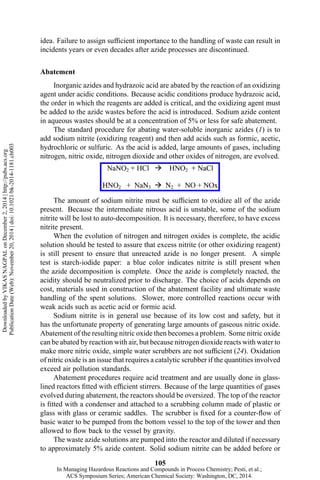
The standard procedure for abating water-soluble inorganic azides (1) is to
add sodium nitrite (oxidizing reagent) and then add acids such as formic, acetic,
hydrochloric or sulfuric. As the acid is added, large amounts of gases, including
nitrogen, nitric oxide, nitrogen dioxide and other oxides of nitrogen, are evolved.
The amount of sodium nitrite must be sufficient to oxidize all of the azide
present. Because the intermediate nitrous acid is unstable, some of the sodium
nitrite will be lost to auto-decomposition. It is necessary, therefore, to have excess
nitrite present.
When the evolution of nitrogen and nitrogen oxides is complete, the acidic
solution should be tested to assure that excess nitrite (or other oxidizing reagent)
is still present to ensure that unreacted azide is no longer present. A simple
test is starch-iodide paper: a blue color indicates nitrite is still present when
the azide decomposition is complete. Once the azide is completely reacted, the
acidity should be neutralized prior to discharge. The choice of acids depends on
cost, materials used in construction of the abatement facility and ultimate waste
handling of the spent solutions. Slower, more controlled reactions occur with
weak acids such as acetic acid or formic acid.
Sodium nitrite is in general use because of its low cost and safety, but it
has the unfortunate property of generating large amounts of gaseous nitric oxide.
Abatement of the resulting nitric oxide then becomes a problem. Some nitric oxide
can be abated by reaction with air, but because nitrogen dioxide reacts with water to
make more nitric oxide, simple water scrubbers are not sufficient (24). Oxidation
of nitric oxide is an issue that requires a catalytic scrubber if the quantities involved
exceed air pollution standards.
Abatement procedures require acid treatment and are usually done in glass-
lined reactors fitted with efficient stirrers. Because of the large quantities of gases
evolved during abatement, the reactors should be oversized. The top of the reactor
is fitted with a condenser and attached to a scrubbing column made of plastic or
glass with glass or ceramic saddles. The scrubber is fixed for a counter-flow of
basic water to be pumped from the bottom vessel to the top of the tower and then
allowed to flow back to the vessel by gravity.
The waste azide solutions are pumped into the reactor and diluted if necessary
to approximately 5% azide content. Solid sodium nitrite can be added before or
105
DownloadedbyVIKASNAGPALonDecember2,2014|http://pubs.acs.org
PublicationDate(Web):November20,2014|doi:10.1021/bk-2014-1181.ch003
In Managing Hazardous Reactions and Compounds in Process Chemistry; Pesti, et al.;
ACS Symposium Series; American Chemical Society: Washington, DC, 2014.
after the azide solution is added. An acid solution can be pumped or gravity fed
slowly to control gas evolution so that the gases do not cause unreacted azide
wastes to leave the reactor. At the end of the abatement, the reactor is checked
for the presence of excess nitrite or other oxidizing reagent. The solution is then
neutralized and sent to waste treatment as non-hazardous waste.
Many organic azides are potentially explosive, but since they are not water
soluble, the acid oxidizer abatement used for inorganic azides cannot be used.
Instead, most water insoluble organic azides can be destroyed by reduction with
hydrogen, triphenylphosphine or by incineration. For small amounts of material,
solutions of triphenylphosphine in organic solvents will rapidly convert azides
into imines with the evolution of nitrogen. Further treatment with water will
produce amino compounds and triphenylphosphine oxide, which in most cases
can be disposed with normal organic wastes.
Recycling and Reuse of Solvents Used in Azide Chemistry
Because hydrazoic acid will dissolve in both water and organic solvents,
care must be taken when recycling solvents used in azide-containing processes.
Washing organic solvents prior to distillation with basic water and subsequent
analysis to ensure the absence of azide are recommended. If hydrazoic acid
is present in spent solvents, subsequent distillation during purification may
inadvertently separate this low-boiling component and concentrate it. The
opposite problem exists for non-volatile azides as they will concentrate in the
reactor during distillation. Azide-containing waste should not be distilled to avoid
potential safety hazards. Distillations involving azide-contaminated materials
should be carefully monitored but in consideration of the cost required to monitor
and avoid hazardous situations, solvent recovery is only cost effective for unusual
cases.
Maintenance and Repair
Maintenance operations involving major repairs, changes, or the use of
hazardous equipment should not be performed when azides are present. An
approval procedure should be established to ensure that the area has been
inspected for azides and is safe for the desired work. When approved, only
required and authorized maintenance or construction operators should be present
during these repairs.. Records should be maintained for inspection, repair, and
servicing of process and handling equipment.
For equipment that may have been exposed to azides during operations,
special procedures should be developed for maintenance. Opening bearings that
may contain copper-containing alloys or electrical boxes containing copper wires
should be done with extra care and personnel protection. Similar care should be
used in waste plumbing lines if the presence of metal azides is suspected.
In cases where inspection, visual or other, shows the likely presence of
metal azide contamination, the equipment should be decontaminated prior to
maintenance or repair. Heavy metal azides are generally not soluble in water
alone, so chemical decontamination with nitrite and acid solutions may be
106
DownloadedbyVIKASNAGPALonDecember2,2014|http://pubs.acs.org
PublicationDate(Web):November20,2014|doi:10.1021/bk-2014-1181.ch003
In Managing Hazardous Reactions and Compounds in Process Chemistry; Pesti, et al.;
ACS Symposium Series; American Chemical Society: Washington, DC, 2014.
required. Such treatment may degrade the equipment beyond reclamation, thus
prevention of contamination of the equipment is always a better idea. No repair or
maintenance of hoods, plumbing or electrical equipment used in azide processes
should be undertaken while flammable organic vapors are present.
Glass-lined reactors should be inspected for pitting that may cause iron or
water to be introduced into the reaction mixture. If stainless steel is used, the
reactor and associated equipment should be inspected for stability to the reaction
mixture. A broken metal stirrer or other metal debris striking solid sodium azide
within a reactor could cause a problem.
Emergency Controls and Considerations
Azide operations should be designated with recognizable signs. Although no
standards currently exist for signage, placards showing both explosion and toxic
dangers are suggested. Plants in operation should be closed to employees who lack
training in azide work. Worker exposure to azide should be reported immediately
to the plant health official and will nearly always require the attention of properly
trained medical personnel. Please refer to the section on response to employee
exposure to azides.
Failure of equipment which releases azide-contaminated materials should be
treated as serious events. Personnel in the plant and surrounding area should be
evacuated, and HAZMAT teams with Tyvek suits and self-contained breathing air
should be sent to clean up the spill. In the event of gaseous hydrazoic acid release,
emergency procedures and evacuation of the entire plant may be necessary. Plant
personnel must be knowledgeable about local, state and federal requirements for
responding to emergencies, and reporting releases and spills.
For failures not involving escape of azide-containing materials, reactors
should be cooled to stabilize azides in solution and prevent concentration of
hydrazoic acid or azides. Most azides dissolved in cool dilute solutions will be
stable for long periods (assuming precipitation of solids azides does not occur)
and reactions may be continued after the equipment is repaired or abated as
required.
Conclusion
Azide chemistry is useful synthetically and is characterized by high yields and
clean reactions. The azide molecule allows results that cannot easily be attained
by alternative chemistry. Industrially it is limited by issues of explosivity of some
intermediates. Most companies will actively seek alternative routes to azide use
to avoid the extensive safety issues required for safe processing. However, in the
case of some compounds such as AZT, where the final product contains the azido
group, or for drugs containing tetrazole groups, there are no alternatives to the use
of azide. Azide has been used on industrial scale by pharmaceutical companies
and by contract manufacturers who specialize in understanding the risks. There
are a number of companies with extensive experience in azide reactions, and these
107
DownloadedbyVIKASNAGPALonDecember2,2014|http://pubs.acs.org
PublicationDate(Web):November20,2014|doi:10.1021/bk-2014-1181.ch003
In Managing Hazardous Reactions and Compounds in Process Chemistry; Pesti, et al.;
ACS Symposium Series; American Chemical Society: Washington, DC, 2014.
companies have an excellent safety record. This experience has shown that azide
reactions can be safe on industrial scale.
Still, azide processing must be taken seriously. Problems, including fatalities,
have occurred. Most incidents result from failure to contain azide or from
unwarranted changes to procedures. The problems generally come months
or years after a process has been running successfully. Communication and
training of operators and research staff is necessary so that they understand the
implications of changes to the process. Operational discipline is required, and
change control is critical.
This chapter has tried to highlight some of the issues and strategies to cope
with azide chemistry. As with any general topic, anyone engaging in azide
chemistry is advised to verify that the suggestions presented are relevant to their
processing and facilities. It is hoped that during the process development and
safety analysis, as much time will be spent on issues arising from outside the
reactor as on the reaction chemistry inside it. The risks can be understood and
controlled through a combination of planning, safety awareness, engineering and
plain good sense.
References
1. Fedoroff, B. T.; Aaronson, H. A.; Reese, E. F.; Sheffield, O. E.; Clift, G.
D. Encyclopedia of Explosives and Related Items; Picatinny Arsenal: Dover,
NJ, 1960; Vol. 1, pp A537 – A643, available from www.aryanalibris.com;
accessed May 20, 2014.
2. Richte, T. Synthesis and the chemical properties. In Energetic Materials;
Fair, H. D., Walker, R. F., Eds.; Plenum Press: New York, 1960; Vol 1, pp
1−86.
3. Keicher, T.; Lobbecke, S. L. Lab Scale Safety. In Organic Azides: Syntheses
and Applications; Bräse, S., Banert, K., Eds.; John Wiley & Sons, Ltd.: New
York, 2010; pp 3−27.
4. Kolb, H. C.; Finn, M. G.; Sharpless, K. B. Angew. Chem., Int. Ed. 2001, 40,
2004–2021.
5. Fedoroff, B. T.; Aaronson, H. A.; Reese, E. F.; Sheffield, O. E.; Clift, G.
D. Encyclopedia of Explosives and Related Items; Picatinny Arsenal: Dover,
NJ, 1960; Vol. 1, pp A537.
6. Curtius, T. Chem. Ber. 1890, 23, 3023; cited in http://en.wikipedia.org/wiki/
Hydrazoic_acid; accessed May 20, 2014.
7. Joyner, A. R. Cited in Evans, B. L.; Yaffe, A. D.; Greg, P. Chem. Rev. 1959,
59, 515.
8. Wiss, J.; Fleury, C.; Heuberger, C.; Onken, U.; Glor, M. Org. Process Res.
Dev. 2007, 11, 1096–1103.
9. Wang, G.; Sun, B.; Peng, C. Org. Process Res. Dev. 2011, 15, 986−988.
Larsen, R. D.; King, A. O.; Chen, C. Y.; Corley, E. G.; Foster, B. S.; Roberts,
F. E.; Yang, C.; Lieberman, D. R.; Reamer, R. A. J. Org. Chem. 1994, 59,
6391−6394.
108
DownloadedbyVIKASNAGPALonDecember2,2014|http://pubs.acs.org
PublicationDate(Web):November20,2014|doi:10.1021/bk-2014-1181.ch003
In Managing Hazardous Reactions and Compounds in Process Chemistry; Pesti, et al.;
ACS Symposium Series; American Chemical Society: Washington, DC, 2014.
10. Larson, R. D.; King, A. O.; Chen, C. Y.; Corley, E. G.; Foster, B. S.;
Roberts, F. E.; Yang, C.; Liberman, D. R.; Reamer, R. A.; Tschaen, D. M.;
Verhoeven, T. R.; Reider, P. J. J. Org. Chem. 1994, 59, 6391–6394.
11. Wiss, J.; Fleury, C.; Heuberger, C.; Onken, U. Org. Process Res. Dev. 2006,
10, 349–353.
12. González-Bobes, F.; Kopp, N.; Li, L.; Deerberg, J.; Sharma, P.; Leung, S.;
Davies, M.; Bush, J.; Hamm, J.; Hrytsak, M. Org. Process Res. Dev. 2012,
16, 2051–2057.
13. Various sources, for example Sigma Aldrich MSDS reports 37 mg/kg.
14. Wislicenus, W. Chem. Ber. 1891, 24, 3347.
15. Dionex application note 172. Determination of Azide in Aqueous
Samples by Ion Chromatography with Suppressed Conductivity Detection.
http://www.dionex.com/en-us/webdocs/56255-AN172_released032707.pdf;
accessed May 20, 2014.
16. Conrow, R. E.; Dean, W. D. Org. Process Res. Dev. 2008, 12, 1285–1286.
17. Klapotke, T. M.; Krumm, B. Azide-containing High Energy Materials. In
Organic Azides: Syntheses and Applications; Bräse, S., Banert, K., Eds.;
John Wiley & Sons, Ltd.: New York, 2010; pp 3−27.
18. Bretherick, L. Chem. Eng. News 1986, 64 (51), 2.
19. Fischer, N.; Goddard-Borger, E. D.; Greiner, R.; Klapotke, T. M.; Skelton, B.
W.; Stierstorfer, J. J. Org. Chem. 2012, 77, 1760–1764.
20. Lahti, P. M. Synth. Commun. 1998, 28, 3513.
21. Feyen, P. Angew. Chem. 1977, 89 (2), 119.
22. Bassan, E.; Ruck, R. T.; Dienemann, E.; Emerson, K. M.; Humphrey, G. R.;
Raheem, I. T.; Tschaen, D. M.; Vickery, T. P.; Wood, H. B.; Yasuda, N. Org.
Process Res. Dev. 2013, 17, 1611–1616.
23. http://www.bt.cdc.gov/agent/sodiumazide/basics/facts.asp; accessed May
20, 2014.
24. Selby, G. W; Counce, R. M. Ind. Eng. Chem. Res. 1988, 27 (10),
1917–1922.
109
DownloadedbyVIKASNAGPALonDecember2,2014|http://pubs.acs.org
PublicationDate(Web):November20,2014|doi:10.1021/bk-2014-1181.ch003
In Managing Hazardous Reactions and Compounds in Process Chemistry; Pesti, et al.;
ACS Symposium Series; American Chemical Society: Washington, DC, 2014.

Azide safety archibald

  • 1.
    Chapter 3 Strategies forSafely Handling Industrial Azide Reactions: The Three Traps Thomas Archibald* Technology Consultants, 1909 Beach Drive SE, St. Petersburg, Florida 33705 *E-mail: Archibaldmail@gmail.com Industrial use of azides requires special care to avoid explosions or poisonings. Life-cycle management of azide is discussed from the time azide-containing material is received at the front gate, sampled and stored, moved to the plant, placed in reactors, and finally until all wastes are abated and all equipment decontaminated. Key failure modes resulting from inadvertent isolation of extremely dangerous hydrazoic acid or other azides are described. Recommendations are made for control and containment of azides in a multi-purpose plant. Operational discipline, which includes operator training, plant maintenance and change control, is highlighted as a critical safety element. Introduction This review offers guidelines for operating industrial azide reactions after the safety of the reaction chemistry is understood (1–3). Reactions containing azides need increased attention and skills, particularly on commercial scale. But azide chemistry is not capricious, and its dangers can be readily understood and handled. Azide’s notoriety comes from small-scale laboratory experiments whose safety is often poorly understood. As a result, accidents occur and scientists hear only about the deleterious results of using azide. Scientific safety studies have usually been focused on reaction chemistry and product stability, issues that are rarely troublesome in a manufacturing setting. Less attention has been paid to dangers which arise from control and containment of azide. Clearly for industrial use, a holistic approach to the procurement, use and disposal of azides is best. The focus here will be on a life-cycle approach for large-scale operations. © 2014 American Chemical Society DownloadedbyVIKASNAGPALonDecember2,2014|http://pubs.acs.org PublicationDate(Web):November20,2014|doi:10.1021/bk-2014-1181.ch003 In Managing Hazardous Reactions and Compounds in Process Chemistry; Pesti, et al.; ACS Symposium Series; American Chemical Society: Washington, DC, 2014.
  • 2.
    What follows isa compilation of the author’s personal experiences and general knowledge, and is designed to illuminate the areas where workers have traditionally run into difficulties. Unlike laboratory incidents which are often published, manufacturing incidents are generally not reported outside of legally mandated channels. Companies will investigate and remedy problems but will rarely publish either the incident or its cause because its process may involve trade secrets or confidentiality. Companies using azide chemistry will also not discuss their practices because of liability concerns. As a result, information that could prevent recurrences of hazardous operations and events is not disseminated. This chapter has as a goal to cover as many of these potential problems as possible. Sodium azide has a rich chemistry for introducing functionality into molecules. With the advent of “Click” chemistry (4), the number of publications using azide reactions has grown rapidly, and consequently so has the number of laboratories. Annual scientific citations to azide has increased by 300% from 2000 to 2013 to over 4000 per year. Azide chemistry has also become an integral part of pharmaceutical manufacture as shown by increased numbers of target compounds potentially requiring its use, for instance zidovudine (AZT) for HIV/AIDS or tetrazole-containing sartins such as Irbesartan (Figure 1). Figure 1. Structures of zidovudine (AZT) and Irbesartan The usefulness of azide reactions is limited by the threat of hazardous events, as intermediates and reagents can be both explosive and toxic. Therefore, safety considerations for such reactions require high priority. Once operational parameters and appropriate equipment have been designed, then operational discipline (training and change control) becomes the key to safe operations. To understand the safety requirements and procedures for handling, reacting and abating materials containing inorganic and organic azides, this review should be seen only as a starting point. It does not substitute for a detailed safety review for each process. Even for chemistry that has been run before, there will be something different in the next permutation to be run and as will be shown, insignificant changes can lead to disaster. Information should be continuously updated to incorporate lessons learned, new technologies, and suggestions for improvements as they are discovered. Since these reactions are often done in a multi-purpose facility, particular care must be paid to changes in the facilities, procedures, or quantities. A good place to start will be to discuss three situations that this author has found to be common problems when working with azides. 88 DownloadedbyVIKASNAGPALonDecember2,2014|http://pubs.acs.org PublicationDate(Web):November20,2014|doi:10.1021/bk-2014-1181.ch003 In Managing Hazardous Reactions and Compounds in Process Chemistry; Pesti, et al.; ACS Symposium Series; American Chemical Society: Washington, DC, 2014.
  • 3.
    Three Traps Most incidentsresult from one of three “traps” inherent in the nature of azide chemistry. These traps are well known to “specialist” companies working with azides, but are often inadequately understood by scientists without extensive experience with azides. Understanding the nature of each trap can help workers understand and avoid them. The three traps are: (1) The ease of formation and accidental isolation of concentrated solutions of hydrazoic acid. (2) The uncontrolled handling of azides permitting formation of solid metal azides. (3) The unintended formation or isolation of low molecular weight organic azides. Each trap will be discussed in detail to show how sometimes traps can work in combination. Trap 1: Hydrazoic Acid Hydrazoic acid is an extremely dangerous material both as a liquid and in vapor phase; it is both highly toxic and explosive (5). Few compounds possess such a combination of acute dangers as hydrazoic acid. Reactions involving hydrazoic acid in the neat or concentrated form should be run remotely or in specially constructed bunkers. But all reactions making or involving hydrazoic acid require special precautions in reactor design and personal protection. Hydrazoic acid is usually formed by the reaction of azide salts with acids. Hydrazoic acid is a weak acid with a pKa of 4.6 (6). Therefore, hydrazoic acid will form whenever any azide salt is dissolved in neutral water. For example, a 1 M solution of sodium azide in water at pH 7 will contain hydrazoic acid. Hydrazoic acid is quite soluble in water and strong acids, but it will partition into organic solvents, such as dichloromethane and ether, with a ratio of about 5:1 in favor of aqueous layer. Thus, it is possible to accidentally isolate and concentrate hydrazoic acid by simple solvent extraction and fractional distillation. Industrial incidents have occurred in this manner when solvents were not washed with base to remove hydrazoic acid prior to distillation. Hydrazoic acid has a boiling point of 37 °C (5) and a high vapor pressure at room temperature leading to its high volatility. This means that hydrazoic acid can distill from flasks and reactors under ambient conditions and collect in locations such as the low spots and elbows in the overhead equipment of reactors or rotary evaporators. General properties for hydrazoic acid are available in published MSDSs but data is often incomplete because its dangerous properties make it difficult to test. Thus, MSDSs should be taken as a starting point for azide handling and not a definitive document for safe handling of the compound. Hydrazoic acid is a powerful explosive; even as a concentrated aqueous solution it can be similar in 89 DownloadedbyVIKASNAGPALonDecember2,2014|http://pubs.acs.org PublicationDate(Web):November20,2014|doi:10.1021/bk-2014-1181.ch003 In Managing Hazardous Reactions and Compounds in Process Chemistry; Pesti, et al.; ACS Symposium Series; American Chemical Society: Washington, DC, 2014.
  • 4.
    energy to modernmilitary explosives. The explosive limit in solvents, including water, is approximately 15% (7), and over 10% in the gas phase (8). Surprisingly, certain reactions, such as the cycloaddition of azide to form tetrazoles, are routinely run at higher concentrations. (9, 10). While clearly most of such reactions do not explode, the safety of each system should be studied individually. Some reports suggest that hydrazoic acid is relatively insensitive to initiation to explode, comparable to nitromethane (1, 5). But other reports suggest it is highly sensitive and may spontaneously decompose on standing (7). While it is not clear why the reports differ, it is likely small variations (e.g. impurities, material of construction, concentration) may be responsible for the differences in sensitivity for specific lots. There are examples of explosions where neat hydrazoic acid accumulated and then detonated with minimal shock, perhaps from vibrations due to the agitator or even the wind. Accordingly, hydrazoic acid should not be allowed to accumulate in any form or solution, and consideration of conditions and equipment should be completed before a reaction is run to ensure such events will not happen spontaneously. The detection of hydrazoic acid is an important component of safety on large scale. FT-IR or NIR analysis allows for direct and continuous detection of hydrazoic acid in vapors above reactors (11). As a practical matter, hydrazoic acid vapor in head spaces will certainly be present during plant operations with azides, but the threat of accumulation of liquid acid represents a greater danger. When hydrazoic acid is present, it will condense beginning at 37 °C, and thus temperature monitoring during operations near this temperature may be useful for detection of hydrazoic acid condensation. Although analysis is available for hydrazoic acid, the expense and potential false negatives that may result reduce the value of process analytical technology. It is better to proceed on the assumption that in all azide reactions, hydrazoic acid is present and to take the correct precautions. Proper safety plans will ascertain that no condensed hydrazoic acid will be allowed to form or collect, the head space in reactors will be swept with nitrogen, and any hydrazoic acid vapor swept out of the reactor will be neutralized in a caustic trap. Hydrazoic acid also presents a worker safety issue as a toxic inhalant. Fortunately, there is a warning to workers at low concentrations by its pungent obnoxious odor. It also may cause severe headaches upon exposure and any such observation should immediately lead to investigation. Workers should be protected by engineering controls and personnel protective devices to prevent exposure. The silyl analog to hydrazoic acid, trimethylsilyl azide (TMS-azide), is often offered as a safer alternative to hydrazoic acid (12). Nevertheless, great care should be exercised with this material as it can readily generate hydrazoic acid under a variety of conditions. Of most significance is hydrolysis, if water enters the reactor. The use of TMS-azide is problematic as it can behave normally over many runs, and then a new impurity in the starting material may catalyze its decomposition to hydrazoic acid. A safety plan for reactions using TMS-azide should always consider the possibility of hydrazoic acid formation. 90 DownloadedbyVIKASNAGPALonDecember2,2014|http://pubs.acs.org PublicationDate(Web):November20,2014|doi:10.1021/bk-2014-1181.ch003 In Managing Hazardous Reactions and Compounds in Process Chemistry; Pesti, et al.; ACS Symposium Series; American Chemical Society: Washington, DC, 2014.
  • 5.
    In summary, mostserious accidents involving azide reactions can be attributed to inadvertent isolation of hydrazoic acid. Careful planning is required to avoid explosions . Trap 2: Handling of Sodium Azide Sodium azide is the most common azide reagent, existing as a white solid with the formula NaN3. It is highly soluble in water (> 30g/100 mL at 0 °C) and decomposes above 275 °C. It is extremely toxic. The general characteristics of sodium azide are available from manufacturers’ MSDS sheets (13). Some of its large-scale uses include the gas-forming component of automobile airbags and as preservatives in biological laboratories. It is also used in pharmaceutical manufacturing for the preparation of intermediates and active drugs. Most industrial processes uses sodium azide for the initial introduction of the azide group that will eventually become a primary amine or part of a heterocycle. Sodium azide is supplied commercially as a free-flowing white solid which tends to agglomerate on standing to form a solid mass. When uncontained, solid sodium azide tends to form powders and dusts that drift through the air to coat surfaces. This dusting tendency allows sodium azide to penetrate air-handling equipment and other locales where it may contact heavy metals such as lead and copper to form shock-sensitive explosives. Thus, a second trap occurs when sodium azide comes in contact with metals or metal salts during plant operations, usually leading to the formation of unstable and sensitive metal azides. The most common problems occur from coating of lead-containing drains and copper-containing electric wires in switches or hood motors which may lead to ignition or explosion during maintenance or repairs. Even the metal of common explosion-proof bung wrenches can react with sodium azide dust to form coatings of sensitive metal azides. When dropped, the wrenches then become a source of ignition compromising the explosion-proof rating of a plant. Sodium azide which has fused into a solid mass is best disposed of as hazardous solid considering the low cost of the salt. Mechanical grinders or blenders should never be used. Sodium azide decomposes by excessive heat or spark, and any method that will generate either of these should be avoided. Most commercial sodium azide is prepared by the “Wislicenus” (14) process, which proceeds in two steps from ammonia, sodium and nitrous oxide. The method of preparation may be important to obtaining a free-flowing solid. The addition of a compatible anti-caking agent can be useful in preventing agglomeration of the azide. 91 DownloadedbyVIKASNAGPALonDecember2,2014|http://pubs.acs.org PublicationDate(Web):November20,2014|doi:10.1021/bk-2014-1181.ch003 In Managing Hazardous Reactions and Compounds in Process Chemistry; Pesti, et al.; ACS Symposium Series; American Chemical Society: Washington, DC, 2014.
  • 6.
    Unlike other metalazides and hydrazoic acid, sodium azide itself is not considered an explosive. Sodium azide has relatively low energy in the decomposition reaction to the elements, meaning no combustion and relatively little heat are generated. Since large amounts of nitrogen are formed, the expansion of the nitrogen if unconfined offsets the heat generated, thus making it useful in airbags. The decomposition reaction of sodium azide yields sodium metal and nitrogen: In using or storing sodium azide, decomposition of large amounts should be avoided. The decomposition of sodium azide can be initiated by an explosive initiator, high temperature, a spark or a flame. Upon decomposition, sodium metal is formed, thus in the event of a fire, water fire suppression equipment should not be used. The sodium formed will react violently with the water, as well as generate hydrogen, an explosion hazard. Sodium azide is not compatible with any acid as it reacts to form hydrazoic acid on contact. Even weak acids such as acetic acid will produce low levels of hydrazoic acid. Furthermore, acidified solutions of sodium azide in water may be detonable. The contact of concentrated acids on solid sodium azide will form gaseous hydrazoic acid and may explode. Lewis acids, such as zinc chloride, are acidic in water and will react with sodium azide to give hydrazoic acid. Tetrazole- forming reactions often employ Lewis acid catalysts, and reactions containing these materials should accordingly be treated as hydrazoic acid reactions if water is present. It is important to isolate sodium azide-contaminated wastes from all other chemical wastes. These contaminated wastes must be kept basic until chemically destroyed (abated) and not allowed to contact acids or metals. Thus, it is a poor idea to mix azide wastes into general waste storage containers since a variety of compounds may be combined that could lead to dangerous situations. The presence of sodium azide may be analyzed by titration (1) or ion chromatography (15). The analyst needs to take the same safety precautions as listed above, particularly for the disposal of analytical samples. The list of incompatible metals not approved for direct contact with sodium azide includes all heavy metals, such as mercury, silver and lead, as well as alloys containing copper, magnesium or aluminum. Cadmium and zinc coatings are acceptable as long as the coatings remain intact and shield the potentially reactive metals that may exist at the core. Sodium azide is prepared in stainless steel reactors so iron itself is generally not a problem when dry. Other salts of azides are to be avoided because most inorganic salts, including lithium azide, potassium azide, calcium azide, and all transition metal azides, are unstable and may explode when shocked or heated. Trap 3: Low Molecular Weight Organic Azides Low molecular weight organic azides are often dangerous as the “ballast” of the rest of the molecule does not sufficiently dilute the energy that can be generated 92 DownloadedbyVIKASNAGPALonDecember2,2014|http://pubs.acs.org PublicationDate(Web):November20,2014|doi:10.1021/bk-2014-1181.ch003 In Managing Hazardous Reactions and Compounds in Process Chemistry; Pesti, et al.; ACS Symposium Series; American Chemical Society: Washington, DC, 2014.
  • 7.
    per gram. Anyorganic azide where the weight attributable to the azide group exceeds 25% of the molecular weight should be viewed with caution (1). Low molecular weight acyl and small aromatic azides are often sensitive to heat or friction. A particular but little appreciated problem of low MW organic azides arises from using dichloromethane. Azide ion displaces chloride ion from dichloromethane surprisingly rapidly to form diazidomethane, an explosive material. Even an experienced chemist conducting azide chemistry might not see a problem using dichloromethane during the workup. Unlike hydrazoic acid, diazidomethane and other organic azides cannot be removed by basic washes and have been the source of several laboratory rotary evaporator explosions (16). In large-scale azide reactions, even 0.1% residual dichloromethane in the starting materials can produce substantial amounts of dangerous organic azides in the waste and product streams. Therefore, solvents containing displaceable groups should be used with care in azide reactions. Even for product extractions, dichloromethane is not recommended until all the free azide has been abated. In general, reactions that can potentially produce poly-azido compounds must be avoided (17). A particular danger is the presence of phase transfer reagents which increase the rate of azide displacement when conducted in dichloromethane and are likely to produce large quantities of diazidomethane (18). Many other low molecular weight azides are potentially dangerous and should be handled in solution. For example, several imidazol-1-sulfonylazide salts show a typical pattern of high sensitivity, which can be moderated by dilution with heavier counter ions or solvents (19). Organic azides such as acyl azides or aromatic azides such as phenyl azide are problematic. For example 4-azidobenzaldehyde has sensitivity similar to the military explosive TNT (20). Each organic azide must be tested individually for a proper safety protocol (3). While molecular weight is one guide, compounds such as methanesulfonyl azide can be quite sensitive whereas polymers of 3,3-bis(azidomethyl)oxetane are not. It is prudent to assume all organic azides could cause problems until their safety is established (21). Although most organic azides are not considered dangerous in dilute solution, care should be taken to prevent azide-containing precipitates from forming due to evaporation, lowering of the solution’s temperature or salting out effects. Even highly explosive azides like tetra(azidomethyl)methane are relatively safe in dilute solution. Needless to say, solutions still have to be monitored. In one incident, the concentration of solvent was allowed to increase to a level where the compound crystallized out of solution. The mixture exploded when fresh solvent was added in an attempt to redissolve the compound. The safety properties of organic azides should be fully understood before isolation is attempted at scale. Many incidents involving azides can be attributed to one of the listed three traps. Typically, hazard analysis focuses on the reaction. Although a firm understanding of reaction kinetics and thermochemistry is required, using azides safely often involves operations that occur outside of the reactor itself. The 93 DownloadedbyVIKASNAGPALonDecember2,2014|http://pubs.acs.org PublicationDate(Web):November20,2014|doi:10.1021/bk-2014-1181.ch003 In Managing Hazardous Reactions and Compounds in Process Chemistry; Pesti, et al.; ACS Symposium Series; American Chemical Society: Washington, DC, 2014.
  • 8.
    common factor forsafe processing is sodium azide containment to avoid contact with workers or incompatible materials such as metals or acids. Small changes in feed stock or equipment after the reaction has been run uneventfully many times can cause problems when unappreciated new situations arise. Thus, containment, change control and training are requirements. Life-cycle analysis is suggested to ensure that containment is guaranteed and that all unused azide is destroyed at the end of the campaign. Life-Cycle Management of Azide Most industrial operations involving azides begin with sodium azide. It is recommended that a life-cycle approach to safety analysis be adopted such that all azides are controlled from the moment these materials enter the gate until they are used up, shipped out or destroyed by abatement. A cradle-to-grave approach for an ordinary inorganic compound may seem superfluous but ultimately saves time, money and probably lives. Hazard Identification, Training, and Communication The single most important aspect of the operation of an azide facility is operational control. This requires proper managerial control, a disciplined and well-trained workforce, and a robust change control culture. Before beginning azide operations, managers should identify and maintain a list of all azide-containing materials to be used; review the manufacturer’s Material Safety Data Sheets (MSDS) or other informational sources; and consult with appropriate facility safety staff and emergency personnel. Health hazard information and other safety information should be communicated to employees who work with azide materials. Applicable regulations concerning the use of azides, personnel handling of these materials and environmental requirements should be consulted. It is useful to keep a list of all the documentation associated with azide work handy so that nothing is overlooked. All azide operations should be treated as hazardous. This requires regular training of all employees regarding the hazards and precautions for handling azides. The goal of the training should be to develop a safe attitude towards working with azides while understanding the potential hazards involved, learning the correct skills to perform azide reactions safely and preparing for unexpected hazardous conditions. It is important to treat sodium azide as a highly hazardous material and to schedule frequent refresher courses to retrain employees involved with its use and storage to fight complacency. A good schedule is to aim for yearly training if azide chemistry is ongoing. Azide storage facilities should be clearly marked and segregated from facilities where people are working, tank farms and waste treatment areas. Buildings should indicate with signs and warning lights when azide processes are in operation. Although reactions can be run in a multi-purpose facility, it is a good idea not to run other types of reactions simultaneously with azide operations. Ideally, if a facility is dedicated to azide work, it is best not to introduce new 94 DownloadedbyVIKASNAGPALonDecember2,2014|http://pubs.acs.org PublicationDate(Web):November20,2014|doi:10.1021/bk-2014-1181.ch003 In Managing Hazardous Reactions and Compounds in Process Chemistry; Pesti, et al.; ACS Symposium Series; American Chemical Society: Washington, DC, 2014.
  • 9.
    chemistry until itis clear the facility will not be further used for azide work in the foreseeable future. It is safer to complete all azide chemistry and do a proper cleaning rather than returning to it at irregular intervals. A process hazard analysis (22) should be performed at the beginning of any azide chemistry project. A “worst-case” scenario or “what if” process is the basis for a hazard analysis in which sensitivity of the materials, quantities, number of personnel potentially affected and impact on other operations should be studied. This analysis is often done by a team consisting of an engineer, an operator and a chemist. Standard corporate polices as to HAZOP, FMEA or other safety protocols should be followed and the hazard analysis should be formally documented. Process hazard analysis should be updated and revalidated at least every three years or immediately when significant changes (e.g., new equipment, modified process) occur. Toxicity Hazards and Medical Oversight Sodium azide is highly toxic with an LD50 variously reported from 27 to 50 mg/kg for rats (13). The potential consequences of azide poisoning can be similar to some of the deadliest poisons: sodium cyanide or sodium arsenate. Exposure to azides can occur when one ingests contaminated food or water or inhales the dust or gas. Although sodium azide is not readily absorbed through the skin when dry, it is highly soluble in water (including perspiration) and then becomes a concern for skin absorption. Aqueous solutions of sodium azide form significant amounts of hydrazoic acid which is probably the greater danger since it will penetrate the skin. When spills or contact with azide occur, water for washing should be adjusted to pH >9 to minimize the hydrazoic acid content in the solution. A typical symptom (23) of sodium azide exposure is a headache lasting two to four hours. Hydrazoic acid exposure may also be felt as pressure or sensation in the back of the head over longer periods of time. Other symptoms include a drop in blood pressure, dilation of pupils, bloodshot eyes, rapid pulse, nausea, and vomiting. However, lower levels of exposure may not elicit any these responses, thus any one is a signal to consider treatment. Exposure to a large amount of sodium azide by any route may cause more serious health effects, including convulsions, low blood pressure, loss of consciousness, and in the extreme, respiratory failure leading to death. First-responders should be made aware of the storage of azide (including waste storage) and have a plan in case of a spill or emergency. They should also be aware that the victim may be contaminated with azide as it could expose the emergency worker to danger. In case of a fire, fire-fighters must be informed of the presence of azide solids, solutions or waste to avoid exposing them to the danger of azide toxicity or detonation. Ideally, fire chiefs will be aware of where azide is stored, used and processed, and the expected amounts as a prudent safety practice. In the event of ingestion, sodium azide will react with stomach acids to generate hydrazoic acid. Therefore, inducing vomiting or giving fluids to drink is not recommended. Direct CPR should not be used as the person giving CPR will be exposed to hydrazoic acid. Treatment for azide exposure will depend on the severity of the poisoning. For minor cases, workers should be removed to a safe 95 DownloadedbyVIKASNAGPALonDecember2,2014|http://pubs.acs.org PublicationDate(Web):November20,2014|doi:10.1021/bk-2014-1181.ch003 In Managing Hazardous Reactions and Compounds in Process Chemistry; Pesti, et al.; ACS Symposium Series; American Chemical Society: Washington, DC, 2014.
  • 10.
    area with timeto recover in fresh air. Symptoms may be relieved with a shower, clean clothing, stimulants like caffeine, and food. Exposed employees should not be left alone until treatment is complete. In all cases, victims should be kept under medical attention until the exposed individuals recover completely. Reaction to exposure may be worse when it occurs on an empty stomach, and employees are encouraged to eat before the start of their shift. Any employees showing signs of exposure must be removed immediately from the process area, and their blood pressure monitored hourly until it is clear there is no concern for exposure. In all cases of poisoning, medical help should be obtained rather than treating the exposure based on information in this chapter. There is no antidote to azide poisoning, but fatalities are extremely rare. Although sodium azide is in wide-spread use in automobile airbags, the azide is contained and there have been no reports of poisoning from airbags. Special personnel training and procedures should be in place in the event that someone ingests sodium azide. Because sodium azide is acidified by stomach acid, the contents of the stomach will contain highly toxic hydrazoic acid. In the event that vomiting has occurred, personnel should isolate the stomach contents and neutralize them with basic water if possible. Any substance containing sodium azide (including food, water or vomit) must be collected and sent for abatement. Once the symptoms of exposure have dissipated, and a doctor finds no lingering effects, employees can return to normal duties. There is currently no medical evidence that exposure to hydrazoic acid or sodium azide causes chronic illness. Employees who are exposed, or think they may have been exposed, should follow the Center for Disease Control guidelines (23). Persons involved routinely in azide operations should be monitored by medical staff. A common effect of azide poisoning is low blood pressure. The use of blood pressure monitoring devices in common areas is suggested to encourage self-examination in case of concern. In the event of symptoms of exposure, there should be a formal incident report and investigation into the source of exposure. Then one must examine procedures and personnel protection equipment to see if modifications are required. Another process hazard analysis should be conducted to prevent a recurrence of the problem. Should similar incidents be repeated, senior management must take charge to understand why this is occurring and to initiate action before a serious event happens. Azides must be contained at all times, and there should be no worker exposure during normal operations. Facilities The danger of impact leading to azide explosions require unusual precautions in facilities. Ideally, in work environments where solid azides are handled, the floor and all hard objects within striking range of azides should be cushioned to minimize energy transference from an inadvertent impact. Plexiglas barriers where open vision lanes are important or foam insulation can be used. A procedure should be established to account for and secure hand tools that may inadvertently fall into an azide-processing operation. 96 DownloadedbyVIKASNAGPALonDecember2,2014|http://pubs.acs.org PublicationDate(Web):November20,2014|doi:10.1021/bk-2014-1181.ch003 In Managing Hazardous Reactions and Compounds in Process Chemistry; Pesti, et al.; ACS Symposium Series; American Chemical Society: Washington, DC, 2014.
  • 11.
    Each worker’s locationshould be monitored frequently so that assistance can be provided or aid summoned in the event of an emergency. Personnel devices that sound an alarm if the person remains stationary too long or becomes horizontal are one possibility. Electronic surveillance via security cameras also provides rapid response as long as a worker is assigned to monitor the cameras. Manufacturing areas containing azide should be controlled after the individual features of each building have been analyzed and understood. Only necessary personnel with proper training should be present and the presence of each worker should be documented. In the case of reactions capable of generating hydrazoic acid in high concentration, the operations should be conducted remotely with barriers, warning lights and other engineering controls to prevent entry during hazardous operations. Ideally, facilities that will handle azide in any manner are best designed for the continuous presence of azide at all times. Such an “azide-proof” facility would be housed in an enclosed azide-resistant area that provides for solid, liquid and vapor azide containment. This allows the best design to be incorporated rather than requiring compromises to be rigged later in non-dedicated facilities. For instance, a design that allows the entire interior surface of a reaction bay to be hosed down is a useful means to prevent azide dust from remaining on otherwise difficult-to-clean surfaces. Provisions for inert gas tracing of conduits containing copper wires and removal of metal bearings are also useful. The use of tracing requires oxygen sensors and breathing air for worker protection. Co-location of dedicated scrubbers with reactors and dedicated make-up rooms to allow contained introduction of azide into the reactor are preferred. Air-handlers should be fitted with filters and scrubbers to prevent azide from reacting in vents or motors. The ability to run reactions remotely is always preferred when working with azide. While few companies have large-scale equipment designed for dedicated azide work, a conscientious team of workers and management will be able to devise a work plan that still allows processing under safe conditions Personal Protective Equipment (PPE) and Devices The first thoughts for safe azide work start with facilities and training; however, personal protective equipment provides what should be redundant protection. Provision should be made to launder and disinfect protective garments and devices. This is especially important for equipment worn about the face where inhaling chemical dust or contact with mucous membranes can happen. Coveralls may be washed in a laundry without special consideration so long as the garments are not heavily contaminated. For small amounts of azide contamination, treatment of wash waters from a laundry is not necessary as cleaning solutions are typically basic. However, all water wastes generated within the plant from the cleaning of any equipment, personnel or clothing must be collected and sent for abatement. Each operation should be analyzed to determine appropriate personnel protection. This is, of course, in addition to the protective equipment that may be 97 DownloadedbyVIKASNAGPALonDecember2,2014|http://pubs.acs.org PublicationDate(Web):November20,2014|doi:10.1021/bk-2014-1181.ch003 In Managing Hazardous Reactions and Compounds in Process Chemistry; Pesti, et al.; ACS Symposium Series; American Chemical Society: Washington, DC, 2014.
  • 12.
    required for typicalplant hazards, such as hard hats, safety shoes, etc. For sodium azide, this would include rubber boots, cotton coveralls or coats, gloves, safety glasses and face shields. Coveralls should not have cuffs or ridges where solid sodium azide may collect. The coveralls should not have metallic fasteners that can react to form metal azides. Antistatic outer garments and footwear should be used. If direct contact with sodium azide or hydrazoic acid is expected, a Tyvek respirator hood, leather gloves and breathing air or respirators are recommended. After contact, operators should shower and don clean coveralls. A small amount of sodium azide on coveralls is not considered a hazard so long as it remains dry. Therefore, removal of the soiled coveralls before the workers wash up is a necessary consideration. Footwear should be rinsed before leaving the operations area and the waters collected and sent for abatement. In the event of localized contamination, washing with water buffered to pH 9 is recommended. When contact with sodium azide is expected to continue for a protracted period, operators should use only air-supplied respirators as the multi-gas/acid vapor cartridges break down quickly and could expose the user to hydrazoic acid fumes. We have not spoken of personal protection against azide explosions since any significant threat of a serious azide explosion should automatically bar the presence of workers. If there is such a situation, processing must be conducted remotely. In small reactions such as found in laboratories, use of blast shields and heavy leather gloves in addition to regular safety equipment is recommended. Proper protection of operators and other personnel present in azide handling facilities requires preparation, thought, well-trained personnel and the use of proper personal protective equipment. If a situation arises where explosions or serious contamination may occur, then processing must be conducted remotely. Preventive measures should be implemented to curtail danger to personnel. Short-changing this safety measure can end in regret. Transportation and Handling of Azide to and within the Facility Generally sodium azide is shipped by truck without unusual precautions to the plant location in 25 to 50 kg plastic bags inside fiberboard drums. The density of sodium azide is high (1.84 g/cc) so the containers are relatively small. Sodium azide has been given UN number 1687, Class 6.1 (toxic material). Care should be taken during transportation to avoid excessive heat, fire or electrostatic discharge (ESD). Sodium azide can be moved about the plant using standard trucks or forklifts with the usual care taken to secure the containers on the pallets to avoid spills. In the event of damage to a fiberboard container releasing sodium azide, the spill must be cleaned up by a HAZMAT team and sent for abatement. Sodium azide should not be allowed to become wet for both quality issues and the danger of forming hydrazoic acid. For most operations, the plastic bags are sufficient to protect the sodium azide, however, the fiberboard containers should be protected from rain or water. Sodium azide which has become contaminated by water, metals or either inorganic or organic materials should not be used. Contaminated material may be returned to the vendor or sent for abatement. The 98 DownloadedbyVIKASNAGPALonDecember2,2014|http://pubs.acs.org PublicationDate(Web):November20,2014|doi:10.1021/bk-2014-1181.ch003 In Managing Hazardous Reactions and Compounds in Process Chemistry; Pesti, et al.; ACS Symposium Series; American Chemical Society: Washington, DC, 2014.
  • 13.
    presence of foreignsubstances in sodium azide may make the material more hazardous, and such material should be treated carefully after consideration of the specific impurities. Generally, sodium azide is accepted on certificates of analysis (CoA) from vendors (usually of 95 to 105 wgt %). If analysis is required, the container must be sampled in a special sampling room prepared for handling azide. Such a facility should have the same characteristics as a plant designed for azide use, including special hoods, drains and personnel protective devices. Sampling and weighing of azides are not recommended in storage areas or in general-purpose sampling or weighing rooms. Because of its dusting characteristics and the increased chance of spillage, sodium azide sampling and weighing require special controls. Samples of sodium azide should be sent to analytical labs in specially designated or specially marked sample containers. Analytical procedures have been performed by colorimetric analysis, nitrogen evolution, and FT-IR or ion chromatography. All samples sent for analysis and wastes from the analysis procedures should be collected and properly abated following analysis. If samples are to be archived, they should be saved in special storage containers isolated from other materials. Storage Facilities Due to the danger of an explosion or decomposition, sodium azide should be stored in dedicated facilities. The storage buildings should not be made of metal or contain metal shelving, and should have blow-out walls or roofs to avoid over-pressurization in the event of azide decomposition in case of a fire. Incompatible materials should not be present. The storage facility construction should protect against sodium azide becoming wet under all weather conditions. The building should not have water-based fire suppression equipment. Adequate ventilation is required to prevent accumulation of azide vapors. The maximum safe temperature for sodium azide storage has not been reported; however, sodium azide in automobile airbags is routinely subjected to temperatures above 40 °C suggesting that cooling is only required for the most extreme temperatures found at industrial sites. Operators who maintain the azide storage facility or transport azide should be trained in azide handling and on specific aspects of the work at the facility, depending upon their assignment. Special care in operating forklifts is required to prevent damage to sodium azide containers. So long as the integrity of the sodium azide containers is not compromised, no special personnel protective equipment is required. Sodium azide containers should never be opened in the storage areas. In general, storage facilities do not absolutely require special construction or maintenance to be viable for azide storage. However, the immediate vicinity should be free of metals, water and other incompatible materials to avoid possible decomposition and/or explosion. There may, therefore, be advantages to designing a dedicated facility for azide storage and handling. 99 DownloadedbyVIKASNAGPALonDecember2,2014|http://pubs.acs.org PublicationDate(Web):November20,2014|doi:10.1021/bk-2014-1181.ch003 In Managing Hazardous Reactions and Compounds in Process Chemistry; Pesti, et al.; ACS Symposium Series; American Chemical Society: Washington, DC, 2014.
  • 14.
    Weighing Sodium azide shouldbe obtained from vendors in containers and sizes appropriate to the batch size in the plant to avoid difficulties in weighing azide. Ideally, pre-packaged quantities targeted for exactly the charge required will significantly reduce hazards related to weighing out samples, storage of opened containers and staging. In such cases, it may be best to accept the lot based on CoA rather than sample for analytical clearance. If partial containers are to be used, special weighing rooms should be used similar to the sampling rooms described above. The unused portion must be carefully resealed to avoid contact with incompatible materials or water, but in consideration of the relatively low cost of NaN3 and the problems that can occur upon exposure to moisture, perhaps disposal of unused small quantities is more cost effective and safer. In the event that sodium azide is repackaged after weighing, only compatible plastic containers should be used. Care must be taken to avoid contamination, and the new containers must be marked with the appropriate labels and safety data. Laboratory and Testing Operations Because the quantities of azide used in laboratories are small, employees may think of them as insignificant in regards to safety (16). Unfortunately, azide dust and metal azides will build up over time to cause explosions in pipes and hoods during maintenance operations and at other unexpected times. The requirements for the use of azides in a laboratory setting should be nearly identical to those found elsewhere in the facility. But since most laboratories employ open electrical equipment and unprotected hoods, extra vigilance is required. Further, because abatement is time-consuming, azide-containing wastes are typically poured into laboratory sinks. In analytical labs associated with plants and in hospitals where azide is used as an anti-bacterial, accidents are common because of this practice which allows azide to react with the metals in drains. For R&D labs, analytical chemists in particular should be trained in handling azides since their training does not typically emphasize the hazards of compounds like azides. Reactions involving azide should be enclosed and connected to caustic water solution scrubbers in order to trap any hydrazoic acid vapor or azide dusts, similar to the procedures used in the plant. All wastes from lab experiments should be collected separately from other laboratory wastes, labeled appropriately, and abated. All unused azide samples and azide contaminated materials in analytical labs must be collected and properly abated. Production Equipment Two approaches to azide-compliant facilities have been used: azide-proof and azide-resistant. Azide-proof means the plant is safe for azide use because all potentially incompatible materials have been removed, and equipment is isolated, remotely run and designed for azide use. These facilities are very safe but very expensive and over-designed for non-azide chemistry in the future. The more common approach is to make the facility azide-resistant, providing protection only 100 DownloadedbyVIKASNAGPALonDecember2,2014|http://pubs.acs.org PublicationDate(Web):November20,2014|doi:10.1021/bk-2014-1181.ch003 In Managing Hazardous Reactions and Compounds in Process Chemistry; Pesti, et al.; ACS Symposium Series; American Chemical Society: Washington, DC, 2014.
  • 15.
    for the equipmentexpected to come into contact with azide. Since the rest of the building is not protected, engineering and operational disciplines are required to prevent unexpected contamination. Most azide reactions are run in multi-purpose plants. Those involving concentrated hydrazoic acid generally require isolation in bunkers and remote control because of the danger of explosions, but not many reactions call for this reagent. Reactions in which hydrazoic acid is generated in situ in dilute solution and reacted without isolation, such as tetrazole forming reactions, are often conducted in multi-purpose facilities. Safety hazards analysis should be carefully performed to assure the facilities are appropriate to the chemistry being conducted. Ideally, all azide reactions would be conducted in a separate building, similar to the requirement for hydrogenations that take into account the possibility of a large explosion due to gaseous reagents. If it is necessary to use general purpose facilities, the reactors should be positioned in a segregated and shielded area, preferably close to windows or blow-out walls and away from other operations or personnel areas (break rooms, changing areas, etc). Where possible, a partition wall (panels) is recommended to direct the potential blast towards the outside so as to reduce the effect on other equipment. Activity should be avoided that may trap operators in the area between the reactor and the plant wall. Only employees who have been properly trained and are necessary to the work should be admitted to the area. Equipment must not contain incompatible materials such as copper or copper alloys, lead, and aluminum. If bearings or exposed wire could come in contact with sodium azide, compatible coatings, nitrogen tracing or other strategies should be used to avoid direct contact. All reactions or isolations involving azides should be in enclosed systems. Sodium azide should not be stored or staged in process buildings for longer than necessary to complete the operation. Hazards analysis of the quantities to be stored should be undertaken to assure the quantities do not exceed acceptable risks. When on the production floor, sodium azide in fiberboard containers should be isolated from other incompatible materials and protected from water. The use of glass-lined equipment is recommended for most azide applications. In some cases, stainless steel can be used but its compatibility with the reaction mixture must be determined before its use since iron azide is detonable in the dry form. Stability of azide-containing products should be tested for stability to iron azide (if stainless steel will be present) and other Lewis acids. The reactor top (head) should have minimum piping, with the fewest bends and loops in order to prevent accumulation or holdup of liquid hydrazoic acid. Hydrazoic acid is a highly volatile liquid that may evaporate easily and recondense in pipes due to relatively small temperature differentials. Piping found in a multi-purpose environment that is not required for the azide reaction should be dismantled or dead-headed. A condenser should be installed above the reactor in a vertical position on the vent riser pipe (closest to the reactor top) to prevent any liquid hydrazoic acid from escaping into the overhead piping. Where reactions are run under reflux, conditions should be used to avoid fractionation of the hydrazoic acid from the solvent. Temperature monitors should be installed in the pipes before and above 101 DownloadedbyVIKASNAGPALonDecember2,2014|http://pubs.acs.org PublicationDate(Web):November20,2014|doi:10.1021/bk-2014-1181.ch003 In Managing Hazardous Reactions and Compounds in Process Chemistry; Pesti, et al.; ACS Symposium Series; American Chemical Society: Washington, DC, 2014.
  • 16.
    the condenser. Thepresence of hydrazoic acid distillate can be inferred by a temperature reading of 37 °C corresponding to the boiling point of hydrazoic acid. An indication of accumulating hydrazoic acid should lead to immediate emergency procedures to shut down the reaction and evacuate the area until the status of the chemistry can be ascertained. Where it is impractical to avoid metal surfaces or parts, encasement of units, such as closets or glove boxes, with Plexiglas or other coatings is recommended. PVC shrink-wrap coatings or dipped/sprayed epoxy paints are acceptable but should be routinely inspected for cracks or breaks in the surfaces where metal may be exposed to azide dusts. Vent sizing for reactors should be engineered based on the stability data from the individual reaction mixtures. A highly reliable automated heating/cooling system should be provided for the reactor jacket. Hot water circulation may be preferred to live steam in some reactions where the azide product may be thermally unstable and accumulate on walls above the reaction mixture. For certain reactions, hazardous conditions may result if a hole in the reactor jacket allows water into the reaction mixture. Where water is not compatible with the reaction mixture and the results of a leak would be catastrophic, non-aqueous heating and cooling media should be used. Maintaining a dry atmosphere in the reactor is always recommended. A method to detect the presence of water, whether from failure of the condenser cooling system or from undetected pitting of the reactor lining, is recommended. A nitrogen purge system should be available to eliminate azide fumes from the reactor before it is opened and to assure no hydrazoic acid remains in the system. Reaction mixtures should be transferred from one reactor to another by gravity flow through Teflon-coated pipes containing no holdups or low points. Pumping, when required, should not use gear pumps if solid sodium azide is present. Piping integrity should be verified periodically. A dedicated scrubber containing water at pH >9 should be connected to all reactors containing azide. The scrubber should be located as close as possible to the reactors, and the vents connecting the reactor and the scrubber must have no bends or low spots where hydrazoic acid may accumulate. The vent lines and scrubber ideally should be made of plastic or glass. A pH monitoring device is recommended to assure that the caustic is not exhausted during processing. The scrubbers must be dedicated so that azide vapors cannot find their way into other non-azide process equipment. During filtration or another isolation processes, the equipment should be contained and vented to azide scrubbers. If air handlers are used, the air should not be directly vented to the atmosphere and the air handlers should be azide-compatible. Introduction of sodium azide into the reactors should be contained, either through glove boxes or separate isolation rooms. Ideally, a glove box attached to a reactor port can be used. The glove box or other equipment for introducing azide should be constructed from antistatic or non-metallic materials. The inside of the box should be kept under negative pressure. The box can be charged with bags of azide, closed and the reactor port opened. Introduction of one bag of azide at a time is desirable. If sodium azide is to be placed into reactors directly through hatches, provision should be made to contain spills and to clean the hatch area 102 DownloadedbyVIKASNAGPALonDecember2,2014|http://pubs.acs.org PublicationDate(Web):November20,2014|doi:10.1021/bk-2014-1181.ch003 In Managing Hazardous Reactions and Compounds in Process Chemistry; Pesti, et al.; ACS Symposium Series; American Chemical Society: Washington, DC, 2014.
  • 17.
    to avoid theretention of sodium azide within the hatch assembly. Alternatively, if solid addition is not practical, sodium azide can be slurried or dissolved in a separate room and pumped into the reactors. Gear pumps are not recommended: gravity feed is the safest. Nitrogen inertization is not mandatory if the reactor does not contain flammable solvents. All equipment should be cleaned and dried after each batch. Because of the possibility of azide vapors or dust, air handlers should be protected from contamination by the use of filters or in-line scrubbers to prevent azide contamination of motors or wiring. Nitrogen tracing of electrical wiring or analytical sensors may be necessary in some cases. The rationale for the design of production equipment is the same as that for designing facilities: it is best to consider azide use before fabrication so that the equipment is constructed correctly from the start rather than requiring modification afterwards. The more typical situation is the utilization of multi-functional equipment; for this, careful consideration is needed before processing starts. Cleaning Facilities containing azides should be kept clean and orderly to simplify detection of azide spills or other potentially hazardous conditions. Azide dust should not be allowed to accumulate on structural members, heating coils, utility lines, equipment, or electrical fixtures. A regular cleaning program for facility interiors should be in place to prevent the accumulation of azide dust and waste. In buildings containing azide, floors should be cleaned with basic water wherever practical. Small spills should be swept up or dissolved in basic water. Reaction bays with rounded corners that can be entirely hosed down reduce the chances of azide dusts accumulating in odd places. It is recommended that when mopping floors or wiping up spills with wet rags, the water be buffered with potassium hydroxide, sodium carbonate, or trisodium phosphate to a pH of 9. Non-abrasive sweeping compounds that are compatible with the azides may be used when water is not practical. During azide decontamination, activities involving large volumes of organic solvents (generally over 1L), should be prohibited. Cleaning protocols are more efficient and more easily implemented if cleaning needs were taken into account during the design phase of a facility. Failing that, extra care is needed during cleaning to maintain a safe operation. Decontamination and Waste Collection Azide-contaminated waste should be isolated from other plant wastes at all times to prevent catalytic interactions that could lead to violent decomposition or the formation of explosive metal azides. Process streams, cleaning solutions, containers, scrubber solutions and any materials in contact with azide must be treated to destroy the azide. Allowing azide-contaminated wastes to mix with other plant wastes may create explosive or toxic mixtures, including metal azides and hydrazoic acid. Since azides are routinely used to stop bacterial growth, introduction of azide wastes into the waste treatment facility without prior 103 DownloadedbyVIKASNAGPALonDecember2,2014|http://pubs.acs.org PublicationDate(Web):November20,2014|doi:10.1021/bk-2014-1181.ch003 In Managing Hazardous Reactions and Compounds in Process Chemistry; Pesti, et al.; ACS Symposium Series; American Chemical Society: Washington, DC, 2014.
  • 18.
    abatement may negativelyaffect the bacteria being used to treat the waste, even at parts per million concentrations. Compromised bio-remediation facilities are very expensive to recover. During the design phase, plants operating azide processes should be fitted with dedicated drains in which spills, waste waters and cleaning solutions can be contained and separated from other plant wastes. This is very expensive to incorporate into an existing plant. The pH of the waters in the drains should be monitored to remain basic. Drains should be emptied and cleaned after azide operations are complete and all liquids captured by the drains should be sent for abatement. Employees involved in cleaning, decontamination or abatement should have proper personnel protective equipment as detailed earlier. Hydrazoic acid will partition (dissolve) into organic solvents. Cleaning solvents such as acetone and methanol used for washing reactors should be treated as azide-contaminated unless shown otherwise. If azide solids or solutions have come into contact with metals, chemical decontamination may be required. For water-insoluble heavy metal azides, such as copper or lead, treatment with acid solutions of sodium nitrite will be required to dissolve and neutralize the azides. Solid azide spills should be swept up before the area is washed with basic water and sent for abatement. Sodium azide-contaminated packing materials may be washed to remove the azide component and disposed of in the normal trash. The washes from packing materials, however, should be sent to abatement. The wash waters for clothing, rags or other cleaning equipment may be disposed of normally if the azide contamination is minor. Cleaned clothing and towels can then be reused after normal washing. Alternatively, azide-contaminated boxes, bags or cloths may be burned without washing. Sodium azide is often shipped in fiberboard containers, double sealed in plastic bags. These materials should be burned without cleaning and not reused. Because the fiberboard container comes from an azide-contaminated factory, it should be considered azide-contaminated. The plastic bags can be washed and the washing solutions sent for abatement, or placed in uncontaminated bags and sent for incineration. Azide wastes should be isolated, clearly marked and the pH should be adjusted to >9. They should not be stored for extended time periods. If such storage is unavoidable, the pH of the waste should be monitored, and the waste should be protected from evaporation and concentration. Azide waste will often generate gases so waste containers should be vented and the emitted gases safely handled. Lab-scale waste containers may be stored in the back of a hood. Larger containers will need a dedicated venting system. The collected wastes should be transported to the azide abatement facility regularly and treated as soon as feasible thereafter. Transportation should be in plastic containers or tanks made of or coated with compatible materials. All containers should be properly marked as hazardous azide-containing wastes. All azides must be destroyed chemically or by incineration and never commingled with other plant wastes. The complexity of waste handling and treatment can approach that of the use of azides in production, but the associated hazards render such attention a good 104 DownloadedbyVIKASNAGPALonDecember2,2014|http://pubs.acs.org PublicationDate(Web):November20,2014|doi:10.1021/bk-2014-1181.ch003 In Managing Hazardous Reactions and Compounds in Process Chemistry; Pesti, et al.; ACS Symposium Series; American Chemical Society: Washington, DC, 2014.
  • 19.
    idea. Failure toassign sufficient importance to the handling of waste can result in incidents years or even decades after azide processes are discontinued. Abatement Inorganic azides and hydrazoic acid are abated by the reaction of an oxidizing agent under acidic conditions. Because acidic conditions produce hydrazoic acid, the order in which the reagents are added is critical, and the oxidizing agent must be added to the azide wastes before the acid is introduced. Sodium azide content in aqueous wastes should be at a concentration of 5% or less for safe abatement. The standard procedure for abating water-soluble inorganic azides (1) is to add sodium nitrite (oxidizing reagent) and then add acids such as formic, acetic, hydrochloric or sulfuric. As the acid is added, large amounts of gases, including nitrogen, nitric oxide, nitrogen dioxide and other oxides of nitrogen, are evolved. The amount of sodium nitrite must be sufficient to oxidize all of the azide present. Because the intermediate nitrous acid is unstable, some of the sodium nitrite will be lost to auto-decomposition. It is necessary, therefore, to have excess nitrite present. When the evolution of nitrogen and nitrogen oxides is complete, the acidic solution should be tested to assure that excess nitrite (or other oxidizing reagent) is still present to ensure that unreacted azide is no longer present. A simple test is starch-iodide paper: a blue color indicates nitrite is still present when the azide decomposition is complete. Once the azide is completely reacted, the acidity should be neutralized prior to discharge. The choice of acids depends on cost, materials used in construction of the abatement facility and ultimate waste handling of the spent solutions. Slower, more controlled reactions occur with weak acids such as acetic acid or formic acid. Sodium nitrite is in general use because of its low cost and safety, but it has the unfortunate property of generating large amounts of gaseous nitric oxide. Abatement of the resulting nitric oxide then becomes a problem. Some nitric oxide can be abated by reaction with air, but because nitrogen dioxide reacts with water to make more nitric oxide, simple water scrubbers are not sufficient (24). Oxidation of nitric oxide is an issue that requires a catalytic scrubber if the quantities involved exceed air pollution standards. Abatement procedures require acid treatment and are usually done in glass- lined reactors fitted with efficient stirrers. Because of the large quantities of gases evolved during abatement, the reactors should be oversized. The top of the reactor is fitted with a condenser and attached to a scrubbing column made of plastic or glass with glass or ceramic saddles. The scrubber is fixed for a counter-flow of basic water to be pumped from the bottom vessel to the top of the tower and then allowed to flow back to the vessel by gravity. The waste azide solutions are pumped into the reactor and diluted if necessary to approximately 5% azide content. Solid sodium nitrite can be added before or 105 DownloadedbyVIKASNAGPALonDecember2,2014|http://pubs.acs.org PublicationDate(Web):November20,2014|doi:10.1021/bk-2014-1181.ch003 In Managing Hazardous Reactions and Compounds in Process Chemistry; Pesti, et al.; ACS Symposium Series; American Chemical Society: Washington, DC, 2014.
  • 20.
    after the azidesolution is added. An acid solution can be pumped or gravity fed slowly to control gas evolution so that the gases do not cause unreacted azide wastes to leave the reactor. At the end of the abatement, the reactor is checked for the presence of excess nitrite or other oxidizing reagent. The solution is then neutralized and sent to waste treatment as non-hazardous waste. Many organic azides are potentially explosive, but since they are not water soluble, the acid oxidizer abatement used for inorganic azides cannot be used. Instead, most water insoluble organic azides can be destroyed by reduction with hydrogen, triphenylphosphine or by incineration. For small amounts of material, solutions of triphenylphosphine in organic solvents will rapidly convert azides into imines with the evolution of nitrogen. Further treatment with water will produce amino compounds and triphenylphosphine oxide, which in most cases can be disposed with normal organic wastes. Recycling and Reuse of Solvents Used in Azide Chemistry Because hydrazoic acid will dissolve in both water and organic solvents, care must be taken when recycling solvents used in azide-containing processes. Washing organic solvents prior to distillation with basic water and subsequent analysis to ensure the absence of azide are recommended. If hydrazoic acid is present in spent solvents, subsequent distillation during purification may inadvertently separate this low-boiling component and concentrate it. The opposite problem exists for non-volatile azides as they will concentrate in the reactor during distillation. Azide-containing waste should not be distilled to avoid potential safety hazards. Distillations involving azide-contaminated materials should be carefully monitored but in consideration of the cost required to monitor and avoid hazardous situations, solvent recovery is only cost effective for unusual cases. Maintenance and Repair Maintenance operations involving major repairs, changes, or the use of hazardous equipment should not be performed when azides are present. An approval procedure should be established to ensure that the area has been inspected for azides and is safe for the desired work. When approved, only required and authorized maintenance or construction operators should be present during these repairs.. Records should be maintained for inspection, repair, and servicing of process and handling equipment. For equipment that may have been exposed to azides during operations, special procedures should be developed for maintenance. Opening bearings that may contain copper-containing alloys or electrical boxes containing copper wires should be done with extra care and personnel protection. Similar care should be used in waste plumbing lines if the presence of metal azides is suspected. In cases where inspection, visual or other, shows the likely presence of metal azide contamination, the equipment should be decontaminated prior to maintenance or repair. Heavy metal azides are generally not soluble in water alone, so chemical decontamination with nitrite and acid solutions may be 106 DownloadedbyVIKASNAGPALonDecember2,2014|http://pubs.acs.org PublicationDate(Web):November20,2014|doi:10.1021/bk-2014-1181.ch003 In Managing Hazardous Reactions and Compounds in Process Chemistry; Pesti, et al.; ACS Symposium Series; American Chemical Society: Washington, DC, 2014.
  • 21.
    required. Such treatmentmay degrade the equipment beyond reclamation, thus prevention of contamination of the equipment is always a better idea. No repair or maintenance of hoods, plumbing or electrical equipment used in azide processes should be undertaken while flammable organic vapors are present. Glass-lined reactors should be inspected for pitting that may cause iron or water to be introduced into the reaction mixture. If stainless steel is used, the reactor and associated equipment should be inspected for stability to the reaction mixture. A broken metal stirrer or other metal debris striking solid sodium azide within a reactor could cause a problem. Emergency Controls and Considerations Azide operations should be designated with recognizable signs. Although no standards currently exist for signage, placards showing both explosion and toxic dangers are suggested. Plants in operation should be closed to employees who lack training in azide work. Worker exposure to azide should be reported immediately to the plant health official and will nearly always require the attention of properly trained medical personnel. Please refer to the section on response to employee exposure to azides. Failure of equipment which releases azide-contaminated materials should be treated as serious events. Personnel in the plant and surrounding area should be evacuated, and HAZMAT teams with Tyvek suits and self-contained breathing air should be sent to clean up the spill. In the event of gaseous hydrazoic acid release, emergency procedures and evacuation of the entire plant may be necessary. Plant personnel must be knowledgeable about local, state and federal requirements for responding to emergencies, and reporting releases and spills. For failures not involving escape of azide-containing materials, reactors should be cooled to stabilize azides in solution and prevent concentration of hydrazoic acid or azides. Most azides dissolved in cool dilute solutions will be stable for long periods (assuming precipitation of solids azides does not occur) and reactions may be continued after the equipment is repaired or abated as required. Conclusion Azide chemistry is useful synthetically and is characterized by high yields and clean reactions. The azide molecule allows results that cannot easily be attained by alternative chemistry. Industrially it is limited by issues of explosivity of some intermediates. Most companies will actively seek alternative routes to azide use to avoid the extensive safety issues required for safe processing. However, in the case of some compounds such as AZT, where the final product contains the azido group, or for drugs containing tetrazole groups, there are no alternatives to the use of azide. Azide has been used on industrial scale by pharmaceutical companies and by contract manufacturers who specialize in understanding the risks. There are a number of companies with extensive experience in azide reactions, and these 107 DownloadedbyVIKASNAGPALonDecember2,2014|http://pubs.acs.org PublicationDate(Web):November20,2014|doi:10.1021/bk-2014-1181.ch003 In Managing Hazardous Reactions and Compounds in Process Chemistry; Pesti, et al.; ACS Symposium Series; American Chemical Society: Washington, DC, 2014.
  • 22.
    companies have anexcellent safety record. This experience has shown that azide reactions can be safe on industrial scale. Still, azide processing must be taken seriously. Problems, including fatalities, have occurred. Most incidents result from failure to contain azide or from unwarranted changes to procedures. The problems generally come months or years after a process has been running successfully. Communication and training of operators and research staff is necessary so that they understand the implications of changes to the process. Operational discipline is required, and change control is critical. This chapter has tried to highlight some of the issues and strategies to cope with azide chemistry. As with any general topic, anyone engaging in azide chemistry is advised to verify that the suggestions presented are relevant to their processing and facilities. It is hoped that during the process development and safety analysis, as much time will be spent on issues arising from outside the reactor as on the reaction chemistry inside it. The risks can be understood and controlled through a combination of planning, safety awareness, engineering and plain good sense. References 1. Fedoroff, B. T.; Aaronson, H. A.; Reese, E. F.; Sheffield, O. E.; Clift, G. D. Encyclopedia of Explosives and Related Items; Picatinny Arsenal: Dover, NJ, 1960; Vol. 1, pp A537 – A643, available from www.aryanalibris.com; accessed May 20, 2014. 2. Richte, T. Synthesis and the chemical properties. In Energetic Materials; Fair, H. D., Walker, R. F., Eds.; Plenum Press: New York, 1960; Vol 1, pp 1−86. 3. Keicher, T.; Lobbecke, S. L. Lab Scale Safety. In Organic Azides: Syntheses and Applications; Bräse, S., Banert, K., Eds.; John Wiley & Sons, Ltd.: New York, 2010; pp 3−27. 4. Kolb, H. C.; Finn, M. G.; Sharpless, K. B. Angew. Chem., Int. Ed. 2001, 40, 2004–2021. 5. Fedoroff, B. T.; Aaronson, H. A.; Reese, E. F.; Sheffield, O. E.; Clift, G. D. Encyclopedia of Explosives and Related Items; Picatinny Arsenal: Dover, NJ, 1960; Vol. 1, pp A537. 6. Curtius, T. Chem. Ber. 1890, 23, 3023; cited in http://en.wikipedia.org/wiki/ Hydrazoic_acid; accessed May 20, 2014. 7. Joyner, A. R. Cited in Evans, B. L.; Yaffe, A. D.; Greg, P. Chem. Rev. 1959, 59, 515. 8. Wiss, J.; Fleury, C.; Heuberger, C.; Onken, U.; Glor, M. Org. Process Res. Dev. 2007, 11, 1096–1103. 9. Wang, G.; Sun, B.; Peng, C. Org. Process Res. Dev. 2011, 15, 986−988. Larsen, R. D.; King, A. O.; Chen, C. Y.; Corley, E. G.; Foster, B. S.; Roberts, F. E.; Yang, C.; Lieberman, D. R.; Reamer, R. A. J. Org. Chem. 1994, 59, 6391−6394. 108 DownloadedbyVIKASNAGPALonDecember2,2014|http://pubs.acs.org PublicationDate(Web):November20,2014|doi:10.1021/bk-2014-1181.ch003 In Managing Hazardous Reactions and Compounds in Process Chemistry; Pesti, et al.; ACS Symposium Series; American Chemical Society: Washington, DC, 2014.
  • 23.
    10. Larson, R.D.; King, A. O.; Chen, C. Y.; Corley, E. G.; Foster, B. S.; Roberts, F. E.; Yang, C.; Liberman, D. R.; Reamer, R. A.; Tschaen, D. M.; Verhoeven, T. R.; Reider, P. J. J. Org. Chem. 1994, 59, 6391–6394. 11. Wiss, J.; Fleury, C.; Heuberger, C.; Onken, U. Org. Process Res. Dev. 2006, 10, 349–353. 12. González-Bobes, F.; Kopp, N.; Li, L.; Deerberg, J.; Sharma, P.; Leung, S.; Davies, M.; Bush, J.; Hamm, J.; Hrytsak, M. Org. Process Res. Dev. 2012, 16, 2051–2057. 13. Various sources, for example Sigma Aldrich MSDS reports 37 mg/kg. 14. Wislicenus, W. Chem. Ber. 1891, 24, 3347. 15. Dionex application note 172. Determination of Azide in Aqueous Samples by Ion Chromatography with Suppressed Conductivity Detection. http://www.dionex.com/en-us/webdocs/56255-AN172_released032707.pdf; accessed May 20, 2014. 16. Conrow, R. E.; Dean, W. D. Org. Process Res. Dev. 2008, 12, 1285–1286. 17. Klapotke, T. M.; Krumm, B. Azide-containing High Energy Materials. In Organic Azides: Syntheses and Applications; Bräse, S., Banert, K., Eds.; John Wiley & Sons, Ltd.: New York, 2010; pp 3−27. 18. Bretherick, L. Chem. Eng. News 1986, 64 (51), 2. 19. Fischer, N.; Goddard-Borger, E. D.; Greiner, R.; Klapotke, T. M.; Skelton, B. W.; Stierstorfer, J. J. Org. Chem. 2012, 77, 1760–1764. 20. Lahti, P. M. Synth. Commun. 1998, 28, 3513. 21. Feyen, P. Angew. Chem. 1977, 89 (2), 119. 22. Bassan, E.; Ruck, R. T.; Dienemann, E.; Emerson, K. M.; Humphrey, G. R.; Raheem, I. T.; Tschaen, D. M.; Vickery, T. P.; Wood, H. B.; Yasuda, N. Org. Process Res. Dev. 2013, 17, 1611–1616. 23. http://www.bt.cdc.gov/agent/sodiumazide/basics/facts.asp; accessed May 20, 2014. 24. Selby, G. W; Counce, R. M. Ind. Eng. Chem. Res. 1988, 27 (10), 1917–1922. 109 DownloadedbyVIKASNAGPALonDecember2,2014|http://pubs.acs.org PublicationDate(Web):November20,2014|doi:10.1021/bk-2014-1181.ch003 In Managing Hazardous Reactions and Compounds in Process Chemistry; Pesti, et al.; ACS Symposium Series; American Chemical Society: Washington, DC, 2014.