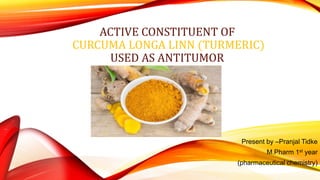
ACTIVE CONSTITUENT OF
CURCUMA LONGA LINN (TURMERIC)
USED AS ANTITUMOR
Present by –Pranjal Tidke
M.Pharm 1st year
(pharmaceutical chemistry)
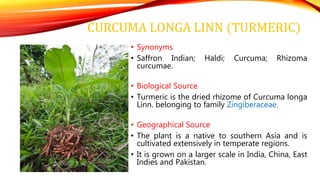
CURCUMA LONGA LINN (TURMERIC)
• Synonyms
• Saffron Indian; Haldi; Curcuma; Rhizoma
curcumae.
• Biological Source
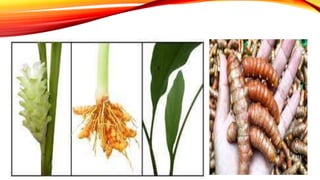
• Turmeric is the dried rhizome of Curcuma longa
Linn. belonging to family Zingiberaceae.
• Geographical Source
• The plant is a native to southern Asia and is
cultivated extensively in temperate regions.
• It is grown on a larger scale in India, China, East
Indies and Pakistan.
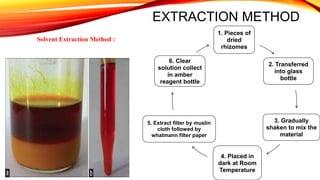
EXTRACTION METHOD
1. Pieces of
dried
rhizomes
2. Transferred
into glass
bottle
3. Gradually
shaken to mix the
material
4. Placed in
dark at Room
Temperature
5. Extract filter by muslin
cloth followed by
whatmann filter paper
6. Clear
solution collect
in amber
reagent bottle
Solvent Extraction Method :
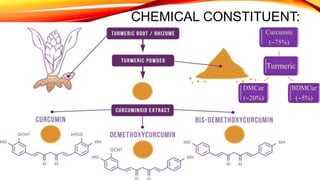
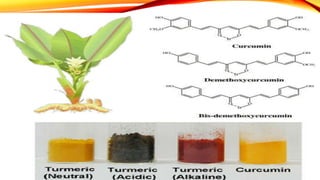
CHEMICAL CONSTITUENT:
Turmeric
Curcumin
(75%)
BDMCur
(5%)
DMCur
(20%)
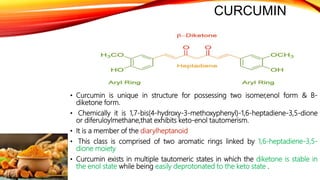
CURCUMIN
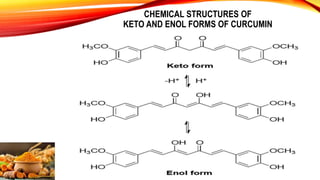
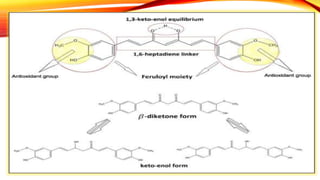
• Curcumin is unique in structure for possessing two isomer,enol form & B-
diketone form.
• Chemically it is 1,7-bis(4-hydroxy-3-methoxyphenyl)-1,6-heptadiene-3,5-dione
or diferuloylmethane,that exhibits keto-enol tautomerism.
• It is a member of the diarylheptanoid
• This class is comprised of two aromatic rings linked by 1,6-heptadiene-3,5-
dione moiety
• Curcumin exists in multiple tautomeric states in which the diketone is stable in
the enol state while being easily deprotonated to the keto state .
CHEMICAL STRUCTURES OF
KETO AND ENOL FORMS OF CURCUMIN
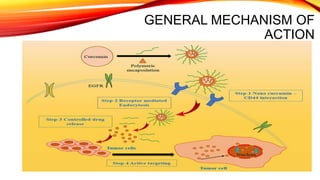
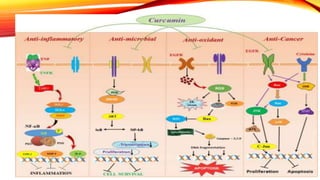
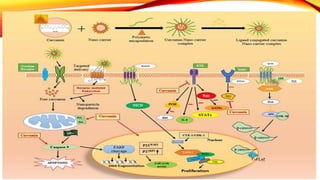
GENERAL MECHANISM OF
ACTION
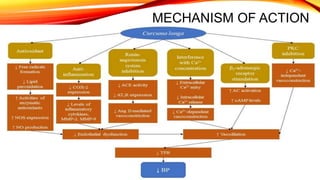
MECHANISM OF ACTION
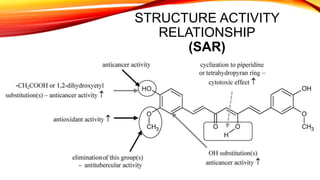
STRUCTURE ACTIVITY
RELATIONSHIP
(SAR)
MODIFICATION ON THE
AROMATIC RING
• Curcumin has two phenyl rings & substitutions at 3 & 4 positions with methoxy &
hydroxyl groups respectively. it undergoes extensive in vito & in vivo phase1 & phase II
metabolism through oxidation,reduction,glucuronidation & sulfation.
The glucoronidation and sulfation occur on the 4-OH groups present on both
phenyl ring of curcumin,enhance the activity.
• Removal of 3-OCH3 groups from phenyl ring or exchange of 3-OCH3 & 4-OH group on
phenyl ring of curcumin,there loss of antiproliferative activity.
• The etherification,esterification or sulphation of 4-OH group on aromatic rings without
loss of oxygen functionality and no alteration of 3-OCH3 group can produce potent
anticancer agents.
However,removal of hydroxyl group results in loss of potency.
MODIFICATION IN THE B-DIKETONE
CHAIN (1,6-HEPTADIENE-3,5-DIONE)
• Introduction of pyrazole ring in to the B-ketone chain enhances the anti-proliferative
activity.the compound possesses more antiangiogenic & androgen receptor
antagonistic activity than curcumin.19
• Modification of B-diketone moiety into isoxazole ring in the chain of curcumin
enhances anti tumor activity.20
• Replacement of both the oxygen atoms with nitrogen atom gave active promising
results.
• Reduction of chain length to 5carbons removal of one of the carbonyl group results
in improved structural stablity in vitro and improved pharmacokinetic profile in vivo.
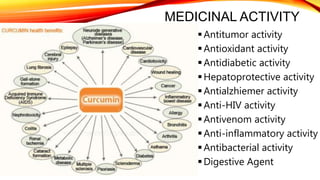
MEDICINAL ACTIVITY
Antitumor activity
Antioxidant activity
Antidiabetic activity
Hepatoprotective activity
Antialzhiemer activity
Anti-HIV activity
Antivenom activity
Anti-inflammatory activity
Antibacterial activity
Digestive Agent
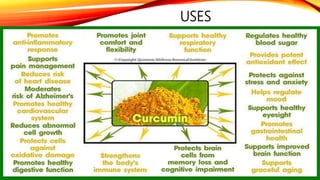
USES
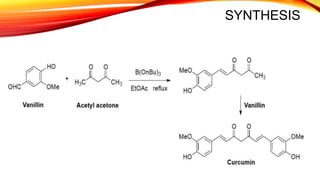
SYNTHESIS
PRODUCT
THANK
YOU..!!!

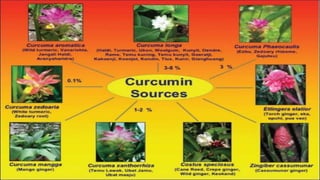
Curcumina longa active constituent

  • 1.
    ACTIVE CONSTITUENT OF CURCUMALONGA LINN (TURMERIC) USED AS ANTITUMOR Present by –Pranjal Tidke M.Pharm 1st year (pharmaceutical chemistry)
  • 2.
    CURCUMA LONGA LINN(TURMERIC) • Synonyms • Saffron Indian; Haldi; Curcuma; Rhizoma curcumae. • Biological Source • Turmeric is the dried rhizome of Curcuma longa Linn. belonging to family Zingiberaceae. • Geographical Source • The plant is a native to southern Asia and is cultivated extensively in temperate regions. • It is grown on a larger scale in India, China, East Indies and Pakistan.
  • 5.
    EXTRACTION METHOD 1. Piecesof dried rhizomes 2. Transferred into glass bottle 3. Gradually shaken to mix the material 4. Placed in dark at Room Temperature 5. Extract filter by muslin cloth followed by whatmann filter paper 6. Clear solution collect in amber reagent bottle Solvent Extraction Method :
  • 6.
  • 8.
    CURCUMIN • Curcumin isunique in structure for possessing two isomer,enol form & B- diketone form. • Chemically it is 1,7-bis(4-hydroxy-3-methoxyphenyl)-1,6-heptadiene-3,5-dione or diferuloylmethane,that exhibits keto-enol tautomerism. • It is a member of the diarylheptanoid • This class is comprised of two aromatic rings linked by 1,6-heptadiene-3,5- dione moiety • Curcumin exists in multiple tautomeric states in which the diketone is stable in the enol state while being easily deprotonated to the keto state .
  • 9.
    CHEMICAL STRUCTURES OF KETOAND ENOL FORMS OF CURCUMIN
  • 11.
  • 12.
  • 15.
  • 16.
    MODIFICATION ON THE AROMATICRING • Curcumin has two phenyl rings & substitutions at 3 & 4 positions with methoxy & hydroxyl groups respectively. it undergoes extensive in vito & in vivo phase1 & phase II metabolism through oxidation,reduction,glucuronidation & sulfation. The glucoronidation and sulfation occur on the 4-OH groups present on both phenyl ring of curcumin,enhance the activity. • Removal of 3-OCH3 groups from phenyl ring or exchange of 3-OCH3 & 4-OH group on phenyl ring of curcumin,there loss of antiproliferative activity. • The etherification,esterification or sulphation of 4-OH group on aromatic rings without loss of oxygen functionality and no alteration of 3-OCH3 group can produce potent anticancer agents. However,removal of hydroxyl group results in loss of potency.
  • 17.
    MODIFICATION IN THEB-DIKETONE CHAIN (1,6-HEPTADIENE-3,5-DIONE) • Introduction of pyrazole ring in to the B-ketone chain enhances the anti-proliferative activity.the compound possesses more antiangiogenic & androgen receptor antagonistic activity than curcumin.19 • Modification of B-diketone moiety into isoxazole ring in the chain of curcumin enhances anti tumor activity.20 • Replacement of both the oxygen atoms with nitrogen atom gave active promising results. • Reduction of chain length to 5carbons removal of one of the carbonyl group results in improved structural stablity in vitro and improved pharmacokinetic profile in vivo.
  • 18.
    MEDICINAL ACTIVITY Antitumor activity Antioxidantactivity Antidiabetic activity Hepatoprotective activity Antialzhiemer activity Anti-HIV activity Antivenom activity Anti-inflammatory activity Antibacterial activity Digestive Agent
  • 19.
  • 20.
  • 21.
  • 22.