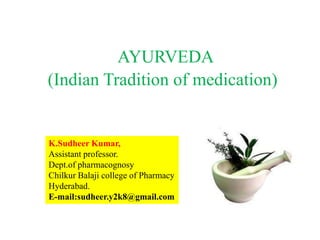
AYURVEDA
(Indian Tradition of medication)
K.Sudheer Kumar,
Assistant professor.
Dept.of pharmacognosy
Chilkur Balaji college of Pharmacy
Hyderabad.
E-mail:sudheer.y2k8@gmail.com
CONTENTS
 INTRODUCTION
 ORIGIN OF AYURVEDA
BASIC PRINCIPLES OF AYURVEDA
AYURVEDIC DOSAGE FORMS
CONCLUSION
REFERENCES
AYURVEDA (The Complete Knowledge for long life)
Ancient science of life
In ‘SANSKRIT’, the word Ayurveda consists of
two words
AYUR- Life
VEDA - Knowledge or science.
INTRODUCTION
ORGIN OF AYURVEDA
Oldest form of health care in the world
Upaveda of Atharvanaveda.
DEFINITION:-
“All medicines intended for internal or external use for or in
the diagnosis, treatment, mitigation or prevention of
diseases/disorder in human beings or animals.
Authoritative books of Ayurvedic system
Arogya kalpadruma
Charaka Samhita
Kupi pakva Rasayana
Arka Prakasha
OBJECTIVES OFAYURVEDA:-
i) Swasthyas Swaastha Rakshanam
o Keeping the healthy person healthy
(ii) Vyadhakanam Vyadhi Paramokshaha
o Person who does not have this knowledge of how to stay
optimally healthy or does not implement the knowledge and
gets out of balance.
BASIC PRINCIPLES OF AYURVEDA
(1) Panchamahabhuta Siddhanta
(2) Tridosha theory (Three pillars of life)
(3) Guna-Rasa- Virya- Vipaka- Prabhava Siddhanta
PANCHAMAHABHUTA SIDDHANTA
Space or void (Akash)
Earth or solid (Prithvi)
Air (Vayu)
Energy or fire (Teja)
Water or liquid (Apa or jal)
Tridosha theory
Vata (Space and air), Pitta (energy and liquid), Kapha (Liquid and
solid)
Exists inseven forms called Saptadhatu (Rasa, Rakta, Meda,
Mamsa, Majja, Shukra, Asthi)
Tissues are subject to wear and tear so that mala(excretoy material)
is fomed.
Imbalance in these three factors develops disease in the body.
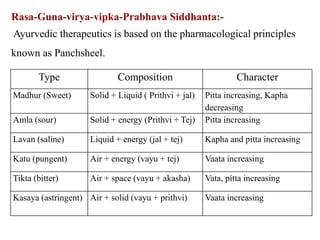
Rasa-Guna-virya-vipka-Prabhava Siddhanta:-
Ayurvedic therapeutics is based on the pharmacological principles
known as Panchsheel.
Type Composition Character
Madhur (Sweet) Solid + Liquid ( Prithvi + jal) Pitta increasing, Kapha
decreasing
Amla (sour) Solid + energy (Prithvi + Tej) Pitta increasing
Lavan (saline) Liquid + energy (jal + tej) Kapha and pitta increasing
Katu (pungent) Air + energy (vayu + tej) Vaata increasing
Tikta (bitter) Air + space (vayu + akasha) Vata, pitta increasing
Kasaya (astringent) Air + solid (vayu + prithvi) Vaata increasing
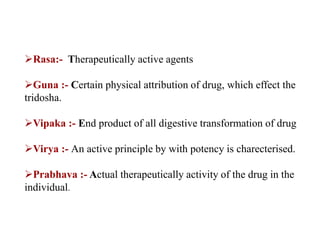
Rasa:- Therapeutically active agents
Guna :- Certain physical attribution of drug, which effect the
tridosha.
Vipaka :- End product of all digestive transformation of drug
Virya :- An active principle by with potency is charecterised.
Prabhava :- Actual therapeutically activity of the drug in the
individual.
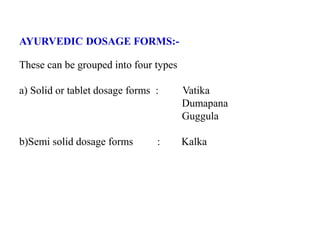
AYURVEDIC DOSAGE FORMS:-
These can be grouped into four types
a) Solid or tablet dosage forms : Vatika
Dumapana
Guggula
b)Semi solid dosage forms : Kalka
c) Liquid dosage forms:
i) Aqueous : Swarasa, Kasaya, Kwatha
ii) Oily : Taila
iii) Spiritous : Sura,Asava
d) Powder dosage forms: Churna
Bhasma
CONCLUSION
The theories of Panchamahabhutha-Tridosha are the fundamental
basis for its Pathophysiological condition
Rasa-Guna-Virya-Vipaka-Prabhava are principles for
pharmacological basis of ayurvedic therapeutics.
“SWASTHAYAS SWAASTHA RAKSHANAM”,
“VYADHAKANAM VYADHI PARAMOKSHAHA”
THANK YOU

Ayurveda

  • 1.
    AYURVEDA (Indian Tradition ofmedication) K.Sudheer Kumar, Assistant professor. Dept.of pharmacognosy Chilkur Balaji college of Pharmacy Hyderabad. E-mail:sudheer.y2k8@gmail.com
  • 2.
    CONTENTS  INTRODUCTION  ORIGINOF AYURVEDA BASIC PRINCIPLES OF AYURVEDA AYURVEDIC DOSAGE FORMS CONCLUSION REFERENCES
  • 3.
    AYURVEDA (The CompleteKnowledge for long life) Ancient science of life In ‘SANSKRIT’, the word Ayurveda consists of two words AYUR- Life VEDA - Knowledge or science. INTRODUCTION
  • 4.
    ORGIN OF AYURVEDA Oldestform of health care in the world Upaveda of Atharvanaveda. DEFINITION:- “All medicines intended for internal or external use for or in the diagnosis, treatment, mitigation or prevention of diseases/disorder in human beings or animals.
  • 5.
    Authoritative books ofAyurvedic system Arogya kalpadruma Charaka Samhita Kupi pakva Rasayana Arka Prakasha
  • 6.
    OBJECTIVES OFAYURVEDA:- i) SwasthyasSwaastha Rakshanam o Keeping the healthy person healthy (ii) Vyadhakanam Vyadhi Paramokshaha o Person who does not have this knowledge of how to stay optimally healthy or does not implement the knowledge and gets out of balance.
  • 7.
    BASIC PRINCIPLES OFAYURVEDA (1) Panchamahabhuta Siddhanta (2) Tridosha theory (Three pillars of life) (3) Guna-Rasa- Virya- Vipaka- Prabhava Siddhanta
  • 8.
    PANCHAMAHABHUTA SIDDHANTA Space orvoid (Akash) Earth or solid (Prithvi) Air (Vayu) Energy or fire (Teja) Water or liquid (Apa or jal)
  • 9.
    Tridosha theory Vata (Spaceand air), Pitta (energy and liquid), Kapha (Liquid and solid) Exists inseven forms called Saptadhatu (Rasa, Rakta, Meda, Mamsa, Majja, Shukra, Asthi) Tissues are subject to wear and tear so that mala(excretoy material) is fomed. Imbalance in these three factors develops disease in the body.
  • 10.
    Rasa-Guna-virya-vipka-Prabhava Siddhanta:- Ayurvedic therapeuticsis based on the pharmacological principles known as Panchsheel. Type Composition Character Madhur (Sweet) Solid + Liquid ( Prithvi + jal) Pitta increasing, Kapha decreasing Amla (sour) Solid + energy (Prithvi + Tej) Pitta increasing Lavan (saline) Liquid + energy (jal + tej) Kapha and pitta increasing Katu (pungent) Air + energy (vayu + tej) Vaata increasing Tikta (bitter) Air + space (vayu + akasha) Vata, pitta increasing Kasaya (astringent) Air + solid (vayu + prithvi) Vaata increasing
  • 11.
    Rasa:- Therapeutically activeagents Guna :- Certain physical attribution of drug, which effect the tridosha. Vipaka :- End product of all digestive transformation of drug Virya :- An active principle by with potency is charecterised. Prabhava :- Actual therapeutically activity of the drug in the individual.
  • 12.
    AYURVEDIC DOSAGE FORMS:- Thesecan be grouped into four types a) Solid or tablet dosage forms : Vatika Dumapana Guggula b)Semi solid dosage forms : Kalka
  • 13.
    c) Liquid dosageforms: i) Aqueous : Swarasa, Kasaya, Kwatha ii) Oily : Taila iii) Spiritous : Sura,Asava d) Powder dosage forms: Churna Bhasma
  • 14.
    CONCLUSION The theories ofPanchamahabhutha-Tridosha are the fundamental basis for its Pathophysiological condition Rasa-Guna-Virya-Vipaka-Prabhava are principles for pharmacological basis of ayurvedic therapeutics.
  • 15.
  • 16.