Ayurveda
The Ancient Science
Dr.M.Hemanth Kumar
MSc.Ph.D.MBA
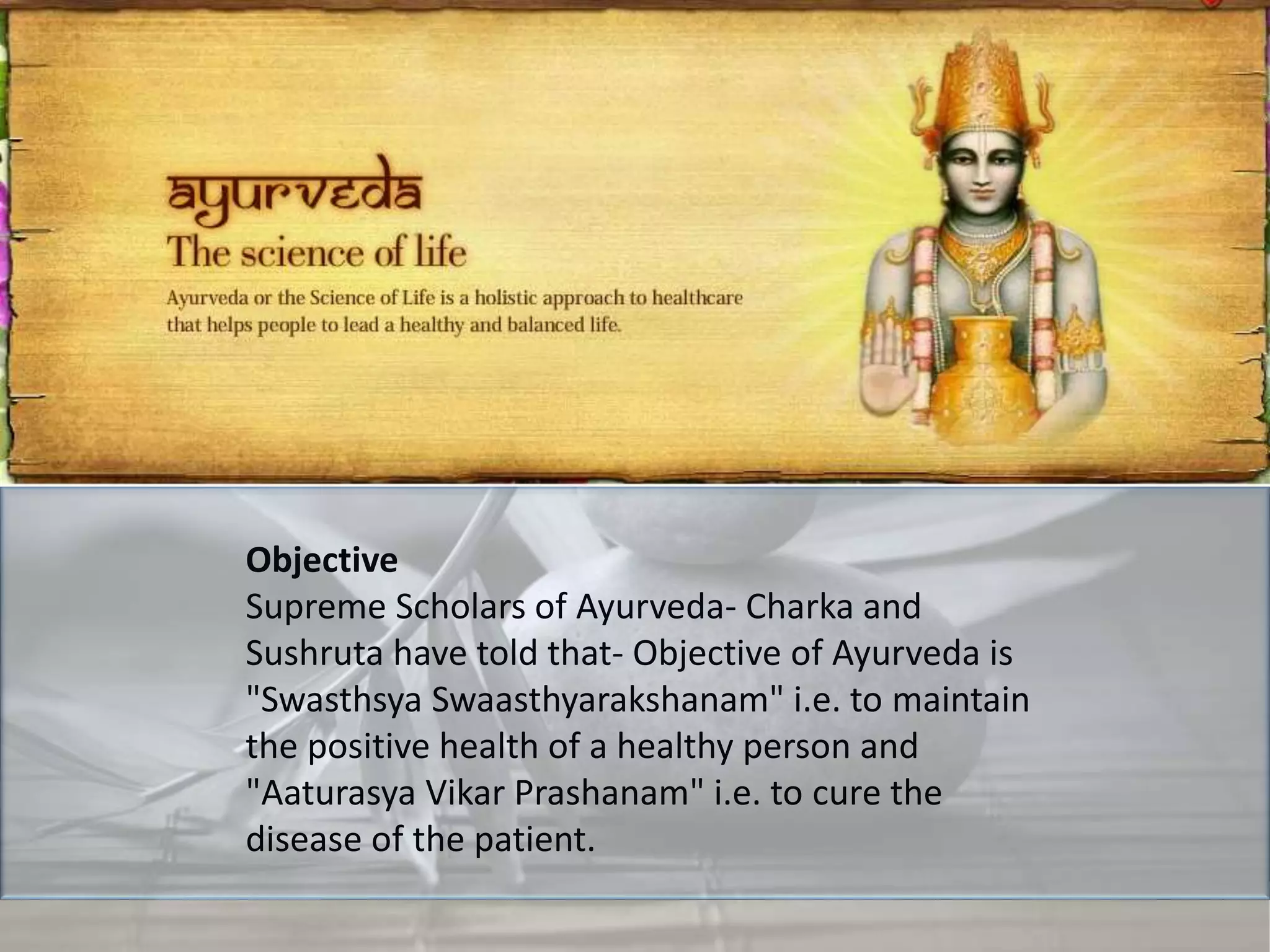
Definition
Ayurveda is a holistic approach to health that is
designed to help people live long, healthy, and
well-balanced lives. The term Ayurveda is taken
from the ancient Indian language, Sanskrit
words Ayus, meaning life or lifespan, and Veda
meaning knowledge literally means "Knowledge
of Life".
Evolution
Ayurvedic medicine (also called Ayurveda) is one
of the world’s oldest medical systems. It originated
in India and has evolved there over thousands of
years. The "contemporary" form of Ayurvedic
medicine is mostly derived from several sacred
Indian texts which were written in Sanskrit
between 1500 BC and 400 AD.
Objective
Supreme Scholars of Ayurveda- Charka and
Sushruta have told that- Objective of Ayurveda is
"Swasthsya Swaasthyarakshanam" i.e. to maintain
the positive health of a healthy person and
"Aaturasya Vikar Prashanam" i.e. to cure the
disease of the patient.
Ayu + Veda
LIFE: The unified State of
Body, Mind & Soul
SCIENCE
(Knowledge)
Ayurveda = Science of Life
History of
Ayurveda
Ayurveda – the Wisdom of Life
• Offers a proven guide for a life of
happiness, vitality, love and purpose.
• Human beings are not viewed as mere
thinking physical machines, but
• Rather as fields of intelligence in dynamic
exchange with the energy and
information of the environment.
Ayurveda – a holistic system
• A Comprehensive System with equal
emphasis on the body, mind and spirit
• Strives to restore the innate harmony
of the individual
• It is not only about treating sickness
but – preventing disease and
enhancing health, longevity, vitality
and happiness.
Vedas
– It is the bedrock upon which Ayurveda rests
• Considered to be composed around 1500-2000
BC
• Four Vedas
Rig-veda :contains hymns to be recited
Sam-veda : collection of hymns to be sung
Yajur-veda : entire sacrificial rite
Athar-veda : contains information on
health and sickness
Earliest Texts
• 760 BC : Charaka Samhita – herbal or plant
based pharmacopoeia
• 660 BC : Sushruta Samhita – Surgical
approaches
• 7th Century : Ashtanga Sangraha of Vagbhata
– summary of previous two
• AD 100 : Nagarjuna – iatrochemistry
• 1331 : Madhava Nidana by Madhava
– Ayurvedic Diagnosis
• 14th Century :Sarangadhara Samhita
– Pulse diagnosis
Eight Wings of Ayurveda (Ashtanga Ayurveda)
• Kaya Chikitsa
• Shalya Chikitsa
• Shalakya (Urdhvanga) Chikitsa
• Bala (Kaumar-Bhritya) Chikitsa
• Rasayana (Jara) Chikitsa
• Vajikarana (Vrishya Chikitsa)
• Bhoot Vidya (Graha Chikitsa)
• Visha Chikitsa (Agad tantra)
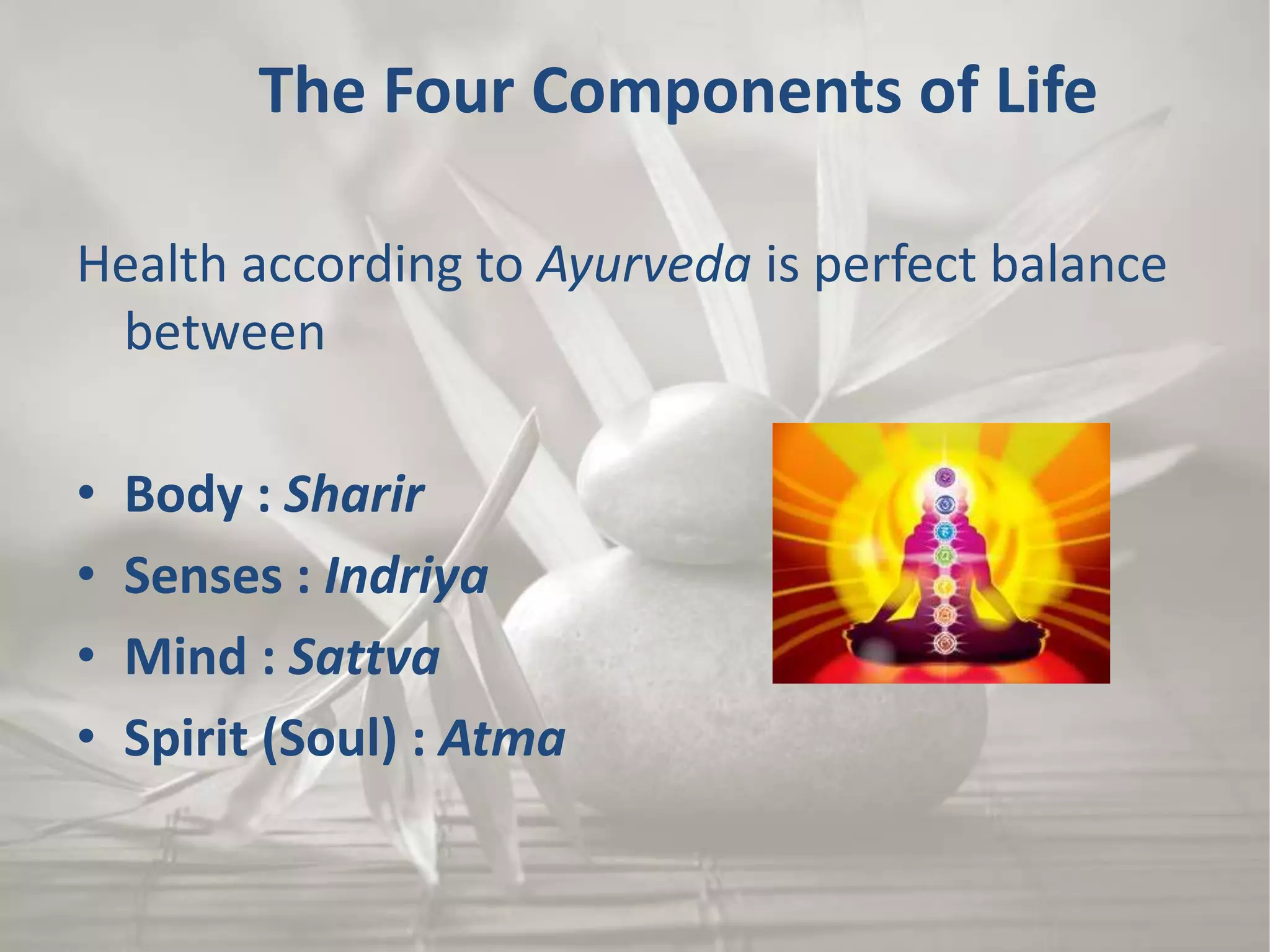
The Four Components of Life
Health according to Ayurveda is perfect balance
between
• Body : Sharir
• Senses : Indriya
• Mind : Sattva
• Spirit (Soul) : Atma
AYURVEDA
TRIDOSHA THEORY- 3 DOSHAS
PANCHAMAHABHUTA THEORY- 5 elements
VATA PITTA KAPHA
PRITHVI
Earth
JALA
Water
AGNI
Fire
VAYU
Air
AKASH
Space
EQUILIBRIUM
of 3 DOSHAS
DISEQUILIBRIUM
of 3 DOSHAS
HEALTH DISEASE
SOUL+
Effecting Human Physiology
Space :
• In the human body, many spaces are aspects
of the Space element.
• The spaces in the mouth, nose,
gastrointestinal tract, respiratory tract,
abdomen, thorax, capillaries, etc.
Effecting Human Physiology
Air :
• All movements involve Air as an element.
• The nature of the elements themselves
determine the nature of physiology.
• With the human body Air is present in the
pulsations of the heart, lungs etc.
Effecting Human Physiology
• Fire : The source of Fire and light in the solar
system is the sun.
• In the human body, the source of Fire is
metabolism.
• Fire works in the digestive system as well as
in the gray matter of the brain, where Fire
manifests as intelligence. Fire also activates
the retina to perceive light.
• Therefore body temperature, digestion,
thinking etc are all the functions of the Fire.
Effecting Human Physiology
Water:
• It manifests in the body as the secretions of
digestive juices, in the mucous membranes
and in plasma and cytoplasm.
• Water is vital for the functioning of all the
systems of the body.
• For example, dehydration resulting from
diarrhea and vomiting is due to water
element.
Effecting Human Physiology
Earth :
• The fifth element, is also present in the
microcosm of the human being.
• Life is possible on this planet because the
Earth holds all living and non-living substances
to its solid surface.
The Four Components of Life
1. Body
2. INDRIYA (Senses & Functions):
• Gyan-Indriya (Senses) : Sight, Hearing, Smell,
Touch & Taste
• Karm-Indriya (Voluntary functions) :
3. MANAS (Mind) : Supreme Indriya that controls
all Indriyas
• Has three abstract qualities – ‘Sattva’, ‘Rajas’
and ‘Tamas’.
The Four Components of Life
4. ATMA (Soul/Self) :
• Param Atma : Supreme, immortal pure has
only Sattva, free of happiness or sorrow.
• Jiv Atma : resides in living body attached to
Rajas and Tamas, witness every function &
emotion throughout the life.
Dosha, Dhatu and Mala
The concept of ‘Dosha Dhatu Mala’ theory is the basic
philosophy of Ayurveda, which deals about ‘Tridoshas’.
Doshas Functions
Vatta (wind) Mobility
Pitta (fire) Transformation
Kapha (water) Consistency/Stability
Tridosha
Ayurveda is based on 3 energies.
Their balanced state is health and imbalance
disease.
• VATA – the kinetic energy, movement,
division, growth, etc.
• PITTA – the thermal energy, heat
generation, intellect, sight, etc.
• KAPHA – the potential energy
Three Doshas (Tridoshas)
• Tridoshas are Vata, Pitta & Kapha
• Tridosha concept is applicable in living organisms
• Tridoshas are biological entities responsible for
structure, function and behaviour dimensions of all
living organisms
• Therefore human body mind constitution (Prakriti),
diseases, Medicines and Food all has been categorized
in Vata type, Pitta type and Kapha type.
• But nothing is absolute pure; every thing is
permutation and combination of Tridoshas
Characteristics of Doshas
Vata Pitta Kapha
Dry Oily Oily
Cold Hot Cold
Light Light Heavy
Irregular Intense Stable
Mobile Fluid Viscous
Rarified Mal odorous Dense
Rough Liquid Smoth
Five Fundamentals Elements of Ayurveda (Panchmahabhuta)
Panchmahabhuta Sensory Organs/work Properties and actions in the body
Space (Aakash) Ears/Hearing Sound Akash forms vacuumed organs of the body.
All body channels, working for the
movement of the nutrients and all other
fluids. It produces softness, lightness and
porosity
Air (Vayu or Pavan) Skin/Touch Governs inhalation, exhalation, opening and
closing of eyelids, locomotion and other
motor functions. Air creates dryness,
lightness and emaciation.
Fire (Agni or Teja) Eyes/Visual (Sight) Fire controls temperature and luster of body
colour. It helps in digestion and assimilation
of food, maturation and improves eye sight.
Water (Aap or Jala) Tongue/Taste Jal is the connecting force and fluid part of
the body and slimy, fat and sweat by nature.
It makes things supple and smooth, Imparts
glossiness and Enhances fluid content. It
acts as nutrient, emollient and purgative.
Earth (Prithvi or Bhoomi) Nose/Smell Prithvi controls organs as teeth, nails, flesh,
skin, tendons and muscles. It is heavy,
immobile, compact and rough and increases
firmness & strength of the body. It acts as
nutrient, emollient and purgative.
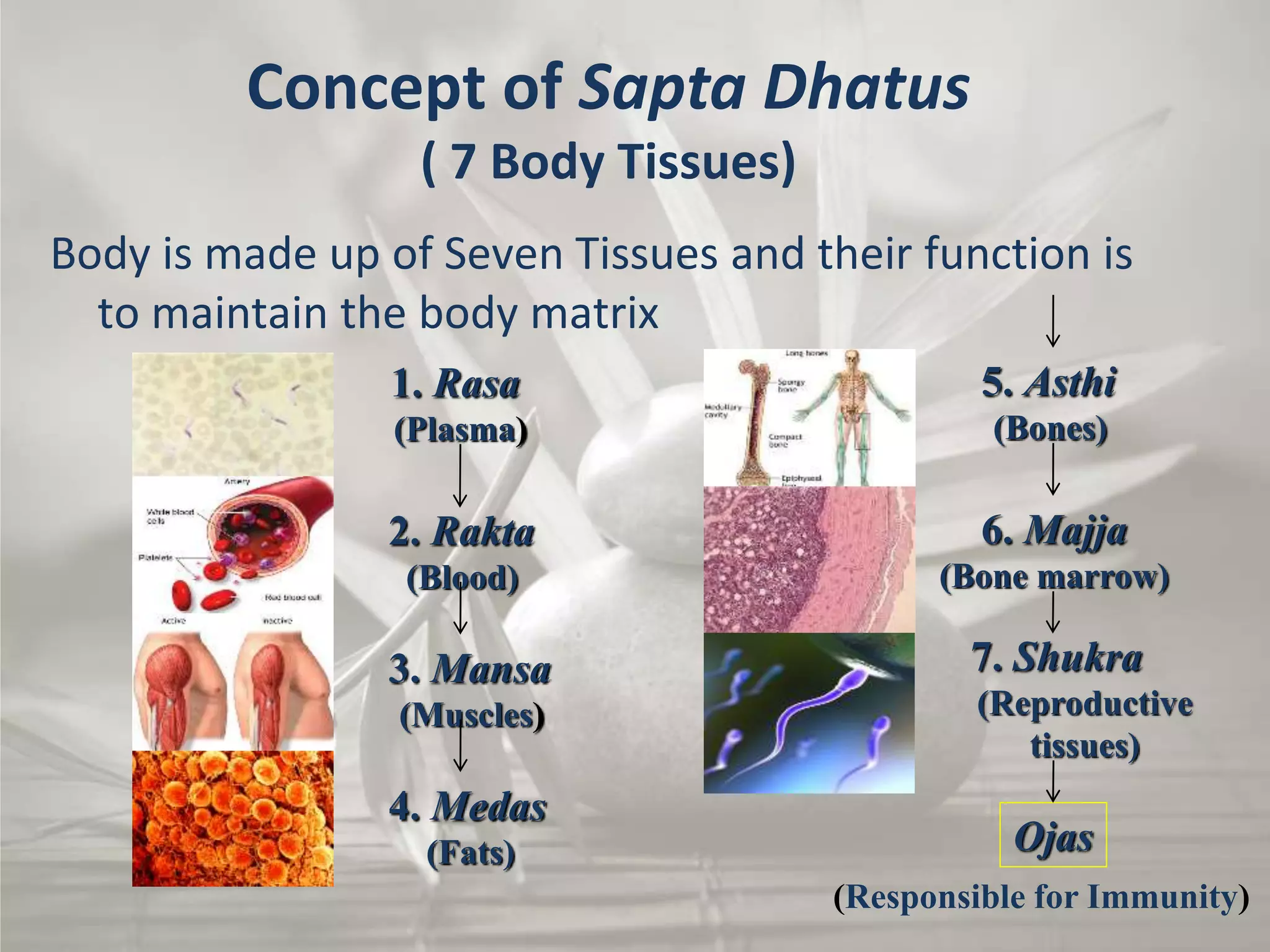
Concept of Sapta Dhatus
( 7 Body Tissues)
Body is made up of Seven Tissues and their function is
to maintain the body matrix
1. Rasa
(Plasma)
3. Mansa
(Muscles)
4. Medas
(Fats)
5. Asthi
(Bones)
6. Majja
(Bone marrow)
7. Shukra
(Reproductive
tissues)
2. Rakta
(Blood)
Ojas
(Responsible for Immunity)
Concept of Prakriti
(Body Mind Constitution and Temperament)
• Concept of Prakriti (human constitution) is related to
physiological attributes to health and disease.
• Prakriti is determined by relative predominance of dosha
in intra-uterine life of a fetus.
• Prakriti is unchangeable throughout the life span, but
• One can take remedial measures in diet and behavior
suitable to his/her prakriti to maintain health and
prevention of disease.
Significance of Prakriti in Clinical Medicine
• For Promotive & Preventive Health
– Know your prakriti and diseases susceptibility
– Prakriti will tell the risk factors, course of disease,
complications and prognosis
– Follow your diet, behaviour, profession and life style suitable
to your prakriti to lead a healthy life.
• Curative Health
– Select the drugs and dose as per prakriti
– Drug body interaction and reaction pattern depend upon the
prakriti of individual & drug
– Associated complications of a disease, prognosis and their
treatment can be improved as per prakriti of disease &
individual
Promotion
of
Health
Prevention
of
Disease
Ayurveda
Science of Longevity
with quality of life
Holistic
management
of disease
Ayurvedic Approach of Health and Disease
The factors responsible for prevention
of illness and promotion of health
 Day regimen (Dinacharya)
 Night regimen (Ratricharya )
 Seasonal regimen
(Rutucharya)
 Seasonal Purification (Rutu
anusara Shodhana)
Dosha - 3 (Vata, Pitta, Kapha)
Agni - 13 (Metabolic fire)
Dhatu - 7 (Body tissues)
Mala - 3 (Waste products)
Indriya - 5 (Sensory motor organs)
Manas - 1 (Mind)
Atma - Soul
Components of
health
Definition of Health
Physical &
Physiological
Psychological
Spiritual
One whose doshas, agni, functions of doshas and malas are in state of
equilibrium, who has cheerful atman, mind, intellect and sense organs is
designated as healthy.
Types of Treatment in Ayurveda:
There are two aspects of treatment in Ayurveda:
1. Shamana Chikitsa (Curing of diseases - Alleviating Therapy)
2. Shodhana Chikitsa (Prevention of diseases - Purification Therapy)
Pacification Treatment Purification Treatment
Pacifies doshas locally Removes doshas from body
Comparatively of temporary
action.
Effect lasts for long
Done in minimal or moderate
dosha and of minimal or
moderate strength
Done in profound dosha and of
profound strength
Does not interfere much with
tissues (dhatus)
Normalizes tissue (dhatu)
functions
Basic treatment modalities
Rasayana
• Rejuvenation Therapy
• Delays Aging
• Provide Immunity
• Improve Memory and sensory
perception
Traditional way to be EVER GREEN
Shodhana Chikitsa (Prevention of diseases)
The main aim of Shodhana treatment is to eliminate the internal
causative factors of the disease. It is one the most important techniques
in Ayurveda and is an internal purification process. Panchakarma
therapeutic procedures are used to facilitate the elimination of harmful
factors through following processes:
Vaman Emesis For Kapha dosha
Virechan Purgation For Pitta dosha
Basti Enema For Vatta dosha
Nasya
Administrating medicines
especially through nose
For Kapha dosha from head
Raktamokshan Blood letting For Rakta and Pitta dosha
Shamana Chikitsa (Curing of diseases)
Shamana is specially done after the Shodhana therapy and in less vitiation.
Ayurvedic medicines are used internally and externally to manage the
symptoms and cause of the disease through the balancing the equilibrium
of Dosha, Dhatu, Mala and Agni and also to increase the Immunity. In
Ayurveda there are thousands of medicines consisting of herbs, minerals
and biological products, which are used alone or in compound form to
suppress and cure diseases, particularly when the disease is at an early
stage.
Ayurveda Vs Modern Medicine
Philosophy
M: treats discrete disease entities
A: treats subtle dysphoria, whose disruptive trends may later develop into
discrete disease
Diagnostic
M: scientific objectivity and verifiability (accumulating statistically significant
data) – “experience-distant”
A: pratyaksha (perceptive understanding of each individual “experience-near”
Treatment
M: Linear logic, categorical and uses a classification system of disease
A: Maintenance of optimal health by daily proactive care, continually modified
according to seasonal changes
Belief
A: Individual has the innate capacity for potential self-correction and primary self
healing
Benefits of Ayurveda
Physical Benefits
The basic constitution represents the
individual’s psychological and physical
nature, distinctly.
Non-invasive diagnostic Ayurvedic treatments are
beneficial for chronic diseases such as diabetes, heart
ailments and cancer.
Difficult diseases like asthma and tumor growths
(gulmas) are managed effectively.
A discerning diet according to one’s dosha type, and well
regulated life (dinacharya) helps strengthen one’s natural
immune system.
Benefits of Ayurveda
•Detoxification methods like Panchakarma and other
herbal remedies make the body more responsive to
medicines and treatment.
•It hastens the healing process.
•Yogasanas achieve the twin purpose of strengthening
body-parts such as bone, muscle and vital organs like
heart, liver, stomach, intestine as well as
•Keeping out blood circulation and psychological
conditions strong and resilient.
Benefits of Ayurveda
Psychological Benefits:
It is said that the condition of body and
mind are integral to the overall health
of an individual.
Ayurvedic massages, inhalation
of herbal (Aromatherapy)
preparations, panchakarma
(nasya) besides much-tested
yogasanas and meditation leave
a calming effect on the nerves.
Spiritual Benefits:
The treatment methods, diet and lifestyle regimen
in Ayurveda are meticulously planned to heal the
body as well enrich the mind
So that each can improve from their own levels to
the higher goal of realizing the full self-potential.
It was with Ayurveda that the unique longevity and
rejuvenating method of Rasayana was born for
mankind to progress in the path of spirituality.
Benefits of Ayurveda
• Ayurveda is not only treatment, it is a way of life
• Has no side effects
• Gives happy, healthy disease free long life
• Makes you Tension Free
• Relaxes mind
• Provides knowledge about life
• Tells about good and bad dietary effects to life
• Tells the way for life goals, with keeping good
health status
Summary of Benefits of Ayurveda
Thank You
Dr.M.Hemanth Kumar
MSc.Ph.D.MBA
EMAIL : phytochem2@gmail.com
Research Head Patanjali
Haridwar , Uttarakhand - INDIA

Ayurveda simplified

  • 1.
  • 2.
    Definition Ayurveda is aholistic approach to health that is designed to help people live long, healthy, and well-balanced lives. The term Ayurveda is taken from the ancient Indian language, Sanskrit words Ayus, meaning life or lifespan, and Veda meaning knowledge literally means "Knowledge of Life".
  • 3.
    Evolution Ayurvedic medicine (alsocalled Ayurveda) is one of the world’s oldest medical systems. It originated in India and has evolved there over thousands of years. The "contemporary" form of Ayurvedic medicine is mostly derived from several sacred Indian texts which were written in Sanskrit between 1500 BC and 400 AD.
  • 4.
    Objective Supreme Scholars ofAyurveda- Charka and Sushruta have told that- Objective of Ayurveda is "Swasthsya Swaasthyarakshanam" i.e. to maintain the positive health of a healthy person and "Aaturasya Vikar Prashanam" i.e. to cure the disease of the patient.
  • 5.
    Ayu + Veda LIFE:The unified State of Body, Mind & Soul SCIENCE (Knowledge) Ayurveda = Science of Life
  • 6.
  • 7.
    Ayurveda – theWisdom of Life • Offers a proven guide for a life of happiness, vitality, love and purpose. • Human beings are not viewed as mere thinking physical machines, but • Rather as fields of intelligence in dynamic exchange with the energy and information of the environment.
  • 8.
    Ayurveda – aholistic system • A Comprehensive System with equal emphasis on the body, mind and spirit • Strives to restore the innate harmony of the individual • It is not only about treating sickness but – preventing disease and enhancing health, longevity, vitality and happiness.
  • 9.
    Vedas – It isthe bedrock upon which Ayurveda rests • Considered to be composed around 1500-2000 BC • Four Vedas Rig-veda :contains hymns to be recited Sam-veda : collection of hymns to be sung Yajur-veda : entire sacrificial rite Athar-veda : contains information on health and sickness
  • 10.
    Earliest Texts • 760BC : Charaka Samhita – herbal or plant based pharmacopoeia • 660 BC : Sushruta Samhita – Surgical approaches • 7th Century : Ashtanga Sangraha of Vagbhata – summary of previous two • AD 100 : Nagarjuna – iatrochemistry • 1331 : Madhava Nidana by Madhava – Ayurvedic Diagnosis • 14th Century :Sarangadhara Samhita – Pulse diagnosis
  • 11.
    Eight Wings ofAyurveda (Ashtanga Ayurveda) • Kaya Chikitsa • Shalya Chikitsa • Shalakya (Urdhvanga) Chikitsa • Bala (Kaumar-Bhritya) Chikitsa • Rasayana (Jara) Chikitsa • Vajikarana (Vrishya Chikitsa) • Bhoot Vidya (Graha Chikitsa) • Visha Chikitsa (Agad tantra)
  • 12.
    The Four Componentsof Life Health according to Ayurveda is perfect balance between • Body : Sharir • Senses : Indriya • Mind : Sattva • Spirit (Soul) : Atma
  • 13.
    AYURVEDA TRIDOSHA THEORY- 3DOSHAS PANCHAMAHABHUTA THEORY- 5 elements VATA PITTA KAPHA PRITHVI Earth JALA Water AGNI Fire VAYU Air AKASH Space EQUILIBRIUM of 3 DOSHAS DISEQUILIBRIUM of 3 DOSHAS HEALTH DISEASE SOUL+
  • 14.
    Effecting Human Physiology Space: • In the human body, many spaces are aspects of the Space element. • The spaces in the mouth, nose, gastrointestinal tract, respiratory tract, abdomen, thorax, capillaries, etc.
  • 15.
    Effecting Human Physiology Air: • All movements involve Air as an element. • The nature of the elements themselves determine the nature of physiology. • With the human body Air is present in the pulsations of the heart, lungs etc.
  • 16.
    Effecting Human Physiology •Fire : The source of Fire and light in the solar system is the sun. • In the human body, the source of Fire is metabolism. • Fire works in the digestive system as well as in the gray matter of the brain, where Fire manifests as intelligence. Fire also activates the retina to perceive light. • Therefore body temperature, digestion, thinking etc are all the functions of the Fire.
  • 17.
    Effecting Human Physiology Water: •It manifests in the body as the secretions of digestive juices, in the mucous membranes and in plasma and cytoplasm. • Water is vital for the functioning of all the systems of the body. • For example, dehydration resulting from diarrhea and vomiting is due to water element.
  • 18.
    Effecting Human Physiology Earth: • The fifth element, is also present in the microcosm of the human being. • Life is possible on this planet because the Earth holds all living and non-living substances to its solid surface.
  • 19.
    The Four Componentsof Life 1. Body 2. INDRIYA (Senses & Functions): • Gyan-Indriya (Senses) : Sight, Hearing, Smell, Touch & Taste • Karm-Indriya (Voluntary functions) : 3. MANAS (Mind) : Supreme Indriya that controls all Indriyas • Has three abstract qualities – ‘Sattva’, ‘Rajas’ and ‘Tamas’.
  • 20.
    The Four Componentsof Life 4. ATMA (Soul/Self) : • Param Atma : Supreme, immortal pure has only Sattva, free of happiness or sorrow. • Jiv Atma : resides in living body attached to Rajas and Tamas, witness every function & emotion throughout the life.
  • 21.
    Dosha, Dhatu andMala The concept of ‘Dosha Dhatu Mala’ theory is the basic philosophy of Ayurveda, which deals about ‘Tridoshas’. Doshas Functions Vatta (wind) Mobility Pitta (fire) Transformation Kapha (water) Consistency/Stability
  • 22.
    Tridosha Ayurveda is basedon 3 energies. Their balanced state is health and imbalance disease. • VATA – the kinetic energy, movement, division, growth, etc. • PITTA – the thermal energy, heat generation, intellect, sight, etc. • KAPHA – the potential energy
  • 23.
    Three Doshas (Tridoshas) •Tridoshas are Vata, Pitta & Kapha • Tridosha concept is applicable in living organisms • Tridoshas are biological entities responsible for structure, function and behaviour dimensions of all living organisms • Therefore human body mind constitution (Prakriti), diseases, Medicines and Food all has been categorized in Vata type, Pitta type and Kapha type. • But nothing is absolute pure; every thing is permutation and combination of Tridoshas
  • 24.
    Characteristics of Doshas VataPitta Kapha Dry Oily Oily Cold Hot Cold Light Light Heavy Irregular Intense Stable Mobile Fluid Viscous Rarified Mal odorous Dense Rough Liquid Smoth
  • 25.
    Five Fundamentals Elementsof Ayurveda (Panchmahabhuta) Panchmahabhuta Sensory Organs/work Properties and actions in the body Space (Aakash) Ears/Hearing Sound Akash forms vacuumed organs of the body. All body channels, working for the movement of the nutrients and all other fluids. It produces softness, lightness and porosity Air (Vayu or Pavan) Skin/Touch Governs inhalation, exhalation, opening and closing of eyelids, locomotion and other motor functions. Air creates dryness, lightness and emaciation. Fire (Agni or Teja) Eyes/Visual (Sight) Fire controls temperature and luster of body colour. It helps in digestion and assimilation of food, maturation and improves eye sight. Water (Aap or Jala) Tongue/Taste Jal is the connecting force and fluid part of the body and slimy, fat and sweat by nature. It makes things supple and smooth, Imparts glossiness and Enhances fluid content. It acts as nutrient, emollient and purgative. Earth (Prithvi or Bhoomi) Nose/Smell Prithvi controls organs as teeth, nails, flesh, skin, tendons and muscles. It is heavy, immobile, compact and rough and increases firmness & strength of the body. It acts as nutrient, emollient and purgative.
  • 26.
    Concept of SaptaDhatus ( 7 Body Tissues) Body is made up of Seven Tissues and their function is to maintain the body matrix 1. Rasa (Plasma) 3. Mansa (Muscles) 4. Medas (Fats) 5. Asthi (Bones) 6. Majja (Bone marrow) 7. Shukra (Reproductive tissues) 2. Rakta (Blood) Ojas (Responsible for Immunity)
  • 27.
    Concept of Prakriti (BodyMind Constitution and Temperament) • Concept of Prakriti (human constitution) is related to physiological attributes to health and disease. • Prakriti is determined by relative predominance of dosha in intra-uterine life of a fetus. • Prakriti is unchangeable throughout the life span, but • One can take remedial measures in diet and behavior suitable to his/her prakriti to maintain health and prevention of disease.
  • 28.
    Significance of Prakritiin Clinical Medicine • For Promotive & Preventive Health – Know your prakriti and diseases susceptibility – Prakriti will tell the risk factors, course of disease, complications and prognosis – Follow your diet, behaviour, profession and life style suitable to your prakriti to lead a healthy life. • Curative Health – Select the drugs and dose as per prakriti – Drug body interaction and reaction pattern depend upon the prakriti of individual & drug – Associated complications of a disease, prognosis and their treatment can be improved as per prakriti of disease & individual
  • 29.
    Promotion of Health Prevention of Disease Ayurveda Science of Longevity withquality of life Holistic management of disease Ayurvedic Approach of Health and Disease
  • 30.
    The factors responsiblefor prevention of illness and promotion of health  Day regimen (Dinacharya)  Night regimen (Ratricharya )  Seasonal regimen (Rutucharya)  Seasonal Purification (Rutu anusara Shodhana)
  • 31.
    Dosha - 3(Vata, Pitta, Kapha) Agni - 13 (Metabolic fire) Dhatu - 7 (Body tissues) Mala - 3 (Waste products) Indriya - 5 (Sensory motor organs) Manas - 1 (Mind) Atma - Soul Components of health Definition of Health Physical & Physiological Psychological Spiritual One whose doshas, agni, functions of doshas and malas are in state of equilibrium, who has cheerful atman, mind, intellect and sense organs is designated as healthy.
  • 32.
    Types of Treatmentin Ayurveda: There are two aspects of treatment in Ayurveda: 1. Shamana Chikitsa (Curing of diseases - Alleviating Therapy) 2. Shodhana Chikitsa (Prevention of diseases - Purification Therapy)
  • 33.
    Pacification Treatment PurificationTreatment Pacifies doshas locally Removes doshas from body Comparatively of temporary action. Effect lasts for long Done in minimal or moderate dosha and of minimal or moderate strength Done in profound dosha and of profound strength Does not interfere much with tissues (dhatus) Normalizes tissue (dhatu) functions Basic treatment modalities
  • 35.
    Rasayana • Rejuvenation Therapy •Delays Aging • Provide Immunity • Improve Memory and sensory perception Traditional way to be EVER GREEN
  • 36.
    Shodhana Chikitsa (Preventionof diseases) The main aim of Shodhana treatment is to eliminate the internal causative factors of the disease. It is one the most important techniques in Ayurveda and is an internal purification process. Panchakarma therapeutic procedures are used to facilitate the elimination of harmful factors through following processes: Vaman Emesis For Kapha dosha Virechan Purgation For Pitta dosha Basti Enema For Vatta dosha Nasya Administrating medicines especially through nose For Kapha dosha from head Raktamokshan Blood letting For Rakta and Pitta dosha
  • 37.
    Shamana Chikitsa (Curingof diseases) Shamana is specially done after the Shodhana therapy and in less vitiation. Ayurvedic medicines are used internally and externally to manage the symptoms and cause of the disease through the balancing the equilibrium of Dosha, Dhatu, Mala and Agni and also to increase the Immunity. In Ayurveda there are thousands of medicines consisting of herbs, minerals and biological products, which are used alone or in compound form to suppress and cure diseases, particularly when the disease is at an early stage.
  • 38.
    Ayurveda Vs ModernMedicine Philosophy M: treats discrete disease entities A: treats subtle dysphoria, whose disruptive trends may later develop into discrete disease Diagnostic M: scientific objectivity and verifiability (accumulating statistically significant data) – “experience-distant” A: pratyaksha (perceptive understanding of each individual “experience-near” Treatment M: Linear logic, categorical and uses a classification system of disease A: Maintenance of optimal health by daily proactive care, continually modified according to seasonal changes Belief A: Individual has the innate capacity for potential self-correction and primary self healing
  • 39.
    Benefits of Ayurveda PhysicalBenefits The basic constitution represents the individual’s psychological and physical nature, distinctly. Non-invasive diagnostic Ayurvedic treatments are beneficial for chronic diseases such as diabetes, heart ailments and cancer. Difficult diseases like asthma and tumor growths (gulmas) are managed effectively.
  • 40.
    A discerning dietaccording to one’s dosha type, and well regulated life (dinacharya) helps strengthen one’s natural immune system. Benefits of Ayurveda •Detoxification methods like Panchakarma and other herbal remedies make the body more responsive to medicines and treatment. •It hastens the healing process. •Yogasanas achieve the twin purpose of strengthening body-parts such as bone, muscle and vital organs like heart, liver, stomach, intestine as well as •Keeping out blood circulation and psychological conditions strong and resilient.
  • 41.
    Benefits of Ayurveda PsychologicalBenefits: It is said that the condition of body and mind are integral to the overall health of an individual. Ayurvedic massages, inhalation of herbal (Aromatherapy) preparations, panchakarma (nasya) besides much-tested yogasanas and meditation leave a calming effect on the nerves.
  • 42.
    Spiritual Benefits: The treatmentmethods, diet and lifestyle regimen in Ayurveda are meticulously planned to heal the body as well enrich the mind So that each can improve from their own levels to the higher goal of realizing the full self-potential. It was with Ayurveda that the unique longevity and rejuvenating method of Rasayana was born for mankind to progress in the path of spirituality. Benefits of Ayurveda
  • 43.
    • Ayurveda isnot only treatment, it is a way of life • Has no side effects • Gives happy, healthy disease free long life • Makes you Tension Free • Relaxes mind • Provides knowledge about life • Tells about good and bad dietary effects to life • Tells the way for life goals, with keeping good health status Summary of Benefits of Ayurveda
  • 44.
    Thank You Dr.M.Hemanth Kumar MSc.Ph.D.MBA EMAIL: phytochem2@gmail.com Research Head Patanjali Haridwar , Uttarakhand - INDIA