Ayurveda
The Science of Life
Introduction
• Ayurveda is the most ancient(900 B.C.) and
renowned system of medicine in India.
• It is more than 5000 years old system.
• But yet has the potential to cure many diseases
in an efficient manner.
• Ayurveda is made from two words. "Ayuh"
means life and "Ved" means knowledge or
science.
• Thus "AYURVEDA’ in totality means ‘Science of
Life’.
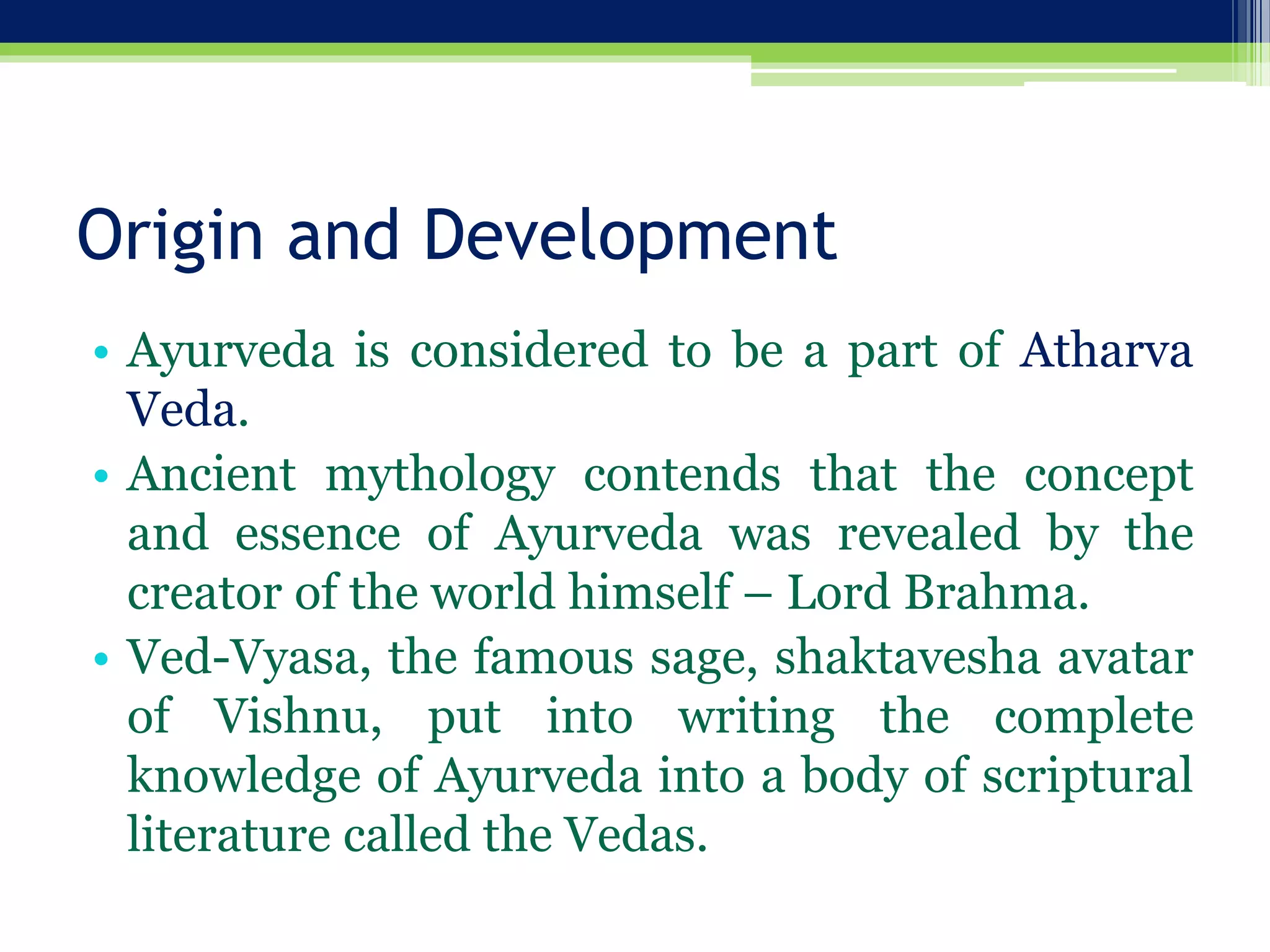
Origin and Development
• Ayurveda is considered to be a part of Atharva
Veda.
• Ancient mythology contends that the concept
and essence of Ayurveda was revealed by the
creator of the world himself – Lord Brahma.
• Ved-Vyasa, the famous sage, shaktavesha avatar
of Vishnu, put into writing the complete
knowledge of Ayurveda into a body of scriptural
literature called the Vedas.
• The Vedic Sages took the passages from the
Vedic Scriptures relating to Ayurveda and
compiled separate books dealing only with
Ayurveda.
• One of these books, called the Atreya Samhita is
the oldest medical book in the world!
• There are two main re-organizers of Ayurveda
whose works are still existing today - Charak and
Sushrut.
• The third major treatise is called the Ashtanga
Hridaya, which is a concise version of the works
of Charak and Sushrut.
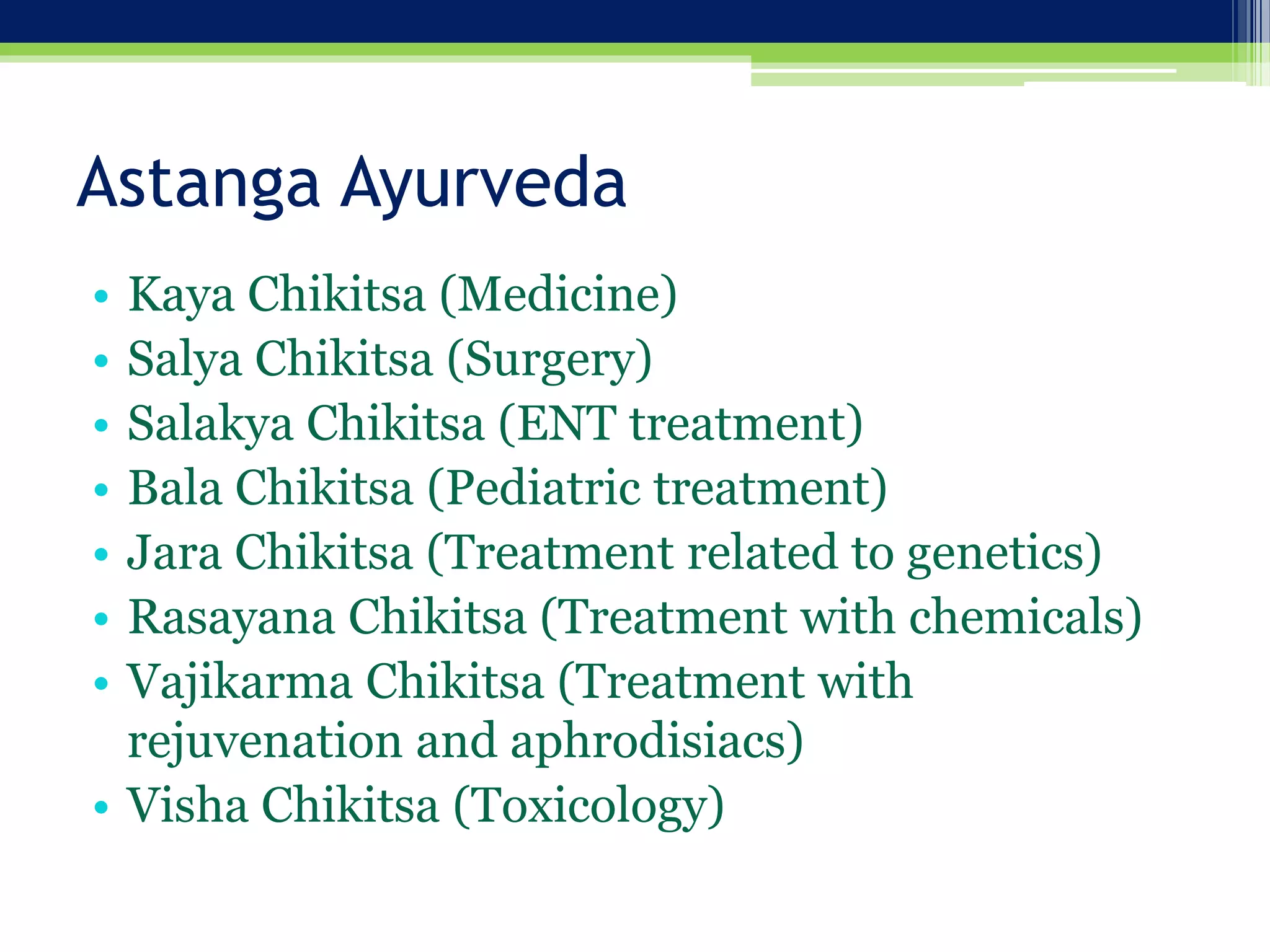
Astanga Ayurveda
• Kaya Chikitsa (Medicine)
• Salya Chikitsa (Surgery)
• Salakya Chikitsa (ENT treatment)
• Bala Chikitsa (Pediatric treatment)
• Jara Chikitsa (Treatment related to genetics)
• Rasayana Chikitsa (Treatment with chemicals)
• Vajikarma Chikitsa (Treatment with
rejuvenation and aphrodisiacs)
• Visha Chikitsa (Toxicology)
The Concept
Everything in universe is composed of 5 basic
elements known as Panchamahabhutas
• Prithvi (earth)
• Apa/Jala (water)
• Teja/agni (fire)
• Vayu (air)
• Akasha (vacuum/void)
• These 5 elements exists in the body in combine
form of doshas, dhatus and malas.
Tridosha (3 humours)
Sapta dhatu (7 basic tissues)
Trimalas (3 waste products)
• Vata, Pitta, Kapha
• Rasa, Rakta, Mansa, Meda, Asthi, Majja, Sukra
• Purusha, Mootra, Sweda
Panchamahabhuta Theory
• According to Ayurveda, the entire universe is
made up of 5 basic elements.
• The body has perfect balance of these elements
and when the balance is disturbed, an unhealthy
condition develops which we call as illness.
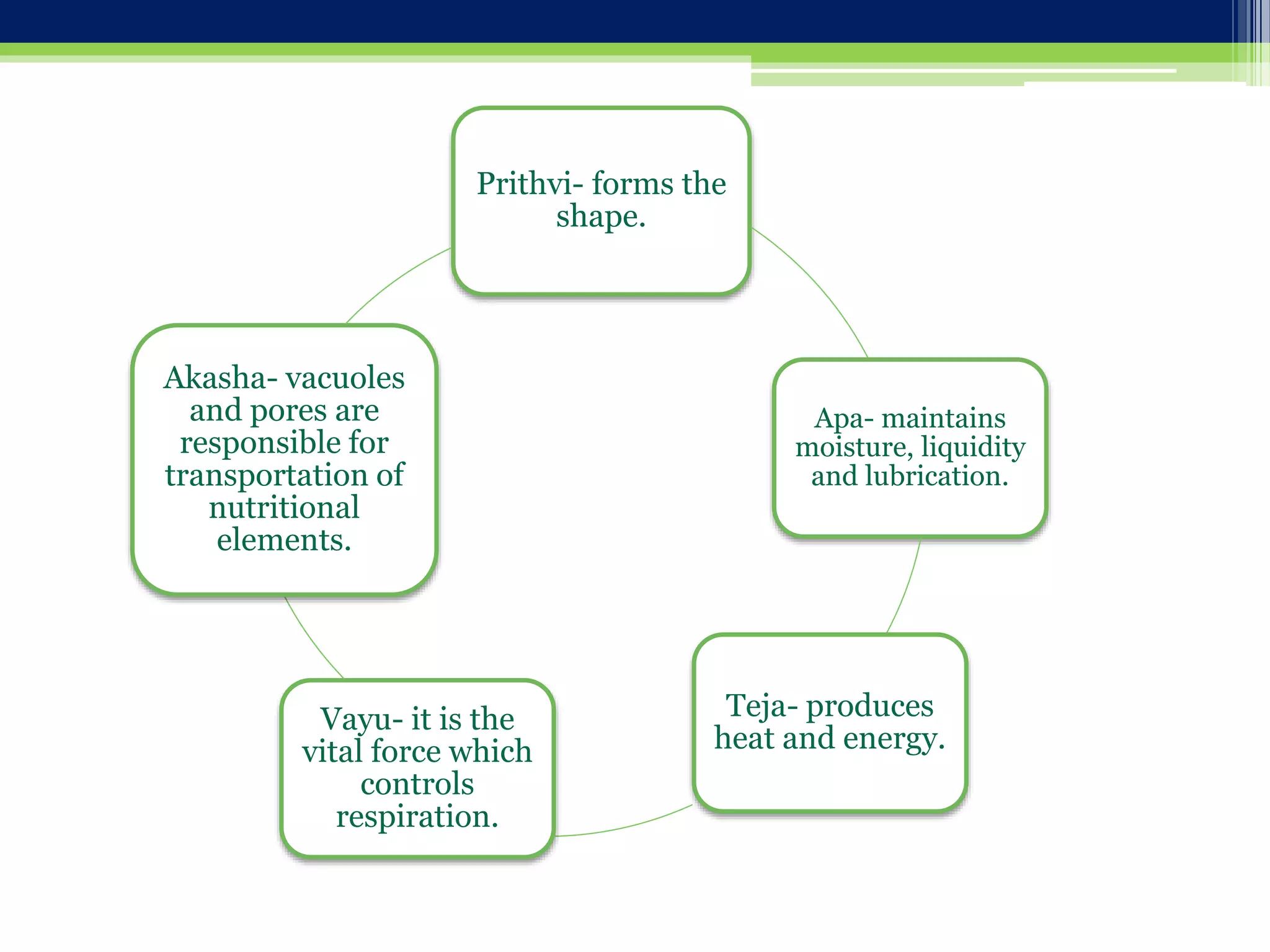
Prithvi- forms the
shape.
Apa- maintains
moisture, liquidity
and lubrication.
Teja- produces
heat and energy.
Vayu- it is the
vital force which
controls
respiration.
Akasha- vacuoles
and pores are
responsible for
transportation of
nutritional
elements.
Tridosha Theory
• The 5 elements combine to form the 3 doshas.
• The word dosha means impurity or imbalance.
• Tridosha exists in everything and influence the
physical and mental process of body.
• Health is maintained when these doshas are in
harmony with each other.
• Any imbalance leads to development of disease
in the body.
Vata
• The biological air humour is called “vata”.
• Governs other and responsible for all physical
processes.
• Helps in exhalation, movement & discharge
impulses, equilibrium of tissues and coordination of
senses.
• When disturbed causes illness, weakness, tremors,
constipation, insomnia.
• Located in colon, thigh, hips, ears & bones.
Pitta
• The biological fire humour is called “Pitta”.
• Responsible for all chemical and metabolic
transformation in the body.
• Exists mainly in acid form as fire.
• Governs digesion, heat, hunger, thirst, intelligence,
courage & softness of body.
• In excess causes yellow color of stool, urine, eyes &
skin.
• Located in smal intestine, stomach, blood, lymph.
Kapha
• The biological water humour is called “Kapha”.
• Gives stability, lubrication & holding together of
joints.
• Excessive kapha causes depression of digestive
fire, nausea, lethargy, cough, difficult breathing,
excessive sleeping.
Diagnosis
• The Charak Samhita describes “Nidana sthana”
which is concerned with the diagnosis of disease.
• It gives details of etiology, pathology, signs and
symptoms of disease.
• Recording of the pulse is very important in
Ayurvedic diagnosis.
• Ayurvedic practitioners look for the dominance
of dosha on the basis of pulse characters.
• Systemic examination is also a part of diagnosis.
• E.g. Functional nature of respiratory tract,
gastrointestinal tract and circulatory system, etc.
is noted.
• Investigation of malas also helps in the diagnosis
of the disease.
Treatment
• It mainly consists of two types of treatments:
1) Shodhana karma/Panchakarma (elimination of
morbid factors)
2) Shaman karma (palliative treatment)
Panchakarma
• Panchakarma is Ayurveda’s primary purification
and detoxification treatment.
• This is a process used to clean the toxic
materials in the body left by disease and poor
nutrition.
• Ayurveda says that imbalanced doshas create
waste matter.
• This waste matter is called Ama in Ayurveda.
• Panchakarma will stick out the excess doshas (or
imbalances in the dosha) along with the Ama out
of your system by means of the body waste
evacuation channels such as sweat glands,
urinary tract, intestines, etc.
• Panchakarma is, thus, a balancing operation.
• Ayurveda recommends Panchakarma as a
seasonal treatment for toning your mind body
system.
Drug Formulation Theory
• For formulation and assessment of action of the
drugs, the theory of rasa-guna-virya-vipaka-
prabhava was established.
• With this theory it is more convenient for a
physician to formulate the medicine according to
the need of the patient and not necessarily
depend on the pharmaceutical preparations.
• Rasa- therapeutically active agent
• Guna- quality
• Virya- an active principle by which potency is
characterized
• Vipaka- end product of digestion
• Prabhava- actual therapeutical activity of drug in
the individual
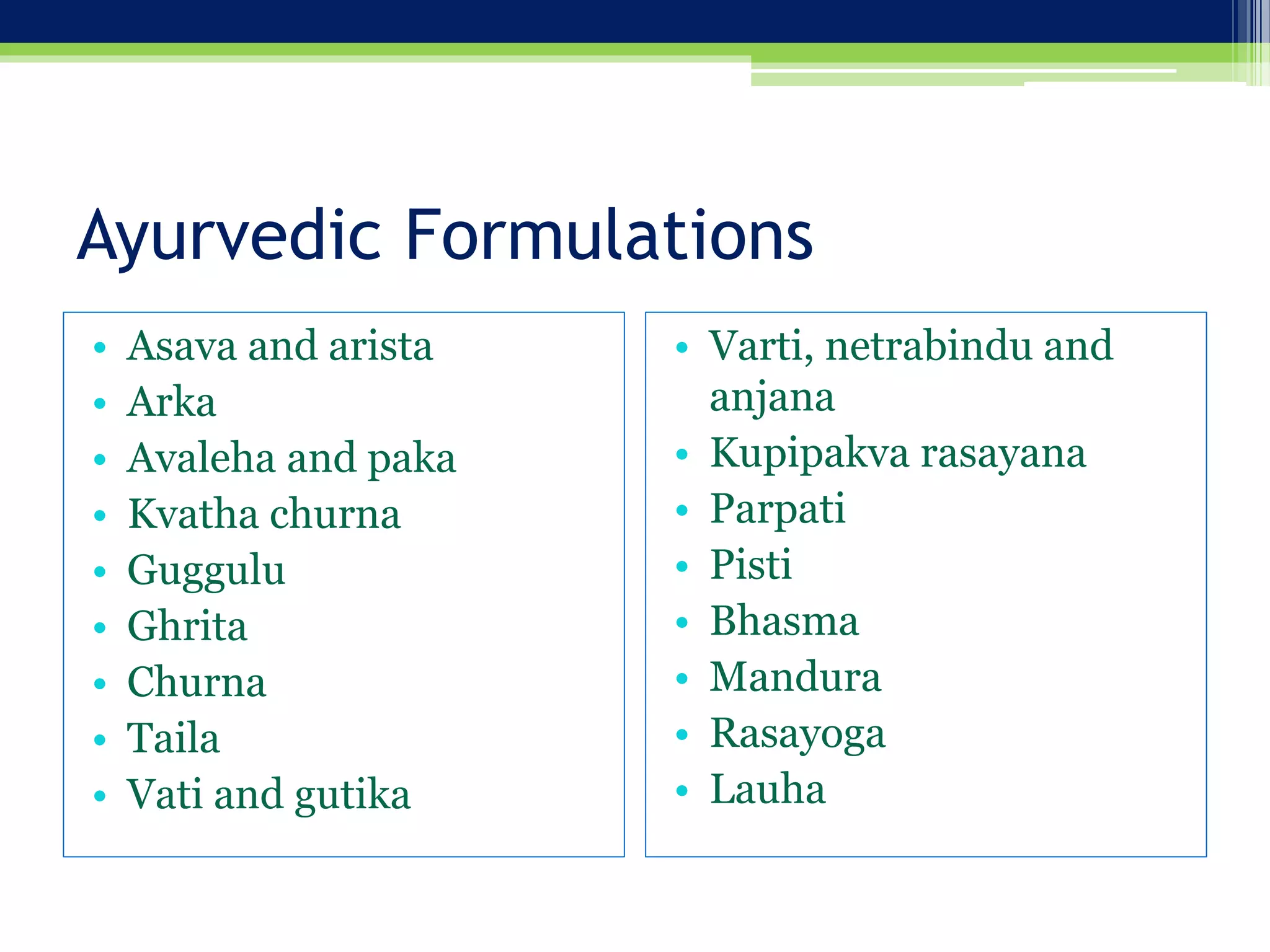
Ayurvedic Formulations
• Asava and arista
• Arka
• Avaleha and paka
• Kvatha churna
• Guggulu
• Ghrita
• Churna
• Taila
• Vati and gutika
• Varti, netrabindu and
anjana
• Kupipakva rasayana
• Parpati
• Pisti
• Bhasma
• Mandura
• Rasayoga
• Lauha
Rasayana
• It is believed in Ayurveda that the qualities of
rasa dhatu influences the health of other dhatus
of the body.
• Hence any medicine which improves the quality
of rasa can be called as rasayana.
• According to Charaka “With a rasayana, one
obtains longevity, regains youth, vitality and
vigor, gets a sharp memory, intellect
and freedom from diseases, gets
a lustrous complexion and the strength of
a horse.”
• According to Shushrut “A rasayana is anti-
ageing, increases life-span, promotes
intelligence and memory and increases
resistance to disease.”
Properties
• Anti ageing
• Adaptogen
• Immunostimulant and immunomodulator
• Anti mutagenic
• Strengthens brain and mind
• Prevents disease
• Promotes life and bestows longevity
• Anti stress and anti oxidant
Introduction to ayurveda

Introduction to ayurveda

  • 1.
  • 2.
    Introduction • Ayurveda isthe most ancient(900 B.C.) and renowned system of medicine in India. • It is more than 5000 years old system. • But yet has the potential to cure many diseases in an efficient manner. • Ayurveda is made from two words. "Ayuh" means life and "Ved" means knowledge or science. • Thus "AYURVEDA’ in totality means ‘Science of Life’.
  • 3.
    Origin and Development •Ayurveda is considered to be a part of Atharva Veda. • Ancient mythology contends that the concept and essence of Ayurveda was revealed by the creator of the world himself – Lord Brahma. • Ved-Vyasa, the famous sage, shaktavesha avatar of Vishnu, put into writing the complete knowledge of Ayurveda into a body of scriptural literature called the Vedas.
  • 4.
    • The VedicSages took the passages from the Vedic Scriptures relating to Ayurveda and compiled separate books dealing only with Ayurveda. • One of these books, called the Atreya Samhita is the oldest medical book in the world! • There are two main re-organizers of Ayurveda whose works are still existing today - Charak and Sushrut. • The third major treatise is called the Ashtanga Hridaya, which is a concise version of the works of Charak and Sushrut.
  • 5.
    Astanga Ayurveda • KayaChikitsa (Medicine) • Salya Chikitsa (Surgery) • Salakya Chikitsa (ENT treatment) • Bala Chikitsa (Pediatric treatment) • Jara Chikitsa (Treatment related to genetics) • Rasayana Chikitsa (Treatment with chemicals) • Vajikarma Chikitsa (Treatment with rejuvenation and aphrodisiacs) • Visha Chikitsa (Toxicology)
  • 6.
    The Concept Everything inuniverse is composed of 5 basic elements known as Panchamahabhutas • Prithvi (earth) • Apa/Jala (water) • Teja/agni (fire) • Vayu (air) • Akasha (vacuum/void)
  • 7.
    • These 5elements exists in the body in combine form of doshas, dhatus and malas. Tridosha (3 humours) Sapta dhatu (7 basic tissues) Trimalas (3 waste products) • Vata, Pitta, Kapha • Rasa, Rakta, Mansa, Meda, Asthi, Majja, Sukra • Purusha, Mootra, Sweda
  • 8.
    Panchamahabhuta Theory • Accordingto Ayurveda, the entire universe is made up of 5 basic elements. • The body has perfect balance of these elements and when the balance is disturbed, an unhealthy condition develops which we call as illness.
  • 9.
    Prithvi- forms the shape. Apa-maintains moisture, liquidity and lubrication. Teja- produces heat and energy. Vayu- it is the vital force which controls respiration. Akasha- vacuoles and pores are responsible for transportation of nutritional elements.
  • 11.
    Tridosha Theory • The5 elements combine to form the 3 doshas. • The word dosha means impurity or imbalance. • Tridosha exists in everything and influence the physical and mental process of body. • Health is maintained when these doshas are in harmony with each other. • Any imbalance leads to development of disease in the body.
  • 16.
    Vata • The biologicalair humour is called “vata”. • Governs other and responsible for all physical processes. • Helps in exhalation, movement & discharge impulses, equilibrium of tissues and coordination of senses. • When disturbed causes illness, weakness, tremors, constipation, insomnia. • Located in colon, thigh, hips, ears & bones.
  • 17.
    Pitta • The biologicalfire humour is called “Pitta”. • Responsible for all chemical and metabolic transformation in the body. • Exists mainly in acid form as fire. • Governs digesion, heat, hunger, thirst, intelligence, courage & softness of body. • In excess causes yellow color of stool, urine, eyes & skin. • Located in smal intestine, stomach, blood, lymph.
  • 19.
    Kapha • The biologicalwater humour is called “Kapha”. • Gives stability, lubrication & holding together of joints. • Excessive kapha causes depression of digestive fire, nausea, lethargy, cough, difficult breathing, excessive sleeping.
  • 20.
    Diagnosis • The CharakSamhita describes “Nidana sthana” which is concerned with the diagnosis of disease. • It gives details of etiology, pathology, signs and symptoms of disease. • Recording of the pulse is very important in Ayurvedic diagnosis. • Ayurvedic practitioners look for the dominance of dosha on the basis of pulse characters.
  • 21.
    • Systemic examinationis also a part of diagnosis. • E.g. Functional nature of respiratory tract, gastrointestinal tract and circulatory system, etc. is noted. • Investigation of malas also helps in the diagnosis of the disease.
  • 22.
    Treatment • It mainlyconsists of two types of treatments: 1) Shodhana karma/Panchakarma (elimination of morbid factors) 2) Shaman karma (palliative treatment)
  • 23.
    Panchakarma • Panchakarma isAyurveda’s primary purification and detoxification treatment. • This is a process used to clean the toxic materials in the body left by disease and poor nutrition. • Ayurveda says that imbalanced doshas create waste matter. • This waste matter is called Ama in Ayurveda.
  • 24.
    • Panchakarma willstick out the excess doshas (or imbalances in the dosha) along with the Ama out of your system by means of the body waste evacuation channels such as sweat glands, urinary tract, intestines, etc. • Panchakarma is, thus, a balancing operation. • Ayurveda recommends Panchakarma as a seasonal treatment for toning your mind body system.
  • 26.
    Drug Formulation Theory •For formulation and assessment of action of the drugs, the theory of rasa-guna-virya-vipaka- prabhava was established. • With this theory it is more convenient for a physician to formulate the medicine according to the need of the patient and not necessarily depend on the pharmaceutical preparations.
  • 27.
    • Rasa- therapeuticallyactive agent • Guna- quality • Virya- an active principle by which potency is characterized • Vipaka- end product of digestion • Prabhava- actual therapeutical activity of drug in the individual
  • 28.
    Ayurvedic Formulations • Asavaand arista • Arka • Avaleha and paka • Kvatha churna • Guggulu • Ghrita • Churna • Taila • Vati and gutika • Varti, netrabindu and anjana • Kupipakva rasayana • Parpati • Pisti • Bhasma • Mandura • Rasayoga • Lauha
  • 29.
    Rasayana • It isbelieved in Ayurveda that the qualities of rasa dhatu influences the health of other dhatus of the body. • Hence any medicine which improves the quality of rasa can be called as rasayana. • According to Charaka “With a rasayana, one obtains longevity, regains youth, vitality and vigor, gets a sharp memory, intellect and freedom from diseases, gets a lustrous complexion and the strength of a horse.”
  • 30.
    • According toShushrut “A rasayana is anti- ageing, increases life-span, promotes intelligence and memory and increases resistance to disease.”
  • 31.
    Properties • Anti ageing •Adaptogen • Immunostimulant and immunomodulator • Anti mutagenic • Strengthens brain and mind • Prevents disease • Promotes life and bestows longevity • Anti stress and anti oxidant