Alysha Budhathoki
BNS 1ST YEAR ,
1ST Batch 2019
Kathmandu Medical College ,
Duwakot, Bhaktapur
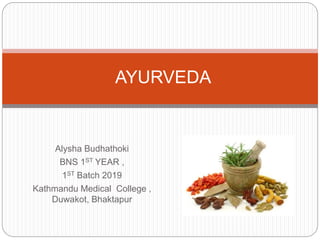
AYURVEDA
CONTENT
 INTRODUCTION
 COMPONENT OF AYURVEDA
 BASIC PRINCIPLES OF AYURVEDA
 CLINICAL PRACTICE
 SUBSTANCE USED
 LIMITATION
N
 AYURVEDA (The Complete Knowledge for long life).
 Ancient science of life .
 In SANSKRIT , the word ayurveda consists of two words
AYUR- Life
VEDA- knowledge or science
Thus , AYURVEDA in totality means : “SCIENCE OF
LIFE”
Cont.
 It is the most ancient(900 B.C) and
renowned system of medicine in India.
 It is more than 5000 years old system
 But yet has the potential to cure many
disease in effficient manner
 It is a system of medicine with hystorical
roots in the indian subcontinent
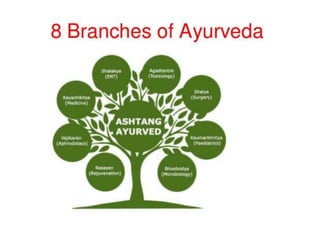
COMPONENT OF
AYURVEDA
 Kaya Chikitsa (Medicine)
 Salya Chikitsa(Surgery)
 Salakya Chikitsa(ENT Treatment)
 Bala Chikitsa (Pediatric treatment)
 Jara Chikitsa (Treatment related to
genetics )
 Rasayana Chikitsa (Treatment with
chemicals)
 Vajikarma Chikitsa ( Treatments with
aphrodisiacs)
BASIC PRINCIPLES OF
AYURVEDA
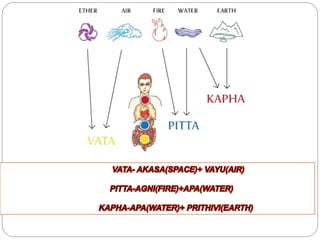
 Ayurveda believes five basic elements
Pancamahabhutas
1. Prithivi (earth)
2. Jal (water)
3. Teja (fire)
4. Vayu (air)
5. Akash (space)
 Manifest in the human body as
three basic humours known as tridosas:
(Vata,Pitta and Kapha).
VATA
 The biological air humor is called VATA.
 Helps in exalation, movement and discharge,
impulses, equilibrium of tissue and coordination of
senses.
 When disturbed causes illness, weakness , tremors,
constipation,insomnia
 Located in colon, thigh, hip and bones
PITTA
 The biological fire humor is called PITTA.
 Responsible for all chemical and metabolic
transformation in the body
 Exist mainly in acid form as fire.
 Governs digestion, heat,hunger thrust ,
intelligence,courage and softness of body.
 Located in small intestine, stomach
blood ,lymph
KAPHA
 The biological water humor is called KAPA
 Gives stability, lubrication and holding
together of joints
 Excessive kapha causes depression of
digestive fire, nausea , lethargy ,
cough,difficulty in breathing and excessive
sleeping.
CLINICAL PRACTICE
 Ayurvedic medicine (“Ayurveda” for short) is one
of the world's oldest holistic (“whole-body”)
healing systems.
 It's based on the belief that health and wellness
depend on a delicate balance between the mind,
body, and spirit. Its main goal is to promote good
health, not fight disease.
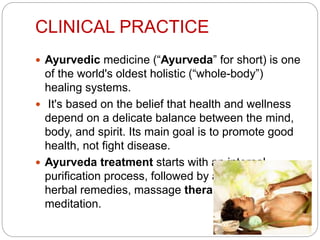
 Ayurveda treatment starts with an internal
purification process, followed by a special diet,
herbal remedies, massage therapy, yoga, and
meditation.
Cont..
DIAGNOSIS:
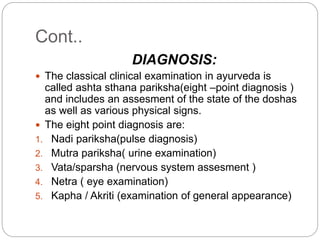
 The classical clinical examination in ayurveda is
called ashta sthana pariksha(eight –point diagnosis )
and includes an assesment of the state of the doshas
as well as various physical signs.
 The eight point diagnosis are:
1. Nadi pariksha(pulse diagnosis)
2. Mutra pariksha( urine examination)
3. Vata/sparsha (nervous system assesment )
4. Netra ( eye examination)
5. Kapha / Akriti (examination of general appearance)
Cont….
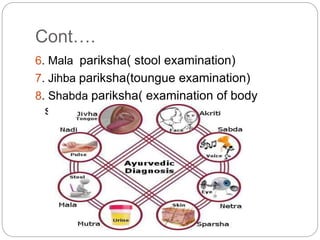
6. Mala pariksha( stool examination)
7. Jihba pariksha(toungue examination)
8. Shabda pariksha( examination of body
sounds)
TREATMENT
“ focus on the person than the disease”
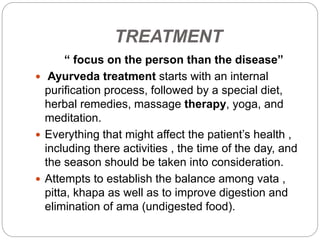
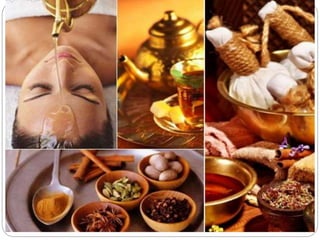
 Ayurveda treatment starts with an internal
purification process, followed by a special diet,
herbal remedies, massage therapy, yoga, and
meditation.
 Everything that might affect the patient’s health ,
including there activities , the time of the day, and
the season should be taken into consideration.
 Attempts to establish the balance among vata ,
pitta, khapa as well as to improve digestion and
elimination of ama (undigested food).
SUBSTANCE USED
 Plant-based treatments in Ayurveda may be
derived from roots, leaves, fruits, bark, or seeds
such as cardamom and cinnamon.
 Animal products used in Ayurveda include milk,
bones, and gallstones
 The addition of minerals to herbal medicine is
called rasa shastra which include minerals
like sulphur, arsenic, lead, copper sulfate and
gold.
 Ayurveda says that both oil and tar can be used
to stop bleeding.
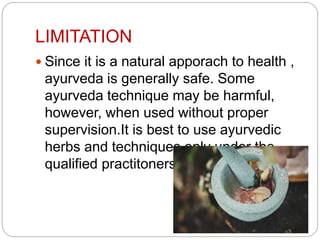
LIMITATION
 Since it is a natural apporach to health ,
ayurveda is generally safe. Some
ayurveda technique may be harmful,
however, when used without proper
supervision.It is best to use ayurvedic
herbs and techniques only under the
qualified practitoners.
References
 Sharma Mona ,Nursing concepts and
principles.Pag.e num(79-82).
 https://www.ayurveda.com/resources/articles/ayur
veda-a-brief-introduction-and-guide
 https://www.slideshare.net/SudheerKandibanda/a
yurveda-56893476
 http://ayush.gov.in/About-The-
Systems/Ayurveda/faq/how-diagnosis-done-
ayurveda
THANK
YOU
THE NATURAL HEALING FORCE WITH IN EACH OF
US IS THE GREATEST FORCE IN GETTING WELL !!

Ayurveda

  • 1.
    Alysha Budhathoki BNS 1STYEAR , 1ST Batch 2019 Kathmandu Medical College , Duwakot, Bhaktapur AYURVEDA
  • 2.
    CONTENT  INTRODUCTION  COMPONENTOF AYURVEDA  BASIC PRINCIPLES OF AYURVEDA  CLINICAL PRACTICE  SUBSTANCE USED  LIMITATION
  • 3.
    N  AYURVEDA (TheComplete Knowledge for long life).  Ancient science of life .  In SANSKRIT , the word ayurveda consists of two words AYUR- Life VEDA- knowledge or science Thus , AYURVEDA in totality means : “SCIENCE OF LIFE”
  • 4.
    Cont.  It isthe most ancient(900 B.C) and renowned system of medicine in India.  It is more than 5000 years old system  But yet has the potential to cure many disease in effficient manner  It is a system of medicine with hystorical roots in the indian subcontinent
  • 5.
    COMPONENT OF AYURVEDA  KayaChikitsa (Medicine)  Salya Chikitsa(Surgery)  Salakya Chikitsa(ENT Treatment)  Bala Chikitsa (Pediatric treatment)  Jara Chikitsa (Treatment related to genetics )  Rasayana Chikitsa (Treatment with chemicals)  Vajikarma Chikitsa ( Treatments with aphrodisiacs)
  • 7.
    BASIC PRINCIPLES OF AYURVEDA Ayurveda believes five basic elements Pancamahabhutas 1. Prithivi (earth) 2. Jal (water) 3. Teja (fire) 4. Vayu (air) 5. Akash (space)  Manifest in the human body as three basic humours known as tridosas: (Vata,Pitta and Kapha).
  • 9.
    VATA  The biologicalair humor is called VATA.  Helps in exalation, movement and discharge, impulses, equilibrium of tissue and coordination of senses.  When disturbed causes illness, weakness , tremors, constipation,insomnia  Located in colon, thigh, hip and bones
  • 10.
    PITTA  The biologicalfire humor is called PITTA.  Responsible for all chemical and metabolic transformation in the body  Exist mainly in acid form as fire.  Governs digestion, heat,hunger thrust , intelligence,courage and softness of body.  Located in small intestine, stomach blood ,lymph
  • 11.
    KAPHA  The biologicalwater humor is called KAPA  Gives stability, lubrication and holding together of joints  Excessive kapha causes depression of digestive fire, nausea , lethargy , cough,difficulty in breathing and excessive sleeping.
  • 12.
    CLINICAL PRACTICE  Ayurvedicmedicine (“Ayurveda” for short) is one of the world's oldest holistic (“whole-body”) healing systems.  It's based on the belief that health and wellness depend on a delicate balance between the mind, body, and spirit. Its main goal is to promote good health, not fight disease.  Ayurveda treatment starts with an internal purification process, followed by a special diet, herbal remedies, massage therapy, yoga, and meditation.
  • 13.
    Cont.. DIAGNOSIS:  The classicalclinical examination in ayurveda is called ashta sthana pariksha(eight –point diagnosis ) and includes an assesment of the state of the doshas as well as various physical signs.  The eight point diagnosis are: 1. Nadi pariksha(pulse diagnosis) 2. Mutra pariksha( urine examination) 3. Vata/sparsha (nervous system assesment ) 4. Netra ( eye examination) 5. Kapha / Akriti (examination of general appearance)
  • 14.
    Cont…. 6. Mala pariksha(stool examination) 7. Jihba pariksha(toungue examination) 8. Shabda pariksha( examination of body sounds)
  • 15.
    TREATMENT “ focus onthe person than the disease”  Ayurveda treatment starts with an internal purification process, followed by a special diet, herbal remedies, massage therapy, yoga, and meditation.  Everything that might affect the patient’s health , including there activities , the time of the day, and the season should be taken into consideration.  Attempts to establish the balance among vata , pitta, khapa as well as to improve digestion and elimination of ama (undigested food).
  • 17.
    SUBSTANCE USED  Plant-basedtreatments in Ayurveda may be derived from roots, leaves, fruits, bark, or seeds such as cardamom and cinnamon.  Animal products used in Ayurveda include milk, bones, and gallstones  The addition of minerals to herbal medicine is called rasa shastra which include minerals like sulphur, arsenic, lead, copper sulfate and gold.  Ayurveda says that both oil and tar can be used to stop bleeding.
  • 18.
    LIMITATION  Since itis a natural apporach to health , ayurveda is generally safe. Some ayurveda technique may be harmful, however, when used without proper supervision.It is best to use ayurvedic herbs and techniques only under the qualified practitoners.
  • 19.
    References  Sharma Mona,Nursing concepts and principles.Pag.e num(79-82).  https://www.ayurveda.com/resources/articles/ayur veda-a-brief-introduction-and-guide  https://www.slideshare.net/SudheerKandibanda/a yurveda-56893476  http://ayush.gov.in/About-The- Systems/Ayurveda/faq/how-diagnosis-done- ayurveda
  • 20.
    THANK YOU THE NATURAL HEALINGFORCE WITH IN EACH OF US IS THE GREATEST FORCE IN GETTING WELL !!