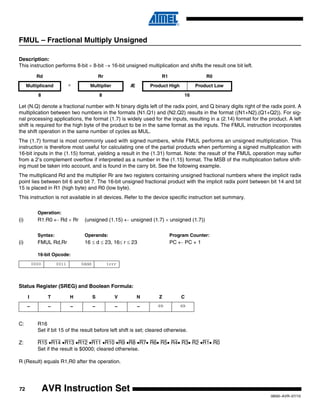
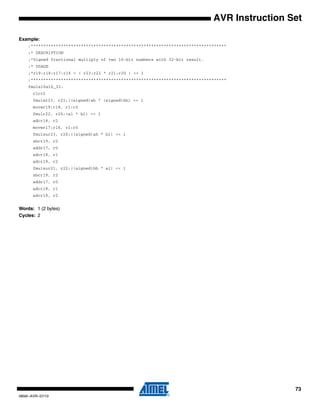
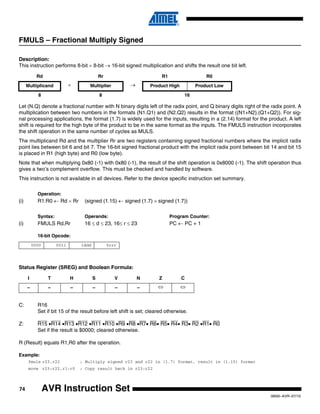
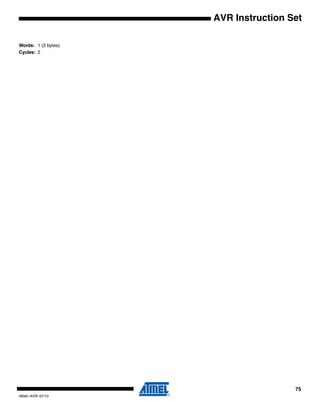
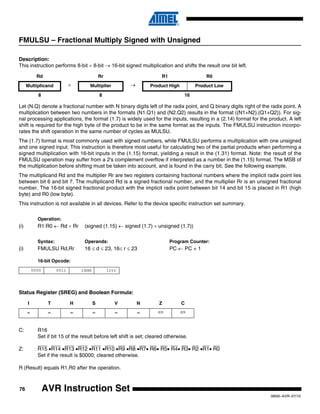
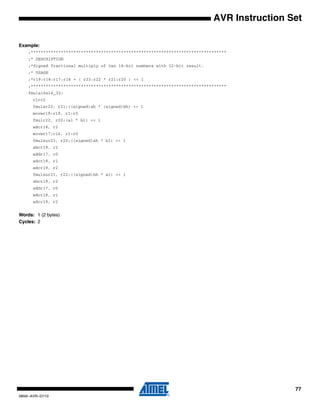
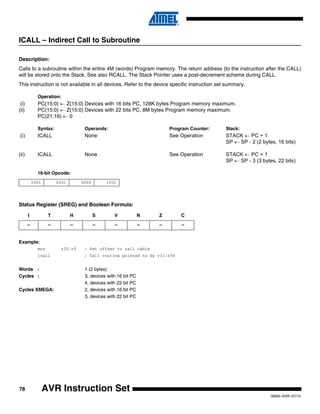
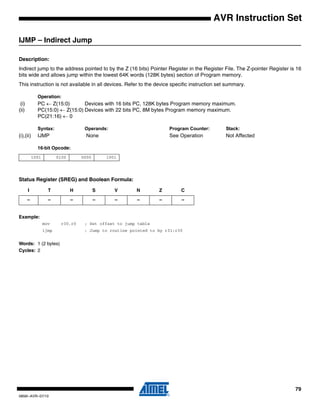
Instruction Set Nomenclature
Status Register (SREG)
SREG: Status Register
C: Carry Flag
Z: Zero Flag
N: Negative Flag
V: Two’s complement overflow indicator
S: N ⊕ V, For signed tests
H: Half Carry Flag
T: Transfer bit used by BLD and BST instructions
I: Global Interrupt Enable/Disable Flag
Registers and Operands
Rd: Destination (and source) register in the Register File
Rr: Source register in the Register File
R: Result after instruction is executed
K: Constant data
k: Constant address
b: Bit in the Register File or I/O Register (3-bit)
s: Bit in the Status Register (3-bit)
X,Y,Z: Indirect Address Register
(X=R27:R26, Y=R29:R28 and Z=R31:R30)
A: I/O location address
q: Displacement for direct addressing (6-bit)
8-bit
Instruction Set
Rev. 0856I–AVR–07/10
2
0856I–AVR–07/10
AVR Instruction Set
I/O Registers
RAMPX, RAMPY, RAMPZ
Registers concatenated with the X-, Y-, and Z-registers enabling indirect addressing of the whole data space on MCUs with
more than 64K bytes data space, and constant data fetch on MCUs with more than 64K bytes program space.
RAMPD
Register concatenated with the Z-register enabling direct addressing of the whole data space on MCUs with more than 64K
bytes data space.
EIND
Register concatenated with the Z-register enabling indirect jump and call to the whole program space on MCUs with more
than 64K words (128K bytes) program space.
Stack
STACK: Stack for return address and pushed registers
SP: Stack Pointer to STACK
Flags
⇔: Flag affected by instruction
0: Flag cleared by instruction
1: Flag set by instruction
-: Flag not affected by instruction
3
0856I–AVR–07/10
AVR Instruction Set
The Program and Data Addressing Modes
The AVR Enhanced RISC microcontroller supports powerful and efficient addressing modes for access to the Program
memory (Flash) and Data memory (SRAM, Register file, I/O Memory, and Extended I/O Memory). This section describes
the various addressing modes supported by the AVR architecture. In the following figures, OP means the operation code
part of the instruction word. To simplify, not all figures show the exact location of the addressing bits. To generalize, the
abstract terms RAMEND and FLASHEND have been used to represent the highest location in data and program space,
respectively.
Note: Not all addressing modes are present in all devices. Refer to the device spesific instruction summary.
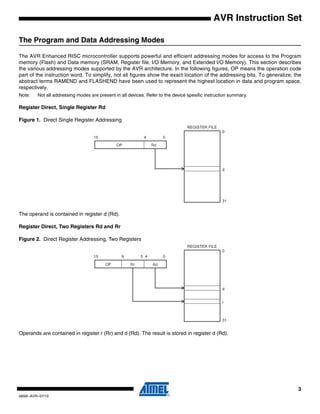
Register Direct, Single Register Rd
Figure 1. Direct Single Register Addressing
The operand is contained in register d (Rd).
Register Direct, Two Registers Rd and Rr
Figure 2. Direct Register Addressing, Two Registers
Operands are contained in register r (Rr) and d (Rd). The result is stored in register d (Rd).
4
0856I–AVR–07/10
AVR Instruction Set
I/O Direct
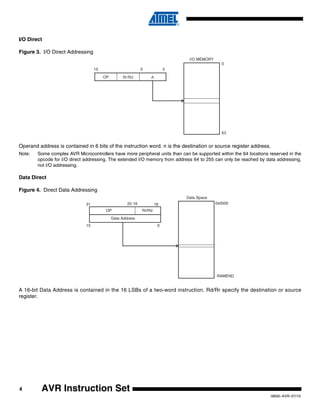
Figure 3. I/O Direct Addressing
Operand address is contained in 6 bits of the instruction word. n is the destination or source register address.
Note: Some complex AVR Microcontrollers have more peripheral units than can be supported within the 64 locations reserved in the
opcode for I/O direct addressing. The extended I/O memory from address 64 to 255 can only be reached by data addressing,
not I/O addressing.
Data Direct
Figure 4. Direct Data Addressing
A 16-bit Data Address is contained in the 16 LSBs of a two-word instruction. Rd/Rr specify the destination or source
register.
OP Rr/Rd
1631
15 0
Data Address
0x0000
RAMEND
20 19
Data Space
5
0856I–AVR–07/10
AVR Instruction Set
Data Indirect with Displacement
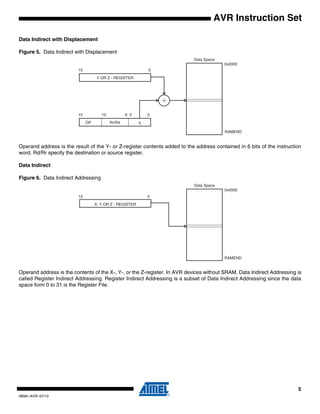
Figure 5. Data Indirect with Displacement
Operand address is the result of the Y- or Z-register contents added to the address contained in 6 bits of the instruction
word. Rd/Rr specify the destination or source register.
Data Indirect
Figure 6. Data Indirect Addressing
Operand address is the contents of the X-, Y-, or the Z-register. In AVR devices without SRAM, Data Indirect Addressing is
called Register Indirect Addressing. Register Indirect Addressing is a subset of Data Indirect Addressing since the data
space form 0 to 31 is the Register File.
Data Space
0x0000
RAMEND
Y OR Z - REGISTER
OP qRr/Rd
0
05610
15
15
Data Space
0x0000
X, Y OR Z - REGISTER
015
RAMEND
6
0856I–AVR–07/10
AVR Instruction Set
Data Indirect with Pre-decrement
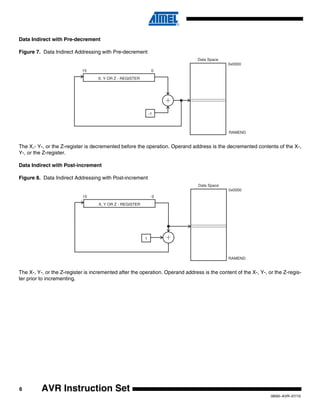
Figure 7. Data Indirect Addressing with Pre-decrement
The X,- Y-, or the Z-register is decremented before the operation. Operand address is the decremented contents of the X-,
Y-, or the Z-register.
Data Indirect with Post-increment
Figure 8. Data Indirect Addressing with Post-increment
The X-, Y-, or the Z-register is incremented after the operation. Operand address is the content of the X-, Y-, or the Z-regis-
ter prior to incrementing.
Data Space
0x0000
X, Y OR Z - REGISTER
015
-1
RAMEND
Data Space
0x0000
X, Y OR Z - REGISTER
015
1
RAMEND
7
0856I–AVR–07/10
AVR Instruction Set
Program Memory Constant Addressing using the LPM, ELPM, and SPM Instructions
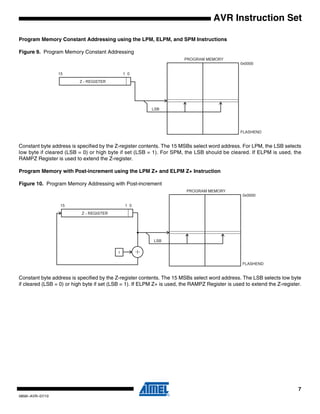
Figure 9. Program Memory Constant Addressing
Constant byte address is specified by the Z-register contents. The 15 MSBs select word address. For LPM, the LSB selects
low byte if cleared (LSB = 0) or high byte if set (LSB = 1). For SPM, the LSB should be cleared. If ELPM is used, the
RAMPZ Register is used to extend the Z-register.
Program Memory with Post-increment using the LPM Z+ and ELPM Z+ Instruction
Figure 10. Program Memory Addressing with Post-increment
Constant byte address is specified by the Z-register contents. The 15 MSBs select word address. The LSB selects low byte
if cleared (LSB = 0) or high byte if set (LSB = 1). If ELPM Z+ is used, the RAMPZ Register is used to extend the Z-register.
FLASHEND
0x0000
LSB
FLASHEND
0x0000
1
LSB
8
0856I–AVR–07/10
AVR Instruction Set
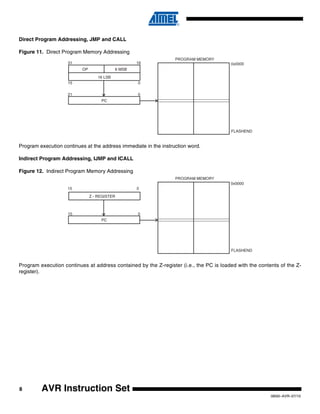
Direct Program Addressing, JMP and CALL
Figure 11. Direct Program Memory Addressing
Program execution continues at the address immediate in the instruction word.
Indirect Program Addressing, IJMP and ICALL
Figure 12. Indirect Program Memory Addressing
Program execution continues at address contained by the Z-register (i.e., the PC is loaded with the contents of the Z-
register).
FLASHEND
31 16
OP 6 MSB
16 LSB
PC
21 0
15 0
0x0000
FLASHEND
PC
15 0
0x0000
9
0856I–AVR–07/10
AVR Instruction Set
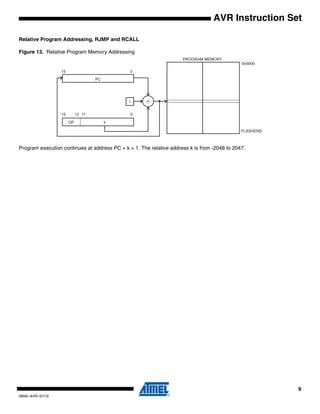
Relative Program Addressing, RJMP and RCALL
Figure 13. Relative Program Memory Addressing
Program execution continues at address PC + k + 1. The relative address k is from -2048 to 2047.
FLASHEND
1
0x0000
10
0856I–AVR–07/10
AVR Instruction Set
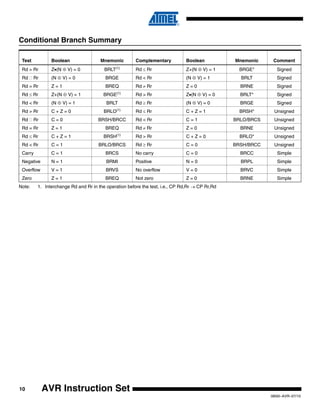
Conditional Branch Summary
Note: 1. Interchange Rd and Rr in the operation before the test, i.e., CP Rd,Rr → CP Rr,Rd
Test Boolean Mnemonic Complementary Boolean Mnemonic Comment
Rd > Rr Z•(N ⊕ V) = 0 BRLT(1)
Rd ≤ Rr Z+(N ⊕ V) = 1 BRGE* Signed
Rd Rr (N ⊕ V) = 0 BRGE Rd < Rr (N ⊕ V) = 1 BRLT Signed
Rd = Rr Z = 1 BREQ Rd ≠ Rr Z = 0 BRNE Signed
Rd ≤ Rr Z+(N ⊕ V) = 1 BRGE(1)
Rd > Rr Z•(N ⊕ V) = 0 BRLT* Signed
Rd < Rr (N ⊕ V) = 1 BRLT Rd ≥ Rr (N ⊕ V) = 0 BRGE Signed
Rd > Rr C + Z = 0 BRLO(1)
Rd ≤ Rr C + Z = 1 BRSH* Unsigned
Rd Rr C = 0 BRSH/BRCC Rd < Rr C = 1 BRLO/BRCS Unsigned
Rd = Rr Z = 1 BREQ Rd ≠ Rr Z = 0 BRNE Unsigned
Rd ≤ Rr C + Z = 1 BRSH(1)
Rd > Rr C + Z = 0 BRLO* Unsigned
Rd < Rr C = 1 BRLO/BRCS Rd ≥ Rr C = 0 BRSH/BRCC Unsigned
Carry C = 1 BRCS No carry C = 0 BRCC Simple
Negative N = 1 BRMI Positive N = 0 BRPL Simple
Overflow V = 1 BRVS No overflow V = 0 BRVC Simple
Zero Z = 1 BREQ Not zero Z = 0 BRNE Simple
11
0856I–AVR–07/10
AVR Instruction Set
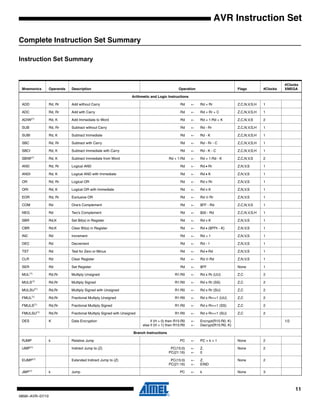
Complete Instruction Set Summary
Instruction Set Summary
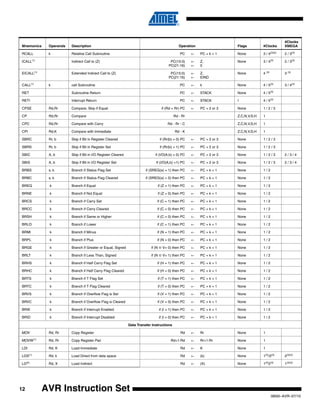
Mnemonics Operands Description Operation Flags #Clocks
#Clocks
XMEGA
Arithmetic and Logic Instructions
ADD Rd, Rr Add without Carry Rd ← Rd + Rr Z,C,N,V,S,H 1
ADC Rd, Rr Add with Carry Rd ← Rd + Rr + C Z,C,N,V,S,H 1
ADIW(1)
Rd, K Add Immediate to Word Rd ← Rd + 1:Rd + K Z,C,N,V,S 2
SUB Rd, Rr Subtract without Carry Rd ← Rd - Rr Z,C,N,V,S,H 1
SUBI Rd, K Subtract Immediate Rd ← Rd - K Z,C,N,V,S,H 1
SBC Rd, Rr Subtract with Carry Rd ← Rd - Rr - C Z,C,N,V,S,H 1
SBCI Rd, K Subtract Immediate with Carry Rd ← Rd - K - C Z,C,N,V,S,H 1
SBIW(1)
Rd, K Subtract Immediate from Word Rd + 1:Rd ← Rd + 1:Rd - K Z,C,N,V,S 2
AND Rd, Rr Logical AND Rd ← Rd • Rr Z,N,V,S 1
ANDI Rd, K Logical AND with Immediate Rd ← Rd • K Z,N,V,S 1
OR Rd, Rr Logical OR Rd ← Rd v Rr Z,N,V,S 1
ORI Rd, K Logical OR with Immediate Rd ← Rd v K Z,N,V,S 1
EOR Rd, Rr Exclusive OR Rd ← Rd ⊕ Rr Z,N,V,S 1
COM Rd One’s Complement Rd ← $FF - Rd Z,C,N,V,S 1
NEG Rd Two’s Complement Rd ← $00 - Rd Z,C,N,V,S,H 1
SBR Rd,K Set Bit(s) in Register Rd ← Rd v K Z,N,V,S 1
CBR Rd,K Clear Bit(s) in Register Rd ← Rd • ($FFh - K) Z,N,V,S 1
INC Rd Increment Rd ← Rd + 1 Z,N,V,S 1
DEC Rd Decrement Rd ← Rd - 1 Z,N,V,S 1
TST Rd Test for Zero or Minus Rd ← Rd • Rd Z,N,V,S 1
CLR Rd Clear Register Rd ← Rd ⊕ Rd Z,N,V,S 1
SER Rd Set Register Rd ← $FF None 1
MUL(1)
Rd,Rr Multiply Unsigned R1:R0 ← Rd x Rr (UU) Z,C 2
MULS(1)
Rd,Rr Multiply Signed R1:R0 ← Rd x Rr (SS) Z,C 2
MULSU(1)
Rd,Rr Multiply Signed with Unsigned R1:R0 ← Rd x Rr (SU) Z,C 2
FMUL(1)
Rd,Rr Fractional Multiply Unsigned R1:R0 ← Rd x Rr<<1 (UU) Z,C 2
FMULS(1)
Rd,Rr Fractional Multiply Signed R1:R0 ← Rd x Rr<<1 (SS) Z,C 2
FMULSU(1)
Rd,Rr Fractional Multiply Signed with Unsigned R1:R0 ← Rd x Rr<<1 (SU) Z,C 2
DES K Data Encryption if (H = 0) then R15:R0
else if (H = 1) then R15:R0
←
←
Encrypt(R15:R0, K)
Decrypt(R15:R0, K)
1/2
Branch Instructions
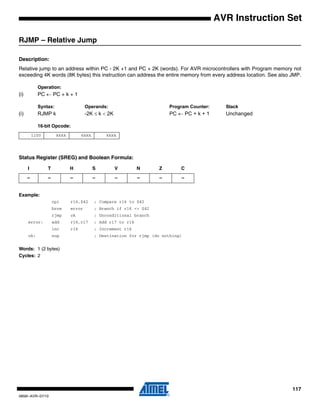
RJMP k Relative Jump PC ← PC + k + 1 None 2
IJMP(1)
Indirect Jump to (Z) PC(15:0)
PC(21:16)
←
←
Z,
0
None 2
EIJMP(1)
Extended Indirect Jump to (Z) PC(15:0)
PC(21:16)
←
←
Z,
EIND
None 2
JMP(1)
k Jump PC ← k None 3
12
0856I–AVR–07/10
AVR Instruction Set
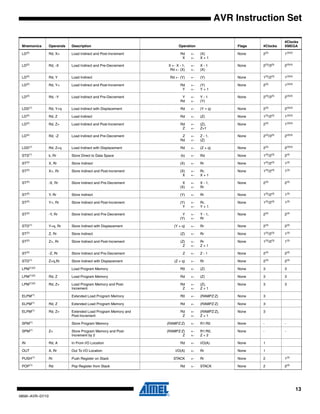
RCALL k Relative Call Subroutine PC ← PC + k + 1 None 3 / 4(3)(5)
2 / 3(3)
ICALL(1)
Indirect Call to (Z) PC(15:0)
PC(21:16)
←
←
Z,
0
None 3 / 4(3)
2 / 3(3)
EICALL(1)
Extended Indirect Call to (Z) PC(15:0)
PC(21:16)
←
←
Z,
EIND
None 4 (3)
3 (3)
CALL(1)
k call Subroutine PC ← k None 4 / 5(3)
3 / 4(3)
RET Subroutine Return PC ← STACK None 4 / 5(3)
RETI Interrupt Return PC ← STACK I 4 / 5(3)
CPSE Rd,Rr Compare, Skip if Equal if (Rd = Rr) PC ← PC + 2 or 3 None 1 / 2 / 3
CP Rd,Rr Compare Rd - Rr Z,C,N,V,S,H 1
CPC Rd,Rr Compare with Carry Rd - Rr - C Z,C,N,V,S,H 1
CPI Rd,K Compare with Immediate Rd - K Z,C,N,V,S,H 1
SBRC Rr, b Skip if Bit in Register Cleared if (Rr(b) = 0) PC ← PC + 2 or 3 None 1 / 2 / 3
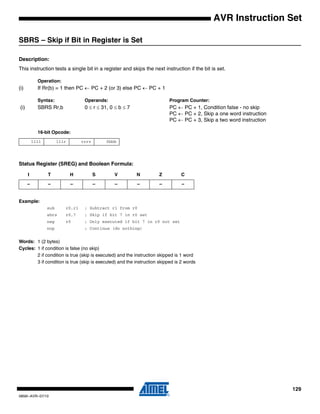
SBRS Rr, b Skip if Bit in Register Set if (Rr(b) = 1) PC ← PC + 2 or 3 None 1 / 2 / 3
SBIC A, b Skip if Bit in I/O Register Cleared if (I/O(A,b) = 0) PC ← PC + 2 or 3 None 1 / 2 / 3 2 / 3 / 4
SBIS A, b Skip if Bit in I/O Register Set If (I/O(A,b) =1) PC ← PC + 2 or 3 None 1 / 2 / 3 2 / 3 / 4
BRBS s, k Branch if Status Flag Set if (SREG(s) = 1) then PC ← PC + k + 1 None 1 / 2
BRBC s, k Branch if Status Flag Cleared if (SREG(s) = 0) then PC ← PC + k + 1 None 1 / 2
BREQ k Branch if Equal if (Z = 1) then PC ← PC + k + 1 None 1 / 2
BRNE k Branch if Not Equal if (Z = 0) then PC ← PC + k + 1 None 1 / 2
BRCS k Branch if Carry Set if (C = 1) then PC ← PC + k + 1 None 1 / 2
BRCC k Branch if Carry Cleared if (C = 0) then PC ← PC + k + 1 None 1 / 2
BRSH k Branch if Same or Higher if (C = 0) then PC ← PC + k + 1 None 1 / 2
BRLO k Branch if Lower if (C = 1) then PC ← PC + k + 1 None 1 / 2
BRMI k Branch if Minus if (N = 1) then PC ← PC + k + 1 None 1 / 2
BRPL k Branch if Plus if (N = 0) then PC ← PC + k + 1 None 1 / 2
BRGE k Branch if Greater or Equal, Signed if (N ⊕ V= 0) then PC ← PC + k + 1 None 1 / 2
BRLT k Branch if Less Than, Signed if (N ⊕ V= 1) then PC ← PC + k + 1 None 1 / 2
BRHS k Branch if Half Carry Flag Set if (H = 1) then PC ← PC + k + 1 None 1 / 2
BRHC k Branch if Half Carry Flag Cleared if (H = 0) then PC ← PC + k + 1 None 1 / 2
BRTS k Branch if T Flag Set if (T = 1) then PC ← PC + k + 1 None 1 / 2
BRTC k Branch if T Flag Cleared if (T = 0) then PC ← PC + k + 1 None 1 / 2
BRVS k Branch if Overflow Flag is Set if (V = 1) then PC ← PC + k + 1 None 1 / 2
BRVC k Branch if Overflow Flag is Cleared if (V = 0) then PC ← PC + k + 1 None 1 / 2
BRIE k Branch if Interrupt Enabled if (I = 1) then PC ← PC + k + 1 None 1 / 2
BRID k Branch if Interrupt Disabled if (I = 0) then PC ← PC + k + 1 None 1 / 2
Data Transfer Instructions
MOV Rd, Rr Copy Register Rd ← Rr None 1
MOVW(1)
Rd, Rr Copy Register Pair Rd+1:Rd ← Rr+1:Rr None 1
LDI Rd, K Load Immediate Rd ← K None 1
LDS(1)
Rd, k Load Direct from data space Rd ← (k) None 1(5)
/2(3)
2(3)(4)
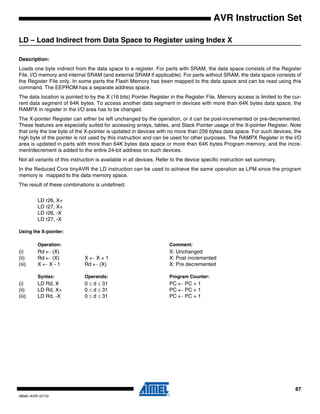
LD(2)
Rd, X Load Indirect Rd ← (X) None 1(5)
2(3)
1(3)(4)
Mnemonics Operands Description Operation Flags #Clocks
#Clocks
XMEGA
13
0856I–AVR–07/10
AVR Instruction Set
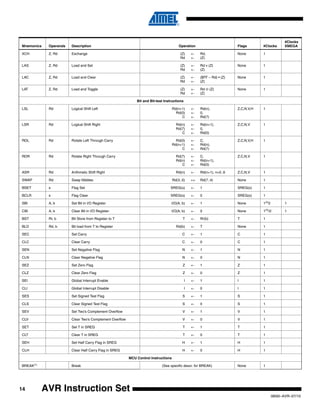
LD(2)
Rd, X+ Load Indirect and Post-Increment Rd
X
←
←
(X)
X + 1
None 2(3)
1(3)(4)
LD(2)
Rd, -X Load Indirect and Pre-Decrement X ← X - 1,
Rd ← (X)
←
←
X - 1
(X)
None 2(3)
/3(5)
2(3)(4)
LD(2)
Rd, Y Load Indirect Rd ← (Y) ← (Y) None 1(5)
/2(3)
1(3)(4)
LD(2)
Rd, Y+ Load Indirect and Post-Increment Rd
Y
←
←
(Y)
Y + 1
None 2(3)
1(3)(4)
LD(2)
Rd, -Y Load Indirect and Pre-Decrement Y
Rd
←
←
Y - 1
(Y)
None 2(3)
/3(5)
2(3)(4)
LDD(1)
Rd, Y+q Load Indirect with Displacement Rd ← (Y + q) None 2(3)
2(3)(4)
LD(2)
Rd, Z Load Indirect Rd ← (Z) None 1(5)
/2(3)
1(3)(4)
LD(2)
Rd, Z+ Load Indirect and Post-Increment Rd
Z
←
←
(Z),
Z+1
None 2(3)
1(3)(4)
LD(2)
Rd, -Z Load Indirect and Pre-Decrement Z
Rd
←
←
Z - 1,
(Z)
None 2(3)
/3(5)
2(3)(4)
LDD(1)
Rd, Z+q Load Indirect with Displacement Rd ← (Z + q) None 2(3)
2(3)(4)
STS(1)
k, Rr Store Direct to Data Space (k) ← Rd None 1(5)
/2(3)
2(3)
ST(2)
X, Rr Store Indirect (X) ← Rr None 1(5)
/2(3)
1(3)
ST(2)
X+, Rr Store Indirect and Post-Increment (X)
X
←
←
Rr,
X + 1
None 1(5)
/2(3)
1(3)
ST(2)
-X, Rr Store Indirect and Pre-Decrement X
(X)
←
←
X - 1,
Rr
None 2(3)
2(3)
ST(2)
Y, Rr Store Indirect (Y) ← Rr None 1(5)
/2(3)
1(3)
ST(2)
Y+, Rr Store Indirect and Post-Increment (Y)
Y
←
←
Rr,
Y + 1
None 1(5)
/2(3)
1(3)
ST(2)
-Y, Rr Store Indirect and Pre-Decrement Y
(Y)
←
←
Y - 1,
Rr
None 2(3)
2(3)
STD(1)
Y+q, Rr Store Indirect with Displacement (Y + q) ← Rr None 2(3)
2(3)
ST(2)
Z, Rr Store Indirect (Z) ← Rr None 1(5)
/2(3)
1(3)
ST(2)
Z+, Rr Store Indirect and Post-Increment (Z)
Z
←
←
Rr
Z + 1
None 1(5)
/2(3)
1(3)
ST(2)
-Z, Rr Store Indirect and Pre-Decrement Z ← Z - 1 None 2(3)
2(3)
STD(1)
Z+q,Rr Store Indirect with Displacement (Z + q) ← Rr None 2(3)
2(3)
LPM(1)(2)
Load Program Memory R0 ← (Z) None 3 3
LPM(1)(2)
Rd, Z Load Program Memory Rd ← (Z) None 3 3
LPM(1)(2)
Rd, Z+ Load Program Memory and Post-
Increment
Rd
Z
←
←
(Z),
Z + 1
None 3 3
ELPM(1)
Extended Load Program Memory R0 ← (RAMPZ:Z) None 3
ELPM(1)
Rd, Z Extended Load Program Memory Rd ← (RAMPZ:Z) None 3
ELPM(1)
Rd, Z+ Extended Load Program Memory and
Post-Increment
Rd
Z
←
←
(RAMPZ:Z),
Z + 1
None 3
SPM(1)
Store Program Memory (RAMPZ:Z) ← R1:R0 None - -
SPM(1)
Z+ Store Program Memory and Post-
Increment by 2
(RAMPZ:Z)
Z
←
←
R1:R0,
Z + 2
None - -
IN Rd, A In From I/O Location Rd ← I/O(A) None 1
OUT A, Rr Out To I/O Location I/O(A) ← Rr None 1
PUSH(1)
Rr Push Register on Stack STACK ← Rr None 2 1(3)
POP(1)
Rd Pop Register from Stack Rd ← STACK None 2 2(3)
Mnemonics Operands Description Operation Flags #Clocks
#Clocks
XMEGA
14
0856I–AVR–07/10
AVR Instruction Set
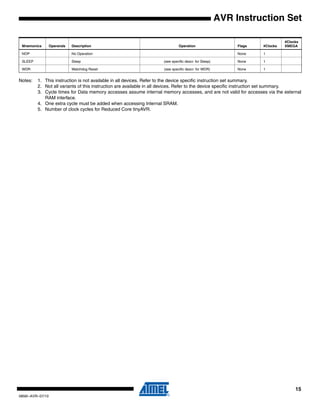
XCH Z, Rd Exchange (Z)
Rd
←
←
Rd,
(Z)
None 1
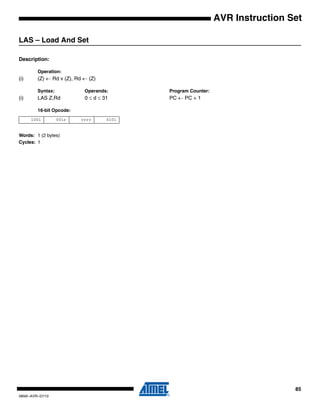
LAS Z, Rd Load and Set (Z)
Rd
←
←
Rd v (Z)
(Z)
None 1
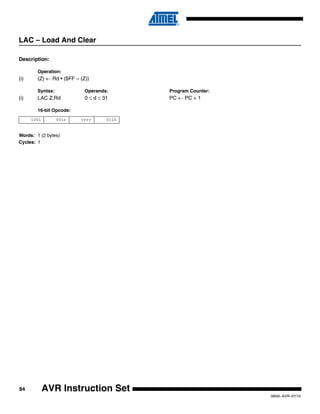
LAC Z, Rd Load and Clear (Z)
Rd
←
←
($FF – Rd) • (Z)
(Z)
None 1
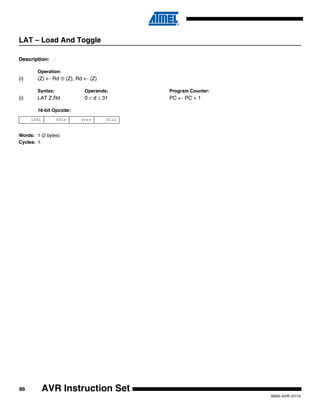
LAT Z, Rd Load and Toggle (Z)
Rd
←
←
Rd ⊕ (Z)
(Z)
None 1
Bit and Bit-test Instructions
LSL Rd Logical Shift Left Rd(n+1)
Rd(0)
C
←
←
←
Rd(n),
0,
Rd(7)
Z,C,N,V,H 1
LSR Rd Logical Shift Right Rd(n)
Rd(7)
C
←
←
←
Rd(n+1),
0,
Rd(0)
Z,C,N,V 1
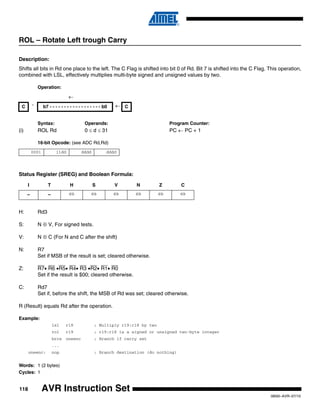
ROL Rd Rotate Left Through Carry Rd(0)
Rd(n+1)
C
←
←
←
C,
Rd(n),
Rd(7)
Z,C,N,V,H 1
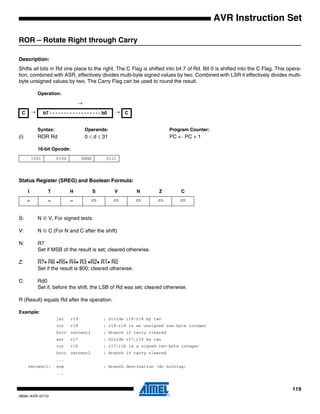
ROR Rd Rotate Right Through Carry Rd(7)
Rd(n)
C
←
←
←
C,
Rd(n+1),
Rd(0)
Z,C,N,V 1
ASR Rd Arithmetic Shift Right Rd(n) ← Rd(n+1), n=0..6 Z,C,N,V 1
SWAP Rd Swap Nibbles Rd(3..0) ↔ Rd(7..4) None 1
BSET s Flag Set SREG(s) ← 1 SREG(s) 1
BCLR s Flag Clear SREG(s) ← 0 SREG(s) 1
SBI A, b Set Bit in I/O Register I/O(A, b) ← 1 None 1(5)
2 1
CBI A, b Clear Bit in I/O Register I/O(A, b) ← 0 None 1(5)
/2 1
BST Rr, b Bit Store from Register to T T ← Rr(b) T 1
BLD Rd, b Bit load from T to Register Rd(b) ← T None 1
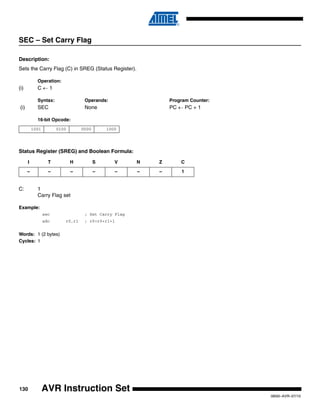
SEC Set Carry C ← 1 C 1
CLC Clear Carry C ← 0 C 1
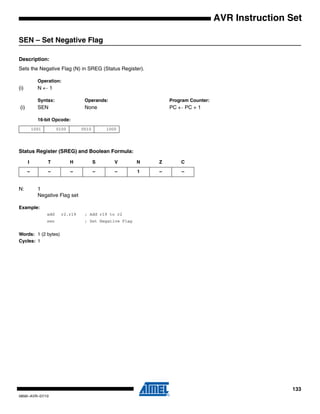
SEN Set Negative Flag N ← 1 N 1
CLN Clear Negative Flag N ← 0 N 1
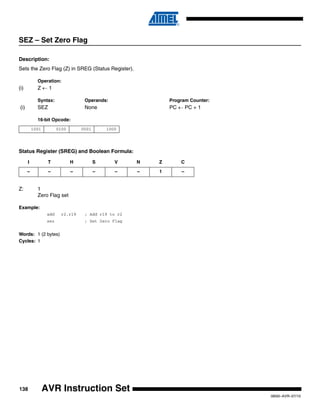
SEZ Set Zero Flag Z ← 1 Z 1
CLZ Clear Zero Flag Z ← 0 Z 1
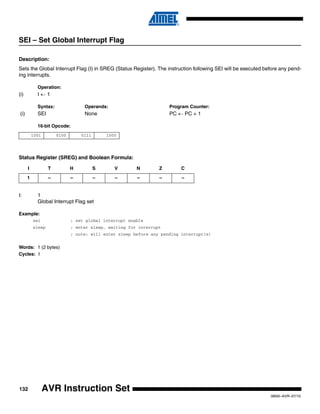
SEI Global Interrupt Enable I ← 1 I 1
CLI Global Interrupt Disable I ← 0 I 1
SES Set Signed Test Flag S ← 1 S 1
CLS Clear Signed Test Flag S ← 0 S 1
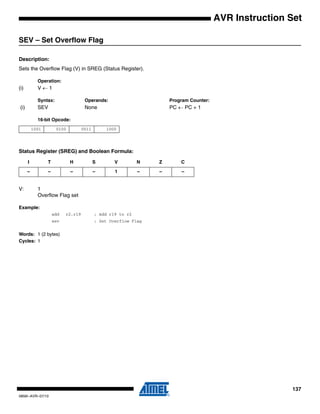
SEV Set Two’s Complement Overflow V ← 1 V 1
CLV Clear Two’s Complement Overflow V ← 0 V 1
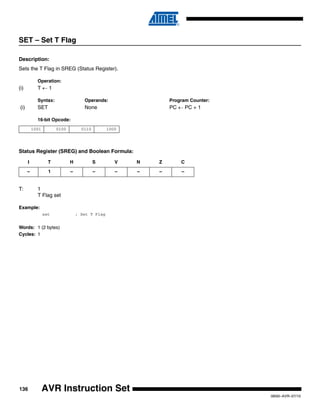
SET Set T in SREG T ← 1 T 1
CLT Clear T in SREG T ← 0 T 1
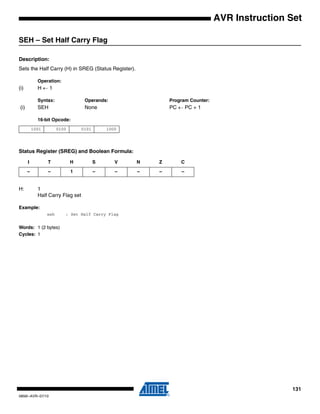
SEH Set Half Carry Flag in SREG H ← 1 H 1
CLH Clear Half Carry Flag in SREG H ← 0 H 1
MCU Control Instructions
BREAK(1)
Break (See specific descr. for BREAK) None 1
Mnemonics Operands Description Operation Flags #Clocks
#Clocks
XMEGA
15
0856I–AVR–07/10
AVR Instruction Set
Notes: 1. This instruction is not available in all devices. Refer to the device specific instruction set summary.
2. Not all variants of this instruction are available in all devices. Refer to the device specific instruction set summary.
3. Cycle times for Data memory accesses assume internal memory accesses, and are not valid for accesses via the external
RAM interface.
4. One extra cycle must be added when accessing Internal SRAM.
5. Number of clock cycles for Reduced Core tinyAVR.
NOP No Operation None 1
SLEEP Sleep (see specific descr. for Sleep) None 1
WDR Watchdog Reset (see specific descr. for WDR) None 1
Mnemonics Operands Description Operation Flags #Clocks
#Clocks
XMEGA
16
0856I–AVR–07/10
AVR Instruction Set
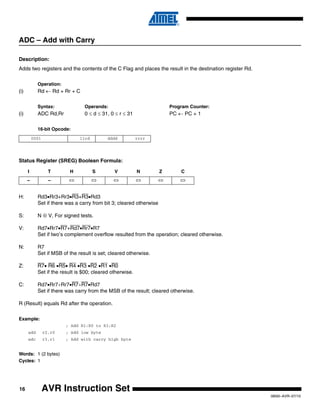
ADC – Add with Carry
Description:
Adds two registers and the contents of the C Flag and places the result in the destination register Rd.
Operation:
(i) Rd ← Rd + Rr + C
Syntax: Operands: Program Counter:
(i) ADC Rd,Rr 0 ≤ d ≤ 31, 0 ≤ r ≤ 31 PC ← PC + 1
16-bit Opcode:
Status Register (SREG) Boolean Formula:
H: Rd3•Rr3+Rr3•R3+R3•Rd3
Set if there was a carry from bit 3; cleared otherwise
S: N ⊕ V, For signed tests.
V: Rd7•Rr7•R7+Rd7•Rr7•R7
Set if two’s complement overflow resulted from the operation; cleared otherwise.
N: R7
Set if MSB of the result is set; cleared otherwise.
Z: R7• R6 •R5• R4 •R3 •R2 •R1 •R0
Set if the result is $00; cleared otherwise.
C: Rd7•Rr7+Rr7•R7+R7•Rd7
Set if there was carry from the MSB of the result; cleared otherwise.
R (Result) equals Rd after the operation.
Example:
; Add R1:R0 to R3:R2
add r2,r0 ; Add low byte
adc r3,r1 ; Add with carry high byte
Words: 1 (2 bytes)
Cycles: 1
0001 11rd dddd rrrr
I T H S V N Z C
– – ⇔ ⇔ ⇔ ⇔ ⇔ ⇔
17
0856I–AVR–07/10
AVR Instruction Set
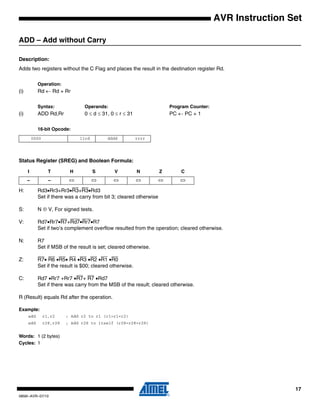
ADD – Add without Carry
Description:
Adds two registers without the C Flag and places the result in the destination register Rd.
Operation:
(i) Rd ← Rd + Rr
Syntax: Operands: Program Counter:
(i) ADD Rd,Rr 0 ≤ d ≤ 31, 0 ≤ r ≤ 31 PC ← PC + 1
16-bit Opcode:
Status Register (SREG) and Boolean Formula:
H: Rd3•Rr3+Rr3•R3+R3•Rd3
Set if there was a carry from bit 3; cleared otherwise
S: N ⊕ V, For signed tests.
V: Rd7•Rr7•R7+Rd7•Rr7•R7
Set if two’s complement overflow resulted from the operation; cleared otherwise.
N: R7
Set if MSB of the result is set; cleared otherwise.
Z: R7• R6 •R5• R4 •R3 •R2 •R1 •R0
Set if the result is $00; cleared otherwise.
C: Rd7 •Rr7 +Rr7 •R7+ R7 •Rd7
Set if there was carry from the MSB of the result; cleared otherwise.
R (Result) equals Rd after the operation.
Example:
add r1,r2 ; Add r2 to r1 (r1=r1+r2)
add r28,r28 ; Add r28 to itself (r28=r28+r28)
Words: 1 (2 bytes)
Cycles: 1
0000 11rd dddd rrrr
I T H S V N Z C
– – ⇔ ⇔ ⇔ ⇔ ⇔ ⇔
18
0856I–AVR–07/10
AVR Instruction Set
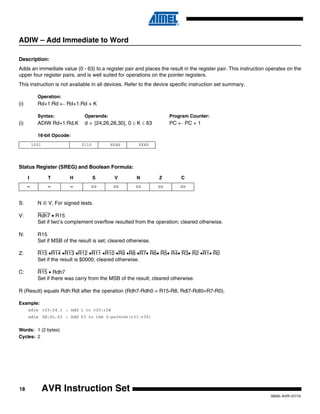
ADIW – Add Immediate to Word
Description:
Adds an immediate value (0 - 63) to a register pair and places the result in the register pair. This instruction operates on the
upper four register pairs, and is well suited for operations on the pointer registers.
This instruction is not available in all devices. Refer to the device specific instruction set summary.
Operation:
(i) Rd+1:Rd ← Rd+1:Rd + K
Syntax: Operands: Program Counter:
(i) ADIW Rd+1:Rd,K d ∈ {24,26,28,30}, 0 ≤ K ≤ 63 PC ← PC + 1
16-bit Opcode:
Status Register (SREG) and Boolean Formula:
S: N ⊕ V, For signed tests.
V: Rdh7 • R15
Set if two’s complement overflow resulted from the operation; cleared otherwise.
N: R15
Set if MSB of the result is set; cleared otherwise.
Z: R15 •R14 •R13 •R12 •R11 •R10 •R9 •R8 •R7• R6• R5• R4• R3• R2 •R1• R0
Set if the result is $0000; cleared otherwise.
C: R15 • Rdh7
Set if there was carry from the MSB of the result; cleared otherwise.
R (Result) equals Rdh:Rdl after the operation (Rdh7-Rdh0 = R15-R8, Rdl7-Rdl0=R7-R0).
Example:
adiw r25:24,1 ; Add 1 to r25:r24
adiw ZH:ZL,63 ; Add 63 to the Z-pointer(r31:r30)
Words: 1 (2 bytes)
Cycles: 2
1001 0110 KKdd KKKK
I T H S V N Z C
– – – ⇔ ⇔ ⇔ ⇔ ⇔
19
0856I–AVR–07/10
AVR Instruction Set
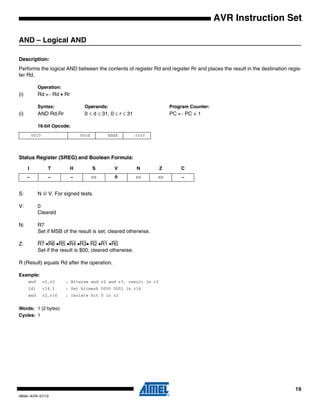
AND – Logical AND
Description:
Performs the logical AND between the contents of register Rd and register Rr and places the result in the destination regis-
ter Rd.
Operation:
(i) Rd ← Rd • Rr
Syntax: Operands: Program Counter:
(i) AND Rd,Rr 0 ≤ d ≤ 31, 0 ≤ r ≤ 31 PC ← PC + 1
16-bit Opcode:
Status Register (SREG) and Boolean Formula:
S: N ⊕ V, For signed tests.
V: 0
Cleared
N: R7
Set if MSB of the result is set; cleared otherwise.
Z: R7 •R6 •R5 •R4 •R3• R2 •R1 •R0
Set if the result is $00; cleared otherwise.
R (Result) equals Rd after the operation.
Example:
and r2,r3 ; Bitwise and r2 and r3, result in r2
ldi r16,1 ; Set bitmask 0000 0001 in r16
and r2,r16 ; Isolate bit 0 in r2
Words: 1 (2 bytes)
Cycles: 1
0010 00rd dddd rrrr
I T H S V N Z C
– – – ⇔ 0 ⇔ ⇔ –
20
0856I–AVR–07/10
AVR Instruction Set
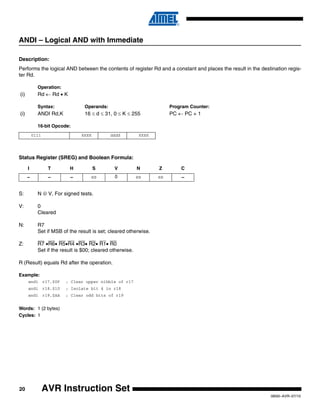
ANDI – Logical AND with Immediate
Description:
Performs the logical AND between the contents of register Rd and a constant and places the result in the destination regis-
ter Rd.
Operation:
(i) Rd ← Rd • K
Syntax: Operands: Program Counter:
(i) ANDI Rd,K 16 ≤ d ≤ 31, 0 ≤ K ≤ 255 PC ← PC + 1
16-bit Opcode:
Status Register (SREG) and Boolean Formula:
S: N ⊕ V, For signed tests.
V: 0
Cleared
N: R7
Set if MSB of the result is set; cleared otherwise.
Z: R7 •R6• R5•R4 •R3• R2• R1• R0
Set if the result is $00; cleared otherwise.
R (Result) equals Rd after the operation.
Example:
andi r17,$0F ; Clear upper nibble of r17
andi r18,$10 ; Isolate bit 4 in r18
andi r19,$AA ; Clear odd bits of r19
Words: 1 (2 bytes)
Cycles: 1
0111 KKKK dddd KKKK
I T H S V N Z C
– – – ⇔ 0 ⇔ ⇔ –
21
0856I–AVR–07/10
AVR Instruction Set
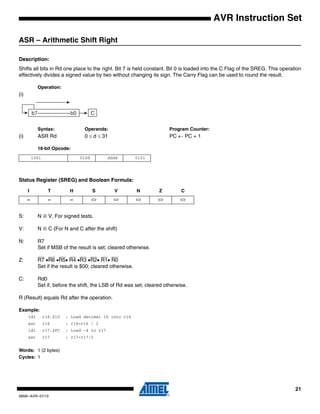
ASR – Arithmetic Shift Right
Description:
Shifts all bits in Rd one place to the right. Bit 7 is held constant. Bit 0 is loaded into the C Flag of the SREG. This operation
effectively divides a signed value by two without changing its sign. The Carry Flag can be used to round the result.
Operation:
(i)
Syntax: Operands: Program Counter:
(i) ASR Rd 0 ≤ d ≤ 31 PC ← PC + 1
16-bit Opcode:
Status Register (SREG) and Boolean Formula:
S: N ⊕ V, For signed tests.
V: N ⊕ C (For N and C after the shift)
N: R7
Set if MSB of the result is set; cleared otherwise.
Z: R7 •R6 •R5• R4 •R3 •R2• R1• R0
Set if the result is $00; cleared otherwise.
C: Rd0
Set if, before the shift, the LSB of Rd was set; cleared otherwise.
R (Result) equals Rd after the operation.
Example:
ldi r16,$10 ; Load decimal 16 into r16
asr r16 ; r16=r16 / 2
ldi r17,$FC ; Load -4 in r17
asr r17 ; r17=r17/2
Words: 1 (2 bytes)
Cycles: 1
1001 010d dddd 0101
I T H S V N Z C
– – – ⇔ ⇔ ⇔ ⇔ ⇔
b7-------------------b0 C
22
0856I–AVR–07/10
AVR Instruction Set
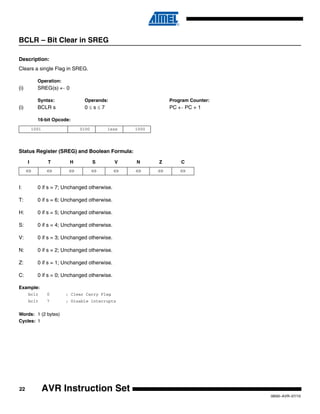
BCLR – Bit Clear in SREG
Description:
Clears a single Flag in SREG.
Operation:
(i) SREG(s) ← 0
Syntax: Operands: Program Counter:
(i) BCLR s 0 ≤ s ≤ 7 PC ← PC + 1
16-bit Opcode:
Status Register (SREG) and Boolean Formula:
I: 0 if s = 7; Unchanged otherwise.
T: 0 if s = 6; Unchanged otherwise.
H: 0 if s = 5; Unchanged otherwise.
S: 0 if s = 4; Unchanged otherwise.
V: 0 if s = 3; Unchanged otherwise.
N: 0 if s = 2; Unchanged otherwise.
Z: 0 if s = 1; Unchanged otherwise.
C: 0 if s = 0; Unchanged otherwise.
Example:
bclr 0 ; Clear Carry Flag
bclr 7 ; Disable interrupts
Words: 1 (2 bytes)
Cycles: 1
1001 0100 1sss 1000
I T H S V N Z C
⇔ ⇔ ⇔ ⇔ ⇔ ⇔ ⇔ ⇔
23
0856I–AVR–07/10
AVR Instruction Set
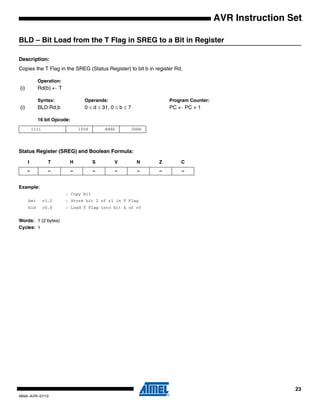
BLD – Bit Load from the T Flag in SREG to a Bit in Register
Description:
Copies the T Flag in the SREG (Status Register) to bit b in register Rd.
Operation:
(i) Rd(b) ← T
Syntax: Operands: Program Counter:
(i) BLD Rd,b 0 ≤ d ≤ 31, 0 ≤ b ≤ 7 PC ← PC + 1
16 bit Opcode:
Status Register (SREG) and Boolean Formula:
Example:
; Copy bit
bst r1,2 ; Store bit 2 of r1 in T Flag
bld r0,4 ; Load T Flag into bit 4 of r0
Words: 1 (2 bytes)
Cycles: 1
1111 100d dddd 0bbb
I T H S V N Z C
– – – – – – – –
24
0856I–AVR–07/10
AVR Instruction Set
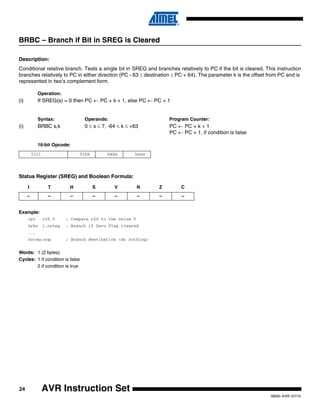
BRBC – Branch if Bit in SREG is Cleared
Description:
Conditional relative branch. Tests a single bit in SREG and branches relatively to PC if the bit is cleared. This instruction
branches relatively to PC in either direction (PC - 63 ≤ destination ≤ PC + 64). The parameter k is the offset from PC and is
represented in two’s complement form.
Operation:
(i) If SREG(s) = 0 then PC ← PC + k + 1, else PC ← PC + 1
Syntax: Operands: Program Counter:
(i) BRBC s,k 0 ≤ s ≤ 7, -64 ≤ k ≤ +63 PC ← PC + k + 1
PC ← PC + 1, if condition is false
16-bit Opcode:
Status Register (SREG) and Boolean Formula:
Example:
cpi r20,5 ; Compare r20 to the value 5
brbc 1,noteq ; Branch if Zero Flag cleared
...
noteq:nop ; Branch destination (do nothing)
Words: 1 (2 bytes)
Cycles: 1 if condition is false
2 if condition is true
1111 01kk kkkk ksss
I T H S V N Z C
– – – – – – – –
25
0856I–AVR–07/10
AVR Instruction Set
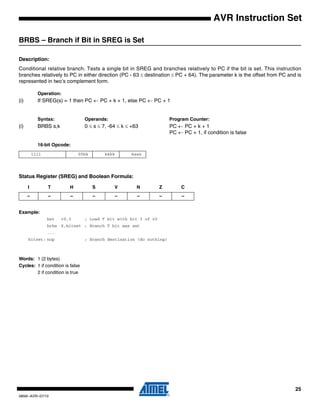
BRBS – Branch if Bit in SREG is Set
Description:
Conditional relative branch. Tests a single bit in SREG and branches relatively to PC if the bit is set. This instruction
branches relatively to PC in either direction (PC - 63 ≤ destination ≤ PC + 64). The parameter k is the offset from PC and is
represented in two’s complement form.
Operation:
(i) If SREG(s) = 1 then PC ← PC + k + 1, else PC ← PC + 1
Syntax: Operands: Program Counter:
(i) BRBS s,k 0 ≤ s ≤ 7, -64 ≤ k ≤ +63 PC ← PC + k + 1
PC ← PC + 1, if condition is false
16-bit Opcode:
Status Register (SREG) and Boolean Formula:
Example:
bst r0,3 ; Load T bit with bit 3 of r0
brbs 6,bitset ; Branch T bit was set
...
bitset: nop ; Branch destination (do nothing)
Words: 1 (2 bytes)
Cycles: 1 if condition is false
2 if condition is true
1111 00kk kkkk ksss
I T H S V N Z C
– – – – – – – –
26
0856I–AVR–07/10
AVR Instruction Set
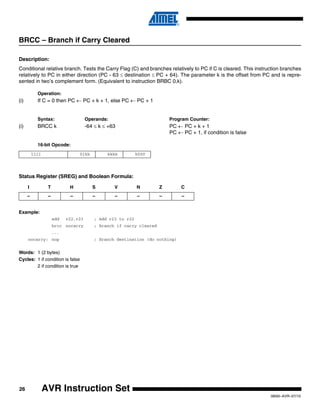
BRCC – Branch if Carry Cleared
Description:
Conditional relative branch. Tests the Carry Flag (C) and branches relatively to PC if C is cleared. This instruction branches
relatively to PC in either direction (PC - 63 ≤ destination ≤ PC + 64). The parameter k is the offset from PC and is repre-
sented in two’s complement form. (Equivalent to instruction BRBC 0,k).
Operation:
(i) If C = 0 then PC ← PC + k + 1, else PC ← PC + 1
Syntax: Operands: Program Counter:
(i) BRCC k -64 ≤ k ≤ +63 PC ← PC + k + 1
PC ← PC + 1, if condition is false
16-bit Opcode:
Status Register (SREG) and Boolean Formula:
Example:
add r22,r23 ; Add r23 to r22
brcc nocarry ; Branch if carry cleared
...
nocarry: nop ; Branch destination (do nothing)
Words: 1 (2 bytes)
Cycles: 1 if condition is false
2 if condition is true
1111 01kk kkkk k000
I T H S V N Z C
– – – – – – – –
27
0856I–AVR–07/10
AVR Instruction Set
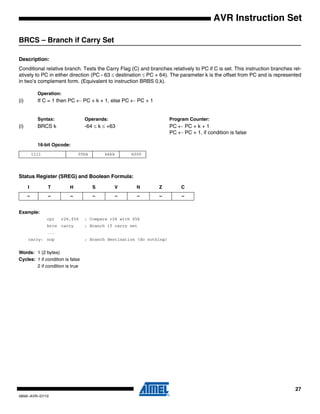
BRCS – Branch if Carry Set
Description:
Conditional relative branch. Tests the Carry Flag (C) and branches relatively to PC if C is set. This instruction branches rel-
atively to PC in either direction (PC - 63 ≤ destination ≤ PC + 64). The parameter k is the offset from PC and is represented
in two’s complement form. (Equivalent to instruction BRBS 0,k).
Operation:
(i) If C = 1 then PC ← PC + k + 1, else PC ← PC + 1
Syntax: Operands: Program Counter:
(i) BRCS k -64 ≤ k ≤ +63 PC ← PC + k + 1
PC ← PC + 1, if condition is false
16-bit Opcode:
Status Register (SREG) and Boolean Formula:
Example:
cpi r26,$56 ; Compare r26 with $56
brcs carry ; Branch if carry set
...
carry: nop ; Branch destination (do nothing)
Words: 1 (2 bytes)
Cycles: 1 if condition is false
2 if condition is true
1111 00kk kkkk k000
I T H S V N Z C
– – – – – – – –
28
0856I–AVR–07/10
AVR Instruction Set
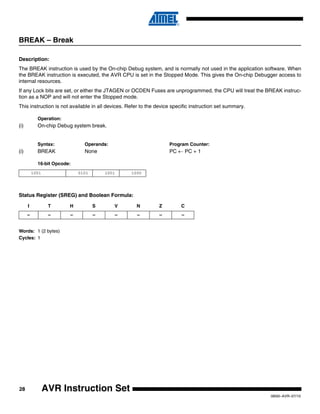
BREAK – Break
Description:
The BREAK instruction is used by the On-chip Debug system, and is normally not used in the application software. When
the BREAK instruction is executed, the AVR CPU is set in the Stopped Mode. This gives the On-chip Debugger access to
internal resources.
If any Lock bits are set, or either the JTAGEN or OCDEN Fuses are unprogrammed, the CPU will treat the BREAK instruc-
tion as a NOP and will not enter the Stopped mode.
This instruction is not available in all devices. Refer to the device specific instruction set summary.
Operation:
(i) On-chip Debug system break.
Syntax: Operands: Program Counter:
(i) BREAK None PC ← PC + 1
16-bit Opcode:
Status Register (SREG) and Boolean Formula:
Words: 1 (2 bytes)
Cycles: 1
1001 0101 1001 1000
I T H S V N Z C
– – – – – – – –
29
0856I–AVR–07/10
AVR Instruction Set
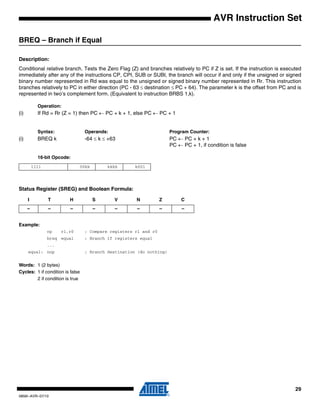
BREQ – Branch if Equal
Description:
Conditional relative branch. Tests the Zero Flag (Z) and branches relatively to PC if Z is set. If the instruction is executed
immediately after any of the instructions CP, CPI, SUB or SUBI, the branch will occur if and only if the unsigned or signed
binary number represented in Rd was equal to the unsigned or signed binary number represented in Rr. This instruction
branches relatively to PC in either direction (PC - 63 ≤ destination ≤ PC + 64). The parameter k is the offset from PC and is
represented in two’s complement form. (Equivalent to instruction BRBS 1,k).
Operation:
(i) If Rd = Rr (Z = 1) then PC ← PC + k + 1, else PC ← PC + 1
Syntax: Operands: Program Counter:
(i) BREQ k -64 ≤ k ≤ +63 PC ← PC + k + 1
PC ← PC + 1, if condition is false
16-bit Opcode:
Status Register (SREG) and Boolean Formula:
Example:
cp r1,r0 ; Compare registers r1 and r0
breq equal ; Branch if registers equal
...
equal: nop ; Branch destination (do nothing)
Words: 1 (2 bytes)
Cycles: 1 if condition is false
2 if condition is true
1111 00kk kkkk k001
I T H S V N Z C
– – – – – – – –
30
0856I–AVR–07/10
AVR Instruction Set
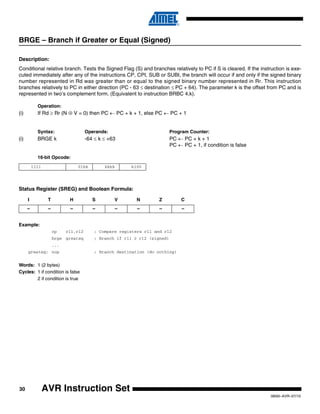
BRGE – Branch if Greater or Equal (Signed)
Description:
Conditional relative branch. Tests the Signed Flag (S) and branches relatively to PC if S is cleared. If the instruction is exe-
cuted immediately after any of the instructions CP, CPI, SUB or SUBI, the branch will occur if and only if the signed binary
number represented in Rd was greater than or equal to the signed binary number represented in Rr. This instruction
branches relatively to PC in either direction (PC - 63 ≤ destination ≤ PC + 64). The parameter k is the offset from PC and is
represented in two’s complement form. (Equivalent to instruction BRBC 4,k).
Operation:
(i) If Rd ≥ Rr (N ⊕ V = 0) then PC ← PC + k + 1, else PC ← PC + 1
Syntax: Operands: Program Counter:
(i) BRGE k -64 ≤ k ≤ +63 PC ← PC + k + 1
PC ← PC + 1, if condition is false
16-bit Opcode:
Status Register (SREG) and Boolean Formula:
Example:
cp r11,r12 ; Compare registers r11 and r12
brge greateq ; Branch if r11 ≥ r12 (signed)
...
greateq: nop ; Branch destination (do nothing)
Words: 1 (2 bytes)
Cycles: 1 if condition is false
2 if condition is true
1111 01kk kkkk k100
I T H S V N Z C
– – – – – – – –
31
0856I–AVR–07/10
AVR Instruction Set
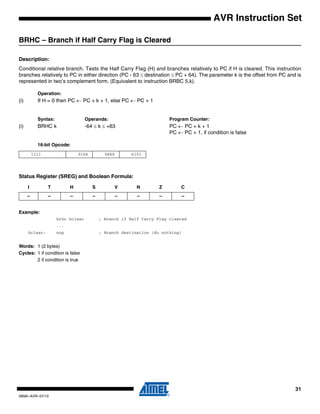
BRHC – Branch if Half Carry Flag is Cleared
Description:
Conditional relative branch. Tests the Half Carry Flag (H) and branches relatively to PC if H is cleared. This instruction
branches relatively to PC in either direction (PC - 63 ≤ destination ≤ PC + 64). The parameter k is the offset from PC and is
represented in two’s complement form. (Equivalent to instruction BRBC 5,k).
Operation:
(i) If H = 0 then PC ← PC + k + 1, else PC ← PC + 1
Syntax: Operands: Program Counter:
(i) BRHC k -64 ≤ k ≤ +63 PC ← PC + k + 1
PC ← PC + 1, if condition is false
16-bit Opcode:
Status Register (SREG) and Boolean Formula:
Example:
brhc hclear ; Branch if Half Carry Flag cleared
...
hclear: nop ; Branch destination (do nothing)
Words: 1 (2 bytes)
Cycles: 1 if condition is false
2 if condition is true
1111 01kk kkkk k101
I T H S V N Z C
– – – – – – – –
32
0856I–AVR–07/10
AVR Instruction Set
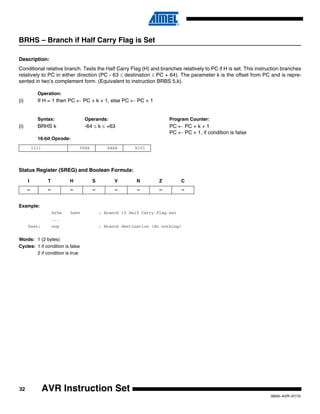
BRHS – Branch if Half Carry Flag is Set
Description:
Conditional relative branch. Tests the Half Carry Flag (H) and branches relatively to PC if H is set. This instruction branches
relatively to PC in either direction (PC - 63 ≤ destination ≤ PC + 64). The parameter k is the offset from PC and is repre-
sented in two’s complement form. (Equivalent to instruction BRBS 5,k).
Operation:
(i) If H = 1 then PC ← PC + k + 1, else PC ← PC + 1
Syntax: Operands: Program Counter:
(i) BRHS k -64 ≤ k ≤ +63 PC ← PC + k + 1
PC ← PC + 1, if condition is false
16-bit Opcode:
Status Register (SREG) and Boolean Formula:
Example:
brhs hset ; Branch if Half Carry Flag set
...
hset: nop ; Branch destination (do nothing)
Words: 1 (2 bytes)
Cycles: 1 if condition is false
2 if condition is true
1111 00kk kkkk k101
I T H S V N Z C
– – – – – – – –
33
0856I–AVR–07/10
AVR Instruction Set
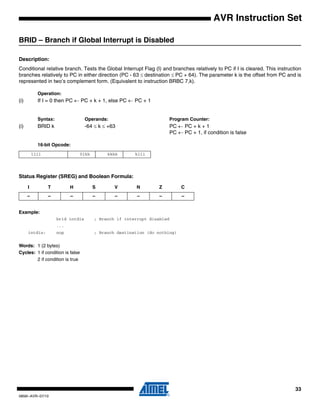
BRID – Branch if Global Interrupt is Disabled
Description:
Conditional relative branch. Tests the Global Interrupt Flag (I) and branches relatively to PC if I is cleared. This instruction
branches relatively to PC in either direction (PC - 63 ≤ destination ≤ PC + 64). The parameter k is the offset from PC and is
represented in two’s complement form. (Equivalent to instruction BRBC 7,k).
Operation:
(i) If I = 0 then PC ← PC + k + 1, else PC ← PC + 1
Syntax: Operands: Program Counter:
(i) BRID k -64 ≤ k ≤ +63 PC ← PC + k + 1
PC ← PC + 1, if condition is false
16-bit Opcode:
Status Register (SREG) and Boolean Formula:
Example:
brid intdis ; Branch if interrupt disabled
...
intdis: nop ; Branch destination (do nothing)
Words: 1 (2 bytes)
Cycles: 1 if condition is false
2 if condition is true
1111 01kk kkkk k111
I T H S V N Z C
– – – – – – – –
34
0856I–AVR–07/10
AVR Instruction Set
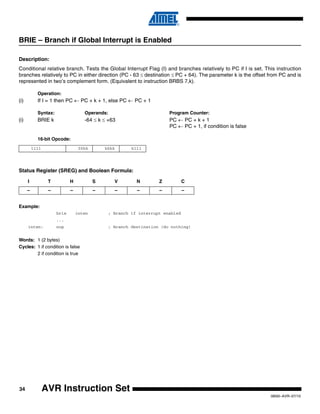
BRIE – Branch if Global Interrupt is Enabled
Description:
Conditional relative branch. Tests the Global Interrupt Flag (I) and branches relatively to PC if I is set. This instruction
branches relatively to PC in either direction (PC - 63 ≤ destination ≤ PC + 64). The parameter k is the offset from PC and is
represented in two’s complement form. (Equivalent to instruction BRBS 7,k).
Operation:
(i) If I = 1 then PC ← PC + k + 1, else PC ← PC + 1
Syntax: Operands: Program Counter:
(i) BRIE k -64 ≤ k ≤ +63 PC ← PC + k + 1
PC ← PC + 1, if condition is false
16-bit Opcode:
Status Register (SREG) and Boolean Formula:
Example:
brie inten ; Branch if interrupt enabled
...
inten: nop ; Branch destination (do nothing)
Words: 1 (2 bytes)
Cycles: 1 if condition is false
2 if condition is true
1111 00kk kkkk k111
I T H S V N Z C
– – – – – – – –
35
0856I–AVR–07/10
AVR Instruction Set
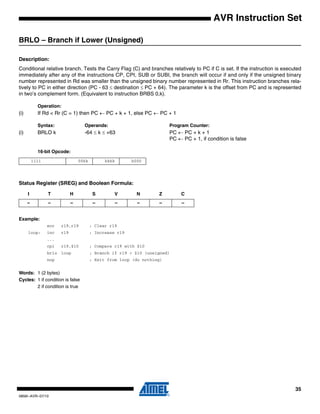
BRLO – Branch if Lower (Unsigned)
Description:
Conditional relative branch. Tests the Carry Flag (C) and branches relatively to PC if C is set. If the instruction is executed
immediately after any of the instructions CP, CPI, SUB or SUBI, the branch will occur if and only if the unsigned binary
number represented in Rd was smaller than the unsigned binary number represented in Rr. This instruction branches rela-
tively to PC in either direction (PC - 63 ≤ destination ≤ PC + 64). The parameter k is the offset from PC and is represented
in two’s complement form. (Equivalent to instruction BRBS 0,k).
Operation:
(i) If Rd < Rr (C = 1) then PC ← PC + k + 1, else PC ← PC + 1
Syntax: Operands: Program Counter:
(i) BRLO k -64 ≤ k ≤ +63 PC ← PC + k + 1
PC ← PC + 1, if condition is false
16-bit Opcode:
Status Register (SREG) and Boolean Formula:
Example:
eor r19,r19 ; Clear r19
loop: inc r19 ; Increase r19
...
cpi r19,$10 ; Compare r19 with $10
brlo loop ; Branch if r19 < $10 (unsigned)
nop ; Exit from loop (do nothing)
Words: 1 (2 bytes)
Cycles: 1 if condition is false
2 if condition is true
1111 00kk kkkk k000
I T H S V N Z C
– – – – – – – –
36
0856I–AVR–07/10
AVR Instruction Set
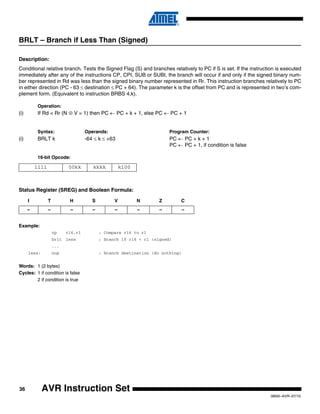
BRLT – Branch if Less Than (Signed)
Description:
Conditional relative branch. Tests the Signed Flag (S) and branches relatively to PC if S is set. If the instruction is executed
immediately after any of the instructions CP, CPI, SUB or SUBI, the branch will occur if and only if the signed binary num-
ber represented in Rd was less than the signed binary number represented in Rr. This instruction branches relatively to PC
in either direction (PC - 63 ≤ destination ≤ PC + 64). The parameter k is the offset from PC and is represented in two’s com-
plement form. (Equivalent to instruction BRBS 4,k).
Operation:
(i) If Rd < Rr (N ⊕ V = 1) then PC ← PC + k + 1, else PC ← PC + 1
Syntax: Operands: Program Counter:
(i) BRLT k -64 ≤ k ≤ +63 PC ← PC + k + 1
PC ← PC + 1, if condition is false
16-bit Opcode:
Status Register (SREG) and Boolean Formula:
Example:
cp r16,r1 ; Compare r16 to r1
brlt less ; Branch if r16 < r1 (signed)
...
less: nop ; Branch destination (do nothing)
Words: 1 (2 bytes)
Cycles: 1 if condition is false
2 if condition is true
1111 00kk kkkk k100
I T H S V N Z C
– – – – – – – –
37
0856I–AVR–07/10
AVR Instruction Set
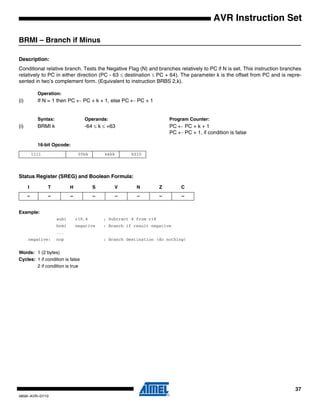
BRMI – Branch if Minus
Description:
Conditional relative branch. Tests the Negative Flag (N) and branches relatively to PC if N is set. This instruction branches
relatively to PC in either direction (PC - 63 ≤ destination ≤ PC + 64). The parameter k is the offset from PC and is repre-
sented in two’s complement form. (Equivalent to instruction BRBS 2,k).
Operation:
(i) If N = 1 then PC ← PC + k + 1, else PC ← PC + 1
Syntax: Operands: Program Counter:
(i) BRMI k -64 ≤ k ≤ +63 PC ← PC + k + 1
PC ← PC + 1, if condition is false
16-bit Opcode:
Status Register (SREG) and Boolean Formula:
Example:
subi r18,4 ; Subtract 4 from r18
brmi negative ; Branch if result negative
...
negative: nop ; Branch destination (do nothing)
Words: 1 (2 bytes)
Cycles: 1 if condition is false
2 if condition is true
1111 00kk kkkk k010
I T H S V N Z C
– – – – – – – –
38
0856I–AVR–07/10
AVR Instruction Set
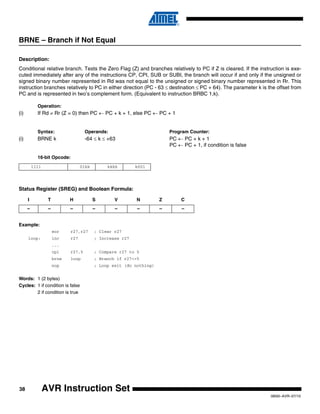
BRNE – Branch if Not Equal
Description:
Conditional relative branch. Tests the Zero Flag (Z) and branches relatively to PC if Z is cleared. If the instruction is exe-
cuted immediately after any of the instructions CP, CPI, SUB or SUBI, the branch will occur if and only if the unsigned or
signed binary number represented in Rd was not equal to the unsigned or signed binary number represented in Rr. This
instruction branches relatively to PC in either direction (PC - 63 ≤ destination ≤ PC + 64). The parameter k is the offset from
PC and is represented in two’s complement form. (Equivalent to instruction BRBC 1,k).
Operation:
(i) If Rd ≠ Rr (Z = 0) then PC ← PC + k + 1, else PC ← PC + 1
Syntax: Operands: Program Counter:
(i) BRNE k -64 ≤ k ≤ +63 PC ← PC + k + 1
PC ← PC + 1, if condition is false
16-bit Opcode:
Status Register (SREG) and Boolean Formula:
Example:
eor r27,r27 ; Clear r27
loop: inc r27 ; Increase r27
...
cpi r27,5 ; Compare r27 to 5
brne loop ; Branch if r27<>5
nop ; Loop exit (do nothing)
Words: 1 (2 bytes)
Cycles: 1 if condition is false
2 if condition is true
1111 01kk kkkk k001
I T H S V N Z C
– – – – – – – –
39
0856I–AVR–07/10
AVR Instruction Set
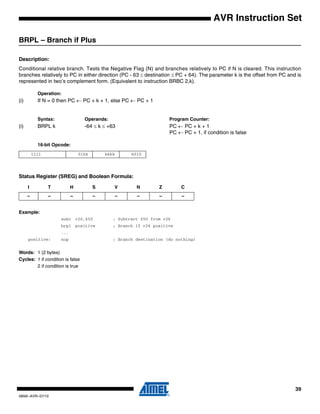
BRPL – Branch if Plus
Description:
Conditional relative branch. Tests the Negative Flag (N) and branches relatively to PC if N is cleared. This instruction
branches relatively to PC in either direction (PC - 63 ≤ destination ≤ PC + 64). The parameter k is the offset from PC and is
represented in two’s complement form. (Equivalent to instruction BRBC 2,k).
Operation:
(i) If N = 0 then PC ← PC + k + 1, else PC ← PC + 1
Syntax: Operands: Program Counter:
(i) BRPL k -64 ≤ k ≤ +63 PC ← PC + k + 1
PC ← PC + 1, if condition is false
16-bit Opcode:
Status Register (SREG) and Boolean Formula:
Example:
subi r26,$50 ; Subtract $50 from r26
brpl positive ; Branch if r26 positive
...
positive: nop ; Branch destination (do nothing)
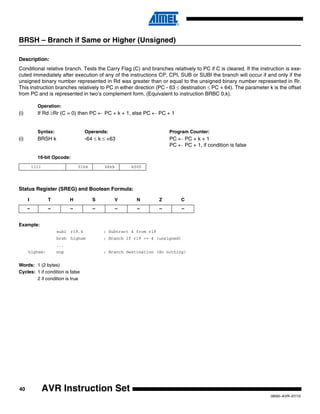
Words: 1 (2 bytes)
Cycles: 1 if condition is false
2 if condition is true
1111 01kk kkkk k010
I T H S V N Z C
– – – – – – – –
40
0856I–AVR–07/10
AVR Instruction Set
BRSH – Branch if Same or Higher (Unsigned)
Description:
Conditional relative branch. Tests the Carry Flag (C) and branches relatively to PC if C is cleared. If the instruction is exe-
cuted immediately after execution of any of the instructions CP, CPI, SUB or SUBI the branch will occur if and only if the
unsigned binary number represented in Rd was greater than or equal to the unsigned binary number represented in Rr.
This instruction branches relatively to PC in either direction (PC - 63 ≤ destination ≤ PC + 64). The parameter k is the offset
from PC and is represented in two’s complement form. (Equivalent to instruction BRBC 0,k).
Operation:
(i) If Rd ≥Rr (C = 0) then PC ← PC + k + 1, else PC ← PC + 1
Syntax: Operands: Program Counter:
(i) BRSH k -64 ≤ k ≤ +63 PC ← PC + k + 1
PC ← PC + 1, if condition is false
16-bit Opcode:
Status Register (SREG) and Boolean Formula:
Example:
subi r19,4 ; Subtract 4 from r19
brsh highsm ; Branch if r19 >= 4 (unsigned)
...
highsm: nop ; Branch destination (do nothing)
Words: 1 (2 bytes)
Cycles: 1 if condition is false
2 if condition is true
1111 01kk kkkk k000
I T H S V N Z C
– – – – – – – –
41
0856I–AVR–07/10
AVR Instruction Set
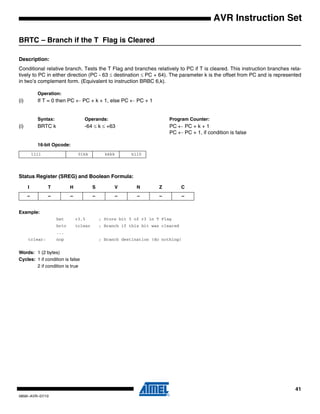
BRTC – Branch if the T Flag is Cleared
Description:
Conditional relative branch. Tests the T Flag and branches relatively to PC if T is cleared. This instruction branches rela-
tively to PC in either direction (PC - 63 ≤ destination ≤ PC + 64). The parameter k is the offset from PC and is represented
in two’s complement form. (Equivalent to instruction BRBC 6,k).
Operation:
(i) If T = 0 then PC ← PC + k + 1, else PC ← PC + 1
Syntax: Operands: Program Counter:
(i) BRTC k -64 ≤ k ≤ +63 PC ← PC + k + 1
PC ← PC + 1, if condition is false
16-bit Opcode:
Status Register (SREG) and Boolean Formula:
Example:
bst r3,5 ; Store bit 5 of r3 in T Flag
brtc tclear ; Branch if this bit was cleared
...
tclear: nop ; Branch destination (do nothing)
Words: 1 (2 bytes)
Cycles: 1 if condition is false
2 if condition is true
1111 01kk kkkk k110
I T H S V N Z C
– – – – – – – –
42
0856I–AVR–07/10
AVR Instruction Set
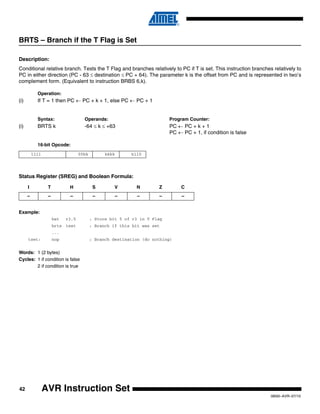
BRTS – Branch if the T Flag is Set
Description:
Conditional relative branch. Tests the T Flag and branches relatively to PC if T is set. This instruction branches relatively to
PC in either direction (PC - 63 ≤ destination ≤ PC + 64). The parameter k is the offset from PC and is represented in two’s
complement form. (Equivalent to instruction BRBS 6,k).
Operation:
(i) If T = 1 then PC ← PC + k + 1, else PC ← PC + 1
Syntax: Operands: Program Counter:
(i) BRTS k -64 ≤ k ≤ +63 PC ← PC + k + 1
PC ← PC + 1, if condition is false
16-bit Opcode:
Status Register (SREG) and Boolean Formula:
Example:
bst r3,5 ; Store bit 5 of r3 in T Flag
brts tset ; Branch if this bit was set
...
tset: nop ; Branch destination (do nothing)
Words: 1 (2 bytes)
Cycles: 1 if condition is false
2 if condition is true
1111 00kk kkkk k110
I T H S V N Z C
– – – – – – – –
43
0856I–AVR–07/10
AVR Instruction Set
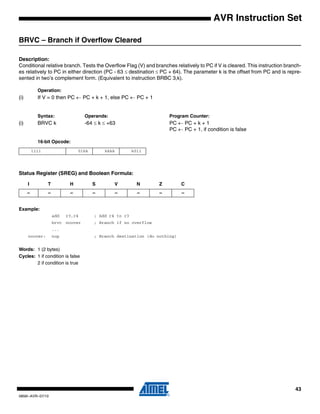
BRVC – Branch if Overflow Cleared
Description:
Conditional relative branch. Tests the Overflow Flag (V) and branches relatively to PC if V is cleared. This instruction branch-
es relatively to PC in either direction (PC - 63 ≤ destination ≤ PC + 64). The parameter k is the offset from PC and is repre-
sented in two’s complement form. (Equivalent to instruction BRBC 3,k).
Operation:
(i) If V = 0 then PC ← PC + k + 1, else PC ← PC + 1
Syntax: Operands: Program Counter:
(i) BRVC k -64 ≤ k ≤ +63 PC ← PC + k + 1
PC ← PC + 1, if condition is false
16-bit Opcode:
Status Register (SREG) and Boolean Formula:
Example:
add r3,r4 ; Add r4 to r3
brvc noover ; Branch if no overflow
...
noover: nop ; Branch destination (do nothing)
Words: 1 (2 bytes)
Cycles: 1 if condition is false
2 if condition is true
1111 01kk kkkk k011
I T H S V N Z C
– – – – – – – –
44
0856I–AVR–07/10
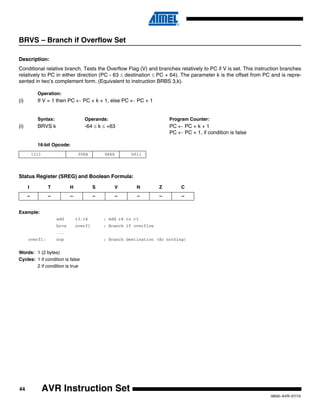
AVR Instruction Set
BRVS – Branch if Overflow Set
Description:
Conditional relative branch. Tests the Overflow Flag (V) and branches relatively to PC if V is set. This instruction branches
relatively to PC in either direction (PC - 63 ≤ destination ≤ PC + 64). The parameter k is the offset from PC and is repre-
sented in two’s complement form. (Equivalent to instruction BRBS 3,k).
Operation:
(i) If V = 1 then PC ← PC + k + 1, else PC ← PC + 1
Syntax: Operands: Program Counter:
(i) BRVS k -64 ≤ k ≤ +63 PC ← PC + k + 1
PC ← PC + 1, if condition is false
16-bit Opcode:
Status Register (SREG) and Boolean Formula:
Example:
add r3,r4 ; Add r4 to r3
brvs overfl ; Branch if overflow
...
overfl: nop ; Branch destination (do nothing)
Words: 1 (2 bytes)
Cycles: 1 if condition is false
2 if condition is true
1111 00kk kkkk k011
I T H S V N Z C
– – – – – – – –
45
0856I–AVR–07/10
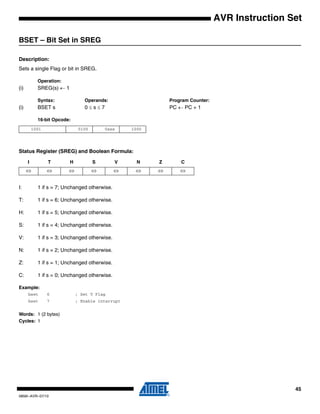
AVR Instruction Set
BSET – Bit Set in SREG
Description:
Sets a single Flag or bit in SREG.
Operation:
(i) SREG(s) ← 1
Syntax: Operands: Program Counter:
(i) BSET s 0 ≤ s ≤ 7 PC ← PC + 1
16-bit Opcode:
Status Register (SREG) and Boolean Formula:
I: 1 if s = 7; Unchanged otherwise.
T: 1 if s = 6; Unchanged otherwise.
H: 1 if s = 5; Unchanged otherwise.
S: 1 if s = 4; Unchanged otherwise.
V: 1 if s = 3; Unchanged otherwise.
N: 1 if s = 2; Unchanged otherwise.
Z: 1 if s = 1; Unchanged otherwise.
C: 1 if s = 0; Unchanged otherwise.
Example:
bset 6 ; Set T Flag
bset 7 ; Enable interrupt
Words: 1 (2 bytes)
Cycles: 1
1001 0100 0sss 1000
I T H S V N Z C
⇔ ⇔ ⇔ ⇔ ⇔ ⇔ ⇔ ⇔
46
0856I–AVR–07/10
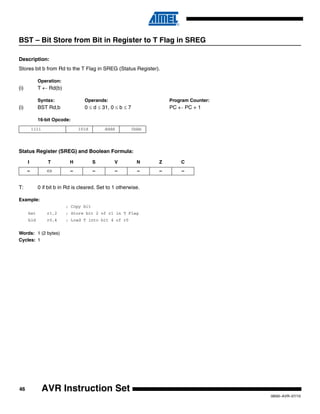
AVR Instruction Set
BST – Bit Store from Bit in Register to T Flag in SREG
Description:
Stores bit b from Rd to the T Flag in SREG (Status Register).
Operation:
(i) T ← Rd(b)
Syntax: Operands: Program Counter:
(i) BST Rd,b 0 ≤ d ≤ 31, 0 ≤ b ≤ 7 PC ← PC + 1
16-bit Opcode:
Status Register (SREG) and Boolean Formula:
T: 0 if bit b in Rd is cleared. Set to 1 otherwise.
Example:
; Copy bit
bst r1,2 ; Store bit 2 of r1 in T Flag
bld r0,4 ; Load T into bit 4 of r0
Words: 1 (2 bytes)
Cycles: 1
1111 101d dddd 0bbb
I T H S V N Z C
– ⇔ – – – – – –
47
0856I–AVR–07/10
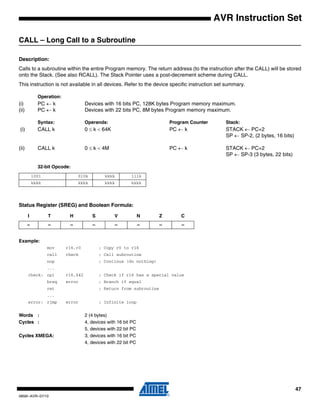
AVR Instruction Set
CALL – Long Call to a Subroutine
Description:
Calls to a subroutine within the entire Program memory. The return address (to the instruction after the CALL) will be stored
onto the Stack. (See also RCALL). The Stack Pointer uses a post-decrement scheme during CALL.
This instruction is not available in all devices. Refer to the device specific instruction set summary.
Operation:
(i) PC ← k Devices with 16 bits PC, 128K bytes Program memory maximum.
(ii) PC ← k Devices with 22 bits PC, 8M bytes Program memory maximum.
Syntax: Operands: Program Counter Stack:
(i) CALL k 0 ≤ k < 64K PC ← k STACK ← PC+2
SP ← SP-2, (2 bytes, 16 bits)
(ii) CALL k 0 ≤ k < 4M PC ← k STACK ← PC+2
SP ← SP-3 (3 bytes, 22 bits)
32-bit Opcode:
Status Register (SREG) and Boolean Formula:
Example:
mov r16,r0 ; Copy r0 to r16
call check ; Call subroutine
nop ; Continue (do nothing)
...
check: cpi r16,$42 ; Check if r16 has a special value
breq error ; Branch if equal
ret ; Return from subroutine
...
error: rjmp error ; Infinite loop
Words : 2 (4 bytes)
Cycles : 4, devices with 16 bit PC
5, devices with 22 bit PC
Cycles XMEGA: 3, devices with 16 bit PC
4, devices with 22 bit PC
1001 010k kkkk 111k
kkkk kkkk kkkk kkkk
I T H S V N Z C
– – – – – – – –
48
0856I–AVR–07/10
AVR Instruction Set
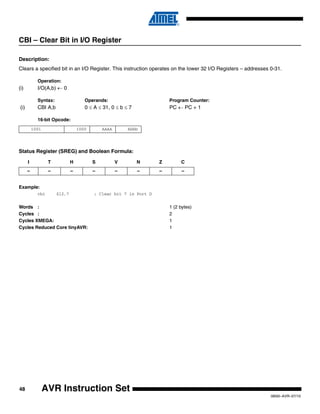
CBI – Clear Bit in I/O Register
Description:
Clears a specified bit in an I/O Register. This instruction operates on the lower 32 I/O Registers – addresses 0-31.
Operation:
(i) I/O(A,b) ← 0
Syntax: Operands: Program Counter:
(i) CBI A,b 0 ≤ A ≤ 31, 0 ≤ b ≤ 7 PC ← PC + 1
16-bit Opcode:
Status Register (SREG) and Boolean Formula:
Example:
cbi $12,7 ; Clear bit 7 in Port D
Words : 1 (2 bytes)
Cycles : 2
Cycles XMEGA: 1
Cycles Reduced Core tinyAVR: 1
1001 1000 AAAA Abbb
I T H S V N Z C
– – – – – – – –
49
0856I–AVR–07/10
AVR Instruction Set
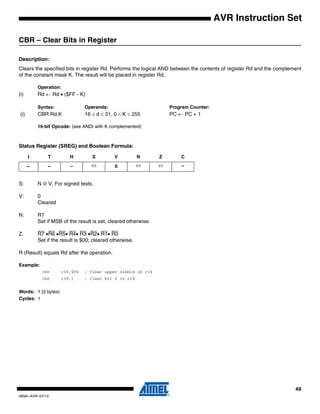
CBR – Clear Bits in Register
Description:
Clears the specified bits in register Rd. Performs the logical AND between the contents of register Rd and the complement
of the constant mask K. The result will be placed in register Rd.
Operation:
(i) Rd ← Rd • ($FF - K)
Syntax: Operands: Program Counter:
(i) CBR Rd,K 16 ≤ d ≤ 31, 0 ≤ K ≤ 255 PC ← PC + 1
16-bit Opcode: (see ANDI with K complemented)
Status Register (SREG) and Boolean Formula:
S: N ⊕ V, For signed tests.
V: 0
Cleared
N: R7
Set if MSB of the result is set; cleared otherwise.
Z: R7 •R6 •R5• R4• R3 •R2• R1• R0
Set if the result is $00; cleared otherwise.
R (Result) equals Rd after the operation.
Example:
cbr r16,$F0 ; Clear upper nibble of r16
cbr r18,1 ; Clear bit 0 in r18
Words: 1 (2 bytes)
Cycles: 1
I T H S V N Z C
– – – ⇔ 0 ⇔ ⇔ –
50
0856I–AVR–07/10
AVR Instruction Set
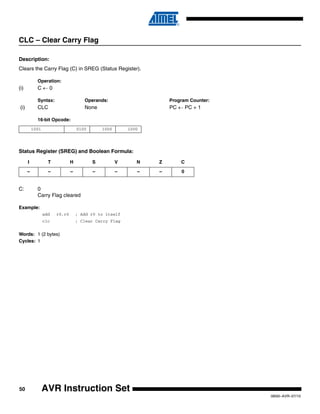
CLC – Clear Carry Flag
Description:
Clears the Carry Flag (C) in SREG (Status Register).
Operation:
(i) C ← 0
Syntax: Operands: Program Counter:
(i) CLC None PC ← PC + 1
16-bit Opcode:
Status Register (SREG) and Boolean Formula:
C: 0
Carry Flag cleared
Example:
add r0,r0 ; Add r0 to itself
clc ; Clear Carry Flag
Words: 1 (2 bytes)
Cycles: 1
1001 0100 1000 1000
I T H S V N Z C
– – – – – – – 0
51
0856I–AVR–07/10
AVR Instruction Set
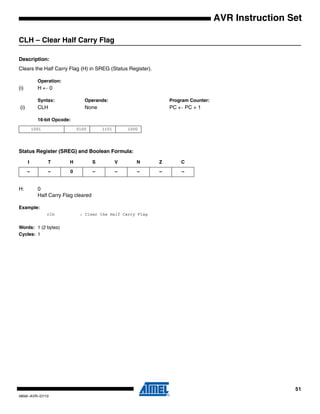
CLH – Clear Half Carry Flag
Description:
Clears the Half Carry Flag (H) in SREG (Status Register).
Operation:
(i) H ← 0
Syntax: Operands: Program Counter:
(i) CLH None PC ← PC + 1
16-bit Opcode:
Status Register (SREG) and Boolean Formula:
H: 0
Half Carry Flag cleared
Example:
clh ; Clear the Half Carry Flag
Words: 1 (2 bytes)
Cycles: 1
1001 0100 1101 1000
I T H S V N Z C
– – 0 – – – – –
52
0856I–AVR–07/10
AVR Instruction Set
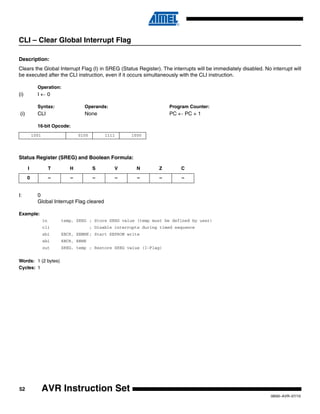
CLI – Clear Global Interrupt Flag
Description:
Clears the Global Interrupt Flag (I) in SREG (Status Register). The interrupts will be immediately disabled. No interrupt will
be executed after the CLI instruction, even if it occurs simultaneously with the CLI instruction.
Operation:
(i) I ← 0
Syntax: Operands: Program Counter:
(i) CLI None PC ← PC + 1
16-bit Opcode:
Status Register (SREG) and Boolean Formula:
I: 0
Global Interrupt Flag cleared
Example:
in temp, SREG ; Store SREG value (temp must be defined by user)
cli ; Disable interrupts during timed sequence
sbi EECR, EEMWE ; Start EEPROM write
sbi EECR, EEWE
out SREG, temp ; Restore SREG value (I-Flag)
Words: 1 (2 bytes)
Cycles: 1
1001 0100 1111 1000
I T H S V N Z C
0 – – – – – – –
53
0856I–AVR–07/10
AVR Instruction Set
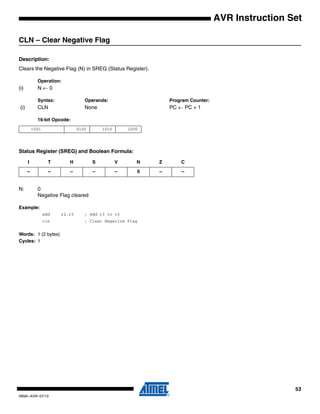
CLN – Clear Negative Flag
Description:
Clears the Negative Flag (N) in SREG (Status Register).
Operation:
(i) N ← 0
Syntax: Operands: Program Counter:
(i) CLN None PC ← PC + 1
16-bit Opcode:
Status Register (SREG) and Boolean Formula:
N: 0
Negative Flag cleared
Example:
add r2,r3 ; Add r3 to r2
cln ; Clear Negative Flag
Words: 1 (2 bytes)
Cycles: 1
1001 0100 1010 1000
I T H S V N Z C
– – – – – 0 – –
54
0856I–AVR–07/10
AVR Instruction Set
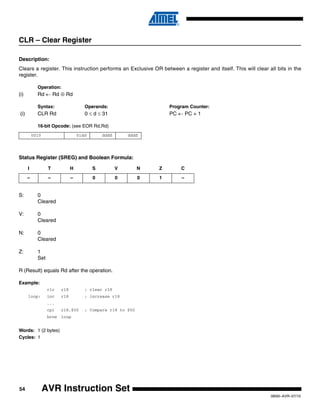
CLR – Clear Register
Description:
Clears a register. This instruction performs an Exclusive OR between a register and itself. This will clear all bits in the
register.
Operation:
(i) Rd ← Rd ⊕ Rd
Syntax: Operands: Program Counter:
(i) CLR Rd 0 ≤ d ≤ 31 PC ← PC + 1
16-bit Opcode: (see EOR Rd,Rd)
Status Register (SREG) and Boolean Formula:
S: 0
Cleared
V: 0
Cleared
N: 0
Cleared
Z: 1
Set
R (Result) equals Rd after the operation.
Example:
clr r18 ; clear r18
loop: inc r18 ; increase r18
...
cpi r18,$50 ; Compare r18 to $50
brne loop
Words: 1 (2 bytes)
Cycles: 1
0010 01dd dddd dddd
I T H S V N Z C
– – – 0 0 0 1 –
55
0856I–AVR–07/10
AVR Instruction Set
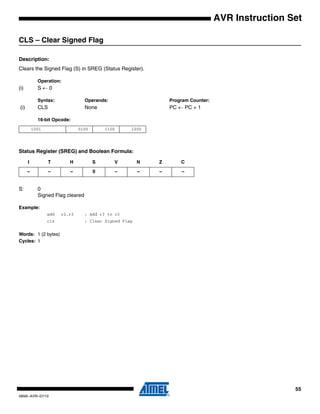
CLS – Clear Signed Flag
Description:
Clears the Signed Flag (S) in SREG (Status Register).
Operation:
(i) S ← 0
Syntax: Operands: Program Counter:
(i) CLS None PC ← PC + 1
16-bit Opcode:
Status Register (SREG) and Boolean Formula:
S: 0
Signed Flag cleared
Example:
add r2,r3 ; Add r3 to r2
cls ; Clear Signed Flag
Words: 1 (2 bytes)
Cycles: 1
1001 0100 1100 1000
I T H S V N Z C
– – – 0 – – – –
56
0856I–AVR–07/10
AVR Instruction Set
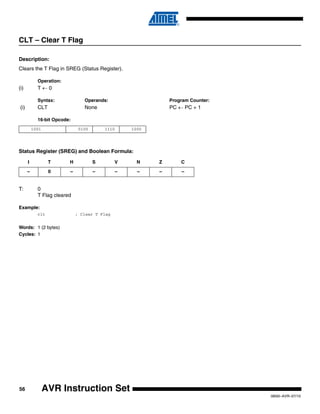
CLT – Clear T Flag
Description:
Clears the T Flag in SREG (Status Register).
Operation:
(i) T ← 0
Syntax: Operands: Program Counter:
(i) CLT None PC ← PC + 1
16-bit Opcode:
Status Register (SREG) and Boolean Formula:
T: 0
T Flag cleared
Example:
clt ; Clear T Flag
Words: 1 (2 bytes)
Cycles: 1
1001 0100 1110 1000
I T H S V N Z C
– 0 – – – – – –
57
0856I–AVR–07/10
AVR Instruction Set
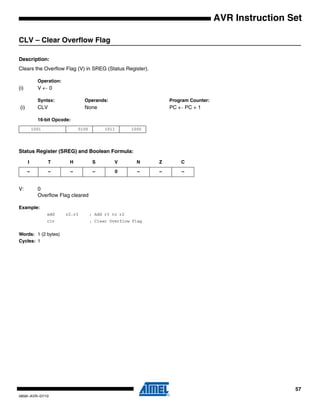
CLV – Clear Overflow Flag
Description:
Clears the Overflow Flag (V) in SREG (Status Register).
Operation:
(i) V ← 0
Syntax: Operands: Program Counter:
(i) CLV None PC ← PC + 1
16-bit Opcode:
Status Register (SREG) and Boolean Formula:
V: 0
Overflow Flag cleared
Example:
add r2,r3 ; Add r3 to r2
clv ; Clear Overflow Flag
Words: 1 (2 bytes)
Cycles: 1
1001 0100 1011 1000
I T H S V N Z C
– – – – 0 – – –
58
0856I–AVR–07/10
AVR Instruction Set
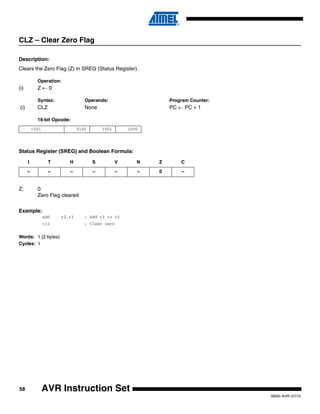
CLZ – Clear Zero Flag
Description:
Clears the Zero Flag (Z) in SREG (Status Register).
Operation:
(i) Z ← 0
Syntax: Operands: Program Counter:
(i) CLZ None PC ← PC + 1
16-bit Opcode:
Status Register (SREG) and Boolean Formula:
Z: 0
Zero Flag cleared
Example:
add r2,r3 ; Add r3 to r2
clz ; Clear zero
Words: 1 (2 bytes)
Cycles: 1
1001 0100 1001 1000
I T H S V N Z C
– – – – – – 0 –
59
0856I–AVR–07/10
AVR Instruction Set
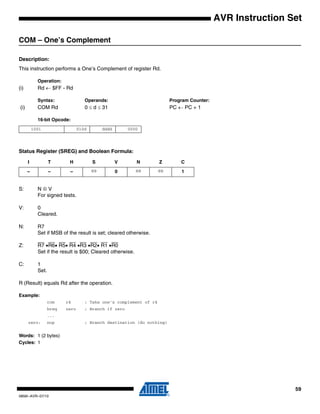
COM – One’s Complement
Description:
This instruction performs a One’s Complement of register Rd.
Operation:
(i) Rd ← $FF - Rd
Syntax: Operands: Program Counter:
(i) COM Rd 0 ≤ d ≤ 31 PC ← PC + 1
16-bit Opcode:
Status Register (SREG) and Boolean Formula:
S: N ⊕ V
For signed tests.
V: 0
Cleared.
N: R7
Set if MSB of the result is set; cleared otherwise.
Z: R7 •R6• R5• R4 •R3 •R2• R1 •R0
Set if the result is $00; Cleared otherwise.
C: 1
Set.
R (Result) equals Rd after the operation.
Example:
com r4 ; Take one’s complement of r4
breq zero ; Branch if zero
...
zero: nop ; Branch destination (do nothing)
Words: 1 (2 bytes)
Cycles: 1
1001 010d dddd 0000
I T H S V N Z C
– – – ⇔ 0 ⇔ ⇔ 1
60
0856I–AVR–07/10
AVR Instruction Set
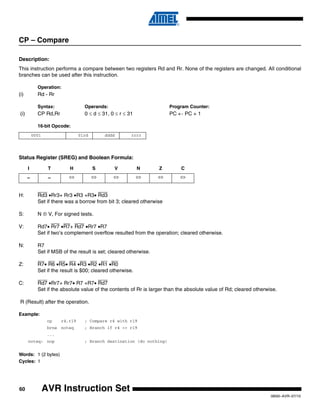
CP – Compare
Description:
This instruction performs a compare between two registers Rd and Rr. None of the registers are changed. All conditional
branches can be used after this instruction.
Operation:
(i) Rd - Rr
Syntax: Operands: Program Counter:
(i) CP Rd,Rr 0 ≤ d ≤ 31, 0 ≤ r ≤ 31 PC ← PC + 1
16-bit Opcode:
Status Register (SREG) and Boolean Formula:
H: Rd3 •Rr3+ Rr3 •R3 +R3• Rd3
Set if there was a borrow from bit 3; cleared otherwise
S: N ⊕ V, For signed tests.
V: Rd7• Rr7 •R7+ Rd7 •Rr7 •R7
Set if two’s complement overflow resulted from the operation; cleared otherwise.
N: R7
Set if MSB of the result is set; cleared otherwise.
Z: R7• R6 •R5• R4 •R3 •R2 •R1 •R0
Set if the result is $00; cleared otherwise.
C: Rd7 •Rr7+ Rr7• R7 +R7• Rd7
Set if the absolute value of the contents of Rr is larger than the absolute value of Rd; cleared otherwise.
R (Result) after the operation.
Example:
cp r4,r19 ; Compare r4 with r19
brne noteq ; Branch if r4 <> r19
...
noteq: nop ; Branch destination (do nothing)
Words: 1 (2 bytes)
Cycles: 1
0001 01rd dddd rrrr
I T H S V N Z C
– – ⇔ ⇔ ⇔ ⇔ ⇔ ⇔
61
0856I–AVR–07/10
AVR Instruction Set
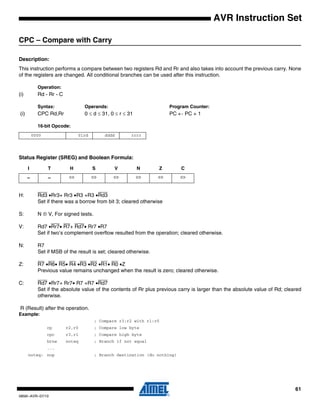
CPC – Compare with Carry
Description:
This instruction performs a compare between two registers Rd and Rr and also takes into account the previous carry. None
of the registers are changed. All conditional branches can be used after this instruction.
Operation:
(i) Rd - Rr - C
Syntax: Operands: Program Counter:
(i) CPC Rd,Rr 0 ≤ d ≤ 31, 0 ≤ r ≤ 31 PC ← PC + 1
16-bit Opcode:
Status Register (SREG) and Boolean Formula:
H: Rd3 •Rr3+ Rr3 •R3 +R3 •Rd3
Set if there was a borrow from bit 3; cleared otherwise
S: N ⊕ V, For signed tests.
V: Rd7 •Rr7• R7+ Rd7• Rr7 •R7
Set if two’s complement overflow resulted from the operation; cleared otherwise.
N: R7
Set if MSB of the result is set; cleared otherwise.
Z: R7 •R6• R5• R4 •R3 •R2 •R1• R0 •Z
Previous value remains unchanged when the result is zero; cleared otherwise.
C: Rd7 •Rr7+ Rr7• R7 +R7 •Rd7
Set if the absolute value of the contents of Rr plus previous carry is larger than the absolute value of Rd; cleared
otherwise.
R (Result) after the operation.
Example:
; Compare r3:r2 with r1:r0
cp r2,r0 ; Compare low byte
cpc r3,r1 ; Compare high byte
brne noteq ; Branch if not equal
...
noteq: nop ; Branch destination (do nothing)
0000 01rd dddd rrrr
I T H S V N Z C
– – ⇔ ⇔ ⇔ ⇔ ⇔ ⇔
62
0856I–AVR–07/10
AVR Instruction Set
Words: 1 (2 bytes)
Cycles: 1
63
0856I–AVR–07/10
AVR Instruction Set
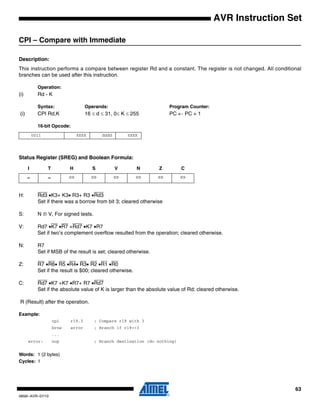
CPI – Compare with Immediate
Description:
This instruction performs a compare between register Rd and a constant. The register is not changed. All conditional
branches can be used after this instruction.
Operation:
(i) Rd - K
Syntax: Operands: Program Counter:
(i) CPI Rd,K 16 ≤ d ≤ 31, 0≤ K ≤ 255 PC ← PC + 1
16-bit Opcode:
Status Register (SREG) and Boolean Formula:
H: Rd3 •K3+ K3• R3+ R3 •Rd3
Set if there was a borrow from bit 3; cleared otherwise
S: N ⊕ V, For signed tests.
V: Rd7 •K7 •R7 +Rd7 •K7 •R7
Set if two’s complement overflow resulted from the operation; cleared otherwise.
N: R7
Set if MSB of the result is set; cleared otherwise.
Z: R7 •R6• R5 •R4• R3• R2 •R1 •R0
Set if the result is $00; cleared otherwise.
C: Rd7 •K7 +K7 •R7+ R7 •Rd7
Set if the absolute value of K is larger than the absolute value of Rd; cleared otherwise.
R (Result) after the operation.
Example:
cpi r19,3 ; Compare r19 with 3
brne error ; Branch if r19<>3
...
error: nop ; Branch destination (do nothing)
Words: 1 (2 bytes)
Cycles: 1
0011 KKKK dddd KKKK
I T H S V N Z C
– – ⇔ ⇔ ⇔ ⇔ ⇔ ⇔
64
0856I–AVR–07/10
AVR Instruction Set
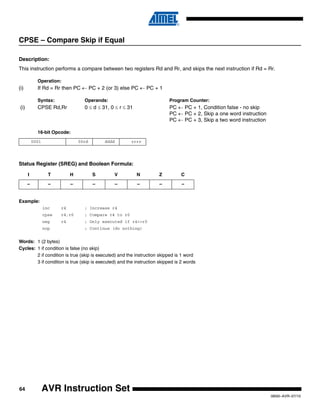
CPSE – Compare Skip if Equal
Description:
This instruction performs a compare between two registers Rd and Rr, and skips the next instruction if Rd = Rr.
Operation:
(i) If Rd = Rr then PC ← PC + 2 (or 3) else PC ← PC + 1
Syntax: Operands: Program Counter:
(i) CPSE Rd,Rr 0 ≤ d ≤ 31, 0 ≤ r ≤ 31 PC ← PC + 1, Condition false - no skip
PC ← PC + 2, Skip a one word instruction
PC ← PC + 3, Skip a two word instruction
16-bit Opcode:
Status Register (SREG) and Boolean Formula:
Example:
inc r4 ; Increase r4
cpse r4,r0 ; Compare r4 to r0
neg r4 ; Only executed if r4<>r0
nop ; Continue (do nothing)
Words: 1 (2 bytes)
Cycles: 1 if condition is false (no skip)
2 if condition is true (skip is executed) and the instruction skipped is 1 word
3 if condition is true (skip is executed) and the instruction skipped is 2 words
0001 00rd dddd rrrr
I T H S V N Z C
– – – – – – – –
65
0856I–AVR–07/10
AVR Instruction Set
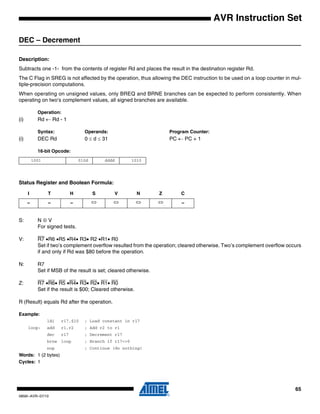
DEC – Decrement
Description:
Subtracts one -1- from the contents of register Rd and places the result in the destination register Rd.
The C Flag in SREG is not affected by the operation, thus allowing the DEC instruction to be used on a loop counter in mul-
tiple-precision computations.
When operating on unsigned values, only BREQ and BRNE branches can be expected to perform consistently. When
operating on two’s complement values, all signed branches are available.
Operation:
(i) Rd ← Rd - 1
Syntax: Operands: Program Counter:
(i) DEC Rd 0 ≤ d ≤ 31 PC ← PC + 1
16-bit Opcode:
Status Register and Boolean Formula:
S: N ⊕ V
For signed tests.
V: R7 •R6 •R5 •R4• R3• R2 •R1• R0
Set if two’s complement overflow resulted from the operation; cleared otherwise. Two’s complement overflow occurs
if and only if Rd was $80 before the operation.
N: R7
Set if MSB of the result is set; cleared otherwise.
Z: R7 •R6• R5 •R4• R3• R2• R1• R0
Set if the result is $00; Cleared otherwise.
R (Result) equals Rd after the operation.
Example:
ldi r17,$10 ; Load constant in r17
loop: add r1,r2 ; Add r2 to r1
dec r17 ; Decrement r17
brne loop ; Branch if r17<>0
nop ; Continue (do nothing)
Words: 1 (2 bytes)
Cycles: 1
1001 010d dddd 1010
I T H S V N Z C
– – – ⇔ ⇔ ⇔ ⇔ –
66
0856I–AVR–07/10
AVR Instruction Set
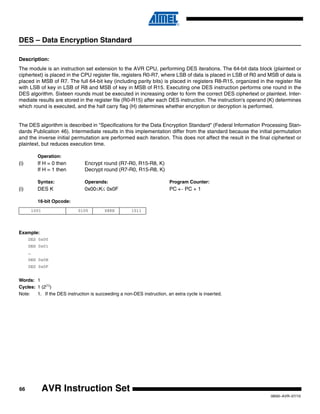
DES – Data Encryption Standard
Description:
The module is an instruction set extension to the AVR CPU, performing DES iterations. The 64-bit data block (plaintext or
ciphertext) is placed in the CPU register file, registers R0-R7, where LSB of data is placed in LSB of R0 and MSB of data is
placed in MSB of R7. The full 64-bit key (including parity bits) is placed in registers R8-R15, organized in the register file
with LSB of key in LSB of R8 and MSB of key in MSB of R15. Executing one DES instruction performs one round in the
DES algorithm. Sixteen rounds must be executed in increasing order to form the correct DES ciphertext or plaintext. Inter-
mediate results are stored in the register file (R0-R15) after each DES instruction. The instruction's operand (K) determines
which round is executed, and the half carry flag (H) determines whether encryption or decryption is performed.
The DES algorithm is described in "Specifications for the Data Encryption Standard" (Federal Information Processing Stan-
dards Publication 46). Intermediate results in this implementation differ from the standard because the initial permutation
and the inverse initial permutation are performed each iteration. This does not affect the result in the final ciphertext or
plaintext, but reduces execution time.
Operation:
(i) If H = 0 then Encrypt round (R7-R0, R15-R8, K)
If H = 1 then Decrypt round (R7-R0, R15-R8, K)
Syntax: Operands: Program Counter:
(i) DES K 0x00≤K≤ 0x0F PC ← PC + 1
16-bit Opcode:
Example:
DES 0x00
DES 0x01
…
DES 0x0E
DES 0x0F
Words: 1
Cycles: 1 (2(1)
)
Note: 1. If the DES instruction is succeeding a non-DES instruction, an extra cycle is inserted.
1001 0100 KKKK 1011
67
0856I–AVR–07/10
AVR Instruction Set
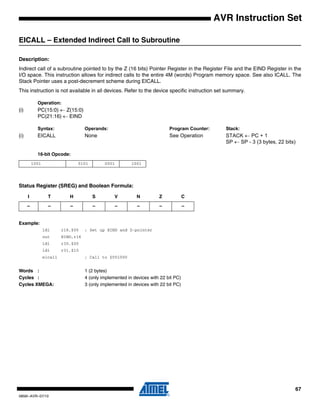
EICALL – Extended Indirect Call to Subroutine
Description:
Indirect call of a subroutine pointed to by the Z (16 bits) Pointer Register in the Register File and the EIND Register in the
I/O space. This instruction allows for indirect calls to the entire 4M (words) Program memory space. See also ICALL. The
Stack Pointer uses a post-decrement scheme during EICALL.
This instruction is not available in all devices. Refer to the device specific instruction set summary.
Operation:
(i) PC(15:0) ← Z(15:0)
PC(21:16) ← EIND
Syntax: Operands: Program Counter: Stack:
(i) EICALL None See Operation STACK ← PC + 1
SP ← SP - 3 (3 bytes, 22 bits)
16-bit Opcode:
Status Register (SREG) and Boolean Formula:
Example:
ldi r16,$05 ; Set up EIND and Z-pointer
out EIND,r16
ldi r30,$00
ldi r31,$10
eicall ; Call to $051000
Words : 1 (2 bytes)
Cycles : 4 (only implemented in devices with 22 bit PC)
Cycles XMEGA: 3 (only implemented in devices with 22 bit PC)
1001 0101 0001 1001
I T H S V N Z C
– – – – – – – –
68
0856I–AVR–07/10
AVR Instruction Set
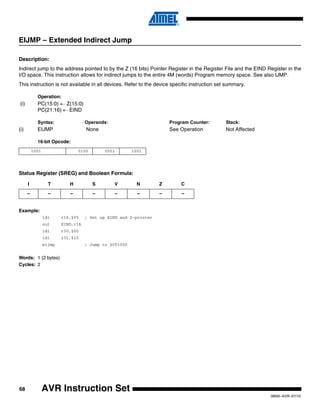
EIJMP – Extended Indirect Jump
Description:
Indirect jump to the address pointed to by the Z (16 bits) Pointer Register in the Register File and the EIND Register in the
I/O space. This instruction allows for indirect jumps to the entire 4M (words) Program memory space. See also IJMP.
This instruction is not available in all devices. Refer to the device specific instruction set summary.
Operation:
(i) PC(15:0) ← Z(15:0)
PC(21:16) ← EIND
Syntax: Operands: Program Counter: Stack:
(i) EIJMP None See Operation Not Affected
16-bit Opcode:
Status Register (SREG) and Boolean Formula:
Example:
ldi r16,$05 ; Set up EIND and Z-pointer
out EIND,r16
ldi r30,$00
ldi r31,$10
eijmp ; Jump to $051000
Words: 1 (2 bytes)
Cycles: 2
1001 0100 0001 1001
I T H S V N Z C
– – – – – – – –
69
0856I–AVR–07/10
AVR Instruction Set
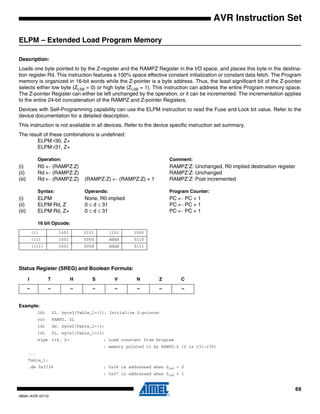
ELPM – Extended Load Program Memory
Description:
Loads one byte pointed to by the Z-register and the RAMPZ Register in the I/O space, and places this byte in the destina-
tion register Rd. This instruction features a 100% space effective constant initialization or constant data fetch. The Program
memory is organized in 16-bit words while the Z-pointer is a byte address. Thus, the least significant bit of the Z-pointer
selects either low byte (ZLSB = 0) or high byte (ZLSB = 1). This instruction can address the entire Program memory space.
The Z-pointer Register can either be left unchanged by the operation, or it can be incremented. The incrementation applies
to the entire 24-bit concatenation of the RAMPZ and Z-pointer Registers.
Devices with Self-Programming capability can use the ELPM instruction to read the Fuse and Lock bit value. Refer to the
device documentation for a detailed description.
This instruction is not available in all devices. Refer to the device specific instruction set summary.
The result of these combinations is undefined:
ELPM r30, Z+
ELPM r31, Z+
Operation: Comment:
(i) R0 ← (RAMPZ:Z) RAMPZ:Z: Unchanged, R0 implied destination register
(ii) Rd ← (RAMPZ:Z) RAMPZ:Z: Unchanged
(iii) Rd ← (RAMPZ:Z) (RAMPZ:Z) ← (RAMPZ:Z) + 1 RAMPZ:Z: Post incremented
Syntax: Operands: Program Counter:
(i) ELPM None, R0 implied PC ← PC + 1
(ii) ELPM Rd, Z 0 ≤ d ≤ 31 PC ← PC + 1
(iii) ELPM Rd, Z+ 0 ≤ d ≤ 31 PC ← PC + 1
16 bit Opcode:
Status Register (SREG) and Boolean Formula:
Example:
ldi ZL, byte3(Table_1<<1); Initialize Z-pointer
out RAMPZ, ZL
ldi ZH, byte2(Table_1<<1)
ldi ZL, byte1(Table_1<<1)
elpm r16, Z+ ; Load constant from Program
; memory pointed to by RAMPZ:Z (Z is r31:r30)
...
Table_1:
.dw 0x3738 ; 0x38 is addressed when ZLSB = 0
; 0x37 is addressed when ZLSB = 1
(i) 1001 0101 1101 1000
(ii) 1001 000d dddd 0110
(iii) 1001 000d dddd 0111
I T H S V N Z C
– – – – – – – –
70
0856I–AVR–07/10
AVR Instruction Set
...
Words: 1 (2 bytes)
Cycles: 3
71
0856I–AVR–07/10
AVR Instruction Set
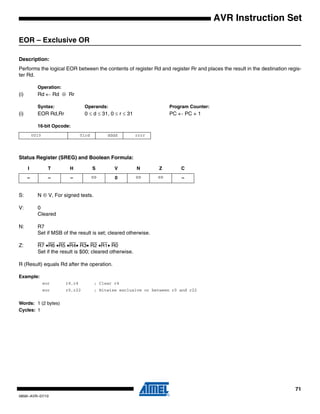
EOR – Exclusive OR
Description:
Performs the logical EOR between the contents of register Rd and register Rr and places the result in the destination regis-
ter Rd.
Operation:
(i) Rd ← Rd ⊕ Rr
Syntax: Operands: Program Counter:
(i) EOR Rd,Rr 0 ≤ d ≤ 31, 0 ≤ r ≤ 31 PC ← PC + 1
16-bit Opcode:
Status Register (SREG) and Boolean Formula:
S: N ⊕ V, For signed tests.
V: 0
Cleared
N: R7
Set if MSB of the result is set; cleared otherwise.
Z: R7 •R6 •R5 •R4• R3• R2 •R1• R0
Set if the result is $00; cleared otherwise.
R (Result) equals Rd after the operation.
Example:
eor r4,r4 ; Clear r4
eor r0,r22 ; Bitwise exclusive or between r0 and r22
Words: 1 (2 bytes)
Cycles: 1
0010 01rd dddd rrrr
I T H S V N Z C
– – – ⇔ 0 ⇔ ⇔ –
72
0856I–AVR–07/10
AVR Instruction Set
FMUL – Fractional Multiply Unsigned
Description:
This instruction performs 8-bit × 8-bit → 16-bit unsigned multiplication and shifts the result one bit left.
Let (N.Q) denote a fractional number with N binary digits left of the radix point, and Q binary digits right of the radix point. A
multiplication between two numbers in the formats (N1.Q1) and (N2.Q2) results in the format ((N1+N2).(Q1+Q2)). For sig-
nal processing applications, the format (1.7) is widely used for the inputs, resulting in a (2.14) format for the product. A left
shift is required for the high byte of the product to be in the same format as the inputs. The FMUL instruction incorporates
the shift operation in the same number of cycles as MUL.
The (1.7) format is most commonly used with signed numbers, while FMUL performs an unsigned multiplication. This
instruction is therefore most useful for calculating one of the partial products when performing a signed multiplication with
16-bit inputs in the (1.15) format, yielding a result in the (1.31) format. Note: the result of the FMUL operation may suffer
from a 2’s complement overflow if interpreted as a number in the (1.15) format. The MSB of the multiplication before shift-
ing must be taken into account, and is found in the carry bit. See the following example.
The multiplicand Rd and the multiplier Rr are two registers containing unsigned fractional numbers where the implicit radix
point lies between bit 6 and bit 7. The 16-bit unsigned fractional product with the implicit radix point between bit 14 and bit
15 is placed in R1 (high byte) and R0 (low byte).
This instruction is not available in all devices. Refer to the device specific instruction set summary.
Operation:
(i) R1:R0 ← Rd × Rr (unsigned (1.15) ← unsigned (1.7) × unsigned (1.7))
Syntax: Operands: Program Counter:
(i) FMUL Rd,Rr 16 ≤ d ≤ 23, 16≤ r ≤ 23 PC ← PC + 1
16-bit Opcode:
Status Register (SREG) and Boolean Formula:
C: R16
Set if bit 15 of the result before left shift is set; cleared otherwise.
Z: R15 •R14 •R13 •R12 •R11 •R10 •R9 •R8 •R7• R6• R5• R4• R3• R2 •R1• R0
Set if the result is $0000; cleared otherwise.
R (Result) equals R1,R0 after the operation.
Rd Rr R1 R0
Multiplicand × Multiplier Æ Product High Product Low
8 8 16
0000 0011 0ddd 1rrr
I T H S V N Z C
– – – – – – ⇔ ⇔
73
0856I–AVR–07/10
AVR Instruction Set
Example:
;******************************************************************************
;* DESCRIPTION
;*Signed fractional multiply of two 16-bit numbers with 32-bit result.
;* USAGE
;*r19:r18:r17:r16 = ( r23:r22 * r21:r20 ) << 1
;******************************************************************************
fmuls16x16_32:
clrr2
fmulsr23, r21;((signed)ah * (signed)bh) << 1
movwr19:r18, r1:r0
fmulr22, r20;(al * bl) << 1
adcr18, r2
movwr17:r16, r1:r0
fmulsur23, r20;((signed)ah * bl) << 1
sbcr19, r2
addr17, r0
adcr18, r1
adcr19, r2
fmulsur21, r22;((signed)bh * al) << 1
sbcr19, r2
addr17, r0
adcr18, r1
adcr19, r2
Words: 1 (2 bytes)
Cycles: 2
74
0856I–AVR–07/10
AVR Instruction Set
FMULS – Fractional Multiply Signed
Description:
This instruction performs 8-bit × 8-bit → 16-bit signed multiplication and shifts the result one bit left.
Let (N.Q) denote a fractional number with N binary digits left of the radix point, and Q binary digits right of the radix point. A
multiplication between two numbers in the formats (N1.Q1) and (N2.Q2) results in the format ((N1+N2).(Q1+Q2)). For sig-
nal processing applications, the format (1.7) is widely used for the inputs, resulting in a (2.14) format for the product. A left
shift is required for the high byte of the product to be in the same format as the inputs. The FMULS instruction incorporates
the shift operation in the same number of cycles as MULS.
The multiplicand Rd and the multiplier Rr are two registers containing signed fractional numbers where the implicit radix
point lies between bit 6 and bit 7. The 16-bit signed fractional product with the implicit radix point between bit 14 and bit 15
is placed in R1 (high byte) and R0 (low byte).
Note that when multiplying 0x80 (-1) with 0x80 (-1), the result of the shift operation is 0x8000 (-1). The shift operation thus
gives a two’s complement overflow. This must be checked and handled by software.
This instruction is not available in all devices. Refer to the device specific instruction set summary.
Operation:
(i) R1:R0 ← Rd × Rr (signed (1.15) ← signed (1.7) × signed (1.7))
Syntax: Operands: Program Counter:
(i) FMULS Rd,Rr 16 ≤ d ≤ 23, 16≤ r ≤ 23 PC ← PC + 1
16-bit Opcode:
Status Register (SREG) and Boolean Formula:
C: R16
Set if bit 15 of the result before left shift is set; cleared otherwise.
Z: R15 •R14 •R13 •R12 •R11 •R10 •R9 •R8 •R7• R6• R5• R4• R3• R2 •R1• R0
Set if the result is $0000; cleared otherwise.
R (Result) equals R1,R0 after the operation.
Example:
fmuls r23,r22 ; Multiply signed r23 and r22 in (1.7) format, result in (1.15) format
movw r23:r22,r1:r0 ; Copy result back in r23:r22
Rd Rr R1 R0
Multiplicand × Multiplier → Product High Product Low
8 8 16
0000 0011 1ddd 0rrr
I T H S V N Z C
– – – – – – ⇔ ⇔
75
0856I–AVR–07/10
AVR Instruction Set
Words: 1 (2 bytes)
Cycles: 2
76
0856I–AVR–07/10
AVR Instruction Set
FMULSU – Fractional Multiply Signed with Unsigned
Description:
This instruction performs 8-bit × 8-bit → 16-bit signed multiplication and shifts the result one bit left.
Let (N.Q) denote a fractional number with N binary digits left of the radix point, and Q binary digits right of the radix point. A
multiplication between two numbers in the formats (N1.Q1) and (N2.Q2) results in the format ((N1+N2).(Q1+Q2)). For sig-
nal processing applications, the format (1.7) is widely used for the inputs, resulting in a (2.14) format for the product. A left
shift is required for the high byte of the product to be in the same format as the inputs. The FMULSU instruction incorpo-
rates the shift operation in the same number of cycles as MULSU.
The (1.7) format is most commonly used with signed numbers, while FMULSU performs a multiplication with one unsigned
and one signed input. This instruction is therefore most useful for calculating two of the partial products when performing a
signed multiplication with 16-bit inputs in the (1.15) format, yielding a result in the (1.31) format. Note: the result of the
FMULSU operation may suffer from a 2's complement overflow if interpreted as a number in the (1.15) format. The MSB of
the multiplication before shifting must be taken into account, and is found in the carry bit. See the following example.
The multiplicand Rd and the multiplier Rr are two registers containing fractional numbers where the implicit radix point lies
between bit 6 and bit 7. The multiplicand Rd is a signed fractional number, and the multiplier Rr is an unsigned fractional
number. The 16-bit signed fractional product with the implicit radix point between bit 14 and bit 15 is placed in R1 (high
byte) and R0 (low byte).
This instruction is not available in all devices. Refer to the device specific instruction set summary.
Operation:
(i) R1:R0 ← Rd × Rr (signed (1.15) ← signed (1.7) × unsigned (1.7))
Syntax: Operands: Program Counter:
(i) FMULSU Rd,Rr 16 ≤ d ≤ 23, 16≤ r ≤ 23 PC ← PC + 1
16-bit Opcode:
Status Register (SREG) and Boolean Formula:
C: R16
Set if bit 15 of the result before left shift is set; cleared otherwise.
Z: R15 •R14 •R13 •R12 •R11 •R10 •R9 •R8 •R7• R6• R5• R4• R3• R2 •R1• R0
Set if the result is $0000; cleared otherwise.
R (Result) equals R1,R0 after the operation.
Rd Rr R1 R0
Multiplicand × Multiplier → Product High Product Low
8 8 16
0000 0011 1ddd 1rrr
I T H S V N Z C
– – – – – – ⇔ ⇔
77
0856I–AVR–07/10
AVR Instruction Set
Example:
;******************************************************************************
;* DESCRIPTION
;*Signed fractional multiply of two 16-bit numbers with 32-bit result.
;* USAGE
;*r19:r18:r17:r16 = ( r23:r22 * r21:r20 ) << 1
;******************************************************************************
fmuls16x16_32:
clrr2
fmulsr23, r21;((signed)ah * (signed)bh) << 1
movwr19:r18, r1:r0
fmulr22, r20;(al * bl) << 1
adcr18, r2
movwr17:r16, r1:r0
fmulsur23, r20;((signed)ah * bl) << 1
sbcr19, r2
addr17, r0
adcr18, r1
adcr19, r2
fmulsur21, r22;((signed)bh * al) << 1
sbcr19, r2
addr17, r0
adcr18, r1
adcr19, r2
Words: 1 (2 bytes)
Cycles: 2
78
0856I–AVR–07/10
AVR Instruction Set
ICALL – Indirect Call to Subroutine
Description:
Calls to a subroutine within the entire 4M (words) Program memory. The return address (to the instruction after the CALL)
will be stored onto the Stack. See also RCALL. The Stack Pointer uses a post-decrement scheme during CALL.
This instruction is not available in all devices. Refer to the device specific instruction set summary.
Operation:
(i) PC(15:0) ← Z(15:0) Devices with 16 bits PC, 128K bytes Program memory maximum.
(ii) PC(15:0) ← Z(15:0) Devices with 22 bits PC, 8M bytes Program memory maximum.
PC(21:16) ← 0
Syntax: Operands: Program Counter: Stack:
(i) ICALL None See Operation STACK ← PC + 1
SP ← SP - 2 (2 bytes, 16 bits)
(ii) ICALL None See Operation STACK ← PC + 1
SP ← SP - 3 (3 bytes, 22 bits)
16-bit Opcode:
Status Register (SREG) and Boolean Formula:
Example:
mov r30,r0 ; Set offset to call table
icall ; Call routine pointed to by r31:r30
Words : 1 (2 bytes)
Cycles : 3, devices with 16 bit PC
4, devices with 22 bit PC
Cycles XMEGA: 2, devices with 16 bit PC
3, devices with 22 bit PC
1001 0101 0000 1001
I T H S V N Z C
– – – – – – – –
79
0856I–AVR–07/10
AVR Instruction Set
IJMP – Indirect Jump
Description:
Indirect jump to the address pointed to by the Z (16 bits) Pointer Register in the Register File. The Z-pointer Register is 16
bits wide and allows jump within the lowest 64K words (128K bytes) section of Program memory.
This instruction is not available in all devices. Refer to the device specific instruction set summary.
Operation:
(i) PC ← Z(15:0) Devices with 16 bits PC, 128K bytes Program memory maximum.
(ii) PC(15:0) ← Z(15:0) Devices with 22 bits PC, 8M bytes Program memory maximum.
PC(21:16) ← 0
Syntax: Operands: Program Counter: Stack:
(i),(ii) IJMP None See Operation Not Affected
16-bit Opcode:
Status Register (SREG) and Boolean Formula:
Example:
mov r30,r0 ; Set offset to jump table
ijmp ; Jump to routine pointed to by r31:r30
Words: 1 (2 bytes)
Cycles: 2
1001 0100 0000 1001
I T H S V N Z C
– – – – – – – –
80
0856I–AVR–07/10
AVR Instruction Set
IN - Load an I/O Location to Register
Description:
Loads data from the I/O Space (Ports, Timers, Configuration Registers etc.) into register Rd in the Register File.
Operation:
(i) Rd ← I/O(A)
Syntax: Operands: Program Counter:
(i) IN Rd,A 0 ≤ d ≤ 31, 0 ≤ A ≤ 63 PC ← PC + 1
16-bit Opcode:
Status Register (SREG) and Boolean Formula:
Example:
in r25,$16 ; Read Port B
cpi r25,4 ; Compare read value to constant
breq exit ; Branch if r25=4
...
exit: nop ; Branch destination (do nothing)
Words: 1 (2 bytes)
Cycles: 1
1011 0AAd dddd AAAA
I T H S V N Z C
– – – – – – – –
81
0856I–AVR–07/10
AVR Instruction Set
INC – Increment
Description:
Adds one -1- to the contents of register Rd and places the result in the destination register Rd.
The C Flag in SREG is not affected by the operation, thus allowing the INC instruction to be used on a loop counter in mul-
tiple-precision computations.
When operating on unsigned numbers, only BREQ and BRNE branches can be expected to perform consistently. When
operating on two’s complement values, all signed branches are available.
Operation:
(i) Rd ← Rd + 1
Syntax: Operands: Program Counter:
(i) INC Rd 0 ≤ d ≤ 31 PC ← PC + 1
16-bit Opcode:
Status Register and Boolean Formula:
S: N ⊕ V
For signed tests.
V: R7 •R6 •R5 •R4 •R3• R2 •R1 •R0
Set if two’s complement overflow resulted from the operation; cleared otherwise. Two’s complement overflow occurs
if and only if Rd was $7F before the operation.
N: R7
Set if MSB of the result is set; cleared otherwise.
Z: R7 •R6 •R5 •R4•R3 •R2• R1• R0
Set if the result is $00; Cleared otherwise.
R (Result) equals Rd after the operation.
Example:
clr r22 ; clear r22
loop: inc r22 ; increment r22
...
cpi r22,$4F ; Compare r22 to $4f
brne loop ; Branch if not equal
nop ; Continue (do nothing)
1001 010d dddd 0011
I T H S V N Z C
– – – ⇔ ⇔ ⇔ ⇔ –
82
0856I–AVR–07/10
AVR Instruction Set
Words: 1 (2 bytes)
Cycles: 1
83
0856I–AVR–07/10
AVR Instruction Set
JMP – Jump
Description:
Jump to an address within the entire 4M (words) Program memory. See also RJMP.
This instruction is not available in all devices. Refer to the device specific instruction set summary.
Operation:
(i) PC ← k
Syntax: Operands: Program Counter: Stack:
(i) JMP k 0 ≤ k < 4M PC ← k Unchanged
32-bit Opcode:
Status Register (SREG) and Boolean Formula:
Example:
mov r1,r0 ; Copy r0 to r1
jmp farplc ; Unconditional jump
...
farplc: nop ; Jump destination (do nothing)
Words: 2 (4 bytes)
Cycles: 3
1001 010k kkkk 110k
kkkk kkkk kkkk kkkk
I T H S V N Z C
– – – – – – – –
84
0856I–AVR–07/10
AVR Instruction Set
LAC – Load And Clear
Description:
Operation:
(i) (Z) ← Rd • ($FF – (Z))
Syntax: Operands: Program Counter:
(i) LAC Z,Rd 0 ≤ d ≤ 31 PC ← PC + 1
16-bit Opcode:
Words: 1 (2 bytes)
Cycles: 1
1001 001r rrrr 0110
85
0856I–AVR–07/10
AVR Instruction Set
LAS – Load And Set
Description:
Operation:
(i) (Z) ← Rd v (Z), Rd ← (Z)
Syntax: Operands: Program Counter:
(i) LAS Z,Rd 0 ≤ d ≤ 31 PC ← PC + 1
16-bit Opcode:
Words: 1 (2 bytes)
Cycles: 1
1001 001r rrrr 0101
86
0856I–AVR–07/10
AVR Instruction Set
LAT – Load And Toggle
Description:
Operation:
(i) (Z) ← Rd ⊕ (Z), Rd ← (Z)
Syntax: Operands: Program Counter:
(i) LAT Z,Rd 0 ≤ d ≤ 31 PC ← PC + 1
16-bit Opcode:
Words: 1 (2 bytes)
Cycles: 1
1001 001r rrrr 0111
87
0856I–AVR–07/10
AVR Instruction Set
LD – Load Indirect from Data Space to Register using Index X
Description:
Loads one byte indirect from the data space to a register. For parts with SRAM, the data space consists of the Register
File, I/O memory and internal SRAM (and external SRAM if applicable). For parts without SRAM, the data space consists of
the Register File only. In some parts the Flash Memory has been mapped to the data space and can be read using this
command. The EEPROM has a separate address space.
The data location is pointed to by the X (16 bits) Pointer Register in the Register File. Memory access is limited to the cur-
rent data segment of 64K bytes. To access another data segment in devices with more than 64K bytes data space, the
RAMPX in register in the I/O area has to be changed.
The X-pointer Register can either be left unchanged by the operation, or it can be post-incremented or pre-decremented.
These features are especially suited for accessing arrays, tables, and Stack Pointer usage of the X-pointer Register. Note
that only the low byte of the X-pointer is updated in devices with no more than 256 bytes data space. For such devices, the
high byte of the pointer is not used by this instruction and can be used for other purposes. The RAMPX Register in the I/O
area is updated in parts with more than 64K bytes data space or more than 64K bytes Program memory, and the incre-
ment/decrement is added to the entire 24-bit address on such devices.
Not all variants of this instruction is available in all devices. Refer to the device specific instruction set summary.
In the Reduced Core tinyAVR the LD instruction can be used to achieve the same operation as LPM since the program
memory is mapped to the data memory space.
The result of these combinations is undefined:
LD r26, X+
LD r27, X+
LD r26, -X
LD r27, -X
Using the X-pointer:
Operation: Comment:
(i) Rd ← (X) X: Unchanged
(ii) Rd ← (X) X ← X + 1 X: Post incremented
(iii) X ← X - 1 Rd ← (X) X: Pre decremented
Syntax: Operands: Program Counter:
(i) LD Rd, X 0 ≤ d ≤ 31 PC ← PC + 1
(ii) LD Rd, X+ 0 ≤ d ≤ 31 PC ← PC + 1
(iii) LD Rd, -X 0 ≤ d ≤ 31 PC ← PC + 1
88
0856I–AVR–07/10
AVR Instruction Set
16-bit Opcode:
Status Register (SREG) and Boolean Formula:
(i) 1001 000d dddd 1100
(ii) 1001 000d dddd 1101
(iii) 1001 000d dddd 1110
I T H S V N Z C
– – – – – – – –
89
0856I–AVR–07/10
AVR Instruction Set
Example:
clr r27 ; Clear X high byte
ldi r26,$60 ; Set X low byte to $60
ld r0,X+ ; Load r0 with data space loc. $60(X post inc)
ld r1,X ; Load r1 with data space loc. $61
ldi r26,$63 ; Set X low byte to $63
ld r2,X ; Load r2 with data space loc. $63
ld r3,–X ; Load r3 with data space loc. $62(X pre dec)
Words: 1 (2 bytes)
Cycles: (i) 1(2)
(ii) 2
(iii) 3(2)
Cycles XMEGA: (i) 1(1)
(ii) 1(1)
(iii) 2(1)
Notes: 1. IF the LD instruction is accessing internal SRAM, one extra cycle is inserted.
2. LD instruction can load data from program memory since the flash is memory mapped. Loading data from the data memory
takes 1 clock cycle, and loading from the program memory takes 2 clock cycles. But if an interrupt occur (before the last
clock cycle) no additional clock cycles is necessary when loading from the program memory. Hence, the instruction takes
only 1 clock cycle to execute.
LD instruction with pre-decrement can load data from program memory since the flash is memory mapped. Loading data
from the data memory takes 2 clock cycles, and loading from the program memory takes 3 clock cycles. But if an interrupt
occur (before the last clock cycle) no additional clock cycles is necessary when loading from the program memory. Hence,
the instruction takes only 1 clock cycle to execute.
90
0856I–AVR–07/10
AVR Instruction Set
LD (LDD) – Load Indirect from Data Space to Register using Index Y
Description:
Loads one byte indirect with or without displacement from the data space to a register. For parts with SRAM, the data
space consists of the Register File, I/O memory and internal SRAM (and external SRAM if applicable). For parts without
SRAM, the data space consists of the Register File only. In some parts the Flash Memory has been mapped to the data
space and can be read using this command. The EEPROM has a separate address space.
The data location is pointed to by the Y (16 bits) Pointer Register in the Register File. Memory access is limited to the cur-
rent data segment of 64K bytes. To access another data segment in devices with more than 64K bytes data space, the
RAMPY in register in the I/O area has to be changed.
The Y-pointer Register can either be left unchanged by the operation, or it can be post-incremented or pre-decremented.
These features are especially suited for accessing arrays, tables, and Stack Pointer usage of the Y-pointer Register. Note
that only the low byte of the Y-pointer is updated in devices with no more than 256 bytes data space. For such devices, the
high byte of the pointer is not used by this instruction and can be used for other purposes. The RAMPY Register in the I/O
area is updated in parts with more than 64K bytes data space or more than 64K bytes Program memory, and the incre-
ment/decrement/displacement is added to the entire 24-bit address on such devices.
Not all variants of this instruction is available in all devices. Refer to the device specific instruction set summary.
In the Reduced Core tinyAVR the LD instruction can be used to achieve the same operation as LPM since the program
memory is mapped to the data memory space.
The result of these combinations is undefined:
LD r28, Y+
LD r29, Y+
LD r28, -Y
LD r29, -Y
Using the Y-pointer:
Operation: Comment:
(i) Rd ← (Y) Y: Unchanged
(ii) Rd ← (Y) Y ← Y + 1 Y: Post incremented
(iii) Y ← Y - 1 Rd ← (Y) Y: Pre decremented
(iv) Rd ← (Y+q) Y: Unchanged, q: Displacement
Syntax: Operands: Program Counter:
(i) LD Rd, Y 0 ≤ d ≤ 31 PC ← PC + 1
(ii) LD Rd, Y+ 0 ≤ d ≤ 31 PC ← PC + 1
(iii) LD Rd, -Y 0 ≤ d ≤ 31 PC ← PC + 1
(iv) LDD Rd, Y+q 0 ≤ d ≤ 31, 0 ≤ q ≤ 63 PC ← PC + 1
91
0856I–AVR–07/10
AVR Instruction Set
16-bit Opcode:
Status Register (SREG) and Boolean Formula:
Example:
clr r29 ; Clear Y high byte
ldi r28,$60 ; Set Y low byte to $60
ld r0,Y+ ; Load r0 with data space loc. $60(Y post inc)
ld r1,Y ; Load r1 with data space loc. $61
ldi r28,$63 ; Set Y low byte to $63
ld r2,Y ; Load r2 with data space loc. $63
ld r3,-Y ; Load r3 with data space loc. $62(Y pre dec)
ldd r4,Y+2 ; Load r4 with data space loc. $64
Words: 1 (2 bytes)
Cycles: (i) 1(2)
(ii) 2
(iii) 3(2)
Cycles XMEGA: (i) 1(1)
(ii) 1(1)
(iii) 2(1)
(iv) 2(1)
Notes: 1. IF the LD instruction is accessing internal SRAM, one extra cycle is inserted.
2. LD instruction can load data from program memory since the flash is memory mapped. Loading data from the data memory
takes 1 clock cycle, and loading from the program memory takes 2 clock cycles. But if an interrupt occur (before the last
clock cycle) no additional clock cycles is necessary when loading from the program memory. Hence, the instruction takes
only 1 clock cycle to execute.
LD instruction with pre-decrement can load data from program memory since the flash is memory mapped. Loading data
from the data memory takes 2 clock cycles, and loading from the program memory takes 3 clock cycles. But if an interrupt
occur (before the last clock cycle) no additional clock cycles is necessary when loading from the program memory. Hence,
the instruction takes only 1 clock cycle to execute.
(i) 1000 000d dddd 1000
(ii) 1001 000d dddd 1001
(iii) 1001 000d dddd 1010
(iv) 10q0 qq0d dddd 1qqq
I T H S V N Z C
– – – – – – – –
92
0856I–AVR–07/10
AVR Instruction Set
LD (LDD) – Load Indirect From Data Space to Register using Index Z
Description:
Loads one byte indirect with or without displacement from the data space to a register. For parts with SRAM, the data
space consists of the Register File, I/O memory and internal SRAM (and external SRAM if applicable). For parts without
SRAM, the data space consists of the Register File only. In some parts the Flash Memory has been mapped to the data
space and can be read using this command. The EEPROM has a separate address space.
The data location is pointed to by the Z (16 bits) Pointer Register in the Register File. Memory access is limited to the cur-
rent data segment of 64K bytes. To access another data segment in devices with more than 64K bytes data space, the
RAMPZ in register in the I/O area has to be changed.
The Z-pointer Register can either be left unchanged by the operation, or it can be post-incremented or pre-decremented.
These features are especially suited for Stack Pointer usage of the Z-pointer Register, however because the Z-pointer
Register can be used for indirect subroutine calls, indirect jumps and table lookup, it is often more convenient to use the X
or Y-pointer as a dedicated Stack Pointer. Note that only the low byte of the Z-pointer is updated in devices with no more
than 256 bytes data space. For such devices, the high byte of the pointer is not used by this instruction and can be used for
other purposes. The RAMPZ Register in the I/O area is updated in parts with more than 64K bytes data space or more than
64K bytes Program memory, and the increment/decrement/displacement is added to the entire 24-bit address on such
devices.
Not all variants of this instruction is available in all devices. Refer to the device specific instruction set summary.
In the Reduced Core tinyAVR the LD instruction can be used to achieve the same operation as LPM since the program
memory is mapped to the data memory space.
For using the Z-pointer for table lookup in Program memory see the LPM and ELPM instructions.
The result of these combinations is undefined:
LD r30, Z+
LD r31, Z+
LD r30, -Z
LD r31, -Z
Using the Z-pointer:
Operation: Comment:
(i) Rd ← (Z) Z: Unchanged
(ii) Rd ← (Z) Z ← Z + 1 Z: Post increment
(iii) Z ← Z -1 Rd ← (Z) Z: Pre decrement
(iv) Rd ← (Z+q) Z: Unchanged, q: Displacement
Syntax: Operands: Program Counter:
(i) LD Rd, Z 0 ≤ d ≤ 31 PC ← PC + 1
(ii) LD Rd, Z+ 0 ≤ d ≤ 31 PC ← PC + 1
(iii) LD Rd, -Z 0 ≤ d ≤ 31 PC ← PC + 1
(iv) LDD Rd, Z+q 0 ≤ d ≤ 31, 0 ≤ q ≤ 63 PC ← PC + 1
93
0856I–AVR–07/10
AVR Instruction Set
16-bit Opcode:
Status Register (SREG) and Boolean Formula:
Example:
clr r31 ; Clear Z high byte
ldi r30,$60 ; Set Z low byte to $60
ld r0,Z+ ; Load r0 with data space loc. $60(Z post inc)
ld r1,Z ; Load r1 with data space loc. $61
ldi r30,$63 ; Set Z low byte to $63
ld r2,Z ; Load r2 with data space loc. $63
ld r3,-Z ; Load r3 with data space loc. $62(Z pre dec)
ldd r4,Z+2 ; Load r4 with data space loc. $64
Words: 1 (2 bytes)
Cycles: (i) 1(2)
(ii) 2
(iii) 3(2)
Cycles XMEGA: (i) 1(1)
(ii) 1(1)
(iii) 2(1)
(iv) 2(1)
Notes: 1. IF the LD instruction is accessing internal SRAM, one extra cycle is inserted.
2. LD instruction can load data from program memory since the flash is memory mapped. Loading data from the data memory
takes 1 clock cycle, and loading from the program memory takes 2 clock cycles. But if an interrupt occur (before the last
clock cycle) no additional clock cycles is necessary when loading from the program memory. Hence, the instruction takes
only 1 clock cycle to execute.
LD instruction with pre-decrement can load data from program memory since the flash is memory mapped. Loading data
from the data memory takes 2 clock cycles, and loading from the program memory takes 3 clock cycles. But if an interrupt
occur (before the last clock cycle) no additional clock cycles is necessary when loading from the program memory. Hence,
the instruction takes only 1 clock cycle to execute.
(i) 1000 000d dddd 0000
(ii) 1001 000d dddd 0001
(iii) 1001 000d dddd 0010
(iv) 10q0 qq0d dddd 0qqq
I T H S V N Z C
– – – – – – – –
94
0856I–AVR–07/10
AVR Instruction Set
LDI – Load Immediate
Description:
Loads an 8 bit constant directly to register 16 to 31.
Operation:
(i) Rd ← K
Syntax: Operands: Program Counter:
(i) LDI Rd,K 16 ≤ d ≤ 31, 0 ≤ K ≤ 255 PC ← PC + 1
16-bit Opcode:
Status Register (SREG) and Boolean Formula:
Example:
clr r31 ; Clear Z high byte
ldi r30,$F0 ; Set Z low byte to $F0
lpm ; Load constant from Program
; memory pointed to by Z
Words: 1 (2 bytes)
Cycles: 1
1110 KKKK dddd KKKK
I T H S V N Z C
– – – – – – – –
95
0856I–AVR–07/10
AVR Instruction Set
LDS – Load Direct from Data Space
Description:
Loads one byte from the data space to a register. For parts with SRAM, the data space consists of the Register File, I/O
memory and internal SRAM (and external SRAM if applicable). For parts without SRAM, the data space consists of the reg-
ister file only. The EEPROM has a separate address space.
A 16-bit address must be supplied. Memory access is limited to the current data segment of 64K bytes. The LDS instruction
uses the RAMPD Register to access memory above 64K bytes. To access another data segment in devices with more than
64K bytes data space, the RAMPD in register in the I/O area has to be changed.
This instruction is not available in all devices. Refer to the device specific instruction set summary.
Operation:
(i) Rd ← (k)
Syntax: Operands: Program Counter:
(i) LDS Rd,k 0 ≤ d ≤ 31, 0 ≤ k ≤ 65535 PC ← PC + 2
32-bit Opcode:
Status Register (SREG) and Boolean Formula:
Example:
lds r2,$FF00 ; Load r2 with the contents of data space location $FF00
add r2,r1 ; add r1 to r2
sts $FF00,r2 ; Write back
Words: 2 (4 bytes)
Cycles: 2
Cycles XMEGA: 2 If the LDS instruction is accessing internal SRAM, one extra cycle is inserted.
1001 000d dddd 0000
kkkk kkkk kkkk kkkk
I T H S V N Z C
– – – – – – – –
96
0856I–AVR–07/10
AVR Instruction Set
LDS (16-bit) – Load Direct from Data Space
Description:
Loads one byte from the data space to a register. For parts with SRAM, the data space consists of the Register File, I/O
memory and internal SRAM (and external SRAM if applicable). For parts without SRAM, the data space consists of the reg-
ister file only. In some parts the Flash memory has been mapped to the data space and can be read using this command.
The EEPROM has a separate address space.
A 7-bit address must be supplied. The address given in the instruction is coded to a data space address as follows:
ADDR[7:0] = (INST[8], INST[8], INST[10], INST[9], INST[3], INST[2], INST[1], INST[0])
Memory access is limited to the address range 0x40..0xbf.
This instruction is not available in all devices. Refer to the device specific instruction set summary.
Operation:
(i) Rd ← (k)
Syntax: Operands: Program Counter:
(i) LDS Rd,k 16 ≤ d ≤ 31, 0 ≤ k ≤ 127 PC ← PC + 1
16-bit Opcode:
Status Register (SREG) and Boolean Formula:
Example:
lds r16,$00 ; Load r16 with the contents of data space location $00
add r16,r17 ; add r17 to r16
sts $00,r16 ; Write result to the same address it was fetched from
Words: 1 (2 bytes)
Cycles: 1
Note: Registers r0..r15 are remapped to r16..r31.
1010 0kkk dddd kkkk
I T H S V N Z C
– – – – – – – –
97
0856I–AVR–07/10
AVR Instruction Set
LPM – Load Program Memory
Description:
Loads one byte pointed to by the Z-register into the destination register Rd. This instruction features a 100% space effec-
tive constant initialization or constant data fetch. The Program memory is organized in 16-bit words while the Z-pointer is a
byte address. Thus, the least significant bit of the Z-pointer selects either low byte (ZLSB = 0) or high byte (ZLSB = 1). This
instruction can address the first 64K bytes (32K words) of Program memory. The Z-pointer Register can either be left
unchanged by the operation, or it can be incremented. The incrementation does not apply to the RAMPZ Register.
Devices with Self-Programming capability can use the LPM instruction to read the Fuse and Lock bit values. Refer to the
device documentation for a detailed description.
The LPM instruction is not available in all devices. Refer to the device specific instruction set summary.
The result of these combinations is undefined:
LPM r30, Z+
LPM r31, Z+
Operation: Comment:
(i) R0 ← (Z) Z: Unchanged, R0 implied destination register
(ii) Rd ← (Z) Z: Unchanged
(iii) Rd ← (Z) Z ← Z + 1 Z: Post incremented
Syntax: Operands: Program Counter:
(i) LPM None, R0 implied PC ← PC + 1
(ii) LPM Rd, Z 0 ≤ d ≤ 31 PC ← PC + 1
(iii) LPM Rd, Z+ 0 ≤ d ≤ 31 PC ← PC + 1
16-bit Opcode:
Status Register (SREG) and Boolean Formula:
Example:
ldi ZH, high(Table_1<<1); Initialize Z-pointer
ldi ZL, low(Table_1<<1)
lpm r16, Z ; Load constant from Program
; Memory pointed to by Z (r31:r30)
...
Table_1:
.dw 0x5876 ; 0x76 is addresses when ZLSB = 0
; 0x58 is addresses when ZLSB = 1
...
(i) 1001 0101 1100 1000
(ii) 1001 000d dddd 0100
(iii) 1001 000d dddd 0101
I T H S V N Z C
– – – – – – – –
98
0856I–AVR–07/10
AVR Instruction Set
Words: 1 (2 bytes)
Cycles: 3
99
0856I–AVR–07/10
AVR Instruction Set
LSL – Logical Shift Left
Description:
Shifts all bits in Rd one place to the left. Bit 0 is cleared. Bit 7 is loaded into the C Flag of the SREG. This operation effec-
tively multiplies signed and unsigned values by two.
Operation:
(i)
Syntax: Operands: Program Counter:
(i) LSL Rd 0 ≤ d ≤ 31 PC ← PC + 1
16-bit Opcode: (see ADD Rd,Rd)
Status Register (SREG) and Boolean Formula:
H: Rd3
S: N ⊕ V, For signed tests.
V: N ⊕ C (For N and C after the shift)
N: R7
Set if MSB of the result is set; cleared otherwise.
Z: R7• R6 •R5• R4• R3 •R2• R1• R0
Set if the result is $00; cleared otherwise.
C: Rd7
Set if, before the shift, the MSB of Rd was set; cleared otherwise.
R (Result) equals Rd after the operation.
Example:
add r0,r4 ; Add r4 to r0
lsl r0 ; Multiply r0 by 2
Words: 1 (2 bytes)
Cycles: 1
←
C ← b7 - - - - - - - - - - - - - - - - - - b0 ← 0
0000 11dd dddd dddd
I T H S V N Z C
– – ⇔ ⇔ ⇔ ⇔ ⇔ ⇔
100
0856I–AVR–07/10
AVR Instruction Set
LSR – Logical Shift Right
Description:
Shifts all bits in Rd one place to the right. Bit 7 is cleared. Bit 0 is loaded into the C Flag of the SREG. This operation effec-
tively divides an unsigned value by two. The C Flag can be used to round the result.
Operation:
Syntax: Operands: Program Counter:
(i) LSR Rd 0 ≤ d ≤ 31 PC ← PC + 1
16-bit Opcode:
Status Register (SREG) and Boolean Formula:
S: N ⊕ V, For signed tests.
V: N ⊕ C (For N and C after the shift)
N: 0
Z: R7• R6 •R5• R4• R3 •R2• R1• R0
Set if the result is $00; cleared otherwise.
C: Rd0
Set if, before the shift, the LSB of Rd was set; cleared otherwise.
R (Result) equals Rd after the operation.
Example:
add r0,r4 ; Add r4 to r0
lsr r0 ; Divide r0 by 2
Words: 1 (2 bytes)
Cycles: 1
→
0 → b7 - - - - - - - - - - - - - - - - - - b0 → C
1001 010d dddd 0110
I T H S V N Z C
– – – ⇔ ⇔ 0 ⇔ ⇔
101
0856I–AVR–07/10
AVR Instruction Set
MOV – Copy Register
Description:
This instruction makes a copy of one register into another. The source register Rr is left unchanged, while the destination
register Rd is loaded with a copy of Rr.
Operation:
(i) Rd ← Rr
Syntax: Operands: Program Counter:
(i) MOV Rd,Rr 0 ≤ d ≤ 31, 0 ≤ r ≤ 31 PC ← PC + 1
16-bit Opcode:
Status Register (SREG) and Boolean Formula:
Example:
mov r16,r0 ; Copy r0 to r16
call check ; Call subroutine
...
check: cpi r16,$11 ; Compare r16 to $11
...
ret ; Return from subroutine
Words: 1 (2 bytes)
Cycles: 1
0010 11rd dddd rrrr
I T H S V N Z C
– – – – – – – –
102
0856I–AVR–07/10
AVR Instruction Set
MOVW – Copy Register Word
Description:
This instruction makes a copy of one register pair into another register pair. The source register pair Rr+1:Rr is left
unchanged, while the destination register pair Rd+1:Rd is loaded with a copy of Rr + 1:Rr.
This instruction is not available in all devices. Refer to the device specific instruction set summary.
Operation:
(i) Rd+1:Rd ← Rr+1:Rr
Syntax: Operands: Program Counter:
(i) MOVW Rd+1:Rd,Rr+1Rrd ∈ {0,2,...,30}, r ∈ {0,2,...,30} PC ← PC + 1
16-bit Opcode:
Status Register (SREG) and Boolean Formula:
Example:
movw r17:16,r1:r0 ; Copy r1:r0 to r17:r16
call check ; Call subroutine
...
check: cpi r16,$11 ; Compare r16 to $11
...
cpi r17,$32 ; Compare r17 to $32
...
ret ; Return from subroutine
Words: 1 (2 bytes)
Cycles: 1
0000 0001 dddd rrrr
I T H S V N Z C
– – – – – – – –
103
0856I–AVR–07/10
AVR Instruction Set
MUL – Multiply Unsigned
Description:
This instruction performs 8-bit × 8-bit → 16-bit unsigned multiplication.
The multiplicand Rd and the multiplier Rr are two registers containing unsigned numbers. The 16-bit unsigned product is
placed in R1 (high byte) and R0 (low byte). Note that if the multiplicand or the multiplier is selected from R0 or R1 the result
will overwrite those after multiplication.
This instruction is not available in all devices. Refer to the device specific instruction set summary.
Operation:
(i) R1:R0 ← Rd × Rr (unsigned ← unsigned × unsigned)
Syntax: Operands: Program Counter:
(i) MUL Rd,Rr 0 ≤ d ≤ 31, 0 ≤ r ≤ 31 PC ← PC + 1
16-bit Opcode:
Status Register (SREG) and Boolean Formula:
C: R15
Set if bit 15 of the result is set; cleared otherwise.
Z: R15 •R14 •R13 •R12 •R11 •R10 •R9 •R8 •R7• R6• R5• R4• R3• R2 •R1• R0
Set if the result is $0000; cleared otherwise.
R (Result) equals R1,R0 after the operation.
Example:
mul r5,r4 ; Multiply unsigned r5 and r4
movw r4,r0 ; Copy result back in r5:r4
Words: 1 (2 bytes)
Cycles: 2
Rd Rr R1 R0
Multiplicand × Multiplier → Product High Product Low
8 8 16
1001 11rd dddd rrrr
I T H S V N Z C
– – – – – – ⇔ ⇔
104
0856I–AVR–07/10
AVR Instruction Set
MULS – Multiply Signed
Description:
This instruction performs 8-bit × 8-bit → 16-bit signed multiplication.
The multiplicand Rd and the multiplier Rr are two registers containing signed numbers. The 16-bit signed product is placed
in R1 (high byte) and R0 (low byte).
This instruction is not available in all devices. Refer to the device specific instruction set summary.
Operation:
(i) R1:R0 ← Rd × Rr (signed ← signed × signed)
Syntax: Operands: Program Counter:
(i) MULS Rd,Rr 16 ≤ d ≤ 31, 16 ≤ r ≤ 31 PC ← PC + 1
16-bit Opcode:
Status Register (SREG) and Boolean Formula:
C: R15
Set if bit 15 of the result is set; cleared otherwise.
Z: R15 •R14 •R13 •R12 •R11 •R10 •R9 •R8 •R7• R6• R5• R4• R3• R2 •R1• R0
Set if the result is $0000; cleared otherwise.
R (Result) equals R1,R0 after the operation.
Example:
muls r21,r20 ; Multiply signed r21 and r20
movw r20,r0 ; Copy result back in r21:r20
Words: 1 (2 bytes)
Cycles: 2
Rd Rr R1 R0
Multiplicand × Multiplier → Product High Product Low
8 8 16
0000 0010 dddd rrrr
I T H S V N Z C
– – – – – – ⇔ ⇔
105
0856I–AVR–07/10
AVR Instruction Set
MULSU – Multiply Signed with Unsigned
Description:
This instruction performs 8-bit × 8-bit → 16-bit multiplication of a signed and an unsigned number.
The multiplicand Rd and the multiplier Rr are two registers. The multiplicand Rd is a signed number, and the multiplier Rr is
unsigned. The 16-bit signed product is placed in R1 (high byte) and R0 (low byte).
This instruction is not available in all devices. Refer to the device specific instruction set summary.
Operation:
(i) R1:R0 ← Rd × Rr (signed ← signed × unsigned)
Syntax: Operands: Program Counter:
(i) MULSU Rd,Rr 16 ≤ d ≤ 23, 16 ≤ r ≤ 23 PC ← PC + 1
16-bit Opcode:
Status Register (SREG) and Boolean Formula:
C: R15
Set if bit 15 of the result is set; cleared otherwise.
Z: R15 •R14 •R13 •R12 •R11 •R10 •R9 •R8 •R7• R6• R5• R4• R3• R2 •R1• R0
Set if the result is $0000; cleared otherwise.
R (Result) equals R1,R0 after the operation.
Example:
;******************************************************************************
;* DESCRIPTION
;*Signed multiply of two 16-bit numbers with 32-bit result.
;* USAGE
;*r19:r18:r17:r16 = r23:r22 * r21:r20
;******************************************************************************
muls16x16_32:
clrr2
mulsr23, r21; (signed)ah * (signed)bh
Rd Rr R1 R0
Multiplicand × Multiplier → Product High Product Low
8 8 16
0000 0011 0ddd 0rrr
I T H S V N Z C
– – – – – – ⇔ ⇔
106
0856I–AVR–07/10
AVR Instruction Set
movwr19:r18, r1:r0
mulr22, r20; al * bl
movwr17:r16, r1:r0
mulsur23, r20; (signed)ah * bl
sbcr19, r2
addr17, r0
adcr18, r1
adcr19, r2
mulsur21, r22; (signed)bh * al
sbcr19, r2
addr17, r0
adcr18, r1
adcr19, r2
ret
Words: 1 (2 bytes)
Cycles: 2
107
0856I–AVR–07/10
AVR Instruction Set
NEG – Two’s Complement
Description:
Replaces the contents of register Rd with its two’s complement; the value $80 is left unchanged.
Operation:
(i) Rd ← $00 - Rd
Syntax: Operands: Program Counter:
(i) NEG Rd 0 ≤ d ≤ 31 PC ← PC + 1
16-bit Opcode:
Status Register (SREG) and Boolean Formula:
H: R3 + Rd3
Set if there was a borrow from bit 3; cleared otherwise
S: N ⊕ V
For signed tests.
V: R7• R6 •R5• R4• R3 •R2• R1• R0
Set if there is a two’s complement overflow from the implied subtraction from zero; cleared otherwise. A two’s com-
plement overflow will occur if and only if the contents of the Register after operation (Result) is $80.
N: R7
Set if MSB of the result is set; cleared otherwise.
Z: R7• R6 •R5• R4• R3 •R2• R1• R0
Set if the result is $00; Cleared otherwise.
C: R7 + R6 + R5 + R4 + R3 + R2 + R1 + R0
Set if there is a borrow in the implied subtraction from zero; cleared otherwise. The C Flag will be set in all cases
except when the contents of Register after operation is $00.
R (Result) equals Rd after the operation.
Example:
sub r11,r0 ; Subtract r0 from r11
brpl positive ; Branch if result positive
neg r11 ; Take two’s complement of r11
positive: nop ; Branch destination (do nothing)
Words: 1 (2 bytes)
Cycles: 1
1001 010d dddd 0001
I T H S V N Z C
– – ⇔ ⇔ ⇔ ⇔ ⇔ ⇔
108
0856I–AVR–07/10
AVR Instruction Set
NOP – No Operation
Description:
This instruction performs a single cycle No Operation.
Operation:
(i) No
Syntax: Operands: Program Counter:
(i) NOP None PC ← PC + 1
16-bit Opcode:
Status Register (SREG) and Boolean Formula:
Example:
clr r16 ; Clear r16
ser r17 ; Set r17
out $18,r16 ; Write zeros to Port B
nop ; Wait (do nothing)
out $18,r17 ; Write ones to Port B
Words: 1 (2 bytes)
Cycles: 1
0000 0000 0000 0000
I T H S V N Z C
– – – – – – – –
109
0856I–AVR–07/10
AVR Instruction Set
OR – Logical OR
Description:
Performs the logical OR between the contents of register Rd and register Rr and places the result in the destination register
Rd.
Operation:
(i) Rd ← Rd v Rr
Syntax: Operands: Program Counter:
(i) OR Rd,Rr 0 ≤ d ≤ 31, 0 ≤ r ≤ 31 PC ← PC + 1
16-bit Opcode:
Status Register (SREG) and Boolean Formula:
S: N ⊕ V, For signed tests.
V: 0
Cleared
N: R7
Set if MSB of the result is set; cleared otherwise.
Z: R7• R6 •R5• R4• R3 •R2• R1• R0
Set if the result is $00; cleared otherwise.
R (Result) equals Rd after the operation.
Example:
or r15,r16 ; Do bitwise or between registers
bst r15,6 ; Store bit 6 of r15 in T Flag
brts ok ; Branch if T Flag set
...
ok: nop ; Branch destination (do nothing)
Words: 1 (2 bytes)
Cycles: 1
0010 10rd dddd rrrr
I T H S V N Z C
– – – ⇔ 0 ⇔ ⇔ –
110
0856I–AVR–07/10
AVR Instruction Set
ORI – Logical OR with Immediate
Description:
Performs the logical OR between the contents of register Rd and a constant and places the result in the destination register
Rd.
Operation:
(i) Rd ← Rd v K
Syntax: Operands: Program Counter:
(i) ORI Rd,K 16 ≤ d ≤ 31, 0 ≤ K ≤ 255 PC ← PC + 1
16-bit Opcode:
Status Register (SREG) and Boolean Formula:
S: N ⊕ V, For signed tests.
V: 0
Cleared
N: R7
Set if MSB of the result is set; cleared otherwise.
Z: R7• R6 •R5• R4• R3 •R2• R1• R0
Set if the result is $00; cleared otherwise.
R (Result) equals Rd after the operation.
Example:
ori r16,$F0 ; Set high nibble of r16
ori r17,1 ; Set bit 0 of r17
Words: 1 (2 bytes)
Cycles: 1
0110 KKKK dddd KKKK
I T H S V N Z C
– – – ⇔ 0 ⇔ ⇔ –
111
0856I–AVR–07/10
AVR Instruction Set
OUT – Store Register to I/O Location
Description:
Stores data from register Rr in the Register File to I/O Space (Ports, Timers, Configuration Registers etc.).
Operation:
(i) I/O(A) ← Rr
Syntax: Operands: Program Counter:
(i) OUT A,Rr 0 ≤ r ≤ 31, 0 ≤ A ≤ 63 PC ← PC + 1
16-bit Opcode:
Status Register (SREG) and Boolean Formula:
Example:
clr r16 ; Clear r16
ser r17 ; Set r17
out $18,r16 ; Write zeros to Port B
nop ; Wait (do nothing)
out $18,r17 ; Write ones to Port B
Words: 1 (2 bytes)
Cycles: 1
1011 1AAr rrrr AAAA
I T H S V N Z C
– – – – – – – –
112
0856I–AVR–07/10
AVR Instruction Set
POP – Pop Register from Stack
Description:
This instruction loads register Rd with a byte from the STACK. The Stack Pointer is pre-incremented by 1 before the POP.
This instruction is not available in all devices. Refer to the device specific instruction set summary.
Operation:
(i) Rd ← STACK
Syntax: Operands: Program Counter: Stack:
(i) POP Rd 0 ≤ d ≤ 31 PC ← PC + 1 SP ← SP + 1
16-bit Opcode:
Status Register (SREG) and Boolean Formula:
Example:
call routine ; Call subroutine
...
routine: push r14 ; Save r14 on the Stack
push r13 ; Save r13 on the Stack
...
pop r13 ; Restore r13
pop r14 ; Restore r14
ret ; Return from subroutine
Words: 1 (2 bytes)
Cycles: 2
1001 000d dddd 1111
I T H S V N Z C
– – – – – – – –
113
0856I–AVR–07/10
AVR Instruction Set
PUSH – Push Register on Stack
Description:
This instruction stores the contents of register Rr on the STACK. The Stack Pointer is post-decremented by 1 after the
PUSH.
This instruction is not available in all devices. Refer to the device specific instruction set summary.
Operation:
(i) STACK ← Rr
Syntax: Operands: Program Counter: Stack:
(i) PUSH Rr 0 ≤ r ≤ 31 PC ← PC + 1 SP ← SP - 1
16-bit Opcode:
Status Register (SREG) and Boolean Formula:
Example:
call routine ; Call subroutine
...
routine: push r14 ; Save r14 on the Stack
push r13 ; Save r13 on the Stack
...
pop r13 ; Restore r13
pop r14 ; Restore r14
ret ; Return from subroutine
Words : 1 (2 bytes)
Cycles : 2
Cycles XMEGA: 1
1001 001d dddd 1111
I T H S V N Z C
– – – – – – – –
114
0856I–AVR–07/10
AVR Instruction Set
RCALL – Relative Call to Subroutine
Description:
Relative call to an address within PC - 2K + 1 and PC + 2K (words). The return address (the instruction after the RCALL) is
stored onto the Stack. See also CALL. For AVR microcontrollers with Program memory not exceeding 4K words (8K bytes)
this instruction can address the entire memory from every address location. The Stack Pointer uses a post-decrement
scheme during RCALL.
Operation:
(i) PC ← PC + k + 1 Devices with 16 bits PC, 128K bytes Program memory maximum.
(ii) PC ← PC + k + 1 Devices with 22 bits PC, 8M bytes Program memory maximum.
Syntax: Operands: Program Counter: Stack:
(i) RCALL k -2K ≤ k < 2K PC ← PC + k + 1 STACK ← PC + 1
SP ← SP - 2 (2 bytes, 16 bits)
(ii) RCALL k -2K ≤ k < 2K PC ← PC + k + 1 STACK ← PC + 1
SP ← SP - 3 (3 bytes, 22 bits)
16-bit Opcode:
Status Register (SREG) and Boolean Formula:
Example:
rcall routine ; Call subroutine
...
routine: push r14 ; Save r14 on the Stack
...
pop r14 ; Restore r14
ret ; Return from subroutine
Words : 1 (2 bytes)
Cycles : 3, devices with 16 bit PC
4, devices with 22 bit PC
Cycles XMEGA: 2, devices with 16 bit PC
3, devices with 22 bit PC
Cycles Reduced Core tinyAVR:4
1101 kkkk kkkk kkkk
I T H S V N Z C
– – – – – – – –
115
0856I–AVR–07/10
AVR Instruction Set
RET – Return from Subroutine
Description:
Returns from subroutine. The return address is loaded from the STACK. The Stack Pointer uses a pre-increment scheme
during RET.
Operation:
(i) PC(15:0) ← STACKDevices with 16 bits PC, 128K bytes Program memory maximum.
(ii) PC(21:0) ← STACKDevices with 22 bits PC, 8M bytes Program memory maximum.
Syntax: Operands: Program Counter: Stack:
(i) RET None See Operation SP←SP + 2, (2bytes,16 bits)
(ii) RET None See Operation SP←SP + 3, (3bytes,22 bits)
16-bit Opcode:
Status Register (SREG) and Boolean Formula:
Example:
call routine ; Call subroutine
...
routine: push r14 ; Save r14 on the Stack
...
pop r14 ; Restore r14
ret ; Return from subroutine
Words: 1 (2 bytes)
Cycles: 4 devices with 16-bit PC
5 devices with 22-bit PC
1001 0101 0000 1000
I T H S V N Z C
– – – – – – – –
116
0856I–AVR–07/10
AVR Instruction Set
RETI – Return from Interrupt
Description:
Returns from interrupt. The return address is loaded from the STACK and the Global Interrupt Flag is set.
Note that the Status Register is not automatically stored when entering an interrupt routine, and it is not restored when
returning from an interrupt routine. This must be handled by the application program. The Stack Pointer uses a pre-incre-
ment scheme during RETI.
Operation:
(i) PC(15:0) ← STACKDevices with 16 bits PC, 128K bytes Program memory maximum.
(ii) PC(21:0) ← STACKDevices with 22 bits PC, 8M bytes Program memory maximum.
Syntax: Operands: Program Counter: Stack
(i) RETI None See Operation SP ← SP + 2 (2 bytes, 16 bits)
(ii) RETI None See Operation SP ← SP + 3 (3 bytes, 22 bits)
16-bit Opcode:
Status Register (SREG) and Boolean Formula:
I: 1
The I Flag is set.
Example:
...
extint: push r0 ; Save r0 on the Stack
...
pop r0 ; Restore r0
reti ; Return and enable interrupts
Words: 1 (2 bytes)
Cycles: 4 devices with 16-bit PC
5 devices with 22-bit PC
1001 0101 0001 1000
I T H S V N Z C
1 – – – – – – –
117
0856I–AVR–07/10
AVR Instruction Set
RJMP – Relative Jump
Description:
Relative jump to an address within PC - 2K +1 and PC + 2K (words). For AVR microcontrollers with Program memory not
exceeding 4K words (8K bytes) this instruction can address the entire memory from every address location. See also JMP.
Operation:
(i) PC ← PC + k + 1
Syntax: Operands: Program Counter: Stack
(i) RJMP k -2K ≤ k < 2K PC ← PC + k + 1 Unchanged
16-bit Opcode:
Status Register (SREG) and Boolean Formula:
Example:
cpi r16,$42 ; Compare r16 to $42
brne error ; Branch if r16 <> $42
rjmp ok ; Unconditional branch
error: add r16,r17 ; Add r17 to r16
inc r16 ; Increment r16
ok: nop ; Destination for rjmp (do nothing)
Words: 1 (2 bytes)
Cycles: 2
1100 kkkk kkkk kkkk
I T H S V N Z C
– – – – – – – –
118
0856I–AVR–07/10
AVR Instruction Set
ROL – Rotate Left trough Carry
Description:
Shifts all bits in Rd one place to the left. The C Flag is shifted into bit 0 of Rd. Bit 7 is shifted into the C Flag. This operation,
combined with LSL, effectively multiplies multi-byte signed and unsigned values by two.
Operation:
Syntax: Operands: Program Counter:
(i) ROL Rd 0 ≤ d ≤ 31 PC ← PC + 1
16-bit Opcode: (see ADC Rd,Rd)
Status Register (SREG) and Boolean Formula:
H: Rd3
S: N ⊕ V, For signed tests.
V: N ⊕ C (For N and C after the shift)
N: R7
Set if MSB of the result is set; cleared otherwise.
Z: R7• R6 •R5• R4• R3 •R2• R1• R0
Set if the result is $00; cleared otherwise.
C: Rd7
Set if, before the shift, the MSB of Rd was set; cleared otherwise.
R (Result) equals Rd after the operation.
Example:
lsl r18 ; Multiply r19:r18 by two
rol r19 ; r19:r18 is a signed or unsigned two-byte integer
brcs oneenc ; Branch if carry set
...
oneenc: nop ; Branch destination (do nothing)
Words: 1 (2 bytes)
Cycles: 1
←
C ¨ b7 - - - - - - - - - - - - - - - - - - b0 ← C
0001 11dd dddd dddd
I T H S V N Z C
– – ⇔ ⇔ ⇔ ⇔ ⇔ ⇔
119
0856I–AVR–07/10
AVR Instruction Set
ROR – Rotate Right through Carry
Description:
Shifts all bits in Rd one place to the right. The C Flag is shifted into bit 7 of Rd. Bit 0 is shifted into the C Flag. This opera-
tion, combined with ASR, effectively divides multi-byte signed values by two. Combined with LSR it effectively divides multi-
byte unsigned values by two. The Carry Flag can be used to round the result.
Operation:
Syntax: Operands: Program Counter:
(i) ROR Rd 0 ≤ d ≤ 31 PC ← PC + 1
16-bit Opcode:
Status Register (SREG) and Boolean Formula:
S: N ⊕ V, For signed tests.
V: N ⊕ C (For N and C after the shift)
N: R7
Set if MSB of the result is set; cleared otherwise.
Z: R7• R6 •R5• R4• R3 •R2• R1• R0
Set if the result is $00; cleared otherwise.
C: Rd0
Set if, before the shift, the LSB of Rd was set; cleared otherwise.
R (Result) equals Rd after the operation.
Example:
lsr r19 ; Divide r19:r18 by two
ror r18 ; r19:r18 is an unsigned two-byte integer
brcc zeroenc1 ; Branch if carry cleared
asr r17 ; Divide r17:r16 by two
ror r16 ; r17:r16 is a signed two-byte integer
brcc zeroenc2 ; Branch if carry cleared
...
zeroenc1: nop ; Branch destination (do nothing)
...
→
C → b7 - - - - - - - - - - - - - - - - - - b0 → C
1001 010d dddd 0111
I T H S V N Z C
– – – ⇔ ⇔ ⇔ ⇔ ⇔
120
0856I–AVR–07/10
AVR Instruction Set
zeroenc1: nop ; Branch destination (do nothing)
Words: 1 (2 bytes)
Cycles: 1
121
0856I–AVR–07/10
AVR Instruction Set
SBC – Subtract with Carry
Description:
Subtracts two registers and subtracts with the C Flag and places the result in the destination register Rd.
Operation:
(i) Rd ← Rd - Rr - C
Syntax: Operands: Program Counter:
(i) SBC Rd,Rr 0 ≤ d ≤ 31, 0 ≤ r ≤ 31 PC ← PC + 1
16-bit Opcode:
Status Register and Boolean Formula:
H: Rd3• Rr3 + Rr3• R3 + R3 •Rd3
Set if there was a borrow from bit 3; cleared otherwise
S: N ⊕ V, For signed tests.
V: Rd7 •Rr7• R7 +Rd7 •Rr7 •R7
Set if two’s complement overflow resulted from the operation; cleared otherwise.
N: R7
Set if MSB of the result is set; cleared otherwise.
Z: R7• R6 •R5• R4• R3 •R2• R1• R0• Z
Previous value remains unchanged when the result is zero; cleared otherwise.
C: Rd7 •Rr7+ Rr7 •R7 +R7 •Rd7
Set if the absolute value of the contents of Rr plus previous carry is larger than the absolute value of the Rd; cleared
otherwise.
R (Result) equals Rd after the operation.
Example:
; Subtract r1:r0 from r3:r2
sub r2,r0 ; Subtract low byte
sbc r3,r1 ; Subtract with carry high byte
Words: 1 (2 bytes)
Cycles: 1
0000 10rd dddd rrrr
I T H S V N Z C
– – ⇔ ⇔ ⇔ ⇔ ⇔ ⇔
122
0856I–AVR–07/10
AVR Instruction Set
SBCI – Subtract Immediate with Carry
Description:
Subtracts a constant from a register and subtracts with the C Flag and places the result in the destination register Rd.
Operation:
(i) Rd ← Rd - K - C
Syntax: Operands: Program Counter:
(i) SBCI Rd,K 16 ≤ d ≤ 31, 0 ≤ K ≤ 255 PC ← PC + 1
16-bit Opcode:
Status Register and Boolean Formula:
H: Rd3• K3 + K3• R3 + R3 •Rd3
Set if there was a borrow from bit 3; cleared otherwise
S: N ⊕ V, For signed tests.
V: Rd7 •K7• R7 +Rd7 •K7 •R7
Set if two’s complement overflow resulted from the operation; cleared otherwise.
N: R7
Set if MSB of the result is set; cleared otherwise.
Z: R7• R6 •R5• R4• R3 •R2• R1• R0• Z
Previous value remains unchanged when the result is zero; cleared otherwise.
C: Rd7 •K7+ K7 • R7 +R7 •Rd7
Set if the absolute value of the constant plus previous carry is larger than the absolute value of Rd; cleared other-
wise.
R (Result) equals Rd after the operation.
Example:
; Subtract $4F23 from r17:r16
subi r16,$23 ; Subtract low byte
sbci r17,$4F ; Subtract with carry high byte
Words: 1 (2 bytes)
Cycles: 1
0100 KKKK dddd KKKK
I T H S V N Z C
– – ⇔ ⇔ ⇔ ⇔ ⇔ ⇔
123
0856I–AVR–07/10
AVR Instruction Set
SBI – Set Bit in I/O Register
Description:
Sets a specified bit in an I/O Register. This instruction operates on the lower 32 I/O Registers – addresses 0-31.
Operation:
(i) I/O(A,b) ← 1
Syntax: Operands: Program Counter:
(i) SBI A,b 0 ≤ A ≤ 31, 0 ≤ b ≤ 7 PC ← PC + 1
16-bit Opcode:
Status Register (SREG) and Boolean Formula:
Example:
out $1E,r0 ; Write EEPROM address
sbi $1C,0 ; Set read bit in EECR
in r1,$1D ; Read EEPROM data
Words : 1 (2 bytes)
Cycles : 2
Cycles XMEGA: 1
Cycles Reduced Core tinyAVR:1
1001 1010 AAAA Abbb
I T H S V N Z C
– – – – – – – –
124
0856I–AVR–07/10
AVR Instruction Set
SBIC – Skip if Bit in I/O Register is Cleared
Description:
This instruction tests a single bit in an I/O Register and skips the next instruction if the bit is cleared. This instruction oper-
ates on the lower 32 I/O Registers – addresses 0-31.
Operation:
(i) If I/O(A,b) = 0 then PC ← PC + 2 (or 3) else PC ← PC + 1
Syntax: Operands: Program Counter:
(i) SBIC A,b 0 ≤ A ≤ 31, 0 ≤ b ≤ 7 PC ← PC + 1, Condition false - no skip
PC ← PC + 2, Skip a one word instruction
PC ← PC + 3, Skip a two word instruction
16-bit Opcode:
Status Register (SREG) and Boolean Formula:
Example:
e2wait: sbic $1C,1 ; Skip next inst. if EEWE cleared
rjmp e2wait ; EEPROM write not finished
nop ; Continue (do nothing)
Words : 1 (2 bytes)
Cycles : 1 if condition is false (no skip)
2 if condition is true (skip is executed) and the instruction skipped is 1 word
3 if condition is true (skip is executed) and the instruction skipped is 2 words
Cycles XMEGA: 2 if condition is false (no skip)
3 if condition is true (skip is executed) and the instruction skipped is 1 word
4 if condition is true (skip is executed) and the instruction skipped is 2 words
1001 1001 AAAA Abbb
I T H S V N Z C
– – – – – – – –
125
0856I–AVR–07/10
AVR Instruction Set
SBIS – Skip if Bit in I/O Register is Set
Description:
This instruction tests a single bit in an I/O Register and skips the next instruction if the bit is set. This instruction operates on
the lower 32 I/O Registers – addresses 0-31.
Operation:
(i) If I/O(A,b) = 1 then PC ← PC + 2 (or 3) else PC ← PC + 1
Syntax: Operands: Program Counter:
(i) SBIS A,b 0 ≤ A ≤ 31, 0 ≤ b ≤ 7 PC ← PC + 1, Condition false - no skip
PC ← PC + 2, Skip a one word instruction
PC ← PC + 3, Skip a two word instruction
16-bit Opcode:
Status Register (SREG) and Boolean Formula:
Example:
waitset: sbis $10,0 ; Skip next inst. if bit 0 in Port D set
rjmp waitset ; Bit not set
nop ; Continue (do nothing)
Words : 1 (2 bytes)
Cycles : 1 if condition is false (no skip)
2 if condition is true (skip is executed) and the instruction skipped is 1 word
3 if condition is true (skip is executed) and the instruction skipped is 2 words
Cycles XMEGA: 2 if condition is false (no skip)
3 if condition is true (skip is executed) and the instruction skipped is 1 word
4 if condition is true (skip is executed) and the instruction skipped is 2 words
1001 1011 AAAA Abbb
I T H S V N Z C
– – – – – – – –
126
0856I–AVR–07/10
AVR Instruction Set
SBIW – Subtract Immediate from Word
Description:
Subtracts an immediate value (0-63) from a register pair and places the result in the register pair. This instruction operates
on the upper four register pairs, and is well suited for operations on the Pointer Registers.
This instruction is not available in all devices. Refer to the device specific instruction set summary.
Operation:
(i) Rd+1:Rd ← Rd+1:Rd - K
Syntax: Operands: Program Counter:
(i) SBIW Rd+1:Rd,K d ∈ {24,26,28,30}, 0 ≤ K ≤ 63 PC ← PC + 1
16-bit Opcode:
Status Register (SREG) and Boolean Formula:
S: N ⊕ V, For signed tests.
V: Rdh7 •R15
Set if two’s complement overflow resulted from the operation; cleared otherwise.
N: R15
Set if MSB of the result is set; cleared otherwise.
Z: R15• R14 •R13 •R12 •R11• R10• R9• R8• R7• R6 •R5• R4• R3 •R2• R1• R0
Set if the result is $0000; cleared otherwise.
C: R15• Rdh7
Set if the absolute value of K is larger than the absolute value of Rd; cleared otherwise.
R (Result) equals Rdh:Rdl after the operation (Rdh7-Rdh0 = R15-R8, Rdl7-Rdl0=R7-R0).
Example:
sbiw r25:r24,1 ; Subtract 1 from r25:r24
sbiw YH:YL,63 ; Subtract 63 from the Y-pointer(r29:r28)
Words: 1 (2 bytes)
Cycles: 2
1001 0111 KKdd KKKK
I T H S V N Z C
– – – ⇔ ⇔ ⇔ ⇔ ⇔
127
0856I–AVR–07/10
AVR Instruction Set
SBR – Set Bits in Register
Description:
Sets specified bits in register Rd. Performs the logical ORI between the contents of register Rd and a constant mask K and
places the result in the destination register Rd.
Operation:
(i) Rd ← Rd v K
Syntax: Operands: Program Counter:
(i) SBR Rd,K 16 ≤ d ≤ 31, 0 ≤ K ≤ 255 PC ← PC + 1
16-bit Opcode:
Status Register (SREG) and Boolean Formula:
S: N ⊕ V, For signed tests.
V: 0
Cleared
N: R7
Set if MSB of the result is set; cleared otherwise.
Z: R7• R6 •R5• R4• R3 •R2• R1• R0
Set if the result is $00; cleared otherwise.
R (Result) equals Rd after the operation.
Example:
sbr r16,3 ; Set bits 0 and 1 in r16
sbr r17,$F0 ; Set 4 MSB in r17
Words: 1 (2 bytes)
Cycles: 1
0110 KKKK dddd KKKK
I T H S V N Z C
– – – ⇔ 0 ⇔ ⇔ –
128
0856I–AVR–07/10
AVR Instruction Set
SBRC – Skip if Bit in Register is Cleared
Description:
This instruction tests a single bit in a register and skips the next instruction if the bit is cleared.
Operation:
(i) If Rr(b) = 0 then PC ← PC + 2 (or 3) else PC ← PC + 1
Syntax: Operands: Program Counter:
(i) SBRC Rr,b 0 ≤ r ≤ 31, 0 ≤ b ≤ 7 PC ← PC + 1, Condition false - no skip
PC ← PC + 2, Skip a one word instruction
PC ← PC + 3, Skip a two word instruction
16-bit Opcode:
Status Register (SREG) and Boolean Formula:
Example:
sub r0,r1 ; Subtract r1 from r0
sbrc r0,7 ; Skip if bit 7 in r0 cleared
sub r0,r1 ; Only executed if bit 7 in r0 not cleared
nop ; Continue (do nothing)
Words: 1 (2 bytes)
Cycles: 1 if condition is false (no skip)
2 if condition is true (skip is executed) and the instruction skipped is 1 word
3 if condition is true (skip is executed) and the instruction skipped is 2 words
1111 110r rrrr 0bbb
I T H S V N Z C
– – – – – – – –
129
0856I–AVR–07/10
AVR Instruction Set
SBRS – Skip if Bit in Register is Set
Description:
This instruction tests a single bit in a register and skips the next instruction if the bit is set.
Operation:
(i) If Rr(b) = 1 then PC ← PC + 2 (or 3) else PC ← PC + 1
Syntax: Operands: Program Counter:
(i) SBRS Rr,b 0 ≤ r ≤ 31, 0 ≤ b ≤ 7 PC ← PC + 1, Condition false - no skip
PC ← PC + 2, Skip a one word instruction
PC ← PC + 3, Skip a two word instruction
16-bit Opcode:
Status Register (SREG) and Boolean Formula:
Example:
sub r0,r1 ; Subtract r1 from r0
sbrs r0,7 ; Skip if bit 7 in r0 set
neg r0 ; Only executed if bit 7 in r0 not set
nop ; Continue (do nothing)
Words: 1 (2 bytes)
Cycles: 1 if condition is false (no skip)
2 if condition is true (skip is executed) and the instruction skipped is 1 word
3 if condition is true (skip is executed) and the instruction skipped is 2 words
1111 111r rrrr 0bbb
I T H S V N Z C
– – – – – – – –
130
0856I–AVR–07/10
AVR Instruction Set
SEC – Set Carry Flag
Description:
Sets the Carry Flag (C) in SREG (Status Register).
Operation:
(i) C ← 1
Syntax: Operands: Program Counter:
(i) SEC None PC ← PC + 1
16-bit Opcode:
Status Register (SREG) and Boolean Formula:
C: 1
Carry Flag set
Example:
sec ; Set Carry Flag
adc r0,r1 ; r0=r0+r1+1
Words: 1 (2 bytes)
Cycles: 1
1001 0100 0000 1000
I T H S V N Z C
– – – – – – – 1
131
0856I–AVR–07/10
AVR Instruction Set
SEH – Set Half Carry Flag
Description:
Sets the Half Carry (H) in SREG (Status Register).
Operation:
(i) H ← 1
Syntax: Operands: Program Counter:
(i) SEH None PC ← PC + 1
16-bit Opcode:
Status Register (SREG) and Boolean Formula:
H: 1
Half Carry Flag set
Example:
seh ; Set Half Carry Flag
Words: 1 (2 bytes)
Cycles: 1
1001 0100 0101 1000
I T H S V N Z C
– – 1 – – – – –
132
0856I–AVR–07/10
AVR Instruction Set
SEI – Set Global Interrupt Flag
Description:
Sets the Global Interrupt Flag (I) in SREG (Status Register). The instruction following SEI will be executed before any pend-
ing interrupts.
Operation:
(i) I ← 1
Syntax: Operands: Program Counter:
(i) SEI None PC ← PC + 1
16-bit Opcode:
Status Register (SREG) and Boolean Formula:
I: 1
Global Interrupt Flag set
Example:
sei ; set global interrupt enable
sleep ; enter sleep, waiting for interrupt
; note: will enter sleep before any pending interrupt(s)
Words: 1 (2 bytes)
Cycles: 1
1001 0100 0111 1000
I T H S V N Z C
1 – – – – – – –
133
0856I–AVR–07/10
AVR Instruction Set
SEN – Set Negative Flag
Description:
Sets the Negative Flag (N) in SREG (Status Register).
Operation:
(i) N ← 1
Syntax: Operands: Program Counter:
(i) SEN None PC ← PC + 1
16-bit Opcode:
Status Register (SREG) and Boolean Formula:
N: 1
Negative Flag set
Example:
add r2,r19 ; Add r19 to r2
sen ; Set Negative Flag
Words: 1 (2 bytes)
Cycles: 1
1001 0100 0010 1000
I T H S V N Z C
– – – – – 1 – –
134
0856I–AVR–07/10
AVR Instruction Set
SER – Set all Bits in Register
Description:
Loads $FF directly to register Rd.
Operation:
(i) Rd ← $FF
Syntax: Operands: Program Counter:
(i) SER Rd 16 ≤ d ≤ 31 PC ← PC + 1
16-bit Opcode:
Status Register (SREG) and Boolean Formula:
Example:
clr r16 ; Clear r16
ser r17 ; Set r17
out $18,r16 ; Write zeros to Port B
nop ; Delay (do nothing)
out $18,r17 ; Write ones to Port B
Words: 1 (2 bytes)
Cycles: 1
1110 1111 dddd 1111
I T H S V N Z C
– – – – – – – –
135
0856I–AVR–07/10
AVR Instruction Set
SES – Set Signed Flag
Description:
Sets the Signed Flag (S) in SREG (Status Register).
Operation:
(i) S ← 1
Syntax: Operands: Program Counter:
(i) SES None PC ← PC + 1
16-bit Opcode:
Status Register (SREG) and Boolean Formula:
S: 1
Signed Flag set
Example:
add r2,r19 ; Add r19 to r2
ses ; Set Negative Flag
Words: 1 (2 bytes)
Cycles: 1
1001 0100 0100 1000
I T H S V N Z C
– – – 1 – – – –
136
0856I–AVR–07/10
AVR Instruction Set
SET – Set T Flag
Description:
Sets the T Flag in SREG (Status Register).
Operation:
(i) T ← 1
Syntax: Operands: Program Counter:
(i) SET None PC ← PC + 1
16-bit Opcode:
Status Register (SREG) and Boolean Formula:
T: 1
T Flag set
Example:
set ; Set T Flag
Words: 1 (2 bytes)
Cycles: 1
1001 0100 0110 1000
I T H S V N Z C
– 1 – – – – – –
137
0856I–AVR–07/10
AVR Instruction Set
SEV – Set Overflow Flag
Description:
Sets the Overflow Flag (V) in SREG (Status Register).
Operation:
(i) V ← 1
Syntax: Operands: Program Counter:
(i) SEV None PC ← PC + 1
16-bit Opcode:
Status Register (SREG) and Boolean Formula:
V: 1
Overflow Flag set
Example:
add r2,r19 ; Add r19 to r2
sev ; Set Overflow Flag
Words: 1 (2 bytes)
Cycles: 1
1001 0100 0011 1000
I T H S V N Z C
– – – – 1 – – –
138
0856I–AVR–07/10
AVR Instruction Set
SEZ – Set Zero Flag
Description:
Sets the Zero Flag (Z) in SREG (Status Register).
Operation:
(i) Z ← 1
Syntax: Operands: Program Counter:
(i) SEZ None PC ← PC + 1
16-bit Opcode:
Status Register (SREG) and Boolean Formula:
Z: 1
Zero Flag set
Example:
add r2,r19 ; Add r19 to r2
sez ; Set Zero Flag
Words: 1 (2 bytes)
Cycles: 1
1001 0100 0001 1000
I T H S V N Z C
– – – – – – 1 –
139
0856I–AVR–07/10
AVR Instruction Set
SLEEP
Description:
This instruction sets the circuit in sleep mode defined by the MCU Control Register.
Operation:
Refer to the device documentation for detailed description of SLEEP usage.
Syntax: Operands: Program Counter:
SLEEP None PC ← PC + 1
16-bit Opcode:
Status Register (SREG) and Boolean Formula:
Example:
mov r0,r11 ; Copy r11 to r0
ldi r16,(1<<SE) ; Enable sleep mode
out MCUCR, r16
sleep ; Put MCU in sleep mode
Words: 1 (2 bytes)
Cycles: 1
1001 0101 1000 1000
I T H S V N Z C
– – – – – – – –
140
0856I–AVR–07/10
AVR Instruction Set
SPM – Store Program Memory
Description:
SPM can be used to erase a page in the Program memory, to write a page in the Program memory (that is already erased),
and to set Boot Loader Lock bits. In some devices, the Program memory can be written one word at a time, in other devices
an entire page can be programmed simultaneously after first filling a temporary page buffer. In all cases, the Program
memory must be erased one page at a time. When erasing the Program memory, the RAMPZ and Z-register are used as
page address. When writing the Program memory, the RAMPZ and Z-register are used as page or word address, and the
R1:R0 register pair is used as data(1)
. When setting the Boot Loader Lock bits, the R1:R0 register pair is used as data.
Refer to the device documentation for detailed description of SPM usage. This instruction can address the entire Program
memory.
The SPM instruction is not available in all devices. Refer to the device specific instruction set summary.
Note: 1. R1 determines the instruction high byte, and R0 determines the instruction low byte.
Operation: Comment:
(i) (RAMPZ:Z) ← $ffff Erase Program memory page
(ii) (RAMPZ:Z) ← R1:R0 Write Program memory word
(iii) (RAMPZ:Z) ← R1:R0 Write temporary page buffer
(iv) (RAMPZ:Z) ← TEMP Write temporary page buffer to Program memory
(v) BLBITS ← R1:R0 Set Boot Loader Lock bits
Syntax: Operands: Program Counter:
(i)-(v) SPM Z+ PC ← PC + 1
16-bit Opcode:
Status Register (SREG) and Boolean Formula:
Example:
;This example shows SPM write of one page for devices with page write
;- the routine writes one page of data from RAM to Flash
; the first data location in RAM is pointed to by the Y-pointer
; the first data location in Flash is pointed to by the Z-pointer
;- error handling is not included
;- the routine must be placed inside the boot space
; (at least the do_spm sub routine)
;- registers used: r0, r1, temp1, temp2, looplo, loophi, spmcrval
; (temp1, temp2, looplo, loophi, spmcrval must be defined by the user)
; storing and restoring of registers is not included in the routine
; register usage can be optimized at the expense of code size
.equPAGESIZEB = PAGESIZE*2;PAGESIZEB is page size in BYTES, not words
.org SMALLBOOTSTART
write_page:
1001 0101 1110 1000
I T H S V N Z C
– – – – – – – –
141
0856I–AVR–07/10
AVR Instruction Set
;page erase
ldispmcrval, (1<<PGERS) + (1<<SPMEN)
calldo_spm
;transfer data from RAM to Flash page buffer
ldilooplo, low(PAGESIZEB);init loop variable
ldiloophi, high(PAGESIZEB);not required for PAGESIZEB<=256
wrloop:ldr0, Y+
ldr1, Y+
ldispmcrval, (1<<SPMEN)
calldo_spm
adiwZH:ZL, 2
sbiwloophi:looplo, 2;use subi for PAGESIZEB<=256
brnewrloop
;execute page write
subiZL, low(PAGESIZEB);restore pointer
sbciZH, high(PAGESIZEB);not required for PAGESIZEB<=256
ldispmcrval, (1<<PGWRT) + (1<<SPMEN)
calldo_spm
;read back and check, optional
ldilooplo, low(PAGESIZEB);init loop variable
ldiloophi, high(PAGESIZEB);not required for PAGESIZEB<=256
subiYL, low(PAGESIZEB);restore pointer
sbciYH, high(PAGESIZEB)
rdloop:lpmr0, Z+
ldr1, Y+
cpser0, r1
jmperror
sbiwloophi:looplo, 2;use subi for PAGESIZEB<=256
brnerdloop
;return
ret
do_spm:
;input: spmcrval determines SPM action
;disable interrupts if enabled, store status
intemp2, SREG
cli
;check for previous SPM complete
wait:intemp1, SPMCR
sbrctemp1, SPMEN
rjmpwait
;SPM timed sequence
outSPMCR, spmcrval
spm
;restore SREG (to enable interrupts if originally enabled)
outSREG, temp2
142
0856I–AVR–07/10
AVR Instruction Set
ret
Words: 1 (2 bytes)
Cycles: depends on the operation
143
0856I–AVR–07/10
AVR Instruction Set
SPM #2– Store Program Memory
Description:
SPM can be used to erase a page in the Program memory and to write a page in the Program memory (that is already
erased). An entire page can be programmed simultaneously after first filling a temporary page buffer. The Program mem-
ory must be erased one page at a time. When erasing the Program memory, the RAMPZ and Z-register are used as page
address. When writing the Program memory, the RAMPZ and Z-register are used as page or word address, and the R1:R0
register pair is used as data(1)
.
Refer to the device documentation for detailed description of SPM usage. This instruction can address the entire Program
memory.
Note: 1. R1 determines the instruction high byte, and R0 determines the instruction low byte.
Operation: Comment:
(i) (RAMPZ:Z) ← $ffff Erase Program memory page
(ii) (RAMPZ:Z) ← R1:R0 Load Page Buffer
(iii) (RAMPZ:Z) ← BUFFER Write Page Buffer to Program memory
(iv) (RAMPZ:Z) ← $fff Z ← Z + 2 Erase Program memory page, Z post incremented
(v) (RAMPZ:Z) ← R1:R0 Z ← Z + 2 Load Page Buffer, Z post incremented
(vi) (RAMPZ:Z) ←BUFFER Z ← Z + 2 Write Page Buffer to Program memory,
Z post incremented
Syntax: Operands: Program Counter:
(i)-(iii) SPM None PC ← PC + 1
(iv)-(vi) SPM Z+ None PC ← PC + 1
16-bit Opcode:
Status Register (SREG) and Boolean Formula:
Example:
TBD
Words: 1 (2 bytes)
Cycles: depends on the operation
(i)-(iii) 1001 0101 1110 1000
(iv)-(vi) 1001 0101 1111 1000
I T H S V N Z C
– – – – – – – –
144
0856I–AVR–07/10
AVR Instruction Set
ST – Store Indirect From Register to Data Space using Index X
Description:
Stores one byte indirect from a register to data space. For parts with SRAM, the data space consists of the Register File,
I/O memory and internal SRAM (and external SRAM if applicable). For parts without SRAM, the data space consists of the
Register File only. The EEPROM has a separate address space.
The data location is pointed to by the X (16 bits) Pointer Register in the Register File. Memory access is limited to the cur-
rent data segment of 64K bytes. To access another data segment in devices with more than 64K bytes data space, the
RAMPX in register in the I/O area has to be changed.
The X-pointer Register can either be left unchanged by the operation, or it can be post-incremented or pre-decremented.
These features are especially suited for accessing arrays, tables, and Stack Pointer usage of the X-pointer Register. Note
that only the low byte of the X-pointer is updated in devices with no more than 256 bytes data space. For such devices, the
high byte of the pointer is not used by this instruction and can be used for other purposes. The RAMPX Register in the I/O
area is updated in parts with more than 64K bytes data space or more than 64K bytes Program memory, and the incre-
ment/ decrement is added to the entire 24-bit address on such devices.
Not all variants of this instruction is available in all devices. Refer to the device specific instruction set summary.
The result of these combinations is undefined:
ST X+, r26
ST X+, r27
ST -X, r26
ST -X, r27
Using the X-pointer:
Operation: Comment:
(i) (X) ← Rr X: Unchanged
(ii) (X) ← Rr X ← X+1 X: Post incremented
(iii) X ← X - 1 (X) ← Rr X: Pre decremented
Syntax: Operands: Program Counter:
(i) ST X, Rr 0 ≤ r ≤ 31 PC ← PC + 1
(ii) ST X+, Rr 0 ≤ r ≤ 31 PC ← PC + 1
(iii) ST -X, Rr 0 ≤ r ≤ 31 PC ← PC + 1
16-bit Opcode :
Status Register (SREG) and Boolean Formula:
(i) 1001 001r rrrr 1100
(ii) 1001 001r rrrr 1101
(iii) 1001 001r rrrr 1110
I T H S V N Z C
– – – – – – – –
145
0856I–AVR–07/10
AVR Instruction Set
Example:
clr r27 ; Clear X high byte
ldi r26,$60 ; Set X low byte to $60
st X+,r0 ; Store r0 in data space loc. $60(X post inc)
st X,r1 ; Store r1 in data space loc. $61
ldi r26,$63 ; Set X low byte to $63
st X,r2 ; Store r2 in data space loc. $63
st -X,r3 ; Store r3 in data space loc. $62(X pre dec)
Words: 1 (2 bytes)
Cycles: 2
Cycles XMEGA: (i) 1
(ii) 1
(iii) 2
Cycles Reduced Core tinyAVR:(i) 1
(ii) 1
(iii) 2
146
0856I–AVR–07/10
AVR Instruction Set
ST (STD) – Store Indirect From Register to Data Space using Index Y
Description:
Stores one byte indirect with or without displacement from a register to data space. For parts with SRAM, the data space
consists of the Register File, I/O memory and internal SRAM (and external SRAM if applicable). For parts without SRAM,
the data space consists of the Register File only. The EEPROM has a separate address space.
The data location is pointed to by the Y (16 bits) Pointer Register in the Register File. Memory access is limited to the cur-
rent data segment of 64K bytes. To access another data segment in devices with more than 64K bytes data space, the
RAMPY in register in the I/O area has to be changed.
The Y-pointer Register can either be left unchanged by the operation, or it can be post-incremented or pre-decremented.
These features are especially suited for accessing arrays, tables, and Stack Pointer usage of the Y-pointer Register. Note
that only the low byte of the Y-pointer is updated in devices with no more than 256 bytes data space. For such devices, the
high byte of the pointer is not used by this instruction and can be used for other purposes. The RAMPY Register in the I/O
area is updated in parts with more than 64K bytes data space or more than 64K bytes Program memory, and the incre-
ment/ decrement/displacement is added to the entire 24-bit address on such devices.
Not all variants of this instruction is available in all devices. Refer to the device specific instruction set summary.
The result of these combinations is undefined:
ST Y+, r28
ST Y+, r29
ST -Y, r28
ST -Y, r29
Using the Y-pointer:
Operation: Comment:
(i) (Y) ← Rr Y: Unchanged
(ii) (Y) ← Rr Y ← Y+1 Y: Post incremented
(iii) Y ← Y - 1 (Y) ← Rr Y: Pre decremented
(iv) (Y+q) ← Rr Y: Unchanged, q: Displacement
Syntax: Operands: Program Counter:
(i) ST Y, Rr 0 ≤ r ≤ 31 PC ← PC + 1
(ii) ST Y+, Rr 0 ≤ r ≤ 31 PC ← PC + 1
(iii) ST -Y, Rr 0 ≤ r ≤ 31 PC ← PC + 1
(iv) STD Y+q, Rr 0 ≤ r ≤ 31, 0 ≤ q ≤ 63 PC ← PC + 1
16-bit Opcode:
(i) 1000 001r rrrr 1000
(ii) 1001 001r rrrr 1001
(iii) 1001 001r rrrr 1010
(iv) 10q0 qq1r rrrr 1qqq
147
0856I–AVR–07/10
AVR Instruction Set
Status Register (SREG) and Boolean Formula:
Example:
clr r29 ; Clear Y high byte
ldi r28,$60 ; Set Y low byte to $60
st Y+,r0 ; Store r0 in data space loc. $60(Y post inc)
st Y,r1 ; Store r1 in data space loc. $61
ldi r28,$63 ; Set Y low byte to $63
st Y,r2 ; Store r2 in data space loc. $63
st -Y,r3 ; Store r3 in data space loc. $62(Y pre dec)
std Y+2,r4 ; Store r4 in data space loc. $64
Words: 1 (2 bytes)
Cycles: 2
Cycles XMEGA: (i) 1
(ii) 1
(iii) 2
(iv) 2
Cycles Reduced Core tinyAVR:(i) 1
(ii) 1
(iii) 2
I T H S V N Z C
– – – – – – – –
148
0856I–AVR–07/10
AVR Instruction Set
ST (STD) – Store Indirect From Register to Data Space using Index Z
Description:
Stores one byte indirect with or without displacement from a register to data space. For parts with SRAM, the data space
consists of the Register File, I/O memory and internal SRAM (and external SRAM if applicable). For parts without SRAM,
the data space consists of the Register File only. The EEPROM has a separate address space.
The data location is pointed to by the Z (16 bits) Pointer Register in the Register File. Memory access is limited to the cur-
rent data segment of 64K bytes. To access another data segment in devices with more than 64K bytes data space, the
RAMPZ in register in the I/O area has to be changed.
The Z-pointer Register can either be left unchanged by the operation, or it can be post-incremented or pre-decremented.
These features are especially suited for Stack Pointer usage of the Z-pointer Register, however because the Z-pointer
Register can be used for indirect subroutine calls, indirect jumps and table lookup, it is often more convenient to use the X
or Y-pointer as a dedicated Stack Pointer. Note that only the low byte of the Z-pointer is updated in devices with no more
than 256 bytes data space. For such devices, the high byte of the pointer is not used by this instruction and can be used for
other purposes. The RAMPZ Register in the I/O area is updated in parts with more than 64K bytes data space or more than
64K bytes Program memory, and the increment/decrement/displacement is added to the entire 24-bit address on such
devices.
Not all variants of this instruction is available in all devices. Refer to the device specific instruction set summary.
The result of these combinations is undefined:
ST Z+, r30
ST Z+, r31
ST -Z, r30
ST -Z, r31
Using the Z-pointer:
Operation: Comment:
(i) (Z) ←Rr Z: Unchanged
(ii) (Z) ← Rr Z ← Z+1 Z: Post incremented
(iii) Z ← Z - 1 (Z) ← Rr Z: Pre decremented
(iv) (Z+q) ← Rr Z: Unchanged, q: Displacement
Syntax: Operands: Program Counter:
(i) ST Z, Rr 0 ≤ r ≤ 31 PC ← PC + 1
(ii) ST Z+, Rr 0 ≤ r ≤ 31 PC ← PC + 1
(iii) ST -Z, Rr 0 ≤ r ≤ 31 PC ← PC + 1
(iv) STD Z+q, Rr 0 ≤ r ≤ 31, 0 ≤ q ≤ 63 PC ← PC + 1
149
0856I–AVR–07/10
AVR Instruction Set
16-bit Opcode :
Status Register (SREG) and Boolean Formula:
Example:
clr r31 ; Clear Z high byte
ldi r30,$60 ; Set Z low byte to $60
st Z+,r0 ; Store r0 in data space loc. $60(Z post inc)
st Z,r1 ; Store r1 in data space loc. $61
ldi r30,$63 ; Set Z low byte to $63
st Z,r2 ; Store r2 in data space loc. $63
st -Z,r3 ; Store r3 in data space loc. $62(Z pre dec)
std Z+2,r4 ; Store r4 in data space loc. $64
Words: 1 (2 bytes)
Cycles: 2
Cycles XMEGA: (i) 1
(ii) 1
(iii) 2
(iv) 2
Cycles Reduced Core tinyAVR:(i) 1
(ii) 1
(iii) 2
(i) 1000 001r rrrr 0000
(ii) 1001 001r rrrr 0001
(iii) 1001 001r rrrr 0010
(iv) 10q0 qq1r rrrr 0qqq
I T H S V N Z C
– – – – – – – –
150
0856I–AVR–07/10
AVR Instruction Set
STS – Store Direct to Data Space
Description:
Stores one byte from a Register to the data space. For parts with SRAM, the data space consists of the Register File, I/O
memory and internal SRAM (and external SRAM if applicable). For parts without SRAM, the data space consists of the
Register File only. The EEPROM has a separate address space.
A 16-bit address must be supplied. Memory access is limited to the current data segment of 64K bytes. The STS instruction
uses the RAMPD Register to access memory above 64K bytes. To access another data segment in devices with more than
64K bytes data space, the RAMPD in register in the I/O area has to be changed.
This instruction is not available in all devices. Refer to the device specific instruction set summary.
Operation:
(i) (k) ← Rr
Syntax: Operands: Program Counter:
(i) STS k,Rr 0 ≤ r ≤ 31, 0 ≤ k ≤ 65535 PC ← PC + 2
32-bit Opcode:
Status Register (SREG) and Boolean Formula:
Example:
lds r2,$FF00 ; Load r2 with the contents of data space location $FF00
add r2,r1 ; add r1 to r2
sts $FF00,r2 ; Write back
Words: 2 (4 bytes)
Cycles: 2
1001 001d dddd 0000
kkkk kkkk kkkk kkkk
I T H S V N Z C
– – – – – – – –
151
0856I–AVR–07/10
AVR Instruction Set
STS (16-bit) – Store Direct to Data Space
Description:
Stores one byte from a Register to the data space. For parts with SRAM, the data space consists of the Register File, I/O
memory and internal SRAM (and external SRAM if applicable). For parts without SRAM, the data space consists of the
Register File only. In some parts the Flash memory has been mapped to the data space and can be written using this com-
mand. The EEPROM has a separate address space.
A 7-bit address must be supplied. The address given in the instruction is coded to a data space address as follows:
ADDR[7:0] = (INST[8], INST[8], INST[10], INST[9], INST[3], INST[2], INST[1], INST[0] )
Memory access is limited to the address range 0x40...0xbf of the data segment.
This instruction is not available in all devices. Refer to the device specific instruction set summary.
Operation:
(i) (k) ← Rr
Syntax: Operands: Program Counter:
(i) STS k,Rr 16 ≤ r ≤ 31, 0 ≤ k ≤ 127 PC ← PC + 1
16-bit Opcode:
Status Register (SREG) and Boolean Formula:
Example:
lds r16,$00 ; Load r16 with the contents of data space location $00
add r16,r17 ; add r17 to r16
sts $00,r16 ; Write result to the same address it was fetched from
Words: 1 (2 bytes)
Cycles: 1
Note: Registers r0..r15 are remaped to r16..r31
1010 1kkk dddd kkkk
I T H S V N Z C
– – – – – – – –
152
0856I–AVR–07/10
AVR Instruction Set
SUB – Subtract without Carry
Description:
Subtracts two registers and places the result in the destination register Rd.
Operation:
(i) Rd ← Rd - Rr
Syntax: Operands: Program Counter:
(i) SUB Rd,Rr 0 ≤ d ≤ 31, 0 ≤ r ≤ 31 PC ← PC + 1
16-bit Opcode:
Status Register and Boolean Formula:
H: Rd3• Rr3 +Rr3 •R3 +R3• Rd3
Set if there was a borrow from bit 3; cleared otherwise
S: N ⊕ V, For signed tests.
V: Rd7• Rr7 •R7 +Rd7 •Rr7• R7
Set if two’s complement overflow resulted from the operation; cleared otherwise.
N: R7
Set if MSB of the result is set; cleared otherwise.
Z: R7• R6 •R5• R4• R3 •R2• R1• R0
Set if the result is $00; cleared otherwise.
C: Rd7• Rr7 +Rr7 •R7 +R7• Rd7
Set if the absolute value of the contents of Rr is larger than the absolute value of Rd; cleared otherwise.
R (Result) equals Rd after the operation.
Example:
sub r13,r12 ; Subtract r12 from r13
brne noteq ; Branch if r12<>r13
...
noteq: nop ; Branch destination (do nothing)
Words: 1 (2 bytes)
Cycles: 1
0001 10rd dddd rrrr
I T H S V N Z C
– – ⇔ ⇔ ⇔ ⇔ ⇔ ⇔
153
0856I–AVR–07/10
AVR Instruction Set
SUBI – Subtract Immediate
Description:
Subtracts a register and a constant and places the result in the destination register Rd. This instruction is working on Reg-
ister R16 to R31 and is very well suited for operations on the X, Y and Z-pointers.
Operation:
(i) Rd ← Rd - K
Syntax: Operands: Program Counter:
(i) SUBI Rd,K 16 ≤ d ≤ 31, 0 ≤ K ≤ 255 PC ← PC + 1
16-bit Opcode:
Status Register and Boolean Formula:
H: Rd3• K3+K3 •R3 +R3 •Rd3
Set if there was a borrow from bit 3; cleared otherwise
S: N ⊕ V, For signed tests.
V: Rd7• K7 •R7 +Rd7• K7 •R7
Set if two’s complement overflow resulted from the operation; cleared otherwise.
N: R7
Set if MSB of the result is set; cleared otherwise.
Z: R7• R6 •R5• R4• R3 •R2• R1• R0
Set if the result is $00; cleared otherwise.
C: Rd7• K7 +K7 •R7 +R7• Rd7
Set if the absolute value of K is larger than the absolute value of Rd; cleared otherwise.
R (Result) equals Rd after the operation.
Example:
subi r22,$11 ; Subtract $11 from r22
brne noteq ; Branch if r22<>$11
...
noteq: nop ; Branch destination (do nothing)
Words: 1 (2 bytes)
Cycles: 1
0101 KKKK dddd KKKK
I T H S V N Z C
– – ⇔ ⇔ ⇔ ⇔ ⇔ ⇔
154
0856I–AVR–07/10
AVR Instruction Set
SWAP – Swap Nibbles
Description:
Swaps high and low nibbles in a register.
Operation:
(i) R(7:4) ← Rd(3:0), R(3:0) ← Rd(7:4)
Syntax: Operands: Program Counter:
(i) SWAP Rd 0 ≤ d ≤ 31 PC ← PC + 1
16-bit Opcode:
Status Register and Boolean Formula:
R (Result) equals Rd after the operation.
Example:
inc r1 ; Increment r1
swap r1 ; Swap high and low nibble of r1
inc r1 ; Increment high nibble of r1
swap r1 ; Swap back
Words: 1 (2 bytes)
Cycles: 1
1001 010d dddd 0010
I T H S V N Z C
– – – – – – – –
155
0856I–AVR–07/10
AVR Instruction Set
TST – Test for Zero or Minus
Description:
Tests if a register is zero or negative. Performs a logical AND between a register and itself. The register will remain
unchanged.
Operation:
(i) Rd ← Rd • Rd
Syntax: Operands: Program Counter:
(i) TST Rd 0 ≤ d ≤ 31 PC ← PC + 1
16-bit Opcode: (see AND Rd, Rd)
Status Register and Boolean Formula:
S: N ⊕ V, For signed tests.
V: 0
Cleared
N: R7
Set if MSB of the result is set; cleared otherwise.
Z: R7• R6 •R5• R4• R3 •R2• R1• R0
Set if the result is $00; cleared otherwise.
R (Result) equals Rd.
Example:
tst r0 ; Test r0
breq zero ; Branch if r0=0
...
zero: nop ; Branch destination (do nothing)
Words: 1 (2 bytes)
Cycles: 1
0010 00dd dddd dddd
I T H S V N Z C
– – – ⇔ 0 ⇔ ⇔ –
156
0856I–AVR–07/10
AVR Instruction Set
WDR – Watchdog Reset
Description:
This instruction resets the Watchdog Timer. This instruction must be executed within a limited time given by the WD pres-
caler. See the Watchdog Timer hardware specification.
Operation:
(i) WD timer restart.
Syntax: Operands: Program Counter:
(i) WDR None PC ← PC + 1
16-bit Opcode:
Status Register and Boolean Formula:
Example:
wdr ; Reset watchdog timer
Words: 1 (2 bytes)
Cycles: 1
1001 0101 1010 1000
I T H S V N Z C
– – – – – – – –
157
0856I–AVR–07/10
AVR Instruction Set
XCH – Exchange
Description:
Operation:
(i) (Z) ← Rd, Rd ← (Z)
Syntax: Operands: Program Counter:
(i) XCH Z,Rd 0 ≤ d ≤ 31 PC ← PC + 1
16-bit Opcode:
Words: 1 (2 bytes)
Cycles: 1
1001 001r rrrr 0100
158
0856I–AVR–07/10
AVR Instruction Set
Datasheet Revision History
Please note that the referring page numbers in this section are referred to this document. The referring revision in this sec-
tion is referred to the document revision.
Rev.0856I – 07/10
1. Updated “Complete Instruction Set Summary” on page 11 with new instructions: LAC, LAS, LAT and XCH.
“LAC – Load And Clear” on page 84
“LAS – Load And Set” on page 85
“LAT – Load And Toggle” on page 86
“XCH – Exchange” on page 157
2. Updated number of clock cycles column to include Reduced Core tinyAVR.
(ATtiny replaced by Reduced Core tinyAVR).
Rev.0856H – 04/09
1. Updated “Complete Instruction Set Summary” on page 11:
Updated number of clock cycles column to include Reduced Core tinyAVR.
2. Updated sections for Reduced Core tinyAVR compatibility:
“CBI – Clear Bit in I/O Register” on page 48
“LD – Load Indirect from Data Space to Register using Index X” on page 87
“LD (LDD) – Load Indirect from Data Space to Register using Index Y” on page 90
“LD (LDD) – Load Indirect From Data Space to Register using Index Z” on page 92
“RCALL – Relative Call to Subroutine” on page 114
“SBI – Set Bit in I/O Register” on page 123
“ST – Store Indirect From Register to Data Space using Index X” on page 144
“ST (STD) – Store Indirect From Register to Data Space using Index Y” on page 146
“ST (STD) – Store Indirect From Register to Data Space using Index Z” on page 148
3. Added sections for Reduced Core tinyAVR compatibility:
“LDS (16-bit) – Load Direct from Data Space” on page 96
“STS (16-bit) – Store Direct to Data Space” on page 151
Rev.0856G – 07/08
1. Inserted “Datasheet Revision History”
2. Updated “Cycles XMEGA” for ST, by removing (iv).
3. Updated “SPM #2” opcodes.
159
0856I–AVR–07/10
AVR Instruction Set
Rev.0856F – 05/08
1. This revision is based on the AVR Instruction Set 0856E-AVR-11/05
Changes done compared to AVR Instruction Set 0856E-AVR-11/05:
– Updated “Complete Instruction Set Summary” with DES and SPM #2.
– Updated AVR Instruction Set with XMEGA Clock cycles and Instruction Description.
0856I–AVR–07/10
Headquarters International
Atmel Corporation
2325 Orchard Parkway
San Jose, CA 95131
USA
Tel: 1(408) 441-0311
Fax: 1(408) 487-2600
Atmel Asia
Unit 1-5 & 16, 19/F
BEA Tower, Millennium City 5
418 Kwun Tong Road
Kwun Tong, Kowloon
Hong Kong
Tel: (852) 2245-6100
Fax: (852) 2722-1369
Atmel Europe
Le Krebs
8, Rue Jean-Pierre Timbaud
BP 309
78054 Saint-Quentin-en-
Yvelines Cedex
France
Tel: (33) 1-30-60-70-00
Fax: (33) 1-30-60-71-11
Atmel Japan
9F, Tonetsu Shinkawa Bldg.
1-24-8 Shinkawa
Chuo-ku, Tokyo 104-0033
Japan
Tel: (81) 3-3523-3551
Fax: (81) 3-3523-7581
Product Contact
Web Site
www.atmel.com
Technical Support
avr@atmel.com
Sales Contact
www.atmel.com/contacts
Literature Requests
www.atmel.com/literature
Disclaimer: The information in this document is provided in connection with Atmel products. No license, express or implied, by estoppel or otherwise, to any
intellectual property right is granted by this document or in connection with the sale of Atmel products. EXCEPT AS SET FORTH IN ATMEL’S TERMS AND CONDI-
TIONS OF SALE LOCATED ON ATMEL’S WEB SITE, ATMEL ASSUMES NO LIABILITY WHATSOEVER AND DISCLAIMS ANY EXPRESS, IMPLIED OR STATUTORY
WARRANTY RELATING TO ITS PRODUCTS INCLUDING, BUT NOT LIMITED TO, THE IMPLIED WARRANTY OF MERCHANTABILITY, FITNESS FOR A PARTICULAR
PURPOSE, OR NON-INFRINGEMENT. IN NO EVENT SHALL ATMEL BE LIABLE FOR ANY DIRECT, INDIRECT, CONSEQUENTIAL, PUNITIVE, SPECIAL OR INCIDEN-
TAL DAMAGES (INCLUDING, WITHOUT LIMITATION, DAMAGES FOR LOSS OF PROFITS, BUSINESS INTERRUPTION, OR LOSS OF INFORMATION) ARISING OUT OF
THE USE OR INABILITY TO USE THIS DOCUMENT, EVEN IF ATMEL HAS BEEN ADVISED OF THE POSSIBILITY OF SUCH DAMAGES. Atmel makes no
representations or warranties with respect to the accuracy or completeness of the contents of this document and reserves the right to make changes to specifications
and product descriptions at any time without notice. Atmel does not make any commitment to update the information contained herein. Unless specifically provided
otherwise, Atmel products are not suitable for, and shall not be used in, automotive applications. Atmel’s products are not intended, authorized, or warranted for use
as components in applications intended to support or sustain life.
© 2010 Atmel Corporation. All rights reserved. Atmel®
, Atmel logo and combinations thereof, AVR®
, AVR®
logo, tinyAVR®
and others are regis-
tered trademarks, XMEGATM
and others are trademarks of Atmel Corporation or its subsidiaries. Other terms and product names may be trade-
marks of others.

Avr instruction set

  • 1.
    Instruction Set Nomenclature StatusRegister (SREG) SREG: Status Register C: Carry Flag Z: Zero Flag N: Negative Flag V: Two’s complement overflow indicator S: N ⊕ V, For signed tests H: Half Carry Flag T: Transfer bit used by BLD and BST instructions I: Global Interrupt Enable/Disable Flag Registers and Operands Rd: Destination (and source) register in the Register File Rr: Source register in the Register File R: Result after instruction is executed K: Constant data k: Constant address b: Bit in the Register File or I/O Register (3-bit) s: Bit in the Status Register (3-bit) X,Y,Z: Indirect Address Register (X=R27:R26, Y=R29:R28 and Z=R31:R30) A: I/O location address q: Displacement for direct addressing (6-bit) 8-bit Instruction Set Rev. 0856I–AVR–07/10
  • 2.
    2 0856I–AVR–07/10 AVR Instruction Set I/ORegisters RAMPX, RAMPY, RAMPZ Registers concatenated with the X-, Y-, and Z-registers enabling indirect addressing of the whole data space on MCUs with more than 64K bytes data space, and constant data fetch on MCUs with more than 64K bytes program space. RAMPD Register concatenated with the Z-register enabling direct addressing of the whole data space on MCUs with more than 64K bytes data space. EIND Register concatenated with the Z-register enabling indirect jump and call to the whole program space on MCUs with more than 64K words (128K bytes) program space. Stack STACK: Stack for return address and pushed registers SP: Stack Pointer to STACK Flags ⇔: Flag affected by instruction 0: Flag cleared by instruction 1: Flag set by instruction -: Flag not affected by instruction
  • 3.
    3 0856I–AVR–07/10 AVR Instruction Set TheProgram and Data Addressing Modes The AVR Enhanced RISC microcontroller supports powerful and efficient addressing modes for access to the Program memory (Flash) and Data memory (SRAM, Register file, I/O Memory, and Extended I/O Memory). This section describes the various addressing modes supported by the AVR architecture. In the following figures, OP means the operation code part of the instruction word. To simplify, not all figures show the exact location of the addressing bits. To generalize, the abstract terms RAMEND and FLASHEND have been used to represent the highest location in data and program space, respectively. Note: Not all addressing modes are present in all devices. Refer to the device spesific instruction summary. Register Direct, Single Register Rd Figure 1. Direct Single Register Addressing The operand is contained in register d (Rd). Register Direct, Two Registers Rd and Rr Figure 2. Direct Register Addressing, Two Registers Operands are contained in register r (Rr) and d (Rd). The result is stored in register d (Rd).
  • 4.
    4 0856I–AVR–07/10 AVR Instruction Set I/ODirect Figure 3. I/O Direct Addressing Operand address is contained in 6 bits of the instruction word. n is the destination or source register address. Note: Some complex AVR Microcontrollers have more peripheral units than can be supported within the 64 locations reserved in the opcode for I/O direct addressing. The extended I/O memory from address 64 to 255 can only be reached by data addressing, not I/O addressing. Data Direct Figure 4. Direct Data Addressing A 16-bit Data Address is contained in the 16 LSBs of a two-word instruction. Rd/Rr specify the destination or source register. OP Rr/Rd 1631 15 0 Data Address 0x0000 RAMEND 20 19 Data Space
  • 5.
    5 0856I–AVR–07/10 AVR Instruction Set DataIndirect with Displacement Figure 5. Data Indirect with Displacement Operand address is the result of the Y- or Z-register contents added to the address contained in 6 bits of the instruction word. Rd/Rr specify the destination or source register. Data Indirect Figure 6. Data Indirect Addressing Operand address is the contents of the X-, Y-, or the Z-register. In AVR devices without SRAM, Data Indirect Addressing is called Register Indirect Addressing. Register Indirect Addressing is a subset of Data Indirect Addressing since the data space form 0 to 31 is the Register File. Data Space 0x0000 RAMEND Y OR Z - REGISTER OP qRr/Rd 0 05610 15 15 Data Space 0x0000 X, Y OR Z - REGISTER 015 RAMEND
  • 6.
    6 0856I–AVR–07/10 AVR Instruction Set DataIndirect with Pre-decrement Figure 7. Data Indirect Addressing with Pre-decrement The X,- Y-, or the Z-register is decremented before the operation. Operand address is the decremented contents of the X-, Y-, or the Z-register. Data Indirect with Post-increment Figure 8. Data Indirect Addressing with Post-increment The X-, Y-, or the Z-register is incremented after the operation. Operand address is the content of the X-, Y-, or the Z-regis- ter prior to incrementing. Data Space 0x0000 X, Y OR Z - REGISTER 015 -1 RAMEND Data Space 0x0000 X, Y OR Z - REGISTER 015 1 RAMEND
  • 7.
    7 0856I–AVR–07/10 AVR Instruction Set ProgramMemory Constant Addressing using the LPM, ELPM, and SPM Instructions Figure 9. Program Memory Constant Addressing Constant byte address is specified by the Z-register contents. The 15 MSBs select word address. For LPM, the LSB selects low byte if cleared (LSB = 0) or high byte if set (LSB = 1). For SPM, the LSB should be cleared. If ELPM is used, the RAMPZ Register is used to extend the Z-register. Program Memory with Post-increment using the LPM Z+ and ELPM Z+ Instruction Figure 10. Program Memory Addressing with Post-increment Constant byte address is specified by the Z-register contents. The 15 MSBs select word address. The LSB selects low byte if cleared (LSB = 0) or high byte if set (LSB = 1). If ELPM Z+ is used, the RAMPZ Register is used to extend the Z-register. FLASHEND 0x0000 LSB FLASHEND 0x0000 1 LSB
  • 8.
    8 0856I–AVR–07/10 AVR Instruction Set DirectProgram Addressing, JMP and CALL Figure 11. Direct Program Memory Addressing Program execution continues at the address immediate in the instruction word. Indirect Program Addressing, IJMP and ICALL Figure 12. Indirect Program Memory Addressing Program execution continues at address contained by the Z-register (i.e., the PC is loaded with the contents of the Z- register). FLASHEND 31 16 OP 6 MSB 16 LSB PC 21 0 15 0 0x0000 FLASHEND PC 15 0 0x0000
  • 9.
    9 0856I–AVR–07/10 AVR Instruction Set RelativeProgram Addressing, RJMP and RCALL Figure 13. Relative Program Memory Addressing Program execution continues at address PC + k + 1. The relative address k is from -2048 to 2047. FLASHEND 1 0x0000
  • 10.
    10 0856I–AVR–07/10 AVR Instruction Set ConditionalBranch Summary Note: 1. Interchange Rd and Rr in the operation before the test, i.e., CP Rd,Rr → CP Rr,Rd Test Boolean Mnemonic Complementary Boolean Mnemonic Comment Rd > Rr Z•(N ⊕ V) = 0 BRLT(1) Rd ≤ Rr Z+(N ⊕ V) = 1 BRGE* Signed Rd Rr (N ⊕ V) = 0 BRGE Rd < Rr (N ⊕ V) = 1 BRLT Signed Rd = Rr Z = 1 BREQ Rd ≠ Rr Z = 0 BRNE Signed Rd ≤ Rr Z+(N ⊕ V) = 1 BRGE(1) Rd > Rr Z•(N ⊕ V) = 0 BRLT* Signed Rd < Rr (N ⊕ V) = 1 BRLT Rd ≥ Rr (N ⊕ V) = 0 BRGE Signed Rd > Rr C + Z = 0 BRLO(1) Rd ≤ Rr C + Z = 1 BRSH* Unsigned Rd Rr C = 0 BRSH/BRCC Rd < Rr C = 1 BRLO/BRCS Unsigned Rd = Rr Z = 1 BREQ Rd ≠ Rr Z = 0 BRNE Unsigned Rd ≤ Rr C + Z = 1 BRSH(1) Rd > Rr C + Z = 0 BRLO* Unsigned Rd < Rr C = 1 BRLO/BRCS Rd ≥ Rr C = 0 BRSH/BRCC Unsigned Carry C = 1 BRCS No carry C = 0 BRCC Simple Negative N = 1 BRMI Positive N = 0 BRPL Simple Overflow V = 1 BRVS No overflow V = 0 BRVC Simple Zero Z = 1 BREQ Not zero Z = 0 BRNE Simple
  • 11.
    11 0856I–AVR–07/10 AVR Instruction Set CompleteInstruction Set Summary Instruction Set Summary Mnemonics Operands Description Operation Flags #Clocks #Clocks XMEGA Arithmetic and Logic Instructions ADD Rd, Rr Add without Carry Rd ← Rd + Rr Z,C,N,V,S,H 1 ADC Rd, Rr Add with Carry Rd ← Rd + Rr + C Z,C,N,V,S,H 1 ADIW(1) Rd, K Add Immediate to Word Rd ← Rd + 1:Rd + K Z,C,N,V,S 2 SUB Rd, Rr Subtract without Carry Rd ← Rd - Rr Z,C,N,V,S,H 1 SUBI Rd, K Subtract Immediate Rd ← Rd - K Z,C,N,V,S,H 1 SBC Rd, Rr Subtract with Carry Rd ← Rd - Rr - C Z,C,N,V,S,H 1 SBCI Rd, K Subtract Immediate with Carry Rd ← Rd - K - C Z,C,N,V,S,H 1 SBIW(1) Rd, K Subtract Immediate from Word Rd + 1:Rd ← Rd + 1:Rd - K Z,C,N,V,S 2 AND Rd, Rr Logical AND Rd ← Rd • Rr Z,N,V,S 1 ANDI Rd, K Logical AND with Immediate Rd ← Rd • K Z,N,V,S 1 OR Rd, Rr Logical OR Rd ← Rd v Rr Z,N,V,S 1 ORI Rd, K Logical OR with Immediate Rd ← Rd v K Z,N,V,S 1 EOR Rd, Rr Exclusive OR Rd ← Rd ⊕ Rr Z,N,V,S 1 COM Rd One’s Complement Rd ← $FF - Rd Z,C,N,V,S 1 NEG Rd Two’s Complement Rd ← $00 - Rd Z,C,N,V,S,H 1 SBR Rd,K Set Bit(s) in Register Rd ← Rd v K Z,N,V,S 1 CBR Rd,K Clear Bit(s) in Register Rd ← Rd • ($FFh - K) Z,N,V,S 1 INC Rd Increment Rd ← Rd + 1 Z,N,V,S 1 DEC Rd Decrement Rd ← Rd - 1 Z,N,V,S 1 TST Rd Test for Zero or Minus Rd ← Rd • Rd Z,N,V,S 1 CLR Rd Clear Register Rd ← Rd ⊕ Rd Z,N,V,S 1 SER Rd Set Register Rd ← $FF None 1 MUL(1) Rd,Rr Multiply Unsigned R1:R0 ← Rd x Rr (UU) Z,C 2 MULS(1) Rd,Rr Multiply Signed R1:R0 ← Rd x Rr (SS) Z,C 2 MULSU(1) Rd,Rr Multiply Signed with Unsigned R1:R0 ← Rd x Rr (SU) Z,C 2 FMUL(1) Rd,Rr Fractional Multiply Unsigned R1:R0 ← Rd x Rr<<1 (UU) Z,C 2 FMULS(1) Rd,Rr Fractional Multiply Signed R1:R0 ← Rd x Rr<<1 (SS) Z,C 2 FMULSU(1) Rd,Rr Fractional Multiply Signed with Unsigned R1:R0 ← Rd x Rr<<1 (SU) Z,C 2 DES K Data Encryption if (H = 0) then R15:R0 else if (H = 1) then R15:R0 ← ← Encrypt(R15:R0, K) Decrypt(R15:R0, K) 1/2 Branch Instructions RJMP k Relative Jump PC ← PC + k + 1 None 2 IJMP(1) Indirect Jump to (Z) PC(15:0) PC(21:16) ← ← Z, 0 None 2 EIJMP(1) Extended Indirect Jump to (Z) PC(15:0) PC(21:16) ← ← Z, EIND None 2 JMP(1) k Jump PC ← k None 3
  • 12.
    12 0856I–AVR–07/10 AVR Instruction Set RCALLk Relative Call Subroutine PC ← PC + k + 1 None 3 / 4(3)(5) 2 / 3(3) ICALL(1) Indirect Call to (Z) PC(15:0) PC(21:16) ← ← Z, 0 None 3 / 4(3) 2 / 3(3) EICALL(1) Extended Indirect Call to (Z) PC(15:0) PC(21:16) ← ← Z, EIND None 4 (3) 3 (3) CALL(1) k call Subroutine PC ← k None 4 / 5(3) 3 / 4(3) RET Subroutine Return PC ← STACK None 4 / 5(3) RETI Interrupt Return PC ← STACK I 4 / 5(3) CPSE Rd,Rr Compare, Skip if Equal if (Rd = Rr) PC ← PC + 2 or 3 None 1 / 2 / 3 CP Rd,Rr Compare Rd - Rr Z,C,N,V,S,H 1 CPC Rd,Rr Compare with Carry Rd - Rr - C Z,C,N,V,S,H 1 CPI Rd,K Compare with Immediate Rd - K Z,C,N,V,S,H 1 SBRC Rr, b Skip if Bit in Register Cleared if (Rr(b) = 0) PC ← PC + 2 or 3 None 1 / 2 / 3 SBRS Rr, b Skip if Bit in Register Set if (Rr(b) = 1) PC ← PC + 2 or 3 None 1 / 2 / 3 SBIC A, b Skip if Bit in I/O Register Cleared if (I/O(A,b) = 0) PC ← PC + 2 or 3 None 1 / 2 / 3 2 / 3 / 4 SBIS A, b Skip if Bit in I/O Register Set If (I/O(A,b) =1) PC ← PC + 2 or 3 None 1 / 2 / 3 2 / 3 / 4 BRBS s, k Branch if Status Flag Set if (SREG(s) = 1) then PC ← PC + k + 1 None 1 / 2 BRBC s, k Branch if Status Flag Cleared if (SREG(s) = 0) then PC ← PC + k + 1 None 1 / 2 BREQ k Branch if Equal if (Z = 1) then PC ← PC + k + 1 None 1 / 2 BRNE k Branch if Not Equal if (Z = 0) then PC ← PC + k + 1 None 1 / 2 BRCS k Branch if Carry Set if (C = 1) then PC ← PC + k + 1 None 1 / 2 BRCC k Branch if Carry Cleared if (C = 0) then PC ← PC + k + 1 None 1 / 2 BRSH k Branch if Same or Higher if (C = 0) then PC ← PC + k + 1 None 1 / 2 BRLO k Branch if Lower if (C = 1) then PC ← PC + k + 1 None 1 / 2 BRMI k Branch if Minus if (N = 1) then PC ← PC + k + 1 None 1 / 2 BRPL k Branch if Plus if (N = 0) then PC ← PC + k + 1 None 1 / 2 BRGE k Branch if Greater or Equal, Signed if (N ⊕ V= 0) then PC ← PC + k + 1 None 1 / 2 BRLT k Branch if Less Than, Signed if (N ⊕ V= 1) then PC ← PC + k + 1 None 1 / 2 BRHS k Branch if Half Carry Flag Set if (H = 1) then PC ← PC + k + 1 None 1 / 2 BRHC k Branch if Half Carry Flag Cleared if (H = 0) then PC ← PC + k + 1 None 1 / 2 BRTS k Branch if T Flag Set if (T = 1) then PC ← PC + k + 1 None 1 / 2 BRTC k Branch if T Flag Cleared if (T = 0) then PC ← PC + k + 1 None 1 / 2 BRVS k Branch if Overflow Flag is Set if (V = 1) then PC ← PC + k + 1 None 1 / 2 BRVC k Branch if Overflow Flag is Cleared if (V = 0) then PC ← PC + k + 1 None 1 / 2 BRIE k Branch if Interrupt Enabled if (I = 1) then PC ← PC + k + 1 None 1 / 2 BRID k Branch if Interrupt Disabled if (I = 0) then PC ← PC + k + 1 None 1 / 2 Data Transfer Instructions MOV Rd, Rr Copy Register Rd ← Rr None 1 MOVW(1) Rd, Rr Copy Register Pair Rd+1:Rd ← Rr+1:Rr None 1 LDI Rd, K Load Immediate Rd ← K None 1 LDS(1) Rd, k Load Direct from data space Rd ← (k) None 1(5) /2(3) 2(3)(4) LD(2) Rd, X Load Indirect Rd ← (X) None 1(5) 2(3) 1(3)(4) Mnemonics Operands Description Operation Flags #Clocks #Clocks XMEGA
  • 13.
    13 0856I–AVR–07/10 AVR Instruction Set LD(2) Rd,X+ Load Indirect and Post-Increment Rd X ← ← (X) X + 1 None 2(3) 1(3)(4) LD(2) Rd, -X Load Indirect and Pre-Decrement X ← X - 1, Rd ← (X) ← ← X - 1 (X) None 2(3) /3(5) 2(3)(4) LD(2) Rd, Y Load Indirect Rd ← (Y) ← (Y) None 1(5) /2(3) 1(3)(4) LD(2) Rd, Y+ Load Indirect and Post-Increment Rd Y ← ← (Y) Y + 1 None 2(3) 1(3)(4) LD(2) Rd, -Y Load Indirect and Pre-Decrement Y Rd ← ← Y - 1 (Y) None 2(3) /3(5) 2(3)(4) LDD(1) Rd, Y+q Load Indirect with Displacement Rd ← (Y + q) None 2(3) 2(3)(4) LD(2) Rd, Z Load Indirect Rd ← (Z) None 1(5) /2(3) 1(3)(4) LD(2) Rd, Z+ Load Indirect and Post-Increment Rd Z ← ← (Z), Z+1 None 2(3) 1(3)(4) LD(2) Rd, -Z Load Indirect and Pre-Decrement Z Rd ← ← Z - 1, (Z) None 2(3) /3(5) 2(3)(4) LDD(1) Rd, Z+q Load Indirect with Displacement Rd ← (Z + q) None 2(3) 2(3)(4) STS(1) k, Rr Store Direct to Data Space (k) ← Rd None 1(5) /2(3) 2(3) ST(2) X, Rr Store Indirect (X) ← Rr None 1(5) /2(3) 1(3) ST(2) X+, Rr Store Indirect and Post-Increment (X) X ← ← Rr, X + 1 None 1(5) /2(3) 1(3) ST(2) -X, Rr Store Indirect and Pre-Decrement X (X) ← ← X - 1, Rr None 2(3) 2(3) ST(2) Y, Rr Store Indirect (Y) ← Rr None 1(5) /2(3) 1(3) ST(2) Y+, Rr Store Indirect and Post-Increment (Y) Y ← ← Rr, Y + 1 None 1(5) /2(3) 1(3) ST(2) -Y, Rr Store Indirect and Pre-Decrement Y (Y) ← ← Y - 1, Rr None 2(3) 2(3) STD(1) Y+q, Rr Store Indirect with Displacement (Y + q) ← Rr None 2(3) 2(3) ST(2) Z, Rr Store Indirect (Z) ← Rr None 1(5) /2(3) 1(3) ST(2) Z+, Rr Store Indirect and Post-Increment (Z) Z ← ← Rr Z + 1 None 1(5) /2(3) 1(3) ST(2) -Z, Rr Store Indirect and Pre-Decrement Z ← Z - 1 None 2(3) 2(3) STD(1) Z+q,Rr Store Indirect with Displacement (Z + q) ← Rr None 2(3) 2(3) LPM(1)(2) Load Program Memory R0 ← (Z) None 3 3 LPM(1)(2) Rd, Z Load Program Memory Rd ← (Z) None 3 3 LPM(1)(2) Rd, Z+ Load Program Memory and Post- Increment Rd Z ← ← (Z), Z + 1 None 3 3 ELPM(1) Extended Load Program Memory R0 ← (RAMPZ:Z) None 3 ELPM(1) Rd, Z Extended Load Program Memory Rd ← (RAMPZ:Z) None 3 ELPM(1) Rd, Z+ Extended Load Program Memory and Post-Increment Rd Z ← ← (RAMPZ:Z), Z + 1 None 3 SPM(1) Store Program Memory (RAMPZ:Z) ← R1:R0 None - - SPM(1) Z+ Store Program Memory and Post- Increment by 2 (RAMPZ:Z) Z ← ← R1:R0, Z + 2 None - - IN Rd, A In From I/O Location Rd ← I/O(A) None 1 OUT A, Rr Out To I/O Location I/O(A) ← Rr None 1 PUSH(1) Rr Push Register on Stack STACK ← Rr None 2 1(3) POP(1) Rd Pop Register from Stack Rd ← STACK None 2 2(3) Mnemonics Operands Description Operation Flags #Clocks #Clocks XMEGA
  • 14.
    14 0856I–AVR–07/10 AVR Instruction Set XCHZ, Rd Exchange (Z) Rd ← ← Rd, (Z) None 1 LAS Z, Rd Load and Set (Z) Rd ← ← Rd v (Z) (Z) None 1 LAC Z, Rd Load and Clear (Z) Rd ← ← ($FF – Rd) • (Z) (Z) None 1 LAT Z, Rd Load and Toggle (Z) Rd ← ← Rd ⊕ (Z) (Z) None 1 Bit and Bit-test Instructions LSL Rd Logical Shift Left Rd(n+1) Rd(0) C ← ← ← Rd(n), 0, Rd(7) Z,C,N,V,H 1 LSR Rd Logical Shift Right Rd(n) Rd(7) C ← ← ← Rd(n+1), 0, Rd(0) Z,C,N,V 1 ROL Rd Rotate Left Through Carry Rd(0) Rd(n+1) C ← ← ← C, Rd(n), Rd(7) Z,C,N,V,H 1 ROR Rd Rotate Right Through Carry Rd(7) Rd(n) C ← ← ← C, Rd(n+1), Rd(0) Z,C,N,V 1 ASR Rd Arithmetic Shift Right Rd(n) ← Rd(n+1), n=0..6 Z,C,N,V 1 SWAP Rd Swap Nibbles Rd(3..0) ↔ Rd(7..4) None 1 BSET s Flag Set SREG(s) ← 1 SREG(s) 1 BCLR s Flag Clear SREG(s) ← 0 SREG(s) 1 SBI A, b Set Bit in I/O Register I/O(A, b) ← 1 None 1(5) 2 1 CBI A, b Clear Bit in I/O Register I/O(A, b) ← 0 None 1(5) /2 1 BST Rr, b Bit Store from Register to T T ← Rr(b) T 1 BLD Rd, b Bit load from T to Register Rd(b) ← T None 1 SEC Set Carry C ← 1 C 1 CLC Clear Carry C ← 0 C 1 SEN Set Negative Flag N ← 1 N 1 CLN Clear Negative Flag N ← 0 N 1 SEZ Set Zero Flag Z ← 1 Z 1 CLZ Clear Zero Flag Z ← 0 Z 1 SEI Global Interrupt Enable I ← 1 I 1 CLI Global Interrupt Disable I ← 0 I 1 SES Set Signed Test Flag S ← 1 S 1 CLS Clear Signed Test Flag S ← 0 S 1 SEV Set Two’s Complement Overflow V ← 1 V 1 CLV Clear Two’s Complement Overflow V ← 0 V 1 SET Set T in SREG T ← 1 T 1 CLT Clear T in SREG T ← 0 T 1 SEH Set Half Carry Flag in SREG H ← 1 H 1 CLH Clear Half Carry Flag in SREG H ← 0 H 1 MCU Control Instructions BREAK(1) Break (See specific descr. for BREAK) None 1 Mnemonics Operands Description Operation Flags #Clocks #Clocks XMEGA
  • 15.
    15 0856I–AVR–07/10 AVR Instruction Set Notes:1. This instruction is not available in all devices. Refer to the device specific instruction set summary. 2. Not all variants of this instruction are available in all devices. Refer to the device specific instruction set summary. 3. Cycle times for Data memory accesses assume internal memory accesses, and are not valid for accesses via the external RAM interface. 4. One extra cycle must be added when accessing Internal SRAM. 5. Number of clock cycles for Reduced Core tinyAVR. NOP No Operation None 1 SLEEP Sleep (see specific descr. for Sleep) None 1 WDR Watchdog Reset (see specific descr. for WDR) None 1 Mnemonics Operands Description Operation Flags #Clocks #Clocks XMEGA
  • 16.
    16 0856I–AVR–07/10 AVR Instruction Set ADC– Add with Carry Description: Adds two registers and the contents of the C Flag and places the result in the destination register Rd. Operation: (i) Rd ← Rd + Rr + C Syntax: Operands: Program Counter: (i) ADC Rd,Rr 0 ≤ d ≤ 31, 0 ≤ r ≤ 31 PC ← PC + 1 16-bit Opcode: Status Register (SREG) Boolean Formula: H: Rd3•Rr3+Rr3•R3+R3•Rd3 Set if there was a carry from bit 3; cleared otherwise S: N ⊕ V, For signed tests. V: Rd7•Rr7•R7+Rd7•Rr7•R7 Set if two’s complement overflow resulted from the operation; cleared otherwise. N: R7 Set if MSB of the result is set; cleared otherwise. Z: R7• R6 •R5• R4 •R3 •R2 •R1 •R0 Set if the result is $00; cleared otherwise. C: Rd7•Rr7+Rr7•R7+R7•Rd7 Set if there was carry from the MSB of the result; cleared otherwise. R (Result) equals Rd after the operation. Example: ; Add R1:R0 to R3:R2 add r2,r0 ; Add low byte adc r3,r1 ; Add with carry high byte Words: 1 (2 bytes) Cycles: 1 0001 11rd dddd rrrr I T H S V N Z C – – ⇔ ⇔ ⇔ ⇔ ⇔ ⇔
  • 17.
    17 0856I–AVR–07/10 AVR Instruction Set ADD– Add without Carry Description: Adds two registers without the C Flag and places the result in the destination register Rd. Operation: (i) Rd ← Rd + Rr Syntax: Operands: Program Counter: (i) ADD Rd,Rr 0 ≤ d ≤ 31, 0 ≤ r ≤ 31 PC ← PC + 1 16-bit Opcode: Status Register (SREG) and Boolean Formula: H: Rd3•Rr3+Rr3•R3+R3•Rd3 Set if there was a carry from bit 3; cleared otherwise S: N ⊕ V, For signed tests. V: Rd7•Rr7•R7+Rd7•Rr7•R7 Set if two’s complement overflow resulted from the operation; cleared otherwise. N: R7 Set if MSB of the result is set; cleared otherwise. Z: R7• R6 •R5• R4 •R3 •R2 •R1 •R0 Set if the result is $00; cleared otherwise. C: Rd7 •Rr7 +Rr7 •R7+ R7 •Rd7 Set if there was carry from the MSB of the result; cleared otherwise. R (Result) equals Rd after the operation. Example: add r1,r2 ; Add r2 to r1 (r1=r1+r2) add r28,r28 ; Add r28 to itself (r28=r28+r28) Words: 1 (2 bytes) Cycles: 1 0000 11rd dddd rrrr I T H S V N Z C – – ⇔ ⇔ ⇔ ⇔ ⇔ ⇔
  • 18.
    18 0856I–AVR–07/10 AVR Instruction Set ADIW– Add Immediate to Word Description: Adds an immediate value (0 - 63) to a register pair and places the result in the register pair. This instruction operates on the upper four register pairs, and is well suited for operations on the pointer registers. This instruction is not available in all devices. Refer to the device specific instruction set summary. Operation: (i) Rd+1:Rd ← Rd+1:Rd + K Syntax: Operands: Program Counter: (i) ADIW Rd+1:Rd,K d ∈ {24,26,28,30}, 0 ≤ K ≤ 63 PC ← PC + 1 16-bit Opcode: Status Register (SREG) and Boolean Formula: S: N ⊕ V, For signed tests. V: Rdh7 • R15 Set if two’s complement overflow resulted from the operation; cleared otherwise. N: R15 Set if MSB of the result is set; cleared otherwise. Z: R15 •R14 •R13 •R12 •R11 •R10 •R9 •R8 •R7• R6• R5• R4• R3• R2 •R1• R0 Set if the result is $0000; cleared otherwise. C: R15 • Rdh7 Set if there was carry from the MSB of the result; cleared otherwise. R (Result) equals Rdh:Rdl after the operation (Rdh7-Rdh0 = R15-R8, Rdl7-Rdl0=R7-R0). Example: adiw r25:24,1 ; Add 1 to r25:r24 adiw ZH:ZL,63 ; Add 63 to the Z-pointer(r31:r30) Words: 1 (2 bytes) Cycles: 2 1001 0110 KKdd KKKK I T H S V N Z C – – – ⇔ ⇔ ⇔ ⇔ ⇔
  • 19.
    19 0856I–AVR–07/10 AVR Instruction Set AND– Logical AND Description: Performs the logical AND between the contents of register Rd and register Rr and places the result in the destination regis- ter Rd. Operation: (i) Rd ← Rd • Rr Syntax: Operands: Program Counter: (i) AND Rd,Rr 0 ≤ d ≤ 31, 0 ≤ r ≤ 31 PC ← PC + 1 16-bit Opcode: Status Register (SREG) and Boolean Formula: S: N ⊕ V, For signed tests. V: 0 Cleared N: R7 Set if MSB of the result is set; cleared otherwise. Z: R7 •R6 •R5 •R4 •R3• R2 •R1 •R0 Set if the result is $00; cleared otherwise. R (Result) equals Rd after the operation. Example: and r2,r3 ; Bitwise and r2 and r3, result in r2 ldi r16,1 ; Set bitmask 0000 0001 in r16 and r2,r16 ; Isolate bit 0 in r2 Words: 1 (2 bytes) Cycles: 1 0010 00rd dddd rrrr I T H S V N Z C – – – ⇔ 0 ⇔ ⇔ –
  • 20.
    20 0856I–AVR–07/10 AVR Instruction Set ANDI– Logical AND with Immediate Description: Performs the logical AND between the contents of register Rd and a constant and places the result in the destination regis- ter Rd. Operation: (i) Rd ← Rd • K Syntax: Operands: Program Counter: (i) ANDI Rd,K 16 ≤ d ≤ 31, 0 ≤ K ≤ 255 PC ← PC + 1 16-bit Opcode: Status Register (SREG) and Boolean Formula: S: N ⊕ V, For signed tests. V: 0 Cleared N: R7 Set if MSB of the result is set; cleared otherwise. Z: R7 •R6• R5•R4 •R3• R2• R1• R0 Set if the result is $00; cleared otherwise. R (Result) equals Rd after the operation. Example: andi r17,$0F ; Clear upper nibble of r17 andi r18,$10 ; Isolate bit 4 in r18 andi r19,$AA ; Clear odd bits of r19 Words: 1 (2 bytes) Cycles: 1 0111 KKKK dddd KKKK I T H S V N Z C – – – ⇔ 0 ⇔ ⇔ –
  • 21.
    21 0856I–AVR–07/10 AVR Instruction Set ASR– Arithmetic Shift Right Description: Shifts all bits in Rd one place to the right. Bit 7 is held constant. Bit 0 is loaded into the C Flag of the SREG. This operation effectively divides a signed value by two without changing its sign. The Carry Flag can be used to round the result. Operation: (i) Syntax: Operands: Program Counter: (i) ASR Rd 0 ≤ d ≤ 31 PC ← PC + 1 16-bit Opcode: Status Register (SREG) and Boolean Formula: S: N ⊕ V, For signed tests. V: N ⊕ C (For N and C after the shift) N: R7 Set if MSB of the result is set; cleared otherwise. Z: R7 •R6 •R5• R4 •R3 •R2• R1• R0 Set if the result is $00; cleared otherwise. C: Rd0 Set if, before the shift, the LSB of Rd was set; cleared otherwise. R (Result) equals Rd after the operation. Example: ldi r16,$10 ; Load decimal 16 into r16 asr r16 ; r16=r16 / 2 ldi r17,$FC ; Load -4 in r17 asr r17 ; r17=r17/2 Words: 1 (2 bytes) Cycles: 1 1001 010d dddd 0101 I T H S V N Z C – – – ⇔ ⇔ ⇔ ⇔ ⇔ b7-------------------b0 C
  • 22.
    22 0856I–AVR–07/10 AVR Instruction Set BCLR– Bit Clear in SREG Description: Clears a single Flag in SREG. Operation: (i) SREG(s) ← 0 Syntax: Operands: Program Counter: (i) BCLR s 0 ≤ s ≤ 7 PC ← PC + 1 16-bit Opcode: Status Register (SREG) and Boolean Formula: I: 0 if s = 7; Unchanged otherwise. T: 0 if s = 6; Unchanged otherwise. H: 0 if s = 5; Unchanged otherwise. S: 0 if s = 4; Unchanged otherwise. V: 0 if s = 3; Unchanged otherwise. N: 0 if s = 2; Unchanged otherwise. Z: 0 if s = 1; Unchanged otherwise. C: 0 if s = 0; Unchanged otherwise. Example: bclr 0 ; Clear Carry Flag bclr 7 ; Disable interrupts Words: 1 (2 bytes) Cycles: 1 1001 0100 1sss 1000 I T H S V N Z C ⇔ ⇔ ⇔ ⇔ ⇔ ⇔ ⇔ ⇔
  • 23.
    23 0856I–AVR–07/10 AVR Instruction Set BLD– Bit Load from the T Flag in SREG to a Bit in Register Description: Copies the T Flag in the SREG (Status Register) to bit b in register Rd. Operation: (i) Rd(b) ← T Syntax: Operands: Program Counter: (i) BLD Rd,b 0 ≤ d ≤ 31, 0 ≤ b ≤ 7 PC ← PC + 1 16 bit Opcode: Status Register (SREG) and Boolean Formula: Example: ; Copy bit bst r1,2 ; Store bit 2 of r1 in T Flag bld r0,4 ; Load T Flag into bit 4 of r0 Words: 1 (2 bytes) Cycles: 1 1111 100d dddd 0bbb I T H S V N Z C – – – – – – – –
  • 24.
    24 0856I–AVR–07/10 AVR Instruction Set BRBC– Branch if Bit in SREG is Cleared Description: Conditional relative branch. Tests a single bit in SREG and branches relatively to PC if the bit is cleared. This instruction branches relatively to PC in either direction (PC - 63 ≤ destination ≤ PC + 64). The parameter k is the offset from PC and is represented in two’s complement form. Operation: (i) If SREG(s) = 0 then PC ← PC + k + 1, else PC ← PC + 1 Syntax: Operands: Program Counter: (i) BRBC s,k 0 ≤ s ≤ 7, -64 ≤ k ≤ +63 PC ← PC + k + 1 PC ← PC + 1, if condition is false 16-bit Opcode: Status Register (SREG) and Boolean Formula: Example: cpi r20,5 ; Compare r20 to the value 5 brbc 1,noteq ; Branch if Zero Flag cleared ... noteq:nop ; Branch destination (do nothing) Words: 1 (2 bytes) Cycles: 1 if condition is false 2 if condition is true 1111 01kk kkkk ksss I T H S V N Z C – – – – – – – –
  • 25.
    25 0856I–AVR–07/10 AVR Instruction Set BRBS– Branch if Bit in SREG is Set Description: Conditional relative branch. Tests a single bit in SREG and branches relatively to PC if the bit is set. This instruction branches relatively to PC in either direction (PC - 63 ≤ destination ≤ PC + 64). The parameter k is the offset from PC and is represented in two’s complement form. Operation: (i) If SREG(s) = 1 then PC ← PC + k + 1, else PC ← PC + 1 Syntax: Operands: Program Counter: (i) BRBS s,k 0 ≤ s ≤ 7, -64 ≤ k ≤ +63 PC ← PC + k + 1 PC ← PC + 1, if condition is false 16-bit Opcode: Status Register (SREG) and Boolean Formula: Example: bst r0,3 ; Load T bit with bit 3 of r0 brbs 6,bitset ; Branch T bit was set ... bitset: nop ; Branch destination (do nothing) Words: 1 (2 bytes) Cycles: 1 if condition is false 2 if condition is true 1111 00kk kkkk ksss I T H S V N Z C – – – – – – – –
  • 26.
    26 0856I–AVR–07/10 AVR Instruction Set BRCC– Branch if Carry Cleared Description: Conditional relative branch. Tests the Carry Flag (C) and branches relatively to PC if C is cleared. This instruction branches relatively to PC in either direction (PC - 63 ≤ destination ≤ PC + 64). The parameter k is the offset from PC and is repre- sented in two’s complement form. (Equivalent to instruction BRBC 0,k). Operation: (i) If C = 0 then PC ← PC + k + 1, else PC ← PC + 1 Syntax: Operands: Program Counter: (i) BRCC k -64 ≤ k ≤ +63 PC ← PC + k + 1 PC ← PC + 1, if condition is false 16-bit Opcode: Status Register (SREG) and Boolean Formula: Example: add r22,r23 ; Add r23 to r22 brcc nocarry ; Branch if carry cleared ... nocarry: nop ; Branch destination (do nothing) Words: 1 (2 bytes) Cycles: 1 if condition is false 2 if condition is true 1111 01kk kkkk k000 I T H S V N Z C – – – – – – – –
  • 27.
    27 0856I–AVR–07/10 AVR Instruction Set BRCS– Branch if Carry Set Description: Conditional relative branch. Tests the Carry Flag (C) and branches relatively to PC if C is set. This instruction branches rel- atively to PC in either direction (PC - 63 ≤ destination ≤ PC + 64). The parameter k is the offset from PC and is represented in two’s complement form. (Equivalent to instruction BRBS 0,k). Operation: (i) If C = 1 then PC ← PC + k + 1, else PC ← PC + 1 Syntax: Operands: Program Counter: (i) BRCS k -64 ≤ k ≤ +63 PC ← PC + k + 1 PC ← PC + 1, if condition is false 16-bit Opcode: Status Register (SREG) and Boolean Formula: Example: cpi r26,$56 ; Compare r26 with $56 brcs carry ; Branch if carry set ... carry: nop ; Branch destination (do nothing) Words: 1 (2 bytes) Cycles: 1 if condition is false 2 if condition is true 1111 00kk kkkk k000 I T H S V N Z C – – – – – – – –
  • 28.
    28 0856I–AVR–07/10 AVR Instruction Set BREAK– Break Description: The BREAK instruction is used by the On-chip Debug system, and is normally not used in the application software. When the BREAK instruction is executed, the AVR CPU is set in the Stopped Mode. This gives the On-chip Debugger access to internal resources. If any Lock bits are set, or either the JTAGEN or OCDEN Fuses are unprogrammed, the CPU will treat the BREAK instruc- tion as a NOP and will not enter the Stopped mode. This instruction is not available in all devices. Refer to the device specific instruction set summary. Operation: (i) On-chip Debug system break. Syntax: Operands: Program Counter: (i) BREAK None PC ← PC + 1 16-bit Opcode: Status Register (SREG) and Boolean Formula: Words: 1 (2 bytes) Cycles: 1 1001 0101 1001 1000 I T H S V N Z C – – – – – – – –
  • 29.
    29 0856I–AVR–07/10 AVR Instruction Set BREQ– Branch if Equal Description: Conditional relative branch. Tests the Zero Flag (Z) and branches relatively to PC if Z is set. If the instruction is executed immediately after any of the instructions CP, CPI, SUB or SUBI, the branch will occur if and only if the unsigned or signed binary number represented in Rd was equal to the unsigned or signed binary number represented in Rr. This instruction branches relatively to PC in either direction (PC - 63 ≤ destination ≤ PC + 64). The parameter k is the offset from PC and is represented in two’s complement form. (Equivalent to instruction BRBS 1,k). Operation: (i) If Rd = Rr (Z = 1) then PC ← PC + k + 1, else PC ← PC + 1 Syntax: Operands: Program Counter: (i) BREQ k -64 ≤ k ≤ +63 PC ← PC + k + 1 PC ← PC + 1, if condition is false 16-bit Opcode: Status Register (SREG) and Boolean Formula: Example: cp r1,r0 ; Compare registers r1 and r0 breq equal ; Branch if registers equal ... equal: nop ; Branch destination (do nothing) Words: 1 (2 bytes) Cycles: 1 if condition is false 2 if condition is true 1111 00kk kkkk k001 I T H S V N Z C – – – – – – – –
  • 30.
    30 0856I–AVR–07/10 AVR Instruction Set BRGE– Branch if Greater or Equal (Signed) Description: Conditional relative branch. Tests the Signed Flag (S) and branches relatively to PC if S is cleared. If the instruction is exe- cuted immediately after any of the instructions CP, CPI, SUB or SUBI, the branch will occur if and only if the signed binary number represented in Rd was greater than or equal to the signed binary number represented in Rr. This instruction branches relatively to PC in either direction (PC - 63 ≤ destination ≤ PC + 64). The parameter k is the offset from PC and is represented in two’s complement form. (Equivalent to instruction BRBC 4,k). Operation: (i) If Rd ≥ Rr (N ⊕ V = 0) then PC ← PC + k + 1, else PC ← PC + 1 Syntax: Operands: Program Counter: (i) BRGE k -64 ≤ k ≤ +63 PC ← PC + k + 1 PC ← PC + 1, if condition is false 16-bit Opcode: Status Register (SREG) and Boolean Formula: Example: cp r11,r12 ; Compare registers r11 and r12 brge greateq ; Branch if r11 ≥ r12 (signed) ... greateq: nop ; Branch destination (do nothing) Words: 1 (2 bytes) Cycles: 1 if condition is false 2 if condition is true 1111 01kk kkkk k100 I T H S V N Z C – – – – – – – –
  • 31.
    31 0856I–AVR–07/10 AVR Instruction Set BRHC– Branch if Half Carry Flag is Cleared Description: Conditional relative branch. Tests the Half Carry Flag (H) and branches relatively to PC if H is cleared. This instruction branches relatively to PC in either direction (PC - 63 ≤ destination ≤ PC + 64). The parameter k is the offset from PC and is represented in two’s complement form. (Equivalent to instruction BRBC 5,k). Operation: (i) If H = 0 then PC ← PC + k + 1, else PC ← PC + 1 Syntax: Operands: Program Counter: (i) BRHC k -64 ≤ k ≤ +63 PC ← PC + k + 1 PC ← PC + 1, if condition is false 16-bit Opcode: Status Register (SREG) and Boolean Formula: Example: brhc hclear ; Branch if Half Carry Flag cleared ... hclear: nop ; Branch destination (do nothing) Words: 1 (2 bytes) Cycles: 1 if condition is false 2 if condition is true 1111 01kk kkkk k101 I T H S V N Z C – – – – – – – –
  • 32.
    32 0856I–AVR–07/10 AVR Instruction Set BRHS– Branch if Half Carry Flag is Set Description: Conditional relative branch. Tests the Half Carry Flag (H) and branches relatively to PC if H is set. This instruction branches relatively to PC in either direction (PC - 63 ≤ destination ≤ PC + 64). The parameter k is the offset from PC and is repre- sented in two’s complement form. (Equivalent to instruction BRBS 5,k). Operation: (i) If H = 1 then PC ← PC + k + 1, else PC ← PC + 1 Syntax: Operands: Program Counter: (i) BRHS k -64 ≤ k ≤ +63 PC ← PC + k + 1 PC ← PC + 1, if condition is false 16-bit Opcode: Status Register (SREG) and Boolean Formula: Example: brhs hset ; Branch if Half Carry Flag set ... hset: nop ; Branch destination (do nothing) Words: 1 (2 bytes) Cycles: 1 if condition is false 2 if condition is true 1111 00kk kkkk k101 I T H S V N Z C – – – – – – – –
  • 33.
    33 0856I–AVR–07/10 AVR Instruction Set BRID– Branch if Global Interrupt is Disabled Description: Conditional relative branch. Tests the Global Interrupt Flag (I) and branches relatively to PC if I is cleared. This instruction branches relatively to PC in either direction (PC - 63 ≤ destination ≤ PC + 64). The parameter k is the offset from PC and is represented in two’s complement form. (Equivalent to instruction BRBC 7,k). Operation: (i) If I = 0 then PC ← PC + k + 1, else PC ← PC + 1 Syntax: Operands: Program Counter: (i) BRID k -64 ≤ k ≤ +63 PC ← PC + k + 1 PC ← PC + 1, if condition is false 16-bit Opcode: Status Register (SREG) and Boolean Formula: Example: brid intdis ; Branch if interrupt disabled ... intdis: nop ; Branch destination (do nothing) Words: 1 (2 bytes) Cycles: 1 if condition is false 2 if condition is true 1111 01kk kkkk k111 I T H S V N Z C – – – – – – – –
  • 34.
    34 0856I–AVR–07/10 AVR Instruction Set BRIE– Branch if Global Interrupt is Enabled Description: Conditional relative branch. Tests the Global Interrupt Flag (I) and branches relatively to PC if I is set. This instruction branches relatively to PC in either direction (PC - 63 ≤ destination ≤ PC + 64). The parameter k is the offset from PC and is represented in two’s complement form. (Equivalent to instruction BRBS 7,k). Operation: (i) If I = 1 then PC ← PC + k + 1, else PC ← PC + 1 Syntax: Operands: Program Counter: (i) BRIE k -64 ≤ k ≤ +63 PC ← PC + k + 1 PC ← PC + 1, if condition is false 16-bit Opcode: Status Register (SREG) and Boolean Formula: Example: brie inten ; Branch if interrupt enabled ... inten: nop ; Branch destination (do nothing) Words: 1 (2 bytes) Cycles: 1 if condition is false 2 if condition is true 1111 00kk kkkk k111 I T H S V N Z C – – – – – – – –
  • 35.
    35 0856I–AVR–07/10 AVR Instruction Set BRLO– Branch if Lower (Unsigned) Description: Conditional relative branch. Tests the Carry Flag (C) and branches relatively to PC if C is set. If the instruction is executed immediately after any of the instructions CP, CPI, SUB or SUBI, the branch will occur if and only if the unsigned binary number represented in Rd was smaller than the unsigned binary number represented in Rr. This instruction branches rela- tively to PC in either direction (PC - 63 ≤ destination ≤ PC + 64). The parameter k is the offset from PC and is represented in two’s complement form. (Equivalent to instruction BRBS 0,k). Operation: (i) If Rd < Rr (C = 1) then PC ← PC + k + 1, else PC ← PC + 1 Syntax: Operands: Program Counter: (i) BRLO k -64 ≤ k ≤ +63 PC ← PC + k + 1 PC ← PC + 1, if condition is false 16-bit Opcode: Status Register (SREG) and Boolean Formula: Example: eor r19,r19 ; Clear r19 loop: inc r19 ; Increase r19 ... cpi r19,$10 ; Compare r19 with $10 brlo loop ; Branch if r19 < $10 (unsigned) nop ; Exit from loop (do nothing) Words: 1 (2 bytes) Cycles: 1 if condition is false 2 if condition is true 1111 00kk kkkk k000 I T H S V N Z C – – – – – – – –
  • 36.
    36 0856I–AVR–07/10 AVR Instruction Set BRLT– Branch if Less Than (Signed) Description: Conditional relative branch. Tests the Signed Flag (S) and branches relatively to PC if S is set. If the instruction is executed immediately after any of the instructions CP, CPI, SUB or SUBI, the branch will occur if and only if the signed binary num- ber represented in Rd was less than the signed binary number represented in Rr. This instruction branches relatively to PC in either direction (PC - 63 ≤ destination ≤ PC + 64). The parameter k is the offset from PC and is represented in two’s com- plement form. (Equivalent to instruction BRBS 4,k). Operation: (i) If Rd < Rr (N ⊕ V = 1) then PC ← PC + k + 1, else PC ← PC + 1 Syntax: Operands: Program Counter: (i) BRLT k -64 ≤ k ≤ +63 PC ← PC + k + 1 PC ← PC + 1, if condition is false 16-bit Opcode: Status Register (SREG) and Boolean Formula: Example: cp r16,r1 ; Compare r16 to r1 brlt less ; Branch if r16 < r1 (signed) ... less: nop ; Branch destination (do nothing) Words: 1 (2 bytes) Cycles: 1 if condition is false 2 if condition is true 1111 00kk kkkk k100 I T H S V N Z C – – – – – – – –
  • 37.
    37 0856I–AVR–07/10 AVR Instruction Set BRMI– Branch if Minus Description: Conditional relative branch. Tests the Negative Flag (N) and branches relatively to PC if N is set. This instruction branches relatively to PC in either direction (PC - 63 ≤ destination ≤ PC + 64). The parameter k is the offset from PC and is repre- sented in two’s complement form. (Equivalent to instruction BRBS 2,k). Operation: (i) If N = 1 then PC ← PC + k + 1, else PC ← PC + 1 Syntax: Operands: Program Counter: (i) BRMI k -64 ≤ k ≤ +63 PC ← PC + k + 1 PC ← PC + 1, if condition is false 16-bit Opcode: Status Register (SREG) and Boolean Formula: Example: subi r18,4 ; Subtract 4 from r18 brmi negative ; Branch if result negative ... negative: nop ; Branch destination (do nothing) Words: 1 (2 bytes) Cycles: 1 if condition is false 2 if condition is true 1111 00kk kkkk k010 I T H S V N Z C – – – – – – – –
  • 38.
    38 0856I–AVR–07/10 AVR Instruction Set BRNE– Branch if Not Equal Description: Conditional relative branch. Tests the Zero Flag (Z) and branches relatively to PC if Z is cleared. If the instruction is exe- cuted immediately after any of the instructions CP, CPI, SUB or SUBI, the branch will occur if and only if the unsigned or signed binary number represented in Rd was not equal to the unsigned or signed binary number represented in Rr. This instruction branches relatively to PC in either direction (PC - 63 ≤ destination ≤ PC + 64). The parameter k is the offset from PC and is represented in two’s complement form. (Equivalent to instruction BRBC 1,k). Operation: (i) If Rd ≠ Rr (Z = 0) then PC ← PC + k + 1, else PC ← PC + 1 Syntax: Operands: Program Counter: (i) BRNE k -64 ≤ k ≤ +63 PC ← PC + k + 1 PC ← PC + 1, if condition is false 16-bit Opcode: Status Register (SREG) and Boolean Formula: Example: eor r27,r27 ; Clear r27 loop: inc r27 ; Increase r27 ... cpi r27,5 ; Compare r27 to 5 brne loop ; Branch if r27<>5 nop ; Loop exit (do nothing) Words: 1 (2 bytes) Cycles: 1 if condition is false 2 if condition is true 1111 01kk kkkk k001 I T H S V N Z C – – – – – – – –
  • 39.
    39 0856I–AVR–07/10 AVR Instruction Set BRPL– Branch if Plus Description: Conditional relative branch. Tests the Negative Flag (N) and branches relatively to PC if N is cleared. This instruction branches relatively to PC in either direction (PC - 63 ≤ destination ≤ PC + 64). The parameter k is the offset from PC and is represented in two’s complement form. (Equivalent to instruction BRBC 2,k). Operation: (i) If N = 0 then PC ← PC + k + 1, else PC ← PC + 1 Syntax: Operands: Program Counter: (i) BRPL k -64 ≤ k ≤ +63 PC ← PC + k + 1 PC ← PC + 1, if condition is false 16-bit Opcode: Status Register (SREG) and Boolean Formula: Example: subi r26,$50 ; Subtract $50 from r26 brpl positive ; Branch if r26 positive ... positive: nop ; Branch destination (do nothing) Words: 1 (2 bytes) Cycles: 1 if condition is false 2 if condition is true 1111 01kk kkkk k010 I T H S V N Z C – – – – – – – –
  • 40.
    40 0856I–AVR–07/10 AVR Instruction Set BRSH– Branch if Same or Higher (Unsigned) Description: Conditional relative branch. Tests the Carry Flag (C) and branches relatively to PC if C is cleared. If the instruction is exe- cuted immediately after execution of any of the instructions CP, CPI, SUB or SUBI the branch will occur if and only if the unsigned binary number represented in Rd was greater than or equal to the unsigned binary number represented in Rr. This instruction branches relatively to PC in either direction (PC - 63 ≤ destination ≤ PC + 64). The parameter k is the offset from PC and is represented in two’s complement form. (Equivalent to instruction BRBC 0,k). Operation: (i) If Rd ≥Rr (C = 0) then PC ← PC + k + 1, else PC ← PC + 1 Syntax: Operands: Program Counter: (i) BRSH k -64 ≤ k ≤ +63 PC ← PC + k + 1 PC ← PC + 1, if condition is false 16-bit Opcode: Status Register (SREG) and Boolean Formula: Example: subi r19,4 ; Subtract 4 from r19 brsh highsm ; Branch if r19 >= 4 (unsigned) ... highsm: nop ; Branch destination (do nothing) Words: 1 (2 bytes) Cycles: 1 if condition is false 2 if condition is true 1111 01kk kkkk k000 I T H S V N Z C – – – – – – – –
  • 41.
    41 0856I–AVR–07/10 AVR Instruction Set BRTC– Branch if the T Flag is Cleared Description: Conditional relative branch. Tests the T Flag and branches relatively to PC if T is cleared. This instruction branches rela- tively to PC in either direction (PC - 63 ≤ destination ≤ PC + 64). The parameter k is the offset from PC and is represented in two’s complement form. (Equivalent to instruction BRBC 6,k). Operation: (i) If T = 0 then PC ← PC + k + 1, else PC ← PC + 1 Syntax: Operands: Program Counter: (i) BRTC k -64 ≤ k ≤ +63 PC ← PC + k + 1 PC ← PC + 1, if condition is false 16-bit Opcode: Status Register (SREG) and Boolean Formula: Example: bst r3,5 ; Store bit 5 of r3 in T Flag brtc tclear ; Branch if this bit was cleared ... tclear: nop ; Branch destination (do nothing) Words: 1 (2 bytes) Cycles: 1 if condition is false 2 if condition is true 1111 01kk kkkk k110 I T H S V N Z C – – – – – – – –
  • 42.
    42 0856I–AVR–07/10 AVR Instruction Set BRTS– Branch if the T Flag is Set Description: Conditional relative branch. Tests the T Flag and branches relatively to PC if T is set. This instruction branches relatively to PC in either direction (PC - 63 ≤ destination ≤ PC + 64). The parameter k is the offset from PC and is represented in two’s complement form. (Equivalent to instruction BRBS 6,k). Operation: (i) If T = 1 then PC ← PC + k + 1, else PC ← PC + 1 Syntax: Operands: Program Counter: (i) BRTS k -64 ≤ k ≤ +63 PC ← PC + k + 1 PC ← PC + 1, if condition is false 16-bit Opcode: Status Register (SREG) and Boolean Formula: Example: bst r3,5 ; Store bit 5 of r3 in T Flag brts tset ; Branch if this bit was set ... tset: nop ; Branch destination (do nothing) Words: 1 (2 bytes) Cycles: 1 if condition is false 2 if condition is true 1111 00kk kkkk k110 I T H S V N Z C – – – – – – – –
  • 43.
    43 0856I–AVR–07/10 AVR Instruction Set BRVC– Branch if Overflow Cleared Description: Conditional relative branch. Tests the Overflow Flag (V) and branches relatively to PC if V is cleared. This instruction branch- es relatively to PC in either direction (PC - 63 ≤ destination ≤ PC + 64). The parameter k is the offset from PC and is repre- sented in two’s complement form. (Equivalent to instruction BRBC 3,k). Operation: (i) If V = 0 then PC ← PC + k + 1, else PC ← PC + 1 Syntax: Operands: Program Counter: (i) BRVC k -64 ≤ k ≤ +63 PC ← PC + k + 1 PC ← PC + 1, if condition is false 16-bit Opcode: Status Register (SREG) and Boolean Formula: Example: add r3,r4 ; Add r4 to r3 brvc noover ; Branch if no overflow ... noover: nop ; Branch destination (do nothing) Words: 1 (2 bytes) Cycles: 1 if condition is false 2 if condition is true 1111 01kk kkkk k011 I T H S V N Z C – – – – – – – –
  • 44.
    44 0856I–AVR–07/10 AVR Instruction Set BRVS– Branch if Overflow Set Description: Conditional relative branch. Tests the Overflow Flag (V) and branches relatively to PC if V is set. This instruction branches relatively to PC in either direction (PC - 63 ≤ destination ≤ PC + 64). The parameter k is the offset from PC and is repre- sented in two’s complement form. (Equivalent to instruction BRBS 3,k). Operation: (i) If V = 1 then PC ← PC + k + 1, else PC ← PC + 1 Syntax: Operands: Program Counter: (i) BRVS k -64 ≤ k ≤ +63 PC ← PC + k + 1 PC ← PC + 1, if condition is false 16-bit Opcode: Status Register (SREG) and Boolean Formula: Example: add r3,r4 ; Add r4 to r3 brvs overfl ; Branch if overflow ... overfl: nop ; Branch destination (do nothing) Words: 1 (2 bytes) Cycles: 1 if condition is false 2 if condition is true 1111 00kk kkkk k011 I T H S V N Z C – – – – – – – –
  • 45.
    45 0856I–AVR–07/10 AVR Instruction Set BSET– Bit Set in SREG Description: Sets a single Flag or bit in SREG. Operation: (i) SREG(s) ← 1 Syntax: Operands: Program Counter: (i) BSET s 0 ≤ s ≤ 7 PC ← PC + 1 16-bit Opcode: Status Register (SREG) and Boolean Formula: I: 1 if s = 7; Unchanged otherwise. T: 1 if s = 6; Unchanged otherwise. H: 1 if s = 5; Unchanged otherwise. S: 1 if s = 4; Unchanged otherwise. V: 1 if s = 3; Unchanged otherwise. N: 1 if s = 2; Unchanged otherwise. Z: 1 if s = 1; Unchanged otherwise. C: 1 if s = 0; Unchanged otherwise. Example: bset 6 ; Set T Flag bset 7 ; Enable interrupt Words: 1 (2 bytes) Cycles: 1 1001 0100 0sss 1000 I T H S V N Z C ⇔ ⇔ ⇔ ⇔ ⇔ ⇔ ⇔ ⇔
  • 46.
    46 0856I–AVR–07/10 AVR Instruction Set BST– Bit Store from Bit in Register to T Flag in SREG Description: Stores bit b from Rd to the T Flag in SREG (Status Register). Operation: (i) T ← Rd(b) Syntax: Operands: Program Counter: (i) BST Rd,b 0 ≤ d ≤ 31, 0 ≤ b ≤ 7 PC ← PC + 1 16-bit Opcode: Status Register (SREG) and Boolean Formula: T: 0 if bit b in Rd is cleared. Set to 1 otherwise. Example: ; Copy bit bst r1,2 ; Store bit 2 of r1 in T Flag bld r0,4 ; Load T into bit 4 of r0 Words: 1 (2 bytes) Cycles: 1 1111 101d dddd 0bbb I T H S V N Z C – ⇔ – – – – – –
  • 47.
    47 0856I–AVR–07/10 AVR Instruction Set CALL– Long Call to a Subroutine Description: Calls to a subroutine within the entire Program memory. The return address (to the instruction after the CALL) will be stored onto the Stack. (See also RCALL). The Stack Pointer uses a post-decrement scheme during CALL. This instruction is not available in all devices. Refer to the device specific instruction set summary. Operation: (i) PC ← k Devices with 16 bits PC, 128K bytes Program memory maximum. (ii) PC ← k Devices with 22 bits PC, 8M bytes Program memory maximum. Syntax: Operands: Program Counter Stack: (i) CALL k 0 ≤ k < 64K PC ← k STACK ← PC+2 SP ← SP-2, (2 bytes, 16 bits) (ii) CALL k 0 ≤ k < 4M PC ← k STACK ← PC+2 SP ← SP-3 (3 bytes, 22 bits) 32-bit Opcode: Status Register (SREG) and Boolean Formula: Example: mov r16,r0 ; Copy r0 to r16 call check ; Call subroutine nop ; Continue (do nothing) ... check: cpi r16,$42 ; Check if r16 has a special value breq error ; Branch if equal ret ; Return from subroutine ... error: rjmp error ; Infinite loop Words : 2 (4 bytes) Cycles : 4, devices with 16 bit PC 5, devices with 22 bit PC Cycles XMEGA: 3, devices with 16 bit PC 4, devices with 22 bit PC 1001 010k kkkk 111k kkkk kkkk kkkk kkkk I T H S V N Z C – – – – – – – –
  • 48.
    48 0856I–AVR–07/10 AVR Instruction Set CBI– Clear Bit in I/O Register Description: Clears a specified bit in an I/O Register. This instruction operates on the lower 32 I/O Registers – addresses 0-31. Operation: (i) I/O(A,b) ← 0 Syntax: Operands: Program Counter: (i) CBI A,b 0 ≤ A ≤ 31, 0 ≤ b ≤ 7 PC ← PC + 1 16-bit Opcode: Status Register (SREG) and Boolean Formula: Example: cbi $12,7 ; Clear bit 7 in Port D Words : 1 (2 bytes) Cycles : 2 Cycles XMEGA: 1 Cycles Reduced Core tinyAVR: 1 1001 1000 AAAA Abbb I T H S V N Z C – – – – – – – –
  • 49.
    49 0856I–AVR–07/10 AVR Instruction Set CBR– Clear Bits in Register Description: Clears the specified bits in register Rd. Performs the logical AND between the contents of register Rd and the complement of the constant mask K. The result will be placed in register Rd. Operation: (i) Rd ← Rd • ($FF - K) Syntax: Operands: Program Counter: (i) CBR Rd,K 16 ≤ d ≤ 31, 0 ≤ K ≤ 255 PC ← PC + 1 16-bit Opcode: (see ANDI with K complemented) Status Register (SREG) and Boolean Formula: S: N ⊕ V, For signed tests. V: 0 Cleared N: R7 Set if MSB of the result is set; cleared otherwise. Z: R7 •R6 •R5• R4• R3 •R2• R1• R0 Set if the result is $00; cleared otherwise. R (Result) equals Rd after the operation. Example: cbr r16,$F0 ; Clear upper nibble of r16 cbr r18,1 ; Clear bit 0 in r18 Words: 1 (2 bytes) Cycles: 1 I T H S V N Z C – – – ⇔ 0 ⇔ ⇔ –
  • 50.
    50 0856I–AVR–07/10 AVR Instruction Set CLC– Clear Carry Flag Description: Clears the Carry Flag (C) in SREG (Status Register). Operation: (i) C ← 0 Syntax: Operands: Program Counter: (i) CLC None PC ← PC + 1 16-bit Opcode: Status Register (SREG) and Boolean Formula: C: 0 Carry Flag cleared Example: add r0,r0 ; Add r0 to itself clc ; Clear Carry Flag Words: 1 (2 bytes) Cycles: 1 1001 0100 1000 1000 I T H S V N Z C – – – – – – – 0
  • 51.
    51 0856I–AVR–07/10 AVR Instruction Set CLH– Clear Half Carry Flag Description: Clears the Half Carry Flag (H) in SREG (Status Register). Operation: (i) H ← 0 Syntax: Operands: Program Counter: (i) CLH None PC ← PC + 1 16-bit Opcode: Status Register (SREG) and Boolean Formula: H: 0 Half Carry Flag cleared Example: clh ; Clear the Half Carry Flag Words: 1 (2 bytes) Cycles: 1 1001 0100 1101 1000 I T H S V N Z C – – 0 – – – – –
  • 52.
    52 0856I–AVR–07/10 AVR Instruction Set CLI– Clear Global Interrupt Flag Description: Clears the Global Interrupt Flag (I) in SREG (Status Register). The interrupts will be immediately disabled. No interrupt will be executed after the CLI instruction, even if it occurs simultaneously with the CLI instruction. Operation: (i) I ← 0 Syntax: Operands: Program Counter: (i) CLI None PC ← PC + 1 16-bit Opcode: Status Register (SREG) and Boolean Formula: I: 0 Global Interrupt Flag cleared Example: in temp, SREG ; Store SREG value (temp must be defined by user) cli ; Disable interrupts during timed sequence sbi EECR, EEMWE ; Start EEPROM write sbi EECR, EEWE out SREG, temp ; Restore SREG value (I-Flag) Words: 1 (2 bytes) Cycles: 1 1001 0100 1111 1000 I T H S V N Z C 0 – – – – – – –
  • 53.
    53 0856I–AVR–07/10 AVR Instruction Set CLN– Clear Negative Flag Description: Clears the Negative Flag (N) in SREG (Status Register). Operation: (i) N ← 0 Syntax: Operands: Program Counter: (i) CLN None PC ← PC + 1 16-bit Opcode: Status Register (SREG) and Boolean Formula: N: 0 Negative Flag cleared Example: add r2,r3 ; Add r3 to r2 cln ; Clear Negative Flag Words: 1 (2 bytes) Cycles: 1 1001 0100 1010 1000 I T H S V N Z C – – – – – 0 – –
  • 54.
    54 0856I–AVR–07/10 AVR Instruction Set CLR– Clear Register Description: Clears a register. This instruction performs an Exclusive OR between a register and itself. This will clear all bits in the register. Operation: (i) Rd ← Rd ⊕ Rd Syntax: Operands: Program Counter: (i) CLR Rd 0 ≤ d ≤ 31 PC ← PC + 1 16-bit Opcode: (see EOR Rd,Rd) Status Register (SREG) and Boolean Formula: S: 0 Cleared V: 0 Cleared N: 0 Cleared Z: 1 Set R (Result) equals Rd after the operation. Example: clr r18 ; clear r18 loop: inc r18 ; increase r18 ... cpi r18,$50 ; Compare r18 to $50 brne loop Words: 1 (2 bytes) Cycles: 1 0010 01dd dddd dddd I T H S V N Z C – – – 0 0 0 1 –
  • 55.
    55 0856I–AVR–07/10 AVR Instruction Set CLS– Clear Signed Flag Description: Clears the Signed Flag (S) in SREG (Status Register). Operation: (i) S ← 0 Syntax: Operands: Program Counter: (i) CLS None PC ← PC + 1 16-bit Opcode: Status Register (SREG) and Boolean Formula: S: 0 Signed Flag cleared Example: add r2,r3 ; Add r3 to r2 cls ; Clear Signed Flag Words: 1 (2 bytes) Cycles: 1 1001 0100 1100 1000 I T H S V N Z C – – – 0 – – – –
  • 56.
    56 0856I–AVR–07/10 AVR Instruction Set CLT– Clear T Flag Description: Clears the T Flag in SREG (Status Register). Operation: (i) T ← 0 Syntax: Operands: Program Counter: (i) CLT None PC ← PC + 1 16-bit Opcode: Status Register (SREG) and Boolean Formula: T: 0 T Flag cleared Example: clt ; Clear T Flag Words: 1 (2 bytes) Cycles: 1 1001 0100 1110 1000 I T H S V N Z C – 0 – – – – – –
  • 57.
    57 0856I–AVR–07/10 AVR Instruction Set CLV– Clear Overflow Flag Description: Clears the Overflow Flag (V) in SREG (Status Register). Operation: (i) V ← 0 Syntax: Operands: Program Counter: (i) CLV None PC ← PC + 1 16-bit Opcode: Status Register (SREG) and Boolean Formula: V: 0 Overflow Flag cleared Example: add r2,r3 ; Add r3 to r2 clv ; Clear Overflow Flag Words: 1 (2 bytes) Cycles: 1 1001 0100 1011 1000 I T H S V N Z C – – – – 0 – – –
  • 58.
    58 0856I–AVR–07/10 AVR Instruction Set CLZ– Clear Zero Flag Description: Clears the Zero Flag (Z) in SREG (Status Register). Operation: (i) Z ← 0 Syntax: Operands: Program Counter: (i) CLZ None PC ← PC + 1 16-bit Opcode: Status Register (SREG) and Boolean Formula: Z: 0 Zero Flag cleared Example: add r2,r3 ; Add r3 to r2 clz ; Clear zero Words: 1 (2 bytes) Cycles: 1 1001 0100 1001 1000 I T H S V N Z C – – – – – – 0 –
  • 59.
    59 0856I–AVR–07/10 AVR Instruction Set COM– One’s Complement Description: This instruction performs a One’s Complement of register Rd. Operation: (i) Rd ← $FF - Rd Syntax: Operands: Program Counter: (i) COM Rd 0 ≤ d ≤ 31 PC ← PC + 1 16-bit Opcode: Status Register (SREG) and Boolean Formula: S: N ⊕ V For signed tests. V: 0 Cleared. N: R7 Set if MSB of the result is set; cleared otherwise. Z: R7 •R6• R5• R4 •R3 •R2• R1 •R0 Set if the result is $00; Cleared otherwise. C: 1 Set. R (Result) equals Rd after the operation. Example: com r4 ; Take one’s complement of r4 breq zero ; Branch if zero ... zero: nop ; Branch destination (do nothing) Words: 1 (2 bytes) Cycles: 1 1001 010d dddd 0000 I T H S V N Z C – – – ⇔ 0 ⇔ ⇔ 1
  • 60.
    60 0856I–AVR–07/10 AVR Instruction Set CP– Compare Description: This instruction performs a compare between two registers Rd and Rr. None of the registers are changed. All conditional branches can be used after this instruction. Operation: (i) Rd - Rr Syntax: Operands: Program Counter: (i) CP Rd,Rr 0 ≤ d ≤ 31, 0 ≤ r ≤ 31 PC ← PC + 1 16-bit Opcode: Status Register (SREG) and Boolean Formula: H: Rd3 •Rr3+ Rr3 •R3 +R3• Rd3 Set if there was a borrow from bit 3; cleared otherwise S: N ⊕ V, For signed tests. V: Rd7• Rr7 •R7+ Rd7 •Rr7 •R7 Set if two’s complement overflow resulted from the operation; cleared otherwise. N: R7 Set if MSB of the result is set; cleared otherwise. Z: R7• R6 •R5• R4 •R3 •R2 •R1 •R0 Set if the result is $00; cleared otherwise. C: Rd7 •Rr7+ Rr7• R7 +R7• Rd7 Set if the absolute value of the contents of Rr is larger than the absolute value of Rd; cleared otherwise. R (Result) after the operation. Example: cp r4,r19 ; Compare r4 with r19 brne noteq ; Branch if r4 <> r19 ... noteq: nop ; Branch destination (do nothing) Words: 1 (2 bytes) Cycles: 1 0001 01rd dddd rrrr I T H S V N Z C – – ⇔ ⇔ ⇔ ⇔ ⇔ ⇔
  • 61.
    61 0856I–AVR–07/10 AVR Instruction Set CPC– Compare with Carry Description: This instruction performs a compare between two registers Rd and Rr and also takes into account the previous carry. None of the registers are changed. All conditional branches can be used after this instruction. Operation: (i) Rd - Rr - C Syntax: Operands: Program Counter: (i) CPC Rd,Rr 0 ≤ d ≤ 31, 0 ≤ r ≤ 31 PC ← PC + 1 16-bit Opcode: Status Register (SREG) and Boolean Formula: H: Rd3 •Rr3+ Rr3 •R3 +R3 •Rd3 Set if there was a borrow from bit 3; cleared otherwise S: N ⊕ V, For signed tests. V: Rd7 •Rr7• R7+ Rd7• Rr7 •R7 Set if two’s complement overflow resulted from the operation; cleared otherwise. N: R7 Set if MSB of the result is set; cleared otherwise. Z: R7 •R6• R5• R4 •R3 •R2 •R1• R0 •Z Previous value remains unchanged when the result is zero; cleared otherwise. C: Rd7 •Rr7+ Rr7• R7 +R7 •Rd7 Set if the absolute value of the contents of Rr plus previous carry is larger than the absolute value of Rd; cleared otherwise. R (Result) after the operation. Example: ; Compare r3:r2 with r1:r0 cp r2,r0 ; Compare low byte cpc r3,r1 ; Compare high byte brne noteq ; Branch if not equal ... noteq: nop ; Branch destination (do nothing) 0000 01rd dddd rrrr I T H S V N Z C – – ⇔ ⇔ ⇔ ⇔ ⇔ ⇔
  • 62.
  • 63.
    63 0856I–AVR–07/10 AVR Instruction Set CPI– Compare with Immediate Description: This instruction performs a compare between register Rd and a constant. The register is not changed. All conditional branches can be used after this instruction. Operation: (i) Rd - K Syntax: Operands: Program Counter: (i) CPI Rd,K 16 ≤ d ≤ 31, 0≤ K ≤ 255 PC ← PC + 1 16-bit Opcode: Status Register (SREG) and Boolean Formula: H: Rd3 •K3+ K3• R3+ R3 •Rd3 Set if there was a borrow from bit 3; cleared otherwise S: N ⊕ V, For signed tests. V: Rd7 •K7 •R7 +Rd7 •K7 •R7 Set if two’s complement overflow resulted from the operation; cleared otherwise. N: R7 Set if MSB of the result is set; cleared otherwise. Z: R7 •R6• R5 •R4• R3• R2 •R1 •R0 Set if the result is $00; cleared otherwise. C: Rd7 •K7 +K7 •R7+ R7 •Rd7 Set if the absolute value of K is larger than the absolute value of Rd; cleared otherwise. R (Result) after the operation. Example: cpi r19,3 ; Compare r19 with 3 brne error ; Branch if r19<>3 ... error: nop ; Branch destination (do nothing) Words: 1 (2 bytes) Cycles: 1 0011 KKKK dddd KKKK I T H S V N Z C – – ⇔ ⇔ ⇔ ⇔ ⇔ ⇔
  • 64.
    64 0856I–AVR–07/10 AVR Instruction Set CPSE– Compare Skip if Equal Description: This instruction performs a compare between two registers Rd and Rr, and skips the next instruction if Rd = Rr. Operation: (i) If Rd = Rr then PC ← PC + 2 (or 3) else PC ← PC + 1 Syntax: Operands: Program Counter: (i) CPSE Rd,Rr 0 ≤ d ≤ 31, 0 ≤ r ≤ 31 PC ← PC + 1, Condition false - no skip PC ← PC + 2, Skip a one word instruction PC ← PC + 3, Skip a two word instruction 16-bit Opcode: Status Register (SREG) and Boolean Formula: Example: inc r4 ; Increase r4 cpse r4,r0 ; Compare r4 to r0 neg r4 ; Only executed if r4<>r0 nop ; Continue (do nothing) Words: 1 (2 bytes) Cycles: 1 if condition is false (no skip) 2 if condition is true (skip is executed) and the instruction skipped is 1 word 3 if condition is true (skip is executed) and the instruction skipped is 2 words 0001 00rd dddd rrrr I T H S V N Z C – – – – – – – –
  • 65.
    65 0856I–AVR–07/10 AVR Instruction Set DEC– Decrement Description: Subtracts one -1- from the contents of register Rd and places the result in the destination register Rd. The C Flag in SREG is not affected by the operation, thus allowing the DEC instruction to be used on a loop counter in mul- tiple-precision computations. When operating on unsigned values, only BREQ and BRNE branches can be expected to perform consistently. When operating on two’s complement values, all signed branches are available. Operation: (i) Rd ← Rd - 1 Syntax: Operands: Program Counter: (i) DEC Rd 0 ≤ d ≤ 31 PC ← PC + 1 16-bit Opcode: Status Register and Boolean Formula: S: N ⊕ V For signed tests. V: R7 •R6 •R5 •R4• R3• R2 •R1• R0 Set if two’s complement overflow resulted from the operation; cleared otherwise. Two’s complement overflow occurs if and only if Rd was $80 before the operation. N: R7 Set if MSB of the result is set; cleared otherwise. Z: R7 •R6• R5 •R4• R3• R2• R1• R0 Set if the result is $00; Cleared otherwise. R (Result) equals Rd after the operation. Example: ldi r17,$10 ; Load constant in r17 loop: add r1,r2 ; Add r2 to r1 dec r17 ; Decrement r17 brne loop ; Branch if r17<>0 nop ; Continue (do nothing) Words: 1 (2 bytes) Cycles: 1 1001 010d dddd 1010 I T H S V N Z C – – – ⇔ ⇔ ⇔ ⇔ –
  • 66.
    66 0856I–AVR–07/10 AVR Instruction Set DES– Data Encryption Standard Description: The module is an instruction set extension to the AVR CPU, performing DES iterations. The 64-bit data block (plaintext or ciphertext) is placed in the CPU register file, registers R0-R7, where LSB of data is placed in LSB of R0 and MSB of data is placed in MSB of R7. The full 64-bit key (including parity bits) is placed in registers R8-R15, organized in the register file with LSB of key in LSB of R8 and MSB of key in MSB of R15. Executing one DES instruction performs one round in the DES algorithm. Sixteen rounds must be executed in increasing order to form the correct DES ciphertext or plaintext. Inter- mediate results are stored in the register file (R0-R15) after each DES instruction. The instruction's operand (K) determines which round is executed, and the half carry flag (H) determines whether encryption or decryption is performed. The DES algorithm is described in "Specifications for the Data Encryption Standard" (Federal Information Processing Stan- dards Publication 46). Intermediate results in this implementation differ from the standard because the initial permutation and the inverse initial permutation are performed each iteration. This does not affect the result in the final ciphertext or plaintext, but reduces execution time. Operation: (i) If H = 0 then Encrypt round (R7-R0, R15-R8, K) If H = 1 then Decrypt round (R7-R0, R15-R8, K) Syntax: Operands: Program Counter: (i) DES K 0x00≤K≤ 0x0F PC ← PC + 1 16-bit Opcode: Example: DES 0x00 DES 0x01 … DES 0x0E DES 0x0F Words: 1 Cycles: 1 (2(1) ) Note: 1. If the DES instruction is succeeding a non-DES instruction, an extra cycle is inserted. 1001 0100 KKKK 1011
  • 67.
    67 0856I–AVR–07/10 AVR Instruction Set EICALL– Extended Indirect Call to Subroutine Description: Indirect call of a subroutine pointed to by the Z (16 bits) Pointer Register in the Register File and the EIND Register in the I/O space. This instruction allows for indirect calls to the entire 4M (words) Program memory space. See also ICALL. The Stack Pointer uses a post-decrement scheme during EICALL. This instruction is not available in all devices. Refer to the device specific instruction set summary. Operation: (i) PC(15:0) ← Z(15:0) PC(21:16) ← EIND Syntax: Operands: Program Counter: Stack: (i) EICALL None See Operation STACK ← PC + 1 SP ← SP - 3 (3 bytes, 22 bits) 16-bit Opcode: Status Register (SREG) and Boolean Formula: Example: ldi r16,$05 ; Set up EIND and Z-pointer out EIND,r16 ldi r30,$00 ldi r31,$10 eicall ; Call to $051000 Words : 1 (2 bytes) Cycles : 4 (only implemented in devices with 22 bit PC) Cycles XMEGA: 3 (only implemented in devices with 22 bit PC) 1001 0101 0001 1001 I T H S V N Z C – – – – – – – –
  • 68.
    68 0856I–AVR–07/10 AVR Instruction Set EIJMP– Extended Indirect Jump Description: Indirect jump to the address pointed to by the Z (16 bits) Pointer Register in the Register File and the EIND Register in the I/O space. This instruction allows for indirect jumps to the entire 4M (words) Program memory space. See also IJMP. This instruction is not available in all devices. Refer to the device specific instruction set summary. Operation: (i) PC(15:0) ← Z(15:0) PC(21:16) ← EIND Syntax: Operands: Program Counter: Stack: (i) EIJMP None See Operation Not Affected 16-bit Opcode: Status Register (SREG) and Boolean Formula: Example: ldi r16,$05 ; Set up EIND and Z-pointer out EIND,r16 ldi r30,$00 ldi r31,$10 eijmp ; Jump to $051000 Words: 1 (2 bytes) Cycles: 2 1001 0100 0001 1001 I T H S V N Z C – – – – – – – –
  • 69.
    69 0856I–AVR–07/10 AVR Instruction Set ELPM– Extended Load Program Memory Description: Loads one byte pointed to by the Z-register and the RAMPZ Register in the I/O space, and places this byte in the destina- tion register Rd. This instruction features a 100% space effective constant initialization or constant data fetch. The Program memory is organized in 16-bit words while the Z-pointer is a byte address. Thus, the least significant bit of the Z-pointer selects either low byte (ZLSB = 0) or high byte (ZLSB = 1). This instruction can address the entire Program memory space. The Z-pointer Register can either be left unchanged by the operation, or it can be incremented. The incrementation applies to the entire 24-bit concatenation of the RAMPZ and Z-pointer Registers. Devices with Self-Programming capability can use the ELPM instruction to read the Fuse and Lock bit value. Refer to the device documentation for a detailed description. This instruction is not available in all devices. Refer to the device specific instruction set summary. The result of these combinations is undefined: ELPM r30, Z+ ELPM r31, Z+ Operation: Comment: (i) R0 ← (RAMPZ:Z) RAMPZ:Z: Unchanged, R0 implied destination register (ii) Rd ← (RAMPZ:Z) RAMPZ:Z: Unchanged (iii) Rd ← (RAMPZ:Z) (RAMPZ:Z) ← (RAMPZ:Z) + 1 RAMPZ:Z: Post incremented Syntax: Operands: Program Counter: (i) ELPM None, R0 implied PC ← PC + 1 (ii) ELPM Rd, Z 0 ≤ d ≤ 31 PC ← PC + 1 (iii) ELPM Rd, Z+ 0 ≤ d ≤ 31 PC ← PC + 1 16 bit Opcode: Status Register (SREG) and Boolean Formula: Example: ldi ZL, byte3(Table_1<<1); Initialize Z-pointer out RAMPZ, ZL ldi ZH, byte2(Table_1<<1) ldi ZL, byte1(Table_1<<1) elpm r16, Z+ ; Load constant from Program ; memory pointed to by RAMPZ:Z (Z is r31:r30) ... Table_1: .dw 0x3738 ; 0x38 is addressed when ZLSB = 0 ; 0x37 is addressed when ZLSB = 1 (i) 1001 0101 1101 1000 (ii) 1001 000d dddd 0110 (iii) 1001 000d dddd 0111 I T H S V N Z C – – – – – – – –
  • 70.
  • 71.
    71 0856I–AVR–07/10 AVR Instruction Set EOR– Exclusive OR Description: Performs the logical EOR between the contents of register Rd and register Rr and places the result in the destination regis- ter Rd. Operation: (i) Rd ← Rd ⊕ Rr Syntax: Operands: Program Counter: (i) EOR Rd,Rr 0 ≤ d ≤ 31, 0 ≤ r ≤ 31 PC ← PC + 1 16-bit Opcode: Status Register (SREG) and Boolean Formula: S: N ⊕ V, For signed tests. V: 0 Cleared N: R7 Set if MSB of the result is set; cleared otherwise. Z: R7 •R6 •R5 •R4• R3• R2 •R1• R0 Set if the result is $00; cleared otherwise. R (Result) equals Rd after the operation. Example: eor r4,r4 ; Clear r4 eor r0,r22 ; Bitwise exclusive or between r0 and r22 Words: 1 (2 bytes) Cycles: 1 0010 01rd dddd rrrr I T H S V N Z C – – – ⇔ 0 ⇔ ⇔ –
  • 72.
    72 0856I–AVR–07/10 AVR Instruction Set FMUL– Fractional Multiply Unsigned Description: This instruction performs 8-bit × 8-bit → 16-bit unsigned multiplication and shifts the result one bit left. Let (N.Q) denote a fractional number with N binary digits left of the radix point, and Q binary digits right of the radix point. A multiplication between two numbers in the formats (N1.Q1) and (N2.Q2) results in the format ((N1+N2).(Q1+Q2)). For sig- nal processing applications, the format (1.7) is widely used for the inputs, resulting in a (2.14) format for the product. A left shift is required for the high byte of the product to be in the same format as the inputs. The FMUL instruction incorporates the shift operation in the same number of cycles as MUL. The (1.7) format is most commonly used with signed numbers, while FMUL performs an unsigned multiplication. This instruction is therefore most useful for calculating one of the partial products when performing a signed multiplication with 16-bit inputs in the (1.15) format, yielding a result in the (1.31) format. Note: the result of the FMUL operation may suffer from a 2’s complement overflow if interpreted as a number in the (1.15) format. The MSB of the multiplication before shift- ing must be taken into account, and is found in the carry bit. See the following example. The multiplicand Rd and the multiplier Rr are two registers containing unsigned fractional numbers where the implicit radix point lies between bit 6 and bit 7. The 16-bit unsigned fractional product with the implicit radix point between bit 14 and bit 15 is placed in R1 (high byte) and R0 (low byte). This instruction is not available in all devices. Refer to the device specific instruction set summary. Operation: (i) R1:R0 ← Rd × Rr (unsigned (1.15) ← unsigned (1.7) × unsigned (1.7)) Syntax: Operands: Program Counter: (i) FMUL Rd,Rr 16 ≤ d ≤ 23, 16≤ r ≤ 23 PC ← PC + 1 16-bit Opcode: Status Register (SREG) and Boolean Formula: C: R16 Set if bit 15 of the result before left shift is set; cleared otherwise. Z: R15 •R14 •R13 •R12 •R11 •R10 •R9 •R8 •R7• R6• R5• R4• R3• R2 •R1• R0 Set if the result is $0000; cleared otherwise. R (Result) equals R1,R0 after the operation. Rd Rr R1 R0 Multiplicand × Multiplier Æ Product High Product Low 8 8 16 0000 0011 0ddd 1rrr I T H S V N Z C – – – – – – ⇔ ⇔
  • 73.
    73 0856I–AVR–07/10 AVR Instruction Set Example: ;****************************************************************************** ;*DESCRIPTION ;*Signed fractional multiply of two 16-bit numbers with 32-bit result. ;* USAGE ;*r19:r18:r17:r16 = ( r23:r22 * r21:r20 ) << 1 ;****************************************************************************** fmuls16x16_32: clrr2 fmulsr23, r21;((signed)ah * (signed)bh) << 1 movwr19:r18, r1:r0 fmulr22, r20;(al * bl) << 1 adcr18, r2 movwr17:r16, r1:r0 fmulsur23, r20;((signed)ah * bl) << 1 sbcr19, r2 addr17, r0 adcr18, r1 adcr19, r2 fmulsur21, r22;((signed)bh * al) << 1 sbcr19, r2 addr17, r0 adcr18, r1 adcr19, r2 Words: 1 (2 bytes) Cycles: 2
  • 74.
    74 0856I–AVR–07/10 AVR Instruction Set FMULS– Fractional Multiply Signed Description: This instruction performs 8-bit × 8-bit → 16-bit signed multiplication and shifts the result one bit left. Let (N.Q) denote a fractional number with N binary digits left of the radix point, and Q binary digits right of the radix point. A multiplication between two numbers in the formats (N1.Q1) and (N2.Q2) results in the format ((N1+N2).(Q1+Q2)). For sig- nal processing applications, the format (1.7) is widely used for the inputs, resulting in a (2.14) format for the product. A left shift is required for the high byte of the product to be in the same format as the inputs. The FMULS instruction incorporates the shift operation in the same number of cycles as MULS. The multiplicand Rd and the multiplier Rr are two registers containing signed fractional numbers where the implicit radix point lies between bit 6 and bit 7. The 16-bit signed fractional product with the implicit radix point between bit 14 and bit 15 is placed in R1 (high byte) and R0 (low byte). Note that when multiplying 0x80 (-1) with 0x80 (-1), the result of the shift operation is 0x8000 (-1). The shift operation thus gives a two’s complement overflow. This must be checked and handled by software. This instruction is not available in all devices. Refer to the device specific instruction set summary. Operation: (i) R1:R0 ← Rd × Rr (signed (1.15) ← signed (1.7) × signed (1.7)) Syntax: Operands: Program Counter: (i) FMULS Rd,Rr 16 ≤ d ≤ 23, 16≤ r ≤ 23 PC ← PC + 1 16-bit Opcode: Status Register (SREG) and Boolean Formula: C: R16 Set if bit 15 of the result before left shift is set; cleared otherwise. Z: R15 •R14 •R13 •R12 •R11 •R10 •R9 •R8 •R7• R6• R5• R4• R3• R2 •R1• R0 Set if the result is $0000; cleared otherwise. R (Result) equals R1,R0 after the operation. Example: fmuls r23,r22 ; Multiply signed r23 and r22 in (1.7) format, result in (1.15) format movw r23:r22,r1:r0 ; Copy result back in r23:r22 Rd Rr R1 R0 Multiplicand × Multiplier → Product High Product Low 8 8 16 0000 0011 1ddd 0rrr I T H S V N Z C – – – – – – ⇔ ⇔
  • 75.
  • 76.
    76 0856I–AVR–07/10 AVR Instruction Set FMULSU– Fractional Multiply Signed with Unsigned Description: This instruction performs 8-bit × 8-bit → 16-bit signed multiplication and shifts the result one bit left. Let (N.Q) denote a fractional number with N binary digits left of the radix point, and Q binary digits right of the radix point. A multiplication between two numbers in the formats (N1.Q1) and (N2.Q2) results in the format ((N1+N2).(Q1+Q2)). For sig- nal processing applications, the format (1.7) is widely used for the inputs, resulting in a (2.14) format for the product. A left shift is required for the high byte of the product to be in the same format as the inputs. The FMULSU instruction incorpo- rates the shift operation in the same number of cycles as MULSU. The (1.7) format is most commonly used with signed numbers, while FMULSU performs a multiplication with one unsigned and one signed input. This instruction is therefore most useful for calculating two of the partial products when performing a signed multiplication with 16-bit inputs in the (1.15) format, yielding a result in the (1.31) format. Note: the result of the FMULSU operation may suffer from a 2's complement overflow if interpreted as a number in the (1.15) format. The MSB of the multiplication before shifting must be taken into account, and is found in the carry bit. See the following example. The multiplicand Rd and the multiplier Rr are two registers containing fractional numbers where the implicit radix point lies between bit 6 and bit 7. The multiplicand Rd is a signed fractional number, and the multiplier Rr is an unsigned fractional number. The 16-bit signed fractional product with the implicit radix point between bit 14 and bit 15 is placed in R1 (high byte) and R0 (low byte). This instruction is not available in all devices. Refer to the device specific instruction set summary. Operation: (i) R1:R0 ← Rd × Rr (signed (1.15) ← signed (1.7) × unsigned (1.7)) Syntax: Operands: Program Counter: (i) FMULSU Rd,Rr 16 ≤ d ≤ 23, 16≤ r ≤ 23 PC ← PC + 1 16-bit Opcode: Status Register (SREG) and Boolean Formula: C: R16 Set if bit 15 of the result before left shift is set; cleared otherwise. Z: R15 •R14 •R13 •R12 •R11 •R10 •R9 •R8 •R7• R6• R5• R4• R3• R2 •R1• R0 Set if the result is $0000; cleared otherwise. R (Result) equals R1,R0 after the operation. Rd Rr R1 R0 Multiplicand × Multiplier → Product High Product Low 8 8 16 0000 0011 1ddd 1rrr I T H S V N Z C – – – – – – ⇔ ⇔
  • 77.
    77 0856I–AVR–07/10 AVR Instruction Set Example: ;****************************************************************************** ;*DESCRIPTION ;*Signed fractional multiply of two 16-bit numbers with 32-bit result. ;* USAGE ;*r19:r18:r17:r16 = ( r23:r22 * r21:r20 ) << 1 ;****************************************************************************** fmuls16x16_32: clrr2 fmulsr23, r21;((signed)ah * (signed)bh) << 1 movwr19:r18, r1:r0 fmulr22, r20;(al * bl) << 1 adcr18, r2 movwr17:r16, r1:r0 fmulsur23, r20;((signed)ah * bl) << 1 sbcr19, r2 addr17, r0 adcr18, r1 adcr19, r2 fmulsur21, r22;((signed)bh * al) << 1 sbcr19, r2 addr17, r0 adcr18, r1 adcr19, r2 Words: 1 (2 bytes) Cycles: 2
  • 78.
    78 0856I–AVR–07/10 AVR Instruction Set ICALL– Indirect Call to Subroutine Description: Calls to a subroutine within the entire 4M (words) Program memory. The return address (to the instruction after the CALL) will be stored onto the Stack. See also RCALL. The Stack Pointer uses a post-decrement scheme during CALL. This instruction is not available in all devices. Refer to the device specific instruction set summary. Operation: (i) PC(15:0) ← Z(15:0) Devices with 16 bits PC, 128K bytes Program memory maximum. (ii) PC(15:0) ← Z(15:0) Devices with 22 bits PC, 8M bytes Program memory maximum. PC(21:16) ← 0 Syntax: Operands: Program Counter: Stack: (i) ICALL None See Operation STACK ← PC + 1 SP ← SP - 2 (2 bytes, 16 bits) (ii) ICALL None See Operation STACK ← PC + 1 SP ← SP - 3 (3 bytes, 22 bits) 16-bit Opcode: Status Register (SREG) and Boolean Formula: Example: mov r30,r0 ; Set offset to call table icall ; Call routine pointed to by r31:r30 Words : 1 (2 bytes) Cycles : 3, devices with 16 bit PC 4, devices with 22 bit PC Cycles XMEGA: 2, devices with 16 bit PC 3, devices with 22 bit PC 1001 0101 0000 1001 I T H S V N Z C – – – – – – – –
  • 79.
    79 0856I–AVR–07/10 AVR Instruction Set IJMP– Indirect Jump Description: Indirect jump to the address pointed to by the Z (16 bits) Pointer Register in the Register File. The Z-pointer Register is 16 bits wide and allows jump within the lowest 64K words (128K bytes) section of Program memory. This instruction is not available in all devices. Refer to the device specific instruction set summary. Operation: (i) PC ← Z(15:0) Devices with 16 bits PC, 128K bytes Program memory maximum. (ii) PC(15:0) ← Z(15:0) Devices with 22 bits PC, 8M bytes Program memory maximum. PC(21:16) ← 0 Syntax: Operands: Program Counter: Stack: (i),(ii) IJMP None See Operation Not Affected 16-bit Opcode: Status Register (SREG) and Boolean Formula: Example: mov r30,r0 ; Set offset to jump table ijmp ; Jump to routine pointed to by r31:r30 Words: 1 (2 bytes) Cycles: 2 1001 0100 0000 1001 I T H S V N Z C – – – – – – – –
  • 80.
    80 0856I–AVR–07/10 AVR Instruction Set IN- Load an I/O Location to Register Description: Loads data from the I/O Space (Ports, Timers, Configuration Registers etc.) into register Rd in the Register File. Operation: (i) Rd ← I/O(A) Syntax: Operands: Program Counter: (i) IN Rd,A 0 ≤ d ≤ 31, 0 ≤ A ≤ 63 PC ← PC + 1 16-bit Opcode: Status Register (SREG) and Boolean Formula: Example: in r25,$16 ; Read Port B cpi r25,4 ; Compare read value to constant breq exit ; Branch if r25=4 ... exit: nop ; Branch destination (do nothing) Words: 1 (2 bytes) Cycles: 1 1011 0AAd dddd AAAA I T H S V N Z C – – – – – – – –
  • 81.
    81 0856I–AVR–07/10 AVR Instruction Set INC– Increment Description: Adds one -1- to the contents of register Rd and places the result in the destination register Rd. The C Flag in SREG is not affected by the operation, thus allowing the INC instruction to be used on a loop counter in mul- tiple-precision computations. When operating on unsigned numbers, only BREQ and BRNE branches can be expected to perform consistently. When operating on two’s complement values, all signed branches are available. Operation: (i) Rd ← Rd + 1 Syntax: Operands: Program Counter: (i) INC Rd 0 ≤ d ≤ 31 PC ← PC + 1 16-bit Opcode: Status Register and Boolean Formula: S: N ⊕ V For signed tests. V: R7 •R6 •R5 •R4 •R3• R2 •R1 •R0 Set if two’s complement overflow resulted from the operation; cleared otherwise. Two’s complement overflow occurs if and only if Rd was $7F before the operation. N: R7 Set if MSB of the result is set; cleared otherwise. Z: R7 •R6 •R5 •R4•R3 •R2• R1• R0 Set if the result is $00; Cleared otherwise. R (Result) equals Rd after the operation. Example: clr r22 ; clear r22 loop: inc r22 ; increment r22 ... cpi r22,$4F ; Compare r22 to $4f brne loop ; Branch if not equal nop ; Continue (do nothing) 1001 010d dddd 0011 I T H S V N Z C – – – ⇔ ⇔ ⇔ ⇔ –
  • 82.
  • 83.
    83 0856I–AVR–07/10 AVR Instruction Set JMP– Jump Description: Jump to an address within the entire 4M (words) Program memory. See also RJMP. This instruction is not available in all devices. Refer to the device specific instruction set summary. Operation: (i) PC ← k Syntax: Operands: Program Counter: Stack: (i) JMP k 0 ≤ k < 4M PC ← k Unchanged 32-bit Opcode: Status Register (SREG) and Boolean Formula: Example: mov r1,r0 ; Copy r0 to r1 jmp farplc ; Unconditional jump ... farplc: nop ; Jump destination (do nothing) Words: 2 (4 bytes) Cycles: 3 1001 010k kkkk 110k kkkk kkkk kkkk kkkk I T H S V N Z C – – – – – – – –
  • 84.
    84 0856I–AVR–07/10 AVR Instruction Set LAC– Load And Clear Description: Operation: (i) (Z) ← Rd • ($FF – (Z)) Syntax: Operands: Program Counter: (i) LAC Z,Rd 0 ≤ d ≤ 31 PC ← PC + 1 16-bit Opcode: Words: 1 (2 bytes) Cycles: 1 1001 001r rrrr 0110
  • 85.
    85 0856I–AVR–07/10 AVR Instruction Set LAS– Load And Set Description: Operation: (i) (Z) ← Rd v (Z), Rd ← (Z) Syntax: Operands: Program Counter: (i) LAS Z,Rd 0 ≤ d ≤ 31 PC ← PC + 1 16-bit Opcode: Words: 1 (2 bytes) Cycles: 1 1001 001r rrrr 0101
  • 86.
    86 0856I–AVR–07/10 AVR Instruction Set LAT– Load And Toggle Description: Operation: (i) (Z) ← Rd ⊕ (Z), Rd ← (Z) Syntax: Operands: Program Counter: (i) LAT Z,Rd 0 ≤ d ≤ 31 PC ← PC + 1 16-bit Opcode: Words: 1 (2 bytes) Cycles: 1 1001 001r rrrr 0111
  • 87.
    87 0856I–AVR–07/10 AVR Instruction Set LD– Load Indirect from Data Space to Register using Index X Description: Loads one byte indirect from the data space to a register. For parts with SRAM, the data space consists of the Register File, I/O memory and internal SRAM (and external SRAM if applicable). For parts without SRAM, the data space consists of the Register File only. In some parts the Flash Memory has been mapped to the data space and can be read using this command. The EEPROM has a separate address space. The data location is pointed to by the X (16 bits) Pointer Register in the Register File. Memory access is limited to the cur- rent data segment of 64K bytes. To access another data segment in devices with more than 64K bytes data space, the RAMPX in register in the I/O area has to be changed. The X-pointer Register can either be left unchanged by the operation, or it can be post-incremented or pre-decremented. These features are especially suited for accessing arrays, tables, and Stack Pointer usage of the X-pointer Register. Note that only the low byte of the X-pointer is updated in devices with no more than 256 bytes data space. For such devices, the high byte of the pointer is not used by this instruction and can be used for other purposes. The RAMPX Register in the I/O area is updated in parts with more than 64K bytes data space or more than 64K bytes Program memory, and the incre- ment/decrement is added to the entire 24-bit address on such devices. Not all variants of this instruction is available in all devices. Refer to the device specific instruction set summary. In the Reduced Core tinyAVR the LD instruction can be used to achieve the same operation as LPM since the program memory is mapped to the data memory space. The result of these combinations is undefined: LD r26, X+ LD r27, X+ LD r26, -X LD r27, -X Using the X-pointer: Operation: Comment: (i) Rd ← (X) X: Unchanged (ii) Rd ← (X) X ← X + 1 X: Post incremented (iii) X ← X - 1 Rd ← (X) X: Pre decremented Syntax: Operands: Program Counter: (i) LD Rd, X 0 ≤ d ≤ 31 PC ← PC + 1 (ii) LD Rd, X+ 0 ≤ d ≤ 31 PC ← PC + 1 (iii) LD Rd, -X 0 ≤ d ≤ 31 PC ← PC + 1
  • 88.
    88 0856I–AVR–07/10 AVR Instruction Set 16-bitOpcode: Status Register (SREG) and Boolean Formula: (i) 1001 000d dddd 1100 (ii) 1001 000d dddd 1101 (iii) 1001 000d dddd 1110 I T H S V N Z C – – – – – – – –
  • 89.
    89 0856I–AVR–07/10 AVR Instruction Set Example: clrr27 ; Clear X high byte ldi r26,$60 ; Set X low byte to $60 ld r0,X+ ; Load r0 with data space loc. $60(X post inc) ld r1,X ; Load r1 with data space loc. $61 ldi r26,$63 ; Set X low byte to $63 ld r2,X ; Load r2 with data space loc. $63 ld r3,–X ; Load r3 with data space loc. $62(X pre dec) Words: 1 (2 bytes) Cycles: (i) 1(2) (ii) 2 (iii) 3(2) Cycles XMEGA: (i) 1(1) (ii) 1(1) (iii) 2(1) Notes: 1. IF the LD instruction is accessing internal SRAM, one extra cycle is inserted. 2. LD instruction can load data from program memory since the flash is memory mapped. Loading data from the data memory takes 1 clock cycle, and loading from the program memory takes 2 clock cycles. But if an interrupt occur (before the last clock cycle) no additional clock cycles is necessary when loading from the program memory. Hence, the instruction takes only 1 clock cycle to execute. LD instruction with pre-decrement can load data from program memory since the flash is memory mapped. Loading data from the data memory takes 2 clock cycles, and loading from the program memory takes 3 clock cycles. But if an interrupt occur (before the last clock cycle) no additional clock cycles is necessary when loading from the program memory. Hence, the instruction takes only 1 clock cycle to execute.
  • 90.
    90 0856I–AVR–07/10 AVR Instruction Set LD(LDD) – Load Indirect from Data Space to Register using Index Y Description: Loads one byte indirect with or without displacement from the data space to a register. For parts with SRAM, the data space consists of the Register File, I/O memory and internal SRAM (and external SRAM if applicable). For parts without SRAM, the data space consists of the Register File only. In some parts the Flash Memory has been mapped to the data space and can be read using this command. The EEPROM has a separate address space. The data location is pointed to by the Y (16 bits) Pointer Register in the Register File. Memory access is limited to the cur- rent data segment of 64K bytes. To access another data segment in devices with more than 64K bytes data space, the RAMPY in register in the I/O area has to be changed. The Y-pointer Register can either be left unchanged by the operation, or it can be post-incremented or pre-decremented. These features are especially suited for accessing arrays, tables, and Stack Pointer usage of the Y-pointer Register. Note that only the low byte of the Y-pointer is updated in devices with no more than 256 bytes data space. For such devices, the high byte of the pointer is not used by this instruction and can be used for other purposes. The RAMPY Register in the I/O area is updated in parts with more than 64K bytes data space or more than 64K bytes Program memory, and the incre- ment/decrement/displacement is added to the entire 24-bit address on such devices. Not all variants of this instruction is available in all devices. Refer to the device specific instruction set summary. In the Reduced Core tinyAVR the LD instruction can be used to achieve the same operation as LPM since the program memory is mapped to the data memory space. The result of these combinations is undefined: LD r28, Y+ LD r29, Y+ LD r28, -Y LD r29, -Y Using the Y-pointer: Operation: Comment: (i) Rd ← (Y) Y: Unchanged (ii) Rd ← (Y) Y ← Y + 1 Y: Post incremented (iii) Y ← Y - 1 Rd ← (Y) Y: Pre decremented (iv) Rd ← (Y+q) Y: Unchanged, q: Displacement Syntax: Operands: Program Counter: (i) LD Rd, Y 0 ≤ d ≤ 31 PC ← PC + 1 (ii) LD Rd, Y+ 0 ≤ d ≤ 31 PC ← PC + 1 (iii) LD Rd, -Y 0 ≤ d ≤ 31 PC ← PC + 1 (iv) LDD Rd, Y+q 0 ≤ d ≤ 31, 0 ≤ q ≤ 63 PC ← PC + 1
  • 91.
    91 0856I–AVR–07/10 AVR Instruction Set 16-bitOpcode: Status Register (SREG) and Boolean Formula: Example: clr r29 ; Clear Y high byte ldi r28,$60 ; Set Y low byte to $60 ld r0,Y+ ; Load r0 with data space loc. $60(Y post inc) ld r1,Y ; Load r1 with data space loc. $61 ldi r28,$63 ; Set Y low byte to $63 ld r2,Y ; Load r2 with data space loc. $63 ld r3,-Y ; Load r3 with data space loc. $62(Y pre dec) ldd r4,Y+2 ; Load r4 with data space loc. $64 Words: 1 (2 bytes) Cycles: (i) 1(2) (ii) 2 (iii) 3(2) Cycles XMEGA: (i) 1(1) (ii) 1(1) (iii) 2(1) (iv) 2(1) Notes: 1. IF the LD instruction is accessing internal SRAM, one extra cycle is inserted. 2. LD instruction can load data from program memory since the flash is memory mapped. Loading data from the data memory takes 1 clock cycle, and loading from the program memory takes 2 clock cycles. But if an interrupt occur (before the last clock cycle) no additional clock cycles is necessary when loading from the program memory. Hence, the instruction takes only 1 clock cycle to execute. LD instruction with pre-decrement can load data from program memory since the flash is memory mapped. Loading data from the data memory takes 2 clock cycles, and loading from the program memory takes 3 clock cycles. But if an interrupt occur (before the last clock cycle) no additional clock cycles is necessary when loading from the program memory. Hence, the instruction takes only 1 clock cycle to execute. (i) 1000 000d dddd 1000 (ii) 1001 000d dddd 1001 (iii) 1001 000d dddd 1010 (iv) 10q0 qq0d dddd 1qqq I T H S V N Z C – – – – – – – –
  • 92.
    92 0856I–AVR–07/10 AVR Instruction Set LD(LDD) – Load Indirect From Data Space to Register using Index Z Description: Loads one byte indirect with or without displacement from the data space to a register. For parts with SRAM, the data space consists of the Register File, I/O memory and internal SRAM (and external SRAM if applicable). For parts without SRAM, the data space consists of the Register File only. In some parts the Flash Memory has been mapped to the data space and can be read using this command. The EEPROM has a separate address space. The data location is pointed to by the Z (16 bits) Pointer Register in the Register File. Memory access is limited to the cur- rent data segment of 64K bytes. To access another data segment in devices with more than 64K bytes data space, the RAMPZ in register in the I/O area has to be changed. The Z-pointer Register can either be left unchanged by the operation, or it can be post-incremented or pre-decremented. These features are especially suited for Stack Pointer usage of the Z-pointer Register, however because the Z-pointer Register can be used for indirect subroutine calls, indirect jumps and table lookup, it is often more convenient to use the X or Y-pointer as a dedicated Stack Pointer. Note that only the low byte of the Z-pointer is updated in devices with no more than 256 bytes data space. For such devices, the high byte of the pointer is not used by this instruction and can be used for other purposes. The RAMPZ Register in the I/O area is updated in parts with more than 64K bytes data space or more than 64K bytes Program memory, and the increment/decrement/displacement is added to the entire 24-bit address on such devices. Not all variants of this instruction is available in all devices. Refer to the device specific instruction set summary. In the Reduced Core tinyAVR the LD instruction can be used to achieve the same operation as LPM since the program memory is mapped to the data memory space. For using the Z-pointer for table lookup in Program memory see the LPM and ELPM instructions. The result of these combinations is undefined: LD r30, Z+ LD r31, Z+ LD r30, -Z LD r31, -Z Using the Z-pointer: Operation: Comment: (i) Rd ← (Z) Z: Unchanged (ii) Rd ← (Z) Z ← Z + 1 Z: Post increment (iii) Z ← Z -1 Rd ← (Z) Z: Pre decrement (iv) Rd ← (Z+q) Z: Unchanged, q: Displacement Syntax: Operands: Program Counter: (i) LD Rd, Z 0 ≤ d ≤ 31 PC ← PC + 1 (ii) LD Rd, Z+ 0 ≤ d ≤ 31 PC ← PC + 1 (iii) LD Rd, -Z 0 ≤ d ≤ 31 PC ← PC + 1 (iv) LDD Rd, Z+q 0 ≤ d ≤ 31, 0 ≤ q ≤ 63 PC ← PC + 1
  • 93.
    93 0856I–AVR–07/10 AVR Instruction Set 16-bitOpcode: Status Register (SREG) and Boolean Formula: Example: clr r31 ; Clear Z high byte ldi r30,$60 ; Set Z low byte to $60 ld r0,Z+ ; Load r0 with data space loc. $60(Z post inc) ld r1,Z ; Load r1 with data space loc. $61 ldi r30,$63 ; Set Z low byte to $63 ld r2,Z ; Load r2 with data space loc. $63 ld r3,-Z ; Load r3 with data space loc. $62(Z pre dec) ldd r4,Z+2 ; Load r4 with data space loc. $64 Words: 1 (2 bytes) Cycles: (i) 1(2) (ii) 2 (iii) 3(2) Cycles XMEGA: (i) 1(1) (ii) 1(1) (iii) 2(1) (iv) 2(1) Notes: 1. IF the LD instruction is accessing internal SRAM, one extra cycle is inserted. 2. LD instruction can load data from program memory since the flash is memory mapped. Loading data from the data memory takes 1 clock cycle, and loading from the program memory takes 2 clock cycles. But if an interrupt occur (before the last clock cycle) no additional clock cycles is necessary when loading from the program memory. Hence, the instruction takes only 1 clock cycle to execute. LD instruction with pre-decrement can load data from program memory since the flash is memory mapped. Loading data from the data memory takes 2 clock cycles, and loading from the program memory takes 3 clock cycles. But if an interrupt occur (before the last clock cycle) no additional clock cycles is necessary when loading from the program memory. Hence, the instruction takes only 1 clock cycle to execute. (i) 1000 000d dddd 0000 (ii) 1001 000d dddd 0001 (iii) 1001 000d dddd 0010 (iv) 10q0 qq0d dddd 0qqq I T H S V N Z C – – – – – – – –
  • 94.
    94 0856I–AVR–07/10 AVR Instruction Set LDI– Load Immediate Description: Loads an 8 bit constant directly to register 16 to 31. Operation: (i) Rd ← K Syntax: Operands: Program Counter: (i) LDI Rd,K 16 ≤ d ≤ 31, 0 ≤ K ≤ 255 PC ← PC + 1 16-bit Opcode: Status Register (SREG) and Boolean Formula: Example: clr r31 ; Clear Z high byte ldi r30,$F0 ; Set Z low byte to $F0 lpm ; Load constant from Program ; memory pointed to by Z Words: 1 (2 bytes) Cycles: 1 1110 KKKK dddd KKKK I T H S V N Z C – – – – – – – –
  • 95.
    95 0856I–AVR–07/10 AVR Instruction Set LDS– Load Direct from Data Space Description: Loads one byte from the data space to a register. For parts with SRAM, the data space consists of the Register File, I/O memory and internal SRAM (and external SRAM if applicable). For parts without SRAM, the data space consists of the reg- ister file only. The EEPROM has a separate address space. A 16-bit address must be supplied. Memory access is limited to the current data segment of 64K bytes. The LDS instruction uses the RAMPD Register to access memory above 64K bytes. To access another data segment in devices with more than 64K bytes data space, the RAMPD in register in the I/O area has to be changed. This instruction is not available in all devices. Refer to the device specific instruction set summary. Operation: (i) Rd ← (k) Syntax: Operands: Program Counter: (i) LDS Rd,k 0 ≤ d ≤ 31, 0 ≤ k ≤ 65535 PC ← PC + 2 32-bit Opcode: Status Register (SREG) and Boolean Formula: Example: lds r2,$FF00 ; Load r2 with the contents of data space location $FF00 add r2,r1 ; add r1 to r2 sts $FF00,r2 ; Write back Words: 2 (4 bytes) Cycles: 2 Cycles XMEGA: 2 If the LDS instruction is accessing internal SRAM, one extra cycle is inserted. 1001 000d dddd 0000 kkkk kkkk kkkk kkkk I T H S V N Z C – – – – – – – –
  • 96.
    96 0856I–AVR–07/10 AVR Instruction Set LDS(16-bit) – Load Direct from Data Space Description: Loads one byte from the data space to a register. For parts with SRAM, the data space consists of the Register File, I/O memory and internal SRAM (and external SRAM if applicable). For parts without SRAM, the data space consists of the reg- ister file only. In some parts the Flash memory has been mapped to the data space and can be read using this command. The EEPROM has a separate address space. A 7-bit address must be supplied. The address given in the instruction is coded to a data space address as follows: ADDR[7:0] = (INST[8], INST[8], INST[10], INST[9], INST[3], INST[2], INST[1], INST[0]) Memory access is limited to the address range 0x40..0xbf. This instruction is not available in all devices. Refer to the device specific instruction set summary. Operation: (i) Rd ← (k) Syntax: Operands: Program Counter: (i) LDS Rd,k 16 ≤ d ≤ 31, 0 ≤ k ≤ 127 PC ← PC + 1 16-bit Opcode: Status Register (SREG) and Boolean Formula: Example: lds r16,$00 ; Load r16 with the contents of data space location $00 add r16,r17 ; add r17 to r16 sts $00,r16 ; Write result to the same address it was fetched from Words: 1 (2 bytes) Cycles: 1 Note: Registers r0..r15 are remapped to r16..r31. 1010 0kkk dddd kkkk I T H S V N Z C – – – – – – – –
  • 97.
    97 0856I–AVR–07/10 AVR Instruction Set LPM– Load Program Memory Description: Loads one byte pointed to by the Z-register into the destination register Rd. This instruction features a 100% space effec- tive constant initialization or constant data fetch. The Program memory is organized in 16-bit words while the Z-pointer is a byte address. Thus, the least significant bit of the Z-pointer selects either low byte (ZLSB = 0) or high byte (ZLSB = 1). This instruction can address the first 64K bytes (32K words) of Program memory. The Z-pointer Register can either be left unchanged by the operation, or it can be incremented. The incrementation does not apply to the RAMPZ Register. Devices with Self-Programming capability can use the LPM instruction to read the Fuse and Lock bit values. Refer to the device documentation for a detailed description. The LPM instruction is not available in all devices. Refer to the device specific instruction set summary. The result of these combinations is undefined: LPM r30, Z+ LPM r31, Z+ Operation: Comment: (i) R0 ← (Z) Z: Unchanged, R0 implied destination register (ii) Rd ← (Z) Z: Unchanged (iii) Rd ← (Z) Z ← Z + 1 Z: Post incremented Syntax: Operands: Program Counter: (i) LPM None, R0 implied PC ← PC + 1 (ii) LPM Rd, Z 0 ≤ d ≤ 31 PC ← PC + 1 (iii) LPM Rd, Z+ 0 ≤ d ≤ 31 PC ← PC + 1 16-bit Opcode: Status Register (SREG) and Boolean Formula: Example: ldi ZH, high(Table_1<<1); Initialize Z-pointer ldi ZL, low(Table_1<<1) lpm r16, Z ; Load constant from Program ; Memory pointed to by Z (r31:r30) ... Table_1: .dw 0x5876 ; 0x76 is addresses when ZLSB = 0 ; 0x58 is addresses when ZLSB = 1 ... (i) 1001 0101 1100 1000 (ii) 1001 000d dddd 0100 (iii) 1001 000d dddd 0101 I T H S V N Z C – – – – – – – –
  • 98.
  • 99.
    99 0856I–AVR–07/10 AVR Instruction Set LSL– Logical Shift Left Description: Shifts all bits in Rd one place to the left. Bit 0 is cleared. Bit 7 is loaded into the C Flag of the SREG. This operation effec- tively multiplies signed and unsigned values by two. Operation: (i) Syntax: Operands: Program Counter: (i) LSL Rd 0 ≤ d ≤ 31 PC ← PC + 1 16-bit Opcode: (see ADD Rd,Rd) Status Register (SREG) and Boolean Formula: H: Rd3 S: N ⊕ V, For signed tests. V: N ⊕ C (For N and C after the shift) N: R7 Set if MSB of the result is set; cleared otherwise. Z: R7• R6 •R5• R4• R3 •R2• R1• R0 Set if the result is $00; cleared otherwise. C: Rd7 Set if, before the shift, the MSB of Rd was set; cleared otherwise. R (Result) equals Rd after the operation. Example: add r0,r4 ; Add r4 to r0 lsl r0 ; Multiply r0 by 2 Words: 1 (2 bytes) Cycles: 1 ← C ← b7 - - - - - - - - - - - - - - - - - - b0 ← 0 0000 11dd dddd dddd I T H S V N Z C – – ⇔ ⇔ ⇔ ⇔ ⇔ ⇔
  • 100.
    100 0856I–AVR–07/10 AVR Instruction Set LSR– Logical Shift Right Description: Shifts all bits in Rd one place to the right. Bit 7 is cleared. Bit 0 is loaded into the C Flag of the SREG. This operation effec- tively divides an unsigned value by two. The C Flag can be used to round the result. Operation: Syntax: Operands: Program Counter: (i) LSR Rd 0 ≤ d ≤ 31 PC ← PC + 1 16-bit Opcode: Status Register (SREG) and Boolean Formula: S: N ⊕ V, For signed tests. V: N ⊕ C (For N and C after the shift) N: 0 Z: R7• R6 •R5• R4• R3 •R2• R1• R0 Set if the result is $00; cleared otherwise. C: Rd0 Set if, before the shift, the LSB of Rd was set; cleared otherwise. R (Result) equals Rd after the operation. Example: add r0,r4 ; Add r4 to r0 lsr r0 ; Divide r0 by 2 Words: 1 (2 bytes) Cycles: 1 → 0 → b7 - - - - - - - - - - - - - - - - - - b0 → C 1001 010d dddd 0110 I T H S V N Z C – – – ⇔ ⇔ 0 ⇔ ⇔
  • 101.
    101 0856I–AVR–07/10 AVR Instruction Set MOV– Copy Register Description: This instruction makes a copy of one register into another. The source register Rr is left unchanged, while the destination register Rd is loaded with a copy of Rr. Operation: (i) Rd ← Rr Syntax: Operands: Program Counter: (i) MOV Rd,Rr 0 ≤ d ≤ 31, 0 ≤ r ≤ 31 PC ← PC + 1 16-bit Opcode: Status Register (SREG) and Boolean Formula: Example: mov r16,r0 ; Copy r0 to r16 call check ; Call subroutine ... check: cpi r16,$11 ; Compare r16 to $11 ... ret ; Return from subroutine Words: 1 (2 bytes) Cycles: 1 0010 11rd dddd rrrr I T H S V N Z C – – – – – – – –
  • 102.
    102 0856I–AVR–07/10 AVR Instruction Set MOVW– Copy Register Word Description: This instruction makes a copy of one register pair into another register pair. The source register pair Rr+1:Rr is left unchanged, while the destination register pair Rd+1:Rd is loaded with a copy of Rr + 1:Rr. This instruction is not available in all devices. Refer to the device specific instruction set summary. Operation: (i) Rd+1:Rd ← Rr+1:Rr Syntax: Operands: Program Counter: (i) MOVW Rd+1:Rd,Rr+1Rrd ∈ {0,2,...,30}, r ∈ {0,2,...,30} PC ← PC + 1 16-bit Opcode: Status Register (SREG) and Boolean Formula: Example: movw r17:16,r1:r0 ; Copy r1:r0 to r17:r16 call check ; Call subroutine ... check: cpi r16,$11 ; Compare r16 to $11 ... cpi r17,$32 ; Compare r17 to $32 ... ret ; Return from subroutine Words: 1 (2 bytes) Cycles: 1 0000 0001 dddd rrrr I T H S V N Z C – – – – – – – –
  • 103.
    103 0856I–AVR–07/10 AVR Instruction Set MUL– Multiply Unsigned Description: This instruction performs 8-bit × 8-bit → 16-bit unsigned multiplication. The multiplicand Rd and the multiplier Rr are two registers containing unsigned numbers. The 16-bit unsigned product is placed in R1 (high byte) and R0 (low byte). Note that if the multiplicand or the multiplier is selected from R0 or R1 the result will overwrite those after multiplication. This instruction is not available in all devices. Refer to the device specific instruction set summary. Operation: (i) R1:R0 ← Rd × Rr (unsigned ← unsigned × unsigned) Syntax: Operands: Program Counter: (i) MUL Rd,Rr 0 ≤ d ≤ 31, 0 ≤ r ≤ 31 PC ← PC + 1 16-bit Opcode: Status Register (SREG) and Boolean Formula: C: R15 Set if bit 15 of the result is set; cleared otherwise. Z: R15 •R14 •R13 •R12 •R11 •R10 •R9 •R8 •R7• R6• R5• R4• R3• R2 •R1• R0 Set if the result is $0000; cleared otherwise. R (Result) equals R1,R0 after the operation. Example: mul r5,r4 ; Multiply unsigned r5 and r4 movw r4,r0 ; Copy result back in r5:r4 Words: 1 (2 bytes) Cycles: 2 Rd Rr R1 R0 Multiplicand × Multiplier → Product High Product Low 8 8 16 1001 11rd dddd rrrr I T H S V N Z C – – – – – – ⇔ ⇔
  • 104.
    104 0856I–AVR–07/10 AVR Instruction Set MULS– Multiply Signed Description: This instruction performs 8-bit × 8-bit → 16-bit signed multiplication. The multiplicand Rd and the multiplier Rr are two registers containing signed numbers. The 16-bit signed product is placed in R1 (high byte) and R0 (low byte). This instruction is not available in all devices. Refer to the device specific instruction set summary. Operation: (i) R1:R0 ← Rd × Rr (signed ← signed × signed) Syntax: Operands: Program Counter: (i) MULS Rd,Rr 16 ≤ d ≤ 31, 16 ≤ r ≤ 31 PC ← PC + 1 16-bit Opcode: Status Register (SREG) and Boolean Formula: C: R15 Set if bit 15 of the result is set; cleared otherwise. Z: R15 •R14 •R13 •R12 •R11 •R10 •R9 •R8 •R7• R6• R5• R4• R3• R2 •R1• R0 Set if the result is $0000; cleared otherwise. R (Result) equals R1,R0 after the operation. Example: muls r21,r20 ; Multiply signed r21 and r20 movw r20,r0 ; Copy result back in r21:r20 Words: 1 (2 bytes) Cycles: 2 Rd Rr R1 R0 Multiplicand × Multiplier → Product High Product Low 8 8 16 0000 0010 dddd rrrr I T H S V N Z C – – – – – – ⇔ ⇔
  • 105.
    105 0856I–AVR–07/10 AVR Instruction Set MULSU– Multiply Signed with Unsigned Description: This instruction performs 8-bit × 8-bit → 16-bit multiplication of a signed and an unsigned number. The multiplicand Rd and the multiplier Rr are two registers. The multiplicand Rd is a signed number, and the multiplier Rr is unsigned. The 16-bit signed product is placed in R1 (high byte) and R0 (low byte). This instruction is not available in all devices. Refer to the device specific instruction set summary. Operation: (i) R1:R0 ← Rd × Rr (signed ← signed × unsigned) Syntax: Operands: Program Counter: (i) MULSU Rd,Rr 16 ≤ d ≤ 23, 16 ≤ r ≤ 23 PC ← PC + 1 16-bit Opcode: Status Register (SREG) and Boolean Formula: C: R15 Set if bit 15 of the result is set; cleared otherwise. Z: R15 •R14 •R13 •R12 •R11 •R10 •R9 •R8 •R7• R6• R5• R4• R3• R2 •R1• R0 Set if the result is $0000; cleared otherwise. R (Result) equals R1,R0 after the operation. Example: ;****************************************************************************** ;* DESCRIPTION ;*Signed multiply of two 16-bit numbers with 32-bit result. ;* USAGE ;*r19:r18:r17:r16 = r23:r22 * r21:r20 ;****************************************************************************** muls16x16_32: clrr2 mulsr23, r21; (signed)ah * (signed)bh Rd Rr R1 R0 Multiplicand × Multiplier → Product High Product Low 8 8 16 0000 0011 0ddd 0rrr I T H S V N Z C – – – – – – ⇔ ⇔
  • 106.
    106 0856I–AVR–07/10 AVR Instruction Set movwr19:r18,r1:r0 mulr22, r20; al * bl movwr17:r16, r1:r0 mulsur23, r20; (signed)ah * bl sbcr19, r2 addr17, r0 adcr18, r1 adcr19, r2 mulsur21, r22; (signed)bh * al sbcr19, r2 addr17, r0 adcr18, r1 adcr19, r2 ret Words: 1 (2 bytes) Cycles: 2
  • 107.
    107 0856I–AVR–07/10 AVR Instruction Set NEG– Two’s Complement Description: Replaces the contents of register Rd with its two’s complement; the value $80 is left unchanged. Operation: (i) Rd ← $00 - Rd Syntax: Operands: Program Counter: (i) NEG Rd 0 ≤ d ≤ 31 PC ← PC + 1 16-bit Opcode: Status Register (SREG) and Boolean Formula: H: R3 + Rd3 Set if there was a borrow from bit 3; cleared otherwise S: N ⊕ V For signed tests. V: R7• R6 •R5• R4• R3 •R2• R1• R0 Set if there is a two’s complement overflow from the implied subtraction from zero; cleared otherwise. A two’s com- plement overflow will occur if and only if the contents of the Register after operation (Result) is $80. N: R7 Set if MSB of the result is set; cleared otherwise. Z: R7• R6 •R5• R4• R3 •R2• R1• R0 Set if the result is $00; Cleared otherwise. C: R7 + R6 + R5 + R4 + R3 + R2 + R1 + R0 Set if there is a borrow in the implied subtraction from zero; cleared otherwise. The C Flag will be set in all cases except when the contents of Register after operation is $00. R (Result) equals Rd after the operation. Example: sub r11,r0 ; Subtract r0 from r11 brpl positive ; Branch if result positive neg r11 ; Take two’s complement of r11 positive: nop ; Branch destination (do nothing) Words: 1 (2 bytes) Cycles: 1 1001 010d dddd 0001 I T H S V N Z C – – ⇔ ⇔ ⇔ ⇔ ⇔ ⇔
  • 108.
    108 0856I–AVR–07/10 AVR Instruction Set NOP– No Operation Description: This instruction performs a single cycle No Operation. Operation: (i) No Syntax: Operands: Program Counter: (i) NOP None PC ← PC + 1 16-bit Opcode: Status Register (SREG) and Boolean Formula: Example: clr r16 ; Clear r16 ser r17 ; Set r17 out $18,r16 ; Write zeros to Port B nop ; Wait (do nothing) out $18,r17 ; Write ones to Port B Words: 1 (2 bytes) Cycles: 1 0000 0000 0000 0000 I T H S V N Z C – – – – – – – –
  • 109.
    109 0856I–AVR–07/10 AVR Instruction Set OR– Logical OR Description: Performs the logical OR between the contents of register Rd and register Rr and places the result in the destination register Rd. Operation: (i) Rd ← Rd v Rr Syntax: Operands: Program Counter: (i) OR Rd,Rr 0 ≤ d ≤ 31, 0 ≤ r ≤ 31 PC ← PC + 1 16-bit Opcode: Status Register (SREG) and Boolean Formula: S: N ⊕ V, For signed tests. V: 0 Cleared N: R7 Set if MSB of the result is set; cleared otherwise. Z: R7• R6 •R5• R4• R3 •R2• R1• R0 Set if the result is $00; cleared otherwise. R (Result) equals Rd after the operation. Example: or r15,r16 ; Do bitwise or between registers bst r15,6 ; Store bit 6 of r15 in T Flag brts ok ; Branch if T Flag set ... ok: nop ; Branch destination (do nothing) Words: 1 (2 bytes) Cycles: 1 0010 10rd dddd rrrr I T H S V N Z C – – – ⇔ 0 ⇔ ⇔ –
  • 110.
    110 0856I–AVR–07/10 AVR Instruction Set ORI– Logical OR with Immediate Description: Performs the logical OR between the contents of register Rd and a constant and places the result in the destination register Rd. Operation: (i) Rd ← Rd v K Syntax: Operands: Program Counter: (i) ORI Rd,K 16 ≤ d ≤ 31, 0 ≤ K ≤ 255 PC ← PC + 1 16-bit Opcode: Status Register (SREG) and Boolean Formula: S: N ⊕ V, For signed tests. V: 0 Cleared N: R7 Set if MSB of the result is set; cleared otherwise. Z: R7• R6 •R5• R4• R3 •R2• R1• R0 Set if the result is $00; cleared otherwise. R (Result) equals Rd after the operation. Example: ori r16,$F0 ; Set high nibble of r16 ori r17,1 ; Set bit 0 of r17 Words: 1 (2 bytes) Cycles: 1 0110 KKKK dddd KKKK I T H S V N Z C – – – ⇔ 0 ⇔ ⇔ –
  • 111.
    111 0856I–AVR–07/10 AVR Instruction Set OUT– Store Register to I/O Location Description: Stores data from register Rr in the Register File to I/O Space (Ports, Timers, Configuration Registers etc.). Operation: (i) I/O(A) ← Rr Syntax: Operands: Program Counter: (i) OUT A,Rr 0 ≤ r ≤ 31, 0 ≤ A ≤ 63 PC ← PC + 1 16-bit Opcode: Status Register (SREG) and Boolean Formula: Example: clr r16 ; Clear r16 ser r17 ; Set r17 out $18,r16 ; Write zeros to Port B nop ; Wait (do nothing) out $18,r17 ; Write ones to Port B Words: 1 (2 bytes) Cycles: 1 1011 1AAr rrrr AAAA I T H S V N Z C – – – – – – – –
  • 112.
    112 0856I–AVR–07/10 AVR Instruction Set POP– Pop Register from Stack Description: This instruction loads register Rd with a byte from the STACK. The Stack Pointer is pre-incremented by 1 before the POP. This instruction is not available in all devices. Refer to the device specific instruction set summary. Operation: (i) Rd ← STACK Syntax: Operands: Program Counter: Stack: (i) POP Rd 0 ≤ d ≤ 31 PC ← PC + 1 SP ← SP + 1 16-bit Opcode: Status Register (SREG) and Boolean Formula: Example: call routine ; Call subroutine ... routine: push r14 ; Save r14 on the Stack push r13 ; Save r13 on the Stack ... pop r13 ; Restore r13 pop r14 ; Restore r14 ret ; Return from subroutine Words: 1 (2 bytes) Cycles: 2 1001 000d dddd 1111 I T H S V N Z C – – – – – – – –
  • 113.
    113 0856I–AVR–07/10 AVR Instruction Set PUSH– Push Register on Stack Description: This instruction stores the contents of register Rr on the STACK. The Stack Pointer is post-decremented by 1 after the PUSH. This instruction is not available in all devices. Refer to the device specific instruction set summary. Operation: (i) STACK ← Rr Syntax: Operands: Program Counter: Stack: (i) PUSH Rr 0 ≤ r ≤ 31 PC ← PC + 1 SP ← SP - 1 16-bit Opcode: Status Register (SREG) and Boolean Formula: Example: call routine ; Call subroutine ... routine: push r14 ; Save r14 on the Stack push r13 ; Save r13 on the Stack ... pop r13 ; Restore r13 pop r14 ; Restore r14 ret ; Return from subroutine Words : 1 (2 bytes) Cycles : 2 Cycles XMEGA: 1 1001 001d dddd 1111 I T H S V N Z C – – – – – – – –
  • 114.
    114 0856I–AVR–07/10 AVR Instruction Set RCALL– Relative Call to Subroutine Description: Relative call to an address within PC - 2K + 1 and PC + 2K (words). The return address (the instruction after the RCALL) is stored onto the Stack. See also CALL. For AVR microcontrollers with Program memory not exceeding 4K words (8K bytes) this instruction can address the entire memory from every address location. The Stack Pointer uses a post-decrement scheme during RCALL. Operation: (i) PC ← PC + k + 1 Devices with 16 bits PC, 128K bytes Program memory maximum. (ii) PC ← PC + k + 1 Devices with 22 bits PC, 8M bytes Program memory maximum. Syntax: Operands: Program Counter: Stack: (i) RCALL k -2K ≤ k < 2K PC ← PC + k + 1 STACK ← PC + 1 SP ← SP - 2 (2 bytes, 16 bits) (ii) RCALL k -2K ≤ k < 2K PC ← PC + k + 1 STACK ← PC + 1 SP ← SP - 3 (3 bytes, 22 bits) 16-bit Opcode: Status Register (SREG) and Boolean Formula: Example: rcall routine ; Call subroutine ... routine: push r14 ; Save r14 on the Stack ... pop r14 ; Restore r14 ret ; Return from subroutine Words : 1 (2 bytes) Cycles : 3, devices with 16 bit PC 4, devices with 22 bit PC Cycles XMEGA: 2, devices with 16 bit PC 3, devices with 22 bit PC Cycles Reduced Core tinyAVR:4 1101 kkkk kkkk kkkk I T H S V N Z C – – – – – – – –
  • 115.
    115 0856I–AVR–07/10 AVR Instruction Set RET– Return from Subroutine Description: Returns from subroutine. The return address is loaded from the STACK. The Stack Pointer uses a pre-increment scheme during RET. Operation: (i) PC(15:0) ← STACKDevices with 16 bits PC, 128K bytes Program memory maximum. (ii) PC(21:0) ← STACKDevices with 22 bits PC, 8M bytes Program memory maximum. Syntax: Operands: Program Counter: Stack: (i) RET None See Operation SP←SP + 2, (2bytes,16 bits) (ii) RET None See Operation SP←SP + 3, (3bytes,22 bits) 16-bit Opcode: Status Register (SREG) and Boolean Formula: Example: call routine ; Call subroutine ... routine: push r14 ; Save r14 on the Stack ... pop r14 ; Restore r14 ret ; Return from subroutine Words: 1 (2 bytes) Cycles: 4 devices with 16-bit PC 5 devices with 22-bit PC 1001 0101 0000 1000 I T H S V N Z C – – – – – – – –
  • 116.
    116 0856I–AVR–07/10 AVR Instruction Set RETI– Return from Interrupt Description: Returns from interrupt. The return address is loaded from the STACK and the Global Interrupt Flag is set. Note that the Status Register is not automatically stored when entering an interrupt routine, and it is not restored when returning from an interrupt routine. This must be handled by the application program. The Stack Pointer uses a pre-incre- ment scheme during RETI. Operation: (i) PC(15:0) ← STACKDevices with 16 bits PC, 128K bytes Program memory maximum. (ii) PC(21:0) ← STACKDevices with 22 bits PC, 8M bytes Program memory maximum. Syntax: Operands: Program Counter: Stack (i) RETI None See Operation SP ← SP + 2 (2 bytes, 16 bits) (ii) RETI None See Operation SP ← SP + 3 (3 bytes, 22 bits) 16-bit Opcode: Status Register (SREG) and Boolean Formula: I: 1 The I Flag is set. Example: ... extint: push r0 ; Save r0 on the Stack ... pop r0 ; Restore r0 reti ; Return and enable interrupts Words: 1 (2 bytes) Cycles: 4 devices with 16-bit PC 5 devices with 22-bit PC 1001 0101 0001 1000 I T H S V N Z C 1 – – – – – – –
  • 117.
    117 0856I–AVR–07/10 AVR Instruction Set RJMP– Relative Jump Description: Relative jump to an address within PC - 2K +1 and PC + 2K (words). For AVR microcontrollers with Program memory not exceeding 4K words (8K bytes) this instruction can address the entire memory from every address location. See also JMP. Operation: (i) PC ← PC + k + 1 Syntax: Operands: Program Counter: Stack (i) RJMP k -2K ≤ k < 2K PC ← PC + k + 1 Unchanged 16-bit Opcode: Status Register (SREG) and Boolean Formula: Example: cpi r16,$42 ; Compare r16 to $42 brne error ; Branch if r16 <> $42 rjmp ok ; Unconditional branch error: add r16,r17 ; Add r17 to r16 inc r16 ; Increment r16 ok: nop ; Destination for rjmp (do nothing) Words: 1 (2 bytes) Cycles: 2 1100 kkkk kkkk kkkk I T H S V N Z C – – – – – – – –
  • 118.
    118 0856I–AVR–07/10 AVR Instruction Set ROL– Rotate Left trough Carry Description: Shifts all bits in Rd one place to the left. The C Flag is shifted into bit 0 of Rd. Bit 7 is shifted into the C Flag. This operation, combined with LSL, effectively multiplies multi-byte signed and unsigned values by two. Operation: Syntax: Operands: Program Counter: (i) ROL Rd 0 ≤ d ≤ 31 PC ← PC + 1 16-bit Opcode: (see ADC Rd,Rd) Status Register (SREG) and Boolean Formula: H: Rd3 S: N ⊕ V, For signed tests. V: N ⊕ C (For N and C after the shift) N: R7 Set if MSB of the result is set; cleared otherwise. Z: R7• R6 •R5• R4• R3 •R2• R1• R0 Set if the result is $00; cleared otherwise. C: Rd7 Set if, before the shift, the MSB of Rd was set; cleared otherwise. R (Result) equals Rd after the operation. Example: lsl r18 ; Multiply r19:r18 by two rol r19 ; r19:r18 is a signed or unsigned two-byte integer brcs oneenc ; Branch if carry set ... oneenc: nop ; Branch destination (do nothing) Words: 1 (2 bytes) Cycles: 1 ← C ¨ b7 - - - - - - - - - - - - - - - - - - b0 ← C 0001 11dd dddd dddd I T H S V N Z C – – ⇔ ⇔ ⇔ ⇔ ⇔ ⇔
  • 119.
    119 0856I–AVR–07/10 AVR Instruction Set ROR– Rotate Right through Carry Description: Shifts all bits in Rd one place to the right. The C Flag is shifted into bit 7 of Rd. Bit 0 is shifted into the C Flag. This opera- tion, combined with ASR, effectively divides multi-byte signed values by two. Combined with LSR it effectively divides multi- byte unsigned values by two. The Carry Flag can be used to round the result. Operation: Syntax: Operands: Program Counter: (i) ROR Rd 0 ≤ d ≤ 31 PC ← PC + 1 16-bit Opcode: Status Register (SREG) and Boolean Formula: S: N ⊕ V, For signed tests. V: N ⊕ C (For N and C after the shift) N: R7 Set if MSB of the result is set; cleared otherwise. Z: R7• R6 •R5• R4• R3 •R2• R1• R0 Set if the result is $00; cleared otherwise. C: Rd0 Set if, before the shift, the LSB of Rd was set; cleared otherwise. R (Result) equals Rd after the operation. Example: lsr r19 ; Divide r19:r18 by two ror r18 ; r19:r18 is an unsigned two-byte integer brcc zeroenc1 ; Branch if carry cleared asr r17 ; Divide r17:r16 by two ror r16 ; r17:r16 is a signed two-byte integer brcc zeroenc2 ; Branch if carry cleared ... zeroenc1: nop ; Branch destination (do nothing) ... → C → b7 - - - - - - - - - - - - - - - - - - b0 → C 1001 010d dddd 0111 I T H S V N Z C – – – ⇔ ⇔ ⇔ ⇔ ⇔
  • 120.
    120 0856I–AVR–07/10 AVR Instruction Set zeroenc1:nop ; Branch destination (do nothing) Words: 1 (2 bytes) Cycles: 1
  • 121.
    121 0856I–AVR–07/10 AVR Instruction Set SBC– Subtract with Carry Description: Subtracts two registers and subtracts with the C Flag and places the result in the destination register Rd. Operation: (i) Rd ← Rd - Rr - C Syntax: Operands: Program Counter: (i) SBC Rd,Rr 0 ≤ d ≤ 31, 0 ≤ r ≤ 31 PC ← PC + 1 16-bit Opcode: Status Register and Boolean Formula: H: Rd3• Rr3 + Rr3• R3 + R3 •Rd3 Set if there was a borrow from bit 3; cleared otherwise S: N ⊕ V, For signed tests. V: Rd7 •Rr7• R7 +Rd7 •Rr7 •R7 Set if two’s complement overflow resulted from the operation; cleared otherwise. N: R7 Set if MSB of the result is set; cleared otherwise. Z: R7• R6 •R5• R4• R3 •R2• R1• R0• Z Previous value remains unchanged when the result is zero; cleared otherwise. C: Rd7 •Rr7+ Rr7 •R7 +R7 •Rd7 Set if the absolute value of the contents of Rr plus previous carry is larger than the absolute value of the Rd; cleared otherwise. R (Result) equals Rd after the operation. Example: ; Subtract r1:r0 from r3:r2 sub r2,r0 ; Subtract low byte sbc r3,r1 ; Subtract with carry high byte Words: 1 (2 bytes) Cycles: 1 0000 10rd dddd rrrr I T H S V N Z C – – ⇔ ⇔ ⇔ ⇔ ⇔ ⇔
  • 122.
    122 0856I–AVR–07/10 AVR Instruction Set SBCI– Subtract Immediate with Carry Description: Subtracts a constant from a register and subtracts with the C Flag and places the result in the destination register Rd. Operation: (i) Rd ← Rd - K - C Syntax: Operands: Program Counter: (i) SBCI Rd,K 16 ≤ d ≤ 31, 0 ≤ K ≤ 255 PC ← PC + 1 16-bit Opcode: Status Register and Boolean Formula: H: Rd3• K3 + K3• R3 + R3 •Rd3 Set if there was a borrow from bit 3; cleared otherwise S: N ⊕ V, For signed tests. V: Rd7 •K7• R7 +Rd7 •K7 •R7 Set if two’s complement overflow resulted from the operation; cleared otherwise. N: R7 Set if MSB of the result is set; cleared otherwise. Z: R7• R6 •R5• R4• R3 •R2• R1• R0• Z Previous value remains unchanged when the result is zero; cleared otherwise. C: Rd7 •K7+ K7 • R7 +R7 •Rd7 Set if the absolute value of the constant plus previous carry is larger than the absolute value of Rd; cleared other- wise. R (Result) equals Rd after the operation. Example: ; Subtract $4F23 from r17:r16 subi r16,$23 ; Subtract low byte sbci r17,$4F ; Subtract with carry high byte Words: 1 (2 bytes) Cycles: 1 0100 KKKK dddd KKKK I T H S V N Z C – – ⇔ ⇔ ⇔ ⇔ ⇔ ⇔
  • 123.
    123 0856I–AVR–07/10 AVR Instruction Set SBI– Set Bit in I/O Register Description: Sets a specified bit in an I/O Register. This instruction operates on the lower 32 I/O Registers – addresses 0-31. Operation: (i) I/O(A,b) ← 1 Syntax: Operands: Program Counter: (i) SBI A,b 0 ≤ A ≤ 31, 0 ≤ b ≤ 7 PC ← PC + 1 16-bit Opcode: Status Register (SREG) and Boolean Formula: Example: out $1E,r0 ; Write EEPROM address sbi $1C,0 ; Set read bit in EECR in r1,$1D ; Read EEPROM data Words : 1 (2 bytes) Cycles : 2 Cycles XMEGA: 1 Cycles Reduced Core tinyAVR:1 1001 1010 AAAA Abbb I T H S V N Z C – – – – – – – –
  • 124.
    124 0856I–AVR–07/10 AVR Instruction Set SBIC– Skip if Bit in I/O Register is Cleared Description: This instruction tests a single bit in an I/O Register and skips the next instruction if the bit is cleared. This instruction oper- ates on the lower 32 I/O Registers – addresses 0-31. Operation: (i) If I/O(A,b) = 0 then PC ← PC + 2 (or 3) else PC ← PC + 1 Syntax: Operands: Program Counter: (i) SBIC A,b 0 ≤ A ≤ 31, 0 ≤ b ≤ 7 PC ← PC + 1, Condition false - no skip PC ← PC + 2, Skip a one word instruction PC ← PC + 3, Skip a two word instruction 16-bit Opcode: Status Register (SREG) and Boolean Formula: Example: e2wait: sbic $1C,1 ; Skip next inst. if EEWE cleared rjmp e2wait ; EEPROM write not finished nop ; Continue (do nothing) Words : 1 (2 bytes) Cycles : 1 if condition is false (no skip) 2 if condition is true (skip is executed) and the instruction skipped is 1 word 3 if condition is true (skip is executed) and the instruction skipped is 2 words Cycles XMEGA: 2 if condition is false (no skip) 3 if condition is true (skip is executed) and the instruction skipped is 1 word 4 if condition is true (skip is executed) and the instruction skipped is 2 words 1001 1001 AAAA Abbb I T H S V N Z C – – – – – – – –
  • 125.
    125 0856I–AVR–07/10 AVR Instruction Set SBIS– Skip if Bit in I/O Register is Set Description: This instruction tests a single bit in an I/O Register and skips the next instruction if the bit is set. This instruction operates on the lower 32 I/O Registers – addresses 0-31. Operation: (i) If I/O(A,b) = 1 then PC ← PC + 2 (or 3) else PC ← PC + 1 Syntax: Operands: Program Counter: (i) SBIS A,b 0 ≤ A ≤ 31, 0 ≤ b ≤ 7 PC ← PC + 1, Condition false - no skip PC ← PC + 2, Skip a one word instruction PC ← PC + 3, Skip a two word instruction 16-bit Opcode: Status Register (SREG) and Boolean Formula: Example: waitset: sbis $10,0 ; Skip next inst. if bit 0 in Port D set rjmp waitset ; Bit not set nop ; Continue (do nothing) Words : 1 (2 bytes) Cycles : 1 if condition is false (no skip) 2 if condition is true (skip is executed) and the instruction skipped is 1 word 3 if condition is true (skip is executed) and the instruction skipped is 2 words Cycles XMEGA: 2 if condition is false (no skip) 3 if condition is true (skip is executed) and the instruction skipped is 1 word 4 if condition is true (skip is executed) and the instruction skipped is 2 words 1001 1011 AAAA Abbb I T H S V N Z C – – – – – – – –
  • 126.
    126 0856I–AVR–07/10 AVR Instruction Set SBIW– Subtract Immediate from Word Description: Subtracts an immediate value (0-63) from a register pair and places the result in the register pair. This instruction operates on the upper four register pairs, and is well suited for operations on the Pointer Registers. This instruction is not available in all devices. Refer to the device specific instruction set summary. Operation: (i) Rd+1:Rd ← Rd+1:Rd - K Syntax: Operands: Program Counter: (i) SBIW Rd+1:Rd,K d ∈ {24,26,28,30}, 0 ≤ K ≤ 63 PC ← PC + 1 16-bit Opcode: Status Register (SREG) and Boolean Formula: S: N ⊕ V, For signed tests. V: Rdh7 •R15 Set if two’s complement overflow resulted from the operation; cleared otherwise. N: R15 Set if MSB of the result is set; cleared otherwise. Z: R15• R14 •R13 •R12 •R11• R10• R9• R8• R7• R6 •R5• R4• R3 •R2• R1• R0 Set if the result is $0000; cleared otherwise. C: R15• Rdh7 Set if the absolute value of K is larger than the absolute value of Rd; cleared otherwise. R (Result) equals Rdh:Rdl after the operation (Rdh7-Rdh0 = R15-R8, Rdl7-Rdl0=R7-R0). Example: sbiw r25:r24,1 ; Subtract 1 from r25:r24 sbiw YH:YL,63 ; Subtract 63 from the Y-pointer(r29:r28) Words: 1 (2 bytes) Cycles: 2 1001 0111 KKdd KKKK I T H S V N Z C – – – ⇔ ⇔ ⇔ ⇔ ⇔
  • 127.
    127 0856I–AVR–07/10 AVR Instruction Set SBR– Set Bits in Register Description: Sets specified bits in register Rd. Performs the logical ORI between the contents of register Rd and a constant mask K and places the result in the destination register Rd. Operation: (i) Rd ← Rd v K Syntax: Operands: Program Counter: (i) SBR Rd,K 16 ≤ d ≤ 31, 0 ≤ K ≤ 255 PC ← PC + 1 16-bit Opcode: Status Register (SREG) and Boolean Formula: S: N ⊕ V, For signed tests. V: 0 Cleared N: R7 Set if MSB of the result is set; cleared otherwise. Z: R7• R6 •R5• R4• R3 •R2• R1• R0 Set if the result is $00; cleared otherwise. R (Result) equals Rd after the operation. Example: sbr r16,3 ; Set bits 0 and 1 in r16 sbr r17,$F0 ; Set 4 MSB in r17 Words: 1 (2 bytes) Cycles: 1 0110 KKKK dddd KKKK I T H S V N Z C – – – ⇔ 0 ⇔ ⇔ –
  • 128.
    128 0856I–AVR–07/10 AVR Instruction Set SBRC– Skip if Bit in Register is Cleared Description: This instruction tests a single bit in a register and skips the next instruction if the bit is cleared. Operation: (i) If Rr(b) = 0 then PC ← PC + 2 (or 3) else PC ← PC + 1 Syntax: Operands: Program Counter: (i) SBRC Rr,b 0 ≤ r ≤ 31, 0 ≤ b ≤ 7 PC ← PC + 1, Condition false - no skip PC ← PC + 2, Skip a one word instruction PC ← PC + 3, Skip a two word instruction 16-bit Opcode: Status Register (SREG) and Boolean Formula: Example: sub r0,r1 ; Subtract r1 from r0 sbrc r0,7 ; Skip if bit 7 in r0 cleared sub r0,r1 ; Only executed if bit 7 in r0 not cleared nop ; Continue (do nothing) Words: 1 (2 bytes) Cycles: 1 if condition is false (no skip) 2 if condition is true (skip is executed) and the instruction skipped is 1 word 3 if condition is true (skip is executed) and the instruction skipped is 2 words 1111 110r rrrr 0bbb I T H S V N Z C – – – – – – – –
  • 129.
    129 0856I–AVR–07/10 AVR Instruction Set SBRS– Skip if Bit in Register is Set Description: This instruction tests a single bit in a register and skips the next instruction if the bit is set. Operation: (i) If Rr(b) = 1 then PC ← PC + 2 (or 3) else PC ← PC + 1 Syntax: Operands: Program Counter: (i) SBRS Rr,b 0 ≤ r ≤ 31, 0 ≤ b ≤ 7 PC ← PC + 1, Condition false - no skip PC ← PC + 2, Skip a one word instruction PC ← PC + 3, Skip a two word instruction 16-bit Opcode: Status Register (SREG) and Boolean Formula: Example: sub r0,r1 ; Subtract r1 from r0 sbrs r0,7 ; Skip if bit 7 in r0 set neg r0 ; Only executed if bit 7 in r0 not set nop ; Continue (do nothing) Words: 1 (2 bytes) Cycles: 1 if condition is false (no skip) 2 if condition is true (skip is executed) and the instruction skipped is 1 word 3 if condition is true (skip is executed) and the instruction skipped is 2 words 1111 111r rrrr 0bbb I T H S V N Z C – – – – – – – –
  • 130.
    130 0856I–AVR–07/10 AVR Instruction Set SEC– Set Carry Flag Description: Sets the Carry Flag (C) in SREG (Status Register). Operation: (i) C ← 1 Syntax: Operands: Program Counter: (i) SEC None PC ← PC + 1 16-bit Opcode: Status Register (SREG) and Boolean Formula: C: 1 Carry Flag set Example: sec ; Set Carry Flag adc r0,r1 ; r0=r0+r1+1 Words: 1 (2 bytes) Cycles: 1 1001 0100 0000 1000 I T H S V N Z C – – – – – – – 1
  • 131.
    131 0856I–AVR–07/10 AVR Instruction Set SEH– Set Half Carry Flag Description: Sets the Half Carry (H) in SREG (Status Register). Operation: (i) H ← 1 Syntax: Operands: Program Counter: (i) SEH None PC ← PC + 1 16-bit Opcode: Status Register (SREG) and Boolean Formula: H: 1 Half Carry Flag set Example: seh ; Set Half Carry Flag Words: 1 (2 bytes) Cycles: 1 1001 0100 0101 1000 I T H S V N Z C – – 1 – – – – –
  • 132.
    132 0856I–AVR–07/10 AVR Instruction Set SEI– Set Global Interrupt Flag Description: Sets the Global Interrupt Flag (I) in SREG (Status Register). The instruction following SEI will be executed before any pend- ing interrupts. Operation: (i) I ← 1 Syntax: Operands: Program Counter: (i) SEI None PC ← PC + 1 16-bit Opcode: Status Register (SREG) and Boolean Formula: I: 1 Global Interrupt Flag set Example: sei ; set global interrupt enable sleep ; enter sleep, waiting for interrupt ; note: will enter sleep before any pending interrupt(s) Words: 1 (2 bytes) Cycles: 1 1001 0100 0111 1000 I T H S V N Z C 1 – – – – – – –
  • 133.
    133 0856I–AVR–07/10 AVR Instruction Set SEN– Set Negative Flag Description: Sets the Negative Flag (N) in SREG (Status Register). Operation: (i) N ← 1 Syntax: Operands: Program Counter: (i) SEN None PC ← PC + 1 16-bit Opcode: Status Register (SREG) and Boolean Formula: N: 1 Negative Flag set Example: add r2,r19 ; Add r19 to r2 sen ; Set Negative Flag Words: 1 (2 bytes) Cycles: 1 1001 0100 0010 1000 I T H S V N Z C – – – – – 1 – –
  • 134.
    134 0856I–AVR–07/10 AVR Instruction Set SER– Set all Bits in Register Description: Loads $FF directly to register Rd. Operation: (i) Rd ← $FF Syntax: Operands: Program Counter: (i) SER Rd 16 ≤ d ≤ 31 PC ← PC + 1 16-bit Opcode: Status Register (SREG) and Boolean Formula: Example: clr r16 ; Clear r16 ser r17 ; Set r17 out $18,r16 ; Write zeros to Port B nop ; Delay (do nothing) out $18,r17 ; Write ones to Port B Words: 1 (2 bytes) Cycles: 1 1110 1111 dddd 1111 I T H S V N Z C – – – – – – – –
  • 135.
    135 0856I–AVR–07/10 AVR Instruction Set SES– Set Signed Flag Description: Sets the Signed Flag (S) in SREG (Status Register). Operation: (i) S ← 1 Syntax: Operands: Program Counter: (i) SES None PC ← PC + 1 16-bit Opcode: Status Register (SREG) and Boolean Formula: S: 1 Signed Flag set Example: add r2,r19 ; Add r19 to r2 ses ; Set Negative Flag Words: 1 (2 bytes) Cycles: 1 1001 0100 0100 1000 I T H S V N Z C – – – 1 – – – –
  • 136.
    136 0856I–AVR–07/10 AVR Instruction Set SET– Set T Flag Description: Sets the T Flag in SREG (Status Register). Operation: (i) T ← 1 Syntax: Operands: Program Counter: (i) SET None PC ← PC + 1 16-bit Opcode: Status Register (SREG) and Boolean Formula: T: 1 T Flag set Example: set ; Set T Flag Words: 1 (2 bytes) Cycles: 1 1001 0100 0110 1000 I T H S V N Z C – 1 – – – – – –
  • 137.
    137 0856I–AVR–07/10 AVR Instruction Set SEV– Set Overflow Flag Description: Sets the Overflow Flag (V) in SREG (Status Register). Operation: (i) V ← 1 Syntax: Operands: Program Counter: (i) SEV None PC ← PC + 1 16-bit Opcode: Status Register (SREG) and Boolean Formula: V: 1 Overflow Flag set Example: add r2,r19 ; Add r19 to r2 sev ; Set Overflow Flag Words: 1 (2 bytes) Cycles: 1 1001 0100 0011 1000 I T H S V N Z C – – – – 1 – – –
  • 138.
    138 0856I–AVR–07/10 AVR Instruction Set SEZ– Set Zero Flag Description: Sets the Zero Flag (Z) in SREG (Status Register). Operation: (i) Z ← 1 Syntax: Operands: Program Counter: (i) SEZ None PC ← PC + 1 16-bit Opcode: Status Register (SREG) and Boolean Formula: Z: 1 Zero Flag set Example: add r2,r19 ; Add r19 to r2 sez ; Set Zero Flag Words: 1 (2 bytes) Cycles: 1 1001 0100 0001 1000 I T H S V N Z C – – – – – – 1 –
  • 139.
    139 0856I–AVR–07/10 AVR Instruction Set SLEEP Description: Thisinstruction sets the circuit in sleep mode defined by the MCU Control Register. Operation: Refer to the device documentation for detailed description of SLEEP usage. Syntax: Operands: Program Counter: SLEEP None PC ← PC + 1 16-bit Opcode: Status Register (SREG) and Boolean Formula: Example: mov r0,r11 ; Copy r11 to r0 ldi r16,(1<<SE) ; Enable sleep mode out MCUCR, r16 sleep ; Put MCU in sleep mode Words: 1 (2 bytes) Cycles: 1 1001 0101 1000 1000 I T H S V N Z C – – – – – – – –
  • 140.
    140 0856I–AVR–07/10 AVR Instruction Set SPM– Store Program Memory Description: SPM can be used to erase a page in the Program memory, to write a page in the Program memory (that is already erased), and to set Boot Loader Lock bits. In some devices, the Program memory can be written one word at a time, in other devices an entire page can be programmed simultaneously after first filling a temporary page buffer. In all cases, the Program memory must be erased one page at a time. When erasing the Program memory, the RAMPZ and Z-register are used as page address. When writing the Program memory, the RAMPZ and Z-register are used as page or word address, and the R1:R0 register pair is used as data(1) . When setting the Boot Loader Lock bits, the R1:R0 register pair is used as data. Refer to the device documentation for detailed description of SPM usage. This instruction can address the entire Program memory. The SPM instruction is not available in all devices. Refer to the device specific instruction set summary. Note: 1. R1 determines the instruction high byte, and R0 determines the instruction low byte. Operation: Comment: (i) (RAMPZ:Z) ← $ffff Erase Program memory page (ii) (RAMPZ:Z) ← R1:R0 Write Program memory word (iii) (RAMPZ:Z) ← R1:R0 Write temporary page buffer (iv) (RAMPZ:Z) ← TEMP Write temporary page buffer to Program memory (v) BLBITS ← R1:R0 Set Boot Loader Lock bits Syntax: Operands: Program Counter: (i)-(v) SPM Z+ PC ← PC + 1 16-bit Opcode: Status Register (SREG) and Boolean Formula: Example: ;This example shows SPM write of one page for devices with page write ;- the routine writes one page of data from RAM to Flash ; the first data location in RAM is pointed to by the Y-pointer ; the first data location in Flash is pointed to by the Z-pointer ;- error handling is not included ;- the routine must be placed inside the boot space ; (at least the do_spm sub routine) ;- registers used: r0, r1, temp1, temp2, looplo, loophi, spmcrval ; (temp1, temp2, looplo, loophi, spmcrval must be defined by the user) ; storing and restoring of registers is not included in the routine ; register usage can be optimized at the expense of code size .equPAGESIZEB = PAGESIZE*2;PAGESIZEB is page size in BYTES, not words .org SMALLBOOTSTART write_page: 1001 0101 1110 1000 I T H S V N Z C – – – – – – – –
  • 141.
    141 0856I–AVR–07/10 AVR Instruction Set ;pageerase ldispmcrval, (1<<PGERS) + (1<<SPMEN) calldo_spm ;transfer data from RAM to Flash page buffer ldilooplo, low(PAGESIZEB);init loop variable ldiloophi, high(PAGESIZEB);not required for PAGESIZEB<=256 wrloop:ldr0, Y+ ldr1, Y+ ldispmcrval, (1<<SPMEN) calldo_spm adiwZH:ZL, 2 sbiwloophi:looplo, 2;use subi for PAGESIZEB<=256 brnewrloop ;execute page write subiZL, low(PAGESIZEB);restore pointer sbciZH, high(PAGESIZEB);not required for PAGESIZEB<=256 ldispmcrval, (1<<PGWRT) + (1<<SPMEN) calldo_spm ;read back and check, optional ldilooplo, low(PAGESIZEB);init loop variable ldiloophi, high(PAGESIZEB);not required for PAGESIZEB<=256 subiYL, low(PAGESIZEB);restore pointer sbciYH, high(PAGESIZEB) rdloop:lpmr0, Z+ ldr1, Y+ cpser0, r1 jmperror sbiwloophi:looplo, 2;use subi for PAGESIZEB<=256 brnerdloop ;return ret do_spm: ;input: spmcrval determines SPM action ;disable interrupts if enabled, store status intemp2, SREG cli ;check for previous SPM complete wait:intemp1, SPMCR sbrctemp1, SPMEN rjmpwait ;SPM timed sequence outSPMCR, spmcrval spm ;restore SREG (to enable interrupts if originally enabled) outSREG, temp2
  • 142.
    142 0856I–AVR–07/10 AVR Instruction Set ret Words:1 (2 bytes) Cycles: depends on the operation
  • 143.
    143 0856I–AVR–07/10 AVR Instruction Set SPM#2– Store Program Memory Description: SPM can be used to erase a page in the Program memory and to write a page in the Program memory (that is already erased). An entire page can be programmed simultaneously after first filling a temporary page buffer. The Program mem- ory must be erased one page at a time. When erasing the Program memory, the RAMPZ and Z-register are used as page address. When writing the Program memory, the RAMPZ and Z-register are used as page or word address, and the R1:R0 register pair is used as data(1) . Refer to the device documentation for detailed description of SPM usage. This instruction can address the entire Program memory. Note: 1. R1 determines the instruction high byte, and R0 determines the instruction low byte. Operation: Comment: (i) (RAMPZ:Z) ← $ffff Erase Program memory page (ii) (RAMPZ:Z) ← R1:R0 Load Page Buffer (iii) (RAMPZ:Z) ← BUFFER Write Page Buffer to Program memory (iv) (RAMPZ:Z) ← $fff Z ← Z + 2 Erase Program memory page, Z post incremented (v) (RAMPZ:Z) ← R1:R0 Z ← Z + 2 Load Page Buffer, Z post incremented (vi) (RAMPZ:Z) ←BUFFER Z ← Z + 2 Write Page Buffer to Program memory, Z post incremented Syntax: Operands: Program Counter: (i)-(iii) SPM None PC ← PC + 1 (iv)-(vi) SPM Z+ None PC ← PC + 1 16-bit Opcode: Status Register (SREG) and Boolean Formula: Example: TBD Words: 1 (2 bytes) Cycles: depends on the operation (i)-(iii) 1001 0101 1110 1000 (iv)-(vi) 1001 0101 1111 1000 I T H S V N Z C – – – – – – – –
  • 144.
    144 0856I–AVR–07/10 AVR Instruction Set ST– Store Indirect From Register to Data Space using Index X Description: Stores one byte indirect from a register to data space. For parts with SRAM, the data space consists of the Register File, I/O memory and internal SRAM (and external SRAM if applicable). For parts without SRAM, the data space consists of the Register File only. The EEPROM has a separate address space. The data location is pointed to by the X (16 bits) Pointer Register in the Register File. Memory access is limited to the cur- rent data segment of 64K bytes. To access another data segment in devices with more than 64K bytes data space, the RAMPX in register in the I/O area has to be changed. The X-pointer Register can either be left unchanged by the operation, or it can be post-incremented or pre-decremented. These features are especially suited for accessing arrays, tables, and Stack Pointer usage of the X-pointer Register. Note that only the low byte of the X-pointer is updated in devices with no more than 256 bytes data space. For such devices, the high byte of the pointer is not used by this instruction and can be used for other purposes. The RAMPX Register in the I/O area is updated in parts with more than 64K bytes data space or more than 64K bytes Program memory, and the incre- ment/ decrement is added to the entire 24-bit address on such devices. Not all variants of this instruction is available in all devices. Refer to the device specific instruction set summary. The result of these combinations is undefined: ST X+, r26 ST X+, r27 ST -X, r26 ST -X, r27 Using the X-pointer: Operation: Comment: (i) (X) ← Rr X: Unchanged (ii) (X) ← Rr X ← X+1 X: Post incremented (iii) X ← X - 1 (X) ← Rr X: Pre decremented Syntax: Operands: Program Counter: (i) ST X, Rr 0 ≤ r ≤ 31 PC ← PC + 1 (ii) ST X+, Rr 0 ≤ r ≤ 31 PC ← PC + 1 (iii) ST -X, Rr 0 ≤ r ≤ 31 PC ← PC + 1 16-bit Opcode : Status Register (SREG) and Boolean Formula: (i) 1001 001r rrrr 1100 (ii) 1001 001r rrrr 1101 (iii) 1001 001r rrrr 1110 I T H S V N Z C – – – – – – – –
  • 145.
    145 0856I–AVR–07/10 AVR Instruction Set Example: clrr27 ; Clear X high byte ldi r26,$60 ; Set X low byte to $60 st X+,r0 ; Store r0 in data space loc. $60(X post inc) st X,r1 ; Store r1 in data space loc. $61 ldi r26,$63 ; Set X low byte to $63 st X,r2 ; Store r2 in data space loc. $63 st -X,r3 ; Store r3 in data space loc. $62(X pre dec) Words: 1 (2 bytes) Cycles: 2 Cycles XMEGA: (i) 1 (ii) 1 (iii) 2 Cycles Reduced Core tinyAVR:(i) 1 (ii) 1 (iii) 2
  • 146.
    146 0856I–AVR–07/10 AVR Instruction Set ST(STD) – Store Indirect From Register to Data Space using Index Y Description: Stores one byte indirect with or without displacement from a register to data space. For parts with SRAM, the data space consists of the Register File, I/O memory and internal SRAM (and external SRAM if applicable). For parts without SRAM, the data space consists of the Register File only. The EEPROM has a separate address space. The data location is pointed to by the Y (16 bits) Pointer Register in the Register File. Memory access is limited to the cur- rent data segment of 64K bytes. To access another data segment in devices with more than 64K bytes data space, the RAMPY in register in the I/O area has to be changed. The Y-pointer Register can either be left unchanged by the operation, or it can be post-incremented or pre-decremented. These features are especially suited for accessing arrays, tables, and Stack Pointer usage of the Y-pointer Register. Note that only the low byte of the Y-pointer is updated in devices with no more than 256 bytes data space. For such devices, the high byte of the pointer is not used by this instruction and can be used for other purposes. The RAMPY Register in the I/O area is updated in parts with more than 64K bytes data space or more than 64K bytes Program memory, and the incre- ment/ decrement/displacement is added to the entire 24-bit address on such devices. Not all variants of this instruction is available in all devices. Refer to the device specific instruction set summary. The result of these combinations is undefined: ST Y+, r28 ST Y+, r29 ST -Y, r28 ST -Y, r29 Using the Y-pointer: Operation: Comment: (i) (Y) ← Rr Y: Unchanged (ii) (Y) ← Rr Y ← Y+1 Y: Post incremented (iii) Y ← Y - 1 (Y) ← Rr Y: Pre decremented (iv) (Y+q) ← Rr Y: Unchanged, q: Displacement Syntax: Operands: Program Counter: (i) ST Y, Rr 0 ≤ r ≤ 31 PC ← PC + 1 (ii) ST Y+, Rr 0 ≤ r ≤ 31 PC ← PC + 1 (iii) ST -Y, Rr 0 ≤ r ≤ 31 PC ← PC + 1 (iv) STD Y+q, Rr 0 ≤ r ≤ 31, 0 ≤ q ≤ 63 PC ← PC + 1 16-bit Opcode: (i) 1000 001r rrrr 1000 (ii) 1001 001r rrrr 1001 (iii) 1001 001r rrrr 1010 (iv) 10q0 qq1r rrrr 1qqq
  • 147.
    147 0856I–AVR–07/10 AVR Instruction Set StatusRegister (SREG) and Boolean Formula: Example: clr r29 ; Clear Y high byte ldi r28,$60 ; Set Y low byte to $60 st Y+,r0 ; Store r0 in data space loc. $60(Y post inc) st Y,r1 ; Store r1 in data space loc. $61 ldi r28,$63 ; Set Y low byte to $63 st Y,r2 ; Store r2 in data space loc. $63 st -Y,r3 ; Store r3 in data space loc. $62(Y pre dec) std Y+2,r4 ; Store r4 in data space loc. $64 Words: 1 (2 bytes) Cycles: 2 Cycles XMEGA: (i) 1 (ii) 1 (iii) 2 (iv) 2 Cycles Reduced Core tinyAVR:(i) 1 (ii) 1 (iii) 2 I T H S V N Z C – – – – – – – –
  • 148.
    148 0856I–AVR–07/10 AVR Instruction Set ST(STD) – Store Indirect From Register to Data Space using Index Z Description: Stores one byte indirect with or without displacement from a register to data space. For parts with SRAM, the data space consists of the Register File, I/O memory and internal SRAM (and external SRAM if applicable). For parts without SRAM, the data space consists of the Register File only. The EEPROM has a separate address space. The data location is pointed to by the Z (16 bits) Pointer Register in the Register File. Memory access is limited to the cur- rent data segment of 64K bytes. To access another data segment in devices with more than 64K bytes data space, the RAMPZ in register in the I/O area has to be changed. The Z-pointer Register can either be left unchanged by the operation, or it can be post-incremented or pre-decremented. These features are especially suited for Stack Pointer usage of the Z-pointer Register, however because the Z-pointer Register can be used for indirect subroutine calls, indirect jumps and table lookup, it is often more convenient to use the X or Y-pointer as a dedicated Stack Pointer. Note that only the low byte of the Z-pointer is updated in devices with no more than 256 bytes data space. For such devices, the high byte of the pointer is not used by this instruction and can be used for other purposes. The RAMPZ Register in the I/O area is updated in parts with more than 64K bytes data space or more than 64K bytes Program memory, and the increment/decrement/displacement is added to the entire 24-bit address on such devices. Not all variants of this instruction is available in all devices. Refer to the device specific instruction set summary. The result of these combinations is undefined: ST Z+, r30 ST Z+, r31 ST -Z, r30 ST -Z, r31 Using the Z-pointer: Operation: Comment: (i) (Z) ←Rr Z: Unchanged (ii) (Z) ← Rr Z ← Z+1 Z: Post incremented (iii) Z ← Z - 1 (Z) ← Rr Z: Pre decremented (iv) (Z+q) ← Rr Z: Unchanged, q: Displacement Syntax: Operands: Program Counter: (i) ST Z, Rr 0 ≤ r ≤ 31 PC ← PC + 1 (ii) ST Z+, Rr 0 ≤ r ≤ 31 PC ← PC + 1 (iii) ST -Z, Rr 0 ≤ r ≤ 31 PC ← PC + 1 (iv) STD Z+q, Rr 0 ≤ r ≤ 31, 0 ≤ q ≤ 63 PC ← PC + 1
  • 149.
    149 0856I–AVR–07/10 AVR Instruction Set 16-bitOpcode : Status Register (SREG) and Boolean Formula: Example: clr r31 ; Clear Z high byte ldi r30,$60 ; Set Z low byte to $60 st Z+,r0 ; Store r0 in data space loc. $60(Z post inc) st Z,r1 ; Store r1 in data space loc. $61 ldi r30,$63 ; Set Z low byte to $63 st Z,r2 ; Store r2 in data space loc. $63 st -Z,r3 ; Store r3 in data space loc. $62(Z pre dec) std Z+2,r4 ; Store r4 in data space loc. $64 Words: 1 (2 bytes) Cycles: 2 Cycles XMEGA: (i) 1 (ii) 1 (iii) 2 (iv) 2 Cycles Reduced Core tinyAVR:(i) 1 (ii) 1 (iii) 2 (i) 1000 001r rrrr 0000 (ii) 1001 001r rrrr 0001 (iii) 1001 001r rrrr 0010 (iv) 10q0 qq1r rrrr 0qqq I T H S V N Z C – – – – – – – –
  • 150.
    150 0856I–AVR–07/10 AVR Instruction Set STS– Store Direct to Data Space Description: Stores one byte from a Register to the data space. For parts with SRAM, the data space consists of the Register File, I/O memory and internal SRAM (and external SRAM if applicable). For parts without SRAM, the data space consists of the Register File only. The EEPROM has a separate address space. A 16-bit address must be supplied. Memory access is limited to the current data segment of 64K bytes. The STS instruction uses the RAMPD Register to access memory above 64K bytes. To access another data segment in devices with more than 64K bytes data space, the RAMPD in register in the I/O area has to be changed. This instruction is not available in all devices. Refer to the device specific instruction set summary. Operation: (i) (k) ← Rr Syntax: Operands: Program Counter: (i) STS k,Rr 0 ≤ r ≤ 31, 0 ≤ k ≤ 65535 PC ← PC + 2 32-bit Opcode: Status Register (SREG) and Boolean Formula: Example: lds r2,$FF00 ; Load r2 with the contents of data space location $FF00 add r2,r1 ; add r1 to r2 sts $FF00,r2 ; Write back Words: 2 (4 bytes) Cycles: 2 1001 001d dddd 0000 kkkk kkkk kkkk kkkk I T H S V N Z C – – – – – – – –
  • 151.
    151 0856I–AVR–07/10 AVR Instruction Set STS(16-bit) – Store Direct to Data Space Description: Stores one byte from a Register to the data space. For parts with SRAM, the data space consists of the Register File, I/O memory and internal SRAM (and external SRAM if applicable). For parts without SRAM, the data space consists of the Register File only. In some parts the Flash memory has been mapped to the data space and can be written using this com- mand. The EEPROM has a separate address space. A 7-bit address must be supplied. The address given in the instruction is coded to a data space address as follows: ADDR[7:0] = (INST[8], INST[8], INST[10], INST[9], INST[3], INST[2], INST[1], INST[0] ) Memory access is limited to the address range 0x40...0xbf of the data segment. This instruction is not available in all devices. Refer to the device specific instruction set summary. Operation: (i) (k) ← Rr Syntax: Operands: Program Counter: (i) STS k,Rr 16 ≤ r ≤ 31, 0 ≤ k ≤ 127 PC ← PC + 1 16-bit Opcode: Status Register (SREG) and Boolean Formula: Example: lds r16,$00 ; Load r16 with the contents of data space location $00 add r16,r17 ; add r17 to r16 sts $00,r16 ; Write result to the same address it was fetched from Words: 1 (2 bytes) Cycles: 1 Note: Registers r0..r15 are remaped to r16..r31 1010 1kkk dddd kkkk I T H S V N Z C – – – – – – – –
  • 152.
    152 0856I–AVR–07/10 AVR Instruction Set SUB– Subtract without Carry Description: Subtracts two registers and places the result in the destination register Rd. Operation: (i) Rd ← Rd - Rr Syntax: Operands: Program Counter: (i) SUB Rd,Rr 0 ≤ d ≤ 31, 0 ≤ r ≤ 31 PC ← PC + 1 16-bit Opcode: Status Register and Boolean Formula: H: Rd3• Rr3 +Rr3 •R3 +R3• Rd3 Set if there was a borrow from bit 3; cleared otherwise S: N ⊕ V, For signed tests. V: Rd7• Rr7 •R7 +Rd7 •Rr7• R7 Set if two’s complement overflow resulted from the operation; cleared otherwise. N: R7 Set if MSB of the result is set; cleared otherwise. Z: R7• R6 •R5• R4• R3 •R2• R1• R0 Set if the result is $00; cleared otherwise. C: Rd7• Rr7 +Rr7 •R7 +R7• Rd7 Set if the absolute value of the contents of Rr is larger than the absolute value of Rd; cleared otherwise. R (Result) equals Rd after the operation. Example: sub r13,r12 ; Subtract r12 from r13 brne noteq ; Branch if r12<>r13 ... noteq: nop ; Branch destination (do nothing) Words: 1 (2 bytes) Cycles: 1 0001 10rd dddd rrrr I T H S V N Z C – – ⇔ ⇔ ⇔ ⇔ ⇔ ⇔
  • 153.
    153 0856I–AVR–07/10 AVR Instruction Set SUBI– Subtract Immediate Description: Subtracts a register and a constant and places the result in the destination register Rd. This instruction is working on Reg- ister R16 to R31 and is very well suited for operations on the X, Y and Z-pointers. Operation: (i) Rd ← Rd - K Syntax: Operands: Program Counter: (i) SUBI Rd,K 16 ≤ d ≤ 31, 0 ≤ K ≤ 255 PC ← PC + 1 16-bit Opcode: Status Register and Boolean Formula: H: Rd3• K3+K3 •R3 +R3 •Rd3 Set if there was a borrow from bit 3; cleared otherwise S: N ⊕ V, For signed tests. V: Rd7• K7 •R7 +Rd7• K7 •R7 Set if two’s complement overflow resulted from the operation; cleared otherwise. N: R7 Set if MSB of the result is set; cleared otherwise. Z: R7• R6 •R5• R4• R3 •R2• R1• R0 Set if the result is $00; cleared otherwise. C: Rd7• K7 +K7 •R7 +R7• Rd7 Set if the absolute value of K is larger than the absolute value of Rd; cleared otherwise. R (Result) equals Rd after the operation. Example: subi r22,$11 ; Subtract $11 from r22 brne noteq ; Branch if r22<>$11 ... noteq: nop ; Branch destination (do nothing) Words: 1 (2 bytes) Cycles: 1 0101 KKKK dddd KKKK I T H S V N Z C – – ⇔ ⇔ ⇔ ⇔ ⇔ ⇔
  • 154.
    154 0856I–AVR–07/10 AVR Instruction Set SWAP– Swap Nibbles Description: Swaps high and low nibbles in a register. Operation: (i) R(7:4) ← Rd(3:0), R(3:0) ← Rd(7:4) Syntax: Operands: Program Counter: (i) SWAP Rd 0 ≤ d ≤ 31 PC ← PC + 1 16-bit Opcode: Status Register and Boolean Formula: R (Result) equals Rd after the operation. Example: inc r1 ; Increment r1 swap r1 ; Swap high and low nibble of r1 inc r1 ; Increment high nibble of r1 swap r1 ; Swap back Words: 1 (2 bytes) Cycles: 1 1001 010d dddd 0010 I T H S V N Z C – – – – – – – –
  • 155.
    155 0856I–AVR–07/10 AVR Instruction Set TST– Test for Zero or Minus Description: Tests if a register is zero or negative. Performs a logical AND between a register and itself. The register will remain unchanged. Operation: (i) Rd ← Rd • Rd Syntax: Operands: Program Counter: (i) TST Rd 0 ≤ d ≤ 31 PC ← PC + 1 16-bit Opcode: (see AND Rd, Rd) Status Register and Boolean Formula: S: N ⊕ V, For signed tests. V: 0 Cleared N: R7 Set if MSB of the result is set; cleared otherwise. Z: R7• R6 •R5• R4• R3 •R2• R1• R0 Set if the result is $00; cleared otherwise. R (Result) equals Rd. Example: tst r0 ; Test r0 breq zero ; Branch if r0=0 ... zero: nop ; Branch destination (do nothing) Words: 1 (2 bytes) Cycles: 1 0010 00dd dddd dddd I T H S V N Z C – – – ⇔ 0 ⇔ ⇔ –
  • 156.
    156 0856I–AVR–07/10 AVR Instruction Set WDR– Watchdog Reset Description: This instruction resets the Watchdog Timer. This instruction must be executed within a limited time given by the WD pres- caler. See the Watchdog Timer hardware specification. Operation: (i) WD timer restart. Syntax: Operands: Program Counter: (i) WDR None PC ← PC + 1 16-bit Opcode: Status Register and Boolean Formula: Example: wdr ; Reset watchdog timer Words: 1 (2 bytes) Cycles: 1 1001 0101 1010 1000 I T H S V N Z C – – – – – – – –
  • 157.
    157 0856I–AVR–07/10 AVR Instruction Set XCH– Exchange Description: Operation: (i) (Z) ← Rd, Rd ← (Z) Syntax: Operands: Program Counter: (i) XCH Z,Rd 0 ≤ d ≤ 31 PC ← PC + 1 16-bit Opcode: Words: 1 (2 bytes) Cycles: 1 1001 001r rrrr 0100
  • 158.
    158 0856I–AVR–07/10 AVR Instruction Set DatasheetRevision History Please note that the referring page numbers in this section are referred to this document. The referring revision in this sec- tion is referred to the document revision. Rev.0856I – 07/10 1. Updated “Complete Instruction Set Summary” on page 11 with new instructions: LAC, LAS, LAT and XCH. “LAC – Load And Clear” on page 84 “LAS – Load And Set” on page 85 “LAT – Load And Toggle” on page 86 “XCH – Exchange” on page 157 2. Updated number of clock cycles column to include Reduced Core tinyAVR. (ATtiny replaced by Reduced Core tinyAVR). Rev.0856H – 04/09 1. Updated “Complete Instruction Set Summary” on page 11: Updated number of clock cycles column to include Reduced Core tinyAVR. 2. Updated sections for Reduced Core tinyAVR compatibility: “CBI – Clear Bit in I/O Register” on page 48 “LD – Load Indirect from Data Space to Register using Index X” on page 87 “LD (LDD) – Load Indirect from Data Space to Register using Index Y” on page 90 “LD (LDD) – Load Indirect From Data Space to Register using Index Z” on page 92 “RCALL – Relative Call to Subroutine” on page 114 “SBI – Set Bit in I/O Register” on page 123 “ST – Store Indirect From Register to Data Space using Index X” on page 144 “ST (STD) – Store Indirect From Register to Data Space using Index Y” on page 146 “ST (STD) – Store Indirect From Register to Data Space using Index Z” on page 148 3. Added sections for Reduced Core tinyAVR compatibility: “LDS (16-bit) – Load Direct from Data Space” on page 96 “STS (16-bit) – Store Direct to Data Space” on page 151 Rev.0856G – 07/08 1. Inserted “Datasheet Revision History” 2. Updated “Cycles XMEGA” for ST, by removing (iv). 3. Updated “SPM #2” opcodes.
  • 159.
    159 0856I–AVR–07/10 AVR Instruction Set Rev.0856F– 05/08 1. This revision is based on the AVR Instruction Set 0856E-AVR-11/05 Changes done compared to AVR Instruction Set 0856E-AVR-11/05: – Updated “Complete Instruction Set Summary” with DES and SPM #2. – Updated AVR Instruction Set with XMEGA Clock cycles and Instruction Description.
  • 160.
    0856I–AVR–07/10 Headquarters International Atmel Corporation 2325Orchard Parkway San Jose, CA 95131 USA Tel: 1(408) 441-0311 Fax: 1(408) 487-2600 Atmel Asia Unit 1-5 & 16, 19/F BEA Tower, Millennium City 5 418 Kwun Tong Road Kwun Tong, Kowloon Hong Kong Tel: (852) 2245-6100 Fax: (852) 2722-1369 Atmel Europe Le Krebs 8, Rue Jean-Pierre Timbaud BP 309 78054 Saint-Quentin-en- Yvelines Cedex France Tel: (33) 1-30-60-70-00 Fax: (33) 1-30-60-71-11 Atmel Japan 9F, Tonetsu Shinkawa Bldg. 1-24-8 Shinkawa Chuo-ku, Tokyo 104-0033 Japan Tel: (81) 3-3523-3551 Fax: (81) 3-3523-7581 Product Contact Web Site www.atmel.com Technical Support avr@atmel.com Sales Contact www.atmel.com/contacts Literature Requests www.atmel.com/literature Disclaimer: The information in this document is provided in connection with Atmel products. No license, express or implied, by estoppel or otherwise, to any intellectual property right is granted by this document or in connection with the sale of Atmel products. EXCEPT AS SET FORTH IN ATMEL’S TERMS AND CONDI- TIONS OF SALE LOCATED ON ATMEL’S WEB SITE, ATMEL ASSUMES NO LIABILITY WHATSOEVER AND DISCLAIMS ANY EXPRESS, IMPLIED OR STATUTORY WARRANTY RELATING TO ITS PRODUCTS INCLUDING, BUT NOT LIMITED TO, THE IMPLIED WARRANTY OF MERCHANTABILITY, FITNESS FOR A PARTICULAR PURPOSE, OR NON-INFRINGEMENT. IN NO EVENT SHALL ATMEL BE LIABLE FOR ANY DIRECT, INDIRECT, CONSEQUENTIAL, PUNITIVE, SPECIAL OR INCIDEN- TAL DAMAGES (INCLUDING, WITHOUT LIMITATION, DAMAGES FOR LOSS OF PROFITS, BUSINESS INTERRUPTION, OR LOSS OF INFORMATION) ARISING OUT OF THE USE OR INABILITY TO USE THIS DOCUMENT, EVEN IF ATMEL HAS BEEN ADVISED OF THE POSSIBILITY OF SUCH DAMAGES. Atmel makes no representations or warranties with respect to the accuracy or completeness of the contents of this document and reserves the right to make changes to specifications and product descriptions at any time without notice. Atmel does not make any commitment to update the information contained herein. Unless specifically provided otherwise, Atmel products are not suitable for, and shall not be used in, automotive applications. Atmel’s products are not intended, authorized, or warranted for use as components in applications intended to support or sustain life. © 2010 Atmel Corporation. All rights reserved. Atmel® , Atmel logo and combinations thereof, AVR® , AVR® logo, tinyAVR® and others are regis- tered trademarks, XMEGATM and others are trademarks of Atmel Corporation or its subsidiaries. Other terms and product names may be trade- marks of others.