AVL Trees
Douglas Wilhelm Harder
Department of Electrical and Computer Engineering
University of Waterloo
Copyright © 2006-8 by Douglas Wilhelm Harder. All rights reserved.
ECE 250 Data Structures and Algorithms
Outline
• Background
• Define balance
• Maintaining balance within a tree
– AVL trees
– difference of heights
– rotations
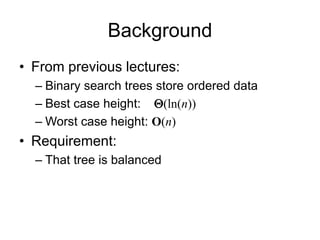
Background
• From previous lectures:
– Binary search trees store ordered data
– Best case height: Q(ln(n))
– Worst case height: O(n)
• Requirement:
– That tree is balanced
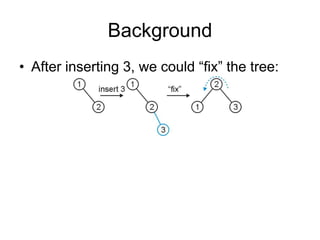
Background
• After inserting 3, we could “fix” the tree:
AVL Trees
• We will focus on the first strategy:
AVL trees
• Named after Adelson-Velskii and Landis
• Balance is defined by comparing the
height of the two sub-trees of a node
AVL Trees
• Recall:
– An empty tree has height –1
– A tree with a single node has height 0
AVL Trees
• A binary search tree is said to be AVL
balanced if:
– The difference in the heights between the left
and right sub-trees is at most 1, and
– Both sub-trees are themselves AVL trees
AVL Trees
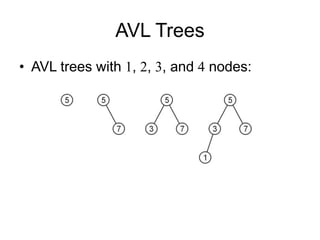
• AVL trees with 1, 2, 3, and 4 nodes:
AVL Trees
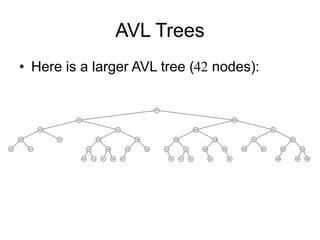
• Here is a larger AVL tree (42 nodes):
AVL Trees
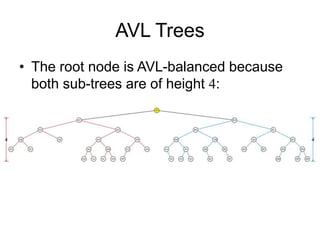
• The root node is AVL-balanced because
both sub-trees are of height 4:
AVL Trees
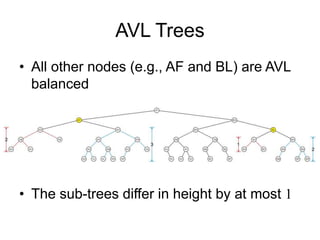
• All other nodes (e.g., AF and BL) are AVL
balanced
• The sub-trees differ in height by at most 1
Height of an AVL Tree
• By the definition of complete trees, any
complete binary search tree is an AVL tree
• Thus an upper bound on the number of
nodes in an AVL tree of height h a perfect
binary tree with 2h + 1 – 1 nodes
• What is an lower bound?
Height of an AVL Tree
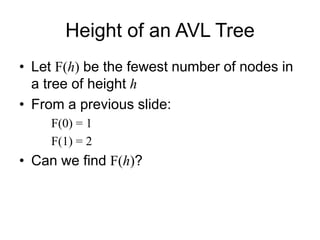
• Let F(h) be the fewest number of nodes in
a tree of height h
• From a previous slide:
F(0) = 1
F(1) = 2
• Can we find F(h)?
Height of an AVL Tree
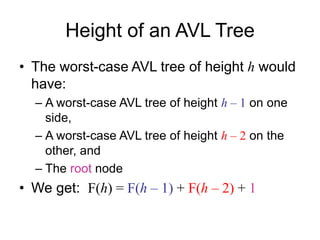
• The worst-case AVL tree of height h would
have:
– A worst-case AVL tree of height h – 1 on one
side,
– A worst-case AVL tree of height h – 2 on the
other, and
– The root node
• We get: F(h) = F(h – 1) + F(h – 2) + 1
Height of an AVL Tree
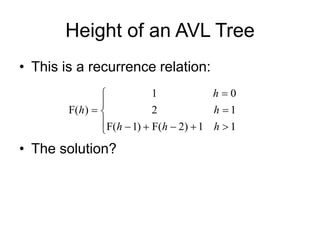
• This is a recurrence relation:
• The solution?













1
1
)
2
F(
)
1
F(
1
2
0
1
)
F(
h
h
h
h
h
h
Height of an AVL Tree
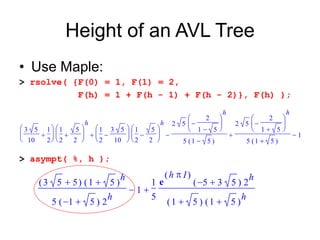
• Use Maple:
> rsolve( {F(0) = 1, F(1) = 2,
F(h) = 1 + F(h - 1) + F(h - 2)}, F(h) );
> asympt( %, h );
   









3 5
10
1
2









1
2
5
2
h









1
2
3 5
10









1
2
5
2
h 2 5









2

1 5
h
5 ( )

1 5
2 5









2

1 5
h
5 ( )

1 5
1
 
( )

3 5 5 ( )

1 5
h
5 ( )
 
1 5 2
h
1
1
5
e
( )
h  I
( )
 
5 3 5 2
h
( )

1 5 ( )

1 5
h
Height of an AVL Tree
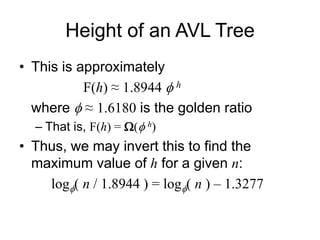
• This is approximately
F(h) ≈ 1.8944 fh
where f ≈ 1.6180 is the golden ratio
– That is, F(h) = W(fh)
• Thus, we may invert this to find the
maximum value of h for a given n:
logf( n / 1.8944 ) = logf( n ) – 1.3277
Height of an AVL Tree
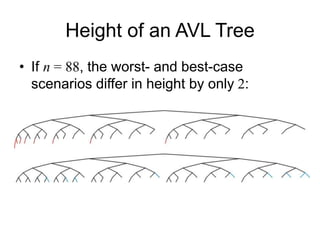
• If n = 88, the worst- and best-case
scenarios differ in height by only 2:
Height of an AVL Tree
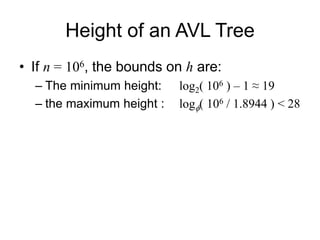
• If n = 106, the bounds on h are:
– The minimum height: log2( 106 ) – 1 ≈ 19
– the maximum height : logf( 106 / 1.8944 ) < 28
Maintaining Balance
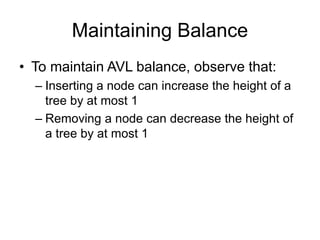
• To maintain AVL balance, observe that:
– Inserting a node can increase the height of a
tree by at most 1
– Removing a node can decrease the height of
a tree by at most 1
Maintaining Balance
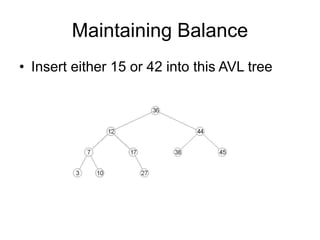
• Insert either 15 or 42 into this AVL tree
Maintaining Balance
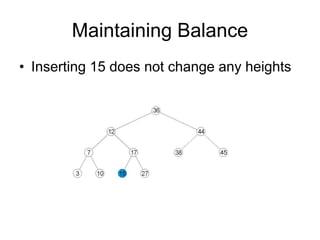
• Inserting 15 does not change any heights
Maintaining Balance
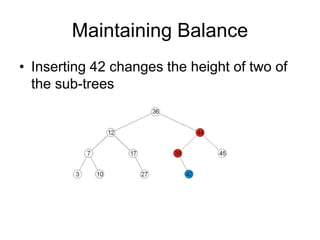
• Inserting 42 changes the height of two of
the sub-trees
Maintaining Balance
• To calculate changes in height, the
member function must run in O(1) time
• Our implementation of height is O(n):
template <typename Comparable>
int BinarySearchNode<Comparable>::height() const {
return max(
( left() == 0 ) ? 0 : 1 + left() -> height(),
( right() == 0 ) ? 0 : 1 + right() -> height()
);
}
Maintaining Balance
• Introduce a member variable
int tree_height;
• The member function is now:
template <typename Comparable>
int BinarySearchNode<Comparable>::height() const {
return tree_height;
}
Maintaining Balance
• Only insert and remove may change the
height
– This is the only place we need to update the
height
– These algorithms are already recursive
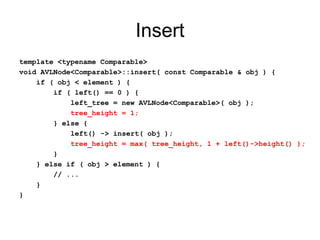
Insert
template <typename Comparable>
void AVLNode<Comparable>::insert( const Comparable & obj ) {
if ( obj < element ) {
if ( left() == 0 ) {
left_tree = new AVLNode<Comparable>( obj );
tree_height = 1;
} else {
left() -> insert( obj );
tree_height = max( tree_height, 1 + left()->height() );
}
} else if ( obj > element ) {
// ...
}
}
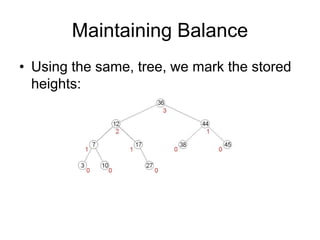
Maintaining Balance
• Using the same, tree, we mark the stored
heights:
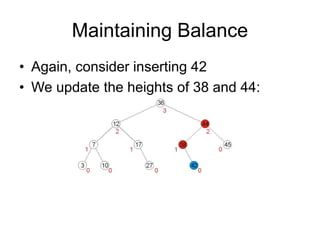
Maintaining Balance
• Again, consider inserting 42
• We update the heights of 38 and 44:
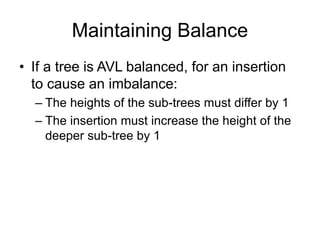
Maintaining Balance
• If a tree is AVL balanced, for an insertion
to cause an imbalance:
– The heights of the sub-trees must differ by 1
– The insertion must increase the height of the
deeper sub-tree by 1
Maintaining Balance
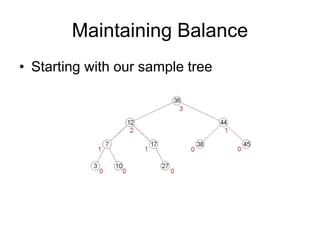
• Starting with our sample tree
Maintaining Balance
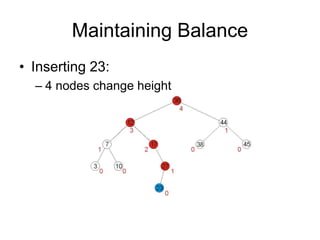
• Inserting 23:
– 4 nodes change height
Maintaining Balance
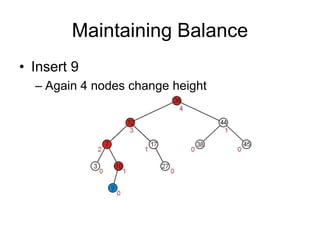
• Insert 9
– Again 4 nodes change height
Maintaining Balance
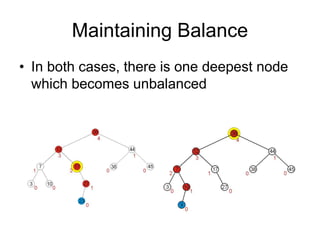
• In both cases, there is one deepest node
which becomes unbalanced
Maintaining Balance
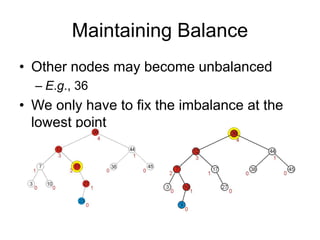
• Other nodes may become unbalanced
– E.g., 36
• We only have to fix the imbalance at the
lowest point
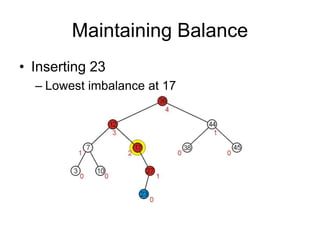
Maintaining Balance
• Inserting 23
– Lowest imbalance at 17
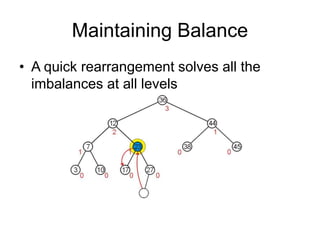
Maintaining Balance
• A quick rearrangement solves all the
imbalances at all levels
Maintaining Balance
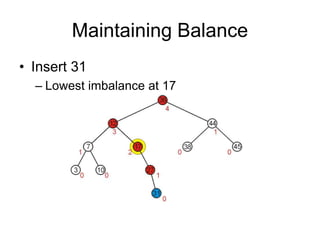
• Insert 31
– Lowest imbalance at 17
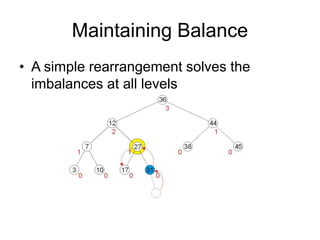
Maintaining Balance
• A simple rearrangement solves the
imbalances at all levels
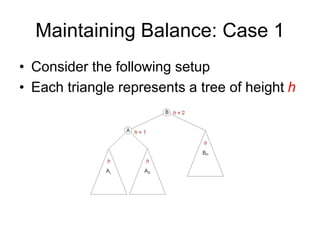
Maintaining Balance: Case 1
• Consider the following setup
• Each triangle represents a tree of height h
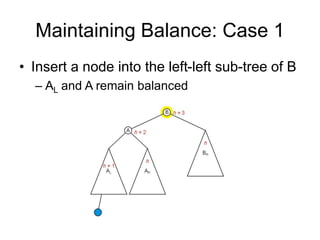
Maintaining Balance: Case 1
• Insert a node into the left-left sub-tree of B
– AL and A remain balanced
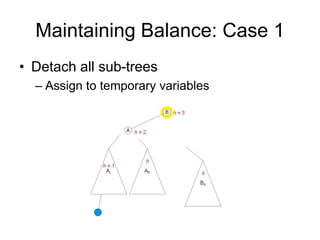
Maintaining Balance: Case 1
• Detach all sub-trees
– Assign to temporary variables
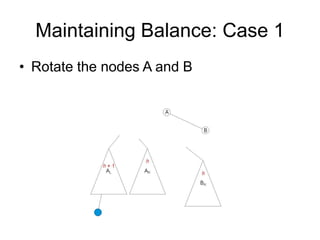
Maintaining Balance: Case 1
• Rotate the nodes A and B
Maintaining Balance: Case 1
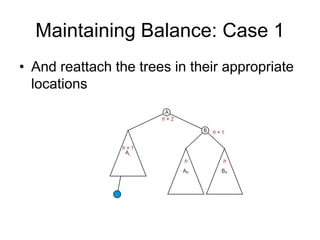
• And reattach the trees in their appropriate
locations
Observations
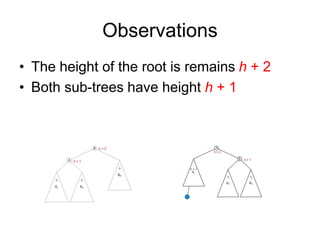
• The height of the root is remains h + 2
• Both sub-trees have height h + 1
Maintain Balance: Case 2
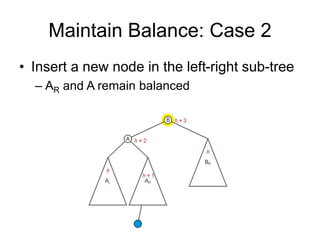
• Insert a new node in the left-right sub-tree
– AR and A remain balanced
Maintain Balance: Case 2
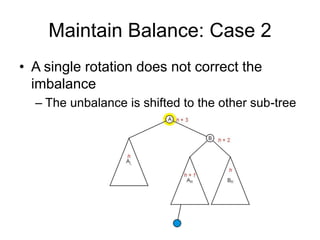
• A single rotation does not correct the
imbalance
– The unbalance is shifted to the other sub-tree
Maintain Balance: Case 2
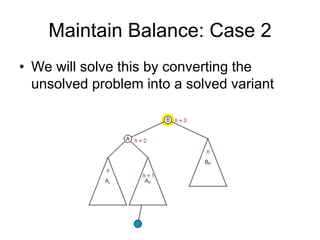
• We will solve this by converting the
unsolved problem into a solved variant
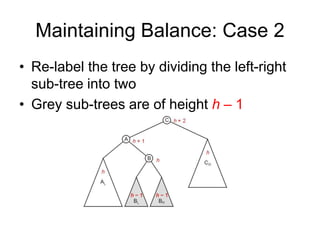
Maintaining Balance: Case 2
• Re-label the tree by dividing the left-right
sub-tree into two
• Grey sub-trees are of height h – 1
Maintaining Balance: Case 2
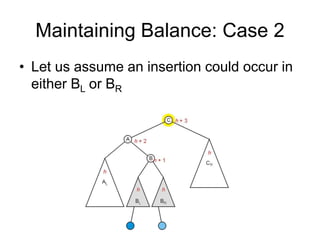
• Let us assume an insertion could occur in
either BL or BR
Maintaining Balance: Case 2
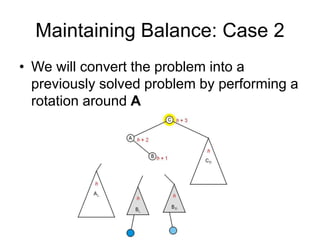
• We will convert the problem into a
previously solved problem by performing a
rotation around A
Maintaining Balance: Case 2
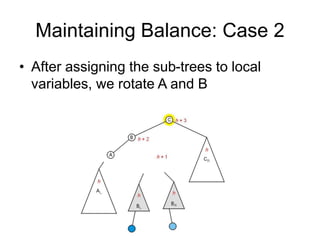
• After assigning the sub-trees to local
variables, we rotate A and B
Maintaining Balance: Case 2
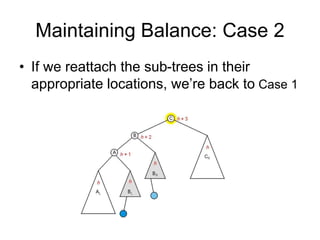
• If we reattach the sub-trees in their
appropriate locations, we’re back to Case 1
Maintaining Balance: Case 2
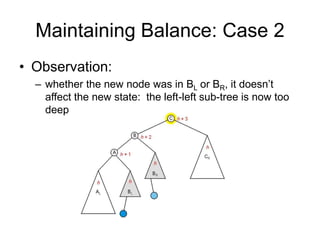
• Observation:
– whether the new node was in BL or BR, it doesn’t
affect the new state: the left-left sub-tree is now too
deep
Maintaining Balance: Case 2
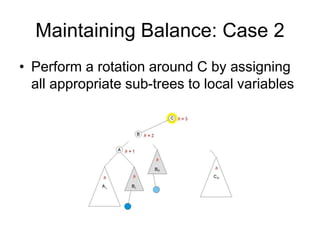
• Perform a rotation around C by assigning
all appropriate sub-trees to local variables
Maintaining Balance: Case 2
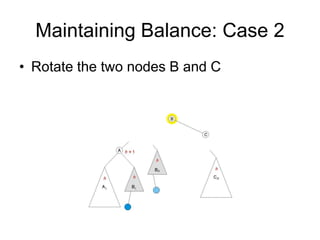
• Rotate the two nodes B and C
Maintaining Balance: Case 2
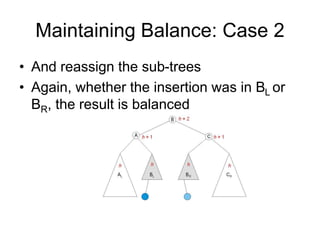
• And reassign the sub-trees
• Again, whether the insertion was in BL or
BR, the result is balanced
Observations
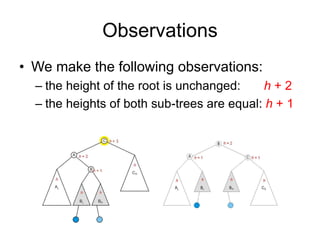
• We make the following observations:
– the height of the root is unchanged: h + 2
– the heights of both sub-trees are equal: h + 1
Rotations: Summary
• There are two symmetric cases to those
we have examined:
– insertions into either the
• left-left sub-tree or the right-right sub-tree
which cause an imbalance require a single
rotation to balance the node
– insertions into either the
• left-right sub-tree or the right-left sub-tree
which cause an imbalance require two
rotations to balance the node
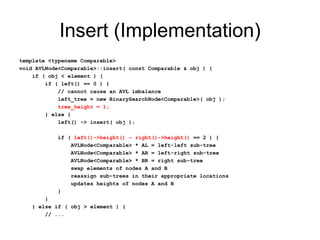
Insert (Implementation)
template <typename Comparable>
void AVLNode<Comparable>::insert( const Comparable & obj ) {
if ( obj < element ) {
if ( left() == 0 ) {
// cannot cause an AVL imbalance
left_tree = new BinarySearchNode<Comparable>( obj );
tree_height = 1;
} else {
left() -> insert( obj );
if ( left()->height() – right()->height() == 2 ) {
AVLNode<Comparable> * AL = left-left sub-tree
AVLNode<Comparable> * AR = left-right sub-tree
AVLNode<Comparable> * BR = right sub-tree
swap elements of nodes A and B
reassign sub-trees in their appropriate locations
updates heights of nodes A and B
}
}
} else if ( obj > element ) {
// ...
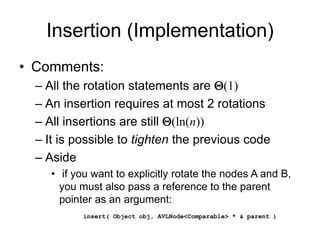
Insertion (Implementation)
• Comments:
– All the rotation statements are Q(1)
– An insertion requires at most 2 rotations
– All insertions are still Q(ln(n))
– It is possible to tighten the previous code
– Aside
• if you want to explicitly rotate the nodes A and B,
you must also pass a reference to the parent
pointer as an argument:
insert( Object obj, AVLNode<Comparable> * & parent )
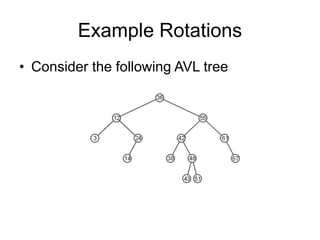
Example Rotations
• Consider the following AVL tree
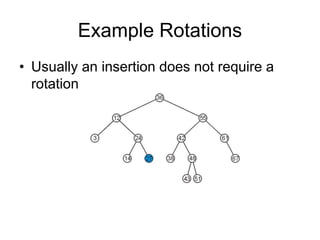
Example Rotations
• Usually an insertion does not require a
rotation
Example Rotations
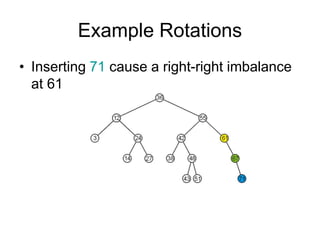
• Inserting 71 cause a right-right imbalance
at 61
Example Rotations
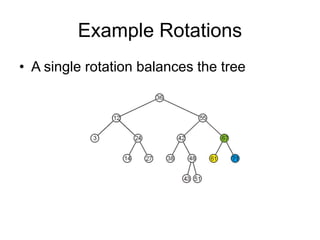
• A single rotation balances the tree
Example Rotations
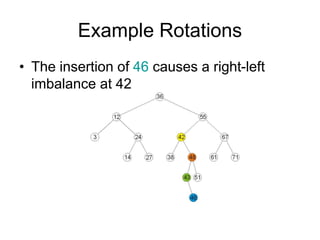
• The insertion of 46 causes a right-left
imbalance at 42
Example Rotations
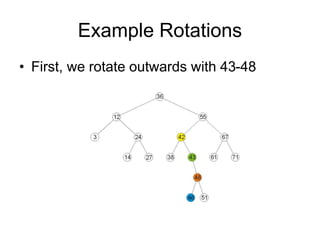
• First, we rotate outwards with 43-48
Example Rotations
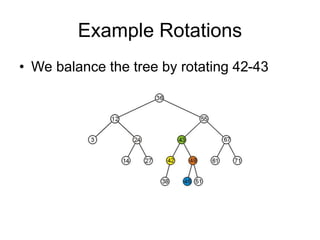
• We balance the tree by rotating 42-43
Example Rotations
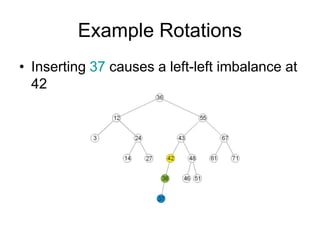
• Inserting 37 causes a left-left imbalance at
42
Example Rotations
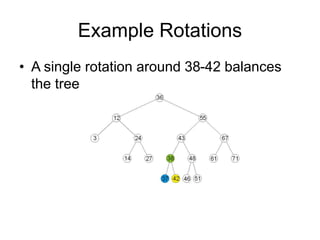
• A single rotation around 38-42 balances
the tree
Example Rotations
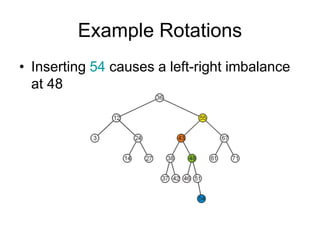
• Inserting 54 causes a left-right imbalance
at 48
Example Rotations
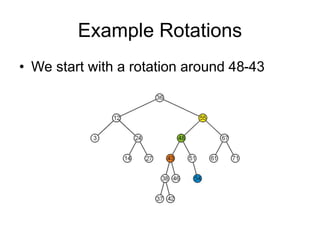
• We start with a rotation around 48-43
Example Rotations
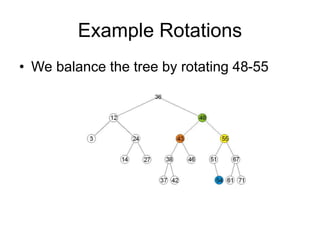
• We balance the tree by rotating 48-55
Example Rotations
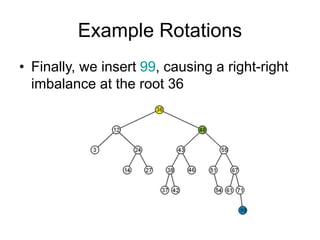
• Finally, we insert 99, causing a right-right
imbalance at the root 36
Example Rotations
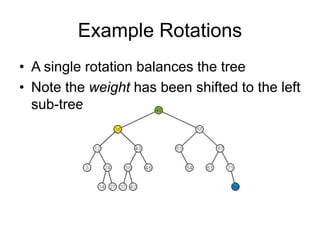
• A single rotation balances the tree
• Note the weight has been shifted to the left
sub-tree
AVL Trees as Arrays?
• We previously saw that:
– Complete tree can be stored using an array
– An arbitrary tree of n nodes requires O(2n)
memory
• Is it possible to store an AVL tree as an
array and not require exponentially more
memory?
AVL Trees as Arrays?
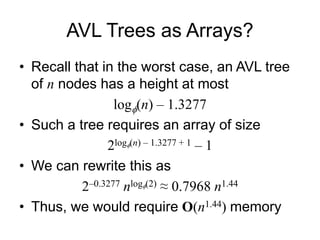
• Recall that in the worst case, an AVL tree
of n nodes has a height at most
logf(n) – 1.3277
• Such a tree requires an array of size
2logf(n) – 1.3277 + 1 – 1
• We can rewrite this as
2–0.3277 nlogf(2) ≈ 0.7968 n1.44
• Thus, we would require O(n1.44) memory
AVL Trees as Arrays?
• While the polynomial behaviour of n1.44 is
not as bad as exponential behaviour, it is
still reasonably sub-optimal when
compared to the linear
growth associated with
node-based trees
• This plot shows
n n1.44
for n = [0, 1000]
Summary
• In this topic we have covered:
– Insertions and removals are like binary search
trees
– With each insertion or removal there is at
most one correction required
• a single rotation, or
• a double rotation;
which runs in O(1) time
– Depth is O( ln(n) )
∴ all operations are O( ln(n) )
Usage Notes
• These slides are made publicly available on the web for
anyone to use
• If you choose to use them, or a part thereof, for a course
at another institution, I ask only three things:
– that you inform me that you are using the slides,
– that you acknowledge my work, and
– that you alert me of any mistakes which I made or changes
which you make, and allow me the option of incorporating such
changes (with an acknowledgment) in my set of slides
Sincerely,
Douglas Wilhelm Harder, MMath
dwharder@alumni.uwaterloo.ca

4.10.AVLTrees[1].ppt

  • 1.
    AVL Trees Douglas WilhelmHarder Department of Electrical and Computer Engineering University of Waterloo Copyright © 2006-8 by Douglas Wilhelm Harder. All rights reserved. ECE 250 Data Structures and Algorithms
  • 2.
    Outline • Background • Definebalance • Maintaining balance within a tree – AVL trees – difference of heights – rotations
  • 3.
    Background • From previouslectures: – Binary search trees store ordered data – Best case height: Q(ln(n)) – Worst case height: O(n) • Requirement: – That tree is balanced
  • 4.
    Background • After inserting3, we could “fix” the tree:
  • 5.
    AVL Trees • Wewill focus on the first strategy: AVL trees • Named after Adelson-Velskii and Landis • Balance is defined by comparing the height of the two sub-trees of a node
  • 6.
    AVL Trees • Recall: –An empty tree has height –1 – A tree with a single node has height 0
  • 7.
    AVL Trees • Abinary search tree is said to be AVL balanced if: – The difference in the heights between the left and right sub-trees is at most 1, and – Both sub-trees are themselves AVL trees
  • 8.
    AVL Trees • AVLtrees with 1, 2, 3, and 4 nodes:
  • 9.
    AVL Trees • Hereis a larger AVL tree (42 nodes):
  • 10.
    AVL Trees • Theroot node is AVL-balanced because both sub-trees are of height 4:
  • 11.
    AVL Trees • Allother nodes (e.g., AF and BL) are AVL balanced • The sub-trees differ in height by at most 1
  • 12.
    Height of anAVL Tree • By the definition of complete trees, any complete binary search tree is an AVL tree • Thus an upper bound on the number of nodes in an AVL tree of height h a perfect binary tree with 2h + 1 – 1 nodes • What is an lower bound?
  • 13.
    Height of anAVL Tree • Let F(h) be the fewest number of nodes in a tree of height h • From a previous slide: F(0) = 1 F(1) = 2 • Can we find F(h)?
  • 14.
    Height of anAVL Tree • The worst-case AVL tree of height h would have: – A worst-case AVL tree of height h – 1 on one side, – A worst-case AVL tree of height h – 2 on the other, and – The root node • We get: F(h) = F(h – 1) + F(h – 2) + 1
  • 15.
    Height of anAVL Tree • This is a recurrence relation: • The solution?              1 1 ) 2 F( ) 1 F( 1 2 0 1 ) F( h h h h h h
  • 16.
    Height of anAVL Tree • Use Maple: > rsolve( {F(0) = 1, F(1) = 2, F(h) = 1 + F(h - 1) + F(h - 2)}, F(h) ); > asympt( %, h );              3 5 10 1 2          1 2 5 2 h          1 2 3 5 10          1 2 5 2 h 2 5          2  1 5 h 5 ( )  1 5 2 5          2  1 5 h 5 ( )  1 5 1   ( )  3 5 5 ( )  1 5 h 5 ( )   1 5 2 h 1 1 5 e ( ) h  I ( )   5 3 5 2 h ( )  1 5 ( )  1 5 h
  • 17.
    Height of anAVL Tree • This is approximately F(h) ≈ 1.8944 fh where f ≈ 1.6180 is the golden ratio – That is, F(h) = W(fh) • Thus, we may invert this to find the maximum value of h for a given n: logf( n / 1.8944 ) = logf( n ) – 1.3277
  • 18.
    Height of anAVL Tree • If n = 88, the worst- and best-case scenarios differ in height by only 2:
  • 19.
    Height of anAVL Tree • If n = 106, the bounds on h are: – The minimum height: log2( 106 ) – 1 ≈ 19 – the maximum height : logf( 106 / 1.8944 ) < 28
  • 20.
    Maintaining Balance • Tomaintain AVL balance, observe that: – Inserting a node can increase the height of a tree by at most 1 – Removing a node can decrease the height of a tree by at most 1
  • 21.
    Maintaining Balance • Inserteither 15 or 42 into this AVL tree
  • 22.
    Maintaining Balance • Inserting15 does not change any heights
  • 23.
    Maintaining Balance • Inserting42 changes the height of two of the sub-trees
  • 24.
    Maintaining Balance • Tocalculate changes in height, the member function must run in O(1) time • Our implementation of height is O(n): template <typename Comparable> int BinarySearchNode<Comparable>::height() const { return max( ( left() == 0 ) ? 0 : 1 + left() -> height(), ( right() == 0 ) ? 0 : 1 + right() -> height() ); }
  • 25.
    Maintaining Balance • Introducea member variable int tree_height; • The member function is now: template <typename Comparable> int BinarySearchNode<Comparable>::height() const { return tree_height; }
  • 26.
    Maintaining Balance • Onlyinsert and remove may change the height – This is the only place we need to update the height – These algorithms are already recursive
  • 27.
    Insert template <typename Comparable> voidAVLNode<Comparable>::insert( const Comparable & obj ) { if ( obj < element ) { if ( left() == 0 ) { left_tree = new AVLNode<Comparable>( obj ); tree_height = 1; } else { left() -> insert( obj ); tree_height = max( tree_height, 1 + left()->height() ); } } else if ( obj > element ) { // ... } }
  • 28.
    Maintaining Balance • Usingthe same, tree, we mark the stored heights:
  • 29.
    Maintaining Balance • Again,consider inserting 42 • We update the heights of 38 and 44:
  • 30.
    Maintaining Balance • Ifa tree is AVL balanced, for an insertion to cause an imbalance: – The heights of the sub-trees must differ by 1 – The insertion must increase the height of the deeper sub-tree by 1
  • 31.
  • 32.
    Maintaining Balance • Inserting23: – 4 nodes change height
  • 33.
    Maintaining Balance • Insert9 – Again 4 nodes change height
  • 34.
    Maintaining Balance • Inboth cases, there is one deepest node which becomes unbalanced
  • 35.
    Maintaining Balance • Othernodes may become unbalanced – E.g., 36 • We only have to fix the imbalance at the lowest point
  • 36.
    Maintaining Balance • Inserting23 – Lowest imbalance at 17
  • 37.
    Maintaining Balance • Aquick rearrangement solves all the imbalances at all levels
  • 38.
    Maintaining Balance • Insert31 – Lowest imbalance at 17
  • 39.
    Maintaining Balance • Asimple rearrangement solves the imbalances at all levels
  • 40.
    Maintaining Balance: Case1 • Consider the following setup • Each triangle represents a tree of height h
  • 41.
    Maintaining Balance: Case1 • Insert a node into the left-left sub-tree of B – AL and A remain balanced
  • 42.
    Maintaining Balance: Case1 • Detach all sub-trees – Assign to temporary variables
  • 43.
    Maintaining Balance: Case1 • Rotate the nodes A and B
  • 44.
    Maintaining Balance: Case1 • And reattach the trees in their appropriate locations
  • 45.
    Observations • The heightof the root is remains h + 2 • Both sub-trees have height h + 1
  • 46.
    Maintain Balance: Case2 • Insert a new node in the left-right sub-tree – AR and A remain balanced
  • 47.
    Maintain Balance: Case2 • A single rotation does not correct the imbalance – The unbalance is shifted to the other sub-tree
  • 48.
    Maintain Balance: Case2 • We will solve this by converting the unsolved problem into a solved variant
  • 49.
    Maintaining Balance: Case2 • Re-label the tree by dividing the left-right sub-tree into two • Grey sub-trees are of height h – 1
  • 50.
    Maintaining Balance: Case2 • Let us assume an insertion could occur in either BL or BR
  • 51.
    Maintaining Balance: Case2 • We will convert the problem into a previously solved problem by performing a rotation around A
  • 52.
    Maintaining Balance: Case2 • After assigning the sub-trees to local variables, we rotate A and B
  • 53.
    Maintaining Balance: Case2 • If we reattach the sub-trees in their appropriate locations, we’re back to Case 1
  • 54.
    Maintaining Balance: Case2 • Observation: – whether the new node was in BL or BR, it doesn’t affect the new state: the left-left sub-tree is now too deep
  • 55.
    Maintaining Balance: Case2 • Perform a rotation around C by assigning all appropriate sub-trees to local variables
  • 56.
    Maintaining Balance: Case2 • Rotate the two nodes B and C
  • 57.
    Maintaining Balance: Case2 • And reassign the sub-trees • Again, whether the insertion was in BL or BR, the result is balanced
  • 58.
    Observations • We makethe following observations: – the height of the root is unchanged: h + 2 – the heights of both sub-trees are equal: h + 1
  • 59.
    Rotations: Summary • Thereare two symmetric cases to those we have examined: – insertions into either the • left-left sub-tree or the right-right sub-tree which cause an imbalance require a single rotation to balance the node – insertions into either the • left-right sub-tree or the right-left sub-tree which cause an imbalance require two rotations to balance the node
  • 60.
    Insert (Implementation) template <typenameComparable> void AVLNode<Comparable>::insert( const Comparable & obj ) { if ( obj < element ) { if ( left() == 0 ) { // cannot cause an AVL imbalance left_tree = new BinarySearchNode<Comparable>( obj ); tree_height = 1; } else { left() -> insert( obj ); if ( left()->height() – right()->height() == 2 ) { AVLNode<Comparable> * AL = left-left sub-tree AVLNode<Comparable> * AR = left-right sub-tree AVLNode<Comparable> * BR = right sub-tree swap elements of nodes A and B reassign sub-trees in their appropriate locations updates heights of nodes A and B } } } else if ( obj > element ) { // ...
  • 61.
    Insertion (Implementation) • Comments: –All the rotation statements are Q(1) – An insertion requires at most 2 rotations – All insertions are still Q(ln(n)) – It is possible to tighten the previous code – Aside • if you want to explicitly rotate the nodes A and B, you must also pass a reference to the parent pointer as an argument: insert( Object obj, AVLNode<Comparable> * & parent )
  • 62.
    Example Rotations • Considerthe following AVL tree
  • 63.
    Example Rotations • Usuallyan insertion does not require a rotation
  • 64.
    Example Rotations • Inserting71 cause a right-right imbalance at 61
  • 65.
    Example Rotations • Asingle rotation balances the tree
  • 66.
    Example Rotations • Theinsertion of 46 causes a right-left imbalance at 42
  • 67.
    Example Rotations • First,we rotate outwards with 43-48
  • 68.
    Example Rotations • Webalance the tree by rotating 42-43
  • 69.
    Example Rotations • Inserting37 causes a left-left imbalance at 42
  • 70.
    Example Rotations • Asingle rotation around 38-42 balances the tree
  • 71.
    Example Rotations • Inserting54 causes a left-right imbalance at 48
  • 72.
    Example Rotations • Westart with a rotation around 48-43
  • 73.
    Example Rotations • Webalance the tree by rotating 48-55
  • 74.
    Example Rotations • Finally,we insert 99, causing a right-right imbalance at the root 36
  • 75.
    Example Rotations • Asingle rotation balances the tree • Note the weight has been shifted to the left sub-tree
  • 76.
    AVL Trees asArrays? • We previously saw that: – Complete tree can be stored using an array – An arbitrary tree of n nodes requires O(2n) memory • Is it possible to store an AVL tree as an array and not require exponentially more memory?
  • 77.
    AVL Trees asArrays? • Recall that in the worst case, an AVL tree of n nodes has a height at most logf(n) – 1.3277 • Such a tree requires an array of size 2logf(n) – 1.3277 + 1 – 1 • We can rewrite this as 2–0.3277 nlogf(2) ≈ 0.7968 n1.44 • Thus, we would require O(n1.44) memory
  • 78.
    AVL Trees asArrays? • While the polynomial behaviour of n1.44 is not as bad as exponential behaviour, it is still reasonably sub-optimal when compared to the linear growth associated with node-based trees • This plot shows n n1.44 for n = [0, 1000]
  • 79.
    Summary • In thistopic we have covered: – Insertions and removals are like binary search trees – With each insertion or removal there is at most one correction required • a single rotation, or • a double rotation; which runs in O(1) time – Depth is O( ln(n) ) ∴ all operations are O( ln(n) )
  • 80.
    Usage Notes • Theseslides are made publicly available on the web for anyone to use • If you choose to use them, or a part thereof, for a course at another institution, I ask only three things: – that you inform me that you are using the slides, – that you acknowledge my work, and – that you alert me of any mistakes which I made or changes which you make, and allow me the option of incorporating such changes (with an acknowledgment) in my set of slides Sincerely, Douglas Wilhelm Harder, MMath dwharder@alumni.uwaterloo.ca