AVL Trees
AVL Trees
AVL Trees
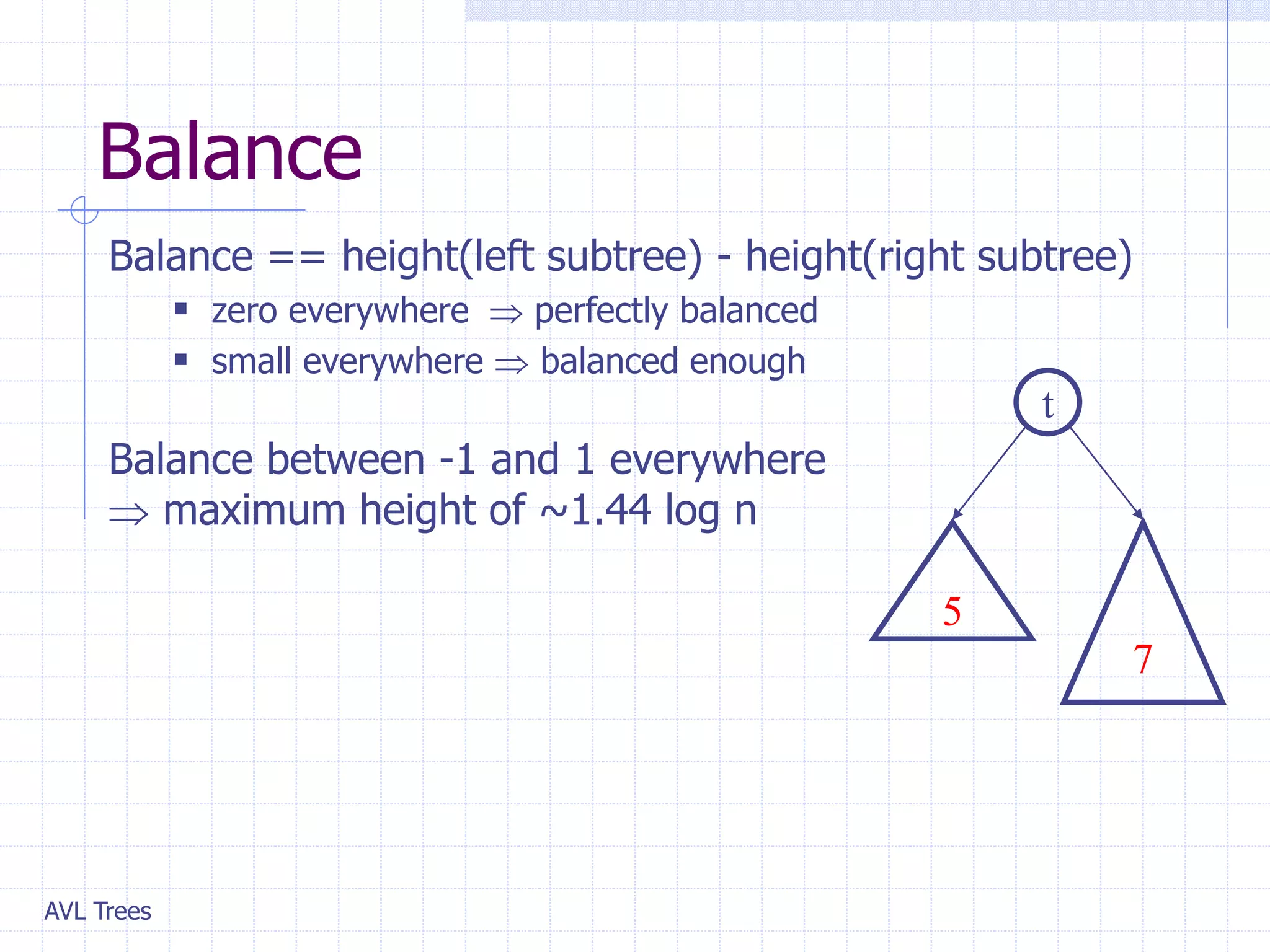
Balance
Balance == height(left subtree) - height(right subtree)
 zero everywhere  perfectly balanced
 small everywhere  balanced enough
Balance between -1 and 1 everywhere
 maximum height of ~1.44 log n
t
5
7
AVL Trees
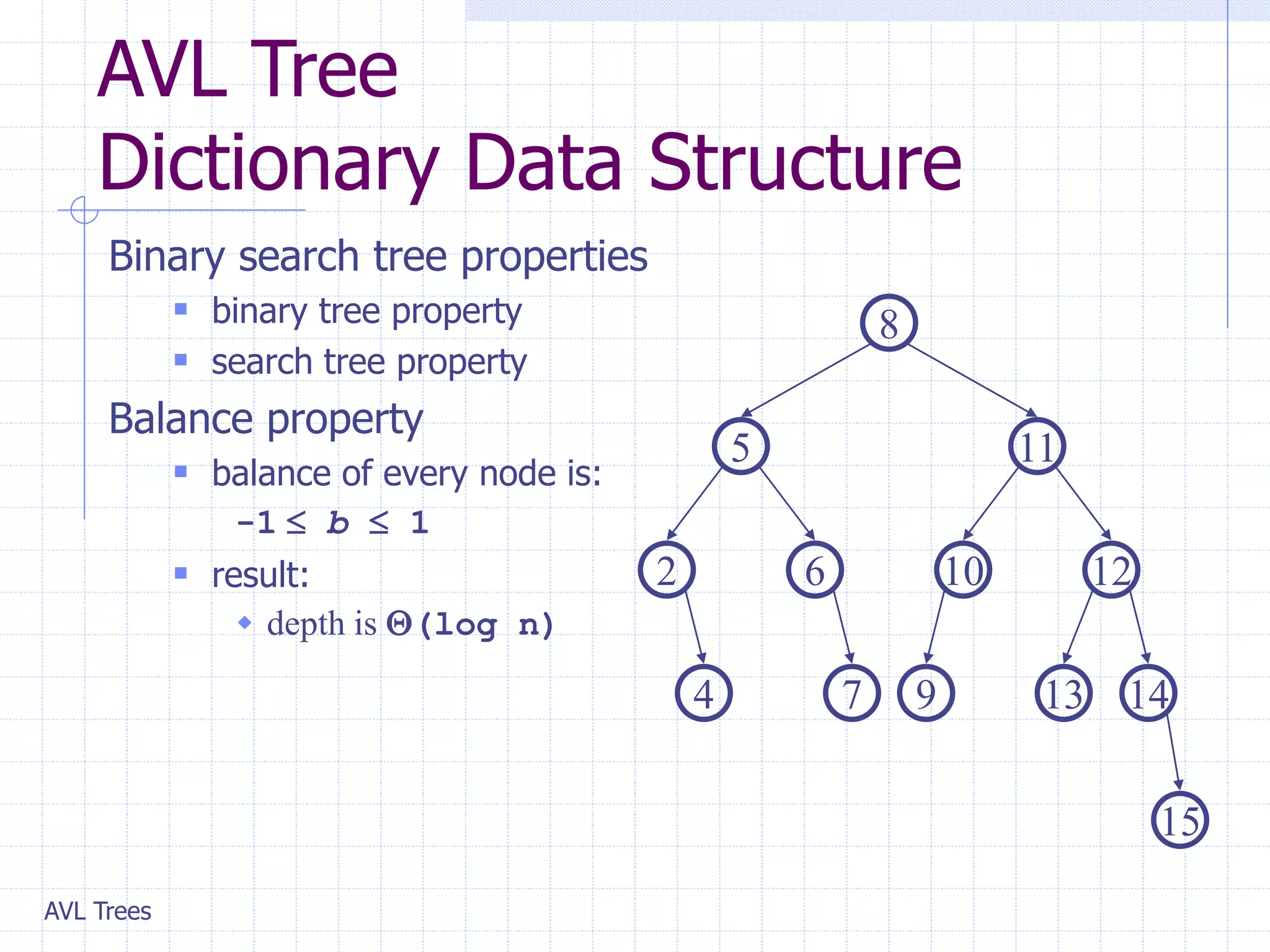
AVL Tree
Dictionary Data Structure
4
12
10
6
2
11
5
8
14
13
7 9
Binary search tree properties
 binary tree property
 search tree property
Balance property
 balance of every node is:
-1 b  1
 result:
 depth is (log n)
15
AVL Trees
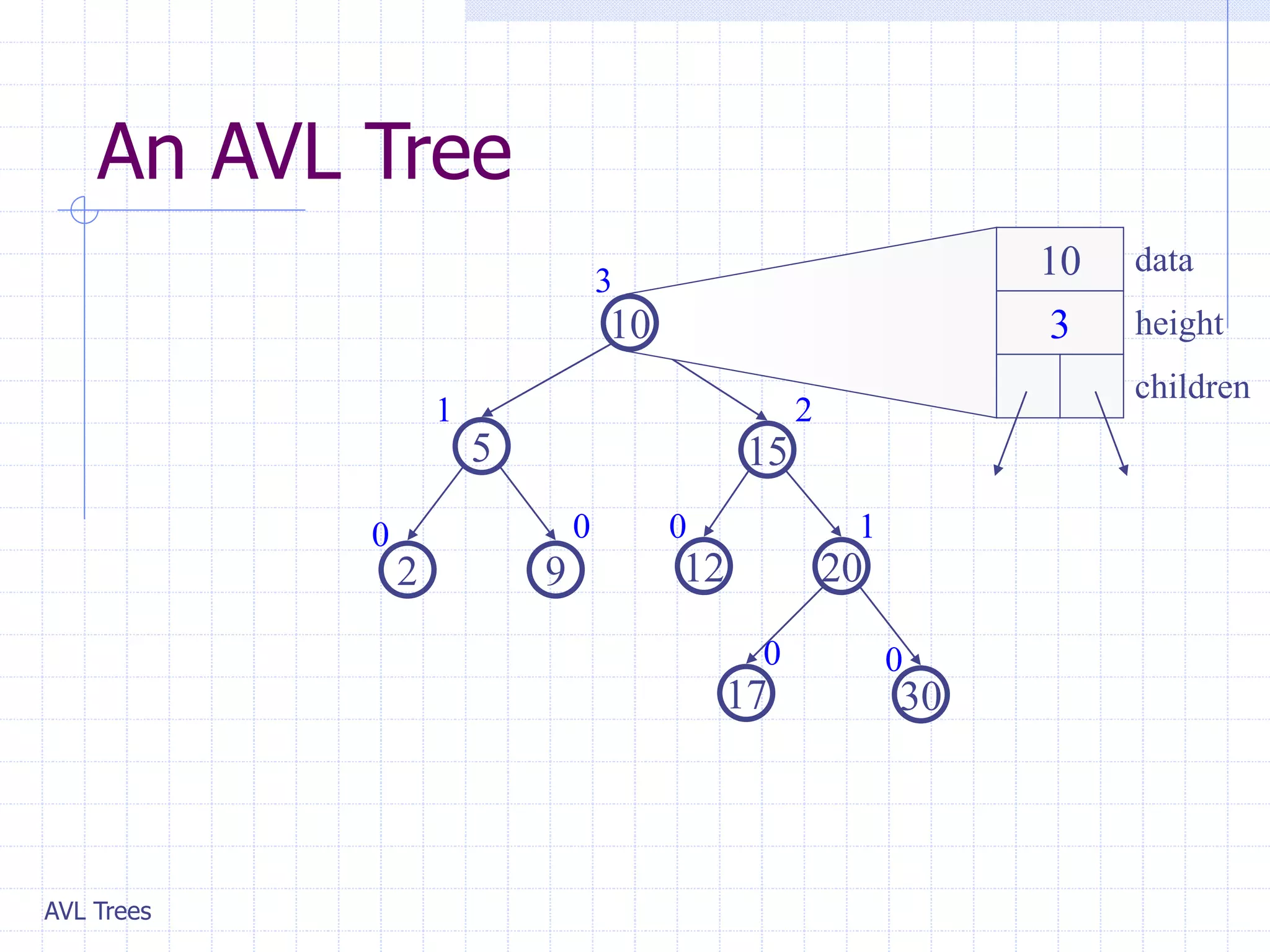
An AVL Tree
15
9
2 12
5
10
20
17
0
0
1
0
0
1 2
3 10
3
data
height
children
30
0
AVL Trees
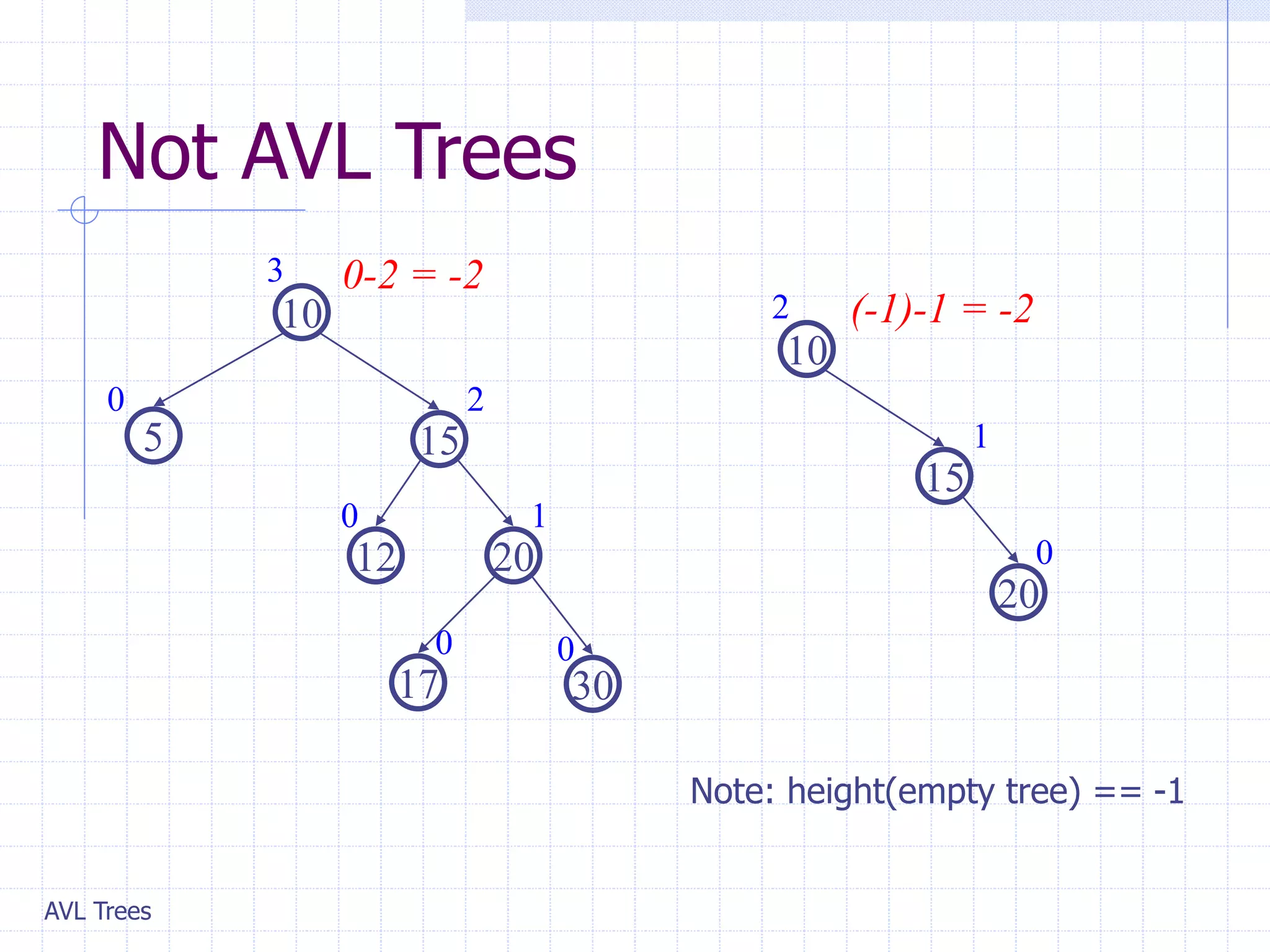
Not AVL Trees
15
12
5
10
20
17
0
1
0
0 2
3
30
0
15
10
20
0
1
2 (-1)-1 = -2
0-2 = -2
Note: height(empty tree) == -1
AVL Trees
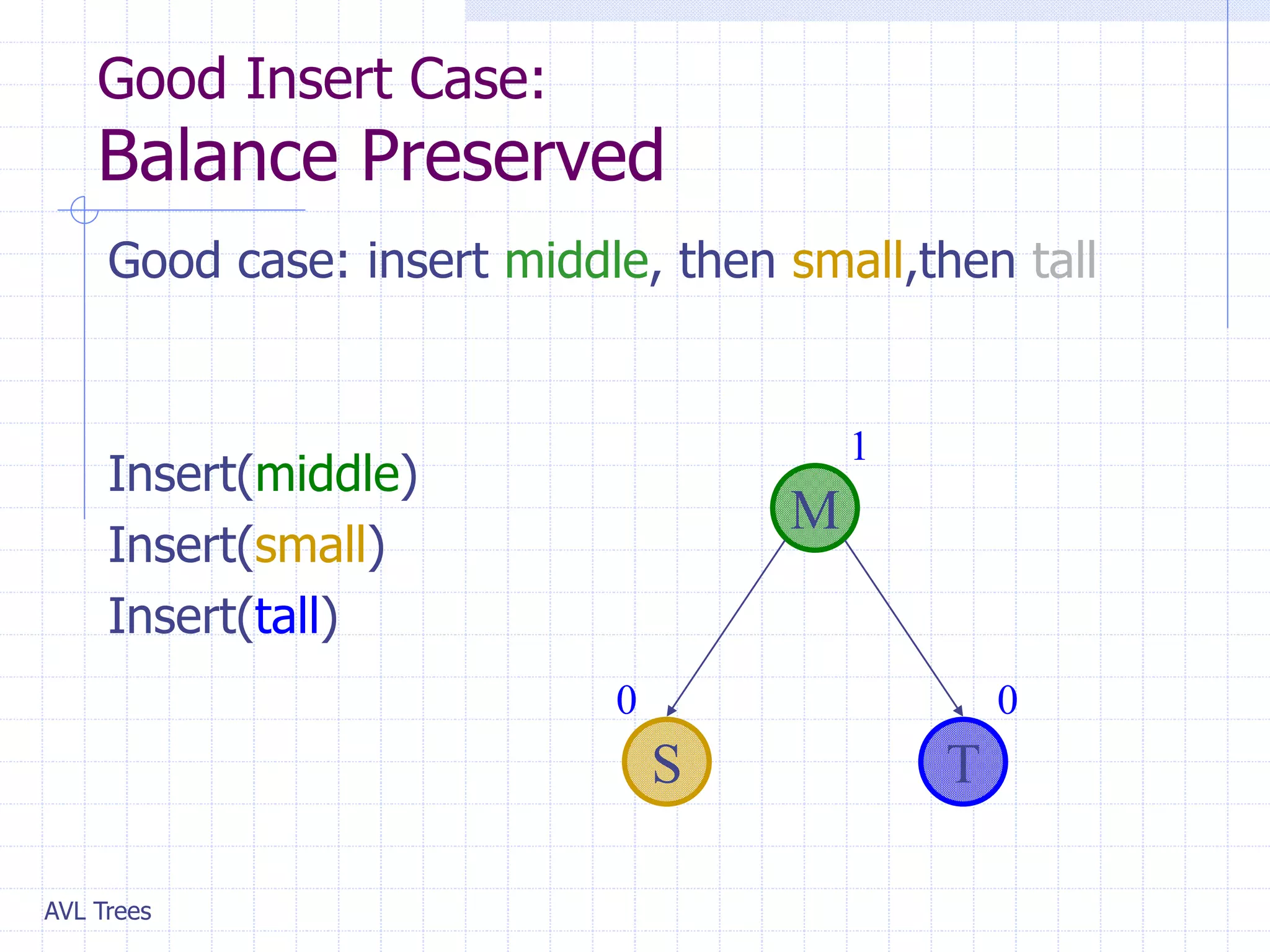
Good Insert Case:
Balance Preserved
Good case: insert middle, then small,then tall
Insert(middle)
Insert(small)
Insert(tall)
M
S T
0
0
1
AVL Trees
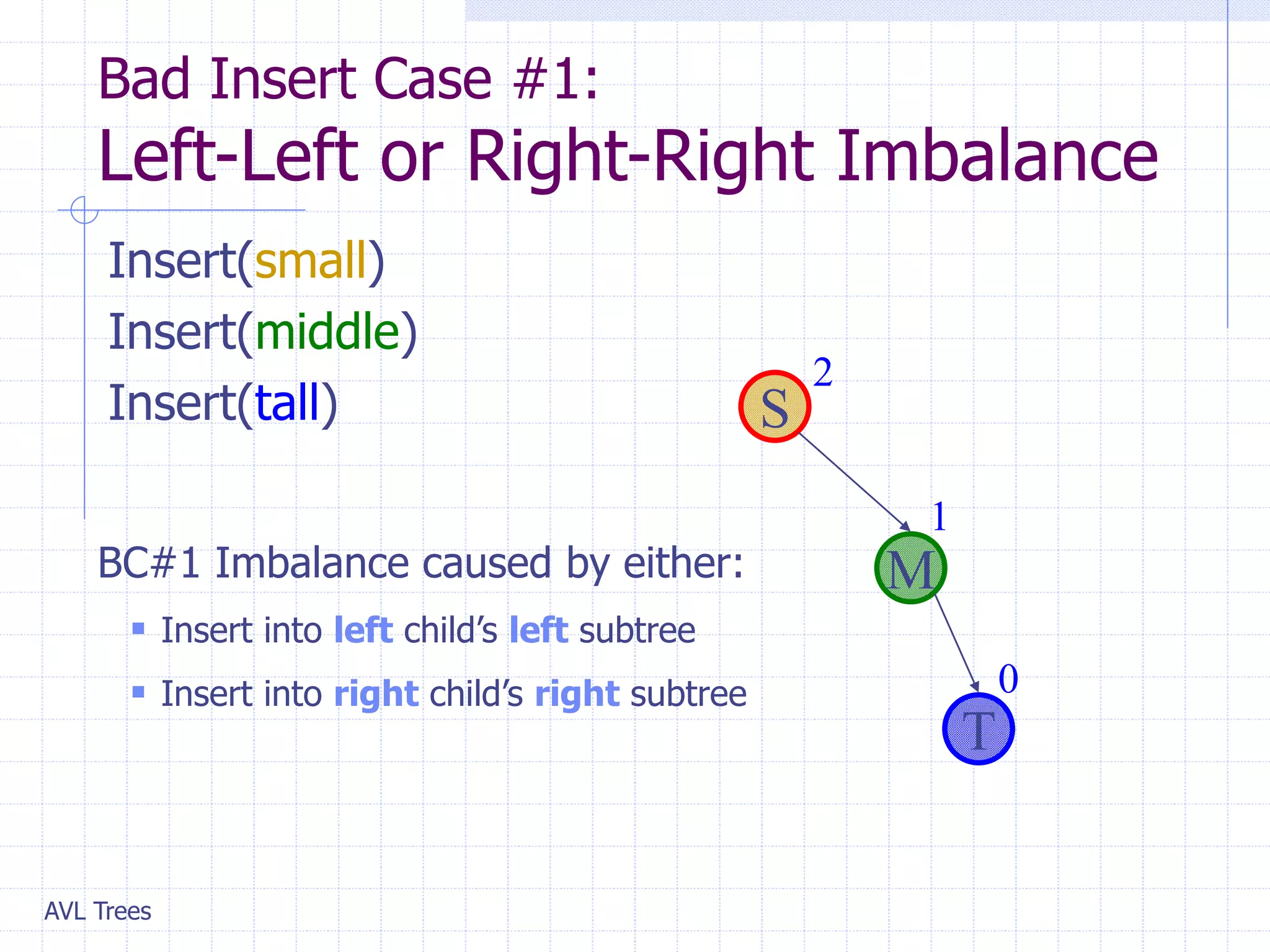
Bad Insert Case #1:
Left-Left or Right-Right Imbalance
Insert(small)
Insert(middle)
Insert(tall)
T
M
S
0
1
2
BC#1 Imbalance caused by either:
 Insert into left child’s left subtree
 Insert into right child’s right subtree
AVL Trees
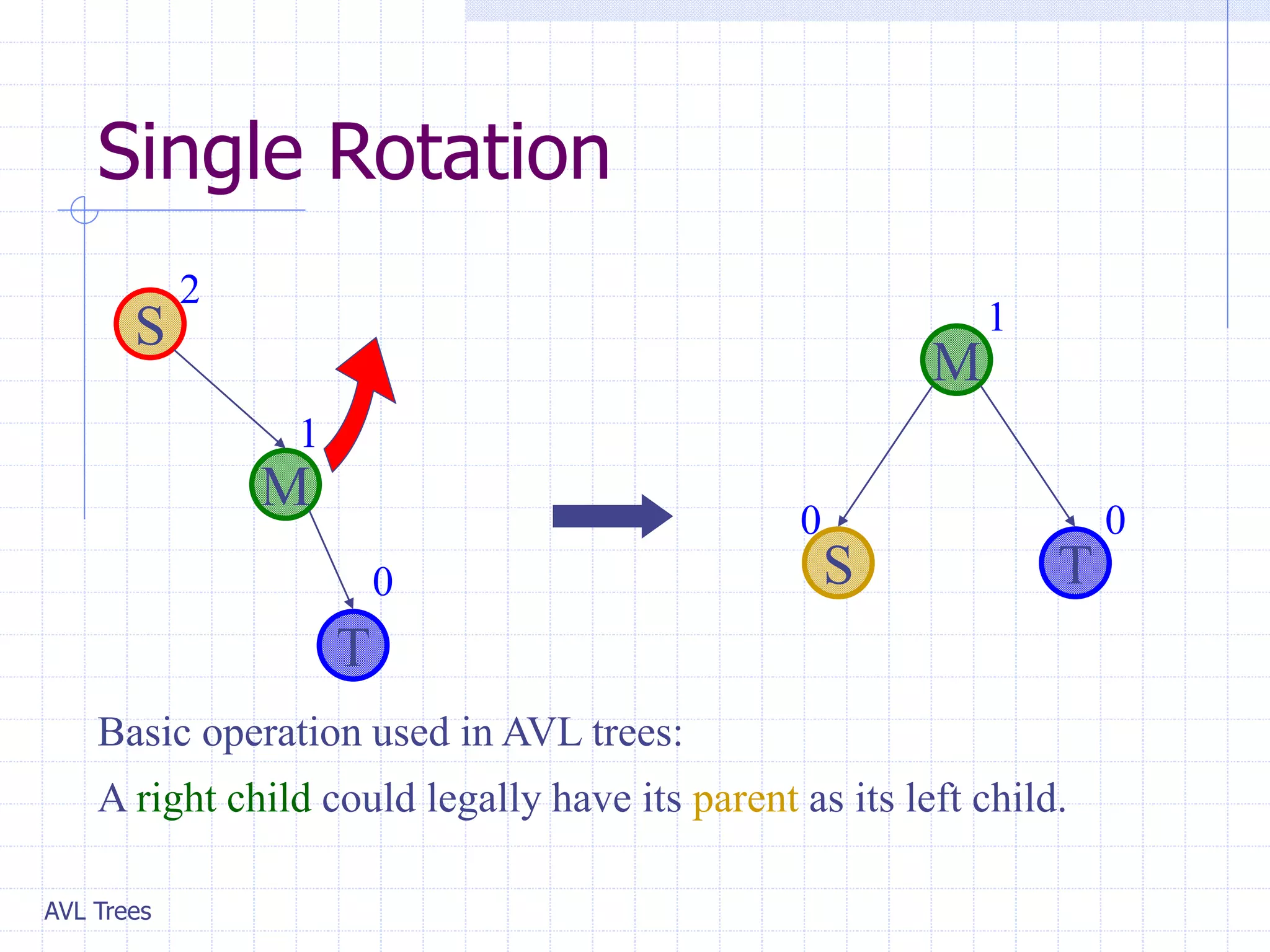
Single Rotation
T
M
S
0
1
2
M
S T
0
0
1
Basic operation used in AVL trees:
A right child could legally have its parent as its left child.
AVL Trees
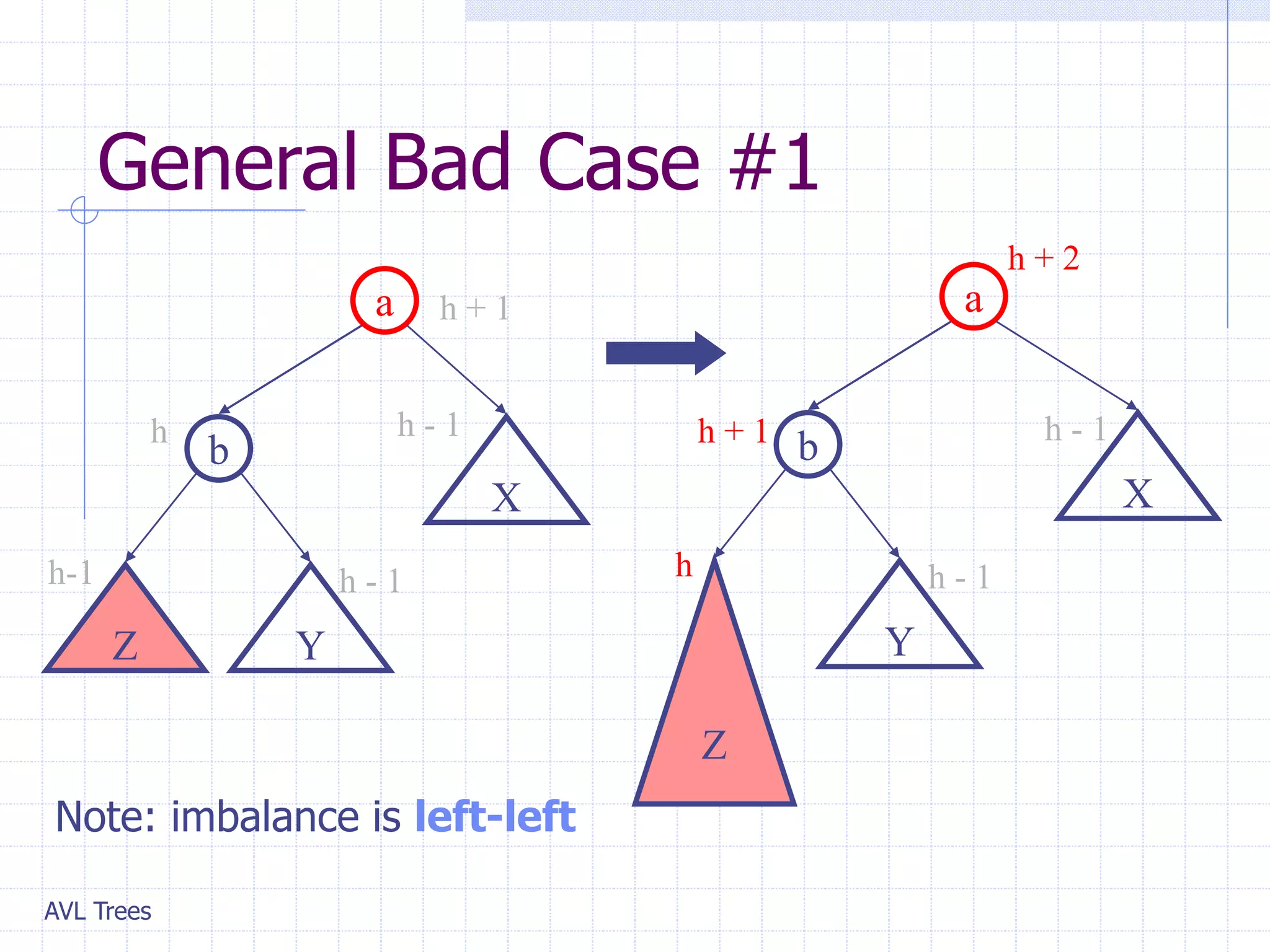
General Bad Case #1
a
X
Y
b
Z
h h - 1
h + 1 h - 1
h + 2
a
X
Y
b
Z
h-1 h - 1
h h - 1
h + 1
Note: imbalance is left-left
AVL Trees
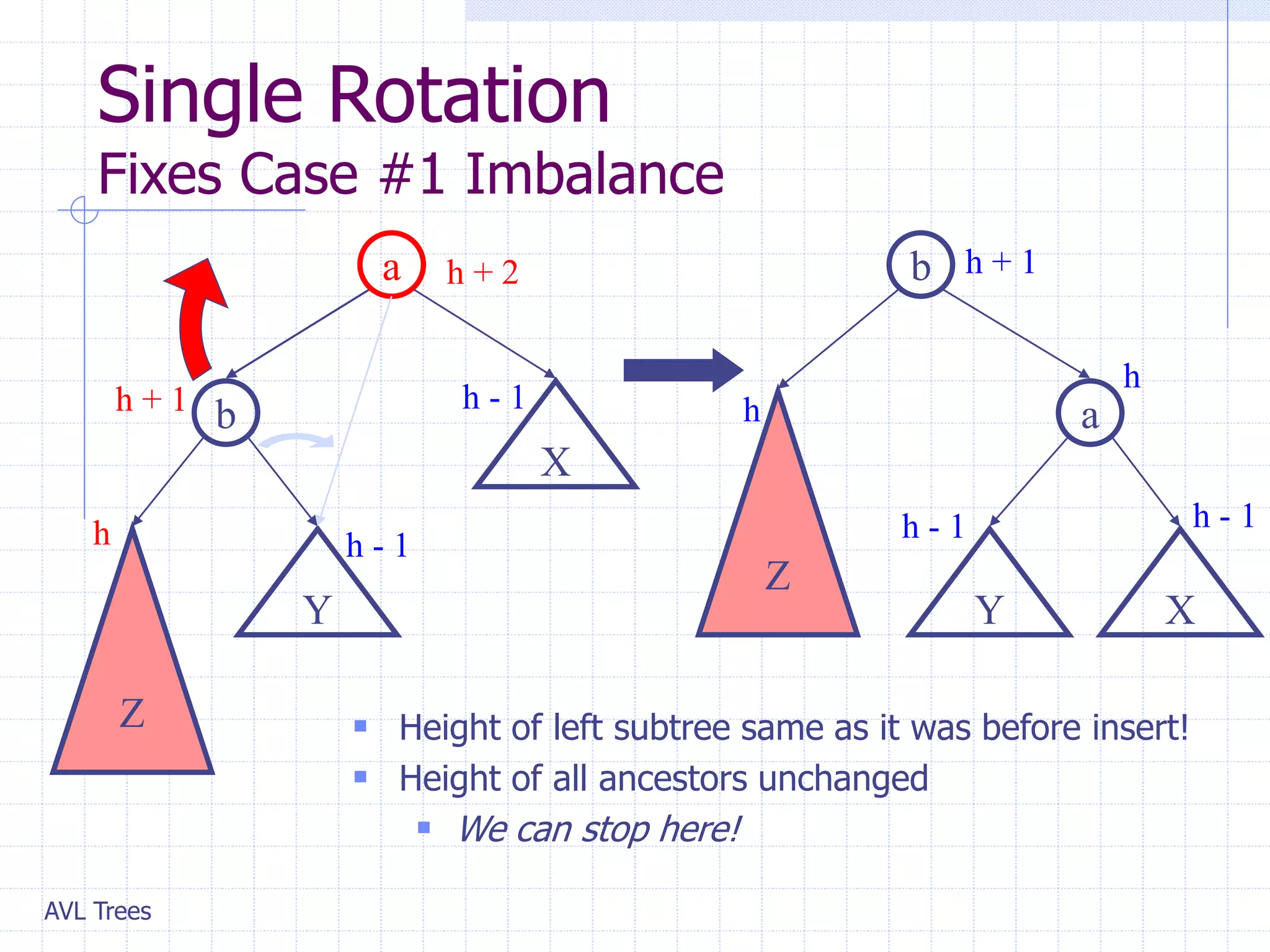
Single Rotation
Fixes Case #1 Imbalance
 Height of left subtree same as it was before insert!
 Height of all ancestors unchanged
 We can stop here!
a
X
Y
b
Z
a
X
Y
b
Z
h h - 1
h + 1 h - 1
h + 2
h
h - 1
h
h - 1
h + 1
AVL Trees
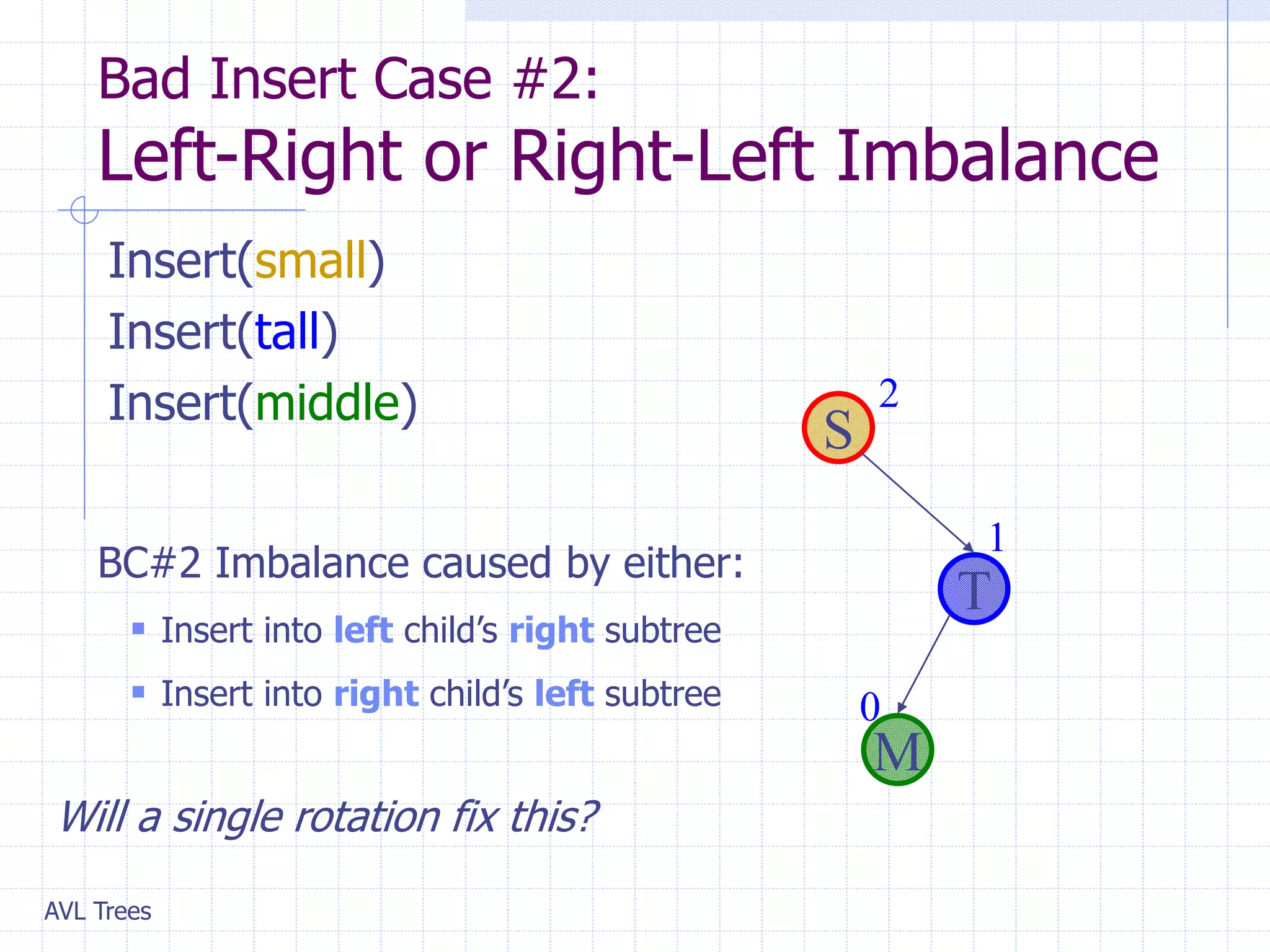
Bad Insert Case #2:
Left-Right or Right-Left Imbalance
Insert(small)
Insert(tall)
Insert(middle)
M
T
S
0
1
2
Will a single rotation fix this?
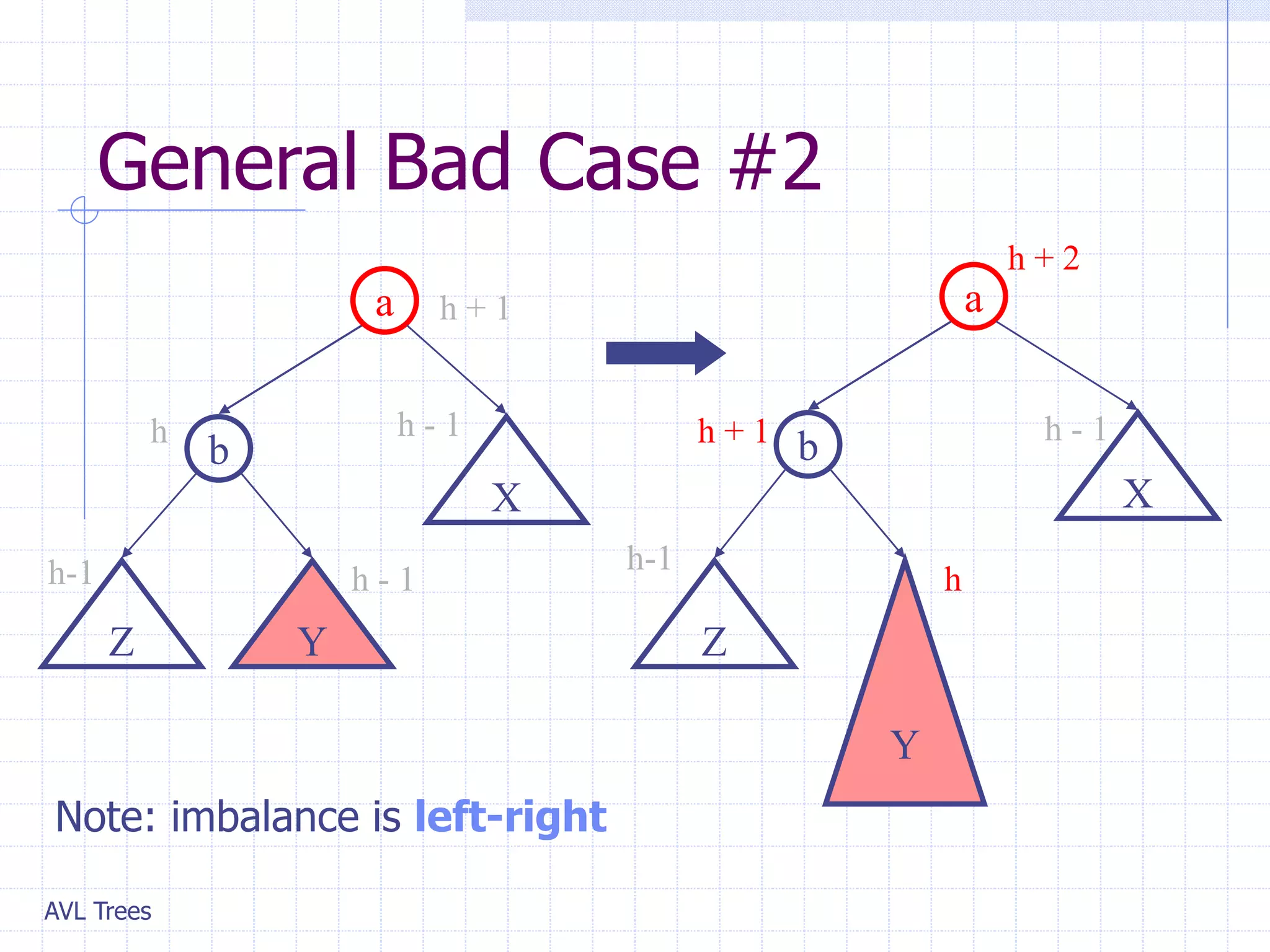
BC#2 Imbalance caused by either:
 Insert into left child’s right subtree
 Insert into right child’s left subtree
AVL Trees
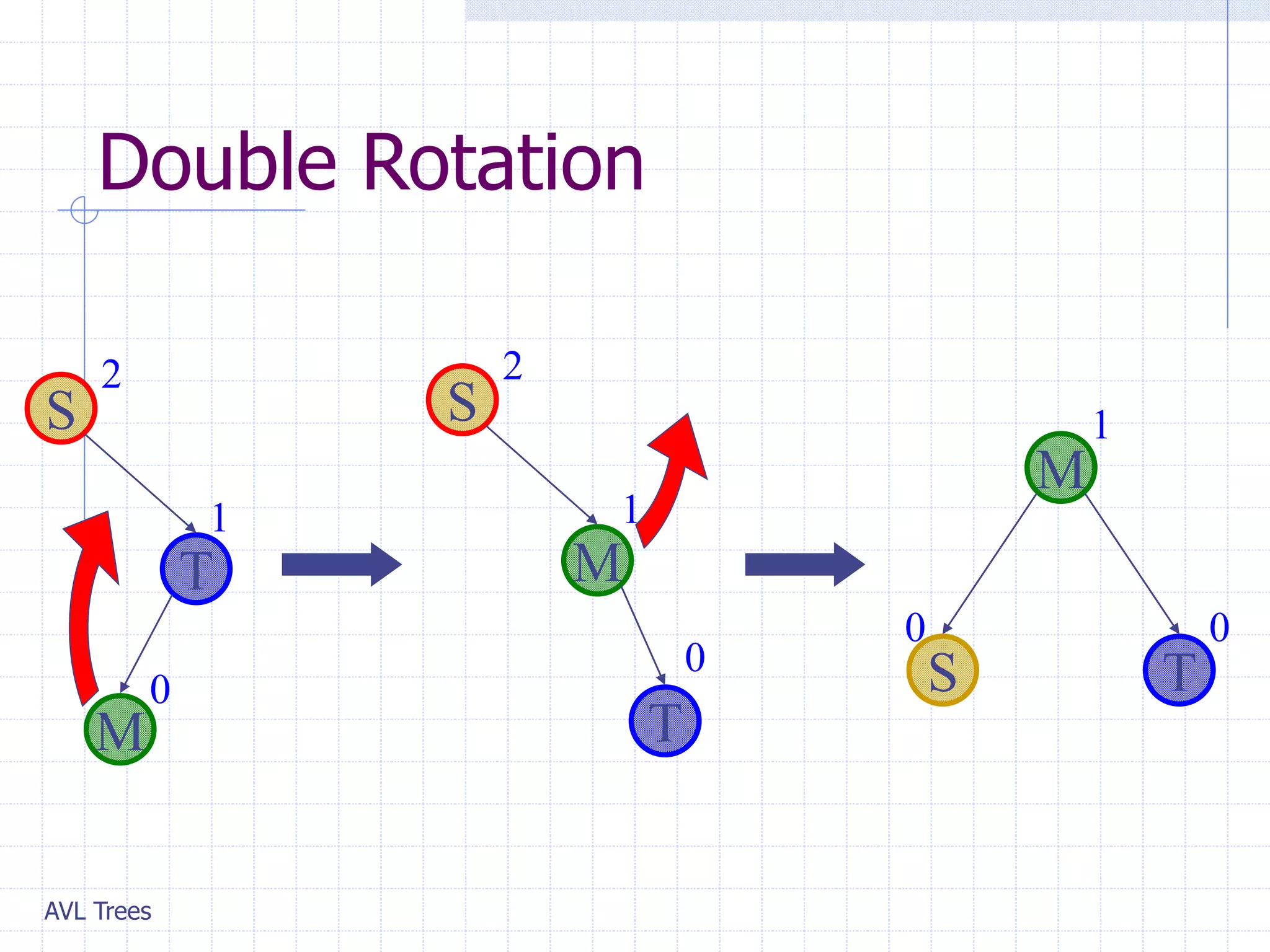
Double Rotation
M
S T
0
0
1
M
T
S
0
1
2
T
M
S
0
1
2
AVL Trees
General Bad Case #2
a
X
b
Z
h
h + 1 h - 1
h + 2
a
X
b
Z
h-1 h - 1
h h - 1
h + 1
Note: imbalance is left-right
h-1
Y
Y
AVL Trees
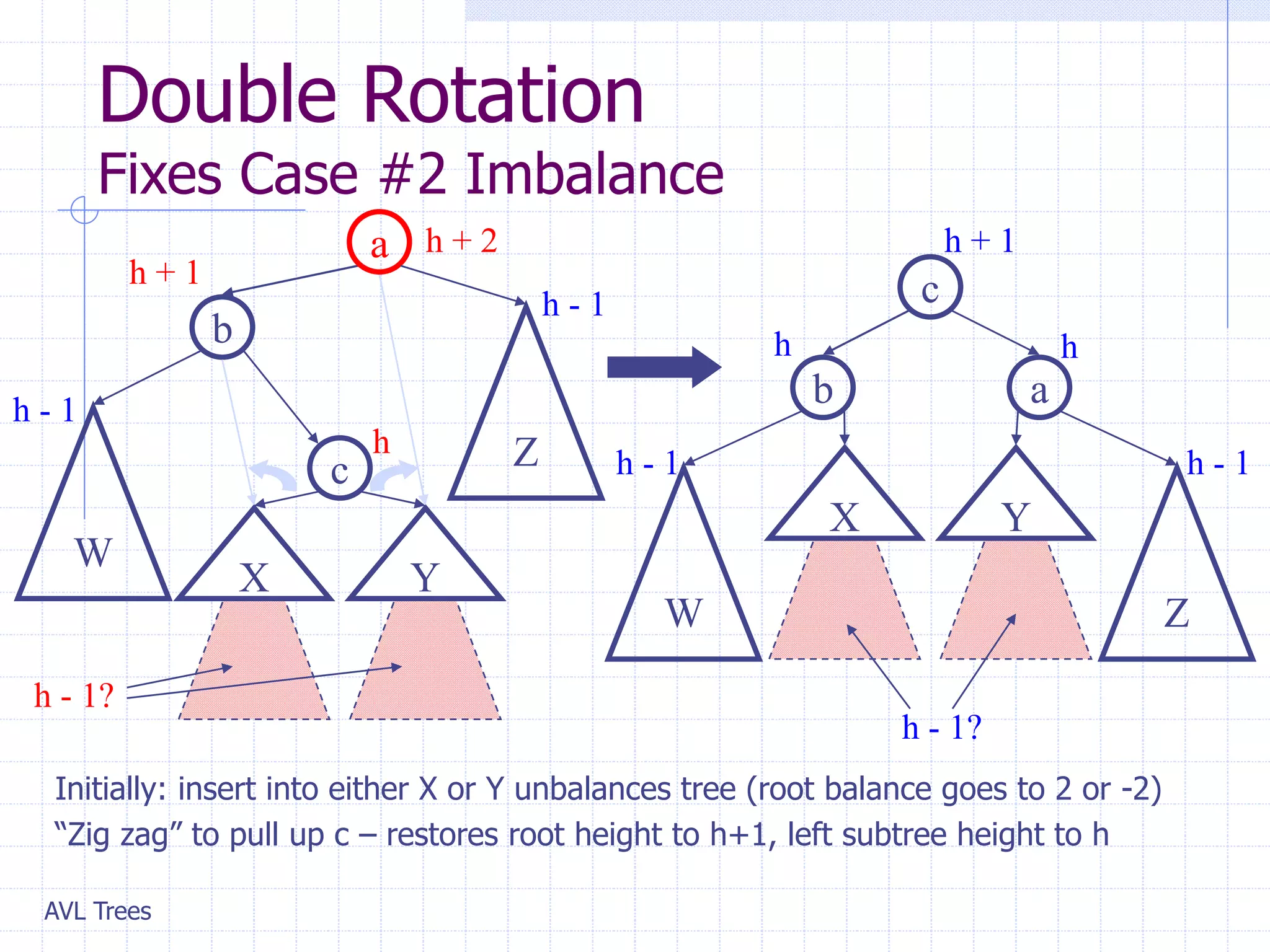
Double Rotation
Fixes Case #2 Imbalance
Initially: insert into either X or Y unbalances tree (root balance goes to 2 or -2)
“Zig zag” to pull up c – restores root height to h+1, left subtree height to h
a
Z
b
W
c
X Y
a
Z
b
W
c
X Y
h
h - 1?
h - 1
h - 1
h + 2
h + 1
h - 1
h - 1
h
h + 1
h
h - 1?
AVL Trees
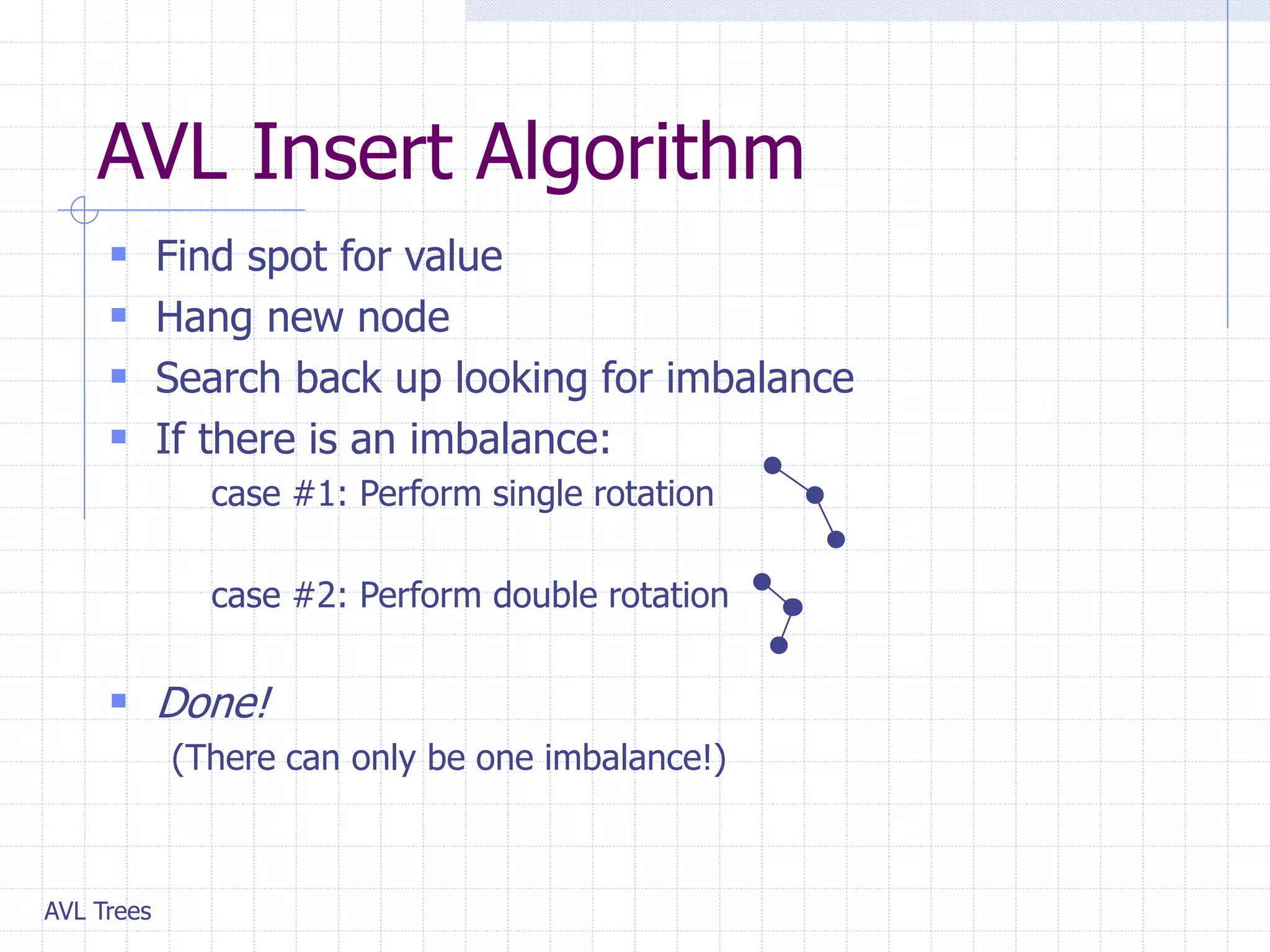
AVL Insert Algorithm
 Find spot for value
 Hang new node
 Search back up looking for imbalance
 If there is an imbalance:
case #1: Perform single rotation
case #2: Perform double rotation
 Done!
(There can only be one imbalance!)
AVL Trees
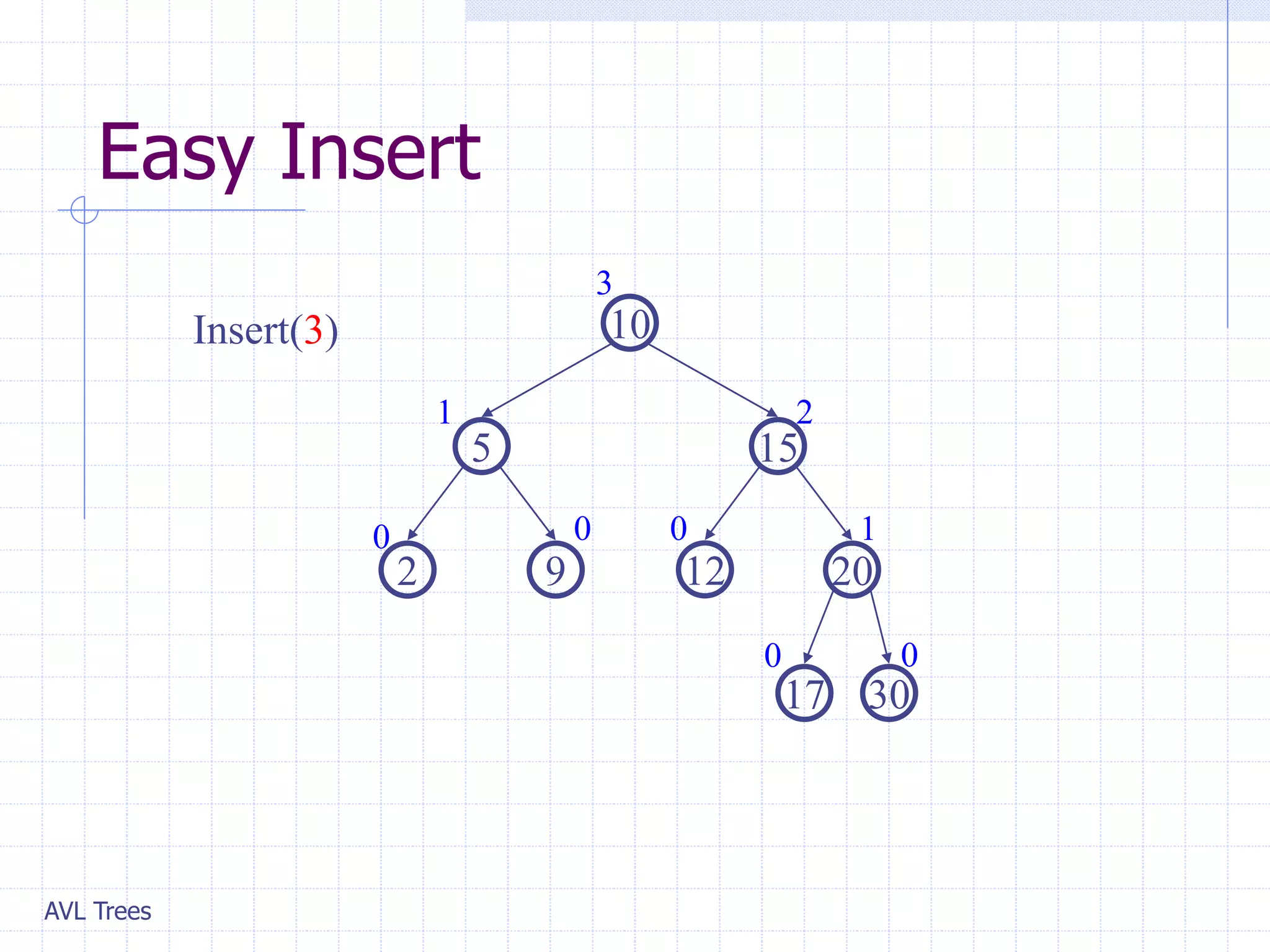
Easy Insert
20
9
2
15
5
10
30
17
Insert(3)
12
0
0
1
0
0
1 2
3
0
AVL Trees
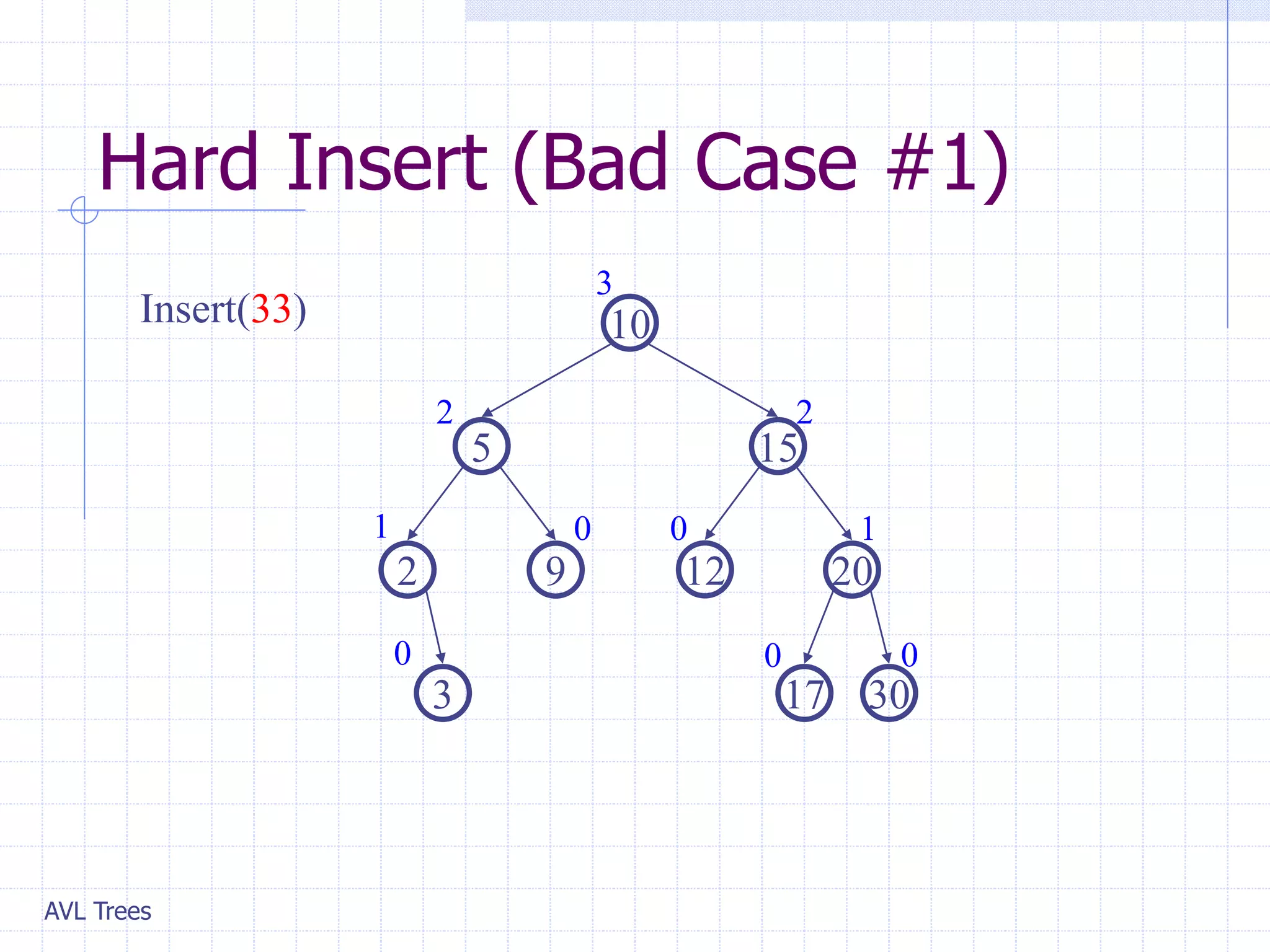
Hard Insert (Bad Case #1)
20
9
2
15
5
10
30
17
Insert(33)
3
12
1
0
1
0
0
2 2
3
0
0
AVL Trees
Single Rotation
20
9
2
15
5
10
30
17
3
12
33
1
0
2
0
0
2 3
3
1
0
0
30
9
2
20
5
10
33
3
15
1
0
1
1
0
2 2
3
0
0
17
12
0
AVL Trees
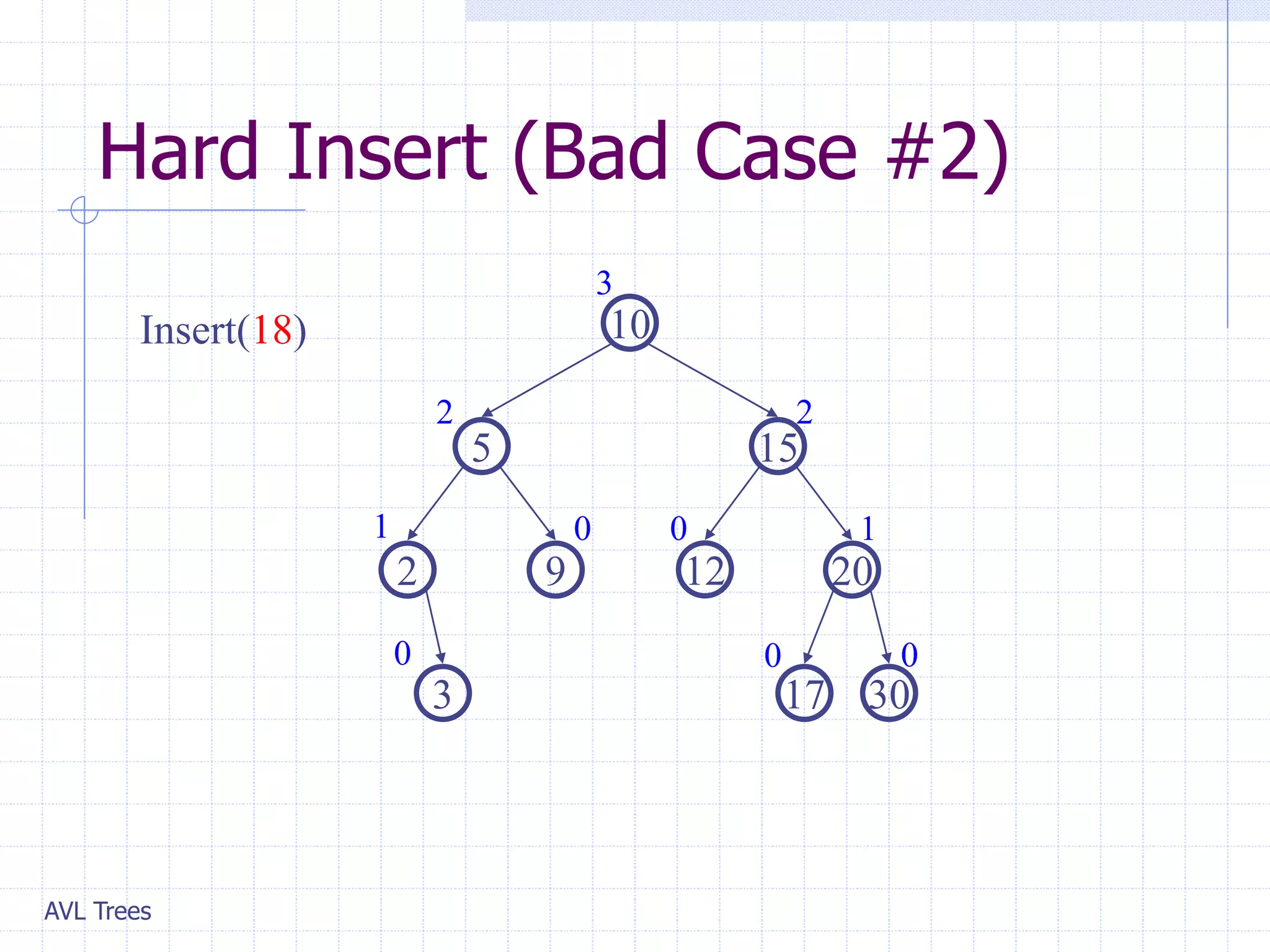
Hard Insert (Bad Case #2)
Insert(18)
20
9
2
15
5
10
30
17
3
12
1
0
1
0
0
2 2
3
0
0
AVL Trees
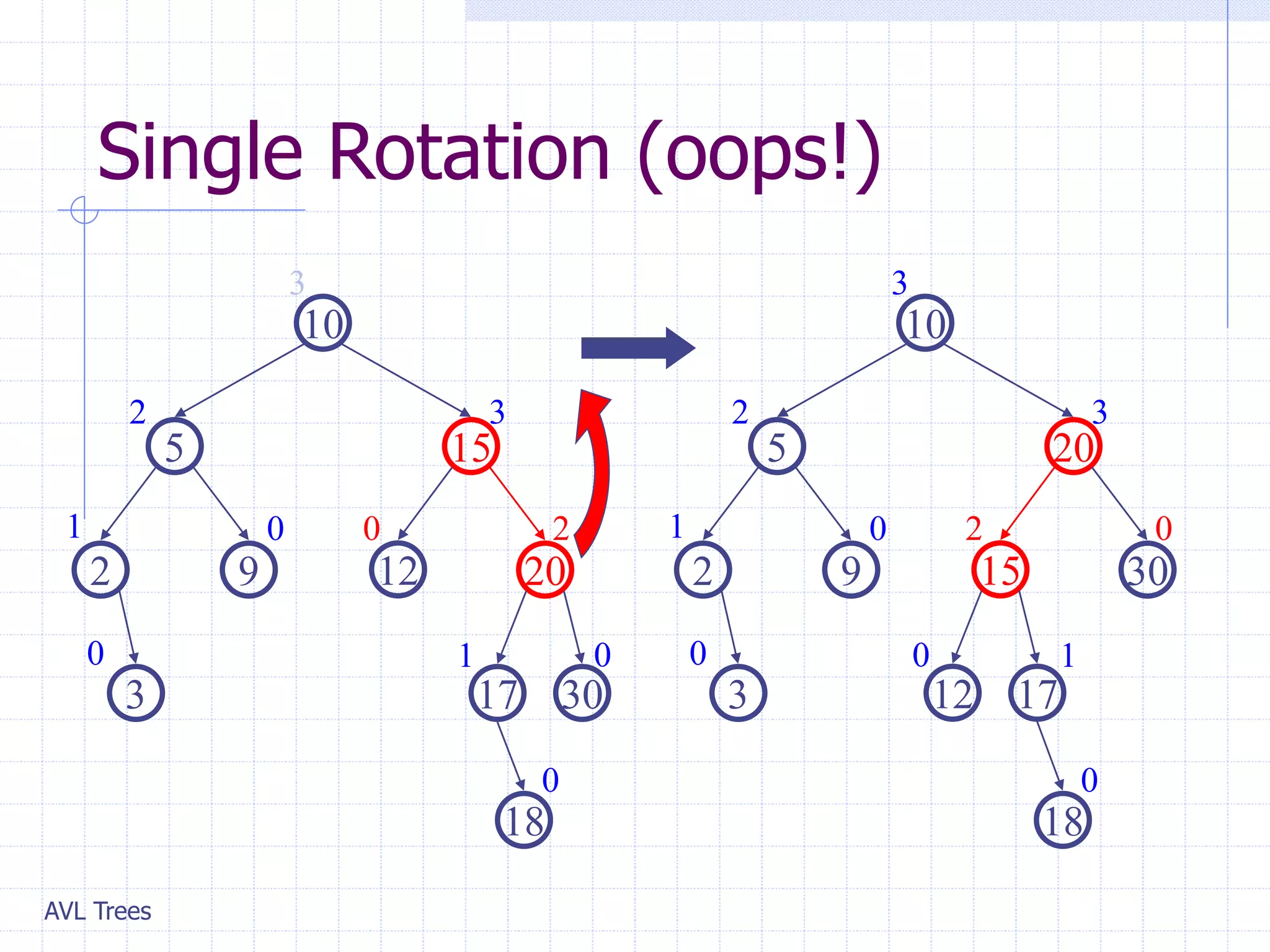
Single Rotation (oops!)
20
9
2
15
5
10
30
17
3
12
1
1
2
0
0
2 3
3
0
0
30
9
2
20
5
10
3
15
1
1
0
2
0
2 3
3
0
17
12
0
18
0
18
0
AVL Trees
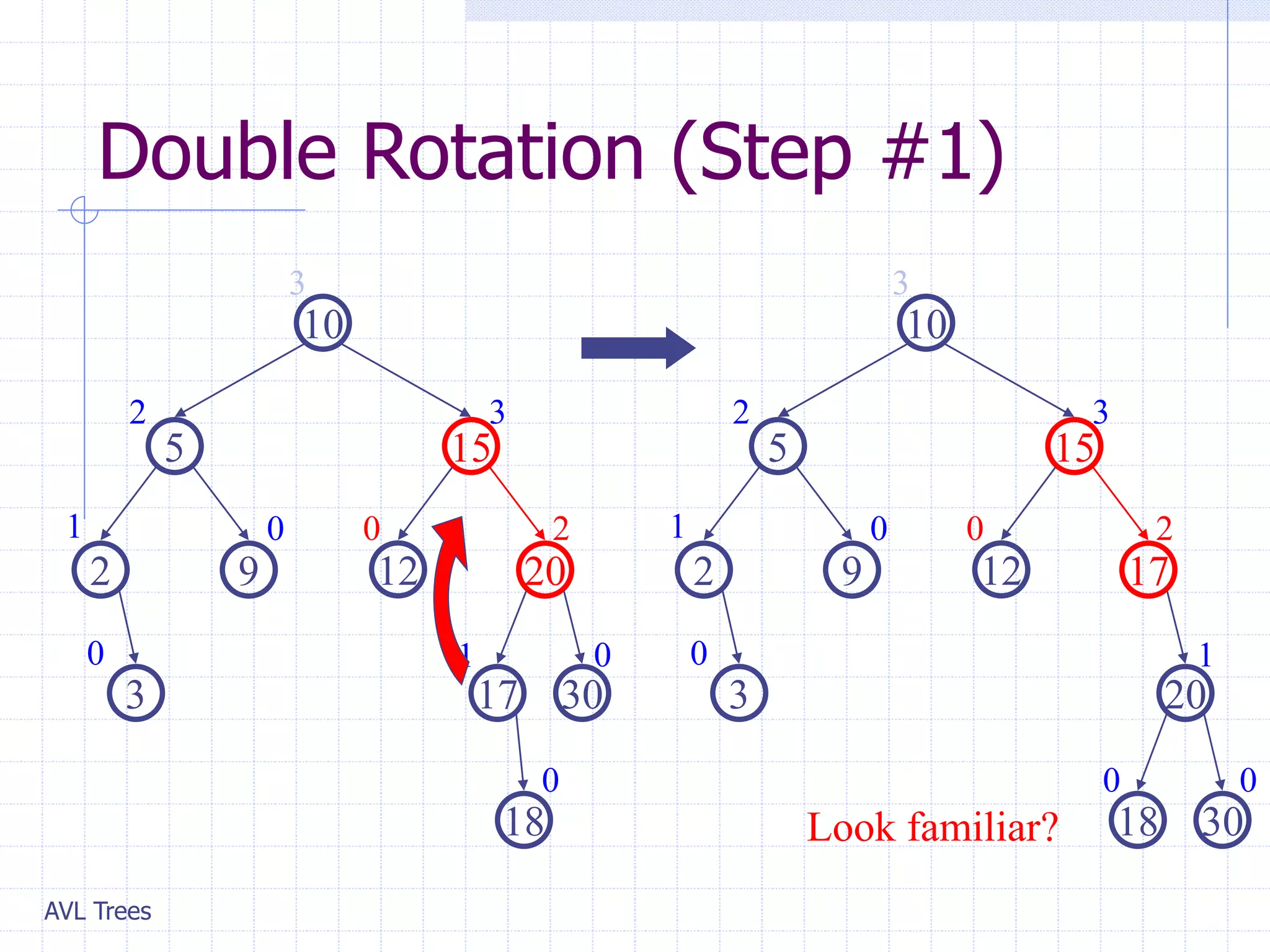
Double Rotation (Step #1)
20
9
2
15
5
10
30
17
3
12
1
1
2
0
0
2 3
3
0
0
18
0
17
9
2
15
5
10
20
3
12
1 2
0
0
2 3
3
1
0
30
0
Look familiar? 18
0
AVL Trees
Double Rotation (Step #2)
17
9
2
15
5
10
20
3
12
1 2
0
0
2 3
3
1
0
30
0
18
0
20
9
2
17
5
10
30
3
15
1
0
1
1
0
2 2
3
0
0
12
0
18
AVL Trees
AVL Insert Algorithm Revisited
 Recursive
1. Search downward for
spot
2. Insert node
3. Unwind stack,
correcting heights
a. If imbalance #1,
single rotate
b. If imbalance #2,
double rotate
 Iterative
1. Search downward for
spot, stacking
parent nodes
2. Insert node
3. Unwind stack,
correcting heights
a. If imbalance #1,
single rotate and
exit
b. If imbalance #2,
double rotate and
exit
AVL Trees
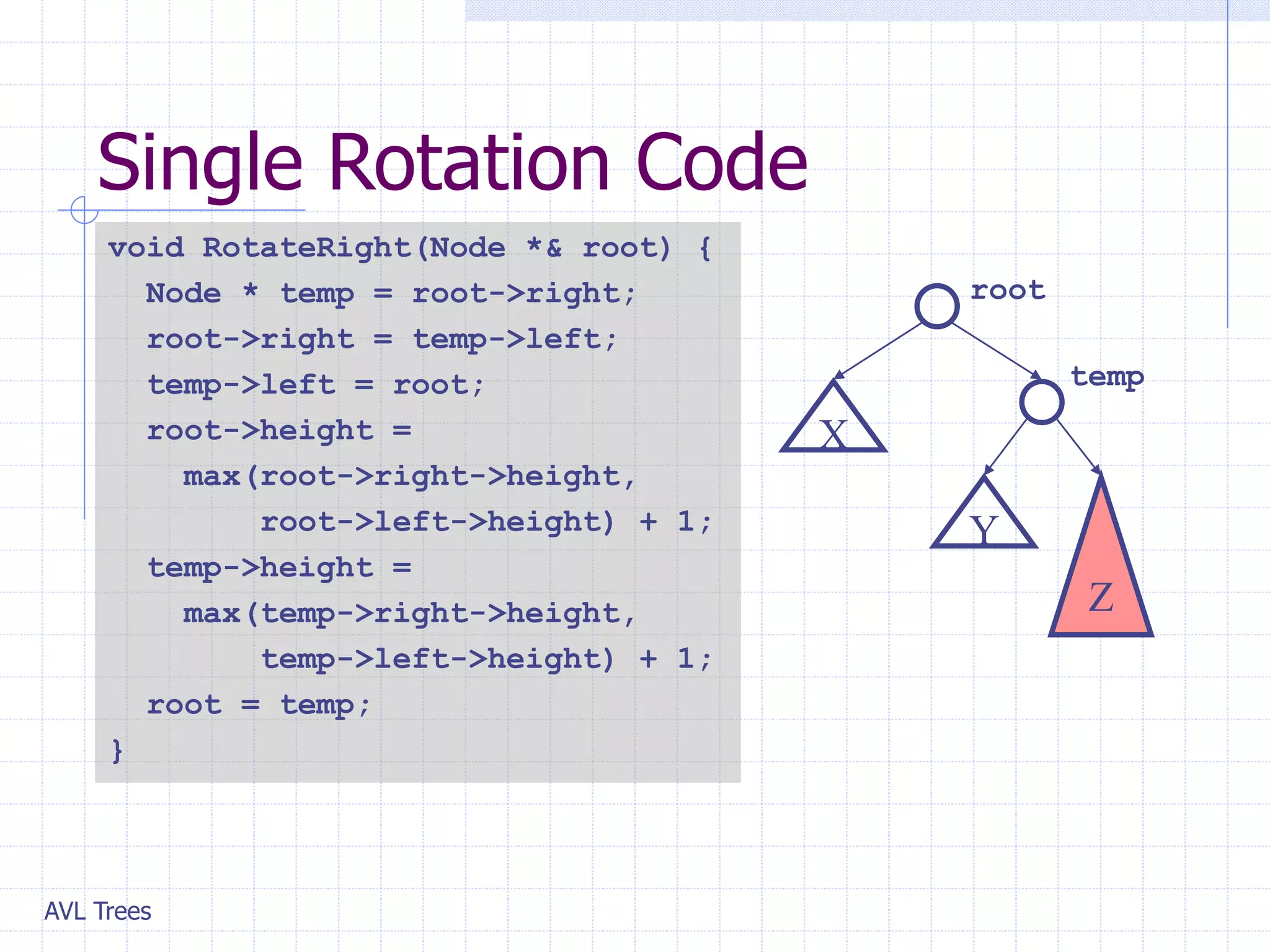
Single Rotation Code
void RotateRight(Node *& root) {
Node * temp = root->right;
root->right = temp->left;
temp->left = root;
root->height =
max(root->right->height,
root->left->height) + 1;
temp->height =
max(temp->right->height,
temp->left->height) + 1;
root = temp;
}
X
Y
Z
root
temp
AVL Trees
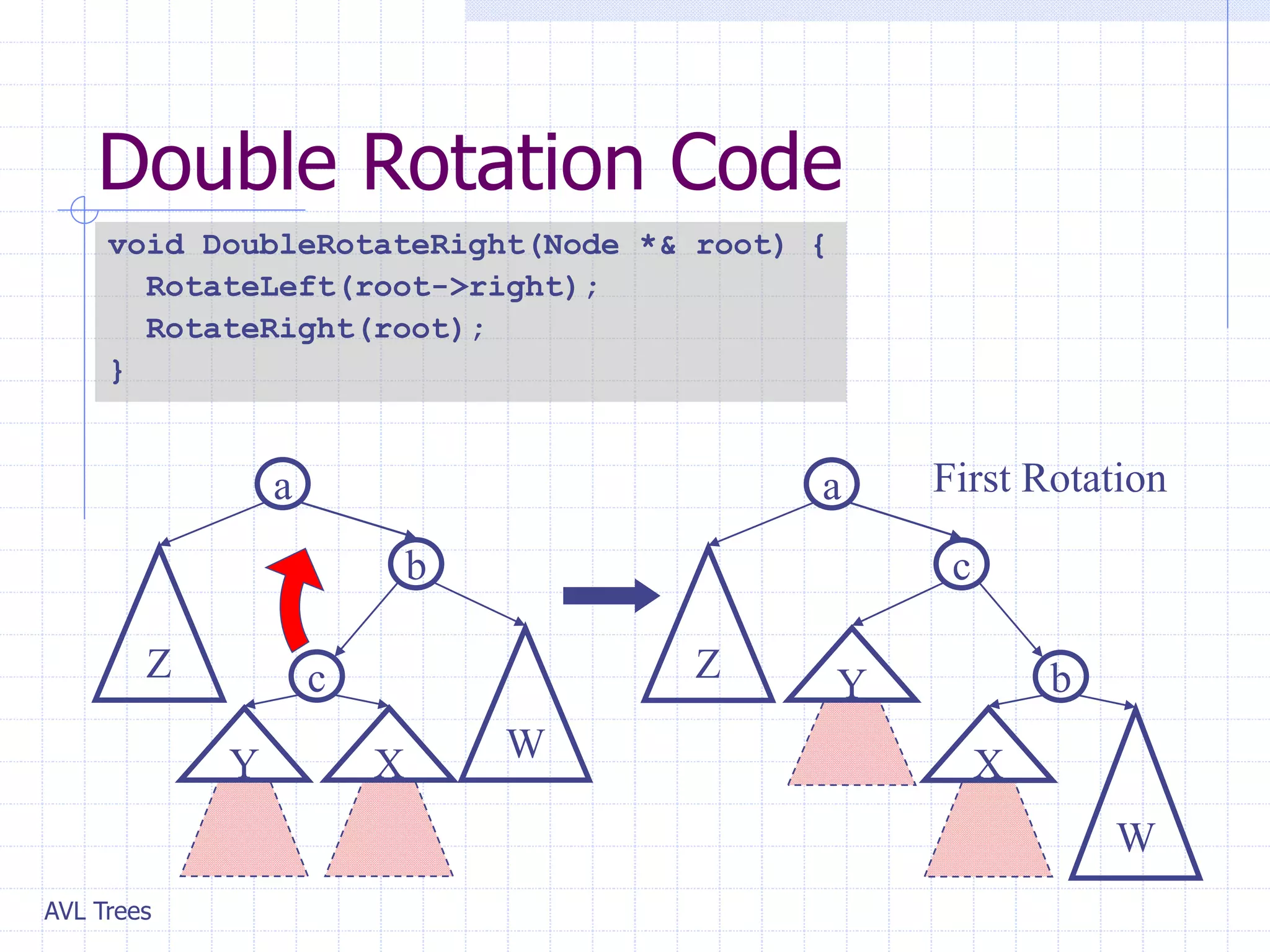
Double Rotation Code
void DoubleRotateRight(Node *& root) {
RotateLeft(root->right);
RotateRight(root);
}
a
Z
b
W
c
X
Y
a
Z
c
b
X
Y
W
First Rotation
AVL Trees
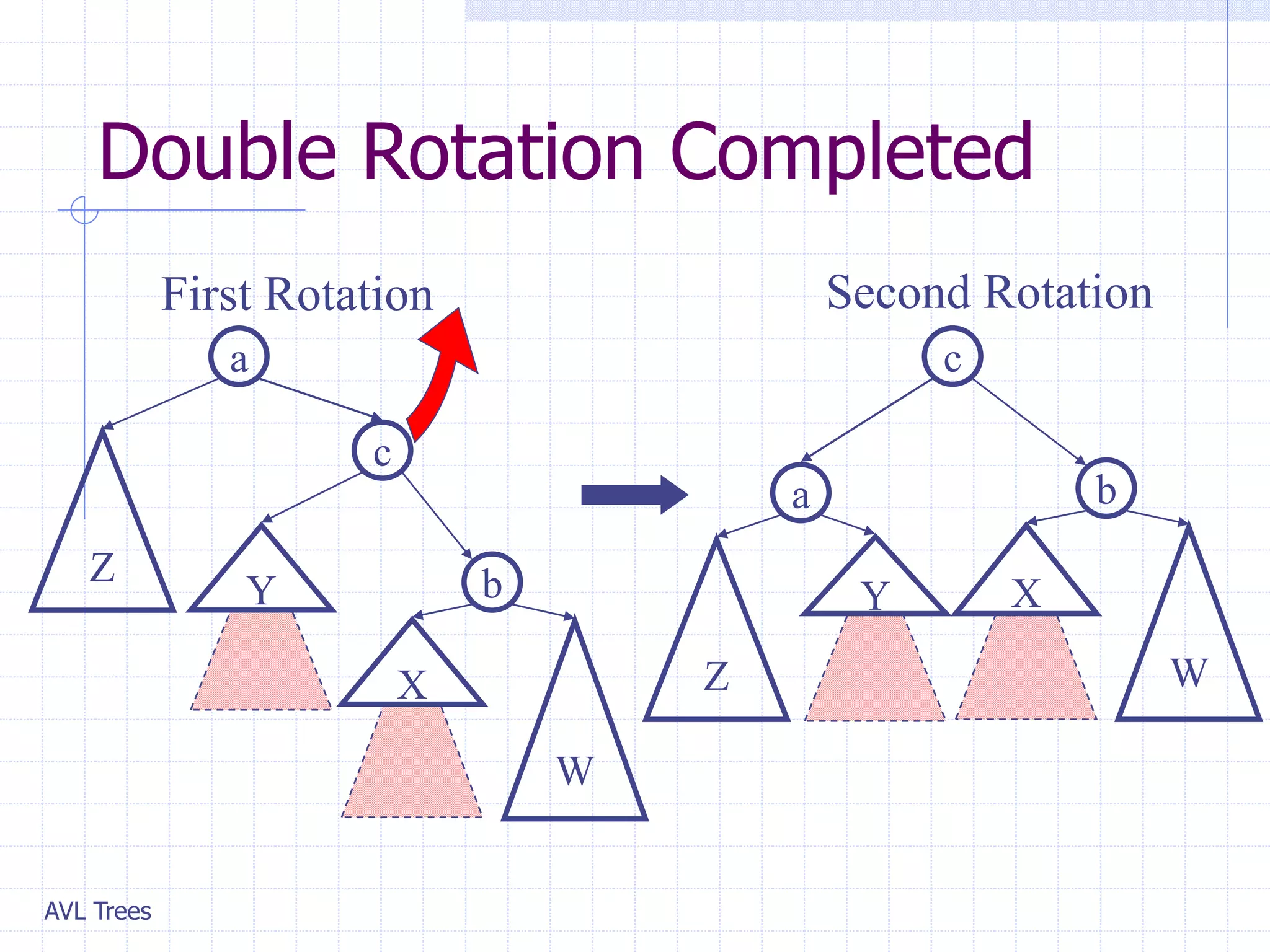
Double Rotation Completed
a
Z
c
b
X
Y
W
a
Z
c
b
X
Y
W
First Rotation Second Rotation
AVL Trees
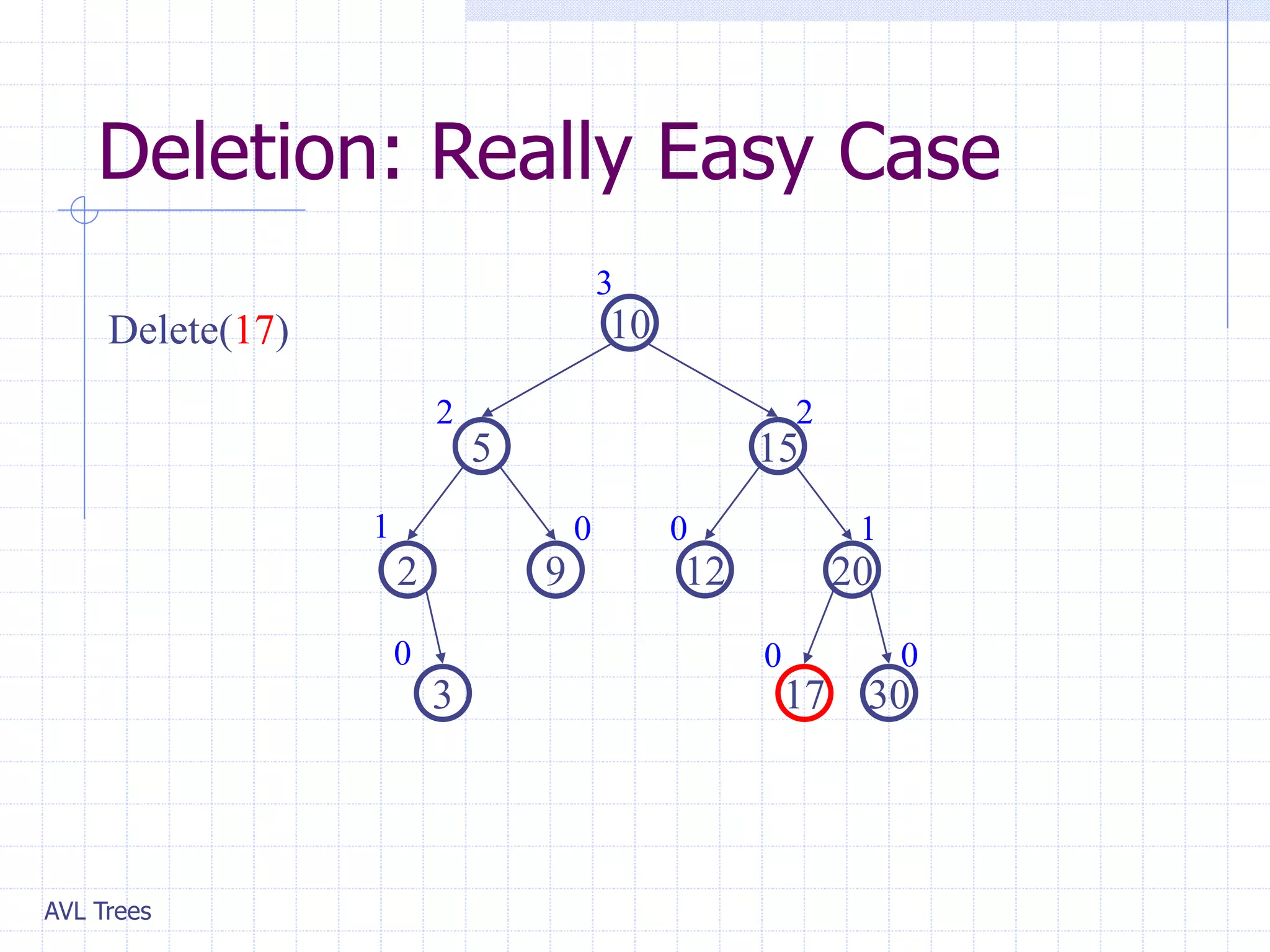
Deletion: Really Easy Case
20
9
2
15
5
10
30
17
3
12
1
0
1
0
0
2 2
3
0
0
Delete(17)
AVL Trees
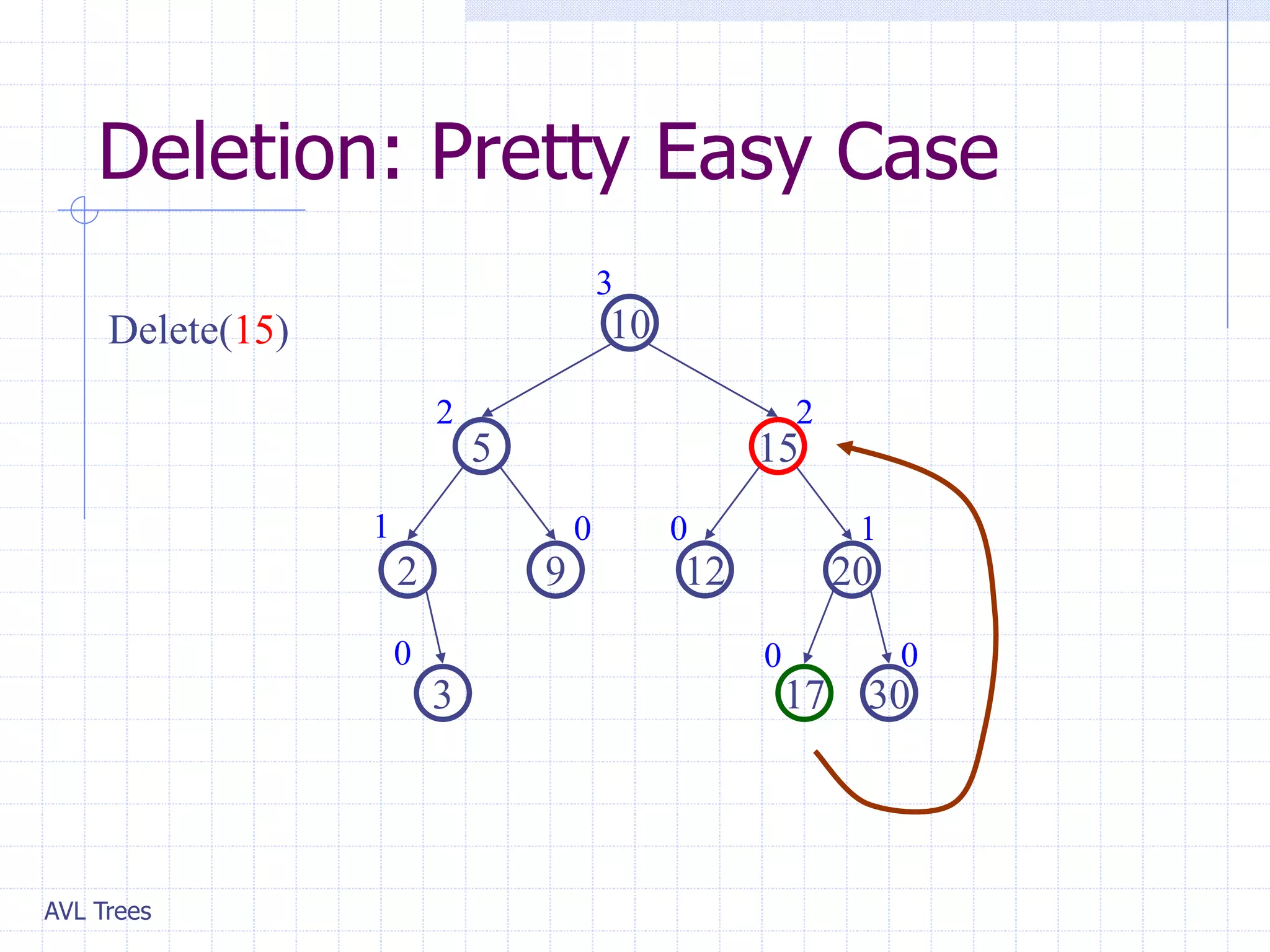
Deletion: Pretty Easy Case
20
9
2
15
5
10
30
17
3
12
1
0
1
0
0
2 2
3
0
0
Delete(15)
AVL Trees
Deletion: Pretty Easy Case (cont.)
20
9
2
17
5
10
30
3
12
1 1
0
0
2 2
3
0
0
Delete(15)
AVL Trees
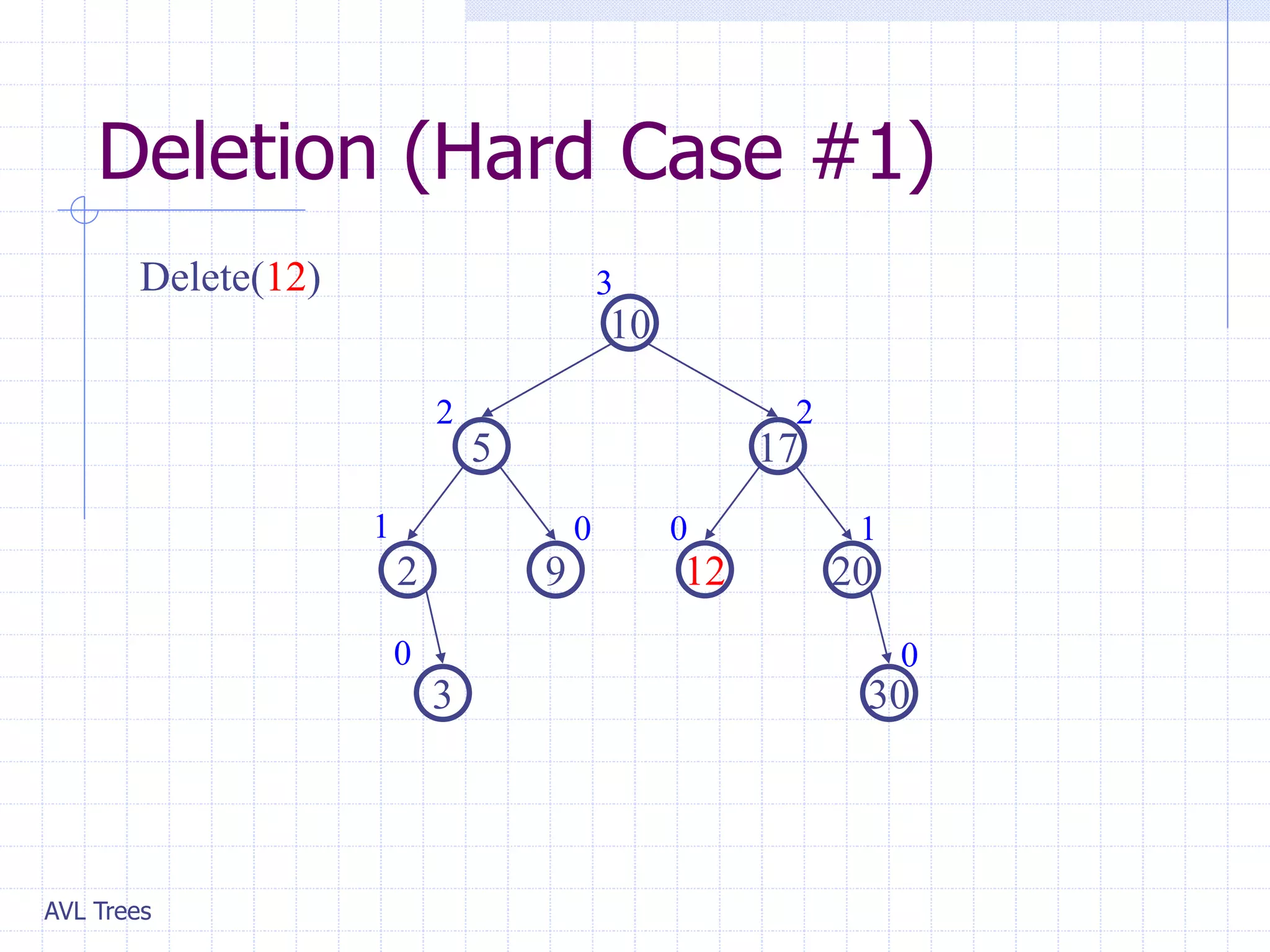
Deletion (Hard Case #1)
20
9
2
17
5
10
30
3
12
1 1
0
0
2 2
3
0
0
Delete(12)
AVL Trees
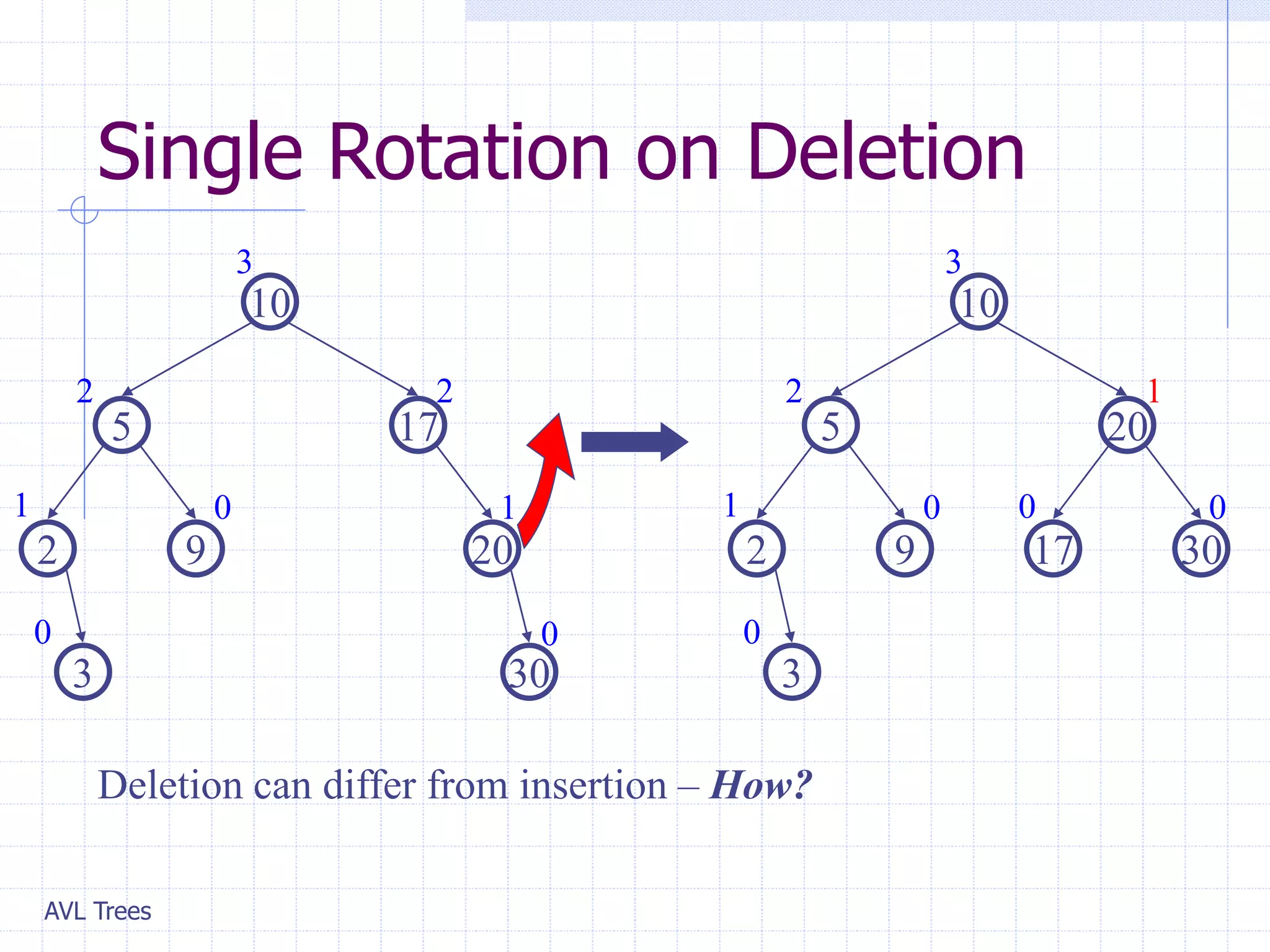
Single Rotation on Deletion
20
9
2
17
5
10
30
3
1 1
0
2 2
3
0
0
30
9
2
20
5
10
17
3
1 0
0
2 1
3
0
0
Deletion can differ from insertion – How?
AVL Trees
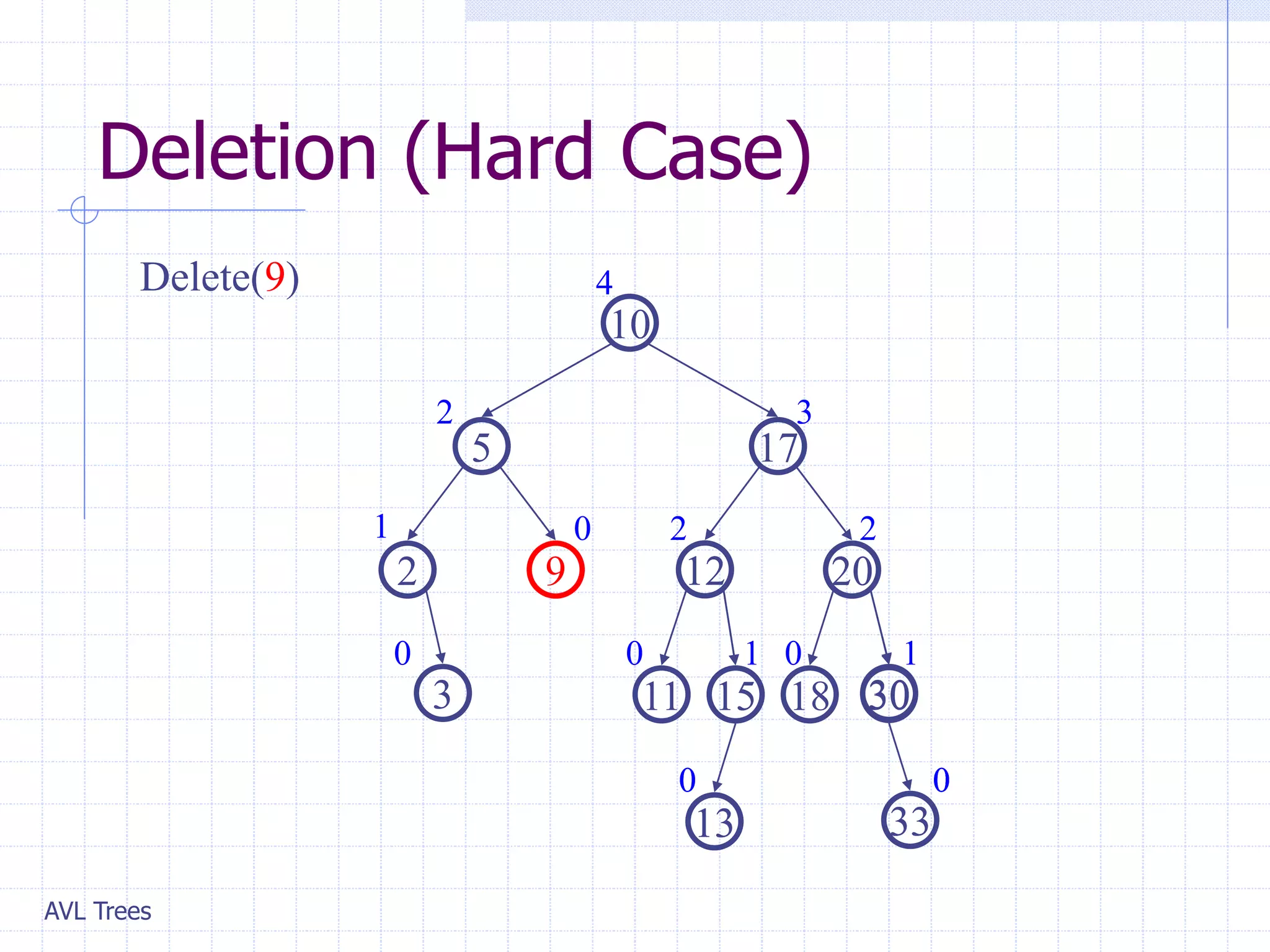
Deletion (Hard Case)
Delete(9)
20
9
2
17
5
10
30
3
12
1 2
2
0
2 3
4
0
33
15
13
0 0
1
0
20
30
12
33
15
13
1
0 0
11
0
18
0
AVL Trees
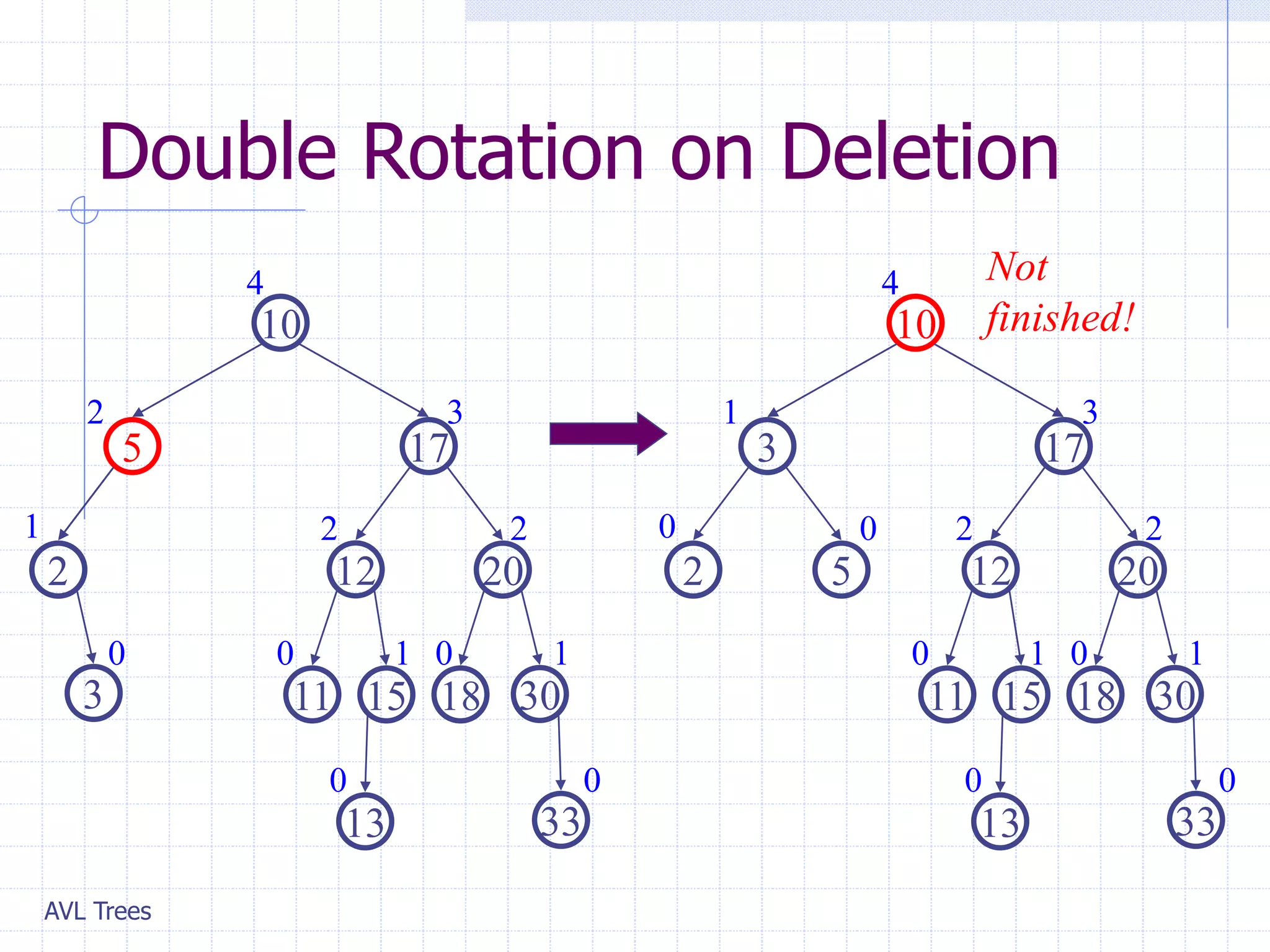
Double Rotation on Deletion
2
3
0
20
2
17
5
10
30
12
1 2
2
2 3
4
33
15
13
1
0 0
1
11
0
18
0
20
5
2
17
3
10
30
12
0 2
2
0
1 3
4
33
15
13
1
0 0
1
11
0
18
0
0
Not
finished!
AVL Trees
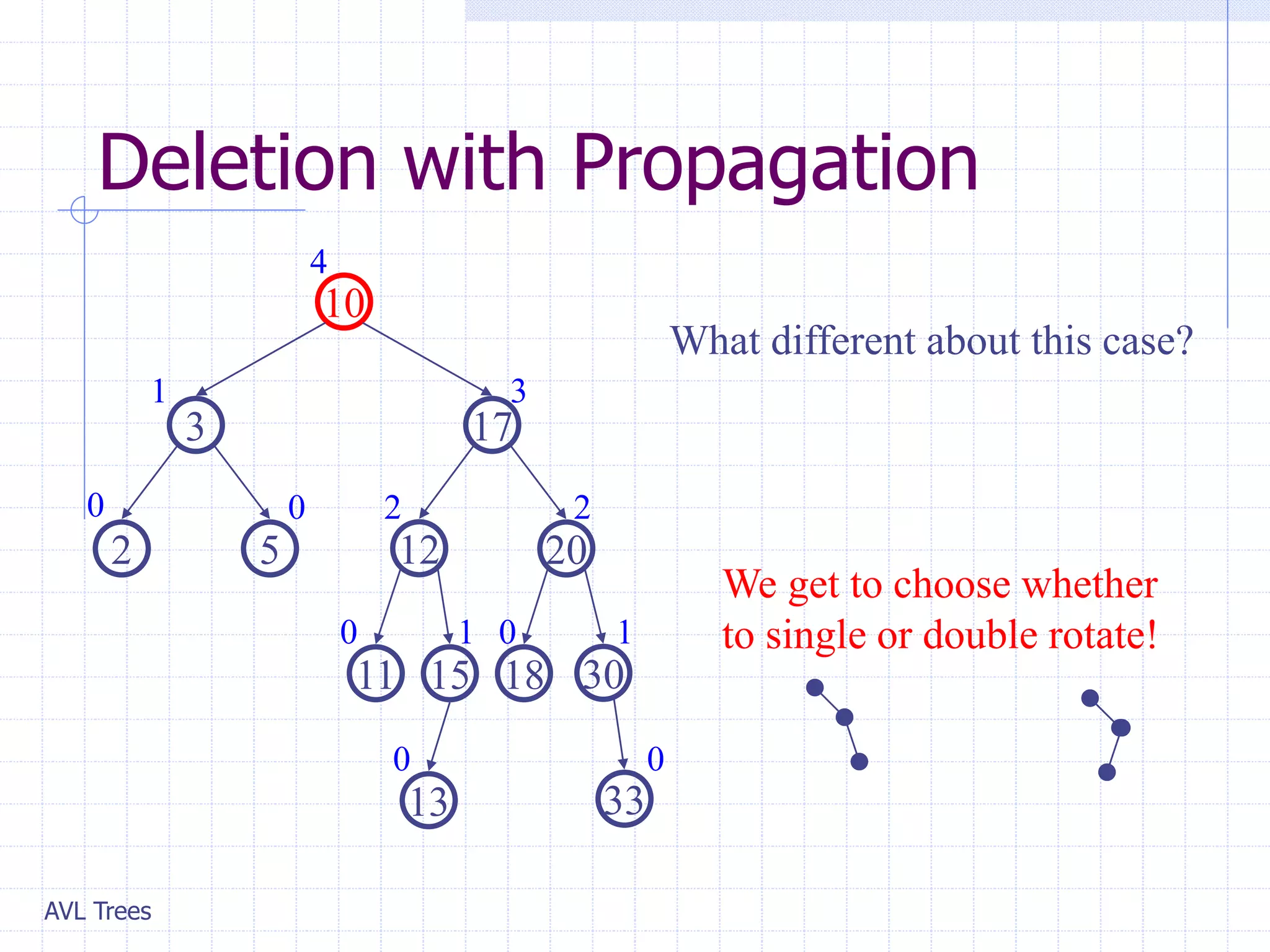
Deletion with Propagation
We get to choose whether
to single or double rotate!
20
5
2
17
3
10
30
12
0 2
2
0
1 3
4
33
15
13
1
0 0
1
11
0
18
0
What different about this case?
AVL Trees
Propagated Single Rotation
0
30
20
17
33
12
15
13
1
0
5
2
3
10
4
3 2
1 2 1
0 0 0
11
0
20
5
2
17
3
10
30
12
0 2
2
0
1 3
4
33
15
13
1
0
1
11
0
18
0
18
0
AVL Trees
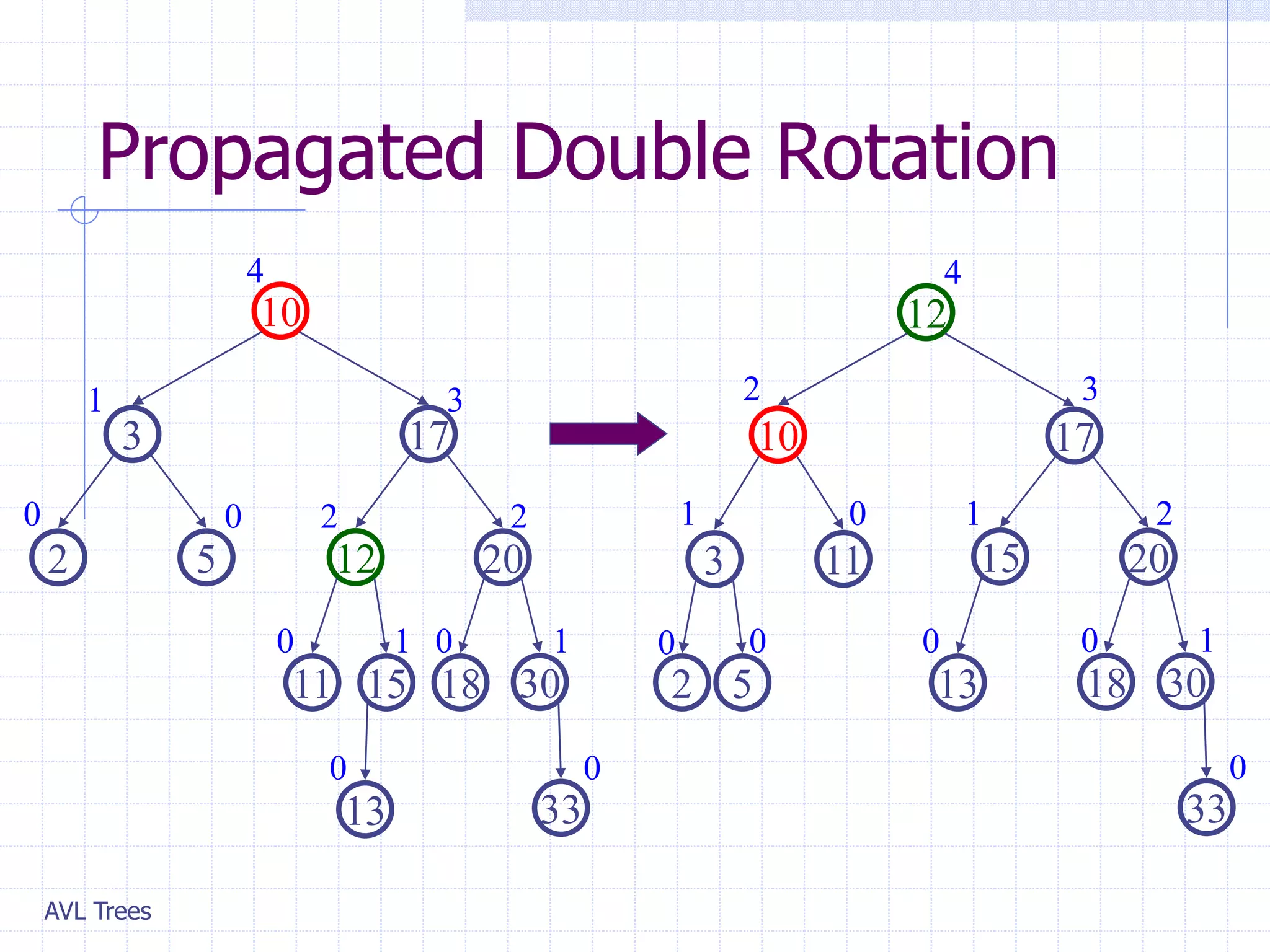
Propagated Double Rotation
0
17
12
11
5
2
3
10
4
2 3
1 0
0 0
20
5
2
17
3
10
30
12
0 2
2
0
1 3
4
33
15
13
1
0
1
11
0
18
0
15
1
0
20
30
33
1
18
0
13
0
2
AVL Trees
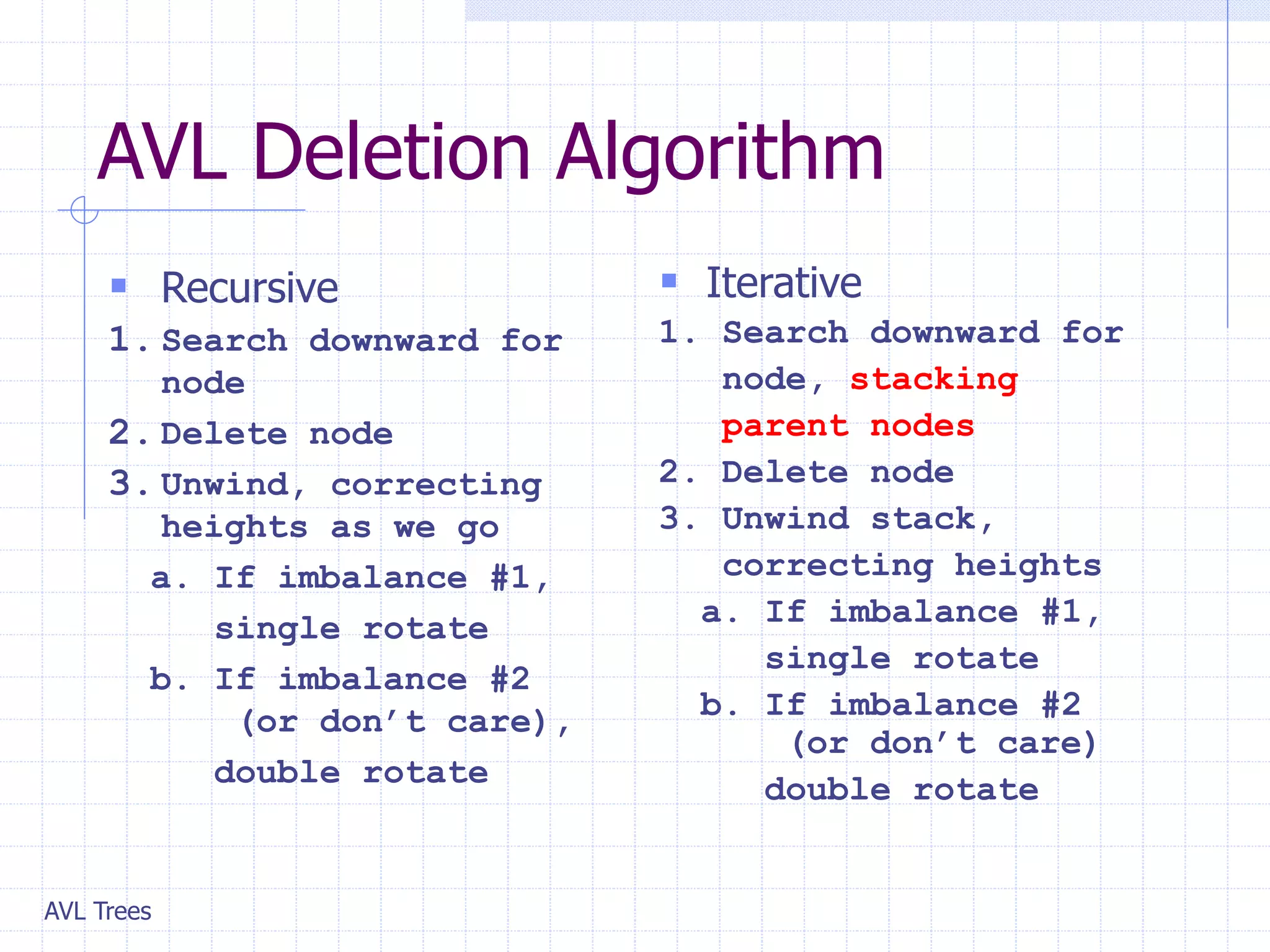
AVL Deletion Algorithm
 Recursive
1. Search downward for
node
2. Delete node
3. Unwind, correcting
heights as we go
a. If imbalance #1,
single rotate
b. If imbalance #2
(or don’t care),
double rotate
 Iterative
1. Search downward for
node, stacking
parent nodes
2. Delete node
3. Unwind stack,
correcting heights
a. If imbalance #1,
single rotate
b. If imbalance #2
(or don’t care)
double rotate
AVL Trees
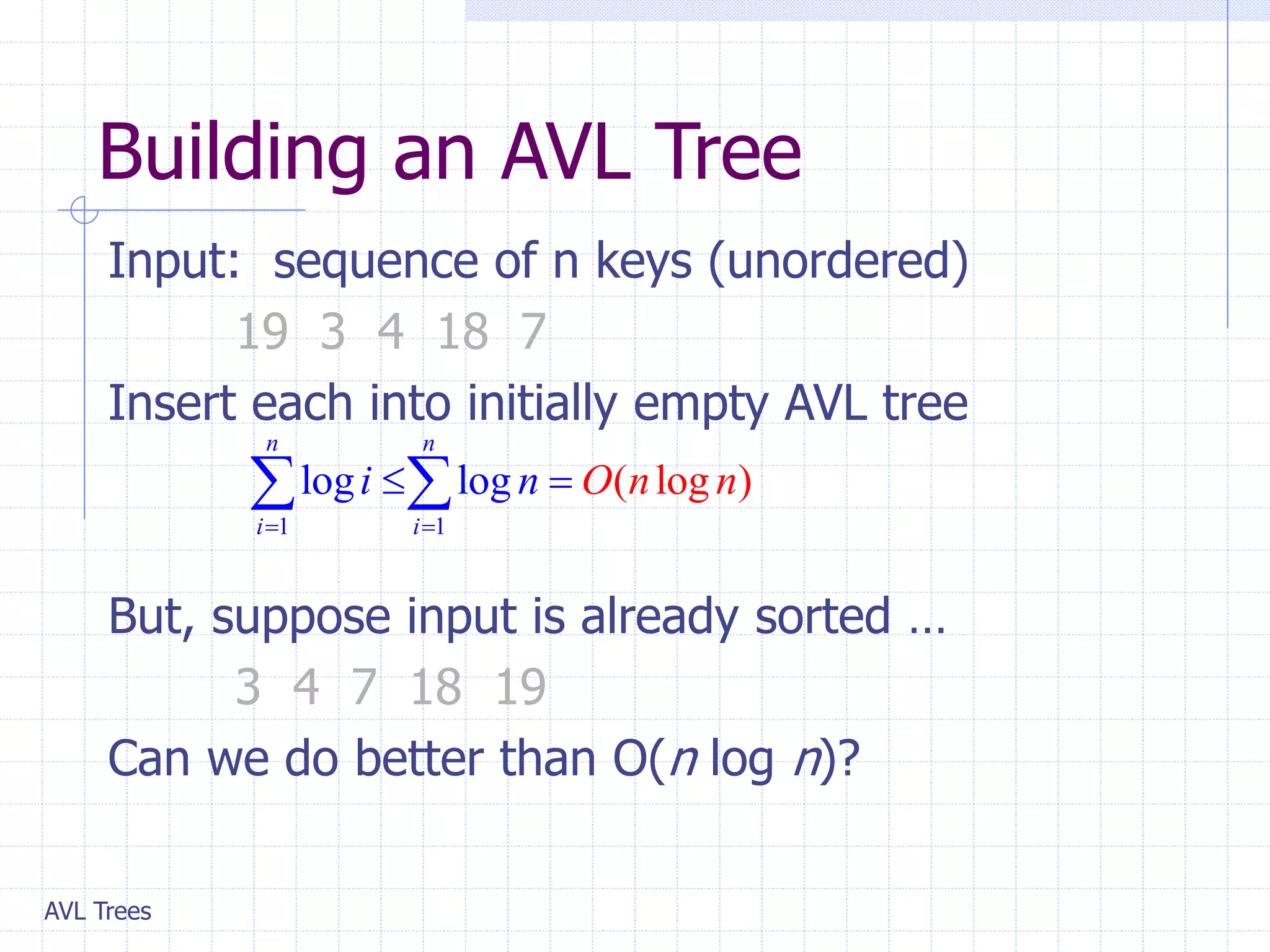
Building an AVL Tree
Input: sequence of n keys (unordered)
19 3 4 18 7
Insert each into initially empty AVL tree
But, suppose input is already sorted …
3 4 7 18 19
Can we do better than O(n log n)?
1 1
( lo
l g )
og log
n n
i i
O n n
i n
 
 
 
AVL Trees
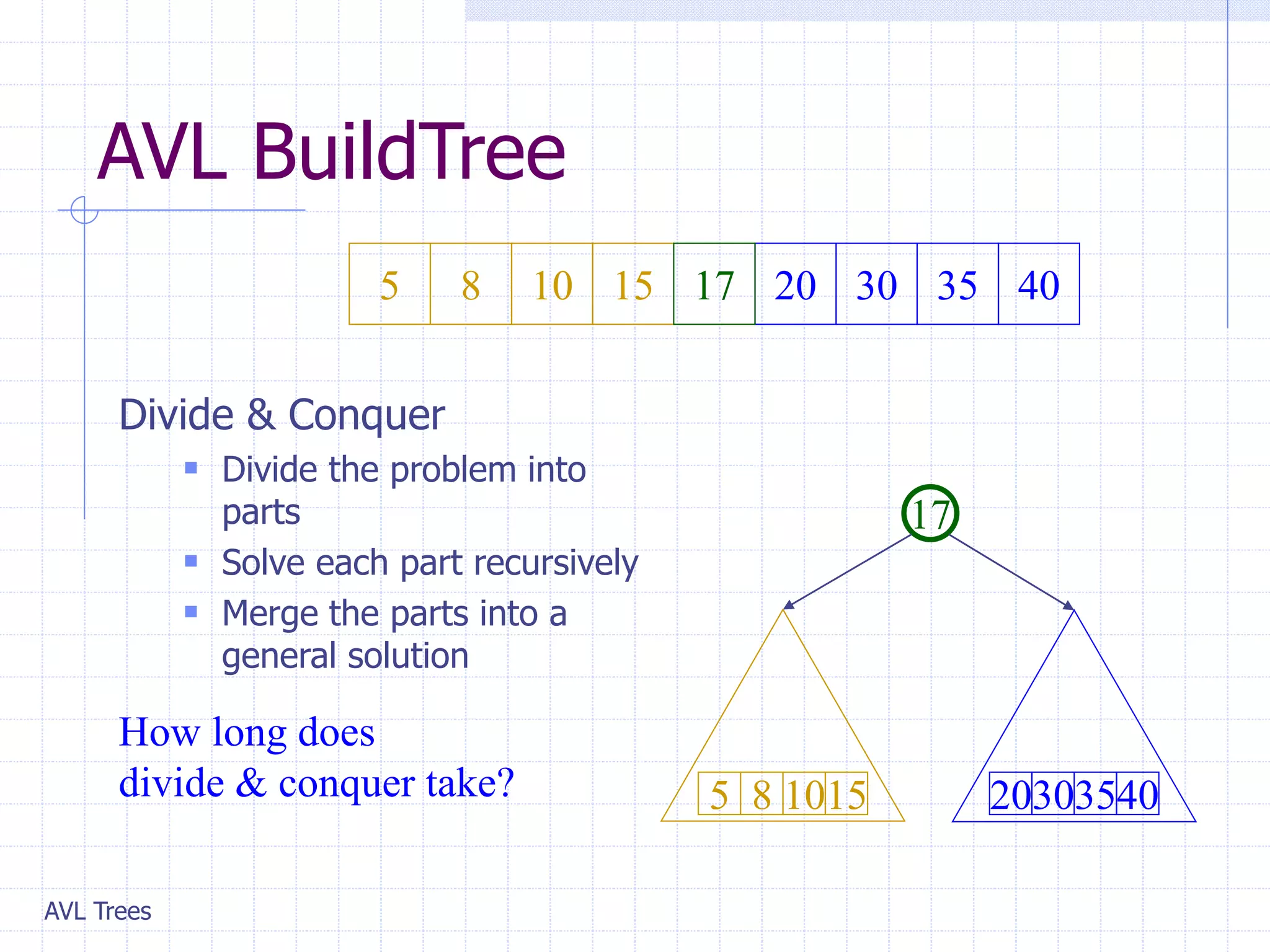
AVL BuildTree
8 10 15 20 30 35 40
5
17
17
8 1015
5 20303540
Divide & Conquer
 Divide the problem into
parts
 Solve each part recursively
 Merge the parts into a
general solution
How long does
divide & conquer take?
AVL Trees
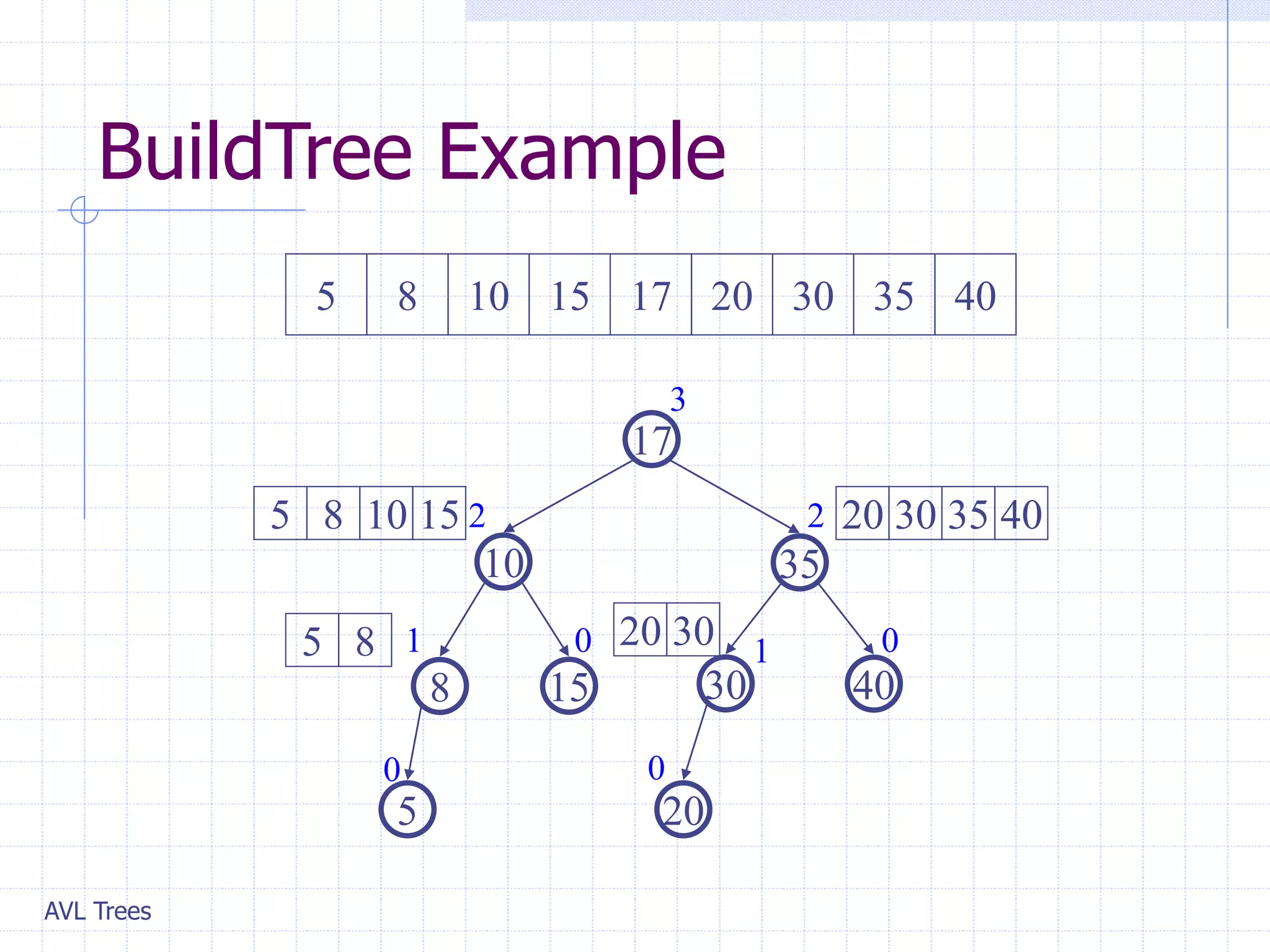
BuildTree Example
35
17
15
5
8
10
3
2 2
1 0
0
30
1
40
20
0
0
8 10 15 20 30 35 40
5 17
8 10 15
5
8
5
30 35 40
20
30
20
AVL Trees
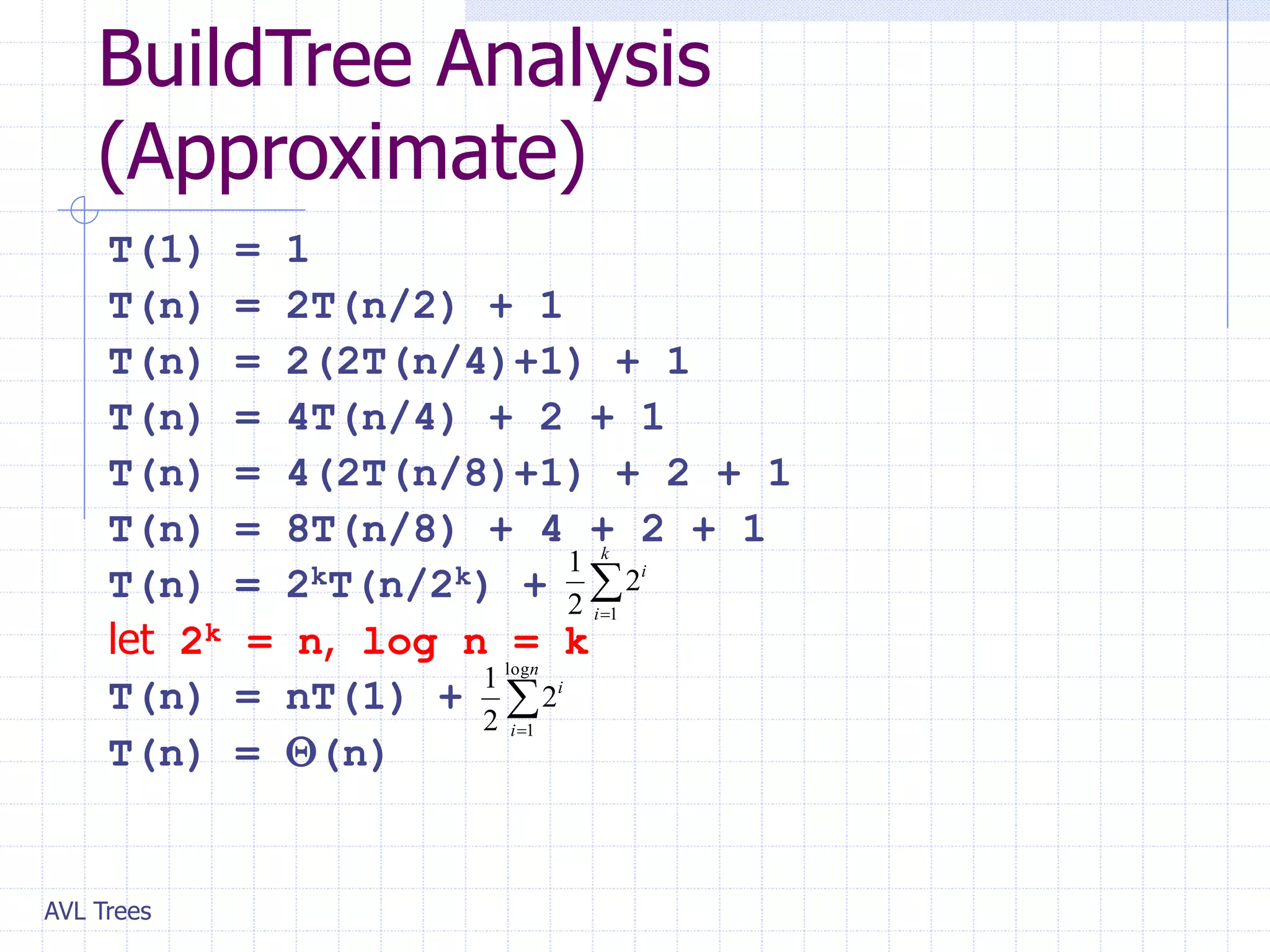
BuildTree Analysis
(Approximate)
T(1) = 1
T(n) = 2T(n/2) + 1
T(n) = 2(2T(n/4)+1) + 1
T(n) = 4T(n/4) + 2 + 1
T(n) = 4(2T(n/8)+1) + 2 + 1
T(n) = 8T(n/8) + 4 + 2 + 1
T(n) = 2kT(n/2k) +
let 2k = n, log n = k
T(n) = nT(1) +
T(n) = (n)


k
i
i
1
2
2
1


n
i
i
log
1
2
2
1
AVL Trees
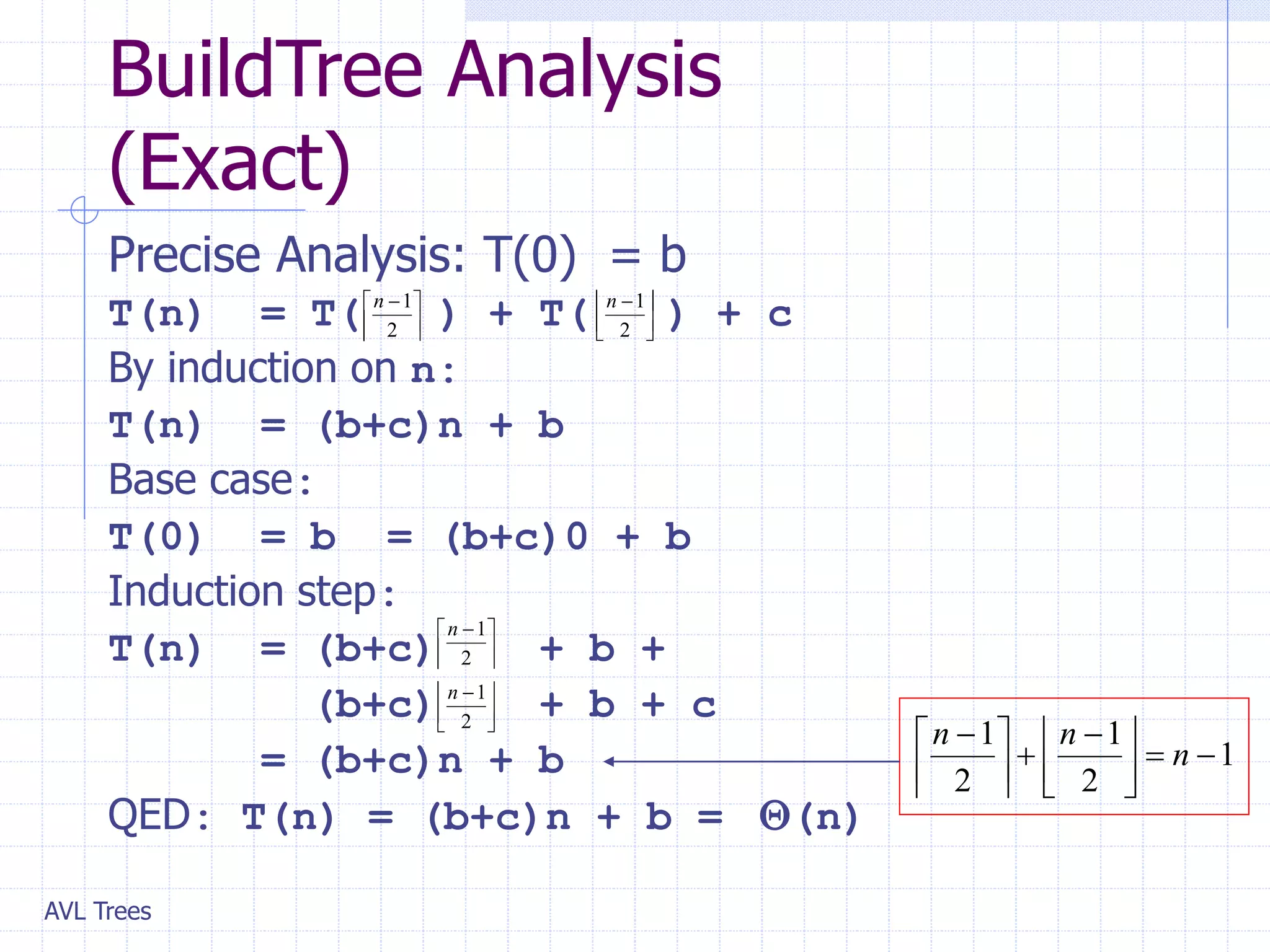
Precise Analysis: T(0) = b
T(n) = T( ) + T( ) + c
By induction on n:
T(n) = (b+c)n + b
Base case:
T(0) = b = (b+c)0 + b
Induction step:
T(n) = (b+c) + b +
(b+c) + b + c
= (b+c)n + b
QED: T(n) = (b+c)n + b = (n)





 
2
1
n





 
2
1
n





 
2
1
n





 
2
1
n
BuildTree Analysis
(Exact)
1
2
1
2
1







 






 
n
n
n
AVL Trees
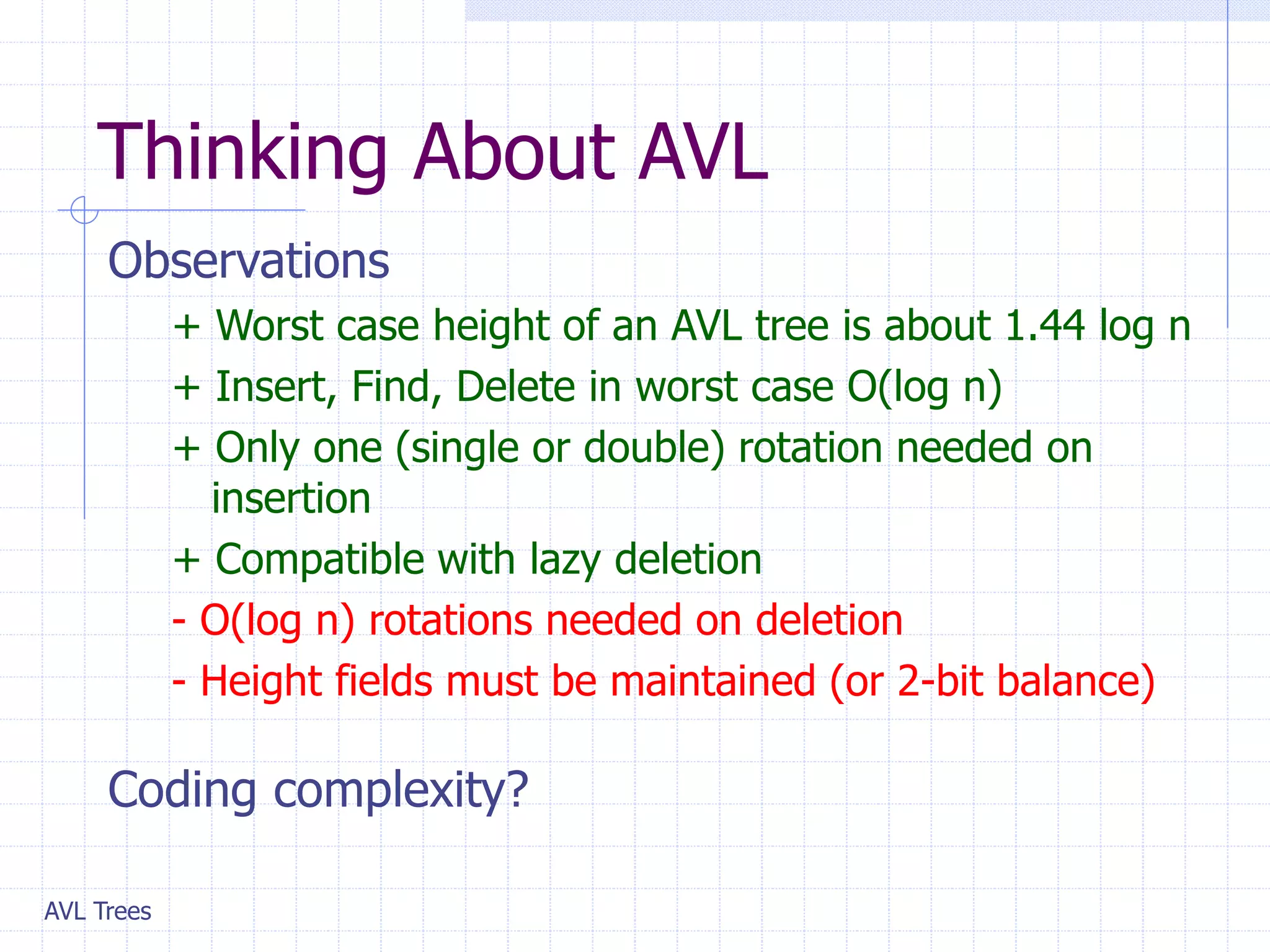
Thinking About AVL
Observations
+ Worst case height of an AVL tree is about 1.44 log n
+ Insert, Find, Delete in worst case O(log n)
+ Only one (single or double) rotation needed on
insertion
+ Compatible with lazy deletion
- O(log n) rotations needed on deletion
- Height fields must be maintained (or 2-bit balance)
Coding complexity?
AVL Trees
Alternatives to AVL Trees
 Weight balanced trees
 keep about the same number of nodes in each subtree
 not nearly as nice
 Splay trees
 “blind” adjusting version of AVL trees
 no height information maintained!
 insert/find always rotates node to the root!
 worst case time is O(n)
 amortized time for all operations is O(log n)
 mysterious, but often faster than AVL trees in practice
(better low-order terms)

AVL Tree.ppt

  • 1.
  • 2.
    AVL Trees Balance Balance ==height(left subtree) - height(right subtree)  zero everywhere  perfectly balanced  small everywhere  balanced enough Balance between -1 and 1 everywhere  maximum height of ~1.44 log n t 5 7
  • 3.
    AVL Trees AVL Tree DictionaryData Structure 4 12 10 6 2 11 5 8 14 13 7 9 Binary search tree properties  binary tree property  search tree property Balance property  balance of every node is: -1 b  1  result:  depth is (log n) 15
  • 4.
    AVL Trees An AVLTree 15 9 2 12 5 10 20 17 0 0 1 0 0 1 2 3 10 3 data height children 30 0
  • 5.
    AVL Trees Not AVLTrees 15 12 5 10 20 17 0 1 0 0 2 3 30 0 15 10 20 0 1 2 (-1)-1 = -2 0-2 = -2 Note: height(empty tree) == -1
  • 6.
    AVL Trees Good InsertCase: Balance Preserved Good case: insert middle, then small,then tall Insert(middle) Insert(small) Insert(tall) M S T 0 0 1
  • 7.
    AVL Trees Bad InsertCase #1: Left-Left or Right-Right Imbalance Insert(small) Insert(middle) Insert(tall) T M S 0 1 2 BC#1 Imbalance caused by either:  Insert into left child’s left subtree  Insert into right child’s right subtree
  • 8.
    AVL Trees Single Rotation T M S 0 1 2 M ST 0 0 1 Basic operation used in AVL trees: A right child could legally have its parent as its left child.
  • 9.
    AVL Trees General BadCase #1 a X Y b Z h h - 1 h + 1 h - 1 h + 2 a X Y b Z h-1 h - 1 h h - 1 h + 1 Note: imbalance is left-left
  • 10.
    AVL Trees Single Rotation FixesCase #1 Imbalance  Height of left subtree same as it was before insert!  Height of all ancestors unchanged  We can stop here! a X Y b Z a X Y b Z h h - 1 h + 1 h - 1 h + 2 h h - 1 h h - 1 h + 1
  • 11.
    AVL Trees Bad InsertCase #2: Left-Right or Right-Left Imbalance Insert(small) Insert(tall) Insert(middle) M T S 0 1 2 Will a single rotation fix this? BC#2 Imbalance caused by either:  Insert into left child’s right subtree  Insert into right child’s left subtree
  • 12.
    AVL Trees Double Rotation M ST 0 0 1 M T S 0 1 2 T M S 0 1 2
  • 13.
    AVL Trees General BadCase #2 a X b Z h h + 1 h - 1 h + 2 a X b Z h-1 h - 1 h h - 1 h + 1 Note: imbalance is left-right h-1 Y Y
  • 14.
    AVL Trees Double Rotation FixesCase #2 Imbalance Initially: insert into either X or Y unbalances tree (root balance goes to 2 or -2) “Zig zag” to pull up c – restores root height to h+1, left subtree height to h a Z b W c X Y a Z b W c X Y h h - 1? h - 1 h - 1 h + 2 h + 1 h - 1 h - 1 h h + 1 h h - 1?
  • 15.
    AVL Trees AVL InsertAlgorithm  Find spot for value  Hang new node  Search back up looking for imbalance  If there is an imbalance: case #1: Perform single rotation case #2: Perform double rotation  Done! (There can only be one imbalance!)
  • 16.
  • 17.
    AVL Trees Hard Insert(Bad Case #1) 20 9 2 15 5 10 30 17 Insert(33) 3 12 1 0 1 0 0 2 2 3 0 0
  • 18.
    AVL Trees Single Rotation 20 9 2 15 5 10 30 17 3 12 33 1 0 2 0 0 23 3 1 0 0 30 9 2 20 5 10 33 3 15 1 0 1 1 0 2 2 3 0 0 17 12 0
  • 19.
    AVL Trees Hard Insert(Bad Case #2) Insert(18) 20 9 2 15 5 10 30 17 3 12 1 0 1 0 0 2 2 3 0 0
  • 20.
    AVL Trees Single Rotation(oops!) 20 9 2 15 5 10 30 17 3 12 1 1 2 0 0 2 3 3 0 0 30 9 2 20 5 10 3 15 1 1 0 2 0 2 3 3 0 17 12 0 18 0 18 0
  • 21.
    AVL Trees Double Rotation(Step #1) 20 9 2 15 5 10 30 17 3 12 1 1 2 0 0 2 3 3 0 0 18 0 17 9 2 15 5 10 20 3 12 1 2 0 0 2 3 3 1 0 30 0 Look familiar? 18 0
  • 22.
    AVL Trees Double Rotation(Step #2) 17 9 2 15 5 10 20 3 12 1 2 0 0 2 3 3 1 0 30 0 18 0 20 9 2 17 5 10 30 3 15 1 0 1 1 0 2 2 3 0 0 12 0 18
  • 23.
    AVL Trees AVL InsertAlgorithm Revisited  Recursive 1. Search downward for spot 2. Insert node 3. Unwind stack, correcting heights a. If imbalance #1, single rotate b. If imbalance #2, double rotate  Iterative 1. Search downward for spot, stacking parent nodes 2. Insert node 3. Unwind stack, correcting heights a. If imbalance #1, single rotate and exit b. If imbalance #2, double rotate and exit
  • 24.
    AVL Trees Single RotationCode void RotateRight(Node *& root) { Node * temp = root->right; root->right = temp->left; temp->left = root; root->height = max(root->right->height, root->left->height) + 1; temp->height = max(temp->right->height, temp->left->height) + 1; root = temp; } X Y Z root temp
  • 25.
    AVL Trees Double RotationCode void DoubleRotateRight(Node *& root) { RotateLeft(root->right); RotateRight(root); } a Z b W c X Y a Z c b X Y W First Rotation
  • 26.
    AVL Trees Double RotationCompleted a Z c b X Y W a Z c b X Y W First Rotation Second Rotation
  • 27.
    AVL Trees Deletion: ReallyEasy Case 20 9 2 15 5 10 30 17 3 12 1 0 1 0 0 2 2 3 0 0 Delete(17)
  • 28.
    AVL Trees Deletion: PrettyEasy Case 20 9 2 15 5 10 30 17 3 12 1 0 1 0 0 2 2 3 0 0 Delete(15)
  • 29.
    AVL Trees Deletion: PrettyEasy Case (cont.) 20 9 2 17 5 10 30 3 12 1 1 0 0 2 2 3 0 0 Delete(15)
  • 30.
    AVL Trees Deletion (HardCase #1) 20 9 2 17 5 10 30 3 12 1 1 0 0 2 2 3 0 0 Delete(12)
  • 31.
    AVL Trees Single Rotationon Deletion 20 9 2 17 5 10 30 3 1 1 0 2 2 3 0 0 30 9 2 20 5 10 17 3 1 0 0 2 1 3 0 0 Deletion can differ from insertion – How?
  • 32.
    AVL Trees Deletion (HardCase) Delete(9) 20 9 2 17 5 10 30 3 12 1 2 2 0 2 3 4 0 33 15 13 0 0 1 0 20 30 12 33 15 13 1 0 0 11 0 18 0
  • 33.
    AVL Trees Double Rotationon Deletion 2 3 0 20 2 17 5 10 30 12 1 2 2 2 3 4 33 15 13 1 0 0 1 11 0 18 0 20 5 2 17 3 10 30 12 0 2 2 0 1 3 4 33 15 13 1 0 0 1 11 0 18 0 0 Not finished!
  • 34.
    AVL Trees Deletion withPropagation We get to choose whether to single or double rotate! 20 5 2 17 3 10 30 12 0 2 2 0 1 3 4 33 15 13 1 0 0 1 11 0 18 0 What different about this case?
  • 35.
    AVL Trees Propagated SingleRotation 0 30 20 17 33 12 15 13 1 0 5 2 3 10 4 3 2 1 2 1 0 0 0 11 0 20 5 2 17 3 10 30 12 0 2 2 0 1 3 4 33 15 13 1 0 1 11 0 18 0 18 0
  • 36.
    AVL Trees Propagated DoubleRotation 0 17 12 11 5 2 3 10 4 2 3 1 0 0 0 20 5 2 17 3 10 30 12 0 2 2 0 1 3 4 33 15 13 1 0 1 11 0 18 0 15 1 0 20 30 33 1 18 0 13 0 2
  • 37.
    AVL Trees AVL DeletionAlgorithm  Recursive 1. Search downward for node 2. Delete node 3. Unwind, correcting heights as we go a. If imbalance #1, single rotate b. If imbalance #2 (or don’t care), double rotate  Iterative 1. Search downward for node, stacking parent nodes 2. Delete node 3. Unwind stack, correcting heights a. If imbalance #1, single rotate b. If imbalance #2 (or don’t care) double rotate
  • 38.
    AVL Trees Building anAVL Tree Input: sequence of n keys (unordered) 19 3 4 18 7 Insert each into initially empty AVL tree But, suppose input is already sorted … 3 4 7 18 19 Can we do better than O(n log n)? 1 1 ( lo l g ) og log n n i i O n n i n      
  • 39.
    AVL Trees AVL BuildTree 810 15 20 30 35 40 5 17 17 8 1015 5 20303540 Divide & Conquer  Divide the problem into parts  Solve each part recursively  Merge the parts into a general solution How long does divide & conquer take?
  • 40.
    AVL Trees BuildTree Example 35 17 15 5 8 10 3 22 1 0 0 30 1 40 20 0 0 8 10 15 20 30 35 40 5 17 8 10 15 5 8 5 30 35 40 20 30 20
  • 41.
    AVL Trees BuildTree Analysis (Approximate) T(1)= 1 T(n) = 2T(n/2) + 1 T(n) = 2(2T(n/4)+1) + 1 T(n) = 4T(n/4) + 2 + 1 T(n) = 4(2T(n/8)+1) + 2 + 1 T(n) = 8T(n/8) + 4 + 2 + 1 T(n) = 2kT(n/2k) + let 2k = n, log n = k T(n) = nT(1) + T(n) = (n)   k i i 1 2 2 1   n i i log 1 2 2 1
  • 42.
    AVL Trees Precise Analysis:T(0) = b T(n) = T( ) + T( ) + c By induction on n: T(n) = (b+c)n + b Base case: T(0) = b = (b+c)0 + b Induction step: T(n) = (b+c) + b + (b+c) + b + c = (b+c)n + b QED: T(n) = (b+c)n + b = (n)        2 1 n        2 1 n        2 1 n        2 1 n BuildTree Analysis (Exact) 1 2 1 2 1                  n n n
  • 43.
    AVL Trees Thinking AboutAVL Observations + Worst case height of an AVL tree is about 1.44 log n + Insert, Find, Delete in worst case O(log n) + Only one (single or double) rotation needed on insertion + Compatible with lazy deletion - O(log n) rotations needed on deletion - Height fields must be maintained (or 2-bit balance) Coding complexity?
  • 44.
    AVL Trees Alternatives toAVL Trees  Weight balanced trees  keep about the same number of nodes in each subtree  not nearly as nice  Splay trees  “blind” adjusting version of AVL trees  no height information maintained!  insert/find always rotates node to the root!  worst case time is O(n)  amortized time for all operations is O(log n)  mysterious, but often faster than AVL trees in practice (better low-order terms)