AVL trees
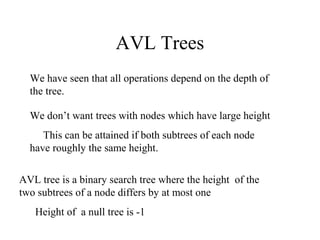
AVL Trees
  We have seen that all operations depend on the depth of
  the tree.

  We don’t want trees with nodes which have large height
     This can be attained if both subtrees of each node
  have roughly the same height.

AVL tree is a binary search tree where the height of the
two subtrees of a node differs by at most one
   Height of a null tree is -1
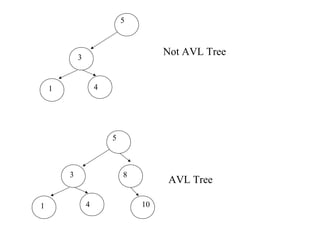
5


            3
                                     Not AVL Tree


    1               4


                        5


        3                   8
                                      AVL Tree

1               4               10
Section 10.4 KR

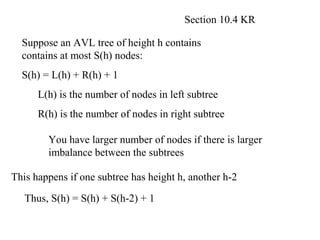
  Suppose an AVL tree of height h contains
  contains at most S(h) nodes:
  S(h) = L(h) + R(h) + 1
      L(h) is the number of nodes in left subtree
      R(h) is the number of nodes in right subtree

        You have larger number of nodes if there is larger
        imbalance between the subtrees

This happens if one subtree has height h, another h-2

   Thus, S(h) = S(h) + S(h-2) + 1
Operations in AVL Tree
 Searching, Complexity?    O(log N)

    FindMin, Complexity?   O(log N)


Deletion? Insertion?
Insertion
 Search for the element
 If it is not there, insert it in its place.

 Any problem?
      Insertion may imbalance the tree. Heights of two
      children of a node may differ by 2 after an
      insertion.


Tree Rotations used to restore the balance.
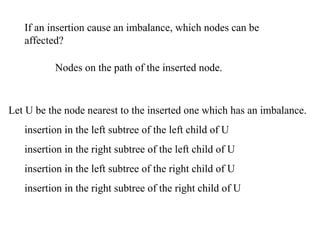
If an insertion cause an imbalance, which nodes can be
   affected?

          Nodes on the path of the inserted node.


Let U be the node nearest to the inserted one which has an imbalance.
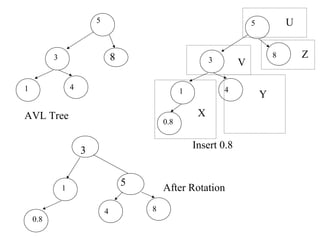
   insertion in the left subtree of the left child of U
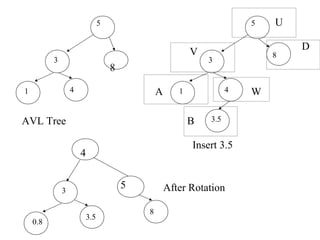
   insertion in the right subtree of the left child of U
   insertion in the left subtree of the right child of U
   insertion in the right subtree of the right child of U
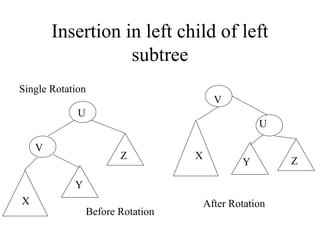
Insertion in left child of left
                   subtree
Single Rotation
                                         V
             U
                                                   U

    V
                        Z          X
                                               Y        Z

            Y
X                                      After Rotation
                 Before Rotation
5                                              5           U


          3                       8                          3
                                                                                 8       Z
                                                                     V

1                 4                                              4
                                                    1                        Y

AVL Tree                                                 X
                                              0.8


                                                        Insert 0.8
                      3


                                      5
              1                               After Rotation

                              4           8
    0.8
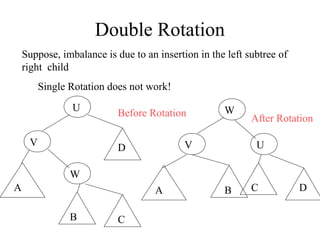
Double Rotation
    Suppose, imbalance is due to an insertion in the left subtree of
    right child
         Single Rotation does not work!
                U                                   W
                           Before Rotation                 After Rotation

     V                                     V                U
                           D

                W
A                                   A               B      C           D

                B          C
5                                        5   U

                                                                              D
                                                        V                 8
          3                                                 3
                                 8

1                 4                          A      1             4   W

AVL Tree                                                B   3.5


                                                        Insert 3.5
                      4


              3
                                     5           After Rotation

                                         8
                       3.5
    0.8
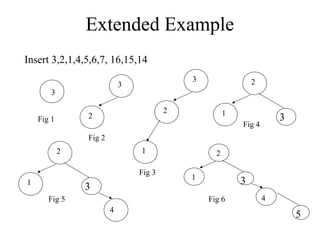
Extended Example
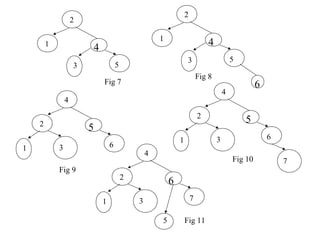
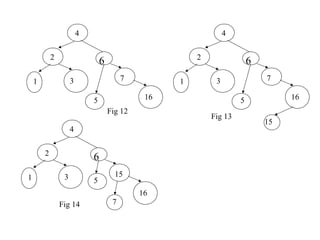
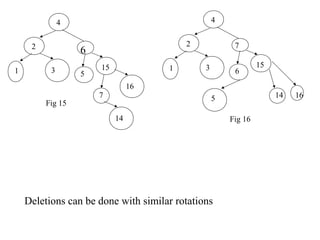
Insert 3,2,1,4,5,6,7, 16,15,14
                                            3                 2
                            3
       3

                                        2             1
    Fig 1       2                                                     3
                                                          Fig 4
                Fig 2
            2                   1                 2

                                Fig 3
                                            1
1                                                         3
                3
       Fig 5                                    Fig 6             4
                        4
                                                                          5
2
                    2

                                                     1
        1                                                                    4
                         4
                                                                  3                      5
                    3                5
                                                                         Fig 8
                             Fig 7                                                                6
                                                                                     4
                4
                                                                         2
    2                                                                                        5
                        5
                                                             1                   3                    6
1           3                    6
                                                 4
                                                                                         Fig 10           7
            Fig 9
                                         2
                                                         6
                             1               3                       7

                                                     5           Fig 11
4                                       4

            2                                           2
                                 6                                       6
    1                3                    7         1        3               7

                             5                 16                    5            16
                                     Fig 12
                                                            Fig 13
                                                                             15
                     4

        2
                             6
1                3                     15
                             5
                                              16
                Fig 14                7
4                                   4


     2                                   2             7
                  6
                      15             1        3                15
1         3       5                                    6
                                16
                      7                           5                 14   16
         Fig 15
                           14                         Fig 16


    Deletions can be done with similar rotations
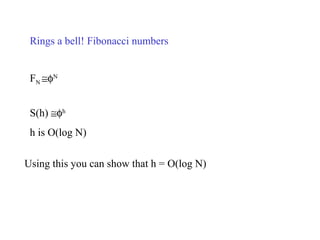
Rings a bell! Fibonacci numbers


 FN ≅φN


 S(h) ≅φh
 h is O(log N)

Using this you can show that h = O(log N)

Avltrees

  • 1.
  • 2.
    AVL Trees We have seen that all operations depend on the depth of the tree. We don’t want trees with nodes which have large height This can be attained if both subtrees of each node have roughly the same height. AVL tree is a binary search tree where the height of the two subtrees of a node differs by at most one Height of a null tree is -1
  • 3.
    5 3 Not AVL Tree 1 4 5 3 8 AVL Tree 1 4 10
  • 4.
    Section 10.4 KR Suppose an AVL tree of height h contains contains at most S(h) nodes: S(h) = L(h) + R(h) + 1 L(h) is the number of nodes in left subtree R(h) is the number of nodes in right subtree You have larger number of nodes if there is larger imbalance between the subtrees This happens if one subtree has height h, another h-2 Thus, S(h) = S(h) + S(h-2) + 1
  • 5.
    Operations in AVLTree Searching, Complexity? O(log N) FindMin, Complexity? O(log N) Deletion? Insertion?
  • 6.
    Insertion Search forthe element If it is not there, insert it in its place. Any problem? Insertion may imbalance the tree. Heights of two children of a node may differ by 2 after an insertion. Tree Rotations used to restore the balance.
  • 7.
    If an insertioncause an imbalance, which nodes can be affected? Nodes on the path of the inserted node. Let U be the node nearest to the inserted one which has an imbalance. insertion in the left subtree of the left child of U insertion in the right subtree of the left child of U insertion in the left subtree of the right child of U insertion in the right subtree of the right child of U
  • 8.
    Insertion in leftchild of left subtree Single Rotation V U U V Z X Y Z Y X After Rotation Before Rotation
  • 9.
    5 5 U 3 8 3 8 Z V 1 4 4 1 Y AVL Tree X 0.8 Insert 0.8 3 5 1 After Rotation 4 8 0.8
  • 10.
    Double Rotation Suppose, imbalance is due to an insertion in the left subtree of right child Single Rotation does not work! U W Before Rotation After Rotation V V U D W A A B C D B C
  • 11.
    5 5 U D V 8 3 3 8 1 4 A 1 4 W AVL Tree B 3.5 Insert 3.5 4 3 5 After Rotation 8 3.5 0.8
  • 12.
    Extended Example Insert 3,2,1,4,5,6,7,16,15,14 3 2 3 3 2 1 Fig 1 2 3 Fig 4 Fig 2 2 1 2 Fig 3 1 1 3 3 Fig 5 Fig 6 4 4 5
  • 13.
    2 2 1 1 4 4 3 5 3 5 Fig 8 Fig 7 6 4 4 2 2 5 5 1 3 6 1 3 6 4 Fig 10 7 Fig 9 2 6 1 3 7 5 Fig 11
  • 14.
    4 4 2 2 6 6 1 3 7 1 3 7 5 16 5 16 Fig 12 Fig 13 15 4 2 6 1 3 15 5 16 Fig 14 7
  • 15.
    4 4 2 2 7 6 15 1 3 15 1 3 5 6 16 7 5 14 16 Fig 15 14 Fig 16 Deletions can be done with similar rotations
  • 16.
    Rings a bell!Fibonacci numbers FN ≅φN S(h) ≅φh h is O(log N) Using this you can show that h = O(log N)