RESEARCH PROBLEM
AND
QUESTIONS
FORMULATION
DR. SHIVAJI VISHWAS SHINDE
Department of Accountancy
D.A.V.Velankar College of
Commerce, Solapur.
You Cannot Make Everybody
Happy
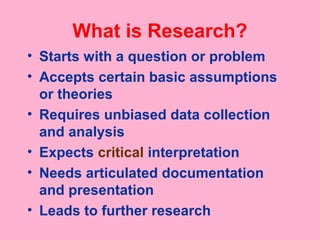
What is Research?
• Starts with a question or problem
• Accepts certain basic assumptions
or theories
• Requires unbiased data collection
and analysis
• Expects critical interpretation
• Needs articulated documentation
and presentation
• Leads to further research
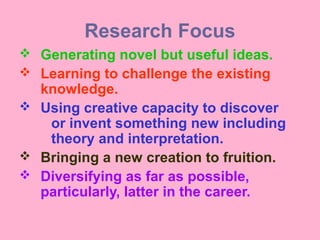
Research Focus
 Generating novel but useful ideas.
 Learning to challenge the existing
knowledge.
 Using creative capacity to discover
or invent something new including
theory and interpretation.
 Bringing a new creation to fruition.
 Diversifying as far as possible,
particularly, latter in the career.
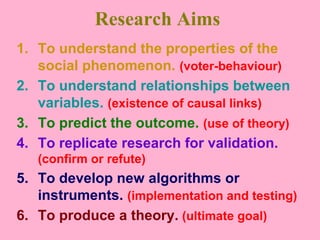
Research Aims
1. To understand the properties of the
social phenomenon. (voter-behaviour)
2. To understand relationships between
variables. (existence of causal links)
3. To predict the outcome. (use of theory)
4. To replicate research for validation.
(confirm or refute)
5. To develop new algorithms or
instruments. (implementation and testing)
6. To produce a theory. (ultimate goal)
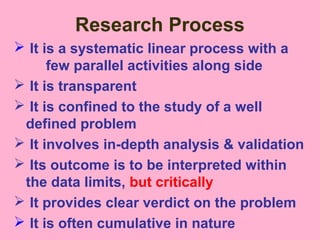
Research Process
 It is a systematic linear process with a
few parallel activities along side
 It is transparent
 It is confined to the study of a well
defined problem
 It involves in-depth analysis & validation
 Its outcome is to be interpreted within
the data limits, but critically
 It provides clear verdict on the problem
 It is often cumulative in nature
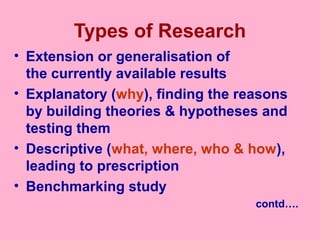
Types of Research
• Extension or generalisation of
the currently available results
• Explanatory (why), finding the reasons
by building theories & hypotheses and
testing them
• Descriptive (what, where, who & how),
leading to prescription
• Benchmarking study
contd….
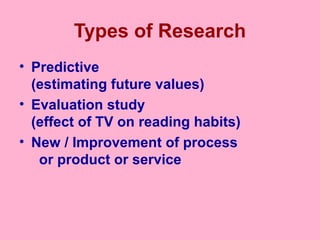
Types of Research
• Predictive
(estimating future values)
• Evaluation study
(effect of TV on reading habits)
• New / Improvement of process
or product or service
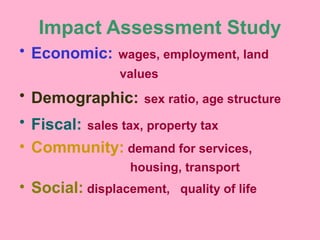
Impact Assessment Study
• Economic: wages, employment, land
values
• Demographic: sex ratio, age structure
• Fiscal: sales tax, property tax
• Community: demand for services,
housing, transport
• Social: displacement, quality of life
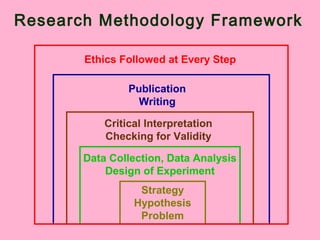
Strategy
Hypothesis
Problem
Data Collection, Data Analysis
Design of Experiment
Critical Interpretation
Checking for Validity
Publication
Writing
Ethics Followed at Every Step
Research Methodology Framework
Research Steps
Identify the Research Problem
Prepare a Research Plan
Gather the Data
Analyse & Interpret Data
Prepare the Research Report
Select the Research Strategy
Establish Research Questions
S-1
S-2
S-3
S-4
S-5
S-6
S-7
Research Proposal
Preliminary
Research Activities
[continuous
literature search
is expected]
Approval
Starting Point
• Curiosity
• Cause Effect relationship study
• To generalise the available results
• Dissatisfied with the existing
product or process
or explanation
• To test an unorthodox idea
Locating a Problem
• Paradox and contradiction:
By focusing on such phenomenon
new opportunities can be explored –
treat them as leverage points
(e.g. bumper crop, but starvation
continues)
• Perspective and scale:
Building different perspectives from
different observation points helps
(e.g. managerial competence from feminine
perspective)
• Reengineering option:
Considering this approach to a
situation often provides new
Problem Identification
 The problem is the aspect the researcher
- worries about,
- thinks about, and
- wants to find a solution for.
 The purpose is to solve the problem,
i.e. find answers to the question/s.
Examples:
1) Suicides in recent years by the farmers in Maharashtra (why?)
2) Commercialisation of education in India (what are the impacts?)
3) A digital divide prevails in the Indian society (how to bridge it?)
4) Social capital in the urban areas helps the migrants (how?)
Ways for Problem Identification
 Drawing on life experience
 Historical incidence
 Item in the news
 Eye-witness
 Local issues
 Country or region specific
 Guide’s research programme
 Cyber inspiration
Initiation
Outline the general context of the
problem area
Highlight key theories, concepts and
ideas current in this area
Enlist basic underlying assumptions
of the problem area
Write down the identified important
issues
Focus on what is to be solved or
resolved
Idea Development
Literature Search:
 Use different libraries; take notes
(Refer Sociological Abstracts, Dissertation
Abstracts)
 Do the Internet search; scan pertinent
blogs; note the URLs & date of browsing
 Locate major authors and institutions
active in the area (get in touch with them)
Actions-Interactions:
 Crystalise your ideas, frame the
objective and prepare first draft of your
proposal
Problem Background
• Are there issues about this problem
to which answers have not been
found up to the present?
• Why are these identified issues so
important?
• What needs to be solved?
• What are the underlying
assumptions?
• How far is it relevant in the Indian
context?
Problem Statement
 Grammatically correct
 Complete, unambiguous and well
articulated
 All the technical terms are suitably
defined
 Division in sub-problems for better
management of the study & further
translation into research questions
Research Questions
• To be researchable, a research problem
has to be translated into one or more
research questions.
Types of Research Questions:
• What questions require a descriptive
answer (describing the features of a social
phenomenon)
• Why questions ask for the causes or
reasons for the observed features
(seeking to understand the relations between social
processes)
• How questions are concerned with
bringing about change
(suggesting possible interventions and outcomes)
Research Question Forms
• A research question is a logical
statement that progresses from what is
known and factual to that which is
unknown and needs validation.
• Two forms of research questions:
- central question
- associated or sub-questions
Ex.:- How can the quality of Indian research be raised?
Which are the governing factors?
What is to be changed in the education system?
What could be the incentives?
A Research Question Feature
• Research Questions should be Well
Grounded.
• Well grounded means that they are
searchable questions.
• Well grounded questions are not too
narrow, too broad, nor too challenging.
• In practice it implies inclusion of key
words or terms, one can use to search
information resources (both online & print)
to know more about research done in
that area.
Problematic Questions
Too Narrow:
• Does India have a social security system?
• When was Emergency declared in India?
These questions have a “Yes” or “No” answer, or can be
replied by one word answer.
Too Broad:
• What is the history and value of Philosophy?
This question cannot be covered in the scope of single
work.
Too Challenging:
• Why is the Indian college education so lopsided?
This question is too opinionated and is based upon
people’s feeling and would need a very large study.
Example of a Research Question
Topic: A Study of Mid-Day Meal Scheme
in the Municipal Schools in Solapur
Research Question: What are the health
and academic benefits of mid-day meal
scheme in primary, and middle school
sections of the Municipal Schools in
Solapur?
Sub-questions
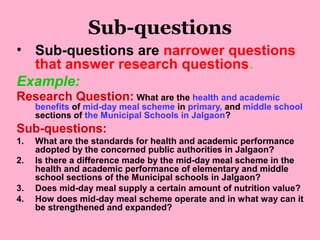
• Sub-questions are narrower questions
that answer research questions.
Example:
Research Question: What are the health and academic
benefits of mid-day meal scheme in primary, and middle school
sections of the Municipal Schools in Jalgaon?
Sub-questions:
1. What are the standards for health and academic performance
adopted by the concerned public authorities in Jalgaon?
2. Is there a difference made by the mid-day meal scheme in the
health and academic performance of elementary and middle
school sections of the Municipal schools in Jalgaon?
3. Does mid-day meal supply a certain amount of nutrition value?
4. How does mid-day meal scheme operate and in what way can it
be strengthened and expanded?
Types of Research Questions
 Existence [Do senior citizens suffer from general
slowing?]
 Description and Classification [What are the
characteristics of span of attention? Is it constant or variable?]
 Composition [What are the factors that make IQ?]
 Relationship [Is saving directly related to income?]
 Descriptive-Comparative [Are instruction
booklets with text and graphics more effective than those with
text alone?]
 Causality [Does dividing attention degrade performance?]
 Causality-Comparative [Is swimming better than
cycling to build the physical stamina?]
Good Questions
• Clear
• Specific
• Answerable
• Interconnected
• Substantially relevant
Sub-questions could be converted in
hypotheses, if justified
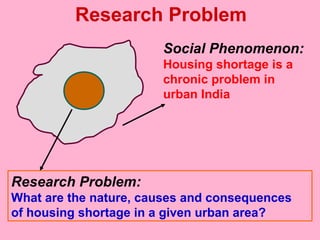
Research Problem
Social Phenomenon:
Housing shortage is a
chronic problem in
urban India
Research Problem:
What are the nature, causes and consequences
of housing shortage in a given urban area?
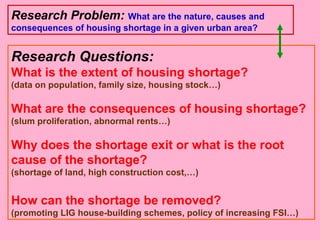
Research Problem: What are the nature, causes and
consequences of housing shortage in a given urban area?
Research Questions:
What is the extent of housing shortage?
(data on population, family size, housing stock…)
What are the consequences of housing shortage?
(slum proliferation, abnormal rents…)
Why does the shortage exit or what is the root
cause of the shortage?
(shortage of land, high construction cost,…)
How can the shortage be removed?
(promoting LIG house-building schemes, policy of increasing FSI…)
Topic Selection
(Academic Research)
Factors to be considered:
• Relevant to the institution and time
• State of the current knowledge
• Emerging research area (future oriented)
• Data expediency can largely be ensured
• Availability of guidance & facilities
• Personal confidence
Select Leads
Some triggering event observed or
learnt about
Own experience or the experience
of others
Literature review to notice that a
certain field or types of problems
are not covered
Shortcomings of the existing theories
Fancy for some topic or concept
arising out of the study say, during the
M.A. or M.Phil. stage
Select Leads (2)
Research can thus be aimed at
clarifying or substantiating an existing
theory
clarifying contradictory findings
correcting a faulty methodology
correcting the inadequate or unsuitable
use of statistical techniques
reconciling conflicting opinions
solving existing practical problems
Developing better algorithms or methods
Variety
• Prepare exhaustive list of factors
associated with a design situation
• Solicit inputs from as many
participants and stakeholders as
possible using different means
[Aim is to build the maximum possible
variety in design to counter the variety
in tune with Ashby’s law of requisite
variety]
Checklist
1. Is the problem of interest for both
current and future?
2. Is the research question put in clear,
concise and argument form?
3. How does its study would contribute?
4. Will it lead to new research?
5. Will it be practical to conduct the
research?
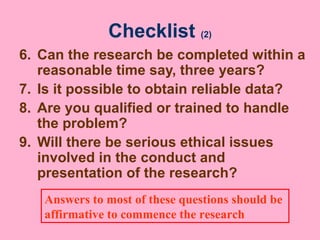
Checklist (2)
6. Can the research be completed within a
reasonable time say, three years?
7. Is it possible to obtain reliable data?
8. Are you qualified or trained to handle
the problem?
9. Will there be serious ethical issues
involved in the conduct and
presentation of the research?
Answers to most of these questions should be
affirmative to commence the research
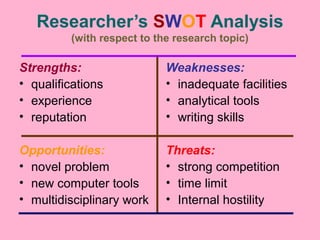
Researcher’s SWOT Analysis
(with respect to the research topic)
Strengths:
• qualifications
• experience
• reputation
Opportunities:
• novel problem
• new computer tools
• multidisciplinary work
Weaknesses:
• inadequate facilities
• analytical tools
• writing skills
Threats:
• strong competition
• time limit
• Internal hostility
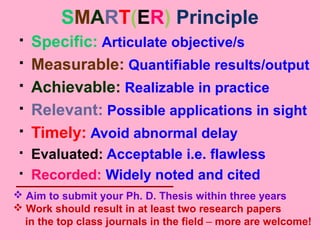
SMART(ER) Principle
 Specific: Articulate objective/s
 Measurable: Quantifiable results/output
 Achievable: Realizable in practice
 Relevant: Possible applications in sight
 Timely: Avoid abnormal delay
 Evaluated: Acceptable i.e. flawless
 Recorded: Widely noted and cited
 Aim to submit your Ph. D. Thesis within three years
 Work should result in at least two research papers
in the top class journals in the field – more are welcome!
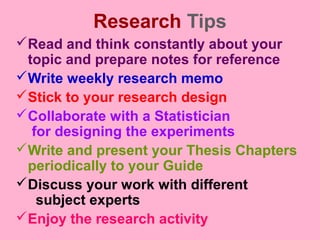
Research Tips
Read and think constantly about your
topic and prepare notes for reference
Write weekly research memo
Stick to your research design
Collaborate with a Statistician
for designing the experiments
Write and present your Thesis Chapters
periodically to your Guide
Discuss your work with different
subject experts
Enjoy the research activity
Avishkar

Avishkar

  • 1.
    RESEARCH PROBLEM AND QUESTIONS FORMULATION DR. SHIVAJIVISHWAS SHINDE Department of Accountancy D.A.V.Velankar College of Commerce, Solapur.
  • 2.
    You Cannot MakeEverybody Happy
  • 3.
    What is Research? •Starts with a question or problem • Accepts certain basic assumptions or theories • Requires unbiased data collection and analysis • Expects critical interpretation • Needs articulated documentation and presentation • Leads to further research
  • 4.
    Research Focus  Generatingnovel but useful ideas.  Learning to challenge the existing knowledge.  Using creative capacity to discover or invent something new including theory and interpretation.  Bringing a new creation to fruition.  Diversifying as far as possible, particularly, latter in the career.
  • 5.
    Research Aims 1. Tounderstand the properties of the social phenomenon. (voter-behaviour) 2. To understand relationships between variables. (existence of causal links) 3. To predict the outcome. (use of theory) 4. To replicate research for validation. (confirm or refute) 5. To develop new algorithms or instruments. (implementation and testing) 6. To produce a theory. (ultimate goal)
  • 6.
    Research Process  Itis a systematic linear process with a few parallel activities along side  It is transparent  It is confined to the study of a well defined problem  It involves in-depth analysis & validation  Its outcome is to be interpreted within the data limits, but critically  It provides clear verdict on the problem  It is often cumulative in nature
  • 7.
    Types of Research •Extension or generalisation of the currently available results • Explanatory (why), finding the reasons by building theories & hypotheses and testing them • Descriptive (what, where, who & how), leading to prescription • Benchmarking study contd….
  • 8.
    Types of Research •Predictive (estimating future values) • Evaluation study (effect of TV on reading habits) • New / Improvement of process or product or service
  • 9.
    Impact Assessment Study •Economic: wages, employment, land values • Demographic: sex ratio, age structure • Fiscal: sales tax, property tax • Community: demand for services, housing, transport • Social: displacement, quality of life
  • 10.
    Strategy Hypothesis Problem Data Collection, DataAnalysis Design of Experiment Critical Interpretation Checking for Validity Publication Writing Ethics Followed at Every Step Research Methodology Framework
  • 11.
    Research Steps Identify theResearch Problem Prepare a Research Plan Gather the Data Analyse & Interpret Data Prepare the Research Report Select the Research Strategy Establish Research Questions S-1 S-2 S-3 S-4 S-5 S-6 S-7 Research Proposal Preliminary Research Activities [continuous literature search is expected] Approval
  • 12.
    Starting Point • Curiosity •Cause Effect relationship study • To generalise the available results • Dissatisfied with the existing product or process or explanation • To test an unorthodox idea
  • 13.
    Locating a Problem •Paradox and contradiction: By focusing on such phenomenon new opportunities can be explored – treat them as leverage points (e.g. bumper crop, but starvation continues) • Perspective and scale: Building different perspectives from different observation points helps (e.g. managerial competence from feminine perspective) • Reengineering option: Considering this approach to a situation often provides new
  • 14.
    Problem Identification  Theproblem is the aspect the researcher - worries about, - thinks about, and - wants to find a solution for.  The purpose is to solve the problem, i.e. find answers to the question/s. Examples: 1) Suicides in recent years by the farmers in Maharashtra (why?) 2) Commercialisation of education in India (what are the impacts?) 3) A digital divide prevails in the Indian society (how to bridge it?) 4) Social capital in the urban areas helps the migrants (how?)
  • 15.
    Ways for ProblemIdentification  Drawing on life experience  Historical incidence  Item in the news  Eye-witness  Local issues  Country or region specific  Guide’s research programme  Cyber inspiration
  • 16.
    Initiation Outline the generalcontext of the problem area Highlight key theories, concepts and ideas current in this area Enlist basic underlying assumptions of the problem area Write down the identified important issues Focus on what is to be solved or resolved
  • 17.
    Idea Development Literature Search: Use different libraries; take notes (Refer Sociological Abstracts, Dissertation Abstracts)  Do the Internet search; scan pertinent blogs; note the URLs & date of browsing  Locate major authors and institutions active in the area (get in touch with them) Actions-Interactions:  Crystalise your ideas, frame the objective and prepare first draft of your proposal
  • 18.
    Problem Background • Arethere issues about this problem to which answers have not been found up to the present? • Why are these identified issues so important? • What needs to be solved? • What are the underlying assumptions? • How far is it relevant in the Indian context?
  • 19.
    Problem Statement  Grammaticallycorrect  Complete, unambiguous and well articulated  All the technical terms are suitably defined  Division in sub-problems for better management of the study & further translation into research questions
  • 20.
    Research Questions • Tobe researchable, a research problem has to be translated into one or more research questions. Types of Research Questions: • What questions require a descriptive answer (describing the features of a social phenomenon) • Why questions ask for the causes or reasons for the observed features (seeking to understand the relations between social processes) • How questions are concerned with bringing about change (suggesting possible interventions and outcomes)
  • 21.
    Research Question Forms •A research question is a logical statement that progresses from what is known and factual to that which is unknown and needs validation. • Two forms of research questions: - central question - associated or sub-questions Ex.:- How can the quality of Indian research be raised? Which are the governing factors? What is to be changed in the education system? What could be the incentives?
  • 22.
    A Research QuestionFeature • Research Questions should be Well Grounded. • Well grounded means that they are searchable questions. • Well grounded questions are not too narrow, too broad, nor too challenging. • In practice it implies inclusion of key words or terms, one can use to search information resources (both online & print) to know more about research done in that area.
  • 23.
    Problematic Questions Too Narrow: •Does India have a social security system? • When was Emergency declared in India? These questions have a “Yes” or “No” answer, or can be replied by one word answer. Too Broad: • What is the history and value of Philosophy? This question cannot be covered in the scope of single work. Too Challenging: • Why is the Indian college education so lopsided? This question is too opinionated and is based upon people’s feeling and would need a very large study.
  • 24.
    Example of aResearch Question Topic: A Study of Mid-Day Meal Scheme in the Municipal Schools in Solapur Research Question: What are the health and academic benefits of mid-day meal scheme in primary, and middle school sections of the Municipal Schools in Solapur?
  • 25.
    Sub-questions • Sub-questions arenarrower questions that answer research questions. Example: Research Question: What are the health and academic benefits of mid-day meal scheme in primary, and middle school sections of the Municipal Schools in Jalgaon? Sub-questions: 1. What are the standards for health and academic performance adopted by the concerned public authorities in Jalgaon? 2. Is there a difference made by the mid-day meal scheme in the health and academic performance of elementary and middle school sections of the Municipal schools in Jalgaon? 3. Does mid-day meal supply a certain amount of nutrition value? 4. How does mid-day meal scheme operate and in what way can it be strengthened and expanded?
  • 26.
    Types of ResearchQuestions  Existence [Do senior citizens suffer from general slowing?]  Description and Classification [What are the characteristics of span of attention? Is it constant or variable?]  Composition [What are the factors that make IQ?]  Relationship [Is saving directly related to income?]  Descriptive-Comparative [Are instruction booklets with text and graphics more effective than those with text alone?]  Causality [Does dividing attention degrade performance?]  Causality-Comparative [Is swimming better than cycling to build the physical stamina?]
  • 27.
    Good Questions • Clear •Specific • Answerable • Interconnected • Substantially relevant Sub-questions could be converted in hypotheses, if justified
  • 28.
    Research Problem Social Phenomenon: Housingshortage is a chronic problem in urban India Research Problem: What are the nature, causes and consequences of housing shortage in a given urban area?
  • 29.
    Research Problem: Whatare the nature, causes and consequences of housing shortage in a given urban area? Research Questions: What is the extent of housing shortage? (data on population, family size, housing stock…) What are the consequences of housing shortage? (slum proliferation, abnormal rents…) Why does the shortage exit or what is the root cause of the shortage? (shortage of land, high construction cost,…) How can the shortage be removed? (promoting LIG house-building schemes, policy of increasing FSI…)
  • 30.
    Topic Selection (Academic Research) Factorsto be considered: • Relevant to the institution and time • State of the current knowledge • Emerging research area (future oriented) • Data expediency can largely be ensured • Availability of guidance & facilities • Personal confidence
  • 31.
    Select Leads Some triggeringevent observed or learnt about Own experience or the experience of others Literature review to notice that a certain field or types of problems are not covered Shortcomings of the existing theories Fancy for some topic or concept arising out of the study say, during the M.A. or M.Phil. stage
  • 32.
    Select Leads (2) Researchcan thus be aimed at clarifying or substantiating an existing theory clarifying contradictory findings correcting a faulty methodology correcting the inadequate or unsuitable use of statistical techniques reconciling conflicting opinions solving existing practical problems Developing better algorithms or methods
  • 33.
    Variety • Prepare exhaustivelist of factors associated with a design situation • Solicit inputs from as many participants and stakeholders as possible using different means [Aim is to build the maximum possible variety in design to counter the variety in tune with Ashby’s law of requisite variety]
  • 34.
    Checklist 1. Is theproblem of interest for both current and future? 2. Is the research question put in clear, concise and argument form? 3. How does its study would contribute? 4. Will it lead to new research? 5. Will it be practical to conduct the research?
  • 35.
    Checklist (2) 6. Canthe research be completed within a reasonable time say, three years? 7. Is it possible to obtain reliable data? 8. Are you qualified or trained to handle the problem? 9. Will there be serious ethical issues involved in the conduct and presentation of the research? Answers to most of these questions should be affirmative to commence the research
  • 36.
    Researcher’s SWOT Analysis (withrespect to the research topic) Strengths: • qualifications • experience • reputation Opportunities: • novel problem • new computer tools • multidisciplinary work Weaknesses: • inadequate facilities • analytical tools • writing skills Threats: • strong competition • time limit • Internal hostility
  • 37.
    SMART(ER) Principle  Specific:Articulate objective/s  Measurable: Quantifiable results/output  Achievable: Realizable in practice  Relevant: Possible applications in sight  Timely: Avoid abnormal delay  Evaluated: Acceptable i.e. flawless  Recorded: Widely noted and cited  Aim to submit your Ph. D. Thesis within three years  Work should result in at least two research papers in the top class journals in the field – more are welcome!
  • 38.
    Research Tips Read andthink constantly about your topic and prepare notes for reference Write weekly research memo Stick to your research design Collaborate with a Statistician for designing the experiments Write and present your Thesis Chapters periodically to your Guide Discuss your work with different subject experts Enjoy the research activity