Introduction to Accounting
1
Introduction to Accounting
INTRODUCTION TO ACCOUNTING
Presented by:-
Dr. S. V. Shinde
Associate Professor - D.A.V. Velankar College of
Commerce, Solapur.
2
Introduction to Accounting
Learning Objectives
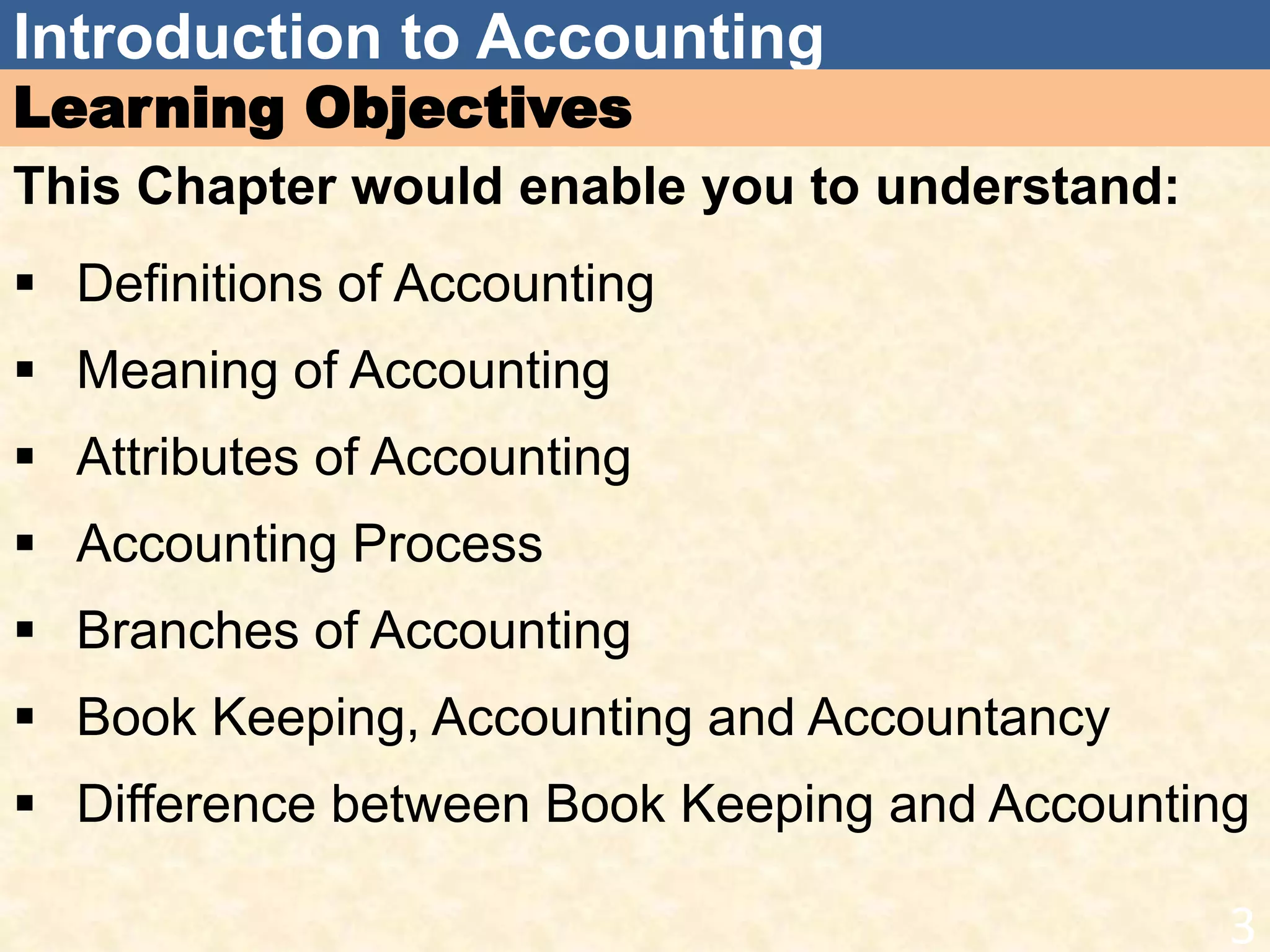
This Chapter would enable you to understand:
 Definitions of Accounting
 Meaning of Accounting
 Attributes of Accounting
 Accounting Process
 Branches of Accounting
 Book Keeping, Accounting and Accountancy
 Difference between Book Keeping and Accounting
3
Introduction to Accounting
Learning Objectives
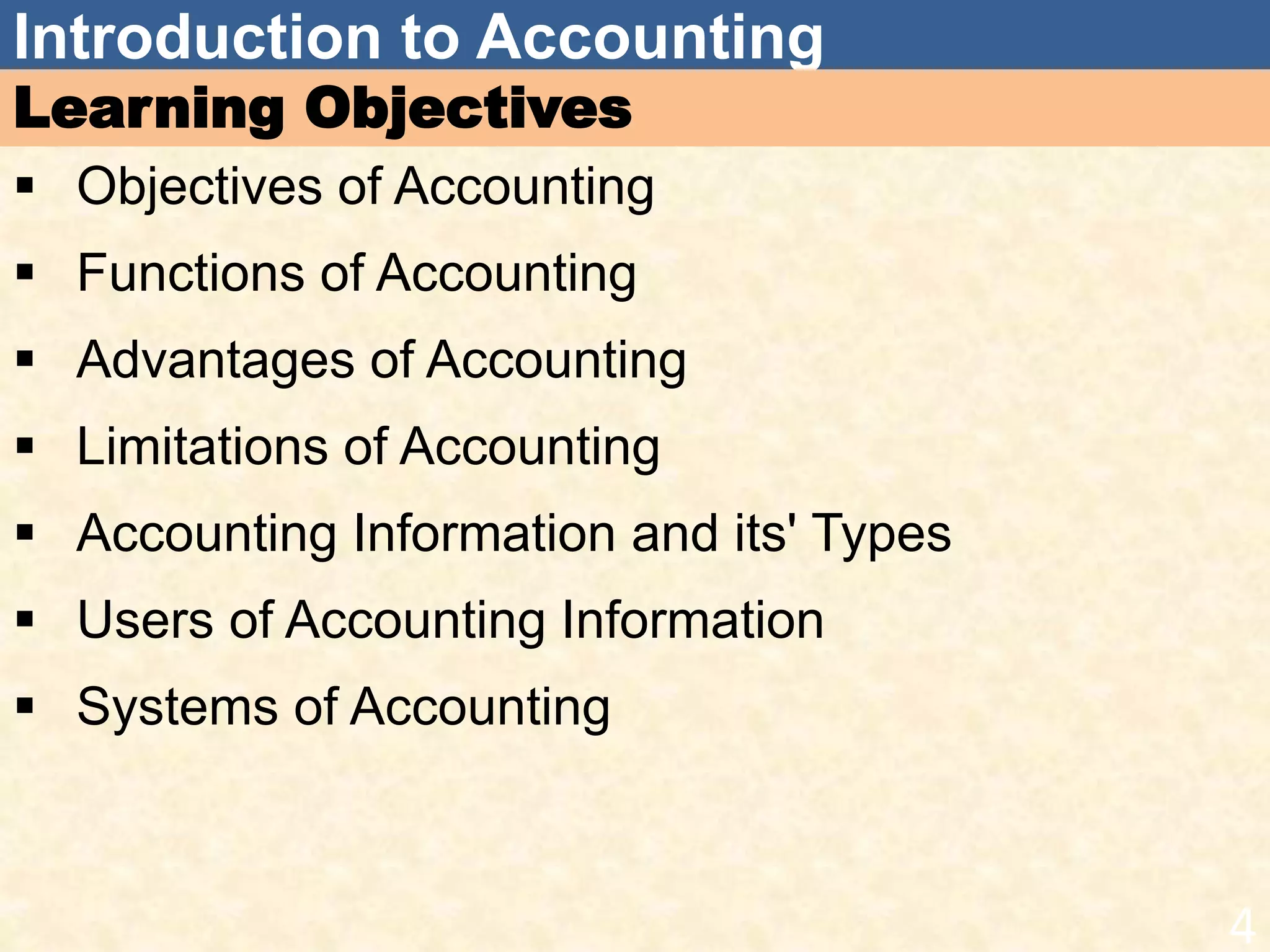
 Objectives of Accounting
 Functions of Accounting
 Advantages of Accounting
 Limitations of Accounting
 Accounting Information and its' Types
 Users of Accounting Information
 Systems of Accounting
4
Introduction to Accounting
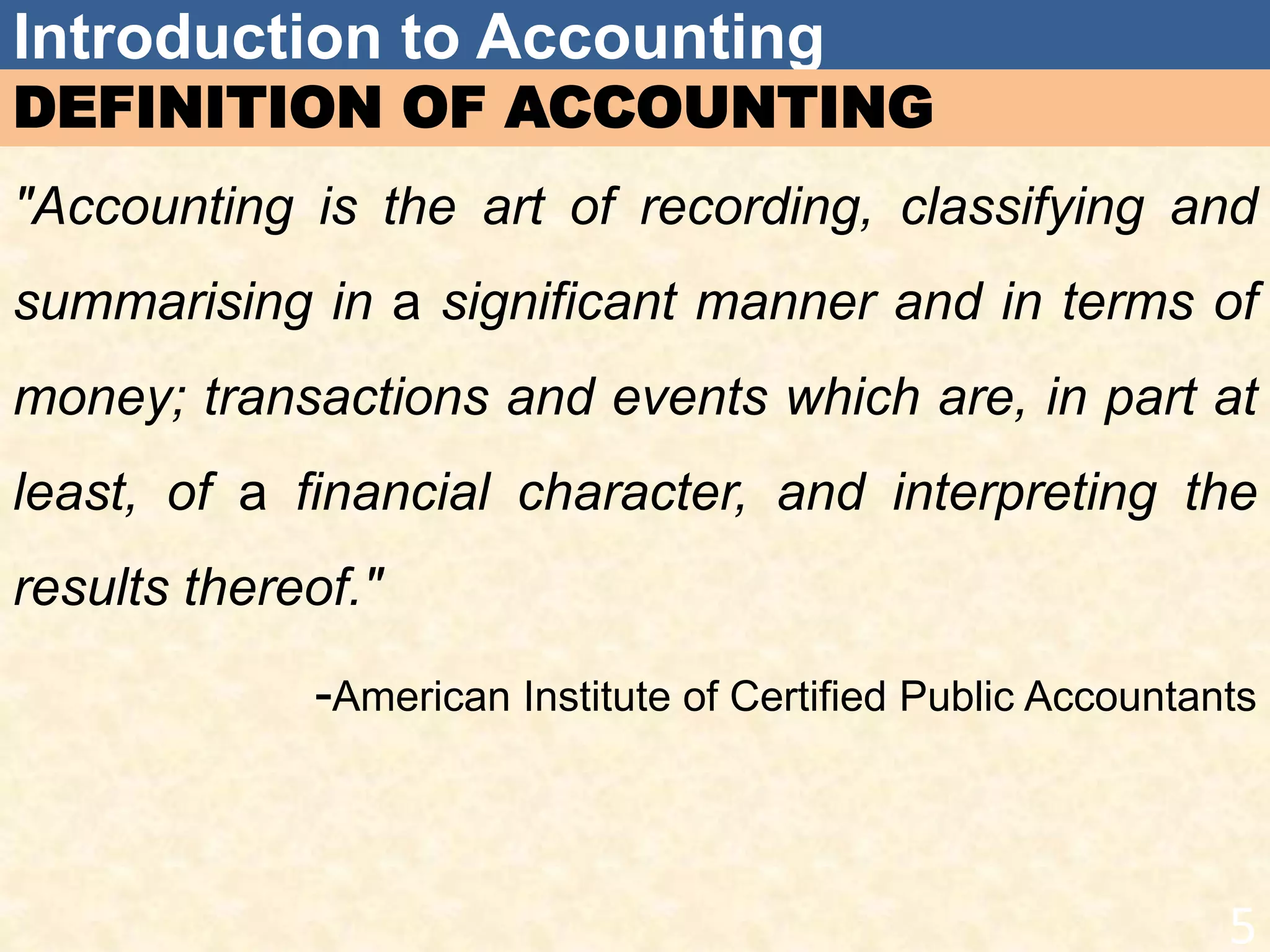
DEFINITION OF ACCOUNTING
"Accounting is the art of recording, classifying and
summarising in a significant manner and in terms of
money; transactions and events which are, in part at
least, of a financial character, and interpreting the
results thereof."
-American Institute of Certified Public Accountants
5
Introduction to Accounting
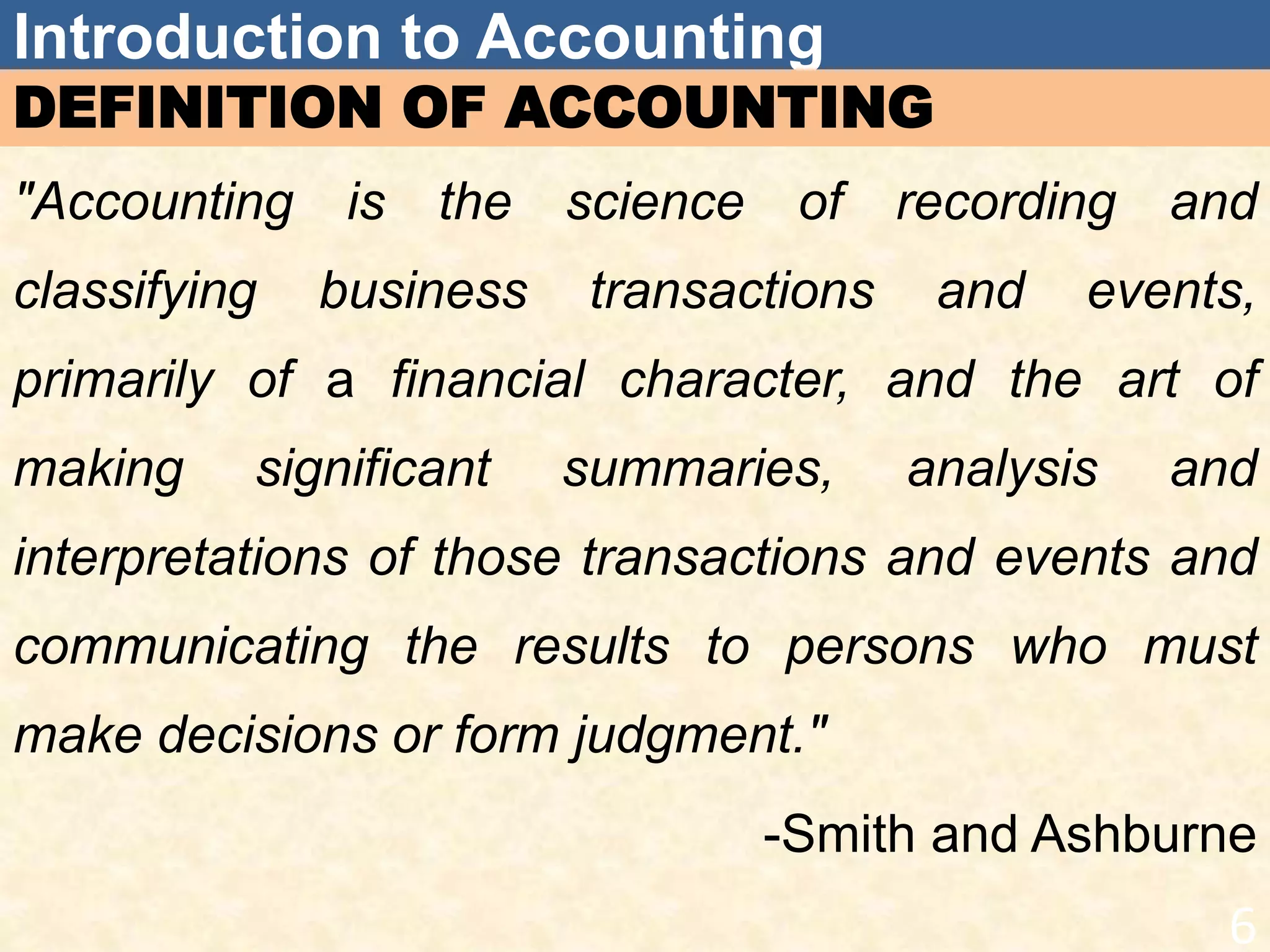
DEFINITION OF ACCOUNTING
"Accounting is the science of recording and
classifying business transactions and events,
primarily of a financial character, and the art of
making significant summaries, analysis and
interpretations of those transactions and events and
communicating the results to persons who must
make decisions or form judgment."
-Smith and Ashburne
6
Introduction to Accounting
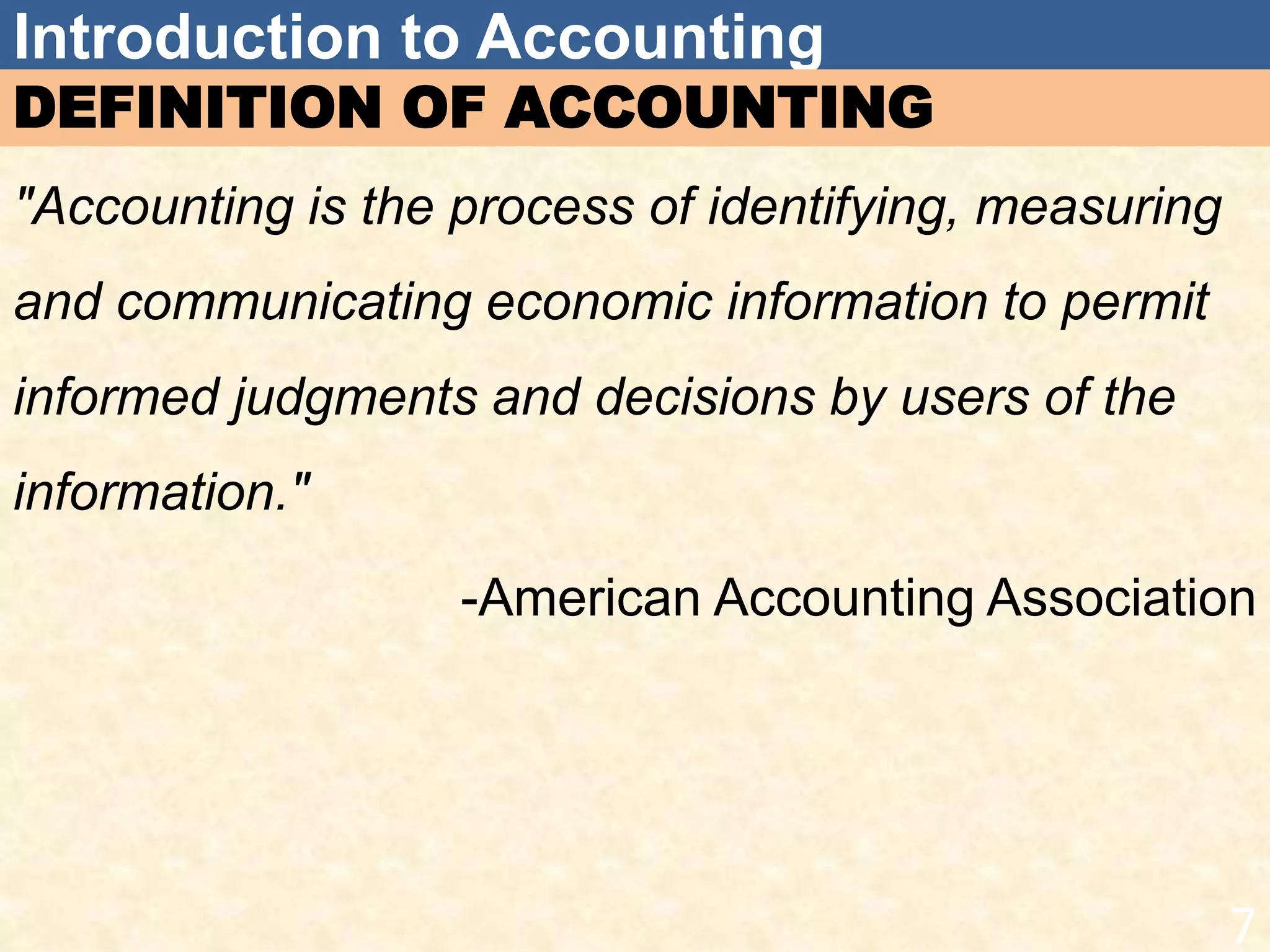
DEFINITION OF ACCOUNTING
"Accounting is the process of identifying, measuring
and communicating economic information to permit
informed judgments and decisions by users of the
information."
-American Accounting Association
7
Introduction to Accounting
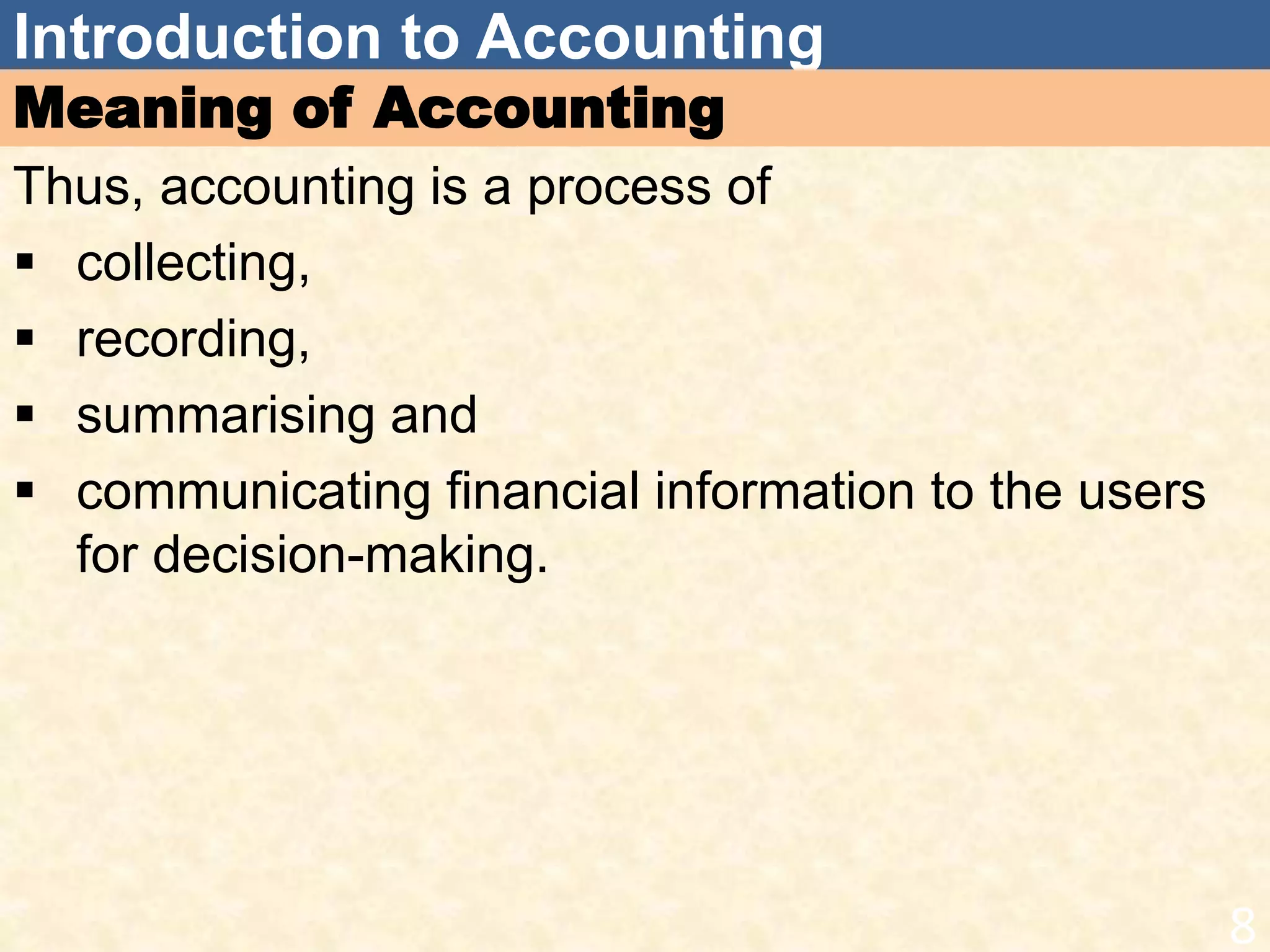
Meaning of Accounting
Thus, accounting is a process of
 collecting,
 recording,
 summarising and
 communicating financial information to the users
for decision-making.
8
Introduction to Accounting
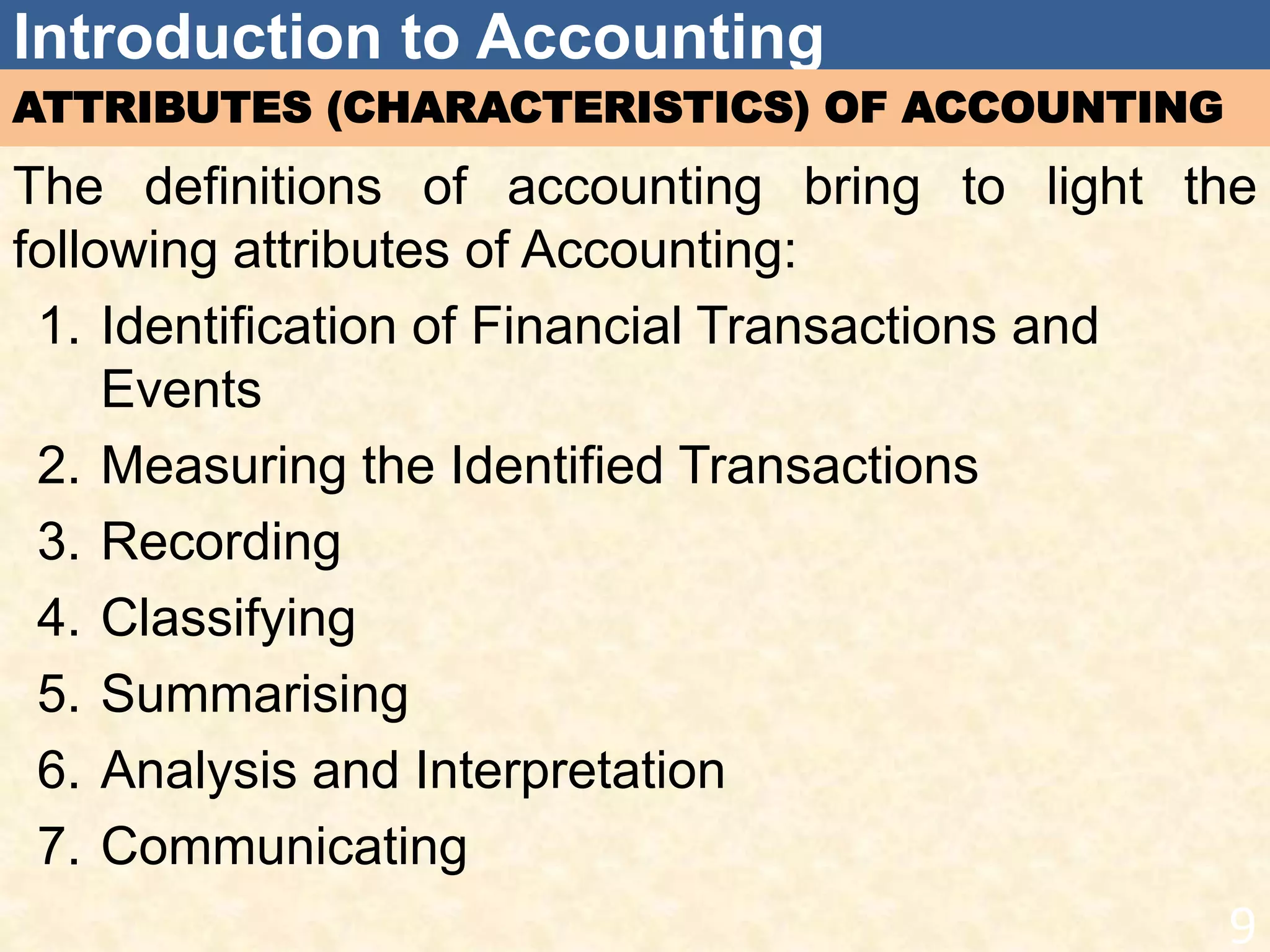
ATTRIBUTES (CHARACTERISTICS) OF ACCOUNTING
The definitions of accounting bring to light the
following attributes of Accounting:
1. Identification of Financial Transactions and
Events
2. Measuring the Identified Transactions
3. Recording
4. Classifying
5. Summarising
6. Analysis and Interpretation
7. Communicating
9
Introduction to Accounting
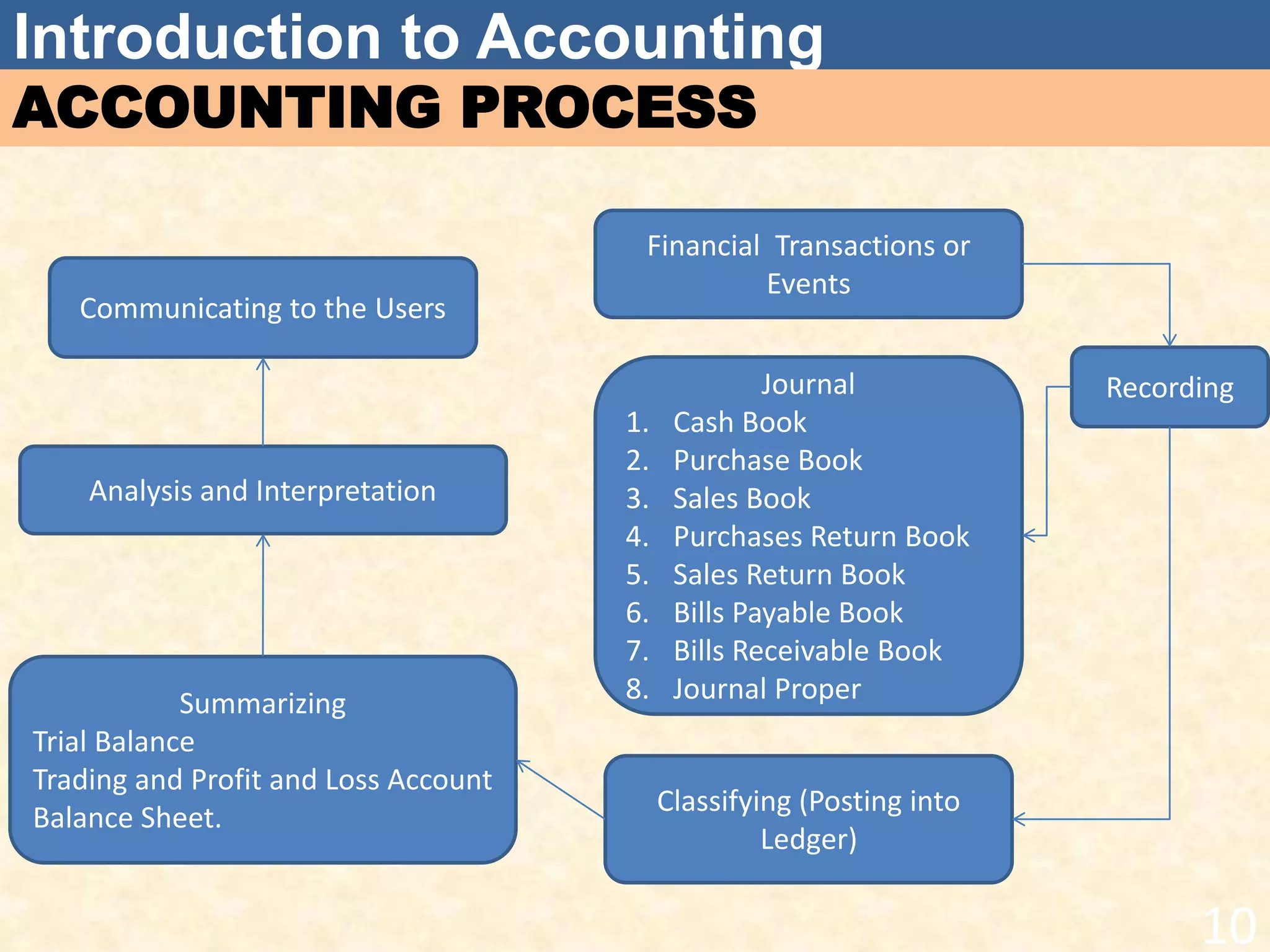
Financial Transactions or
Events
RecordingJournal
1. Cash Book
2. Purchase Book
3. Sales Book
4. Purchases Return Book
5. Sales Return Book
6. Bills Payable Book
7. Bills Receivable Book
8. Journal Proper
Classifying (Posting into
Ledger)
Summarizing
Trial Balance
Trading and Profit and Loss Account
Balance Sheet.
Analysis and Interpretation
Communicating to the Users
ACCOUNTING PROCESS
10
Introduction to Accounting
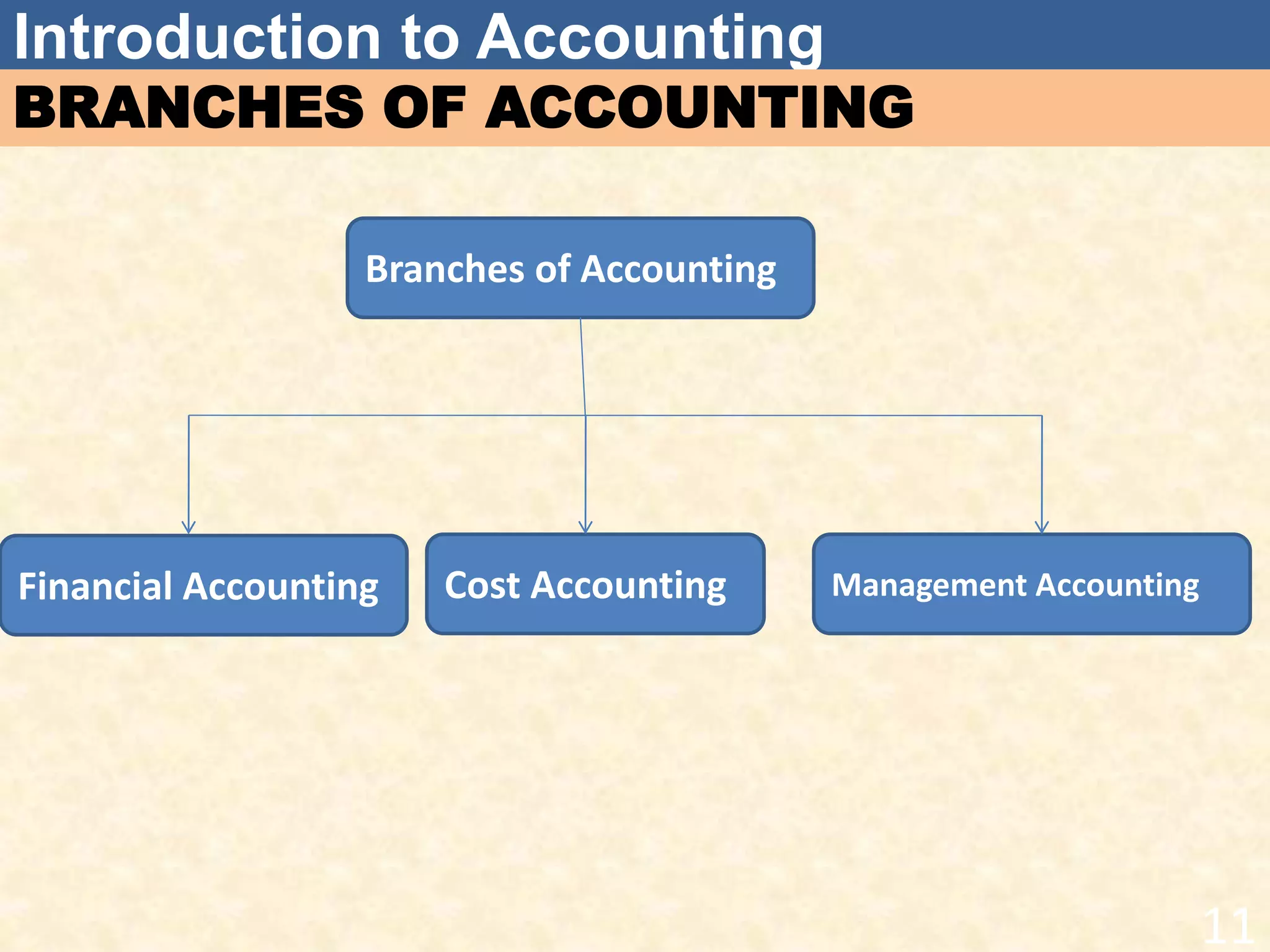
Branches of Accounting
BRANCHES OF ACCOUNTING
11
Financial Accounting Cost Accounting Management Accounting
Introduction to Accounting
Financial Accounting
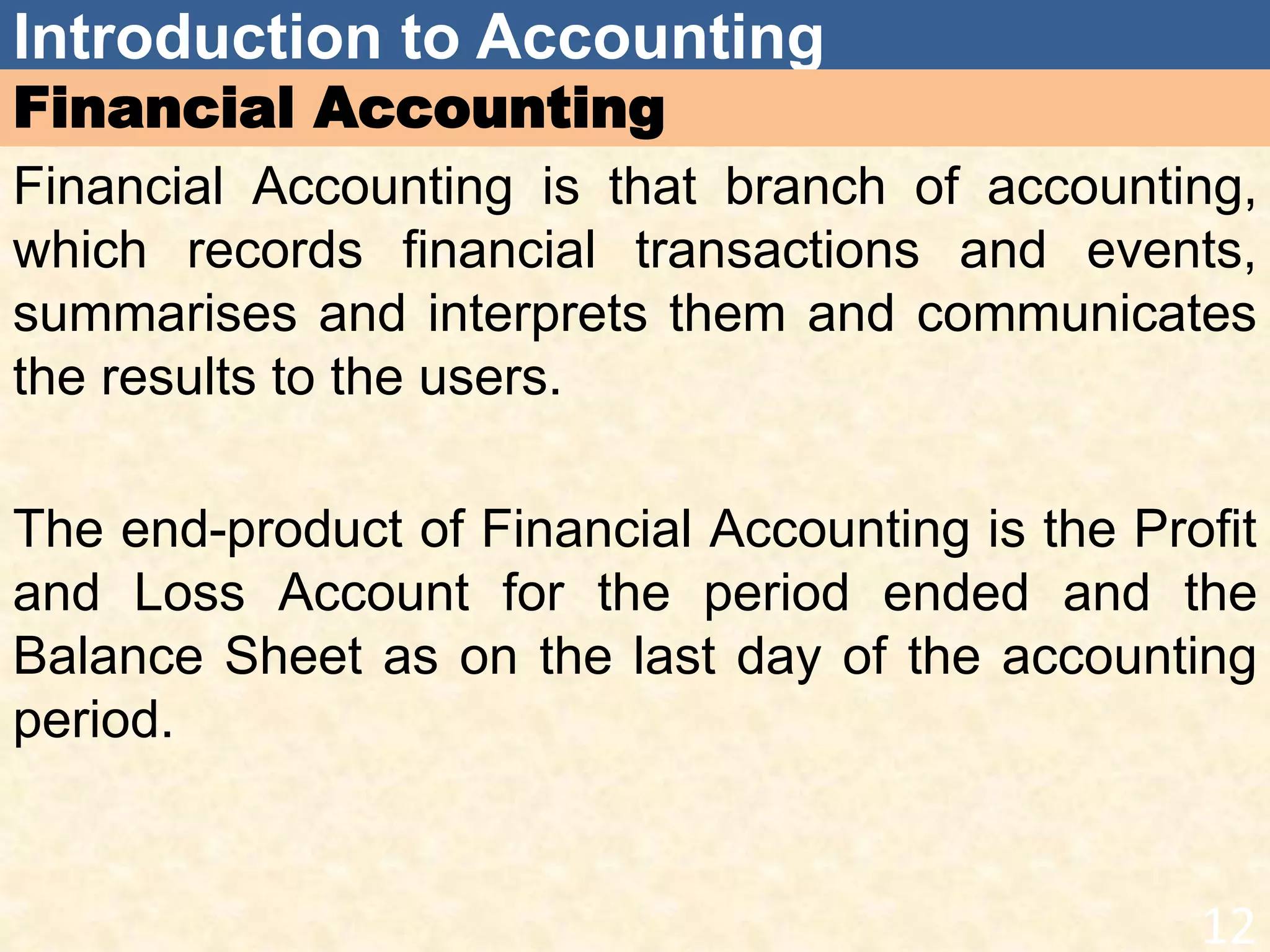
Financial Accounting is that branch of accounting,
which records financial transactions and events,
summarises and interprets them and communicates
the results to the users.
The end-product of Financial Accounting is the Profit
and Loss Account for the period ended and the
Balance Sheet as on the last day of the accounting
period.
12
Introduction to Accounting
Cost Accounting
The limitation of Financial Accounting in respect of
information relating to the cost of products or
services led to the development of a specialised
branch, i.e., Cost Accounting.
It ascertains the cost of products manufactured or
services rendered and helps the management in
decision-making (say price fixation) and exercising
controls.
13
Introduction to Accounting
Management Accounting
Management Accounting is the most recently
developed branch of accounting.
It is concerned with generating accounting
information relating to funds, costs, profits, etc., as it
enables the management in decision-making.
We may say that Management Accounting
addresses the needs of a single user group, i.e., the
management.
14
Introduction to Accounting
BOOK KEEPING, ACCOUNTING AND ACCOUNTANCY
Meaning of Book Keeping
Book Keeping is part of and it is concerned with:
 Identifying financial transactions and events,
 Measuring them in terms of money,
 Recording the financial transactions and events so
identified in the books of accounts, and
 Classifying recorded transactions and events, i.e.,
posting them into Ledger accounts.
15
Introduction to Accounting
BOOK KEEPING, ACCOUNTING AND ACCOUNTANCY
Definitions of Book Keeping
"Book Keeping is an art of recording in the books of accounts
the monetary aspect of commercial and financial
transactions."
-Northcott
"Book Keeping is an art of recording business dealings in a
set of books."
-J.R. Batliboi
"Book Keeping is the science and art of recording correctly in
the books of accounts all those business transactions that
result in the transfer of money or money's worth."
-R.N. Carter
"Bool: Keeping is the art of recording business transactions
in a systematic manner."
-A.N. Rosen Kampff
16
Introduction to Accounting
BOOK KEEPING, ACCOUNTING AND ACCOUNTANCY
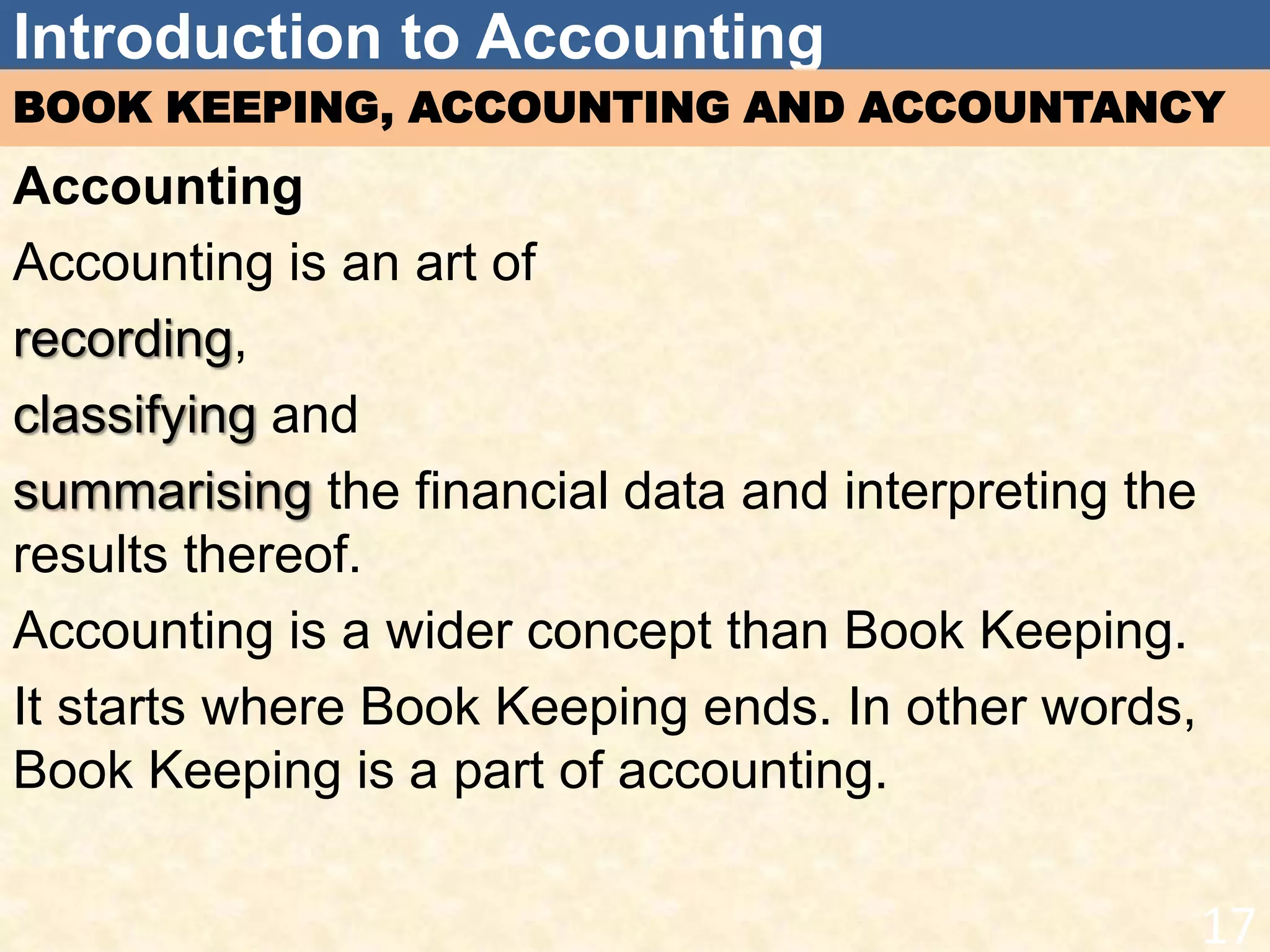
Accounting
Accounting is an art of
recording,
classifying and
summarising the financial data and interpreting the
results thereof.
Accounting is a wider concept than Book Keeping.
It starts where Book Keeping ends. In other words,
Book Keeping is a part of accounting.
17
Introduction to Accounting
BOOK KEEPING, ACCOUNTING AND ACCOUNTANCY
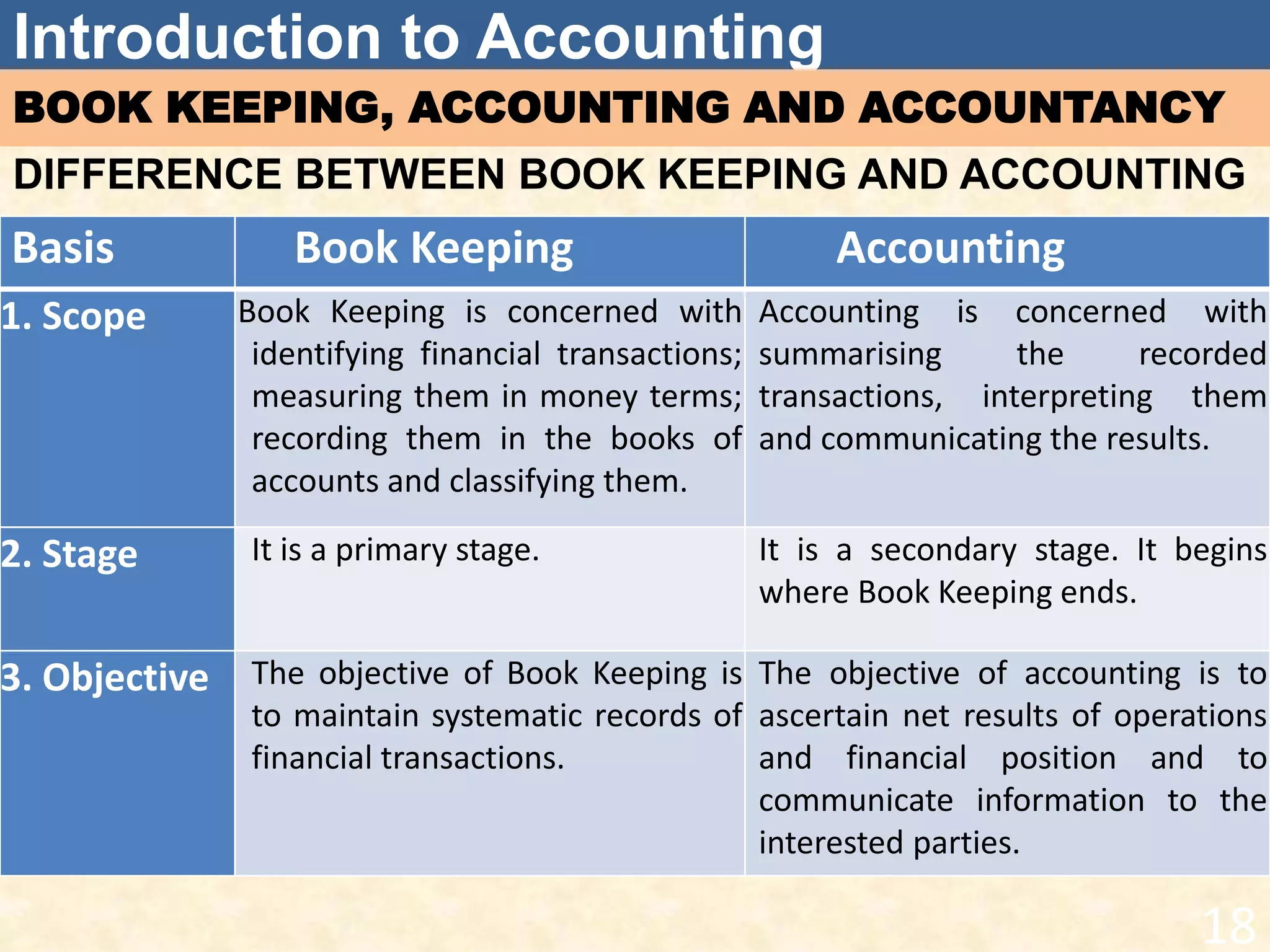
DIFFERENCE BETWEEN BOOK KEEPING AND ACCOUNTING
Basis Book Keeping Accounting
1. Scope Book Keeping is concerned with
identifying financial transactions;
measuring them in money terms;
recording them in the books of
accounts and classifying them.
Accounting is concerned with
summarising the recorded
transactions, interpreting them
and communicating the results.
2. Stage It is a primary stage. It is a secondary stage. It begins
where Book Keeping ends.
3. Objective The objective of Book Keeping is
to maintain systematic records of
financial transactions.
The objective of accounting is to
ascertain net results of operations
and financial position and to
communicate information to the
interested parties.
18
Introduction to Accounting
BOOK KEEPING, ACCOUNTING AND ACCOUNTANCY
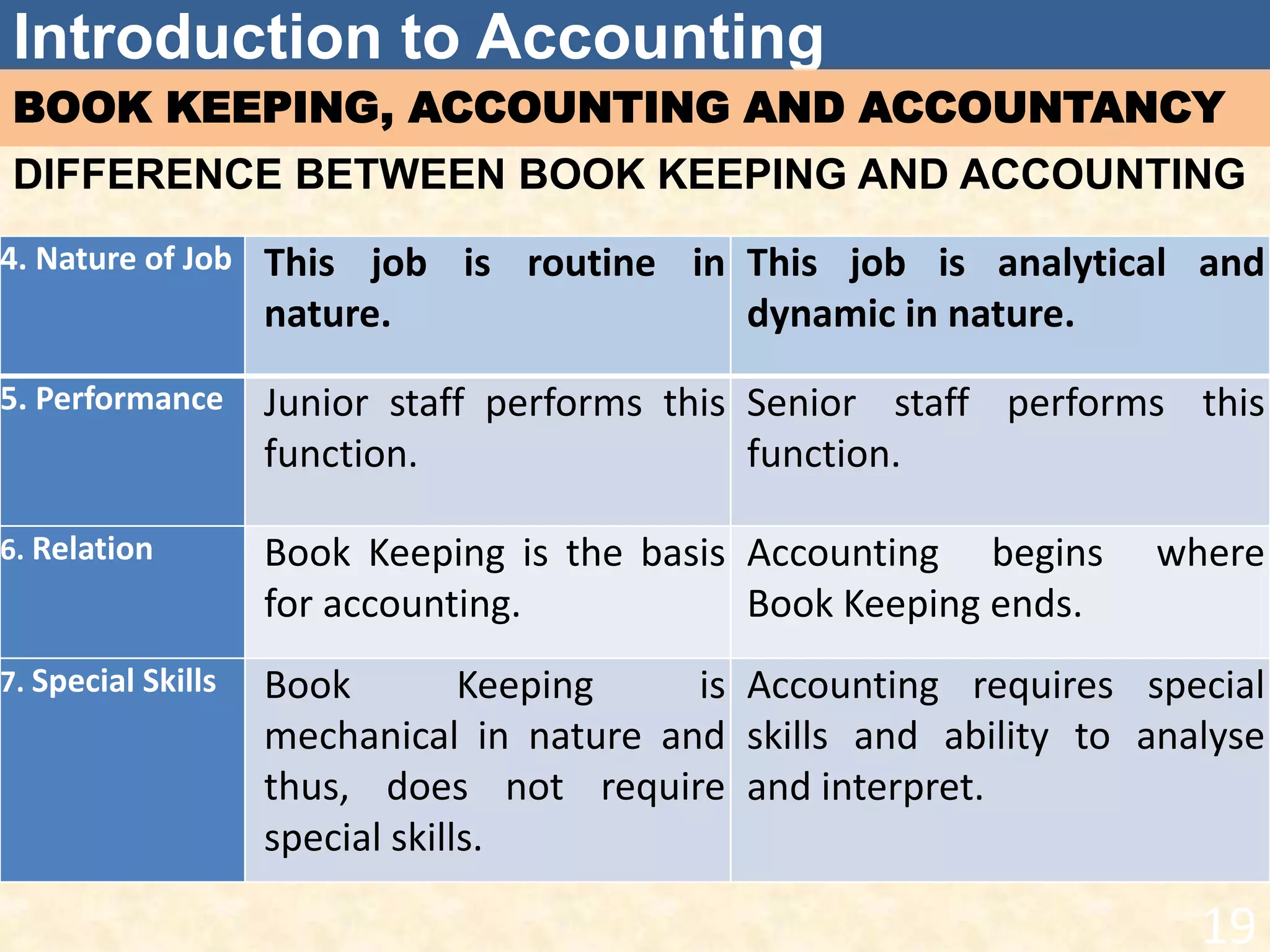
DIFFERENCE BETWEEN BOOK KEEPING AND ACCOUNTING
4. Nature of Job This job is routine in
nature.
This job is analytical and
dynamic in nature.
5. Performance Junior staff performs this
function.
Senior staff performs this
function.
6. Relation Book Keeping is the basis
for accounting.
Accounting begins where
Book Keeping ends.
7. Special Skills Book Keeping is
mechanical in nature and
thus, does not require
special skills.
Accounting requires special
skills and ability to analyse
and interpret.
19
Introduction to Accounting
BOOK KEEPING, ACCOUNTING AND ACCOUNTANCY
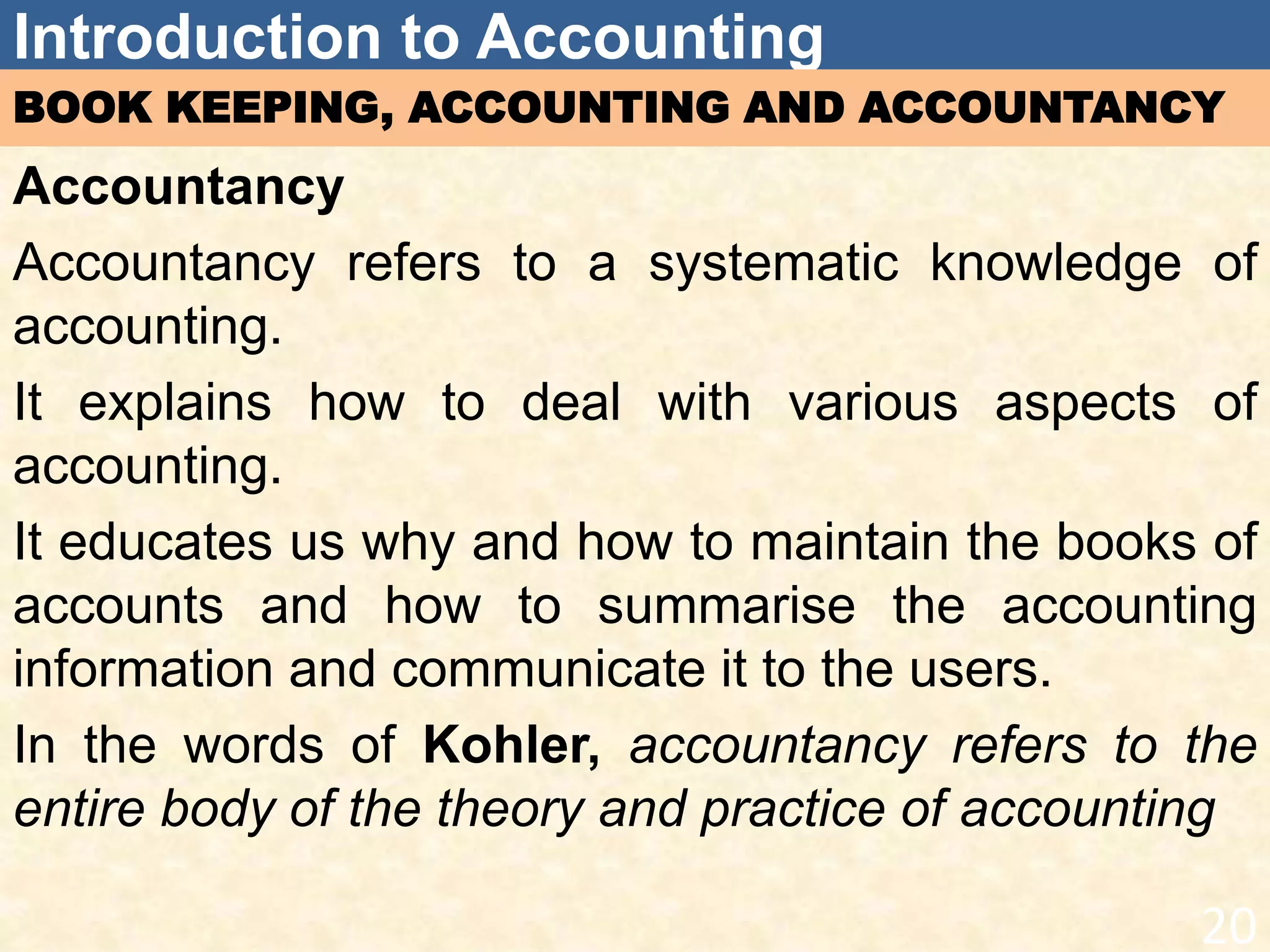
Accountancy
Accountancy refers to a systematic knowledge of
accounting.
It explains how to deal with various aspects of
accounting.
It educates us why and how to maintain the books of
accounts and how to summarise the accounting
information and communicate it to the users.
In the words of Kohler, accountancy refers to the
entire body of the theory and practice of accounting
20
Introduction to Accounting
BOOK KEEPING, ACCOUNTING AND ACCOUNTANCY
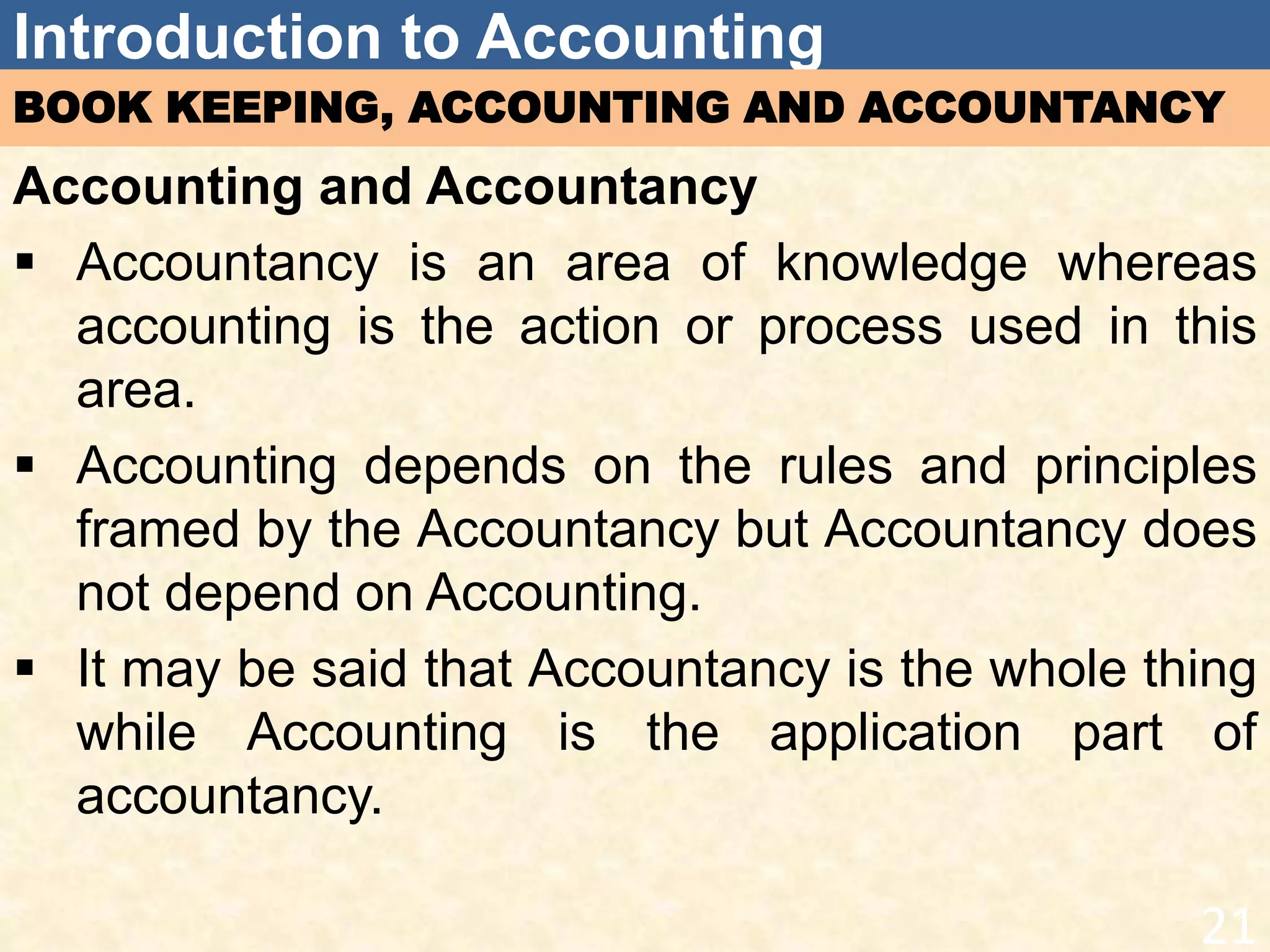
Accounting and Accountancy
 Accountancy is an area of knowledge whereas
accounting is the action or process used in this
area.
 Accounting depends on the rules and principles
framed by the Accountancy but Accountancy does
not depend on Accounting.
 It may be said that Accountancy is the whole thing
while Accounting is the application part of
accountancy.
21
Introduction to Accounting
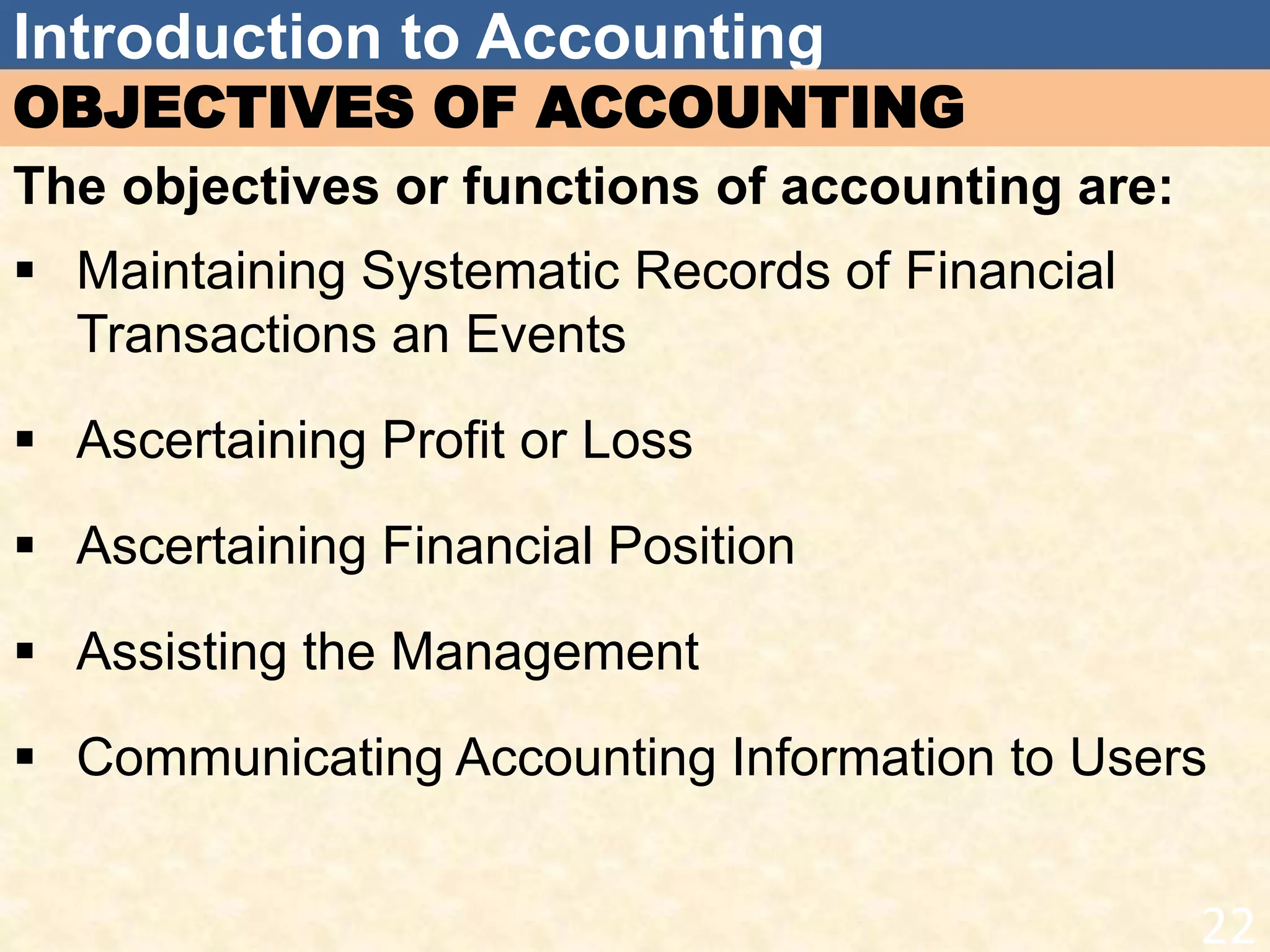
OBJECTIVES OF ACCOUNTING
The objectives or functions of accounting are:
 Maintaining Systematic Records of Financial
Transactions an Events
 Ascertaining Profit or Loss
 Ascertaining Financial Position
 Assisting the Management
 Communicating Accounting Information to Users
22
Introduction to Accounting
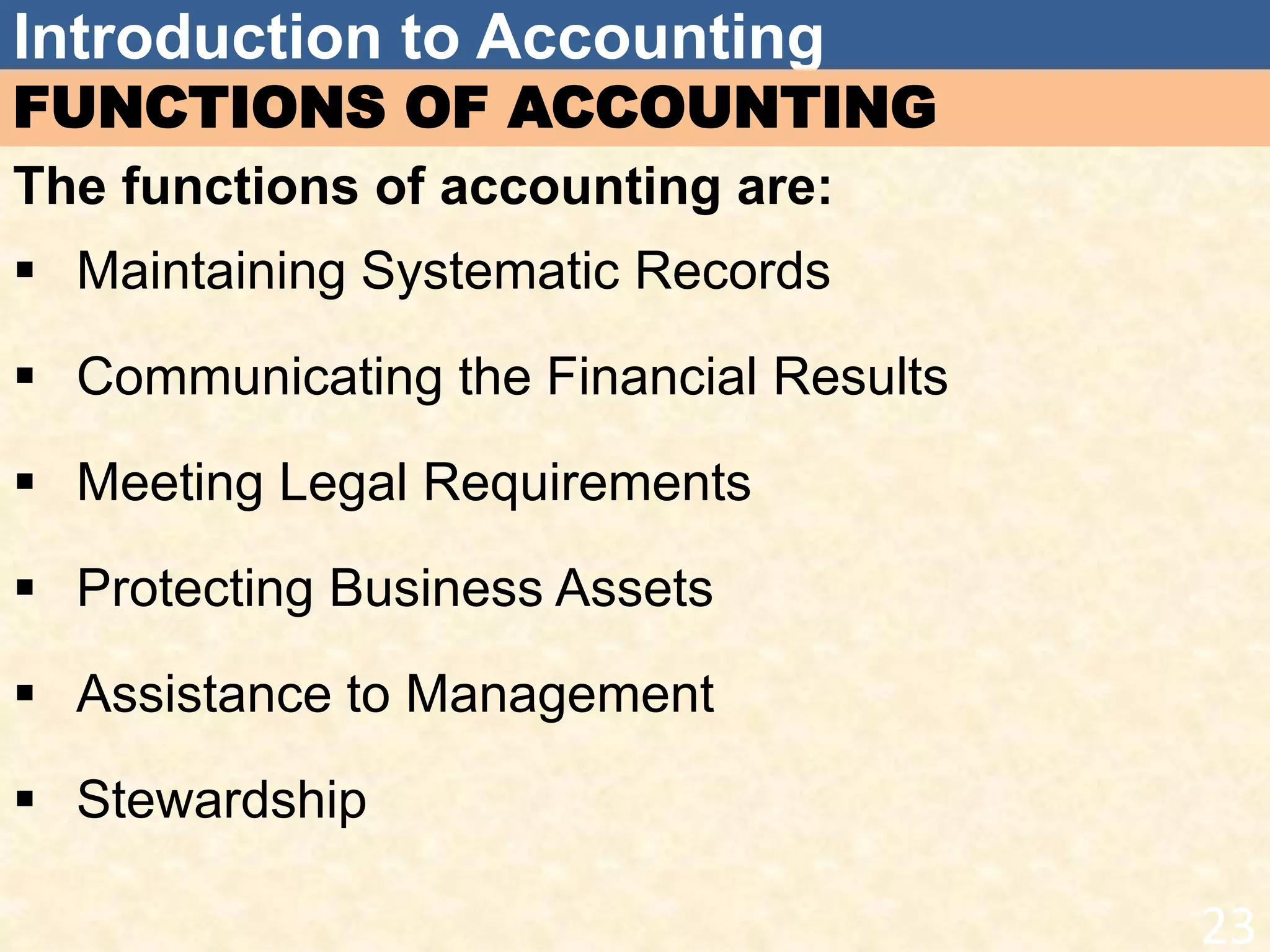
FUNCTIONS OF ACCOUNTING
The functions of accounting are:
 Maintaining Systematic Records
 Communicating the Financial Results
 Meeting Legal Requirements
 Protecting Business Assets
 Assistance to Management
 Stewardship
23
Introduction to Accounting
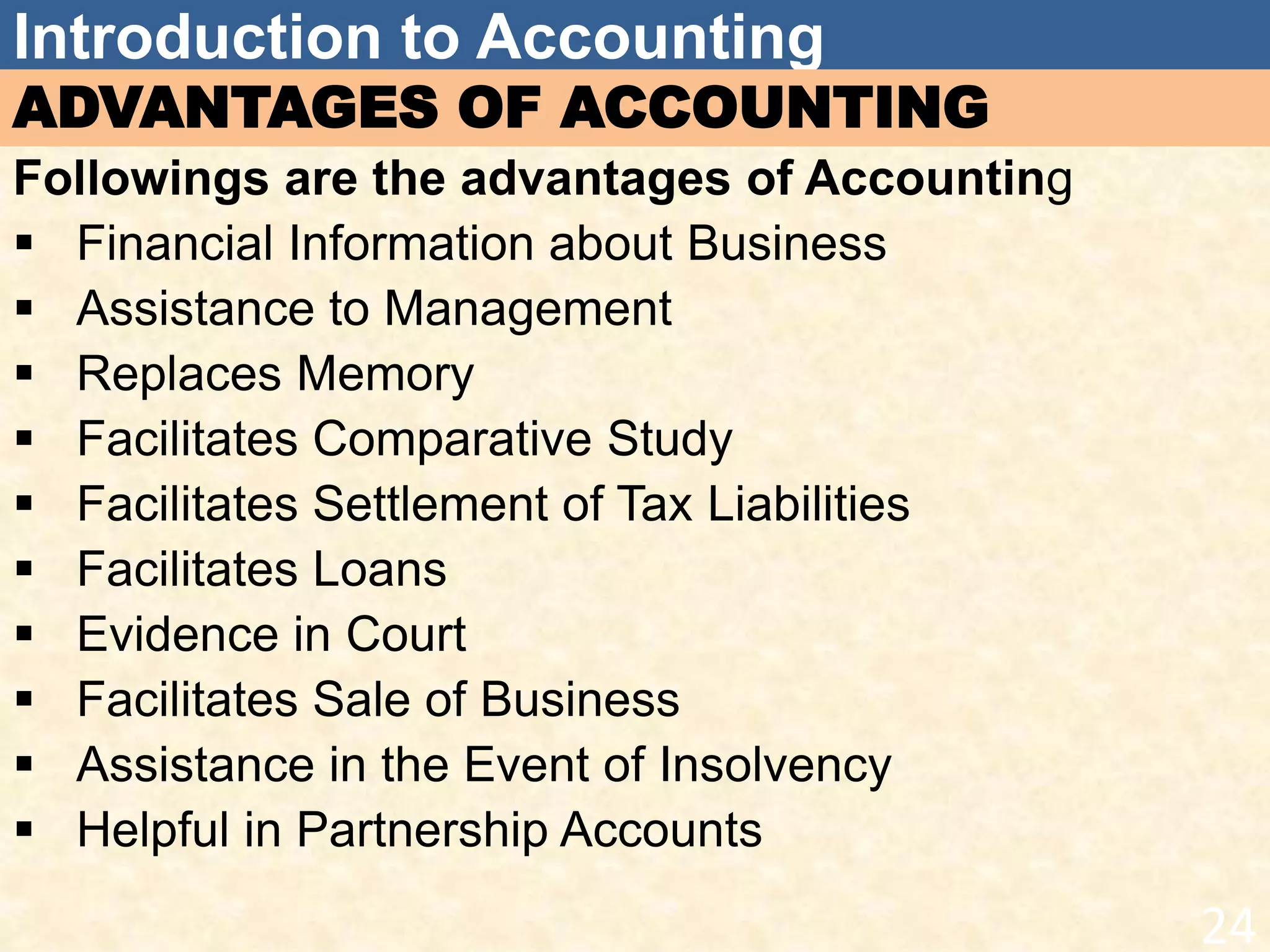
ADVANTAGES OF ACCOUNTING
Followings are the advantages of Accounting
 Financial Information about Business
 Assistance to Management
 Replaces Memory
 Facilitates Comparative Study
 Facilitates Settlement of Tax Liabilities
 Facilitates Loans
 Evidence in Court
 Facilitates Sale of Business
 Assistance in the Event of Insolvency
 Helpful in Partnership Accounts
24
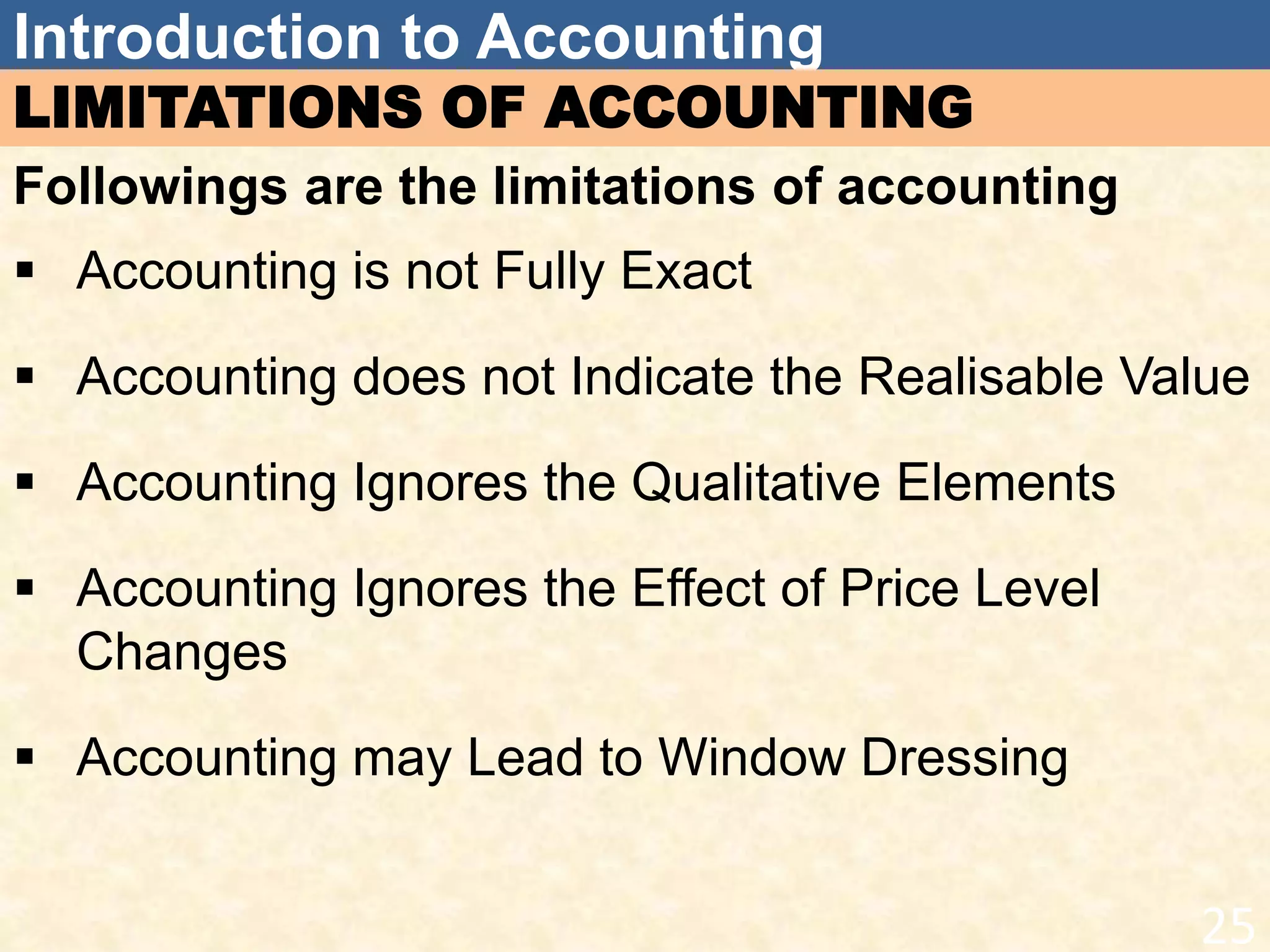
Introduction to Accounting
LIMITATIONS OF ACCOUNTING
Followings are the limitations of accounting
 Accounting is not Fully Exact
 Accounting does not Indicate the Realisable Value
 Accounting Ignores the Qualitative Elements
 Accounting Ignores the Effect of Price Level
Changes
 Accounting may Lead to Window Dressing
25
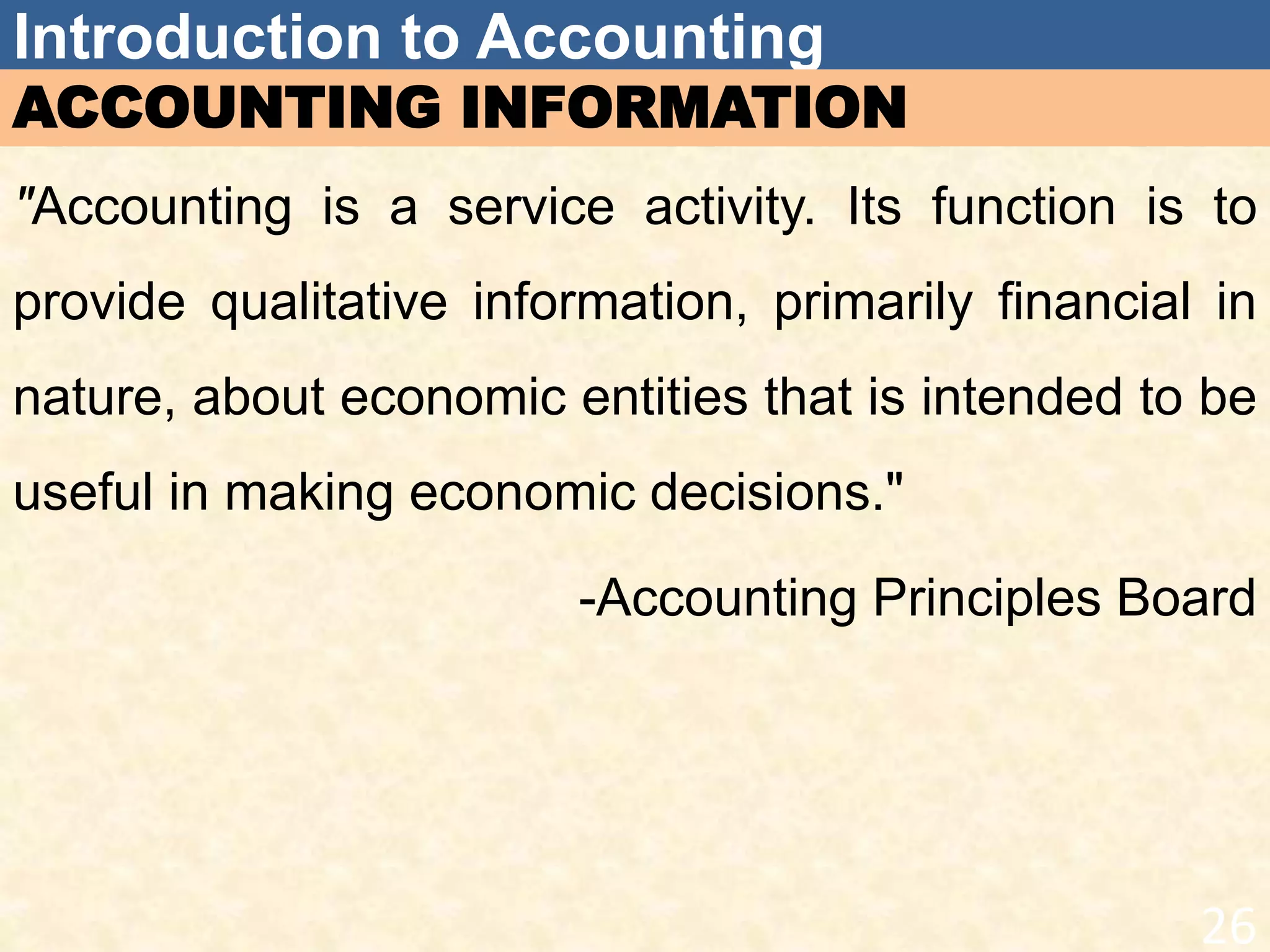
Introduction to Accounting
ACCOUNTING INFORMATION
"Accounting is a service activity. Its function is to
provide qualitative information, primarily financial in
nature, about economic entities that is intended to be
useful in making economic decisions."
-Accounting Principles Board
26
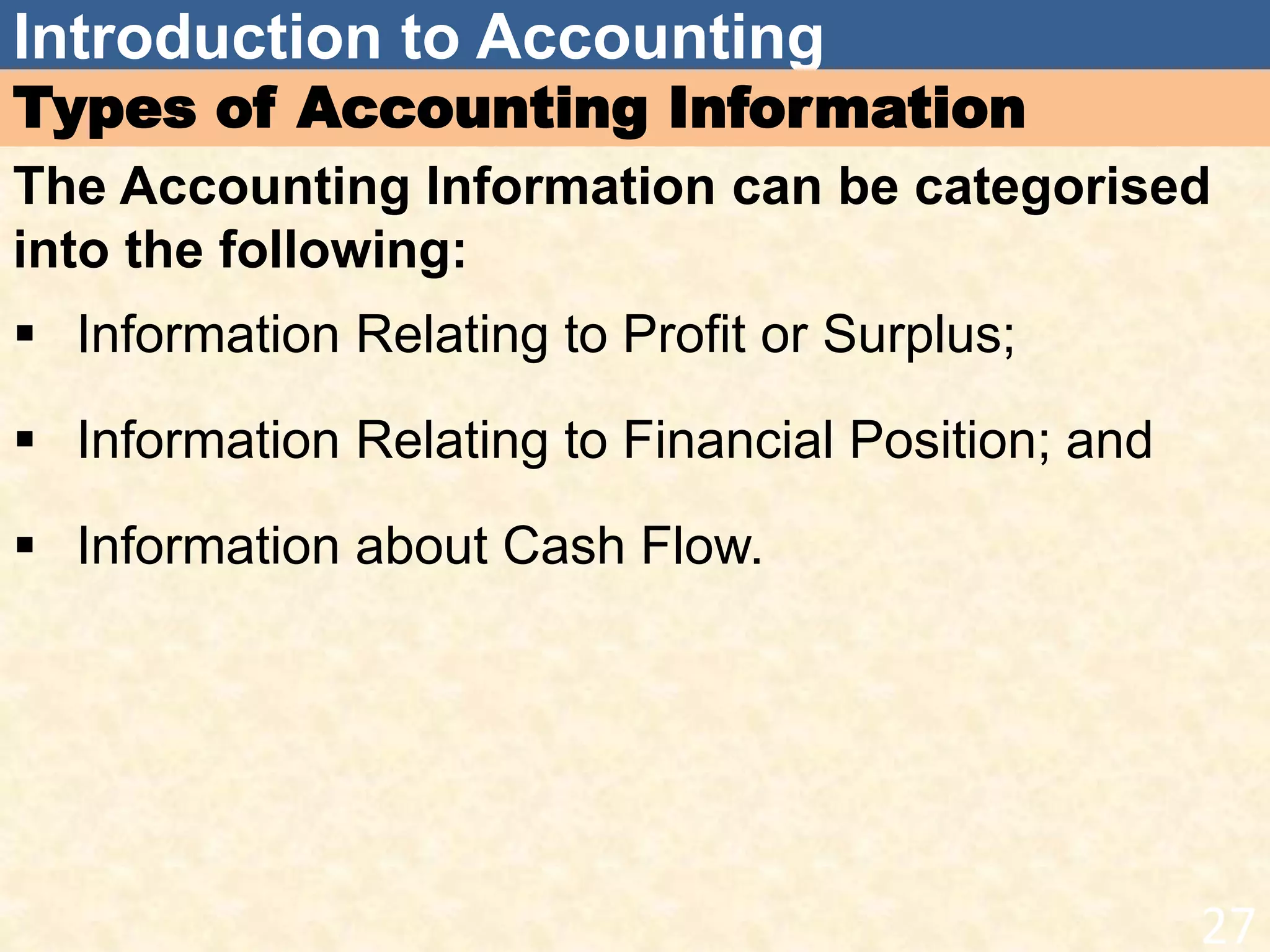
Introduction to Accounting
Types of Accounting Information
The Accounting Information can be categorised
into the following:
 Information Relating to Profit or Surplus;
 Information Relating to Financial Position; and
 Information about Cash Flow.
27
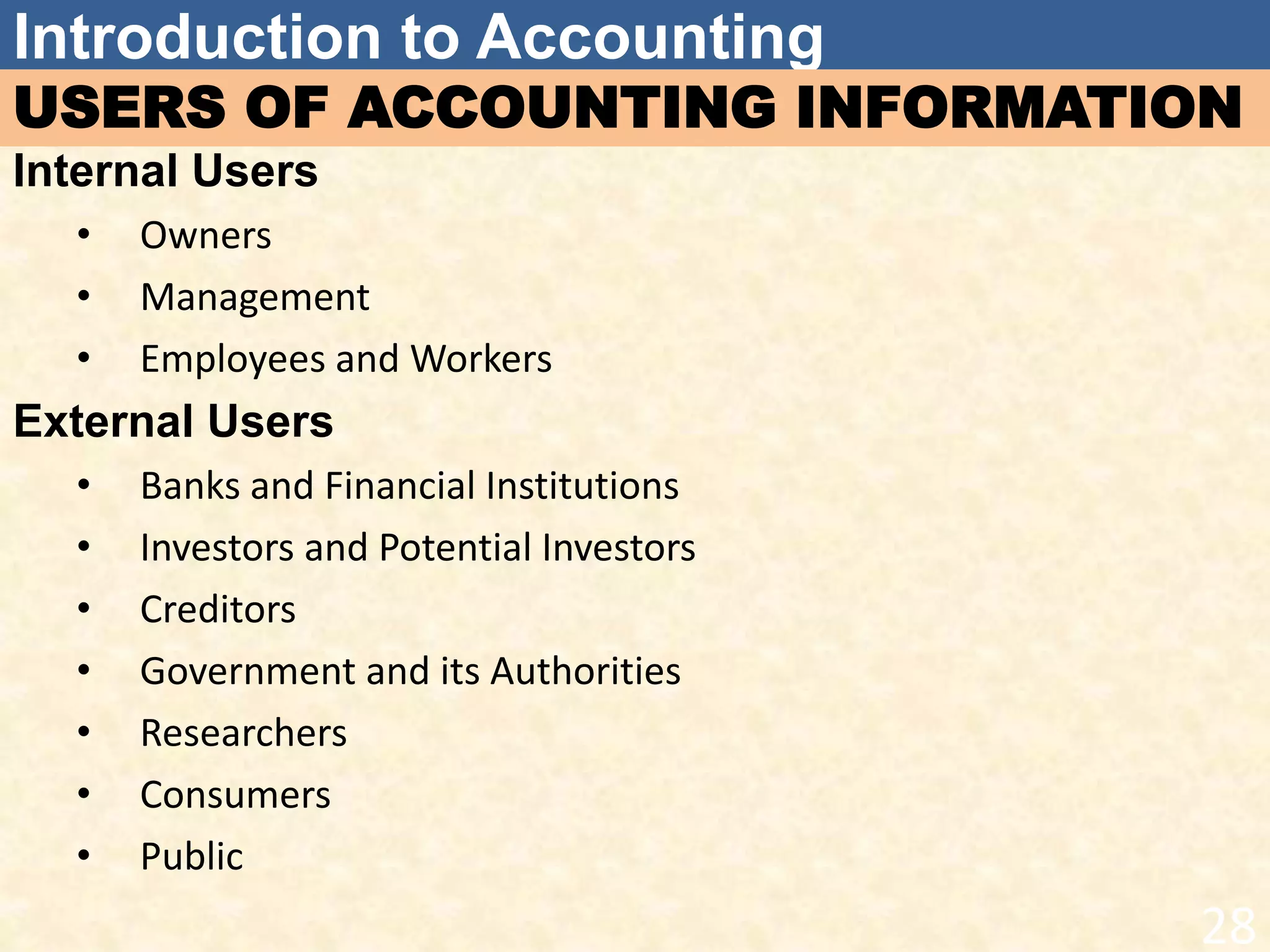
Introduction to Accounting
USERS OF ACCOUNTING INFORMATION
Internal Users
• Owners
• Management
• Employees and Workers
External Users
• Banks and Financial Institutions
• Investors and Potential Investors
• Creditors
• Government and its Authorities
• Researchers
• Consumers
• Public
28
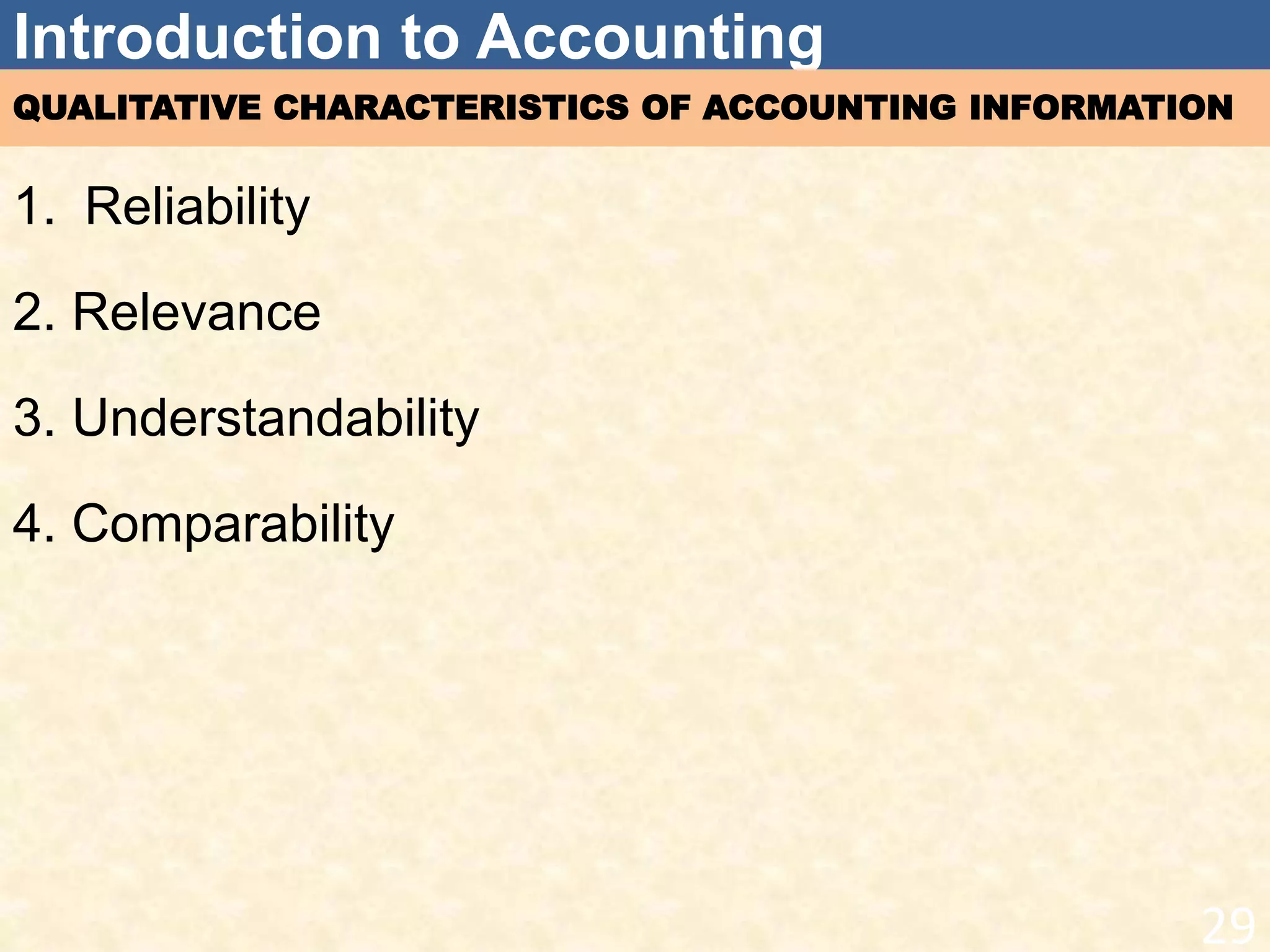
Introduction to Accounting
QUALITATIVE CHARACTERISTICS OF ACCOUNTING INFORMATION
1. Reliability
2. Relevance
3. Understandability
4. Comparability
29
Introduction to Accounting
SYSTEMS OF ACCOUNTING
The systems of recording transactions in the
books of accounts are two namely:
1. Double Entry System and
2. Single Entry System.
30
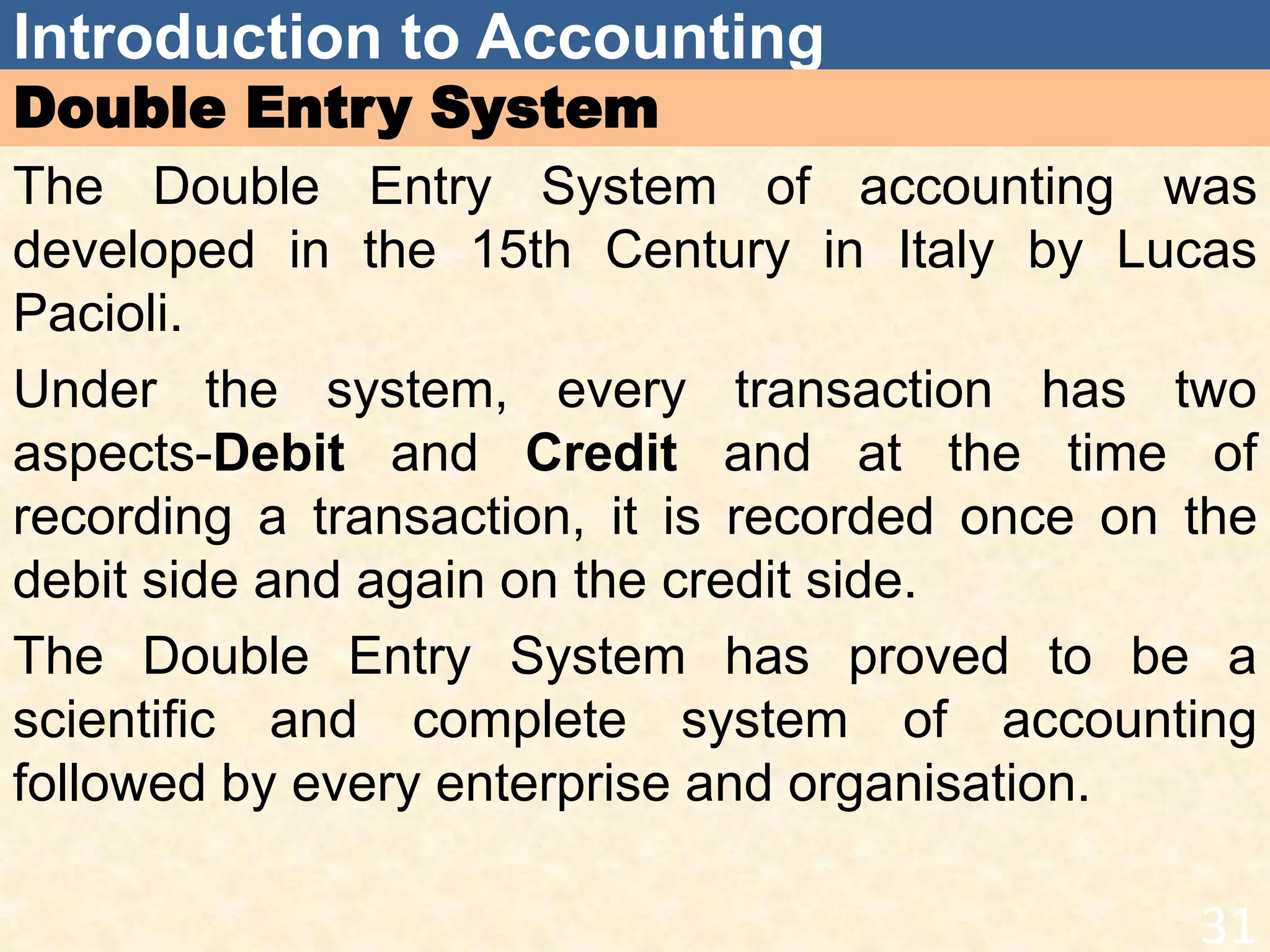
Introduction to Accounting
Double Entry System
The Double Entry System of accounting was
developed in the 15th Century in Italy by Lucas
Pacioli.
Under the system, every transaction has two
aspects-Debit and Credit and at the time of
recording a transaction, it is recorded once on the
debit side and again on the credit side.
The Double Entry System has proved to be a
scientific and complete system of accounting
followed by every enterprise and organisation.
31
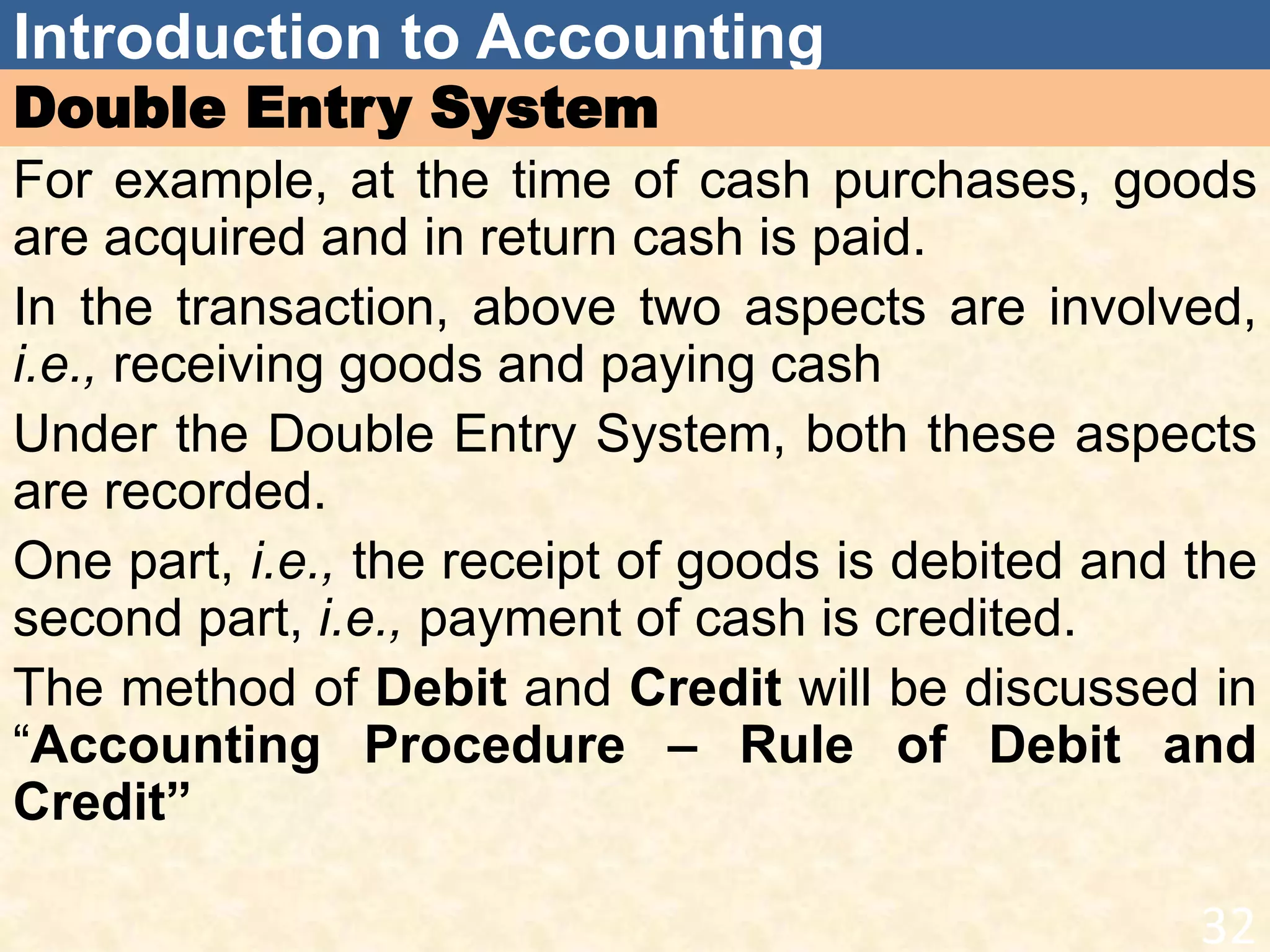
Introduction to Accounting
Double Entry System
For example, at the time of cash purchases, goods
are acquired and in return cash is paid.
In the transaction, above two aspects are involved,
i.e., receiving goods and paying cash
Under the Double Entry System, both these aspects
are recorded.
One part, i.e., the receipt of goods is debited and the
second part, i.e., payment of cash is credited.
The method of Debit and Credit will be discussed in
“Accounting Procedure – Rule of Debit and
Credit”
32
Introduction to Accounting
Features of the Double Entry System
 It maintains a complete record of each transaction.
 It recognises the two-fold aspect of every transaction,
viz., the aspect of receiving (value in) and the aspect
of giving (value out).
 In this system, one aspect is debited and other aspect
is credited following the rules of debit and credit.
 Since, one aspect of a transaction is debited and the
other is credited, the total of all debits is always equal
to total of all credits. It helps in establishing
arithmetical accuracy by preparing the Trial Balance.
33
Introduction to Accounting
Stages of Double Entry System
The following are the three different stages of a
complete system of a double entry book keeping:
 Recording the transactions in the Journal.
 Classifying the transactions in the Journal by posting
them to the appropriate ledger accounts and then
preparing the Trial Balance.
 Closing the books and preparing the final accounts.
All these stages shall be discussed one by one in
succeeding chapters.
34
Introduction to Accounting
Advantages of the Double Entry System
The main advantages of Double Entry System are
 Scientific System
 Complete Record of Transactions
 A Check on the Accuracy of Accounts
 Ascertainment of Profit or Loss
 Knowledge of Financial Position
 Full Details for Purposes of Control
 Comparative Study is Possible
 Helps Management in Decision-Making
 No Scope of Fraud
35
Introduction to Accounting
Single Entry System
Single Entry System of recording transactions in the
books of accounts, may be defined to be an
incomplete Double Entry System.
In this system, all transactions are not recorded on
the double entry basis.
As regards some transactions, both aspects of the
transactions are recorded, as regards others, either
one aspect is recorded or not recorded at all.
Instead of maintaining all the accounts, only
Personal Accounts and Cash Book are maintained
under this system.
36
Introduction to Accounting
Single Entry System
The accounts maintained under this system are
incomplete and unsystematic and therefore, not
reliable.
The Single Entry System is also known as Accounts
from Incomplete Records.
Since all transactions are not recorded under double
entry principle, it is not possible to prepare a Trial
Balance.
As a result, the Profit and Loss Account and the
Balance Sheet cannot be prepared.
37
Introduction to Accounting
38

accounting introduction

  • 1.
  • 2.
    Introduction to Accounting INTRODUCTIONTO ACCOUNTING Presented by:- Dr. S. V. Shinde Associate Professor - D.A.V. Velankar College of Commerce, Solapur. 2
  • 3.
    Introduction to Accounting LearningObjectives This Chapter would enable you to understand:  Definitions of Accounting  Meaning of Accounting  Attributes of Accounting  Accounting Process  Branches of Accounting  Book Keeping, Accounting and Accountancy  Difference between Book Keeping and Accounting 3
  • 4.
    Introduction to Accounting LearningObjectives  Objectives of Accounting  Functions of Accounting  Advantages of Accounting  Limitations of Accounting  Accounting Information and its' Types  Users of Accounting Information  Systems of Accounting 4
  • 5.
    Introduction to Accounting DEFINITIONOF ACCOUNTING "Accounting is the art of recording, classifying and summarising in a significant manner and in terms of money; transactions and events which are, in part at least, of a financial character, and interpreting the results thereof." -American Institute of Certified Public Accountants 5
  • 6.
    Introduction to Accounting DEFINITIONOF ACCOUNTING "Accounting is the science of recording and classifying business transactions and events, primarily of a financial character, and the art of making significant summaries, analysis and interpretations of those transactions and events and communicating the results to persons who must make decisions or form judgment." -Smith and Ashburne 6
  • 7.
    Introduction to Accounting DEFINITIONOF ACCOUNTING "Accounting is the process of identifying, measuring and communicating economic information to permit informed judgments and decisions by users of the information." -American Accounting Association 7
  • 8.
    Introduction to Accounting Meaningof Accounting Thus, accounting is a process of  collecting,  recording,  summarising and  communicating financial information to the users for decision-making. 8
  • 9.
    Introduction to Accounting ATTRIBUTES(CHARACTERISTICS) OF ACCOUNTING The definitions of accounting bring to light the following attributes of Accounting: 1. Identification of Financial Transactions and Events 2. Measuring the Identified Transactions 3. Recording 4. Classifying 5. Summarising 6. Analysis and Interpretation 7. Communicating 9
  • 10.
    Introduction to Accounting FinancialTransactions or Events RecordingJournal 1. Cash Book 2. Purchase Book 3. Sales Book 4. Purchases Return Book 5. Sales Return Book 6. Bills Payable Book 7. Bills Receivable Book 8. Journal Proper Classifying (Posting into Ledger) Summarizing Trial Balance Trading and Profit and Loss Account Balance Sheet. Analysis and Interpretation Communicating to the Users ACCOUNTING PROCESS 10
  • 11.
    Introduction to Accounting Branchesof Accounting BRANCHES OF ACCOUNTING 11 Financial Accounting Cost Accounting Management Accounting
  • 12.
    Introduction to Accounting FinancialAccounting Financial Accounting is that branch of accounting, which records financial transactions and events, summarises and interprets them and communicates the results to the users. The end-product of Financial Accounting is the Profit and Loss Account for the period ended and the Balance Sheet as on the last day of the accounting period. 12
  • 13.
    Introduction to Accounting CostAccounting The limitation of Financial Accounting in respect of information relating to the cost of products or services led to the development of a specialised branch, i.e., Cost Accounting. It ascertains the cost of products manufactured or services rendered and helps the management in decision-making (say price fixation) and exercising controls. 13
  • 14.
    Introduction to Accounting ManagementAccounting Management Accounting is the most recently developed branch of accounting. It is concerned with generating accounting information relating to funds, costs, profits, etc., as it enables the management in decision-making. We may say that Management Accounting addresses the needs of a single user group, i.e., the management. 14
  • 15.
    Introduction to Accounting BOOKKEEPING, ACCOUNTING AND ACCOUNTANCY Meaning of Book Keeping Book Keeping is part of and it is concerned with:  Identifying financial transactions and events,  Measuring them in terms of money,  Recording the financial transactions and events so identified in the books of accounts, and  Classifying recorded transactions and events, i.e., posting them into Ledger accounts. 15
  • 16.
    Introduction to Accounting BOOKKEEPING, ACCOUNTING AND ACCOUNTANCY Definitions of Book Keeping "Book Keeping is an art of recording in the books of accounts the monetary aspect of commercial and financial transactions." -Northcott "Book Keeping is an art of recording business dealings in a set of books." -J.R. Batliboi "Book Keeping is the science and art of recording correctly in the books of accounts all those business transactions that result in the transfer of money or money's worth." -R.N. Carter "Bool: Keeping is the art of recording business transactions in a systematic manner." -A.N. Rosen Kampff 16
  • 17.
    Introduction to Accounting BOOKKEEPING, ACCOUNTING AND ACCOUNTANCY Accounting Accounting is an art of recording, classifying and summarising the financial data and interpreting the results thereof. Accounting is a wider concept than Book Keeping. It starts where Book Keeping ends. In other words, Book Keeping is a part of accounting. 17
  • 18.
    Introduction to Accounting BOOKKEEPING, ACCOUNTING AND ACCOUNTANCY DIFFERENCE BETWEEN BOOK KEEPING AND ACCOUNTING Basis Book Keeping Accounting 1. Scope Book Keeping is concerned with identifying financial transactions; measuring them in money terms; recording them in the books of accounts and classifying them. Accounting is concerned with summarising the recorded transactions, interpreting them and communicating the results. 2. Stage It is a primary stage. It is a secondary stage. It begins where Book Keeping ends. 3. Objective The objective of Book Keeping is to maintain systematic records of financial transactions. The objective of accounting is to ascertain net results of operations and financial position and to communicate information to the interested parties. 18
  • 19.
    Introduction to Accounting BOOKKEEPING, ACCOUNTING AND ACCOUNTANCY DIFFERENCE BETWEEN BOOK KEEPING AND ACCOUNTING 4. Nature of Job This job is routine in nature. This job is analytical and dynamic in nature. 5. Performance Junior staff performs this function. Senior staff performs this function. 6. Relation Book Keeping is the basis for accounting. Accounting begins where Book Keeping ends. 7. Special Skills Book Keeping is mechanical in nature and thus, does not require special skills. Accounting requires special skills and ability to analyse and interpret. 19
  • 20.
    Introduction to Accounting BOOKKEEPING, ACCOUNTING AND ACCOUNTANCY Accountancy Accountancy refers to a systematic knowledge of accounting. It explains how to deal with various aspects of accounting. It educates us why and how to maintain the books of accounts and how to summarise the accounting information and communicate it to the users. In the words of Kohler, accountancy refers to the entire body of the theory and practice of accounting 20
  • 21.
    Introduction to Accounting BOOKKEEPING, ACCOUNTING AND ACCOUNTANCY Accounting and Accountancy  Accountancy is an area of knowledge whereas accounting is the action or process used in this area.  Accounting depends on the rules and principles framed by the Accountancy but Accountancy does not depend on Accounting.  It may be said that Accountancy is the whole thing while Accounting is the application part of accountancy. 21
  • 22.
    Introduction to Accounting OBJECTIVESOF ACCOUNTING The objectives or functions of accounting are:  Maintaining Systematic Records of Financial Transactions an Events  Ascertaining Profit or Loss  Ascertaining Financial Position  Assisting the Management  Communicating Accounting Information to Users 22
  • 23.
    Introduction to Accounting FUNCTIONSOF ACCOUNTING The functions of accounting are:  Maintaining Systematic Records  Communicating the Financial Results  Meeting Legal Requirements  Protecting Business Assets  Assistance to Management  Stewardship 23
  • 24.
    Introduction to Accounting ADVANTAGESOF ACCOUNTING Followings are the advantages of Accounting  Financial Information about Business  Assistance to Management  Replaces Memory  Facilitates Comparative Study  Facilitates Settlement of Tax Liabilities  Facilitates Loans  Evidence in Court  Facilitates Sale of Business  Assistance in the Event of Insolvency  Helpful in Partnership Accounts 24
  • 25.
    Introduction to Accounting LIMITATIONSOF ACCOUNTING Followings are the limitations of accounting  Accounting is not Fully Exact  Accounting does not Indicate the Realisable Value  Accounting Ignores the Qualitative Elements  Accounting Ignores the Effect of Price Level Changes  Accounting may Lead to Window Dressing 25
  • 26.
    Introduction to Accounting ACCOUNTINGINFORMATION "Accounting is a service activity. Its function is to provide qualitative information, primarily financial in nature, about economic entities that is intended to be useful in making economic decisions." -Accounting Principles Board 26
  • 27.
    Introduction to Accounting Typesof Accounting Information The Accounting Information can be categorised into the following:  Information Relating to Profit or Surplus;  Information Relating to Financial Position; and  Information about Cash Flow. 27
  • 28.
    Introduction to Accounting USERSOF ACCOUNTING INFORMATION Internal Users • Owners • Management • Employees and Workers External Users • Banks and Financial Institutions • Investors and Potential Investors • Creditors • Government and its Authorities • Researchers • Consumers • Public 28
  • 29.
    Introduction to Accounting QUALITATIVECHARACTERISTICS OF ACCOUNTING INFORMATION 1. Reliability 2. Relevance 3. Understandability 4. Comparability 29
  • 30.
    Introduction to Accounting SYSTEMSOF ACCOUNTING The systems of recording transactions in the books of accounts are two namely: 1. Double Entry System and 2. Single Entry System. 30
  • 31.
    Introduction to Accounting DoubleEntry System The Double Entry System of accounting was developed in the 15th Century in Italy by Lucas Pacioli. Under the system, every transaction has two aspects-Debit and Credit and at the time of recording a transaction, it is recorded once on the debit side and again on the credit side. The Double Entry System has proved to be a scientific and complete system of accounting followed by every enterprise and organisation. 31
  • 32.
    Introduction to Accounting DoubleEntry System For example, at the time of cash purchases, goods are acquired and in return cash is paid. In the transaction, above two aspects are involved, i.e., receiving goods and paying cash Under the Double Entry System, both these aspects are recorded. One part, i.e., the receipt of goods is debited and the second part, i.e., payment of cash is credited. The method of Debit and Credit will be discussed in “Accounting Procedure – Rule of Debit and Credit” 32
  • 33.
    Introduction to Accounting Featuresof the Double Entry System  It maintains a complete record of each transaction.  It recognises the two-fold aspect of every transaction, viz., the aspect of receiving (value in) and the aspect of giving (value out).  In this system, one aspect is debited and other aspect is credited following the rules of debit and credit.  Since, one aspect of a transaction is debited and the other is credited, the total of all debits is always equal to total of all credits. It helps in establishing arithmetical accuracy by preparing the Trial Balance. 33
  • 34.
    Introduction to Accounting Stagesof Double Entry System The following are the three different stages of a complete system of a double entry book keeping:  Recording the transactions in the Journal.  Classifying the transactions in the Journal by posting them to the appropriate ledger accounts and then preparing the Trial Balance.  Closing the books and preparing the final accounts. All these stages shall be discussed one by one in succeeding chapters. 34
  • 35.
    Introduction to Accounting Advantagesof the Double Entry System The main advantages of Double Entry System are  Scientific System  Complete Record of Transactions  A Check on the Accuracy of Accounts  Ascertainment of Profit or Loss  Knowledge of Financial Position  Full Details for Purposes of Control  Comparative Study is Possible  Helps Management in Decision-Making  No Scope of Fraud 35
  • 36.
    Introduction to Accounting SingleEntry System Single Entry System of recording transactions in the books of accounts, may be defined to be an incomplete Double Entry System. In this system, all transactions are not recorded on the double entry basis. As regards some transactions, both aspects of the transactions are recorded, as regards others, either one aspect is recorded or not recorded at all. Instead of maintaining all the accounts, only Personal Accounts and Cash Book are maintained under this system. 36
  • 37.
    Introduction to Accounting SingleEntry System The accounts maintained under this system are incomplete and unsystematic and therefore, not reliable. The Single Entry System is also known as Accounts from Incomplete Records. Since all transactions are not recorded under double entry principle, it is not possible to prepare a Trial Balance. As a result, the Profit and Loss Account and the Balance Sheet cannot be prepared. 37
  • 38.