Evolution  of  Intellectual Property Rights Lalit Ambastha Director, Patentwire
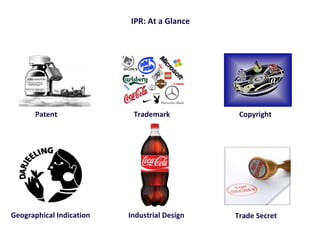
IPR: At a Glance Patent Trademark Copyright Geographical Indication Trade Secret Industrial Design
Historical Background: Ancient Times Continued… Signatures on Paintings & Creations Substantial and Identifiable Patterns & particularity in Architectures, Paintings,  Jewellery, Dresses etc. Rewards and monopolies granted by Emperors Stamping of Jewelers’ Initials on Jewellery made by them (Still followed by local Jewelers) Concept of Copyright came only after invention of Printing Press.
Modern patents originated in Europe where European sovereigns commonly awarded "letters patent" to favored inventors.  The first U.S. patent laws were enacted by Congress in 1790 as part of the Constitution.  The first patent was granted by the Massachusetts General Court to Samuel Winslow in 1641 for a novel method of making salt.   George Washington signed the First United States Patent Grant on July 31, 1790. Patent system in India was first introduced by British Government in 1856.  The Indian Patents and Designs Act, 1911, (2 of 1911) first enacted under the management of Controller of Patents with a patent term of 14 years.   The Patents Act (39 of 1970) came into force on 20th April 1972 .  Initially, the Patent Act, 1970, provided a term of 7 years for pharmaceutical, agro chemical and food products and 16 years for other categories. Historical Background: Modern Times
Current IP Laws in India Copyright Copyright Act of 1957  Customs  Intellectual Property Rights (Imported Goods) Enforcement Rules, 2007   Designs The Designs Act, 2000  The Design (Amendment) Rules, 2008  Geographical Indications Geographical Indications of Goods (Registration and Protection) Act, 1999  Geographical Indications of Goods (Registration and Protection) Rules, 2002  Information Technology The Information Technology Act, 2000  The Information Technology Rules, 2000  Cyber Regulations Appellate Tribunal (Procedure) Rules, 2000  Patents  The Patents Act, 1970  The Patents (Amendment) Act, 2005  The Patents Rules, 2003  The Patents (Amendment) Rules, 2006  Plant  Plant Varieties Protection and Farmers' Rights Act, 2001 Semiconductor and Integrated Circuits Semiconductor Integrated Circuits Layout Design Act 2000  Rules for the Semiconductor Integrated Circuits Layout Design Act 2000  Trademarks The Trade Marks Act, 1999  The Trade Marks Rules, 2002
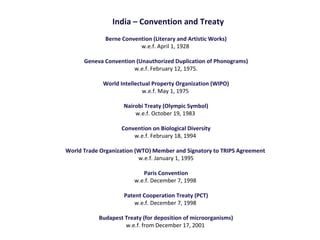
Berne Convention (Literary and Artistic Works) w.e.f. April 1, 1928  Geneva Convention (Unauthorized Duplication of Phonograms) w.e.f. February 12, 1975.  World Intellectual Property Organization (WIPO) w.e.f. May 1, 1975  Nairobi Treaty (Olympic Symbol) w.e.f. October 19, 1983  Convention on Biological Diversity w.e.f. February 18, 1994  World Trade Organization (WTO) Member and Signatory to TRIPS Agreement   w.e.f. January 1, 1995  Paris Convention w.e.f. December 7, 1998  Patent Cooperation Treaty (PCT) w.e.f. December 7, 1998  Budapest Treaty (for deposition of microorganisms) w.e.f. from December 17, 2001  India – Convention and Treaty
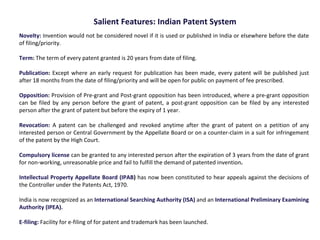
Salient Features: Indian Patent System  Novelty:   Invention would not be considered novel if it is used or published in India or elsewhere before the date of filing/priority.  Term :  The term of every patent granted is 20 years from date of filing. Publication :  Except where an early request for publication has been made, every patent will be published just after 18 months from the date of filing/priority and will be open for public on payment of fee prescribed.   Opposition:   Provision of Pre-grant and Post-grant opposition has been introduced, where a pre-grant opposition can be filed by any person before the grant of patent, a post-grant opposition can be filed by any interested person after the grant of patent but before the expiry of 1 year.  Revocation:   A patent can be challenged and revoked anytime after the grant of patent on a petition of any interested person or Central Government by the Appellate Board or on a counter-claim in a suit for infringement of the patent by the High Court.  Compulsory license   can be granted to any interested person after the expiration of 3 years from the date of grant for non-working, unreasonable price and fail to fulfill the demand of patented invention .  Intellectual Property Appellate Board (IPAB )  has now been constituted to hear appeals against the decisions of the Controller under the Patents Act, 1970.  India is now recognized as an   International Searching Authority (ISA)   and an   International Preliminary Examining Authority (IPEA).  E-filing:   Facility for e-filing of for patent and trademark has been launched.
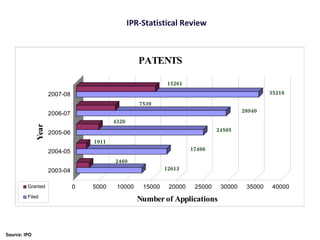
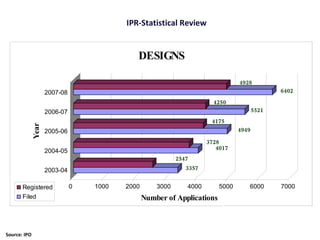
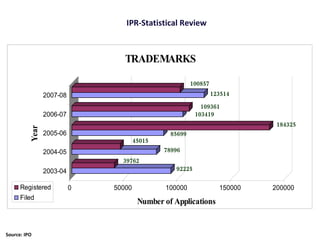
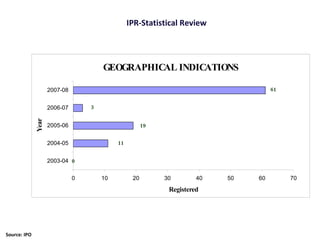
IPR-Statistical Review   Source: IPO
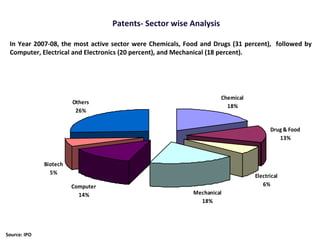
Patents- Sector wise Analysis   In  Year 2007-08, the most active sector were Chemicals, Food and Drugs (31 percent),  followed by Computer, Electrical and Electronics (20 percent), and Mechanical (18 percent). Source: IPO
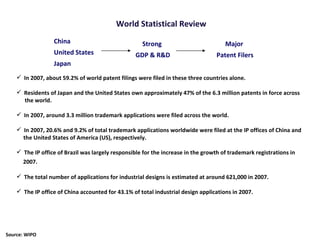
World Statistical Review  In 2007, about 59.2% of world patent filings were filed in these three countries alone. Residents of Japan and the United States own approximately 47% of the 6.3 million patents in force across the world.  In 2007, around 3.3 million trademark applications were filed across the world. In 2007, 20.6% and 9.2% of total trademark applications worldwide were filed at the IP offices of China and the United States of America (US), respectively. The IP office of Brazil was largely responsible for the increase in the growth of trademark registrations in 2007. The total number of applications for industrial designs is estimated at around 621,000 in 2007. The IP office of China accounted for 43.1% of total industrial design applications in 2007. China United States Japan Strong  GDP & R&D Major  Patent Filers Source: WIPO
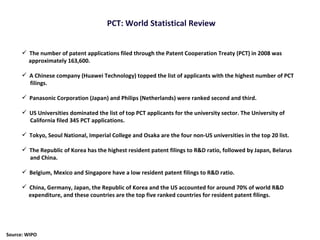
The number of patent applications filed through the Patent Cooperation Treaty (PCT) in 2008 was approximately 163,600. A Chinese company (Huawei Technology) topped the list of applicants with the highest number of PCT filings. Panasonic Corporation (Japan) and Philips (Netherlands) were ranked second and third.  US Universities dominated the list of top PCT applicants for the university sector. The University of California filed 345 PCT applications.  Tokyo, Seoul National, Imperial College and Osaka are the four non-US universities in the top 20 list. The Republic of Korea has the highest resident patent filings to R&D ratio, followed by Japan, Belarus and China.  Belgium, Mexico and Singapore have a low resident patent filings to R&D ratio. China, Germany, Japan, the Republic of Korea and the US accounted for around 70% of world R&D expenditure, and these countries are the top five ranked countries for resident patent filings. PCT: World Statistical Review Source: WIPO
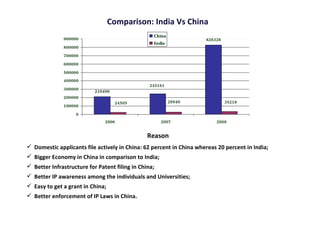
Comparison: India Vs China Reason Domestic applicants file actively in China: 62 percent in China whereas 20 percent in India; Bigger Economy in China in comparison to India; Better Infrastructure for Patent filing in China; Better IP awareness among the individuals and Universities; Easy to get a grant in China;  Better enforcement of IP Laws in China.
Academia: Requirements & Challenges IP Awareness  IP Knowledge: Realizing Ground Realities Counseling of Scientists/Scholars/Students Pre-Publication Screening Gateway IP Policy: Confidentiality and Contract Agreements  IP Coordinator IP Management Cell
Thank You Thank You… PATENTWIRE CONSULTANTS PVT. LTD. B-10, Ground Floor Vishwakarma Colony M.B. Road, New Delhi 110044   Telephone:  [+91] 11-26360036 Fax: [+91] 11-26360037 Email:  [email_address] www.patentwire.co.in © Patentwire 2009

Evolution Of IPR

  • 1.
    Evolution of Intellectual Property Rights Lalit Ambastha Director, Patentwire
  • 2.
    IPR: At aGlance Patent Trademark Copyright Geographical Indication Trade Secret Industrial Design
  • 3.
    Historical Background: AncientTimes Continued… Signatures on Paintings & Creations Substantial and Identifiable Patterns & particularity in Architectures, Paintings, Jewellery, Dresses etc. Rewards and monopolies granted by Emperors Stamping of Jewelers’ Initials on Jewellery made by them (Still followed by local Jewelers) Concept of Copyright came only after invention of Printing Press.
  • 4.
    Modern patents originatedin Europe where European sovereigns commonly awarded "letters patent" to favored inventors. The first U.S. patent laws were enacted by Congress in 1790 as part of the Constitution. The first patent was granted by the Massachusetts General Court to Samuel Winslow in 1641 for a novel method of making salt. George Washington signed the First United States Patent Grant on July 31, 1790. Patent system in India was first introduced by British Government in 1856. The Indian Patents and Designs Act, 1911, (2 of 1911) first enacted under the management of Controller of Patents with a patent term of 14 years. The Patents Act (39 of 1970) came into force on 20th April 1972 . Initially, the Patent Act, 1970, provided a term of 7 years for pharmaceutical, agro chemical and food products and 16 years for other categories. Historical Background: Modern Times
  • 5.
    Current IP Lawsin India Copyright Copyright Act of 1957 Customs Intellectual Property Rights (Imported Goods) Enforcement Rules, 2007  Designs The Designs Act, 2000 The Design (Amendment) Rules, 2008 Geographical Indications Geographical Indications of Goods (Registration and Protection) Act, 1999 Geographical Indications of Goods (Registration and Protection) Rules, 2002 Information Technology The Information Technology Act, 2000 The Information Technology Rules, 2000 Cyber Regulations Appellate Tribunal (Procedure) Rules, 2000 Patents The Patents Act, 1970 The Patents (Amendment) Act, 2005 The Patents Rules, 2003 The Patents (Amendment) Rules, 2006 Plant Plant Varieties Protection and Farmers' Rights Act, 2001 Semiconductor and Integrated Circuits Semiconductor Integrated Circuits Layout Design Act 2000 Rules for the Semiconductor Integrated Circuits Layout Design Act 2000 Trademarks The Trade Marks Act, 1999 The Trade Marks Rules, 2002
  • 6.
    Berne Convention (Literaryand Artistic Works) w.e.f. April 1, 1928 Geneva Convention (Unauthorized Duplication of Phonograms) w.e.f. February 12, 1975. World Intellectual Property Organization (WIPO) w.e.f. May 1, 1975 Nairobi Treaty (Olympic Symbol) w.e.f. October 19, 1983 Convention on Biological Diversity w.e.f. February 18, 1994 World Trade Organization (WTO) Member and Signatory to TRIPS Agreement w.e.f. January 1, 1995 Paris Convention w.e.f. December 7, 1998 Patent Cooperation Treaty (PCT) w.e.f. December 7, 1998 Budapest Treaty (for deposition of microorganisms) w.e.f. from December 17, 2001 India – Convention and Treaty
  • 7.
    Salient Features: IndianPatent System Novelty: Invention would not be considered novel if it is used or published in India or elsewhere before the date of filing/priority. Term : The term of every patent granted is 20 years from date of filing. Publication : Except where an early request for publication has been made, every patent will be published just after 18 months from the date of filing/priority and will be open for public on payment of fee prescribed. Opposition: Provision of Pre-grant and Post-grant opposition has been introduced, where a pre-grant opposition can be filed by any person before the grant of patent, a post-grant opposition can be filed by any interested person after the grant of patent but before the expiry of 1 year. Revocation: A patent can be challenged and revoked anytime after the grant of patent on a petition of any interested person or Central Government by the Appellate Board or on a counter-claim in a suit for infringement of the patent by the High Court. Compulsory license can be granted to any interested person after the expiration of 3 years from the date of grant for non-working, unreasonable price and fail to fulfill the demand of patented invention . Intellectual Property Appellate Board (IPAB ) has now been constituted to hear appeals against the decisions of the Controller under the Patents Act, 1970. India is now recognized as an International Searching Authority (ISA) and an International Preliminary Examining Authority (IPEA). E-filing: Facility for e-filing of for patent and trademark has been launched.
  • 8.
  • 9.
  • 10.
  • 11.
  • 12.
    Patents- Sector wiseAnalysis In Year 2007-08, the most active sector were Chemicals, Food and Drugs (31 percent), followed by Computer, Electrical and Electronics (20 percent), and Mechanical (18 percent). Source: IPO
  • 13.
    World Statistical Review In 2007, about 59.2% of world patent filings were filed in these three countries alone. Residents of Japan and the United States own approximately 47% of the 6.3 million patents in force across the world. In 2007, around 3.3 million trademark applications were filed across the world. In 2007, 20.6% and 9.2% of total trademark applications worldwide were filed at the IP offices of China and the United States of America (US), respectively. The IP office of Brazil was largely responsible for the increase in the growth of trademark registrations in 2007. The total number of applications for industrial designs is estimated at around 621,000 in 2007. The IP office of China accounted for 43.1% of total industrial design applications in 2007. China United States Japan Strong GDP & R&D Major Patent Filers Source: WIPO
  • 14.
    The number ofpatent applications filed through the Patent Cooperation Treaty (PCT) in 2008 was approximately 163,600. A Chinese company (Huawei Technology) topped the list of applicants with the highest number of PCT filings. Panasonic Corporation (Japan) and Philips (Netherlands) were ranked second and third. US Universities dominated the list of top PCT applicants for the university sector. The University of California filed 345 PCT applications. Tokyo, Seoul National, Imperial College and Osaka are the four non-US universities in the top 20 list. The Republic of Korea has the highest resident patent filings to R&D ratio, followed by Japan, Belarus and China. Belgium, Mexico and Singapore have a low resident patent filings to R&D ratio. China, Germany, Japan, the Republic of Korea and the US accounted for around 70% of world R&D expenditure, and these countries are the top five ranked countries for resident patent filings. PCT: World Statistical Review Source: WIPO
  • 15.
    Comparison: India VsChina Reason Domestic applicants file actively in China: 62 percent in China whereas 20 percent in India; Bigger Economy in China in comparison to India; Better Infrastructure for Patent filing in China; Better IP awareness among the individuals and Universities; Easy to get a grant in China; Better enforcement of IP Laws in China.
  • 16.
    Academia: Requirements &Challenges IP Awareness IP Knowledge: Realizing Ground Realities Counseling of Scientists/Scholars/Students Pre-Publication Screening Gateway IP Policy: Confidentiality and Contract Agreements IP Coordinator IP Management Cell
  • 17.
    Thank You ThankYou… PATENTWIRE CONSULTANTS PVT. LTD. B-10, Ground Floor Vishwakarma Colony M.B. Road, New Delhi 110044   Telephone:  [+91] 11-26360036 Fax: [+91] 11-26360037 Email: [email_address] www.patentwire.co.in © Patentwire 2009

Editor's Notes