Circulation and Gas Exchange Chapter 42 (all)4-17-06
Overview: Trading with the EnvironmentEvery organism must exchange materials with its environment (whether it be nutrients or gases (oxygen and carbon dioxide)And this exchange ultimately occurs at the cellular level
In unicellular organismsThese exchanges occur directly with the environment across the cell membrane.  Diffusion is adequate for necessary rapid exchange.For most of the cells making up multicellular organisms direct exchange with the environment is not possible because diffusion distances are too great!  Therefore specialized exchange and transport systems have evolved!
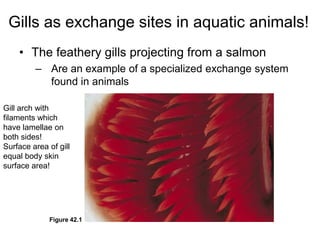
Gills as exchange sites in aquatic animals!Figure 42.1The feathery gills projecting from a salmonAre an example of a specialized exchange system found in animalsGill arch with filaments which have lamellae on both sides!Surface area of gill equal body skin surface area!
Transport systemsFunctionally connect the organs of exchange with the body cells where nutrients and oxygen required!Most complex animals have internal transport systems providing a conduit between the evironment and the cell cytoplasm!
Invertebrate CirculationThe wide range of invertebrate body size and form is paralleled by a great diversity in circulatory systems.  Water vascular system in star fish, open circulatory systems in insects and closed circulatory systems in earth worms and squids.
Gastrovascular CavitiesSimple animals, such as cnidariansHave a body wall only two cells thick that encloses a gastrovascular cavity (recall sea anemone sac with a mouth!)The gastrovascular cavityFunctions in both digestion and distribution of substances throughout the body.  Also gas exchange for cells lining the cavity.
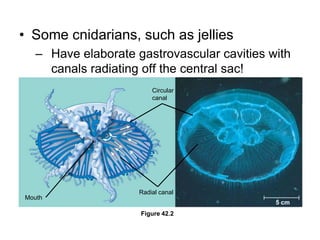
CircularcanalRadial canalMouth5 cmFigure 42.2Some cnidarians, such as jelliesHave elaborate gastrovascular cavities with canals radiating off the central sac!
Open and Closed Circulatory SystemsMore complex animalsHave one of two types of circulatory systems: open or closedBoth of these types of systems have three basic componentsA circulatory fluid (blood)A set of tubes (blood vessels)A muscular pump (the heart)
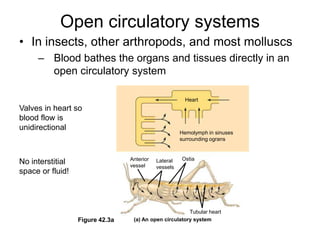
HeartHemolymph in sinusessurrounding ogransOstiaAnterior vesselLateral vesselsTubular heartFigure 42.3a(a) An open circulatory systemOpen circulatory systemsIn insects, other arthropods, and most molluscsBlood bathes the organs and tissues directly in an open circulatory systemValves in heart so blood flow is unidirectional No interstitial space or fluid!
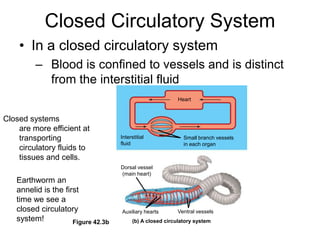
Closed Circulatory System HeartInterstitialfluidSmall branch vessels in each organDorsal vessel(main heart)Ventral vesselsAuxiliary hearts(b) A closed circulatory systemFigure 42.3bIn a closed circulatory systemBlood is confined to vessels and is distinct from the interstitial fluidClosed systemsare more efficient at transporting circulatory fluids to tissues and cells.Earthworm an annelid is the first time we see a closed circulatory system!
Survey of Vertebrate CirculationHumans and other vertebrates have a closed circulatory system often called the cardiovascular system.Blood flows in a closed cardiovascular system consisting of blood vessels and a two- to four-chambered heart.Arteries carry blood from heart to capillariesThe capillaries are the  sites of chemical exchange between the blood and interstitial fluidVeins collect blood from capillaries and return blood to the heart.Types of hearts!
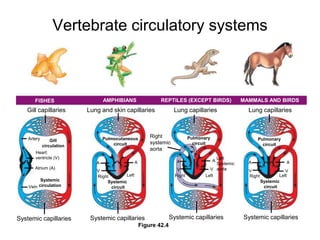
Lung capillariesLung capillariesLung and skin capillariesGill capillariesAMPHIBIANSREPTILES (EXCEPT BIRDS)MAMMALS AND BIRDSFISHES Right systemicaortaPulmonarycircuitPulmocutaneouscircuitArteryPulmonarycircuitGillcirculationHeart:ventricle (V)Left SystemicaortaAAAAAAAtrium (A)VVVVVLeft RightLeft Left RightRightSystemiccirculationSystemic circuitSystemic circuitVeinSystemic capillariesSystemic capillariesSystemic capillariesSystemic capillariesFigure 42.4Vertebrate circulatory systems
Fishes- two chambered heart!A fish heart has two main chambersOne ventricle and one atrium and blood pumped from the ventricle through the gills     where it is loaded with oxygen and unloadsf  CO2.  It then travels through the dorsal aorta to the organs and tissues thru capillary beds and is returned to the heart as venous blood.  Where does heart get its oxygen?  Enough remains in the venous blood.  In some active species (Tuna fishes) a branch off the ventral aorta supplies oxygenated blood to the heart.
AmphibiansFrogs and other amphibians have a three-chambered heart, with two atria and one ventricleThe ventricle pumps blood into a forked artery that splits the ventricle’s output into the pulmocutaneous circuit (lung and skin) and the systemic circuit.  Thus a certain amount of mixing of oxygenated and oxygen poor blood occures.
Reptiles (Except Birds)Reptiles have double circulationWith a pulmonary circuit (lungs) and a systemic circuitTurtles, snakes, and lizardsHave a three-chambered heart.
Mammals and BirdsIn all mammals and birdsThe ventricle is completely divided into separate right and left chambersThe left side of the heart pumps and receives only oxygen-rich bloodWhile the right side receives and pumps only oxygen-poor blood
A powerful four-chambered heartWas an essential adaptation of the endothermic way of life characteristic of mammals and birds.  Reason is because of metabolism being almost 10 times greater than the ectotherms!
A powerful four-chambered heart was an essential adaptation of the endothermic way of life characteristic of mammals and birds.  Reason is because of metabolism being almost 10 times greater than the ectotherms!Double circulation in mammals depends on the anatomy and pumping cycle of the heart (Good model).Heart valves dictate a one-way flow of blood through the heart.Blood begins its flowWith the right ventricle pumping blood to the lungsIn the lungsThe blood loads O2 and unloads CO2
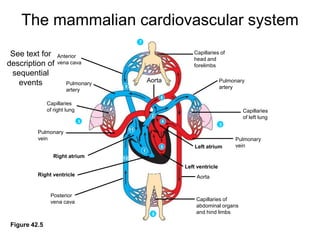
Oxygen-rich blood from the lungsEnters the heart at the left atrium and is pumped to the body tissues by the left ventricleBlood returns to the heartThrough the right atrium
Capillaries ofhead and forelimbs Anteriorvena cavaAortaPulmonaryarteryPulmonaryartery963378Capillariesof right lungCapillariesof left lung2411Pulmonary veinPulmonary veinLeft atrium51Right atrium10Left ventricleRight ventricleAortaPosteriorvena cavaCapillaries ofabdominal organsand hind limbsFigure 42.5The mammalian cardiovascular systemSee text for description of sequential events
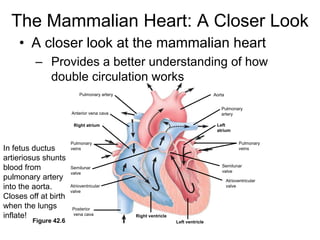
The Mammalian Heart: A Closer LookPulmonary arteryAortaPulmonaryveinsPulmonaryarteryAnterior vena cavaLeftatriumRight atriumPulmonaryveinsAtrioventricularvalveSemilunarvalveSemilunarvalveAtrioventricularvalvePosterior vena cavaRight ventricleFigure 42.6Left ventricleA closer look at the mammalian heartProvides a better understanding of how double circulation worksIn fetus ductus artieriosus shunts blood from pulmonary artery into the aorta.  Closes off at birth when the lungs inflate!
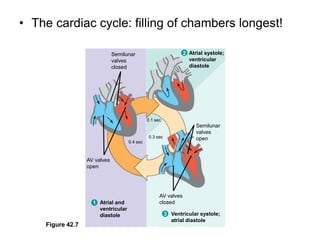
The heart contracts and relaxesIn a rhythmic cycle called the cardiac cycleThe contraction, or pumping, phase of the cycleIs called systoleThe relaxation, or filling, phase of the cycleIs called diastole
Atrial systole; ventricular diastole2Semilunarvalvesclosed0.1 secSemilunarvalvesopen0.3 sec0.4 secAV valvesopenAtrial and ventricular diastoleAV valvesclosed13Ventricular systole; atrial diastoleFigure 42.7The cardiac cycle: filling of chambers longest!
The heart rate, also called the pulseIs the number of beats per minuteThe cardiac outputIs the volume of blood pumped into the systemic circulation per minute and depends on the rate of contraction and the stroke volume (how much blood  is “loaded” into the ventricle during diastole).
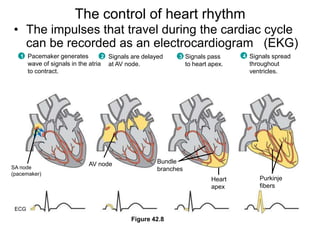
Maintaining the Heart’s Rhythmic BeatSome cardiac muscle cells are self-excitable (myogenic)Meaning they contract without any signal from the nervous system (heart transplant).A region of the heart called the sinoatrial (SA) node, or pacemaker sets the rate and timing at which all cardiac muscle cells contractImpulses from the SA node spread across the atria to the atrioventricular (AV) nodeAt the AV node, the impulses are delayed and then travel down bundle fiber to the  the Purkinje fibers that make the ventricles contract
The impulses that travel during the cardiac cycleCan be recorded as an electrocardiogram (ECG or EKG)
Signals passto heart apex.Signals spreadthroughoutventricles.Pacemaker generates wave of signals in the atriato contract.  Signals are delayedat AV node.BundlebranchesAV nodeSA node(pacemaker)PurkinjefibersHeartapexECG2134Figure 42.8The control of heart rhythmThe impulses that travel during the cardiac cycle can be recorded as an electrocardiogram   (EKG)
The pacemaker is influenced byNerves, hormones, body temperature, and exercise
Blood CirculationThe same physical principles that govern the movement of water in plumbing systemsAlso influence the functioning of animal circulatory systems.Structure of circulatory system is a network of vessels that are differ in structure to accommodate function.
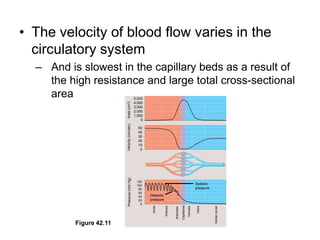
5,0004,0003,0002,0001,0000Area (cm2)50403020100Velocity (cm/sec)120100806040200SystolicpressurePressure (mm Hg)DiastolicpressureAortaVeinsArteriesVenulesCapillariesArteriolesVenae cavaeFigure 42.11The velocity of blood flow varies in the circulatory systemAnd is slowest in the capillary beds as a result of the high resistance and large total cross-sectional area
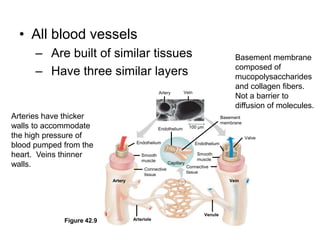
VeinArteryValveEndotheliumBasementmembraneSmoothmuscle100 µmEndotheliumConnectivetissueEndotheliumSmoothmuscleCapillaryConnectivetissueArteryVeinVenuleArterioleFigure 42.9All blood vesselsAre built of similar tissuesHave three similar layersBasement membrane composed of mucopolysaccharides and collagen fibers. Not a barrier to diffusion of molecules.Arteries have thicker walls to accommodate the high pressure of blood pumped from the heart.  Veins thinner walls.
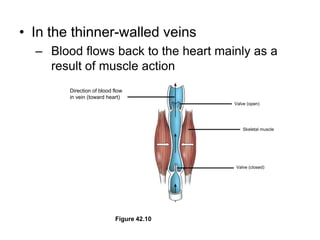
Direction of blood flowin vein (toward heart)Valve (open)Skeletal muscleValve (closed)Figure 42.10In the thinner-walled veinsBlood flows back to the heart mainly as a result of muscle action
Blood Flow VelocityPhysical laws governing the movement of fluids through pipesInfluence blood flow and blood pressure
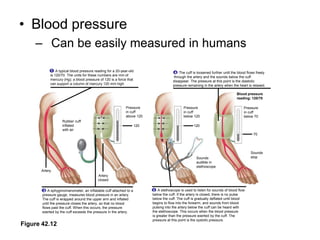
Blood pressureIs the hydrostatic pressure that blood exerts against the wall of a vesselSystolic pressureIs the pressure in the arteries during ventricular systoleIs the highest pressure in the arteriesDiastolic pressureIs the pressure in the arteries during diastoleIs lower than systolic pressure
13     A typical blood pressure reading for a 20-year-oldis 120/70. The units for these numbers are mm of mercury (Hg); a blood pressure of 120 is a force that can support a column of mercury 120 mm high.4      The cuff is loosened further until the blood flows freely through the artery and the sounds below the cuff disappear. The pressure at this point is the diastolic pressure remaining in the artery when the heart is relaxed.Blood pressurereading: 120/70Pressurein cuff above 120Pressurein cuff below 120Pressurein cuff below 70Rubber cuffinflatedwith air12012070Sounds stopSounds audible instethoscopeArteryArteryclosed     A stethoscope is used to listen for sounds of blood flow below the cuff. If the artery is closed, there is no pulse below the cuff. The cuff is gradually deflated until blood begins to flow into the forearm, and sounds from blood pulsing into the artery below the cuff can be heard with the stethoscope. This occurs when the blood pressure is greater than the pressure exerted by the cuff. The pressure at this point is the systolic pressure.     A sphygmomanometer, an inflatable cuff attached to apressure gauge, measures blood pressure in an artery.The cuff is wrapped around the upper arm and inflated until the pressure closes the artery, so that no blood flows past the cuff. When this occurs, the pressure exerted by the cuff exceeds the pressure in the artery.2Figure 42.12Blood pressureCan be easily measured in humans
Blood pressure is determined partly by cardiac outputAnd partly by peripheral resistance due to variable constriction of the arterioles (anaphylactic shock).  For high blood pressure try and reduce peripheral resistance using smooth muscle relaxants!
Capillary FunctionCapillaries in major organs are usually filled to capacityBut in many other sites, the blood supply varies.  Homeostatic mechanisms involved to keep blood pressure constant!
Control of Blood Flow Through CapillariesTwo mechanismsRegulate the distribution of blood in capillary bedsIn one mechanismContraction of the smooth muscle layer in the wall of an arteriole constricts the vessel
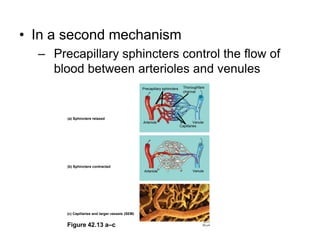
ThoroughfarechannelPrecapillary sphincters(a) Sphincters relaxedVenuleArterioleCapillaries(b) Sphincters contractedVenuleArteriole(c) Capillaries and larger vessels (SEM) Figure 42.13 a–c20 mIn a second mechanismPrecapillary sphincters control the flow of blood between arterioles and venules
The critical exchange of substances between the blood and interstitial fluidTakes place across the thin endothelial walls of the capillaries
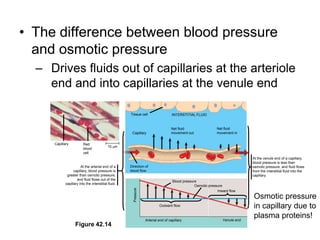
Tissue cellINTERSTITIAL FLUIDNet fluidmovement inNet fluidmovement outCapillaryCapillaryRedbloodcell15 mAt the venule end of a capillary, blood pressure is less than osmotic pressure, and fluid flows from the interstitial fluid into the capillary.Direction of blood flowAt the arterial end of acapillary, blood pressure isgreater than osmotic pressure,and fluid flows out of thecapillary into the interstitial fluid.Blood pressureOsmotic pressureInward flowPressureOutward flowVenule endArterial end of capillaryFigure 42.14The difference between blood pressure and osmotic pressureDrives fluids out of capillaries at the arteriole end and into capillaries at the venule endOsmotic pressure in capillary due to plasma proteins!
Fluid Return by the Lymphatic SystemThe lymphatic systemReturns fluid to the body from the capillary bedsAids in body defense because it passes through lymph nodes where white blood cells take out any pathogens or foreign material!Fluid reenters the circulationDirectly at the venous end of the capillary bed and indirectly through the lymphatic system
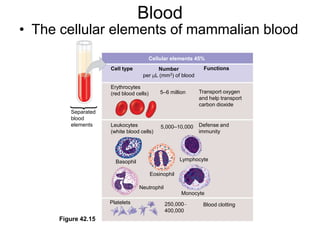
BloodSeparatedbloodelementsThe cellular elements of mammalian bloodCellular elements 45%FunctionsCell typeNumberper L (mm3) of bloodErythrocytes(red blood cells)Transport oxygenand help transportcarbon dioxide5–6 millionDefense andimmunityLeukocytes(white blood cells)5,000–10,000LymphocyteBasophilEosinophilNeutrophilMonocytePlatelets250,000400,000 Blood clottingFigure 42.15
PlasmaBlood plasma is about 90% waterAmong its many solutes areInorganic salts in the form of dissolved ions, sometimes referred to as electrolytes
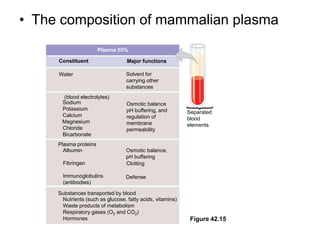
Plasma 55%ConstituentMajor functionsSolvent forcarrying othersubstancesWater(blood electrolytes)SodiumPotassiumCalciumMagnesiumChlorideBicarbonateOsmotic balancepH buffering, andregulation of membranepermeabilitySeparatedbloodelementsPlasma proteinsAlbuminFibringenImmunoglobulins(antibodies)Osmotic balance,pH bufferingClottingDefenseSubstances transported by bloodNutrients (such as glucose, fatty acids, vitamins)Waste products of metabolismRespiratory gases (O2 and CO2)HormonesFigure 42.15The composition of mammalian plasma
ErythrocytesRed blood cells, or erythrocytesAre by far the most numerous blood cellsTransport oxygen throughout the bodyPlatelets function in blood clotting
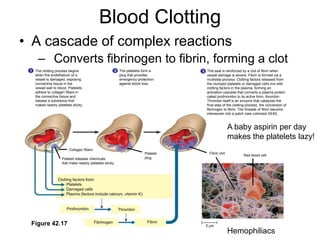
Blood Clotting3The clotting process begins when the endothelium of a vessel is damaged, exposing connective tissue in the vessel wall to blood. Plateletsadhere to collagen fibers in the connective tissue and release a substance thatmakes nearby platelets sticky.The platelets form a plug that providesemergency protectionagainst blood loss.This seal is reinforced by a clot of fibrin when vessel damage is severe. Fibrin is formed via amultistep process: Clotting factors released fromthe clumped platelets or damaged cells mix withclotting factors in the plasma, forming an   activation cascade that converts a plasma proteincalled prothrombin to its active form, thrombin.Thrombin itself is an enzyme that catalyzes the final step of the clotting process, the conversion of fibrinogen to fibrin. The threads of fibrin become interwoven into a patch (see colorized SEM).21Collagen fibersFibrin clotPlateletplugRed blood cellPlatelet releases chemicalsthat make nearby platelets sticky  Clotting factors from:	Platelets	Damaged cells	Plasma (factors include calcium, vitamin K)ProthrombinThrombin FibrinFigure 42.17Fibrinogen5 µmA cascade of complex reactionsConverts fibrinogen to fibrin, forming a clotA baby aspirin per day makes the platelets lazy!Hemophiliacs

04 17-06

  • 1.
    Circulation andGas Exchange Chapter 42 (all)4-17-06
  • 2.
    Overview: Trading withthe EnvironmentEvery organism must exchange materials with its environment (whether it be nutrients or gases (oxygen and carbon dioxide)And this exchange ultimately occurs at the cellular level
  • 3.
    In unicellular organismsTheseexchanges occur directly with the environment across the cell membrane. Diffusion is adequate for necessary rapid exchange.For most of the cells making up multicellular organisms direct exchange with the environment is not possible because diffusion distances are too great! Therefore specialized exchange and transport systems have evolved!
  • 4.
    Gills as exchangesites in aquatic animals!Figure 42.1The feathery gills projecting from a salmonAre an example of a specialized exchange system found in animalsGill arch with filaments which have lamellae on both sides!Surface area of gill equal body skin surface area!
  • 5.
    Transport systemsFunctionally connectthe organs of exchange with the body cells where nutrients and oxygen required!Most complex animals have internal transport systems providing a conduit between the evironment and the cell cytoplasm!
  • 6.
    Invertebrate CirculationThe widerange of invertebrate body size and form is paralleled by a great diversity in circulatory systems. Water vascular system in star fish, open circulatory systems in insects and closed circulatory systems in earth worms and squids.
  • 7.
    Gastrovascular CavitiesSimple animals,such as cnidariansHave a body wall only two cells thick that encloses a gastrovascular cavity (recall sea anemone sac with a mouth!)The gastrovascular cavityFunctions in both digestion and distribution of substances throughout the body. Also gas exchange for cells lining the cavity.
  • 8.
    CircularcanalRadial canalMouth5 cmFigure42.2Some cnidarians, such as jelliesHave elaborate gastrovascular cavities with canals radiating off the central sac!
  • 9.
    Open and ClosedCirculatory SystemsMore complex animalsHave one of two types of circulatory systems: open or closedBoth of these types of systems have three basic componentsA circulatory fluid (blood)A set of tubes (blood vessels)A muscular pump (the heart)
  • 10.
    HeartHemolymph in sinusessurroundingogransOstiaAnterior vesselLateral vesselsTubular heartFigure 42.3a(a) An open circulatory systemOpen circulatory systemsIn insects, other arthropods, and most molluscsBlood bathes the organs and tissues directly in an open circulatory systemValves in heart so blood flow is unidirectional No interstitial space or fluid!
  • 11.
    Closed Circulatory SystemHeartInterstitialfluidSmall branch vessels in each organDorsal vessel(main heart)Ventral vesselsAuxiliary hearts(b) A closed circulatory systemFigure 42.3bIn a closed circulatory systemBlood is confined to vessels and is distinct from the interstitial fluidClosed systemsare more efficient at transporting circulatory fluids to tissues and cells.Earthworm an annelid is the first time we see a closed circulatory system!
  • 12.
    Survey of VertebrateCirculationHumans and other vertebrates have a closed circulatory system often called the cardiovascular system.Blood flows in a closed cardiovascular system consisting of blood vessels and a two- to four-chambered heart.Arteries carry blood from heart to capillariesThe capillaries are the sites of chemical exchange between the blood and interstitial fluidVeins collect blood from capillaries and return blood to the heart.Types of hearts!
  • 13.
    Lung capillariesLung capillariesLungand skin capillariesGill capillariesAMPHIBIANSREPTILES (EXCEPT BIRDS)MAMMALS AND BIRDSFISHES Right systemicaortaPulmonarycircuitPulmocutaneouscircuitArteryPulmonarycircuitGillcirculationHeart:ventricle (V)Left SystemicaortaAAAAAAAtrium (A)VVVVVLeft RightLeft Left RightRightSystemiccirculationSystemic circuitSystemic circuitVeinSystemic capillariesSystemic capillariesSystemic capillariesSystemic capillariesFigure 42.4Vertebrate circulatory systems
  • 14.
    Fishes- two chamberedheart!A fish heart has two main chambersOne ventricle and one atrium and blood pumped from the ventricle through the gills where it is loaded with oxygen and unloadsf CO2. It then travels through the dorsal aorta to the organs and tissues thru capillary beds and is returned to the heart as venous blood. Where does heart get its oxygen? Enough remains in the venous blood. In some active species (Tuna fishes) a branch off the ventral aorta supplies oxygenated blood to the heart.
  • 15.
    AmphibiansFrogs and otheramphibians have a three-chambered heart, with two atria and one ventricleThe ventricle pumps blood into a forked artery that splits the ventricle’s output into the pulmocutaneous circuit (lung and skin) and the systemic circuit. Thus a certain amount of mixing of oxygenated and oxygen poor blood occures.
  • 16.
    Reptiles (Except Birds)Reptileshave double circulationWith a pulmonary circuit (lungs) and a systemic circuitTurtles, snakes, and lizardsHave a three-chambered heart.
  • 17.
    Mammals and BirdsInall mammals and birdsThe ventricle is completely divided into separate right and left chambersThe left side of the heart pumps and receives only oxygen-rich bloodWhile the right side receives and pumps only oxygen-poor blood
  • 18.
    A powerful four-chamberedheartWas an essential adaptation of the endothermic way of life characteristic of mammals and birds. Reason is because of metabolism being almost 10 times greater than the ectotherms!
  • 19.
    A powerful four-chamberedheart was an essential adaptation of the endothermic way of life characteristic of mammals and birds. Reason is because of metabolism being almost 10 times greater than the ectotherms!Double circulation in mammals depends on the anatomy and pumping cycle of the heart (Good model).Heart valves dictate a one-way flow of blood through the heart.Blood begins its flowWith the right ventricle pumping blood to the lungsIn the lungsThe blood loads O2 and unloads CO2
  • 20.
    Oxygen-rich blood fromthe lungsEnters the heart at the left atrium and is pumped to the body tissues by the left ventricleBlood returns to the heartThrough the right atrium
  • 21.
    Capillaries ofhead andforelimbs Anteriorvena cavaAortaPulmonaryarteryPulmonaryartery963378Capillariesof right lungCapillariesof left lung2411Pulmonary veinPulmonary veinLeft atrium51Right atrium10Left ventricleRight ventricleAortaPosteriorvena cavaCapillaries ofabdominal organsand hind limbsFigure 42.5The mammalian cardiovascular systemSee text for description of sequential events
  • 22.
    The Mammalian Heart:A Closer LookPulmonary arteryAortaPulmonaryveinsPulmonaryarteryAnterior vena cavaLeftatriumRight atriumPulmonaryveinsAtrioventricularvalveSemilunarvalveSemilunarvalveAtrioventricularvalvePosterior vena cavaRight ventricleFigure 42.6Left ventricleA closer look at the mammalian heartProvides a better understanding of how double circulation worksIn fetus ductus artieriosus shunts blood from pulmonary artery into the aorta. Closes off at birth when the lungs inflate!
  • 23.
    The heart contractsand relaxesIn a rhythmic cycle called the cardiac cycleThe contraction, or pumping, phase of the cycleIs called systoleThe relaxation, or filling, phase of the cycleIs called diastole
  • 24.
    Atrial systole; ventriculardiastole2Semilunarvalvesclosed0.1 secSemilunarvalvesopen0.3 sec0.4 secAV valvesopenAtrial and ventricular diastoleAV valvesclosed13Ventricular systole; atrial diastoleFigure 42.7The cardiac cycle: filling of chambers longest!
  • 25.
    The heart rate,also called the pulseIs the number of beats per minuteThe cardiac outputIs the volume of blood pumped into the systemic circulation per minute and depends on the rate of contraction and the stroke volume (how much blood is “loaded” into the ventricle during diastole).
  • 26.
    Maintaining the Heart’sRhythmic BeatSome cardiac muscle cells are self-excitable (myogenic)Meaning they contract without any signal from the nervous system (heart transplant).A region of the heart called the sinoatrial (SA) node, or pacemaker sets the rate and timing at which all cardiac muscle cells contractImpulses from the SA node spread across the atria to the atrioventricular (AV) nodeAt the AV node, the impulses are delayed and then travel down bundle fiber to the the Purkinje fibers that make the ventricles contract
  • 27.
    The impulses thattravel during the cardiac cycleCan be recorded as an electrocardiogram (ECG or EKG)
  • 28.
    Signals passto heartapex.Signals spreadthroughoutventricles.Pacemaker generates wave of signals in the atriato contract. Signals are delayedat AV node.BundlebranchesAV nodeSA node(pacemaker)PurkinjefibersHeartapexECG2134Figure 42.8The control of heart rhythmThe impulses that travel during the cardiac cycle can be recorded as an electrocardiogram (EKG)
  • 29.
    The pacemaker isinfluenced byNerves, hormones, body temperature, and exercise
  • 30.
    Blood CirculationThe samephysical principles that govern the movement of water in plumbing systemsAlso influence the functioning of animal circulatory systems.Structure of circulatory system is a network of vessels that are differ in structure to accommodate function.
  • 31.
    5,0004,0003,0002,0001,0000Area (cm2)50403020100Velocity (cm/sec)120100806040200SystolicpressurePressure(mm Hg)DiastolicpressureAortaVeinsArteriesVenulesCapillariesArteriolesVenae cavaeFigure 42.11The velocity of blood flow varies in the circulatory systemAnd is slowest in the capillary beds as a result of the high resistance and large total cross-sectional area
  • 32.
    VeinArteryValveEndotheliumBasementmembraneSmoothmuscle100 µmEndotheliumConnectivetissueEndotheliumSmoothmuscleCapillaryConnectivetissueArteryVeinVenuleArterioleFigure 42.9Allblood vesselsAre built of similar tissuesHave three similar layersBasement membrane composed of mucopolysaccharides and collagen fibers. Not a barrier to diffusion of molecules.Arteries have thicker walls to accommodate the high pressure of blood pumped from the heart. Veins thinner walls.
  • 33.
    Direction of bloodflowin vein (toward heart)Valve (open)Skeletal muscleValve (closed)Figure 42.10In the thinner-walled veinsBlood flows back to the heart mainly as a result of muscle action
  • 34.
    Blood Flow VelocityPhysicallaws governing the movement of fluids through pipesInfluence blood flow and blood pressure
  • 35.
    Blood pressureIs thehydrostatic pressure that blood exerts against the wall of a vesselSystolic pressureIs the pressure in the arteries during ventricular systoleIs the highest pressure in the arteriesDiastolic pressureIs the pressure in the arteries during diastoleIs lower than systolic pressure
  • 36.
    13 A typical blood pressure reading for a 20-year-oldis 120/70. The units for these numbers are mm of mercury (Hg); a blood pressure of 120 is a force that can support a column of mercury 120 mm high.4 The cuff is loosened further until the blood flows freely through the artery and the sounds below the cuff disappear. The pressure at this point is the diastolic pressure remaining in the artery when the heart is relaxed.Blood pressurereading: 120/70Pressurein cuff above 120Pressurein cuff below 120Pressurein cuff below 70Rubber cuffinflatedwith air12012070Sounds stopSounds audible instethoscopeArteryArteryclosed A stethoscope is used to listen for sounds of blood flow below the cuff. If the artery is closed, there is no pulse below the cuff. The cuff is gradually deflated until blood begins to flow into the forearm, and sounds from blood pulsing into the artery below the cuff can be heard with the stethoscope. This occurs when the blood pressure is greater than the pressure exerted by the cuff. The pressure at this point is the systolic pressure. A sphygmomanometer, an inflatable cuff attached to apressure gauge, measures blood pressure in an artery.The cuff is wrapped around the upper arm and inflated until the pressure closes the artery, so that no blood flows past the cuff. When this occurs, the pressure exerted by the cuff exceeds the pressure in the artery.2Figure 42.12Blood pressureCan be easily measured in humans
  • 37.
    Blood pressure isdetermined partly by cardiac outputAnd partly by peripheral resistance due to variable constriction of the arterioles (anaphylactic shock). For high blood pressure try and reduce peripheral resistance using smooth muscle relaxants!
  • 38.
    Capillary FunctionCapillaries inmajor organs are usually filled to capacityBut in many other sites, the blood supply varies. Homeostatic mechanisms involved to keep blood pressure constant!
  • 39.
    Control of BloodFlow Through CapillariesTwo mechanismsRegulate the distribution of blood in capillary bedsIn one mechanismContraction of the smooth muscle layer in the wall of an arteriole constricts the vessel
  • 40.
    ThoroughfarechannelPrecapillary sphincters(a) SphinctersrelaxedVenuleArterioleCapillaries(b) Sphincters contractedVenuleArteriole(c) Capillaries and larger vessels (SEM) Figure 42.13 a–c20 mIn a second mechanismPrecapillary sphincters control the flow of blood between arterioles and venules
  • 41.
    The critical exchangeof substances between the blood and interstitial fluidTakes place across the thin endothelial walls of the capillaries
  • 42.
    Tissue cellINTERSTITIAL FLUIDNetfluidmovement inNet fluidmovement outCapillaryCapillaryRedbloodcell15 mAt the venule end of a capillary, blood pressure is less than osmotic pressure, and fluid flows from the interstitial fluid into the capillary.Direction of blood flowAt the arterial end of acapillary, blood pressure isgreater than osmotic pressure,and fluid flows out of thecapillary into the interstitial fluid.Blood pressureOsmotic pressureInward flowPressureOutward flowVenule endArterial end of capillaryFigure 42.14The difference between blood pressure and osmotic pressureDrives fluids out of capillaries at the arteriole end and into capillaries at the venule endOsmotic pressure in capillary due to plasma proteins!
  • 43.
    Fluid Return bythe Lymphatic SystemThe lymphatic systemReturns fluid to the body from the capillary bedsAids in body defense because it passes through lymph nodes where white blood cells take out any pathogens or foreign material!Fluid reenters the circulationDirectly at the venous end of the capillary bed and indirectly through the lymphatic system
  • 44.
    BloodSeparatedbloodelementsThe cellular elementsof mammalian bloodCellular elements 45%FunctionsCell typeNumberper L (mm3) of bloodErythrocytes(red blood cells)Transport oxygenand help transportcarbon dioxide5–6 millionDefense andimmunityLeukocytes(white blood cells)5,000–10,000LymphocyteBasophilEosinophilNeutrophilMonocytePlatelets250,000400,000 Blood clottingFigure 42.15
  • 45.
    PlasmaBlood plasma isabout 90% waterAmong its many solutes areInorganic salts in the form of dissolved ions, sometimes referred to as electrolytes
  • 46.
    Plasma 55%ConstituentMajor functionsSolventforcarrying othersubstancesWater(blood electrolytes)SodiumPotassiumCalciumMagnesiumChlorideBicarbonateOsmotic balancepH buffering, andregulation of membranepermeabilitySeparatedbloodelementsPlasma proteinsAlbuminFibringenImmunoglobulins(antibodies)Osmotic balance,pH bufferingClottingDefenseSubstances transported by bloodNutrients (such as glucose, fatty acids, vitamins)Waste products of metabolismRespiratory gases (O2 and CO2)HormonesFigure 42.15The composition of mammalian plasma
  • 47.
    ErythrocytesRed blood cells,or erythrocytesAre by far the most numerous blood cellsTransport oxygen throughout the bodyPlatelets function in blood clotting
  • 48.
    Blood Clotting3The clottingprocess begins when the endothelium of a vessel is damaged, exposing connective tissue in the vessel wall to blood. Plateletsadhere to collagen fibers in the connective tissue and release a substance thatmakes nearby platelets sticky.The platelets form a plug that providesemergency protectionagainst blood loss.This seal is reinforced by a clot of fibrin when vessel damage is severe. Fibrin is formed via amultistep process: Clotting factors released fromthe clumped platelets or damaged cells mix withclotting factors in the plasma, forming an activation cascade that converts a plasma proteincalled prothrombin to its active form, thrombin.Thrombin itself is an enzyme that catalyzes the final step of the clotting process, the conversion of fibrinogen to fibrin. The threads of fibrin become interwoven into a patch (see colorized SEM).21Collagen fibersFibrin clotPlateletplugRed blood cellPlatelet releases chemicalsthat make nearby platelets sticky Clotting factors from: Platelets Damaged cells Plasma (factors include calcium, vitamin K)ProthrombinThrombin FibrinFigure 42.17Fibrinogen5 µmA cascade of complex reactionsConverts fibrinogen to fibrin, forming a clotA baby aspirin per day makes the platelets lazy!Hemophiliacs