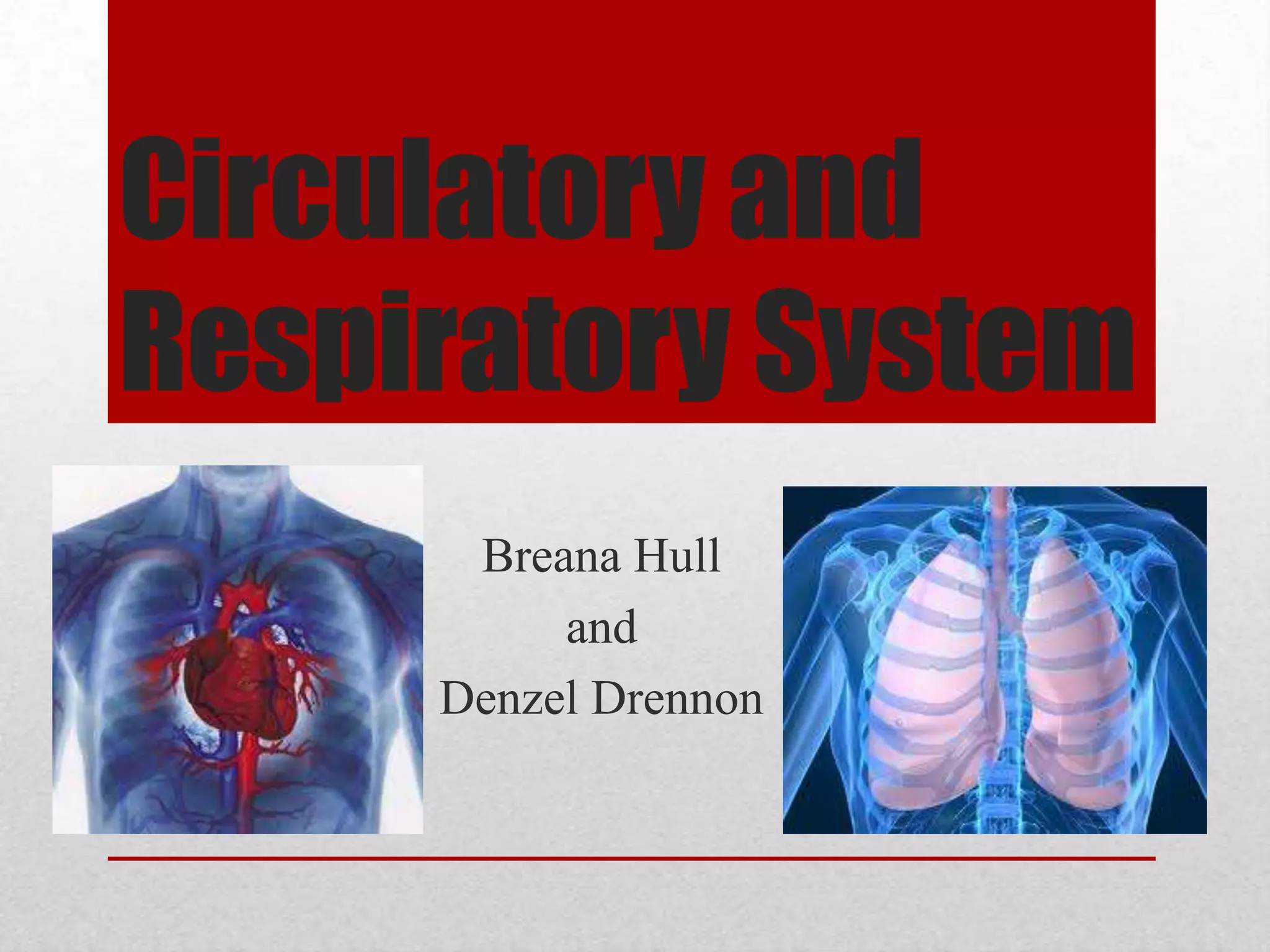
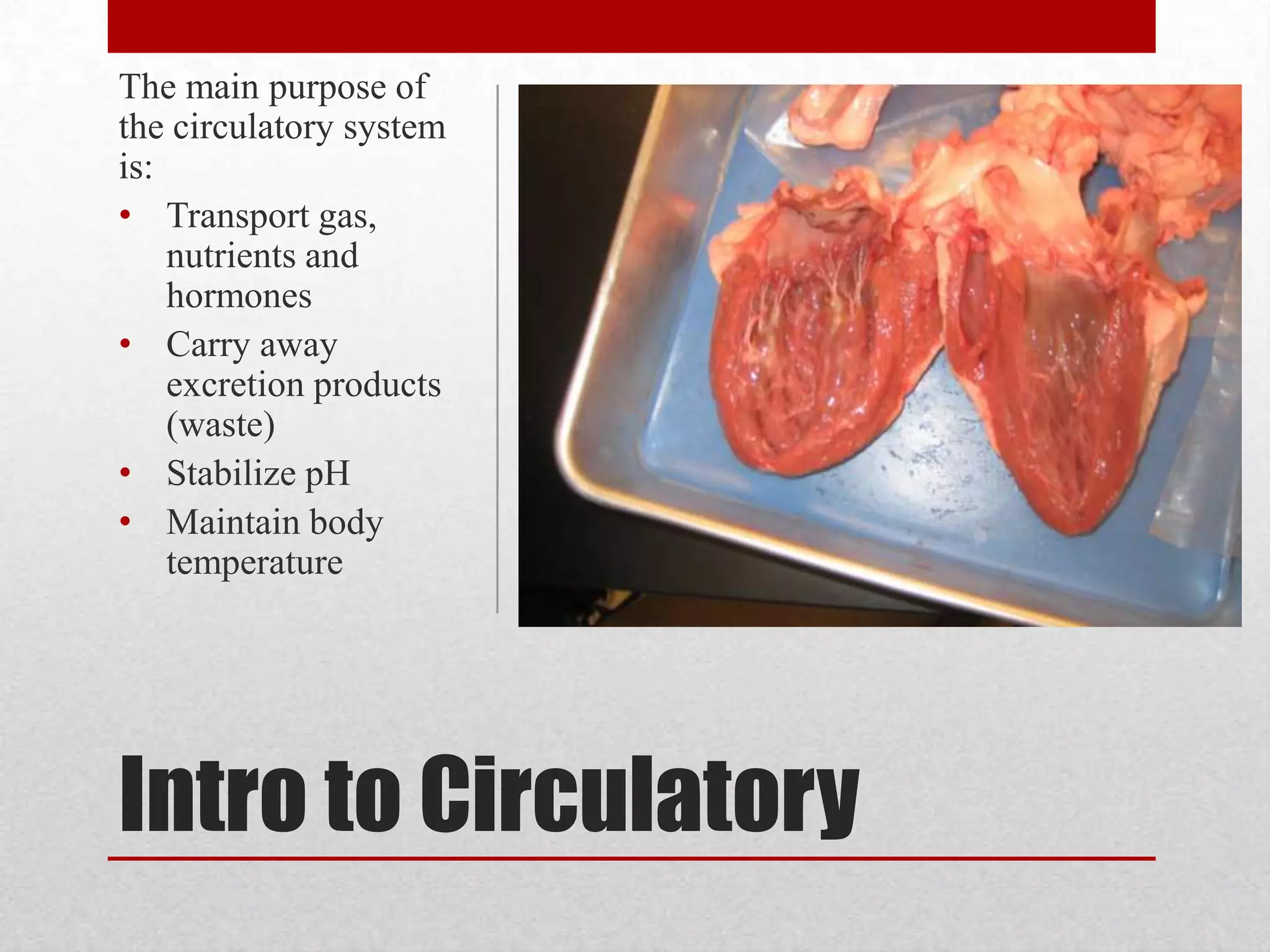

Circulatory and Respiratory SystemBreana Hull and Denzel Drennon
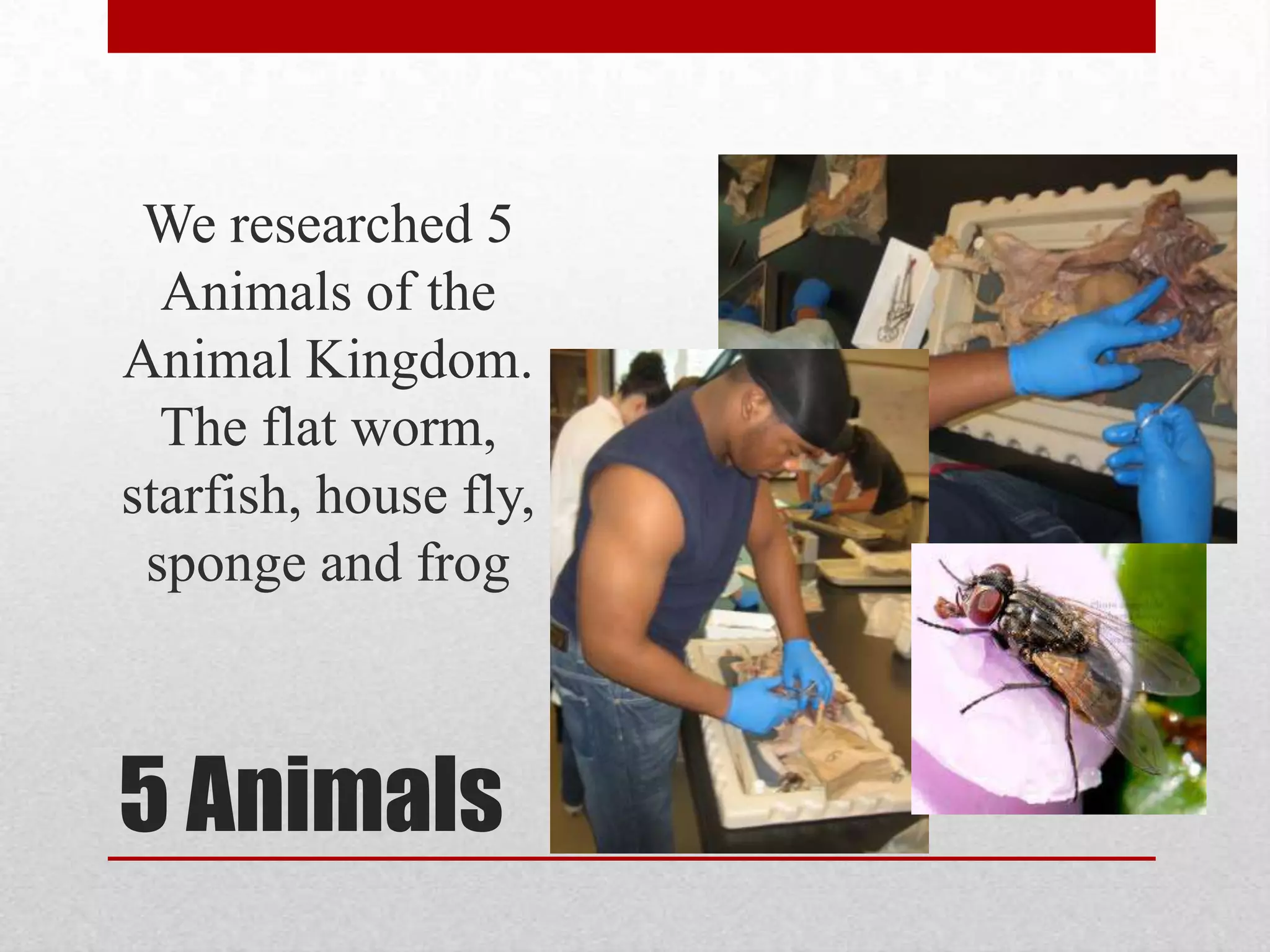
Intro to CirculatoryThe main purpose of the circulatory system is:Transport gas, nutrients and hormones
Carry away excretion products (waste)
Stabilize pH
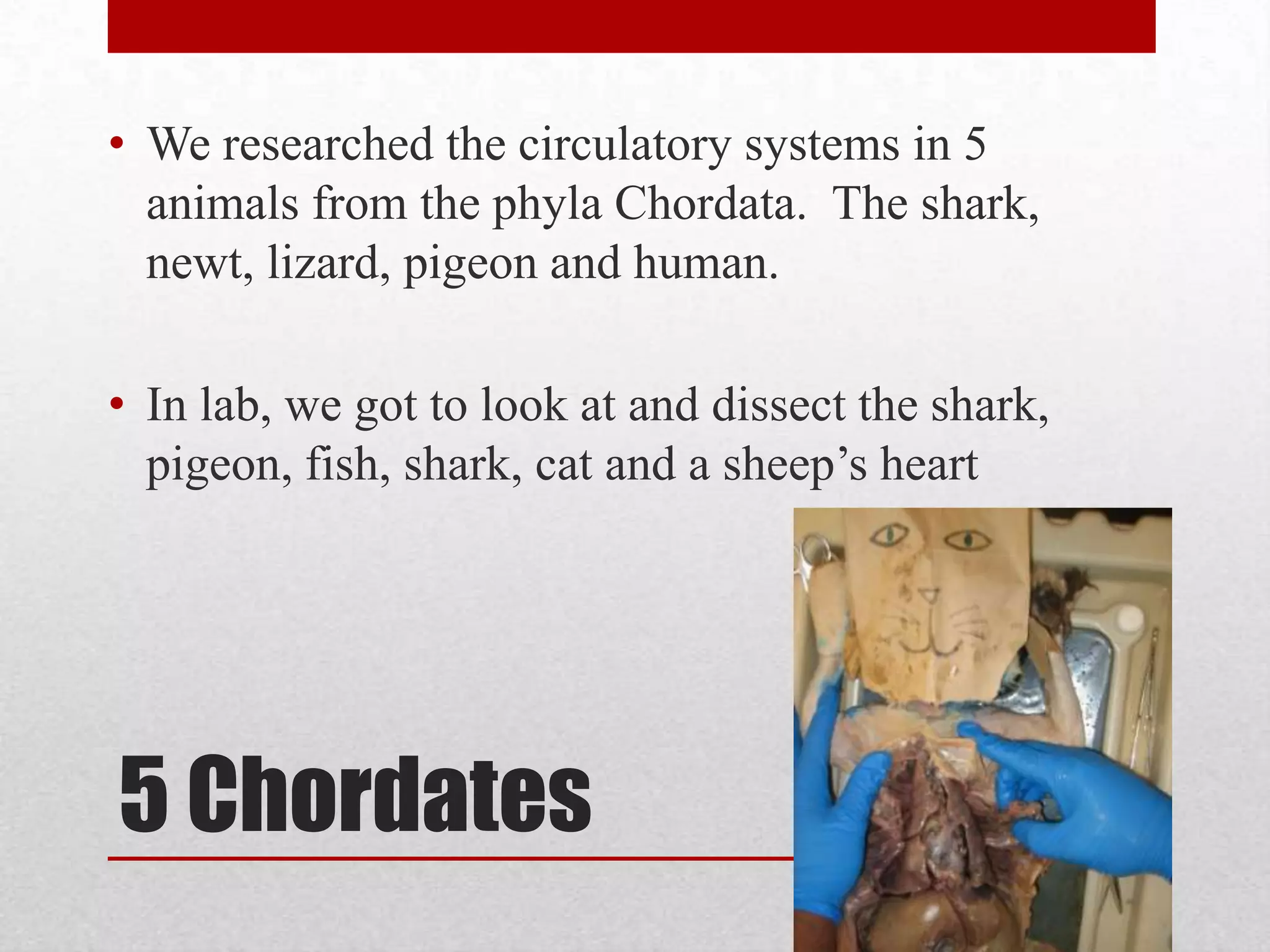
Maintain body temperature5 Animals We researched 5 Animals of the Animal Kingdom. The flat worm, starfish, house fly, sponge and frog
5 ChordatesWe researched the circulatory systems in 5 animals from the phyla Chordata.  The shark, newt, lizard, pigeon and human.In lab, we got to look at and dissect the shark, pigeon, fish, shark, cat and a sheep’s heart
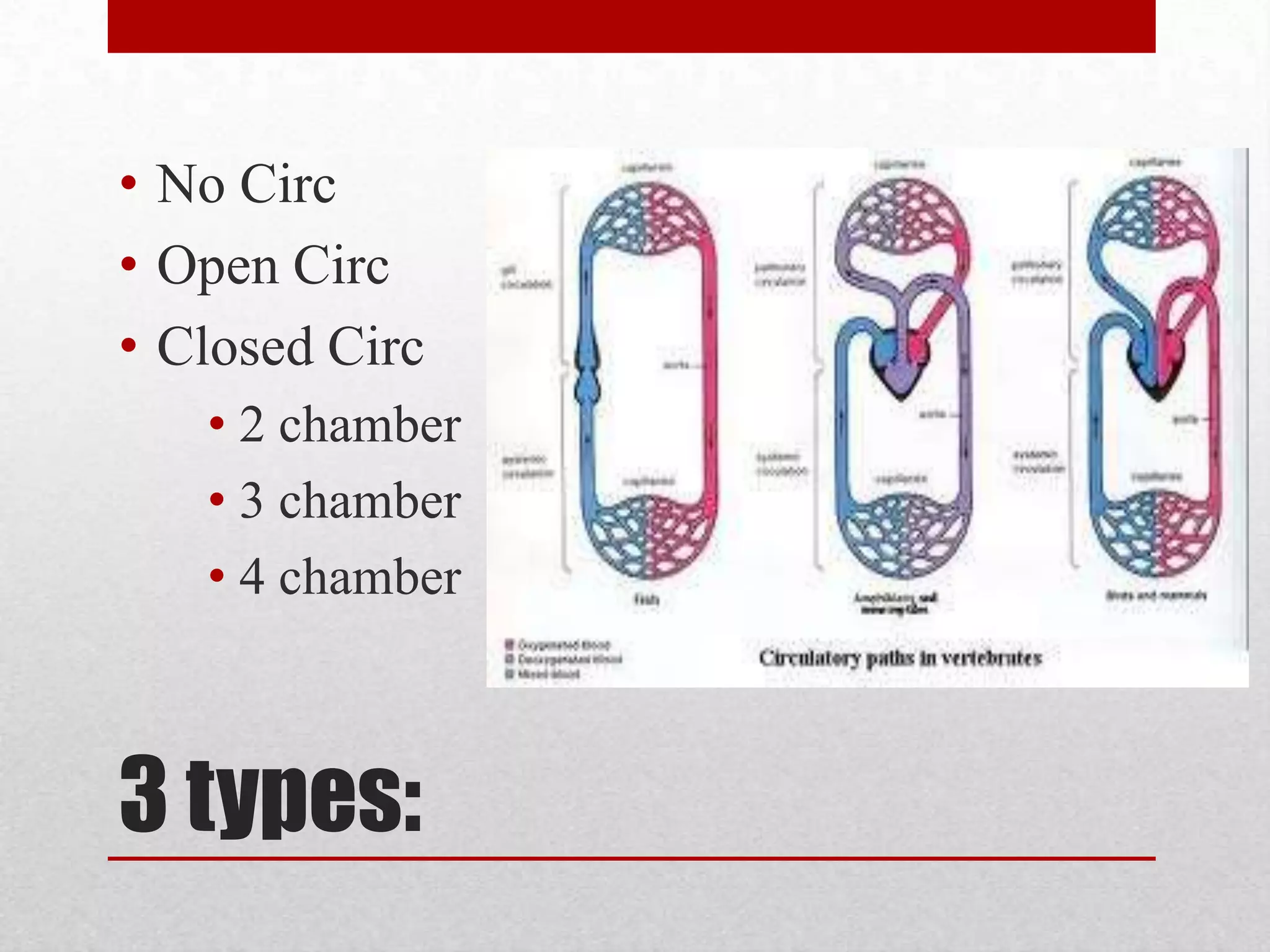
3 types:No CircOpen CircClosed Circ2 chamber3 chamber4 chamber
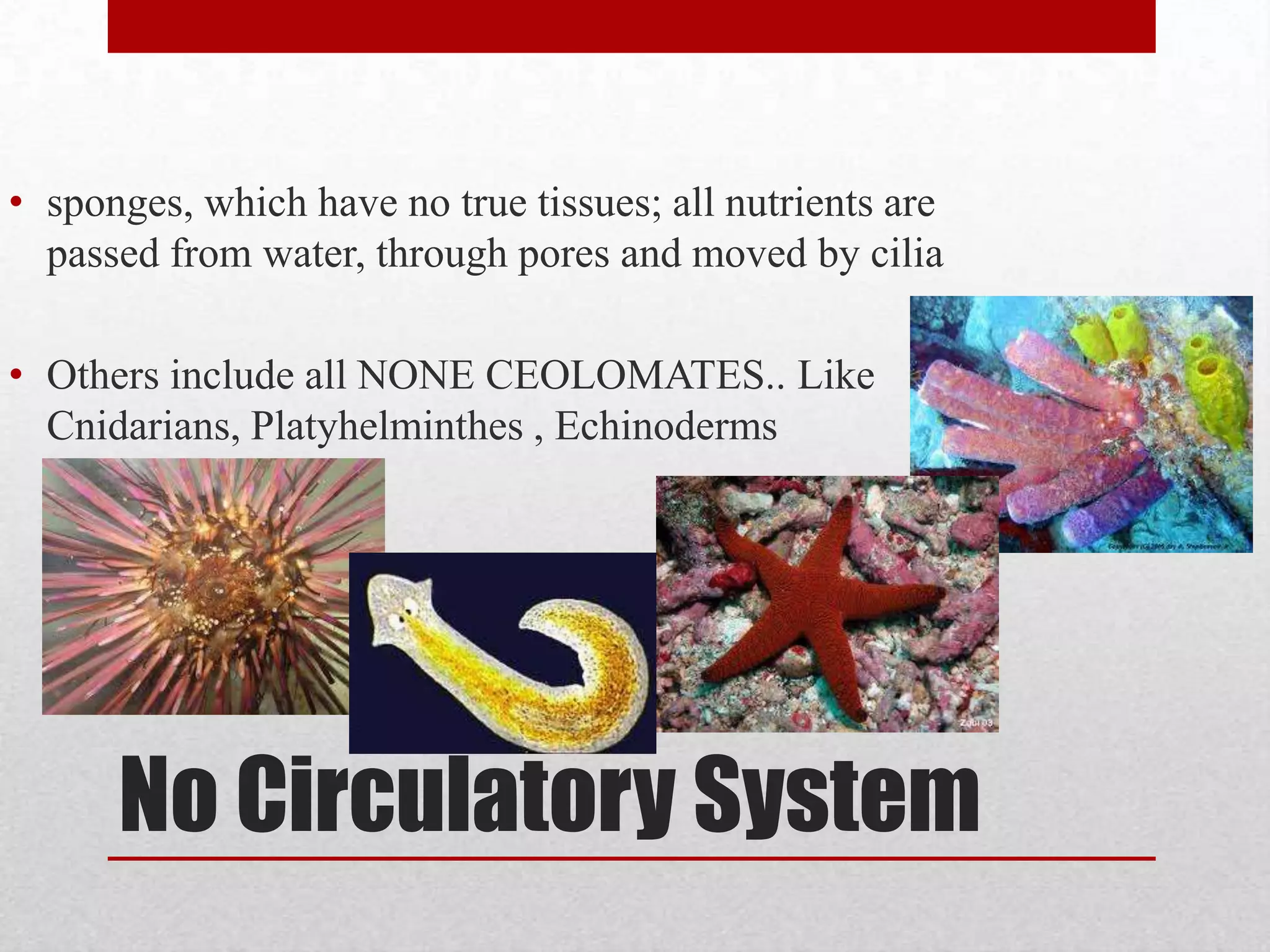
No Circulatory Systemsponges, which have no true tissues; all nutrients are passed from water, through pores and moved by ciliaOthers include all NONE CEOLOMATES.. Like Cnidarians, Platyhelminthes , Echinoderms
Open Circulatory System Heart to blood vessels then leaves into body cavities tissues, a body cavity and more complex structures like organsIn this system blood is a mixture of plasma and cells called hemolymph that flows freely throughout the cavity, bathing the organs, in and around them.  The blood it close enough to contact with the air that they can also use that for oxygen transfer. Arthropods and mollusks
Most efficient, no open in cavity; vertebratesBlood enclosed in heart, vessels, veins, arteries, valves and capillaries Blood cells= cells and plasma=hemoglobinthat help better cover a bigger surface area, flow more blood throughout the body and lungs and to maintain a higher amount of energy)Closed Circulatory System
Under a closed system there is a greater detail of evolution that differs between vertebrates in heart structure2 chamber …3 chamber …4 chamber …      Heart
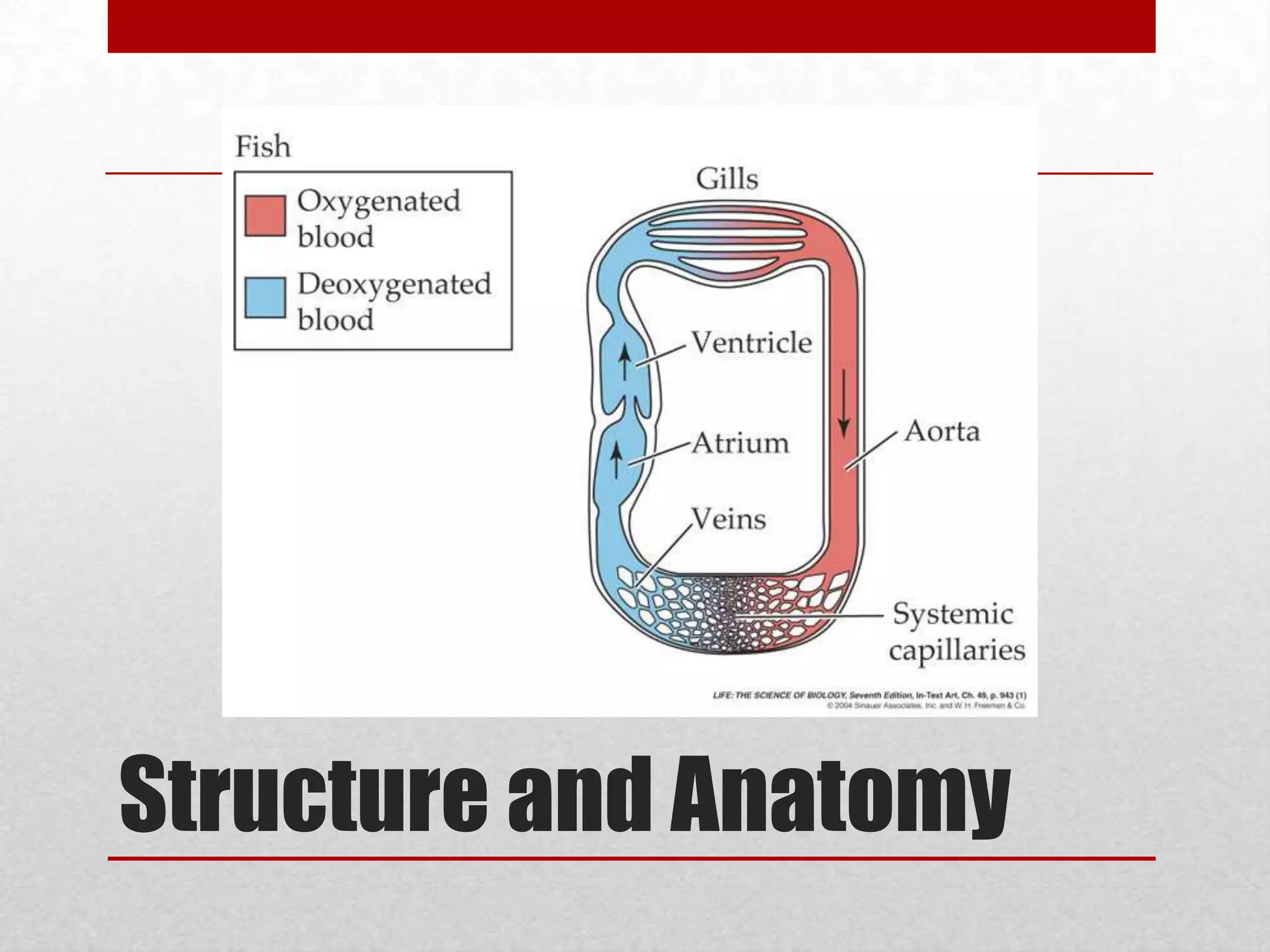
2 Chamber one atrium and one ventricleblood directly pumps to all the body, lungs or gillsrequires lower blood pressure because of their lower body activity
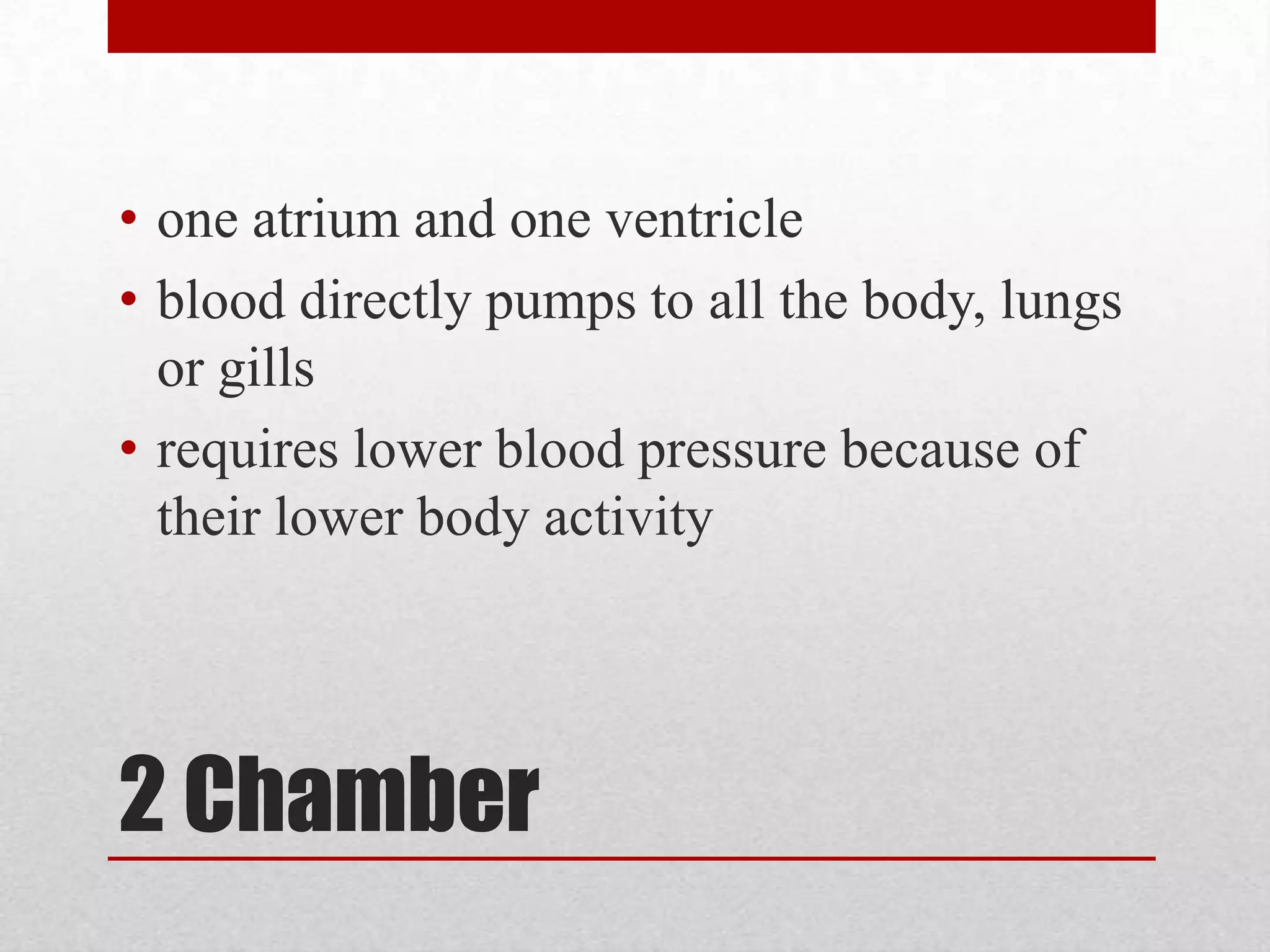
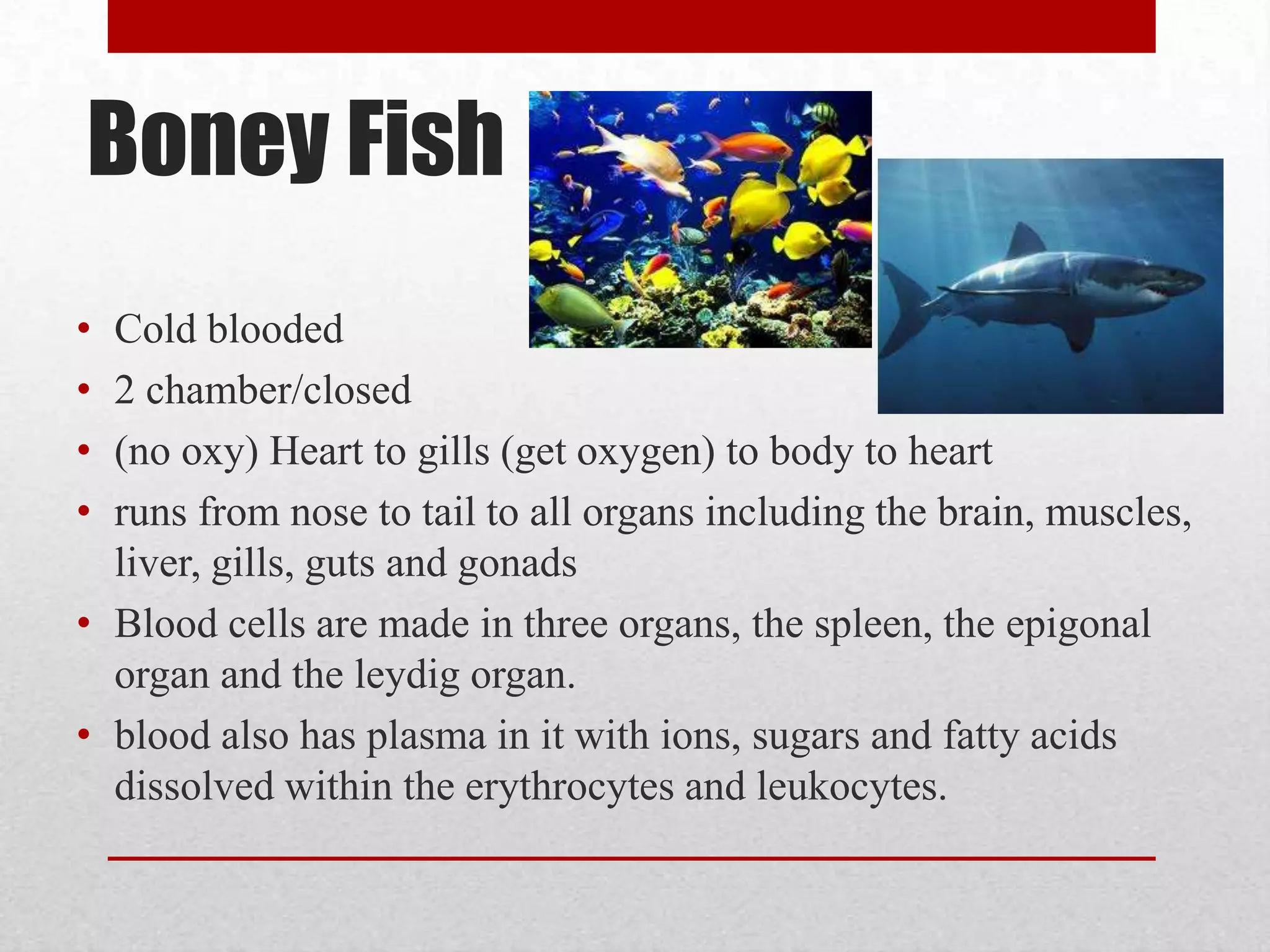
Boney FishCold blooded2 chamber/closed(no oxy) Heart to gills (get oxygen) to body to heartruns from nose to tail to all organs including the brain, muscles, liver, gills, guts and gonads  Blood cells are made in three organs, the spleen, the epigonal organ and the leydig organ.  blood also has plasma in it with ions, sugars and fatty acids dissolved within the erythrocytes and leukocytes.
Structure and Anatomy
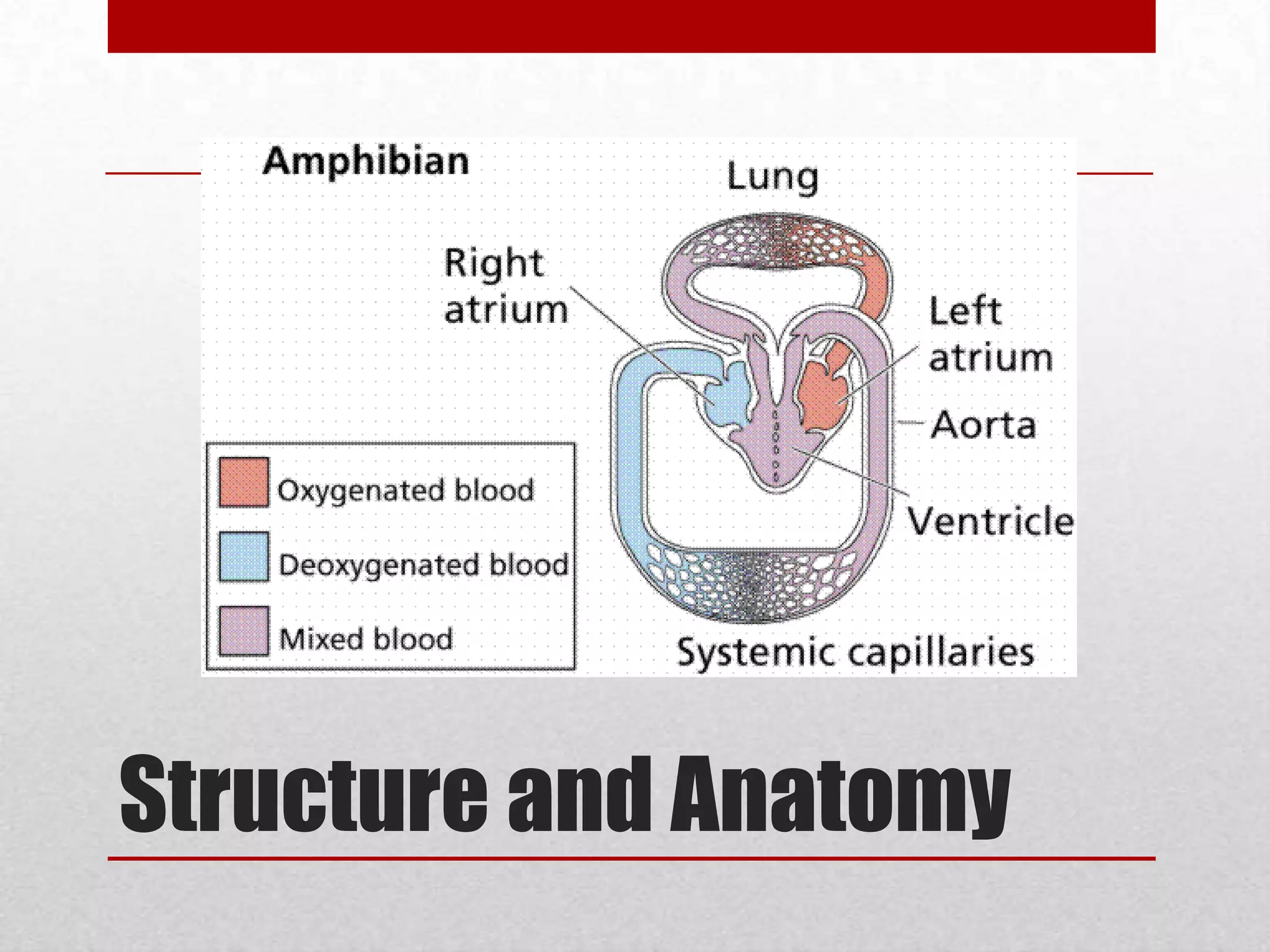
3 Chamberwith 2 atria and 1 ventricleWith the development of lungs, the circulatory system had evolved into 2 separate circulation pathways for lungs and bodyadvantageous with a higher pressure in vessels that lead to both the lungs and body
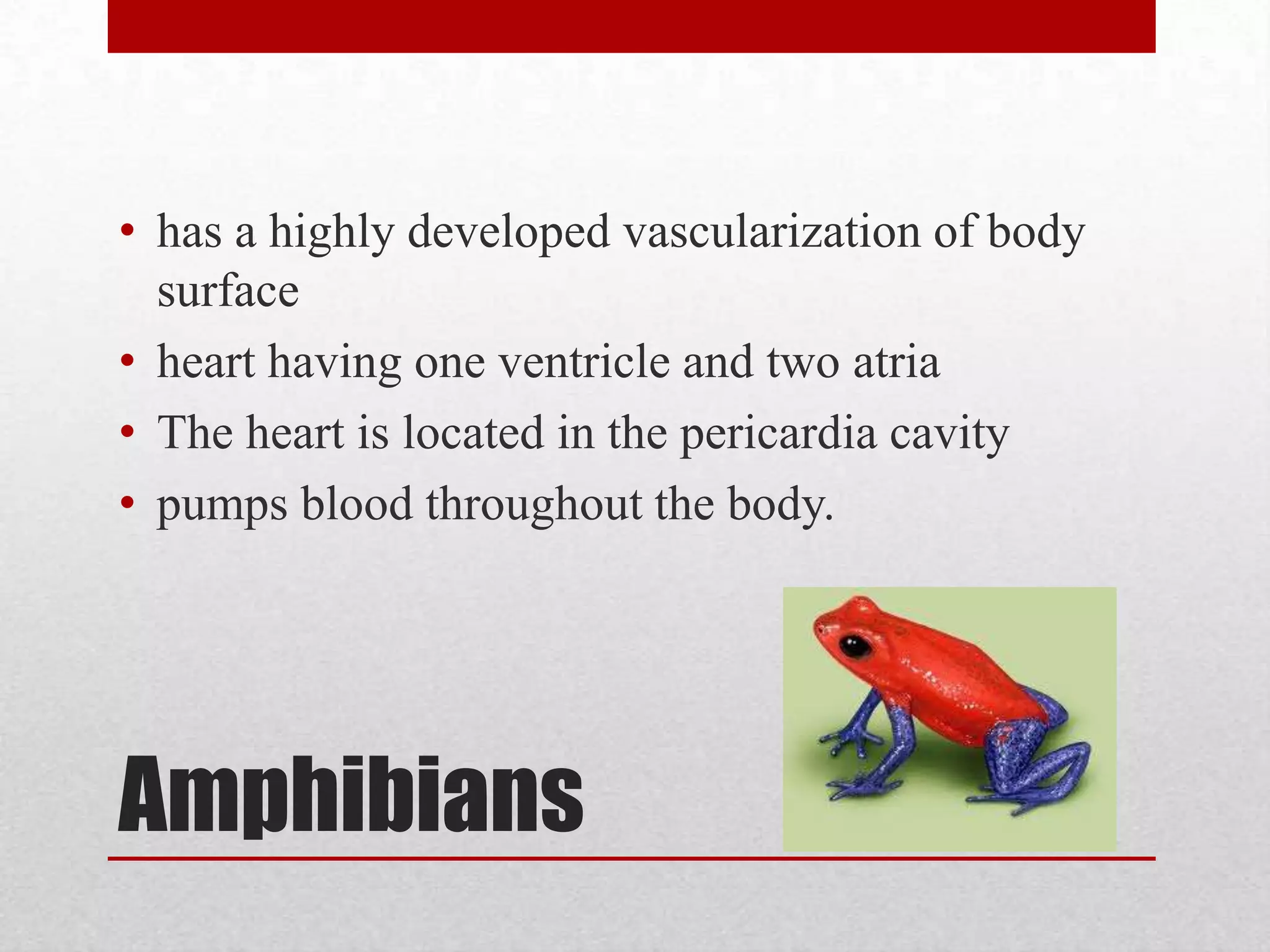
Amphibianshas a highly developed vascularization of body surface heart having one ventricle and two atria The heart is located in the pericardia cavity pumps blood throughout the body.
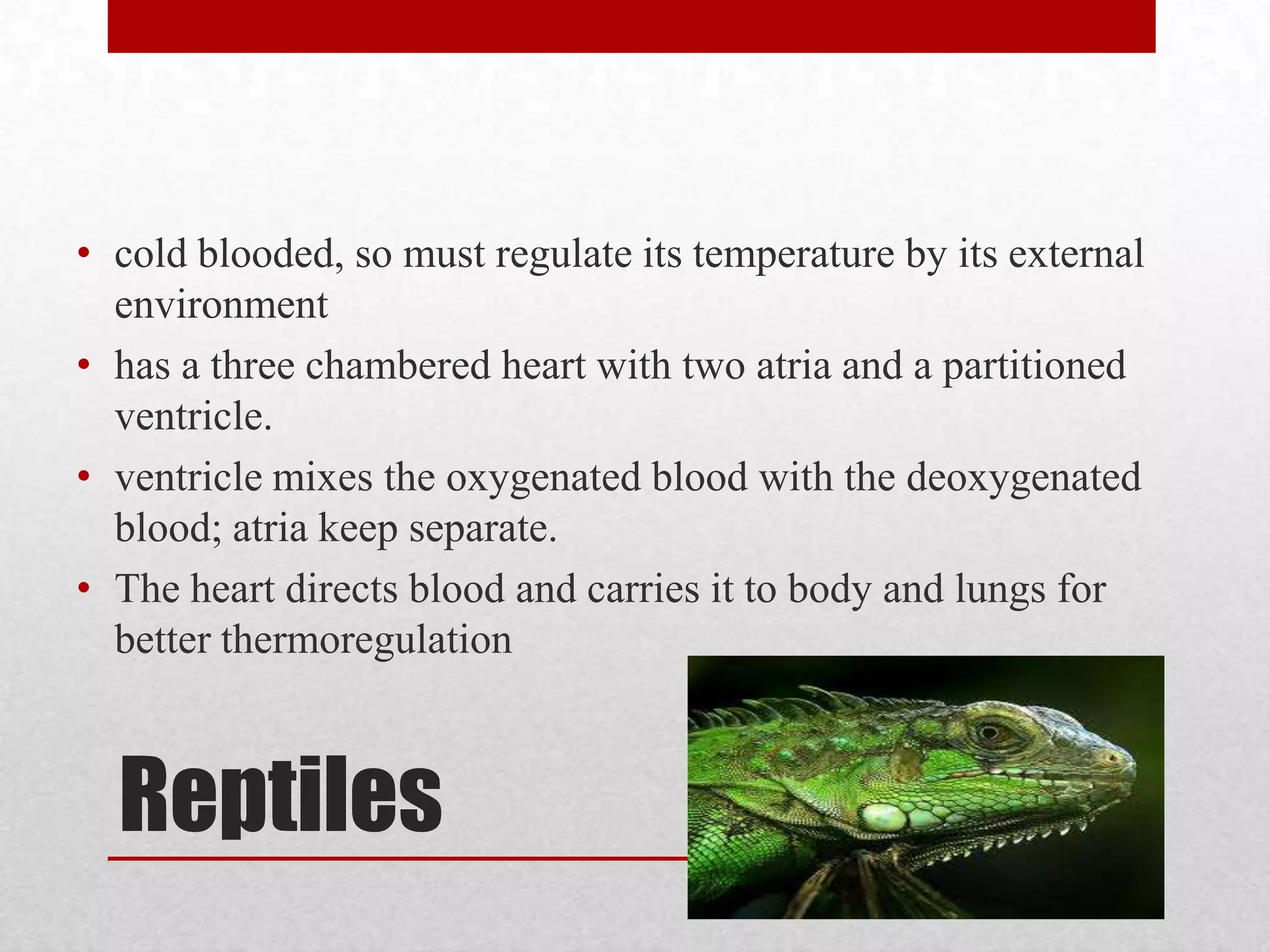
Reptilescold blooded, so must regulate its temperature by its external environment has a three chambered heart with two atria and a partitioned ventricle. ventricle mixes the oxygenated blood with the deoxygenated blood; atria keep separate.The heart directs blood and carries it to body and lungs for better thermoregulation
Structure and Anatomy
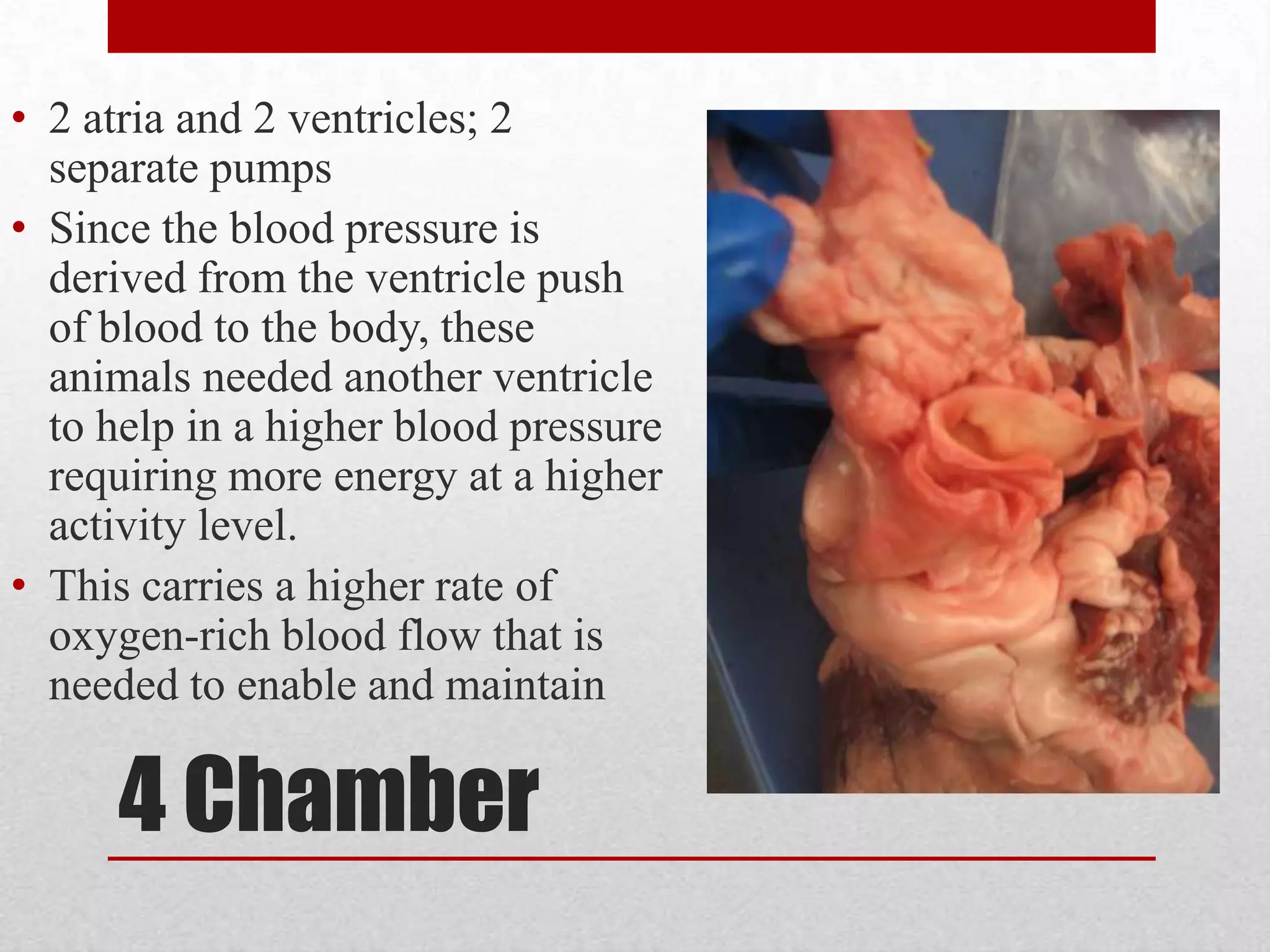
4 Chamber2 atria and 2 ventricles; 2 separate pumps  Since the blood pressure is derived from the ventricle push of blood to the body, these animals needed another ventricle to help in a higher blood pressure requiring more energy at a higher activity level.  This carries a higher rate of oxygen-rich blood flow that is needed to enable and maintain
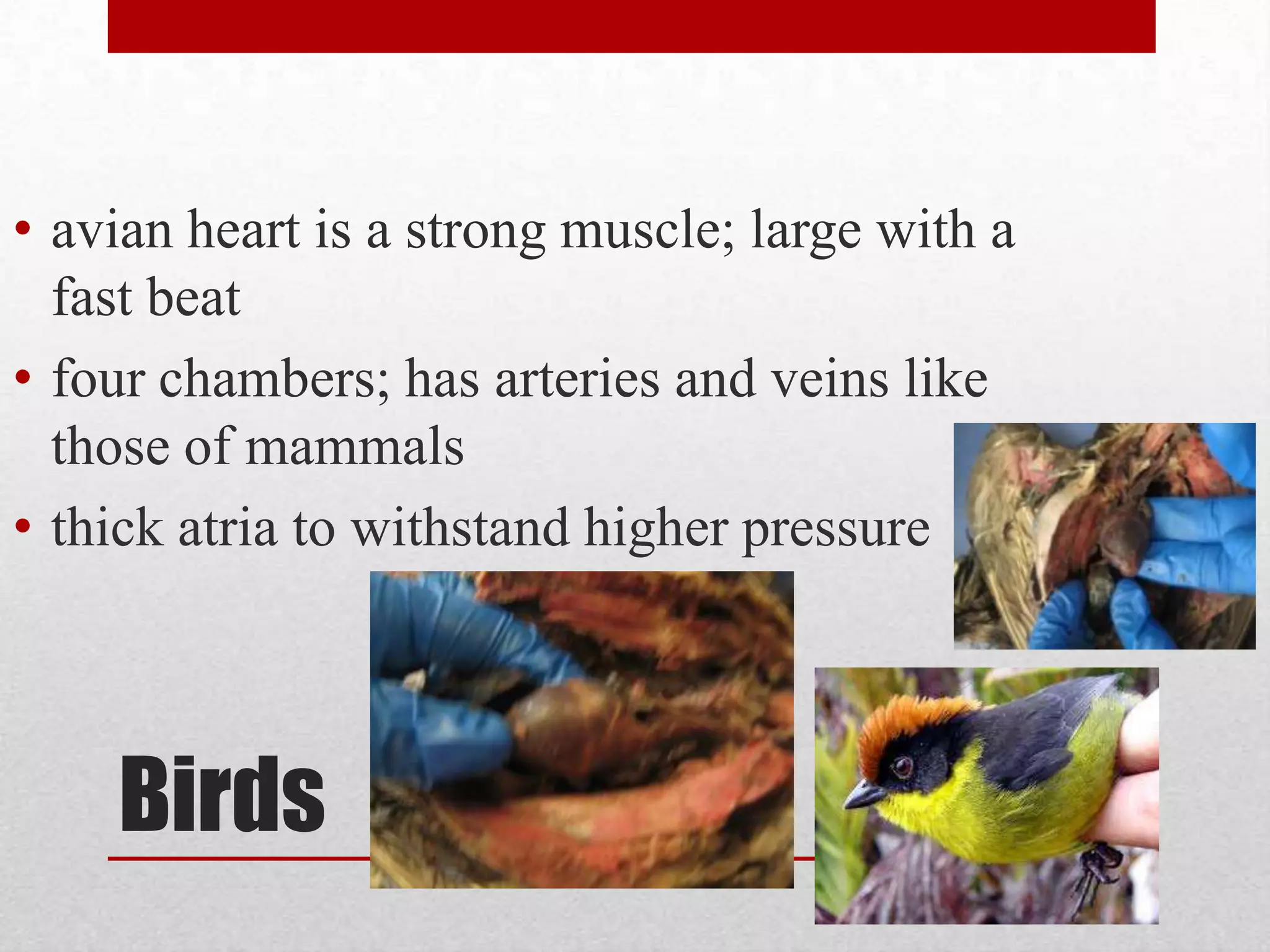
Birdsavian heart is a strong muscle; large with a fast beat four chambers; has arteries and veins like those of mammalsthick atria to withstand higher pressure
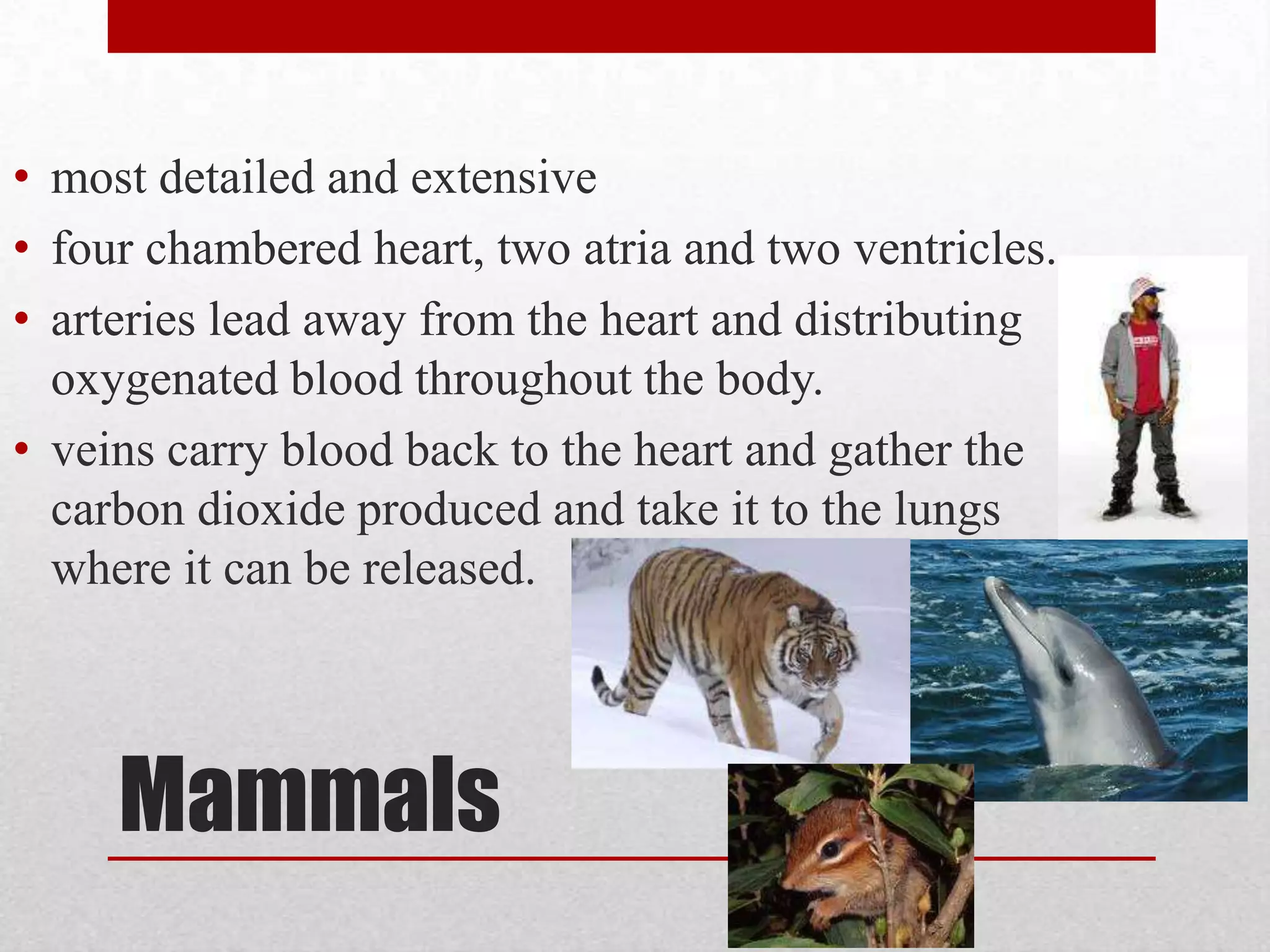
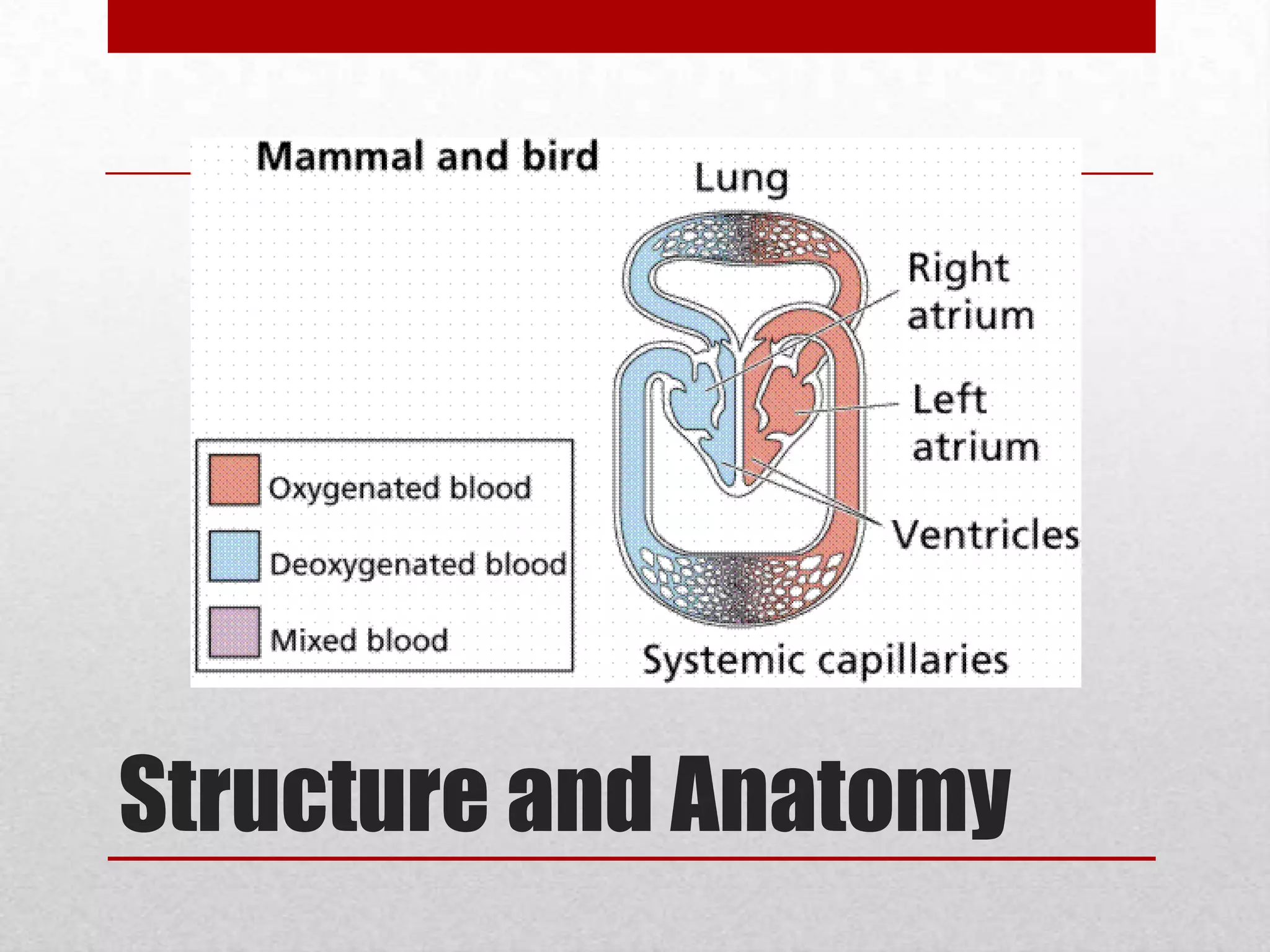
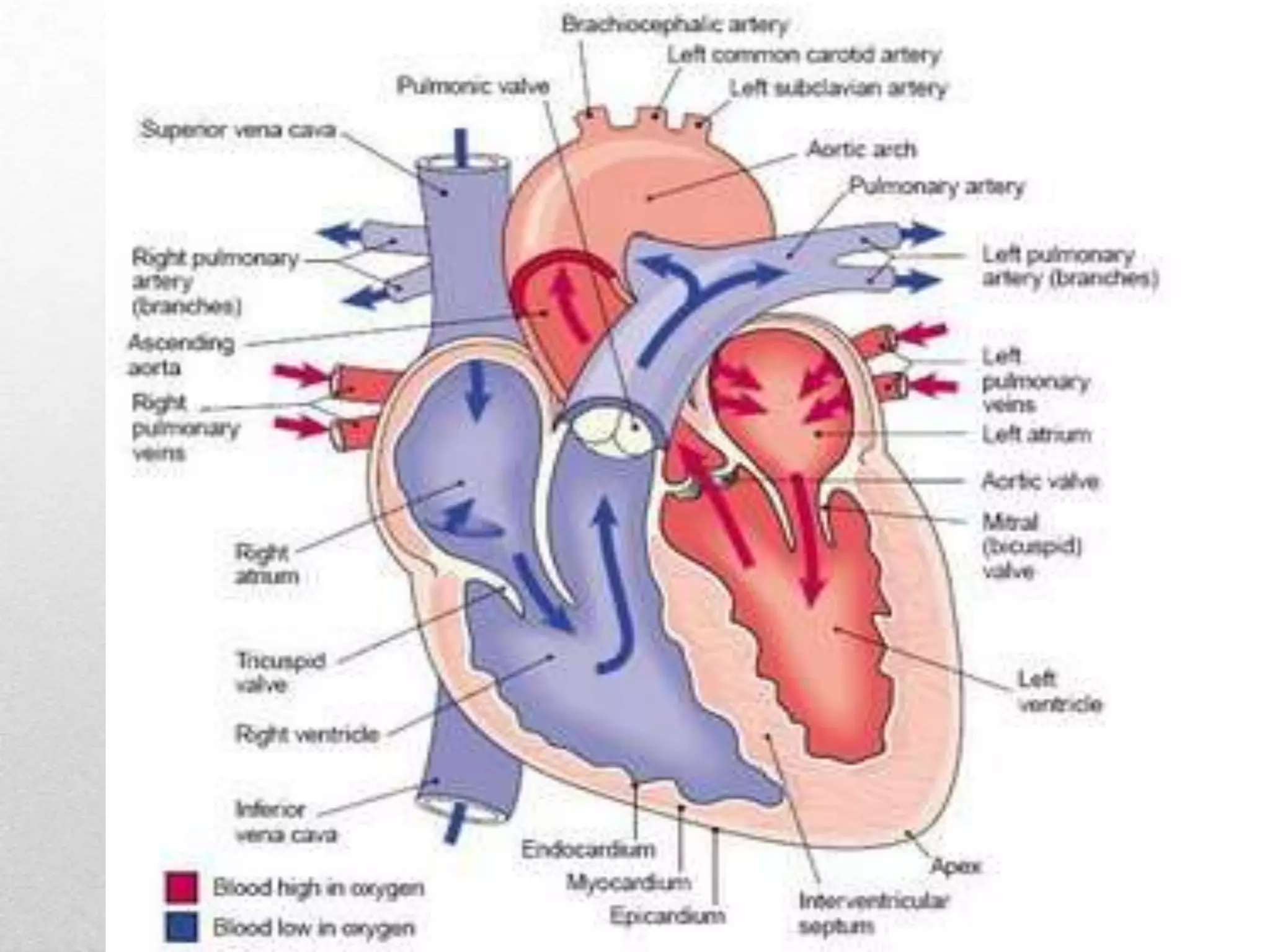
Mammalsmost detailed and extensive four chambered heart, two atria and two ventricles.  arteries lead away from the heart and distributing oxygenated blood throughout the body.  veins carry blood back to the heart and gather the carbon dioxide produced and take it to the lungs where it can be released.
Structure and Anatomy
The cardiac cycle of a human heart enters the right atria from the superior vena cava, the upper parts of the body, and the inferior vena cava, the lower part of the body.  From the right atria the blood passes through the tricuspid valve and into the right ventricle.  The pulmonary valve opens to the pulmonary artery and distributes throughout the lungs.  The blood becomes oxygen-rich and enters the left atria via the pulmonary vein. The blood travels through the mitral valve into the left ventricle and opens the aortic valve to enter the aorta.  The oxygenated blood travels throughout the body, distributing oxygen to the cells and comes back to the heart from the superior and inferior vena cava. Pathway of Blood in the Heart
Blood pumps through the heart by a starting electrical pulse causing the chamber to contract as the electrical impulse moves through it. This activates a bundle of specialized cells called the Sino atrial, or sinus node, in the right atria.  The ‘pacemaker’ causes the heart to beat and generates electrical impulses at a given rate to complete a constant heart beat.Electrical Stimuli
Regulating temperature…When hot, capillaries under the surface of the skin open wider for more heat to be released
When cold, capillaries under the surface of the skin grow thinner to conserve the most heat
Blood will travel from hot places of the body to cold places to maintain 98.6 ° FBlood pressure…Caused by the strength exerted by the ventricles pushing blood out
Does not hurt capillariesThe respiratory system is the means by which an organism performs an exchange of oxygen and carbon dioxide in its internal with its environment. Intro to Respiratory System
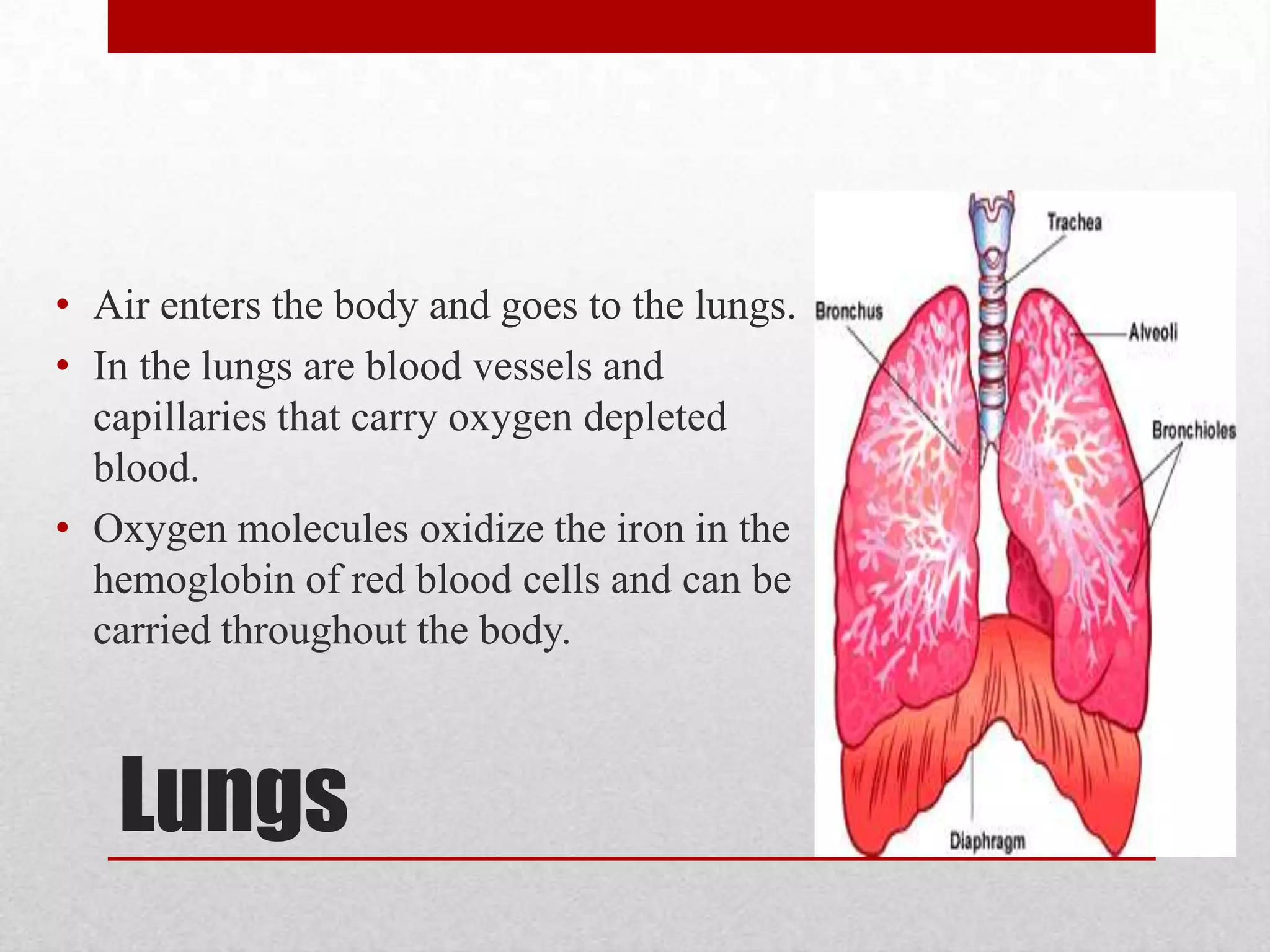
The respiratory system in humans takes in O2 and releases waste CO2. The diaphragm contracts causing the lungs to expand and take in air. The nasal passage where O2 is taken in and filtered of any irritants that may be lingering. Air is passed down through the pharynx larynx and trachea. The trachea keeps dust and debris from getting farther in to the system. The trachea divides into too two bronchus which lead to the lungs and are lined with mucus to keep dirt and dust from getting into the lungs. The lungs are split into lobes, the right lung has 3 lobes and the left has 2. Oxygen is pumped from the longs to the alveoli which pump oxygen into capillaries and the circulatory system. In birds the important organs are the lungs, anterior air sacs, and the posterior air sacs. The bird’s air sacs expand and air is taken into the lungs of the bird through the trachea. In the lungs birds have parabronchi which allow air flow to the bird’s atria which are connected to capillaries where the gases are exchanged5 Chordates
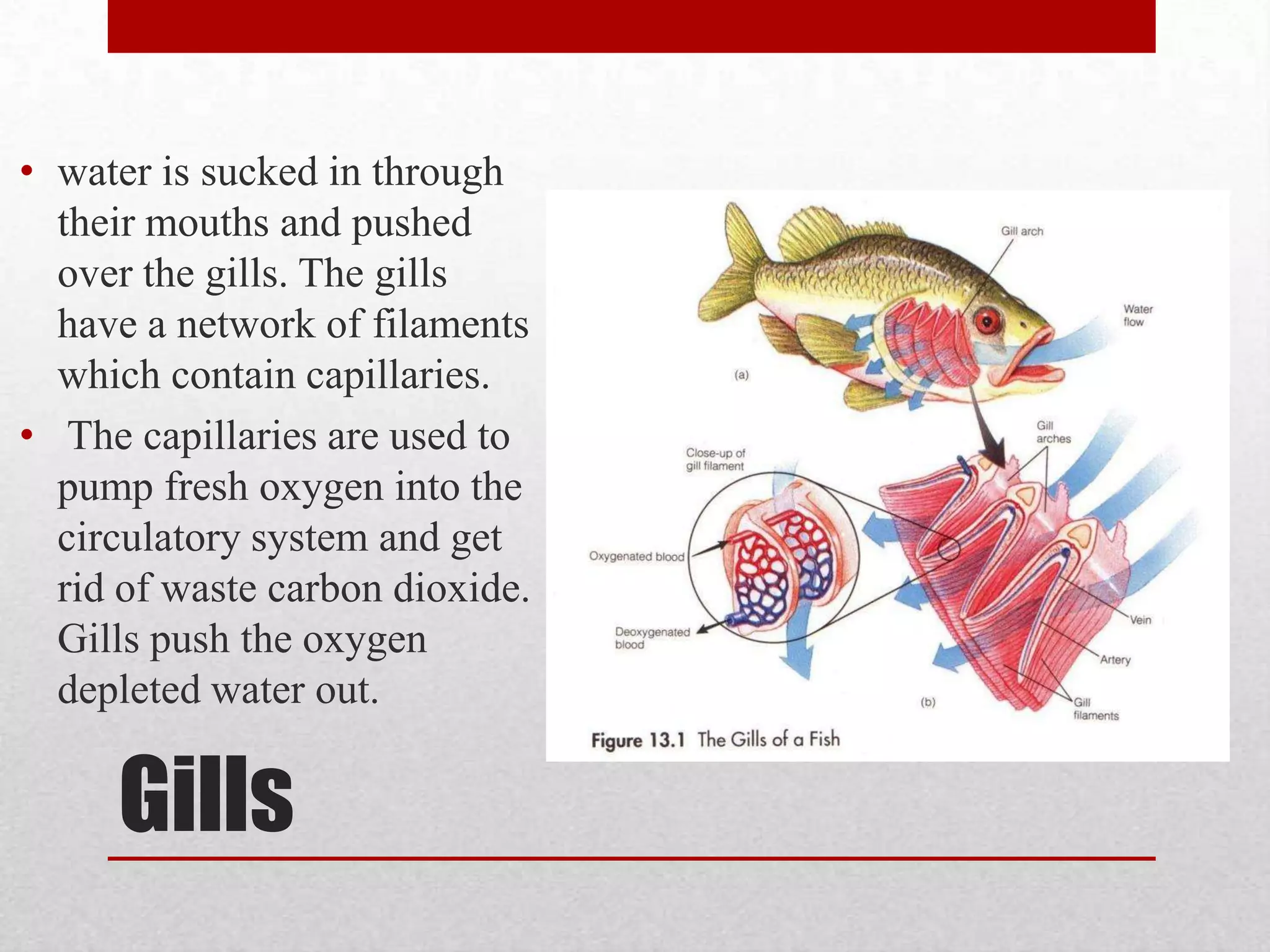
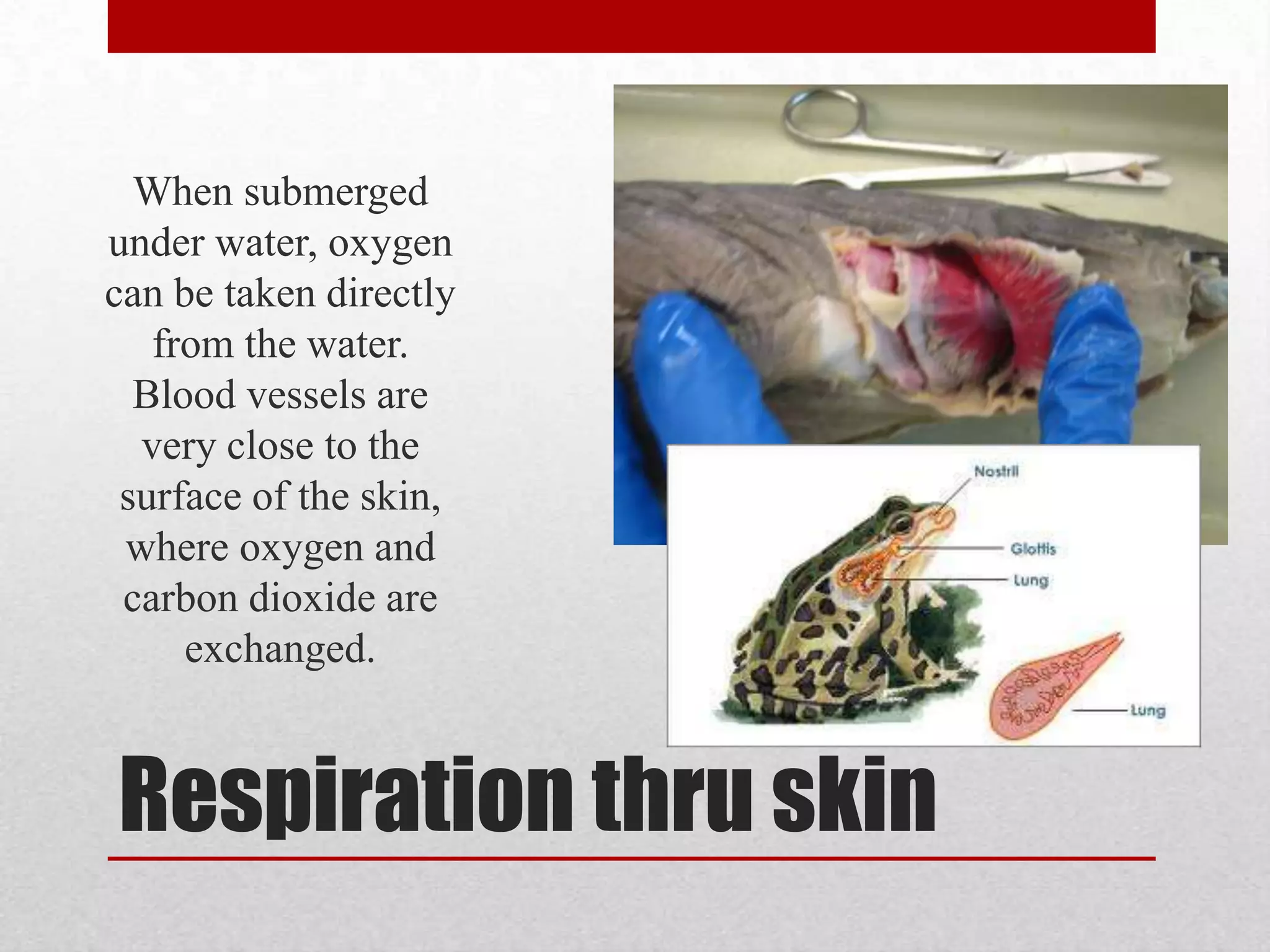
ContinuedIn fish water is sucked in through their mouths and pushed over the gills. The gills have a network of filaments which contain capillaries. The capillaries are used to pump fresh oxygen into the circulatory system and get rid of waste carbon dioxide. Gills push the oxygen depleted water out through the opening on the fish’s larynx. Frogs have a thin skin which aids in respiration. When a frog submerges under water, it can get its oxygen directly from the water. Blood vessels are very close to the surface of the frog’s skin, where oxygen and carbon dioxide are exchanged. When in dry land frogs can breathe using their lungs. Frogs take in oxygen through their nostrils, the throat of the frog puffs out and then it uses its mouth to force the air down into its lungs.
Continued    In snakes, at the back of the mouth they have a covering to the trachea called the glottis. When the glottis is open, air can flow through the trachea to the bronchi. The left bronchus leads to the left lung which is nonfunctioning. The right bronchus leads the right lung which is elongated all the way to the tail. The first half of the lung contains blood vessels which conduct the gas exchange. The second half of the lung is used to assist in maintain the pressure inside the snake’s body cavity.
5 AnimalsWorms respiratory consists of their skin through which the take in oxygen and expel carbon dioxide. Starfish get their oxygen from their papillae lined bodies. The papillae get oxygen from the water and distribute it throughout the body if the starfish. In lobsters gills are used for getting oxygen. Lobsters have 20 pairs of gills in their brachial chambers on the cephlathothorax. Water flows over the gills where oxygen is extracted from the water and shot out taking dirt with it cleaning out the chambers.
ContinuedIn mollusks such as clams they have a gill or a few with cilia covering them. The cilia conduct the flow of water over the gills. The gills are connected to the heart of the animal by a blood vessel. Jellyfish have no respiratory system, oxygen and carbon dioxide exchange is done through contact with the jellyfish’s thin membrane like skin.
Land vs. WaterTerrestrial organisms have a system in which they directly take in oxygen from the air and release carbon dioxide. This is done through the lungs where oxygen taken in can be bonded with the hemoglobin of oxygen depleted red blood cells.
Aquatic organism usually use a system of gills to get their oxygen from the water.Water with oxygen is pumped over the gills where the capillaries of the gills contain oxygen depleted blood cells. The gills finish this process by pushing oxygen depleted water out of the body. Land vs. Water Cont.
Gillswater is sucked in through their mouths and pushed over the gills. The gills have a network of filaments which contain capillaries. The capillaries are used to pump fresh oxygen into the circulatory system and get rid of waste carbon dioxide. Gills push the oxygen depleted water out.
Respiration thru skinWhen submerged under water, oxygen can be taken directly from the water. Blood vessels are very close to the surface of the skin, where oxygen and carbon dioxide are exchanged.
LungsAir enters the body and goes to the lungs.In the lungs are blood vessels and capillaries that carry oxygen depleted blood.Oxygen molecules oxidize the iron in the hemoglobin of red blood cells and can be carried throughout the body.
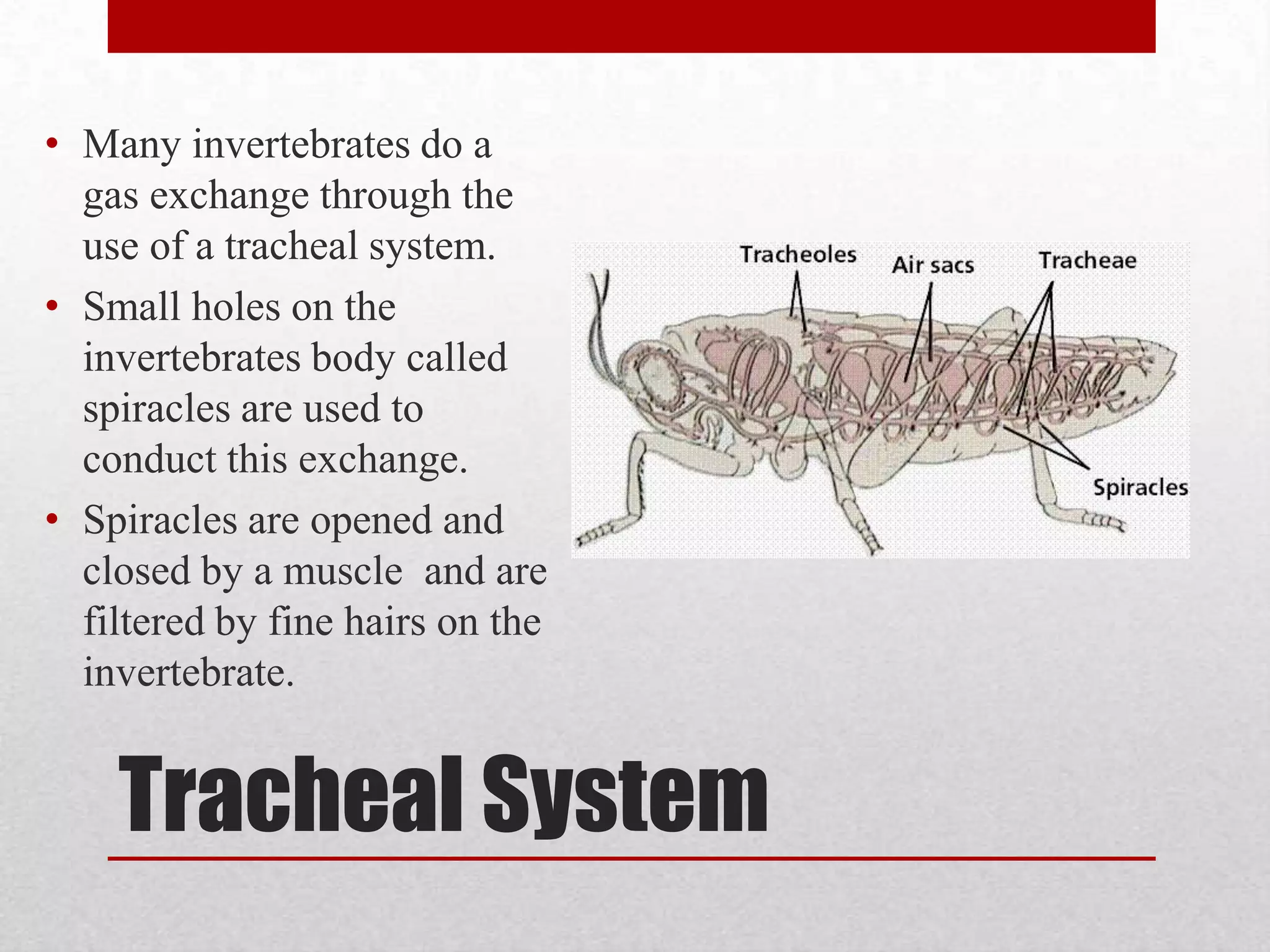
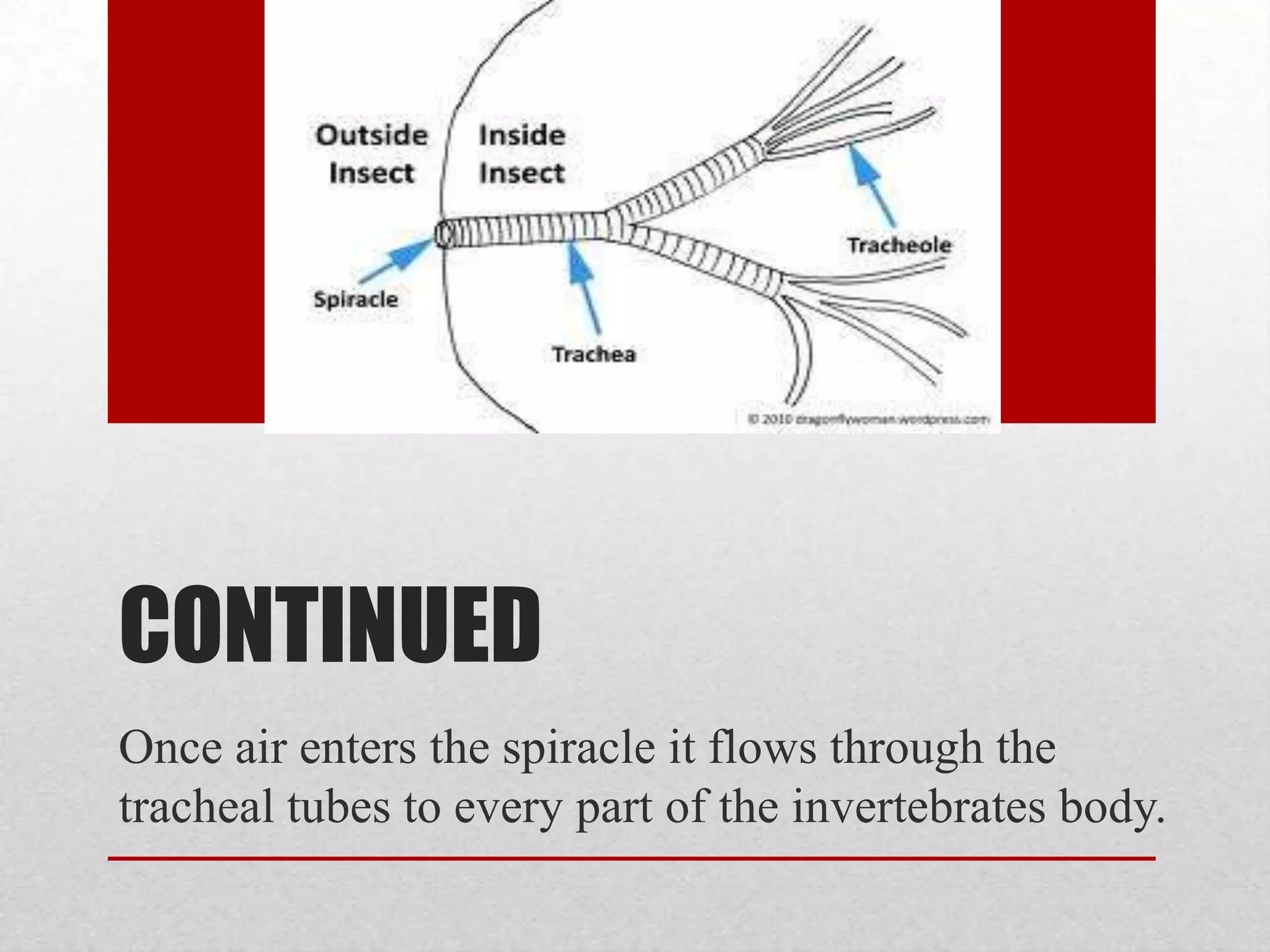
Tracheal SystemMany invertebrates do a gas exchange through the use of a tracheal system.Small holes on the invertebrates body called spiracles are used to conduct this exchange.Spiracles are opened and closed by a muscle  and are filtered by fine hairs on the invertebrate.
ContinuedOnce air enters the spiracle it flows through the tracheal tubes to every part of the invertebrates body.
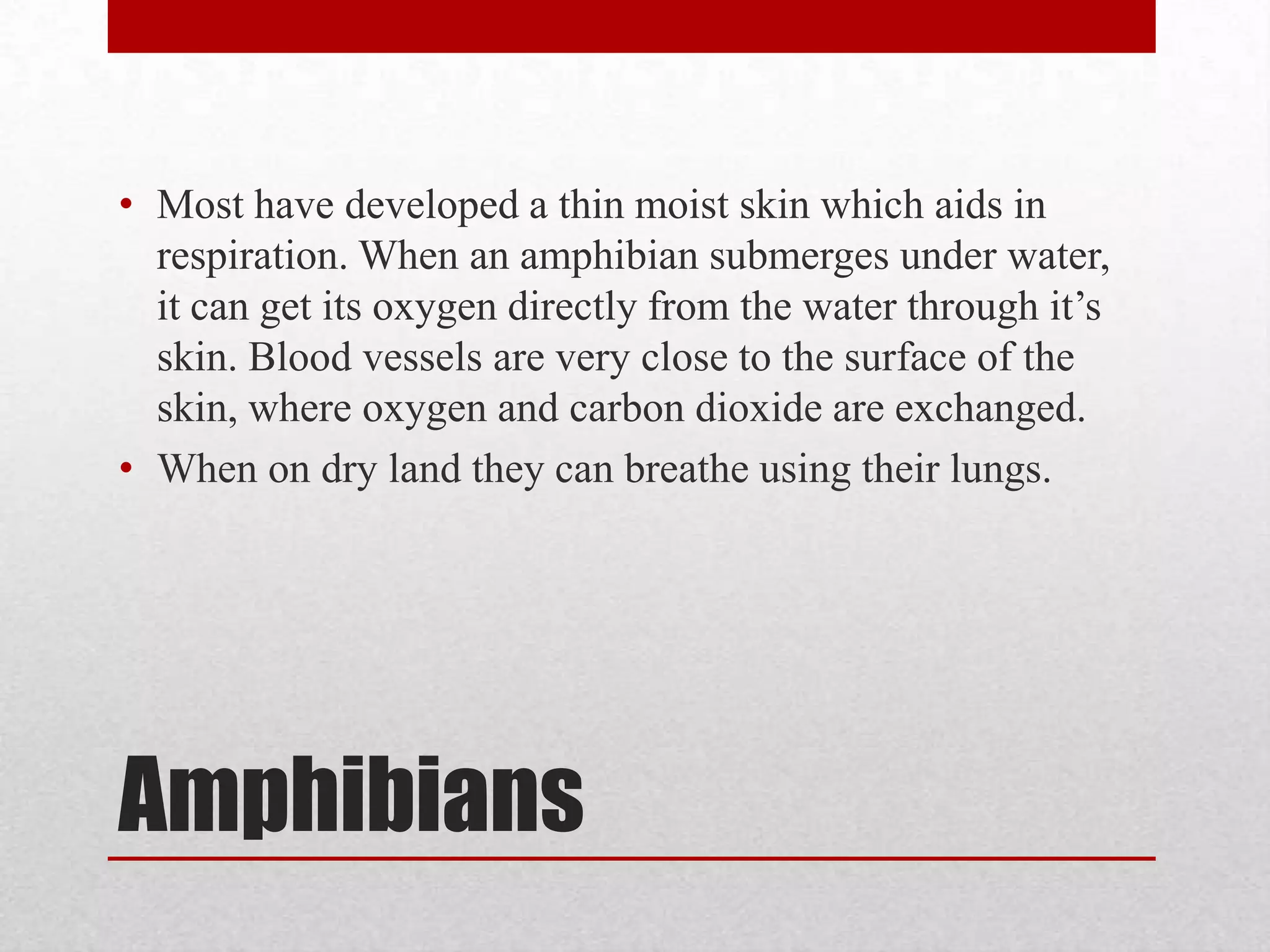
AmphibiansMost have developed a thin moist skin which aids in respiration. When an amphibian submerges under water, it can get its oxygen directly from the water through it’s skin. Blood vessels are very close to the surface of the skin, where oxygen and carbon dioxide are exchanged. When on dry land they can breathe using their lungs.
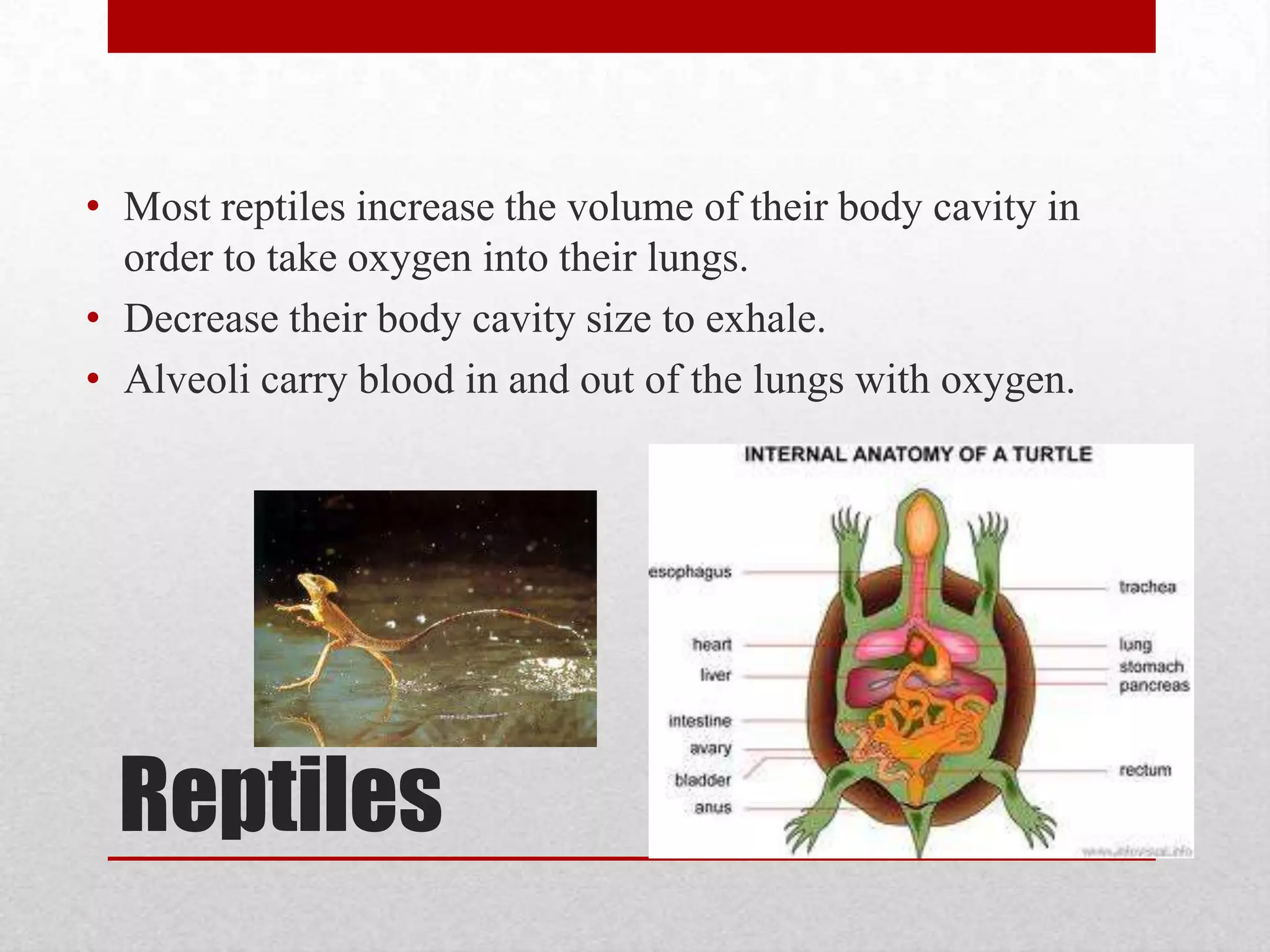
ReptilesMost reptiles increase the volume of their body cavity in order to take oxygen into their lungs.Decrease their body cavity size to exhale. Alveoli carry blood in and out of the lungs with oxygen.
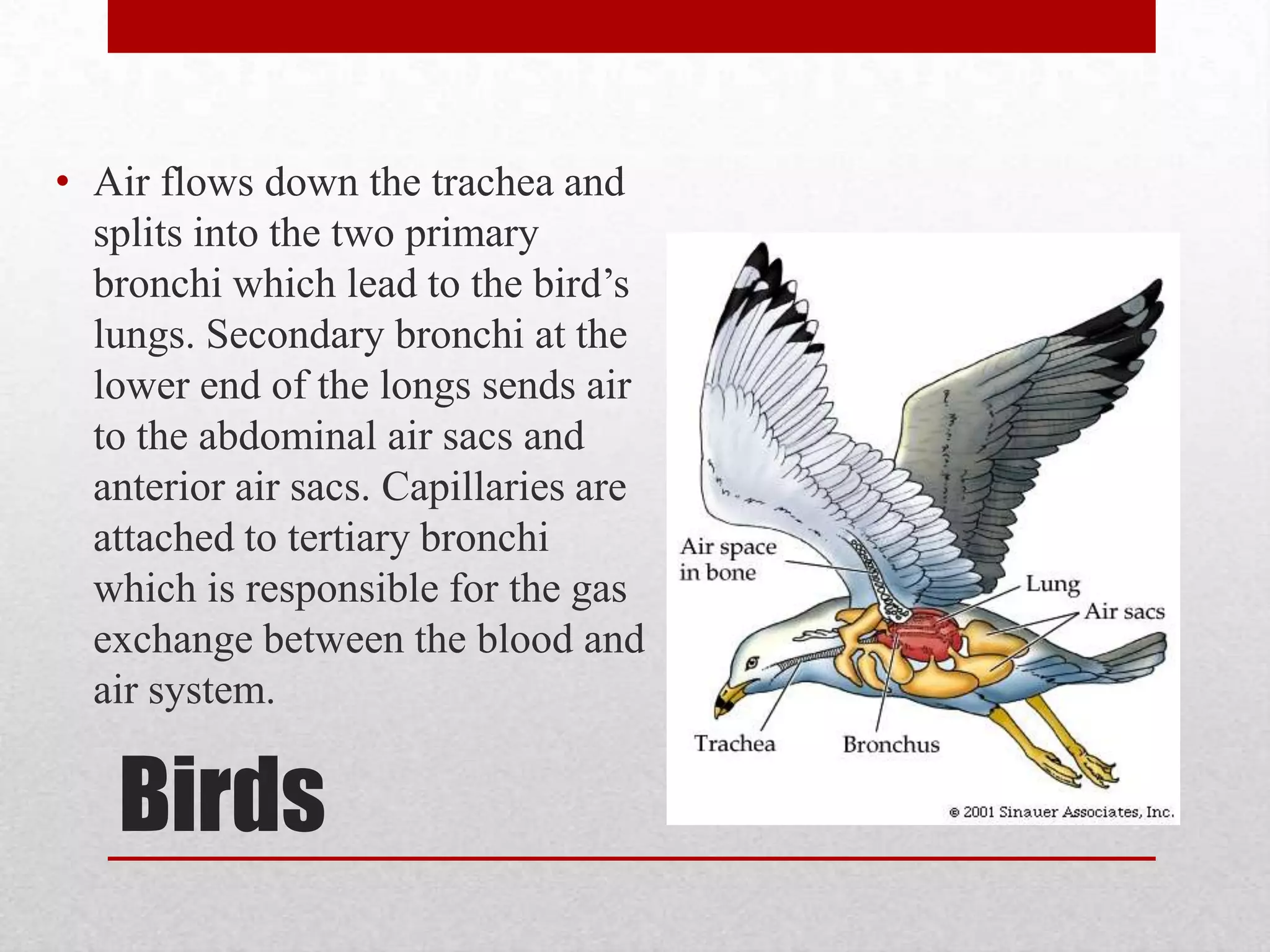
BirdsAir flows down the trachea and splits into the two primary bronchi which lead to the bird’s lungs. Secondary bronchi at the lower end of the longs sends air to the abdominal air sacs and anterior air sacs. Capillaries are attached to tertiary bronchi which is responsible for the gas exchange between the blood and air system.
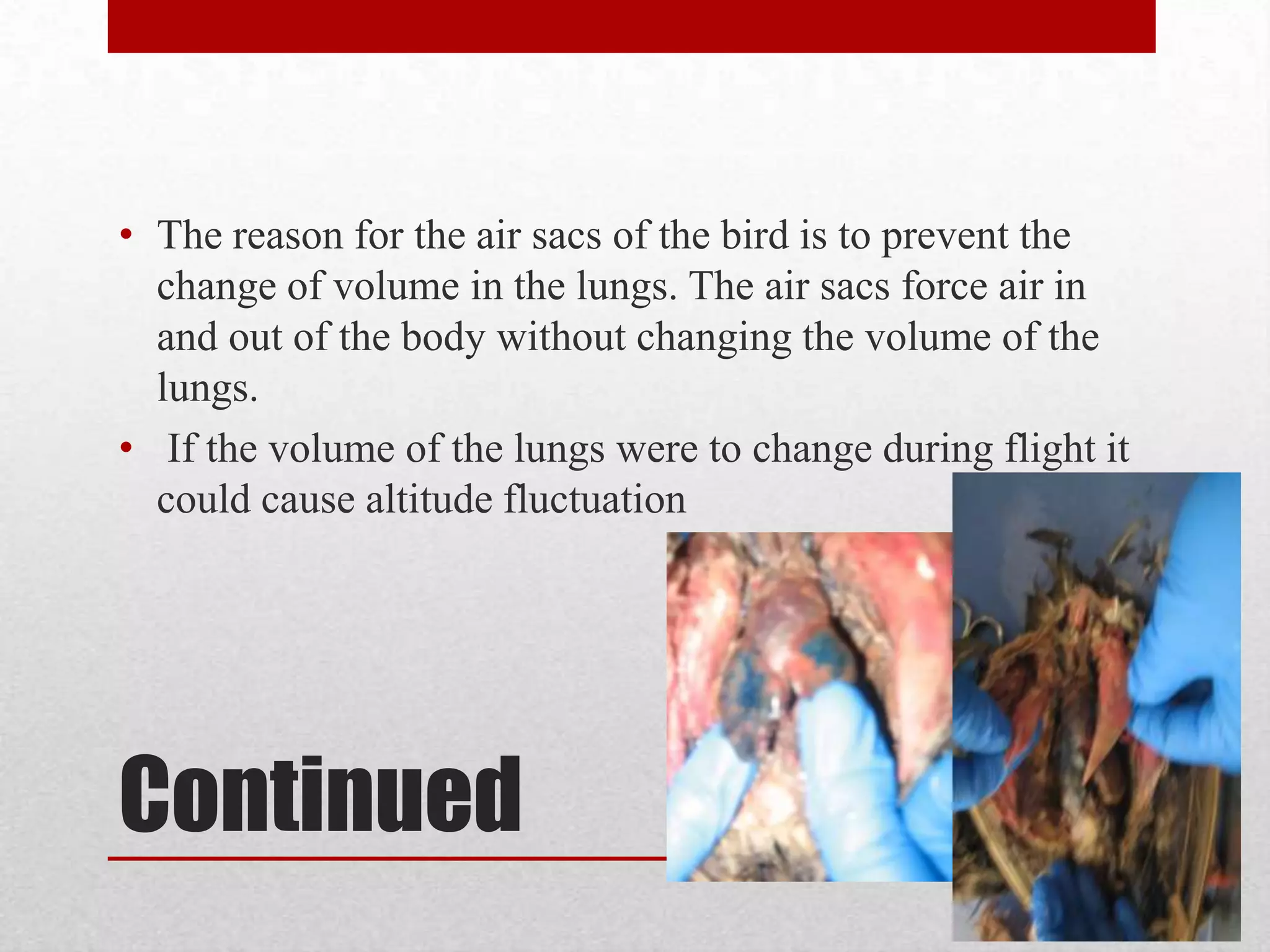
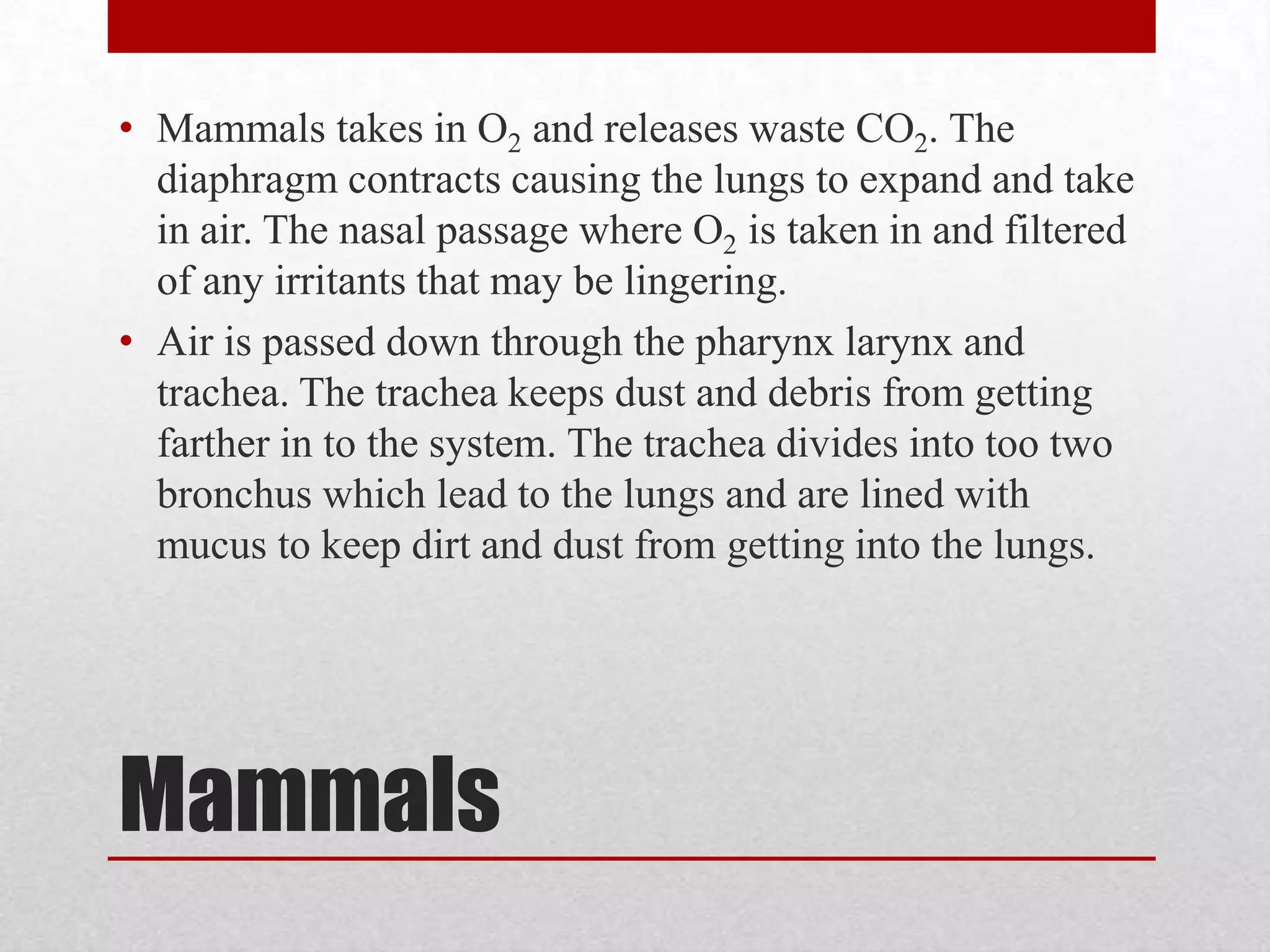
ContinuedThe reason for the air sacs of the bird is to prevent the change of volume in the lungs. The air sacs force air in and out of the body without changing the volume of the lungs. If the volume of the lungs were to change during flight it could cause altitude fluctuation
MammalsMammals takes in O2 and releases waste CO2. The diaphragm contracts causing the lungs to expand and take in air. The nasal passage where O2 is taken in and filtered of any irritants that may be lingering. Air is passed down through the pharynx larynx and trachea. The trachea keeps dust and debris from getting farther in to the system. The trachea divides into too two bronchus which lead to the lungs and are lined with mucus to keep dirt and dust from getting into the lungs.
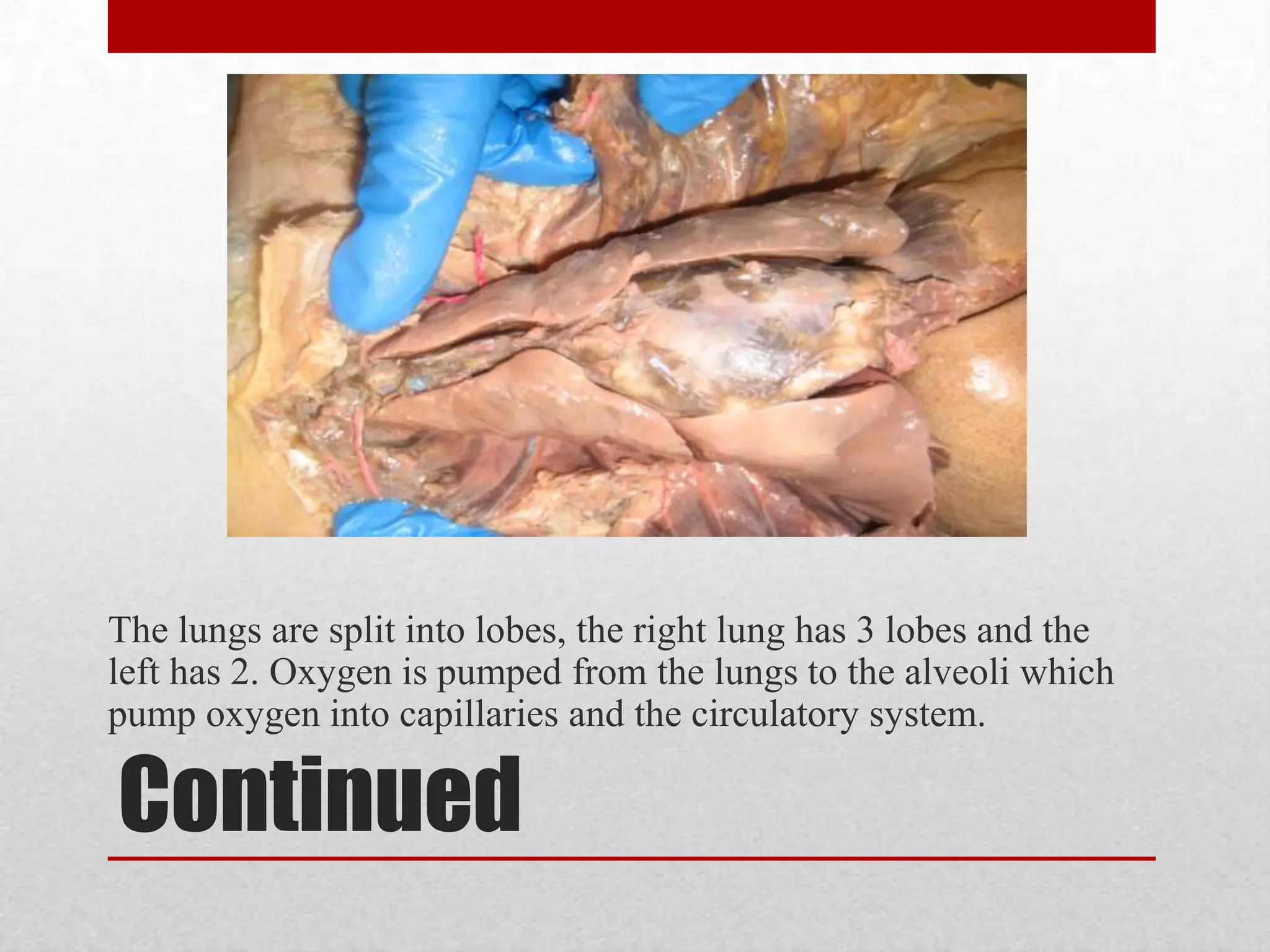
ContinuedThe lungs are split into lobes, the right lung has 3 lobes and the left has 2. Oxygen is pumped from the lungs to the alveoli which pump oxygen into capillaries and the circulatory system.

Circulatory and respiratory systems