Autopsy of brain
Dr.B. Swathi
Final year postgraduate, Pathology
Sri Venkateswara Institute of Medical Sciences,
Tirupathi
• Opening of skull
• Detachment of brain
• fixation
• Dissection of fresh/fixed brain
• Selective sectioning
• Gross findings
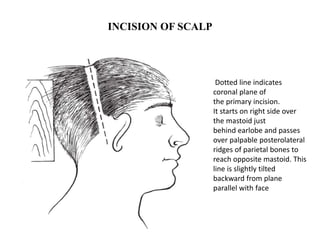
INCISION OF SCALP
Dotted line indicates
coronal plane of
the primary incision.
It starts on right side over
the mastoid just
behind earlobe and passes
over palpable posterolateral
ridges of parietal bones to
reach opposite mastoid. This
line is slightly tilted
backward from plane
parallel with face
OPENING OF SKULL
• Head is held in proper position with a block
• Bitemporal incision passing near the vertex
• Incise the scalp down to the bone
• peel the skin and subcutaneous tissues back to below the
occipital protuberance posteriorly and to the level of
forehead (to a level 1 or 2 cm above the supraorbital ridge)
anteriorly by a combination of sharp and blunt dissection.
SCALP INCISION
The scalp is incised down to
the bone, taking care not to
cut the hair.
SAWING OF CRANIUM
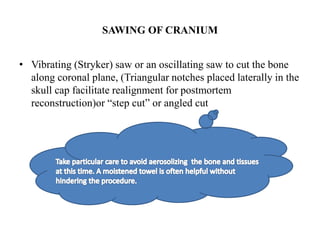
• Vibrating (Stryker) saw or an oscillating saw to cut the bone
along coronal plane, (Triangular notches placed laterally in the
skull cap facilitate realignment for postmortem
reconstruction)or ā€œstep cutā€ or angled cut
• Lipshaw Co. – oscillating saw is equipped with a guard and
can be used with little training, without fear of deep
penetration.
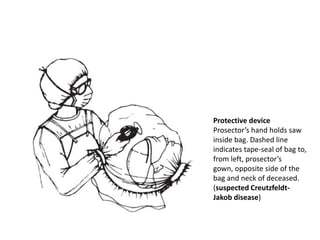
Protective device
Prosector’s hand holds saw
inside bag. Dashed line
indicates tape-seal of bag to,
from left, prosector’s
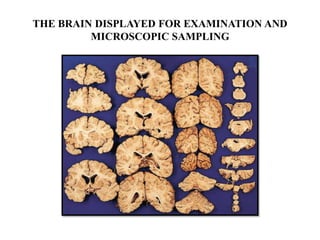
gown, opposite side of the
bag and neck of deceased.
(suspected Creutzfeldt-
Jakob disease)
CONFIGURATION OF THE SAW CUT
Lines of saw cuts for skull cap
removal. Frontal
point (A) is approx two
fingerbreadths above
supraorbital ridges.
Temporal point (B) is at the
top of ear in its natural
position before scalp
reflection. Point (C) is approx
2 cm above (B).
Occipital point (D) is approx
two fingerbreadths above
external occipital
protuberance (inion).
• If (A) is too low, there is danger of cutting into the roof of the
orbit;
• if (B) is too low, saw will enter petrous portion of temporal
bone.
• Either of these will make removal of skull vault difficult.
• When (D) is too low, saw line will be below attachment of the
tentorium.
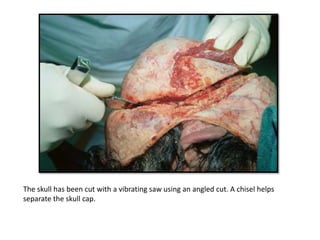
The skull has been cut with a vibrating saw using an angled cut. A chisel helps
separate the skull cap.
• Ideally, sawing should be stopped just short of cutting through
the inner table of the cranium – with the use of a chisel and a
light blow with a mallet.
• Dura and underlying leptomeninges left intact allows to view
the brain with the overlying (CSF) still in the subarachnoid
space.
• To obtain this view, after removal of the skull cap, the dura
must be cut with a pair of scissors along the line of sawing and
reflected.
SEPARATION OF MENINGES
• A twist of chisel placed in the frontal saw line
• admit the fingers inside the skull cap or blunt hook used to
pull the skull cap away from the underlying dura.
• A hand inserted between the skull and the dura (periosteum)
helps the blunt separation of these while the other hand is
pulling the skull cap.
SEPARATION OF MENINGES
 If dura too firmly adheres to the skull
 It is incised along the line of sawing
 anterior attachment of the falx to the skull cut between the
frontal lobes
 posterior portion of the falx cut from inside after the skull cap
is fully reflected.
 The dura is then peeled off the skull cap,superior sagittal sinus
may be opened with a pair of scissors at this time.
• In the presence of epi- or subdural hemorrhage and neoplasia,
it is best to leave the dural flaps attached to the dorsal brain
and section them together.
DETACHMENT OF BRAIN
• The frontal lobes gently raised and the olfactory bulbs and
tracts are peeled away from the cribriform plates.
• The optic nerves are cut as they enter the optic foramina.
• Under its own weight, the brain is allowed to fall away from
the floor of the anterior fossa, while it is being supported with
the palm of one hand.
DETACHMENT OF BRAIN
The dura at the anterior attachment of the falx to the crista galli is cut and the
brain is gently elevated and retracted posteriorly. optic nerves, carotid arteries,
and third cranial nerves are cut where they enter the skull.
DETACHMENT OF BRAIN
• The pituitary stalk is cut,followed by the internal carotid
arteries as they enter the cranialcavity.
• Cranial nerves III, IV, V, and VI are severed as close to the
base of the skull as possible,subdural communicating veins are
also severed.
• Next, the attachment of the tentorium along the petrous ridge
is cut on either side with curved scissors
DETACHMENT OF BRAIN
• At this time, the brain must not drop backward excessively as
this will cause stretch tears in the cerebral peduncles.
• This also can be prevented by raising the head very high from
the beginning, with pronounced flexion of the neck, using a
wooden pillow or a metal support attached to the table.
DETACHMENT OF BRAIN
The brain is supported as the cranial nerves and vessels are transected.
DETACHMENT OF BRAIN
• Cranial nerves VII, VIII, IX, X, XI, and XII are then cut
identifying each one in sequence.
• The vertebral arteries are severed with scissors as they emerge
into the cranial cavity.
• cervical part of the spinal cord is cut across as caudally as
possible but too oblique a plane of sectioning should be
avoided.(Curved scissors will be best for this purpose.)
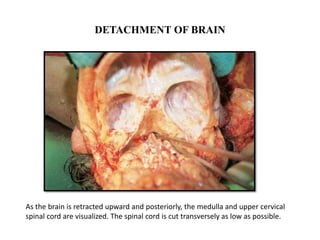
DETACHMENT OF BRAIN
As the brain is retracted upward and posteriorly, the medulla and upper cervical
spinal cord are visualized. The spinal cord is cut transversely as low as possible.
DETACHMENT OF BRAIN
• If a critical lesion exists in the region, a cross-section
perpendicular to the neuroaxis at the pontomedullary junction
or higher may be elected in order to preserve the integrity of
the abnormality.
DETACHMENT OF BRAIN
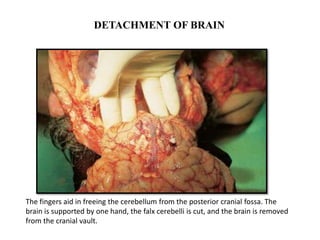
The fingers aid in freeing the cerebellum from the posterior cranial fossa. The
brain is supported by one hand, the falx cerebelli is cut, and the brain is removed
from the cranial vault.
• The brain is pulled away from the base of the skull after
cutting the lateral attachment of the tentorium to the petrous
bones.
• The pineal body must not be left behind during this maneuver.
• weigh the unfixed brain (and note whether the dura is included
in this weight).
• Survey the nerves, vessels,and gross anatomy for
abnormalities.
• If indicated, take additional culture specimens and smears and
prepare sections for rush processing.
• Also take tissues for electron microscopy and other special
studies (e.g., RNA, DNA) now
FIXATION
• Best routine fixative : freshly prepared 10% formalin
solution.
• In fetuses and infants: Aceticacid added to the fixative
• Acetic acid:
I. increases the specific gravity of the fixative and allows the
brain to float in the solution;
II. it also makes the tissue firmer without altering its histologic
characteristics.
IMMERSION METHODS
• plastic buckets that hold 8 L of fixative or traditional glass or
earthenware jars.
• suspend the brain to prevent distortion during fixation by
passing a thread underneath the basilar artery in front of the
pons.
• Inevitably, the vessel is slightly pulled away from the brain
substance.
• If this is undesirable, as in the case of pontine infarcts or other
lesions in this region, a thread can be passed under the
internal carotid or middle cerebral arteries on both sides,
provided that no pathologic lesions are suspected in these
regions.
• Alternatively, dorsal dura can be used as an anchoring point.
• A thread is passed through the short dural flaps on either side
of the falx, and the brain is suspended right-side-up.
• However, a minor pull may deform the parasagittal brain
tissue and cause an abnormally pointed dorsal midline surface
of the brain
• suspension from blood vessels deforms the parenchyma less
than dural suspension
• With all these methods:
• the ends of the thread(s) are tied to the attachments of the
bucket handle.
 care being taken not to allow the specimen to touch the bottom
or sides of the bucket
• Another safe method:
• Use of the plastic brain support.
• Placing several holes in the dome-shaped receptacle
• will ensure proper fixation of the contact surface of the brain.
• Formalin solution should be replaced within the first 24 h not
mandatory if a large amount of fixative is used.
• If the fixative becomes very bloody, prompt replacement with
fresh solution is indicated to prevent undue discoloration of the
specimen.
• Approximately 10–14 d are required for satisfactory fixation.
PERFUSION METHODS
• The brain can be perfused with fixative through the arterial
stumps before further fixation by immersion.
• This can be done manually with a syringe connected to a
simple tubing system.
• For easy handling and better preservation of the contour of the
specimen a plastic holder is used during the procedure.
• Satisfactory fixation for dissection can be obtained in 7–10 d.
• For perfusion of a large amount of fixative, an embalmer’s
pump may be used
• Large volumes of formalin (1,000 mL) improve fixation but :
• With too much fixative, large lakes of fluid may accumulate,
particularly in the areas like infart, hemorrhage, metastasis.
• Specimen may become asymmetric because of uneven
perfusion.
• May produce annoying perivascular zones of tissue rarefaction
microscopically, in addition to unnatural dilatation of small
blood vessels.
• Obstructing emboli or thrombosis also might be obscured.
• Injection of 150 mL of isotonic saline followed by 150 mL of
10% formalin solution causes the least problems.
• For a simple gravity-feed method, one may use an infusion
bottle raised 150–180 cm above the specimen.
DISSECTION OF BRAIN
• Single-blade autopsy knife about 25 cm long and 2cm wide is
prefered.
 dissection of fresh brain in adults
 dissection of fixed brain
DISSECTION OF FRESH BRAIN IN ADULTS
• Fresh dissection is limited to 3/4 coronal cuts through the
cerebral hemispheres.
• More complicated anatomic structures such as the basal
ganglia and upper brain stem (thalamus and midbrain) are left
uncut.
• This preliminary dissection usually reveals the presence of
large lesions, directly or indirectly, by showing distortion of
the ventricular system or other anatomic landmarks.
• Further judiciously selected sections may be made into the
primary slices of the brain tissue to expose the suspected
hidden lesions.
• The central portion of the cerebral hemispheres is left
connected with the brain stem, and this block is suspended by
a string.
• It may be necessary to sever the brain stem and cut into the
infratentorial structures
• One horizontal cut through these structures usually suffices for
preliminary examination.
• Preliminary perfusion or cooling of the brain in a refrigerator
for about 30 min, preferably in a contoured support makes the
brain firmer and dissection easier.
BRAIN BISECTION ALONG THE SAGITTAL PLANE
• If diffuse, roughly symmetric lesions are expected, as in:
 lipidoses, ā€œdegenerative diseases,ā€
 ā€œdemyelinatingā€ disorders,
 other inborn or acquired toxic-metabolic diseases,
 widespread infectious conditions
• one half further sectioned and submitted for chemical or
microbiologic investigations
• Other half is retained for later sectioning and histologic
examination.
• This latter half must be fixed either by suspension or by letting
it lie on its midsagittal plane to avoid undesirable distortions.
DISSECTION OF FIXED BRAIN
Cerebellum should be
held between the index
finger of the one hand
with the tip in proximity
of the pineal gland and
the thumb on
the inferior surface of
cerebellum
brain placed upside down
The blade is held
toward the prosector
with its tip in front of
the distant cerebral
peduncle a few
millimeters above the
tip of the
mammillary body
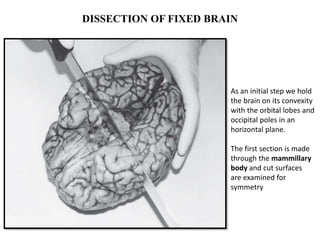
DISSECTION OF FIXED BRAIN
As an initial step we hold
the brain on its convexity
with the orbital lobes and
occipital poles in an
horizontal plane.
The first section is made
through the mammillary
body and cut surfaces
are examined for
symmetry
DISSECTION OF FIXED BRAIN
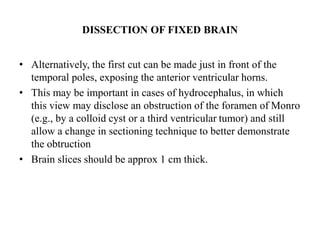
• Alternatively, the first cut can be made just in front of the
temporal poles, exposing the anterior ventricular horns.
• This may be important in cases of hydrocephalus, in which
this view may disclose an obstruction of the foramen of Monro
(e.g., by a colloid cyst or a third ventricular tumor) and still
allow a change in sectioning technique to better demonstrate
the obtruction
• Brain slices should be approx 1 cm thick.
DISSECTION OF FIXED BRAIN
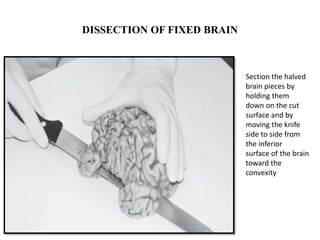
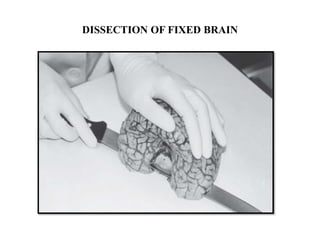
Section the halved
brain pieces by
holding them
down on the cut
surface and by
moving the knife
side to side from
the inferior
surface of the brain
toward the
convexity
DISSECTION OF FIXED BRAIN
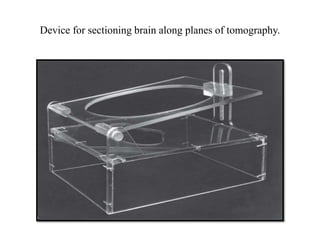
Device for sectioning brain along planes of tomography.
Plexiglass table with
opening for
cerebellum and
brain stem and
movable guide.
Brain in position for
initial cut
Halved brain
positioned on
board for serial
sectioning.
THE BRAIN DISPLAYED FOR EXAMINATION AND
MICROSCOPIC SAMPLING
SELECTION OF TISSUE BLOCKS
1.superior and middle
frontal gyri.
This is an arterial
border (ā€œwater-shedā€)
zone most likely to
arbor small ischemic
lesions. This also may
reveal atrophic or
ā€œsenileā€ changes such
as senile plaques or
neurofibrillary
tangles.
2. basal ganglia
Vascular changes and
their effects on
parenchyma are likely
to be found here, as are
otherā€œdegenerative
changes.ā€
2' = basal ganglia
together with
thalamus.
3 = hippocampus
and adjacent
neocortex. This is
often a sensitive
indicator of anoxic-
ischemic changes.
Neurofibrillary
tangles, neuritic
plaques, and the
ā€œagingā€ changes
make their
first appearance
here.
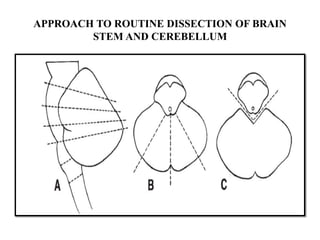
APPROACH TO ROUTINE DISSECTION OF BRAIN
STEM AND CEREBELLUM
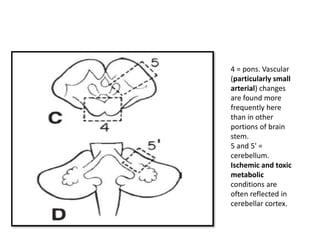
4 = pons. Vascular
(particularly small
arterial) changes
are found more
frequently here
than in other
portions of brain
stem.
5 and 5' =
cerebellum.
Ischemic and toxic
metabolic
conditions are
often reflected in
cerebellar cortex.
Abnormalities of brain
Abnormality Features
Anencephalia ,acrania Tod like face , seen in still borns
cephalocele Cerebral hernia
microcephalia Very small brain,very few gyri
True microgyria Small & thin gyri,more in no. than normal
False microgyria Convolusions abnormally thin and small,
Not increased in no.
Porencephalia Absence of portion of brain
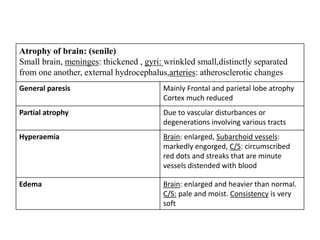
Atrophy of brain: (senile)
Small brain, meninges: thickened , gyri: wrinkled small,distinctly separated
from one another, external hydrocephalus,arteries: atherosclerotic changes
General paresis Mainly Frontal and parietal lobe atrophy
Cortex much reduced
Partial atrophy Due to vascular disturbances or
degenerations involving various tracts
Hyperaemia Brain: enlarged, Subarchoid vessels:
markedly engorged, C/S: circumscribed
red dots and streaks that are minute
vessels distended with blood
Edema Brain: enlarged and heavier than normal.
C/S: pale and moist. Consistency is very
soft
Anaemia brain: normal in size. C/S:white or bluish white,and only
very few vessels are seen. The distinction between the
gray and white matter is not sharp.
Jaundice In instances of severe jaundice as seen in icterus
neonatorum, erythroblastosis foetalis, etc., the basal
nuclei: especially the caudate nuclei ,maybe of bright
yellow colour. This discolouration of basal nuclei is
referred to as kernicterus
BACTERIAL INFECTIONS
• Bacterial Meningitis
• Brain Abscess
• Mycobacterial Infections
• Whipple’s Disease
• Spirochetal Infections
BACTERIAL MENINGITIS
• In H. influenzae meningitis: the purulent exudate may be
particularly prominent and bulky in the basilar cisterns and
cerebral sulci.
• In S. pneumoniae meningitis, the convexities of the cerebral
hemispheres are predominantly involved.
HYPERACUTE BACTERIAL MENINGITIS
• Morphologically, cases with a hyperacute course leading to
death within 24 hours are distinct from acute and subacute
cases.
• In patients who succumb to fulminant disease, massive brain
oedema and acute disseminated bleeding (multiple petechiae)
due to coagulopathy are predominant,although pus formation
is still absent.
• In these cases, the leptomeninges are congested.
• Within the first 48 hours of bacterial meningitis, macroscopic
detection of pus may be difficult.
• In these cases, comprehensive histopathological analyses of
brain tissue, including meninges taken from multiple different
areas, are required in association with microbacterial cultures,
even if the meninges look normal on macroscopic inspection.
• Pus is usually first detectable in the basal cisterns.
• Beyond 48 hours, pus is usually easily detected: the meninges
become cloudy as a result of pus formation.
• With time, the exudate may become yellow, greenish and
creamy.
• The meninges of the cerebral convexity as well as the basal
cisterns, where the subarachnoid space is most deep, are most
prominently involved.
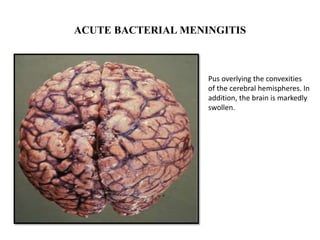
ACUTE BACTERIAL MENINGITIS
Pus overlying the convexities
of the cerebral hemispheres. In
addition, the brain is markedly
swollen.
Acute bacterial meningitis. Purulent exudate in the subarachnoid
space of the convexities also extending into the interhemispheric
fissure
BRAIN ABSCESS
• In immunocompetent adult patients:due to streptococcal
species(S. Milleri), Bacteroides and many other bacteria may
cause brain abscesses.
• In traumatic and postoperative brain abscess: S. aureus
• In mixed infections, abscess following dental infection:
Proteus
• Otogenic brain abscess, abscess following a neurosurgical
intervention or head trauma : P. aeruginosa
BRAIN ABSCESS
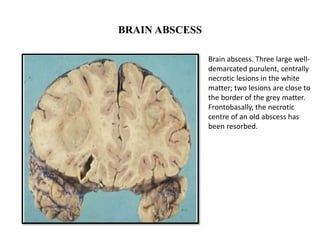
Brain abscess. Three large well-
demarcated purulent, centrally
necrotic lesions in the white
matter; two lesions are close to
the border of the grey matter.
Frontobasally, the necrotic
centre of an old abscess has
been resorbed.
TUBERCULOUS MENINGITIS
• Tuberculous meningitis affects predominantly the base of the
brain, where bacteria induce caseating inflammation.
• Macroscopy: gelatinous, viscous exudate of grey to white
colour covers the subarachnoid space at the base of the brain,
often extending into the suprasellar region anteriorly, the
interpeduncular fossa and the prepontine cistern, encroaching
on the brain stem, cranial nerves and spinal cord.
• The exudate may also be present within the lateral ventricles,
involving the choroid plexus and leading to hydrocephalus.
TUBERCULOUS MENINGITIS
CNS tuberculosis.
Greyish, gelatinous,
viscous exudate covering
the base of the brain in
tuberculous meningitis.
Note that the circle of
Willis and the cranial
nerves are engulfed by
the exudate.
TUBERCULOMA
• Tuberculoma is a space-occupying mass lesion resulting from
haematogenous spread of acid-fast bacilli to the CNS,
commonly seen in patients with miliary tuberculosis.
• Tuberculomas are greyish, circumscribed, encapsulated,
enlarging space-occupying lesions.
• Site:subarachnoid space, subdural and epidural spaces,brain
parenchyma of the cerebrum and cerebellum.
• In children:mostly infratentorial lesions
• In adults supratentorial tuberculomas
WHIPPLE’S DISEASE
• Macroscopically, small yellow-greyish nodules, 1–2 mm in
size, are scattered diffusely throughout the cortical,
subcortical, subependymal and cerebellar grey matter.
• Affected regions include the thalamus, hypothalamus, dentate
nucleus of the cerebellum and periventricular regions.
• In addition to multifocal lesions, solitary space-occupying
lesions may occur, mimicking a tumour.
• Localized CNS involvement seems to be the third major
chronic manifestation
SPIROCHETAL INFECTIONS
• Among spirochetes affecting the CNS, T. pallidum and
Borrelia burgdorferi cause clinically relevant neurologic
symptoms.
• Morphology of meningovascular syphilis:lymphocytic
vasculitis in the course of syphilitic meningitis.
• Macroscopy: inflamed meninges contain a cloudy exudate and
may be fibrosed.
• Impairment of CSF circulation with hydrocephalus and cranial
nerve palsies may result from thickening of the meninges.
• Arteritis of large and small vessels correspond to Heubner’s
arteritis and Nissl-Alzheimer endarteritis, respectively.
SPIROCHETAL INFECTIONS
• Gummas: round lesions of various size ranging from 1 mm to
4 cm in diameter, are present and cause a mass effect. Hard in
consistency and their centre necrotic,in contact with both the
dura and the brain and many become embedded in the brain
parenchyma.
• Most frequently, they reside over the convexities of the
cerebral hemispheres and may also occur in the hypothalamus,
cerebral peduncles, and the spinal cord.
SPIROCHETAL INFECTIONS
Cerebellar gumma in a
patient with acquired
immunodeficiency
syndrome (AIDS).
Round, red-tan-grey,
rubbery
lesion with a central
area of softening.
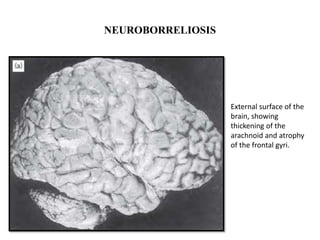
NEUROBORRELIOSIS
• The spirochete B. burgdorferi has a marked tropism for the
• Neurological symptoms may develop some weeks to months
after ixodid tick bite
• The likelihood of developing neuroborreliosis depends on
geographical factors and the season.
NEUROBORRELIOSIS
External surface of the
brain, showing
thickening of the
arachnoid and atrophy
of the frontal gyri.
CEREBRAL MALARIA
Paediatric patient.
Marked congestion and
duskiness of the
meninges, particularly
over the cerebellum.
CEREBRAL MALARIA
Adult patient.
The brain is
swollen, the
ventricles
compressed
and there are
small
haemorrhages
throughout the
white matter.
A small berry aneurysm of
the left middle cerebral
artery (MCA) (arrow) had
ruptured
and caused fatal
subarachnoid
haemorrhage.
Inset: higher
magnification of the
aneurysm
REFERENCES
• Ludwig J, editor. Handbook of autopsy practice. Springer
Science & Business Media; 2002 Jul 18.
• Love S, Perry A, Ironside J, Budka H, editors. Greenfield's
Neuropathology-Two Volume Set. CRC Press; 2018 Oct 8.

Autopsy-of-brain.pptx

  • 1.
    Autopsy of brain Dr.B.Swathi Final year postgraduate, Pathology Sri Venkateswara Institute of Medical Sciences, Tirupathi
  • 2.
    • Opening ofskull • Detachment of brain • fixation • Dissection of fresh/fixed brain • Selective sectioning • Gross findings
  • 3.
    INCISION OF SCALP Dottedline indicates coronal plane of the primary incision. It starts on right side over the mastoid just behind earlobe and passes over palpable posterolateral ridges of parietal bones to reach opposite mastoid. This line is slightly tilted backward from plane parallel with face
  • 4.
    OPENING OF SKULL •Head is held in proper position with a block • Bitemporal incision passing near the vertex • Incise the scalp down to the bone • peel the skin and subcutaneous tissues back to below the occipital protuberance posteriorly and to the level of forehead (to a level 1 or 2 cm above the supraorbital ridge) anteriorly by a combination of sharp and blunt dissection.
  • 5.
    SCALP INCISION The scalpis incised down to the bone, taking care not to cut the hair.
  • 6.
    SAWING OF CRANIUM •Vibrating (Stryker) saw or an oscillating saw to cut the bone along coronal plane, (Triangular notches placed laterally in the skull cap facilitate realignment for postmortem reconstruction)or ā€œstep cutā€ or angled cut
  • 7.
    • Lipshaw Co.– oscillating saw is equipped with a guard and can be used with little training, without fear of deep penetration.
  • 8.
    Protective device Prosector’s handholds saw inside bag. Dashed line indicates tape-seal of bag to, from left, prosector’s gown, opposite side of the bag and neck of deceased. (suspected Creutzfeldt- Jakob disease)
  • 9.
    CONFIGURATION OF THESAW CUT Lines of saw cuts for skull cap removal. Frontal point (A) is approx two fingerbreadths above supraorbital ridges. Temporal point (B) is at the top of ear in its natural position before scalp reflection. Point (C) is approx 2 cm above (B). Occipital point (D) is approx two fingerbreadths above external occipital protuberance (inion).
  • 10.
    • If (A)is too low, there is danger of cutting into the roof of the orbit; • if (B) is too low, saw will enter petrous portion of temporal bone. • Either of these will make removal of skull vault difficult. • When (D) is too low, saw line will be below attachment of the tentorium.
  • 11.
    The skull hasbeen cut with a vibrating saw using an angled cut. A chisel helps separate the skull cap.
  • 12.
    • Ideally, sawingshould be stopped just short of cutting through the inner table of the cranium – with the use of a chisel and a light blow with a mallet. • Dura and underlying leptomeninges left intact allows to view the brain with the overlying (CSF) still in the subarachnoid space. • To obtain this view, after removal of the skull cap, the dura must be cut with a pair of scissors along the line of sawing and reflected.
  • 13.
    SEPARATION OF MENINGES •A twist of chisel placed in the frontal saw line • admit the fingers inside the skull cap or blunt hook used to pull the skull cap away from the underlying dura. • A hand inserted between the skull and the dura (periosteum) helps the blunt separation of these while the other hand is pulling the skull cap.
  • 14.
    SEPARATION OF MENINGES If dura too firmly adheres to the skull  It is incised along the line of sawing  anterior attachment of the falx to the skull cut between the frontal lobes  posterior portion of the falx cut from inside after the skull cap is fully reflected.  The dura is then peeled off the skull cap,superior sagittal sinus may be opened with a pair of scissors at this time.
  • 15.
    • In thepresence of epi- or subdural hemorrhage and neoplasia, it is best to leave the dural flaps attached to the dorsal brain and section them together.
  • 16.
    DETACHMENT OF BRAIN •The frontal lobes gently raised and the olfactory bulbs and tracts are peeled away from the cribriform plates. • The optic nerves are cut as they enter the optic foramina. • Under its own weight, the brain is allowed to fall away from the floor of the anterior fossa, while it is being supported with the palm of one hand.
  • 17.
    DETACHMENT OF BRAIN Thedura at the anterior attachment of the falx to the crista galli is cut and the brain is gently elevated and retracted posteriorly. optic nerves, carotid arteries, and third cranial nerves are cut where they enter the skull.
  • 18.
    DETACHMENT OF BRAIN •The pituitary stalk is cut,followed by the internal carotid arteries as they enter the cranialcavity. • Cranial nerves III, IV, V, and VI are severed as close to the base of the skull as possible,subdural communicating veins are also severed. • Next, the attachment of the tentorium along the petrous ridge is cut on either side with curved scissors
  • 19.
    DETACHMENT OF BRAIN •At this time, the brain must not drop backward excessively as this will cause stretch tears in the cerebral peduncles. • This also can be prevented by raising the head very high from the beginning, with pronounced flexion of the neck, using a wooden pillow or a metal support attached to the table.
  • 20.
    DETACHMENT OF BRAIN Thebrain is supported as the cranial nerves and vessels are transected.
  • 21.
    DETACHMENT OF BRAIN •Cranial nerves VII, VIII, IX, X, XI, and XII are then cut identifying each one in sequence. • The vertebral arteries are severed with scissors as they emerge into the cranial cavity. • cervical part of the spinal cord is cut across as caudally as possible but too oblique a plane of sectioning should be avoided.(Curved scissors will be best for this purpose.)
  • 22.
    DETACHMENT OF BRAIN Asthe brain is retracted upward and posteriorly, the medulla and upper cervical spinal cord are visualized. The spinal cord is cut transversely as low as possible.
  • 23.
    DETACHMENT OF BRAIN •If a critical lesion exists in the region, a cross-section perpendicular to the neuroaxis at the pontomedullary junction or higher may be elected in order to preserve the integrity of the abnormality.
  • 24.
    DETACHMENT OF BRAIN Thefingers aid in freeing the cerebellum from the posterior cranial fossa. The brain is supported by one hand, the falx cerebelli is cut, and the brain is removed from the cranial vault.
  • 25.
    • The brainis pulled away from the base of the skull after cutting the lateral attachment of the tentorium to the petrous bones. • The pineal body must not be left behind during this maneuver.
  • 26.
    • weigh theunfixed brain (and note whether the dura is included in this weight). • Survey the nerves, vessels,and gross anatomy for abnormalities. • If indicated, take additional culture specimens and smears and prepare sections for rush processing. • Also take tissues for electron microscopy and other special studies (e.g., RNA, DNA) now
  • 27.
    FIXATION • Best routinefixative : freshly prepared 10% formalin solution. • In fetuses and infants: Aceticacid added to the fixative • Acetic acid: I. increases the specific gravity of the fixative and allows the brain to float in the solution; II. it also makes the tissue firmer without altering its histologic characteristics.
  • 28.
    IMMERSION METHODS • plasticbuckets that hold 8 L of fixative or traditional glass or earthenware jars. • suspend the brain to prevent distortion during fixation by passing a thread underneath the basilar artery in front of the pons. • Inevitably, the vessel is slightly pulled away from the brain substance.
  • 29.
    • If thisis undesirable, as in the case of pontine infarcts or other lesions in this region, a thread can be passed under the internal carotid or middle cerebral arteries on both sides, provided that no pathologic lesions are suspected in these regions. • Alternatively, dorsal dura can be used as an anchoring point. • A thread is passed through the short dural flaps on either side of the falx, and the brain is suspended right-side-up. • However, a minor pull may deform the parasagittal brain tissue and cause an abnormally pointed dorsal midline surface of the brain
  • 30.
    • suspension fromblood vessels deforms the parenchyma less than dural suspension • With all these methods: • the ends of the thread(s) are tied to the attachments of the bucket handle.  care being taken not to allow the specimen to touch the bottom or sides of the bucket
  • 31.
    • Another safemethod: • Use of the plastic brain support. • Placing several holes in the dome-shaped receptacle • will ensure proper fixation of the contact surface of the brain.
  • 32.
    • Formalin solutionshould be replaced within the first 24 h not mandatory if a large amount of fixative is used. • If the fixative becomes very bloody, prompt replacement with fresh solution is indicated to prevent undue discoloration of the specimen. • Approximately 10–14 d are required for satisfactory fixation.
  • 33.
    PERFUSION METHODS • Thebrain can be perfused with fixative through the arterial stumps before further fixation by immersion. • This can be done manually with a syringe connected to a simple tubing system. • For easy handling and better preservation of the contour of the specimen a plastic holder is used during the procedure. • Satisfactory fixation for dissection can be obtained in 7–10 d. • For perfusion of a large amount of fixative, an embalmer’s pump may be used
  • 34.
    • Large volumesof formalin (1,000 mL) improve fixation but : • With too much fixative, large lakes of fluid may accumulate, particularly in the areas like infart, hemorrhage, metastasis. • Specimen may become asymmetric because of uneven perfusion. • May produce annoying perivascular zones of tissue rarefaction microscopically, in addition to unnatural dilatation of small blood vessels. • Obstructing emboli or thrombosis also might be obscured.
  • 35.
    • Injection of150 mL of isotonic saline followed by 150 mL of 10% formalin solution causes the least problems. • For a simple gravity-feed method, one may use an infusion bottle raised 150–180 cm above the specimen.
  • 36.
    DISSECTION OF BRAIN •Single-blade autopsy knife about 25 cm long and 2cm wide is prefered.  dissection of fresh brain in adults  dissection of fixed brain
  • 37.
    DISSECTION OF FRESHBRAIN IN ADULTS • Fresh dissection is limited to 3/4 coronal cuts through the cerebral hemispheres. • More complicated anatomic structures such as the basal ganglia and upper brain stem (thalamus and midbrain) are left uncut. • This preliminary dissection usually reveals the presence of large lesions, directly or indirectly, by showing distortion of the ventricular system or other anatomic landmarks.
  • 38.
    • Further judiciouslyselected sections may be made into the primary slices of the brain tissue to expose the suspected hidden lesions. • The central portion of the cerebral hemispheres is left connected with the brain stem, and this block is suspended by a string. • It may be necessary to sever the brain stem and cut into the infratentorial structures • One horizontal cut through these structures usually suffices for preliminary examination.
  • 39.
    • Preliminary perfusionor cooling of the brain in a refrigerator for about 30 min, preferably in a contoured support makes the brain firmer and dissection easier.
  • 40.
    BRAIN BISECTION ALONGTHE SAGITTAL PLANE • If diffuse, roughly symmetric lesions are expected, as in:  lipidoses, ā€œdegenerative diseases,ā€  ā€œdemyelinatingā€ disorders,  other inborn or acquired toxic-metabolic diseases,  widespread infectious conditions • one half further sectioned and submitted for chemical or microbiologic investigations • Other half is retained for later sectioning and histologic examination. • This latter half must be fixed either by suspension or by letting it lie on its midsagittal plane to avoid undesirable distortions.
  • 41.
    DISSECTION OF FIXEDBRAIN Cerebellum should be held between the index finger of the one hand with the tip in proximity of the pineal gland and the thumb on the inferior surface of cerebellum brain placed upside down The blade is held toward the prosector with its tip in front of the distant cerebral peduncle a few millimeters above the tip of the mammillary body
  • 42.
    DISSECTION OF FIXEDBRAIN As an initial step we hold the brain on its convexity with the orbital lobes and occipital poles in an horizontal plane. The first section is made through the mammillary body and cut surfaces are examined for symmetry
  • 43.
    DISSECTION OF FIXEDBRAIN • Alternatively, the first cut can be made just in front of the temporal poles, exposing the anterior ventricular horns. • This may be important in cases of hydrocephalus, in which this view may disclose an obstruction of the foramen of Monro (e.g., by a colloid cyst or a third ventricular tumor) and still allow a change in sectioning technique to better demonstrate the obtruction • Brain slices should be approx 1 cm thick.
  • 44.
    DISSECTION OF FIXEDBRAIN Section the halved brain pieces by holding them down on the cut surface and by moving the knife side to side from the inferior surface of the brain toward the convexity
  • 45.
  • 46.
    Device for sectioningbrain along planes of tomography.
  • 47.
    Plexiglass table with openingfor cerebellum and brain stem and movable guide. Brain in position for initial cut
  • 48.
    Halved brain positioned on boardfor serial sectioning.
  • 49.
    THE BRAIN DISPLAYEDFOR EXAMINATION AND MICROSCOPIC SAMPLING
  • 50.
    SELECTION OF TISSUEBLOCKS 1.superior and middle frontal gyri. This is an arterial border (ā€œwater-shedā€) zone most likely to arbor small ischemic lesions. This also may reveal atrophic or ā€œsenileā€ changes such as senile plaques or neurofibrillary tangles. 2. basal ganglia Vascular changes and their effects on parenchyma are likely to be found here, as are otherā€œdegenerative changes.ā€
  • 51.
    2' = basalganglia together with thalamus. 3 = hippocampus and adjacent neocortex. This is often a sensitive indicator of anoxic- ischemic changes. Neurofibrillary tangles, neuritic plaques, and the ā€œagingā€ changes make their first appearance here.
  • 52.
    APPROACH TO ROUTINEDISSECTION OF BRAIN STEM AND CEREBELLUM
  • 53.
    4 = pons.Vascular (particularly small arterial) changes are found more frequently here than in other portions of brain stem. 5 and 5' = cerebellum. Ischemic and toxic metabolic conditions are often reflected in cerebellar cortex.
  • 54.
    Abnormalities of brain AbnormalityFeatures Anencephalia ,acrania Tod like face , seen in still borns cephalocele Cerebral hernia microcephalia Very small brain,very few gyri True microgyria Small & thin gyri,more in no. than normal False microgyria Convolusions abnormally thin and small, Not increased in no. Porencephalia Absence of portion of brain
  • 55.
    Atrophy of brain:(senile) Small brain, meninges: thickened , gyri: wrinkled small,distinctly separated from one another, external hydrocephalus,arteries: atherosclerotic changes General paresis Mainly Frontal and parietal lobe atrophy Cortex much reduced Partial atrophy Due to vascular disturbances or degenerations involving various tracts Hyperaemia Brain: enlarged, Subarchoid vessels: markedly engorged, C/S: circumscribed red dots and streaks that are minute vessels distended with blood Edema Brain: enlarged and heavier than normal. C/S: pale and moist. Consistency is very soft
  • 56.
    Anaemia brain: normalin size. C/S:white or bluish white,and only very few vessels are seen. The distinction between the gray and white matter is not sharp. Jaundice In instances of severe jaundice as seen in icterus neonatorum, erythroblastosis foetalis, etc., the basal nuclei: especially the caudate nuclei ,maybe of bright yellow colour. This discolouration of basal nuclei is referred to as kernicterus
  • 57.
    BACTERIAL INFECTIONS • BacterialMeningitis • Brain Abscess • Mycobacterial Infections • Whipple’s Disease • Spirochetal Infections
  • 58.
    BACTERIAL MENINGITIS • InH. influenzae meningitis: the purulent exudate may be particularly prominent and bulky in the basilar cisterns and cerebral sulci. • In S. pneumoniae meningitis, the convexities of the cerebral hemispheres are predominantly involved.
  • 59.
    HYPERACUTE BACTERIAL MENINGITIS •Morphologically, cases with a hyperacute course leading to death within 24 hours are distinct from acute and subacute cases. • In patients who succumb to fulminant disease, massive brain oedema and acute disseminated bleeding (multiple petechiae) due to coagulopathy are predominant,although pus formation is still absent. • In these cases, the leptomeninges are congested.
  • 60.
    • Within thefirst 48 hours of bacterial meningitis, macroscopic detection of pus may be difficult. • In these cases, comprehensive histopathological analyses of brain tissue, including meninges taken from multiple different areas, are required in association with microbacterial cultures, even if the meninges look normal on macroscopic inspection. • Pus is usually first detectable in the basal cisterns.
  • 61.
    • Beyond 48hours, pus is usually easily detected: the meninges become cloudy as a result of pus formation. • With time, the exudate may become yellow, greenish and creamy. • The meninges of the cerebral convexity as well as the basal cisterns, where the subarachnoid space is most deep, are most prominently involved.
  • 62.
    ACUTE BACTERIAL MENINGITIS Pusoverlying the convexities of the cerebral hemispheres. In addition, the brain is markedly swollen.
  • 63.
    Acute bacterial meningitis.Purulent exudate in the subarachnoid space of the convexities also extending into the interhemispheric fissure
  • 64.
    BRAIN ABSCESS • Inimmunocompetent adult patients:due to streptococcal species(S. Milleri), Bacteroides and many other bacteria may cause brain abscesses. • In traumatic and postoperative brain abscess: S. aureus • In mixed infections, abscess following dental infection: Proteus • Otogenic brain abscess, abscess following a neurosurgical intervention or head trauma : P. aeruginosa
  • 65.
    BRAIN ABSCESS Brain abscess.Three large well- demarcated purulent, centrally necrotic lesions in the white matter; two lesions are close to the border of the grey matter. Frontobasally, the necrotic centre of an old abscess has been resorbed.
  • 66.
    TUBERCULOUS MENINGITIS • Tuberculousmeningitis affects predominantly the base of the brain, where bacteria induce caseating inflammation. • Macroscopy: gelatinous, viscous exudate of grey to white colour covers the subarachnoid space at the base of the brain, often extending into the suprasellar region anteriorly, the interpeduncular fossa and the prepontine cistern, encroaching on the brain stem, cranial nerves and spinal cord. • The exudate may also be present within the lateral ventricles, involving the choroid plexus and leading to hydrocephalus.
  • 67.
    TUBERCULOUS MENINGITIS CNS tuberculosis. Greyish,gelatinous, viscous exudate covering the base of the brain in tuberculous meningitis. Note that the circle of Willis and the cranial nerves are engulfed by the exudate.
  • 68.
    TUBERCULOMA • Tuberculoma isa space-occupying mass lesion resulting from haematogenous spread of acid-fast bacilli to the CNS, commonly seen in patients with miliary tuberculosis. • Tuberculomas are greyish, circumscribed, encapsulated, enlarging space-occupying lesions. • Site:subarachnoid space, subdural and epidural spaces,brain parenchyma of the cerebrum and cerebellum. • In children:mostly infratentorial lesions • In adults supratentorial tuberculomas
  • 69.
    WHIPPLE’S DISEASE • Macroscopically,small yellow-greyish nodules, 1–2 mm in size, are scattered diffusely throughout the cortical, subcortical, subependymal and cerebellar grey matter. • Affected regions include the thalamus, hypothalamus, dentate nucleus of the cerebellum and periventricular regions. • In addition to multifocal lesions, solitary space-occupying lesions may occur, mimicking a tumour. • Localized CNS involvement seems to be the third major chronic manifestation
  • 70.
    SPIROCHETAL INFECTIONS • Amongspirochetes affecting the CNS, T. pallidum and Borrelia burgdorferi cause clinically relevant neurologic symptoms. • Morphology of meningovascular syphilis:lymphocytic vasculitis in the course of syphilitic meningitis. • Macroscopy: inflamed meninges contain a cloudy exudate and may be fibrosed. • Impairment of CSF circulation with hydrocephalus and cranial nerve palsies may result from thickening of the meninges. • Arteritis of large and small vessels correspond to Heubner’s arteritis and Nissl-Alzheimer endarteritis, respectively.
  • 71.
    SPIROCHETAL INFECTIONS • Gummas:round lesions of various size ranging from 1 mm to 4 cm in diameter, are present and cause a mass effect. Hard in consistency and their centre necrotic,in contact with both the dura and the brain and many become embedded in the brain parenchyma. • Most frequently, they reside over the convexities of the cerebral hemispheres and may also occur in the hypothalamus, cerebral peduncles, and the spinal cord.
  • 72.
    SPIROCHETAL INFECTIONS Cerebellar gummain a patient with acquired immunodeficiency syndrome (AIDS). Round, red-tan-grey, rubbery lesion with a central area of softening.
  • 73.
    NEUROBORRELIOSIS • The spirocheteB. burgdorferi has a marked tropism for the • Neurological symptoms may develop some weeks to months after ixodid tick bite • The likelihood of developing neuroborreliosis depends on geographical factors and the season.
  • 74.
    NEUROBORRELIOSIS External surface ofthe brain, showing thickening of the arachnoid and atrophy of the frontal gyri.
  • 75.
    CEREBRAL MALARIA Paediatric patient. Markedcongestion and duskiness of the meninges, particularly over the cerebellum.
  • 76.
    CEREBRAL MALARIA Adult patient. Thebrain is swollen, the ventricles compressed and there are small haemorrhages throughout the white matter.
  • 77.
    A small berryaneurysm of the left middle cerebral artery (MCA) (arrow) had ruptured and caused fatal subarachnoid haemorrhage. Inset: higher magnification of the aneurysm
  • 78.
    REFERENCES • Ludwig J,editor. Handbook of autopsy practice. Springer Science & Business Media; 2002 Jul 18. • Love S, Perry A, Ironside J, Budka H, editors. Greenfield's Neuropathology-Two Volume Set. CRC Press; 2018 Oct 8.