WHEN A WOMANIN LATE
PREGNANCY
HAS A CARDIAC ARREST
AND
RESUSCITATION FAILS,
SHOULD AN ATTEMPT BE MADE
TO SAVE THE BABY
BY
CAESAREAN SECTION?
3.
OBJECTIVES
To know whatis
Postmortem/Perimortem Caesarean
section.
To discuss the Historical perspectives of
it.
To discuss the social, ethical and
religious background.
To discuss the medicolegal aspects.
4.
TRADITIONALLY POSTMORTEM
CAESAREAN SECTION(PMCS) IS
REQUIRED TO BE UNDERTAKEN
To save the life of the fetus of viable age
and still in-utero while the mother has just
died or dying.
As a part of some religious, social or
community practices.
5.
ARISES RARELY POSESVEXING
MEDICOLEGAL PROBLEM
BECAUSE
Guidelines or Protocols are not available.
There is lack of directives from law
enforcing agencies.
6.
WHERE WE STAND………….
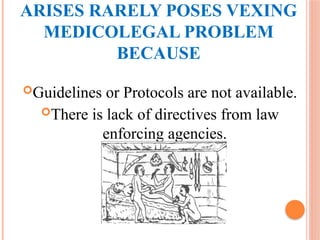
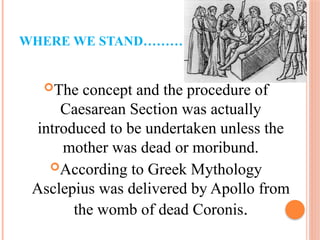
Theconcept and the procedure of
Caesarean Section was actually
introduced to be undertaken unless the
mother was dead or moribund.
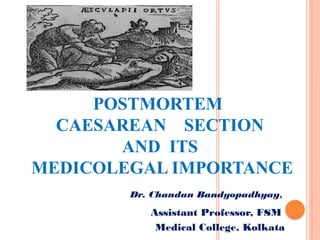
According to Greek Mythology
Asclepius was delivered by Apollo from
the womb of dead Coronis.
7.
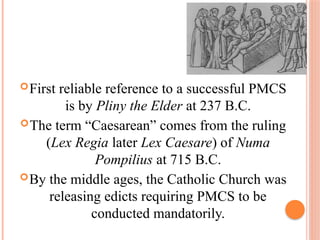
First reliable referenceto a successful PMCS
is by Pliny the Elder at 237 B.C.
The term “Caesarean” comes from the ruling
(Lex Regia later Lex Caesare) of Numa
Pompilius at 715 B.C.
By the middle ages, the Catholic Church was
releasing edicts requiring PMCS to be
conducted mandatorily.
8.
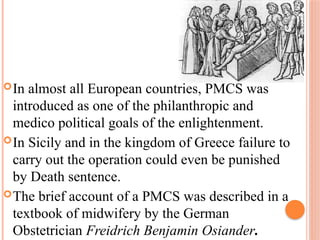
In almost allEuropean countries, PMCS was
introduced as one of the philanthropic and
medico political goals of the enlightenment.
In Sicily and in the kingdom of Greece failure to
carry out the operation could even be punished
by Death sentence.
The brief account of a PMCS was described in a
textbook of midwifery by the German
Obstetrician Freidrich Benjamin Osiander.
9.
Garuda Purana isconsidered the
authoritative vedic reference volume
describing funeral rites and it is recited
as a part Antyesti (Antim Sanskar) or
funeral rites (funeral liturgy) in
Hinduism.
10.
Garuda Purana saysthat when a
pregnant woman dies the unborn
infant must be taken out of the
mother’s womb. If it is under seven
months then it should be buried and if
above seven months it should be
cremated separately.
11.
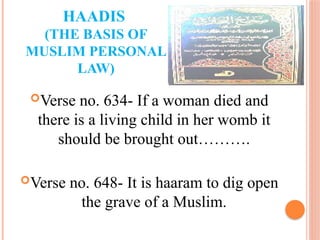
HAADIS
(THE BASIS OF
MUSLIMPERSONAL
LAW)
Verse no. 634- If a woman died and
there is a living child in her womb it
should be brought out……….
Verse no. 648- It is haaram to dig open
the grave of a Muslim.
12.
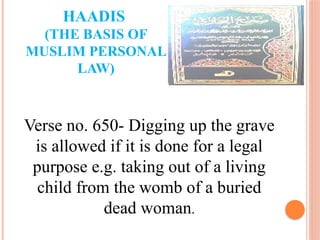
HAADIS
(THE BASIS OF
MUSLIMPERSONAL
LAW)
Verse no. 650- Digging up the grave
is allowed if it is done for a legal
purpose e.g. taking out of a living
child from the womb of a buried
dead woman.
13.
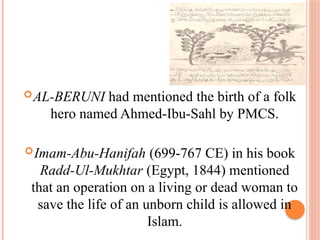
AL-BERUNI had mentionedthe birth of a folk
hero named Ahmed-Ibu-Sahl by PMCS.
Imam-Abu-Hanifah (699-767 CE) in his book
Radd-Ul-Mukhtar (Egypt, 1844) mentioned
that an operation on a living or dead woman to
save the life of an unborn child is allowed in
Islam.
14.
Fatwa Alamgeera, acollection of Islamic decrees
pronounced by Aurangzeb and compiled by
Sheikh Nitzam-Ud-Din says that if a pregnant
woman dies and the child is expected to be
alive, then it must be removed by operation.
15.
During the late19th
and 20th
centuries
some cases were reported of fetal
salvage following PMCS and the
procedure was begun to be seriously
considered as legitimate medical
intervention.
16.
During 1980s,several casesof
unexpected maternal recoveries
following PMCS were reported. As
such some started preferring the
term PERIMORTEM.
17.
Despite the rarityof PMCS, it is worthy of
attention as it may save the lives of both
mother and fetus, when appropriately
applied.
The role of PMCS is broader than
previously envisioned and the procedure
may attain a more prominent role in the
future.
18.
THE BASIC QUERIES,THAT IS
NEEDED TO BE ANSWERED
Whether PMCS should become mandatory?
When may be the right time to intervene?
What may be the contraindications?
Whether to issue two death certificates?
What are the Medicolegal issues that may
arise?
19.
THE CONTRAINDICATIONS:
The fetusis too premature to survive ex-
utero- Known Estimated Gestational Age of
less than 24 weeks may be considered a
contraindication.
Return of spontaneous circulation (of the
mother) after a brief period of resuscitation.
20.
WHETHER AND WHENTO
UNDERTAKE PMCS
Depends on circumstances-
The Estimated Gestational Age of the Fetus
The resources of the institution
Preceding condition of the mother
The time interval between Cardiac arrest
and Delivery
The time interval between Cardiac arrest
and institution of resuscitation
21.
THE BEST OUTCOMESIN TERMS
OF NEUROLOGICAL STATUS OF
SURVIVED INFANTS APPEAR TO
OCCUR IF PMCS IS UNDERTAKEN
WITHIN 5 MINS
22.
De Pace etal described successful
salvage of both mother and fetus after
25 mins of advanced CPR that begun
immediately following cardiac arrest.
23.
Lopez-Zeno et alreported fetal
salvage 47 mins after fatal maternal
injury, mother having no
resuscitation until 25 mins post
injury.
24.
The latest reportedsurvival
was of a fetus delivered 30
mins after a maternal suicide.
25.
Decision not todeliver the fetus may well
leave some unanswered questions both for
the Obstetrician and the remaining family.
Considering PMCS is prudent even if
there has been some delay after a
diagnosed cardiac arrest of the mother.
26.
POTENTIAL MEDICOLEGAL
CONSIDERATIONS
Fear oflitigation may prevent intervention in
most appropriate circumstances of PMCS
In literature no lawsuits have been reported to be
filed.
Only one legal penalty has been levied in regard
to PMCS-the death penalty for failure to perform
PMCS-in 18th
century.
27.
Clear policies onperformance of
PMCS is needed to be known to all
staffs, particularly of Emergency
department
The decision to proceed for operation
should be made at consultant level
28.
Generally PMCS isdeemed to be
emergency procedure for which
consent is not possible
If the circumstances permit an
informed consent should be
obtained from the husband
29.
SCHEDULED PMCS
This isa special case that involves a
woman who is deemed brain dead but is
maintained on artificial support for the
purpose of allowing the fetus to get
matured enough to survive when taken
out.
30.
SCHEDULED PMCS CONTD…….
Anethical issue arises regarding costly
extraordinary support measures for the
sole purpose of providing a fetal
incubator. Full informed consent from
next of keen is mandatory.
31.
SCHEDULED PMCS CONTD…….
Acceptanceof value of support
depends upon the time frame
when a few days make a huge
difference to fetal outcome.
Support beyond likely fetal
survival is controversial.
32.
SCHEDULED PMCS CONTD…….
Dillonand colleagues make a strong
distinction between true brain death
and persistent vegetative state
arguing that termination of support
measures is ethically defensible
only in the former case.
33.
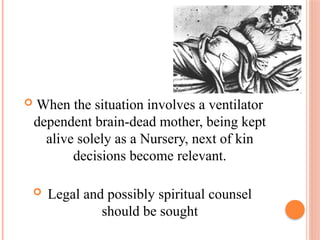
When thesituation involves a ventilator
dependent brain-dead mother, being kept
alive solely as a Nursery, next of kin
decisions become relevant.
Legal and possibly spiritual counsel
should be sought
34.
REFERENCES:
Guven S,Yazar A, Yakut K, Aydogan H, Erguven M, Avci E. Post-mortem
caesarean: report of our successful neonatal outcomes after severe trauma
during pregnancy and review of the literature. J Matern Fetal Neonatal Med.
2012 Jul; 25(7):1102-4.
http://emedicine.medscape.com/article/83059-overview. Cited May 23,
2017. retrieved July 22, 2017.
Hossam E. Fadel. Post-mortem and Perimortem Caesarean Section:
Historical, Religious and Ethical Considerations.
Journal of Islamic Medical Association of North America. 2011 Dec; 43(3):
194–200.
www.hinduwebsite.com/sacredscripts/puranas/gp/gp.asp(The
Garuda Purana - Complete Text, Translated by Ernest Wood and
S.V. Subrahmanyam.)