SAKRA INSTITUTE OF NEUROSCIENCES
Principles of craniotomy
Dr Abhishek Rai
Resident neurosurgery
SAKRA INSTITUTE OF NEUROSCIENCES
Historical perspective
• Neolithic period in 2000 B.C
• 19th century‐ trephines
• 1889 Wagner first osteoplastic bone flap
• Gigli saw for craniotomy‐ Obalinski in 1897
• Electric and gas powered high speed drills
SAKRA INSTITUTE OF NEUROSCIENCES
Surgical anatomy
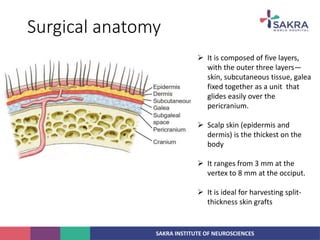
 It is composed of five layers,
with the outer three layers—
skin, subcutaneous tissue, galea
fixed together as a unit that
glides easily over the
pericranium.
 Scalp skin (epidermis and
dermis) is the thickest on the
body
 It ranges from 3 mm at the
vertex to 8 mm at the occiput.
 It is ideal for harvesting split-
thickness skin grafts
SAKRA INSTITUTE OF NEUROSCIENCES
Surgical anatomy
 Dense fibrous septa within the subcutaneous tissue adhere to the adventitia
and prevent retraction of arteries when severed. This is important in control of
scalp hemorrhage.
Manual compression with immediate suturing is a more effective means of
controlling bleeding in the scalp than attempting to grasp bleeding points with a
hemostat.
 This subaponeurotic space is a potential pathway for the ingress of bacteria
intracranially via emissary veins, which can result in meningitis or septic vein
thrombosis.
SAKRA INSTITUTE OF NEUROSCIENCES
Surgical anatomy
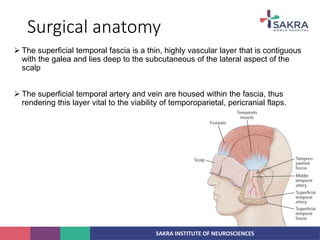
 The superficial temporal fascia is a thin, highly vascular layer that is contiguous
with the galea and lies deep to the subcutaneous of the lateral aspect of the
scalp
 The superficial temporal artery and vein are housed within the fascia, thus
rendering this layer vital to the viability of temporoparietal, pericranial flaps.
SAKRA INSTITUTE OF NEUROSCIENCES
Surgical anatomy
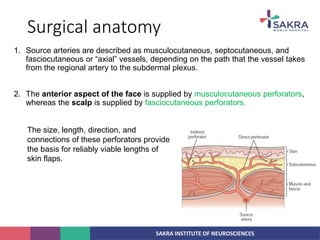
1. Source arteries are described as musculocutaneous, septocutaneous, and
fasciocutaneous or “axial” vessels, depending on the path that the vessel takes
from the regional artery to the subdermal plexus.
2. The anterior aspect of the face is supplied by musculocutaneous perforators,
whereas the scalp is supplied by fasciocutaneous perforators.
The size, length, direction, and
connections of these perforators provide
the basis for reliably viable lengths of
skin flaps.
SAKRA INSTITUTE OF NEUROSCIENCES
Surgical anatomy
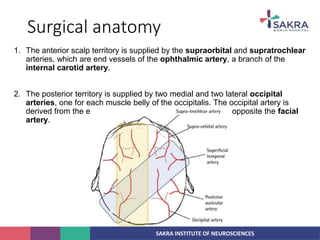
1. The anterior scalp territory is supplied by the supraorbital and supratrochlear
arteries, which are end vessels of the ophthalmic artery, a branch of the
internal carotid artery.
2. The posterior territory is supplied by two medial and two lateral occipital
arteries, one for each muscle belly of the occipitalis. The occipital artery is
derived from the external carotid artery as it branches just opposite the facial
artery.
SAKRA INSTITUTE OF NEUROSCIENCES
Surgical anatomy
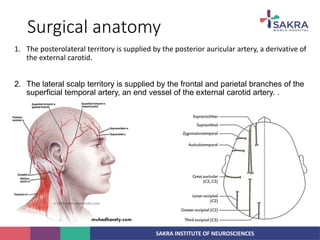
1. The posterolateral territory is supplied by the posterior auricular artery, a derivative of
the external carotid.
2. The lateral scalp territory is supplied by the frontal and parietal branches of the
superficial temporal artery, an end vessel of the external carotid artery. .
SAKRA INSTITUTE OF NEUROSCIENCES
Clinical consideration
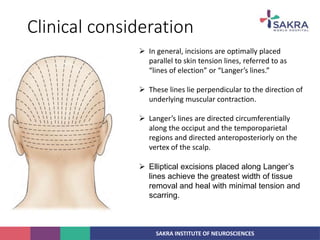
 In general, incisions are optimally placed
parallel to skin tension lines, referred to as
“lines of election” or “Langer’s lines.”
 These lines lie perpendicular to the direction of
underlying muscular contraction.
 Langer’s lines are directed circumferentially
along the occiput and the temporoparietal
regions and directed anteroposteriorly on the
vertex of the scalp.
 Elliptical excisions placed along Langer’s
lines achieve the greatest width of tissue
removal and heal with minimal tension and
scarring.
SAKRA INSTITUTE OF NEUROSCIENCES
Clinical consideration
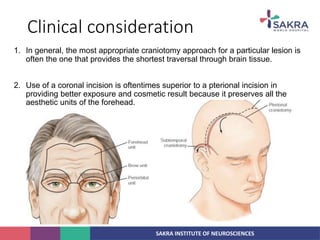
1. In general, the most appropriate craniotomy approach for a particular lesion is
often the one that provides the shortest traversal through brain tissue.
2. Use of a coronal incision is oftentimes superior to a pterional incision in
providing better exposure and cosmetic result because it preserves all the
aesthetic units of the forehead.
SAKRA INSTITUTE OF NEUROSCIENCES
Clinical consideration
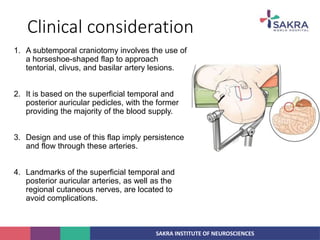
1. A subtemporal craniotomy involves the use of
a horseshoe-shaped flap to approach
tentorial, clivus, and basilar artery lesions.
2. It is based on the superficial temporal and
posterior auricular pedicles, with the former
providing the majority of the blood supply.
3. Design and use of this flap imply persistence
and flow through these arteries.
4. Landmarks of the superficial temporal and
posterior auricular arteries, as well as the
regional cutaneous nerves, are located to
avoid complications.
SAKRA INSTITUTE OF NEUROSCIENCES
Clinical consideration
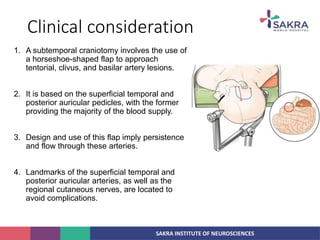
1. A subtemporal craniotomy involves the use of
a horseshoe-shaped flap to approach
tentorial, clivus, and basilar artery lesions.
2. It is based on the superficial temporal and
posterior auricular pedicles, with the former
providing the majority of the blood supply.
3. Design and use of this flap imply persistence
and flow through these arteries.
4. Landmarks of the superficial temporal and
posterior auricular arteries, as well as the
regional cutaneous nerves, are located to
avoid complications.
SAKRA INSTITUTE OF NEUROSCIENCES
Clinical consideration
1. A midline suboccipital craniotomy imparts an inconspicuous scar and takes
advantage of the avascular raphe between the two bellies of the occipitalis
muscle to optimize wound healing and closure.
2. Management of a simple, atraumatic, noncontaminated wound is best achieved
with primary closure, with the goal being to obliterate potential dead space,
distribute tension evenly along deep suture lines, and maintain suture tensile
strength until tissue tensile strength is adequate.
3. Monofilament suture is a single-strand suture with proven resistance to the
ingress of bacteria as compared with multifilament suture.
4. Monofilament suture also has decreased drag when passed through tissues,
which may contribute to a decreased inflammatory response when compared
with multifilament suture.
SAKRA INSTITUTE OF NEUROSCIENCES
Clinical consideration
1. Tension-free closure is highly desirable for wound closure. In general, scalp
defects of 2 cm or less can be closed primarily.
2. Simple primary closure of the scalp can be performed in two layers with
approximation of the galea first, followed by epidermal closure.
3. Deeper tissues bear the majority of the tension and therefore require suture
material with appropriate tensile strength and minimal reactivity, such as longer
lasting absorbable monofilament suture.
4. An interrupted stitch is the preferred closure technique because it avoids
compromising the vessels within the galea supplying the scalp.
SAKRA INSTITUTE OF NEUROSCIENCES
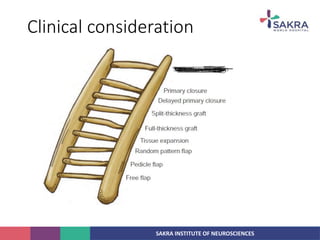
Clinical consideration
SAKRA INSTITUTE OF NEUROSCIENCES
Basic principle
1. It should provide adequate surgical exposure.
2. Minimal brain retraction.
3. Minimum damage to surrounding neurovascular structures.
4. Base of scalp flap should be wider.
5. Preservation of neurovascular bundle of scalp flap.
SAKRA INSTITUTE OF NEUROSCIENCES
Positioning
• Head positioning
• Head and Neck positioning
• Body postioning
• Supine : Horizontal, lawn chair, Reverse Trendelenburg
• Prone : Pure And concorde
• Lateral : Pure, three quarter and Park Bench
• Sitting
SAKRA INSTITUTE OF NEUROSCIENCES
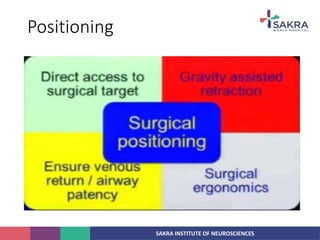
Positioning
SAKRA INSTITUTE OF NEUROSCIENCES
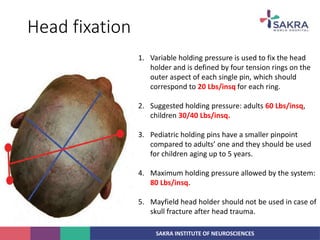
Head fixation
1. Variable holding pressure is used to fix the head
holder and is defined by four tension rings on the
outer aspect of each single pin, which should
correspond to 20 Lbs/insq for each ring.
2. Suggested holding pressure: adults 60 Lbs/insq,
children 30/40 Lbs/insq.
3. Pediatric holding pins have a smaller pinpoint
compared to adults’ one and they should be used
for children aging up to 5 years.
4. Maximum holding pressure allowed by the system:
80 Lbs/insq.
5. Mayfield head holder should not be used in case of
skull fracture after head trauma.
SAKRA INSTITUTE OF NEUROSCIENCES
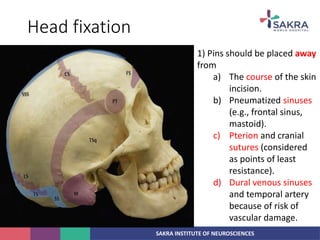
Head fixation
1) Pins should be placed away
from
a) The course of the skin
incision.
b) Pneumatized sinuses
(e.g., frontal sinus,
mastoid).
c) Pterion and cranial
sutures (considered
as points of least
resistance).
d) Dural venous sinuses
and temporal artery
because of risk of
vascular damage.
SAKRA INSTITUTE OF NEUROSCIENCES
Guidelines in positioning
Preoperative assessment:
1. Ascertain that patients can comfortably tolerate the anticipated operative
position
Upper extremity positioning:
1. Arm abduction should be limited to 90° in supine patients; patients who are
positioned prone may comfortably tolerate arm abduction greater than 90°
2. Position arms to decrease pressure on ulnar groove (humerus). When arms
are tucked at the side, neutral forearm position is recommended.
3. When arms are abducted on armboards, either supination or a neutral
forearm position is acceptable.
4. Prolonged pressure on the radial nerve in the spiral groove of the humerus
should be avoided.
5. Extension of the elbow beyond a comfortable range may stretch the median
nerve.
SAKRA INSTITUTE OF NEUROSCIENCES
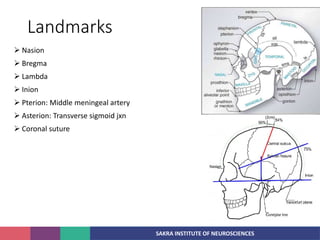
Landmarks
 Nasion
 Bregma
 Lambda
 Inion
 Pterion: Middle meningeal artery
 Asterion: Transverse sigmoid jxn
 Coronal suture
SAKRA INSTITUTE OF NEUROSCIENCES
Principles of craniotomy
• Preoperative review of patient
• Preparation of scalp
• Positioning of patient on the table
• Scalp toilet
• Marking of the incision
• Draping
SAKRA INSTITUTE OF NEUROSCIENCES
Planning
• Location of lesion
• Position of important structures.
• Contingency plans for extension of incision.
SAKRA INSTITUTE OF NEUROSCIENCES
Principles
• General principles:
– Surgical exposure of the lesion
– Neuro vascular supply
– Cosmetic effect
• Types:
– Random pattern
– Based on named vessel
• Length not >1.5 times base
• Integrity of major vascular flap to be maintained
• Incision in hair containing region.
• No crossed incisions
SAKRA INSTITUTE OF NEUROSCIENCES
Principles
• General principles:
– Surgical exposure of the lesion
– Neuro vascular supply
– Cosmetic effect
• Types:
– Random pattern
– Based on named vessel
• Length not >1.5 times base
• Integrity of major vascular flap to be maintained
• Incision in hair containing region.
• No crossed incisions
SAKRA INSTITUTE OF NEUROSCIENCES
Types of craniotomies
Flap craniotomy
 Osteoplastic craniotomy
 Free bone flap
Trephine craniotomy
SAKRA INSTITUTE OF NEUROSCIENCES
Bone flaps
Direct access to target.
For cerebral convexity directly centred over lesion.
Number of buurholes
Separation of underlying dura
If dura lacerated, saw should be turned off and removed
backward via entance hole.
SAKRA INSTITUTE OF NEUROSCIENCES
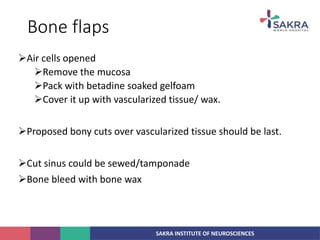
Bone flaps
Air cells opened
Remove the mucosa
Pack with betadine soaked gelfoam
Cover it up with vascularized tissue/ wax.
Proposed bony cuts over vascularized tissue should be last.
Cut sinus could be sewed/tamponade
Bone bleed with bone wax
SAKRA INSTITUTE OF NEUROSCIENCES
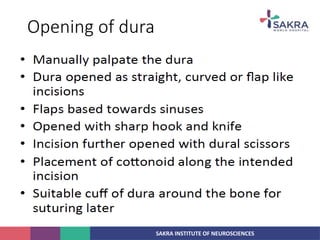
Opening of dura
SAKRA INSTITUTE OF NEUROSCIENCES
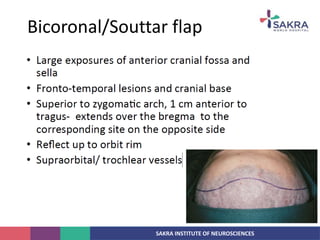
Bicoronal/Souttar flap
SAKRA INSTITUTE OF NEUROSCIENCES
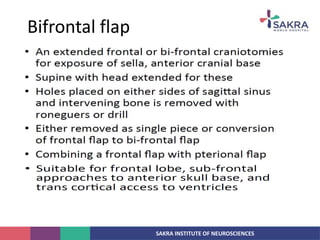
Bifrontal flap
SAKRA INSTITUTE OF NEUROSCIENCES
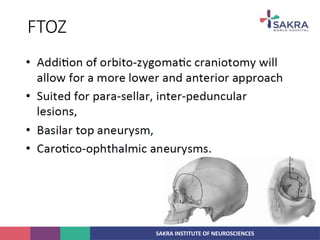
FTOZ
SAKRA INSTITUTE OF NEUROSCIENCES
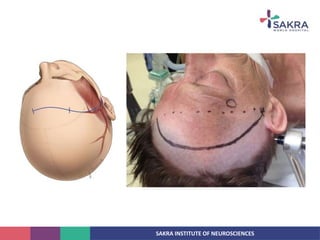
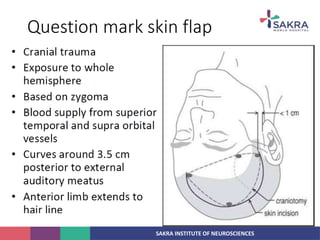
Question mark skin flap
SAKRA INSTITUTE OF NEUROSCIENCES
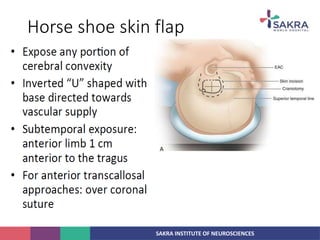
Horse shoe skin flap
SAKRA INSTITUTE OF NEUROSCIENCES
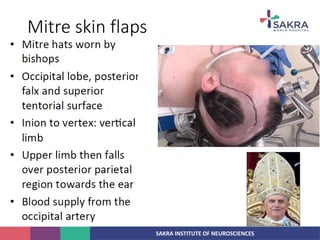
Mitre skin flaps
SAKRA INSTITUTE OF NEUROSCIENCES
Linear and curvilinear incision
SAKRA INSTITUTE OF NEUROSCIENCES
THANK YOU

Principles of craniotomy flaps

  • 1.
    SAKRA INSTITUTE OFNEUROSCIENCES Principles of craniotomy Dr Abhishek Rai Resident neurosurgery
  • 2.
    SAKRA INSTITUTE OFNEUROSCIENCES Historical perspective • Neolithic period in 2000 B.C • 19th century‐ trephines • 1889 Wagner first osteoplastic bone flap • Gigli saw for craniotomy‐ Obalinski in 1897 • Electric and gas powered high speed drills
  • 3.
    SAKRA INSTITUTE OFNEUROSCIENCES Surgical anatomy  It is composed of five layers, with the outer three layers— skin, subcutaneous tissue, galea fixed together as a unit that glides easily over the pericranium.  Scalp skin (epidermis and dermis) is the thickest on the body  It ranges from 3 mm at the vertex to 8 mm at the occiput.  It is ideal for harvesting split- thickness skin grafts
  • 4.
    SAKRA INSTITUTE OFNEUROSCIENCES Surgical anatomy  Dense fibrous septa within the subcutaneous tissue adhere to the adventitia and prevent retraction of arteries when severed. This is important in control of scalp hemorrhage. Manual compression with immediate suturing is a more effective means of controlling bleeding in the scalp than attempting to grasp bleeding points with a hemostat.  This subaponeurotic space is a potential pathway for the ingress of bacteria intracranially via emissary veins, which can result in meningitis or septic vein thrombosis.
  • 5.
    SAKRA INSTITUTE OFNEUROSCIENCES Surgical anatomy  The superficial temporal fascia is a thin, highly vascular layer that is contiguous with the galea and lies deep to the subcutaneous of the lateral aspect of the scalp  The superficial temporal artery and vein are housed within the fascia, thus rendering this layer vital to the viability of temporoparietal, pericranial flaps.
  • 6.
    SAKRA INSTITUTE OFNEUROSCIENCES Surgical anatomy 1. Source arteries are described as musculocutaneous, septocutaneous, and fasciocutaneous or “axial” vessels, depending on the path that the vessel takes from the regional artery to the subdermal plexus. 2. The anterior aspect of the face is supplied by musculocutaneous perforators, whereas the scalp is supplied by fasciocutaneous perforators. The size, length, direction, and connections of these perforators provide the basis for reliably viable lengths of skin flaps.
  • 7.
    SAKRA INSTITUTE OFNEUROSCIENCES Surgical anatomy 1. The anterior scalp territory is supplied by the supraorbital and supratrochlear arteries, which are end vessels of the ophthalmic artery, a branch of the internal carotid artery. 2. The posterior territory is supplied by two medial and two lateral occipital arteries, one for each muscle belly of the occipitalis. The occipital artery is derived from the external carotid artery as it branches just opposite the facial artery.
  • 8.
    SAKRA INSTITUTE OFNEUROSCIENCES Surgical anatomy 1. The posterolateral territory is supplied by the posterior auricular artery, a derivative of the external carotid. 2. The lateral scalp territory is supplied by the frontal and parietal branches of the superficial temporal artery, an end vessel of the external carotid artery. .
  • 9.
    SAKRA INSTITUTE OFNEUROSCIENCES Clinical consideration  In general, incisions are optimally placed parallel to skin tension lines, referred to as “lines of election” or “Langer’s lines.”  These lines lie perpendicular to the direction of underlying muscular contraction.  Langer’s lines are directed circumferentially along the occiput and the temporoparietal regions and directed anteroposteriorly on the vertex of the scalp.  Elliptical excisions placed along Langer’s lines achieve the greatest width of tissue removal and heal with minimal tension and scarring.
  • 10.
    SAKRA INSTITUTE OFNEUROSCIENCES Clinical consideration 1. In general, the most appropriate craniotomy approach for a particular lesion is often the one that provides the shortest traversal through brain tissue. 2. Use of a coronal incision is oftentimes superior to a pterional incision in providing better exposure and cosmetic result because it preserves all the aesthetic units of the forehead.
  • 11.
    SAKRA INSTITUTE OFNEUROSCIENCES Clinical consideration 1. A subtemporal craniotomy involves the use of a horseshoe-shaped flap to approach tentorial, clivus, and basilar artery lesions. 2. It is based on the superficial temporal and posterior auricular pedicles, with the former providing the majority of the blood supply. 3. Design and use of this flap imply persistence and flow through these arteries. 4. Landmarks of the superficial temporal and posterior auricular arteries, as well as the regional cutaneous nerves, are located to avoid complications.
  • 12.
    SAKRA INSTITUTE OFNEUROSCIENCES Clinical consideration 1. A subtemporal craniotomy involves the use of a horseshoe-shaped flap to approach tentorial, clivus, and basilar artery lesions. 2. It is based on the superficial temporal and posterior auricular pedicles, with the former providing the majority of the blood supply. 3. Design and use of this flap imply persistence and flow through these arteries. 4. Landmarks of the superficial temporal and posterior auricular arteries, as well as the regional cutaneous nerves, are located to avoid complications.
  • 13.
    SAKRA INSTITUTE OFNEUROSCIENCES Clinical consideration 1. A midline suboccipital craniotomy imparts an inconspicuous scar and takes advantage of the avascular raphe between the two bellies of the occipitalis muscle to optimize wound healing and closure. 2. Management of a simple, atraumatic, noncontaminated wound is best achieved with primary closure, with the goal being to obliterate potential dead space, distribute tension evenly along deep suture lines, and maintain suture tensile strength until tissue tensile strength is adequate. 3. Monofilament suture is a single-strand suture with proven resistance to the ingress of bacteria as compared with multifilament suture. 4. Monofilament suture also has decreased drag when passed through tissues, which may contribute to a decreased inflammatory response when compared with multifilament suture.
  • 14.
    SAKRA INSTITUTE OFNEUROSCIENCES Clinical consideration 1. Tension-free closure is highly desirable for wound closure. In general, scalp defects of 2 cm or less can be closed primarily. 2. Simple primary closure of the scalp can be performed in two layers with approximation of the galea first, followed by epidermal closure. 3. Deeper tissues bear the majority of the tension and therefore require suture material with appropriate tensile strength and minimal reactivity, such as longer lasting absorbable monofilament suture. 4. An interrupted stitch is the preferred closure technique because it avoids compromising the vessels within the galea supplying the scalp.
  • 15.
    SAKRA INSTITUTE OFNEUROSCIENCES Clinical consideration
  • 16.
    SAKRA INSTITUTE OFNEUROSCIENCES Basic principle 1. It should provide adequate surgical exposure. 2. Minimal brain retraction. 3. Minimum damage to surrounding neurovascular structures. 4. Base of scalp flap should be wider. 5. Preservation of neurovascular bundle of scalp flap.
  • 17.
    SAKRA INSTITUTE OFNEUROSCIENCES Positioning • Head positioning • Head and Neck positioning • Body postioning • Supine : Horizontal, lawn chair, Reverse Trendelenburg • Prone : Pure And concorde • Lateral : Pure, three quarter and Park Bench • Sitting
  • 18.
    SAKRA INSTITUTE OFNEUROSCIENCES Positioning
  • 19.
    SAKRA INSTITUTE OFNEUROSCIENCES Head fixation 1. Variable holding pressure is used to fix the head holder and is defined by four tension rings on the outer aspect of each single pin, which should correspond to 20 Lbs/insq for each ring. 2. Suggested holding pressure: adults 60 Lbs/insq, children 30/40 Lbs/insq. 3. Pediatric holding pins have a smaller pinpoint compared to adults’ one and they should be used for children aging up to 5 years. 4. Maximum holding pressure allowed by the system: 80 Lbs/insq. 5. Mayfield head holder should not be used in case of skull fracture after head trauma.
  • 20.
    SAKRA INSTITUTE OFNEUROSCIENCES Head fixation 1) Pins should be placed away from a) The course of the skin incision. b) Pneumatized sinuses (e.g., frontal sinus, mastoid). c) Pterion and cranial sutures (considered as points of least resistance). d) Dural venous sinuses and temporal artery because of risk of vascular damage.
  • 21.
    SAKRA INSTITUTE OFNEUROSCIENCES Guidelines in positioning Preoperative assessment: 1. Ascertain that patients can comfortably tolerate the anticipated operative position Upper extremity positioning: 1. Arm abduction should be limited to 90° in supine patients; patients who are positioned prone may comfortably tolerate arm abduction greater than 90° 2. Position arms to decrease pressure on ulnar groove (humerus). When arms are tucked at the side, neutral forearm position is recommended. 3. When arms are abducted on armboards, either supination or a neutral forearm position is acceptable. 4. Prolonged pressure on the radial nerve in the spiral groove of the humerus should be avoided. 5. Extension of the elbow beyond a comfortable range may stretch the median nerve.
  • 22.
    SAKRA INSTITUTE OFNEUROSCIENCES Landmarks  Nasion  Bregma  Lambda  Inion  Pterion: Middle meningeal artery  Asterion: Transverse sigmoid jxn  Coronal suture
  • 23.
    SAKRA INSTITUTE OFNEUROSCIENCES Principles of craniotomy • Preoperative review of patient • Preparation of scalp • Positioning of patient on the table • Scalp toilet • Marking of the incision • Draping
  • 24.
    SAKRA INSTITUTE OFNEUROSCIENCES Planning • Location of lesion • Position of important structures. • Contingency plans for extension of incision.
  • 25.
    SAKRA INSTITUTE OFNEUROSCIENCES Principles • General principles: – Surgical exposure of the lesion – Neuro vascular supply – Cosmetic effect • Types: – Random pattern – Based on named vessel • Length not >1.5 times base • Integrity of major vascular flap to be maintained • Incision in hair containing region. • No crossed incisions
  • 26.
    SAKRA INSTITUTE OFNEUROSCIENCES Principles • General principles: – Surgical exposure of the lesion – Neuro vascular supply – Cosmetic effect • Types: – Random pattern – Based on named vessel • Length not >1.5 times base • Integrity of major vascular flap to be maintained • Incision in hair containing region. • No crossed incisions
  • 27.
    SAKRA INSTITUTE OFNEUROSCIENCES Types of craniotomies Flap craniotomy  Osteoplastic craniotomy  Free bone flap Trephine craniotomy
  • 28.
    SAKRA INSTITUTE OFNEUROSCIENCES Bone flaps Direct access to target. For cerebral convexity directly centred over lesion. Number of buurholes Separation of underlying dura If dura lacerated, saw should be turned off and removed backward via entance hole.
  • 29.
    SAKRA INSTITUTE OFNEUROSCIENCES Bone flaps Air cells opened Remove the mucosa Pack with betadine soaked gelfoam Cover it up with vascularized tissue/ wax. Proposed bony cuts over vascularized tissue should be last. Cut sinus could be sewed/tamponade Bone bleed with bone wax
  • 30.
    SAKRA INSTITUTE OFNEUROSCIENCES Opening of dura
  • 31.
    SAKRA INSTITUTE OFNEUROSCIENCES Bicoronal/Souttar flap
  • 32.
    SAKRA INSTITUTE OFNEUROSCIENCES Bifrontal flap
  • 33.
    SAKRA INSTITUTE OFNEUROSCIENCES
  • 34.
    SAKRA INSTITUTE OFNEUROSCIENCES
  • 35.
    SAKRA INSTITUTE OFNEUROSCIENCES
  • 36.
    SAKRA INSTITUTE OFNEUROSCIENCES
  • 37.
    SAKRA INSTITUTE OFNEUROSCIENCES
  • 38.
    SAKRA INSTITUTE OFNEUROSCIENCES
  • 39.
    SAKRA INSTITUTE OFNEUROSCIENCES FTOZ
  • 40.
    SAKRA INSTITUTE OFNEUROSCIENCES Question mark skin flap
  • 41.
    SAKRA INSTITUTE OFNEUROSCIENCES Horse shoe skin flap
  • 42.
    SAKRA INSTITUTE OFNEUROSCIENCES Mitre skin flaps
  • 43.
    SAKRA INSTITUTE OFNEUROSCIENCES Linear and curvilinear incision
  • 44.
    SAKRA INSTITUTE OFNEUROSCIENCES THANK YOU