BP403T Pharmacology I
Autonomic Nervous System
MODERN GROUP OF
INSTITUTIONS
Modern Institute of Pharmaceutical Sciences, Indore
AnkurJoshi
AssociateProfessor
Learning
Outcomes
• At the end of this session, the student would be able
to:
– Briefly describe Sympathetic and
parasympathetic outflow and its functions.
– List the differences between Sympathetic
and Parasympathetic division.
– Explain the adrenergic and cholinergic receptors
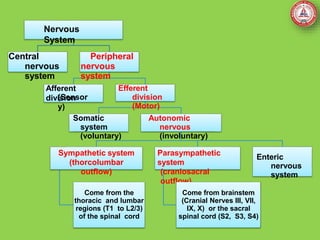
Nervous
System
Central
nervous
system
Peripheral
nervous
system
Afferent
division
(Sensor
y)
Efferent
division
(Motor)
Somatic
system
(voluntary)
Autonomic
nervous
(involuntary)
Sympathetic system
(thorcolumbar
outflow)
Come from the
thoracic and lumbar
regions (T1 to L2/3)
of the spinal cord
Parasympathetic
system
(craniosacral
outflow)
Come from brainstem
(Cranial Nerves III, VII,
IX, X) or the sacral
spinal cord (S2, S3, S4)
Enteric
nervous
system
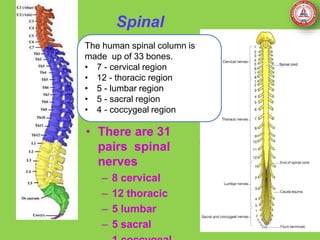
Spinal
nerves
o
f
The human spinal column is
made up of 33 bones.
• 7 - cervical region
• 12 - thoracic region
• 5 - lumbar region
• 5 - sacral region
• 4 - coccygeal region
• There are 31
pairs spinal
nerves
– 8 cervical
– 12 thoracic
– 5 lumbar
– 5 sacral
Peripheral Nervous
System
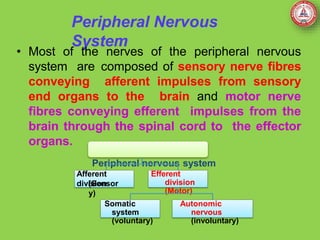
• Most of the nerves of the peripheral nervous
system are composed of sensory nerve fibres
conveying afferent impulses from sensory
end organs to the brain and motor nerve
fibres conveying efferent impulses from the
brain through the spinal cord to the effector
organs.
Peripheral nervous system
Efferent
division
(Motor)
Afferent
division
(Sensor
y)
Somatic
system
(voluntary)
Autonomic
nervous
(involuntary)
Somatic Nervous
System
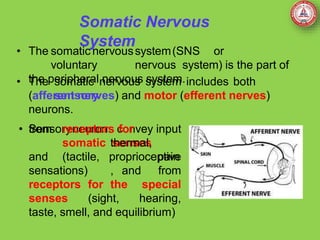
• The somatic nervoussystem(SNS or
voluntary nervous system) is the part of
the peripheral nervous system.
• The somatic nervous system includes both
sensory
(afferent nerves) and motor (efferent nerves)
neurons.
• Sensoryneurons convey input
from receptors for
somatic senses
(tactile,
thermal,
pain
,
and proprioceptive
sensations) and from
receptors for the special
senses (sight, hearing,
taste, smell, and equilibrium)
Autonomic Nervous
System
• The autonomic nervous system is involved
in a complex of reflex activities, which
depend on sensory input to the brain or
spinal cord, and on motor output.
• The majority of the organs of the body are
supplied by both sympathetic and
parasympathetic nerves which have
opposite effects that are finely balanced to
ensure the optimum functioning of the
organ.
Autonomic Nervous
System
• The autonomic nervous system (ANS) is a
complex set of neurons that mediate internal
homeostasis without conscious intervention or
voluntary control.
• The ANS maintains blood pressure, regulates the
rate of breathing, influences digestion, urination,
and modulates sexual arousal.
• There are two main branches to the ANS – the
sympathetic nervous system and the
parasympathetic nervous system.
The effects of autonomic control are rapid and essential for
homeostasis
Sympathetic nervous
system
• Sympathetic nervous system otherwise called as
thoracolumbar system.
• Sympathetic stimulation prepares the body to
deal with exciting and stressful situations, e.g.
strengthening its defences in danger.
sympathetic stimulation mobilises the body for
'fight or flight'.
• Neurones convey impulses from their origin in the
hypothalamus, reticular formation and medulla
oblongata to effector organs and tissues. The first
neurone has its cell body in the brain and its fibre
extends into the spinal cord.
Sympathetic nervous
system
• Structure of the Sympathetic Division
– Pathway from Spinal Cord to Sympathetic Trunk
Ganglia
– Organization of Sympathetic Trunk Ganglia
– Pathways from Sympathetic Trunk Ganglia to
Visceral
Effectors
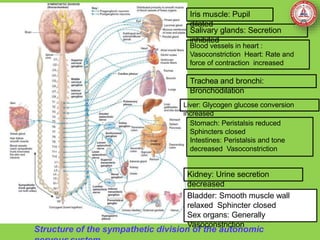
Structure of the sympathetic division of the autonomic
Trachea and bronchi:
Bronchodilation
Liver: Glycogen glucose conversion
increased
Iris muscle: Pupil
dilated
Blood vessels in heart :
Vasoconstriction Heart: Rate and
force of contraction increased
Salivary glands: Secretion
inhibited
Stomach: Peristalsis reduced
Sphincters closed
Intestines: Peristalsis and tone
decreased Vasoconstriction
Kidney: Urine secretion
decreased
Bladder: Smooth muscle wall
relaxed Sphincter closed
Sex organs: Generally
Vasoconstriction
Parasympatheticnervous
system
• Parasympathetic nervous system otherwise
called as craniosacral outflow.
• Parasympathetic stimulation has a tendency
to slow down body processes except
digestion and absorption of food and the
functions of the genitourinary systems. Its
general effect is that of a 'peace maker' allowing
restoration processes to occur quietly and
peacefully.
• Cell bodies of parasympathetic preganglionic
neurons are found in nuclei in the brain stem.
Parasympatheticnervous
system
• Structure of the Parasympathetic Division
– The cranial parasympathetic outflow consists of
preganglionic axons that extend from the brain stem in
four cranial nerves. The cranial outflow has four pairs
of ganglia and the ganglia associated with the vagus
(X) nerve.
– The sacral parasympathetic outflow consists of
preganglionic axons in anterior roots of the second
through fourth sacral spinal nerves.
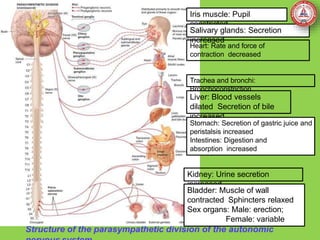
Structure of the parasympathetic division of the autonomic
Trachea and bronchi:
Bronchoconstriction
Liver: Blood vessels
dilated Secretion of bile
increased
Iris muscle: Pupil
constricted
Heart: Rate and force of
contraction decreased
Salivary glands: Secretion
increased
Stomach: Secretion of gastric juice and
peristalsis increased
Intestines: Digestion and
absorption increased
Kidney: Urine secretion
increased
Bladder: Muscle of wall
contracted Sphincters relaxed
Sex organs: Male: erection;
Female: variable
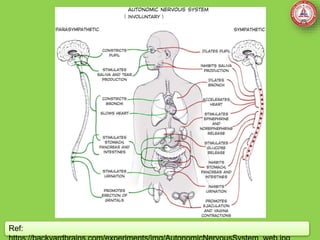
Ref:
Autonomic Motor
Pathways
Autonomic Motor
Pathways
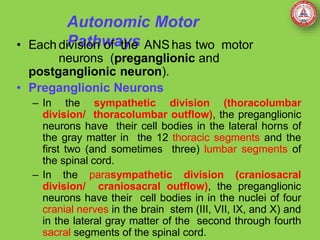
• Each division of the ANS has two motor
neurons (preganglionic and
postganglionic neuron).
• Preganglionic Neurons
– In the sympathetic division (thoracolumbar
division/ thoracolumbar outflow), the preganglionic
neurons have their cell bodies in the lateral horns of
the gray matter in the 12 thoracic segments and the
first two (and sometimes three) lumbar segments of
the spinal cord.
– In the parasympathetic division (craniosacral
division/ craniosacral outflow), the preganglionic
neurons have their cell bodies in in the nuclei of four
cranial nerves in the brain stem (III, VII, IX, and X) and
in the lateral gray matter of the second through fourth
sacral segments of the spinal cord.
Autonomic Motor
Pathways
Preganglionic
Neurons
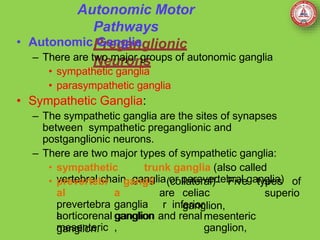
• Autonomic Ganglia
– There are two major groups of autonomic ganglia
• sympathetic ganglia
• parasympathetic ganglia
• Sympathetic Ganglia:
– The sympathetic ganglia are the sites of synapses
between sympathetic preganglionic and
postganglionic neurons.
– There are two major types of sympathetic ganglia:
• sympathetic trunk ganglia (also called
vertebral chain ganglia or paravertebral ganglia)
(collateral)- Five types of
are celiac
ganglion,
• prevertebr
al
prevertebra
l
mesenteric
gangli
a
ganglia
ganglion
,
superio
r inferior
mesenteric
ganglion,
aorticorenal ganglion and renal
ganglion.
Autonomic Motor
Pathways
Preganglionic
Neurons
• Autonomic Ganglia
– There are two major groups of autonomic
ganglia
• sympathetic ganglia
• parasympathetic ganglia
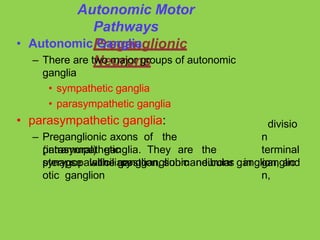
• parasympathetic ganglia:
– Preganglionic axons of the
parasympathetic
synapse with postganglionic neurons in
(intramural) ganglia. They are the
ciliary
divisio
n
terminal
ganglio
n,
pterygopalatine ganglion, submandibular ganglion, and
otic ganglion
Autonomic Motor
Pathways
Postganglionic
Neurons
• Once axons of sympathetic preganglionic
neurons pass to sympathetic trunk ganglia,
they may connect with postganglionic
neurons.
• A single sympathetic preganglionic fiber
has many axon collaterals (branches) and
may synapse with 20 or more
postganglionic neurons.
Autonomic Motor
Pathways
Postganglionic
Neurons
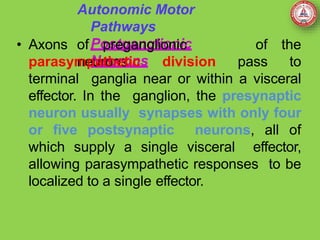
• Axons of preganglionic
neurons
of the
parasympathetic division pass to
terminal ganglia near or within a visceral
effector. In the ganglion, the presynaptic
neuron usually synapses with only four
or five postsynaptic neurons, all of
which supply a single visceral effector,
allowing parasympathetic responses to be
localized to a single effector.
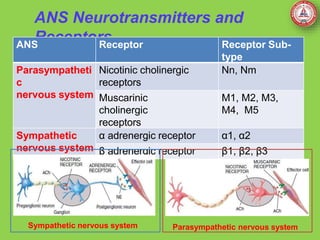
Autonomic
Receptors
ANS Neurotransmitters and
Receptors
ANS Receptor Receptor Sub-
type
Parasympatheti
c
nervous system
Nicotinic cholinergic
receptors
Nn, Nm
Muscarinic
cholinergic
receptors
M1, M2, M3,
M4, M5
Sympathetic
nervous system
α adrenergic receptor α1, α2
β adrenergic receptor β1, β2, β3
Sympathetic nervous system Parasympathetic nervous system
Comparison of Somatic
and Autonomic Motor
Neurons
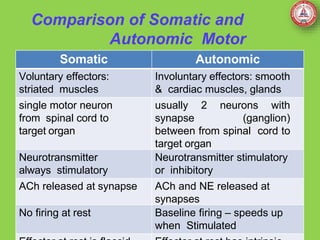
Comparison of Somatic and
Autonomic Motor
Neurons
Somatic Autonomic
Voluntary effectors:
striated muscles
Involuntary effectors: smooth
& cardiac muscles, glands
single motor neuron
from spinal cord to
target organ
usually 2 neurons with
synapse (ganglion)
between from spinal cord to
target organ
Neurotransmitter
always stimulatory
Neurotransmitter stimulatory
or inhibitory
ACh released at synapse ACh and NE released at
synapses
No firing at rest Baseline firing – speeds up
when Stimulated
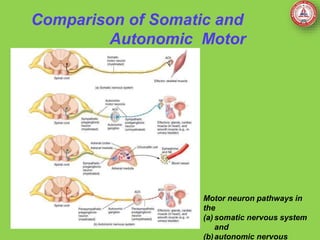
Comparison of Somatic and
Autonomic Motor
Neurons
Motor neuron pathways in
the
(a) somatic nervous system
and
(b)autonomic nervous
Modern Institute of Pharmaceutical Sciences, Indore

Autonomic Nervous System

  • 1.
    BP403T Pharmacology I AutonomicNervous System MODERN GROUP OF INSTITUTIONS Modern Institute of Pharmaceutical Sciences, Indore AnkurJoshi AssociateProfessor
  • 2.
    Learning Outcomes • At theend of this session, the student would be able to: – Briefly describe Sympathetic and parasympathetic outflow and its functions. – List the differences between Sympathetic and Parasympathetic division. – Explain the adrenergic and cholinergic receptors
  • 3.
    Nervous System Central nervous system Peripheral nervous system Afferent division (Sensor y) Efferent division (Motor) Somatic system (voluntary) Autonomic nervous (involuntary) Sympathetic system (thorcolumbar outflow) Come fromthe thoracic and lumbar regions (T1 to L2/3) of the spinal cord Parasympathetic system (craniosacral outflow) Come from brainstem (Cranial Nerves III, VII, IX, X) or the sacral spinal cord (S2, S3, S4) Enteric nervous system
  • 4.
    Spinal nerves o f The human spinalcolumn is made up of 33 bones. • 7 - cervical region • 12 - thoracic region • 5 - lumbar region • 5 - sacral region • 4 - coccygeal region • There are 31 pairs spinal nerves – 8 cervical – 12 thoracic – 5 lumbar – 5 sacral
  • 5.
    Peripheral Nervous System • Mostof the nerves of the peripheral nervous system are composed of sensory nerve fibres conveying afferent impulses from sensory end organs to the brain and motor nerve fibres conveying efferent impulses from the brain through the spinal cord to the effector organs. Peripheral nervous system Efferent division (Motor) Afferent division (Sensor y) Somatic system (voluntary) Autonomic nervous (involuntary)
  • 6.
    Somatic Nervous System • Thesomatic nervoussystem(SNS or voluntary nervous system) is the part of the peripheral nervous system. • The somatic nervous system includes both sensory (afferent nerves) and motor (efferent nerves) neurons. • Sensoryneurons convey input from receptors for somatic senses (tactile, thermal, pain , and proprioceptive sensations) and from receptors for the special senses (sight, hearing, taste, smell, and equilibrium)
  • 7.
    Autonomic Nervous System • Theautonomic nervous system is involved in a complex of reflex activities, which depend on sensory input to the brain or spinal cord, and on motor output. • The majority of the organs of the body are supplied by both sympathetic and parasympathetic nerves which have opposite effects that are finely balanced to ensure the optimum functioning of the organ.
  • 8.
    Autonomic Nervous System • Theautonomic nervous system (ANS) is a complex set of neurons that mediate internal homeostasis without conscious intervention or voluntary control. • The ANS maintains blood pressure, regulates the rate of breathing, influences digestion, urination, and modulates sexual arousal. • There are two main branches to the ANS – the sympathetic nervous system and the parasympathetic nervous system. The effects of autonomic control are rapid and essential for homeostasis
  • 9.
    Sympathetic nervous system • Sympatheticnervous system otherwise called as thoracolumbar system. • Sympathetic stimulation prepares the body to deal with exciting and stressful situations, e.g. strengthening its defences in danger. sympathetic stimulation mobilises the body for 'fight or flight'. • Neurones convey impulses from their origin in the hypothalamus, reticular formation and medulla oblongata to effector organs and tissues. The first neurone has its cell body in the brain and its fibre extends into the spinal cord.
  • 10.
    Sympathetic nervous system • Structureof the Sympathetic Division – Pathway from Spinal Cord to Sympathetic Trunk Ganglia – Organization of Sympathetic Trunk Ganglia – Pathways from Sympathetic Trunk Ganglia to Visceral Effectors
  • 11.
    Structure of thesympathetic division of the autonomic Trachea and bronchi: Bronchodilation Liver: Glycogen glucose conversion increased Iris muscle: Pupil dilated Blood vessels in heart : Vasoconstriction Heart: Rate and force of contraction increased Salivary glands: Secretion inhibited Stomach: Peristalsis reduced Sphincters closed Intestines: Peristalsis and tone decreased Vasoconstriction Kidney: Urine secretion decreased Bladder: Smooth muscle wall relaxed Sphincter closed Sex organs: Generally Vasoconstriction
  • 12.
    Parasympatheticnervous system • Parasympathetic nervoussystem otherwise called as craniosacral outflow. • Parasympathetic stimulation has a tendency to slow down body processes except digestion and absorption of food and the functions of the genitourinary systems. Its general effect is that of a 'peace maker' allowing restoration processes to occur quietly and peacefully. • Cell bodies of parasympathetic preganglionic neurons are found in nuclei in the brain stem.
  • 13.
    Parasympatheticnervous system • Structure ofthe Parasympathetic Division – The cranial parasympathetic outflow consists of preganglionic axons that extend from the brain stem in four cranial nerves. The cranial outflow has four pairs of ganglia and the ganglia associated with the vagus (X) nerve. – The sacral parasympathetic outflow consists of preganglionic axons in anterior roots of the second through fourth sacral spinal nerves.
  • 14.
    Structure of theparasympathetic division of the autonomic Trachea and bronchi: Bronchoconstriction Liver: Blood vessels dilated Secretion of bile increased Iris muscle: Pupil constricted Heart: Rate and force of contraction decreased Salivary glands: Secretion increased Stomach: Secretion of gastric juice and peristalsis increased Intestines: Digestion and absorption increased Kidney: Urine secretion increased Bladder: Muscle of wall contracted Sphincters relaxed Sex organs: Male: erection; Female: variable
  • 15.
  • 16.
  • 17.
    Autonomic Motor Pathways • Eachdivision of the ANS has two motor neurons (preganglionic and postganglionic neuron). • Preganglionic Neurons – In the sympathetic division (thoracolumbar division/ thoracolumbar outflow), the preganglionic neurons have their cell bodies in the lateral horns of the gray matter in the 12 thoracic segments and the first two (and sometimes three) lumbar segments of the spinal cord. – In the parasympathetic division (craniosacral division/ craniosacral outflow), the preganglionic neurons have their cell bodies in in the nuclei of four cranial nerves in the brain stem (III, VII, IX, and X) and in the lateral gray matter of the second through fourth sacral segments of the spinal cord.
  • 18.
    Autonomic Motor Pathways Preganglionic Neurons • AutonomicGanglia – There are two major groups of autonomic ganglia • sympathetic ganglia • parasympathetic ganglia • Sympathetic Ganglia: – The sympathetic ganglia are the sites of synapses between sympathetic preganglionic and postganglionic neurons. – There are two major types of sympathetic ganglia: • sympathetic trunk ganglia (also called vertebral chain ganglia or paravertebral ganglia) (collateral)- Five types of are celiac ganglion, • prevertebr al prevertebra l mesenteric gangli a ganglia ganglion , superio r inferior mesenteric ganglion, aorticorenal ganglion and renal ganglion.
  • 19.
    Autonomic Motor Pathways Preganglionic Neurons • AutonomicGanglia – There are two major groups of autonomic ganglia • sympathetic ganglia • parasympathetic ganglia • parasympathetic ganglia: – Preganglionic axons of the parasympathetic synapse with postganglionic neurons in (intramural) ganglia. They are the ciliary divisio n terminal ganglio n, pterygopalatine ganglion, submandibular ganglion, and otic ganglion
  • 20.
    Autonomic Motor Pathways Postganglionic Neurons • Onceaxons of sympathetic preganglionic neurons pass to sympathetic trunk ganglia, they may connect with postganglionic neurons. • A single sympathetic preganglionic fiber has many axon collaterals (branches) and may synapse with 20 or more postganglionic neurons.
  • 21.
    Autonomic Motor Pathways Postganglionic Neurons • Axonsof preganglionic neurons of the parasympathetic division pass to terminal ganglia near or within a visceral effector. In the ganglion, the presynaptic neuron usually synapses with only four or five postsynaptic neurons, all of which supply a single visceral effector, allowing parasympathetic responses to be localized to a single effector.
  • 22.
  • 23.
    ANS Neurotransmitters and Receptors ANSReceptor Receptor Sub- type Parasympatheti c nervous system Nicotinic cholinergic receptors Nn, Nm Muscarinic cholinergic receptors M1, M2, M3, M4, M5 Sympathetic nervous system α adrenergic receptor α1, α2 β adrenergic receptor β1, β2, β3 Sympathetic nervous system Parasympathetic nervous system
  • 24.
    Comparison of Somatic andAutonomic Motor Neurons
  • 25.
    Comparison of Somaticand Autonomic Motor Neurons Somatic Autonomic Voluntary effectors: striated muscles Involuntary effectors: smooth & cardiac muscles, glands single motor neuron from spinal cord to target organ usually 2 neurons with synapse (ganglion) between from spinal cord to target organ Neurotransmitter always stimulatory Neurotransmitter stimulatory or inhibitory ACh released at synapse ACh and NE released at synapses No firing at rest Baseline firing – speeds up when Stimulated
  • 26.
    Comparison of Somaticand Autonomic Motor Neurons Motor neuron pathways in the (a) somatic nervous system and (b)autonomic nervous
  • 27.
    Modern Institute ofPharmaceutical Sciences, Indore