ANATOMY PRESENTATION
Presented to:
Mam Shumaila Arshad
Presented by:
Abdul Rauf
Mubashar Ali
M Shehroz yaseen
Muhammad Nazim
Adil Naeem
Jahanzaib
Asad Umer
AUTONOMIC NERVOUS SYSTEM
The autonomic nervous system (ANS or visceral nervous system) is the part of
the peripheral nervous system that acts as a control system functioning largely
below the level of consciousness, and controls function.
GENERAL FUNCTION OF THE
AUTONOMIC NERVOUS SYSTEM
The autonomic nervous system (ANS) regulates the activities of cardiac muscle, smooth
muscle, and glands.
 Responsible for control of “involuntary” or visceral bodily function:
 Cardiovascular
 Respiratory
 Digestive
 Urinary
 Reproductive functions
 Key role in the bodies response to stress
AUTONOMIC NERVOUS SYSTEM
Neurotransmitters of ANS
 Neurotransmitters of sympathetic nervous system
 Neurotransmitters of parasympathetic nervous system
DIVISION OF AUTONOMIC NERVOUS SYSTEM
It is classically divided into two sub systems:
SYMPATHETIC NERVOUS SYSTEM:
 Allow body to function under stress
 Fight or flight
 Primes body for intense skeletal muscle activity
EFFECTS OF SYMPATHETIC
NERVOUS SYSTEM
 The sympathetic system prepares the body to meet emergency demands and is
primarily involved with processes that expend energy. During physical or
emotional stress, the sympathetic division dominates the parasympathetic
system, initiating a series of activities known as the fight-or-flight response.
 In addition, there is activation of the adrenal medulla ,causing secretion of nor
epinephrine and epinephrine as hormones to greatly heighten the response.
PARASYMPATHETIC NERVOUS SYSTEM
 Maintenance functions
 Rest-and-digest
 Counterbalances sympathetic function
EFFECTS OF PARASYMPATHETIC
NERVOUS SYSTEM
 The parasympathetic nervous system is an energy conservation-restorative system. It
regulates those activities that conserve and restore body energy during times of rest and
digest.
 The parasympathetic nervous system dominates over sympathetic activity in the glands
and smooth muscle of the gut, stimulating glandular secretion and the gut movements
necessary for food to be digested and absorbed.
 Salivation, lacrimation, urination, and defecation, all controlled by the parasympathetic
nervous system.
 In general nerve impulses from one division of the ANS stimulate the organ to increase
its activity (excitation), and another part inhibit the organs activity (inhibition).
 Structurally, ANS includes:
 a. autonomic sensory neurons (afferent)
 b. integrating centers in the CNS
 c. autonomic motor neurons (efferent)
AUTONOMIC NERVOUS SYSTEM
Receptors of ANS
A. Receptors of Sympathetic Nervous System
 Adrenergic Receptors
 Cholinergic Receptors
B. Receptors of Parasympathetic Nervous System
 Cholinergic Receptors
ADRENERGIC RECEPTORS
Alpha adrenergic
Alpha-1 (a1)- Excitatory
Alpha-2 (a2)- Inhibitory
Beta adrenergic
Beta-1(b1)- Excitatory
Beta-2 (b2) -Inhibitory
 Beta-3 (b3)- Excitatory
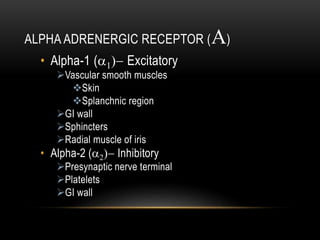
ALPHA ADRENERGIC RECEPTOR (A)
• Alpha-1 (a1)- Excitatory
Vascular smooth muscles
Skin
Splanchnic region
GI wall
Sphincters
Radial muscle of iris
• Alpha-2 (a2)- Inhibitory
Presynaptic nerve terminal
Platelets
GI wall
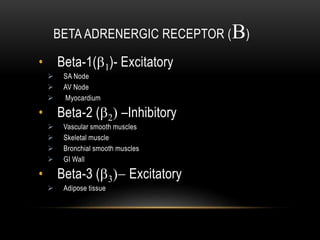
BETA ADRENERGIC RECEPTOR (B)
• Beta-1(b1)- Excitatory
 SA Node
 AV Node
 Myocardium
• Beta-2 (b2) –Inhibitory
 Vascular smooth muscles
 Skeletal muscle
 Bronchial smooth muscles
 GI Wall
• Beta-3 (b3)- Excitatory
 Adipose tissue
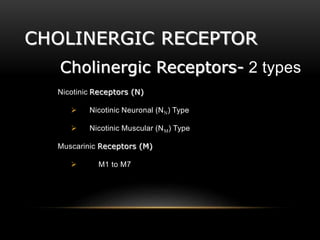
CHOLINERGIC RECEPTOR
Cholinergic Receptors- 2 types
Nicotinic Receptors (N)
 Nicotinic Neuronal (NN) Type
 Nicotinic Muscular (NM) Type
Muscarinic Receptors (M)
 M1 to M7
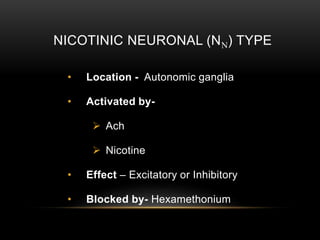
NICOTINIC NEURONAL (NN) TYPE
• Location - Autonomic ganglia
• Activated by-
 Ach
 Nicotine
• Effect – Excitatory or Inhibitory
• Blocked by- Hexamethonium
NICOTINIC MUSCULAR (NM) TYPE
• Location - Neuromuscular Junction
• Activated by-
Ach
Nicotine
• Effect – Always Excitatory
• Blocked by- Curare
MUSCARINIC RECEPTOR
• Location -
 Myocardium
 Glands
 Smooth muscle
• Activated by-
 Ach
 Muscarine
• Effect – Inhibitory/Excitatory
• Blocked by- Atropine
At Sweat Gland
 Neurotransmitter-Acetylcholine
 Receptors- Muscarinic
At the adrenal cortex
 no postsynaptic neuron
 Neurotransmitter-Acetylcholine
 Receptors- Nicotinic
Autonomic nervous system 1

Autonomic nervous system 1

  • 2.
    ANATOMY PRESENTATION Presented to: MamShumaila Arshad Presented by: Abdul Rauf Mubashar Ali M Shehroz yaseen Muhammad Nazim Adil Naeem Jahanzaib Asad Umer
  • 3.
  • 4.
    The autonomic nervoussystem (ANS or visceral nervous system) is the part of the peripheral nervous system that acts as a control system functioning largely below the level of consciousness, and controls function.
  • 5.
    GENERAL FUNCTION OFTHE AUTONOMIC NERVOUS SYSTEM The autonomic nervous system (ANS) regulates the activities of cardiac muscle, smooth muscle, and glands.  Responsible for control of “involuntary” or visceral bodily function:  Cardiovascular  Respiratory  Digestive  Urinary  Reproductive functions  Key role in the bodies response to stress
  • 6.
    AUTONOMIC NERVOUS SYSTEM Neurotransmittersof ANS  Neurotransmitters of sympathetic nervous system  Neurotransmitters of parasympathetic nervous system
  • 7.
    DIVISION OF AUTONOMICNERVOUS SYSTEM It is classically divided into two sub systems: SYMPATHETIC NERVOUS SYSTEM:  Allow body to function under stress  Fight or flight  Primes body for intense skeletal muscle activity
  • 8.
    EFFECTS OF SYMPATHETIC NERVOUSSYSTEM  The sympathetic system prepares the body to meet emergency demands and is primarily involved with processes that expend energy. During physical or emotional stress, the sympathetic division dominates the parasympathetic system, initiating a series of activities known as the fight-or-flight response.  In addition, there is activation of the adrenal medulla ,causing secretion of nor epinephrine and epinephrine as hormones to greatly heighten the response.
  • 9.
    PARASYMPATHETIC NERVOUS SYSTEM Maintenance functions  Rest-and-digest  Counterbalances sympathetic function
  • 10.
    EFFECTS OF PARASYMPATHETIC NERVOUSSYSTEM  The parasympathetic nervous system is an energy conservation-restorative system. It regulates those activities that conserve and restore body energy during times of rest and digest.  The parasympathetic nervous system dominates over sympathetic activity in the glands and smooth muscle of the gut, stimulating glandular secretion and the gut movements necessary for food to be digested and absorbed.  Salivation, lacrimation, urination, and defecation, all controlled by the parasympathetic nervous system.
  • 11.
     In generalnerve impulses from one division of the ANS stimulate the organ to increase its activity (excitation), and another part inhibit the organs activity (inhibition).  Structurally, ANS includes:  a. autonomic sensory neurons (afferent)  b. integrating centers in the CNS  c. autonomic motor neurons (efferent)
  • 12.
    AUTONOMIC NERVOUS SYSTEM Receptorsof ANS A. Receptors of Sympathetic Nervous System  Adrenergic Receptors  Cholinergic Receptors B. Receptors of Parasympathetic Nervous System  Cholinergic Receptors
  • 13.
    ADRENERGIC RECEPTORS Alpha adrenergic Alpha-1(a1)- Excitatory Alpha-2 (a2)- Inhibitory Beta adrenergic Beta-1(b1)- Excitatory Beta-2 (b2) -Inhibitory  Beta-3 (b3)- Excitatory
  • 14.
    ALPHA ADRENERGIC RECEPTOR(A) • Alpha-1 (a1)- Excitatory Vascular smooth muscles Skin Splanchnic region GI wall Sphincters Radial muscle of iris • Alpha-2 (a2)- Inhibitory Presynaptic nerve terminal Platelets GI wall
  • 15.
    BETA ADRENERGIC RECEPTOR(B) • Beta-1(b1)- Excitatory  SA Node  AV Node  Myocardium • Beta-2 (b2) –Inhibitory  Vascular smooth muscles  Skeletal muscle  Bronchial smooth muscles  GI Wall • Beta-3 (b3)- Excitatory  Adipose tissue
  • 16.
    CHOLINERGIC RECEPTOR Cholinergic Receptors-2 types Nicotinic Receptors (N)  Nicotinic Neuronal (NN) Type  Nicotinic Muscular (NM) Type Muscarinic Receptors (M)  M1 to M7
  • 17.
    NICOTINIC NEURONAL (NN)TYPE • Location - Autonomic ganglia • Activated by-  Ach  Nicotine • Effect – Excitatory or Inhibitory • Blocked by- Hexamethonium
  • 18.
    NICOTINIC MUSCULAR (NM)TYPE • Location - Neuromuscular Junction • Activated by- Ach Nicotine • Effect – Always Excitatory • Blocked by- Curare
  • 19.
    MUSCARINIC RECEPTOR • Location-  Myocardium  Glands  Smooth muscle • Activated by-  Ach  Muscarine • Effect – Inhibitory/Excitatory • Blocked by- Atropine
  • 20.
    At Sweat Gland Neurotransmitter-Acetylcholine  Receptors- Muscarinic At the adrenal cortex  no postsynaptic neuron  Neurotransmitter-Acetylcholine  Receptors- Nicotinic