Drug Design and
Relationship of Functional
Groups to Pharmacologic
Activity
Presented to : Prof. Dr. Rao Saeed Sahb
Presented by : Aamna Khatoon
Mphil pharmaceutical Chemistry , 1st Semester
Drug Design and Drug Development
Introduction
Relationship between Molecular Structure and Biological
Activity
Selectivity of Drug action and Receptors
1. Biologic targets for drug action
Physicochemical Properties of Drugs
1. Acid-Base Properties
2. pKa (Relative acid strength)
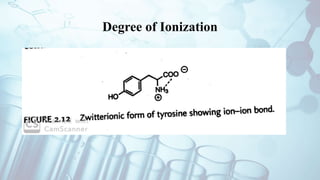
3. Degree of ionization
4. Water solubility
5. Hydrogen bonding
Stereochemistry and Drug action
1. Designation of absolute configuration
2. Stereochemistry and biologic activity
3. Diastereomers
4. Conformational isomerism
RELATIONSHIP BETWEEN MOLECULAR
STRUCTURE AND BIOLOGICAL
ACTIVITY
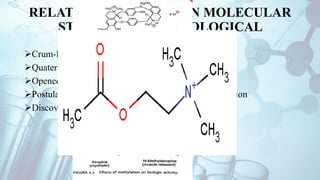
Crum-Brown and Fraser- 1869
Quaternary Ammonium compounds
Opened new era for research
Postulate- one chemical group gives one biological action
Discovery of Acetylcholine- Loewi & Navrati
SELECTION OF DRUG ACTION AND
DRUG RECEPTORS
Background
Ehrlich postulate : complementary Side Chains – Cell surface , magic bullet
Arsenicals – thiol group (-SH)- toxic to trypanosomes
Albert –Selective toxicity
Ing hypothesis : Acetylecholine paradox
 one functional group – different effect
same receptor –size of molecule –more complementary manner
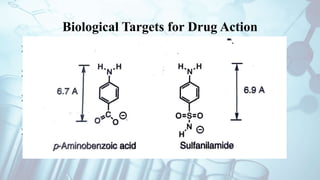
Biological Targets for Drug Action
Interaction with biological target – Pharmacological activity
Targets : receptor , enzyme ,nucleic acid or excitable membrane
Woods demonstration : (1940), PABA and Sulfanilamide
(Sulphonamide)
Drug : Functional group , physicochemical properties, 3D “fit”
Pharmacokinetics of drug
PHYSICOCHEMICAL PROPERTIES OF
DRUGS
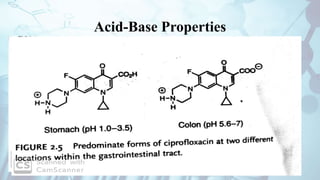
Acid-Base Properties
Human body -70-75%
Most Appropriate concept – Bronsted-Lowry Theory
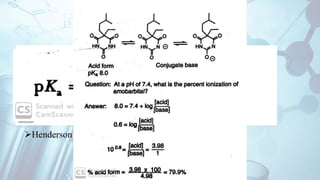
Relative Acid Strength (pKa)
Negative log of acid dissociation constant or Ka value
Lower pKa means an acid is completely dissociated in water
Amphoteric nature of Water – Leveling effect
Most of the drugs are weak acids or weak bases
 Predicting the Degree of Ionization of a Molecule
Relationship of pKa and pH
Henderson Hesselbalch equation
Degree of Ionization
Hydrogen bonding
Type of interaction
Ion dipole interaction
Relation with pKa and pH
Zwitter ion
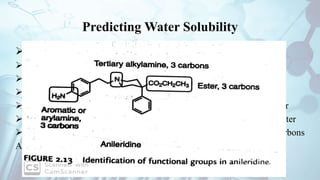
Predicting Water Solubility
The empirical Approach
Lemke development
Solubilizing potential of functional group
Total number of carbons in a compound
If Solubilizing potential is > total number of carbons = soluble in water
If Solubilizing potential is < total number of carbons = insoluble in water
Example : Anileridine = no.of carbons 21, solubilizing potential =9 carbons
Anileridine hydrochloride = solubilizing potential = 29-39 carbons
Predicting Water Solubility
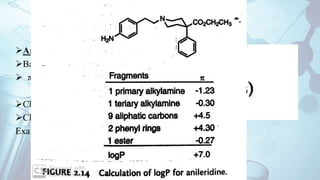
Analytical and Quantitative Approach
Based on Partition Coefficient
 π value of hydrophobic substituents –assigned to each functional group
Clog P value > +0.5 then compound is water insoluble
Clog P value < +0.5 then compound is water soluble
Example : Anileridine
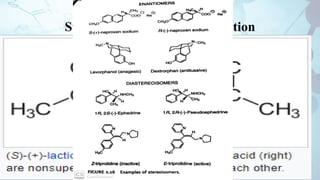
Stereochemistry and Drug Action
Stereoisomers : Molecules having same number and kind of atoms
but different three dimensional structure
Enantiomers : Mirror images , non superimposable, chiral center,
optical rotation
Diastereisomers : all other isomers other than enantiomers
• Geometric isomers , have different physiochemical properties
• Spatial arrangements – asymmetrical environment
• Pharmacokinetics and Pharmacodynamics properties
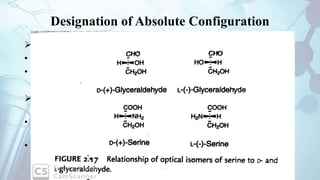
Designation of Absolute Configuration
Optical Rotation : at 1st enantiomers were distinguished
• +/D – clockwise rotation/ right side of plane polarized light
• Limitation : physical property does not explain 3D structure
Fisher and Rosanoff : 19th century , nomenclature based on
glyceraldehyde
• Worked for simple molecules – determined based on chemical
degradation , and synthetic methods .
• Became cumbersome for compounds having more than one chiral
centers.
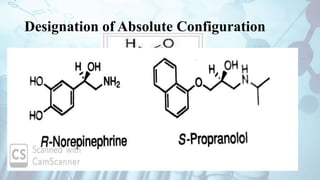
Designation of Absolute Configuration
Sequence Rule or CIP system
Introduced by Cohn in 1956
Chiral Centre is ranked based on priority given to atom with highest
atomic number – extends to next item until a priority is established .
Example glucose , norepinephrine
Priority sequence toward right – named as R isomer
Priority sequence toward left – Named as S isomer
Example : norepinephrine and propranolol.
Stereochemistry and Biological Activity
1886 – Piutti – physiological Action of Asparagine
1933- Easson and Stedman explained reason for difference in
biological activity of enantiomers
• Correct spatial orientation is required for maximum interaction with
receptor sites
• Example R-(-) epinephrine , L –(+)epinephrine , N methyldopa
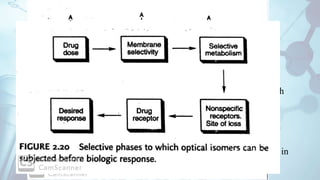
• Spatial orientation also impact on ability of a molecule to reach the
target receptor
Enantioselective biological environment – significant difference in
pharmacological activity of one enantiomer
Diastereomers
Non superimposable
Non mirror images
More than one chiral centers
• Different physiochemical and biological activity
• Example Ephedrine and psuedoephidrine
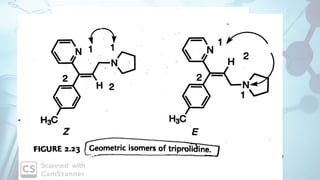
Restricted double bond rotation
• Z(zusammen) and E (entgegen)forms
• 1968 – Blackwood nomenclature (like cohn)
• High priority substituents on same side of double bond = Z(cis)
• High priority substituents on opposite side of double bond = E(trans)
• Geometric isomers of triprolidine (H1- receptor antagonist)
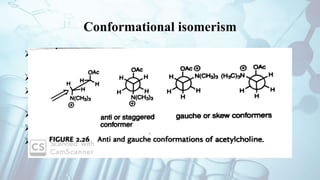
Conformational isomerism
Stereoisomers resulted from the rotation about one or more single
bonds .
Non-identical spatial arrangement of atoms
Much energy is not required – such conversions can occur at room
temperature
Example :
 Acetylecholine – stereoisomers 60°, 120°,180°,240°
Most stable 120°
THANK YOU

2. DRUG DESIGN & RELATION OF FUNCTIONAL GROUPS.pptx

  • 2.
    Drug Design and Relationshipof Functional Groups to Pharmacologic Activity Presented to : Prof. Dr. Rao Saeed Sahb Presented by : Aamna Khatoon Mphil pharmaceutical Chemistry , 1st Semester Drug Design and Drug Development
  • 3.
    Introduction Relationship between MolecularStructure and Biological Activity Selectivity of Drug action and Receptors 1. Biologic targets for drug action Physicochemical Properties of Drugs 1. Acid-Base Properties 2. pKa (Relative acid strength) 3. Degree of ionization 4. Water solubility 5. Hydrogen bonding Stereochemistry and Drug action 1. Designation of absolute configuration 2. Stereochemistry and biologic activity 3. Diastereomers 4. Conformational isomerism
  • 4.
    RELATIONSHIP BETWEEN MOLECULAR STRUCTUREAND BIOLOGICAL ACTIVITY Crum-Brown and Fraser- 1869 Quaternary Ammonium compounds Opened new era for research Postulate- one chemical group gives one biological action Discovery of Acetylcholine- Loewi & Navrati
  • 5.
    SELECTION OF DRUGACTION AND DRUG RECEPTORS Background Ehrlich postulate : complementary Side Chains – Cell surface , magic bullet Arsenicals – thiol group (-SH)- toxic to trypanosomes Albert –Selective toxicity Ing hypothesis : Acetylecholine paradox  one functional group – different effect same receptor –size of molecule –more complementary manner
  • 6.
    Biological Targets forDrug Action Interaction with biological target – Pharmacological activity Targets : receptor , enzyme ,nucleic acid or excitable membrane Woods demonstration : (1940), PABA and Sulfanilamide (Sulphonamide) Drug : Functional group , physicochemical properties, 3D “fit” Pharmacokinetics of drug
  • 7.
  • 8.
    Acid-Base Properties Human body-70-75% Most Appropriate concept – Bronsted-Lowry Theory
  • 9.
    Relative Acid Strength(pKa) Negative log of acid dissociation constant or Ka value Lower pKa means an acid is completely dissociated in water Amphoteric nature of Water – Leveling effect Most of the drugs are weak acids or weak bases  Predicting the Degree of Ionization of a Molecule Relationship of pKa and pH Henderson Hesselbalch equation
  • 10.
    Degree of Ionization Hydrogenbonding Type of interaction Ion dipole interaction Relation with pKa and pH Zwitter ion
  • 11.
    Predicting Water Solubility Theempirical Approach Lemke development Solubilizing potential of functional group Total number of carbons in a compound If Solubilizing potential is > total number of carbons = soluble in water If Solubilizing potential is < total number of carbons = insoluble in water Example : Anileridine = no.of carbons 21, solubilizing potential =9 carbons Anileridine hydrochloride = solubilizing potential = 29-39 carbons
  • 12.
    Predicting Water Solubility Analyticaland Quantitative Approach Based on Partition Coefficient  π value of hydrophobic substituents –assigned to each functional group Clog P value > +0.5 then compound is water insoluble Clog P value < +0.5 then compound is water soluble Example : Anileridine
  • 13.
    Stereochemistry and DrugAction Stereoisomers : Molecules having same number and kind of atoms but different three dimensional structure Enantiomers : Mirror images , non superimposable, chiral center, optical rotation Diastereisomers : all other isomers other than enantiomers • Geometric isomers , have different physiochemical properties • Spatial arrangements – asymmetrical environment • Pharmacokinetics and Pharmacodynamics properties
  • 14.
    Designation of AbsoluteConfiguration Optical Rotation : at 1st enantiomers were distinguished • +/D – clockwise rotation/ right side of plane polarized light • Limitation : physical property does not explain 3D structure Fisher and Rosanoff : 19th century , nomenclature based on glyceraldehyde • Worked for simple molecules – determined based on chemical degradation , and synthetic methods . • Became cumbersome for compounds having more than one chiral centers.
  • 15.
    Designation of AbsoluteConfiguration Sequence Rule or CIP system Introduced by Cohn in 1956 Chiral Centre is ranked based on priority given to atom with highest atomic number – extends to next item until a priority is established . Example glucose , norepinephrine Priority sequence toward right – named as R isomer Priority sequence toward left – Named as S isomer Example : norepinephrine and propranolol.
  • 16.
    Stereochemistry and BiologicalActivity 1886 – Piutti – physiological Action of Asparagine 1933- Easson and Stedman explained reason for difference in biological activity of enantiomers • Correct spatial orientation is required for maximum interaction with receptor sites • Example R-(-) epinephrine , L –(+)epinephrine , N methyldopa • Spatial orientation also impact on ability of a molecule to reach the target receptor Enantioselective biological environment – significant difference in pharmacological activity of one enantiomer
  • 17.
    Diastereomers Non superimposable Non mirrorimages More than one chiral centers • Different physiochemical and biological activity • Example Ephedrine and psuedoephidrine Restricted double bond rotation • Z(zusammen) and E (entgegen)forms • 1968 – Blackwood nomenclature (like cohn) • High priority substituents on same side of double bond = Z(cis) • High priority substituents on opposite side of double bond = E(trans) • Geometric isomers of triprolidine (H1- receptor antagonist)
  • 18.
    Conformational isomerism Stereoisomers resultedfrom the rotation about one or more single bonds . Non-identical spatial arrangement of atoms Much energy is not required – such conversions can occur at room temperature Example :  Acetylecholine – stereoisomers 60°, 120°,180°,240° Most stable 120°
  • 20.