Chapter -3
Autonomic Nervous System
1
Learning objectives
At the end of this lesson, students will be able to:
Identify types of nerves and their action
Describe the function of ANS
Realize the effect of impaired ANS
2
3
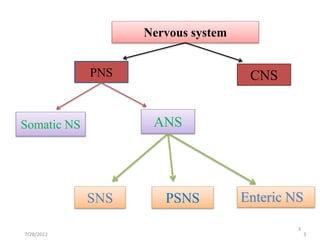
Nervous system
PNS CNS
Somatic NS ANS
SNS PSNS Enteric NS
7/28/2022 3
Peripheral Nervous System -PNS
 Peripheral Nervous System -PNS
 The nervous system outside of the brain and spinal cord
 Consists of:
• 31 pairs of Spinal nerves
• 12 pairs of Cranial nerves
 Carry info to and from the spinal cord and brain
4
PNS….cont’d
 PNS Can be divided further into:
Somatic nervous system -SoNS
 Voluntary (generally)
 Conduct impulses from the CNS to skeletal muscles
Autonomic nervous system -ANS
 Involuntary (generally)
 Conducts impulses from the CNS to smooth muscle,
cardiac muscle, and glands.
5
Somatic nerves
 Originate in anterior horn cells
 A single job; innervates and commands skeletal muscle
fibers
 Consists of one neuron from CNS to effectors
 Produce only excitation of its effectors with pin point
accuracy
 Neurotransmitter (NT) is acetylcholine
 Control its effectors via monosynaptic pathway
6
Enteric nervous system
 Also known as “the little brain /the gut's brain”
 It can and does operate independently of the brain and the
spinal cord.
 Control peristalsis and churning of intestinal contents and
secretion of enzymes, mucus, electrolyte,and blood flow
 Is embedded in the lining of the gastrointestinal system,
beginning in the esophagus and extending down to the anus.
 Autorhythimicity
7
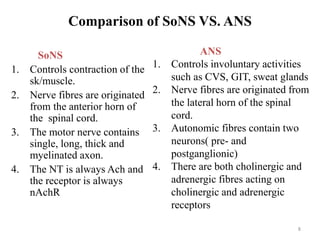
Comparison of SoNS VS. ANS
SoNS
1. Controls contraction of the
sk/muscle.
2. Nerve fibres are originated
from the anterior horn of
the spinal cord.
3. The motor nerve contains
single, long, thick and
myelinated axon.
4. The NT is always Ach and
the receptor is always
nAchR
ANS
1. Controls involuntary activities
such as CVS, GIT, sweat glands
2. Nerve fibres are originated from
the lateral horn of the spinal
cord.
3. Autonomic fibres contain two
neurons( pre- and
postganglionic)
4. There are both cholinergic and
adrenergic fibres acting on
cholinergic and adrenergic
receptors
8
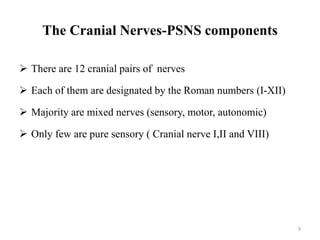
The Cranial Nerves-PSNS components
 There are 12 cranial pairs of nerves
 Each of them are designated by the Roman numbers (I-XII)
 Majority are mixed nerves (sensory, motor, autonomic)
 Only few are pure sensory ( Cranial nerve I,II and VIII)
9
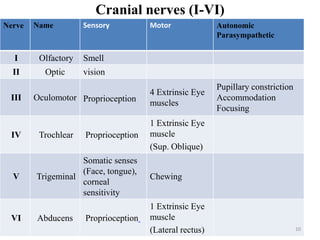
Cranial nerves (I-VI)
Nerve Name Sensory Motor Autonomic
Parasympathetic
I Olfactory Smell
II Optic vision
III Oculomotor Proprioception
4 Extrinsic Eye
muscles
Pupillary constriction
Accommodation
Focusing
IV Trochlear Proprioception
1 Extrinsic Eye
muscle
(Sup. Oblique)
V Trigeminal
Somatic senses
(Face, tongue),
corneal
sensitivity
Chewing
VI Abducens Proprioception
1 Extrinsic Eye
muscle
(Lateral rectus) 10
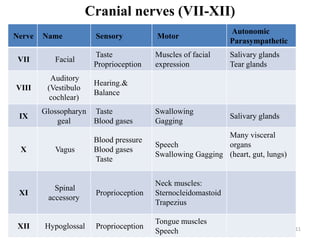
Cranial nerves (VII-XII)
Nerve Name Sensory Motor
Autonomic
Parasympathetic
VII Facial
Taste
Proprioception
Muscles of facial
expression
Salivary glands
Tear glands
VIII
Auditory
(Vestibulo
cochlear)
Hearing.&
Balance
IX
Glossopharyn
geal
Taste
Blood gases
Swallowing
Gagging
Salivary glands
X Vagus
Blood pressure
Blood gases
Taste
Speech
Swallowing Gagging
Many visceral
organs
(heart, gut, lungs)
XI
Spinal
accessory
Proprioception
Neck muscles:
Sternocleidomastoid
Trapezius
XII Hypoglossal Proprioception
Tongue muscles
Speech 11
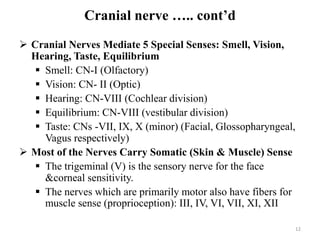
Cranial nerve ….. cont’d
 Cranial Nerves Mediate 5 Special Senses: Smell, Vision,
Hearing, Taste, Equilibrium
 Smell: CN-I (Olfactory)
 Vision: CN- II (Optic)
 Hearing: CN-VIII (Cochlear division)
 Equilibrium: CN-VIII (vestibular division)
 Taste: CNs -VII, IX, X (minor) (Facial, Glossopharyngeal,
Vagus respectively)
 Most of the Nerves Carry Somatic (Skin & Muscle) Sense
 The trigeminal (V) is the sensory nerve for the face
&corneal sensitivity.
 The nerves which are primarily motor also have fibers for
muscle sense (proprioception): III, IV, VI, VII, XI, XII
12
Cranial nerve ….. cont’d
 Three Nerves Are Concerned With Eyeball Movements
 Oculomotor (III): superior rectus, medial rectus, inferior
rectus, inferior oblique
 Trochlear (IV): superior oblique
 Abducens (VI): lateral rectus
 Several of the Nerves Innervate Skeletal Muscles
 The Facial nerve (VII) controls muscles of facial
expression
 The Spinal accessory (XI) stimulates the trapezius and
sternocleidomastoid muscles
 Chewing muscles (masseter, temporalis) are innervated by
the Trigeminal (V)
 Speech muscles (larynx) are under the control of the Vagus
(X)
 The Hypoglossal (XII) moves the tongue
13
Cranial nerve ….. cont’d
 Four of the CNs Carry Parasympathetic Fibers
 Oculomotor (III): innervates iris constrictor (causes pupil
constriction); also controls ciliary muscle (focuses the
lens)
 Facial (VII) and Glossopharyngeal (IX): stimulate salivary
glands to secrete
 Vagus (X): the major nerve of the parasympathetic system:
goes to most visceral organs (heart, lungs, kidneys, liver,
stomach, intestines)
14
Spinal nerves
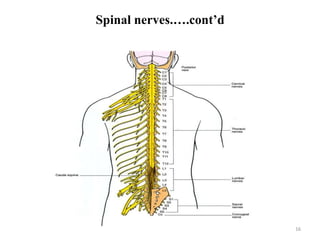
31 pairs of spinal nerves
 All contain afferent and efferent
 8 cervical
 12 thoracic
 5 lumbar
 5 sacral
 1 coccygeal
 Afferent
 Sensory receptors relay to CNS
 Long part of the axon is found out side CNS
 Afferent neurons are 1st order neurons
 Efferent
 Carry signals from CNS to muscles & glands
 More complicated than the afferent division
15
Spinal nerves.….cont’d
16
Functions, properties and Organizations of ANS
 Controls most visceral functions such as
 Heart and lungs in thorax
 Gastrointestinal, genital, urinary system in the abdomen
 Orchestrates the continuous adjustments in
 Respiration
 Circulation
 Digestion
 Body temperature
 Rapidity and intensity of changes on effectors functions
 With in 3-5 seconds it doubles the heart rate
 With in 10-15 sec it doubles the ABP 17
Functions of ANS….cont’d
 ANS is controlled by centers located in the
 Spinal cord
 Brain stem
 Hypothalamus
 Portions of cerebral cortex specially in Limbic cortex
 ANS operates through autonomic reflexes
18
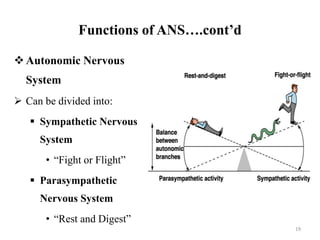
Functions of ANS….cont’d
Autonomic Nervous
System
 Can be divided into:
 Sympathetic Nervous
System
• “Fight or Flight”
 Parasympathetic
Nervous System
• “Rest and Digest”
19
20
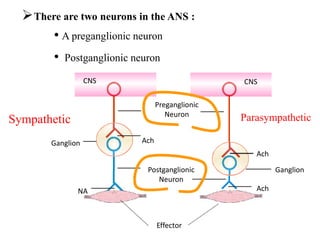
There are two neurons in the ANS :
• A preganglionic neuron
• Postganglionic neuron
CNS
CNS
Ganglion
Preganglionic
Neuron
Ach
Postganglionic
Neuron
Ganglion
Effector
NA
Ach
Ach
Sympathetic Parasympathetic
21
21
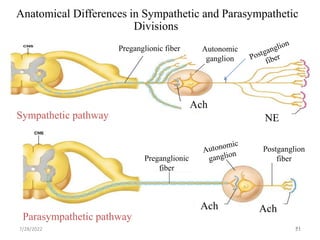
Anatomical Differences in Sympathetic and Parasympathetic
Divisions
Sympathetic pathway
Parasympathetic pathway
Preganglionic
fiber
Postganglion
fiber
Ach Ach
Ach
Autonomic
ganglion
NE
Preganglionic fiber
Ach
7/28/2022
22
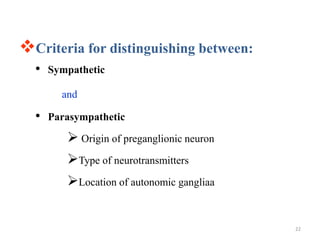
Criteria for distinguishing between:
• Sympathetic
and
• Parasympathetic
 Origin of preganglionic neuron
Type of neurotransmitters
Location of autonomic gangliaa
23
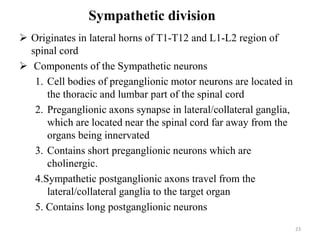
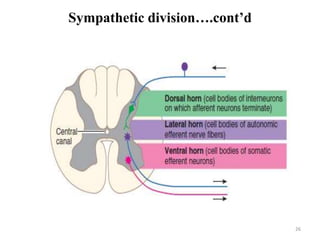
 Originates in lateral horns of T1-T12 and L1-L2 region of
spinal cord
 Components of the Sympathetic neurons
1. Cell bodies of preganglionic motor neurons are located in
the thoracic and lumbar part of the spinal cord
2. Preganglionic axons synapse in lateral/collateral ganglia,
which are located near the spinal cord far away from the
organs being innervated
3. Contains short preganglionic neurons which are
cholinergic.
4.Sympathetic postganglionic axons travel from the
lateral/collateral ganglia to the target organ
5. Contains long postganglionic neurons
Sympathetic division
24
T1  head
T2  neck
T3-T6  thorax
T7-T11  abdomen
T12, L1&L2  legs
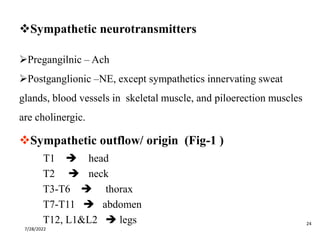
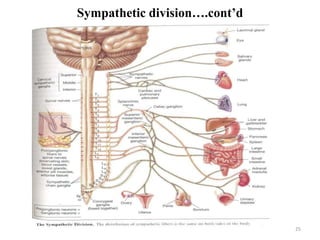
Sympathetic outflow/ origin (Fig-1 )
Sympathetic neurotransmitters
Pregangilnic – Ach
Postganglionic –NE, except sympathetics innervating sweat
glands, blood vessels in skeletal muscle, and piloerection muscles
are cholinergic.
7/28/2022
25
Sympathetic division….cont’d
26
Sympathetic division….cont’d
27
Function:
 Sympathetic mass discharge during emergency" situations (flight or
fight response)
 Sympathetic mass discharge: simultaneous activation of various
organs
 The sympathetic neurons have excitatory effects on almost all body
tissues. Their effect is excitatory on CVS and inhibitory on the GIT
 Catabolic, increases MR and energy output
 Tonic discharge of impulse to the heart and blood vessels
Sympathetic division….cont’d
28
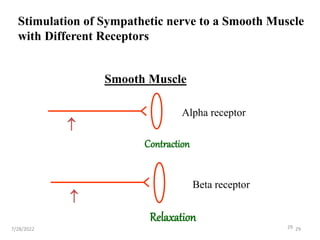
Two classes of adrenoceptors are distinguished
•  - Receptors
• β - Receptors
7/28/2022 28
 Alpha receptors
 Constriction of gastric intestinal and bladder sphincter
 Vasoconstriction
 Contraction of pupillary dilator
 Beta receptors
 Increase in cardiac rate and strength of contraction
 Inhibition of gastric motility
29
29
Beta receptor
Alpha receptor


Smooth Muscle
Contraction
Relaxation
Stimulation of Sympathetic nerve to a Smooth Muscle
with Different Receptors
7/28/2022
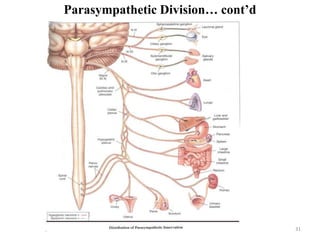
Parasympathetic Division
 Originates from cranial and sacral regions.
Cranial components are part of CN III (Oculomotor), VII
(Facial), IX (Glossopharyngeal), and X (Vagus)
Sacral components from S1 – S4 segments of the spinal cord
30
31
Parasympathetic Division… cont’d
 Components of the parasympathetic neurons
1. Cell bodies of preganglionic motor neurons located in parts of
certain nuclei of cranial nerves and in the sacral part of the
spinal cord
2. Preganglionic axons synapse in terminal ganglia which are
located close to or on the organ being innervated
3. Contains long preganglionic neurons
4. Parasympathetic postganglionic axons travel from the terminal
ganglia to the target organ
5. Contains short postganglionic cholinergic neurons
32
Parasympathetic Division… cont’d
Parasympathetic Division….cont’d
3. Function
 Regulation of digestion, defecation and micturition
 Conservation of energy, anabolic, maintains a homeostatic
environment ”resting and digesting" system
 There is tonic impulse discharge to the heart
 Parasympathetic neurons in general have inhibitory effect on
almost all body tissues except in the GIT.
 They have excitatory effects on the GIT.
33
34
 Parasypatatic neurotransmitter
• Both Pregangilnic and Postganglionic – Ach
 Receptors for Acetylcholine
Found at:
1. Postganglionic parasympathetic neuroeffector junctions
2. All autonomic ganglia
3. At the neuromuscular endplate
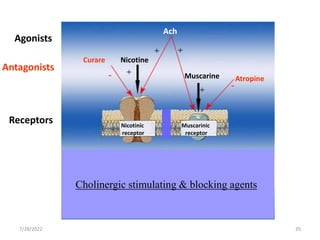
 Types (Based on selective activation and antagonism)
1. Muscarinic receptors
2. Nicotinic receptors
35
7/28/2022 35
Cholinergic stimulating & blocking agents
Receptors
Ach
Agonists
Nicotine
Muscarine
Curare
Atropine
Nicotinic
receptor
Muscarinic
receptor
Antagonists
36
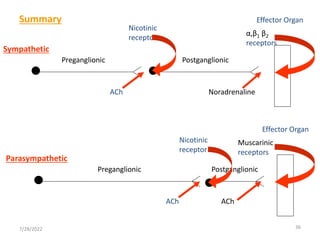
Sympathetic
Preganglionic Postganglionic
Noradrenaline
α,β1 β2
receptors
Nicotinic
receptor
ACh
Effector Organ
Parasympathetic
Preganglionic Postganglionic
ACh
Muscarinic
receptors
Nicotinic
receptor
ACh
Effector Organ
Summary
7/28/2022
37
37
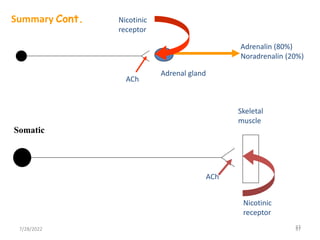
Adrenal gland
ACh
Nicotinic
receptor
Adrenalin (80%)
Noradrenalin (20%)
Skeletal
muscle
Nicotinic
receptor
ACh
Summary Cont.
Somatic
7/28/2022
Autonomic ganglia
 A nucleus (nuclei = pl) is a collection of cell bodies within
the CNS
 A ganglion (ganglia = pl) is a collection of cell bodies
outside the CNS
 Contains
• Cell bodies of postganglionic neurons
• Axon terminals of pregangionic neurons
 They are divergence centers (1 Preg.---8 post g.)
38
39
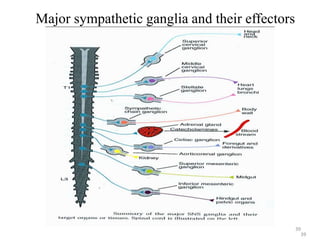
Major sympathetic ganglia and their effectors
39
Autonomic ganglia.....cont’d
Types of the autonomic ganglia
1. Lateral (paravertibral) ganglia
 Are sympathetic ganglia
 Form sympathetic chains on both sides of the vertebral
column
2. Collateral (prevertebral) ganglia
 Are also sympathetic ganglia
 Located in midway b/n the cord and the viscera
 3 types: celiac g., superior mesentric g. and Inferior MG
3. Terminal ganglia: a parasympathetic ganglia, located near/within
the organ that they innervate
40
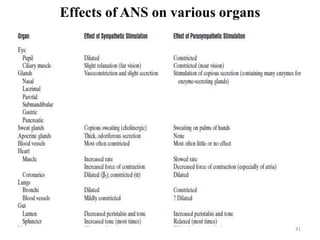
Effects of ANS on various organs
41
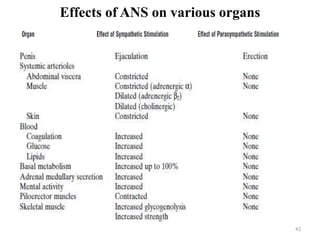
Effects of ANS on various organs
42
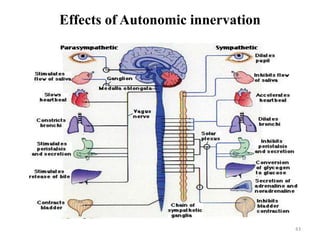
Effects of Autonomic innervation
43
44
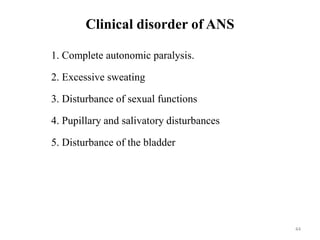
1. Complete autonomic paralysis.
2. Excessive sweating
3. Disturbance of sexual functions
4. Pupillary and salivatory disturbances
5. Disturbance of the bladder
Clinical disorder of ANS
45
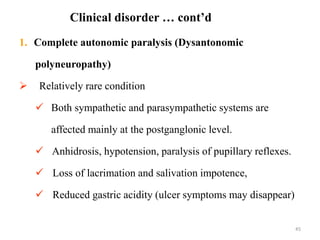
1. Complete autonomic paralysis (Dysantonomic
polyneuropathy)
 Relatively rare condition
 Both sympathetic and parasympathetic systems are
affected mainly at the postganglonic level.
 Anhidrosis, hypotension, paralysis of pupillary reflexes.
 Loss of lacrimation and salivation impotence,
 Reduced gastric acidity (ulcer symptoms may disappear)
Clinical disorder … cont’d
46
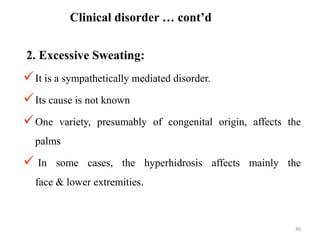
2. Excessive Sweating:
It is a sympathetically mediated disorder.
Its cause is not known
One variety, presumably of congenital origin, affects the
palms
 In some cases, the hyperhidrosis affects mainly the
face & lower extremities.
Clinical disorder … cont’d
47
 Sexual function in the male:
sexual impulse, drive or desire often referred to as libido.
Arousal of libido in man and woman may result from a
variety of stimuli, some purely imaginary.
3. Disturbances of Sexual Function:
Penile erection
By Parasympathetic motor neurones (S3 & S4).
T12 & L1 can mediate psychogenic erections.
Ejaculation
By sympathetic neuron.
7/28/2022 47
48
Assignment (presentation)
 Reflex action g1
 Autonomic reflexes
 Component of reflex
 The Baroreceptor reflex
 The chemoreceptor reflex
 Defecation reflex
 Micturition reflex
 Water and electrolyte balance g5
 Water balance
 Electrolyte balance
 Special sense
 Physiology of hearing and balance g 4
 Physiology Vision g2
 Physiology Taste
 Physiology Smell g3
Thanks !
49

ANS.pptx

  • 1.
  • 2.
    Learning objectives At theend of this lesson, students will be able to: Identify types of nerves and their action Describe the function of ANS Realize the effect of impaired ANS 2
  • 3.
    3 Nervous system PNS CNS SomaticNS ANS SNS PSNS Enteric NS 7/28/2022 3
  • 4.
    Peripheral Nervous System-PNS  Peripheral Nervous System -PNS  The nervous system outside of the brain and spinal cord  Consists of: • 31 pairs of Spinal nerves • 12 pairs of Cranial nerves  Carry info to and from the spinal cord and brain 4
  • 5.
    PNS….cont’d  PNS Canbe divided further into: Somatic nervous system -SoNS  Voluntary (generally)  Conduct impulses from the CNS to skeletal muscles Autonomic nervous system -ANS  Involuntary (generally)  Conducts impulses from the CNS to smooth muscle, cardiac muscle, and glands. 5
  • 6.
    Somatic nerves  Originatein anterior horn cells  A single job; innervates and commands skeletal muscle fibers  Consists of one neuron from CNS to effectors  Produce only excitation of its effectors with pin point accuracy  Neurotransmitter (NT) is acetylcholine  Control its effectors via monosynaptic pathway 6
  • 7.
    Enteric nervous system Also known as “the little brain /the gut's brain”  It can and does operate independently of the brain and the spinal cord.  Control peristalsis and churning of intestinal contents and secretion of enzymes, mucus, electrolyte,and blood flow  Is embedded in the lining of the gastrointestinal system, beginning in the esophagus and extending down to the anus.  Autorhythimicity 7
  • 8.
    Comparison of SoNSVS. ANS SoNS 1. Controls contraction of the sk/muscle. 2. Nerve fibres are originated from the anterior horn of the spinal cord. 3. The motor nerve contains single, long, thick and myelinated axon. 4. The NT is always Ach and the receptor is always nAchR ANS 1. Controls involuntary activities such as CVS, GIT, sweat glands 2. Nerve fibres are originated from the lateral horn of the spinal cord. 3. Autonomic fibres contain two neurons( pre- and postganglionic) 4. There are both cholinergic and adrenergic fibres acting on cholinergic and adrenergic receptors 8
  • 9.
    The Cranial Nerves-PSNScomponents  There are 12 cranial pairs of nerves  Each of them are designated by the Roman numbers (I-XII)  Majority are mixed nerves (sensory, motor, autonomic)  Only few are pure sensory ( Cranial nerve I,II and VIII) 9
  • 10.
    Cranial nerves (I-VI) NerveName Sensory Motor Autonomic Parasympathetic I Olfactory Smell II Optic vision III Oculomotor Proprioception 4 Extrinsic Eye muscles Pupillary constriction Accommodation Focusing IV Trochlear Proprioception 1 Extrinsic Eye muscle (Sup. Oblique) V Trigeminal Somatic senses (Face, tongue), corneal sensitivity Chewing VI Abducens Proprioception 1 Extrinsic Eye muscle (Lateral rectus) 10
  • 11.
    Cranial nerves (VII-XII) NerveName Sensory Motor Autonomic Parasympathetic VII Facial Taste Proprioception Muscles of facial expression Salivary glands Tear glands VIII Auditory (Vestibulo cochlear) Hearing.& Balance IX Glossopharyn geal Taste Blood gases Swallowing Gagging Salivary glands X Vagus Blood pressure Blood gases Taste Speech Swallowing Gagging Many visceral organs (heart, gut, lungs) XI Spinal accessory Proprioception Neck muscles: Sternocleidomastoid Trapezius XII Hypoglossal Proprioception Tongue muscles Speech 11
  • 12.
    Cranial nerve …..cont’d  Cranial Nerves Mediate 5 Special Senses: Smell, Vision, Hearing, Taste, Equilibrium  Smell: CN-I (Olfactory)  Vision: CN- II (Optic)  Hearing: CN-VIII (Cochlear division)  Equilibrium: CN-VIII (vestibular division)  Taste: CNs -VII, IX, X (minor) (Facial, Glossopharyngeal, Vagus respectively)  Most of the Nerves Carry Somatic (Skin & Muscle) Sense  The trigeminal (V) is the sensory nerve for the face &corneal sensitivity.  The nerves which are primarily motor also have fibers for muscle sense (proprioception): III, IV, VI, VII, XI, XII 12
  • 13.
    Cranial nerve …..cont’d  Three Nerves Are Concerned With Eyeball Movements  Oculomotor (III): superior rectus, medial rectus, inferior rectus, inferior oblique  Trochlear (IV): superior oblique  Abducens (VI): lateral rectus  Several of the Nerves Innervate Skeletal Muscles  The Facial nerve (VII) controls muscles of facial expression  The Spinal accessory (XI) stimulates the trapezius and sternocleidomastoid muscles  Chewing muscles (masseter, temporalis) are innervated by the Trigeminal (V)  Speech muscles (larynx) are under the control of the Vagus (X)  The Hypoglossal (XII) moves the tongue 13
  • 14.
    Cranial nerve …..cont’d  Four of the CNs Carry Parasympathetic Fibers  Oculomotor (III): innervates iris constrictor (causes pupil constriction); also controls ciliary muscle (focuses the lens)  Facial (VII) and Glossopharyngeal (IX): stimulate salivary glands to secrete  Vagus (X): the major nerve of the parasympathetic system: goes to most visceral organs (heart, lungs, kidneys, liver, stomach, intestines) 14
  • 15.
    Spinal nerves 31 pairsof spinal nerves  All contain afferent and efferent  8 cervical  12 thoracic  5 lumbar  5 sacral  1 coccygeal  Afferent  Sensory receptors relay to CNS  Long part of the axon is found out side CNS  Afferent neurons are 1st order neurons  Efferent  Carry signals from CNS to muscles & glands  More complicated than the afferent division 15
  • 16.
  • 17.
    Functions, properties andOrganizations of ANS  Controls most visceral functions such as  Heart and lungs in thorax  Gastrointestinal, genital, urinary system in the abdomen  Orchestrates the continuous adjustments in  Respiration  Circulation  Digestion  Body temperature  Rapidity and intensity of changes on effectors functions  With in 3-5 seconds it doubles the heart rate  With in 10-15 sec it doubles the ABP 17
  • 18.
    Functions of ANS….cont’d ANS is controlled by centers located in the  Spinal cord  Brain stem  Hypothalamus  Portions of cerebral cortex specially in Limbic cortex  ANS operates through autonomic reflexes 18
  • 19.
    Functions of ANS….cont’d AutonomicNervous System  Can be divided into:  Sympathetic Nervous System • “Fight or Flight”  Parasympathetic Nervous System • “Rest and Digest” 19
  • 20.
    20 There are twoneurons in the ANS : • A preganglionic neuron • Postganglionic neuron CNS CNS Ganglion Preganglionic Neuron Ach Postganglionic Neuron Ganglion Effector NA Ach Ach Sympathetic Parasympathetic
  • 21.
    21 21 Anatomical Differences inSympathetic and Parasympathetic Divisions Sympathetic pathway Parasympathetic pathway Preganglionic fiber Postganglion fiber Ach Ach Ach Autonomic ganglion NE Preganglionic fiber Ach 7/28/2022
  • 22.
    22 Criteria for distinguishingbetween: • Sympathetic and • Parasympathetic  Origin of preganglionic neuron Type of neurotransmitters Location of autonomic gangliaa
  • 23.
    23  Originates inlateral horns of T1-T12 and L1-L2 region of spinal cord  Components of the Sympathetic neurons 1. Cell bodies of preganglionic motor neurons are located in the thoracic and lumbar part of the spinal cord 2. Preganglionic axons synapse in lateral/collateral ganglia, which are located near the spinal cord far away from the organs being innervated 3. Contains short preganglionic neurons which are cholinergic. 4.Sympathetic postganglionic axons travel from the lateral/collateral ganglia to the target organ 5. Contains long postganglionic neurons Sympathetic division
  • 24.
    24 T1  head T2 neck T3-T6  thorax T7-T11  abdomen T12, L1&L2  legs Sympathetic outflow/ origin (Fig-1 ) Sympathetic neurotransmitters Pregangilnic – Ach Postganglionic –NE, except sympathetics innervating sweat glands, blood vessels in skeletal muscle, and piloerection muscles are cholinergic. 7/28/2022
  • 25.
  • 26.
  • 27.
    27 Function:  Sympathetic massdischarge during emergency" situations (flight or fight response)  Sympathetic mass discharge: simultaneous activation of various organs  The sympathetic neurons have excitatory effects on almost all body tissues. Their effect is excitatory on CVS and inhibitory on the GIT  Catabolic, increases MR and energy output  Tonic discharge of impulse to the heart and blood vessels Sympathetic division….cont’d
  • 28.
    28 Two classes ofadrenoceptors are distinguished •  - Receptors • β - Receptors 7/28/2022 28  Alpha receptors  Constriction of gastric intestinal and bladder sphincter  Vasoconstriction  Contraction of pupillary dilator  Beta receptors  Increase in cardiac rate and strength of contraction  Inhibition of gastric motility
  • 29.
    29 29 Beta receptor Alpha receptor   SmoothMuscle Contraction Relaxation Stimulation of Sympathetic nerve to a Smooth Muscle with Different Receptors 7/28/2022
  • 30.
    Parasympathetic Division  Originatesfrom cranial and sacral regions. Cranial components are part of CN III (Oculomotor), VII (Facial), IX (Glossopharyngeal), and X (Vagus) Sacral components from S1 – S4 segments of the spinal cord 30
  • 31.
  • 32.
     Components ofthe parasympathetic neurons 1. Cell bodies of preganglionic motor neurons located in parts of certain nuclei of cranial nerves and in the sacral part of the spinal cord 2. Preganglionic axons synapse in terminal ganglia which are located close to or on the organ being innervated 3. Contains long preganglionic neurons 4. Parasympathetic postganglionic axons travel from the terminal ganglia to the target organ 5. Contains short postganglionic cholinergic neurons 32 Parasympathetic Division… cont’d
  • 33.
    Parasympathetic Division….cont’d 3. Function Regulation of digestion, defecation and micturition  Conservation of energy, anabolic, maintains a homeostatic environment ”resting and digesting" system  There is tonic impulse discharge to the heart  Parasympathetic neurons in general have inhibitory effect on almost all body tissues except in the GIT.  They have excitatory effects on the GIT. 33
  • 34.
    34  Parasypatatic neurotransmitter •Both Pregangilnic and Postganglionic – Ach  Receptors for Acetylcholine Found at: 1. Postganglionic parasympathetic neuroeffector junctions 2. All autonomic ganglia 3. At the neuromuscular endplate  Types (Based on selective activation and antagonism) 1. Muscarinic receptors 2. Nicotinic receptors
  • 35.
    35 7/28/2022 35 Cholinergic stimulating& blocking agents Receptors Ach Agonists Nicotine Muscarine Curare Atropine Nicotinic receptor Muscarinic receptor Antagonists
  • 36.
    36 Sympathetic Preganglionic Postganglionic Noradrenaline α,β1 β2 receptors Nicotinic receptor ACh EffectorOrgan Parasympathetic Preganglionic Postganglionic ACh Muscarinic receptors Nicotinic receptor ACh Effector Organ Summary 7/28/2022
  • 37.
    37 37 Adrenal gland ACh Nicotinic receptor Adrenalin (80%) Noradrenalin(20%) Skeletal muscle Nicotinic receptor ACh Summary Cont. Somatic 7/28/2022
  • 38.
    Autonomic ganglia  Anucleus (nuclei = pl) is a collection of cell bodies within the CNS  A ganglion (ganglia = pl) is a collection of cell bodies outside the CNS  Contains • Cell bodies of postganglionic neurons • Axon terminals of pregangionic neurons  They are divergence centers (1 Preg.---8 post g.) 38
  • 39.
    39 Major sympathetic gangliaand their effectors 39
  • 40.
    Autonomic ganglia.....cont’d Types ofthe autonomic ganglia 1. Lateral (paravertibral) ganglia  Are sympathetic ganglia  Form sympathetic chains on both sides of the vertebral column 2. Collateral (prevertebral) ganglia  Are also sympathetic ganglia  Located in midway b/n the cord and the viscera  3 types: celiac g., superior mesentric g. and Inferior MG 3. Terminal ganglia: a parasympathetic ganglia, located near/within the organ that they innervate 40
  • 41.
    Effects of ANSon various organs 41
  • 42.
    Effects of ANSon various organs 42
  • 43.
    Effects of Autonomicinnervation 43
  • 44.
    44 1. Complete autonomicparalysis. 2. Excessive sweating 3. Disturbance of sexual functions 4. Pupillary and salivatory disturbances 5. Disturbance of the bladder Clinical disorder of ANS
  • 45.
    45 1. Complete autonomicparalysis (Dysantonomic polyneuropathy)  Relatively rare condition  Both sympathetic and parasympathetic systems are affected mainly at the postganglonic level.  Anhidrosis, hypotension, paralysis of pupillary reflexes.  Loss of lacrimation and salivation impotence,  Reduced gastric acidity (ulcer symptoms may disappear) Clinical disorder … cont’d
  • 46.
    46 2. Excessive Sweating: Itis a sympathetically mediated disorder. Its cause is not known One variety, presumably of congenital origin, affects the palms  In some cases, the hyperhidrosis affects mainly the face & lower extremities. Clinical disorder … cont’d
  • 47.
    47  Sexual functionin the male: sexual impulse, drive or desire often referred to as libido. Arousal of libido in man and woman may result from a variety of stimuli, some purely imaginary. 3. Disturbances of Sexual Function: Penile erection By Parasympathetic motor neurones (S3 & S4). T12 & L1 can mediate psychogenic erections. Ejaculation By sympathetic neuron. 7/28/2022 47
  • 48.
    48 Assignment (presentation)  Reflexaction g1  Autonomic reflexes  Component of reflex  The Baroreceptor reflex  The chemoreceptor reflex  Defecation reflex  Micturition reflex  Water and electrolyte balance g5  Water balance  Electrolyte balance  Special sense  Physiology of hearing and balance g 4  Physiology Vision g2  Physiology Taste  Physiology Smell g3
  • 49.