Autonomic Computing
      Ivo Neskovic
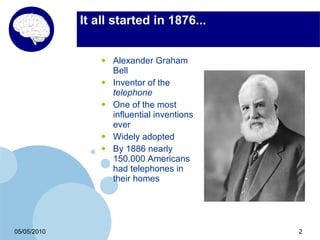
It all started in 1876...


                 •   Alexander Graham
                     Bell
                 •   Inventor of the
                     telephone
                 •   One of the most
                     influential inventions
                     ever
                 •   Widely adopted
                 •   By 1886 nearly
                     150.000 Americans
                     had telephones in
                     their homes


05/05/2010                                    2
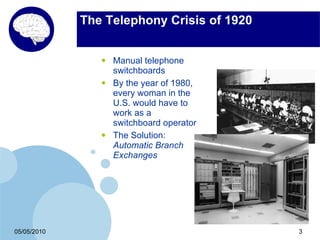
The Telephony Crisis of 1920


                •   Manual telephone
                    switchboards
                •   By the year of 1980,
                    every woman in the
                    U.S. would have to
                    work as a
                    switchboard operator
                •   The Solution:
                    Automatic Branch
                    Exchanges


05/05/2010                                  3
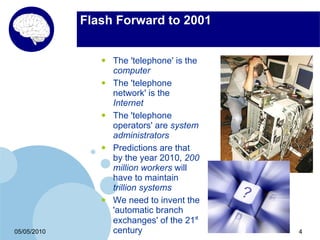
Flash Forward to 2001


                •   The 'telephone' is the
                    computer
                •   The 'telephone
                    network' is the
                    Internet
                •   The 'telephone
                    operators' are system
                    administrators
                •   Predictions are that
                    by the year 2010, 200
                    million workers will
                    have to maintain
                    trillion systems
                •   We need to invent the
                    'automatic branch
                    exchanges' of the 21st
05/05/2010          century                  4
IBM's Vision


                •   Paul Horn, Senior Vice President of
                    Research
                •   Creator of the term 'autonomic
                    computing'
                •   Systems need to develop 'self-
                    managing' capabilities
                •   System administrators will no longer be
                    needed for maintaining computer
                    systems
                •   Author of the Autonomic Computing
                    Manifesto


05/05/2010                                                    5
Outline


                •   The Solution
                •   What is Autonomic Computing?
                •   Designing Autonomic Computer Systems
                •   Eight Principles of Autonomic Computing
                •   The Benefits
                    •   Short-term IT related benefits
                    •   Long-term, Higher Order Benefits
                •   Research Projects


05/05/2010                                                 6
The Solution


                •   End users of computer systems are the
                    primary stakeholders
                •   They desire:
                    •   Intuitive interaction with the system
                    •   Their involvement in the smooth running of the
                        system to be minimal to none
                •   Conclusion: the system has to be
                    autonomic
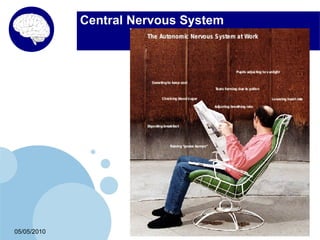
                •   The only know truly autonomic system is
                    the human central nervous system
                •   Sends control messages to the organs in
                    the human body at a sub-concious level

05/05/2010                                                         7
Central Nervous System


05/05/2010                            8
What is Autonomic Computing?


                •   A network of autonomic, smart computing
                    components which provide the user with
                    the desired functionality without a
                    concious effort
                •   A new computing paradigm, transferring
                    the focus from computing to data
                •   Key concept: Allow users to access data
                    from multiple distributed points, with
                    great transparency to how this is
                    achieved
                •   Focus in IT industry must change from
                    increasing processing speed and storage
                    capacity to developing large distributed,
                    self-managing, self-diagnostic networks
05/05/2010                                                9
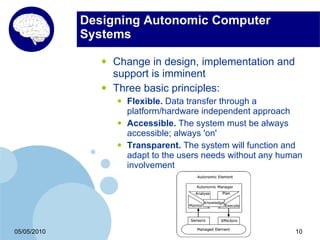
Designing Autonomic Computer
             Systems

                •   Change in design, implementation and
                    support is imminent
                •   Three basic principles:
                    •   Flexible. Data transfer through a
                        platform/hardware independent approach
                    •   Accessible. The system must be always
                        accessible; always 'on'
                    •   Transparent. The system will function and
                        adapt to the users needs without any human
                        involvement


05/05/2010                                                      10
Eight Principles of Autonomic
             Computing

                •   An autonomic computing system needs
                    to ”know itself” - its components must
                    also possess a system identity
                •   An autonomic computing system must
                    configure and reconfigure itself under
                    varying and unpredictable conditions
                •   An autonomic computing system never
                    settles for the status quo - it always looks
                    for ways to optimize its workings
                •   An autonomic computing system must
                    perform something akin to healing - it
                    must be able to recover from routine and
                    extraordinary events that might cause
                    some of its parts to malfunction
05/05/2010                                                   11
Eight Principles of Autonomic
             Computing (Cont.)

                •   An autonomic computing system must
                    detect, identify and protect itself against
                    various types of attacks to maintain
                    overall system security and integrity
                •   An autonomic computing system must
                    know its environment and the context
                    surrounding its activity, and act
                    accordingly
                •   An autonomic computing system cannot
                    exist in a hermetic environment
                •   An autonomic computing system will
                    anticipate the optimized resources
                    needed while keeping its complexity
                    hidden
05/05/2010                                                   12
The Benefits


                •   Short-Term IT Related Benefits
                    •   Simplified user experience through a more
                        responsive, real-time system.
                    •   Cost-savings – scale to use.
                    •   Scaled power, storage and costs that optimize
                        usage across both hardware and software.
                    •   Full use of idle processing power, including
                        home PC's, through networked systems.
                    •   Natural language queries allow deeper and
                        more accurate returns.
                    •   Seamless access to multiple file types. Open
                        standards will allow users to pull data from all
                        potential sources by re-formatting on the fly.
                    •   Stability. High availability. High security
                        system. Fewer system or network errors due
05/05/2010
                        to self-healing.                            13
The Benefits (Cont.)


                •   Long-Term, Higher Order Benefits
                    •   Realize the vision of enablement by shifting
                        available resources to higher-order business.
                    •   Embedding autonomic capabilities in client or
                        access devices, servers, storage systems,
                        middle-ware and network itself.
                    •   Constructing autonomic federated systems.
                    •   Achieving end-to-end service level
                        management.
                    •   Collaboration and global problem-solving.
                    •   Massive simulation – weather, medical –
                        complex calculations like protein folding.


05/05/2010                                                        14
Research Projects


                •   Berkeley University of California:
                    Recovery-Oriented Computing
                    •   Joint Berkeley/Stanford project.
                    •   Investigating novel techniques for building
                        highly-dependable Internet services.
                    •   Emphasizes recovery from failures rather than
                        failure-avoidance.
                •   Carnegie Mellon University: Self-Securing
                    Storage & Devices
                    •   Enabling the storage device to safeguard data
                        even when the client OS is compromised.
                    •   Server-embedded security that cannot be
                        disabled by any software (event the OS).
                    •   Self-securing storage server actively looks for
                        suspicious behaviour.
05/05/2010                                                         15
Research Projects (Cont.)


                •   Georgia Institute of Technology: Qfabric
                    •   Closely integrating applications and resource
                        managers in the Quality of Service
                        management.
                    •   Achieved by tying applications and resource
                        managers through the same event-based
                        control path.
                    •   Application and resource managers can
                        interact freely to ensure optimal resource
                        scheduling and adaptations.
                •   NASA: Autonomous Nanotechnology
                    Swarm (ANTS)
                    •   1,000 pico-class spacecraft.
                    •   Each spacecraft caries only one instrument.
                    •   Swarm will be self-protecting, self-healing,
05/05/2010              self-configuring and self-optimizing.        16
Summary


               •   Inspired by biology.
               •   Evolved as a discipline to create software
                   systems and applications that self-
                   manage.
               •   Main purpose is to overcome the
                   complexities and inability to maintain
                   current and emerging systems effectively.
               •   IT industry, software engineering and
                   development must change the current
                   focus and the process for developing
                   autonomic systems.
               •   Still in the early research-only phases,
                   with hindsight of 'real' projects forming in
05/05/2010
                   the near future.                          17
Bibliography


                •   S. Ahmed, S.I. Ahamed, M. Sharmin, and M.M. Haque,
                    "Self-healing for autonomic pervasive computing,"
                    Proceedings of the 2007 ACM symposium on Applied
                    computing - SAC '07, 2007, p. 110.
                •   J. Cheng, W. Cheng, and R. Nagpal, "Robust and self-
                    repairing formation control for swarms of mobile agents,"
                    Proceedings of the National Conference on Artificial
                    Intelligence, Menlo Park, CA; Cambridge, MA; London;
                    AAAI Press; MIT Press; 1999, 2005, p. 59.
                •   S. Dobson, R. Sterritt, P. Nixon, and M. Hinchey,
                    "Fulfilling the Vision of Autonomic Computing," IEEE
                    Computer, vol. 43, 2010, p. 35–41.
                •   E. Mainsah, "Autonomic computing: the next era of
                    computing," Electronics and Communication
                    Engineering, 2002, pp. 8-9.
                •   B. Melcher and B. Mitchell, "Towards an autonomic
                    framework: Self-configuring network services and
                    developing autonomic applications," Intel Technology
05/05/2010          Journal, vol. 8, 2004, p. 279–290.                  18
Bibliography (Cont.)


                •   A. Garcia, T. Batista, A. Rashid, and C. Sant'Anna,
                    "Autonomic computing: emerging trends and open
                    problems," SIGSOFT Softw Eng Notes, vol. 30, 2005,
                    pp. 1-7.
                •   P. Horn, "Autonomic Computing: IBM's Perspective on
                    the State of Information Technology," Computing
                    Systems, 2002.
                •   M.C. Huebscher and J.A. McCann, "A survey of
                    autonomic computing—degrees, models, and
                    applications," ACM Computing Surveys (CSUR), vol. 40,
                    2008.
                •   IBM, "White Paper: An architectural blueprint for
                    autonomic computing," white paper, 2005.
                •   J. Kephart, "Research challenges of autonomic
                    computing," Proceedings. 27th International Conference
                    on Software Engineering, 2005. ICSE 2005., 2005, pp.
                    15-22.
                •   J. Kephart and D. Chess, "The vision of autonomic
05/05/2010          computing," Computer, 2003, pp. 41-50.              19

Autonomic Computing: Vision or Reality - Presentation

  • 1.
  • 2.
    It all startedin 1876... • Alexander Graham Bell • Inventor of the telephone • One of the most influential inventions ever • Widely adopted • By 1886 nearly 150.000 Americans had telephones in their homes 05/05/2010 2
  • 3.
    The Telephony Crisisof 1920 • Manual telephone switchboards • By the year of 1980, every woman in the U.S. would have to work as a switchboard operator • The Solution: Automatic Branch Exchanges 05/05/2010 3
  • 4.
    Flash Forward to2001 • The 'telephone' is the computer • The 'telephone network' is the Internet • The 'telephone operators' are system administrators • Predictions are that by the year 2010, 200 million workers will have to maintain trillion systems • We need to invent the 'automatic branch exchanges' of the 21st 05/05/2010 century 4
  • 5.
    IBM's Vision • Paul Horn, Senior Vice President of Research • Creator of the term 'autonomic computing' • Systems need to develop 'self- managing' capabilities • System administrators will no longer be needed for maintaining computer systems • Author of the Autonomic Computing Manifesto 05/05/2010 5
  • 6.
    Outline • The Solution • What is Autonomic Computing? • Designing Autonomic Computer Systems • Eight Principles of Autonomic Computing • The Benefits • Short-term IT related benefits • Long-term, Higher Order Benefits • Research Projects 05/05/2010 6
  • 7.
    The Solution • End users of computer systems are the primary stakeholders • They desire: • Intuitive interaction with the system • Their involvement in the smooth running of the system to be minimal to none • Conclusion: the system has to be autonomic • The only know truly autonomic system is the human central nervous system • Sends control messages to the organs in the human body at a sub-concious level 05/05/2010 7
  • 8.
  • 9.
    What is AutonomicComputing? • A network of autonomic, smart computing components which provide the user with the desired functionality without a concious effort • A new computing paradigm, transferring the focus from computing to data • Key concept: Allow users to access data from multiple distributed points, with great transparency to how this is achieved • Focus in IT industry must change from increasing processing speed and storage capacity to developing large distributed, self-managing, self-diagnostic networks 05/05/2010 9
  • 10.
    Designing Autonomic Computer Systems • Change in design, implementation and support is imminent • Three basic principles: • Flexible. Data transfer through a platform/hardware independent approach • Accessible. The system must be always accessible; always 'on' • Transparent. The system will function and adapt to the users needs without any human involvement 05/05/2010 10
  • 11.
    Eight Principles ofAutonomic Computing • An autonomic computing system needs to ”know itself” - its components must also possess a system identity • An autonomic computing system must configure and reconfigure itself under varying and unpredictable conditions • An autonomic computing system never settles for the status quo - it always looks for ways to optimize its workings • An autonomic computing system must perform something akin to healing - it must be able to recover from routine and extraordinary events that might cause some of its parts to malfunction 05/05/2010 11
  • 12.
    Eight Principles ofAutonomic Computing (Cont.) • An autonomic computing system must detect, identify and protect itself against various types of attacks to maintain overall system security and integrity • An autonomic computing system must know its environment and the context surrounding its activity, and act accordingly • An autonomic computing system cannot exist in a hermetic environment • An autonomic computing system will anticipate the optimized resources needed while keeping its complexity hidden 05/05/2010 12
  • 13.
    The Benefits • Short-Term IT Related Benefits • Simplified user experience through a more responsive, real-time system. • Cost-savings – scale to use. • Scaled power, storage and costs that optimize usage across both hardware and software. • Full use of idle processing power, including home PC's, through networked systems. • Natural language queries allow deeper and more accurate returns. • Seamless access to multiple file types. Open standards will allow users to pull data from all potential sources by re-formatting on the fly. • Stability. High availability. High security system. Fewer system or network errors due 05/05/2010 to self-healing. 13
  • 14.
    The Benefits (Cont.) • Long-Term, Higher Order Benefits • Realize the vision of enablement by shifting available resources to higher-order business. • Embedding autonomic capabilities in client or access devices, servers, storage systems, middle-ware and network itself. • Constructing autonomic federated systems. • Achieving end-to-end service level management. • Collaboration and global problem-solving. • Massive simulation – weather, medical – complex calculations like protein folding. 05/05/2010 14
  • 15.
    Research Projects • Berkeley University of California: Recovery-Oriented Computing • Joint Berkeley/Stanford project. • Investigating novel techniques for building highly-dependable Internet services. • Emphasizes recovery from failures rather than failure-avoidance. • Carnegie Mellon University: Self-Securing Storage & Devices • Enabling the storage device to safeguard data even when the client OS is compromised. • Server-embedded security that cannot be disabled by any software (event the OS). • Self-securing storage server actively looks for suspicious behaviour. 05/05/2010 15
  • 16.
    Research Projects (Cont.) • Georgia Institute of Technology: Qfabric • Closely integrating applications and resource managers in the Quality of Service management. • Achieved by tying applications and resource managers through the same event-based control path. • Application and resource managers can interact freely to ensure optimal resource scheduling and adaptations. • NASA: Autonomous Nanotechnology Swarm (ANTS) • 1,000 pico-class spacecraft. • Each spacecraft caries only one instrument. • Swarm will be self-protecting, self-healing, 05/05/2010 self-configuring and self-optimizing. 16
  • 17.
    Summary • Inspired by biology. • Evolved as a discipline to create software systems and applications that self- manage. • Main purpose is to overcome the complexities and inability to maintain current and emerging systems effectively. • IT industry, software engineering and development must change the current focus and the process for developing autonomic systems. • Still in the early research-only phases, with hindsight of 'real' projects forming in 05/05/2010 the near future. 17
  • 18.
    Bibliography • S. Ahmed, S.I. Ahamed, M. Sharmin, and M.M. Haque, "Self-healing for autonomic pervasive computing," Proceedings of the 2007 ACM symposium on Applied computing - SAC '07, 2007, p. 110. • J. Cheng, W. Cheng, and R. Nagpal, "Robust and self- repairing formation control for swarms of mobile agents," Proceedings of the National Conference on Artificial Intelligence, Menlo Park, CA; Cambridge, MA; London; AAAI Press; MIT Press; 1999, 2005, p. 59. • S. Dobson, R. Sterritt, P. Nixon, and M. Hinchey, "Fulfilling the Vision of Autonomic Computing," IEEE Computer, vol. 43, 2010, p. 35–41. • E. Mainsah, "Autonomic computing: the next era of computing," Electronics and Communication Engineering, 2002, pp. 8-9. • B. Melcher and B. Mitchell, "Towards an autonomic framework: Self-configuring network services and developing autonomic applications," Intel Technology 05/05/2010 Journal, vol. 8, 2004, p. 279–290. 18
  • 19.
    Bibliography (Cont.) • A. Garcia, T. Batista, A. Rashid, and C. Sant'Anna, "Autonomic computing: emerging trends and open problems," SIGSOFT Softw Eng Notes, vol. 30, 2005, pp. 1-7. • P. Horn, "Autonomic Computing: IBM's Perspective on the State of Information Technology," Computing Systems, 2002. • M.C. Huebscher and J.A. McCann, "A survey of autonomic computing—degrees, models, and applications," ACM Computing Surveys (CSUR), vol. 40, 2008. • IBM, "White Paper: An architectural blueprint for autonomic computing," white paper, 2005. • J. Kephart, "Research challenges of autonomic computing," Proceedings. 27th International Conference on Software Engineering, 2005. ICSE 2005., 2005, pp. 15-22. • J. Kephart and D. Chess, "The vision of autonomic 05/05/2010 computing," Computer, 2003, pp. 41-50. 19