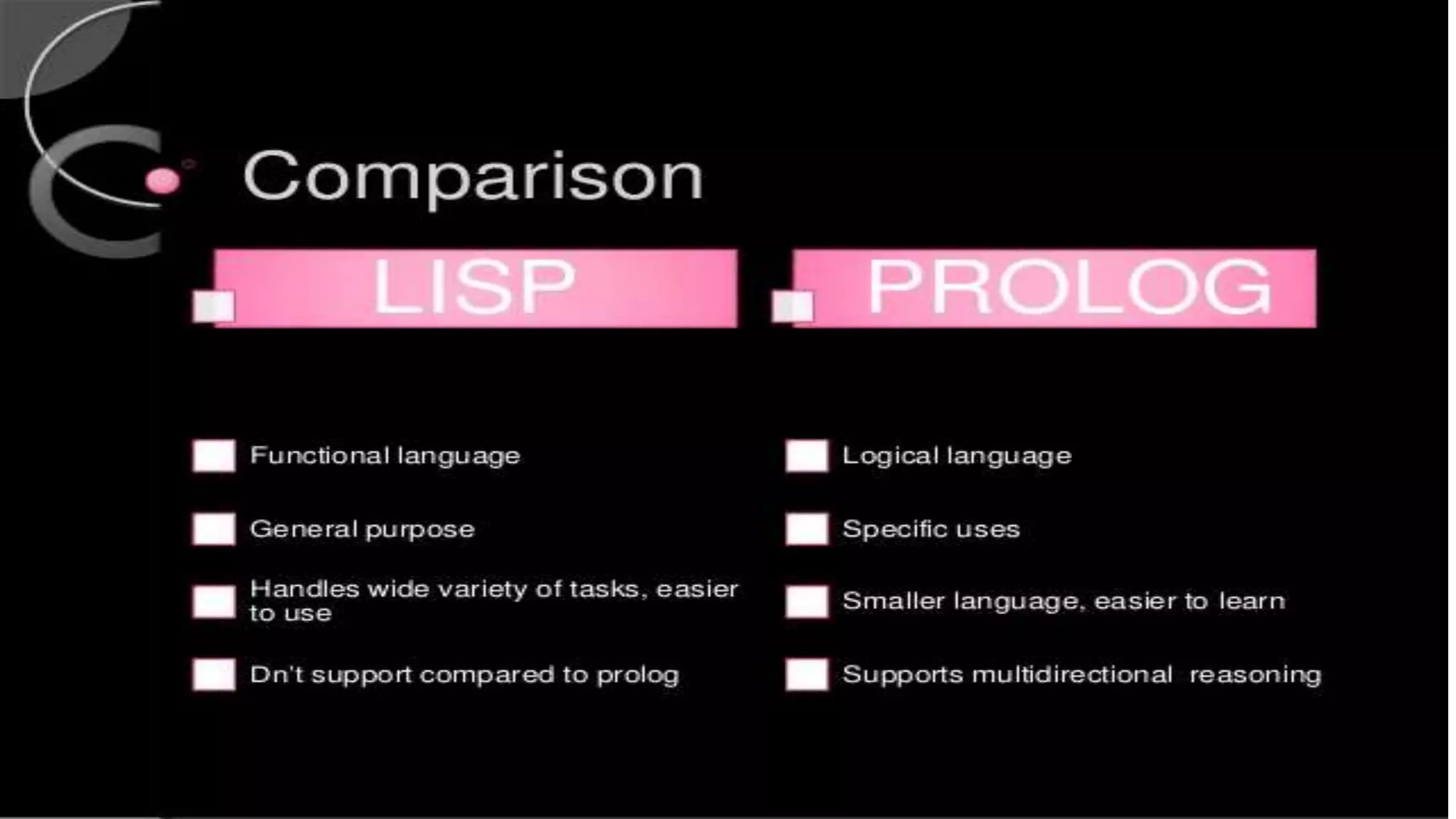
This document provides an overview of artificial intelligence (AI), including its history, languages, applications, and limitations. It defines AI as making computers think like humans through studying processes like reasoning, learning, and problem-solving. The document discusses pioneering AI languages like Lisp and Prolog and applications such as natural language understanding, expert systems, planning, robotics, and machine learning. It also notes some limitations of AI like its limited ability compared to humans, slow real-time response, inability to handle emergencies, difficulty of coding, and high costs.
INTRODUCTION
Artificial Intelligence isan approach to make a computer, a
robot, or a product to think how smart human think. AI is a
study of how human brain think, learn, decide and work,
when it tries to solve problems. And finally this study
outputs intelligent software systems.The aim of AI is to
improve computer functions which are related to human
knowledge, for example, reasoning, learning, and problem-
4.
Are there limitsto how
intelligent machines can be?
Intelligence:
The capacity to learn and solve problems
Artificial Intelligence:
Artificial intelligence (AI) is
the intelligence of machines and robots
and the branch of computer science that
aims to create it
- the ability to solve problems
- the ability to act rationally
- the ability to act like humans
5.
Philosophy of A.l
-Searle's strong Al hypothesis:
"The appropriately
programmed computer with
the right inputs & outputs
would thereby have a mind in
exactly the same sense
human beings have minds.“
- The artificial brain argument:
The brain can be simulated.
- Technologically feasible to
copy the brain directly into
hardware and software, and
that such a simulation will be
essentially identical to the
original.
6.
The history ofartificial intelligence (AI) began
in antiquity, with myths, stories and rumors of
artificial beings endowed with intelligence or
consciousness by master craftsmen. The seeds of
modern AI were planted by classical philosophers
who attempted to describe the process of human
thinking as the mechanical manipulation of symbols.
This work culminated in the invention of
the programmable digital computer in the 1940s, a
machine based on the abstract essence of
mathematical reasoning. This device and the ideas
behind it inspired a handful of scientists to begin
seriously discussing the possibility of building an
electronic brain.
HISTORY OF A.I
7.
How complicated isour brain?
- Neuron
- 10^12 neurons in a human brain
- many more synapses (10 14) connecting these
neurons
- cycle time: 10-3 seconds (1 millisecond)
How complex can we make
computers?
- 10^8 or more transistors per CPU
- supercomputer: hundreds of CPUs, 1012 bits of
RAM
- cycle times: order of 10 - 9 seconds
Conclusion
- YES
- Less interconnections (wires or synapses)
Can AI System Work As Efficient As
Human Brain?
8.
LANGUAGES
Artificial intelligence researchershave developed
several specialized programming languages for
artificial intelligence which include IPL, Lisp, Prolog,
STRIPS, Planner, POP-11 etc.
9.
John McCarthy inventedLISP in 1958, shortly after
the development of FORTRAN. It was first
implemented by Steve Russell on an IBM 704
computer.
It is particularly suitable for Artificial Intelligence
programs, as it processes symbolic information
effectively.
Common Lisp originated, during the 1980s and
1990s, in an attempt to unify the work of several
implementation groups that were successors to
Maclisp, like ZetaLisp and NIL (New Implementation
of Lisp) etc.
It serves as a common language, which can be
easily extended for specific implementation.
Programs written in Common LISP do not depend on
machine-specific characteristics, such as word
length etc.
LISP
10.
Prolog, which isshort for programming logic, is a
programming language used in creating artificial
intelligence. Prolog is classified as a logic
programming language and relies on the user to
specify the rules and facts about a situation along
with the end goal, otherwise known as a query. After
the rules, facts, and goal are stated, the program will
then attempt to derive the solution by analyzing the
relationship between the three.
This is in contrast to traditional programming
languages, like C# and Visual Basic, which have a
program follow a sequence of commands dictated by
the user.
PROLOG
12.
APPLICATION OF A.I
-Natural Language
Understanding
- Expert Systems
- Planning and Robotics
- Machine Learning
- Game Playing
14.
DRAWBACKS OF A.I
-Limited Ability
- Slow Real Time
Response
- Can’t Handle
Emergency Situation
- Difficult code
- High Cost