S-Cube Learning Package

Designing and migrating Service-Based Applications:
   Techniques for design for adaptation

          Politecnico di Milano (POLIMI),
          Fondazione Bruno Kesler (FBK)


 Elisabetta Di Nitto and Cinzia Cappiello (POLIMI),
            Antonio Bucchiarone (FBK)

                  www.s-cube-network.eu
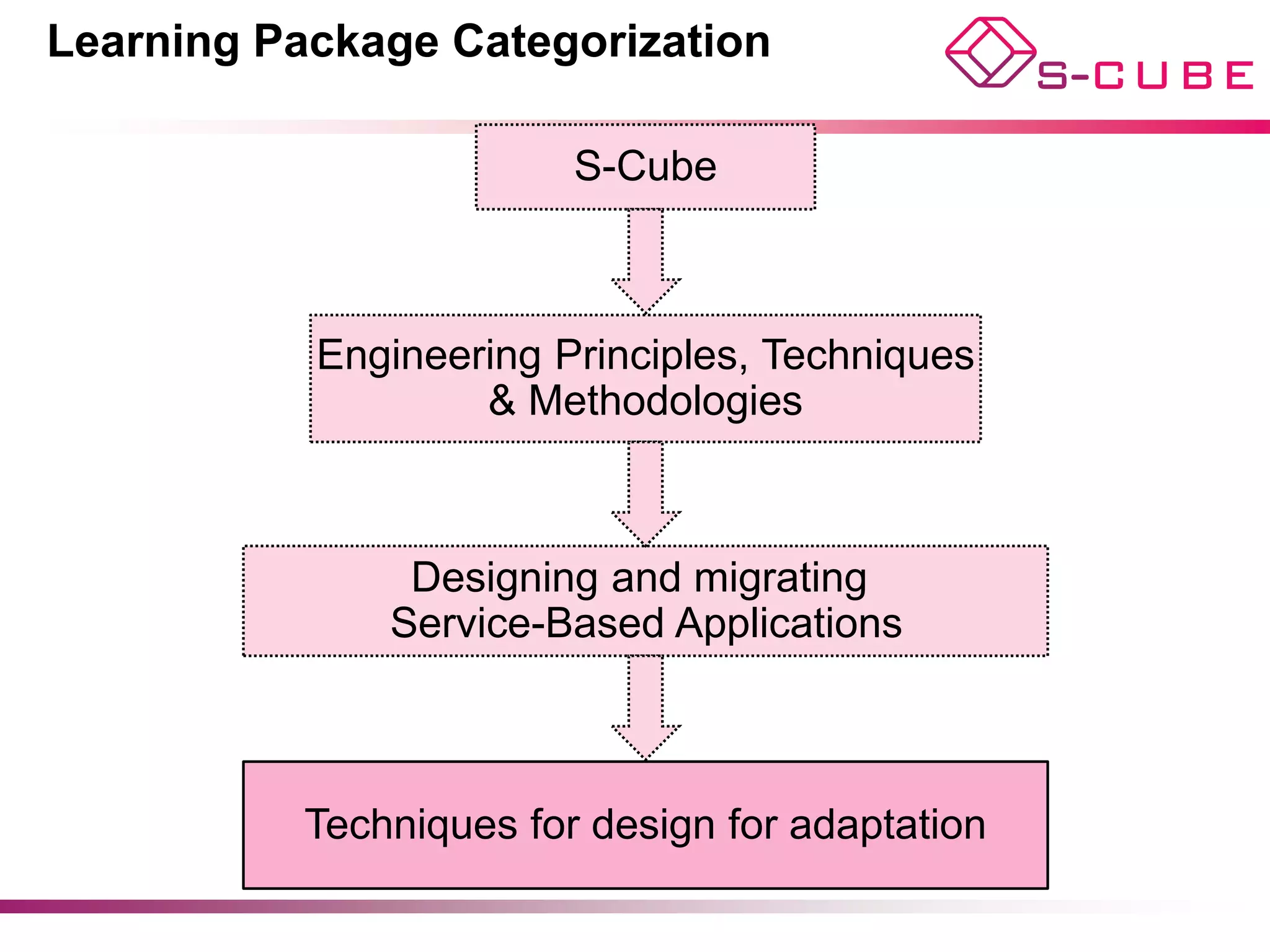
Learning Package Categorization

                         S-Cube


           Engineering Principles, Techniques
                   & Methodologies


                Designing and migrating
               Service-Based Applications


           Techniques for design for adaptation

                                            © Di Nitto, Cappiello, Bucchiarone
Learning Package Overview


§  Problem Description (changes in the world and self-
    adaptation)
§  Support to self-adaptation during the lifecycle of a SBA
§  Context changes and self-adaptation
§  Conclusions


                                                © Di Nitto, Cappiello, Bucchiarone
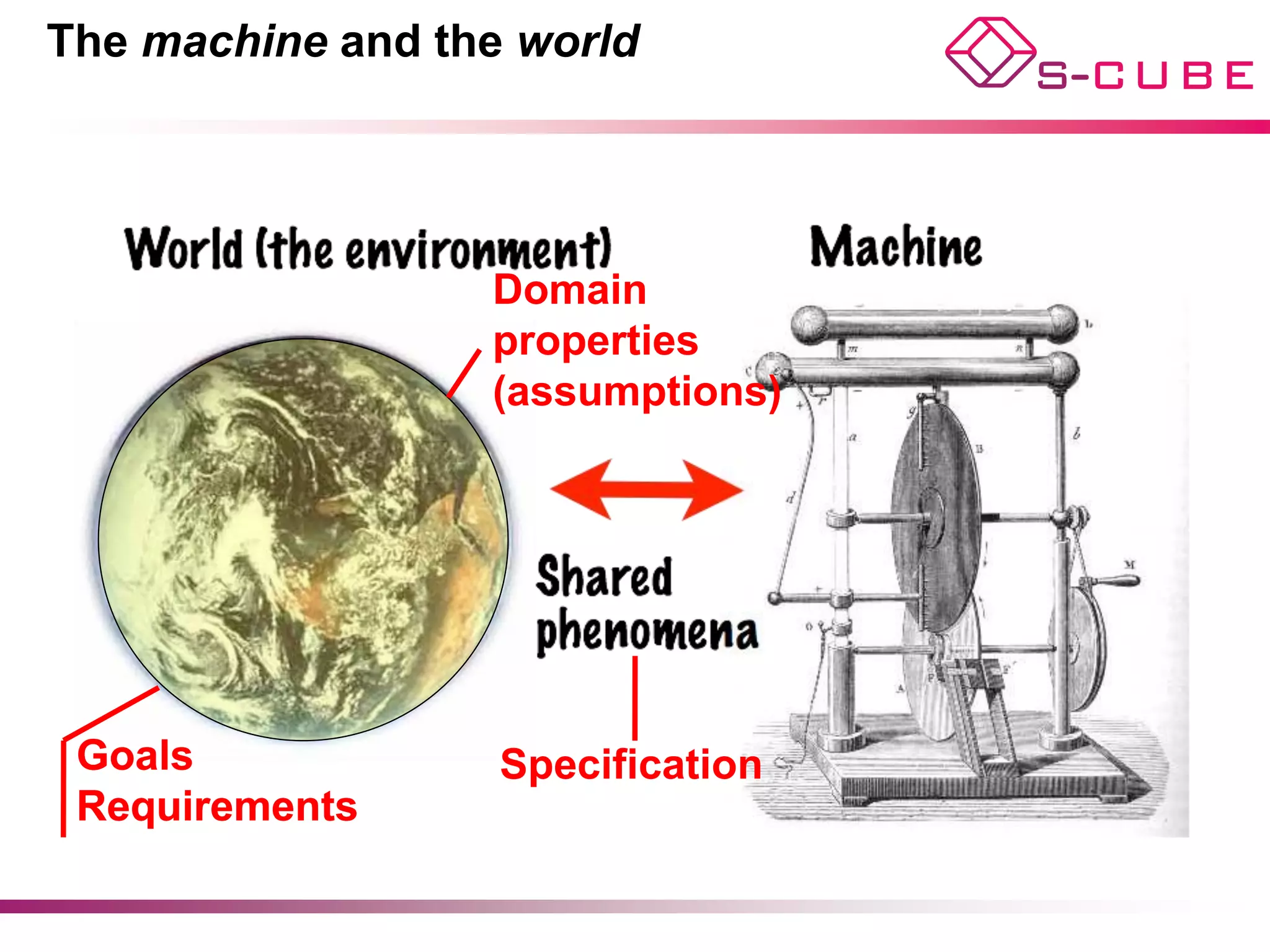
The machine and the world


                  Domain
                  properties
                  (assumptions)


 Goals             Specification
 Requirements
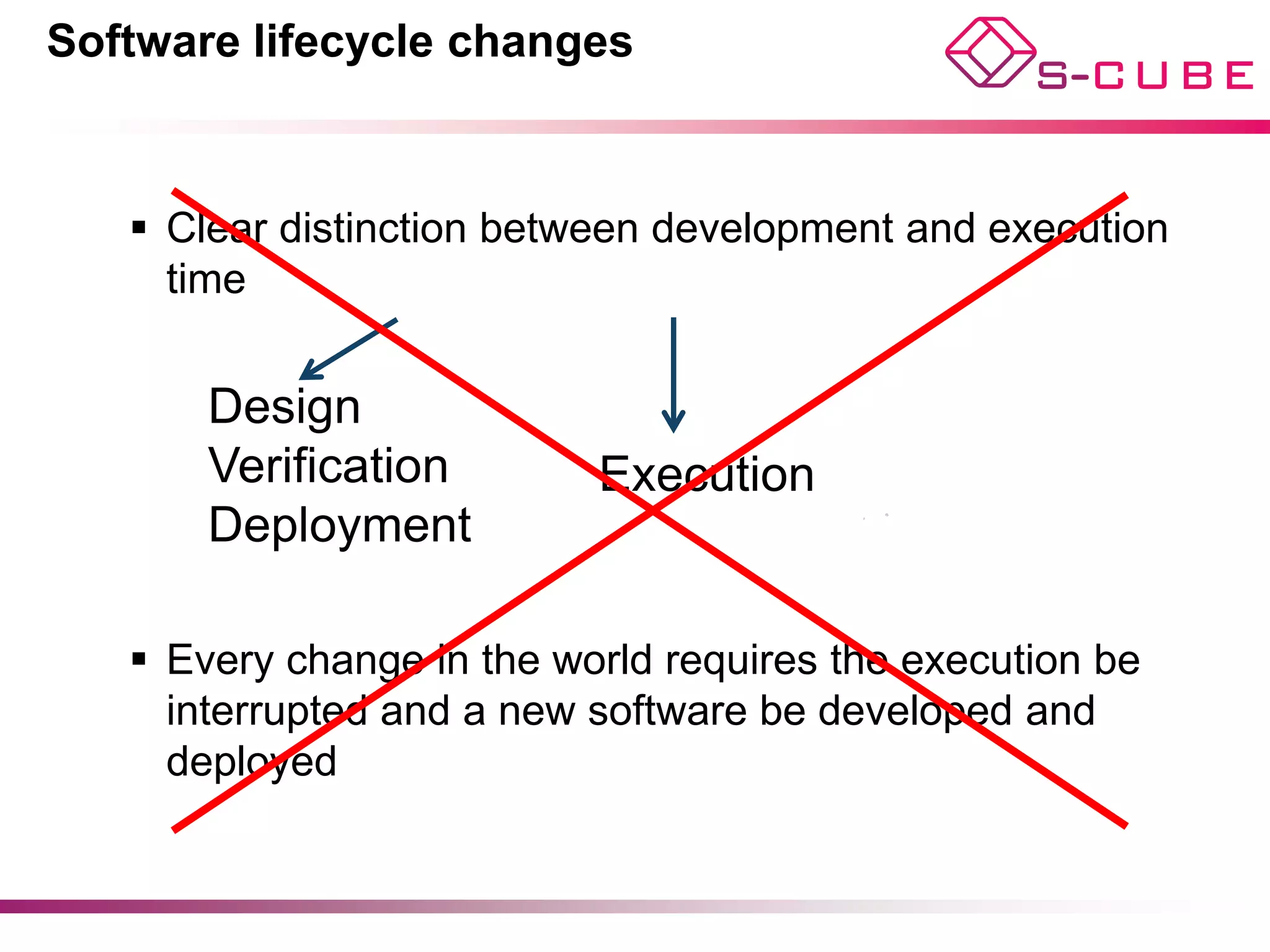
Software lifecycle changes


   §  Clear distinction between development and execution
       time


       Design
       Verification         Execution
       Deployment

   §  Every change in the world requires the execution be
       interrupted and a new software be developed and
       deployed
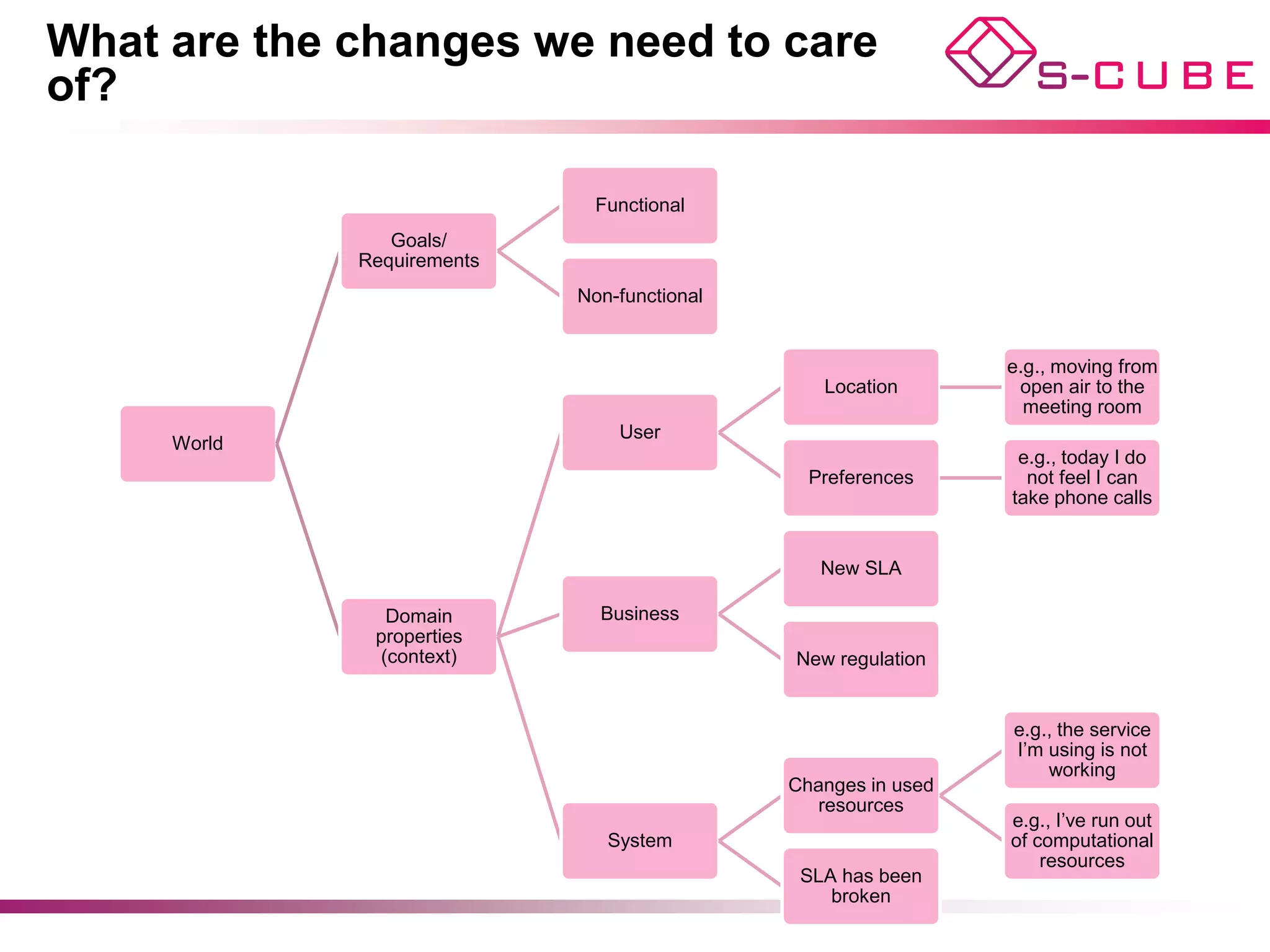
What are the changes we need to care
of?

                             Functional
                Goals/
             Requirements
                            Non-functional


                                                               e.g., moving from
                                                Location        open air to the
                                                                 meeting room
                                User
     World
                                                                e.g., today I do
                                               Preferences       not feel I can
                                                               take phone calls


                                                New SLA

                Domain        Business
              properties
               (context)                     New regulation


                                                               e.g., the service
                                                               I’m using is not
                                                                   working
                                             Changes in used
                                                resources
                                                               e.g., I’ve run out
                               System                          of computational
                                                                   resources
                                              SLA has been
                                                 broken
                                                                                    6
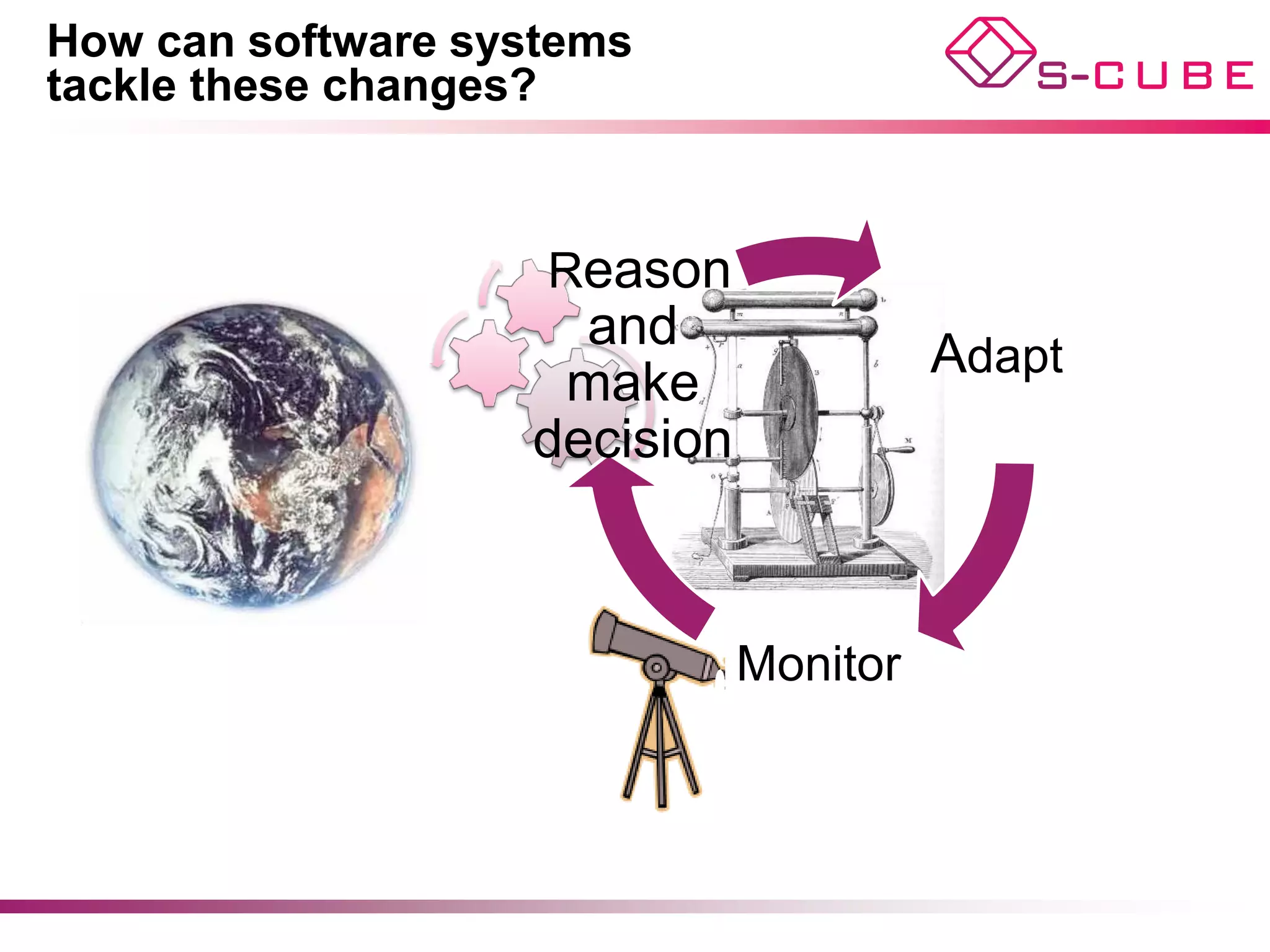
How can software systems
tackle these changes?


                    Reason
                     and
                                        Adapt
                    make
                   decision


                              Monitor


                                                7
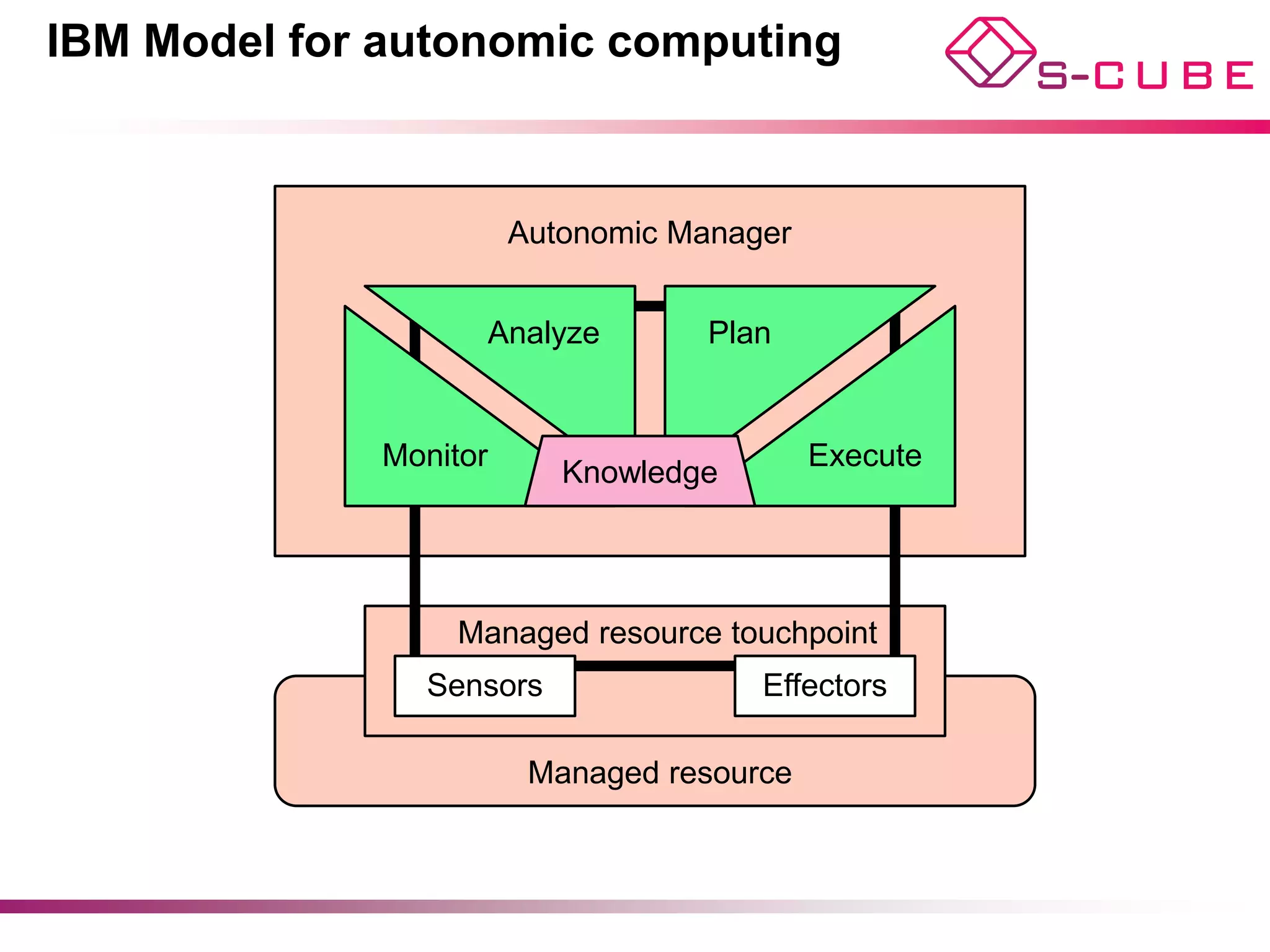
IBM Model for autonomic computing


                                    8
Monitoring

§  Monitor all possible data
§  Activate/deactivate various levels of monitoring depending on
    the situation
§  Perform some filtering to limit the amount of monitoring data
    offered to the system
§  Correlate data


                                                                    9
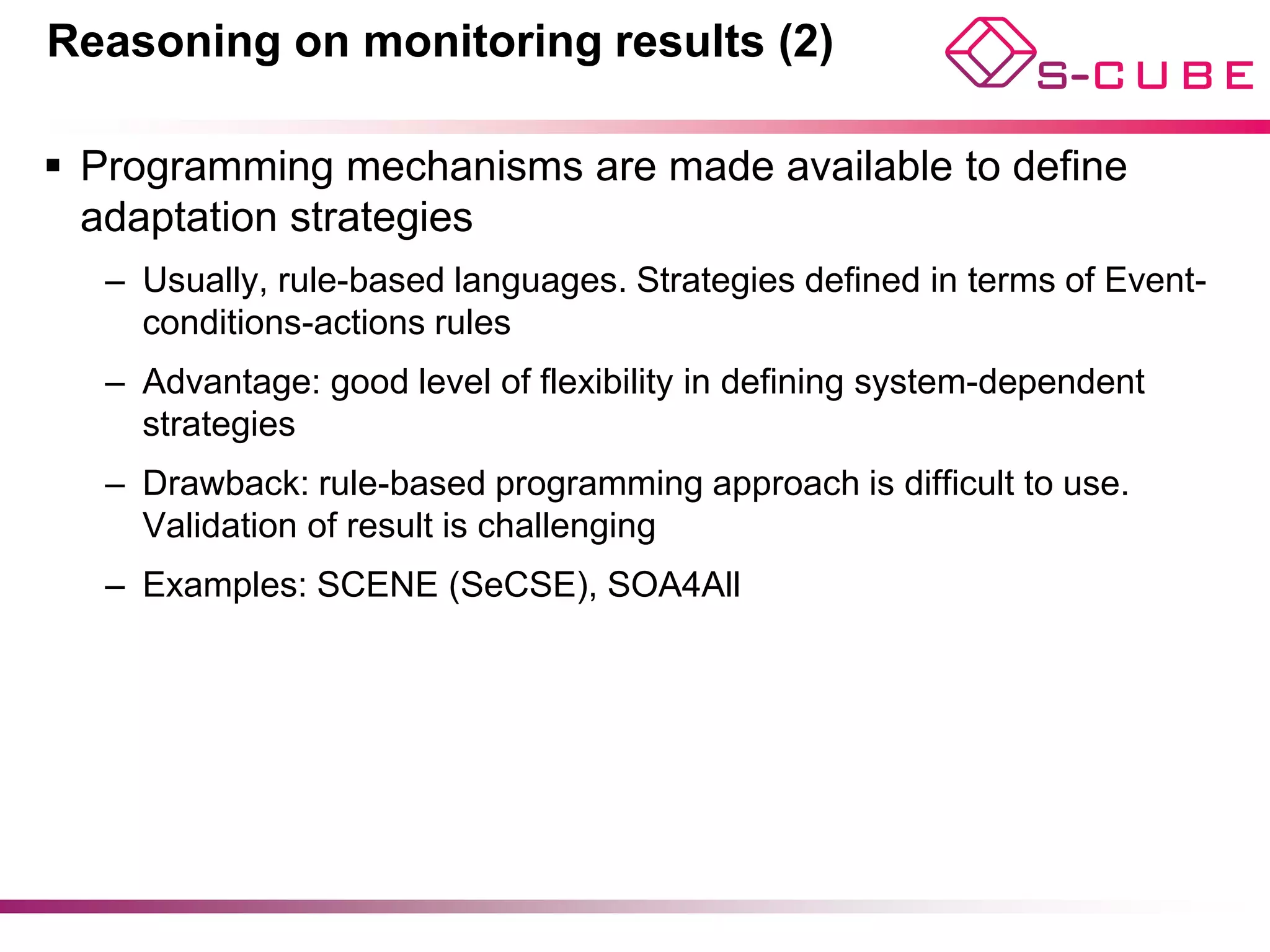
Reasoning on monitoring results (1)

§  Reasoning can be hardcoded in the execution environment
   –  E.g.: always replace a failing service with the first one you find in a
      directory
   –  Advantage: No need to perform specific programming actions to
      achieve self-adaptation
   –  Drawback: Limited to a set of predefined options


                                                                                10
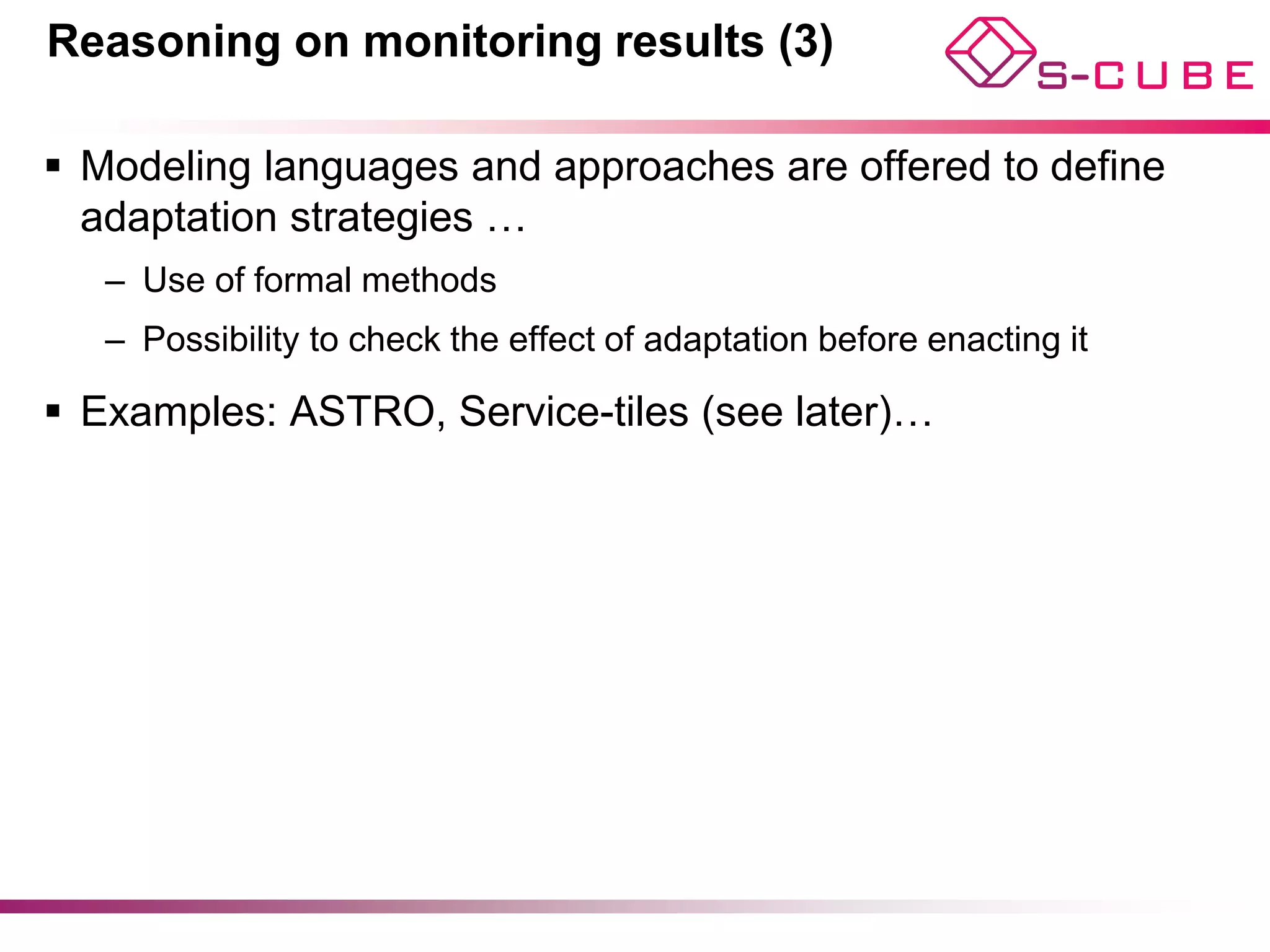
Reasoning on monitoring results (2)

§  Programming mechanisms are made available to define
    adaptation strategies
   –  Usually, rule-based languages. Strategies defined in terms of Event-
      conditions-actions rules
   –  Advantage: good level of flexibility in defining system-dependent
      strategies
   –  Drawback: rule-based programming approach is difficult to use.
      Validation of result is challenging
   –  Examples: SCENE (SeCSE), SOA4All


                                                                             11
Reasoning on monitoring results (3)

§  Modeling languages and approaches are offered to define
    adaptation strategies …
   –  Use of formal methods
   –  Possibility to check the effect of adaptation before enacting it

§  Examples: ASTRO, Service-tiles (see later)…


                                                                         12
Actuating adaptation

§  Many variations
   –  Can be specific of a single system instance or it can apply to all
      running instances
   –  Can impact only on future instances of system
   –  Can be permanent or transitory


                                                                           13
Learning Package Overview


§  Problem Description (changes in the world and self-
    adaptation)
§  Support to self-adaptation during the lifecycle of a SBA
§  Context changes and self-adaptation
§  Conclusions


                                               © Di Nitto, Cappiello, Bucchiarone
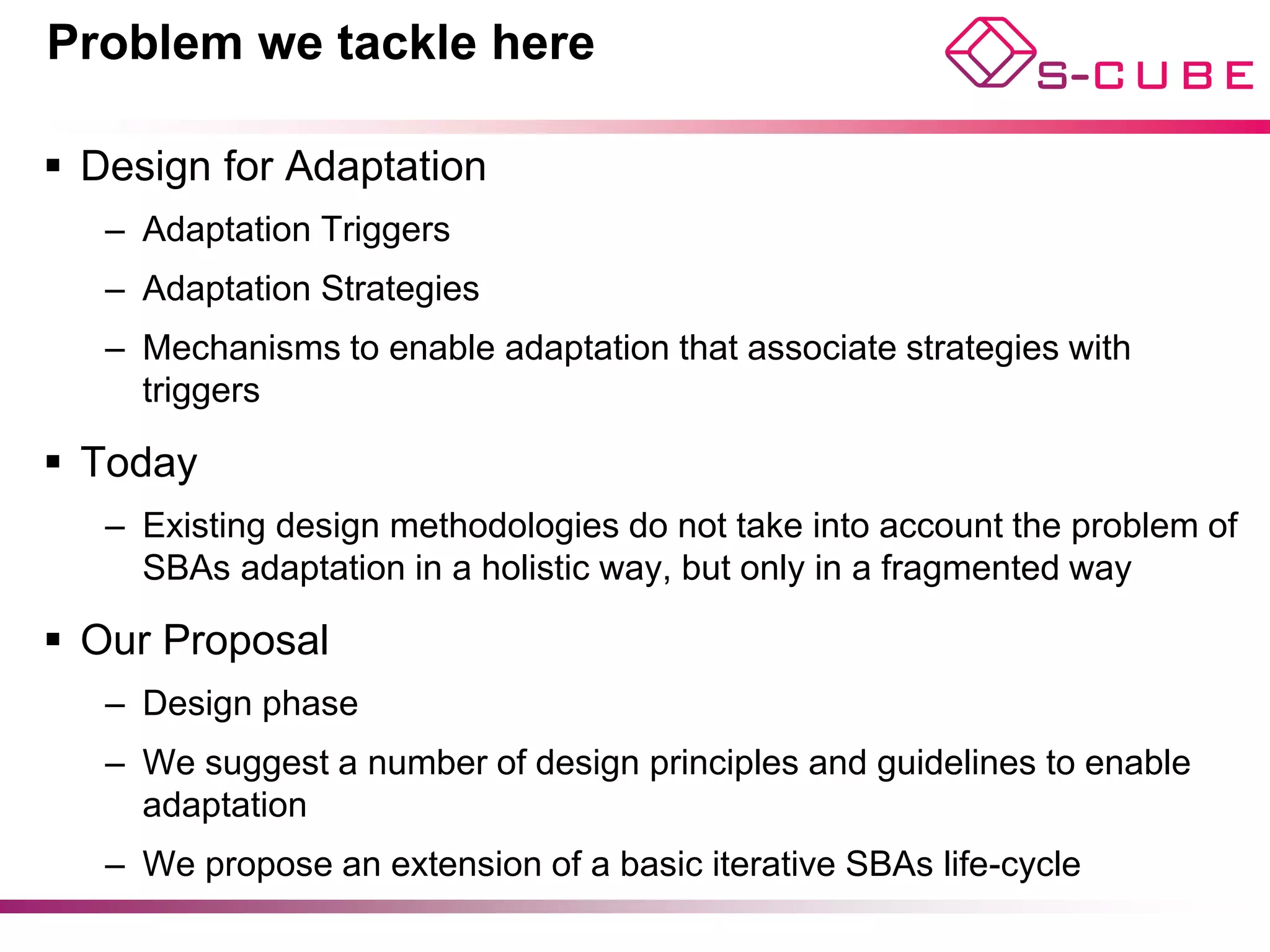
Problem we tackle here

§  Design for Adaptation
   –  Adaptation Triggers
   –  Adaptation Strategies
   –  Mechanisms to enable adaptation that associate strategies with
      triggers

§  Today
   –  Existing design methodologies do not take into account the problem of
      SBAs adaptation in a holistic way, but only in a fragmented way

§  Our Proposal
   –  Design phase
   –  We suggest a number of design principles and guidelines to enable
      adaptation
   –  We propose an extension of a basic iterative SBAs life-cycle
Motivating Scenarios

§  The life-cycles and frameworks available for SBAs do not
    support adaptation or tend to focus on specific adaptation
    strategies
§  We consider three scenarios from different domains with
    different adaptation aspects.
   –  Automotive
   –  Wine Production
   –  Mobile Users

§  SBAs have to face very different adaptation needs
Automotive Scenario

§  Scenario Description
   –  Supply-chain business processes in the automobile production domain
      -  Ordering and importing automobile body parts from supplier
      -  manufactoring activities
      -  customization of the products according to customers’ needs
   –  Long running processes involving a wide range of enterprise services
      -  Agile Service Network (ASN)

§  Scenario Adaptations
   –  Partner can be chosen at runtime from those belonging to the ASN
   –  SBA needs to recover from some problem and to accomodate some
      change in the business context
Wine Production Scenario

§  Scenario Description
   –  SBA realized on a top of a Wireless Sensor and Actuator Nework
   –  Activities of vineyard cultivation handling, the control of grapes
      maturation, their harvesting and fermentation

§  Scenario Adaptations
   –  Ability of autonomously detect problems
       -  Replace devices that may crash, run out of battery or provide
          incorrect information
       -  Change the topology of network to optimize the load and the
          distribution of the sensors
Mobile Users Scenario

§  Scenario Description
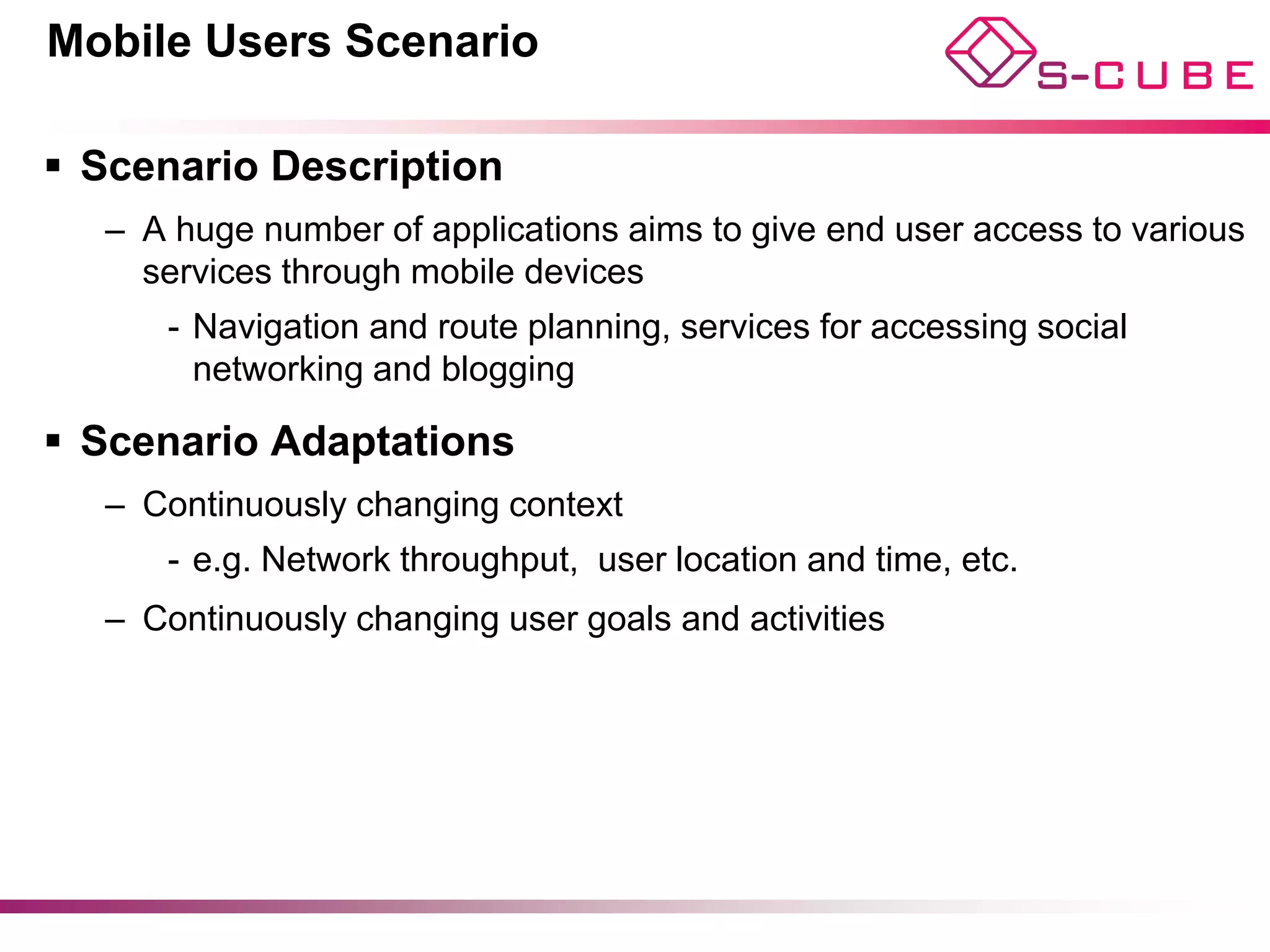
   –  A huge number of applications aims to give end user access to various
      services through mobile devices
      -  Navigation and route planning, services for accessing social
         networking and blogging

§  Scenario Adaptations
   –  Continuously changing context
      -  e.g. Network throughput, user location and time, etc.
   –  Continuously changing user goals and activities
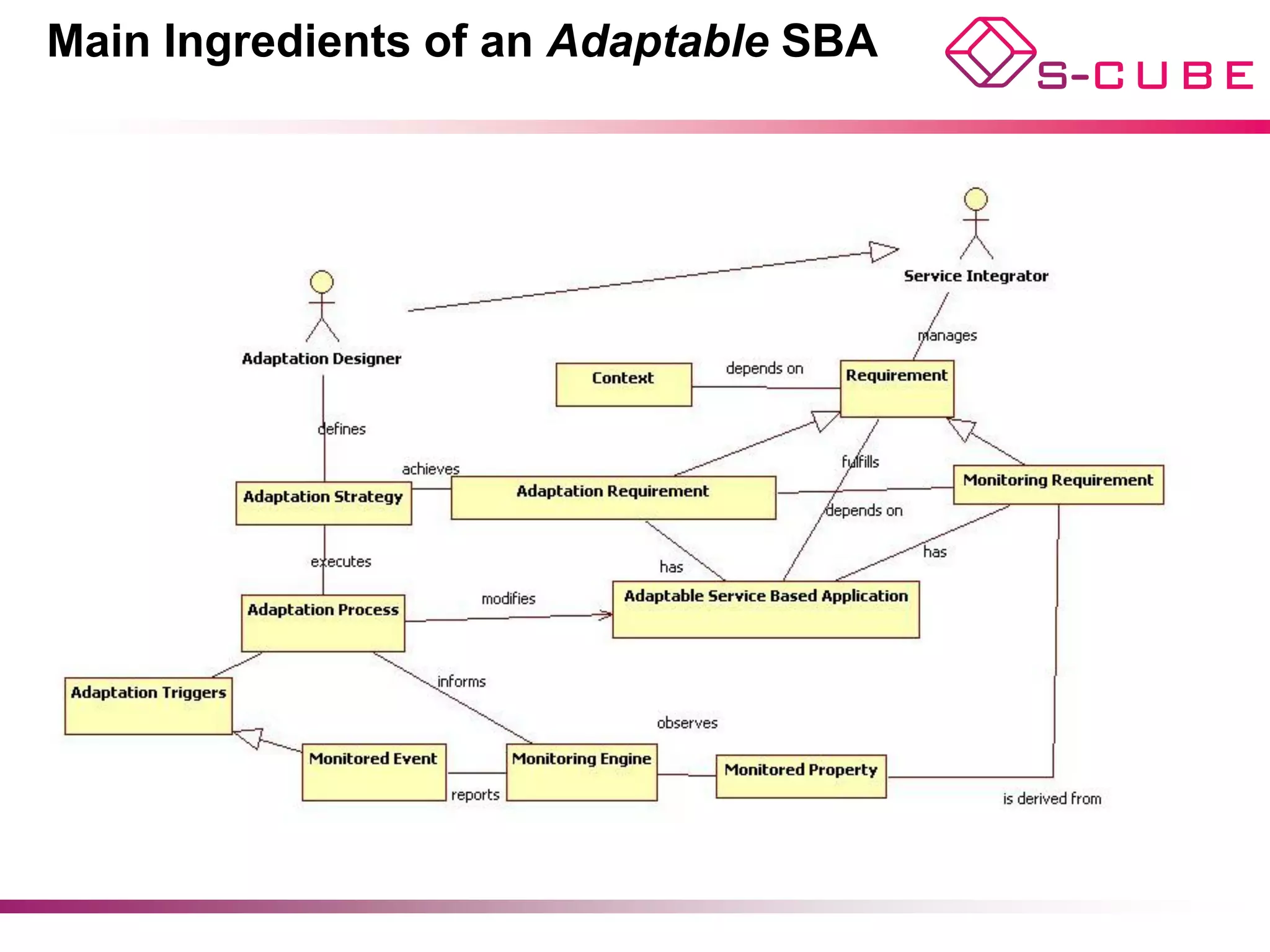
Main Ingredients of an Adaptable SBA
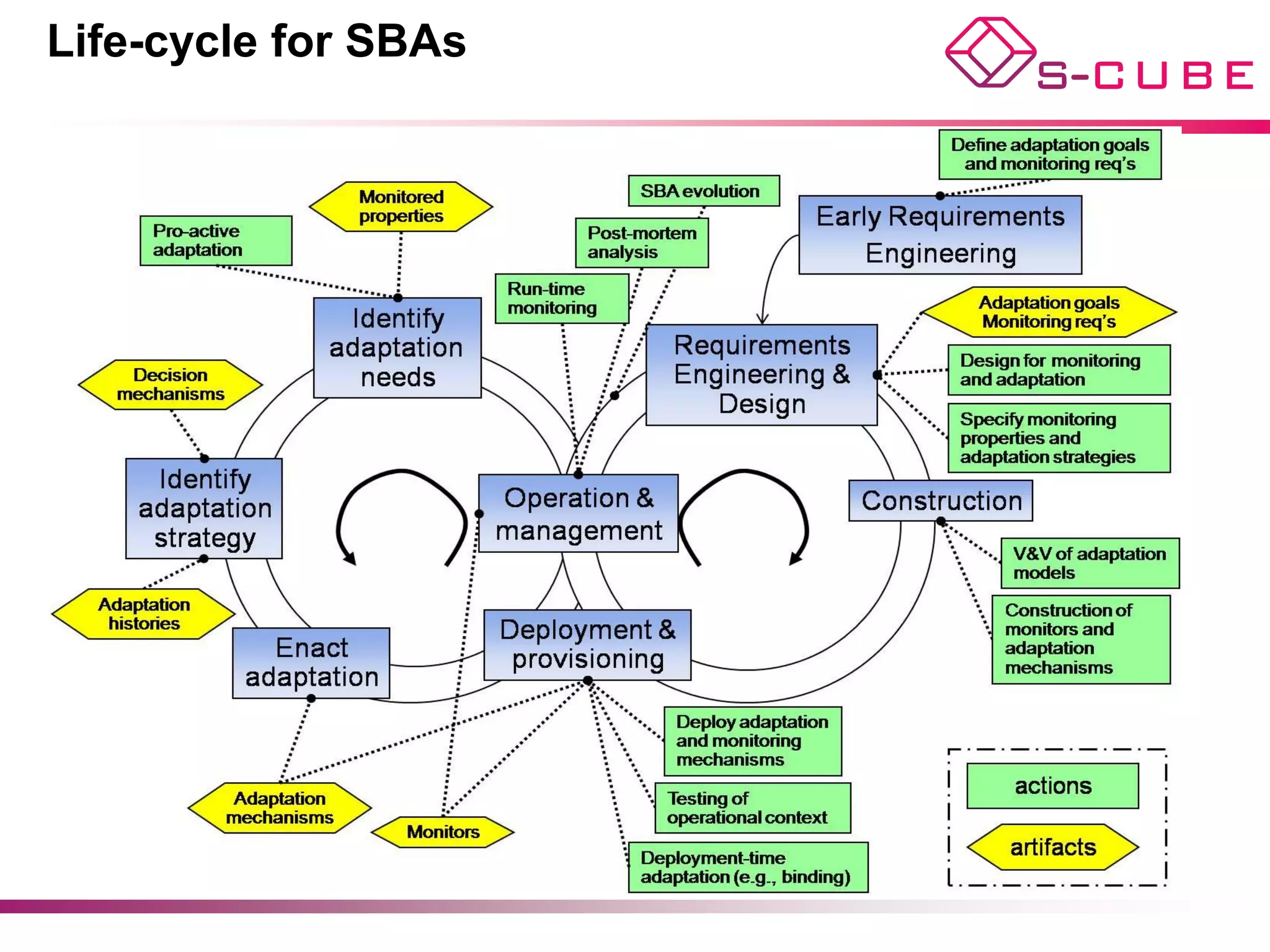
Life-cycle for SBAs
Adaptation Strategies

§  To mantain aligned the application behaviour with the context
    and system requirements
   –  Service substitution
   –  Re-execution
   –  (Re-)negotiation
   –  (Re-)composition
   –  Compensation
   –  Log/Update adaptation Information
   –  Fail
Adaptation Triggers

§  The adaptation may be motivated by variety of triggers
§  Component Services
   –  Service functionality
   –  Service quality

§  SBAs context
   –  Business context
   –  Computational context
   –  User context
Adaptation Strategies & Triggers

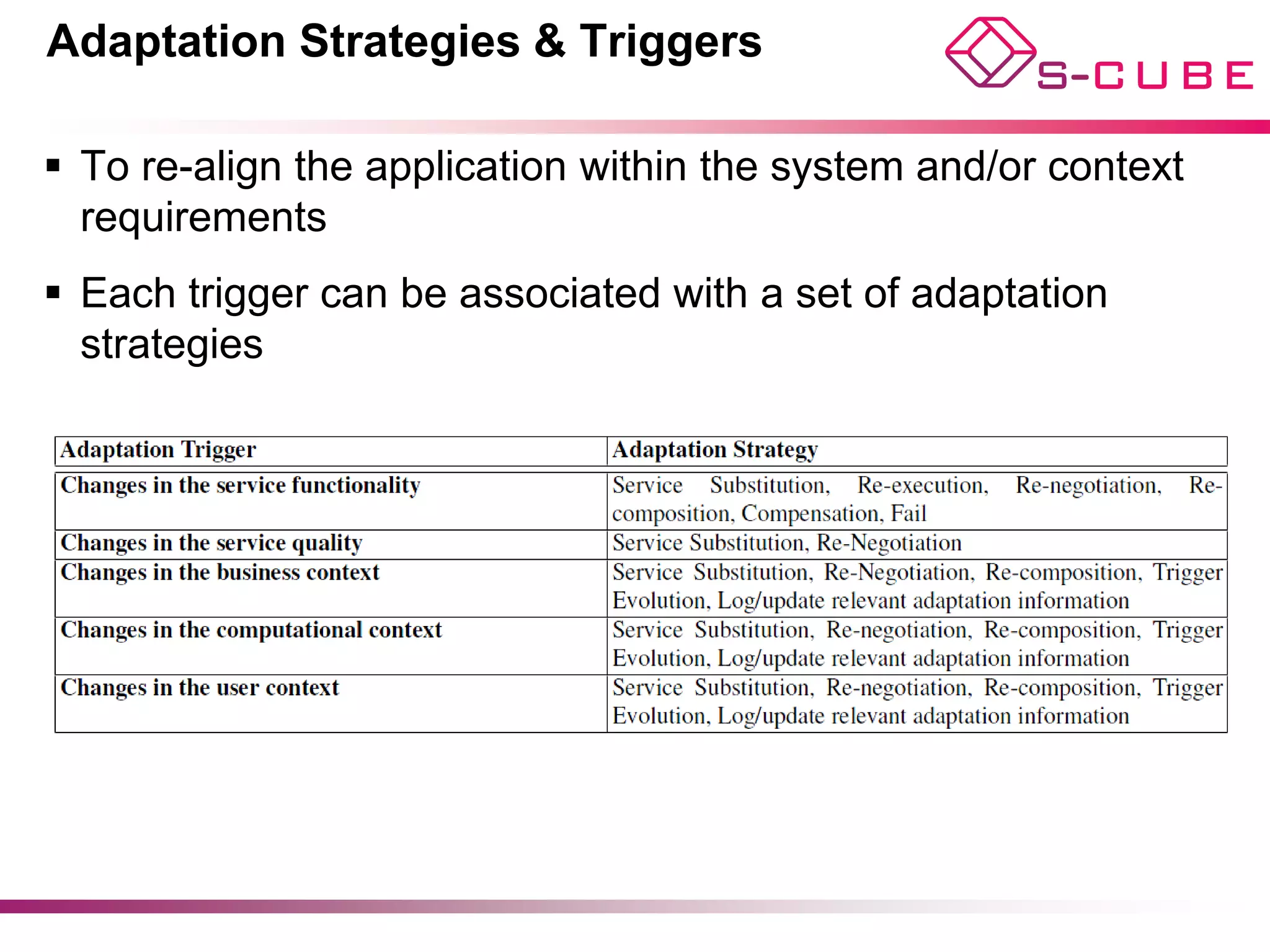
§  To re-align the application within the system and/or context
    requirements
§  Each trigger can be associated with a set of adaptation
    strategies
Design Guidelines

§  Design adaptable SBAs implies relate adaptation triggers and
    adaptation strategies together
   –  Modeling adaptation triggers
   –  Realizing adaptation strategies
   –  Associating adaptation strategies to triggers

§  Design approaches
   –  Built-in adaptation
   –  Abstraction-based adaptation
   –  Dynamic adaptation
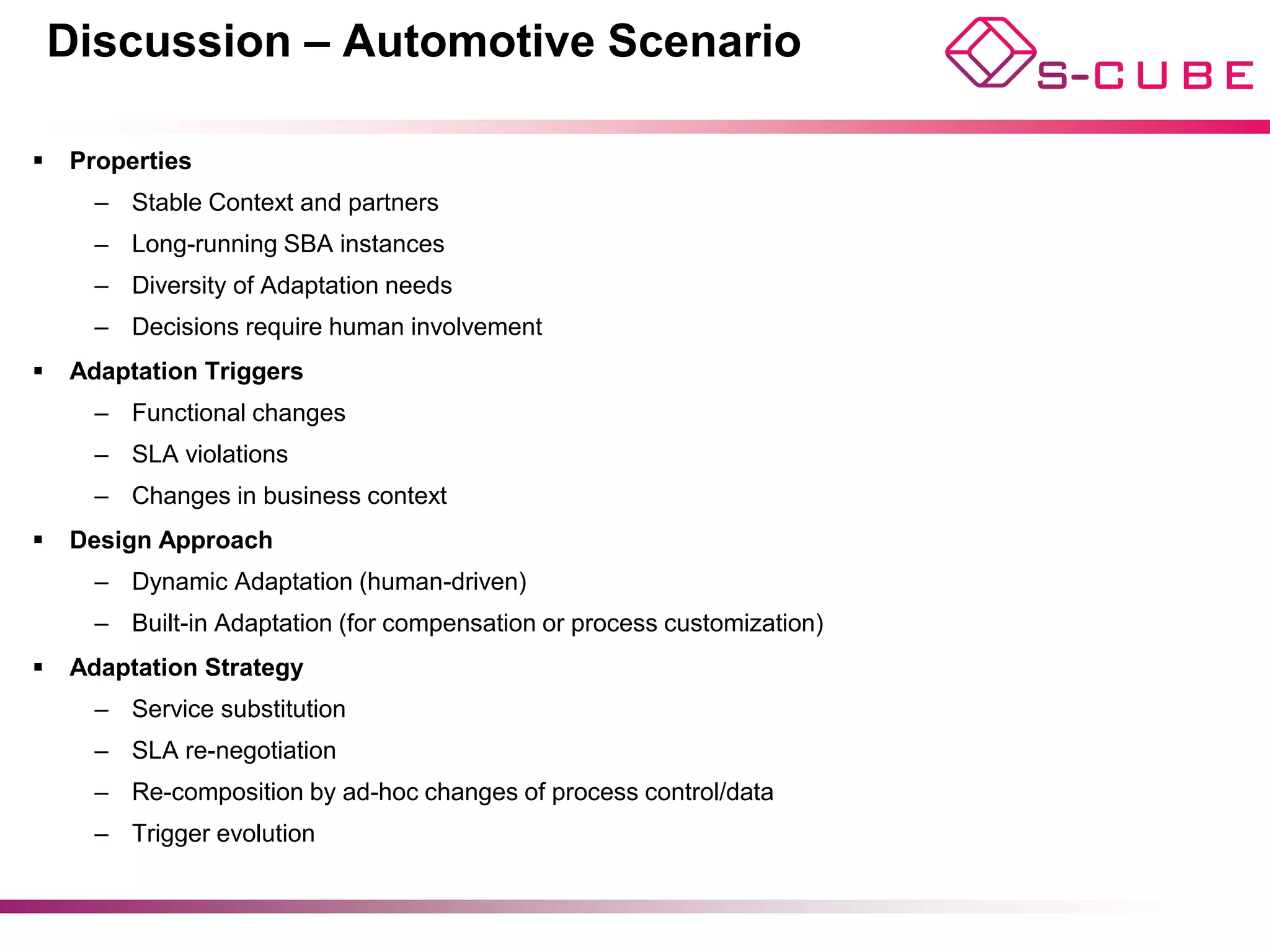
Discussion – Automotive Scenario

§  Properties
     –  Stable Context and partners
     –  Long-running SBA instances
     –  Diversity of Adaptation needs
     –  Decisions require human involvement
§  Adaptation Triggers
     –  Functional changes
     –  SLA violations
     –  Changes in business context
§  Design Approach
     –  Dynamic Adaptation (human-driven)
     –  Built-in Adaptation (for compensation or process customization)
§  Adaptation Strategy
     –  Service substitution
     –  SLA re-negotiation
     –  Re-composition by ad-hoc changes of process control/data
     –  Trigger evolution
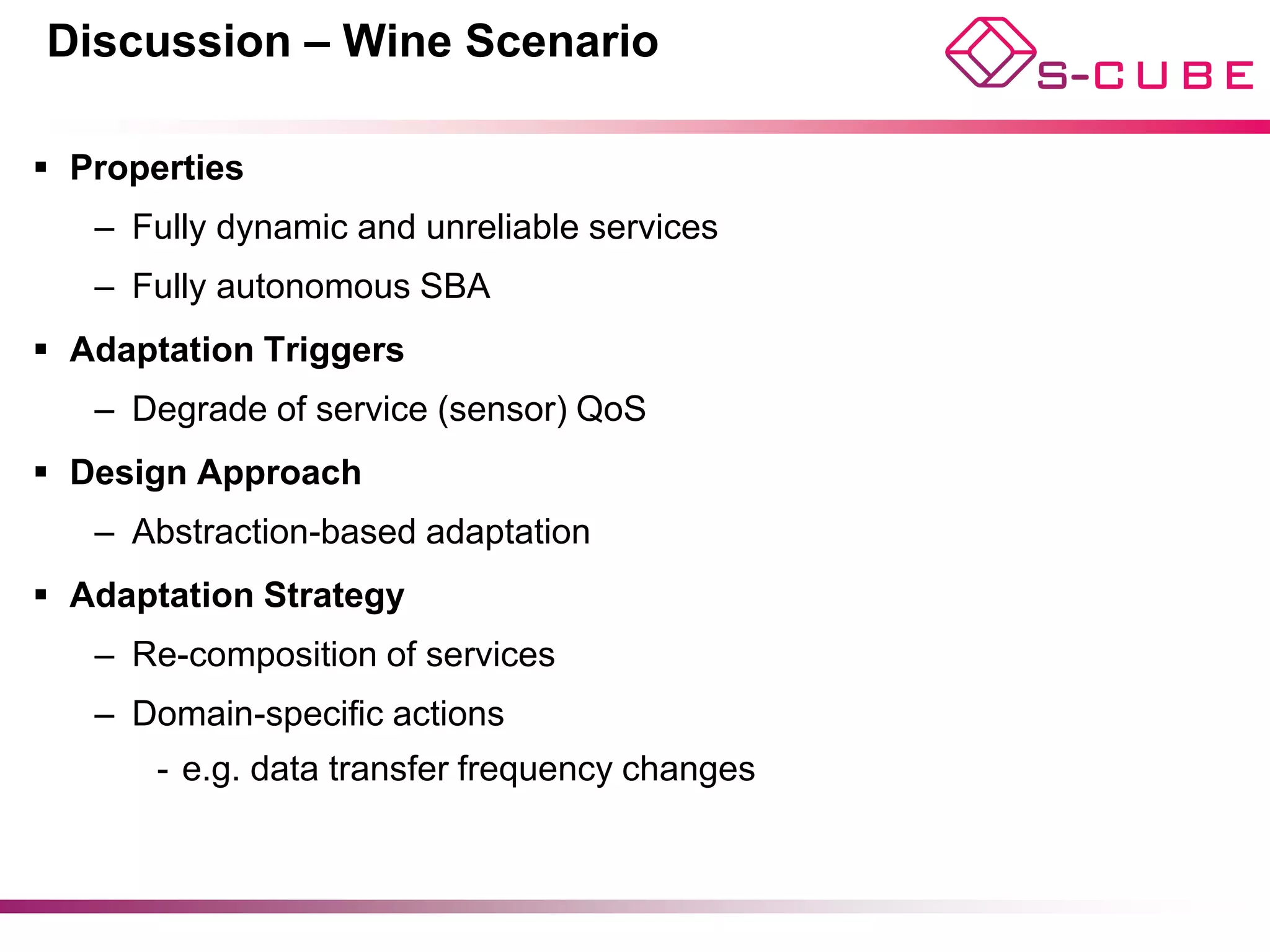
Discussion – Wine Scenario

§  Properties
    –  Fully dynamic and unreliable services
    –  Fully autonomous SBA
§  Adaptation Triggers
    –  Degrade of service (sensor) QoS
§  Design Approach
    –  Abstraction-based adaptation
§  Adaptation Strategy
    –  Re-composition of services
    –  Domain-specific actions
        -  e.g. data transfer frequency changes
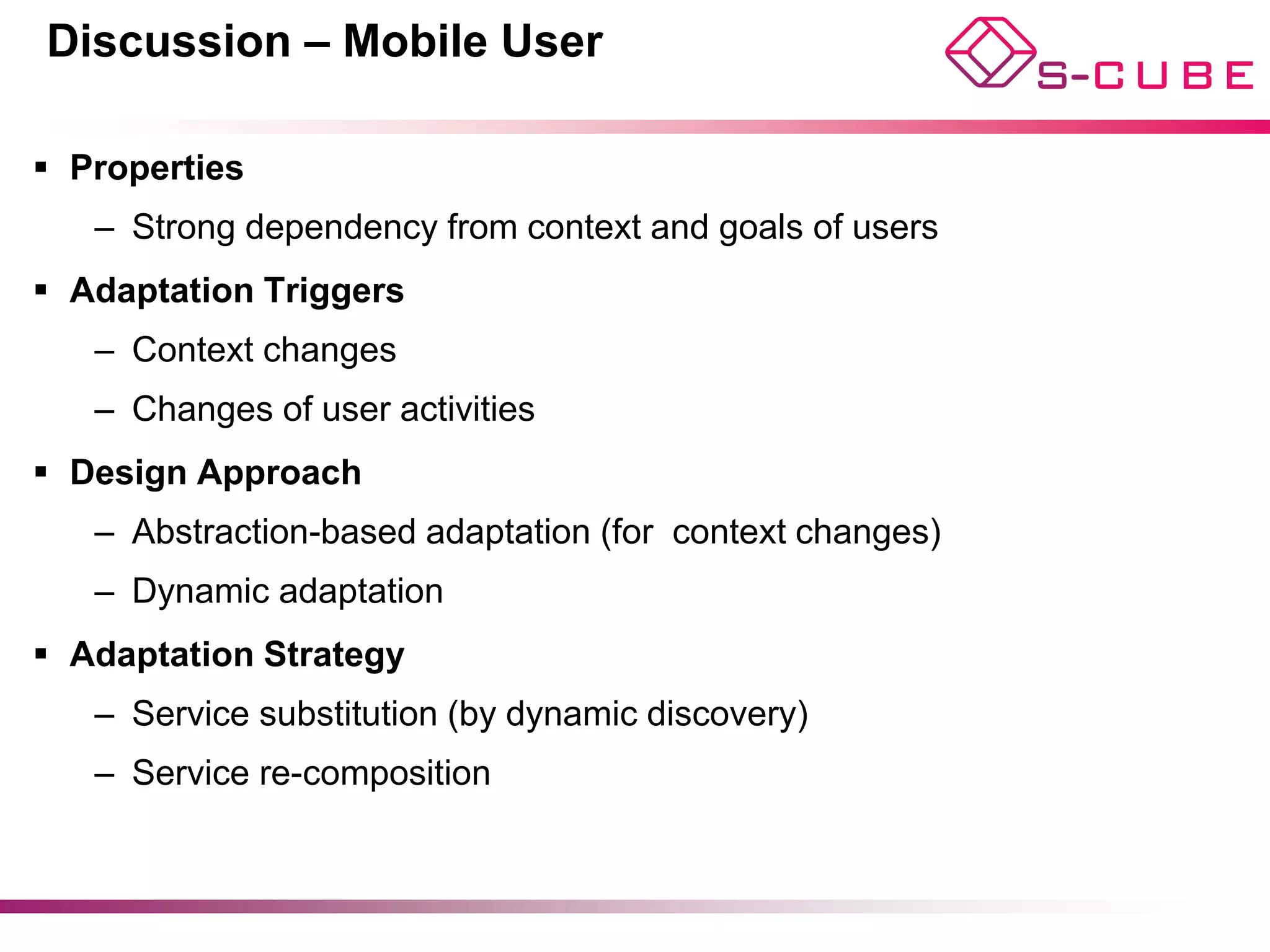
Discussion – Mobile User

§  Properties
    –  Strong dependency from context and goals of users
§  Adaptation Triggers
    –  Context changes
    –  Changes of user activities
§  Design Approach
    –  Abstraction-based adaptation (for context changes)
    –  Dynamic adaptation
§  Adaptation Strategy
    –  Service substitution (by dynamic discovery)
    –  Service re-composition
Learning Package Overview


§  Problem Description (changes in the world and self-
    adaptation)
§  Support to self-adaptation during the lifecycle of a SBA
§  Context changes and self-adaptation
§  Conclusions


                                                © Di Nitto, Cappiello, Bucchiarone
Problem we tackle here


§  Focus on the role of the context in Service Based Applications
   –  How and when the context should be defined
   –  How the context should be exploited
   –  How the context should be evolved
   –  What is the impact of the context on the various adaptation activities
Context and context model

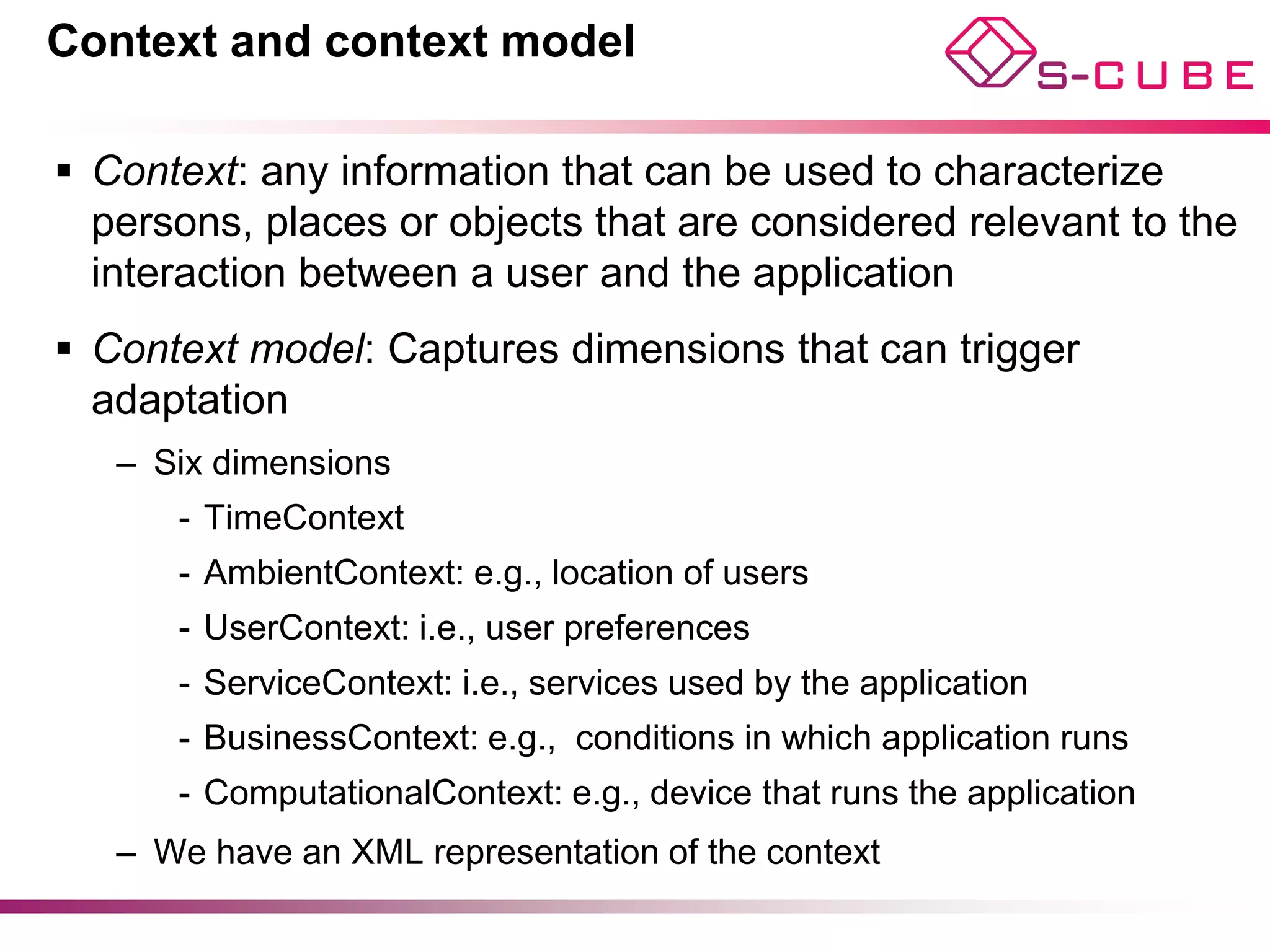
§  Context: any information that can be used to characterize
    persons, places or objects that are considered relevant to the
    interaction between a user and the application
§  Context model: Captures dimensions that can trigger
    adaptation
   –  Six dimensions
      -  TimeContext
      -  AmbientContext: e.g., location of users
      -  UserContext: i.e., user preferences
      -  ServiceContext: i.e., services used by the application
      -  BusinessContext: e.g., conditions in which application runs
      -  ComputationalContext: e.g., device that runs the application
   –  We have an XML representation of the context
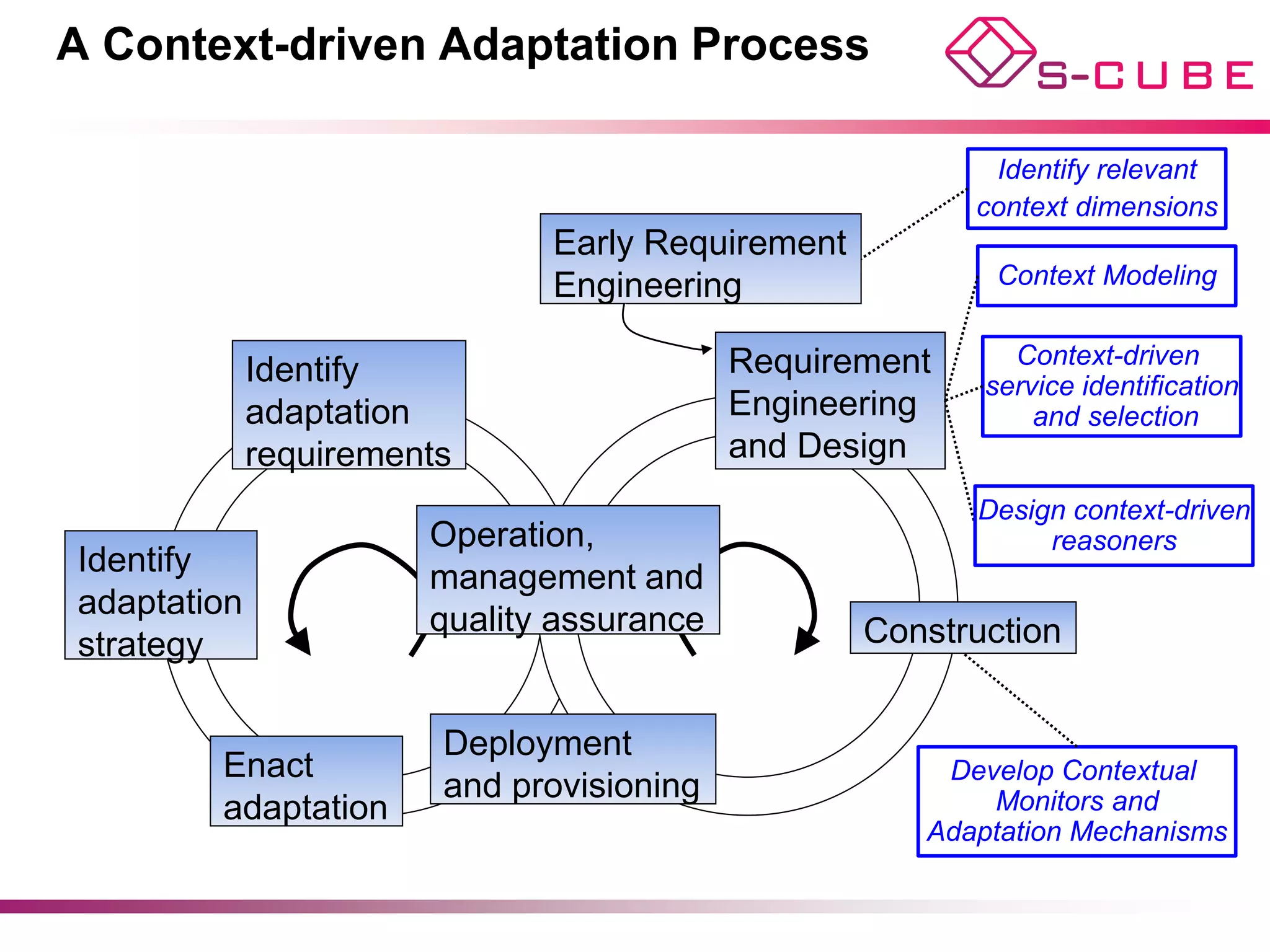
A Context-driven Adaptation Process
               Monitored                     Define adaptation and
                Events                       monitoring requirements
                                                                                Design
                                        Context                           Context Dimensions
 Adaptation                            Early Requirement
                                       Properties
                                                                          Design monitoring
Requirements                           Engineering                         And adaptation

                                                       Context
 Adaptation        Identify           Runtime         Requirement
 strategies                                           Properties
                   adaptation        Monitoring       Engineering
                                                       Watchers             Context Modeling
                   requirements                       and Design

                               Operation,                                Design context-driven
      Identify                 management and                                 Reasoners
      adaptation               quality assurance
      strategy                                                   Construction

                                                                        Contextual Monitors
  Strategy                      Deployment                                      And
  Instance     Enact
                                and provisioning                       Adaptation Mechanisms
               adaptation
                                             Deploy        Design monitoring
                        Adaptation    Contextual Monitors   And adaptation
                        Mechanism             And
                                     Adaptation Mechanisms
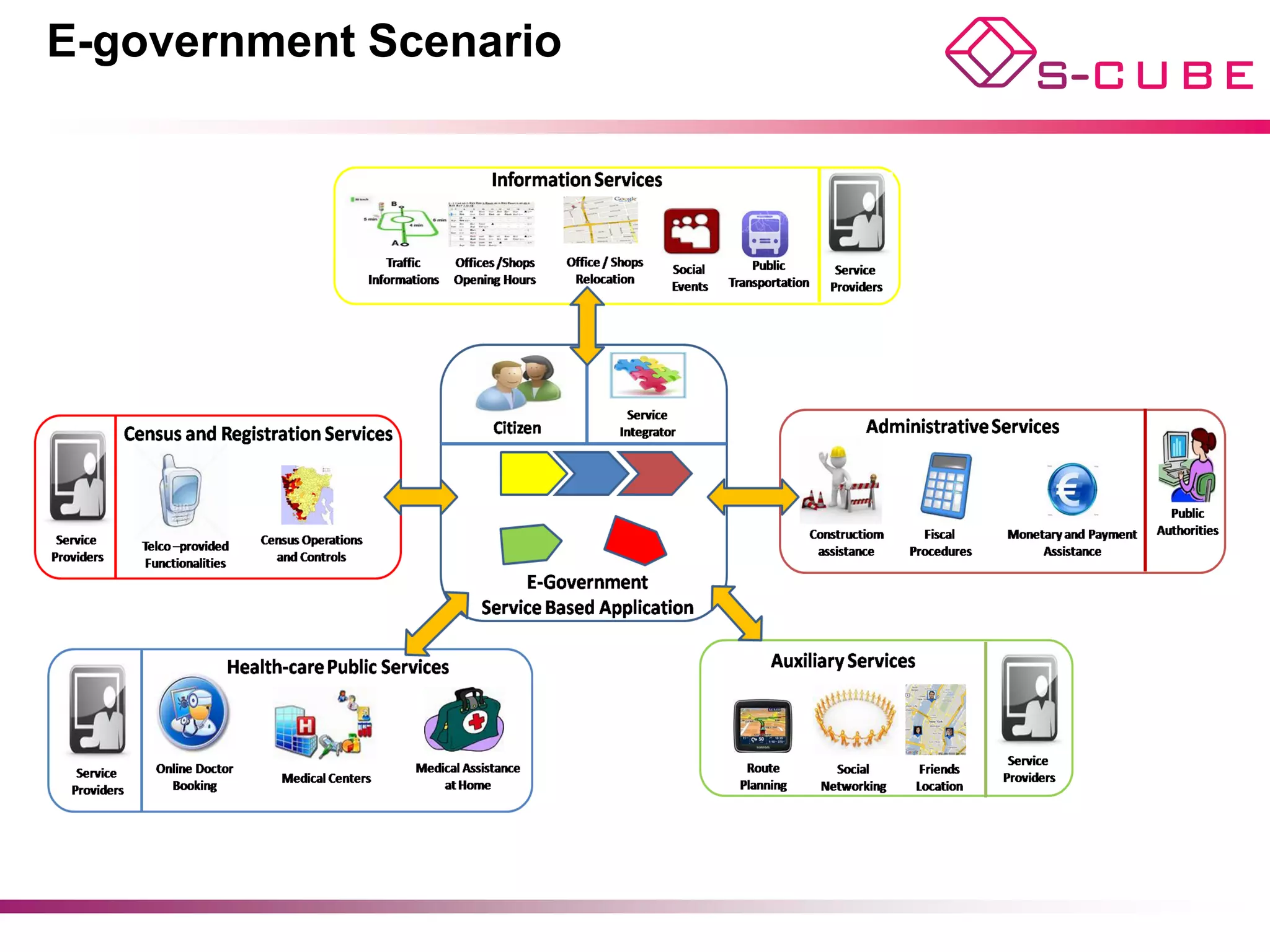
E-government Scenario
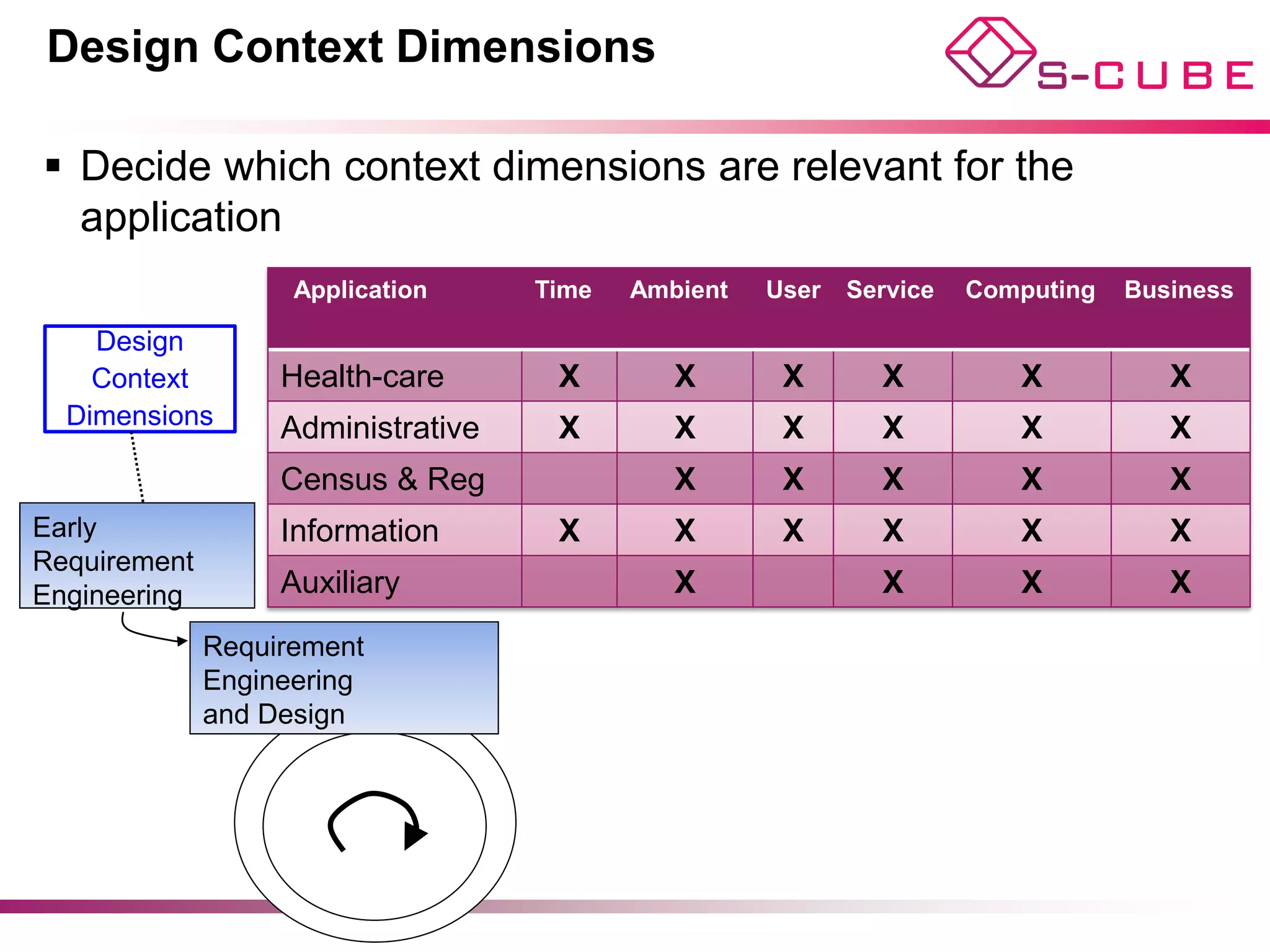
Design Context Dimensions

  §  Decide which context dimensions are relevant for the
      application
                     Application     Time   Ambient   User   Service   Computing   Business


     Design        Health-care        X        X       X       X          X           X
Context Dimensions
                    Administrative    X        X       X       X          X           X
                    Census & Reg               X       X       X          X           X
 Early              Information       X        X       X       X          X           X
 Requirement
 Engineering        Auxiliary                  X               X          X           X
               Requirement
               Engineering
               and Design
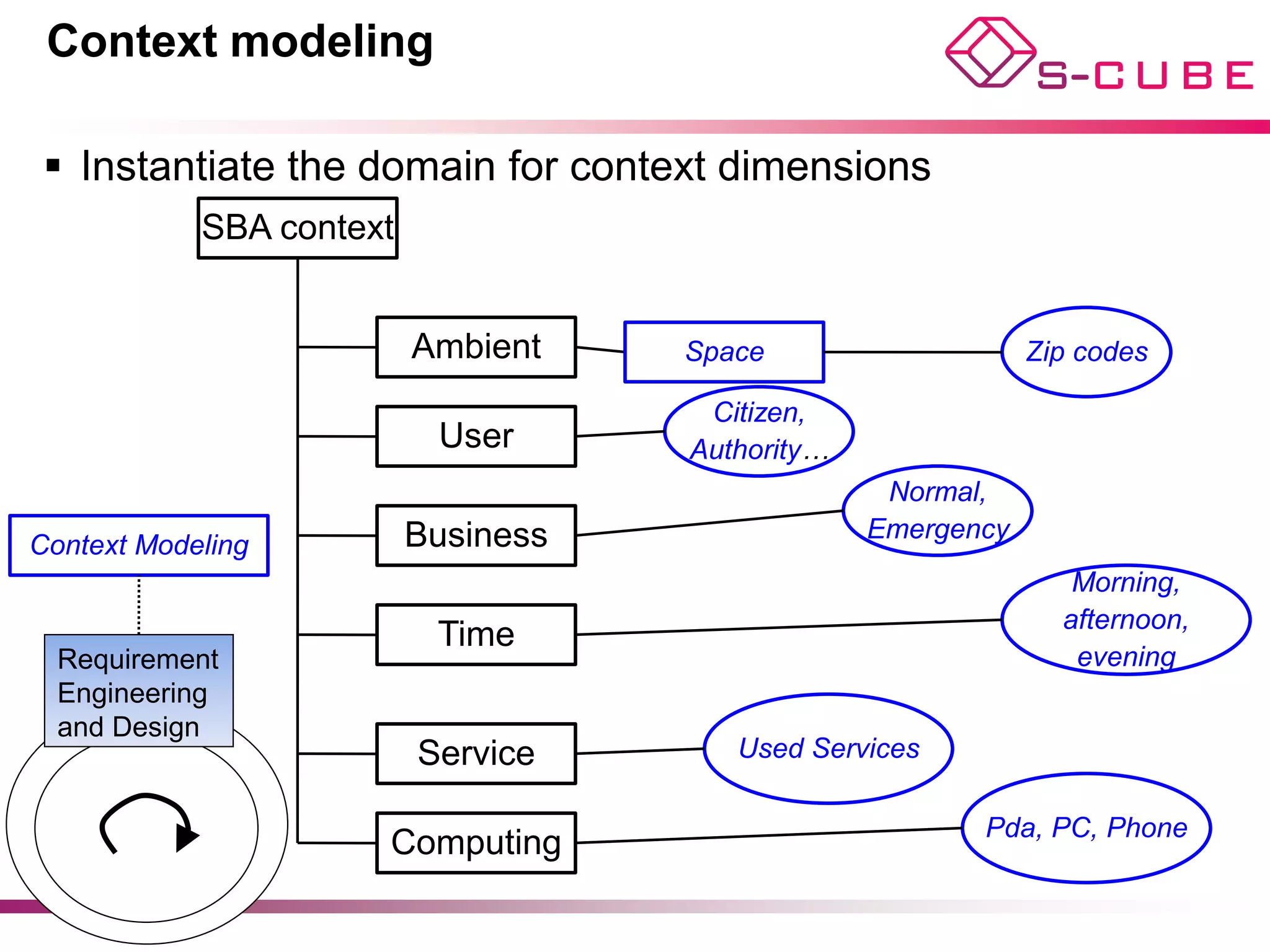
Context modeling

 §  Instantiate the domain for context dimensions
            SBA context


                          Ambient    Space                    Zip codes

                                      Citizen,
                           User      Authority…
                                                   Normal,
                          Business                Emergency
Context Modeling
                                                                 Morning,
                                                                afternoon,
                           Time
  Requirement                                                    evening
  Engineering
  and Design
                          Service       Used Services

                                                         Pda, PC, Phone
                      Computing
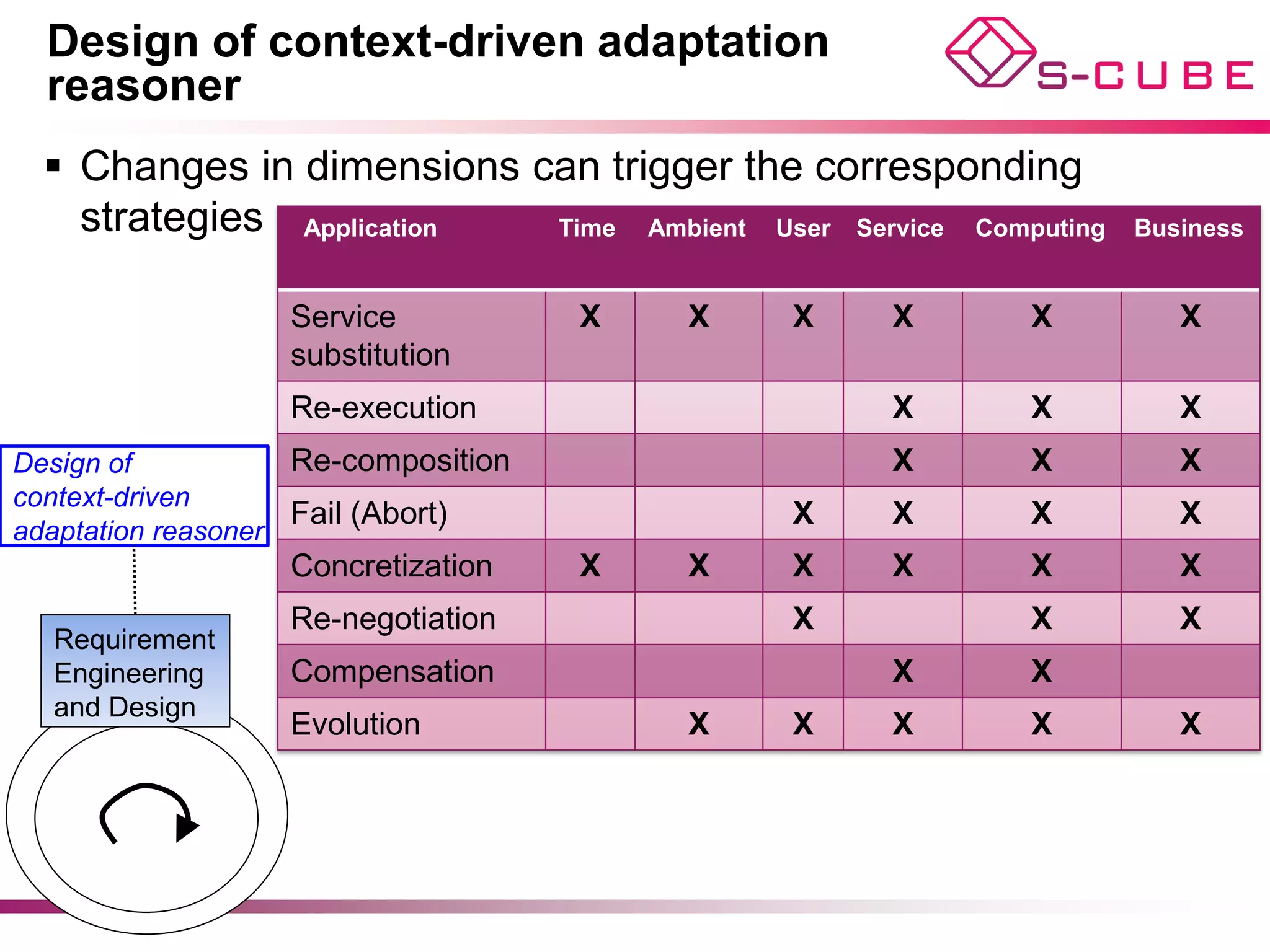
Design of context-driven adaptation
  reasoner
  §  Changes in dimensions can trigger the corresponding
      strategies
                   Application       Time   Ambient   User   Service   Computing   Business


                  Service             X       X        X       X          X           X
                  substitution
Design of           Re-execution                               X          X           X
context-driven
adaptation reasoner
                    Re-composition                             X          X           X
                  Fail (Abort)                         X       X          X           X
                  Concretization      X       X        X       X          X           X
  Requirement
  Engineering     Re-negotiation                       X                  X           X
  and Design
                  Compensation                                 X          X
                  Evolution                   X        X       X          X           X
Requirement Engineering Outcome
                    Monitored
                     Events                                       Design
                                                            Context Dimensions
 Adaptation                       Early Requirement
Requirements                      Engineering
                                                             Context Modeling
 Adaptation        Identify                 Requirement
 strategies                                 Engineering
                   adaptation
                   requirements             and Design  Design context-driven
                                                                Reasoners

                                                                 Context
      Identify
                                                                Properties
      adaptation
      strategy                                        Construction
Learning Package Overview


§  Problem Description (changes in the world and self-
    adaptation)
§  Support to self-adaptation during the lifecycle of a SBA
§  Context changes and self-adaptation
§  Conclusions


                                                © Di Nitto, Cappiello, Bucchiarone
Conclusions

§  We propose a framework to support the design of SBAs that
    targets the adaptation requirements raised by context
    changes
§  We propose a novel life-cycle that emphasizes the relevance
    of the context dimensions in the different facets of adaptation,
    both during the design phase and at run-time.
§  The proposed approach provides guidelines for
   –  The identification of the relevant context dimensions to monitor
   –  The definition of the adaptation triggers able to link context changes
      with suitable adaptation strategies

§  The effectiveness of the approach has been evaluated by
    considering some realistic scenarios
Open issues and challenges

§  How to test self-adaptable software
§  Support to unforeseen changes
§  Preventive adaptation
§  Dependable self-adaptable software
§  …


                                          40
Further S-Cube Reading

§  A. Bucchiarone, C. Cappiello, E. Di Nitto, R. Kazhamiakin, V. Mazza, M.
    Pistore, “Design for Adaptation of Service-Based Applications: Main Issues
    and Requirements”. ICSOC/ServiceWave Workshops 2009: 467-476
§  A. Bucchiarone, C. Cappiello, E. Di Nitto, R. Kazhamiakin, V. Mazza, "A
    Context-driven Adaptation Process for Service-based Applications".
    Proceedings of the PESOS workshop in conjunction with the ICSE
    conference, 2010
§  A. Metzger, E. Schmieders, C. Cappiello, E. Di Nitto, R. Kazhamiakin, B.
    Pernici, et al. (2010). Towards Proactive Adaptation: A Journey along the
    S-Cube Service Life-Cycle. In MESOA: 4th International Workshop on
    Maintenance and Evolution of Service-Oriented Systems.
§  A. Bucchiarone, C. Cappiello, E. Di Nitto, S. Gorlatch, D. Meiländer, A.
    Metzger, “Design for self-adaptation in Service-oriented systems in the
    Cloud”. In: European Research Activities in Cloud Computing, to appear.


                                                        © Di Nitto, Cappiello, Bucchiarone
Acknowledgements


      The research leading to these results has
      received funding from the European
      Community’s Seventh Framework
      Programme [FP7/2007-2013] under grant
      agreement 215483 (S-Cube).


                                        © Di Nitto, Cappiello, Bucchiarone

S-CUBE LP: Techniques for design for adaptation

  • 1.
    S-Cube Learning Package Designingand migrating Service-Based Applications: Techniques for design for adaptation Politecnico di Milano (POLIMI), Fondazione Bruno Kesler (FBK) Elisabetta Di Nitto and Cinzia Cappiello (POLIMI), Antonio Bucchiarone (FBK) www.s-cube-network.eu
  • 2.
    Learning Package Categorization S-Cube Engineering Principles, Techniques & Methodologies Designing and migrating Service-Based Applications Techniques for design for adaptation © Di Nitto, Cappiello, Bucchiarone
  • 3.
    Learning Package Overview § Problem Description (changes in the world and self- adaptation) §  Support to self-adaptation during the lifecycle of a SBA §  Context changes and self-adaptation §  Conclusions © Di Nitto, Cappiello, Bucchiarone
  • 4.
    The machine andthe world Domain properties (assumptions) Goals Specification Requirements
  • 5.
    Software lifecycle changes §  Clear distinction between development and execution time Design Verification Execution Deployment §  Every change in the world requires the execution be interrupted and a new software be developed and deployed
  • 6.
    What are thechanges we need to care of? Functional Goals/ Requirements Non-functional e.g., moving from Location open air to the meeting room User World e.g., today I do Preferences not feel I can take phone calls New SLA Domain Business properties (context) New regulation e.g., the service I’m using is not working Changes in used resources e.g., I’ve run out System of computational resources SLA has been broken 6
  • 7.
    How can softwaresystems tackle these changes? Reason and Adapt make decision Monitor 7
  • 8.
    IBM Model forautonomic computing 8
  • 9.
    Monitoring §  Monitor allpossible data §  Activate/deactivate various levels of monitoring depending on the situation §  Perform some filtering to limit the amount of monitoring data offered to the system §  Correlate data 9
  • 10.
    Reasoning on monitoringresults (1) §  Reasoning can be hardcoded in the execution environment –  E.g.: always replace a failing service with the first one you find in a directory –  Advantage: No need to perform specific programming actions to achieve self-adaptation –  Drawback: Limited to a set of predefined options 10
  • 11.
    Reasoning on monitoringresults (2) §  Programming mechanisms are made available to define adaptation strategies –  Usually, rule-based languages. Strategies defined in terms of Event- conditions-actions rules –  Advantage: good level of flexibility in defining system-dependent strategies –  Drawback: rule-based programming approach is difficult to use. Validation of result is challenging –  Examples: SCENE (SeCSE), SOA4All 11
  • 12.
    Reasoning on monitoringresults (3) §  Modeling languages and approaches are offered to define adaptation strategies … –  Use of formal methods –  Possibility to check the effect of adaptation before enacting it §  Examples: ASTRO, Service-tiles (see later)… 12
  • 13.
    Actuating adaptation §  Manyvariations –  Can be specific of a single system instance or it can apply to all running instances –  Can impact only on future instances of system –  Can be permanent or transitory 13
  • 14.
    Learning Package Overview § Problem Description (changes in the world and self- adaptation) §  Support to self-adaptation during the lifecycle of a SBA §  Context changes and self-adaptation §  Conclusions © Di Nitto, Cappiello, Bucchiarone
  • 15.
    Problem we tacklehere §  Design for Adaptation –  Adaptation Triggers –  Adaptation Strategies –  Mechanisms to enable adaptation that associate strategies with triggers §  Today –  Existing design methodologies do not take into account the problem of SBAs adaptation in a holistic way, but only in a fragmented way §  Our Proposal –  Design phase –  We suggest a number of design principles and guidelines to enable adaptation –  We propose an extension of a basic iterative SBAs life-cycle
  • 16.
    Motivating Scenarios §  Thelife-cycles and frameworks available for SBAs do not support adaptation or tend to focus on specific adaptation strategies §  We consider three scenarios from different domains with different adaptation aspects. –  Automotive –  Wine Production –  Mobile Users §  SBAs have to face very different adaptation needs
  • 17.
    Automotive Scenario §  ScenarioDescription –  Supply-chain business processes in the automobile production domain -  Ordering and importing automobile body parts from supplier -  manufactoring activities -  customization of the products according to customers’ needs –  Long running processes involving a wide range of enterprise services -  Agile Service Network (ASN) §  Scenario Adaptations –  Partner can be chosen at runtime from those belonging to the ASN –  SBA needs to recover from some problem and to accomodate some change in the business context
  • 18.
    Wine Production Scenario § Scenario Description –  SBA realized on a top of a Wireless Sensor and Actuator Nework –  Activities of vineyard cultivation handling, the control of grapes maturation, their harvesting and fermentation §  Scenario Adaptations –  Ability of autonomously detect problems -  Replace devices that may crash, run out of battery or provide incorrect information -  Change the topology of network to optimize the load and the distribution of the sensors
  • 19.
    Mobile Users Scenario § Scenario Description –  A huge number of applications aims to give end user access to various services through mobile devices -  Navigation and route planning, services for accessing social networking and blogging §  Scenario Adaptations –  Continuously changing context -  e.g. Network throughput, user location and time, etc. –  Continuously changing user goals and activities
  • 20.
    Main Ingredients ofan Adaptable SBA
  • 21.
  • 22.
    Adaptation Strategies §  Tomantain aligned the application behaviour with the context and system requirements –  Service substitution –  Re-execution –  (Re-)negotiation –  (Re-)composition –  Compensation –  Log/Update adaptation Information –  Fail
  • 23.
    Adaptation Triggers §  Theadaptation may be motivated by variety of triggers §  Component Services –  Service functionality –  Service quality §  SBAs context –  Business context –  Computational context –  User context
  • 24.
    Adaptation Strategies &Triggers §  To re-align the application within the system and/or context requirements §  Each trigger can be associated with a set of adaptation strategies
  • 25.
    Design Guidelines §  Designadaptable SBAs implies relate adaptation triggers and adaptation strategies together –  Modeling adaptation triggers –  Realizing adaptation strategies –  Associating adaptation strategies to triggers §  Design approaches –  Built-in adaptation –  Abstraction-based adaptation –  Dynamic adaptation
  • 26.
    Discussion – AutomotiveScenario §  Properties –  Stable Context and partners –  Long-running SBA instances –  Diversity of Adaptation needs –  Decisions require human involvement §  Adaptation Triggers –  Functional changes –  SLA violations –  Changes in business context §  Design Approach –  Dynamic Adaptation (human-driven) –  Built-in Adaptation (for compensation or process customization) §  Adaptation Strategy –  Service substitution –  SLA re-negotiation –  Re-composition by ad-hoc changes of process control/data –  Trigger evolution
  • 27.
    Discussion – WineScenario §  Properties –  Fully dynamic and unreliable services –  Fully autonomous SBA §  Adaptation Triggers –  Degrade of service (sensor) QoS §  Design Approach –  Abstraction-based adaptation §  Adaptation Strategy –  Re-composition of services –  Domain-specific actions -  e.g. data transfer frequency changes
  • 28.
    Discussion – MobileUser §  Properties –  Strong dependency from context and goals of users §  Adaptation Triggers –  Context changes –  Changes of user activities §  Design Approach –  Abstraction-based adaptation (for context changes) –  Dynamic adaptation §  Adaptation Strategy –  Service substitution (by dynamic discovery) –  Service re-composition
  • 29.
    Learning Package Overview § Problem Description (changes in the world and self- adaptation) §  Support to self-adaptation during the lifecycle of a SBA §  Context changes and self-adaptation §  Conclusions © Di Nitto, Cappiello, Bucchiarone
  • 30.
    Problem we tacklehere §  Focus on the role of the context in Service Based Applications –  How and when the context should be defined –  How the context should be exploited –  How the context should be evolved –  What is the impact of the context on the various adaptation activities
  • 31.
    Context and contextmodel §  Context: any information that can be used to characterize persons, places or objects that are considered relevant to the interaction between a user and the application §  Context model: Captures dimensions that can trigger adaptation –  Six dimensions -  TimeContext -  AmbientContext: e.g., location of users -  UserContext: i.e., user preferences -  ServiceContext: i.e., services used by the application -  BusinessContext: e.g., conditions in which application runs -  ComputationalContext: e.g., device that runs the application –  We have an XML representation of the context
  • 32.
    A Context-driven AdaptationProcess Monitored Define adaptation and Events monitoring requirements Design Context Context Dimensions Adaptation Early Requirement Properties Design monitoring Requirements Engineering And adaptation Context Adaptation Identify Runtime Requirement strategies Properties adaptation Monitoring Engineering Watchers Context Modeling requirements and Design Operation, Design context-driven Identify management and Reasoners adaptation quality assurance strategy Construction Contextual Monitors Strategy Deployment And Instance Enact and provisioning Adaptation Mechanisms adaptation Deploy Design monitoring Adaptation Contextual Monitors And adaptation Mechanism And Adaptation Mechanisms
  • 33.
  • 34.
    Design Context Dimensions §  Decide which context dimensions are relevant for the application Application Time Ambient User Service Computing Business Design Health-care X X X X X X Context Dimensions Administrative X X X X X X Census & Reg X X X X X Early Information X X X X X X Requirement Engineering Auxiliary X X X X Requirement Engineering and Design
  • 35.
    Context modeling § Instantiate the domain for context dimensions SBA context Ambient Space Zip codes Citizen, User Authority… Normal, Business Emergency Context Modeling Morning, afternoon, Time Requirement evening Engineering and Design Service Used Services Pda, PC, Phone Computing
  • 36.
    Design of context-drivenadaptation reasoner §  Changes in dimensions can trigger the corresponding strategies Application Time Ambient User Service Computing Business Service X X X X X X substitution Design of Re-execution X X X context-driven adaptation reasoner Re-composition X X X Fail (Abort) X X X X Concretization X X X X X X Requirement Engineering Re-negotiation X X X and Design Compensation X X Evolution X X X X X
  • 37.
    Requirement Engineering Outcome Monitored Events Design Context Dimensions Adaptation Early Requirement Requirements Engineering Context Modeling Adaptation Identify Requirement strategies Engineering adaptation requirements and Design Design context-driven Reasoners Context Identify Properties adaptation strategy Construction
  • 38.
    Learning Package Overview § Problem Description (changes in the world and self- adaptation) §  Support to self-adaptation during the lifecycle of a SBA §  Context changes and self-adaptation §  Conclusions © Di Nitto, Cappiello, Bucchiarone
  • 39.
    Conclusions §  We proposea framework to support the design of SBAs that targets the adaptation requirements raised by context changes §  We propose a novel life-cycle that emphasizes the relevance of the context dimensions in the different facets of adaptation, both during the design phase and at run-time. §  The proposed approach provides guidelines for –  The identification of the relevant context dimensions to monitor –  The definition of the adaptation triggers able to link context changes with suitable adaptation strategies §  The effectiveness of the approach has been evaluated by considering some realistic scenarios
  • 40.
    Open issues andchallenges §  How to test self-adaptable software §  Support to unforeseen changes §  Preventive adaptation §  Dependable self-adaptable software §  … 40
  • 41.
    Further S-Cube Reading § A. Bucchiarone, C. Cappiello, E. Di Nitto, R. Kazhamiakin, V. Mazza, M. Pistore, “Design for Adaptation of Service-Based Applications: Main Issues and Requirements”. ICSOC/ServiceWave Workshops 2009: 467-476 §  A. Bucchiarone, C. Cappiello, E. Di Nitto, R. Kazhamiakin, V. Mazza, "A Context-driven Adaptation Process for Service-based Applications". Proceedings of the PESOS workshop in conjunction with the ICSE conference, 2010 §  A. Metzger, E. Schmieders, C. Cappiello, E. Di Nitto, R. Kazhamiakin, B. Pernici, et al. (2010). Towards Proactive Adaptation: A Journey along the S-Cube Service Life-Cycle. In MESOA: 4th International Workshop on Maintenance and Evolution of Service-Oriented Systems. §  A. Bucchiarone, C. Cappiello, E. Di Nitto, S. Gorlatch, D. Meiländer, A. Metzger, “Design for self-adaptation in Service-oriented systems in the Cloud”. In: European Research Activities in Cloud Computing, to appear. © Di Nitto, Cappiello, Bucchiarone
  • 42.
    Acknowledgements The research leading to these results has received funding from the European Community’s Seventh Framework Programme [FP7/2007-2013] under grant agreement 215483 (S-Cube). © Di Nitto, Cappiello, Bucchiarone