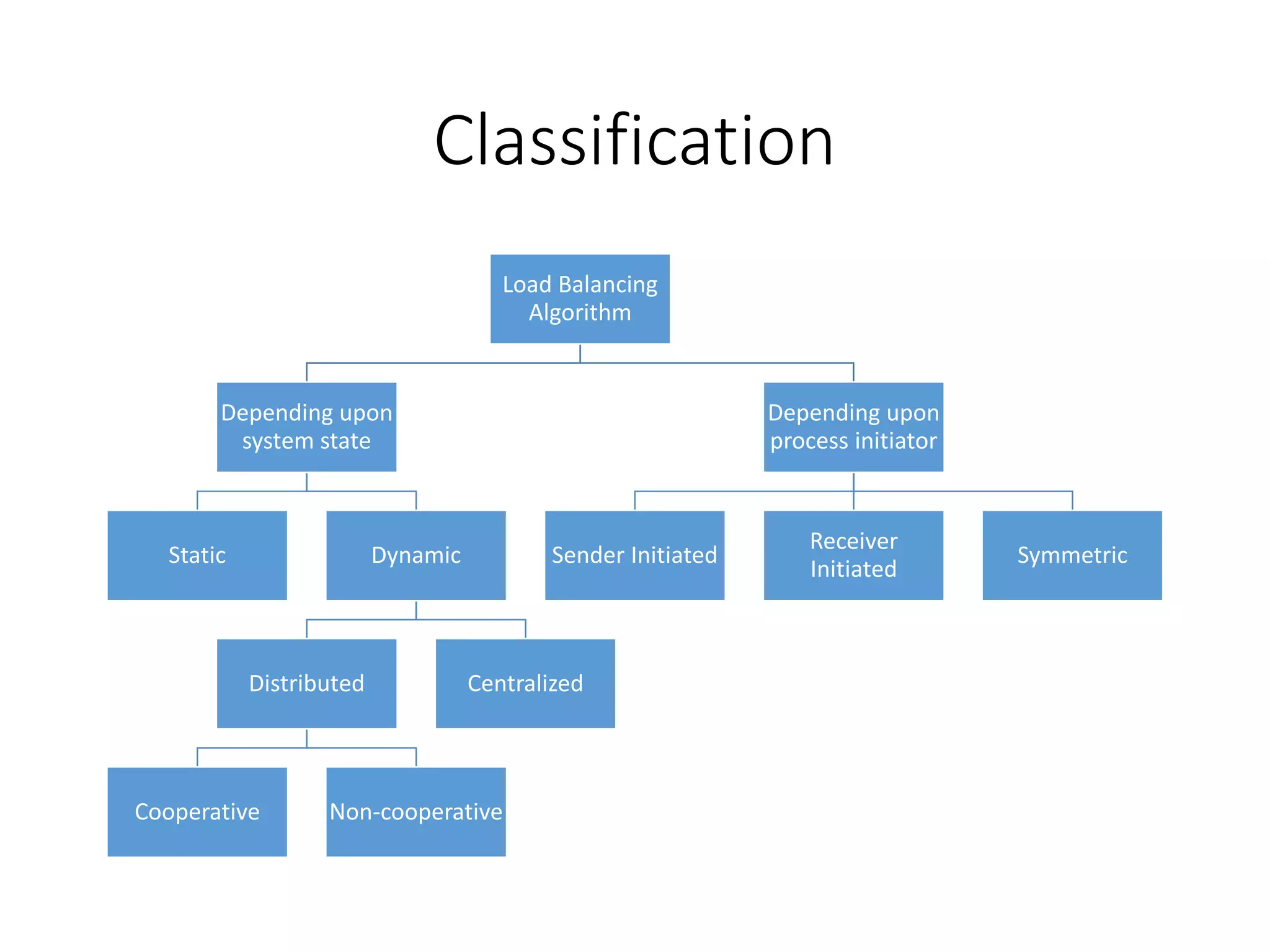
The document discusses cloud computing as the use of remote servers for data management and highlights challenges like security and efficient load balancing. It reviews various load balancing algorithms, including honeybee foraging behavior and active clustering, emphasizing performance impacts based on resource diversity. Additionally, it cites various studies and papers related to cloud computing and load balancing techniques.
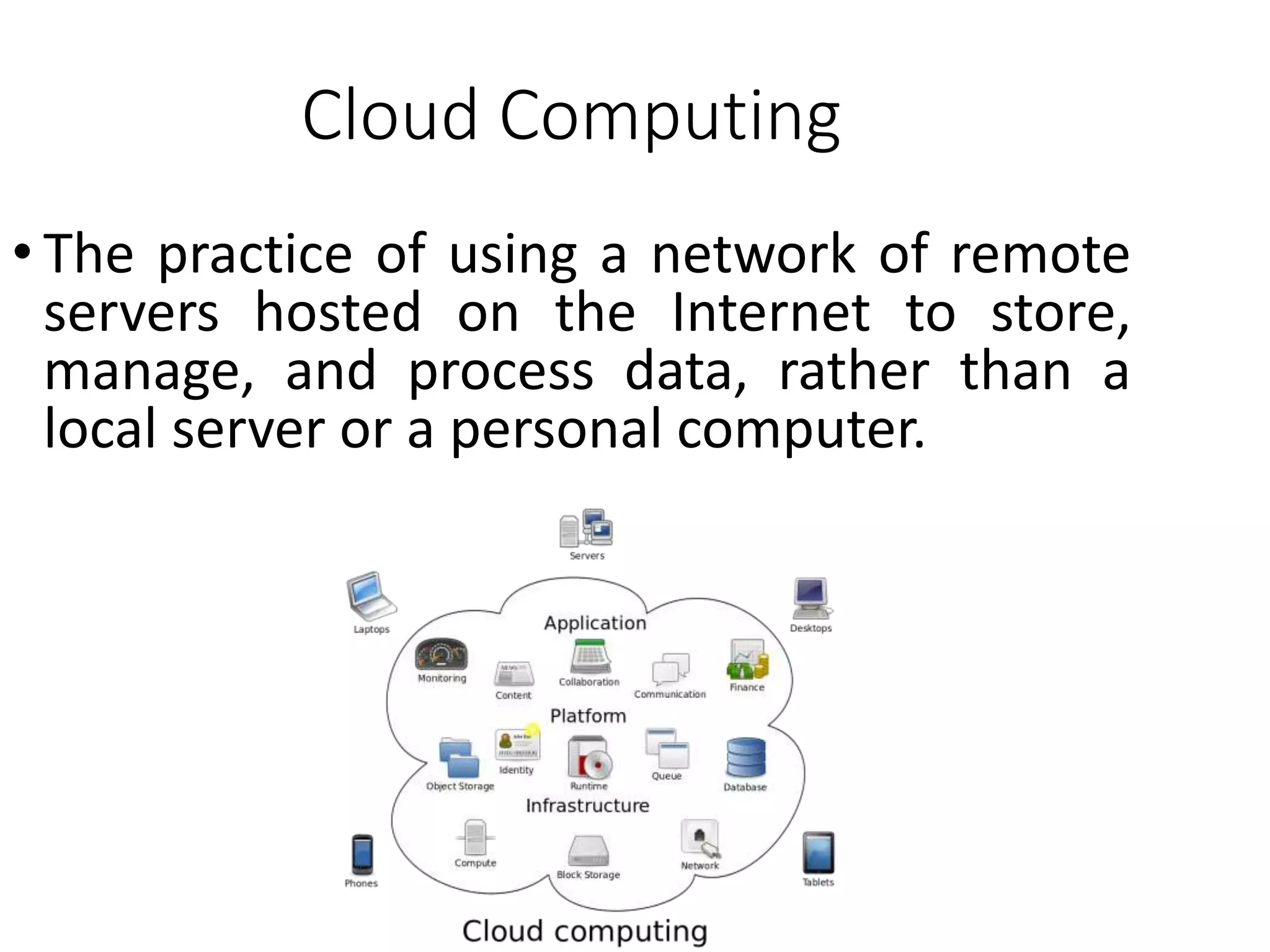
Cloud Computing
• Thepractice of using a network of remote
servers hosted on the Internet to store,
manage, and process data, rather than a
local server or a personal computer.
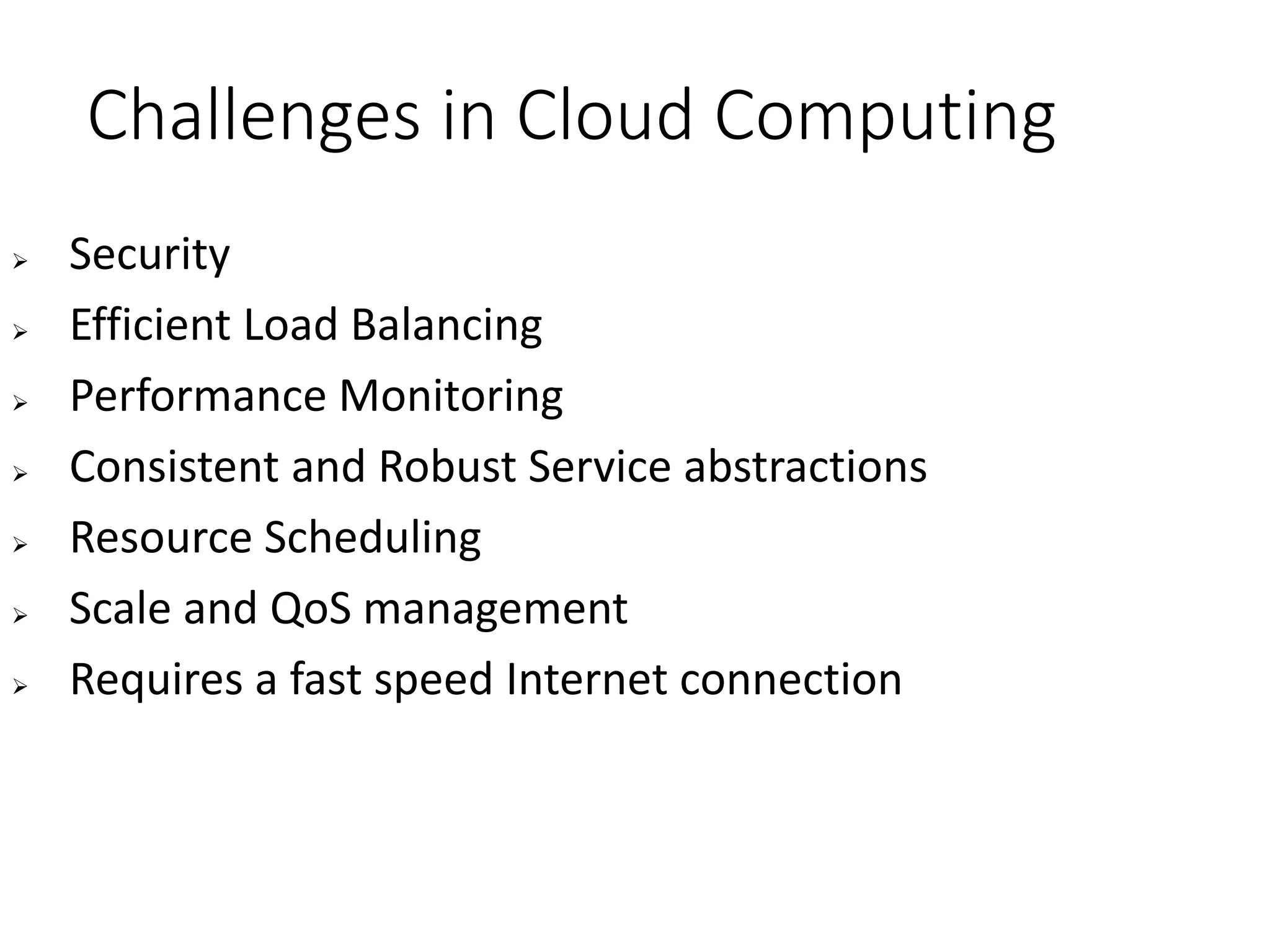
Challenges in CloudComputing
Security
Efficient Load Balancing
Performance Monitoring
Consistent and Robust Service abstractions
Resource Scheduling
Scale and QoS management
Requires a fast speed Internet connection
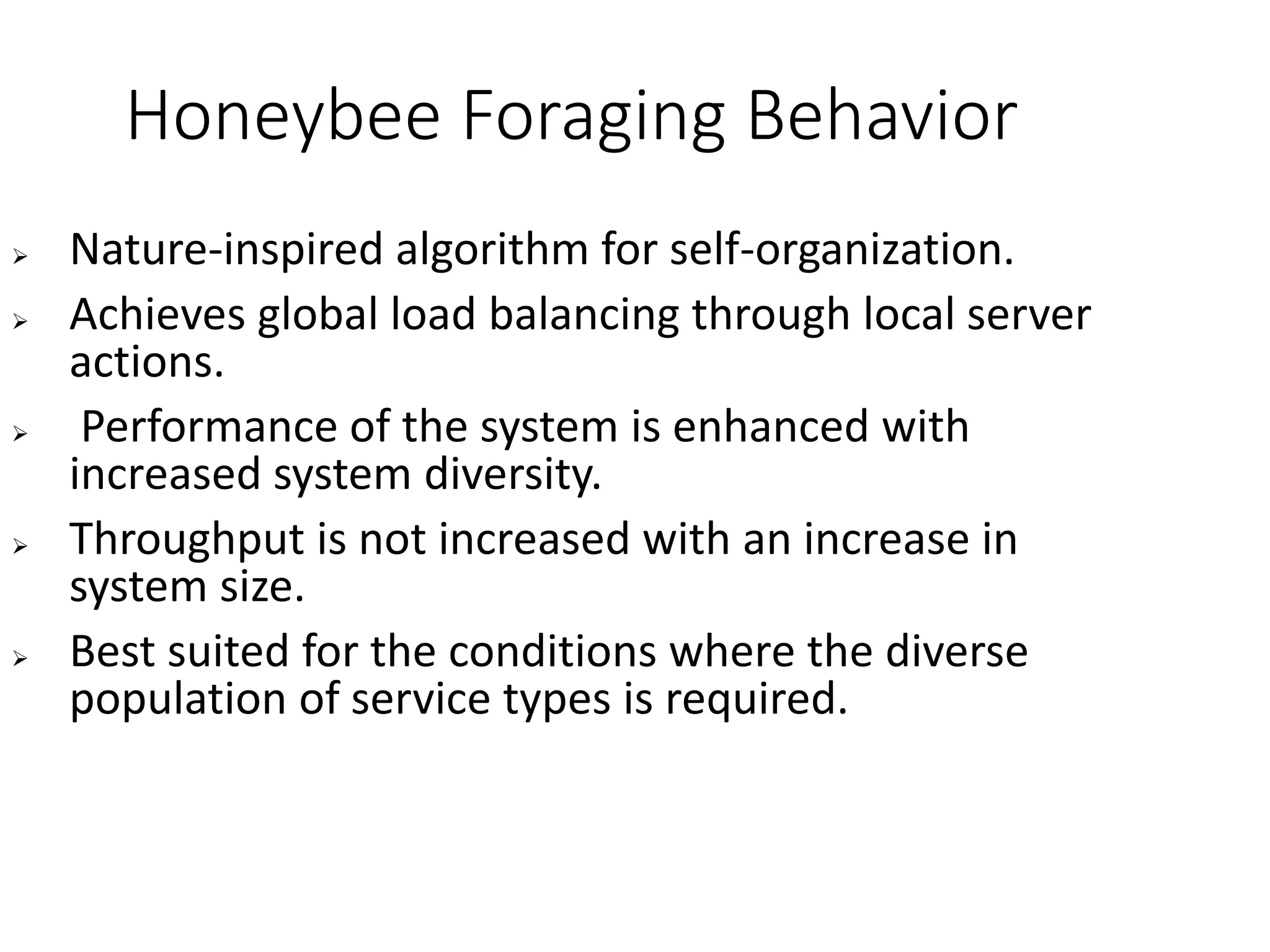
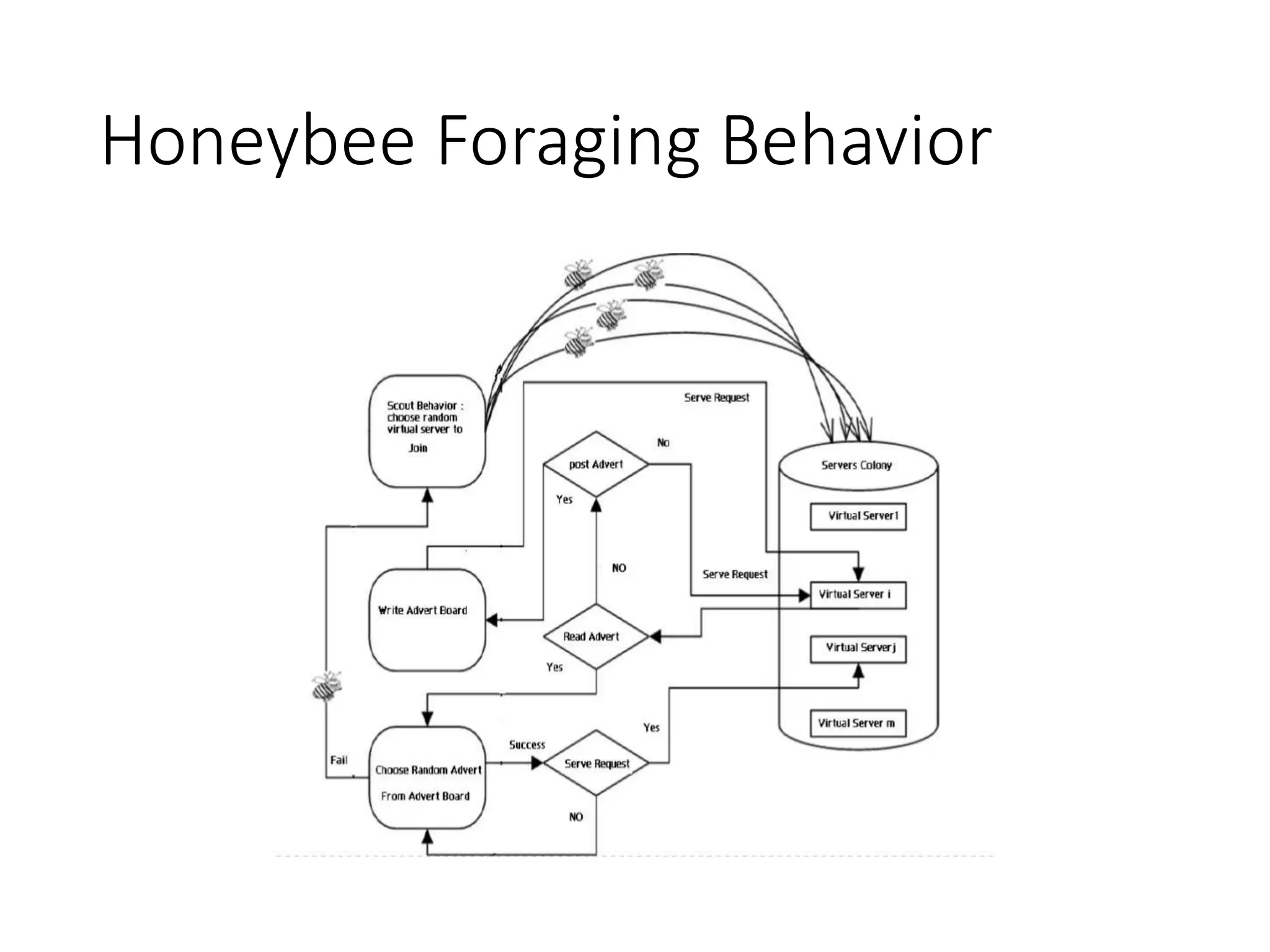
Honeybee Foraging Behavior
Nature-inspired algorithm for self-organization.
Achieves global load balancing through local server
actions.
Performance of the system is enhanced with
increased system diversity.
Throughput is not increased with an increase in
system size.
Best suited for the conditions where the diverse
population of service types is required.
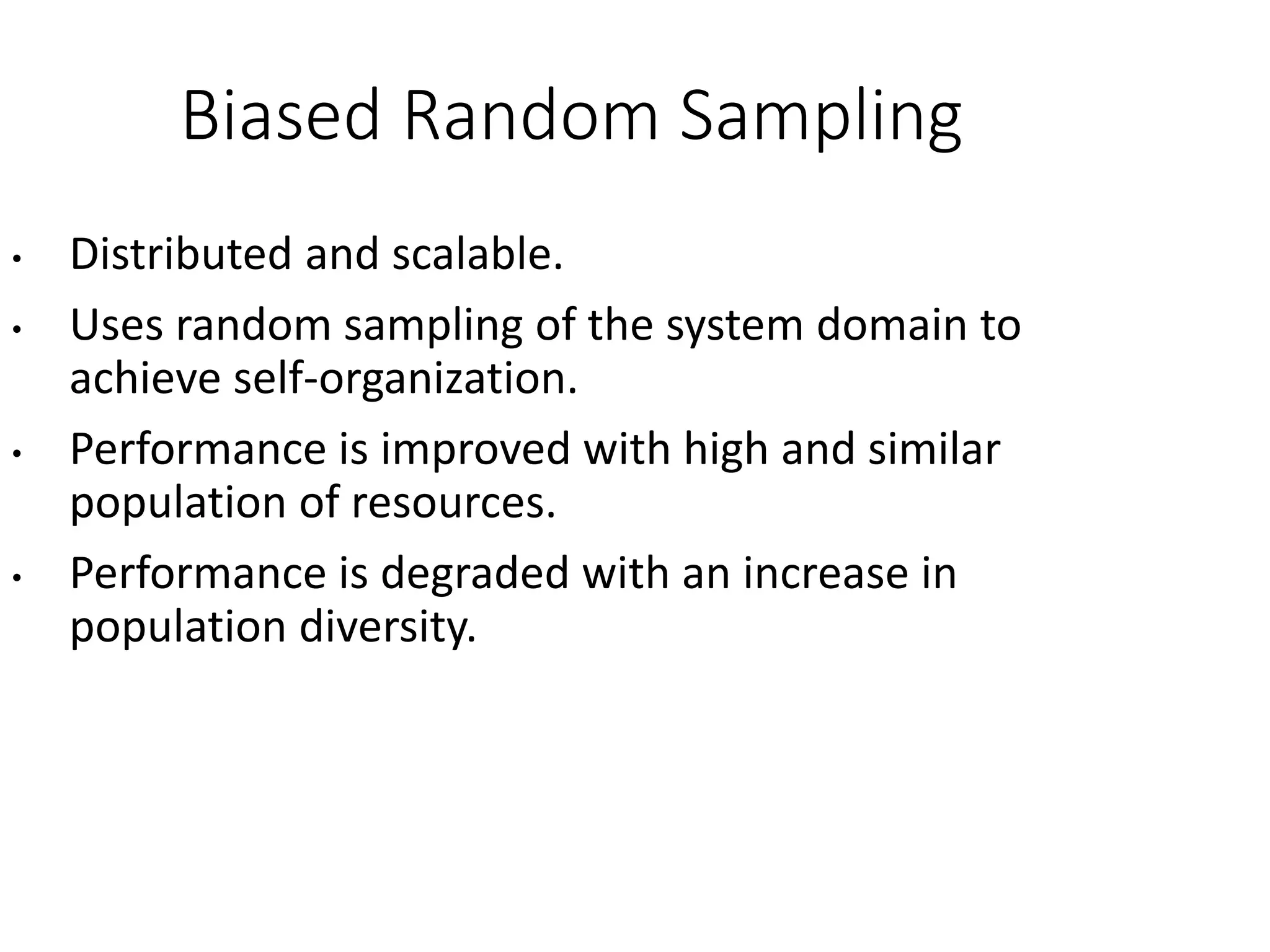
Biased Random Sampling
•Distributed and scalable.
• Uses random sampling of the system domain to
achieve self-organization.
• Performance is improved with high and similar
population of resources.
• Performance is degraded with an increase in
population diversity.
15.
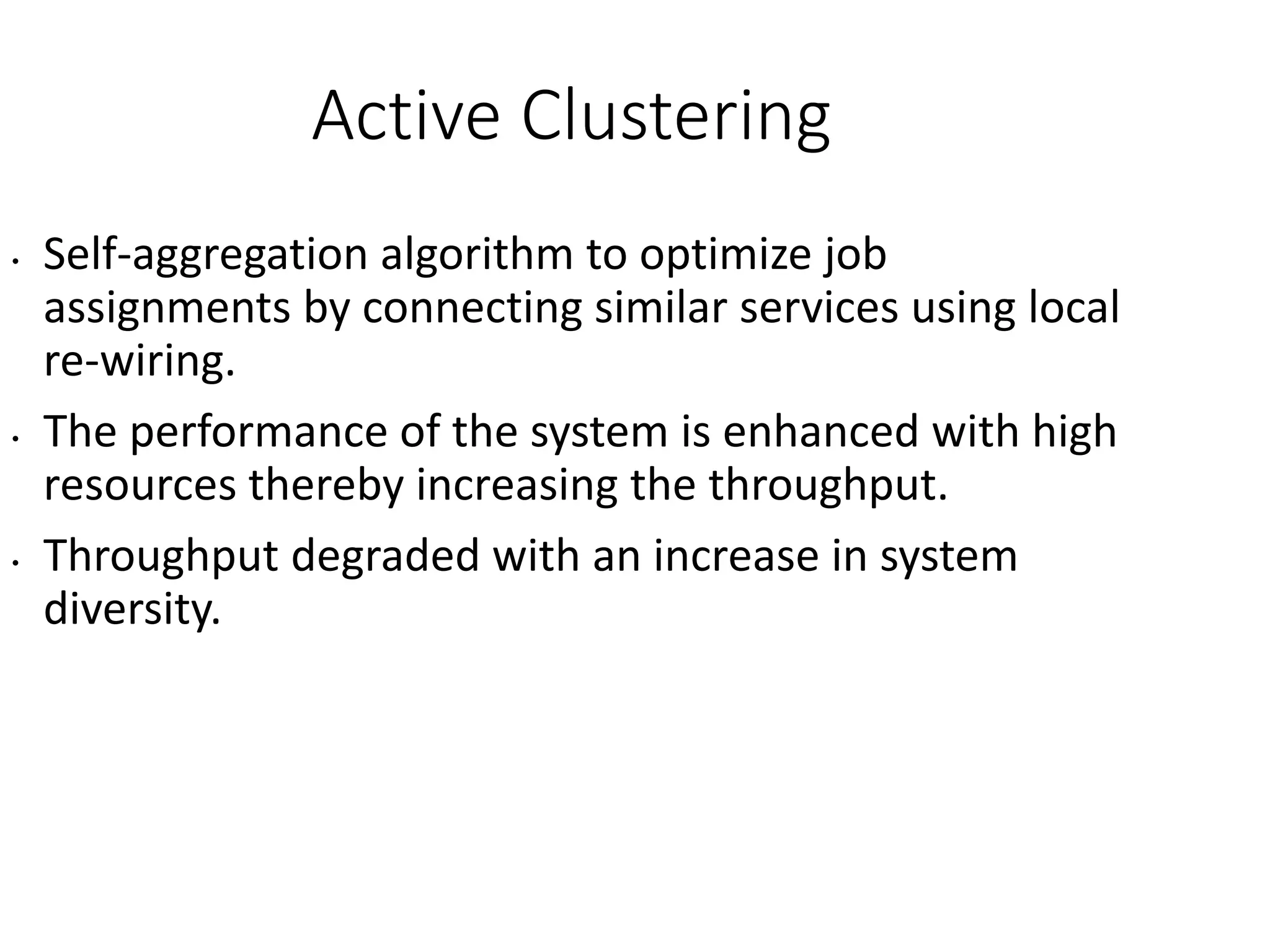
Active Clustering
• Self-aggregationalgorithm to optimize job
assignments by connecting similar services using local
re-wiring.
• The performance of the system is enhanced with high
resources thereby increasing the throughput.
• Throughput degraded with an increase in system
diversity.
16.
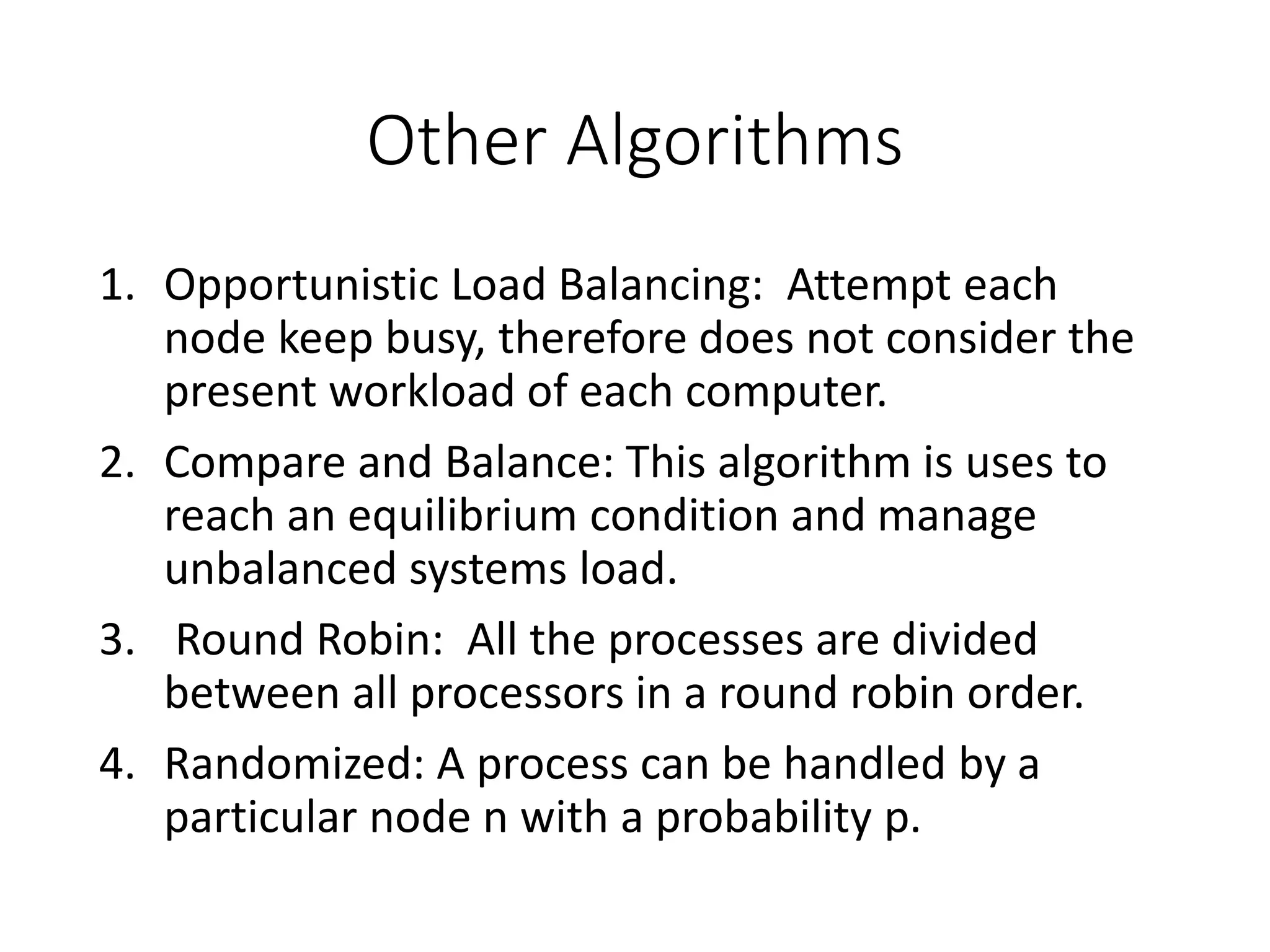
Other Algorithms
1. OpportunisticLoad Balancing: Attempt each
node keep busy, therefore does not consider the
present workload of each computer.
2. Compare and Balance: This algorithm is uses to
reach an equilibrium condition and manage
unbalanced systems load.
3. Round Robin: All the processes are divided
between all processors in a round robin order.
4. Randomized: A process can be handled by a
particular node n with a probability p.
17.
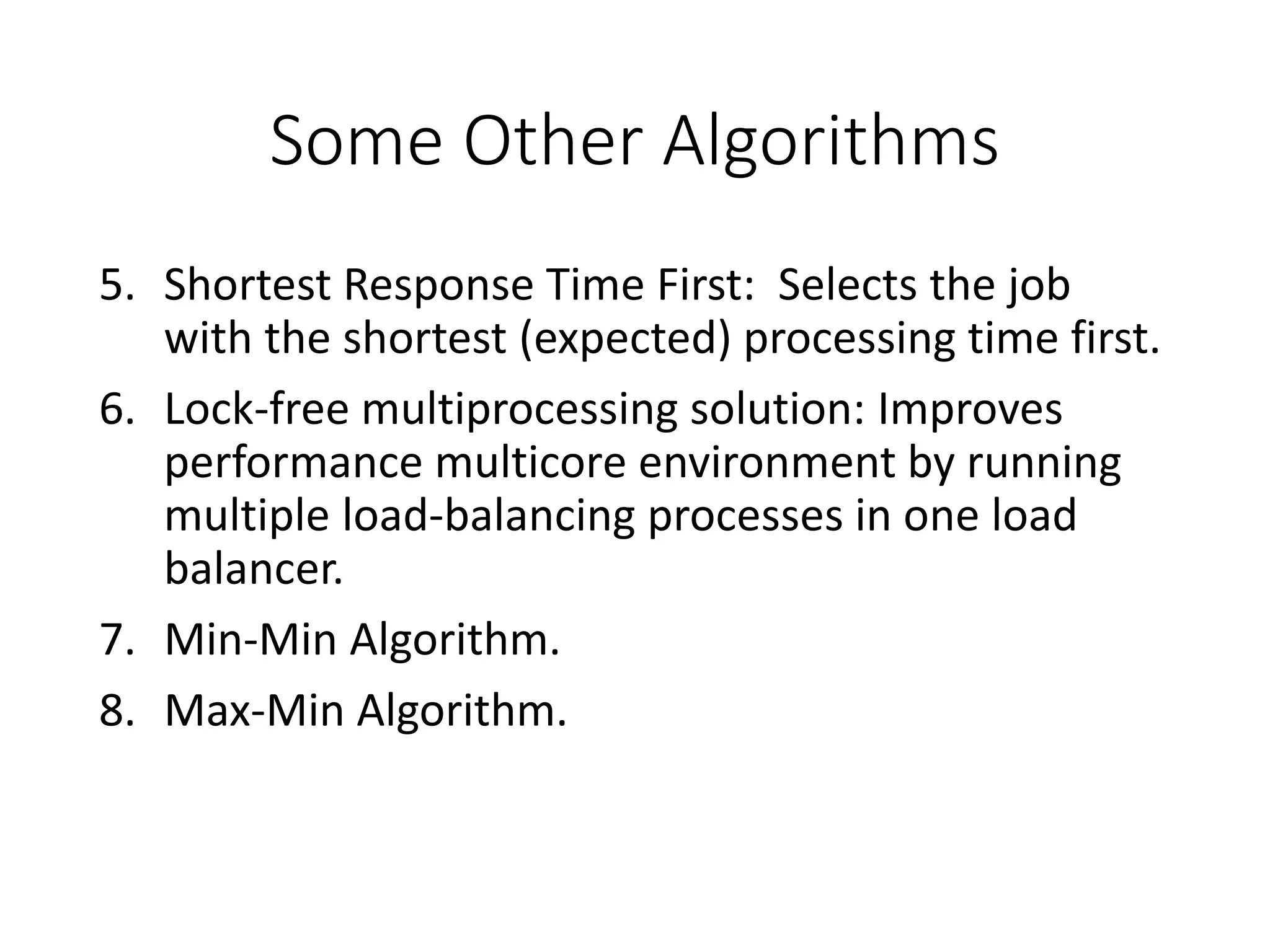
Some Other Algorithms
5.Shortest Response Time First: Selects the job
with the shortest (expected) processing time first.
6. Lock-free multiprocessing solution: Improves
performance multicore environment by running
multiple load-balancing processes in one load
balancer.
7. Min-Min Algorithm.
8. Max-Min Algorithm.
18.
Bibliography
● Mell, Peterand Grance, Tim, “The NIST definition of cloud
computing”, National Institute of Standards and
Technology, 2009,vol53, pages50, Mell2009.
● Haozheng Ren, Yihua Lan, and Chao Yin, “The Load
Balancing Algorithm in Cloud Computing Environment”,
IEEE, 2nd International Conference on Computer Science,
China 2012.
● N. S. Raghava and Deepti Singh,” Comparative Study
on Load Balancing Techniques in Cloud Computing”
OPEN JOURNAL OF MOBILE COMPUTING AND CLOUD
COMPUTING, In Press.



![CleanMyMac X v5.2.8 Crack for MacOS Full Version [Latest] pptx](https://cdn.slidesharecdn.com/ss_thumbnails/softwareoverview-251207194121-a81f0142-thumbnail.jpg?width=640&height=640&fit=bounds)
![Moho Pro 14.4 Crack for MacOS Works Until 2050 [Latest] pptx](https://cdn.slidesharecdn.com/ss_thumbnails/softwareoverview-251207192639-797289c4-thumbnail.jpg?width=640&height=640&fit=bounds)

![PowerISO 9.2 Mac Crack + Serial Key Free Download 2026 [Latest] Software.pptx](https://cdn.slidesharecdn.com/ss_thumbnails/software-251207185653-5d5700e6-thumbnail.jpg?width=640&height=640&fit=bounds)

![iStat Menus 7.20 Crack for MacOS 2026 Full Version [Latest] pptx](https://cdn.slidesharecdn.com/ss_thumbnails/softwareoverview-251207191544-22b737dc-thumbnail.jpg?width=640&height=640&fit=bounds)


![Chapter4_Initiation_of_Sediment_Motion_v2[1].pptx](https://cdn.slidesharecdn.com/ss_thumbnails/chapter4initiationofsedimentmotionv21-251208223747-f94ef163-thumbnail.jpg?width=640&height=640&fit=bounds)


![AnyTrans for iOS 8.9.14.20251127 With Crack for MacOS [Latest] pptx](https://cdn.slidesharecdn.com/ss_thumbnails/softwareoverview-251207190907-2316965f-thumbnail.jpg?width=640&height=640&fit=bounds)


