Virtualization Security
By
Ahmed Adel Nour
What is Server virtualization?
Is an architecture that allows you to run multiple operating system
simultaneously on a single computer. Each copy of an operating system is
installed on its own virtual machine
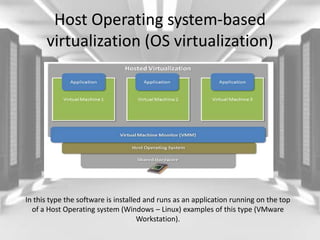
Host Operating system-based
virtualization (OS virtualization)
In this type the software is installed and runs as an application running on the top
of a Host Operating system (Windows – Linux) examples of this type (VMware
Workstation).
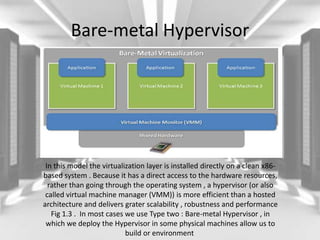
Bare-metal Hypervisor
In this model the virtualization layer is installed directly on a clean x86-
based system . Because it has a direct access to the hardware resources,
rather than going through the operating system , a hypervisor (or also
called virtual machine manager (VMM)) is more efficient than a hosted
architecture and delivers grater scalability , robustness and performance
Fig 1.3 . In most cases we use Type two : Bare-metal Hypervisor , in
which we deploy the Hypervisor in some physical machines allow us to
build or environment
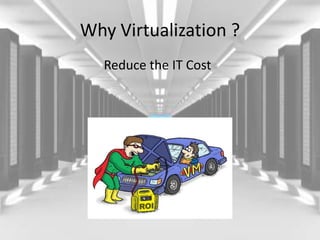
Why Virtualization ?
• Server consolidation and Improve Server
Hardware Utilization.
Why Virtualization ?
• Reduce the Power Consumption and Cooling
in Data Centers (Green-IT)
Why Virtualization ?
Reduce the IT Cost
Virtualization Security Risks
Information Security Isn't Initially Involved in
the Virtualization Projects
Many Migration projects done without the
involving the security teams in the
organizations because of many aspects . one
of it that the virtualization is only a
consolidation of the existing physical servers
to new virtual ones the whole story that I
need more space in the Data center , why I
should evolve the security team ?
The answer is WRONG, security team must be
evolved because of this team always
responsible for the securing every point in the
data center from the design phase till the
implementation and operation.
Virtualization Security Risks
A Compromise of the Virtualization Layer (VMM or
Hypervisor ) Could Result in the Compromise of All
Hosted Virtual machines .
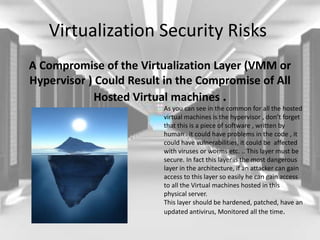
As you can see in the common for all the hosted
virtual machines is the hypervisor , don’t forget
that this is a piece of software , written by
human . it could have problems in the code , it
could have vulnerabilities, it could be affected
with viruses or worms etc. .. This layer must be
secure. In fact this layer is the most dangerous
layer in the architecture, if an attacker can gain
access to this layer so easily he can gain access
to all the Virtual machines hosted in this
physical server.
This layer should be hardened, patched, have an
updated antivirus, Monitored all the time.
Virtualization Security Risks
The Lack of Visibility and Controls on Internal Virtual
Networks Created for VM-to-VM Communications
Blinds Existing Security Policy Enforcement
Mechanisms
The Switches connecting the virtual machines between
the same physical servers is a software switch and suffer
from the lake of manageability. Also the traditional IPS
and IDS cannot monitor this internal Traffic. This lead to
make this part of network to be hidden. and of course
any attack could happened in this part .
the solution for this risk could be in placing a virtual
firewall and IPS in every Virtual machine. It cause a
management overhead and expensive but the other
one is to redirect all the traffic from each Virtual
machine to the external network which contains the IPS
to inspect and then move it back to the other virtual
machine in the same physical server .
Virtualization Security Risks
Virtual machines of Different Trust Levels Are
Consolidated onto a Single Physical Server without
Sufficient Separation.
The famous security model is that we consolidate
the servers with the same Trust level in one zone
and apply the prober security policy on it . In
virtualization we have a problem, virtual
machines can move from one physical server to
another depending upon the performance and
resource utilization . Now we don't have barriers.
At least separate the virtual environment as we
use in the normal one . Make some physical
servers for each zone you have .
Virtualization Security Risks
Lack of Access Control on the hypervisor layer.
To access the hypervisor layer gives you the
all access to everything in this layer.
Network, security countermeasures , virtual
machines etc ..
So you need to secure this access, try to find
a suitable package for access control, ensure
suitable password policy . try to stop
insecure access means such as remote login.

Virtualization security

  • 1.
  • 2.
    What is Servervirtualization? Is an architecture that allows you to run multiple operating system simultaneously on a single computer. Each copy of an operating system is installed on its own virtual machine
  • 3.
    Host Operating system-based virtualization(OS virtualization) In this type the software is installed and runs as an application running on the top of a Host Operating system (Windows – Linux) examples of this type (VMware Workstation).
  • 4.
    Bare-metal Hypervisor In thismodel the virtualization layer is installed directly on a clean x86- based system . Because it has a direct access to the hardware resources, rather than going through the operating system , a hypervisor (or also called virtual machine manager (VMM)) is more efficient than a hosted architecture and delivers grater scalability , robustness and performance Fig 1.3 . In most cases we use Type two : Bare-metal Hypervisor , in which we deploy the Hypervisor in some physical machines allow us to build or environment
  • 5.
    Why Virtualization ? •Server consolidation and Improve Server Hardware Utilization.
  • 6.
    Why Virtualization ? •Reduce the Power Consumption and Cooling in Data Centers (Green-IT)
  • 7.
  • 8.
    Virtualization Security Risks InformationSecurity Isn't Initially Involved in the Virtualization Projects Many Migration projects done without the involving the security teams in the organizations because of many aspects . one of it that the virtualization is only a consolidation of the existing physical servers to new virtual ones the whole story that I need more space in the Data center , why I should evolve the security team ? The answer is WRONG, security team must be evolved because of this team always responsible for the securing every point in the data center from the design phase till the implementation and operation.
  • 9.
    Virtualization Security Risks ACompromise of the Virtualization Layer (VMM or Hypervisor ) Could Result in the Compromise of All Hosted Virtual machines . As you can see in the common for all the hosted virtual machines is the hypervisor , don’t forget that this is a piece of software , written by human . it could have problems in the code , it could have vulnerabilities, it could be affected with viruses or worms etc. .. This layer must be secure. In fact this layer is the most dangerous layer in the architecture, if an attacker can gain access to this layer so easily he can gain access to all the Virtual machines hosted in this physical server. This layer should be hardened, patched, have an updated antivirus, Monitored all the time.
  • 10.
    Virtualization Security Risks TheLack of Visibility and Controls on Internal Virtual Networks Created for VM-to-VM Communications Blinds Existing Security Policy Enforcement Mechanisms The Switches connecting the virtual machines between the same physical servers is a software switch and suffer from the lake of manageability. Also the traditional IPS and IDS cannot monitor this internal Traffic. This lead to make this part of network to be hidden. and of course any attack could happened in this part . the solution for this risk could be in placing a virtual firewall and IPS in every Virtual machine. It cause a management overhead and expensive but the other one is to redirect all the traffic from each Virtual machine to the external network which contains the IPS to inspect and then move it back to the other virtual machine in the same physical server .
  • 11.
    Virtualization Security Risks Virtualmachines of Different Trust Levels Are Consolidated onto a Single Physical Server without Sufficient Separation. The famous security model is that we consolidate the servers with the same Trust level in one zone and apply the prober security policy on it . In virtualization we have a problem, virtual machines can move from one physical server to another depending upon the performance and resource utilization . Now we don't have barriers. At least separate the virtual environment as we use in the normal one . Make some physical servers for each zone you have .
  • 12.
    Virtualization Security Risks Lackof Access Control on the hypervisor layer. To access the hypervisor layer gives you the all access to everything in this layer. Network, security countermeasures , virtual machines etc .. So you need to secure this access, try to find a suitable package for access control, ensure suitable password policy . try to stop insecure access means such as remote login.