Udit J.Modi
B. Tech, mechanical engineer, Nirma University
NECESSITY OF TRANSMISSION
 Variation of resistance to the vehicle motion at various speeds
 Variation of tractive effort of the vehicle available at various
speeds
Total Resistance to the vehicle motion
1) Resistance due to wind:
 Proportional to the square of the vehicle speed
2)Resistance due to gradient
 Constant at all speed
 Component of the vehicle weight parallel to the plane of the road
3)Miscellaneous
 Type of load, tyre friction, etc. this is also constant.
The total resistance for a
particular type of road is
represented in fig.,
RESISTANCE
SPEED
 The total resistance for same type of road with different gradient may represented by
curves shown below,
TOTALRESISTANCE
SPEED
Tractive Effort
 The curves 1,2,3 respectively in fig. represent the tractive effort in first, second and
top gears respectively.
TRACTIVEEFFORT
Transmission Necessity
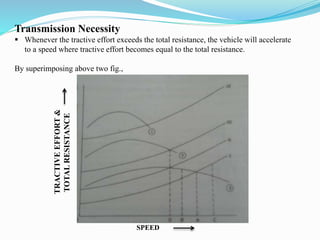
 Whenever the tractive effort exceeds the total resistance, the vehicle will accelerate
to a speed where tractive effort becomes equal to the total resistance.
By superimposing above two fig.,
TRACTIVEEFFORT&
TOTALRESISTANCE
SPEED
 Let vehicle be in top gear, travelling on a gradient which gives total resistance curve I.
 It is seen that OA is stabilizing speed.
 If speed at any instant is less than OB, the excess of tractive effort will accelerate it to
speed OA.
 Similarly if the speed at ant instant is OC, the excess of resistance will decelerate it to
OA.
 Now the vehicle go on next gradient of curve II, in this case stabilizing speed has
decreased.
 For curve III, it is crossed by curve 3,so vehicle will not be able to go at this gradient in
the top gear.
 But if we pass on second gear, we get stabilizing speed OD.
 At start more acceleration is needed to gain speed quickly, can be done in first gear
because of maximum tractive effort is available for acceleration.
FREE WHEEL UNIT
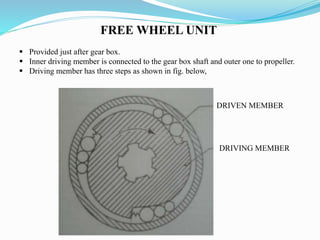
 Provided just after gear box.
 Inner driving member is connected to the gear box shaft and outer one to propeller.
 Driving member has three steps as shown in fig. below,
DRIVEN MEMBER
DRIVING MEMBER
 When driving member rotating in direction shown in fig., the driven member will
also be rotating in same direction.
 But when driven member becomes driving member, the inner member will not
rotate along with outer one.
 This result in fuel economy.
Advantages:
 Without bringing the gears in neutral, engine can be ideal. Thus gear changing at
low speed is much simplified as the clutch need not be disengaged for this
purpose.
 Less wear on the transmission because whenever the car free wheels, engine and
gear box are disconnected from prop. Shaft.
 On long downward slopes, an appreciable amount of fuel is saved. Saving may
be upto 20%.
Disadvantages:
 There is no resistance due to engine and gear box friction while free wheeling,
the brakes must be more effectively to stop the vehicle on a downward slope.
Sliding Mesh Gear Box
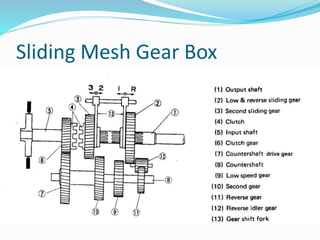
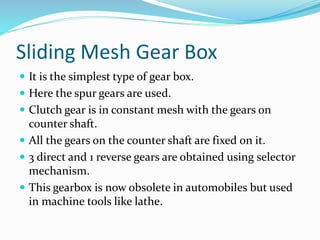
 It is the simplest type of gear box.
 Here the spur gears are used.
 Clutch gear is in constant mesh with the gears on
counter shaft.
 All the gears on the counter shaft are fixed on it.
 3 direct and 1 reverse gears are obtained using selector
mechanism.
 This gearbox is now obsolete in automobiles but used
in machine tools like lathe.
Constant Mesh Gear Box
 In this gear box, all the gears are in constant mesh with
corresponding gears.
 Usually the helical gears are used in it to transmit high
power.
 The dog clutch is present on the main shaft through
shaft.
 The gears on countershaft are fixed.
 The position of dog clutch decides which gear is
engaged.
 Usually used in bikes.
Constant Mesh Gear Box
 Double Declutching
 For the smooth engagement of dog clutch.
 The speed of main shaft gear and sliding gear must be
equal.
 Advantages
 As helical gears can be used, more power can be
transmitted.
 As all the teeth of dog clutch are involved, it wear is less
as compared to the other gears having only one or two
teeth in contact.
Transmission Types
 Transmission may be classified into the manual and
the automatic types.
Manual Transmission
 Manual transmissions are conventionally called gear
boxes.
Advantages:
 Mechanical efficiency in direct drive is 98% whereas in
reduction gears, it is slightly greater than 90%.
 As most of the time the driving is done in direct drive ,
friction losses in manual transmission is very small.
 They are coupled with simplicity, low initial cost, little
maintenance makes it Popular particularly in fuel
efficient automobiles.
Disadvantages:
 On other hand the operation of engaging and
disengaging the clutch along with changing of gears
while driving over a crowded highway means a lot of
fatigue to the driver.
 Moreover, there is interruption of torque caused when
the driver declutches causing discomfort to passengers
and in extreme fuel economy.
 Therefore in luxury vehicles automatic transmissions
are employed which simplify the driving operation
considerably.
Automatic Transmission
 Modern, planetary automatic transmissions shift gears
smoothly and since these are regulated by the
transmission control unit, the best gear is always
selected for the operating conditions, depending on
whether the driver desires performance or economy.
Disadvantages:
 They incur parasitic losses due to the hydraulic pump
required to operate the clutches, and slip in the torque
converter generating heat.
 Most modern transmissions having lock-up clutches to
bypass torque converter during low efficiency
operation, have up to 85 percent efficiency over the
drive cycle.
 The latest types are the Continuously Variable
Transmission (CVTs) and the Automated Manual
Transmissions.
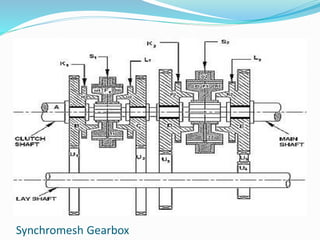
Synchromesh Gearbox
 In this type of gearbox all the gears on the main shaft
are in constant mesh with the corresponding gears on
the layshaft.
 The gear on the layshaft are fixed to it while those on
the main shaft are free to rotate on the same.
 It’s working is also similar to constant mesh type with
one definite improvement.
Improvement in synchromesh
gearbox
 It is provided with a synchromesh device which
avoids necessity of double declutching.
 The parts which are ultimately to be engaged are first
brought into frictional contact which equalizes their
speed, after which these may be engaged smoothly.
Synchromesh Gearbox
Construction of synchromesh
gearbox
 In previous figure A is the engine shaft, Gears B, C, D,
E are free on the main shaft and are always in mesh
with corresponding gears on the layshaft.
 Thus all the gears on main shaft as well as on layshaft
continue to rotate so long as shaft A is rotating.
 Members F1 and F2 are free to slide on splines on the
mainshaft.
 G1 and G2 are ring shaped members having internal
teeth fit onto external teeth members F1 and F2.
 K1 and K2 are dog teeth on B and D respectively and
these also fit onto the teeth of G1 and G2.
 S1 and S2 are forks.
 T1 and T2 are the balls supported by springs. These
tend to prevent the sliding of members G1(G2) on
F1(F2).
 However, when the force applied on G1(G2) through
fork S1(S2) exceeds a certain value, the balls are
overcome and member G1(G2) slides over F1(F2).
 There are usually six of these balls symmetrically
placed circumferentially in on synchromesh device.
 M1, M2, N1, N2, P1, P2, R1, R2 are the frictional
surfaces.
Working of synchromesh gearbox
 Above figure shows in step how gears are engaged.
 For direct gear, member G1 and hence member F1
(through spring-loaded balls) is slid towards left till
cones M1 and M2 rub and friction makes their speed
equal.
 Further pushing the member G1 to left causes it to
override the balls and get engaged with dogs K1
 Now the drive to the main shaft is direct from B via F1
and the splines. However, if member G1 is pushed too
quickly so that there is not sufficient time for
synchronization of speeds, a clash may result.
 Likewise defect will arise in case springs supporting
the balls TF have become weak.
 Similarly for other gear combinations.
Modification required
 In this type of gearbox it is very necessary for the
smooth operation that sufficient time is allowed for
the equalization of the speeds before the gears are
finally brought into mesh.
 To help special modifications have been employed in
gearboxes.
 One such modification is given in next slide
Modified Synchromesh device
Synchronizer ring
 A synchronizer ring is provided between the dog teeth K1
and member F1.
 To push this synchronizer ring in desired direction, three
guide bars equally spaced along the circumference are
provided.
 These are retained in place by means of circlips.
 The synchronizer ring has dog teeth at its outer
circumference and is cut at three places to provide space for
the guide bars.
 The width of each cut is equal to the width of the guide bar
plus half the pitch of the teeth on the synchronizer ring.
Working of synchronizer ring
 When the gear is to be engaged, fork S1 slides F! to left,
pushing synchronizer ring also along till the inclined
friction surface on the inside of the ring comes into contact
with the corresponding friction surface of the gear.
 Till the speeds of the two mating surfaces have not
equalized, the guide bars would be contacting one side of
the corresponding cuts in the synchronizer ring as shown
in fig.
 In this position G1 can not move further, as the speeds are
equalized, the guide bars become central in the cuts and
the member G1 can be pushed further, overriding the
spring-loaded balls.
Actual picture of modified
synchromesh device
Automatic Transmission
There are broadly two types of Automatic
Transmission
1. Semi-Automatic
2. Fully Automatic
 In the first type of transmission operation of clutch
only is automatic while driver still has to select the
gears while the later is fully automatic.
Automatic Transmission Parts
1. Multiplate Clutches
2.Torque Converter
3. Epicyclic Gear Box
Epicyclic Gear Box
 Most automatic transmissions use planetary gear sets to
provide the different gear ranges. Power flow through these
gear sets is controlled by the control devices: clutches,
bands, and one-way clutches.
Epicyclic Gear SetAn epicyclic gear set has some gear or
gears whose center revolves about
some point.
Here is a gearset with a stationary ring
gear and three planet gears on a
rotating carrier.
The input is at the Sun, and the output
is at the planet carrier.
The action is epicyclic, because the
centers of the planet gears revolve
about the sun gear while the planet
gears turn.
INPUT
CARRIER
Planetary Gearsets
 Simple planetary gearsets contain three components
 Internal (ring) gear / (annulus gear)
 Planet gears (and carrier)
 Sun gear
 One component will be the drive member, one the
driven, and one will be held (except direct drive and
neutral)
 Unlike other types of gears, planetary gears are able to
operate on one single axis
Planetary Action
 Direct Drive
 Any two of the components are driven
 1:1 Ratio
Planetary Action
 Underdrive
 Planet carrier is the output
 Minimum reduction
 Ring gear is held
 Sun gear is the input
 Maximum reduction
 Ring gear is input
 Sun gear is held
Planetary Action
 Overdrive
 Planet carrier is the input
 Minimum overdrive
 Ring gear is the input
 Sun gear is held
 Maximum overdrive
 Ring gear is held
 Sun gear is the input
Planetary Action
 Reverse
 Planet carrier is held
 Underdrive
 Ring gear is the output
 Sun gear is the input
 Overdrive
 Ring gear is the input
 Sun gear is output
HISTORY
First transmission in 1832 by W.H.James
First automatic transmission introduced in 1939
First hydraulic automatics were introduced by
GM, Chrysler and Borg-Warner in early 1950’s
Greater developments in 1990’s
Layout(FE-RWD)
Layout(FE-FWD)
Component
Planetary Gear Sets
Hydraulic System
Oil Pump
Valve Body
Clutches
 Band
Seals and Gaskets
Torque Converter
Governor
Computer Controls
PLANETARY GEAR
Planetary gear train
Simple
Compound
Hydraulic Circuit
Bend Brake
COMPUTER CONTROLS
 The computer uses sensors on the engine
and transmission to detect such things as throttle
position, vehicle speed, engine speed, engine
load, brake pedal position, etc. to control exact
shift points as well as how soft or firm the shift
should be. Once the computer receives this
information, it then sends signals to a solenoid
pack inside the transmission
Limitations
Power loss in torque converter during
transmission
The „killer‟ of automatic transmissions is heat.
Excessive heat causes the fluid to lose its ability to
lubricate, which leads to higher internal-component
friction, all resulting in rapid wear-and-tear and premature
transmission failure.
Complicated planetary structure makes the transmission
heavy.
Borg Warner Automatic Transmission
About
3 forward and one reverse speed
 Direct Gear –Clutch A is engaged
 Second gear- clutch B is engaged &Brake BS is applied
 Lower most gear- both brake BS & BF are applied
 Reverse Gear-Only brake BR is applied.
Controls
For selection of gear, Application of clutch & gear is
done hydraulically.
Hydraulic pressure is regulated by
1. Car speed – control pressure on one side of shift valve
2. Throttle opening – control pressure on other side of
shift valve.
Principle of Gear Selection
-Low Gear
Principle of Gear Selection
-Direct Gear
Automobile
Engineering
Gear Selector Mechanism
 Required in all Manual Transmission and for Automatic
Transmission to select particular drive system like neutral,
reverse, parking etc.
 Gears are selected by manipulating a lever called a gear
stick, shift stick, gearshift, gear lever, gear selector, or
shifter.
 Gear Shifter is connected to the transmission via linkage or
cables.
 It is mounted on the floor, dashboard, or steering column.
 Moving the lever forward, backward, left, and right into
specific positions selects particular gears.
Selector Mechanism
 Two types of gear selector mechanism
Gear shift lever mounted on the top of transmission case
Gear shift lever mounted on the steering column
Gear Shifter on
Transmission Top
 No linkages
 As there is no linkages the gear
engagement can be felt easily
 Space utilization is less
Gear Shifter on Steering
Column Complicated operating linkages
 Due to complicated linkages it
is difficult to feel gear
engagement
 Space utilized so saving of space
Gear Lever on the top of
Transmission Case
 Figure shows exploded view of gear
selector.
 Gear lever is ball mounted to facilitate
movement in any direction.
 Lower end of gear lever fits into a slot
in the selector sleeve.
 Forks are mounted on the sleeves on
three separate selector rods.
 Each selector sleeve can slide on its
rod or fork are fixed on rods by pins
and the assembly can slide.
Gear Lever on the top of
Transmission Case
 To avoid unwanted engagement of
gears, slots are made and provided with
spring-loaded balls.
 These balls resist the movements of the
forks until some force applied to
overcome their resistance.
 Groves are provided on the gear bosses
where selector fork can fit in.
 Transverse motion of the gear lever
selects the fork which is to be engaged
and the longitudinal movement then
slides the fork and its gear to engage the
selected gear.
Gear Selection
 Various gear selection
Interlocking Mechanism
 It ensures that only one gear can
be engaged at a time.
 Provision is made to prevent
accidental engagement of the
reverse gear by means of a stiff
spring which has to be overcome
by applying extra force.
 Middle selector rod 2 has a radial
hole chamfered on both side, and
an interconnecting pin ‘C’ inside
it.
 On other two selector rods there
are single grooves cut facing the
central rod.
 There are holes in gear box casing,
holding two interlocking balls A
and B.
Interlocking Mechanism When particular gear is to be engaged, the corresponding selector rod
is moved in the desired direction.
 Figure (a) shows, Selector rods 1 & 3 locked in neutral, only rod 2 can
be moved.
 Figure (b) shows, Selector rods 2 & 3 locked in neutral, only rod 1 can
be moved.
 Figure (c) shows, Selector rods 1 & 2 locked in neutral, only rod 3 can
be moved.
 Thus the mechanism allows only one rod to be operated at a time.
Gear Lever on Steering Column
 The gear lever rod is mounted
on the steering column.
 A tongue is fixed on the gear
lever rod which can be
engaged to either of the forks
by the axial movement of the
rod, which selects the fork to
be operated.
 The angular movement of the
gear shift lever slides that fork
in the gear box and thereby
the concerned gear to engage
the selected gear.
Selector Mechanism with
Remote Control Linkage
 When it is not possible to
mount gear lever on the
top of transmission, this
remote control linkage
selector mechanism is
used.
 In this the gear lever is
mounted on the floor, due
to convenient positioning
of the selector lever from
the driver’s seat.
 This is shown in figure.
1. Nut guide block
2. Guide block
3. Selector rod assy.
4. Lock nut
5. Shift block assy.
6. Nut reverse selector
7. Plunger reverse selector
8. Lever adjusting bolt
Manual Transmission and Gear
Shifting
Transmission

Transmission

  • 1.
    Udit J.Modi B. Tech,mechanical engineer, Nirma University
  • 3.
    NECESSITY OF TRANSMISSION Variation of resistance to the vehicle motion at various speeds  Variation of tractive effort of the vehicle available at various speeds
  • 4.
    Total Resistance tothe vehicle motion 1) Resistance due to wind:  Proportional to the square of the vehicle speed 2)Resistance due to gradient  Constant at all speed  Component of the vehicle weight parallel to the plane of the road 3)Miscellaneous  Type of load, tyre friction, etc. this is also constant. The total resistance for a particular type of road is represented in fig., RESISTANCE SPEED
  • 5.
     The totalresistance for same type of road with different gradient may represented by curves shown below, TOTALRESISTANCE SPEED
  • 6.
    Tractive Effort  Thecurves 1,2,3 respectively in fig. represent the tractive effort in first, second and top gears respectively. TRACTIVEEFFORT
  • 7.
    Transmission Necessity  Wheneverthe tractive effort exceeds the total resistance, the vehicle will accelerate to a speed where tractive effort becomes equal to the total resistance. By superimposing above two fig., TRACTIVEEFFORT& TOTALRESISTANCE SPEED
  • 8.
     Let vehiclebe in top gear, travelling on a gradient which gives total resistance curve I.  It is seen that OA is stabilizing speed.  If speed at any instant is less than OB, the excess of tractive effort will accelerate it to speed OA.  Similarly if the speed at ant instant is OC, the excess of resistance will decelerate it to OA.  Now the vehicle go on next gradient of curve II, in this case stabilizing speed has decreased.  For curve III, it is crossed by curve 3,so vehicle will not be able to go at this gradient in the top gear.  But if we pass on second gear, we get stabilizing speed OD.  At start more acceleration is needed to gain speed quickly, can be done in first gear because of maximum tractive effort is available for acceleration.
  • 9.
    FREE WHEEL UNIT Provided just after gear box.  Inner driving member is connected to the gear box shaft and outer one to propeller.  Driving member has three steps as shown in fig. below, DRIVEN MEMBER DRIVING MEMBER
  • 10.
     When drivingmember rotating in direction shown in fig., the driven member will also be rotating in same direction.  But when driven member becomes driving member, the inner member will not rotate along with outer one.  This result in fuel economy. Advantages:  Without bringing the gears in neutral, engine can be ideal. Thus gear changing at low speed is much simplified as the clutch need not be disengaged for this purpose.  Less wear on the transmission because whenever the car free wheels, engine and gear box are disconnected from prop. Shaft.  On long downward slopes, an appreciable amount of fuel is saved. Saving may be upto 20%. Disadvantages:  There is no resistance due to engine and gear box friction while free wheeling, the brakes must be more effectively to stop the vehicle on a downward slope.
  • 12.
  • 13.
    Sliding Mesh GearBox  It is the simplest type of gear box.  Here the spur gears are used.  Clutch gear is in constant mesh with the gears on counter shaft.  All the gears on the counter shaft are fixed on it.  3 direct and 1 reverse gears are obtained using selector mechanism.  This gearbox is now obsolete in automobiles but used in machine tools like lathe.
  • 14.
  • 15.
    Constant Mesh GearBox  In this gear box, all the gears are in constant mesh with corresponding gears.  Usually the helical gears are used in it to transmit high power.  The dog clutch is present on the main shaft through shaft.  The gears on countershaft are fixed.  The position of dog clutch decides which gear is engaged.  Usually used in bikes.
  • 16.
    Constant Mesh GearBox  Double Declutching  For the smooth engagement of dog clutch.  The speed of main shaft gear and sliding gear must be equal.  Advantages  As helical gears can be used, more power can be transmitted.  As all the teeth of dog clutch are involved, it wear is less as compared to the other gears having only one or two teeth in contact.
  • 18.
    Transmission Types  Transmissionmay be classified into the manual and the automatic types.
  • 19.
    Manual Transmission  Manualtransmissions are conventionally called gear boxes. Advantages:  Mechanical efficiency in direct drive is 98% whereas in reduction gears, it is slightly greater than 90%.  As most of the time the driving is done in direct drive , friction losses in manual transmission is very small.  They are coupled with simplicity, low initial cost, little maintenance makes it Popular particularly in fuel efficient automobiles.
  • 20.
    Disadvantages:  On otherhand the operation of engaging and disengaging the clutch along with changing of gears while driving over a crowded highway means a lot of fatigue to the driver.  Moreover, there is interruption of torque caused when the driver declutches causing discomfort to passengers and in extreme fuel economy.  Therefore in luxury vehicles automatic transmissions are employed which simplify the driving operation considerably.
  • 21.
    Automatic Transmission  Modern,planetary automatic transmissions shift gears smoothly and since these are regulated by the transmission control unit, the best gear is always selected for the operating conditions, depending on whether the driver desires performance or economy. Disadvantages:  They incur parasitic losses due to the hydraulic pump required to operate the clutches, and slip in the torque converter generating heat.
  • 22.
     Most moderntransmissions having lock-up clutches to bypass torque converter during low efficiency operation, have up to 85 percent efficiency over the drive cycle.  The latest types are the Continuously Variable Transmission (CVTs) and the Automated Manual Transmissions.
  • 23.
    Synchromesh Gearbox  Inthis type of gearbox all the gears on the main shaft are in constant mesh with the corresponding gears on the layshaft.  The gear on the layshaft are fixed to it while those on the main shaft are free to rotate on the same.  It’s working is also similar to constant mesh type with one definite improvement.
  • 24.
    Improvement in synchromesh gearbox It is provided with a synchromesh device which avoids necessity of double declutching.  The parts which are ultimately to be engaged are first brought into frictional contact which equalizes their speed, after which these may be engaged smoothly.
  • 25.
  • 26.
    Construction of synchromesh gearbox In previous figure A is the engine shaft, Gears B, C, D, E are free on the main shaft and are always in mesh with corresponding gears on the layshaft.  Thus all the gears on main shaft as well as on layshaft continue to rotate so long as shaft A is rotating.  Members F1 and F2 are free to slide on splines on the mainshaft.  G1 and G2 are ring shaped members having internal teeth fit onto external teeth members F1 and F2.
  • 27.
     K1 andK2 are dog teeth on B and D respectively and these also fit onto the teeth of G1 and G2.  S1 and S2 are forks.  T1 and T2 are the balls supported by springs. These tend to prevent the sliding of members G1(G2) on F1(F2).  However, when the force applied on G1(G2) through fork S1(S2) exceeds a certain value, the balls are overcome and member G1(G2) slides over F1(F2).  There are usually six of these balls symmetrically placed circumferentially in on synchromesh device.  M1, M2, N1, N2, P1, P2, R1, R2 are the frictional surfaces.
  • 28.
  • 29.
     Above figureshows in step how gears are engaged.  For direct gear, member G1 and hence member F1 (through spring-loaded balls) is slid towards left till cones M1 and M2 rub and friction makes their speed equal.  Further pushing the member G1 to left causes it to override the balls and get engaged with dogs K1  Now the drive to the main shaft is direct from B via F1 and the splines. However, if member G1 is pushed too quickly so that there is not sufficient time for synchronization of speeds, a clash may result.  Likewise defect will arise in case springs supporting the balls TF have become weak.  Similarly for other gear combinations.
  • 30.
    Modification required  Inthis type of gearbox it is very necessary for the smooth operation that sufficient time is allowed for the equalization of the speeds before the gears are finally brought into mesh.  To help special modifications have been employed in gearboxes.  One such modification is given in next slide
  • 31.
  • 32.
    Synchronizer ring  Asynchronizer ring is provided between the dog teeth K1 and member F1.  To push this synchronizer ring in desired direction, three guide bars equally spaced along the circumference are provided.  These are retained in place by means of circlips.  The synchronizer ring has dog teeth at its outer circumference and is cut at three places to provide space for the guide bars.  The width of each cut is equal to the width of the guide bar plus half the pitch of the teeth on the synchronizer ring.
  • 33.
    Working of synchronizerring  When the gear is to be engaged, fork S1 slides F! to left, pushing synchronizer ring also along till the inclined friction surface on the inside of the ring comes into contact with the corresponding friction surface of the gear.  Till the speeds of the two mating surfaces have not equalized, the guide bars would be contacting one side of the corresponding cuts in the synchronizer ring as shown in fig.  In this position G1 can not move further, as the speeds are equalized, the guide bars become central in the cuts and the member G1 can be pushed further, overriding the spring-loaded balls.
  • 34.
    Actual picture ofmodified synchromesh device
  • 36.
    Automatic Transmission There arebroadly two types of Automatic Transmission 1. Semi-Automatic 2. Fully Automatic  In the first type of transmission operation of clutch only is automatic while driver still has to select the gears while the later is fully automatic.
  • 37.
    Automatic Transmission Parts 1.Multiplate Clutches 2.Torque Converter 3. Epicyclic Gear Box
  • 38.
    Epicyclic Gear Box Most automatic transmissions use planetary gear sets to provide the different gear ranges. Power flow through these gear sets is controlled by the control devices: clutches, bands, and one-way clutches.
  • 39.
    Epicyclic Gear SetAnepicyclic gear set has some gear or gears whose center revolves about some point. Here is a gearset with a stationary ring gear and three planet gears on a rotating carrier. The input is at the Sun, and the output is at the planet carrier. The action is epicyclic, because the centers of the planet gears revolve about the sun gear while the planet gears turn. INPUT CARRIER
  • 40.
    Planetary Gearsets  Simpleplanetary gearsets contain three components  Internal (ring) gear / (annulus gear)  Planet gears (and carrier)  Sun gear  One component will be the drive member, one the driven, and one will be held (except direct drive and neutral)  Unlike other types of gears, planetary gears are able to operate on one single axis
  • 41.
    Planetary Action  DirectDrive  Any two of the components are driven  1:1 Ratio
  • 42.
    Planetary Action  Underdrive Planet carrier is the output  Minimum reduction  Ring gear is held  Sun gear is the input  Maximum reduction  Ring gear is input  Sun gear is held
  • 43.
    Planetary Action  Overdrive Planet carrier is the input  Minimum overdrive  Ring gear is the input  Sun gear is held  Maximum overdrive  Ring gear is held  Sun gear is the input
  • 44.
    Planetary Action  Reverse Planet carrier is held  Underdrive  Ring gear is the output  Sun gear is the input  Overdrive  Ring gear is the input  Sun gear is output
  • 47.
    HISTORY First transmission in1832 by W.H.James First automatic transmission introduced in 1939 First hydraulic automatics were introduced by GM, Chrysler and Borg-Warner in early 1950’s Greater developments in 1990’s
  • 48.
  • 49.
  • 50.
    Component Planetary Gear Sets HydraulicSystem Oil Pump Valve Body Clutches  Band Seals and Gaskets Torque Converter Governor Computer Controls
  • 52.
  • 53.
  • 54.
  • 55.
  • 56.
    COMPUTER CONTROLS  Thecomputer uses sensors on the engine and transmission to detect such things as throttle position, vehicle speed, engine speed, engine load, brake pedal position, etc. to control exact shift points as well as how soft or firm the shift should be. Once the computer receives this information, it then sends signals to a solenoid pack inside the transmission
  • 57.
    Limitations Power loss intorque converter during transmission The „killer‟ of automatic transmissions is heat. Excessive heat causes the fluid to lose its ability to lubricate, which leads to higher internal-component friction, all resulting in rapid wear-and-tear and premature transmission failure. Complicated planetary structure makes the transmission heavy.
  • 58.
  • 59.
    About 3 forward andone reverse speed  Direct Gear –Clutch A is engaged  Second gear- clutch B is engaged &Brake BS is applied  Lower most gear- both brake BS & BF are applied  Reverse Gear-Only brake BR is applied.
  • 60.
    Controls For selection ofgear, Application of clutch & gear is done hydraulically. Hydraulic pressure is regulated by 1. Car speed – control pressure on one side of shift valve 2. Throttle opening – control pressure on other side of shift valve.
  • 61.
    Principle of GearSelection -Low Gear
  • 62.
    Principle of GearSelection -Direct Gear
  • 63.
  • 64.
    Gear Selector Mechanism Required in all Manual Transmission and for Automatic Transmission to select particular drive system like neutral, reverse, parking etc.  Gears are selected by manipulating a lever called a gear stick, shift stick, gearshift, gear lever, gear selector, or shifter.  Gear Shifter is connected to the transmission via linkage or cables.  It is mounted on the floor, dashboard, or steering column.  Moving the lever forward, backward, left, and right into specific positions selects particular gears.
  • 65.
    Selector Mechanism  Twotypes of gear selector mechanism Gear shift lever mounted on the top of transmission case Gear shift lever mounted on the steering column Gear Shifter on Transmission Top  No linkages  As there is no linkages the gear engagement can be felt easily  Space utilization is less Gear Shifter on Steering Column Complicated operating linkages  Due to complicated linkages it is difficult to feel gear engagement  Space utilized so saving of space
  • 66.
    Gear Lever onthe top of Transmission Case  Figure shows exploded view of gear selector.  Gear lever is ball mounted to facilitate movement in any direction.  Lower end of gear lever fits into a slot in the selector sleeve.  Forks are mounted on the sleeves on three separate selector rods.  Each selector sleeve can slide on its rod or fork are fixed on rods by pins and the assembly can slide.
  • 67.
    Gear Lever onthe top of Transmission Case  To avoid unwanted engagement of gears, slots are made and provided with spring-loaded balls.  These balls resist the movements of the forks until some force applied to overcome their resistance.  Groves are provided on the gear bosses where selector fork can fit in.  Transverse motion of the gear lever selects the fork which is to be engaged and the longitudinal movement then slides the fork and its gear to engage the selected gear.
  • 68.
  • 69.
    Interlocking Mechanism  Itensures that only one gear can be engaged at a time.  Provision is made to prevent accidental engagement of the reverse gear by means of a stiff spring which has to be overcome by applying extra force.  Middle selector rod 2 has a radial hole chamfered on both side, and an interconnecting pin ‘C’ inside it.  On other two selector rods there are single grooves cut facing the central rod.  There are holes in gear box casing, holding two interlocking balls A and B.
  • 70.
    Interlocking Mechanism Whenparticular gear is to be engaged, the corresponding selector rod is moved in the desired direction.  Figure (a) shows, Selector rods 1 & 3 locked in neutral, only rod 2 can be moved.  Figure (b) shows, Selector rods 2 & 3 locked in neutral, only rod 1 can be moved.  Figure (c) shows, Selector rods 1 & 2 locked in neutral, only rod 3 can be moved.  Thus the mechanism allows only one rod to be operated at a time.
  • 71.
    Gear Lever onSteering Column  The gear lever rod is mounted on the steering column.  A tongue is fixed on the gear lever rod which can be engaged to either of the forks by the axial movement of the rod, which selects the fork to be operated.  The angular movement of the gear shift lever slides that fork in the gear box and thereby the concerned gear to engage the selected gear.
  • 72.
    Selector Mechanism with RemoteControl Linkage  When it is not possible to mount gear lever on the top of transmission, this remote control linkage selector mechanism is used.  In this the gear lever is mounted on the floor, due to convenient positioning of the selector lever from the driver’s seat.  This is shown in figure. 1. Nut guide block 2. Guide block 3. Selector rod assy. 4. Lock nut 5. Shift block assy. 6. Nut reverse selector 7. Plunger reverse selector 8. Lever adjusting bolt
  • 73.