Embedded Android
   Workshop
Part 1 - Android Internals
    Linaro Connect Asia 2013

       Karim Yaghmour
       @karimyaghmour


                               1
These slides are made available to you under a Creative Commons          Delivered and/or customized by
Share-Alike 3.0 license. The full terms of this license are here:
https://creativecommons.org/licenses/by-sa/3.0/


Attribution requirements and misc., PLEASE READ:
●   This slide must remain as-is in this specific location (slide #2),
    everything else you are free to change; including the logo :-)
●   Use of figures in other documents must feature the below
    “Originals at” URL immediately under that figure and the below
    copyright notice where appropriate.
●   You are free to fill in the “Delivered and/or customized by” space
    on the right as you see fit.
●   You are FORBIDEN from using the default “About” slide as-is or
    any of its contents.


(C) Copyright 2010-2013, Opersys inc.
These slides created by: Karim Yaghmour
Originals at: www.opersys.com/community/docs
                                                                                  2
About
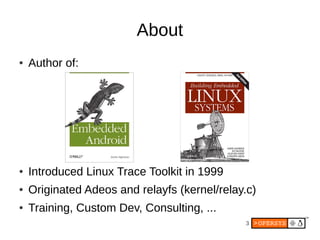
●   Author of:


●   Introduced Linux Trace Toolkit in 1999
●   Originated Adeos and relayfs (kernel/relay.c)
●   Training, Custom Dev, Consulting, ...
                                              3
About Android
●   Huge
●   Fast moving
●   Stealthy


                                  4
1. Android Concepts       9. JNI
2. Framework Intro        10.System Server
3. Overall Architecture   11.Calling on Services
4. System startup         12.Activity Manager
5. Linux Kernel           13.Binder
6. Hardware Support       14.HAL
7. Native User-Space      15.Stock AOSP Apps
8. Dalvik                 16.Case-in-Point
                                        5
1. Android Concepts
●   Components
●   Intents
●   Component lifecycle
●   Manifest file
●   Processes and threads
●   Remote procedure calls


                                    6
1.1. Components
●   1 App = N Components
●   Apps can use components of other applications
●   App processes are automagically started whenever any
    part is needed
●   Ergo: N entry points, !1, and !main()
●   Components:
    ●   Activities
    ●   Services
    ●   Broadcast Receivers
    ●   Content Providers
                                              7
1.2. Intents
●   Intent = asynchronous message w/ or w/o
    designated target
●   Like a polymorphic Unix signal, but w/o
    required target
●   Intents “payload” held in Intent Object
●   Intent Filters specified in Manifest file


                                                8
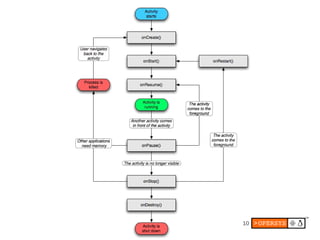
1.3. Component lifecycle
●   System automagically starts/stops/kills
    processes:
    ●   Entire system behaviour predicated on low memory
●   System triggers Lifecycle callbacks when
    relevant
●   Ergo: Must manage Component Lifecycle
●   Some Components are more complex to
    manage than others

                                             9
10
1.4. Manifest file
●   Informs system about app’s components
●   XML format
●   Always called AndroidManifest.xml
●   Activity = <activity> ... static
●   Service = <service> ... static
●   Broadcast Receiver:
    ●   Static = <receiver>
    ●   Dynamic = Context.registerReceiver()
●   Content Provider = <provider> ... static
                                               11
1.5. Processes and threads
●   Processes
    ●   Default: all callbacks to any app Component are issued to the main process thread
    ●   <activity>—<service>—<recipient>—<provider> have process attribute to override
        default
    ●   Do NOT perform blocking/long operations in main process thread:
        –   Spawn threads instead
    ●   Process termination/restart is at system’s discretion
    ●   Therefore:
        –   Must manage Component Lifecycle
●   Threads:
    ●   Create using the regular Java Thread Object
    ●   Android API provides thread helper classes:
        –   Looper: for running a message loop with a thread
        –   Handler: for processing messages
        –   HandlerThread: for setting up a thread with a message loop

                                                                         12
1.6. Remote procedure calls
●   Android RPCs = Binder mechanism
●   No Sys V IPC due to in-kernel resource leakage
●   Binder is a low-level functionality, not used as-is
●   Instead: must define interface using Interface
    Definition Language (IDL)
●   IDL fed to aidl Tool to generate Java interface
    definitions


                                           13
2. Framework Introduction
●   UI
●   Data storage
●   Security/Permissions
●   ... and much more ... :
    ●    Graphics
    ●    Audio and Video
    ●    Location and Maps
    ●    Bluetooth
    ●    NFC
                                 14
2.1. UI
●   Everything based on hierarchy of Views and
    ViewGroups (layouts)
●   Declared in XML or dynamically through Java
●   UI components:
    ●   Widgets
    ●   Event handlers
    ●   Menus
    ●   Dialogs
    ●   Notifications
    ●   ...
                                           15
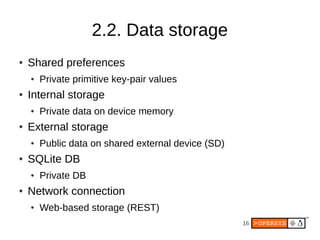
2.2. Data storage
●   Shared preferences
    ●   Private primitive key-pair values
●   Internal storage
    ●   Private data on device memory
●   External storage
    ●   Public data on shared external device (SD)
●   SQLite DB
    ●   Private DB
●   Network connection
    ●   Web-based storage (REST)
                                                     16
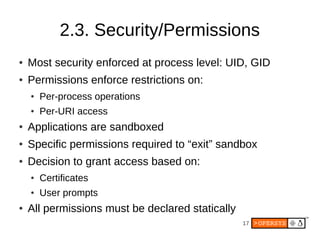
2.3. Security/Permissions
●   Most security enforced at process level: UID, GID
●   Permissions enforce restrictions on:
    ●   Per-process operations
    ●   Per-URI access
●   Applications are sandboxed
●   Specific permissions required to “exit” sandbox
●   Decision to grant access based on:
    ●   Certificates
    ●   User prompts
●   All permissions must be declared statically
                                                  17
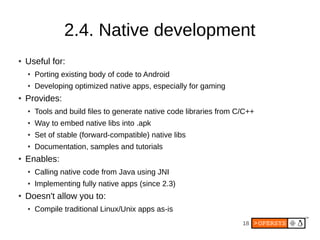
2.4. Native development
●   Useful for:
    ●   Porting existing body of code to Android
    ●   Developing optimized native apps, especially for gaming
●   Provides:
    ●   Tools and build files to generate native code libraries from C/C++
    ●   Way to embed native libs into .apk
    ●   Set of stable (forward-compatible) native libs
    ●   Documentation, samples and tutorials
●   Enables:
    ●   Calling native code from Java using JNI
    ●   Implementing fully native apps (since 2.3)
●   Doesn't allow you to:
    ●   Compile traditional Linux/Unix apps as-is
                                                                      18
3. Architecture
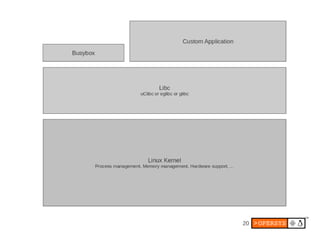
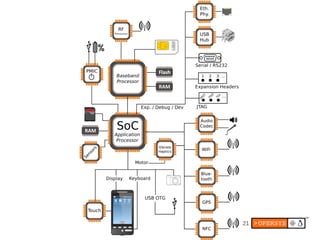
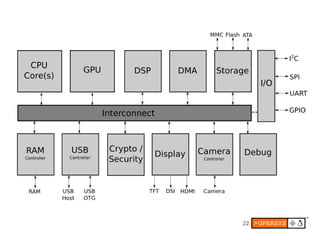
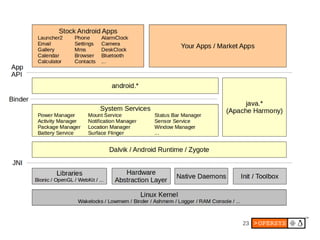
●   Embedded Linux
●   Modern phone/tablet
●   System-on-Chip (SoC)
●   Android


                                 19
20
21
22
23
4. System Startup
●   Bootloader
●   Kernel
●   Init
●   Zygote
●   System Server
●   Activity Manager
●   Launcher (Home)

                                  24
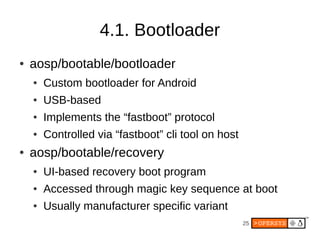
4.1. Bootloader
●   aosp/bootable/bootloader
    ●   Custom bootloader for Android
    ●   USB-based
    ●   Implements the “fastboot” protocol
    ●   Controlled via “fastboot” cli tool on host
●   aosp/bootable/recovery
    ●   UI-based recovery boot program
    ●   Accessed through magic key sequence at boot
    ●   Usually manufacturer specific variant
                                                     25
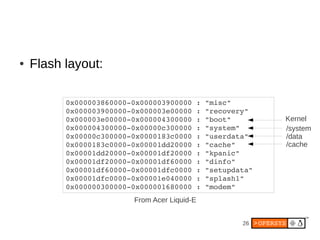
●   Flash layout:

          0x000003860000­0x000003900000 : "misc"
          0x000003900000­0x000003e00000 : "recovery"
          0x000003e00000­0x000004300000 : "boot"        Kernel
          0x000004300000­0x00000c300000 : "system"      /system
          0x00000c300000­0x0000183c0000 : "userdata"    /data
          0x0000183c0000­0x00001dd20000 : "cache"       /cache
          0x00001dd20000­0x00001df20000 : "kpanic"
          0x00001df20000­0x00001df60000 : "dinfo"
          0x00001df60000­0x00001dfc0000 : "setupdata"
          0x00001dfc0000­0x00001e040000 : "splash1"
          0x000000300000­0x000001680000 : "modem"
                         From Acer Liquid-E


                                                  26
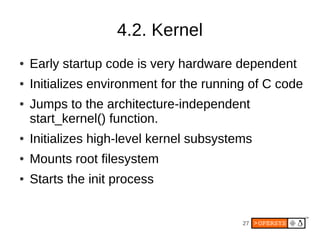
4.2. Kernel
●   Early startup code is very hardware dependent
●   Initializes environment for the running of C code
●   Jumps to the architecture-independent
    start_kernel() function.
●   Initializes high-level kernel subsystems
●   Mounts root filesystem
●   Starts the init process


                                          27
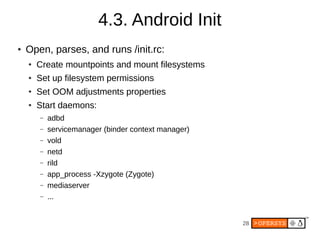
4.3. Android Init
●   Open, parses, and runs /init.rc:
    ●   Create mountpoints and mount filesystems
    ●   Set up filesystem permissions
    ●   Set OOM adjustments properties
    ●   Start daemons:
        –   adbd
        –   servicemanager (binder context manager)
        –   vold
        –   netd
        –   rild
        –   app_process -Xzygote (Zygote)
        –   mediaserver
        –   ...


                                                      28
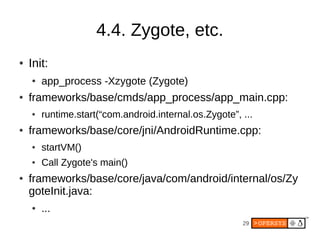
4.4. Zygote, etc.
●   Init:
    ●   app_process -Xzygote (Zygote)
●   frameworks/base/cmds/app_process/app_main.cpp:
    ●   runtime.start(“com.android.internal.os.Zygote”, ...
●   frameworks/base/core/jni/AndroidRuntime.cpp:
    ●   startVM()
    ●   Call Zygote's main()
●   frameworks/base/core/java/com/android/internal/os/Zy
    goteInit.java:
    ●   ...
                                                        29
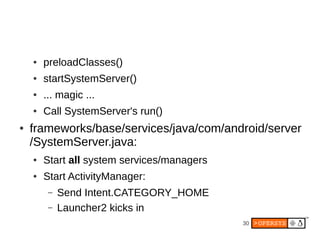
●   preloadClasses()
    ●   startSystemServer()
    ●   ... magic ...
    ●   Call SystemServer's run()
●   frameworks/base/services/java/com/android/server
    /SystemServer.java:
    ●   Start all system services/managers
    ●   Start ActivityManager:
         –   Send Intent.CATEGORY_HOME
         –   Launcher2 kicks in
                                             30
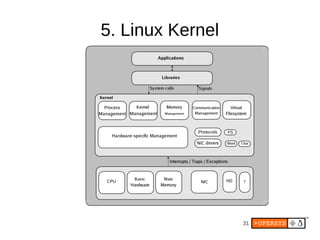
5. Linux Kernel


                  31
5.1. Androidisms
●   Wakelocks
●   lowmem handler
●   Binder
●   ashmem – Anonymous Shared Memory
●   RAM console
●   Logger
●   ...

                                   32
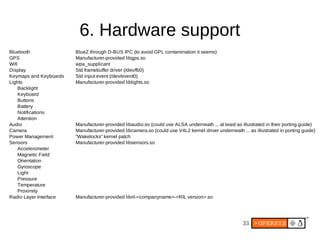
6. Hardware support
Bluetooth               BlueZ through D-BUS IPC (to avoid GPL contamination it seems)
GPS                     Manufacturer-provided libgps.so
Wifi                    wpa_supplicant
Display                 Std framebuffer driver (/dev/fb0)
Keymaps and Keyboards   Std input event (/dev/event0)
Lights                  Manufacturer-provided liblights.so
     Backlight
     Keyboard
     Buttons
     Battery
     Notifications
     Attention
Audio                   Manufacturer-provided libaudio.so (could use ALSA underneath ... at least as illustrated in their porting guide)
Camera                  Manufacturer-provided libcamera.so (could use V4L2 kernel driver underneath ... as illustrated in porting guide)
Power Management        “Wakelocks” kernel patch
Sensors                 Manufacturer-provided libsensors.so
     Accelerometer
     Magnetic Field
     Orientation
     Gyroscope
     Light
     Pressure
     Temperature
     Proximity
Radio Layer Interface   Manufacturer-provided libril-<companyname>-<RIL version>.so


                                                                                                      33
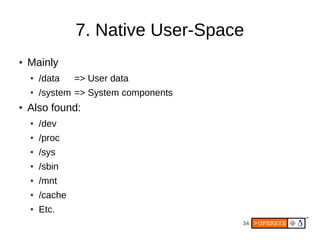
7. Native User-Space
●   Mainly
    ●   /data    => User data
    ●   /system => System components
●   Also found:
    ●   /dev
    ●   /proc
    ●   /sys
    ●   /sbin
    ●   /mnt
    ●   /cache
    ●   Etc.
                                       34
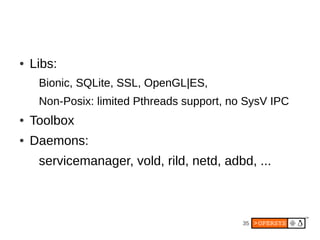
●   Libs:
     Bionic, SQLite, SSL, OpenGL|ES,
     Non-Posix: limited Pthreads support, no SysV IPC
●   Toolbox
●   Daemons:
     servicemanager, vold, rild, netd, adbd, ...


                                            35
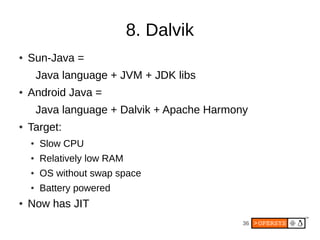
8. Dalvik
●   Sun-Java =
        Java language + JVM + JDK libs
●   Android Java =
        Java language + Dalvik + Apache Harmony
●   Target:
    ●   Slow CPU
    ●   Relatively low RAM
    ●   OS without swap space
    ●   Battery powered
●   Now has JIT
                                              36
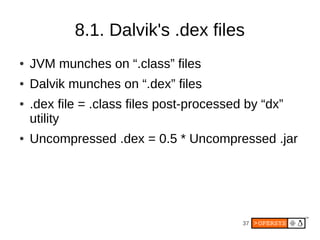
8.1. Dalvik's .dex files
●   JVM munches on “.class” files
●   Dalvik munches on “.dex” files
●   .dex file = .class files post-processed by “dx”
    utility
●   Uncompressed .dex = 0.5 * Uncompressed .jar


                                           37
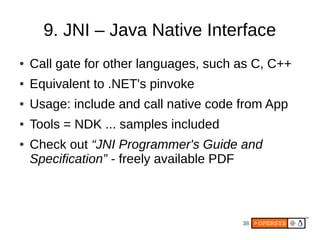
9. JNI – Java Native Interface
●   Call gate for other languages, such as C, C++
●   Equivalent to .NET's pinvoke
●   Usage: include and call native code from App
●   Tools = NDK ... samples included
●   Check out “JNI Programmer's Guide and
    Specification” - freely available PDF


                                        38
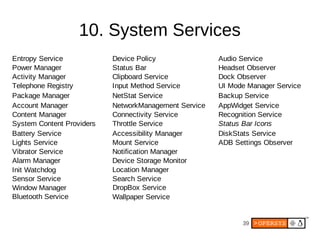
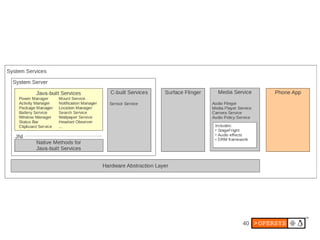
10. System Services
Entropy Service            Device Policy               Audio Service
Power Manager              Status Bar                  Headset Observer
Activity Manager           Clipboard Service           Dock Observer
Telephone Registry         Input Method Service        UI Mode Manager Service
Package Manager            NetStat Service             Backup Service
Account Manager            NetworkManagement Service   AppWidget Service
Content Manager            Connectivity Service        Recognition Service
System Content Providers   Throttle Service            Status Bar Icons
Battery Service            Accessibility Manager       DiskStats Service
Lights Service             Mount Service               ADB Settings Observer
Vibrator Service           Notification Manager
Alarm Manager              Device Storage Monitor
Init Watchdog              Location Manager
Sensor Service             Search Service
Window Manager             DropBox Service
Bluetooth Service          Wallpaper Service


                                                             39
40
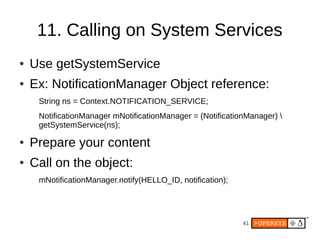
11. Calling on System Services
●   Use getSystemService
●   Ex: NotificationManager Object reference:
     String ns = Context.NOTIFICATION_SERVICE;
     NotificationManager mNotificationManager = (NotificationManager) 
     getSystemService(ns);

●   Prepare your content
●   Call on the object:
     mNotificationManager.notify(HELLO_ID, notification);


                                                            41
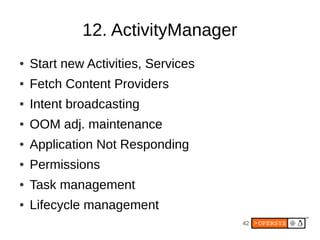
12. ActivityManager
●   Start new Activities, Services
●   Fetch Content Providers
●   Intent broadcasting
●   OOM adj. maintenance
●   Application Not Responding
●   Permissions
●   Task management
●   Lifecycle management
                                     42
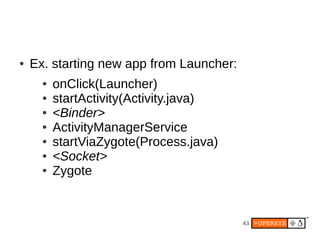
●   Ex. starting new app from Launcher:
      ●   onClick(Launcher)
      ●   startActivity(Activity.java)
      ●   <Binder>
      ●   ActivityManagerService
      ●   startViaZygote(Process.java)
      ●   <Socket>
      ●   Zygote


                                          43
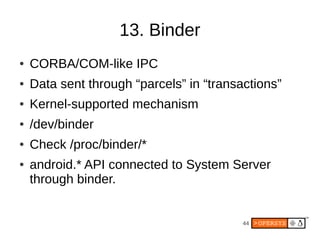
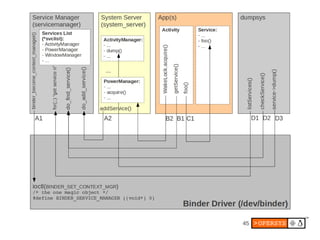
13. Binder
●   CORBA/COM-like IPC
●   Data sent through “parcels” in “transactions”
●   Kernel-supported mechanism
●   /dev/binder
●   Check /proc/binder/*
●   android.* API connected to System Server
    through binder.


                                          44
45
14. Hardware Abstraction Layer
                           /frameworks/base/core/...


                           /frameworks/base/services/java/...
AOSP-provided
    ASL
                           /frameworks/base/services/jni/


                           /hardware/libhardware/

                           /device/[MANUF.]/[DEVICE]
Manuf.-provided            /sdk/emulator/
Manuf. license
                           Kernel or module
Manuf.-provided
 GPL-license


                                     46
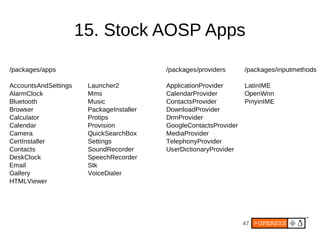
15. Stock AOSP Apps

/packages/apps                            /packages/providers      /packages/inputmethods

AccountsAndSettings    Launcher2          ApplicationProvider      LatinIME
AlarmClock             Mms                CalendarProvider         OpenWnn
Bluetooth              Music              ContactsProvider         PinyinIME
Browser                PackageInstaller   DownloadProvider
Calculator             Protips            DrmProvider
Calendar               Provision          GoogleContactsProvider
Camera                 QuickSearchBox     MediaProvider
CertInstaller          Settings           TelephonyProvider
Contacts               SoundRecorder      UserDictionaryProvider
DeskClock              SpeechRecorder
Email                  Stk
Gallery                VoiceDialer
HTMLViewer


                                                                   47
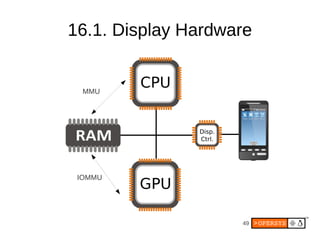
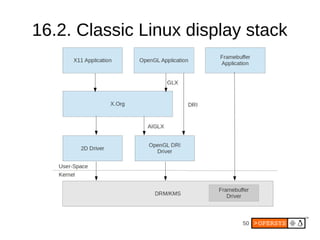
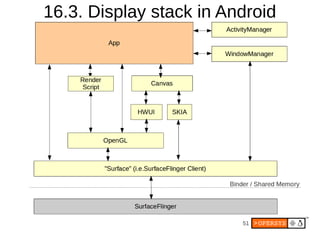
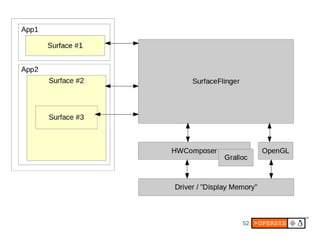
16. Case-in-point: Display Architecture
●   Display Hardware
●   Classic Linux display stack
●   Display stack in Android


                                  48
16.1. Display Hardware


  MMU


 IOMMU


                    49
16.2. Classic Linux display stack


                           50
16.3. Display stack in Android


                         51
52
Thank you ...


karim.yaghmour@opersys.com


                         53

Android Internals at Linaro Connect Asia 2013

  • 1.
    Embedded Android Workshop Part 1 - Android Internals Linaro Connect Asia 2013 Karim Yaghmour @karimyaghmour 1
  • 2.
    These slides aremade available to you under a Creative Commons Delivered and/or customized by Share-Alike 3.0 license. The full terms of this license are here: https://creativecommons.org/licenses/by-sa/3.0/ Attribution requirements and misc., PLEASE READ: ● This slide must remain as-is in this specific location (slide #2), everything else you are free to change; including the logo :-) ● Use of figures in other documents must feature the below “Originals at” URL immediately under that figure and the below copyright notice where appropriate. ● You are free to fill in the “Delivered and/or customized by” space on the right as you see fit. ● You are FORBIDEN from using the default “About” slide as-is or any of its contents. (C) Copyright 2010-2013, Opersys inc. These slides created by: Karim Yaghmour Originals at: www.opersys.com/community/docs 2
  • 3.
    About ● Author of: ● Introduced Linux Trace Toolkit in 1999 ● Originated Adeos and relayfs (kernel/relay.c) ● Training, Custom Dev, Consulting, ... 3
  • 4.
    About Android ● Huge ● Fast moving ● Stealthy 4
  • 5.
    1. Android Concepts 9. JNI 2. Framework Intro 10.System Server 3. Overall Architecture 11.Calling on Services 4. System startup 12.Activity Manager 5. Linux Kernel 13.Binder 6. Hardware Support 14.HAL 7. Native User-Space 15.Stock AOSP Apps 8. Dalvik 16.Case-in-Point 5
  • 6.
    1. Android Concepts ● Components ● Intents ● Component lifecycle ● Manifest file ● Processes and threads ● Remote procedure calls 6
  • 7.
    1.1. Components ● 1 App = N Components ● Apps can use components of other applications ● App processes are automagically started whenever any part is needed ● Ergo: N entry points, !1, and !main() ● Components: ● Activities ● Services ● Broadcast Receivers ● Content Providers 7
  • 8.
    1.2. Intents ● Intent = asynchronous message w/ or w/o designated target ● Like a polymorphic Unix signal, but w/o required target ● Intents “payload” held in Intent Object ● Intent Filters specified in Manifest file 8
  • 9.
    1.3. Component lifecycle ● System automagically starts/stops/kills processes: ● Entire system behaviour predicated on low memory ● System triggers Lifecycle callbacks when relevant ● Ergo: Must manage Component Lifecycle ● Some Components are more complex to manage than others 9
  • 10.
  • 11.
    1.4. Manifest file ● Informs system about app’s components ● XML format ● Always called AndroidManifest.xml ● Activity = <activity> ... static ● Service = <service> ... static ● Broadcast Receiver: ● Static = <receiver> ● Dynamic = Context.registerReceiver() ● Content Provider = <provider> ... static 11
  • 12.
    1.5. Processes andthreads ● Processes ● Default: all callbacks to any app Component are issued to the main process thread ● <activity>—<service>—<recipient>—<provider> have process attribute to override default ● Do NOT perform blocking/long operations in main process thread: – Spawn threads instead ● Process termination/restart is at system’s discretion ● Therefore: – Must manage Component Lifecycle ● Threads: ● Create using the regular Java Thread Object ● Android API provides thread helper classes: – Looper: for running a message loop with a thread – Handler: for processing messages – HandlerThread: for setting up a thread with a message loop 12
  • 13.
    1.6. Remote procedurecalls ● Android RPCs = Binder mechanism ● No Sys V IPC due to in-kernel resource leakage ● Binder is a low-level functionality, not used as-is ● Instead: must define interface using Interface Definition Language (IDL) ● IDL fed to aidl Tool to generate Java interface definitions 13
  • 14.
    2. Framework Introduction ● UI ● Data storage ● Security/Permissions ● ... and much more ... : ● Graphics ● Audio and Video ● Location and Maps ● Bluetooth ● NFC 14
  • 15.
    2.1. UI ● Everything based on hierarchy of Views and ViewGroups (layouts) ● Declared in XML or dynamically through Java ● UI components: ● Widgets ● Event handlers ● Menus ● Dialogs ● Notifications ● ... 15
  • 16.
    2.2. Data storage ● Shared preferences ● Private primitive key-pair values ● Internal storage ● Private data on device memory ● External storage ● Public data on shared external device (SD) ● SQLite DB ● Private DB ● Network connection ● Web-based storage (REST) 16
  • 17.
    2.3. Security/Permissions ● Most security enforced at process level: UID, GID ● Permissions enforce restrictions on: ● Per-process operations ● Per-URI access ● Applications are sandboxed ● Specific permissions required to “exit” sandbox ● Decision to grant access based on: ● Certificates ● User prompts ● All permissions must be declared statically 17
  • 18.
    2.4. Native development ● Useful for: ● Porting existing body of code to Android ● Developing optimized native apps, especially for gaming ● Provides: ● Tools and build files to generate native code libraries from C/C++ ● Way to embed native libs into .apk ● Set of stable (forward-compatible) native libs ● Documentation, samples and tutorials ● Enables: ● Calling native code from Java using JNI ● Implementing fully native apps (since 2.3) ● Doesn't allow you to: ● Compile traditional Linux/Unix apps as-is 18
  • 19.
    3. Architecture ● Embedded Linux ● Modern phone/tablet ● System-on-Chip (SoC) ● Android 19
  • 20.
  • 21.
  • 22.
  • 23.
  • 24.
    4. System Startup ● Bootloader ● Kernel ● Init ● Zygote ● System Server ● Activity Manager ● Launcher (Home) 24
  • 25.
    4.1. Bootloader ● aosp/bootable/bootloader ● Custom bootloader for Android ● USB-based ● Implements the “fastboot” protocol ● Controlled via “fastboot” cli tool on host ● aosp/bootable/recovery ● UI-based recovery boot program ● Accessed through magic key sequence at boot ● Usually manufacturer specific variant 25
  • 26.
    Flash layout: 0x000003860000­0x000003900000 : "misc" 0x000003900000­0x000003e00000 : "recovery" 0x000003e00000­0x000004300000 : "boot" Kernel 0x000004300000­0x00000c300000 : "system" /system 0x00000c300000­0x0000183c0000 : "userdata" /data 0x0000183c0000­0x00001dd20000 : "cache" /cache 0x00001dd20000­0x00001df20000 : "kpanic" 0x00001df20000­0x00001df60000 : "dinfo" 0x00001df60000­0x00001dfc0000 : "setupdata" 0x00001dfc0000­0x00001e040000 : "splash1" 0x000000300000­0x000001680000 : "modem" From Acer Liquid-E 26
  • 27.
    4.2. Kernel ● Early startup code is very hardware dependent ● Initializes environment for the running of C code ● Jumps to the architecture-independent start_kernel() function. ● Initializes high-level kernel subsystems ● Mounts root filesystem ● Starts the init process 27
  • 28.
    4.3. Android Init ● Open, parses, and runs /init.rc: ● Create mountpoints and mount filesystems ● Set up filesystem permissions ● Set OOM adjustments properties ● Start daemons: – adbd – servicemanager (binder context manager) – vold – netd – rild – app_process -Xzygote (Zygote) – mediaserver – ... 28
  • 29.
    4.4. Zygote, etc. ● Init: ● app_process -Xzygote (Zygote) ● frameworks/base/cmds/app_process/app_main.cpp: ● runtime.start(“com.android.internal.os.Zygote”, ... ● frameworks/base/core/jni/AndroidRuntime.cpp: ● startVM() ● Call Zygote's main() ● frameworks/base/core/java/com/android/internal/os/Zy goteInit.java: ● ... 29
  • 30.
    preloadClasses() ● startSystemServer() ● ... magic ... ● Call SystemServer's run() ● frameworks/base/services/java/com/android/server /SystemServer.java: ● Start all system services/managers ● Start ActivityManager: – Send Intent.CATEGORY_HOME – Launcher2 kicks in 30
  • 31.
  • 32.
    5.1. Androidisms ● Wakelocks ● lowmem handler ● Binder ● ashmem – Anonymous Shared Memory ● RAM console ● Logger ● ... 32
  • 33.
    6. Hardware support Bluetooth BlueZ through D-BUS IPC (to avoid GPL contamination it seems) GPS Manufacturer-provided libgps.so Wifi wpa_supplicant Display Std framebuffer driver (/dev/fb0) Keymaps and Keyboards Std input event (/dev/event0) Lights Manufacturer-provided liblights.so Backlight Keyboard Buttons Battery Notifications Attention Audio Manufacturer-provided libaudio.so (could use ALSA underneath ... at least as illustrated in their porting guide) Camera Manufacturer-provided libcamera.so (could use V4L2 kernel driver underneath ... as illustrated in porting guide) Power Management “Wakelocks” kernel patch Sensors Manufacturer-provided libsensors.so Accelerometer Magnetic Field Orientation Gyroscope Light Pressure Temperature Proximity Radio Layer Interface Manufacturer-provided libril-<companyname>-<RIL version>.so 33
  • 34.
    7. Native User-Space ● Mainly ● /data => User data ● /system => System components ● Also found: ● /dev ● /proc ● /sys ● /sbin ● /mnt ● /cache ● Etc. 34
  • 35.
    Libs: Bionic, SQLite, SSL, OpenGL|ES, Non-Posix: limited Pthreads support, no SysV IPC ● Toolbox ● Daemons: servicemanager, vold, rild, netd, adbd, ... 35
  • 36.
    8. Dalvik ● Sun-Java = Java language + JVM + JDK libs ● Android Java = Java language + Dalvik + Apache Harmony ● Target: ● Slow CPU ● Relatively low RAM ● OS without swap space ● Battery powered ● Now has JIT 36
  • 37.
    8.1. Dalvik's .dexfiles ● JVM munches on “.class” files ● Dalvik munches on “.dex” files ● .dex file = .class files post-processed by “dx” utility ● Uncompressed .dex = 0.5 * Uncompressed .jar 37
  • 38.
    9. JNI –Java Native Interface ● Call gate for other languages, such as C, C++ ● Equivalent to .NET's pinvoke ● Usage: include and call native code from App ● Tools = NDK ... samples included ● Check out “JNI Programmer's Guide and Specification” - freely available PDF 38
  • 39.
    10. System Services EntropyService Device Policy Audio Service Power Manager Status Bar Headset Observer Activity Manager Clipboard Service Dock Observer Telephone Registry Input Method Service UI Mode Manager Service Package Manager NetStat Service Backup Service Account Manager NetworkManagement Service AppWidget Service Content Manager Connectivity Service Recognition Service System Content Providers Throttle Service Status Bar Icons Battery Service Accessibility Manager DiskStats Service Lights Service Mount Service ADB Settings Observer Vibrator Service Notification Manager Alarm Manager Device Storage Monitor Init Watchdog Location Manager Sensor Service Search Service Window Manager DropBox Service Bluetooth Service Wallpaper Service 39
  • 40.
  • 41.
    11. Calling onSystem Services ● Use getSystemService ● Ex: NotificationManager Object reference: String ns = Context.NOTIFICATION_SERVICE; NotificationManager mNotificationManager = (NotificationManager) getSystemService(ns); ● Prepare your content ● Call on the object: mNotificationManager.notify(HELLO_ID, notification); 41
  • 42.
    12. ActivityManager ● Start new Activities, Services ● Fetch Content Providers ● Intent broadcasting ● OOM adj. maintenance ● Application Not Responding ● Permissions ● Task management ● Lifecycle management 42
  • 43.
    Ex. starting new app from Launcher: ● onClick(Launcher) ● startActivity(Activity.java) ● <Binder> ● ActivityManagerService ● startViaZygote(Process.java) ● <Socket> ● Zygote 43
  • 44.
    13. Binder ● CORBA/COM-like IPC ● Data sent through “parcels” in “transactions” ● Kernel-supported mechanism ● /dev/binder ● Check /proc/binder/* ● android.* API connected to System Server through binder. 44
  • 45.
  • 46.
    14. Hardware AbstractionLayer /frameworks/base/core/... /frameworks/base/services/java/... AOSP-provided ASL /frameworks/base/services/jni/ /hardware/libhardware/ /device/[MANUF.]/[DEVICE] Manuf.-provided /sdk/emulator/ Manuf. license Kernel or module Manuf.-provided GPL-license 46
  • 47.
    15. Stock AOSPApps /packages/apps /packages/providers /packages/inputmethods AccountsAndSettings Launcher2 ApplicationProvider LatinIME AlarmClock Mms CalendarProvider OpenWnn Bluetooth Music ContactsProvider PinyinIME Browser PackageInstaller DownloadProvider Calculator Protips DrmProvider Calendar Provision GoogleContactsProvider Camera QuickSearchBox MediaProvider CertInstaller Settings TelephonyProvider Contacts SoundRecorder UserDictionaryProvider DeskClock SpeechRecorder Email Stk Gallery VoiceDialer HTMLViewer 47
  • 48.
    16. Case-in-point: DisplayArchitecture ● Display Hardware ● Classic Linux display stack ● Display stack in Android 48
  • 49.
  • 50.
    16.2. Classic Linuxdisplay stack 50
  • 51.
    16.3. Display stackin Android 51
  • 52.
  • 53.