Kernel
for your device
Arnaud Patard
arnaud.patard@hupstream.com
#1Thoughtsabouthow
tochoosethekernel
●
An ideal solution ?
Good hardware support for the SoC ...
... but you need to follow the reference design
●
Based on SoC + distribution
... stable but oldish environment, not supported by the
distribution
#1 KernelfromBSP ?
●
Stable but old kernel due to BSP release time
●
Proprietary drivers included
●
Can use quite big and specific hacks in kernel for better
performance
#1 KernelfromBSP ?
●
Support of chips/peripherals native in the kernel but not
necessary good for the SoC support
●
Get all the newest fun things
#1 Kernelfromkernel.org?
●
Get some extra breakages
SoC vendor can merge specific patches working for a
given kernel configuration
●
See cd282ef56967790aaaab89aa595f27a011091cc2
commit
#1 Kernelfromkernel.org?
●
Different timelines between kernel.org and distributions
upstream kernel is changing too quickly (new major
release ~ every 2 months)
●
Linus usually says that people should use kernels from
distributions
#1 Kernelfromdistribution?
●
Some troubles with proprietary drivers
Ex : emgd together with some Xorg versions
●
But gains all what makes a distribution and the benefit
from the kernel support of the distribution
#1 Kernelfromdistribution?
●
May need some more work than other choices
You may need some small patches with upstream or BSP but
the kernel of the distribution may be quite old so missing a
lot of support
●
Includes some more or less experimental patches
#1 Anecessaryreflexionbeforestarting
●
The decision will impact the maintainance cycle and
process : hard to go backward
●
It often ends up like
using BSP on non x86 platform
using distribution kernel for a x86 platform
... but no rules, depending on every specificities of the
platform
#2Workingwiththekernel
#1 UsingBSPkernel
●
Just add the support for your board and it’s done !
●
But you have to use the build sytem from the BSP
LTIB, weird stuff mixing rpms and spec files looking like
makefiles
#1 UsingBSPkernel
●
Modifying the kernel may not be easy : how to change the
configuration, how to patch
●
All is hardware specific so if your platform changes, you
might start again from scratch
Ex : kernel for SoC S is 2.6.31 but update is done on 3.0
#1 UsingBSPkernel
●
Uneasy to use for developing : obscure build systems may
force you to rebuild everything to get your kernel
●
Possibly poor documentation
●
Use of abstraction layer so that the same code is used
between kernel and uboot
Makes it just terrible to understand : how it works / what
to modify.
#2 Usingkernel+patches(distro,upstream)
●
For security fixes (depends on the use / threat model)
●
Being free to use whatever newer version of the kernel
provided it fits with your needs
#2 Usingkernel+patches(distro,upstream)
●
You have to learn how to package the kernel and make sure
it integrates fine
●
Some usefull tools like make deb-pkg or make rpm-pkg
●
You need to know the required kernel configuration
options
Ex : https://lkml.org/lkml/2012/7/13/369
●
Make it easy with your distribution for proprietary kernel
drivers – Ex : dkms
#3Longtermwhat ?
#1 UsingBSP
●
No futur ! Nearly no evolution planned
●
Want to update to a newer kernel ?
Back to square 1 : try to use an upstream kernel and
cross your fingers
●
Need to backport support/functionnalities from newer
kernel ? A big pain to backport / limit to what can be
backported
#2 Usingkernel+patches(distro,upstream)
●
"Just" rebase patches. It's easy as long as changes has
been properly handled
Use git or make patches with things like quilt or guilt
1 patch per fix or hardware change
●
You have a lot of modifications ?
A lot of work but it's possible to do it as your current
work doesn't depends on external vendor patchset
#2 Usingkernel+patches(distro,upstream)
●
You can keep your good old kernel on newer distribution
but distro may enable some support in libc/Xorg/... thus
require newer kernels
●
Some changes may introduce some forced changes on
other parts
#4Goodpractice
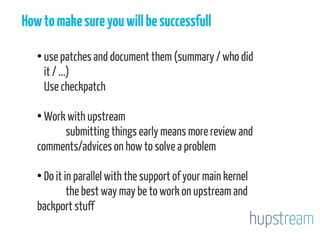
Howtomakesureyouwillbesuccessfull
●
use patches and document them (summary / who did
it / ...)
Use checkpatch
●
Work with upstream
submitting things early means more review and
comments/advices on how to solve a problem
●
Do it in parallel with the support of your main kernel
the best way may be to work on upstream and
backport stuff
#2 Usingkernel+patches(distro,upstream)
lockref: use cmpxchg64 explicitly for lockless updates
The cmpxchg() function tends not to support 64-bit arguments on 32-bit
architectures. This could be either due to use of unsigned long
arguments (like on ARM) or lack of instruction support (cmpxchgq on
x86). However, these architectures may implement a specific cmpxchg64()
function to provide 64-bit cmpxchg support instead.
Since the lockref code requires a 64-bit cmpxchg and relies on the
architecture selecting ARCH_USE_CMPXCHG_LOCKREF, move to using cmpxchg64
instead of cmpxchg and allow 32-bit architectures to make use of the
lockless lockref implementation.
Cc: Waiman Long <Waiman.Long@hp.com>
Signed-off-by: Will Deacon <will.deacon@arm.com>
Signed-off-by: Linus Torvalds <torvalds@linux-foundation.org>
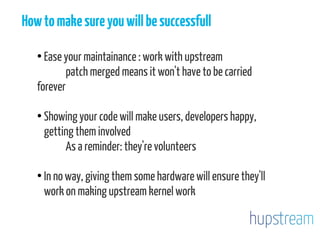
Howtomakesureyouwillbesuccessfull
●
Ease your maintainance : work with upstream
patch merged means it won't have to be carried
forever
●
Showing your code will make users, developers happy,
getting them involved
As a reminder: they're volunteers
●
In no way, giving them some hardware will ensure they'll
work on making upstream kernel work
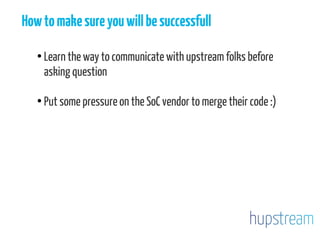
Howtomakesureyouwillbesuccessfull
●
Learn the way to communicate with upstream folks before
asking question
●
Put some pressure on the SoC vendor to merge their code :)

Kernel Recipes 2013 - Kernel for your device

  • 1.
    Kernel for your device ArnaudPatard arnaud.patard@hupstream.com
  • 2.
  • 3.
    ● An ideal solution ? Goodhardware support for the SoC ... ... but you need to follow the reference design ● Based on SoC + distribution ... stable but oldish environment, not supported by the distribution #1 KernelfromBSP ?
  • 4.
    ● Stable but oldkernel due to BSP release time ● Proprietary drivers included ● Can use quite big and specific hacks in kernel for better performance #1 KernelfromBSP ?
  • 5.
    ● Support of chips/peripheralsnative in the kernel but not necessary good for the SoC support ● Get all the newest fun things #1 Kernelfromkernel.org?
  • 6.
    #1 Kernelfromkernel.org? ● Get someextra breakages SoC vendor can merge specific patches working for a given kernel configuration ● See cd282ef56967790aaaab89aa595f27a011091cc2 commit
  • 7.
    #1 Kernelfromkernel.org? ● Different timelinesbetween kernel.org and distributions upstream kernel is changing too quickly (new major release ~ every 2 months) ● Linus usually says that people should use kernels from distributions
  • 8.
    #1 Kernelfromdistribution? ● Some troubleswith proprietary drivers Ex : emgd together with some Xorg versions ● But gains all what makes a distribution and the benefit from the kernel support of the distribution
  • 9.
    #1 Kernelfromdistribution? ● May needsome more work than other choices You may need some small patches with upstream or BSP but the kernel of the distribution may be quite old so missing a lot of support ● Includes some more or less experimental patches
  • 10.
    #1 Anecessaryreflexionbeforestarting ● The decisionwill impact the maintainance cycle and process : hard to go backward ● It often ends up like using BSP on non x86 platform using distribution kernel for a x86 platform ... but no rules, depending on every specificities of the platform
  • 11.
  • 12.
    #1 UsingBSPkernel ● Just addthe support for your board and it’s done ! ● But you have to use the build sytem from the BSP LTIB, weird stuff mixing rpms and spec files looking like makefiles
  • 13.
    #1 UsingBSPkernel ● Modifying thekernel may not be easy : how to change the configuration, how to patch ● All is hardware specific so if your platform changes, you might start again from scratch Ex : kernel for SoC S is 2.6.31 but update is done on 3.0
  • 14.
    #1 UsingBSPkernel ● Uneasy touse for developing : obscure build systems may force you to rebuild everything to get your kernel ● Possibly poor documentation ● Use of abstraction layer so that the same code is used between kernel and uboot Makes it just terrible to understand : how it works / what to modify.
  • 15.
    #2 Usingkernel+patches(distro,upstream) ● For securityfixes (depends on the use / threat model) ● Being free to use whatever newer version of the kernel provided it fits with your needs
  • 16.
    #2 Usingkernel+patches(distro,upstream) ● You haveto learn how to package the kernel and make sure it integrates fine ● Some usefull tools like make deb-pkg or make rpm-pkg ● You need to know the required kernel configuration options Ex : https://lkml.org/lkml/2012/7/13/369 ● Make it easy with your distribution for proprietary kernel drivers – Ex : dkms
  • 17.
  • 18.
    #1 UsingBSP ● No futur !Nearly no evolution planned ● Want to update to a newer kernel ? Back to square 1 : try to use an upstream kernel and cross your fingers ● Need to backport support/functionnalities from newer kernel ? A big pain to backport / limit to what can be backported
  • 19.
    #2 Usingkernel+patches(distro,upstream) ● "Just" rebasepatches. It's easy as long as changes has been properly handled Use git or make patches with things like quilt or guilt 1 patch per fix or hardware change ● You have a lot of modifications ? A lot of work but it's possible to do it as your current work doesn't depends on external vendor patchset
  • 20.
    #2 Usingkernel+patches(distro,upstream) ● You cankeep your good old kernel on newer distribution but distro may enable some support in libc/Xorg/... thus require newer kernels ● Some changes may introduce some forced changes on other parts
  • 21.
  • 22.
    Howtomakesureyouwillbesuccessfull ● use patches anddocument them (summary / who did it / ...) Use checkpatch ● Work with upstream submitting things early means more review and comments/advices on how to solve a problem ● Do it in parallel with the support of your main kernel the best way may be to work on upstream and backport stuff
  • 23.
    #2 Usingkernel+patches(distro,upstream) lockref: usecmpxchg64 explicitly for lockless updates The cmpxchg() function tends not to support 64-bit arguments on 32-bit architectures. This could be either due to use of unsigned long arguments (like on ARM) or lack of instruction support (cmpxchgq on x86). However, these architectures may implement a specific cmpxchg64() function to provide 64-bit cmpxchg support instead. Since the lockref code requires a 64-bit cmpxchg and relies on the architecture selecting ARCH_USE_CMPXCHG_LOCKREF, move to using cmpxchg64 instead of cmpxchg and allow 32-bit architectures to make use of the lockless lockref implementation. Cc: Waiman Long <Waiman.Long@hp.com> Signed-off-by: Will Deacon <will.deacon@arm.com> Signed-off-by: Linus Torvalds <torvalds@linux-foundation.org>
  • 24.
    Howtomakesureyouwillbesuccessfull ● Ease your maintainance :work with upstream patch merged means it won't have to be carried forever ● Showing your code will make users, developers happy, getting them involved As a reminder: they're volunteers ● In no way, giving them some hardware will ensure they'll work on making upstream kernel work
  • 25.
    Howtomakesureyouwillbesuccessfull ● Learn the wayto communicate with upstream folks before asking question ● Put some pressure on the SoC vendor to merge their code :)