• Autoclave name comes from Greek auto- meaning self,
and Latin clavis- meaning key, thus a self-locking
device. For safety reasons most are also sealed
manually from outside.
• The temperature of the steam in this method is lower
when compared with Dry Heat Sterilization (DHS &
Tunnel, etc.), but the high pressure helps with effective
sterilization to take place in half an hour or less time
duration.
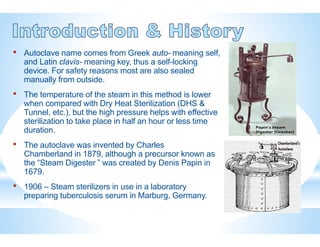
• The autoclave was invented by Charles
Chamberland in 1879, although a precursor known as
the “Steam Digester ” was created by Denis Papin in
1679.
• 1906 – Steam sterilizers in use in a laboratory
preparing tuberculosis serum in Marburg, Germany.
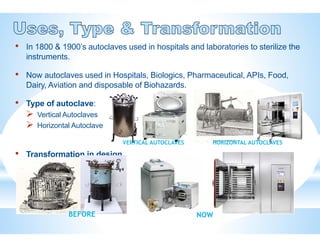
• In 1800 & 1900’s autoclaves used in hospitals and laboratories to sterilize the
instruments.
• Now autoclaves used in Hospitals, Biologics, Pharmaceutical, APIs, Food,
Dairy, Aviation and disposable of Biohazards.
• Type of autoclave:
 Vertical Autoclaves
 Horizontal Autoclave
• Transformation in design
VERTICAL AUTOCLAVES HORIZONTAL AUTOCLAVES
BEFORE NOW
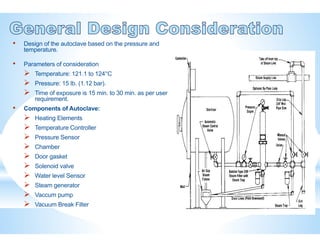
• Design of the autoclave based on the pressure and
temperature.
• Parameters of consideration
 Temperature: 121.1 to 124°C
 Pressure: 15 lb. (1.12 bar).
 Time of exposure is 15 min. to 30 min. as per user
requirement.
• Components of Autoclave:
 Heating Elements
 Temperature Controller
 Pressure Sensor
 Chamber
 Door gasket
 Solenoid valve
 Water level Sensor
 Steam generator
 Vaccum pump
 Vacuum Break Filter
• Any process that effectively kills, removed or eliminates all form of life and
other biological agents (Such as Fungi, Bacteria, Viruses) & their spores from a
surface, equipment, or culture medium through Heat, chemical, radiation and
filtration.
• The sterility of any product is defined by the probability of a viable
microorganism on the product after it has been sterilized. This probability is
referred to as a sterility assurance level (SAL). An SAL is normally expressed
as 10-n with historically.
• Type of Sterilization:
 Heat: 1. MHS, 2. DHS, 3. Flaming, 4. Incineration, 5. Tyndallisation
 Chemical: 1. Ethylene Oxide, 2. Nitrogen Dioxide, 3. Ozone, 4. Hydrogen
Para oxide, 5. Glutaraldehyde & Formaldehyde, 6. Par Acetic Acid
 Radiation: 1. Non-Ionizing Radiation, 2. Ionizing Radiation
 Filtration: Sterile grade filters
• When water is heated in a closed container, saturated steam is produced
under pressure.
• According to Boyle’s Law, when volume of the steam, is kept constant, the
temperature is directly proportional to pressure.
• If the pressure is reduced it boils at a lower temperature. If the pressure rises, it
boils at a greater temperature.
• At 15 lbs pressure 121°C temperature can be obtained.
• Moist heat coagulates cell proteins of the microorganisms and thus kills all the
living entities (including spores) in 15 to 20 minutes.
• Hot saturated steam is efficient means of destroying microorganisms, since it
penetrates rapidly and gives up its latent heat as it condenses on the cooler
objects.
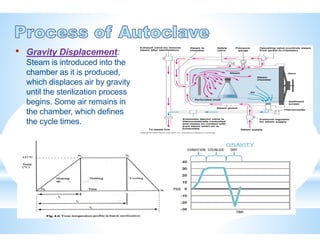
• Gravity Displacement:
Steam is introduced into the
chamber as it is produced,
which displaces air by gravity
until the sterilization process
begins. Some air remains in
the chamber, which defines
the cycle times.
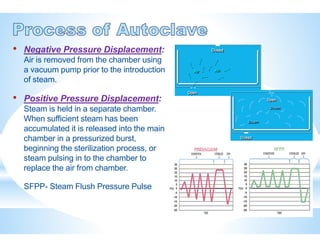
• Negative Pressure Displacement:
Air is removed from the chamber using
a vacuum pump prior to the introduction
of steam.
• Positive Pressure Displacement:
Steam is held in a separate chamber.
When sufficient steam has been
accumulated it is released into the main
chamber in a pressurized burst,
beginning the sterilization process, or
steam pulsing in to the chamber to
replace the air from chamber.
SFPP- Steam Flush Pressure Pulse
ClosedClosed
OpenOpen
AirAir AirAir
ClosedClosed
OpenOpen
AirAir AirAir
ClosedClosed
OpenOpen
SteamSteam
SteamSteam
ClosedClosed
OpenOpen
SteamSteam
SteamSteam
OpenOpen
SteamSteam
SteamSteam
• Steam is an extremely effective “carrier” of thermal energy. It is many times more effective in
conveying thermal energy to the item than is hot (dry) air.
• Steam is an effective sterilant because any resistant, protective outer layer of the
microorganisms can be softened by the steam , allowing coagulation/denature of the
sensitive inner proteins destroys the enzymes of the microorganism.
• Two types of sterilization approaches are there:
 Overkill sterilization primarily is applied to the moist-heat processing of materials,
supplies, and other heat-stable goods. "This is usually achieved by providing a minimum
12-log reduction of microorganisms considering worst case of D-value at 121.1 °C.
 For items that are heat sensitive and can not withstand an overkill approach. It is
necessary to collect the bioburden data and possibly D-value data.
This will reduce the sterilization cycle time.
For example: 134 CFU(bioburden)
To reduce the bioburden from 134 to 01 = log (134) = 2.14 minutes.
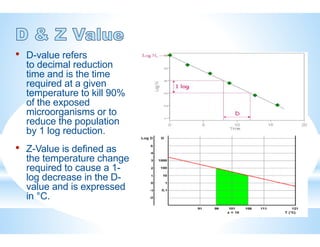
• D-value refers
to decimal reduction
time and is the time
required at a given
temperature to kill 90%
of the exposed
microorganisms or to
reduce the population
by 1 log reduction.
• Z-Value is defined as
the temperature change
required to cause a 1-
log decrease in the D-
value and is expressed
in °C.
• F0-Value is the equivalent exposure time at 121.11°C of the actual exposure
time at a variable temperature, calculated for an ideal microorganism with a
temperature coefficient of destruction equal to 10 °C.
F0= ∆t *10(T-121)/Z
Where ∆ t is the chosen time interval and T is the average temperature over
that interval. The smaller the interval chosen, the more accurate the
calculation will be. Z is the temperature coefficient , equal to be 10°C.
If we assume a sterilization lasting 1 minutes, constantly at 121°C, we
obtain:
F0= 1 *10(121-121)/10 = 1 * 100/10 = 1 * 100 = 1 minute
If we assume sterilization lasts 1 minutes, constantly at 111°C, we instead
obtain
F0= 1 *10(133-121)/10 = 1* 1012/10 = 1 * 101.2 = 25 minute
• Design Qualification (DQ) defines the functional and operational 
specifications of an Autoclave or equipment.
• Installation Qualification (IQ) ensures that an Autoclave or equipment
is received as designed and specified. It documents the installation in 
the selected user environment.
• Operation Qualification (OQ) demonstrates that an Autoclave or 
equipment will function according to its operational specification in the 
selected environment.
• Performance Qualification (PQ) demonstrates that an Autoclave or 
equipment consistently performs according to a specification 
appropriate to its routine use.
• Maintenance Qualification (MQ) describes and documents any 
maintenance required on the autoclave or equipment.
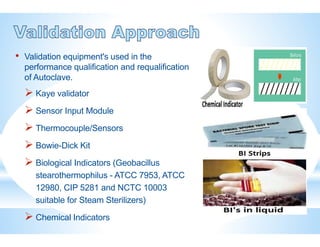
• Validation equipment's used in the
performance qualification and requalification
of Autoclave.
 Kaye validator
 Sensor Input Module
 Thermocouple/Sensors
 Bowie-Dick Kit
 Biological Indicators (Geobacillus
stearothermophilus - ATCC 7953, ATCC
12980, CIP 5281 and NCTC 10003
suitable for Steam Sterilizers)
 Chemical Indicators
1. Chamber Vacuum Leak Test
2. Bowie-Dick Test
3. Air Detection Test
4. Temperature Distribution Test
5. Heat Penetration Test
6. Filter Integrity test (Vacuum Break/Vent Filter)
7. Sound Pressure Test
8. Steam Quality Test
• Performance Qualification:
• Chamber Vacuum Leak Test: A leak test is used to verify the
integrity of the sterilizer pressure vessel and its plumbing.
 Leak rate of any autoclave NMT 13mbar in 10 minutes or 1.3mbar/
minute.
 This test ensure the microorganisms and air entrance into autoclave
chamber.
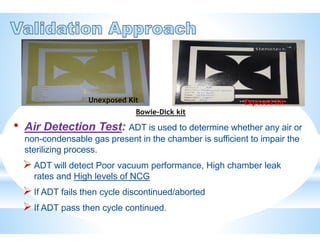
• Bowie-Dick Test: Pre-vacuum pulses are sufficient to remove the
entrapped air or non-condensable gases so as to facilitate rapid and
even steam penetration into all parts of the load.
 Bowie-Dick Test kit colour should change from yellow/Orange to
black/Brown in a uniform manner.
 This test ensure the complete removal of air from autoclave
chamber through pre-vacuum pulses.
• Air Detection Test: ADT is used to determine whether any air or
non-condensable gas present in the chamber is sufficient to impair the
sterilizing process.
 ADT will detect Poor vacuum performance, High chamber leak
rates and High levels of NCG
 If ADT fails then cycle discontinued/aborted
 If ADT pass then cycle continued.
Unexposed Kit Exposed Kit
Bowie-Dick kit
• Temperature Distribution Test: Objective of
this test is to ensure that equipment is suitable for even
dstribution of heat in the sterilizer chamber when
operated with pre-defined parameters.
 The requirements of the automatic control test are
met;
The holding time determined from the measured
temperatures is not less than that specified for the
sterilisation temperature;
During the plateau period the temperature
measured above the load does not exceed the
temperature measured in the active chamber
discharge by more than 5ºC for the first 60 s and
2ºC for the remaining period; Sensor
 During the holding time the temperatures measured in the active
chamber discharge and in the load:
are within the appropriate sterilization temperature band
do not fluctuate by more than ±1ºC;
do not differ from one another by more than 2ºC;
 during the holding time:
 the indicated and recorded chamber temperatures are within 1ºC of
the temperature measured in the active chamber discharge;
 the indicated and recorded chamber pressures are within 0.05 bar
of the measured pressure;
 12 to 16 probes/sensors are required for the heat distribution. Number
of sensors are varies as per the capacity of the autoclave.
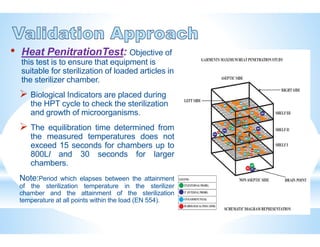
• Heat PenitrationTest: Objective of
this test is to ensure that equipment is
suitable for sterilization of loaded articles in
the sterilizer chamber.
 Biological Indicators are placed during
the HPT cycle to check the sterilization
and growth of microorganisms.
 The equilibration time determined from
the measured temperatures does not
exceed 15 seconds for chambers up to
800Ll and 30 seconds for larger
chambers.
Note:Period which elapses between the attainment
of the sterilization temperature in the sterilizer
chamber and the attainment of the sterilization
temperature at all points within the load (EN 554).
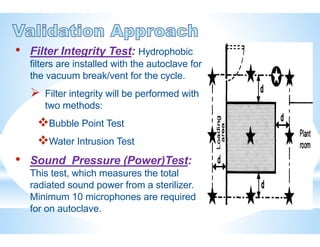
• Filter Integrity Test: Hydrophobic
filters are installed with the autoclave for
the vacuum break/vent for the cycle.
 Filter integrity will be performed with
two methods:
Bubble Point Test
Water Intrusion Test
• Sound Pressure (Power)Test:
This test, which measures the total
radiated sound power from a sterilizer.
Minimum 10 microphones are required
for on autoclave.
• Acceptance Criteria for Sound Power Test:
 in the loading area, the mean A-weighted surface sound pressure level
does not exceed:
55 dBA for a sterilizer installed in an operating suite, pharmacy,
treatment room or other noise-sensitive area;
70 dBA for a sterilizer installed in a sterile services department;
85 dBA for a sterilizer installed in an area that is not noise-sensitive;
 in the plantroom, the mean A-weighted surface sound pressure level
does not exceed 85 dBA;
 in both the loading area and the plantroom, the peak A-weighted surface
sound pressure level does not exceed the mean A-weighted surface
sound pressure level by more than 15 dBA.
• Steam Quality Test: Before start of Autoclave
Qualification Pure Steam should be qualified and meet the
below mentioned criteria of pure steam:
Non-condensable gases should not exceed 3.5%
Super Heat should not exceed 25.0°C
Dryness test - The Dryness value for porous load should be
NLT 0.90% and for metal load should be NLT 0.95%
Steam Condensate should meet the WFI standard.
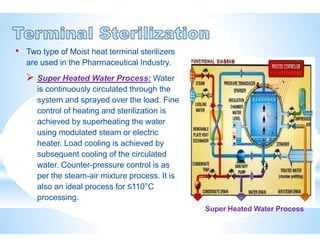
• Two type of Moist heat terminal sterilizers
are used in the Pharmaceutical Industry.
 Super Heated Water Process: Water
is continuously circulated through the
system and sprayed over the load. Fine
control of heating and sterilization is
achieved by superheating the water
using modulated steam or electric
heater. Load cooling is achieved by
subsequent cooling of the circulated
water. Counter-pressure control is as
per the steam-air mixture process. It is
also an ideal process for ͘≤110°C
processing.
Super Heated Water Process
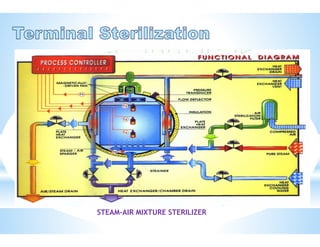
 Steam-Air Mixture Process: Steam and air are injected according to the
control algorithms to finely control the process. This system is the usual
choice where terminally sterilized products are to be unloaded dry. Steam–
air mixture processes typically utilize large recirculating fans to prevent the
formation of cold/hot spots in the sterilizer. The steam–air mixture process
typically uses an indirect cooling method such as cooling of the jacket or
with cooling coils within the sterilizer.
• Note: In some cases, certain products (i.e., suspensions and emulsions and
various food products) require agitation during the sterilization process. For
those types of products, it is typical to use a rotating rack within the sterilizer
but other agitation methods such as an internal shaking device are available.
STEAM-AIR MIXTURE STERILIZER
• Periodic tests: Must be subject to a schedule of periodic tests at various levels and
intervals.
 Daily,
 Weekly,
 Quarterly
 Yearly
 The yearly test schedule is essentially a revalidation schedule. It provides for
performance requalification (PRQ) tests to confirm that data collected during
performance qualification remain valid.
• Safety Measures:
 Eye Protection
 Lab Coat, Buttoned
 Closed-toed Shoes
 Heat-resistant Gloves
• HTM 2010
• ISO 17665
• EU GMP
• EN 285
☺

Autoclaves

  • 2.
    • Autoclave namecomes from Greek auto- meaning self, and Latin clavis- meaning key, thus a self-locking device. For safety reasons most are also sealed manually from outside. • The temperature of the steam in this method is lower when compared with Dry Heat Sterilization (DHS & Tunnel, etc.), but the high pressure helps with effective sterilization to take place in half an hour or less time duration. • The autoclave was invented by Charles Chamberland in 1879, although a precursor known as the “Steam Digester ” was created by Denis Papin in 1679. • 1906 – Steam sterilizers in use in a laboratory preparing tuberculosis serum in Marburg, Germany.
  • 3.
    • In 1800& 1900’s autoclaves used in hospitals and laboratories to sterilize the instruments. • Now autoclaves used in Hospitals, Biologics, Pharmaceutical, APIs, Food, Dairy, Aviation and disposable of Biohazards. • Type of autoclave:  Vertical Autoclaves  Horizontal Autoclave • Transformation in design VERTICAL AUTOCLAVES HORIZONTAL AUTOCLAVES BEFORE NOW
  • 4.
    • Design ofthe autoclave based on the pressure and temperature. • Parameters of consideration  Temperature: 121.1 to 124°C  Pressure: 15 lb. (1.12 bar).  Time of exposure is 15 min. to 30 min. as per user requirement. • Components of Autoclave:  Heating Elements  Temperature Controller  Pressure Sensor  Chamber  Door gasket  Solenoid valve  Water level Sensor  Steam generator  Vaccum pump  Vacuum Break Filter
  • 5.
    • Any processthat effectively kills, removed or eliminates all form of life and other biological agents (Such as Fungi, Bacteria, Viruses) & their spores from a surface, equipment, or culture medium through Heat, chemical, radiation and filtration. • The sterility of any product is defined by the probability of a viable microorganism on the product after it has been sterilized. This probability is referred to as a sterility assurance level (SAL). An SAL is normally expressed as 10-n with historically. • Type of Sterilization:  Heat: 1. MHS, 2. DHS, 3. Flaming, 4. Incineration, 5. Tyndallisation  Chemical: 1. Ethylene Oxide, 2. Nitrogen Dioxide, 3. Ozone, 4. Hydrogen Para oxide, 5. Glutaraldehyde & Formaldehyde, 6. Par Acetic Acid  Radiation: 1. Non-Ionizing Radiation, 2. Ionizing Radiation  Filtration: Sterile grade filters
  • 6.
    • When wateris heated in a closed container, saturated steam is produced under pressure. • According to Boyle’s Law, when volume of the steam, is kept constant, the temperature is directly proportional to pressure. • If the pressure is reduced it boils at a lower temperature. If the pressure rises, it boils at a greater temperature. • At 15 lbs pressure 121°C temperature can be obtained. • Moist heat coagulates cell proteins of the microorganisms and thus kills all the living entities (including spores) in 15 to 20 minutes. • Hot saturated steam is efficient means of destroying microorganisms, since it penetrates rapidly and gives up its latent heat as it condenses on the cooler objects.
  • 7.
    • Gravity Displacement: Steamis introduced into the chamber as it is produced, which displaces air by gravity until the sterilization process begins. Some air remains in the chamber, which defines the cycle times.
  • 8.
    • Negative PressureDisplacement: Air is removed from the chamber using a vacuum pump prior to the introduction of steam. • Positive Pressure Displacement: Steam is held in a separate chamber. When sufficient steam has been accumulated it is released into the main chamber in a pressurized burst, beginning the sterilization process, or steam pulsing in to the chamber to replace the air from chamber. SFPP- Steam Flush Pressure Pulse ClosedClosed OpenOpen AirAir AirAir ClosedClosed OpenOpen AirAir AirAir ClosedClosed OpenOpen SteamSteam SteamSteam ClosedClosed OpenOpen SteamSteam SteamSteam OpenOpen SteamSteam SteamSteam
  • 9.
    • Steam isan extremely effective “carrier” of thermal energy. It is many times more effective in conveying thermal energy to the item than is hot (dry) air. • Steam is an effective sterilant because any resistant, protective outer layer of the microorganisms can be softened by the steam , allowing coagulation/denature of the sensitive inner proteins destroys the enzymes of the microorganism. • Two types of sterilization approaches are there:  Overkill sterilization primarily is applied to the moist-heat processing of materials, supplies, and other heat-stable goods. "This is usually achieved by providing a minimum 12-log reduction of microorganisms considering worst case of D-value at 121.1 °C.  For items that are heat sensitive and can not withstand an overkill approach. It is necessary to collect the bioburden data and possibly D-value data. This will reduce the sterilization cycle time. For example: 134 CFU(bioburden) To reduce the bioburden from 134 to 01 = log (134) = 2.14 minutes.
  • 10.
    • D-value refers todecimal reduction time and is the time required at a given temperature to kill 90% of the exposed microorganisms or to reduce the population by 1 log reduction. • Z-Value is defined as the temperature change required to cause a 1- log decrease in the D- value and is expressed in °C.
  • 11.
    • F0-Value isthe equivalent exposure time at 121.11°C of the actual exposure time at a variable temperature, calculated for an ideal microorganism with a temperature coefficient of destruction equal to 10 °C. F0= ∆t *10(T-121)/Z Where ∆ t is the chosen time interval and T is the average temperature over that interval. The smaller the interval chosen, the more accurate the calculation will be. Z is the temperature coefficient , equal to be 10°C. If we assume a sterilization lasting 1 minutes, constantly at 121°C, we obtain: F0= 1 *10(121-121)/10 = 1 * 100/10 = 1 * 100 = 1 minute If we assume sterilization lasts 1 minutes, constantly at 111°C, we instead obtain F0= 1 *10(133-121)/10 = 1* 1012/10 = 1 * 101.2 = 25 minute
  • 12.
    • Design Qualification(DQ) defines the functional and operational  specifications of an Autoclave or equipment. • Installation Qualification (IQ) ensures that an Autoclave or equipment is received as designed and specified. It documents the installation in  the selected user environment. • Operation Qualification (OQ) demonstrates that an Autoclave or  equipment will function according to its operational specification in the  selected environment. • Performance Qualification (PQ) demonstrates that an Autoclave or  equipment consistently performs according to a specification  appropriate to its routine use. • Maintenance Qualification (MQ) describes and documents any  maintenance required on the autoclave or equipment.
  • 13.
    • Validation equipment'sused in the performance qualification and requalification of Autoclave.  Kaye validator  Sensor Input Module  Thermocouple/Sensors  Bowie-Dick Kit  Biological Indicators (Geobacillus stearothermophilus - ATCC 7953, ATCC 12980, CIP 5281 and NCTC 10003 suitable for Steam Sterilizers)  Chemical Indicators
  • 14.
    1. Chamber VacuumLeak Test 2. Bowie-Dick Test 3. Air Detection Test 4. Temperature Distribution Test 5. Heat Penetration Test 6. Filter Integrity test (Vacuum Break/Vent Filter) 7. Sound Pressure Test 8. Steam Quality Test • Performance Qualification:
  • 15.
    • Chamber VacuumLeak Test: A leak test is used to verify the integrity of the sterilizer pressure vessel and its plumbing.  Leak rate of any autoclave NMT 13mbar in 10 minutes or 1.3mbar/ minute.  This test ensure the microorganisms and air entrance into autoclave chamber. • Bowie-Dick Test: Pre-vacuum pulses are sufficient to remove the entrapped air or non-condensable gases so as to facilitate rapid and even steam penetration into all parts of the load.  Bowie-Dick Test kit colour should change from yellow/Orange to black/Brown in a uniform manner.  This test ensure the complete removal of air from autoclave chamber through pre-vacuum pulses.
  • 16.
    • Air DetectionTest: ADT is used to determine whether any air or non-condensable gas present in the chamber is sufficient to impair the sterilizing process.  ADT will detect Poor vacuum performance, High chamber leak rates and High levels of NCG  If ADT fails then cycle discontinued/aborted  If ADT pass then cycle continued. Unexposed Kit Exposed Kit Bowie-Dick kit
  • 17.
    • Temperature DistributionTest: Objective of this test is to ensure that equipment is suitable for even dstribution of heat in the sterilizer chamber when operated with pre-defined parameters.  The requirements of the automatic control test are met; The holding time determined from the measured temperatures is not less than that specified for the sterilisation temperature; During the plateau period the temperature measured above the load does not exceed the temperature measured in the active chamber discharge by more than 5ºC for the first 60 s and 2ºC for the remaining period; Sensor
  • 18.
     During theholding time the temperatures measured in the active chamber discharge and in the load: are within the appropriate sterilization temperature band do not fluctuate by more than ±1ºC; do not differ from one another by more than 2ºC;  during the holding time:  the indicated and recorded chamber temperatures are within 1ºC of the temperature measured in the active chamber discharge;  the indicated and recorded chamber pressures are within 0.05 bar of the measured pressure;  12 to 16 probes/sensors are required for the heat distribution. Number of sensors are varies as per the capacity of the autoclave.
  • 19.
    • Heat PenitrationTest:Objective of this test is to ensure that equipment is suitable for sterilization of loaded articles in the sterilizer chamber.  Biological Indicators are placed during the HPT cycle to check the sterilization and growth of microorganisms.  The equilibration time determined from the measured temperatures does not exceed 15 seconds for chambers up to 800Ll and 30 seconds for larger chambers. Note:Period which elapses between the attainment of the sterilization temperature in the sterilizer chamber and the attainment of the sterilization temperature at all points within the load (EN 554).
  • 20.
    • Filter IntegrityTest: Hydrophobic filters are installed with the autoclave for the vacuum break/vent for the cycle.  Filter integrity will be performed with two methods: Bubble Point Test Water Intrusion Test • Sound Pressure (Power)Test: This test, which measures the total radiated sound power from a sterilizer. Minimum 10 microphones are required for on autoclave.
  • 21.
    • Acceptance Criteriafor Sound Power Test:  in the loading area, the mean A-weighted surface sound pressure level does not exceed: 55 dBA for a sterilizer installed in an operating suite, pharmacy, treatment room or other noise-sensitive area; 70 dBA for a sterilizer installed in a sterile services department; 85 dBA for a sterilizer installed in an area that is not noise-sensitive;  in the plantroom, the mean A-weighted surface sound pressure level does not exceed 85 dBA;  in both the loading area and the plantroom, the peak A-weighted surface sound pressure level does not exceed the mean A-weighted surface sound pressure level by more than 15 dBA.
  • 22.
    • Steam QualityTest: Before start of Autoclave Qualification Pure Steam should be qualified and meet the below mentioned criteria of pure steam: Non-condensable gases should not exceed 3.5% Super Heat should not exceed 25.0°C Dryness test - The Dryness value for porous load should be NLT 0.90% and for metal load should be NLT 0.95% Steam Condensate should meet the WFI standard.
  • 23.
    • Two typeof Moist heat terminal sterilizers are used in the Pharmaceutical Industry.  Super Heated Water Process: Water is continuously circulated through the system and sprayed over the load. Fine control of heating and sterilization is achieved by superheating the water using modulated steam or electric heater. Load cooling is achieved by subsequent cooling of the circulated water. Counter-pressure control is as per the steam-air mixture process. It is also an ideal process for ͘≤110°C processing. Super Heated Water Process
  • 24.
     Steam-Air MixtureProcess: Steam and air are injected according to the control algorithms to finely control the process. This system is the usual choice where terminally sterilized products are to be unloaded dry. Steam– air mixture processes typically utilize large recirculating fans to prevent the formation of cold/hot spots in the sterilizer. The steam–air mixture process typically uses an indirect cooling method such as cooling of the jacket or with cooling coils within the sterilizer. • Note: In some cases, certain products (i.e., suspensions and emulsions and various food products) require agitation during the sterilization process. For those types of products, it is typical to use a rotating rack within the sterilizer but other agitation methods such as an internal shaking device are available.
  • 25.
  • 26.
    • Periodic tests:Must be subject to a schedule of periodic tests at various levels and intervals.  Daily,  Weekly,  Quarterly  Yearly  The yearly test schedule is essentially a revalidation schedule. It provides for performance requalification (PRQ) tests to confirm that data collected during performance qualification remain valid. • Safety Measures:  Eye Protection  Lab Coat, Buttoned  Closed-toed Shoes  Heat-resistant Gloves
  • 27.
    • HTM 2010 •ISO 17665 • EU GMP • EN 285
  • 28.