Dr. Varidmala Jain
Asst. Prof. Faculty of Health & Medical Sciences
SHIATS, Allahabad, UP, India
Introduction
 “Jean Ayres had conceived that in order to fully develop
both motor and cognitive skills, the human brain has
to internally digest an route (process) continuing
feedback from all the senses, particularly visual-
perceptual and proprioceptive (including vestibular).
Contd.
 SI theory is based on hypothesis that in order to
develop and execute normal adaptive behavior
response the child must be able to optimally receive,
modulate, integrate and process the sensory
information
Contd.
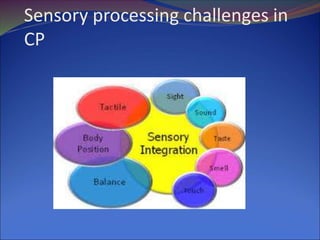
 Vision
 Auditory (Hearing)
 Olfactory (Smell)
 Tactile or Somosensory (Touch)
 Oral (Taste)
 Vestibular Processing (unconscious information
obtained through the inner ear for equilibrium, position
in space and gravity)
 Prioprioception Processing (unconscious information
obtained by the muscles and joints regarding your
position in space, the weight of objects, the pressures
felt, the stretch, body movement, and position changes)
Contd.
 A child’s sensory processing is problematic if they
are:
 Over-responsive – avoidance, caution and fearful
 Under-responsive – withdrawn, passive or difficult
to engage
 Sensory seeking – impulsive and takes risks
Sensory processing challenges in
CP
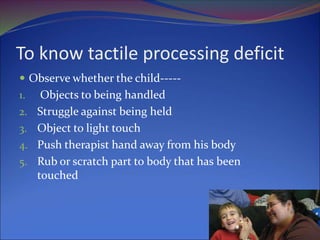
To know tactile processing deficit
 Observe whether the child-----
1. Objects to being handled
2. Struggle against being held
3. Object to light touch
4. Push therapist hand away from his body
5. Rub or scratch part to body that has been
touched
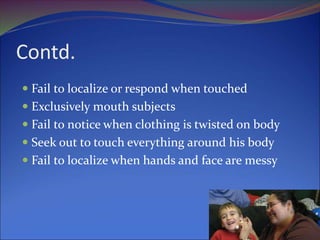
Contd.
 Fail to localize or respond when touched
 Exclusively mouth subjects
 Fail to notice when clothing is twisted on body
 Seek out to touch everything around his body
 Fail to localize when hands and face are messy
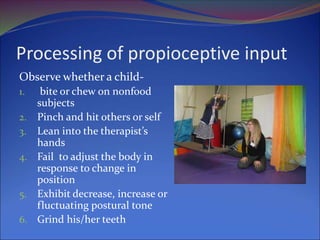
Processing of propioceptive input
Observe whether a child-
1. bite or chew on nonfood
subjects
2. Pinch and hit others or self
3. Lean into the therapist’s
hands
4. Fail to adjust the body in
response to change in
position
5. Exhibit decrease, increase or
fluctuating postural tone
6. Grind his/her teeth
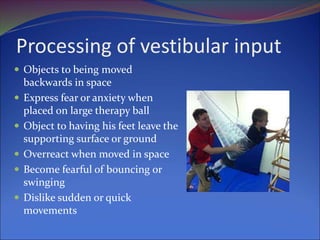
Processing of vestibular input
 Objects to being moved
backwards in space
 Express fear or anxiety when
placed on large therapy ball
 Object to having his feet leave the
supporting surface or ground
 Overreact when moved in space
 Become fearful of bouncing or
swinging
 Dislike sudden or quick
movements
Contd.
 Does the child need to move or rock to soothe
 Does the child fail to increase extensor tone on
linear movement
 Does the child seek opportunity to fall without
fear of safety
 Like to be moved more intensely with other
children
 Enjoy being upside down during play
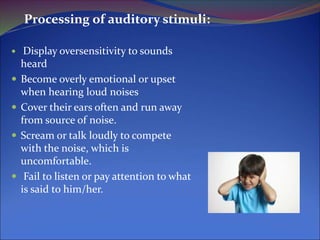
Processing of auditory stimuli:
 Display oversensitivity to sounds
heard
 Become overly emotional or upset
when hearing loud noises
 Cover their ears often and run away
from source of noise.
 Scream or talk loudly to compete
with the noise, which is
uncomfortable.
 Fail to listen or pay attention to what
is said to him/her.
Contd.
 Enjoy being in loud environments with crowds of
people.
 Like to make loud noises, scream or yell.
 Talk excessively.
 Like to sing or dance to loud music.
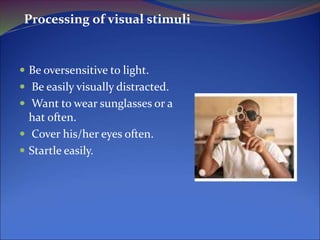
Processing of visual stimuli
 Be oversensitive to light.
 Be easily visually distracted.
 Want to wear sunglasses or a
hat often.
 Cover his/her eyes often.
 Startle easily.
contd.
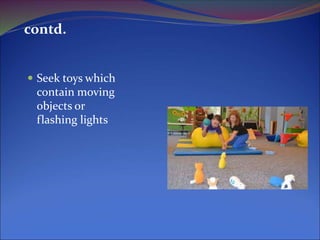
 Seek toys which
contain moving
objects or
flashing lights
Sensory Integration and Sensory Motor
Activities
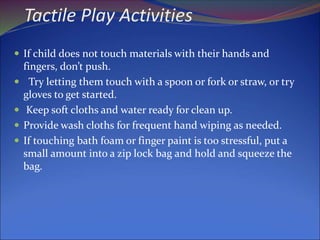
Tactile Play Activities
 If child does not touch materials with their hands and
fingers, don’t push.
 Try letting them touch with a spoon or fork or straw, or try
gloves to get started.
 Keep soft cloths and water ready for clean up.
 Provide wash cloths for frequent hand wiping as needed.
 If touching bath foam or finger paint is too stressful, put a
small amount into a zip lock bag and hold and squeeze the
bag.
Contd.
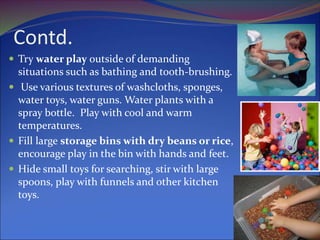
 Try water play outside of demanding
situations such as bathing and tooth-brushing.
 Use various textures of washcloths, sponges,
water toys, water guns. Water plants with a
spray bottle. Play with cool and warm
temperatures.
 Fill large storage bins with dry beans or rice,
encourage play in the bin with hands and feet.
 Hide small toys for searching, stir with large
spoons, play with funnels and other kitchen
toys.
Contd.
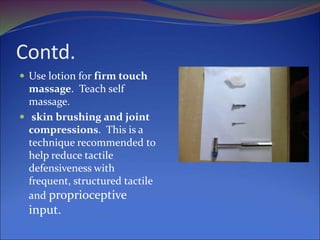
 Use lotion for firm touch
massage. Teach self
massage.
 skin brushing and joint
compressions. This is a
technique recommended to
help reduce tactile
defensiveness with
frequent, structured tactile
and proprioceptive
input.
Contd.
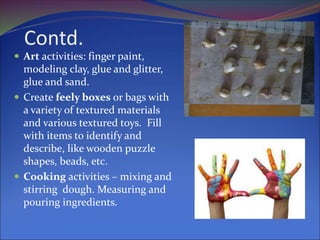
 Art activities: finger paint,
modeling clay, glue and glitter,
glue and sand.
 Create feely boxes or bags with
a variety of textured materials
and various textured toys. Fill
with items to identify and
describe, like wooden puzzle
shapes, beads, etc.
 Cooking activities – mixing and
stirring dough. Measuring and
pouring ingredients.
Contd.
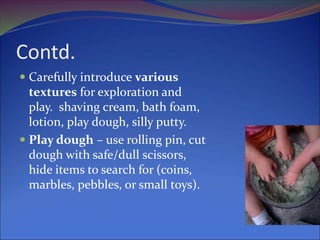
 Carefully introduce various
textures for exploration and
play. shaving cream, bath foam,
lotion, play dough, silly putty.
 Play dough – use rolling pin, cut
dough with safe/dull scissors,
hide items to search for (coins,
marbles, pebbles, or small toys).
Contd.
 Sand play – Use clean dry sand and a
spray bottle with water for added
moisture. Write in sand, or build
shapes or a sand castle
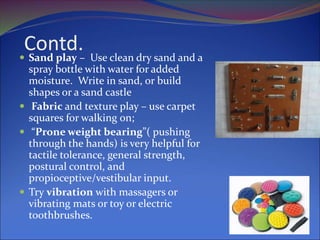
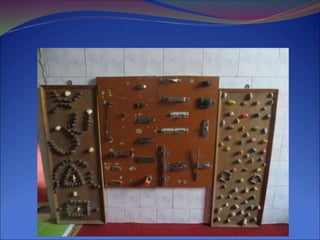
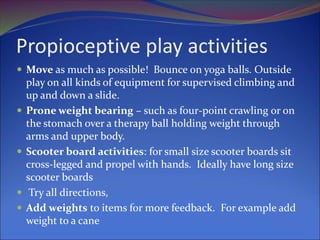
 Fabric and texture play – use carpet
squares for walking on;
 “Prone weight bearing”( pushing
through the hands) is very helpful for
tactile tolerance, general strength,
postural control, and
propioceptive/vestibular input.
 Try vibration with massagers or
vibrating mats or toy or electric
toothbrushes.
Propioceptive play activities
 Move as much as possible! Bounce on yoga balls. Outside
play on all kinds of equipment for supervised climbing and
up and down a slide.
 Prone weight bearing – such as four-point crawling or on
the stomach over a therapy ball holding weight through
arms and upper body.
 Scooter board activities: for small size scooter boards sit
cross-legged and propel with hands. Ideally have long size
scooter boards
 Try all directions,
 Add weights to items for more feedback. For example add
weight to a cane
Contd.
 Hang from a trapeze bar or chin up bar –
 Teach simple isometric exercises such as wall push-ups and
chair push-ups.
 Practice pouring over the sink or outside from heavy
containers
 Use squeeze horns such as a bike horn, bottle glue and
squeeze bottle puff paints for art
 “Zoomball game” is a toy with a plastic ball strung on two
ropes.
 Try using tools with supervision – hammer, screwdriver,
pliers, or sanding wood. Use dull/safe scissors to cut heavy
paper or cardstock.
 Throw balls against a wall. Throw to the left and right sides,
forward and backward and overhead.
Vestibular play activities
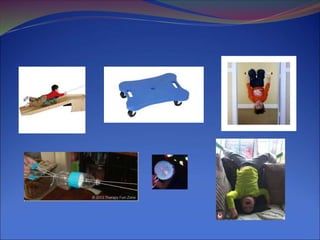
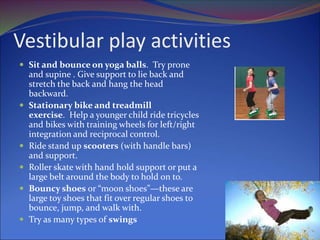
 Sit and bounce on yoga balls. Try prone
and supine . Give support to lie back and
stretch the back and hang the head
backward.
 Stationary bike and treadmill
exercise. Help a younger child ride tricycles
and bikes with training wheels for left/right
integration and reciprocal control.
 Ride stand up scooters (with handle bars)
and support.
 Roller skate with hand hold support or put a
large belt around the body to hold on to.
 Bouncy shoes or “moon shoes”—these are
large toy shoes that fit over regular shoes to
bounce, jump, and walk with.
 Try as many types of swings
Contd.
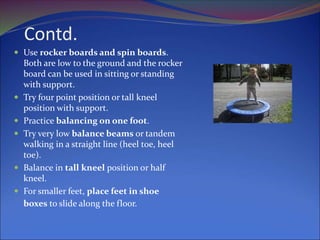
 Use rocker boards and spin boards.
Both are low to the ground and the rocker
board can be used in sitting or standing
with support.
 Try four point position or tall kneel
position with support.
 Practice balancing on one foot.
 Try very low balance beams or tandem
walking in a straight line (heel toe, heel
toe).
 Balance in tall kneel position or half
kneel.
 For smaller feet, place feet in shoe
boxes to slide along the floor.
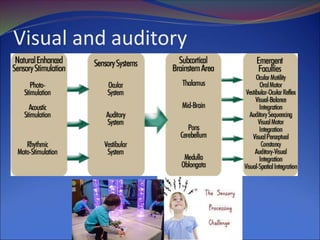
Visual and auditory
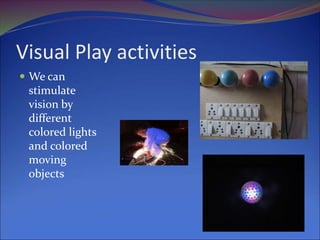
Visual Play activities
 We can
stimulate
vision by
different
colored lights
and colored
moving
objects
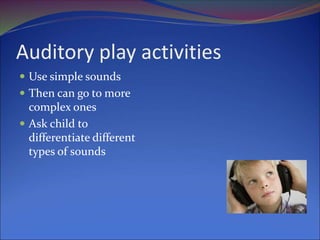
Auditory play activities
 Use simple sounds
 Then can go to more
complex ones
 Ask child to
differentiate different
types of sounds
The goals of sensory integration therapy
 Determine how a child’s specific sensory
perceptions affect their overall physical, social and
human development
 Identify and eliminate barriers caused by
disordered perception
 Implement new sensory processing approaches
that organize multiple sensations, filter out
background stimuli, and compensate for deficits in
perception
 Restore a child’s sense of body position and
function
Contd.
 Restore motor planning (praxis) capabilities, so a
child can focus on his or her senses to plan
movement, respond to other’s movements, and
understand the body’s relationship to space
 Encourage activities that allow children to explore
their environment, learn and develop their senses
 Assist children with perception issues in sorting
out mixed messages
 Create a physical environment that fosters
participation in activities that depend on the
senses
 www.samvednatrust.com
 www.trishlaortho.com
 Fb: samvednatrust.cerebralpalsy
 You tube: jjain999
 Email-samvedna9453039213@gmail.com

Sensory Integration : Problem & approach in cerebral palsy

  • 1.
    Dr. Varidmala Jain Asst.Prof. Faculty of Health & Medical Sciences SHIATS, Allahabad, UP, India
  • 2.
    Introduction  “Jean Ayreshad conceived that in order to fully develop both motor and cognitive skills, the human brain has to internally digest an route (process) continuing feedback from all the senses, particularly visual- perceptual and proprioceptive (including vestibular).
  • 3.
    Contd.  SI theoryis based on hypothesis that in order to develop and execute normal adaptive behavior response the child must be able to optimally receive, modulate, integrate and process the sensory information
  • 4.
    Contd.  Vision  Auditory(Hearing)  Olfactory (Smell)  Tactile or Somosensory (Touch)  Oral (Taste)  Vestibular Processing (unconscious information obtained through the inner ear for equilibrium, position in space and gravity)  Prioprioception Processing (unconscious information obtained by the muscles and joints regarding your position in space, the weight of objects, the pressures felt, the stretch, body movement, and position changes)
  • 5.
    Contd.  A child’ssensory processing is problematic if they are:  Over-responsive – avoidance, caution and fearful  Under-responsive – withdrawn, passive or difficult to engage  Sensory seeking – impulsive and takes risks
  • 6.
  • 7.
    To know tactileprocessing deficit  Observe whether the child----- 1. Objects to being handled 2. Struggle against being held 3. Object to light touch 4. Push therapist hand away from his body 5. Rub or scratch part to body that has been touched
  • 8.
    Contd.  Fail tolocalize or respond when touched  Exclusively mouth subjects  Fail to notice when clothing is twisted on body  Seek out to touch everything around his body  Fail to localize when hands and face are messy
  • 9.
    Processing of propioceptiveinput Observe whether a child- 1. bite or chew on nonfood subjects 2. Pinch and hit others or self 3. Lean into the therapist’s hands 4. Fail to adjust the body in response to change in position 5. Exhibit decrease, increase or fluctuating postural tone 6. Grind his/her teeth
  • 10.
    Processing of vestibularinput  Objects to being moved backwards in space  Express fear or anxiety when placed on large therapy ball  Object to having his feet leave the supporting surface or ground  Overreact when moved in space  Become fearful of bouncing or swinging  Dislike sudden or quick movements
  • 11.
    Contd.  Does thechild need to move or rock to soothe  Does the child fail to increase extensor tone on linear movement  Does the child seek opportunity to fall without fear of safety  Like to be moved more intensely with other children  Enjoy being upside down during play
  • 12.
    Processing of auditorystimuli:  Display oversensitivity to sounds heard  Become overly emotional or upset when hearing loud noises  Cover their ears often and run away from source of noise.  Scream or talk loudly to compete with the noise, which is uncomfortable.  Fail to listen or pay attention to what is said to him/her.
  • 13.
    Contd.  Enjoy beingin loud environments with crowds of people.  Like to make loud noises, scream or yell.  Talk excessively.  Like to sing or dance to loud music.
  • 14.
    Processing of visualstimuli  Be oversensitive to light.  Be easily visually distracted.  Want to wear sunglasses or a hat often.  Cover his/her eyes often.  Startle easily.
  • 15.
    contd.  Seek toyswhich contain moving objects or flashing lights
  • 16.
    Sensory Integration andSensory Motor Activities
  • 17.
    Tactile Play Activities If child does not touch materials with their hands and fingers, don’t push.  Try letting them touch with a spoon or fork or straw, or try gloves to get started.  Keep soft cloths and water ready for clean up.  Provide wash cloths for frequent hand wiping as needed.  If touching bath foam or finger paint is too stressful, put a small amount into a zip lock bag and hold and squeeze the bag.
  • 18.
    Contd.  Try waterplay outside of demanding situations such as bathing and tooth-brushing.  Use various textures of washcloths, sponges, water toys, water guns. Water plants with a spray bottle. Play with cool and warm temperatures.  Fill large storage bins with dry beans or rice, encourage play in the bin with hands and feet.  Hide small toys for searching, stir with large spoons, play with funnels and other kitchen toys.
  • 19.
    Contd.  Use lotionfor firm touch massage. Teach self massage.  skin brushing and joint compressions. This is a technique recommended to help reduce tactile defensiveness with frequent, structured tactile and proprioceptive input.
  • 20.
    Contd.  Art activities:finger paint, modeling clay, glue and glitter, glue and sand.  Create feely boxes or bags with a variety of textured materials and various textured toys. Fill with items to identify and describe, like wooden puzzle shapes, beads, etc.  Cooking activities – mixing and stirring dough. Measuring and pouring ingredients.
  • 21.
    Contd.  Carefully introducevarious textures for exploration and play. shaving cream, bath foam, lotion, play dough, silly putty.  Play dough – use rolling pin, cut dough with safe/dull scissors, hide items to search for (coins, marbles, pebbles, or small toys).
  • 22.
    Contd.  Sand play– Use clean dry sand and a spray bottle with water for added moisture. Write in sand, or build shapes or a sand castle  Fabric and texture play – use carpet squares for walking on;  “Prone weight bearing”( pushing through the hands) is very helpful for tactile tolerance, general strength, postural control, and propioceptive/vestibular input.  Try vibration with massagers or vibrating mats or toy or electric toothbrushes.
  • 24.
    Propioceptive play activities Move as much as possible! Bounce on yoga balls. Outside play on all kinds of equipment for supervised climbing and up and down a slide.  Prone weight bearing – such as four-point crawling or on the stomach over a therapy ball holding weight through arms and upper body.  Scooter board activities: for small size scooter boards sit cross-legged and propel with hands. Ideally have long size scooter boards  Try all directions,  Add weights to items for more feedback. For example add weight to a cane
  • 25.
    Contd.  Hang froma trapeze bar or chin up bar –  Teach simple isometric exercises such as wall push-ups and chair push-ups.  Practice pouring over the sink or outside from heavy containers  Use squeeze horns such as a bike horn, bottle glue and squeeze bottle puff paints for art  “Zoomball game” is a toy with a plastic ball strung on two ropes.  Try using tools with supervision – hammer, screwdriver, pliers, or sanding wood. Use dull/safe scissors to cut heavy paper or cardstock.  Throw balls against a wall. Throw to the left and right sides, forward and backward and overhead.
  • 27.
    Vestibular play activities Sit and bounce on yoga balls. Try prone and supine . Give support to lie back and stretch the back and hang the head backward.  Stationary bike and treadmill exercise. Help a younger child ride tricycles and bikes with training wheels for left/right integration and reciprocal control.  Ride stand up scooters (with handle bars) and support.  Roller skate with hand hold support or put a large belt around the body to hold on to.  Bouncy shoes or “moon shoes”—these are large toy shoes that fit over regular shoes to bounce, jump, and walk with.  Try as many types of swings
  • 28.
    Contd.  Use rockerboards and spin boards. Both are low to the ground and the rocker board can be used in sitting or standing with support.  Try four point position or tall kneel position with support.  Practice balancing on one foot.  Try very low balance beams or tandem walking in a straight line (heel toe, heel toe).  Balance in tall kneel position or half kneel.  For smaller feet, place feet in shoe boxes to slide along the floor.
  • 29.
  • 30.
    Visual Play activities We can stimulate vision by different colored lights and colored moving objects
  • 31.
    Auditory play activities Use simple sounds  Then can go to more complex ones  Ask child to differentiate different types of sounds
  • 32.
    The goals ofsensory integration therapy  Determine how a child’s specific sensory perceptions affect their overall physical, social and human development  Identify and eliminate barriers caused by disordered perception  Implement new sensory processing approaches that organize multiple sensations, filter out background stimuli, and compensate for deficits in perception  Restore a child’s sense of body position and function
  • 33.
    Contd.  Restore motorplanning (praxis) capabilities, so a child can focus on his or her senses to plan movement, respond to other’s movements, and understand the body’s relationship to space  Encourage activities that allow children to explore their environment, learn and develop their senses  Assist children with perception issues in sorting out mixed messages  Create a physical environment that fosters participation in activities that depend on the senses
  • 34.
     www.samvednatrust.com  www.trishlaortho.com Fb: samvednatrust.cerebralpalsy  You tube: jjain999  Email-samvedna9453039213@gmail.com