

AUTISM :AUTISM : REDRED
FLAGSFLAGS FORFOR
EARLY DIAGNOSISEARLY DIAGNOSIS
PROF DR HUSSEIN ABDELDAYEM
MEMBER OF AAN, AAP, ICNA
FACULTY OF MEDICINE, ALEX
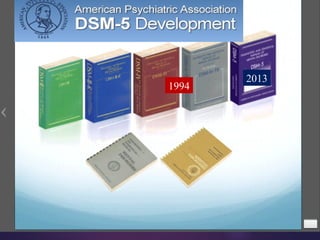
1994
2013
DSM-5 Field Trial Professional
Volunteers .
From Darrel A. Regier, M.D.
To husseindayem@hotmail.com
 Thank you for participating in the DSM-5 Field Trials in Routine Clinical
Practice Settings! This important part of the DSM-5 Field Trials will test
the feasibility and clinical utility of the proposed diagnostic criteria
and measures for routine practices. 
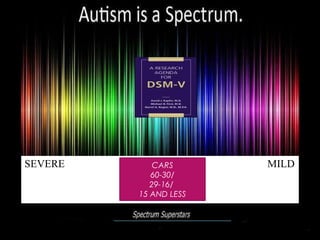
DSM-V
No pervasive developmental
disorder term
But
ASDSEVERE MILDCARS
60-30/
29-16/
15 AND LESS
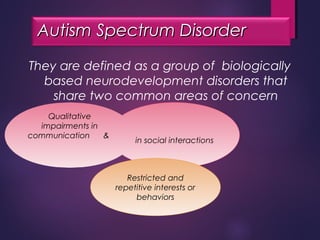
Autism Spectrum DisorderAutism Spectrum Disorder
They are defined as a group of biologically
based neurodevelopment disorders that
share two common areas of concern
in social interactions
Restricted and
repetitive interests or
behaviors
Qualitative
impairments in
communication &
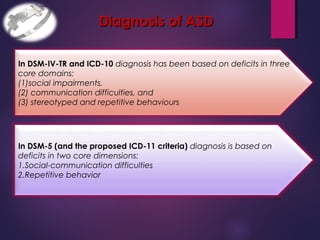
Diagnosis of ASDDiagnosis of ASD
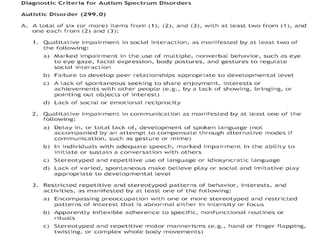
In DSM-IV-TR and ICD-10 diagnosis has been based on deficits in three
core domains:
(1)social impairments,
(2) communication difficulties, and
(3) stereotyped and repetitive behaviours
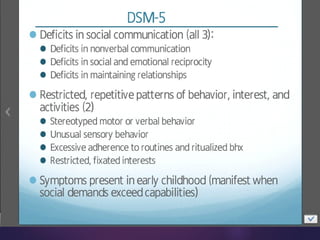
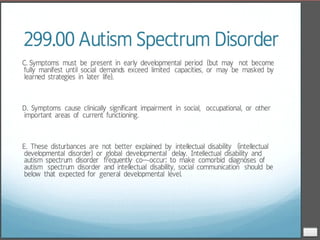
In DSM-5 (and the proposed ICD-11 criteria) diagnosis is based on
deficits in two core dimensions:
1.Social-communication difficulties
2.Repetitive behavior
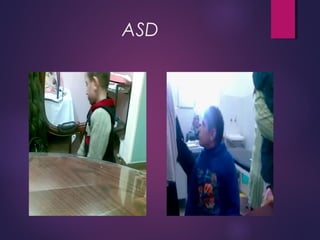
ASD
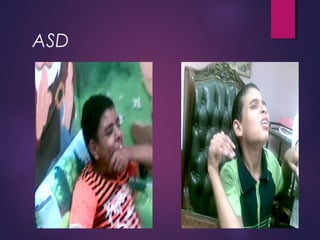
ASD
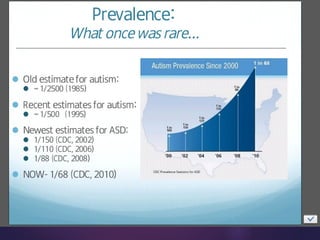
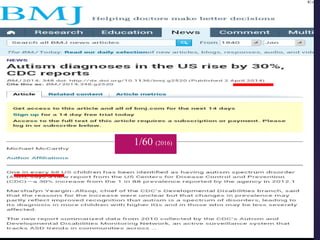
1/60 (2016)
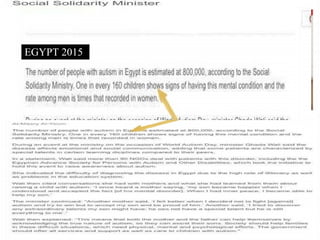
EGYPT 2015
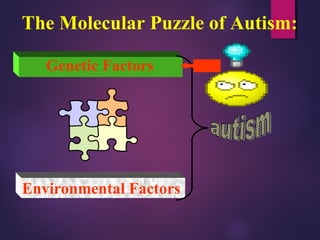
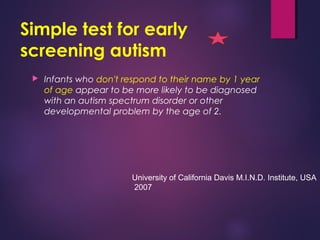
The Molecular Puzzle of Autism:
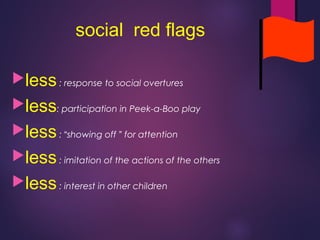
Genetic Factors
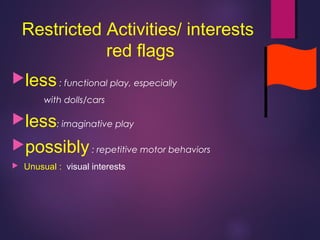
Environmental Factors
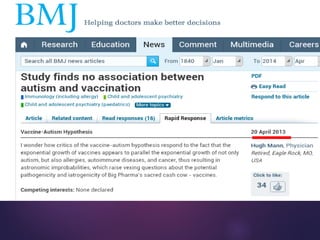
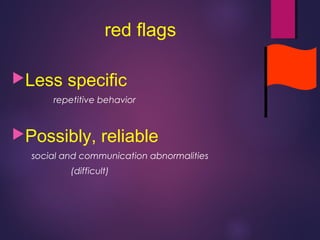
thimerosal is safe
 the latest study joins a growing body of literature
that shows thimerosal is safe and causes no long-
term negative effects on children's health
IS IT POSSIBLE
TO CURE
AUTISM?
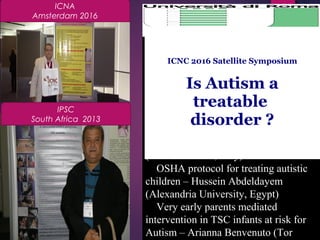
Translational neurobiology in Shank
mutants - mouse models for ASD –
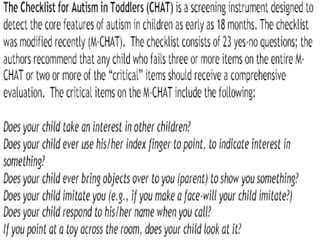
Michael Schmeisser (Ulm University,
Germany)
Mutations in BCKD-kinase lead to a
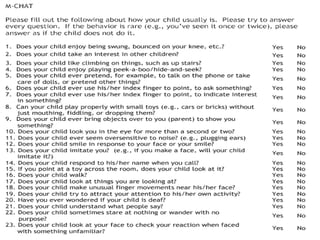
potentially treatable form of autism
with epilepsy – Gaia Novarino (IST,
Vienna, Austria)
Autism Spectrum Disorder with or
without epilepsy: comparative study of
207 patients – Benedetta Berlese
(A.O.U. Verona, Italy)
OSHA protocol for treating autistic
children – Hussein Abdeldayem
(Alexandria University, Egypt)
Very early parents mediated
intervention in TSC infants at risk for
Autism – Arianna Benvenuto (Tor
ICNA
Amsterdam 2016
IPSC
South Africa 2013
                                  
ICNC 2016 Satellite Symposium
Is Autism a
treatable
disorder ?
April 29th
, 2016
Roma (Italy)
RULES FOR TREATMENT OF
ASD
 PHARMACOLOGICAL DRUGS HAVE NO ROLE IN
TREATING OF ASD BUT OF NON SPECIFIC/
SYMPTOMATIC TREATMENT
 INTENSIVE BEHAVIOR MODIFICATION SESSIONS OF
AT LEAST 25 HOURS PER WEEK IS THE IDEAL
TREATMENT NOWADAYS
 Autism was considered as disorder without hope,
but now it is recognized as treatable for many
patients especially who are diagnosed early and
receive ,,,,,,
 INTENSIVE BEHAVIOR
INTERVENTIONS
 MEDICAL LITERATURE SAYS NO, BUT NOWADAYS WITH
ADEQUATE INTENSIVE REHABILITATION
SESSIONS
THE IMPROVEMENT CAN BE SO GREAT THAT IT COULD
JUSTIFY THE USAGE OF THE WORD
TREATED > CURE
SOMETIMES
WITH ADEQUATE INTENSE REHABILITATION
CHILDREN WITH HIGH RISK FOR DEVELOPING ASD
DON’T DEVELOP IT .

(Who?)
If your patient /child is
at risk for developing
or
already with ASD ,
and if you are willing to put effort in helping him,,
attend my presentation
thoroughly
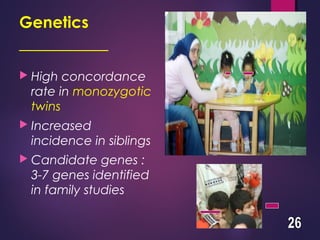
Genetics
__________
 High concordance
rate in monozygotic
twins
 Increased
incidence in siblings
 Candidate genes :
3-7 genes identified
in family studies
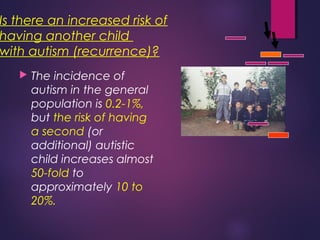
Is there an increased risk of
having another child
with autism (recurrence)?
 The incidence of
autism in the general
population is 0.2-1%,
but the risk of having
a second (or
additional) autistic
child increases almost
50-fold to
approximately 10 to
20%.
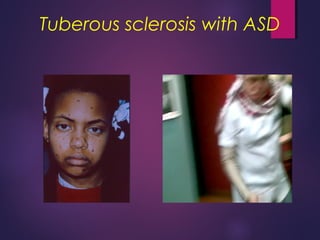
Tuberous sclerosis with ASD
OUR ROLE
 1- early diagnose
 2- full assessment
 3- explain , support
 4- progress , not regress
Early Identification
1. Why we should identify autism at young age?
2. Can we identify accurately autism at
young ages?
3. How we go about identifying autism at
young ages?
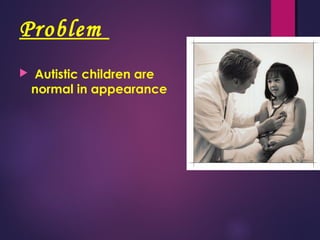
Problem
 Autistic children are
normal in appearance
Early Identification
1. Why we should identify autism at young age?
2. Can we identify accurately autism at young
ages?
3. How we go about identifying autism at
young ages?
? PARENT FIRST CONCERN
 Language
 Social
 behavior
 Emotional
 General delay
? PARENT FIRST CONCERN

LANGUAGE √
 Social
 behavior
 Emotional
 General delay
? PARENT FIRST CONCERN
 6 mo
 12 mo
 18 mo
 24 mo
? PARENT FIRST CONCERN
 6 mo
 12 mo

18 mo √
 24 mo
Early Identification
VARY FROM CHILD
TO CHILD Age
 Delayed onset of LANGUAGE usually first parent
concern ( 18 mo.)
 SEVERITY
 COGNITIVE FUNCTION
Early Identification
how to do it?
 Parent observation
 Direct observation
 Video-tape
 Professional multi-setting Assessment
Milestones :
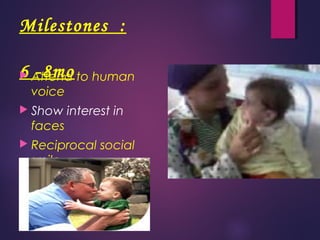
6 -8mo Attend to human
voice
 Show interest in
faces
 Reciprocal social
smile
 Coo or babble
Milestones : 9 – 12 mo
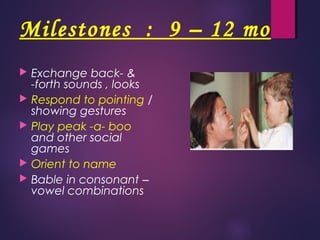
 Exchange back- &
-forth sounds , looks
 Respond to pointing /
showing gestures
 Play peak -a- boo
and other social
games
 Orient to name
 Bable in consonant –
vowel combinations
Milestones : 12 – 15
mo Use gestures and sounds to set needs met
 Show objects & share interest with others
 Use a few words
 Show interest in other children
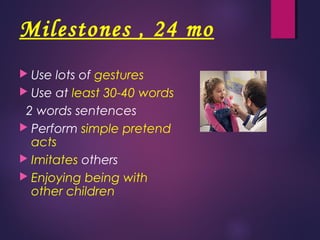
Milestones , 24 mo
 Use lots of gestures
 Use at least 30-40 words
2 words sentences
 Perform simple pretend
acts
 Imitates others
 Enjoying being with
other children
Language red flags
No: bubbling,

No: pointing by 9 mo,
No : other gestures by 12 mo
No: single words by 16 mo
No: spontaneous two words by 24 mo
Or
Loss of language skills at any age
Communication red flags
less: communication to direct
person’s attention
less: use of gestures to communicate
less: use of eye to eye contact to communicate
 Inconsistent response to sounds (name)
Simple test for early
screening autism
 Infants who don't respond to their name by 1 year
of age appear to be more likely to be diagnosed
with an autism spectrum disorder or other
developmental problem by the age of 2.
University of California Davis M.I.N.D. Institute, USA
2007
social red flags
less: response to social overtures
less: participation in Peek-a-Boo play
less: “showing off ” for attention
less: imitation of the actions of the others
less: interest in other children
Restricted Activities/ interests
red flags
less: functional play, especially
with dolls/cars
less: imaginative play
possibly: repetitive motor behaviors
 Unusual : visual interests
red flags
Less specific
repetitive behavior
Possibly, reliable
social and communication abnormalities
(difficult)
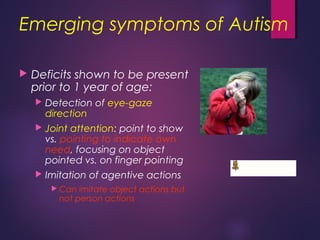
Emerging symptoms of Autism
 Deficits shown to be present
prior to 1 year of age:
 Detection of eye-gaze
direction
 Joint attention: point to show
vs. pointing to indicate own
need, focusing on object
pointed vs. on finger pointing
 Imitation of agentive actions
 Can imitate object actions but
not person actions
OUR ROLE
 1- early diagnose
 2- full assessment
 3- explain , support
 4- progress , not regress
Clinically identifying
children with autism
Level one
Routine Developmental Surveillance and
Screening Specifically for Autism
• Should be performed on all children.
• Involves first identifying those at risk for any type of atypical
development, followed by identifying those specifically at risk for
autism.
Clinically identifying
children with autism
Level Two
Professional Diagnosis and Evaluation of Autism
Involves a more in-depth investigation of already identified children and
differentiates autism from other developmental disorders.
Level one of
evaluation ObserveObserve
ListenListen
M-CHATM-CHAT
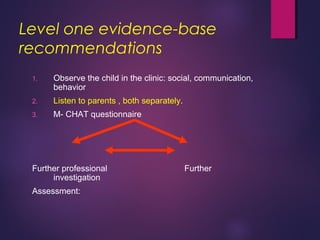
Level one evidence-base
recommendations
1. Observe the child in the clinic: social, communication,
behavior
2. Listen to parents , both separately.
3. M- CHAT questionnaire
Further professional Further
investigation
Assessment:
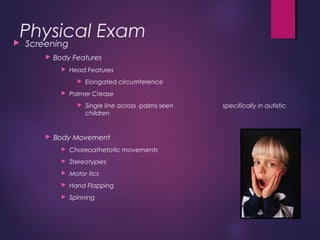
Physical Exam Screening
 Body Features
 Head Features
 Elongated circumference
 Palmer Crease
 Single line across palms seen specifically in autistic
children
 Body Movement
 Choreoathetotic movements
 Stereotypies
 Motor tics
 Hand Flapping
 Spinning
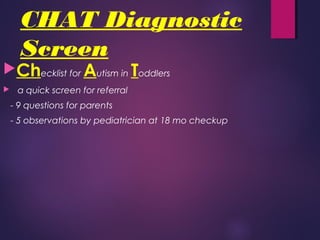
CHAT Diagnostic
Screen
Checklist for Autism in Toddlers
 a quick screen for referral
- 9 questions for parents
- 5 observations by pediatrician at 18 mo checkup
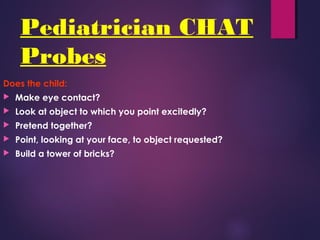
Pediatrician CHAT
Probes
Does the child:
 Make eye contact?
 Look at object to which you point excitedly?
 Pretend together?
 Point, looking at your face, to object requested?
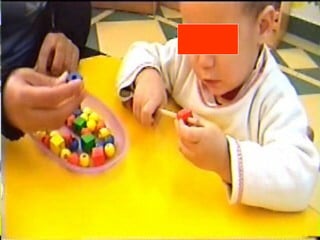
 Build a tower of bricks?
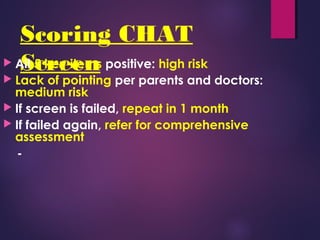
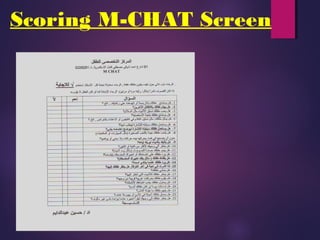
Scoring CHAT
Screen All 5 key items positive: high risk
 Lack of pointing per parents and doctors:
medium risk
 If screen is failed, repeat in 1 month
 If failed again, refer for comprehensive
assessment
-
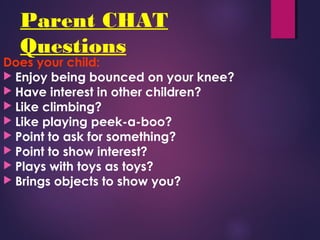
Parent CHAT
Questions
Does your child:
 Enjoy being bounced on your knee?
 Have interest in other children?
 Like climbing?
 Like playing peek-a-boo?
 Point to ask for something?
 Point to show interest?
 Plays with toys as toys?
 Brings objects to show you?
Scoring M-CHAT Screen
Level two: Diagnosis and
evaluation of autism
1-formal Diagnostic
procedures
2- developmental
profile
3- specific language
assessment
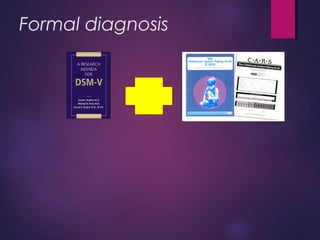
Formal diagnosis
 Language skills :
especially expressive,
receptive is on and off
 motor deficits Impairments
of gross and fine motor
function are common in
autistic individuals
 Cognitive skills
 Social skills/behavior
assessment
Work Up for Autism
(+/-) BERA
 EEG and brain mapping.
 MRI
 Genetic consult if syndrome suspected
 Lead level if high risk or with pica
 Blood sensitivity for casein and gluten
Work Up for Autism
 Young children
- serum AA
- urine organic acids
- pyruvate, lactate
- karyotype with fragile X
 Older children: - karyotype with fragile X
 MRI
When and what laboratory investigations are
indicated for the diagnosis of autism?
(continued)
Other tests There is insufficient evidence to support the use of other
tests such as: hair analysis for trace
elements
 celiac antibodies
 allergy testing (particularly
food allergies for gluten,
casein, candida, and other
molds)
 immunologic or
neurochemical abnormalities
 micronutrients such as
vitamin levels
 intestinal permeability
studies
 stool analysis
 urinary peptides
 mitochondrial disorders
(including lactate and
pyruvate)
 thyroid function tests
 erythrocyte glutathione
peroxidase studies
difficulty for diagnosis
Current methods of screening for autism may
not identify:
 1) children with milder variants of the
disorder
 2) parent denial .
Summary : Red flags
please refer
 Not respond to name by 12 months age
 Avoid eye to eye contact
 Does not share interests with others (children /adults)
 Has flat or inappropriate facial expressions
 Failure to point or respond to pointing
 Avoid or resist physical contact
 Is not comforted by others during distress
 Use few or no gestures e.g., does not wave good bye
 Appears not to listen to others’ speech
 NO single words by 16 mo or 2 simple sentences by 24 mo
 Use words in idiosyncratic ways ( classic Arabic, incoherent)
 Any loss of language or social skills at any age
 Gives unrelated answers to questions
Autism and early diagnosis (red flags)

Autism and early diagnosis (red flags)

  • 1.
    AUTISM :AUTISM :REDRED FLAGSFLAGS FORFOR EARLY DIAGNOSISEARLY DIAGNOSIS PROF DR HUSSEIN ABDELDAYEM MEMBER OF AAN, AAP, ICNA FACULTY OF MEDICINE, ALEX
  • 3.
  • 4.
    DSM-5 Field TrialProfessional Volunteers . From Darrel A. Regier, M.D. To husseindayem@hotmail.com  Thank you for participating in the DSM-5 Field Trials in Routine Clinical Practice Settings! This important part of the DSM-5 Field Trials will test the feasibility and clinical utility of the proposed diagnostic criteria and measures for routine practices. 
  • 5.
    DSM-V No pervasive developmental disorderterm But ASDSEVERE MILDCARS 60-30/ 29-16/ 15 AND LESS
  • 6.
    Autism Spectrum DisorderAutismSpectrum Disorder They are defined as a group of biologically based neurodevelopment disorders that share two common areas of concern in social interactions Restricted and repetitive interests or behaviors Qualitative impairments in communication &
  • 7.
    Diagnosis of ASDDiagnosisof ASD In DSM-IV-TR and ICD-10 diagnosis has been based on deficits in three core domains: (1)social impairments, (2) communication difficulties, and (3) stereotyped and repetitive behaviours In DSM-5 (and the proposed ICD-11 criteria) diagnosis is based on deficits in two core dimensions: 1.Social-communication difficulties 2.Repetitive behavior
  • 10.
  • 11.
  • 13.
  • 14.
  • 15.
    The Molecular Puzzleof Autism: Genetic Factors Environmental Factors
  • 17.
    thimerosal is safe the latest study joins a growing body of literature that shows thimerosal is safe and causes no long- term negative effects on children's health
  • 18.
    IS IT POSSIBLE TOCURE AUTISM?
  • 19.
    Translational neurobiology inShank mutants - mouse models for ASD – Michael Schmeisser (Ulm University, Germany) Mutations in BCKD-kinase lead to a potentially treatable form of autism with epilepsy – Gaia Novarino (IST, Vienna, Austria) Autism Spectrum Disorder with or without epilepsy: comparative study of 207 patients – Benedetta Berlese (A.O.U. Verona, Italy) OSHA protocol for treating autistic children – Hussein Abdeldayem (Alexandria University, Egypt) Very early parents mediated intervention in TSC infants at risk for Autism – Arianna Benvenuto (Tor ICNA Amsterdam 2016 IPSC South Africa 2013                                    ICNC 2016 Satellite Symposium Is Autism a treatable disorder ? April 29th , 2016 Roma (Italy)
  • 20.
    RULES FOR TREATMENTOF ASD  PHARMACOLOGICAL DRUGS HAVE NO ROLE IN TREATING OF ASD BUT OF NON SPECIFIC/ SYMPTOMATIC TREATMENT  INTENSIVE BEHAVIOR MODIFICATION SESSIONS OF AT LEAST 25 HOURS PER WEEK IS THE IDEAL TREATMENT NOWADAYS
  • 21.
     Autism wasconsidered as disorder without hope, but now it is recognized as treatable for many patients especially who are diagnosed early and receive ,,,,,,  INTENSIVE BEHAVIOR INTERVENTIONS
  • 22.
     MEDICAL LITERATURESAYS NO, BUT NOWADAYS WITH ADEQUATE INTENSIVE REHABILITATION SESSIONS THE IMPROVEMENT CAN BE SO GREAT THAT IT COULD JUSTIFY THE USAGE OF THE WORD TREATED > CURE
  • 23.
    SOMETIMES WITH ADEQUATE INTENSEREHABILITATION CHILDREN WITH HIGH RISK FOR DEVELOPING ASD DON’T DEVELOP IT .
  • 24.
  • 25.
    If your patient/child is at risk for developing or already with ASD , and if you are willing to put effort in helping him,, attend my presentation thoroughly
  • 26.
    Genetics __________  High concordance ratein monozygotic twins  Increased incidence in siblings  Candidate genes : 3-7 genes identified in family studies
  • 27.
    Is there anincreased risk of having another child with autism (recurrence)?  The incidence of autism in the general population is 0.2-1%, but the risk of having a second (or additional) autistic child increases almost 50-fold to approximately 10 to 20%.
  • 28.
  • 33.
    OUR ROLE  1-early diagnose  2- full assessment  3- explain , support  4- progress , not regress
  • 34.
    Early Identification 1. Whywe should identify autism at young age? 2. Can we identify accurately autism at young ages? 3. How we go about identifying autism at young ages?
  • 35.
    Problem  Autistic childrenare normal in appearance
  • 36.
    Early Identification 1. Whywe should identify autism at young age? 2. Can we identify accurately autism at young ages? 3. How we go about identifying autism at young ages?
  • 37.
    ? PARENT FIRSTCONCERN  Language  Social  behavior  Emotional  General delay
  • 38.
    ? PARENT FIRSTCONCERN  LANGUAGE √  Social  behavior  Emotional  General delay
  • 39.
    ? PARENT FIRSTCONCERN  6 mo  12 mo  18 mo  24 mo
  • 40.
    ? PARENT FIRSTCONCERN  6 mo  12 mo  18 mo √  24 mo
  • 41.
    Early Identification VARY FROMCHILD TO CHILD Age  Delayed onset of LANGUAGE usually first parent concern ( 18 mo.)  SEVERITY  COGNITIVE FUNCTION
  • 42.
    Early Identification how todo it?  Parent observation  Direct observation  Video-tape  Professional multi-setting Assessment
  • 43.
    Milestones : 6 -8moAttend to human voice  Show interest in faces  Reciprocal social smile  Coo or babble
  • 44.
    Milestones : 9– 12 mo  Exchange back- & -forth sounds , looks  Respond to pointing / showing gestures  Play peak -a- boo and other social games  Orient to name  Bable in consonant – vowel combinations
  • 45.
    Milestones : 12– 15 mo Use gestures and sounds to set needs met  Show objects & share interest with others  Use a few words  Show interest in other children
  • 46.
    Milestones , 24mo  Use lots of gestures  Use at least 30-40 words 2 words sentences  Perform simple pretend acts  Imitates others  Enjoying being with other children
  • 47.
    Language red flags No:bubbling,  No: pointing by 9 mo, No : other gestures by 12 mo No: single words by 16 mo No: spontaneous two words by 24 mo Or Loss of language skills at any age
  • 48.
    Communication red flags less:communication to direct person’s attention less: use of gestures to communicate less: use of eye to eye contact to communicate  Inconsistent response to sounds (name)
  • 49.
    Simple test forearly screening autism  Infants who don't respond to their name by 1 year of age appear to be more likely to be diagnosed with an autism spectrum disorder or other developmental problem by the age of 2. University of California Davis M.I.N.D. Institute, USA 2007
  • 50.
    social red flags less:response to social overtures less: participation in Peek-a-Boo play less: “showing off ” for attention less: imitation of the actions of the others less: interest in other children
  • 51.
    Restricted Activities/ interests redflags less: functional play, especially with dolls/cars less: imaginative play possibly: repetitive motor behaviors  Unusual : visual interests
  • 52.
    red flags Less specific repetitivebehavior Possibly, reliable social and communication abnormalities (difficult)
  • 53.
    Emerging symptoms ofAutism  Deficits shown to be present prior to 1 year of age:  Detection of eye-gaze direction  Joint attention: point to show vs. pointing to indicate own need, focusing on object pointed vs. on finger pointing  Imitation of agentive actions  Can imitate object actions but not person actions
  • 55.
    OUR ROLE  1-early diagnose  2- full assessment  3- explain , support  4- progress , not regress
  • 56.
    Clinically identifying children withautism Level one Routine Developmental Surveillance and Screening Specifically for Autism • Should be performed on all children. • Involves first identifying those at risk for any type of atypical development, followed by identifying those specifically at risk for autism.
  • 57.
    Clinically identifying children withautism Level Two Professional Diagnosis and Evaluation of Autism Involves a more in-depth investigation of already identified children and differentiates autism from other developmental disorders.
  • 58.
    Level one of evaluationObserveObserve ListenListen M-CHATM-CHAT
  • 59.
    Level one evidence-base recommendations 1.Observe the child in the clinic: social, communication, behavior 2. Listen to parents , both separately. 3. M- CHAT questionnaire Further professional Further investigation Assessment:
  • 60.
    Physical Exam Screening Body Features  Head Features  Elongated circumference  Palmer Crease  Single line across palms seen specifically in autistic children  Body Movement  Choreoathetotic movements  Stereotypies  Motor tics  Hand Flapping  Spinning
  • 61.
    CHAT Diagnostic Screen Checklist forAutism in Toddlers  a quick screen for referral - 9 questions for parents - 5 observations by pediatrician at 18 mo checkup
  • 62.
    Pediatrician CHAT Probes Does thechild:  Make eye contact?  Look at object to which you point excitedly?  Pretend together?  Point, looking at your face, to object requested?  Build a tower of bricks?
  • 63.
    Scoring CHAT Screen All5 key items positive: high risk  Lack of pointing per parents and doctors: medium risk  If screen is failed, repeat in 1 month  If failed again, refer for comprehensive assessment -
  • 64.
    Parent CHAT Questions Does yourchild:  Enjoy being bounced on your knee?  Have interest in other children?  Like climbing?  Like playing peek-a-boo?  Point to ask for something?  Point to show interest?  Plays with toys as toys?  Brings objects to show you?
  • 66.
  • 69.
    Level two: Diagnosisand evaluation of autism 1-formal Diagnostic procedures 2- developmental profile 3- specific language assessment
  • 70.
  • 72.
     Language skills: especially expressive, receptive is on and off  motor deficits Impairments of gross and fine motor function are common in autistic individuals  Cognitive skills  Social skills/behavior assessment
  • 73.
    Work Up forAutism (+/-) BERA  EEG and brain mapping.  MRI  Genetic consult if syndrome suspected  Lead level if high risk or with pica  Blood sensitivity for casein and gluten
  • 74.
    Work Up forAutism  Young children - serum AA - urine organic acids - pyruvate, lactate - karyotype with fragile X  Older children: - karyotype with fragile X  MRI
  • 75.
    When and whatlaboratory investigations are indicated for the diagnosis of autism? (continued) Other tests There is insufficient evidence to support the use of other tests such as: hair analysis for trace elements  celiac antibodies  allergy testing (particularly food allergies for gluten, casein, candida, and other molds)  immunologic or neurochemical abnormalities  micronutrients such as vitamin levels  intestinal permeability studies  stool analysis  urinary peptides  mitochondrial disorders (including lactate and pyruvate)  thyroid function tests  erythrocyte glutathione peroxidase studies
  • 76.
    difficulty for diagnosis Currentmethods of screening for autism may not identify:  1) children with milder variants of the disorder  2) parent denial .
  • 77.
  • 78.
    please refer  Notrespond to name by 12 months age  Avoid eye to eye contact  Does not share interests with others (children /adults)  Has flat or inappropriate facial expressions  Failure to point or respond to pointing  Avoid or resist physical contact  Is not comforted by others during distress  Use few or no gestures e.g., does not wave good bye  Appears not to listen to others’ speech  NO single words by 16 mo or 2 simple sentences by 24 mo  Use words in idiosyncratic ways ( classic Arabic, incoherent)  Any loss of language or social skills at any age  Gives unrelated answers to questions

Editor's Notes

  • #7 NON VERBAL COMMUNICATION
  • #11 MALE TO FEMALE 4:1
  • #12 Adult ASD
  • #22 MUCH PROGRESS HAS BEEN MADE IN THE PAST 10 YEARS IN THE TREATMENT OF ASD, A NEURODEVELOPMENTAL DISORDER DEFINED BY DSM5 AS DEFICIT IN SOCIAL COMMUNICATION AND THE PRESENCE OF REPETITIVE BEHAVIORS AND/OR INTERESTS
  • #61 Also, during screening, check body features. Head circumference may be elongated, but this is usually only in a subset of kids. It may be pronounced in first few years of life and may resolve by adolescence. The Palmer crease is a single line across the palms which is seen specifically in autistic children.