Authentic assessment:
a case study
`
Angelica Risquez
Centre for Transformative Learning
angelica_tel
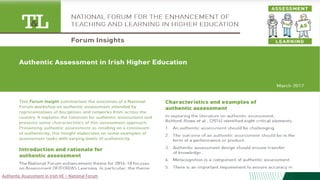
Authentic Assessment in Irish HE – National Forum
Authentic assessment
• Increasing realisation of the over-emphasis on the examination as an
assessment approach (i.e., 61% of modules in a recent profile of Irish
assessment practices contained examinations (National Forum, 2016a).
• Increased awareness of the challenges surrounding enhancing student
motivation and engagement in the curriculum (Healey et al., 2014). With
competing demands on students’ time, the relevance
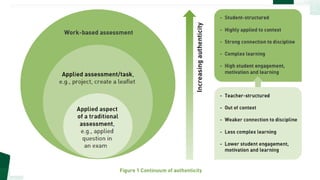
• Authentic assessment is a form of assessment which involves students
conducting ‘real world’ tasks in meaningful contexts (Swaffield, 2011) with
the aim of empowering and engaging students through assessment. It is
concerned with the relevancy of assessment to the student life and work.
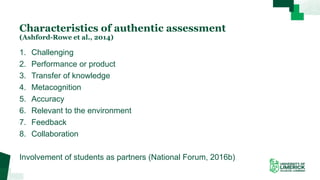
Characteristics of authentic assessment
(Ashford-Rowe et al., 2014)
1. Challenging
2. Performance or product
3. Transfer of knowledge
4. Metacognition
5. Accuracy
6. Relevant to the environment
7. Feedback
8. Collaboration
• Involvement of students as partners (National Forum, 2016b).
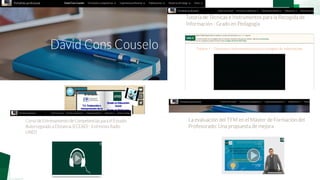
Using e-portolios and video as authentic assessment
Digital media and career guidance
Masters in Career Guidance, UNED (Spanish
Distance Education)
Angelica Risquez (UL), Roberto Baelo (Univ. of Leon)
This Photo by Unknown Author is licensed under CC BY-SA-NC
Background and objectives
• 12 week module with a cohort of ~15 participants, many of which are already
actively working as career counsellors
• We work with the concept of ‘personal digital brand’ through a series of
interlinked e-tivities (Salmon) aimed to promote self-reflection and peer
engagement. Students work towards producing digital contents that enhance
their visibility in the web (personal e-portofolio and video curriculum)
• Continuous assessment supported on peer feedback through the discussion
forum tool, supported with three webinars at key points. Evaluation rubrics
for each element of assessment.
• As a result from this, the module helps develop the students’ digital skills and
to transfer these into their work.
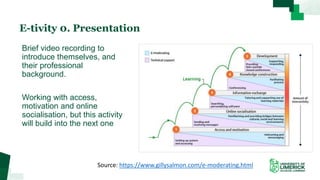
E-tivity 0. Presentation
Brief video recording to
introduce themselves, and
their professional
background.
Working with access,
motivation and online
socialisation, but this activity
will build into the next one
Source: https://www.gillysalmon.com/e-moderating.html
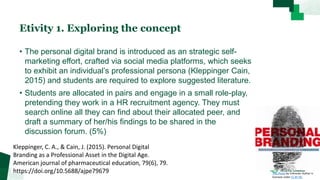
Etivity 1. Exploring the concept
• The personal digital brand is introduced as an strategic self-
marketing effort, crafted via social media platforms, which seeks
to exhibit an individual’s professional persona (Kleppinger Cain,
2015) and students are required to explore suggested literature.
• Students are allocated in pairs and engage in a small role-play,
pretending they work in a HR recruitment agency. They must
search online all they can find about their allocated peer, and
draft a summary of her/his findings to be shared in the
discussion forum. (5%)
Kleppinger, C. A., & Cain, J. (2015). Personal Digital
Branding as a Professional Asset in the Digital Age.
American journal of pharmaceutical education, 79(6), 79.
https://doi.org/10.5688/ajpe79679 This Photo by Unknown Author is
licensed under CC BY-NC
E-tivity 2. Ego-surfing
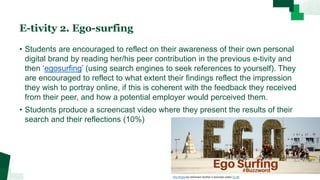
• Students are encouraged to reflect on their awareness of their own personal
digital brand by reading her/his peer contribution in the previous e-tivity and
then ‘egosurfing’ (using search engines to seek references to yourself). They
are encouraged to reflect to what extent their findings reflect the impression
they wish to portray online, if this is coherent with the feedback they received
from their peer, and how a potential employer would perceived them.
• Students produce a screencast video where they present the results of their
search and their reflections (10%)
This Photo by Unknown Author is licensed under CC BY
E-tivity 3. Exploring the videoCV
• Students start exploring the concept and characteristics of videoCV as a
way to provide a brief account of a person's professional experience,
qualifications and interests, which allows her/him to demonstrate public
speaking, inter-personal, creative or technical skills to a potential employer
in a way that a text-only CV can not.
• Students search for examples of videoCV in the web and provide an
example in the discussion forum, analysing its strengths and limitations.
• The lecturer e-moderates this activity by summarising and ‘weaving’
(Salmon, 2012)
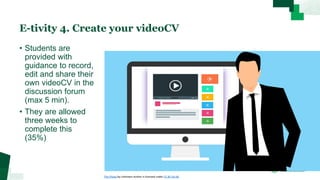
• Students are
provided with
guidance to record,
edit and share their
own videoCV in the
discussion forum
(max 5 min).
• They are allowed
three weeks to
complete this
(35%)
E-tivity 4. Create your videoCV
This Photo by Unknown Author is licensed under CC BY-SA-NC
• Students create a website where they curate
their personal profile, previous experiences,
links to social media (LinkedIn and others),
relevant artefacts (previous projects, pictures,
podcasts, blog posts, etc), their reflections and
learning on their professional journey,
including their videoCV.
• They are provided guidance to use tools such
as Wordpress and Google Sites, and choose
to publish openly or password protected.
• They are allowed three weeks to complete
this, supported by their lecturer.
E-tivity 5. Create e-portfolio
• Students are randomly
allocated in pairs to review
each others e-portfolios,
using the evaluation rubric.
• They are asked to
contribute their feedback in
the discussion forum,
providing constructive
suggestions, asking
meaningful questions, etc.
E-tivity 6. Peer feedback on e-portfolios
This Photo by Unknown Author is licensed under CC BY-NC-ND
• Students take on board the peer
feedback and edit their e-portfolio
accordingly, and upload the link to their
final work (50%)
• Contribute a reflection of their learning
through the module, with special
emphasis on their initial reflections on
their personal digital brand (e-tivities
1&2), what the most challenging
aspects were, and their suggestions for
the future development of the module.
E-tivity 7. Final edition and reflections
This Photo by Unknown Author is licensed under CC BY-SA
Characteristics of authentic assessment
(Ashford-Rowe et al., 2014)
1. Challenging
2. Performance or product
3. Transfer of knowledge
4. Metacognition
5. Accuracy
6. Relevant to the environment
7. Feedback
8. Collaboration
Involvement of students as partners (National Forum, 2016b)
References

Authentic assessment: a case study

  • 1.
    Authentic assessment: a casestudy ` Angelica Risquez Centre for Transformative Learning angelica_tel
  • 2.
    Authentic Assessment inIrish HE – National Forum
  • 3.
    Authentic assessment • Increasingrealisation of the over-emphasis on the examination as an assessment approach (i.e., 61% of modules in a recent profile of Irish assessment practices contained examinations (National Forum, 2016a). • Increased awareness of the challenges surrounding enhancing student motivation and engagement in the curriculum (Healey et al., 2014). With competing demands on students’ time, the relevance • Authentic assessment is a form of assessment which involves students conducting ‘real world’ tasks in meaningful contexts (Swaffield, 2011) with the aim of empowering and engaging students through assessment. It is concerned with the relevancy of assessment to the student life and work.
  • 4.
    Characteristics of authenticassessment (Ashford-Rowe et al., 2014) 1. Challenging 2. Performance or product 3. Transfer of knowledge 4. Metacognition 5. Accuracy 6. Relevant to the environment 7. Feedback 8. Collaboration • Involvement of students as partners (National Forum, 2016b).
  • 6.
    Using e-portolios andvideo as authentic assessment Digital media and career guidance Masters in Career Guidance, UNED (Spanish Distance Education) Angelica Risquez (UL), Roberto Baelo (Univ. of Leon) This Photo by Unknown Author is licensed under CC BY-SA-NC
  • 7.
    Background and objectives •12 week module with a cohort of ~15 participants, many of which are already actively working as career counsellors • We work with the concept of ‘personal digital brand’ through a series of interlinked e-tivities (Salmon) aimed to promote self-reflection and peer engagement. Students work towards producing digital contents that enhance their visibility in the web (personal e-portofolio and video curriculum) • Continuous assessment supported on peer feedback through the discussion forum tool, supported with three webinars at key points. Evaluation rubrics for each element of assessment. • As a result from this, the module helps develop the students’ digital skills and to transfer these into their work.
  • 8.
    E-tivity 0. Presentation Briefvideo recording to introduce themselves, and their professional background. Working with access, motivation and online socialisation, but this activity will build into the next one Source: https://www.gillysalmon.com/e-moderating.html
  • 9.
    Etivity 1. Exploringthe concept • The personal digital brand is introduced as an strategic self- marketing effort, crafted via social media platforms, which seeks to exhibit an individual’s professional persona (Kleppinger Cain, 2015) and students are required to explore suggested literature. • Students are allocated in pairs and engage in a small role-play, pretending they work in a HR recruitment agency. They must search online all they can find about their allocated peer, and draft a summary of her/his findings to be shared in the discussion forum. (5%) Kleppinger, C. A., & Cain, J. (2015). Personal Digital Branding as a Professional Asset in the Digital Age. American journal of pharmaceutical education, 79(6), 79. https://doi.org/10.5688/ajpe79679 This Photo by Unknown Author is licensed under CC BY-NC
  • 10.
    E-tivity 2. Ego-surfing •Students are encouraged to reflect on their awareness of their own personal digital brand by reading her/his peer contribution in the previous e-tivity and then ‘egosurfing’ (using search engines to seek references to yourself). They are encouraged to reflect to what extent their findings reflect the impression they wish to portray online, if this is coherent with the feedback they received from their peer, and how a potential employer would perceived them. • Students produce a screencast video where they present the results of their search and their reflections (10%) This Photo by Unknown Author is licensed under CC BY
  • 11.
    E-tivity 3. Exploringthe videoCV • Students start exploring the concept and characteristics of videoCV as a way to provide a brief account of a person's professional experience, qualifications and interests, which allows her/him to demonstrate public speaking, inter-personal, creative or technical skills to a potential employer in a way that a text-only CV can not. • Students search for examples of videoCV in the web and provide an example in the discussion forum, analysing its strengths and limitations. • The lecturer e-moderates this activity by summarising and ‘weaving’ (Salmon, 2012)
  • 12.
    • Students are providedwith guidance to record, edit and share their own videoCV in the discussion forum (max 5 min). • They are allowed three weeks to complete this (35%) E-tivity 4. Create your videoCV This Photo by Unknown Author is licensed under CC BY-SA-NC
  • 13.
    This Photo byUnknown Author is licensed under CC BY-SA-NC • Students create a website where they curate their personal profile, previous experiences, links to social media (LinkedIn and others), relevant artefacts (previous projects, pictures, podcasts, blog posts, etc), their reflections and learning on their professional journey, including their videoCV. • They are provided guidance to use tools such as Wordpress and Google Sites, and choose to publish openly or password protected. • They are allowed three weeks to complete this, supported by their lecturer. E-tivity 5. Create e-portfolio
  • 14.
    • Students arerandomly allocated in pairs to review each others e-portfolios, using the evaluation rubric. • They are asked to contribute their feedback in the discussion forum, providing constructive suggestions, asking meaningful questions, etc. E-tivity 6. Peer feedback on e-portfolios This Photo by Unknown Author is licensed under CC BY-NC-ND
  • 15.
    • Students takeon board the peer feedback and edit their e-portfolio accordingly, and upload the link to their final work (50%) • Contribute a reflection of their learning through the module, with special emphasis on their initial reflections on their personal digital brand (e-tivities 1&2), what the most challenging aspects were, and their suggestions for the future development of the module. E-tivity 7. Final edition and reflections This Photo by Unknown Author is licensed under CC BY-SA
  • 17.
    Characteristics of authenticassessment (Ashford-Rowe et al., 2014) 1. Challenging 2. Performance or product 3. Transfer of knowledge 4. Metacognition 5. Accuracy 6. Relevant to the environment 7. Feedback 8. Collaboration Involvement of students as partners (National Forum, 2016b)
  • 18.