DATA-ENABLED
STUDENT SUCCESS:
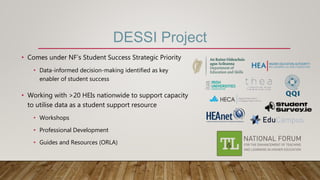
DESSI Project
• Comes under NF’s Student Success Strategic Priority
• Data-informed decision-making identified as key
enabler of student success
• Working with >20 HEIs nationwide to support capacity
to utilise data as a student support resource
• Workshops
• Professional Development
• Guides and Resources (ORLA)
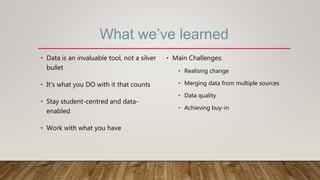
What we’ve learned
• Data is an invaluable tool, not a silver
bullet
• It’s what you DO with it that counts
• Stay student-centred and data-
enabled
• Work with what you have
• Main Challenges:
• Realising change
• Merging data from multiple sources
• Data quality
• Achieving buy-in
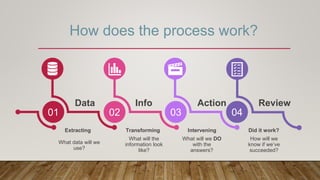
How does the process work?
01 02 03 04
Data Info Action Review
What data will we
use?
Extracting
What will the
information look
like?
Transforming
What will we DO
with the
answers?
Intervening
How will we
know if we’ve
succeeded?
Did it work?
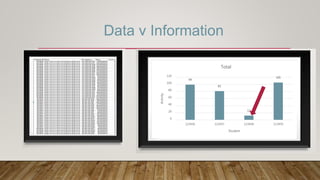
Data v Information
99
81
12
105
0
20
40
60
80
100
120
123456 123457 123458 123459
Activity
Student
Total
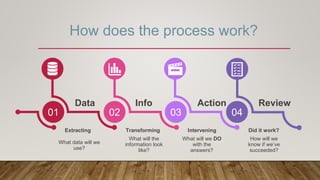
How does the process work?
01 02 03 04
Data Info Action Review
What data will we
use?
Extracting
What will the
information look
like?
Transforming
What will we DO
with the
answers?
Intervening
How will we
know if we’ve
succeeded?
Did it work?
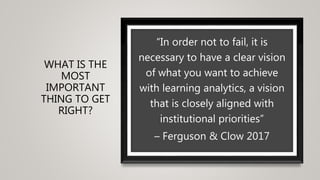
WHAT IS THE
MOST
IMPORTANT
THING TO GET
RIGHT?
“In order not to fail, it is
necessary to have a clear vision
of what you want to achieve
with learning analytics, a vision
that is closely aligned with
institutional priorities”
– Ferguson & Clow 2017
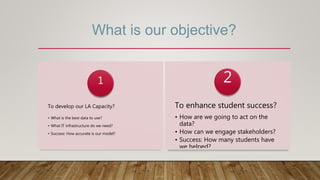
What is our objective?
To develop our LA Capacity?
• What is the best data to use?
• What IT infrastructure do we need?
• Success: How accurate is our model?
1
To enhance student success?
• How are we going to act on the
data?
• How can we engage stakeholders?
• Success: How many students have
we helped?
2
WHAT ARE
OUR
PRINCIPLES?
1. What does student success mean? Is it
synonymous with retention?
2. Can data do everything? What are its
limitations?
3. ‘All models are wrong, some are useful’
George Box, 1976 – What are the
implications of this?
HOW DOES THIS
LINK IN WITH
INSTITUTIONAL &
NATIONAL
PRIORITIES?
• National Plan for Equity of Access to Higher
Education 2015-2019
• HE System Performance Framework 2018-2020
• Expert Group on Future Skills Needs
• Public Service ICT Strategy
• Tracking Leadership Perspectives on Digital Capacity
(National Forum, 2017)
• Student Non-Completion on ICT Programmes
(National Forum, 2015)
• EU’s Digital Education Action Plan
• Institutional?
WHAT (SPECIFIC) CHANGE
ARE WE TRYING TO BRING
ABOUT?
WHAT IS OUR QUESTION?
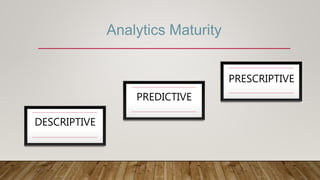
Analytics Maturity
DESCRIPTIVE
PREDICTIVE
PRESCRIPTIVE
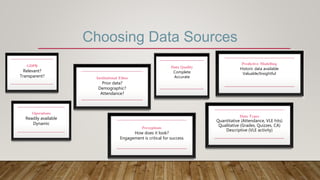
Choosing Data Sources
GDPR
Relevant?
Transparent?
Predictive Modelling
Historic data available
Valuable/Insightful
Operations
Readily available
Dynamic
Institutional Ethos
Prior data?
Demographic?
Attendance?
Data Quality
Complete
Accurate
Perceptions
How does it look?
Engagement is critical for success
Data Types
Quantitative (Attendance, VLE hits)
Qualitative (Grades, Quizzes, CA)
Descriptive (VLE activity)
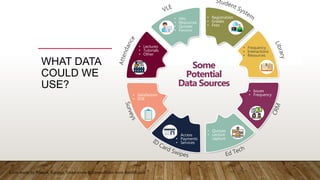
WHAT DATA
COULD WE
USE?
Some
Potential
Data Sources
• Hits
• Resources
• Quizzes
• Forums
• Registration
• Grades
• Fees
• Frequency
• Interactions
• Resources
• Issues
• Frequency
• Quizzes
• Lecture
capture
• Access
• Payments
• Services
• Satisfaction
• ISSE
• Lectures
• Tutorials
• Other
Icons made by Freepik, Eucalyp, Smashicons & Dinosoftlabs from flatiron.com
WHAT ARE WE GOING TO
DO WITH THE ANSWER?
WHAT ACTIONS WILL WE TAKE?
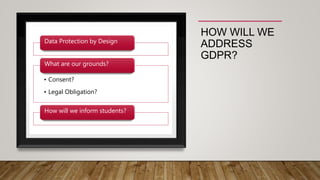
HOW WILL WE
ADDRESS
GDPR?
Data Protection by Design
• Consent?
• Legal Obligation?
What are our grounds?
How will we inform students?
WHAT ACTIONS DO
WE NEED TO TAKE?
THANK YOU
lee.ofarrell@teachingandlearning
.ie
@OFarrellLee
@ForumTL
ORLA:
www.teachingandlearning.ie/orla

Workshop presentation UL

  • 1.
  • 2.
    DESSI Project • Comesunder NF’s Student Success Strategic Priority • Data-informed decision-making identified as key enabler of student success • Working with >20 HEIs nationwide to support capacity to utilise data as a student support resource • Workshops • Professional Development • Guides and Resources (ORLA)
  • 3.
    What we’ve learned •Data is an invaluable tool, not a silver bullet • It’s what you DO with it that counts • Stay student-centred and data- enabled • Work with what you have • Main Challenges: • Realising change • Merging data from multiple sources • Data quality • Achieving buy-in
  • 4.
    How does theprocess work? 01 02 03 04 Data Info Action Review What data will we use? Extracting What will the information look like? Transforming What will we DO with the answers? Intervening How will we know if we’ve succeeded? Did it work?
  • 5.
    Data v Information 99 81 12 105 0 20 40 60 80 100 120 123456123457 123458 123459 Activity Student Total
  • 6.
    How does theprocess work? 01 02 03 04 Data Info Action Review What data will we use? Extracting What will the information look like? Transforming What will we DO with the answers? Intervening How will we know if we’ve succeeded? Did it work?
  • 7.
    WHAT IS THE MOST IMPORTANT THINGTO GET RIGHT? “In order not to fail, it is necessary to have a clear vision of what you want to achieve with learning analytics, a vision that is closely aligned with institutional priorities” – Ferguson & Clow 2017
  • 8.
    What is ourobjective? To develop our LA Capacity? • What is the best data to use? • What IT infrastructure do we need? • Success: How accurate is our model? 1 To enhance student success? • How are we going to act on the data? • How can we engage stakeholders? • Success: How many students have we helped? 2
  • 9.
    WHAT ARE OUR PRINCIPLES? 1. Whatdoes student success mean? Is it synonymous with retention? 2. Can data do everything? What are its limitations? 3. ‘All models are wrong, some are useful’ George Box, 1976 – What are the implications of this?
  • 10.
    HOW DOES THIS LINKIN WITH INSTITUTIONAL & NATIONAL PRIORITIES? • National Plan for Equity of Access to Higher Education 2015-2019 • HE System Performance Framework 2018-2020 • Expert Group on Future Skills Needs • Public Service ICT Strategy • Tracking Leadership Perspectives on Digital Capacity (National Forum, 2017) • Student Non-Completion on ICT Programmes (National Forum, 2015) • EU’s Digital Education Action Plan • Institutional?
  • 11.
    WHAT (SPECIFIC) CHANGE AREWE TRYING TO BRING ABOUT?
  • 12.
    WHAT IS OURQUESTION?
  • 13.
  • 14.
    Choosing Data Sources GDPR Relevant? Transparent? PredictiveModelling Historic data available Valuable/Insightful Operations Readily available Dynamic Institutional Ethos Prior data? Demographic? Attendance? Data Quality Complete Accurate Perceptions How does it look? Engagement is critical for success Data Types Quantitative (Attendance, VLE hits) Qualitative (Grades, Quizzes, CA) Descriptive (VLE activity)
  • 15.
    WHAT DATA COULD WE USE? Some Potential DataSources • Hits • Resources • Quizzes • Forums • Registration • Grades • Fees • Frequency • Interactions • Resources • Issues • Frequency • Quizzes • Lecture capture • Access • Payments • Services • Satisfaction • ISSE • Lectures • Tutorials • Other Icons made by Freepik, Eucalyp, Smashicons & Dinosoftlabs from flatiron.com
  • 16.
    WHAT ARE WEGOING TO DO WITH THE ANSWER? WHAT ACTIONS WILL WE TAKE?
  • 17.
    HOW WILL WE ADDRESS GDPR? DataProtection by Design • Consent? • Legal Obligation? What are our grounds? How will we inform students?
  • 18.
    WHAT ACTIONS DO WENEED TO TAKE?
  • 19.