Keirsey Temperament Sorter (KTS) Effective leadership begins with knowledge of self
The KTS created by Dr. David  Keirsey  in 1978. based on pioneering work by Carl  Jung   adapted from a psychometric instrument developed by Isabel  Myers  and Katherine  Briggs  –  the Myers-Briggs Type Indicator  (1962).
Uses The KTS is widely used by businesses, government agencies, religious organizations, colleges and universities to determine the temperament type of individuals – especially for team-building.
The KTS helps people in organizations to .  . .   • understand themselves and their behaviors appreciate and benefit from individual strengths and differences see a range of perspectives and approaches to problems communicate more effectively with supervisors, peers, and employees
Applying insights from the KTS can help  you. . . •  choose professional pathways improve teamwork solve organizational or personal problems make the most of an organization’s human resources . . .
understand and adapt to differences in management style understand contributions of others to the organization resolve conflicts
The KTS measures preferences, not skills.  We can all do things we do  not prefer, but we “default” to preferred behaviors when we can, and when we are stressed.
Because there is no “best type,” there are no right or wrong responses—only those that are  more accurate descriptions of you.
Guide to taking the KTS Answer each of the 70 questions on a KTS answer sheet (10 – 15 minutes) Be spontaneous. Don’t “second guess” the inventory.  Follow directions for tallying and deriving a four-letter “code” for your temperament type.  Write your name in the box on the wall chart to show your type.  Then we’ll talk!
Interpreting the Types:  Four Primary Domains The  E – I  (extroversion- introversion continuum tells how one is primarily energized E:  social experience   I:  internal reflection.
2.  The  N – S  (intuition-sensation) continuum tells how one creates meaning:  N:   intuition, imagination and    constructs of the mind; focuses on  possibility  S:   facts, experience, evidence from  the five senses; focuses on reality.
The  T-F  (thinking-feeling) continuum tells how one prefers to make decisions T:   by logical or objective, rule-based  criteria   F:   by personal value judgments,  case-by-case
The  J–P  (judging – perceiving)  continuum tells whether one prefers to have things settled and decided or fluid and open. J:   pushes for conclusion P:   seeks more data, more options
Interpreting the Types These pairings determine four primary types:  NT  (intuitive, thinking)   Rationalist NF  (intuitive, feeling)   Idealist SJ  (sensing, judging)   Guardian SP  (sensing, perceiving)   Artisan
NT Only 12% of population Moved to “understand, control, predict and explain” realities.  Loves intelligence and  must  be competent. (Even play is about  improvement!) Most self-critical of all types; fears failure.  Weighs “credentials” of critics; tests authority.  Believes others should work to same high standard.
NF Only 12% of population.  Seeks self-actualization, integrity and unique identity – to become “what I am meant to be.”  Works to find meaning and “make a difference.”  Wants to work with words, transmit ideas. Devotes enormous energy to relationships.  Has trouble limiting work; over-commits.  Often carries unique influence in groups.
SJ About 38% of population.  Acts as protector and caretaker of others.  Must  earn  places of status and belonging. Intensely loyal and responsible.  Believes in hierarchy, established norms.  Plans and conserves for future (SJ created Boy Scouts, “Murphy’s Law.”)
SP About 38% of population.  Hungers for action.  (SP’s don’t plan and practice; they  do !) Thrives on “testing the limits.”  Loves situations with unknown outcomes. Enjoys randomness, varied experience; often leaps before looking.  Not product oriented.  (To SP, work is play!)  Often colorful, electric, envied, admired.
Four NT’s ENTJ Takes charge quickly Expects compliance Imposes order and high expectations Employs long-term strategies and  supportive logistics.  Abandons what interferes with mission Blocks out other areas of life for work
NT’s  INTJ Most self-confident (sense of “self power”) Nearly always high-achieving Thought process is empirical logic Authority  per se  does not impress Always focused on future and long-term goals  Wants to see systems translated into results  Often single-minded in pursuit of goals
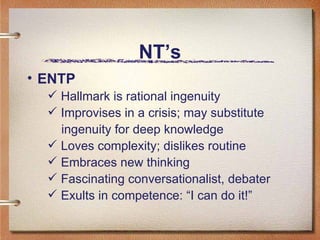
NT’s ENTP Hallmark is rational ingenuity  Improvises in a crisis; may substitute  ingenuity for deep knowledge Loves complexity; dislikes routine Embraces new thinking  Fascinating conversationalist, debater Exults in competence: “I can do it!”
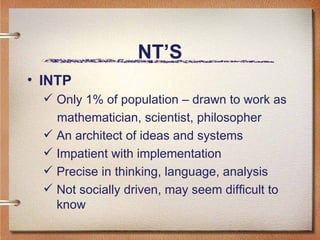
NT’S INTP   Only 1% of population – drawn to work as  mathematician, scientist, philosopher  An architect of ideas and systems  Impatient with implementation Precise in thinking, language, analysis Not socially driven, may seem difficult to  know
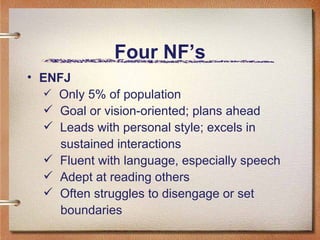
Four NF’s ENFJ Only 5% of population Goal or vision-oriented; plans ahead Leads with personal style; excels in  sustained interactions Fluent with language, especially speech Adept at reading others Often struggles to disengage or set  boundaries
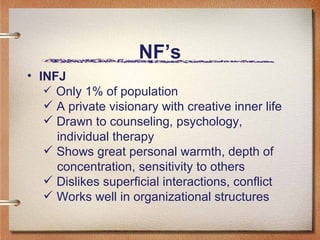
NF’s INFJ Only 1% of population A private visionary with creative inner life Drawn to counseling, psychology,  individual therapy Shows great personal warmth, depth of  concentration, sensitivity to others Dislikes superficial interactions, conflict  Works well in organizational structures
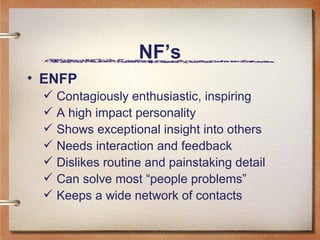
NF’s ENFP Contagiously enthusiastic, inspiring  A high impact personality  Shows exceptional insight into others  Needs interaction and feedback Dislikes routine and painstaking detail Can solve most “people problems”  Keeps a wide network of contacts
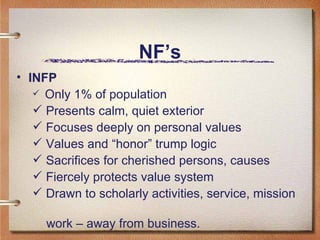
NF’s INFP Only 1% of population Presents calm, quiet exterior Focuses deeply on personal values  Values and “honor” trump logic Sacrifices for cherished persons, causes Fiercely protects value system Drawn to scholarly activities, service, mission  work – away from business.
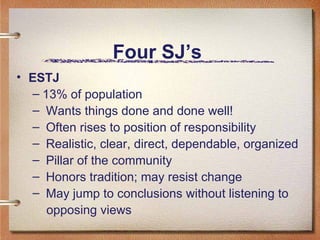
Four SJ’s  ESTJ 13% of population Wants things done and done well! Often rises to position of responsibility Realistic, clear, direct, dependable, organized  Pillar of the community Honors tradition; may resist change May jump to conclusions without listening to  opposing views
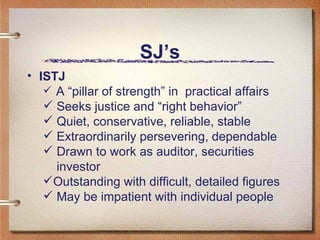
SJ’s ISTJ A “pillar of strength” in  practical affairs Seeks justice and “right behavior” Quiet, conservative, reliable, stable Extraordinarily persevering, dependable Drawn to work as auditor, securities    investor  Outstanding with difficult, detailed figures May be impatient with individual people
SJ’s ESFJ Most sociable of all types Supports and appreciates tradition Brilliantly “personalizes” interactions Loyal; duty and service-oriented Fueled by appreciation  Focuses on people, things, practical  needs; not abstract or philosophical matters
SJ’s ISFJ Primarily desires to serve Super dependable! Carries a strong sense of history and  connection to the past  Relates well to those in need – students,  the “boss” – loses interest if not needed When in charge, may “do it myself” rather than  insist that others do their jobs
Four SP’s ESTP Loves action!  Makes things happen! Outstanding as entrepreneur, diplomat,  peerless negotiator, salesperson, corporate  turnaround leader Lives with a theatrical flourish! Uncanny observer of people, motivations,  non-verbal cues Appears to have nerves of steel!
SP’s ISTP Sees well-executed action as “the whole point”! A master of tools, from scalpels to SST’s Pits oneself, or one’s skill, “against all odds” Views authority as useless or irrelevant Converses little, or tersely Hit men, gunslingers of the past, climbers, racers, surgeons, stunt men and artists (like Michelangelo and Leonardo) are likely ISTP’s.
SP’s ESFP Always has accurate real world data gained   through effortless, pinpoint observations Excellent at working with people in crisis Most generous of all types Avoids being alone; always seeks company Language flows easily Loves excitement; always creates it Low tolerance for anxiety (“Just do it!”)
SP’s ISFP Called to fine arts and athletics Expresses self through artistic action—or not  at all Doesn’t plan and prepare.  Every act is full  performance. Unique intelligence:  must choose action in which every next move is a free variable  Harpo Marx, Beethoven, Rembrandt,  Nijinski and many great athletes are ISFP’s.
A final KTS activity Write your four-letter “type” on your name tag.  Create discussion group with others whose results are similar to yours.  Assess agreement / disagreement with insights regarding your “type.” As a group, consider how you might use this inventory as a tool for personal or professional growth.
REFERENCE Keirsey, D., and Bates, M.  (1984).  Please understand me:  Character and temperament types  (fifth ed.). Del Mar, CA: Prometheus Nemesis.

Aug 09 Kts Barry

  • 1.
    Keirsey Temperament Sorter(KTS) Effective leadership begins with knowledge of self
  • 2.
    The KTS createdby Dr. David Keirsey in 1978. based on pioneering work by Carl Jung adapted from a psychometric instrument developed by Isabel Myers and Katherine Briggs – the Myers-Briggs Type Indicator (1962).
  • 3.
    Uses The KTSis widely used by businesses, government agencies, religious organizations, colleges and universities to determine the temperament type of individuals – especially for team-building.
  • 4.
    The KTS helpspeople in organizations to . . . • understand themselves and their behaviors appreciate and benefit from individual strengths and differences see a range of perspectives and approaches to problems communicate more effectively with supervisors, peers, and employees
  • 5.
    Applying insights fromthe KTS can help you. . . • choose professional pathways improve teamwork solve organizational or personal problems make the most of an organization’s human resources . . .
  • 6.
    understand and adaptto differences in management style understand contributions of others to the organization resolve conflicts
  • 7.
    The KTS measurespreferences, not skills. We can all do things we do not prefer, but we “default” to preferred behaviors when we can, and when we are stressed.
  • 8.
    Because there isno “best type,” there are no right or wrong responses—only those that are more accurate descriptions of you.
  • 9.
    Guide to takingthe KTS Answer each of the 70 questions on a KTS answer sheet (10 – 15 minutes) Be spontaneous. Don’t “second guess” the inventory. Follow directions for tallying and deriving a four-letter “code” for your temperament type. Write your name in the box on the wall chart to show your type. Then we’ll talk!
  • 10.
    Interpreting the Types: Four Primary Domains The E – I (extroversion- introversion continuum tells how one is primarily energized E: social experience I: internal reflection.
  • 11.
    2. The N – S (intuition-sensation) continuum tells how one creates meaning: N: intuition, imagination and constructs of the mind; focuses on possibility S: facts, experience, evidence from the five senses; focuses on reality.
  • 12.
    The T-F (thinking-feeling) continuum tells how one prefers to make decisions T: by logical or objective, rule-based criteria F: by personal value judgments, case-by-case
  • 13.
    The J–P (judging – perceiving) continuum tells whether one prefers to have things settled and decided or fluid and open. J: pushes for conclusion P: seeks more data, more options
  • 14.
    Interpreting the TypesThese pairings determine four primary types: NT (intuitive, thinking) Rationalist NF (intuitive, feeling) Idealist SJ (sensing, judging) Guardian SP (sensing, perceiving) Artisan
  • 15.
    NT Only 12%of population Moved to “understand, control, predict and explain” realities. Loves intelligence and must be competent. (Even play is about improvement!) Most self-critical of all types; fears failure. Weighs “credentials” of critics; tests authority. Believes others should work to same high standard.
  • 16.
    NF Only 12%of population. Seeks self-actualization, integrity and unique identity – to become “what I am meant to be.” Works to find meaning and “make a difference.” Wants to work with words, transmit ideas. Devotes enormous energy to relationships. Has trouble limiting work; over-commits. Often carries unique influence in groups.
  • 17.
    SJ About 38%of population. Acts as protector and caretaker of others. Must earn places of status and belonging. Intensely loyal and responsible. Believes in hierarchy, established norms. Plans and conserves for future (SJ created Boy Scouts, “Murphy’s Law.”)
  • 18.
    SP About 38%of population. Hungers for action. (SP’s don’t plan and practice; they do !) Thrives on “testing the limits.” Loves situations with unknown outcomes. Enjoys randomness, varied experience; often leaps before looking. Not product oriented. (To SP, work is play!) Often colorful, electric, envied, admired.
  • 19.
    Four NT’s ENTJTakes charge quickly Expects compliance Imposes order and high expectations Employs long-term strategies and supportive logistics. Abandons what interferes with mission Blocks out other areas of life for work
  • 20.
    NT’s INTJMost self-confident (sense of “self power”) Nearly always high-achieving Thought process is empirical logic Authority per se does not impress Always focused on future and long-term goals Wants to see systems translated into results Often single-minded in pursuit of goals
  • 21.
    NT’s ENTP Hallmarkis rational ingenuity Improvises in a crisis; may substitute ingenuity for deep knowledge Loves complexity; dislikes routine Embraces new thinking Fascinating conversationalist, debater Exults in competence: “I can do it!”
  • 22.
    NT’S INTP Only 1% of population – drawn to work as mathematician, scientist, philosopher An architect of ideas and systems Impatient with implementation Precise in thinking, language, analysis Not socially driven, may seem difficult to know
  • 23.
    Four NF’s ENFJOnly 5% of population Goal or vision-oriented; plans ahead Leads with personal style; excels in sustained interactions Fluent with language, especially speech Adept at reading others Often struggles to disengage or set boundaries
  • 24.
    NF’s INFJ Only1% of population A private visionary with creative inner life Drawn to counseling, psychology, individual therapy Shows great personal warmth, depth of concentration, sensitivity to others Dislikes superficial interactions, conflict Works well in organizational structures
  • 25.
    NF’s ENFP Contagiouslyenthusiastic, inspiring A high impact personality Shows exceptional insight into others Needs interaction and feedback Dislikes routine and painstaking detail Can solve most “people problems” Keeps a wide network of contacts
  • 26.
    NF’s INFP Only1% of population Presents calm, quiet exterior Focuses deeply on personal values Values and “honor” trump logic Sacrifices for cherished persons, causes Fiercely protects value system Drawn to scholarly activities, service, mission work – away from business.
  • 27.
    Four SJ’s ESTJ 13% of population Wants things done and done well! Often rises to position of responsibility Realistic, clear, direct, dependable, organized Pillar of the community Honors tradition; may resist change May jump to conclusions without listening to opposing views
  • 28.
    SJ’s ISTJ A“pillar of strength” in practical affairs Seeks justice and “right behavior” Quiet, conservative, reliable, stable Extraordinarily persevering, dependable Drawn to work as auditor, securities investor Outstanding with difficult, detailed figures May be impatient with individual people
  • 29.
    SJ’s ESFJ Mostsociable of all types Supports and appreciates tradition Brilliantly “personalizes” interactions Loyal; duty and service-oriented Fueled by appreciation Focuses on people, things, practical needs; not abstract or philosophical matters
  • 30.
    SJ’s ISFJ Primarilydesires to serve Super dependable! Carries a strong sense of history and connection to the past Relates well to those in need – students, the “boss” – loses interest if not needed When in charge, may “do it myself” rather than insist that others do their jobs
  • 31.
    Four SP’s ESTPLoves action! Makes things happen! Outstanding as entrepreneur, diplomat, peerless negotiator, salesperson, corporate turnaround leader Lives with a theatrical flourish! Uncanny observer of people, motivations, non-verbal cues Appears to have nerves of steel!
  • 32.
    SP’s ISTP Seeswell-executed action as “the whole point”! A master of tools, from scalpels to SST’s Pits oneself, or one’s skill, “against all odds” Views authority as useless or irrelevant Converses little, or tersely Hit men, gunslingers of the past, climbers, racers, surgeons, stunt men and artists (like Michelangelo and Leonardo) are likely ISTP’s.
  • 33.
    SP’s ESFP Alwayshas accurate real world data gained through effortless, pinpoint observations Excellent at working with people in crisis Most generous of all types Avoids being alone; always seeks company Language flows easily Loves excitement; always creates it Low tolerance for anxiety (“Just do it!”)
  • 34.
    SP’s ISFP Calledto fine arts and athletics Expresses self through artistic action—or not at all Doesn’t plan and prepare. Every act is full performance. Unique intelligence: must choose action in which every next move is a free variable Harpo Marx, Beethoven, Rembrandt, Nijinski and many great athletes are ISFP’s.
  • 35.
    A final KTSactivity Write your four-letter “type” on your name tag. Create discussion group with others whose results are similar to yours. Assess agreement / disagreement with insights regarding your “type.” As a group, consider how you might use this inventory as a tool for personal or professional growth.
  • 36.
    REFERENCE Keirsey, D.,and Bates, M. (1984). Please understand me: Character and temperament types (fifth ed.). Del Mar, CA: Prometheus Nemesis.

Editor's Notes

  • #15 When these elements are paired, they trump the other elements in creating predictable “type” behaviors or preferences. Note that these elements are drawn from the second, third and fourth domains – but not the first. Thus, these are more important determiners than extroversion and introversion.