Calibration Laboratory Audit 
Preparation
December 10, 2013
Audit Preparation
• Calibration laboratories are subject to many types of 
j
y yp
audits such as ISO 17025 accreditation, Z540.X, 
Nuclear 10 CFR 21, FDA, FCC, and many others 
• Many calibration laboratories provide services to 
lb
l b
d
multiple industries that are regulated by many of 
these regulatory bodies 
these regulatory bodies
• Agenda
– Common factors relating to calibration labs that will keep 
this in perspective and manageable
– Some basic concepts of preparing for an audit 
– Do’s and Do Not’s during the process of being audited
Do s and Do Not s during the process of being audited
What are you being audited to?
Calibration of Measurement and Test Equipment (M&TE) is a 
function required by most industries throughout the world. 
f
db
d
h
h
h
ld
Many of these industries have specific requirements for the 
calibration of their respective M&TE and the processes by which 
the M&TE is calibrated. 
the M&TE is calibrated
Although many industries have some unique requirements most 
requirements are generic.
req irements are generic
The International Standards Organization (ISO) developed 
ISO/IEC 17025 ‐ General Requirements for the Competence of 
ISO/IEC 17025 G
lR
i
f h C
f
Testing and Calibration Laboratories. 
Audit Preparation
• ISO/IEC 17025 General Requirements for the
ISO/IEC 17025 General Requirements for the 
Competence of Testing and Calibration 
Laboratories
– Management Requirements (Section 4)
• Contains all elements of ISO 9001
• 25 Elements

– Technical Requirements (Section 5)
• 28 Elements
Quality System
• Quality Manual
Quality Manual
– Standard Operating Procedures (SOP’s)
– Must Adequately Address all Elements of 17025
Must Adequately Address all Elements of 17025
– Must Adequately Address Other Critical Elements  
Quality System
• Which Elements are important?
Which Elements are important?
– All need to be addressed
– Management Requirements
Management Requirements
• Most customer audits will focus on these

– Industry Specific
y p
– Technical Requirements
• Metrologist
Technical Requirements
The overall goal is to insure that calibrations 
The overall goal is to insure that calibrations
performed are correct and reliable. 
Technical Requirements
• Primary Elements to Produce a Quality
Primary Elements to Produce a Quality 
Calibration
– Human Factors
Human Factors
– Accommodation and Environmental Conditions
– Methods
Methods 
– Equipment
– Measurement Traceability
Measurement Traceability 
– Sampling 
– Handling of M&TE
Handling of M&TE
Technical Requirements 
• Primary Elements to Produce a Quality
Primary Elements to Produce a Quality 
Calibration (con’t)
– Assuring the quality of test and calibration results
Assuring the quality of test and calibration results
– Reporting the results
Technical Requirements
• Human Factors/Personnel
Human Factors/Personnel
– Competent
• Job Descriptions
Job Descriptions
• Training
–
–
–
–

Formal
OJT
Objective Evidence
Qualification Matrix
Qualification Matrix
Technical Requirements
• Human Factors/Personnel
Human Factors/Personnel
– Competent
• Proficiency Tests
y
– External – ISO 17043:2010
» National Association for Proficiency  Testing 
www.proficiency.org
fi i
» AB  Developed
» National Measurement Institutes (NIST)
– Internal
» Correlation studies
Technical Requirements
• Human Factors/Personnel
Human Factors/Personnel
– Undue External Pressures
• Conflicts of Interests
Conflicts of Interests 

– Undue Internal Pressures
Technical Requirements
• Accommodation and Environmental Controls
Accommodation and Environmental Controls 
(Adequate to the level of claimed uncertainties)
–
–
–
–

Temperature/RH
p
Lighting
Vibration
Segregation
• Incompatible activities
Technical Requirements
• Methods
– Need to meet the requirements of the customer 
and must be adequate for the calibrations 
performed
– Standard Methods
– L b
Laboratory Developed Methods
D l
dM h d
• Must be Validated

– Non‐standard Methods
Non‐standard Methods
• Must be validated
• Generally to meet specific customer requirements
Technical Requirements
• Equipment
–
–
–
–
–
–

Adequate for use
Verified upon receipt
Only operated by qualified personnel
Adequate instructions for use
Adequate instructions for use
Must remain in control of lab
Identify long term stability (Calibration interval)

–
–
–

• Labeled to identify calibration status
y
• Interim checks
Unique identification
Segregated and identified when out of control
Performance verified before the unit leaves and after unit is received back 
f
f b f
h
l
f
b k
into the lab
Documentation is essential 

–
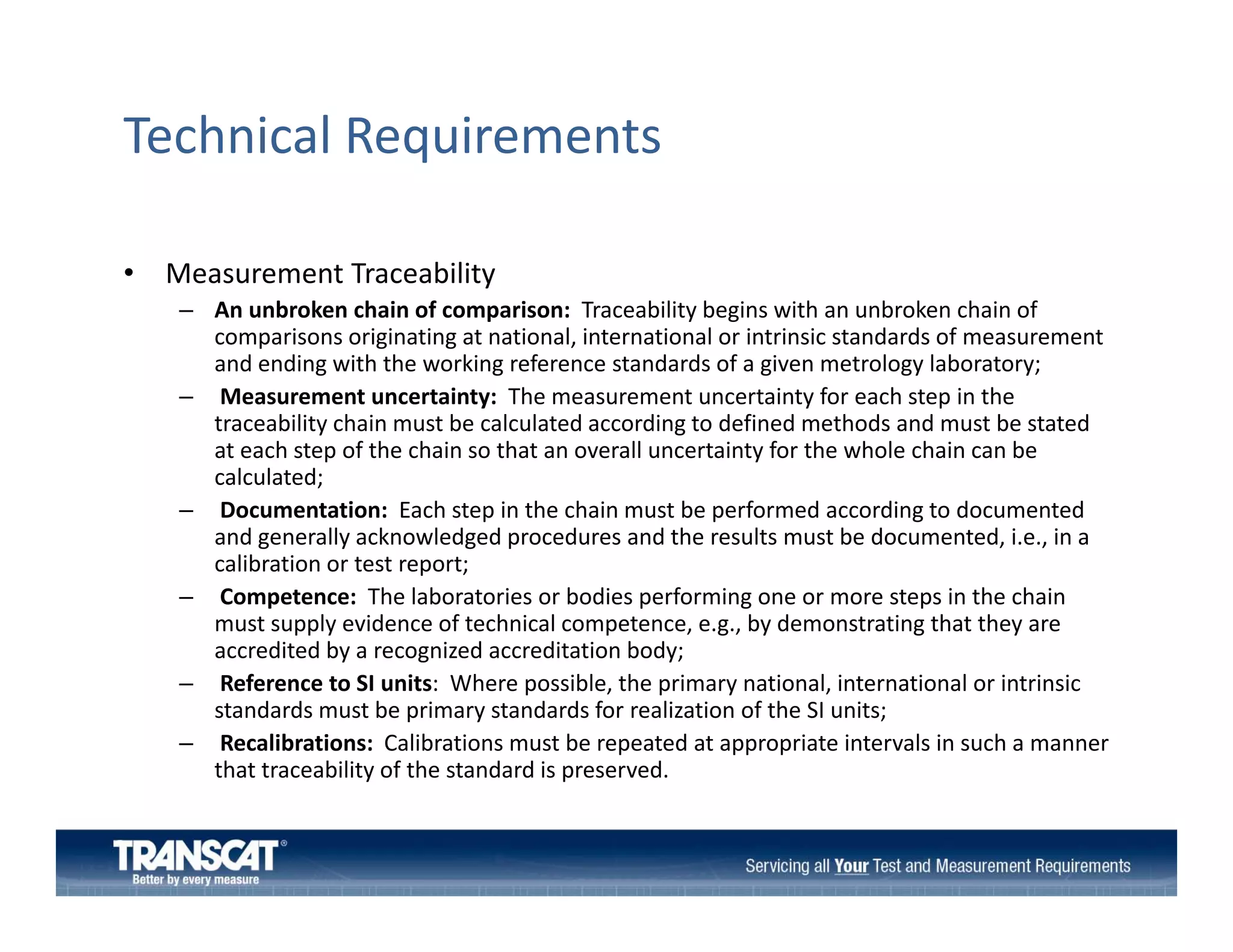
Technical Requirements

• Measurement Traceability
Measurement Traceability
•

Metrological Traceability is the property of a 
measurement result whereby it can be related to stated 
measurement result whereby it can be related to stated
references, usually national or international standards, 
through an unbroken chain of comparisons, each step in 
the chain having stated uncertainties.  The purpose of 
th h i h i
t t d
t i ti
Th
f
requiring traceability is to ensure that measurements are 
accurate representations of the specific quantity subject 
to measurement, within the uncertainty of the 
measurement.  Traceability is characterized by six 
essential elements.
essential elements.
Technical Requirements
•

Measurement Traceability 
– An unbroken chain of comparison: Traceability begins with an unbroken chain of 
comparisons originating at national, international or intrinsic standards of measurement 
and ending with the working reference standards of a given metrology laboratory;
– Measurement uncertainty:  The measurement uncertainty for each step in the 
traceability chain must be calculated according to defined methods and must be stated 
bili h i
b
l l d
di
d fi d
h d
d
b
d
at each step of the chain so that an overall uncertainty for the whole chain can be 
calculated;
– Documentation:  Each step in the chain must be performed according to documented 
and generally acknowledged procedures and the results must be documented, i.e., in a 
and generally acknowledged procedures and the results must be documented i e in a
calibration or test report;
– Competence:  The laboratories or bodies performing one or more steps in the chain 
must supply evidence of technical competence, e.g., by demonstrating that they are 
accredited by a recognized accreditation body;
accredited by a recognized accreditation body;
– Reference to SI units:  Where possible, the primary national, international or intrinsic 
standards must be primary standards for realization of the SI units;   
– Recalibrations:  Calibrations must be repeated at appropriate intervals in such a manner 
that traceability of the standard is preserved.
that traceability of the standard is preserved.
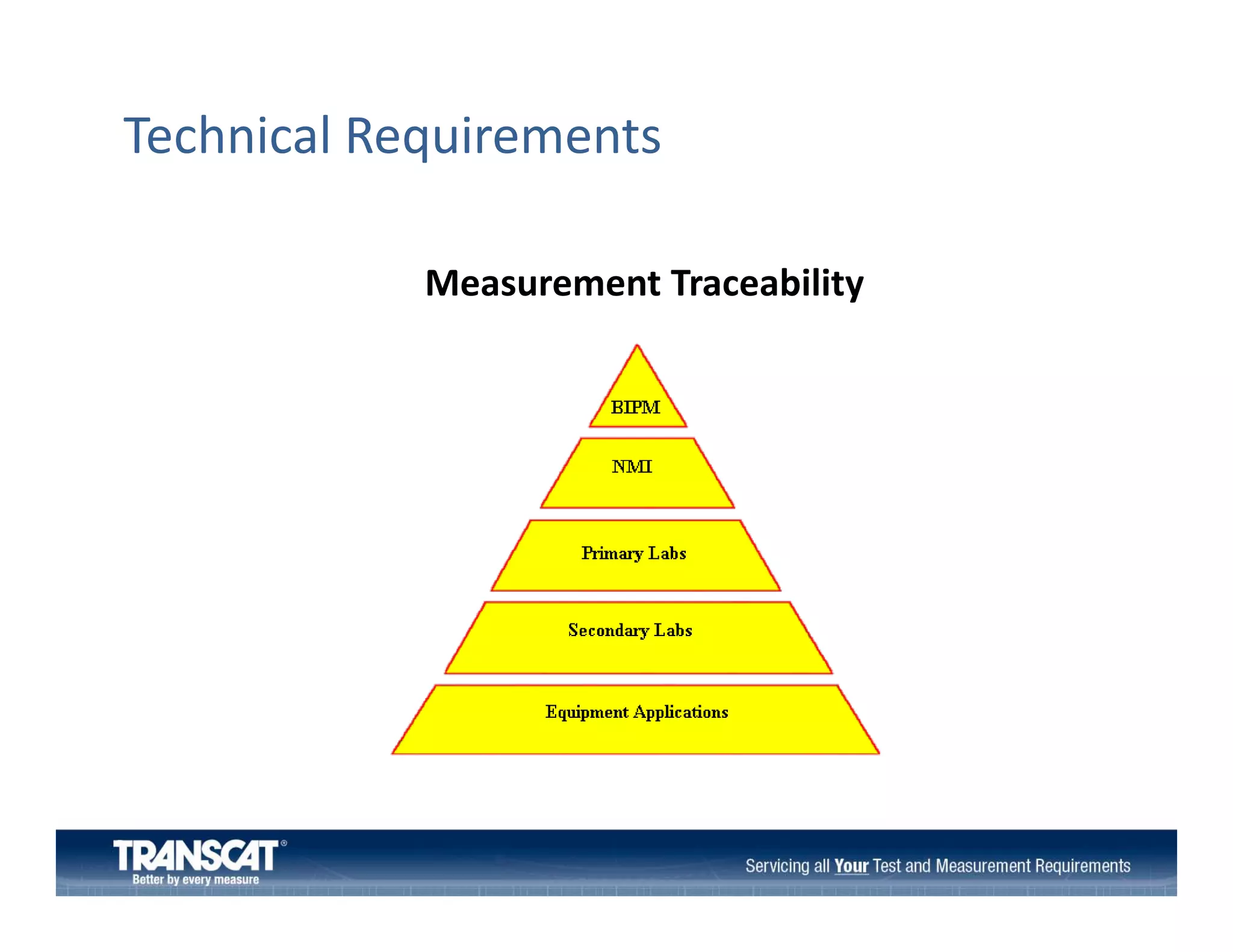
Technical Requirements
Measurement Traceability
easu e e t aceab ty
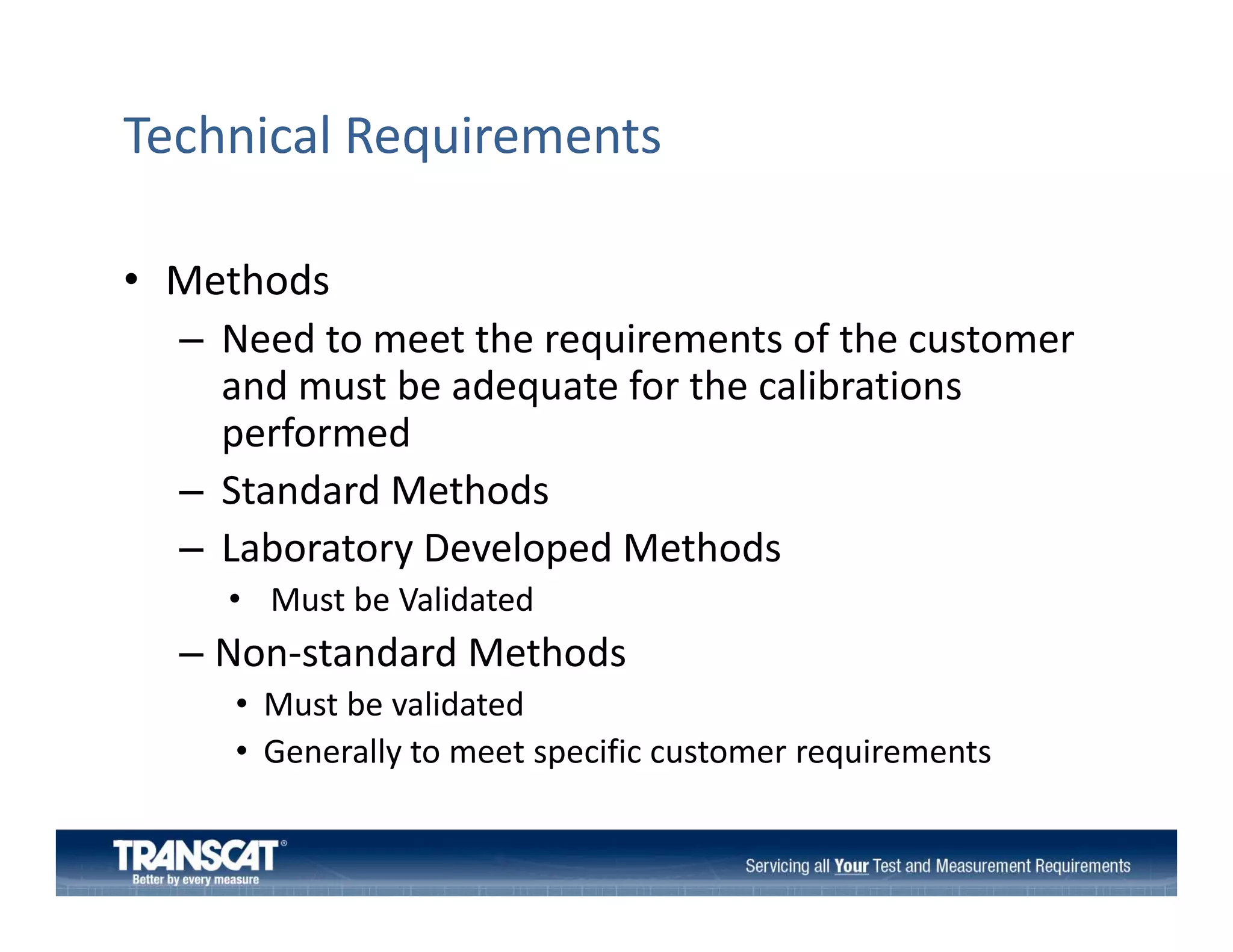
Technical Requirements
• Methods
– Need to meet the requirements of the customer 
and must be adequate for the calibrations 
performed
– Standard Methods
– L b
Laboratory Developed Methods
D l
dM h d
• Must be Validated

– Non‐standard Methods
Non‐standard Methods
• Must be validated
• Generally to meet specific customer requirements
Technical Requirements

Sampling 
Sampling
Not discussed in this presentation
N t di
d i thi
t ti
Technical Requirements
• Handling of M&TE
Handling of M&TE
–
–
–
–

Shipping
Receiving
R i i
Storage
Safeguards against damage 
Technical Requirements
• Assuring the quality of test and calibration results
Assuring the quality of test and calibration results
– Quality review of completed product
• Logging the results to catch trends
ogging the results to catch trends
Technical Requirements
• Reporting the results
Reporting the results
– There are multiple elements/requirements for what 
needs to be presented on certificates and data sets of 
needs to be presented on certificates and data sets of
the calibrated M&TE. ISO 17025 is a good standard to 
develop this. 
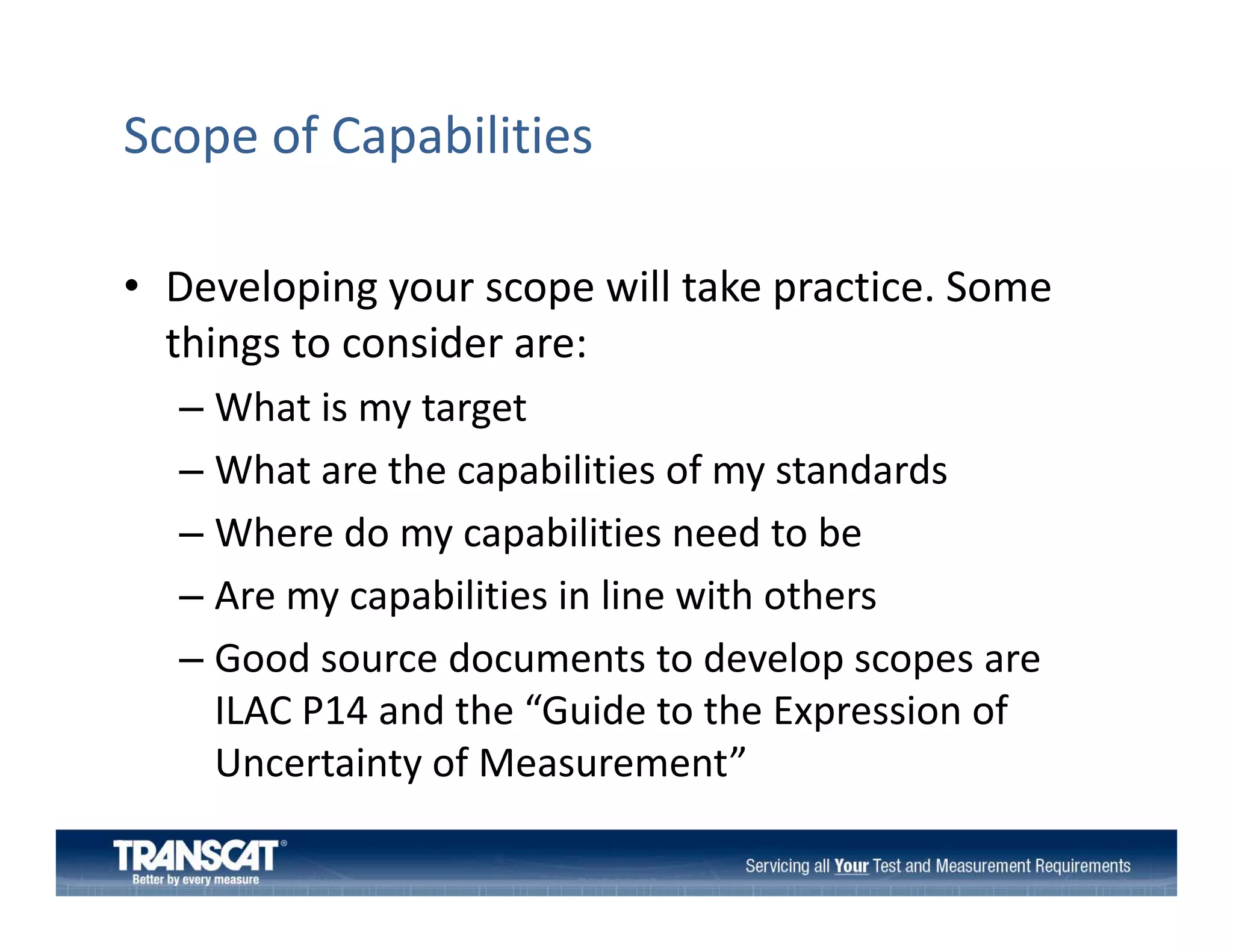
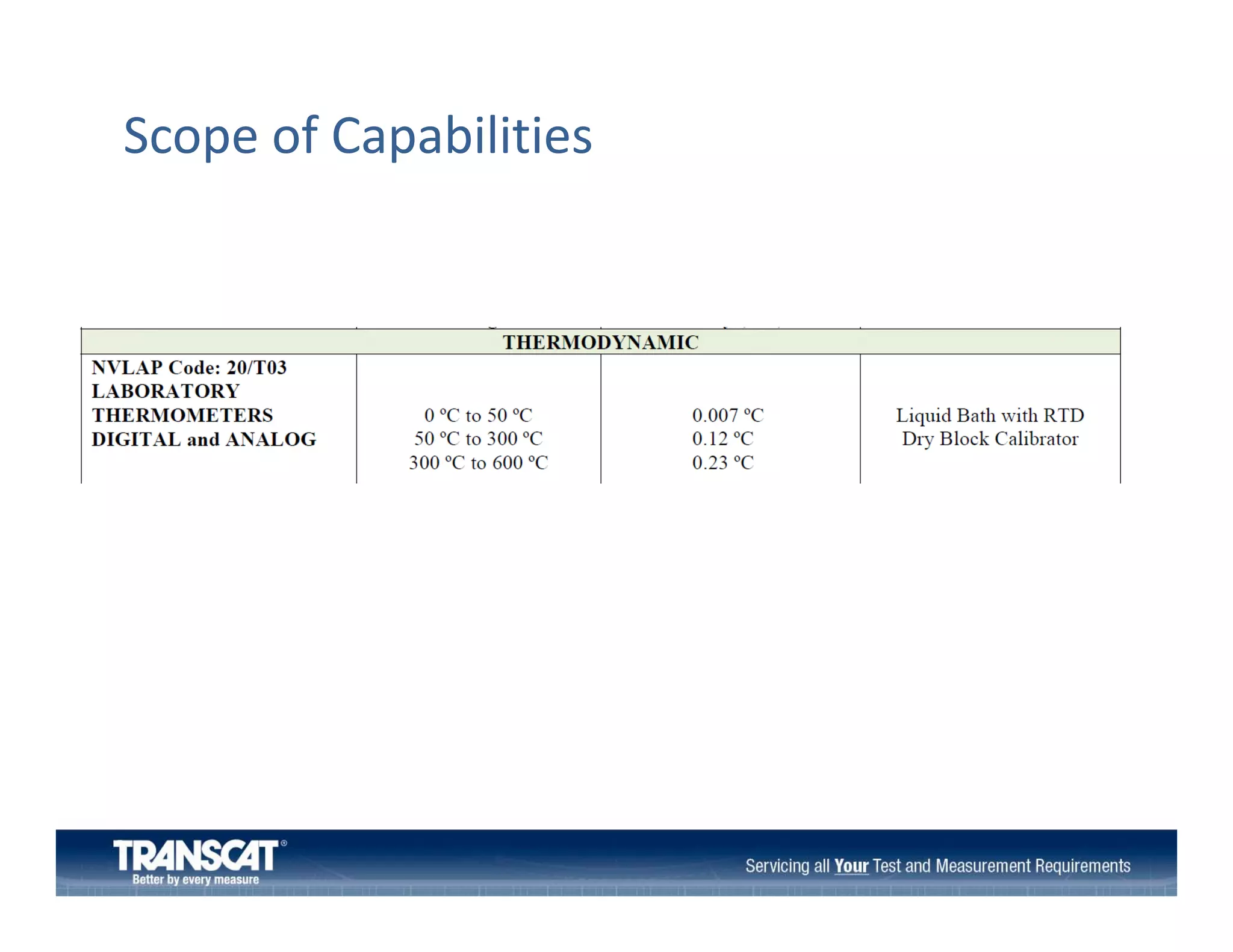
Scope of Capabilities
• Also know as the Scope of Accreditation identifies your 
p
y
capabilities by discipline and sub‐discipline and how capable 
you are (Uncertainties) in these each respective quantity
• Th
The scope is used internally as a snapshot of what your 
i
di t
ll
h t f h t
capabilities are and is a useful marketing document so 
customers know what your capabilities
• The quantities and associated uncertainties are also called 
Calibration and Measurement Capabilities (CMC’s) 
• Th
These are generally considered your Best  Measurement 
ll
id d
B
M
Capabilities
Scope of Capabilities
• Developing your scope will take practice Some
Developing your scope will take practice. Some 
things to consider are:
– What is my target
What is my target
– What are the capabilities of my standards
– Where do my capabilities need to be
Where do my capabilities need to be
– Are my capabilities in line with others
– Good source documents to develop scopes are
Good source documents to develop scopes are 
ILAC P14 and the “Guide to the Expression of 
Uncertainty of Measurement
Uncertainty of Measurement”
Scope of Capabilities
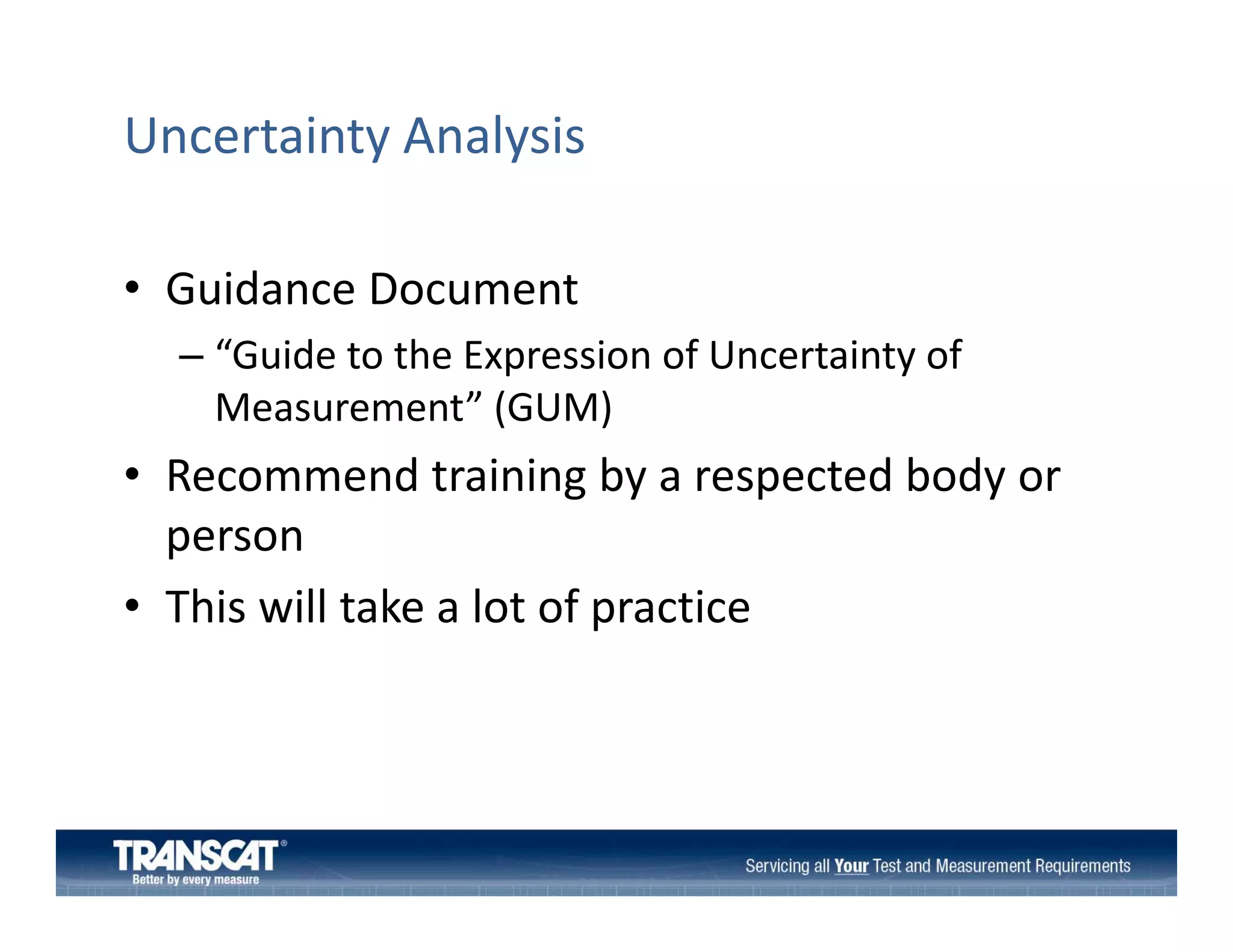
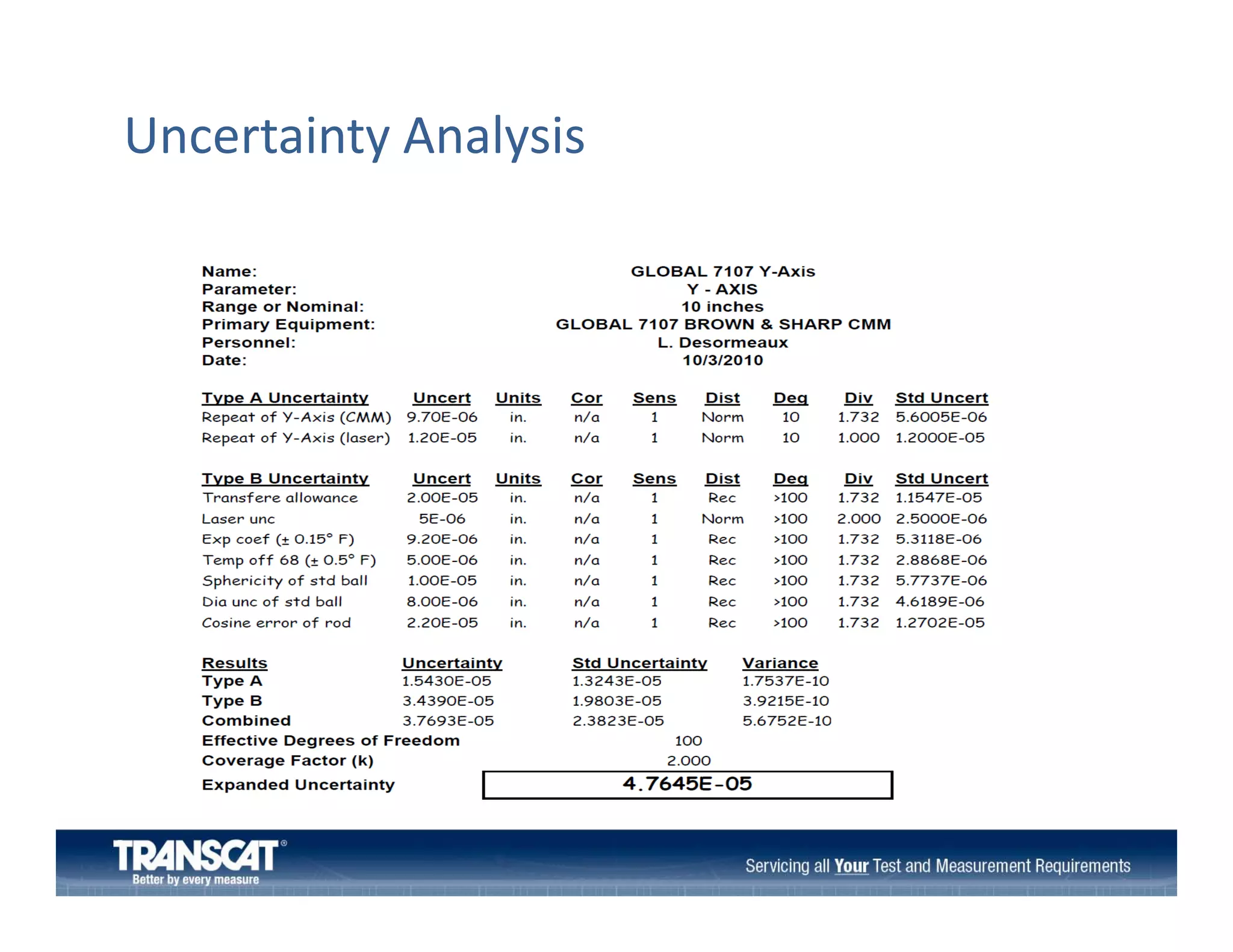
Uncertainty Analysis
• Guidance Document
Guidance Document 
– “Guide to the Expression of Uncertainty of 
Measurement (GUM)
Measurement” (GUM)

• Recommend training by a respected body or 
person
• This will take a lot of practice
Uncertainty Analysis
Internal Audits
• After initial development of Quality System
p
Q
y y
• On a recurring basis 
– Generally on an annual schedule

• Performed by a designated quality representative 
– Impartial
– Sh ld h
Should have reporting structure independent from 
i
i d
d
f
Operations

• Internal audits should be the most stringent of all 
g
external audits
• Should audit all elements of the Quality System 
External Audits
• Customer
• Accreditation 
• Industry Specific
d
S ifi
External Audits
Regardless of what body is performing the audit, 
Regardless of what body is performing the audit
there is a common goal.
Do’s during an Audit
• Appearance – Initial Tour of the Lab
Appearance  Initial Tour of the Lab
– Facilities
–E i
Equipment
t
– Personnel

• Identify Common Areas
Do’s during an Audit
•
•
•
•

Give the auditor your undivided attention
Give the auditor your undivided attention
Give the auditor mutual respect
Acceptance of findings
f fi di
Presenting a challenge to a finding
Do’s during an Audit
• Give the auditor your undivided attention
Give the auditor your undivided attention
– Facilities
–E i
Equipment
t
– Personnel
Audit Preparation
Scope of Capabilities
•
•
•
•
•
•
•
•
•
•
•
•
•

Internal Audits
External Audits
Do’s and Do Not’s
Initial walk through
l lk h
h
Etiquette
Personnel appearance
Mutual respect
M
l
Acceptance of findings
Challenges (Professional)
Findings
Fi di
Types
Addressing
Using to your advantage
Using to your advantage
Calibration Laboratory Audit 
y
Preparation Webinar
Questions?
Contact us at:
www.transcat.com
800.828.1470

Calibration Laboratory Audit Preparation Webinar