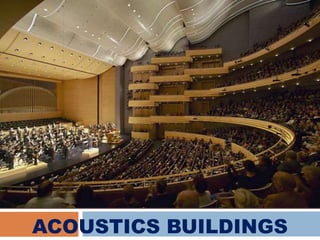
ACOUSTICS BUILDINGS
What is Acoustics
 Acoustics is branch of physics which deal
with the study of sound wave.
 The sound is nothing but sensation which is
received by our ear.
 In the biological terms it’s physical cause
which stimulates the auditory nerve system
 The study of generation, propagation
and reception of sound wave is called
as acoustics
Factors which affected by
acoustics building :-
 Reverberation
 Focusing of sound
 Echoes
 Unwanted resonance
 Interference
 Extraneous noise
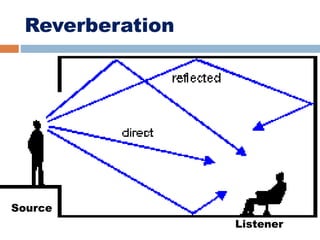
Reverberation
Source
Listener
Reverberation
 The persistence of sound for sometimes due to
repeated reflection after source stop emitting
sound is called as reverberation.
 The time gap between direct note and reflected
note upto sound diminished is called as
reverberation time.
 The reverberation time is depends on the size of
auditorium, nature of reflecting surface and area
of reflecting surface.
Reverberation
 The Reverberation time in auditorium is meant
that time during which the sound reduces 10-6
times its initial value or time during which the
intensity of sound reduces by 60 dB to minimum
threshold of audibility.
 So that it was found reverberation time depend
upon volume of hall, area of reflecting surface
and absorption coefficient.
 Example :- if the hall is 6000 Sq.m. the
reverberation time is 1.1 to 1.5
Reverberation
Sabine Formula
 Prof. Wallace C. Sabine studied reverberation
time.
 The Sabine derive the formula based on
assumption :-
i) The average energy per unit volume is
uniform.
ii) The energy is not lost in auditorium.
The time of reverberation is then the time
required by the energy density to fall to the
minimum. Audibility from an initial value 10-6
times .
Sabine Formula
Sabine Formula
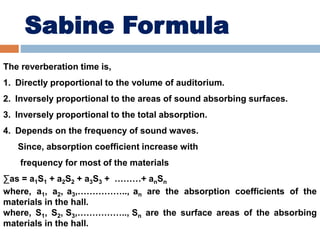
The reverberation time is,
1. Directly proportional to the volume of auditorium.
2. Inversely proportional to the areas of sound absorbing surfaces.
3. Inversely proportional to the total absorption.
4. Depends on the frequency of sound waves.
Since, absorption coefficient increase with
frequency for most of the materials
∑as = a1S1 + a2S2 + a3S3 + ………+ anSn
where, a1, a2, a3,…………….., an are the absorption coefficients of the
materials in the hall.
where, S1, S2, S3,…………….., Sn are the surface areas of the absorbing
materials in the hall.
Determination of Absorption
coefficient
The absorption coefficient defined as ratio of the sound energy absorbed
by a body to the energy incident on it its unit is sabine.
The absorption coefficient derived is as follow :-
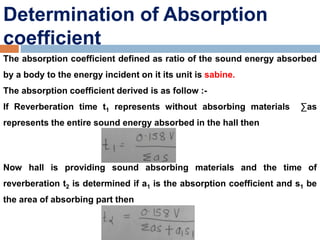
If Reverberation time t1 represents without absorbing materials ∑as
represents the entire sound energy absorbed in the hall then
Now hall is providing sound absorbing materials and the time of
reverberation t2 is determined if a1 is the absorption coefficient and s1 be
the area of absorbing part then
Determination of Absorption
coefficient
Sound Absorbers
 The material which absorbs the sound wave and reflect it
minimum such material are easily available, cheap,
waterproof, light in weight but strengthen material,
adequately fire proof, highly sound absorber.
 i) Panel Absorber : this material are fixed on timber
framing.
 ii) Porus absorber : Materials like wood, wool, soft plaster,
glass silk, asbestos, fiber spray, fiber boards.
 iii) Cavity absorber : Chamber with small opening.
 iv) Composite absorber : Material is made up of
composition of all above material provides sound
absorbing function.
Intensity of Wave
 The Intensity of Sound Wave is defined as the
energy flowing per second through unit area
held normally at place to the direction which the
wave travels.
 The intensity of sound wave is expressed in bels.
 If the power of sources varies from P1 to P2 then
 Number of bels = log10 (P2/P1)
 Number of decibels = 10 log10 (P2/P1)
The intensity being per second flowing through
per unit area normal to direction of the sound the
unit of Intensity is watt/m2
Loudness of Sound
 Loudness of Sound is express as sensation
depends on listener.
 Its observed that two identical loudness of
sound is with different frequency which depends
on frequency of sound.
 To measure the loudness the method is used to
compare the sound with standard has frequency
of 1000Hz.
 The unit of loudness is phon.
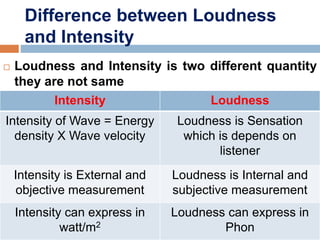
Difference between Loudness
and Intensity
 Loudness and Intensity is two different quantity
they are not same
Intensity Loudness
Intensity of Wave = Energy
density X Wave velocity
Loudness is Sensation
which is depends on
listener
Intensity is External and
objective measurement
Loudness is Internal and
subjective measurement
Intensity can express in
watt/m2
Loudness can express in
Phon
Acoustics of Building
 Sabine Prescribed the following requisites for
good auditorium :-
 The sound energy should be uniformly distributed
within the room.
 The boundaries should be sufficiently sound proof to
exclude extraneous noise.
 There should be no Echelon effect.
Acoustics of Building
 There should be no resonance within the building.
 The hall must be full of audience.
 The reverberation time should be quite proper
(optimum).
1 sec – 2 sec for music & 0.5 sec – 1 sec for speech.
Factors affecting the Acoustics of Building
 Focussing of sound
Factors affecting the Acoustics of Building
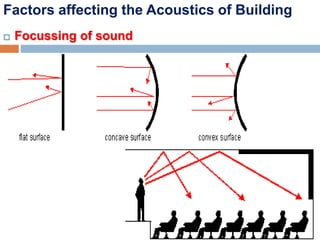
 Focussing of sound
If there are focusing surfaces on the walls or
ceilings of the hall, they produce concentration of
sound into particular region.
Remedy
1. There should be no curved surfaces. If present, it
should be covered with absorbent material.
2. Ceiling should be low.
Factors affecting the Acoustics of Building
 Echoes
Factors affecting the Acoustics of Building
 Echoes
• An echo is heard when direct & reflected
sound waves coming from the same
source, reach the listener with the time
interval of 1/10 th sec or more.
Remedy for echoes
Echoes may be avoided by covering the
long distance walls and high ceiling with
absorbent material.
Factors affecting the Acoustics of Building
 Resonance
• Some times the window-panes, sections of
the window portions and walls lacking in
rigidity are throw into forced vibrations and
create other sounds.
Remedy for Resonance
i) Such resonant vibrations should be suitably
damped.
ii) Hanging a large nos. of curtains in the hall.
Factors affecting the Acoustics of Building
 Interference
• When sound wave produces by source
while it travel through the distance it
interferer with other sound wave and form
alternative maxima & minima at different
places
Remedy for Interference
Interference can be minimized by avoiding
smooth or polished corners in the hall.
Factors affecting the Acoustics of Building
 Echelon Effect
Factors affecting the Acoustics of Building
 Echelon Effect
• A set of railings or any regular spacing of
reflected surfaces may produce a musical
note due to the regular succession of
echoes of the original sound to the listener.
Remedy for Echelon Effect
This type of surfaces should be avoided or
covered with proper sound absorbing
material.
Factors affecting the Acoustics of Building
 Extraneous Noise
• Noise is defined as discontinuous vibration
produced by objects.
• Extraneous Noise is dived into two types a)
Internal noise and external noise .
• The external noise which is produced
outside of the hall from windows doors &
ventilators.
• External Noise can minimized by covers
hall, window & door by sound absorbing
material & making the Hall air conditioning
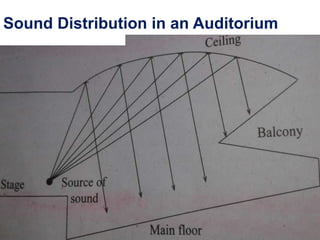
Sound Distribution in an Auditorium
 Sound Distribution explains how the sound
pressure level varies with position in an enclosure.
 In any infrastructure it is necessary for smooth
growth and decay of sound.
 According to this study its say that every place in
any in fracture the sound is uniformly distribute.
 Some of these treatment includes scattering
effects of objects irregularities on wall surface
fixing sound absorbing material on the wall etc.
 Usually this sound distribution is studied through
models analysis using light rays, ultrasonic waves
or sound wave.

Acoustics buildings

  • 1.
  • 2.
    What is Acoustics Acoustics is branch of physics which deal with the study of sound wave.  The sound is nothing but sensation which is received by our ear.  In the biological terms it’s physical cause which stimulates the auditory nerve system  The study of generation, propagation and reception of sound wave is called as acoustics
  • 3.
    Factors which affectedby acoustics building :-  Reverberation  Focusing of sound  Echoes  Unwanted resonance  Interference  Extraneous noise
  • 4.
  • 5.
    Reverberation  The persistenceof sound for sometimes due to repeated reflection after source stop emitting sound is called as reverberation.  The time gap between direct note and reflected note upto sound diminished is called as reverberation time.  The reverberation time is depends on the size of auditorium, nature of reflecting surface and area of reflecting surface.
  • 6.
    Reverberation  The Reverberationtime in auditorium is meant that time during which the sound reduces 10-6 times its initial value or time during which the intensity of sound reduces by 60 dB to minimum threshold of audibility.  So that it was found reverberation time depend upon volume of hall, area of reflecting surface and absorption coefficient.  Example :- if the hall is 6000 Sq.m. the reverberation time is 1.1 to 1.5
  • 7.
  • 8.
    Sabine Formula  Prof.Wallace C. Sabine studied reverberation time.  The Sabine derive the formula based on assumption :- i) The average energy per unit volume is uniform. ii) The energy is not lost in auditorium. The time of reverberation is then the time required by the energy density to fall to the minimum. Audibility from an initial value 10-6 times .
  • 9.
  • 10.
    Sabine Formula The reverberationtime is, 1. Directly proportional to the volume of auditorium. 2. Inversely proportional to the areas of sound absorbing surfaces. 3. Inversely proportional to the total absorption. 4. Depends on the frequency of sound waves. Since, absorption coefficient increase with frequency for most of the materials ∑as = a1S1 + a2S2 + a3S3 + ………+ anSn where, a1, a2, a3,…………….., an are the absorption coefficients of the materials in the hall. where, S1, S2, S3,…………….., Sn are the surface areas of the absorbing materials in the hall.
  • 11.
    Determination of Absorption coefficient Theabsorption coefficient defined as ratio of the sound energy absorbed by a body to the energy incident on it its unit is sabine. The absorption coefficient derived is as follow :- If Reverberation time t1 represents without absorbing materials ∑as represents the entire sound energy absorbed in the hall then Now hall is providing sound absorbing materials and the time of reverberation t2 is determined if a1 is the absorption coefficient and s1 be the area of absorbing part then
  • 12.
  • 13.
    Sound Absorbers  Thematerial which absorbs the sound wave and reflect it minimum such material are easily available, cheap, waterproof, light in weight but strengthen material, adequately fire proof, highly sound absorber.  i) Panel Absorber : this material are fixed on timber framing.  ii) Porus absorber : Materials like wood, wool, soft plaster, glass silk, asbestos, fiber spray, fiber boards.  iii) Cavity absorber : Chamber with small opening.  iv) Composite absorber : Material is made up of composition of all above material provides sound absorbing function.
  • 14.
    Intensity of Wave The Intensity of Sound Wave is defined as the energy flowing per second through unit area held normally at place to the direction which the wave travels.  The intensity of sound wave is expressed in bels.  If the power of sources varies from P1 to P2 then  Number of bels = log10 (P2/P1)  Number of decibels = 10 log10 (P2/P1) The intensity being per second flowing through per unit area normal to direction of the sound the unit of Intensity is watt/m2
  • 15.
    Loudness of Sound Loudness of Sound is express as sensation depends on listener.  Its observed that two identical loudness of sound is with different frequency which depends on frequency of sound.  To measure the loudness the method is used to compare the sound with standard has frequency of 1000Hz.  The unit of loudness is phon.
  • 16.
    Difference between Loudness andIntensity  Loudness and Intensity is two different quantity they are not same Intensity Loudness Intensity of Wave = Energy density X Wave velocity Loudness is Sensation which is depends on listener Intensity is External and objective measurement Loudness is Internal and subjective measurement Intensity can express in watt/m2 Loudness can express in Phon
  • 17.
    Acoustics of Building Sabine Prescribed the following requisites for good auditorium :-  The sound energy should be uniformly distributed within the room.  The boundaries should be sufficiently sound proof to exclude extraneous noise.  There should be no Echelon effect.
  • 18.
    Acoustics of Building There should be no resonance within the building.  The hall must be full of audience.  The reverberation time should be quite proper (optimum). 1 sec – 2 sec for music & 0.5 sec – 1 sec for speech.
  • 19.
    Factors affecting theAcoustics of Building  Focussing of sound
  • 20.
    Factors affecting theAcoustics of Building  Focussing of sound If there are focusing surfaces on the walls or ceilings of the hall, they produce concentration of sound into particular region. Remedy 1. There should be no curved surfaces. If present, it should be covered with absorbent material. 2. Ceiling should be low.
  • 21.
    Factors affecting theAcoustics of Building  Echoes
  • 22.
    Factors affecting theAcoustics of Building  Echoes • An echo is heard when direct & reflected sound waves coming from the same source, reach the listener with the time interval of 1/10 th sec or more. Remedy for echoes Echoes may be avoided by covering the long distance walls and high ceiling with absorbent material.
  • 23.
    Factors affecting theAcoustics of Building  Resonance • Some times the window-panes, sections of the window portions and walls lacking in rigidity are throw into forced vibrations and create other sounds. Remedy for Resonance i) Such resonant vibrations should be suitably damped. ii) Hanging a large nos. of curtains in the hall.
  • 24.
    Factors affecting theAcoustics of Building  Interference • When sound wave produces by source while it travel through the distance it interferer with other sound wave and form alternative maxima & minima at different places Remedy for Interference Interference can be minimized by avoiding smooth or polished corners in the hall.
  • 25.
    Factors affecting theAcoustics of Building  Echelon Effect
  • 26.
    Factors affecting theAcoustics of Building  Echelon Effect • A set of railings or any regular spacing of reflected surfaces may produce a musical note due to the regular succession of echoes of the original sound to the listener. Remedy for Echelon Effect This type of surfaces should be avoided or covered with proper sound absorbing material.
  • 27.
    Factors affecting theAcoustics of Building  Extraneous Noise • Noise is defined as discontinuous vibration produced by objects. • Extraneous Noise is dived into two types a) Internal noise and external noise . • The external noise which is produced outside of the hall from windows doors & ventilators. • External Noise can minimized by covers hall, window & door by sound absorbing material & making the Hall air conditioning
  • 28.
    Sound Distribution inan Auditorium
  • 29.
    Sound Distribution inan Auditorium  Sound Distribution explains how the sound pressure level varies with position in an enclosure.  In any infrastructure it is necessary for smooth growth and decay of sound.  According to this study its say that every place in any in fracture the sound is uniformly distribute.  Some of these treatment includes scattering effects of objects irregularities on wall surface fixing sound absorbing material on the wall etc.  Usually this sound distribution is studied through models analysis using light rays, ultrasonic waves or sound wave.