
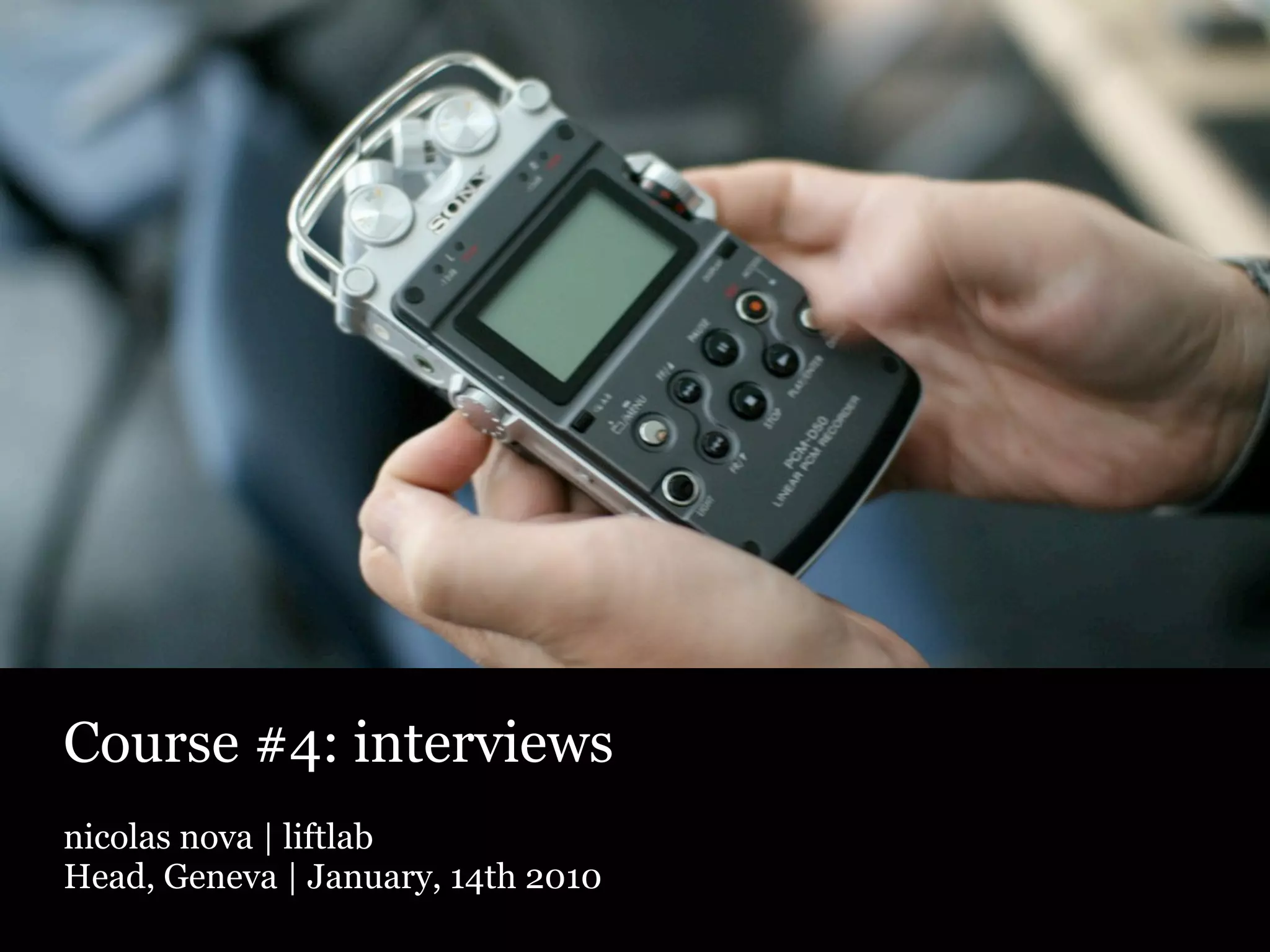


Course #4: interviews
nicolas nova | liftlab
Head, Geneva | January, 14th 2010
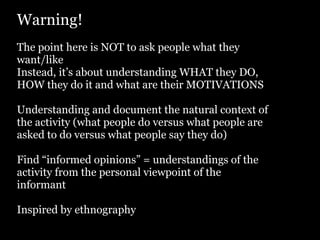
Warning!
The point here is NOT to ask people what they
want/like
Instead, it’s about understanding WHAT they DO,
HOW they do it and what are their MOTIVATIONS

Understanding and document the natural context of
the activity (what people do versus what people are
asked to do versus what people say they do)

Find “informed opinions” = understandings of the
activity from the personal viewpoint of the
informant

Inspired by ethnography
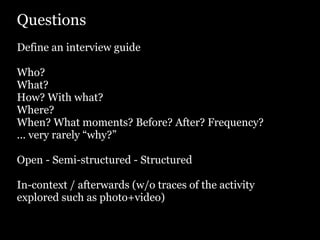
Questions
Define an interview guide

Who?
What?
How? With what?
Where?
When? What moments? Before? After? Frequency?
... very rarely “why?”

Open - Semi-structured - Structured

In-context / afterwards (w/o traces of the activity
explored such as photo+video)
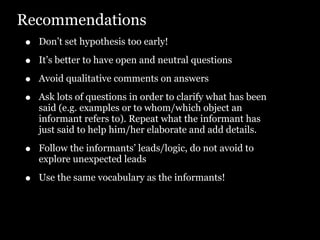
Recommendations
•   Don’t set hypothesis too early!

•   It’s better to have open and neutral questions

•   Avoid qualitative comments on answers

•   Ask lots of questions in order to clarify what has been
    said (e.g. examples or to whom/which object an
    informant refers to). Repeat what the informant has
    just said to help him/her elaborate and add details.

•   Follow the informants’ leads/logic, do not avoid to
    explore unexpected leads

•   Use the same vocabulary as the informants!
Recommendations (2)
•   Observe first, ask afterwards

•   Look for (and write down) motivations for actions,
    drivers, needs or problems, don’t look for solution as
    this stage

•   Do not interfere with the activity/discussion at stake

•   Try to understand what is not said verbally

•   Use neutral questions: “what are you doing when you
    do this?”

•   Try to consider things that go beyond your research
    scope

•   I personally take lots of notes, even (apparently)
    obvious and unimportant things, Be sure to note the
    term employed by informants
Recommendations (3)
•   When opening the interview, it’s generally good to
    use open questions that can lead to rich and broad
    answers:

    •   “do you have a mobile phone?” becomes “can you
        describe how you use your mobile phone?,

    •   “do you often go on the Web?” becomes “when do
        you go on the Web?”

•   Phrase questions by using the informant as the
    actor of the action at stake (verb) and avoid
    negative formulations:

    •   “What questions would you like to ask to a search
        engine?” becomes “What are the informations
        you ask yourself on a regular basis?”
Recommendations (4)
•   Encourage intimacy and trust:

    •   “what do you think about the web as a way to co-
        construct local information?”, “put yourself in
        XXXX’s shoes”

•   Avoid asking “why” (people don’t want to loose face
    so there are rationalizing biases) or if you ask “why”
    be careful with how to use this data

•   Avoid questions that evaluate the informants skills
    (or that made him/her defensive):

    •   “are you able to...?” becomes “have you
        already...?”

    •   “do you know how to send MMS?” becomes “how
        do you exchange pictures with your friends?”
Recommendations (5)
  • Understand practices:
    • Ask concrete questions: “Do you find mobile
            applications that fulfill your needs” becomes “Can
            you give me an example of a mobile applications
            that works well for you?”

        •   Avoid closed/multiple-choice questions,

        •   Specify a context in your questions

        •   Understand the sequences of actions: before/after
            (“what did you do before that?”, “and what do yo
            do afterwards?”), patterns (reccurence, cycles,
            exceptions, routines...). It’s common to ask
            informant to tell what happens during one day
            (“can you tell me what you on a typical day?”).

    •   Don’t interrupt/break the flow
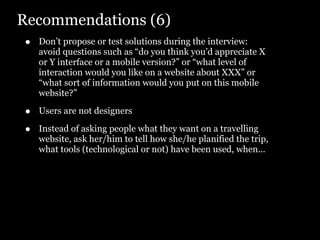
Recommendations (6)
 • Don’t propose or test solutions during the interview:
     avoid questions such as “do you think you’d appreciate X
     or Y interface or a mobile version?” or “what level of
     interaction would you like on a website about XXX” or
     “what sort of information would you put on this mobile
     website?”

 •   Users are not designers

 •   Instead of asking people what they want on a travelling
     website, ask her/him to tell how she/he planified the trip,
     what tools (technological or not) have been used, when...
Project discussion
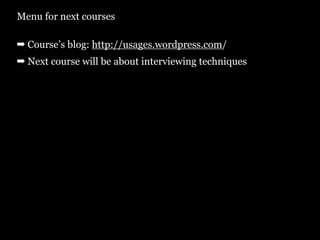
Menu for next courses

➡ Course’s blog: http://usages.wordpress.com/
➡ Next course will be about interviewing techniques
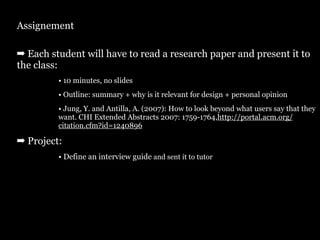
Assignement

➡ Each student will have to read a research paper and present it to
the class:
         • 10 minutes, no slides
         • Outline: summary + why is it relevant for design + personal opinion
         • Jung, Y. and Antilla, A. (2007): How to look beyond what users say that they
         want. CHI Extended Abstracts 2007: 1759-1764,http://portal.acm.org/
         citation.cfm?id=1240896

➡ Project:
         • Define an interview guide and sent it to tutor
Let’s discuss your question
thanks
nicolas@liftlab.com

Field research and interaction design: course #4

  • 1.
    Course #4: interviews nicolasnova | liftlab Head, Geneva | January, 14th 2010
  • 2.
    Warning! The point hereis NOT to ask people what they want/like Instead, it’s about understanding WHAT they DO, HOW they do it and what are their MOTIVATIONS Understanding and document the natural context of the activity (what people do versus what people are asked to do versus what people say they do) Find “informed opinions” = understandings of the activity from the personal viewpoint of the informant Inspired by ethnography
  • 3.
    Questions Define an interviewguide Who? What? How? With what? Where? When? What moments? Before? After? Frequency? ... very rarely “why?” Open - Semi-structured - Structured In-context / afterwards (w/o traces of the activity explored such as photo+video)
  • 4.
    Recommendations • Don’t set hypothesis too early! • It’s better to have open and neutral questions • Avoid qualitative comments on answers • Ask lots of questions in order to clarify what has been said (e.g. examples or to whom/which object an informant refers to). Repeat what the informant has just said to help him/her elaborate and add details. • Follow the informants’ leads/logic, do not avoid to explore unexpected leads • Use the same vocabulary as the informants!
  • 5.
    Recommendations (2) • Observe first, ask afterwards • Look for (and write down) motivations for actions, drivers, needs or problems, don’t look for solution as this stage • Do not interfere with the activity/discussion at stake • Try to understand what is not said verbally • Use neutral questions: “what are you doing when you do this?” • Try to consider things that go beyond your research scope • I personally take lots of notes, even (apparently) obvious and unimportant things, Be sure to note the term employed by informants
  • 6.
    Recommendations (3) • When opening the interview, it’s generally good to use open questions that can lead to rich and broad answers: • “do you have a mobile phone?” becomes “can you describe how you use your mobile phone?, • “do you often go on the Web?” becomes “when do you go on the Web?” • Phrase questions by using the informant as the actor of the action at stake (verb) and avoid negative formulations: • “What questions would you like to ask to a search engine?” becomes “What are the informations you ask yourself on a regular basis?”
  • 7.
    Recommendations (4) • Encourage intimacy and trust: • “what do you think about the web as a way to co- construct local information?”, “put yourself in XXXX’s shoes” • Avoid asking “why” (people don’t want to loose face so there are rationalizing biases) or if you ask “why” be careful with how to use this data • Avoid questions that evaluate the informants skills (or that made him/her defensive): • “are you able to...?” becomes “have you already...?” • “do you know how to send MMS?” becomes “how do you exchange pictures with your friends?”
  • 8.
    Recommendations (5) • Understand practices: • Ask concrete questions: “Do you find mobile applications that fulfill your needs” becomes “Can you give me an example of a mobile applications that works well for you?” • Avoid closed/multiple-choice questions, • Specify a context in your questions • Understand the sequences of actions: before/after (“what did you do before that?”, “and what do yo do afterwards?”), patterns (reccurence, cycles, exceptions, routines...). It’s common to ask informant to tell what happens during one day (“can you tell me what you on a typical day?”). • Don’t interrupt/break the flow
  • 9.
    Recommendations (6) •Don’t propose or test solutions during the interview: avoid questions such as “do you think you’d appreciate X or Y interface or a mobile version?” or “what level of interaction would you like on a website about XXX” or “what sort of information would you put on this mobile website?” • Users are not designers • Instead of asking people what they want on a travelling website, ask her/him to tell how she/he planified the trip, what tools (technological or not) have been used, when...
  • 10.
  • 11.
    Menu for nextcourses ➡ Course’s blog: http://usages.wordpress.com/ ➡ Next course will be about interviewing techniques
  • 12.
    Assignement ➡ Each studentwill have to read a research paper and present it to the class: • 10 minutes, no slides • Outline: summary + why is it relevant for design + personal opinion • Jung, Y. and Antilla, A. (2007): How to look beyond what users say that they want. CHI Extended Abstracts 2007: 1759-1764,http://portal.acm.org/ citation.cfm?id=1240896 ➡ Project: • Define an interview guide and sent it to tutor
  • 13.
  • 14.