Unit No-IV Noise Acoustic
By
Prof. S. R. Korake
Asst. Prof.
ME-Civil(Env.Engg.)
Civil Engineering Dept.
Sanjivani Rural Education Society’s
Sanjivani College of Engineering, Kopargaon-
423603
Unit-IV, Building Services
Building Services includes,
 Electric Services
 Lighting and ventilation
 Air conditioning
 Water supply and sanitation (Plumbing)
 Rain water harvesting
 Vertical circulation units like lifts, elevator and
escalators etc.
-the basic need of any building is to provide functional
aspects so that it will help for human comfort.
Noise and Accoustics
 a sound, especially one that is loud or unpleasant or that
causes disturbance.
 Noise – is an undesirable and unwanted sound, and
noise is a form of waste energy.
[Note: Not all sound is noise]
There are mainly three types of noises that are to be
minimized.
They are (i) air-borne noise,
(ii) structure-borne noise and
(iii) internal noise.
(i) Air-Borne Noise
 The noise that comes into building through air from
distant sources is called air-borne noise.
 A part of it directly enters the hall through the open
windows, doors or other openings while another part
enters by transmission through walls and floors.
Remedies
 The building may be located on quite sites away
from heavy traffic, market places, railway
stations, airports etc.
 They may be shaded from noise by interposing
a buffer zone of trees, gardens etc.
(ii) Structure-Borne Noise
 The noise which comes from impact sources on the
structural extents of the building is known- as the
structure-borne noise. It is directly transmitted to the
building by vibrations in the structure. The common
sources of this type of noise are foot-steps, moving of
furniture, operating machinery etc.
Remedies
 The problem due to machinery and domestic
appliances can be overcome by placing vibration
isolators between machines and their supports.
 Cavity walls, compound walls may be used to
increase the noise transmission loss.
(iii) Internal Noise
• Internal noise is the noise produced in the hall
or office etc.
• They are produced by air conditioners,
movement of people etc.
Remedies
• The walls, floors and ceilings may be provided
with enough sound absorbing materials.
• The gadgets or machinery should be placed on
sound absorbent material.
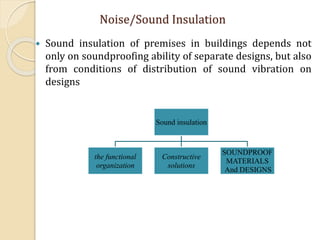
 Sound insulation of premises in buildings depends not
only on soundproofing ability of separate designs, but also
from conditions of distribution of sound vibration on
designs
Noise/Sound Insulation
Sound insulation
the functional
organization
Constructive
solutions
SOUNDPROOF
MATERIALS
And DESIGNS
First of all it is the functional organization
Of a building providing corresponding separation or overlapping of
processes, connected with noisy or silent conditions (noise from
sanitary-engineering and plumbing system). The key rule providing
acoustic comfort, the grouping of silent and noisy premises in
corresponding functional zones and separation of these zones by
the premises which are carrying out buffer function is.
Constructive solutions are the second factor influencing sound
insulation of premises. Sound insulation substantially depends from
sound conductivity a constructive skeleton of a building. In turn,
sound conductivity designs of buildings depends on their
homogeneity. The greatest sound conductivity one-piece buildings
possess. Smaller conductance of a sound have brick buildings with
massive wall designs possess.
Inside of a building sound-proof materials are applied basically in
designs of sound-proof facings internal surfaces of premises and the
technical devices demanding decrease of a level of noise
(installation of ventilation and an air handling, etc.). Also for
improvement of acoustic properties of premises (auditoria,
audiences and so forth). As a rule to such materials requirements in
absence of toxicity, ecological compatibility (application of natural
materials), to aesthetically comprehensible performance (are
applied at facing), simplicity of installation (from for opportunities
of repair), fire safety, to the sizes, etc
Building Acoustics
 Building acoustics or architectural acoustics deals with
sound in the built environment.
 Acoustic is the science of sound as applied to
buildings and its scope includes not only the
design and construction of an enclosure
particularly auditorium with proper acoustical
conditions and correction acoustical faults in
existing ones but also absorption and dissipation
of exterior and interior noises and insulation
against sound both air borne and structure
borne.
 Zero dB means sound pressure of 0.0002 dyne/sq.m.
 Following may be the possible defects due to reflected sound:
1. Deflection time of Reverberation
2. Echo formation
3. Sound Foci
4. Dead spots
5. Loudness of Sound
6. External noise
1. Deflection time of Reverberation
To satisfy the condition the angle of elevation of the inclined floor
should not be less than 8 degree.
Deflection time of Reverberation is the common defect in the
auditoriums. In this case, successive sounds produced by the source
overlap each other and sound is not distinctly audible and, therefore,
this defect can be corrected
Acoustical Defects
The property of a surface by which sound energy is
converted into other form of energy is known as
absorption.
In the process of absorption sound energy is converted
into heat due to frictional resistance inside the pores of the
material.
The fibrous and porous materials absorb sound energy
more, than other solid materials.
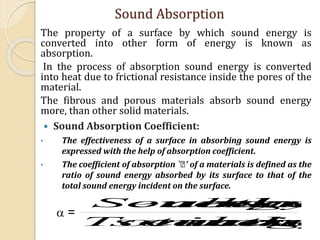
 Sound Absorption Coefficient:
• The effectiveness of a surface in absorbing sound energy is
expressed with the help of absorption coefficient.
• The coefficient of absorption ` ’ of a materials is defined as the
ratio of sound energy absorbed by its surface to that of the
total sound energy incident on the surface.
Sound Absorption
sutheonincidenergysoundTotal
surthebyabsorenergySound
 =
 A unit area of open window is selected as the standard. All the
sound incident on an open window is fully transmitted and
none is reflected. Therefore, it is considered as an ideal
absorber of sound.
 Thus the unit of absorption is the open window unit (O.W.U.),
which is named a “sabin” after the scientist who established
the unit.
 A 1m2 sabin is the amount of sound absorbed by one square
metre area of fully open window.
 The value of ` ’ depends on the nature of the material as well
as the frequency of sound. It is a common practice to use the
value of ` ’ at 500 Hz in acoustic designs.
 If a material has the value of “ ” as 0.5, it means that 50% of
the incident sound energy will be absorbed per unit area.
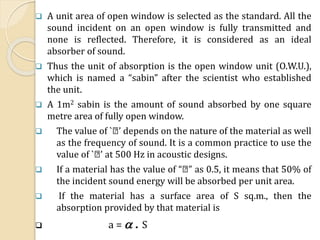
 If the material has a surface area of S sq.m., then the
absorption provided by that material is
 a =  . S
If there are different materials in a hall, then the total sound
absorption by the different materials is given by
A = a1 + a2 + a3 + ……
A = 1S1 + 2S2 + 3S3 + ……
or A =
where 1, 2, 3, ……are absorption coefficients of
materials with areas S1, S2, S3,………

n
nnS
1

Reverberation
 Sound produced in an enclosure does not die out immediately
after the source has ceased to produce it.
 A sound produced in a hall undergoes multiple reflections
from the walls, floor and ceiling before it becomes inaudible.
 A person in the hall continues to receive successive reflections
of progressively diminishing intensity.
 This prolongation of sound before it decays to a negligible
intensity is called reverberation.
 The time taken by the sound in a room to fall from its average
intensity to inaudibility level is called the reverberation time
of the room.
 Reverberation time is defined as the time during which the
sound energy density falls from its steady state value to its
one-millionth (10-6) value after the source is shut off.
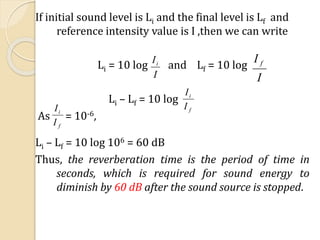
If initial sound level is Li and the final level is Lf and
reference intensity value is I ,then we can write
Li = 10 log and Lf = 10 log
Li – Lf = 10 log
As = 10-6,
Li – Lf = 10 log 106 = 60 dB
Thus, the reverberation time is the period of time in
seconds, which is required for sound energy to
diminish by 60 dB after the sound source is stopped.
I
Ii
I
I f
f
i
I
I
f
i
I
I
Sabine’s Formula for Reverberation Time
 Prof.Wallace C.Sabine (1868-1919) determined the
reverberation times of empty halls and furnished halls
of different sizes and arrived at the following
conclusions.
 The reverberation time depends on the reflecting
properties of the walls, floor and ceiling of the hall.
 The reverberation time depends directly upon the
physical volume V of the hall.
 The reverberation time depends on the absorption
coefficient of various surfaces such as carpets, cushions,
curtains etc present in the hall.
 The reverberation time depends on the frequency of the
sound wave because absorption coefficient of most of the
materials increases with frequency.
Prof. Sabine summarized his results in the form of the
following equation.
Reverberation Time, T 
or
T =
where K is a proportionality constant.
It is found to have a value of 0.161 when the dimensions
are measured in metric units. Thus,
T =
This Equation is known as Sabine’s formula for
reverberation time.
AAbsorption
VHalltheofVolume
,
,
A
V
K
A
V161.0
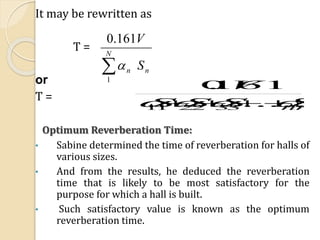
It may be rewritten as
T =
or
T =
Optimum Reverberation Time:
• Sabine determined the time of reverberation for halls of
various sizes.
• And from the results, he deduced the reverberation
time that is likely to be most satisfactory for the
purpose for which a hall is built.
• Such satisfactory value is known as the optimum
reverberation time.

N
nn S
V
1
161.0

nnSSSS
V
  ......
161.0
332211
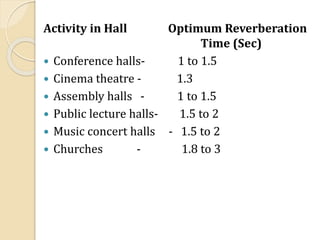
Activity in Hall Optimum Reverberation
Time (Sec)
 Conference halls- 1 to 1.5
 Cinema theatre - 1.3
 Assembly halls - 1 to 1.5
 Public lecture halls- 1.5 to 2
 Music concert halls - 1.5 to 2
 Churches - 1.8 to 3
 Materials which absorb sound are called sound absorbing materials and
are classified as
i) Porous sound absorbers
ii) Non-porous absorbers
Porous materials: Porous absorbers are the most commonly used
sound absorbing materials. Commonly used porous materials are Wood
wools, soft plaster, asbestos fibre, glass wool, Fibre boards carpet etc..
Generally, all of these materials allow air to flow into a cellular structure
where sound energy is converted to heat. Thickness plays an important
role in sound absorption by porous materials.
Non-Porous/Panel absorber: Panel absorbers are non-rigid, non-
porous materials which are placed over an airspace that vibrates in a
flexural mode in response to sound pressure exerted by adjacent air
molecules.
When the sound wave strikes the pannel due to vibration of the panel
the energy is absorbed and finally converted into heat. Common panel
(membrane) absorbers include thin wood paneling over framing,
lightweight impervious ceilings and floors, glazing and other large
surfaces capable of resonating in response to sound. Panel absorbers
are usually most efficient at absorbing low frequencies.
Sound Absorbents
Resonators:
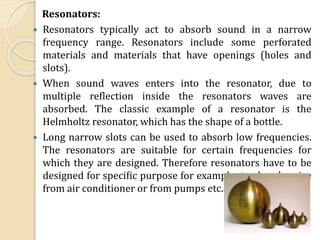
 Resonators typically act to absorb sound in a narrow
frequency range. Resonators include some perforated
materials and materials that have openings (holes and
slots).
 When sound waves enters into the resonator, due to
multiple reflection inside the resonators waves are
absorbed. The classic example of a resonator is the
Helmholtz resonator, which has the shape of a bottle.
 Long narrow slots can be used to absorb low frequencies.
The resonators are suitable for certain frequencies for
which they are designed. Therefore resonators have to be
designed for specific purpose for example to absorb noise
from air conditioner or from pumps etc..
 The branch of science which deals with the planning of a building to
provide the best quality audible sound to audience is termed as
architectural acoustics or acoustics of the building.
 A building or the hall designed for the large audience should take care
of certain features so the audible sound is exact replica of the source.
 Any hall having the good acoustics should have following features:
1. The quality of the speech and the music remains unchanged in each
and every portion of the Hall.
2. The sound produced must be sufficiently loud.
3. There shouldn’t be any echo.
4. The reverberation should be proper.
5. There should not be any focusing of sound in any part of the hall.
6. The walls should be sound proof to avoid the external noise in the
hall.
Planning for Good Acoustics
Noise  acoustic

Noise acoustic

  • 1.
    Unit No-IV NoiseAcoustic By Prof. S. R. Korake Asst. Prof. ME-Civil(Env.Engg.) Civil Engineering Dept. Sanjivani Rural Education Society’s Sanjivani College of Engineering, Kopargaon- 423603
  • 2.
    Unit-IV, Building Services BuildingServices includes,  Electric Services  Lighting and ventilation  Air conditioning  Water supply and sanitation (Plumbing)  Rain water harvesting  Vertical circulation units like lifts, elevator and escalators etc. -the basic need of any building is to provide functional aspects so that it will help for human comfort.
  • 3.
    Noise and Accoustics a sound, especially one that is loud or unpleasant or that causes disturbance.  Noise – is an undesirable and unwanted sound, and noise is a form of waste energy. [Note: Not all sound is noise] There are mainly three types of noises that are to be minimized. They are (i) air-borne noise, (ii) structure-borne noise and (iii) internal noise.
  • 4.
    (i) Air-Borne Noise The noise that comes into building through air from distant sources is called air-borne noise.  A part of it directly enters the hall through the open windows, doors or other openings while another part enters by transmission through walls and floors. Remedies  The building may be located on quite sites away from heavy traffic, market places, railway stations, airports etc.  They may be shaded from noise by interposing a buffer zone of trees, gardens etc.
  • 5.
    (ii) Structure-Borne Noise The noise which comes from impact sources on the structural extents of the building is known- as the structure-borne noise. It is directly transmitted to the building by vibrations in the structure. The common sources of this type of noise are foot-steps, moving of furniture, operating machinery etc. Remedies  The problem due to machinery and domestic appliances can be overcome by placing vibration isolators between machines and their supports.  Cavity walls, compound walls may be used to increase the noise transmission loss.
  • 6.
    (iii) Internal Noise •Internal noise is the noise produced in the hall or office etc. • They are produced by air conditioners, movement of people etc. Remedies • The walls, floors and ceilings may be provided with enough sound absorbing materials. • The gadgets or machinery should be placed on sound absorbent material.
  • 8.
     Sound insulationof premises in buildings depends not only on soundproofing ability of separate designs, but also from conditions of distribution of sound vibration on designs Noise/Sound Insulation Sound insulation the functional organization Constructive solutions SOUNDPROOF MATERIALS And DESIGNS
  • 9.
    First of allit is the functional organization Of a building providing corresponding separation or overlapping of processes, connected with noisy or silent conditions (noise from sanitary-engineering and plumbing system). The key rule providing acoustic comfort, the grouping of silent and noisy premises in corresponding functional zones and separation of these zones by the premises which are carrying out buffer function is. Constructive solutions are the second factor influencing sound insulation of premises. Sound insulation substantially depends from sound conductivity a constructive skeleton of a building. In turn, sound conductivity designs of buildings depends on their homogeneity. The greatest sound conductivity one-piece buildings possess. Smaller conductance of a sound have brick buildings with massive wall designs possess. Inside of a building sound-proof materials are applied basically in designs of sound-proof facings internal surfaces of premises and the technical devices demanding decrease of a level of noise (installation of ventilation and an air handling, etc.). Also for improvement of acoustic properties of premises (auditoria, audiences and so forth). As a rule to such materials requirements in absence of toxicity, ecological compatibility (application of natural materials), to aesthetically comprehensible performance (are applied at facing), simplicity of installation (from for opportunities of repair), fire safety, to the sizes, etc
  • 10.
    Building Acoustics  Buildingacoustics or architectural acoustics deals with sound in the built environment.  Acoustic is the science of sound as applied to buildings and its scope includes not only the design and construction of an enclosure particularly auditorium with proper acoustical conditions and correction acoustical faults in existing ones but also absorption and dissipation of exterior and interior noises and insulation against sound both air borne and structure borne.  Zero dB means sound pressure of 0.0002 dyne/sq.m.
  • 11.
     Following maybe the possible defects due to reflected sound: 1. Deflection time of Reverberation 2. Echo formation 3. Sound Foci 4. Dead spots 5. Loudness of Sound 6. External noise 1. Deflection time of Reverberation To satisfy the condition the angle of elevation of the inclined floor should not be less than 8 degree. Deflection time of Reverberation is the common defect in the auditoriums. In this case, successive sounds produced by the source overlap each other and sound is not distinctly audible and, therefore, this defect can be corrected Acoustical Defects
  • 12.
    The property ofa surface by which sound energy is converted into other form of energy is known as absorption. In the process of absorption sound energy is converted into heat due to frictional resistance inside the pores of the material. The fibrous and porous materials absorb sound energy more, than other solid materials.  Sound Absorption Coefficient: • The effectiveness of a surface in absorbing sound energy is expressed with the help of absorption coefficient. • The coefficient of absorption ` ’ of a materials is defined as the ratio of sound energy absorbed by its surface to that of the total sound energy incident on the surface. Sound Absorption sutheonincidenergysoundTotal surthebyabsorenergySound  =
  • 13.
     A unitarea of open window is selected as the standard. All the sound incident on an open window is fully transmitted and none is reflected. Therefore, it is considered as an ideal absorber of sound.  Thus the unit of absorption is the open window unit (O.W.U.), which is named a “sabin” after the scientist who established the unit.  A 1m2 sabin is the amount of sound absorbed by one square metre area of fully open window.  The value of ` ’ depends on the nature of the material as well as the frequency of sound. It is a common practice to use the value of ` ’ at 500 Hz in acoustic designs.  If a material has the value of “ ” as 0.5, it means that 50% of the incident sound energy will be absorbed per unit area.  If the material has a surface area of S sq.m., then the absorption provided by that material is  a =  . S
  • 14.
    If there aredifferent materials in a hall, then the total sound absorption by the different materials is given by A = a1 + a2 + a3 + …… A = 1S1 + 2S2 + 3S3 + …… or A = where 1, 2, 3, ……are absorption coefficients of materials with areas S1, S2, S3,………  n nnS 1 
  • 15.
    Reverberation  Sound producedin an enclosure does not die out immediately after the source has ceased to produce it.  A sound produced in a hall undergoes multiple reflections from the walls, floor and ceiling before it becomes inaudible.  A person in the hall continues to receive successive reflections of progressively diminishing intensity.  This prolongation of sound before it decays to a negligible intensity is called reverberation.  The time taken by the sound in a room to fall from its average intensity to inaudibility level is called the reverberation time of the room.  Reverberation time is defined as the time during which the sound energy density falls from its steady state value to its one-millionth (10-6) value after the source is shut off.
  • 16.
    If initial soundlevel is Li and the final level is Lf and reference intensity value is I ,then we can write Li = 10 log and Lf = 10 log Li – Lf = 10 log As = 10-6, Li – Lf = 10 log 106 = 60 dB Thus, the reverberation time is the period of time in seconds, which is required for sound energy to diminish by 60 dB after the sound source is stopped. I Ii I I f f i I I f i I I
  • 17.
    Sabine’s Formula forReverberation Time  Prof.Wallace C.Sabine (1868-1919) determined the reverberation times of empty halls and furnished halls of different sizes and arrived at the following conclusions.  The reverberation time depends on the reflecting properties of the walls, floor and ceiling of the hall.  The reverberation time depends directly upon the physical volume V of the hall.  The reverberation time depends on the absorption coefficient of various surfaces such as carpets, cushions, curtains etc present in the hall.  The reverberation time depends on the frequency of the sound wave because absorption coefficient of most of the materials increases with frequency.
  • 18.
    Prof. Sabine summarizedhis results in the form of the following equation. Reverberation Time, T  or T = where K is a proportionality constant. It is found to have a value of 0.161 when the dimensions are measured in metric units. Thus, T = This Equation is known as Sabine’s formula for reverberation time. AAbsorption VHalltheofVolume , , A V K A V161.0
  • 19.
    It may berewritten as T = or T = Optimum Reverberation Time: • Sabine determined the time of reverberation for halls of various sizes. • And from the results, he deduced the reverberation time that is likely to be most satisfactory for the purpose for which a hall is built. • Such satisfactory value is known as the optimum reverberation time.  N nn S V 1 161.0  nnSSSS V   ...... 161.0 332211
  • 20.
    Activity in HallOptimum Reverberation Time (Sec)  Conference halls- 1 to 1.5  Cinema theatre - 1.3  Assembly halls - 1 to 1.5  Public lecture halls- 1.5 to 2  Music concert halls - 1.5 to 2  Churches - 1.8 to 3
  • 21.
     Materials whichabsorb sound are called sound absorbing materials and are classified as i) Porous sound absorbers ii) Non-porous absorbers Porous materials: Porous absorbers are the most commonly used sound absorbing materials. Commonly used porous materials are Wood wools, soft plaster, asbestos fibre, glass wool, Fibre boards carpet etc.. Generally, all of these materials allow air to flow into a cellular structure where sound energy is converted to heat. Thickness plays an important role in sound absorption by porous materials. Non-Porous/Panel absorber: Panel absorbers are non-rigid, non- porous materials which are placed over an airspace that vibrates in a flexural mode in response to sound pressure exerted by adjacent air molecules. When the sound wave strikes the pannel due to vibration of the panel the energy is absorbed and finally converted into heat. Common panel (membrane) absorbers include thin wood paneling over framing, lightweight impervious ceilings and floors, glazing and other large surfaces capable of resonating in response to sound. Panel absorbers are usually most efficient at absorbing low frequencies. Sound Absorbents
  • 22.
    Resonators:  Resonators typicallyact to absorb sound in a narrow frequency range. Resonators include some perforated materials and materials that have openings (holes and slots).  When sound waves enters into the resonator, due to multiple reflection inside the resonators waves are absorbed. The classic example of a resonator is the Helmholtz resonator, which has the shape of a bottle.  Long narrow slots can be used to absorb low frequencies. The resonators are suitable for certain frequencies for which they are designed. Therefore resonators have to be designed for specific purpose for example to absorb noise from air conditioner or from pumps etc..
  • 23.
     The branchof science which deals with the planning of a building to provide the best quality audible sound to audience is termed as architectural acoustics or acoustics of the building.  A building or the hall designed for the large audience should take care of certain features so the audible sound is exact replica of the source.  Any hall having the good acoustics should have following features: 1. The quality of the speech and the music remains unchanged in each and every portion of the Hall. 2. The sound produced must be sufficiently loud. 3. There shouldn’t be any echo. 4. The reverberation should be proper. 5. There should not be any focusing of sound in any part of the hall. 6. The walls should be sound proof to avoid the external noise in the hall. Planning for Good Acoustics