The passive VS active
audience debate
How do audiences read media texts?
What we will be exploring…
• How do we decode media texts? (The ideologies
within them?)
• Why do we respond in certain ways?
• Do we believe everything we are told?
• Do media texts effect the audience and society?
The Passive Audience Idea
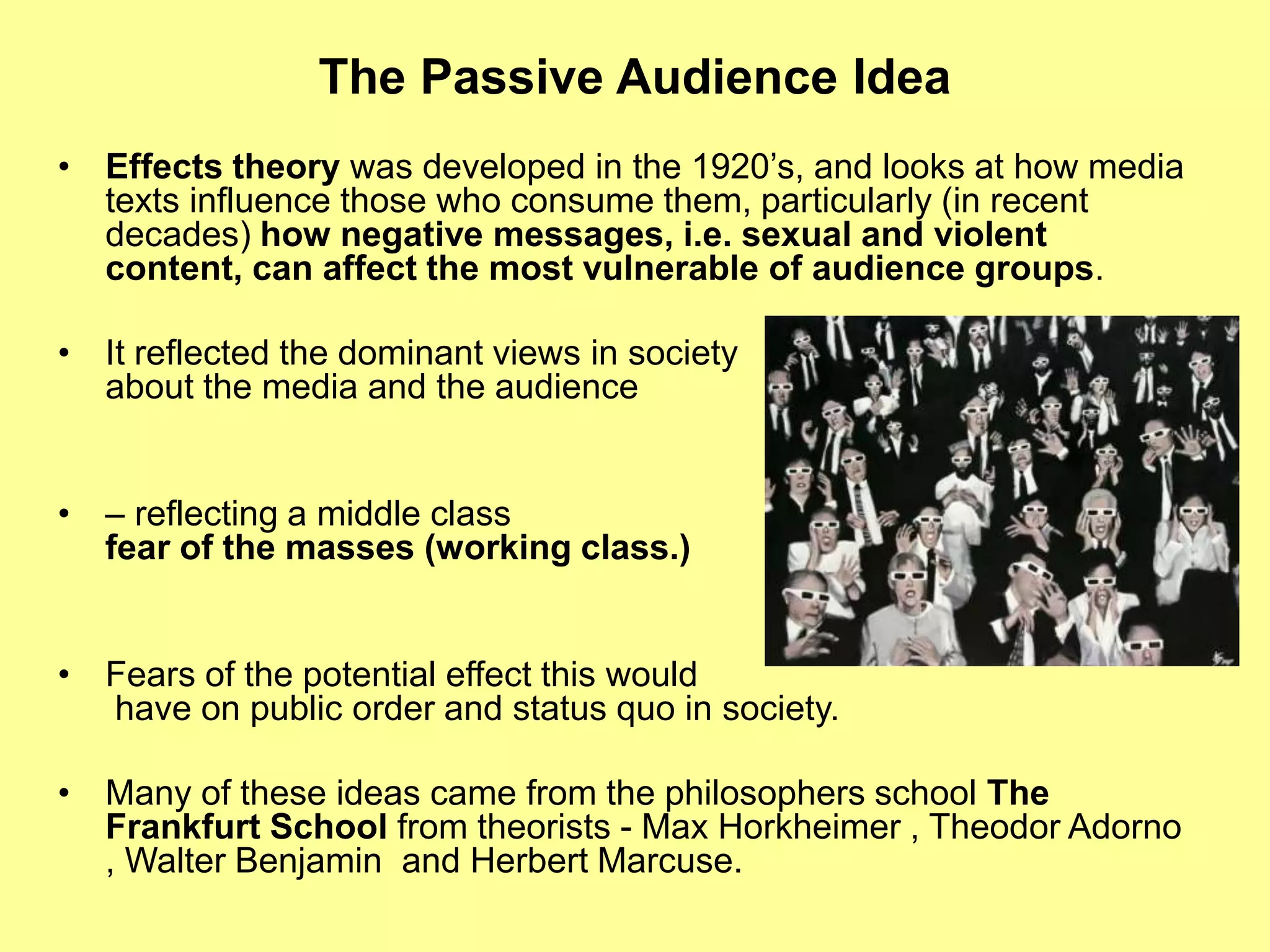
• Effects theory was developed in the 1920’s, and looks at how media
texts influence those who consume them, particularly (in recent
decades) how negative messages, i.e. sexual and violent
content, can affect the most vulnerable of audience groups.
• It reflected the dominant views in society
about the media and the audience
• – reflecting a middle class
fear of the masses (working class.)
• Fears of the potential effect this would
have on public order and status quo in society.
• Many of these ideas came from the philosophers school The
Frankfurt School from theorists - Max Horkheimer , Theodor Adorno
, Walter Benjamin and Herbert Marcuse.
The ‘Hypodermic Needle’ Effect
(or ‘Silver Bullet’ approach)
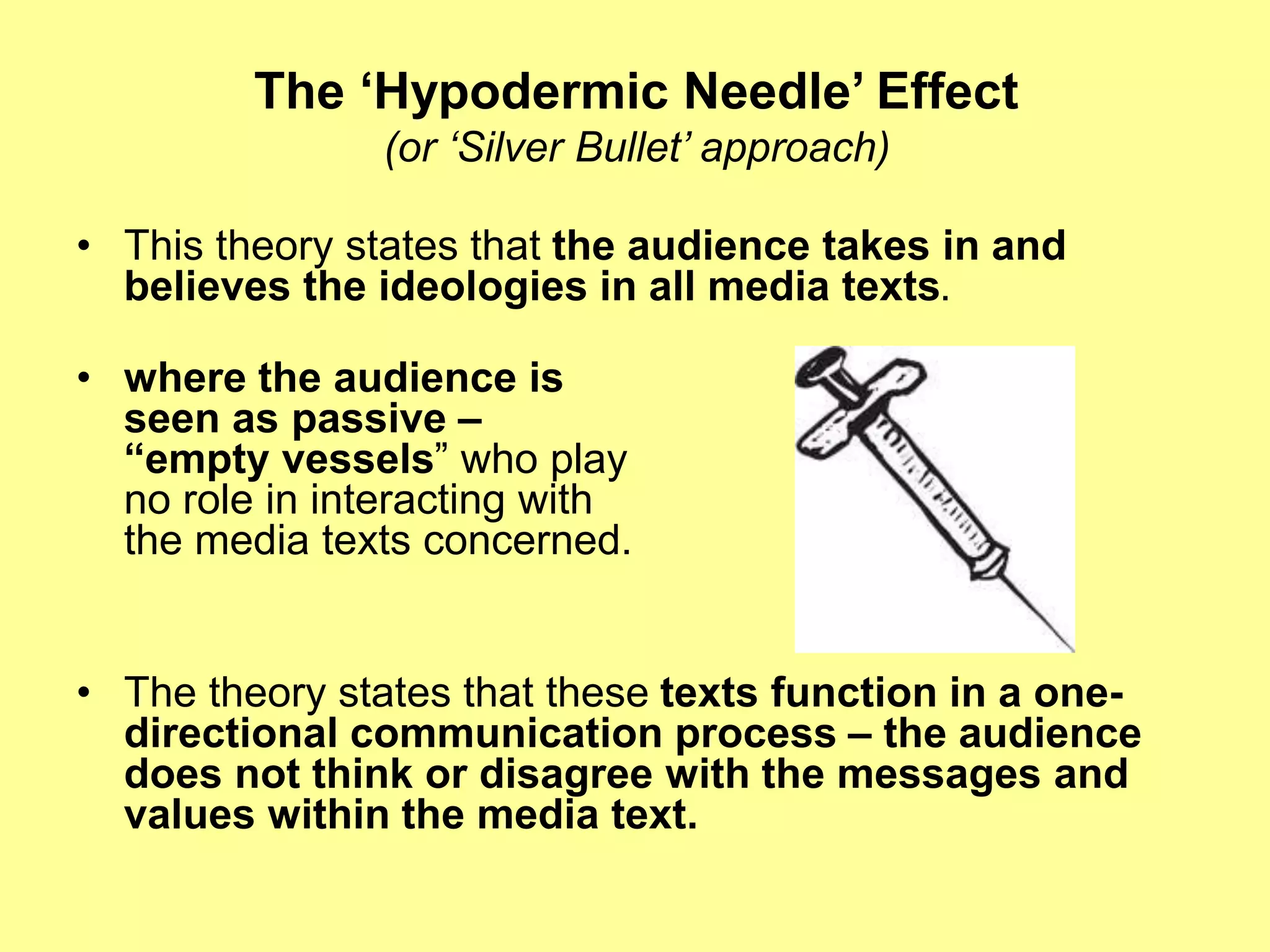
• This theory states that the audience takes in and
believes the ideologies in all media texts.
• where the audience is
seen as passive –
“empty vessels” who play
no role in interacting with
the media texts concerned.
• The theory states that these texts function in a one-
directional communication process – the audience
does not think or disagree with the messages and
values within the media text.
Problems With the Effects Theories
• In recent decades theorists have noted many
problems with Effects theory .
• Many feel it is out of date and that it vastly
underestimates the audiences,
• this has led to the development of more complex
theories about active audience participation in
the reading of media texts.
The Encoding – Decoding Model
: Active Audience Theory (1980)
• Encoding-Decoding is an active audience
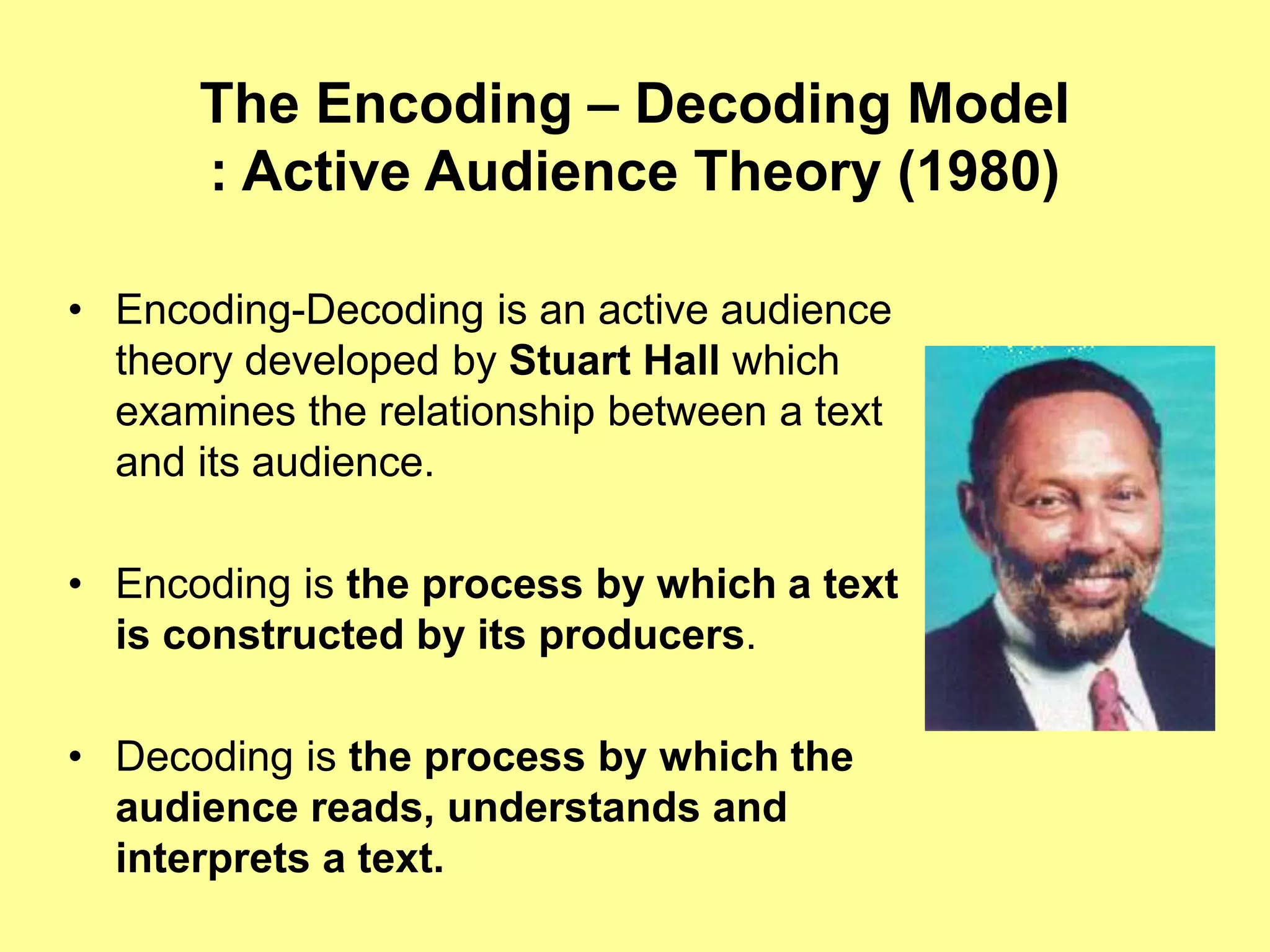
theory developed by Stuart Hall which
examines the relationship between a text
and its audience.
• Encoding is the process by which a text
is constructed by its producers.
• Decoding is the process by which the
audience reads, understands and
interprets a text.
The Encoding – Decoding Model
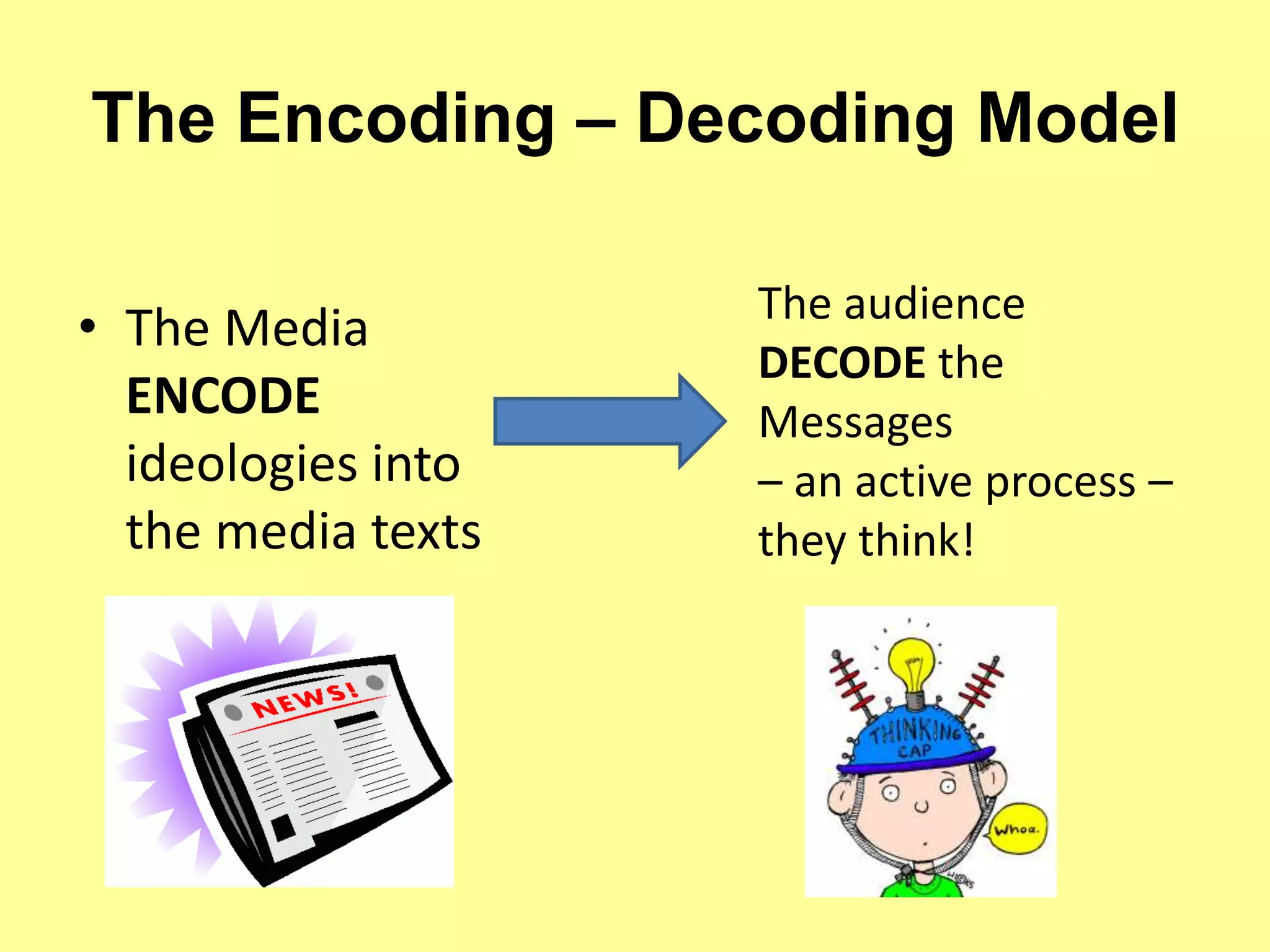
• The Media
ENCODE
ideologies into
the media texts
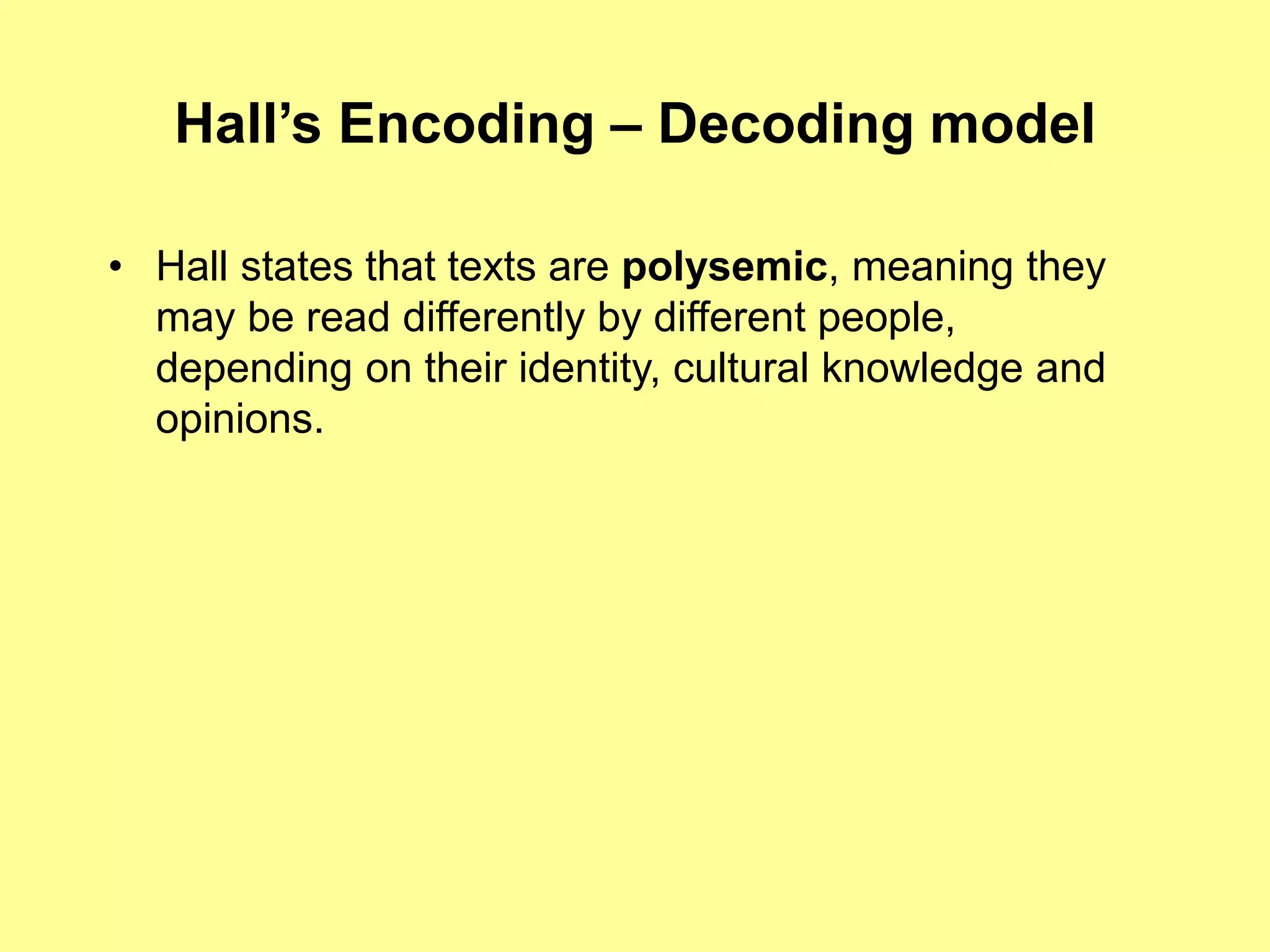
The audience
DECODE the
Messages
– an active process –
they think!
Hall’s Encoding – Decoding model
• Hall states that texts are polysemic, meaning they
may be read differently by different people,
depending on their identity, cultural knowledge and
opinions.
The encoding –decoding model
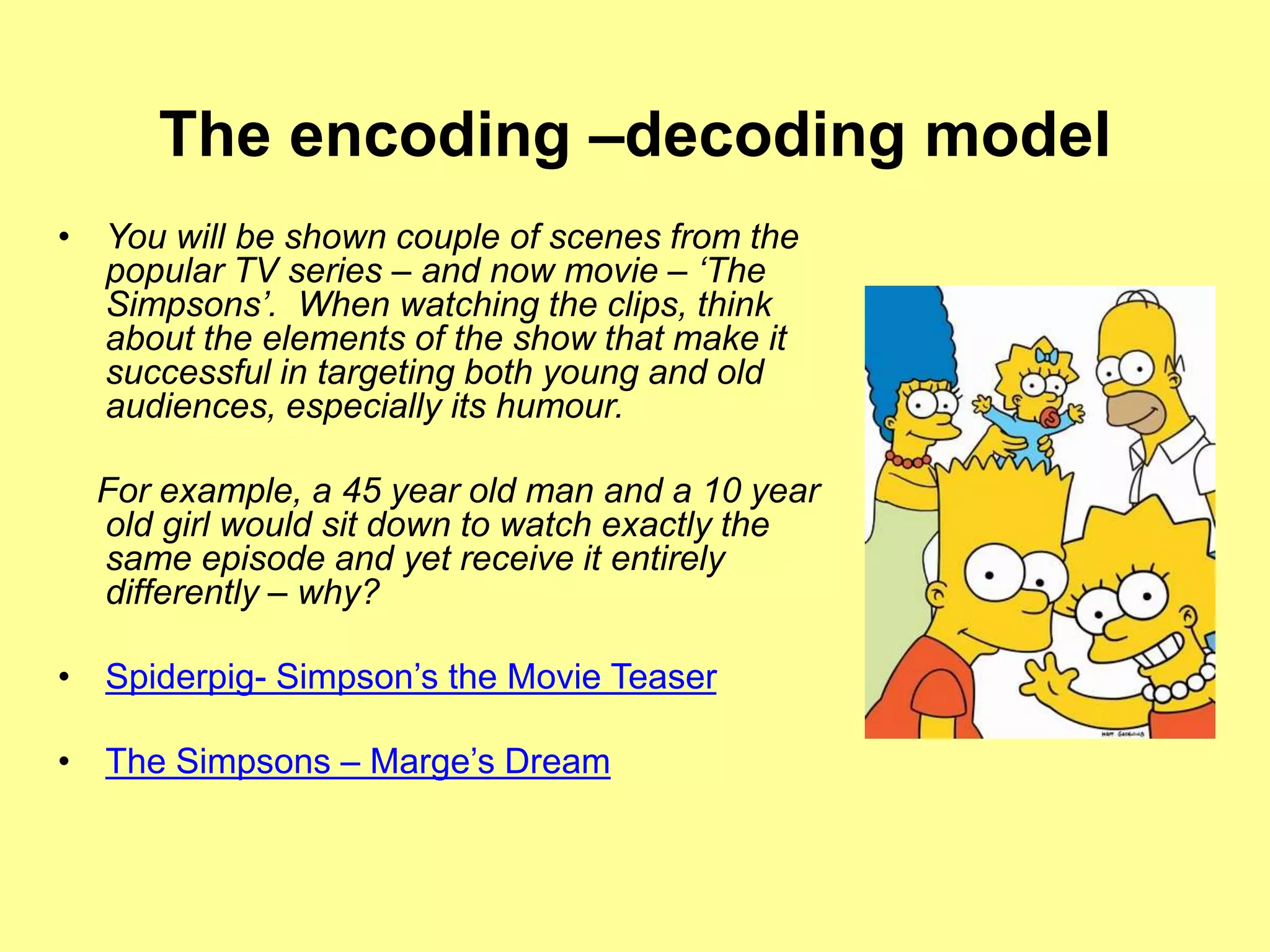
• You will be shown couple of scenes from the
popular TV series – and now movie – ‘The
Simpsons’. When watching the clips, think
about the elements of the show that make it
successful in targeting both young and old
audiences, especially its humour.
For example, a 45 year old man and a 10 year
old girl would sit down to watch exactly the
same episode and yet receive it entirely
differently – why?
• Spiderpig- Simpson’s the Movie Teaser
• The Simpsons – Marge’s Dream
Hall’s Reception Theory
• Reception theory focuses on the role of the audience
in the interpretation of a text, instead of on the text
itself.
• In other words, the theory suggests that audiences play
an active role in reading texts,
• that each person has the ability to interpret the same
text differently, and that a text by itself – i.e. without a
reader – has no specific meaning.
Hall’s Reception Theory
• He termed these different ‘readings’ of the ideologies
in media texts as…
• The preferred reading
• The negotiated reading
• The oppositional reading
• Stuart Hall
Stuart Hall’s Reception Theory
• This clip of a BBC news feature discusses the case of a teenage
homosexual from Iran, seeking asylum in the UK based on claims
that he would be murdered if he returned home due to the
country’s homophobic attitudes and laws.
• When watching the clip, think about the audience theory of
Encoding-Decoding – What would the preferred, negotiated and
oppositional readings of this story be, taking into consideration
the way the BBC present the story – i.e. the preferred reading –
and what types of audience groups would take each particular
reading?
http://www.youtube.com/watch?v=WRIPGhRtB28
• Consider the following audience groups when thinking about
your answer:
• Homosexual people.
• Those classed as homophobic.
• The British caucasian population.
• Iranian people living in the UK.
• British Catholics.
• The British Muslim population.
• British Atheists.
Spectator , Audience, Response
(Patrick Philips 2000)
• See pack.
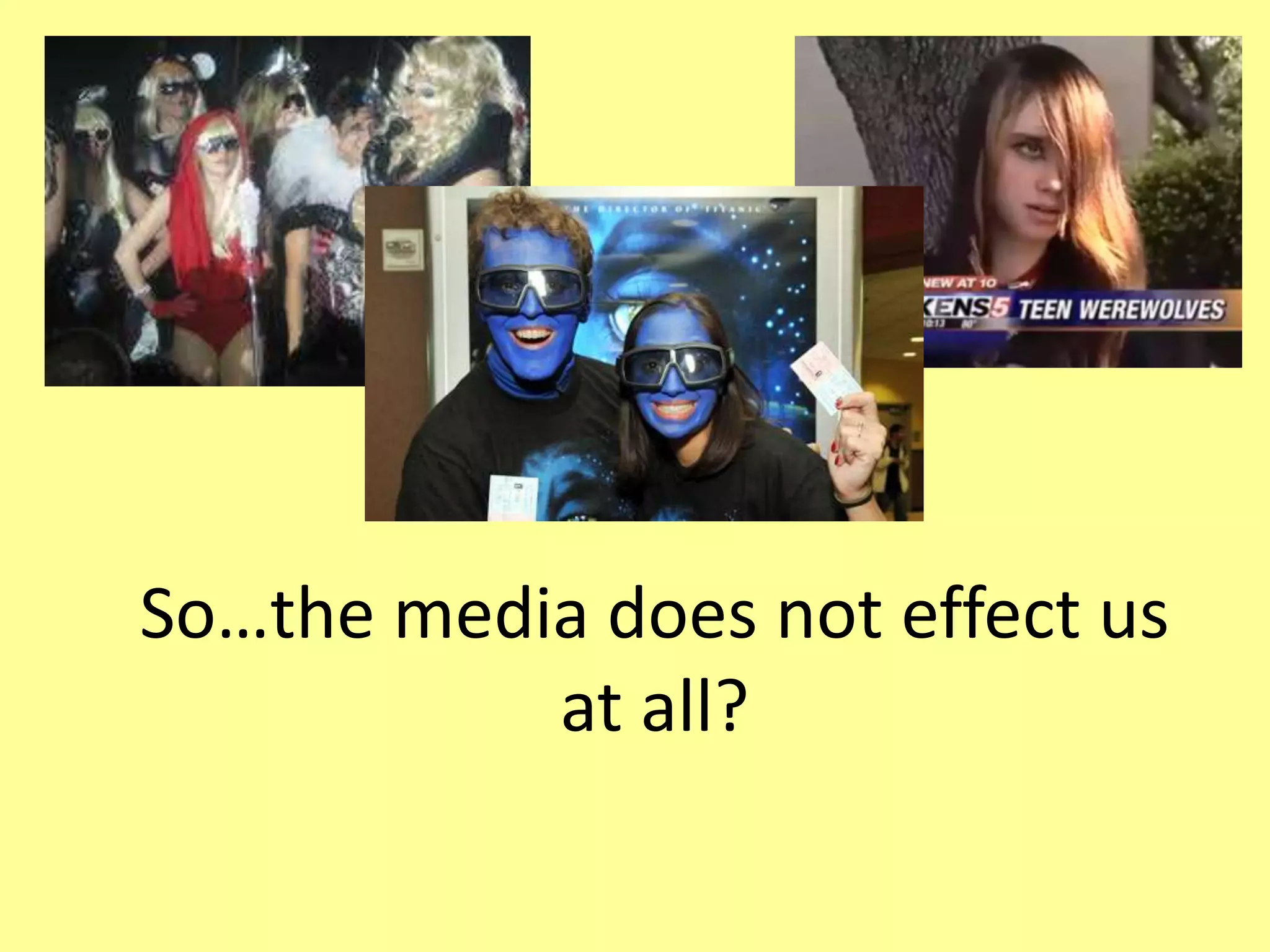
So…the media does not effect us
at all?
The Uses and Gratifications Theory
Blumler, McQuail and Brown (1983)
• Task in pack
Two-step Flow Theory
(Katz and Lazarsfield 1955)
• See pack
The Pick n Mix Approach to Audience
(David Gauntlett)
• This is the idea that we pick and mix our media
( an active choice)…
• We select how we form our identities using
media texts.
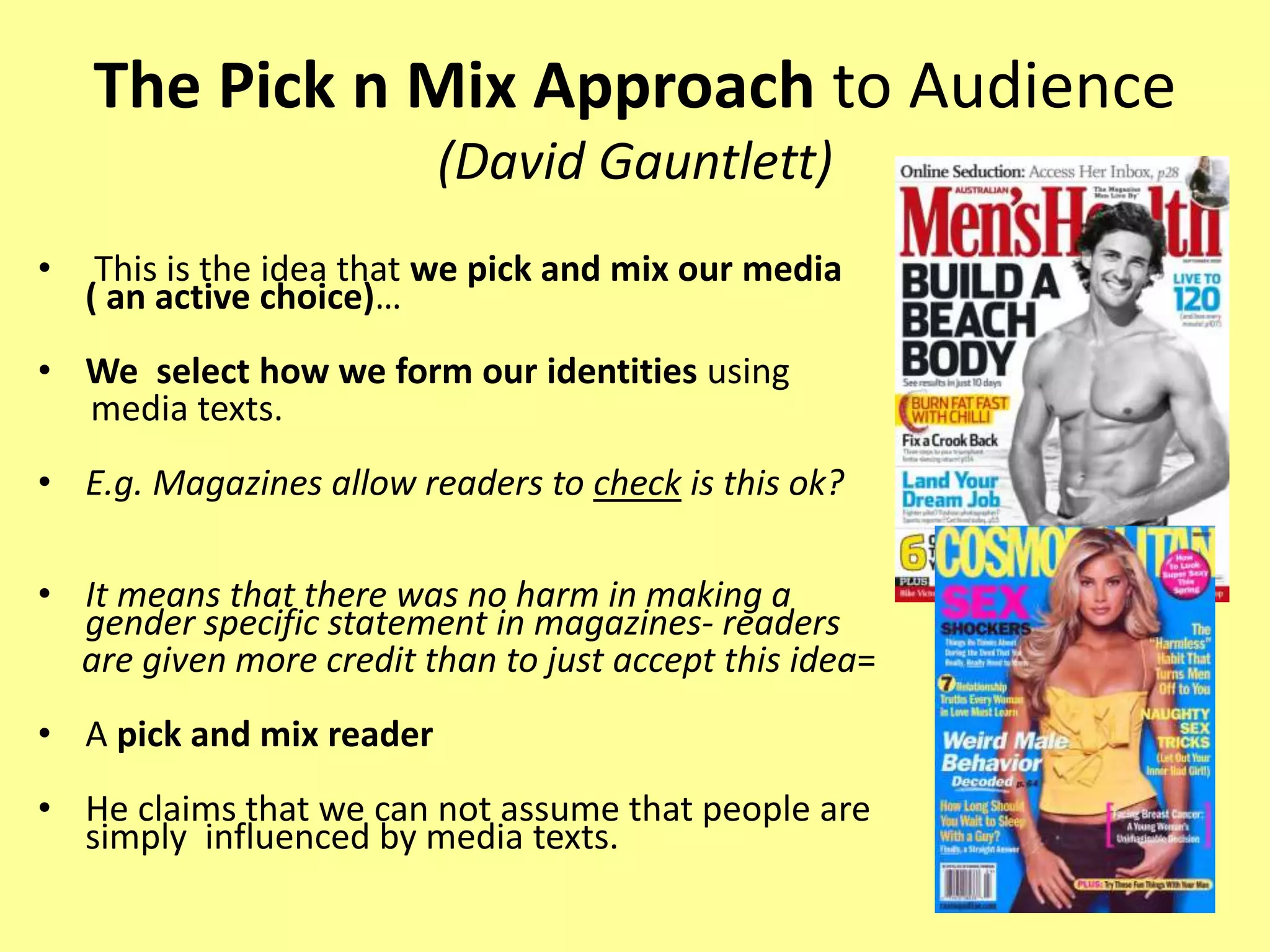
• E.g. Magazines allow readers to check is this ok?
• It means that there was no harm in making a
gender specific statement in magazines- readers
are given more credit than to just accept this idea=
• A pick and mix reader
• He claims that we can not assume that people are
simply influenced by media texts.

how do audiences read media texts.pptx

  • 1.
    The passive VSactive audience debate How do audiences read media texts?
  • 2.
    What we willbe exploring… • How do we decode media texts? (The ideologies within them?) • Why do we respond in certain ways? • Do we believe everything we are told? • Do media texts effect the audience and society?
  • 3.
    The Passive AudienceIdea • Effects theory was developed in the 1920’s, and looks at how media texts influence those who consume them, particularly (in recent decades) how negative messages, i.e. sexual and violent content, can affect the most vulnerable of audience groups. • It reflected the dominant views in society about the media and the audience • – reflecting a middle class fear of the masses (working class.) • Fears of the potential effect this would have on public order and status quo in society. • Many of these ideas came from the philosophers school The Frankfurt School from theorists - Max Horkheimer , Theodor Adorno , Walter Benjamin and Herbert Marcuse.
  • 4.
    The ‘Hypodermic Needle’Effect (or ‘Silver Bullet’ approach) • This theory states that the audience takes in and believes the ideologies in all media texts. • where the audience is seen as passive – “empty vessels” who play no role in interacting with the media texts concerned. • The theory states that these texts function in a one- directional communication process – the audience does not think or disagree with the messages and values within the media text.
  • 5.
    Problems With theEffects Theories • In recent decades theorists have noted many problems with Effects theory . • Many feel it is out of date and that it vastly underestimates the audiences, • this has led to the development of more complex theories about active audience participation in the reading of media texts.
  • 6.
    The Encoding –Decoding Model : Active Audience Theory (1980) • Encoding-Decoding is an active audience theory developed by Stuart Hall which examines the relationship between a text and its audience. • Encoding is the process by which a text is constructed by its producers. • Decoding is the process by which the audience reads, understands and interprets a text.
  • 7.
    The Encoding –Decoding Model • The Media ENCODE ideologies into the media texts The audience DECODE the Messages – an active process – they think!
  • 8.
    Hall’s Encoding –Decoding model • Hall states that texts are polysemic, meaning they may be read differently by different people, depending on their identity, cultural knowledge and opinions.
  • 9.
    The encoding –decodingmodel • You will be shown couple of scenes from the popular TV series – and now movie – ‘The Simpsons’. When watching the clips, think about the elements of the show that make it successful in targeting both young and old audiences, especially its humour. For example, a 45 year old man and a 10 year old girl would sit down to watch exactly the same episode and yet receive it entirely differently – why? • Spiderpig- Simpson’s the Movie Teaser • The Simpsons – Marge’s Dream
  • 10.
    Hall’s Reception Theory •Reception theory focuses on the role of the audience in the interpretation of a text, instead of on the text itself. • In other words, the theory suggests that audiences play an active role in reading texts, • that each person has the ability to interpret the same text differently, and that a text by itself – i.e. without a reader – has no specific meaning.
  • 11.
    Hall’s Reception Theory •He termed these different ‘readings’ of the ideologies in media texts as… • The preferred reading • The negotiated reading • The oppositional reading • Stuart Hall
  • 12.
    Stuart Hall’s ReceptionTheory • This clip of a BBC news feature discusses the case of a teenage homosexual from Iran, seeking asylum in the UK based on claims that he would be murdered if he returned home due to the country’s homophobic attitudes and laws. • When watching the clip, think about the audience theory of Encoding-Decoding – What would the preferred, negotiated and oppositional readings of this story be, taking into consideration the way the BBC present the story – i.e. the preferred reading – and what types of audience groups would take each particular reading? http://www.youtube.com/watch?v=WRIPGhRtB28
  • 13.
    • Consider thefollowing audience groups when thinking about your answer: • Homosexual people. • Those classed as homophobic. • The British caucasian population. • Iranian people living in the UK. • British Catholics. • The British Muslim population. • British Atheists.
  • 14.
    Spectator , Audience,Response (Patrick Philips 2000) • See pack.
  • 15.
    So…the media doesnot effect us at all?
  • 16.
    The Uses andGratifications Theory Blumler, McQuail and Brown (1983) • Task in pack
  • 17.
    Two-step Flow Theory (Katzand Lazarsfield 1955) • See pack
  • 18.
    The Pick nMix Approach to Audience (David Gauntlett) • This is the idea that we pick and mix our media ( an active choice)… • We select how we form our identities using media texts. • E.g. Magazines allow readers to check is this ok? • It means that there was no harm in making a gender specific statement in magazines- readers are given more credit than to just accept this idea= • A pick and mix reader • He claims that we can not assume that people are simply influenced by media texts.