Genre Theories
There are 4 main aspects of genre
theories.
 Location – the domestic/ home consumption of media, as well as commercial
consumption, i.e. in cinemas.
 Consumption – the genre of what an audience is consuming
 Size – the population of the audience and whether it is a niche or mass
audience
 Subjectivity – how the audience view the film in regards to their gender,
sexuality, race, nationality, religion, etc.
 Stewart et al. present the theory that the relationship between a media
text and its audience is changing because of high levels of sophistication
and understanding, texts will always be interpreted in different ways, this
is because of subjectivity and characteristics of targeted audience.
The Effects Model
 All media texts will have a negative impact on the audience after
consumption of the piece of media.
 The overall communication given to the audience in the text, which means
that they have no control and cannot prevent the impact.

The Hypodermic Model
 The messages in all media texts are suggested to be powerful
 The audience will find it hard to resist the messages in the media text.
 When the media text is read as the message is supposed to be ‘injected’ into
them in a syringe-like manner, therefore the audience can be referred to
as addicted audience.
The Uses/Gratification Model
 This is the opposite belief to both the Effects Model and The Hypodermic
Model.
 The audience are suppose to actively be using the text, instead of it being the
other way around, for their own purpose
 The use of texts helps gratify needs such as ‘escapism’, pleasure and
education
 The uses model help audience learn and remember in an emotional way.
Reception Theory
 The reception theory consists of the idea that the producer encodes the media
text with meaning of the story and displays it to the audience
 If level of understanding is high then the audience should be able to solve the
code hidden in the media text, however if they fail to decode then the
message will not be remember.
 Stuart Hall suggests 3 types of audience decoding:
 Dominant or preferred – the audience decodes the message in similar way to the
producers original meaning. Those that decode it can relate and agree with it.
 Negotiated – the audience would decide to change some aspects of their previous
views after decoding the text. The audience wont particularly agree or
disagree with it
 Oppositional – the audience decodes the message but completely disagreed and
disregarded the piece of media text.
Reception Theory
 The reception theory consists of the idea that the producer encodes the media
text with meaning of the story and displays it to the audience
 If level of understanding is high then the audience should be able to solve the
code hidden in the media text, however if they fail to decode then the
message will not be remember.
 Stuart Hall suggests 3 types of audience decoding:
 Dominant or preferred – the audience decodes the message in similar way to the
producers original meaning. Those that decode it can relate and agree with it.
 Negotiated – the audience would decide to change some aspects of their previous
views after decoding the text. The audience wont particularly agree or
disagree with it
 Oppositional – the audience decodes the message but completely disagreed and
disregarded the piece of media text.

Genre theories

  • 1.
  • 2.
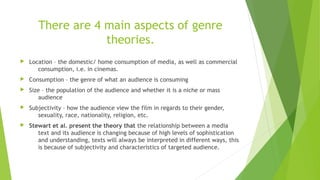
    There are 4main aspects of genre theories.  Location – the domestic/ home consumption of media, as well as commercial consumption, i.e. in cinemas.  Consumption – the genre of what an audience is consuming  Size – the population of the audience and whether it is a niche or mass audience  Subjectivity – how the audience view the film in regards to their gender, sexuality, race, nationality, religion, etc.  Stewart et al. present the theory that the relationship between a media text and its audience is changing because of high levels of sophistication and understanding, texts will always be interpreted in different ways, this is because of subjectivity and characteristics of targeted audience.
  • 3.
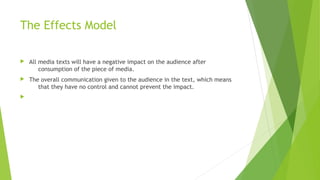
    The Effects Model All media texts will have a negative impact on the audience after consumption of the piece of media.  The overall communication given to the audience in the text, which means that they have no control and cannot prevent the impact. 
  • 4.
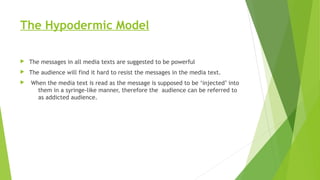
    The Hypodermic Model The messages in all media texts are suggested to be powerful  The audience will find it hard to resist the messages in the media text.  When the media text is read as the message is supposed to be ‘injected’ into them in a syringe-like manner, therefore the audience can be referred to as addicted audience.
  • 5.
    The Uses/Gratification Model This is the opposite belief to both the Effects Model and The Hypodermic Model.  The audience are suppose to actively be using the text, instead of it being the other way around, for their own purpose  The use of texts helps gratify needs such as ‘escapism’, pleasure and education  The uses model help audience learn and remember in an emotional way.
  • 6.
    Reception Theory  Thereception theory consists of the idea that the producer encodes the media text with meaning of the story and displays it to the audience  If level of understanding is high then the audience should be able to solve the code hidden in the media text, however if they fail to decode then the message will not be remember.  Stuart Hall suggests 3 types of audience decoding:  Dominant or preferred – the audience decodes the message in similar way to the producers original meaning. Those that decode it can relate and agree with it.  Negotiated – the audience would decide to change some aspects of their previous views after decoding the text. The audience wont particularly agree or disagree with it  Oppositional – the audience decodes the message but completely disagreed and disregarded the piece of media text.
  • 7.
    Reception Theory  Thereception theory consists of the idea that the producer encodes the media text with meaning of the story and displays it to the audience  If level of understanding is high then the audience should be able to solve the code hidden in the media text, however if they fail to decode then the message will not be remember.  Stuart Hall suggests 3 types of audience decoding:  Dominant or preferred – the audience decodes the message in similar way to the producers original meaning. Those that decode it can relate and agree with it.  Negotiated – the audience would decide to change some aspects of their previous views after decoding the text. The audience wont particularly agree or disagree with it  Oppositional – the audience decodes the message but completely disagreed and disregarded the piece of media text.