Audience
What is audience? 
• Audiences are different and in media studies the media are particularly 
interested in the target audience. This is the audience that media producers 
aim their product at. 
• Media institutions often put their audiences into categories depending upon 
their social, ethnic or economic backgrounds. This is called demographics, they 
use this to work out the best way to target their shows and products. 
• Media producers have a profile of the group and individuals whom they see as 
their intended audience. 
• A music magazine with young people will have a target audience and an 
example of a TV show will be the American drama Glee. 
• For any media text we ask who is the target audience for this text, then we 
have to what sort of audience are they and about them, is it a mass audience?
Categories of audience 
• Profession 
• Life cycle stage 
• Age 
• Gender 
• Martial status 
• Behaviour 
• Demographics
Purpose of audience research 
• Before finalising any project, research must be done before even 
thinking about the initial design. The point of doing this is so that 
the producer can get a better insight of the target audience, it 
would be pointless creating something that’s not going to appeal 
to the right people. It’s important part of the procedure as it’s 
time consuming and a waste of money if the product is not 
created the way it is expected to be. It’s important for a film to 
target a specific audience because everyone has different tastes 
in film for example you could like watching romantic or comedy 
films but when it comes to action films you can utterly dislike 
them.
Social scale 
A – Upper Middle Class – Higher managerial, administrative or 
professional for example a doctor or a lawyer. 
B – Middle Class – Intermediate managerial, administrative or 
professional and these would be teachers or even farmers. 
C1 – Lower Middle Class – Supervisory or Clerical (Nurses, 
Carpenters). 
C2 – Skilled Working class for example electricians or plumbers 
D – Working Class – Semi and unskilled manual workers (Bus drivers) 
E – Lowest level of subsistence (Bar staff, general labourers).
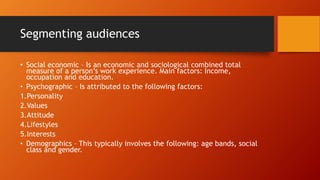
Segmenting audiences 
• Social economic – Is an economic and sociological combined total 
measure of a person’s work experience. Main factors: Income, 
occupation and education. 
• Psychographic – Is attributed to the following factors: 
1.Personality 
2.Values 
3.Attitude 
4.Lifestyles 
5.Interests 
• Demographics – This typically involves the following: age bands, social 
class and gender.
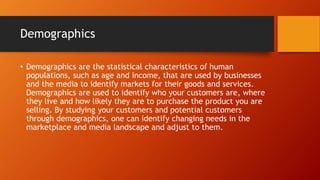
Demographics 
• Demographics are the statistical characteristics of human 
populations, such as age and income, that are used by businesses 
and the media to identify markets for their goods and services. 
Demographics are used to identify who your customers are, where 
they live and how likely they are to purchase the product you are 
selling. By studying your customers and potential customers 
through demographics, one can identify changing needs in the 
marketplace and media landscape and adjust to them.

Audience

  • 1.
  • 2.
    What is audience? • Audiences are different and in media studies the media are particularly interested in the target audience. This is the audience that media producers aim their product at. • Media institutions often put their audiences into categories depending upon their social, ethnic or economic backgrounds. This is called demographics, they use this to work out the best way to target their shows and products. • Media producers have a profile of the group and individuals whom they see as their intended audience. • A music magazine with young people will have a target audience and an example of a TV show will be the American drama Glee. • For any media text we ask who is the target audience for this text, then we have to what sort of audience are they and about them, is it a mass audience?
  • 3.
    Categories of audience • Profession • Life cycle stage • Age • Gender • Martial status • Behaviour • Demographics
  • 4.
    Purpose of audienceresearch • Before finalising any project, research must be done before even thinking about the initial design. The point of doing this is so that the producer can get a better insight of the target audience, it would be pointless creating something that’s not going to appeal to the right people. It’s important part of the procedure as it’s time consuming and a waste of money if the product is not created the way it is expected to be. It’s important for a film to target a specific audience because everyone has different tastes in film for example you could like watching romantic or comedy films but when it comes to action films you can utterly dislike them.
  • 5.
    Social scale A– Upper Middle Class – Higher managerial, administrative or professional for example a doctor or a lawyer. B – Middle Class – Intermediate managerial, administrative or professional and these would be teachers or even farmers. C1 – Lower Middle Class – Supervisory or Clerical (Nurses, Carpenters). C2 – Skilled Working class for example electricians or plumbers D – Working Class – Semi and unskilled manual workers (Bus drivers) E – Lowest level of subsistence (Bar staff, general labourers).
  • 6.
    Segmenting audiences •Social economic – Is an economic and sociological combined total measure of a person’s work experience. Main factors: Income, occupation and education. • Psychographic – Is attributed to the following factors: 1.Personality 2.Values 3.Attitude 4.Lifestyles 5.Interests • Demographics – This typically involves the following: age bands, social class and gender.
  • 7.
    Demographics • Demographicsare the statistical characteristics of human populations, such as age and income, that are used by businesses and the media to identify markets for their goods and services. Demographics are used to identify who your customers are, where they live and how likely they are to purchase the product you are selling. By studying your customers and potential customers through demographics, one can identify changing needs in the marketplace and media landscape and adjust to them.