Media and Collective IdentityRevision
ExamChoice of 2 questionsWrite for one hourRefer to two medias (TV and Film)Apply relevant theoryAnalyse key scenesRefer to past, present and futureUse the T- terminology E- example A- analysis structure.
StructureIntroduction – tell the examiner which Media areas you are looking at and that you have studied Britishness. Relate to the question straight away!Main – For each Paragraph 1. Form an argument by analysing a key scene 2. Is your argument support or contrasted by a theory? 3. Link what you are saying to the question 4. Then move on to a different case study – does this further reinforce you argument or contrast it. Conclusion – Summarise your points, this should be your voice (e.g. do you agree or disagree with the question and theories?) This should be an overall response concluded from your interpretation of all case studies.
Social GroupsRemember you can focus on Britishness as a whole or you could focus on a particular social group:British youthBritish genderBritish classBritish familyAs long as you have key scenes to support your points from each text.
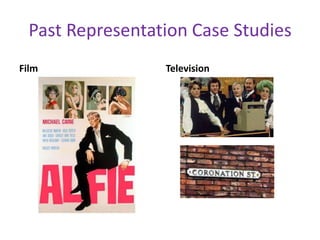
Past Representation Case StudiesFilm Television
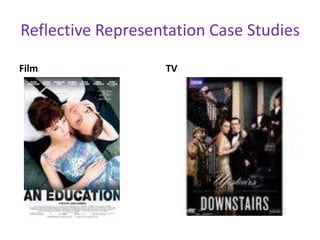
Reflective Representation Case StudiesFilm	TV
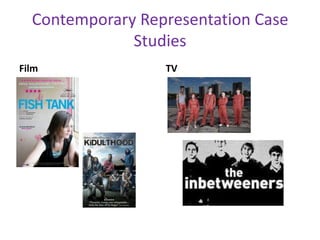
Contemporary Representation Case StudiesFilmTV
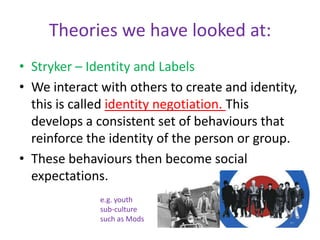
Theories we have looked at:Stryker – Identity and LabelsWe interact with others to create and identity, this is called identity negotiation. This develops a consistent set of behaviours that reinforce the identity of the person or group.These behaviours then become social expectations.e.g. youth sub-culture such as Mods
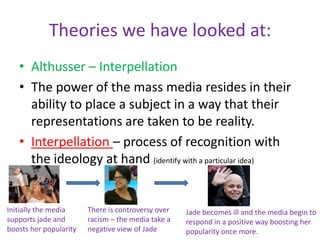
Theories we have looked at:Althusser – InterpellationThe power of the mass media resides in their ability to place a subject in a way that their representations are taken to be reality.Interpellation – process of recognition with the ideology at hand (identify with a particular idea)Initially the media supports jade and boosts her popularityThere is controversy over racism – the media take a negative view of JadeJade becomes ill and the media begin to respond in a positive way boosting her popularity once more.
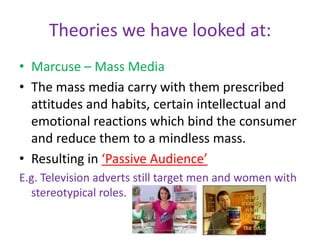
Theories we have looked at:Marcuse – Mass MediaThe mass media carry with them prescribed attitudes and habits, certain intellectual and emotional reactions which bind the consumer and reduce them to a mindless mass.Resulting in ‘Passive Audience’E.g. Television adverts still target men and women with stereotypical roles.
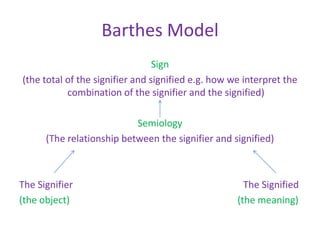
Theories we have looked at:Roland Barthes – SemiologyHe said “If narratives are episodic this helps our reading. A chain of cause and effect is expected and the audience look for signs to help them interpret the narrative….these deeply rooted signs are based on expectations the audience has due to their prior knowledge of old tales or myths”Here is his method of interpretation……
Barthes ModelSign(the total of the signifier and signified e.g. how we interpret the combination of the signifier and the signified)Semiology(The relationship between the signifier and signified)The Signifier						The Signified(the object)					           (the meaning)
Example Questions1. To what extent do you think that contemporary representations of a particular social group mirror current social attitudes towards that group?2. How does the contemporary representation of a particular social group compare to representations from the past?These questions both focus on the contemporary so you should draw mainly on examples from your contemporary case studies and then contrast and compare with your other case studies.

Media and collective identity revision

  • 1.
    Media and CollectiveIdentityRevision
  • 2.
    ExamChoice of 2questionsWrite for one hourRefer to two medias (TV and Film)Apply relevant theoryAnalyse key scenesRefer to past, present and futureUse the T- terminology E- example A- analysis structure.
  • 3.
    StructureIntroduction – tellthe examiner which Media areas you are looking at and that you have studied Britishness. Relate to the question straight away!Main – For each Paragraph 1. Form an argument by analysing a key scene 2. Is your argument support or contrasted by a theory? 3. Link what you are saying to the question 4. Then move on to a different case study – does this further reinforce you argument or contrast it. Conclusion – Summarise your points, this should be your voice (e.g. do you agree or disagree with the question and theories?) This should be an overall response concluded from your interpretation of all case studies.
  • 4.
    Social GroupsRemember youcan focus on Britishness as a whole or you could focus on a particular social group:British youthBritish genderBritish classBritish familyAs long as you have key scenes to support your points from each text.
  • 5.
    Past Representation CaseStudiesFilm Television
  • 6.
  • 7.
  • 8.
    Theories we havelooked at:Stryker – Identity and LabelsWe interact with others to create and identity, this is called identity negotiation. This develops a consistent set of behaviours that reinforce the identity of the person or group.These behaviours then become social expectations.e.g. youth sub-culture such as Mods
  • 9.
    Theories we havelooked at:Althusser – InterpellationThe power of the mass media resides in their ability to place a subject in a way that their representations are taken to be reality.Interpellation – process of recognition with the ideology at hand (identify with a particular idea)Initially the media supports jade and boosts her popularityThere is controversy over racism – the media take a negative view of JadeJade becomes ill and the media begin to respond in a positive way boosting her popularity once more.
  • 10.
    Theories we havelooked at:Marcuse – Mass MediaThe mass media carry with them prescribed attitudes and habits, certain intellectual and emotional reactions which bind the consumer and reduce them to a mindless mass.Resulting in ‘Passive Audience’E.g. Television adverts still target men and women with stereotypical roles.
  • 11.
    Theories we havelooked at:Roland Barthes – SemiologyHe said “If narratives are episodic this helps our reading. A chain of cause and effect is expected and the audience look for signs to help them interpret the narrative….these deeply rooted signs are based on expectations the audience has due to their prior knowledge of old tales or myths”Here is his method of interpretation……
  • 12.
    Barthes ModelSign(the totalof the signifier and signified e.g. how we interpret the combination of the signifier and the signified)Semiology(The relationship between the signifier and signified)The Signifier The Signified(the object) (the meaning)
  • 13.
    Example Questions1. Towhat extent do you think that contemporary representations of a particular social group mirror current social attitudes towards that group?2. How does the contemporary representation of a particular social group compare to representations from the past?These questions both focus on the contemporary so you should draw mainly on examples from your contemporary case studies and then contrast and compare with your other case studies.