Attribute-Based
Encryption
Prof	Bill	Buchanan,	The	Cyber	Academy	
http://asecuritysite.com
Access Control
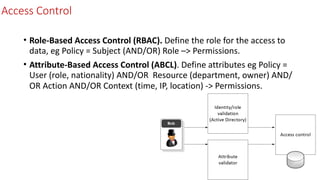
• Role-Based	Access	Control	(RBAC).	Define	the	role	for	the	access	to	
data,	eg	Policy	=	Subject	(AND/OR)	Role	–>	Permissions.	
• Attribute-Based	Access	Control	(ABCL).	Define	attributes	eg	Policy	=	
User	(role,	nationality)	AND/OR		Resource	(department,	owner)	AND/
OR	Action	AND/OR	Context	(time,	IP,	location)	->	Permissions.
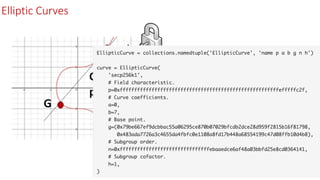
Elliptic Curves
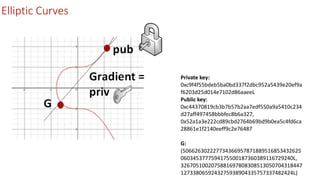
Private	key:	
0xc9f4f55bdeb5ba0bd337f2dbc952a5439e20ef9a
f6203d25d014e7102d86aaeeL	
Public	key:	
0xc44370819cb3b7b57b2aa7edf550a9a5410c234
d27aff497458bbbfec8b6a327,	
0x52a1a3e222cd89cbd2764b69bd9b0ea5c4fd6ca
28861e1f2140eeff9c2e76487	
G:	
(506626302227734366957871889516853432625
0603453777594175500187360389116729240L,	
3267051002075881697808308513050704318447
1273380659243275938904335757337482424L)
Elliptic Curves
Private	key:	
0xc9f4f55bdeb5ba0bd337f2dbc952a5439e20ef9a
f6203d25d014e7102d86aaeeL	
Public	key:	
0xc44370819cb3b7b57b2aa7edf550a9a5410c234
d27aff497458bbbfec8b6a327,	
0x52a1a3e222cd89cbd2764b69bd9b0ea5c4fd6ca
28861e1f2140eeff9c2e76487	
G:	
(506626302227734366957871889516853432625
0603453777594175500187360389116729240L,	
3267051002075881697808308513050704318447
1273380659243275938904335757337482424L)
Finite Fields with Prime
• A:		0	
• B:		7	
• Prime	number:	 	 38047	
• Elliptic	curve	is:	 	 y2=x3+	7	
• Finding	the	first	20	points	
• (83,	33)	(180,	104)	(296,	156)	(491,	81)	(896,	
81)	(905,	155)	(1307,	86)	(1563,	41)	(1570,	
136)	(1857,	56)	(1904,	25)	(2004,	119)	
(2011,	170)	(2209,	75)	(2219,	90)	(2447,	51)	
(2767,	40)	(2843,	170)	(3138,	29)	(3485,	33)	
(3713,	109)	
• [Link]
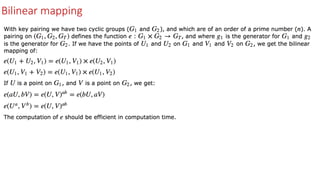
Bilinear mapping
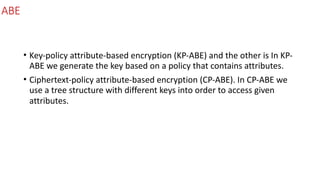
ABE
• Key-policy	attribute-based	encryption	(KP-ABE)	and	the	other	is	In	KP-
ABE	we	generate	the	key	based	on	a	policy	that	contains	attributes.		
• Ciphertext-policy	attribute-based	encryption	(CP-ABE).	In	CP-ABE	we	
use	a	tree	structure	with	different	keys	into	order	to	access	given	
attributes.
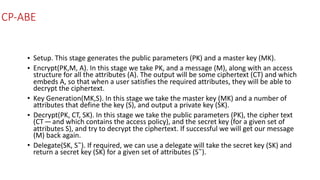
CP-ABE
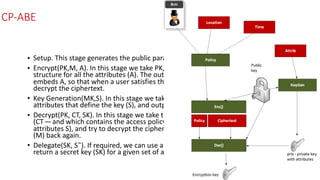
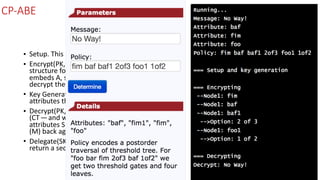
• Setup.	This	stage	generates	the	public	parameters	(PK)	and	a	master	key	(MK).	
• Encrypt(PK,M,	A).	In	this	stage	we	take	PK,	and	a	message	(M),	along	with	an	access	
structure	for	all	the	attributes	(A).	The	output	will	be	some	ciphertext	(CT)	and	which	
embeds	A,	so	that	when	a	user	satisfies	the	required	attributes,	they	will	be	able	to	
decrypt	the	ciphertext.	
• Key	Generation(MK,S).	In	this	stage	we	take	the	master	key	(MK)	and	a	number	of	
attributes	that	define	the	key	(S),	and	output	a	private	key	(SK).	
• Decrypt(PK,	CT,	SK).	In	this	stage	we	take	the	public	parameters	(PK),	the	cipher	text	
(CT — and	which	contains	the	access	policy),	and	the	secret	key	(for	a	given	set	of	
attributes	S),	and	try	to	decrypt	the	ciphertext.	If	successful	we	will	get	our	message	
(M)	back	again.	
• Delegate(SK,	S˜).	If	required,	we	can	use	a	delegate	will	take	the	secret	key	(SK)	and	
return	a	secret	key	(SK)	for	a	given	set	of	attributes	(SËś).
CP-ABE
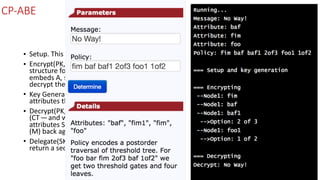
• Setup.	This	stage	generates	the	public	parameters	(PK)	and	a	master	key	(MK).	
• Encrypt(PK,M,	A).	In	this	stage	we	take	PK,	and	a	message	(M),	along	with	an	access	
structure	for	all	the	attributes	(A).	The	output	will	be	some	ciphertext	(CT)	and	which	
embeds	A,	so	that	when	a	user	satisfies	the	required	attributes,	they	will	be	able	to	
decrypt	the	ciphertext.	
• Key	Generation(MK,S).	In	this	stage	we	take	the	master	key	(MK)	and	a	number	of	
attributes	that	define	the	key	(S),	and	output	a	private	key	(SK).	
• Decrypt(PK,	CT,	SK).	In	this	stage	we	take	the	public	parameters	(PK),	the	cipher	text	
(CT — and	which	contains	the	access	policy),	and	the	secret	key	(for	a	given	set	of	
attributes	S),	and	try	to	decrypt	the	ciphertext.	If	successful	we	will	get	our	message	
(M)	back	again.	
• Delegate(SK,	S˜).	If	required,	we	can	use	a	delegate	will	take	the	secret	key	(SK)	and	
return	a	secret	key	(SK)	for	a	given	set	of	attributes	(SËś).
CP-ABE
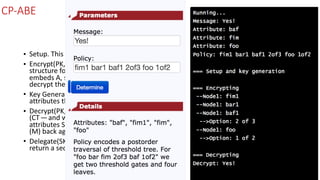
• Setup.	This	stage	generates	the	public	parameters	(PK)	and	a	master	key	(MK).	
• Encrypt(PK,M,	A).	In	this	stage	we	take	PK,	and	a	message	(M),	along	with	an	access	
structure	for	all	the	attributes	(A).	The	output	will	be	some	ciphertext	(CT)	and	which	
embeds	A,	so	that	when	a	user	satisfies	the	required	attributes,	they	will	be	able	to	
decrypt	the	ciphertext.	
• Key	Generation(MK,S).	In	this	stage	we	take	the	master	key	(MK)	and	a	number	of	
attributes	that	define	the	key	(S),	and	output	a	private	key	(SK).	
• Decrypt(PK,	CT,	SK).	In	this	stage	we	take	the	public	parameters	(PK),	the	cipher	text	
(CT — and	which	contains	the	access	policy),	and	the	secret	key	(for	a	given	set	of	
attributes	S),	and	try	to	decrypt	the	ciphertext.	If	successful	we	will	get	our	message	
(M)	back	again.	
• Delegate(SK,	S˜).	If	required,	we	can	use	a	delegate	will	take	the	secret	key	(SK)	and	
return	a	secret	key	(SK)	for	a	given	set	of	attributes	(SËś).
CP-ABE
• Setup.	This	stage	generates	the	public	parameters	(PK)	and	a	master	key	(MK).	
• Encrypt(PK,M,	A).	In	this	stage	we	take	PK,	and	a	message	(M),	along	with	an	access	
structure	for	all	the	attributes	(A).	The	output	will	be	some	ciphertext	(CT)	and	which	
embeds	A,	so	that	when	a	user	satisfies	the	required	attributes,	they	will	be	able	to	
decrypt	the	ciphertext.	
• Key	Generation(MK,S).	In	this	stage	we	take	the	master	key	(MK)	and	a	number	of	
attributes	that	define	the	key	(S),	and	output	a	private	key	(SK).	
• Decrypt(PK,	CT,	SK).	In	this	stage	we	take	the	public	parameters	(PK),	the	cipher	text	
(CT — and	which	contains	the	access	policy),	and	the	secret	key	(for	a	given	set	of	
attributes	S),	and	try	to	decrypt	the	ciphertext.	If	successful	we	will	get	our	message	
(M)	back	again.	
• Delegate(SK,	S˜).	If	required,	we	can	use	a	delegate	will	take	the	secret	key	(SK)	and	
return	a	secret	key	(SK)	for	a	given	set	of	attributes	(SËś).
CP-ABE
• Setup.	This	stage	generates	the	public	parameters	(PK)	and	a	master	key	(MK).	
• Encrypt(PK,M,	A).	In	this	stage	we	take	PK,	and	a	message	(M),	along	with	an	access	
structure	for	all	the	attributes	(A).	The	output	will	be	some	ciphertext	(CT)	and	which	
embeds	A,	so	that	when	a	user	satisfies	the	required	attributes,	they	will	be	able	to	
decrypt	the	ciphertext.	
• Key	Generation(MK,S).	In	this	stage	we	take	the	master	key	(MK)	and	a	number	of	
attributes	that	define	the	key	(S),	and	output	a	private	key	(SK).	
• Decrypt(PK,	CT,	SK).	In	this	stage	we	take	the	public	parameters	(PK),	the	cipher	text	
(CT — and	which	contains	the	access	policy),	and	the	secret	key	(for	a	given	set	of	
attributes	S),	and	try	to	decrypt	the	ciphertext.	If	successful	we	will	get	our	message	
(M)	back	again.	
• Delegate(SK,	S˜).	If	required,	we	can	use	a	delegate	will	take	the	secret	key	(SK)	and	
return	a	secret	key	(SK)	for	a	given	set	of	attributes	(SËś).
CP-ABE
• Setup.	This	stage	generates	the	public	parameters	(PK)	and	a	master	key	(MK).	
• Encrypt(PK,M,	A).	In	this	stage	we	take	PK,	and	a	message	(M),	along	with	an	access	
structure	for	all	the	attributes	(A).	The	output	will	be	some	ciphertext	(CT)	and	which	
embeds	A,	so	that	when	a	user	satisfies	the	required	attributes,	they	will	be	able	to	
decrypt	the	ciphertext.	
• Key	Generation(MK,S).	In	this	stage	we	take	the	master	key	(MK)	and	a	number	of	
attributes	that	define	the	key	(S),	and	output	a	private	key	(SK).	
• Decrypt(PK,	CT,	SK).	In	this	stage	we	take	the	public	parameters	(PK),	the	cipher	text	
(CT — and	which	contains	the	access	policy),	and	the	secret	key	(for	a	given	set	of	
attributes	S),	and	try	to	decrypt	the	ciphertext.	If	successful	we	will	get	our	message	
(M)	back	again.	
• Delegate(SK,	S˜).	If	required,	we	can	use	a	delegate	will	take	the	secret	key	(SK)	and	
return	a	secret	key	(SK)	for	a	given	set	of	attributes	(SËś).
CP-ABE
• Setup.	This	stage	generates	the	public	parameters	(PK)	and	a	master	key	(MK).	
• Encrypt(PK,M,	A).	In	this	stage	we	take	PK,	and	a	message	(M),	along	with	an	access	
structure	for	all	the	attributes	(A).	The	output	will	be	some	ciphertext	(CT)	and	which	
embeds	A,	so	that	when	a	user	satisfies	the	required	attributes,	they	will	be	able	to	
decrypt	the	ciphertext.	
• Key	Generation(MK,S).	In	this	stage	we	take	the	master	key	(MK)	and	a	number	of	
attributes	that	define	the	key	(S),	and	output	a	private	key	(SK).	
• Decrypt(PK,	CT,	SK).	In	this	stage	we	take	the	public	parameters	(PK),	the	cipher	text	
(CT — and	which	contains	the	access	policy),	and	the	secret	key	(for	a	given	set	of	
attributes	S),	and	try	to	decrypt	the	ciphertext.	If	successful	we	will	get	our	message	
(M)	back	again.	
• Delegate(SK,	S˜).	If	required,	we	can	use	a	delegate	will	take	the	secret	key	(SK)	and	
return	a	secret	key	(SK)	for	a	given	set	of	attributes	(SËś).
CP-ABE
• Setup.	This	stage	generates	the	public	parameters	(PK)	and	a	master	key	(MK).	
• Encrypt(PK,M,	A).	In	this	stage	we	take	PK,	and	a	message	(M),	along	with	an	access	
structure	for	all	the	attributes	(A).	The	output	will	be	some	ciphertext	(CT)	and	which	
embeds	A,	so	that	when	a	user	satisfies	the	required	attributes,	they	will	be	able	to	
decrypt	the	ciphertext.	
• Key	Generation(MK,S).	In	this	stage	we	take	the	master	key	(MK)	and	a	number	of	
attributes	that	define	the	key	(S),	and	output	a	private	key	(SK).	
• Decrypt(PK,	CT,	SK).	In	this	stage	we	take	the	public	parameters	(PK),	the	cipher	text	
(CT — and	which	contains	the	access	policy),	and	the	secret	key	(for	a	given	set	of	
attributes	S),	and	try	to	decrypt	the	ciphertext.	If	successful	we	will	get	our	message	
(M)	back	again.	
• Delegate(SK,	S˜).	If	required,	we	can	use	a	delegate	will	take	the	secret	key	(SK)	and	
return	a	secret	key	(SK)	for	a	given	set	of	attributes	(SËś).
Attribute-Based
Encryption
Prof	Bill	Buchanan,	The	Cyber	Academy	
http://asecuritysite.com

Attribute Based Encryption