Defence Systems,
Policies and Risks
“From bits to information”
Outline
• Data, Information, Knowledge and Wisdom.
• Information Security and Forensic Computing.
• Impact and Harm.
• Risks, Costs and Benefits.
• Kill Chain Models.
• Defence Mechanisms.
• Defence-in-Depth.
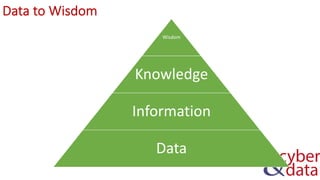
Data to Wisdom
Wisdom
Knowledge
Information
Data
Security, Incident
Response and
Forensic
Computing
“From bits to information”
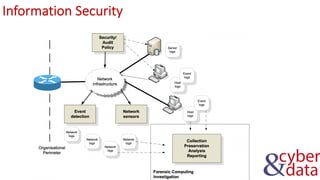
Information Security
Investigation
• Investigating an intrusion on a system (incident response). This might lead
to a criminal prosecution, but most of the time the intrusion is investigated
in order to be able to detect it in the future, and to thwart the activities at
an early stage.
• Investigation of a criminal activity (forensic computing). This might lead to
a criminal prosecution, or to thwart the activities in the future.
• Investigation of a breach of security policy. This might lead to a disciplinary
procedure within an organisation.
Due Care and Due Diligence
• With due care, the organisation must make sure that it has taken the correct
steps in the creation and implementation of its security policy and in its risk
analysis.
• Then due diligence relates to the actual operation and maintenance of its security
system, especially around vulnerability testing. Thus a company might take due
care in analysing and designing their security policy, but not take due diligence in
actually proving that it works. It can work the other way, in that a policy might be
implemented with due diligence, but the originally creation of the policy has not
been properly analysed/designed. It is thus important, in terms of any future
liability, that security systems are designed, analysed, implemented and
maintained with both due care and due diligence.
Impact and Harm
“From bits to information”
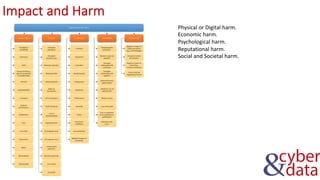
Impact and Harm
Physical or Digital harm.
Economic harm.
Psychological harm.
Reputational harm.
Social and Societal harm.
Risks, Costs and
Benefits
“From bits to information”
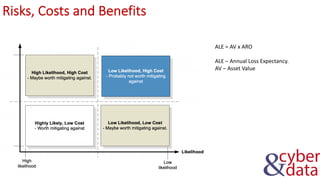
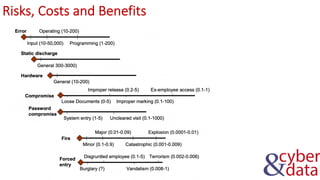
Risks, Costs and Benefits
ALE = AV x ARO
ALE – Annual Loss Expectancy.
AV – Asset Value
Risks, Costs and Benefits
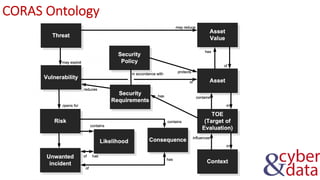
CORAS Ontology
CORAS Risk Management
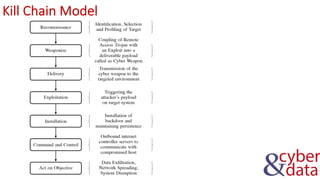
Kill Chain Model
“From bits to information”
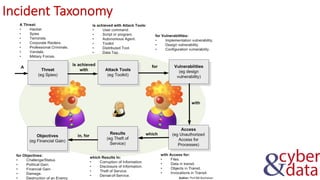
Incident Taxonomy
Kill Chain Model
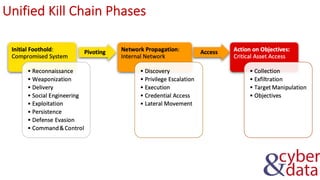
Unified Kill Chain Phases
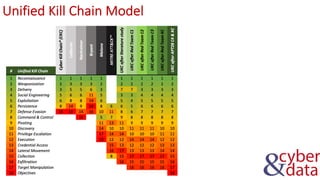
Unified Kill Chain Model
Defence
Mechanisms
“From bits to information”
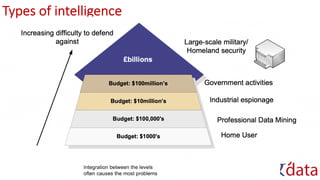
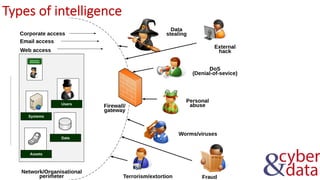
Types of intelligence
• begin{itemize}
• item Deter. This is where the system is designed and implemented in order to initially deter intruders from attacking the system in the first place.
• item Log. This is a key element in modern systems which requires some form of logging system. It is important that the data that is logged does not
breach any civil liberties, and is in a form which can be used to enhance the future security of the system.
• item Detect. This is where detection agents are placed within the network to detect intrusions, and has methods of tracing the events that occurred
in an intrusion, so that it can be used either in a forensic computing investigation, and/or to overcome a future intrusion. Organisations often have
many reasons for detecting network traffic.
• item Protect. This is where policies are created which protect systems, users and data against attack, and in reducing this potential damage. A key
element of this is to protect them against accidental damage, as accidental damage is often more prevalent than non-accidental damage.
• item React. This is where a policy is defined which reacts to intrusions, and defines ways to overcome them in the future. Often organisations do not
have formal policies for this type of activity, and often rely on ad-hoc arrangements, where the method of reacting to a security breach is created
after the event.
• item Recover. This is where policies are defined to overcome any system damage, whether it is actual physical damage, the abuse of users; or the
damage to data.
• item Audit/verify. It is important that the security policy allows for auditing and for the verification that it achieves its requirements.
• end{itemize}
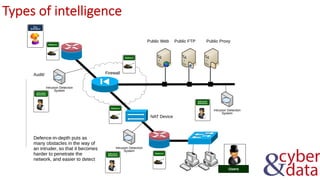
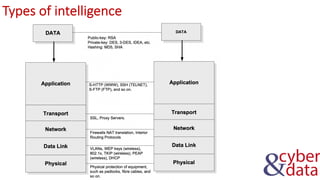
Defence in Depth
“From bits to information”
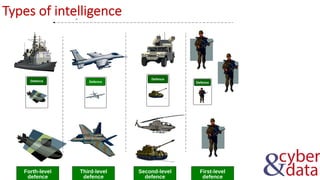
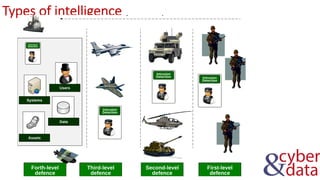
Types of intelligence
Defence Systems,
Policies and Risks
“From bits to information”

2. Defence Systems

  • 1.
    Defence Systems, Policies andRisks “From bits to information”
  • 2.
    Outline • Data, Information,Knowledge and Wisdom. • Information Security and Forensic Computing. • Impact and Harm. • Risks, Costs and Benefits. • Kill Chain Models. • Defence Mechanisms. • Defence-in-Depth.
  • 3.
  • 4.
  • 5.
  • 6.
    Investigation • Investigating anintrusion on a system (incident response). This might lead to a criminal prosecution, but most of the time the intrusion is investigated in order to be able to detect it in the future, and to thwart the activities at an early stage. • Investigation of a criminal activity (forensic computing). This might lead to a criminal prosecution, or to thwart the activities in the future. • Investigation of a breach of security policy. This might lead to a disciplinary procedure within an organisation.
  • 7.
    Due Care andDue Diligence • With due care, the organisation must make sure that it has taken the correct steps in the creation and implementation of its security policy and in its risk analysis. • Then due diligence relates to the actual operation and maintenance of its security system, especially around vulnerability testing. Thus a company might take due care in analysing and designing their security policy, but not take due diligence in actually proving that it works. It can work the other way, in that a policy might be implemented with due diligence, but the originally creation of the policy has not been properly analysed/designed. It is thus important, in terms of any future liability, that security systems are designed, analysed, implemented and maintained with both due care and due diligence.
  • 8.
    Impact and Harm “Frombits to information”
  • 9.
    Impact and Harm Physicalor Digital harm. Economic harm. Psychological harm. Reputational harm. Social and Societal harm.
  • 10.
    Risks, Costs and Benefits “Frombits to information”
  • 11.
    Risks, Costs andBenefits ALE = AV x ARO ALE – Annual Loss Expectancy. AV – Asset Value
  • 12.
  • 13.
  • 14.
  • 15.
    Kill Chain Model “Frombits to information”
  • 16.
  • 17.
  • 18.
  • 19.
  • 20.
  • 21.
    Types of intelligence •begin{itemize} • item Deter. This is where the system is designed and implemented in order to initially deter intruders from attacking the system in the first place. • item Log. This is a key element in modern systems which requires some form of logging system. It is important that the data that is logged does not breach any civil liberties, and is in a form which can be used to enhance the future security of the system. • item Detect. This is where detection agents are placed within the network to detect intrusions, and has methods of tracing the events that occurred in an intrusion, so that it can be used either in a forensic computing investigation, and/or to overcome a future intrusion. Organisations often have many reasons for detecting network traffic. • item Protect. This is where policies are created which protect systems, users and data against attack, and in reducing this potential damage. A key element of this is to protect them against accidental damage, as accidental damage is often more prevalent than non-accidental damage. • item React. This is where a policy is defined which reacts to intrusions, and defines ways to overcome them in the future. Often organisations do not have formal policies for this type of activity, and often rely on ad-hoc arrangements, where the method of reacting to a security breach is created after the event. • item Recover. This is where policies are defined to overcome any system damage, whether it is actual physical damage, the abuse of users; or the damage to data. • item Audit/verify. It is important that the security policy allows for auditing and for the verification that it achieves its requirements. • end{itemize}
  • 22.
    Defence in Depth “Frombits to information”
  • 23.
  • 24.
  • 25.
  • 26.
  • 27.
  • 28.
    Defence Systems, Policies andRisks “From bits to information”