
5th Annual HTCIA Asia Pacific Conference
                                               7th December, 2011 @ Hong Kong


Enterprises’ Dilemma

INCIDENT RESPONSE TRIAGE


Albert Hui, GREM, GCFA, GCFE, GCIA, GCIH, GAWN, GSNA, CISA
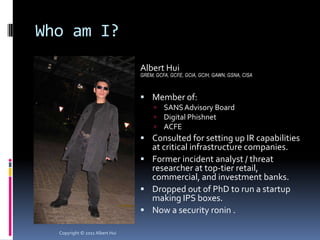
Who am I?
                                Albert Hui
                                GREM, GCFA, GCFE, GCIA, GCIH, GAWN, GSNA, CISA


                                 Member of:
                                        SANS Advisory Board
                                        Digital Phishnet
                                        ACFE
                                 Consulted for setting up IR capabilities
                                  at critical infrastructure companies.
                                 Former incident analyst / threat
                                  researcher at top-tier retail,
                                  commercial, and investment banks.
                                 Dropped out of PhD to run a startup
                                  making IPS boxes.
                                 Now a security ronin .

  Copyright © 2011 Albert Hui
Agenda

 The Context: IR process and Triage.
 Incident Verification: A Systematic Approach.
 Severity Assessment: A Potentiality Model.


   Copyright © 2011 Albert Hui
Enterprises’ Dilemma

 Huge Volume
 Influx of Incidents
 Time Critical
 Horizontal vs. Vertical

 Triage!


    Copyright © 2011 Albert Hui
Forensics vs. Incident Response


                Copyright © 2011 Albert Hui
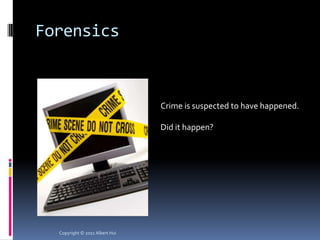
Forensics


                                Crime is suspected to have happened.

                                Did it happen?


  Copyright © 2011 Albert Hui
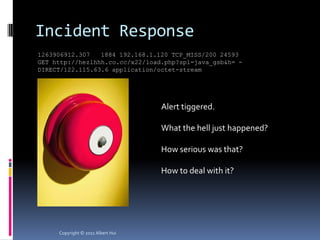
Incident Response
1263906912.307   1884 192.168.1.120 TCP_MISS/200 24593
GET http://hezlhhh.co.cc/x22/load.php?spl=java_gsb&h= -
DIRECT/122.115.63.6 application/octet-stream


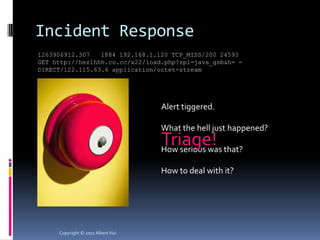
                                   Alert tiggered.

                                   What the hell just happened?

                                   How serious was that?

                                   How to deal with it?


     Copyright © 2011 Albert Hui
Incident Response
1263906912.307   1884 192.168.1.120 TCP_MISS/200 24593
GET http://hezlhhh.co.cc/x22/load.php?spl=java_gsb&h= -
DIRECT/122.115.63.6 application/octet-stream


                                   Alert tiggered.

                                   What the hell just happened?
                                   Triage! that?
                                   How serious was

                                   How to deal with it?


     Copyright © 2011 Albert Hui
Copyright © 2011 Albert Hui
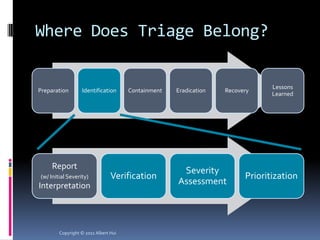
Where Does Triage Belong?

                                                                               Lessons
Preparation       Identification      Containment   Eradication   Recovery
                                                                               Learned


     Report
                                                     Severity
(w/ Initial Severity)           Verification                            Prioritization
Interpretation                                      Assessment


        Copyright © 2011 Albert Hui
Triage Stages

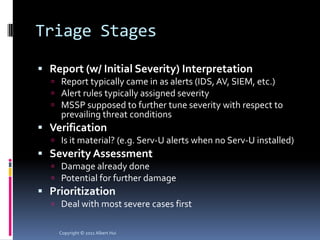
 Report (w/ Initial Severity) Interpretation
   Report typically came in as alerts (IDS, AV, SIEM, etc.)
   Alert rules typically assigned severity
   MSSP supposed to further tune severity with respect to
    prevailing threat conditions
 Verification
   Is it material? (e.g. Serv-U alerts when no Serv-U installed)
 Severity Assessment
   Damage already done
   Potential for further damage
 Prioritization
   Deal with most severe cases first


    Copyright © 2011 Albert Hui
Verification


               Copyright © 2011 Albert Hui
What Tools Do We Need?
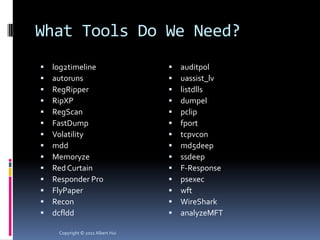
   log2timeline                      auditpol
   autoruns                          uassist_lv
   RegRipper                         listdlls
   RipXP                             dumpel
   RegScan                           pclip
   FastDump                          fport
   Volatility                        tcpvcon
   mdd                               md5deep
   Memoryze                          ssdeep
   Red Curtain                       F-Response
   Responder Pro                     psexec
   FlyPaper                          wft
   Recon                             WireShark
   dcfldd                            analyzeMFT

     Copyright © 2011 Albert Hui
What Tools Do We Need?


                                If you got a hammer,
                                everything looks like a
                                nail.


  Copyright © 2011 Albert Hui
Right Questions

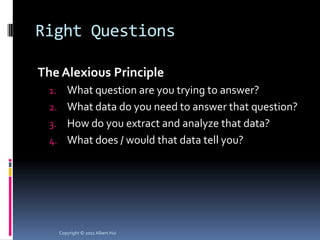
The Alexious Principle
  1. What question are you trying to answer?
  2. What data do you need to answer that question?
  3. How do you extract and analyze that data?
  4. What does / would that data tell you?


       Copyright © 2011 Albert Hui
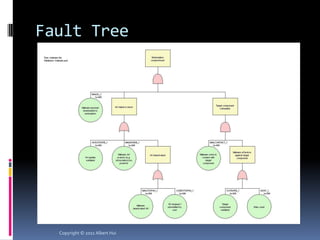
Fault Tree


  Copyright © 2011 Albert Hui
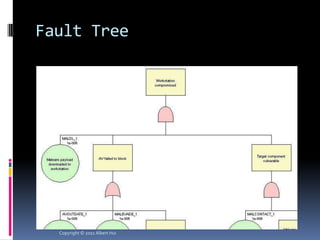
Fault Tree


  Copyright © 2011 Albert Hui
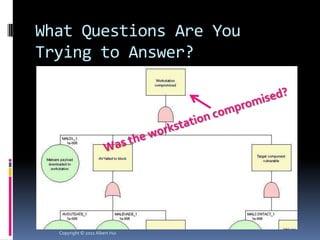
What Questions Are You
Trying to Answer?


  Copyright © 2011 Albert Hui
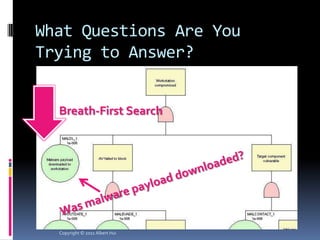
What Questions Are You
Trying to Answer?


  Breath-First Search


  Copyright © 2011 Albert Hui
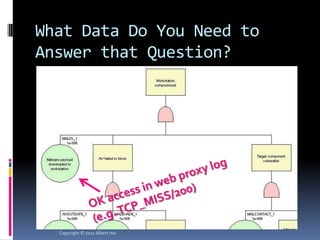
What Data Do You Need to
Answer that Question?


  Copyright © 2011 Albert Hui
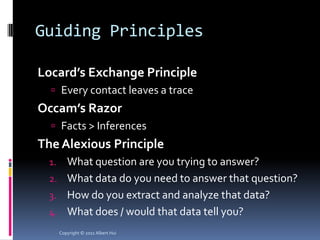
Guiding Principles

Locard’s Exchange Principle
   Every contact leaves a trace
Occam’s Razor
   Facts > Inferences
The Alexious Principle
  1. What question are you trying to answer?
  2. What data do you need to answer that question?
  3. How do you extract and analyze that data?
  4. What does / would that data tell you?
       Copyright © 2011 Albert Hui
Severity Assessment
And Prioritization


                     Copyright © 2011 Albert Hui
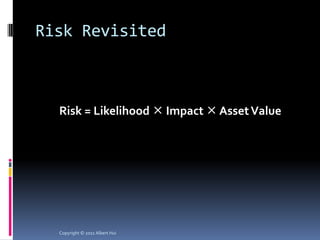
Risk Revisited


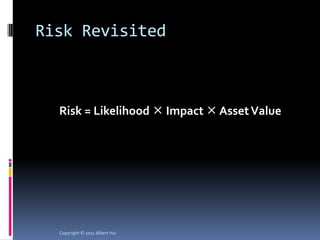
  Risk = Likelihood  Impact  Asset Value


  Copyright © 2011 Albert Hui
Risk Revisited


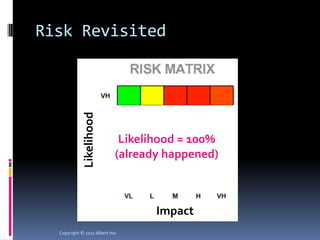
             Likelihood


                             Likelihood = 100%
                            (already happened)


                                   Impact
  Copyright © 2011 Albert Hui
Risk Revisited


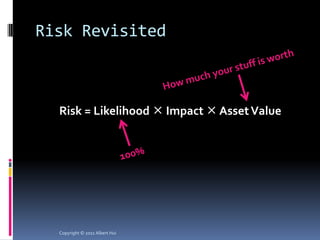
  Risk = Likelihood  Impact  Asset Value


  Copyright © 2011 Albert Hui
Risk Revisited


  Risk = Likelihood  Impact  Asset Value


  Copyright © 2011 Albert Hui
Risk Revisited


  Risk = Likelihood  Impact  Asset Value


  Copyright © 2011 Albert Hui
Risk Revisited


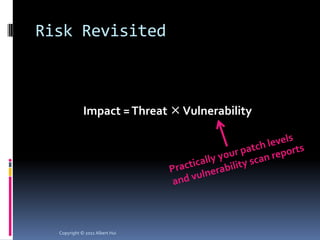
             Impact = Threat  Vulnerability


  Copyright © 2011 Albert Hui
Risk Revisited


             Impact = Threat  Vulnerability


  Copyright © 2011 Albert Hui
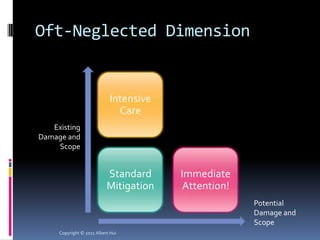
Oft-Neglected Dimension


                            Intensive
                              Care
   Existing
Damage and
    Scope


                           Standard     Immediate
                           Mitigation   Attention!
                                                     Potential
                                                     Damage and
                                                     Scope
     Copyright © 2011 Albert Hui
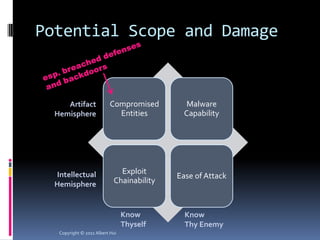
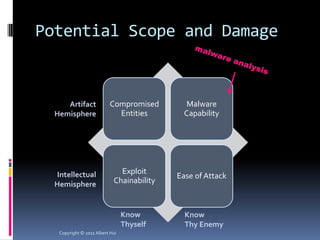
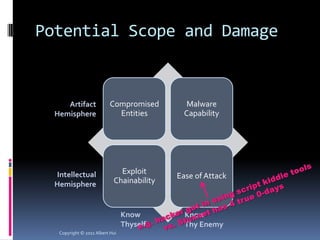
Potential Scope and Damage


     Artifact             Compromised         Malware
  Hemisphere                Entities         Capability


  Intellectual                Exploit
                                           Ease of Attack
  Hemisphere                Chainability


                                 Know        Know
                                 Thyself     Thy Enemy
   Copyright © 2011 Albert Hui
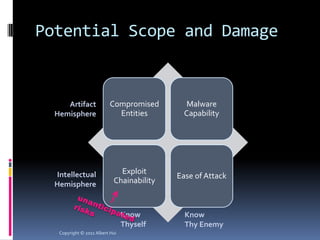
Potential Scope and Damage


     Artifact             Compromised         Malware
  Hemisphere                Entities         Capability


  Intellectual                Exploit
                                           Ease of Attack
  Hemisphere                Chainability


                                 Know        Know
                                 Thyself     Thy Enemy
   Copyright © 2011 Albert Hui
Potential Scope and Damage


     Artifact             Compromised         Malware
  Hemisphere                Entities         Capability


  Intellectual                Exploit
                                           Ease of Attack
  Hemisphere                Chainability


                                 Know        Know
                                 Thyself     Thy Enemy
   Copyright © 2011 Albert Hui
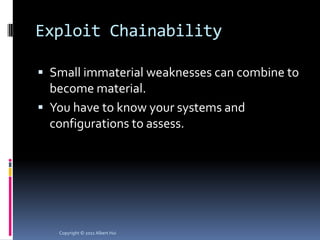
Exploit Chainability

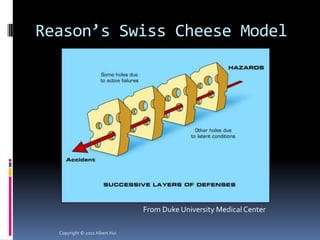
 Small immaterial weaknesses can combine to
  become material.
 You have to know your systems and
  configurations to assess.


   Copyright © 2011 Albert Hui
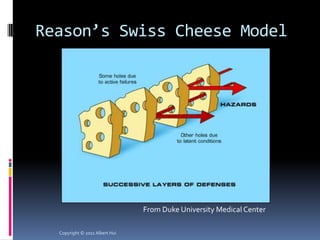
Reason’s Swiss Cheese Model


                                From Duke University Medical Center

  Copyright © 2011 Albert Hui
Reason’s Swiss Cheese Model


                                From Duke University Medical Center

  Copyright © 2011 Albert Hui
Potential Scope and Damage


     Artifact             Compromised         Malware
  Hemisphere                Entities         Capability


  Intellectual                Exploit
                                           Ease of Attack
  Hemisphere                Chainability


                                 Know        Know
                                 Thyself     Thy Enemy
   Copyright © 2011 Albert Hui
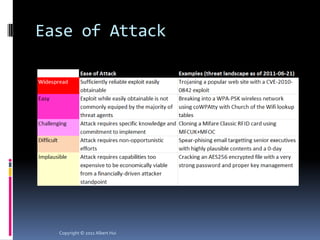
Ease of Attack


  Copyright © 2011 Albert Hui
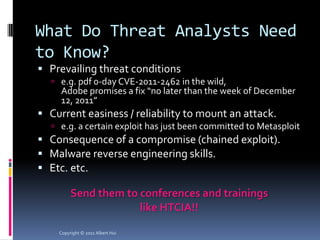
What Do Threat Analysts Need
to Know?
 Prevailing threat conditions
   e.g. pdf 0-day CVE-2011-2462 in the wild,
     Adobe promises a fix “no later than the week of December
     12, 2011”
 Current easiness / reliability to mount an attack.
   e.g. a certain exploit has just been committed to Metasploit
 Consequence of a compromise (chained exploit).
 Malware reverse engineering skills.
 Etc. etc.

         Send them to conferences and trainings
                      like HTCIA!!

    Copyright © 2011 Albert Hui
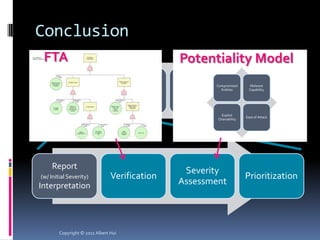
Conclusion
  FTA                                                Potentiality Model
                                                                  Compromised      Malware
                                                                                                  Lessons
Preparation       Identification      Containment   Eradication       Recovery Capability
                                                                    Entities
                                                                                                  Learned


                                                                    Exploit
                                                                                 Ease of Attack
                                                                  Chainability


     Report
                                                     Severity
(w/ Initial Severity)           Verification                                     Prioritization
Interpretation                                      Assessment


        Copyright © 2011 Albert Hui
Thank you!


                  albert@securityronin.com
  Copyright © 2011 Albert Hui

Incident Response Triage

  • 1.
    5th Annual HTCIAAsia Pacific Conference 7th December, 2011 @ Hong Kong Enterprises’ Dilemma INCIDENT RESPONSE TRIAGE Albert Hui, GREM, GCFA, GCFE, GCIA, GCIH, GAWN, GSNA, CISA
  • 2.
    Who am I? Albert Hui GREM, GCFA, GCFE, GCIA, GCIH, GAWN, GSNA, CISA  Member of:  SANS Advisory Board  Digital Phishnet  ACFE  Consulted for setting up IR capabilities at critical infrastructure companies.  Former incident analyst / threat researcher at top-tier retail, commercial, and investment banks.  Dropped out of PhD to run a startup making IPS boxes.  Now a security ronin . Copyright © 2011 Albert Hui
  • 3.
    Agenda  The Context:IR process and Triage.  Incident Verification: A Systematic Approach.  Severity Assessment: A Potentiality Model. Copyright © 2011 Albert Hui
  • 4.
    Enterprises’ Dilemma  HugeVolume  Influx of Incidents  Time Critical  Horizontal vs. Vertical  Triage! Copyright © 2011 Albert Hui
  • 5.
    Forensics vs. IncidentResponse Copyright © 2011 Albert Hui
  • 6.
    Forensics Crime is suspected to have happened. Did it happen? Copyright © 2011 Albert Hui
  • 7.
    Incident Response 1263906912.307 1884 192.168.1.120 TCP_MISS/200 24593 GET http://hezlhhh.co.cc/x22/load.php?spl=java_gsb&h= - DIRECT/122.115.63.6 application/octet-stream Alert tiggered. What the hell just happened? How serious was that? How to deal with it? Copyright © 2011 Albert Hui
  • 8.
    Incident Response 1263906912.307 1884 192.168.1.120 TCP_MISS/200 24593 GET http://hezlhhh.co.cc/x22/load.php?spl=java_gsb&h= - DIRECT/122.115.63.6 application/octet-stream Alert tiggered. What the hell just happened? Triage! that? How serious was How to deal with it? Copyright © 2011 Albert Hui
  • 9.
  • 10.
  • 11.
    Where Does TriageBelong? Lessons Preparation Identification Containment Eradication Recovery Learned Report Severity (w/ Initial Severity) Verification Prioritization Interpretation Assessment Copyright © 2011 Albert Hui
  • 12.
    Triage Stages  Report(w/ Initial Severity) Interpretation  Report typically came in as alerts (IDS, AV, SIEM, etc.)  Alert rules typically assigned severity  MSSP supposed to further tune severity with respect to prevailing threat conditions  Verification  Is it material? (e.g. Serv-U alerts when no Serv-U installed)  Severity Assessment  Damage already done  Potential for further damage  Prioritization  Deal with most severe cases first Copyright © 2011 Albert Hui
  • 13.
    Verification Copyright © 2011 Albert Hui
  • 14.
    What Tools DoWe Need?  log2timeline  auditpol  autoruns  uassist_lv  RegRipper  listdlls  RipXP  dumpel  RegScan  pclip  FastDump  fport  Volatility  tcpvcon  mdd  md5deep  Memoryze  ssdeep  Red Curtain  F-Response  Responder Pro  psexec  FlyPaper  wft  Recon  WireShark  dcfldd  analyzeMFT Copyright © 2011 Albert Hui
  • 15.
    What Tools DoWe Need? If you got a hammer, everything looks like a nail. Copyright © 2011 Albert Hui
  • 16.
    Right Questions The AlexiousPrinciple 1. What question are you trying to answer? 2. What data do you need to answer that question? 3. How do you extract and analyze that data? 4. What does / would that data tell you? Copyright © 2011 Albert Hui
  • 17.
    Fault Tree Copyright © 2011 Albert Hui
  • 18.
    Fault Tree Copyright © 2011 Albert Hui
  • 19.
    What Questions AreYou Trying to Answer? Copyright © 2011 Albert Hui
  • 20.
    What Questions AreYou Trying to Answer? Breath-First Search Copyright © 2011 Albert Hui
  • 21.
    What Data DoYou Need to Answer that Question? Copyright © 2011 Albert Hui
  • 22.
    Guiding Principles Locard’s ExchangePrinciple  Every contact leaves a trace Occam’s Razor  Facts > Inferences The Alexious Principle 1. What question are you trying to answer? 2. What data do you need to answer that question? 3. How do you extract and analyze that data? 4. What does / would that data tell you? Copyright © 2011 Albert Hui
  • 23.
    Severity Assessment And Prioritization Copyright © 2011 Albert Hui
  • 24.
    Risk Revisited Risk = Likelihood  Impact  Asset Value Copyright © 2011 Albert Hui
  • 25.
    Risk Revisited Likelihood Likelihood = 100% (already happened) Impact Copyright © 2011 Albert Hui
  • 26.
    Risk Revisited Risk = Likelihood  Impact  Asset Value Copyright © 2011 Albert Hui
  • 27.
    Risk Revisited Risk = Likelihood  Impact  Asset Value Copyright © 2011 Albert Hui
  • 28.
    Risk Revisited Risk = Likelihood  Impact  Asset Value Copyright © 2011 Albert Hui
  • 29.
    Risk Revisited Impact = Threat  Vulnerability Copyright © 2011 Albert Hui
  • 30.
    Risk Revisited Impact = Threat  Vulnerability Copyright © 2011 Albert Hui
  • 31.
    Oft-Neglected Dimension Intensive Care Existing Damage and Scope Standard Immediate Mitigation Attention! Potential Damage and Scope Copyright © 2011 Albert Hui
  • 32.
    Potential Scope andDamage Artifact Compromised Malware Hemisphere Entities Capability Intellectual Exploit Ease of Attack Hemisphere Chainability Know Know Thyself Thy Enemy Copyright © 2011 Albert Hui
  • 33.
    Potential Scope andDamage Artifact Compromised Malware Hemisphere Entities Capability Intellectual Exploit Ease of Attack Hemisphere Chainability Know Know Thyself Thy Enemy Copyright © 2011 Albert Hui
  • 34.
    Potential Scope andDamage Artifact Compromised Malware Hemisphere Entities Capability Intellectual Exploit Ease of Attack Hemisphere Chainability Know Know Thyself Thy Enemy Copyright © 2011 Albert Hui
  • 35.
    Exploit Chainability  Smallimmaterial weaknesses can combine to become material.  You have to know your systems and configurations to assess. Copyright © 2011 Albert Hui
  • 36.
    Reason’s Swiss CheeseModel From Duke University Medical Center Copyright © 2011 Albert Hui
  • 37.
    Reason’s Swiss CheeseModel From Duke University Medical Center Copyright © 2011 Albert Hui
  • 38.
    Potential Scope andDamage Artifact Compromised Malware Hemisphere Entities Capability Intellectual Exploit Ease of Attack Hemisphere Chainability Know Know Thyself Thy Enemy Copyright © 2011 Albert Hui
  • 39.
    Ease of Attack Copyright © 2011 Albert Hui
  • 40.
    What Do ThreatAnalysts Need to Know?  Prevailing threat conditions  e.g. pdf 0-day CVE-2011-2462 in the wild, Adobe promises a fix “no later than the week of December 12, 2011”  Current easiness / reliability to mount an attack.  e.g. a certain exploit has just been committed to Metasploit  Consequence of a compromise (chained exploit).  Malware reverse engineering skills.  Etc. etc. Send them to conferences and trainings like HTCIA!! Copyright © 2011 Albert Hui
  • 41.
    Conclusion FTA Potentiality Model Compromised Malware Lessons Preparation Identification Containment Eradication Recovery Capability Entities Learned Exploit Ease of Attack Chainability Report Severity (w/ Initial Severity) Verification Prioritization Interpretation Assessment Copyright © 2011 Albert Hui
  • 42.
    Thank you! albert@securityronin.com Copyright © 2011 Albert Hui