




CONSUMER
ATTITUDE
FORMATION
AND CHANGE
Jeri Oktari
WHAT ARE ATTITUDES?
In a consumer behaviour context, an attitude is a learned
predisposition to behave in a consistently favourable or
unfavourable way with respect to a given object.
Each part of this definition describes an important property of
an attitude and is critical to understanding the role of
attitudes in consumer behaviour.
THE ATTETION ‘Object’
The word object in our consumer-oriented definition of attitude should be
interpreted broadly to include specific consumption - or marketing-related
concepts, such as product, product category, brand, service, possessions,
product use, causes or issues, people, advertisement, Internet site, price,
medium or retailer.
Example:
If we were interested in learning consumers’ attitudes towards three major
brands of DVD players, our ‘object’ might include Sony, Toshiba and Panasonic;
if we were examining consumer attitudes towards major brands of mobile
phones, our ‘object’ might include Nokia, Sony Ericsson, Samsung and Motorola.
ATTITUDES ARE LEARNED
PREDISPOSITIONS
There is general agreement that attitudes are learned. This means that attitudes
relevant to purchase behaviour are formed as a result of direct experience with
the product, word-of-mouth information acquired from others, or exposure to
mass-media advertising, the Internet and various forms of direct marketing
(e.g. a retailer’s catalogue).
ATTITUDES HAVE
CONSISTENCY
Another characteristic of attitudes is that they are relatively consistent with
the behaviour they reflect. However, despite their consistency, attitudes are
not necessarily permanent; they do change.
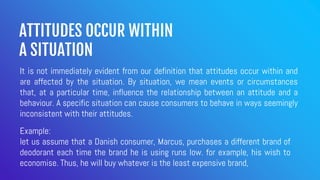
ATTITUDES OCCUR WITHIN
A SITUATION
It is not immediately evident from our definition that attitudes occur within and
are affected by the situation. By situation, we mean events or circumstances
that, at a particular time, influence the relationship between an attitude and a
behaviour. A specific situation can cause consumers to behave in ways seemingly
inconsistent with their attitudes.
Example:
let us assume that a Danish consumer, Marcus, purchases a different brand of
deodorant each time the brand he is using runs low. for example, his wish to
economise. Thus, he will buy whatever is the least expensive brand,
STRUCTURAL MODELS OF ATTITUDES
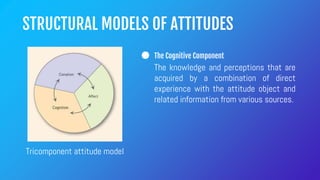
The Cognitive Component
The knowledge and perceptions that are
acquired by a combination of direct
experience with the attitude object and
related information from various sources.
Tricomponent attitude model
STRUCTURAL MODELS OF ATTITUDES
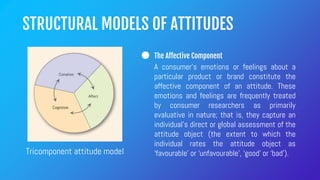
The Affective Component
A consumer’s emotions or feelings about a
particular product or brand constitute the
affective component of an attitude. These
emotions and feelings are frequently treated
by consumer researchers as primarily
evaluative in nature; that is, they capture an
individual’s direct or global assessment of the
attitude object (the extent to which the
individual rates the attitude object as
‘favourable’ or ‘unfavourable’, ‘good’ or ‘bad’).
Tricomponent attitude model
STRUCTURAL MODELS OF ATTITUDES
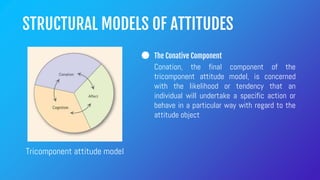
The Conative Component
Conation, the final component of the
tricomponent attitude model, is concerned
with the likelihood or tendency that an
individual will undertake a specific action or
behave in a particular way with regard to the
attitude object
Tricomponent attitude model
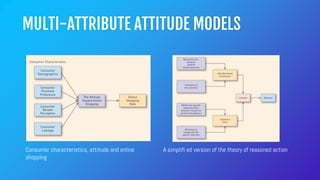
MULTI-ATTRIBUTE ATTITUDE MODELS
Multi-attribute attitude models portray consumers’ attitudes with regard to an attitude
object (e.g. a product, a service, a direct-mail catalogue, a cause or an issue) as a
function of consumers’ perception and assessment of the key attributes or beliefs held
with regard to the particular attitude object.
MULTI-ATTRIBUTE ATTITUDE MODELS
Consumer characteristics, attitude and online
shopping
A simplifi ed version of the theory of reasoned action
ATTITUDE FORMATION
HOW ATTITUDES ARE LEARNED
When we speak of the formation of an attitude, we refer to the shift from having no
attitude towards a given object (e.g. an MP3 player) to having some attitude towards it
(e.g. having an MP3 player is great when you want to listen to music while on a
treadmill at the gym).
ATTITUDE FORMATION
SOURCES OF INFL UENCE
ON ATTITUDE FORMATION
The formation of consumer attitudes is strongly infl uenced by personal experience, the
influence of family and friends, direct marketing and mass media.
The primary means by which attitudes towards goods and services are formed is
through the consumer’s direct experience in trying and evaluating them.
ATTITUDE FORMATION
PERSONALITY FACTORS
Personality also plays a critical role in attitude formation.
Example, individuals with a high need for cognition (i.e. those who crave information
and enjoy thinking) are likely to form positive attitudes in response to advertisements
or direct mail that are rich in product-related information. On the other hand,
consumers who are relatively low in need for cognition are more likely to form positive
attitudes in response to advertisements that feature an attractive model or well-
known celebrity.
Altering consumer attitudes is a key strategy
consideration for most marketers. For marketers
who are fortunate enough to be market leaders and
to enjoy a significant amount of customer goodwill
and loyalty, the overriding goal is to fortify the
existing positive attitudes of customers so that
they will not succumb to competitors’ special offers
and other inducements designed to win them over.
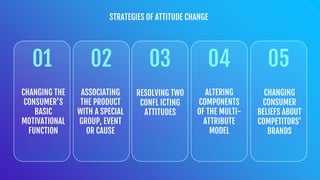
STRATEGIES OF
ATTITUDE CHANGE
01
CHANGING THE
CONSUMER’S
BASIC
MOTIVATIONAL
FUNCTION
02 03 04
STRATEGIES OF ATTITUDE CHANGE
05
ASSOCIATING
THE PRODUCT
WITH A SPECIAL
GROUP, EVENT
OR CAUSE
RESOLVING TWO
CONFL ICTING
ATTITUDES
ALTERING
COMPONENTS
OF THE MULTI-
ATTRIBUTE
MODEL
CHANGING
CONSUMER
BELIEFS ABOUT
COMPETITORS’
BRANDS
BEHAVIOUR CAN PRECEDE OR FOLLOW
ATTITUDE FORMATION
COGNITIVE DISSONANCE THEORY
According to cognitive dissonance theory, discomfort or dissonance occurs when a consumer
holds conflicting thoughts about a belief or an attitude object. For instance, when consumers
have made a commitment – made a deposit or placed an order for a product, particularly an
expensive one such as a car or a personal computer – they often begin to feel cognitive
dissonance when they think of the unique, positive qualities of the brands not selected (‘left
behind’).
BEHAVIOUR CAN PRECEDE OR FOLLOW
ATTITUDE FORMATION
ATTRIBUTION THEORY
As a group of loosely interrelated social psychological principles, attribution theory attempts to
explain how people assign causality (e.g. blame or credit) to events on the basis of either their
own behaviour or the behaviour of others. In other words, a person might say, ‘I contributed
to UNICEF because it really helps people in need’, or ‘She tried to persuade me to buy that
unknown digital camera because she’d make a bigger commission’.
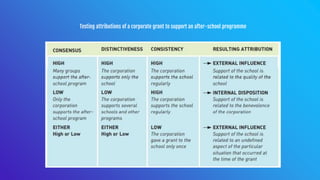
Testing attributions of a corporate grant to support an after-school programme
THANKS

CONSUMER ATTITUDE FORMATION AND CHANGE.pptx

  • 1.
  • 2.
    WHAT ARE ATTITUDES? Ina consumer behaviour context, an attitude is a learned predisposition to behave in a consistently favourable or unfavourable way with respect to a given object. Each part of this definition describes an important property of an attitude and is critical to understanding the role of attitudes in consumer behaviour.
  • 3.
    THE ATTETION ‘Object’ Theword object in our consumer-oriented definition of attitude should be interpreted broadly to include specific consumption - or marketing-related concepts, such as product, product category, brand, service, possessions, product use, causes or issues, people, advertisement, Internet site, price, medium or retailer. Example: If we were interested in learning consumers’ attitudes towards three major brands of DVD players, our ‘object’ might include Sony, Toshiba and Panasonic; if we were examining consumer attitudes towards major brands of mobile phones, our ‘object’ might include Nokia, Sony Ericsson, Samsung and Motorola.
  • 4.
    ATTITUDES ARE LEARNED PREDISPOSITIONS Thereis general agreement that attitudes are learned. This means that attitudes relevant to purchase behaviour are formed as a result of direct experience with the product, word-of-mouth information acquired from others, or exposure to mass-media advertising, the Internet and various forms of direct marketing (e.g. a retailer’s catalogue).
  • 5.
    ATTITUDES HAVE CONSISTENCY Another characteristicof attitudes is that they are relatively consistent with the behaviour they reflect. However, despite their consistency, attitudes are not necessarily permanent; they do change.
  • 6.
    ATTITUDES OCCUR WITHIN ASITUATION It is not immediately evident from our definition that attitudes occur within and are affected by the situation. By situation, we mean events or circumstances that, at a particular time, influence the relationship between an attitude and a behaviour. A specific situation can cause consumers to behave in ways seemingly inconsistent with their attitudes. Example: let us assume that a Danish consumer, Marcus, purchases a different brand of deodorant each time the brand he is using runs low. for example, his wish to economise. Thus, he will buy whatever is the least expensive brand,
  • 7.
    STRUCTURAL MODELS OFATTITUDES The Cognitive Component The knowledge and perceptions that are acquired by a combination of direct experience with the attitude object and related information from various sources. Tricomponent attitude model
  • 8.
    STRUCTURAL MODELS OFATTITUDES The Affective Component A consumer’s emotions or feelings about a particular product or brand constitute the affective component of an attitude. These emotions and feelings are frequently treated by consumer researchers as primarily evaluative in nature; that is, they capture an individual’s direct or global assessment of the attitude object (the extent to which the individual rates the attitude object as ‘favourable’ or ‘unfavourable’, ‘good’ or ‘bad’). Tricomponent attitude model
  • 9.
    STRUCTURAL MODELS OFATTITUDES The Conative Component Conation, the final component of the tricomponent attitude model, is concerned with the likelihood or tendency that an individual will undertake a specific action or behave in a particular way with regard to the attitude object Tricomponent attitude model
  • 10.
    MULTI-ATTRIBUTE ATTITUDE MODELS Multi-attributeattitude models portray consumers’ attitudes with regard to an attitude object (e.g. a product, a service, a direct-mail catalogue, a cause or an issue) as a function of consumers’ perception and assessment of the key attributes or beliefs held with regard to the particular attitude object.
  • 11.
    MULTI-ATTRIBUTE ATTITUDE MODELS Consumercharacteristics, attitude and online shopping A simplifi ed version of the theory of reasoned action
  • 12.
    ATTITUDE FORMATION HOW ATTITUDESARE LEARNED When we speak of the formation of an attitude, we refer to the shift from having no attitude towards a given object (e.g. an MP3 player) to having some attitude towards it (e.g. having an MP3 player is great when you want to listen to music while on a treadmill at the gym).
  • 13.
    ATTITUDE FORMATION SOURCES OFINFL UENCE ON ATTITUDE FORMATION The formation of consumer attitudes is strongly infl uenced by personal experience, the influence of family and friends, direct marketing and mass media. The primary means by which attitudes towards goods and services are formed is through the consumer’s direct experience in trying and evaluating them.
  • 14.
    ATTITUDE FORMATION PERSONALITY FACTORS Personalityalso plays a critical role in attitude formation. Example, individuals with a high need for cognition (i.e. those who crave information and enjoy thinking) are likely to form positive attitudes in response to advertisements or direct mail that are rich in product-related information. On the other hand, consumers who are relatively low in need for cognition are more likely to form positive attitudes in response to advertisements that feature an attractive model or well- known celebrity.
  • 15.
    Altering consumer attitudesis a key strategy consideration for most marketers. For marketers who are fortunate enough to be market leaders and to enjoy a significant amount of customer goodwill and loyalty, the overriding goal is to fortify the existing positive attitudes of customers so that they will not succumb to competitors’ special offers and other inducements designed to win them over. STRATEGIES OF ATTITUDE CHANGE
  • 16.
    01 CHANGING THE CONSUMER’S BASIC MOTIVATIONAL FUNCTION 02 0304 STRATEGIES OF ATTITUDE CHANGE 05 ASSOCIATING THE PRODUCT WITH A SPECIAL GROUP, EVENT OR CAUSE RESOLVING TWO CONFL ICTING ATTITUDES ALTERING COMPONENTS OF THE MULTI- ATTRIBUTE MODEL CHANGING CONSUMER BELIEFS ABOUT COMPETITORS’ BRANDS
  • 17.
    BEHAVIOUR CAN PRECEDEOR FOLLOW ATTITUDE FORMATION COGNITIVE DISSONANCE THEORY According to cognitive dissonance theory, discomfort or dissonance occurs when a consumer holds conflicting thoughts about a belief or an attitude object. For instance, when consumers have made a commitment – made a deposit or placed an order for a product, particularly an expensive one such as a car or a personal computer – they often begin to feel cognitive dissonance when they think of the unique, positive qualities of the brands not selected (‘left behind’).
  • 18.
    BEHAVIOUR CAN PRECEDEOR FOLLOW ATTITUDE FORMATION ATTRIBUTION THEORY As a group of loosely interrelated social psychological principles, attribution theory attempts to explain how people assign causality (e.g. blame or credit) to events on the basis of either their own behaviour or the behaviour of others. In other words, a person might say, ‘I contributed to UNICEF because it really helps people in need’, or ‘She tried to persuade me to buy that unknown digital camera because she’d make a bigger commission’.
  • 19.
    Testing attributions ofa corporate grant to support an after-school programme
  • 20.