Consumer Attitude
Formation and Change
CHAPTER
EIGHT
Learning Objectives
1. To Understand What Attitudes Are, How They Are
Learned, as Well as Their Nature and Characteristics.
2. To Understand the Composition and Scope of
Selected Models of Attitudes.
3. To Understand How Experience Leads to the Initial
Formation of Consumption-Related Attitudes.
4. To Understand the Various Ways in Which
Consumers’ Attitudes Are Changed.
5. To Understand How Consumers’ Attitudes Can Lead
to Behavior and How Behavior Can Lead to Attitudes.
Copyright 2010 Pearson Education, Inc. Publishing as Prentice Hall 2Chapter Eight Slide
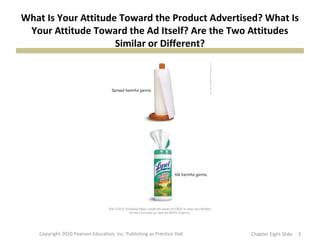
What Is Your Attitude Toward the Product Advertised? What Is
Your Attitude Toward the Ad Itself? Are the Two Attitudes
Similar or Different?
3Copyright 2010 Pearson Education, Inc. Publishing as Prentice Hall Chapter Eight Slide
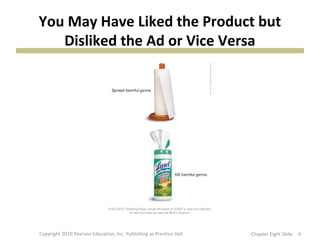
You May Have Liked the Product but
Disliked the Ad or Vice Versa
4Copyright 2010 Pearson Education, Inc. Publishing as Prentice Hall Chapter Eight Slide
Attitude
A learned
predisposition to
behave in a
consistently
favorable or
unfavorable manner
with respect to a
given object.
5Copyright 2010 Pearson Education, Inc. Publishing as Prentice Hall Chapter Eight Slide
What Are Attitudes?
• The attitude “object”
• Attitudes are a learned predisposition.
Predisposition means you have
something in your mind; a thought
• Attitudes have consistency
• Attitudes occur within a situation
6Copyright 2010 Pearson Education, Inc. Publishing as Prentice Hall Chapter Eight Slide
Four functions of attitude
• Utilitarian-attitude object serves some utility eg.I like Imran
khan since I believe he will reduce taxes
• 2)Value Expressive- the attitude object expresses ones values-
e.g.I like body shop because the company doesn’t use animal
testing
• 3)Knowledge- attitude object reduces uncertainty and gives
us comot of knowing e.g.I love Time because it keeps me
updated with the stars of film industry
• 4)Ego-Defensive- attitude object helps us protect our ego-
e.g.I don’t like that student because he misbehaved with me
7
• Tri component Attitude Model
• Multi attribute Attitude Model
• -Attitude towards the object
• -Attitude towards the behaviour model
• - theory of reasoned action
The Trying to consume Model
Attitude toward the Ad Model
8
A simple representation of the tri
componenet attitude model
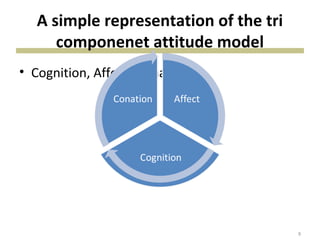
• Cognition, Affect, conation
9
• Cognitive component –beliefs
The knowledge and perceptions that are acquired b a compination of direct
experience with the attitude object and related information from various sources
• Affective component - feelings/emotion
A consumers emotion or feelings about a particular product or brand.
Even people are branded
• Conative component – intention
The likelihood or tendency that an individual will undertake a specific action or
behaviour in a particular way with regard to the attitude object
10
ATTITUDE HIERARCY
• A) The learning hierarchy(rational hierarchy)
THINK-> FEEL – > Act
• B)Emotional Hierarchy
Feel then think then act
• C)The Low Involvement Hierarchy
ACT then FEEL then THINK
11
Attitude Hierarchy
• A) The Learning Hierarchy(High involvement)
• B)Emo hierarchy(high involvement)- Bought a product on sale
and realised it wasn’t worth it and now you’re not happy
• C) Low involvement hierarchy(low involvement)Grocery
shopping where you buy something due to impulse buying
e.g. chewing gum cause of no change, then you taste and
develop cognitive processes
• Every single person has a different attitude so it differs for
everyone person
12
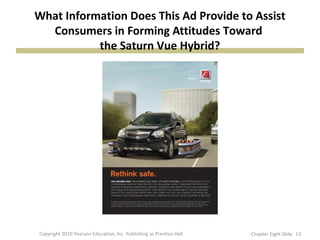
What Information Does This Ad Provide to Assist
Consumers in Forming Attitudes Toward
the Saturn Vue Hybrid?
13Copyright 2010 Pearson Education, Inc. Publishing as Prentice Hall Chapter Eight Slide
It is Stylish, Safe, and
Good for the Environment
14Copyright 2010 Pearson Education, Inc. Publishing as Prentice Hall Chapter Eight Slide
Structural Models of Attitudes
• Tricomponent Attitude Model
• Multiattribute Attitude Model
• The Trying-to-Consume Model
• Attitude-Toward-the-Ad Model
Copyright 2010 Pearson Education, Inc. Publishing as Prentice Hall 15Chapter Eight Slide
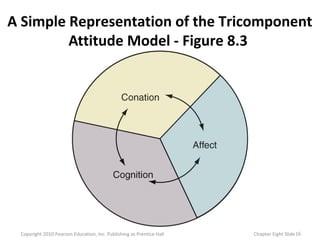
Cognition
A Simple Representation of the Tricomponent
Attitude Model - Figure 8.3
16Copyright 2010 Pearson Education, Inc. Publishing as Prentice Hall Chapter Eight Slide
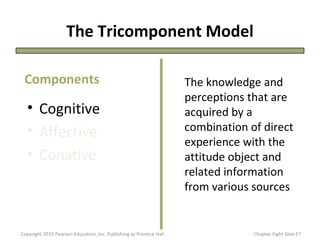
The Tricomponent Model
• Cognitive
• Affective
• Conative
The knowledge and
perceptions that are
acquired by a
combination of direct
experience with the
attitude object and
related information
from various sources
Components
17Copyright 2010 Pearson Education, Inc. Publishing as Prentice Hall Chapter Eight Slide
The Tricomponent Model
• Cognitive
• Affective
• Conative
A consumer’s
emotions or feelings
about a particular
product or brand
Components
18Copyright 2010 Pearson Education, Inc. Publishing as Prentice Hall Chapter Eight Slide
The Tricomponent Model
• Cognitive
• Affective
• Conative
The likelihood or
tendency that an
individual will
undertake a specific
action or behave in a
particular way with
regard to the attitude
object e.g.
Components
19Copyright 2010 Pearson Education, Inc. Publishing as Prentice Hall Chapter Eight Slide
Discussion Questions
• Explain your attitude toward your
college/university based on the tricomponent
attribute model.
• Be sure to isolate the cognitive, affective, and
conative elements.
20Copyright 2010 Pearson Education, Inc. Publishing as Prentice Hall Chapter Eight Slide
MultiattributeMultiattribute
AttitudeAttitude
ModelsModels
Attitude models that
examine the
composition of
consumer
perceptions and
assessment of key
attributes or beliefs
held with regards to
a particular attitude
object.
21Copyright 2010 Pearson Education, Inc. Publishing as Prentice Hall Chapter Eight Slide
Multiattribute Attitude Models
• The attitude-toward-
object model
• The attitude-toward-
behavior model
• Theory-of-reasoned-
action model
• Attitude is function of the
presence of certain beliefs or
attributes.
• Useful to measure attitudes
toward product and service
categories or specific brands.
• According to this
model,consumer attitude
towards a product or a specific
brand of a product is a function
of the presence(or absence) and
evaluation of certain product-
specific beliefs and of attributes
Types
22Copyright 2010 Pearson Education, Inc. Publishing as Prentice Hall Chapter Eight Slide
Multiattribute Attitude Models
• The attitude-toward-
object model
• The attitude-toward-
behavior model
• Theory-of-reasoned-
action model
• Is the attitude toward behaving
or acting with respect to an
object, rather than the attitude
toward the object itself
• Corresponds closely to actual
behavior
• It proposes that a consumer’s
attitude towards a specific
behabiour is a function of how
strongly he or she believes that
action will lead to a specific
outcome(either fav or unfav)
• It corresponds more closely with
the actual behavior than does the
attitude toward the object
model.
Types
23Copyright 2010 Pearson Education, Inc. Publishing as Prentice Hall Chapter Eight Slide
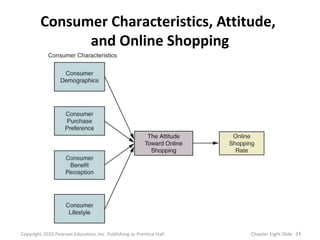
Consumer Characteristics, Attitude,
and Online Shopping
24Copyright 2010 Pearson Education, Inc. Publishing as Prentice Hall Chapter Eight Slide
Multiattribute Attitude Models
• The attitude-toward-
object model
• The attitude-toward-
behavior model
• Theory-of-reasoned-
action model
• Includes cognitive,
affective, and conative
components
• Includes subjective
norms in addition to
attitude
Types
25Copyright 2010 Pearson Education, Inc. Publishing as Prentice Hall Chapter Eight Slide
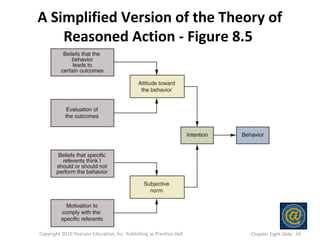
A Simplified Version of the Theory of
Reasoned Action - Figure 8.5
Copyright 2010 Pearson Education, Inc. Publishing as Prentice Hall 26Chapter Eight Slide
Discussion Question
• Now use the theory of reasoned action to
describe your attitude toward your
college/university when deciding on which
school to attend.
27Copyright 2010 Pearson Education, Inc. Publishing as Prentice Hall Chapter Eight Slide
Theory ofTheory of
Trying toTrying to
ConsumeConsume
An attitude theory
designed to account
for the many cases
where the action or
outcome is not certain
but instead reflects
the consumer’s
attempt to consume
(or purchase).
28Copyright 2010 Pearson Education, Inc. Publishing as Prentice Hall Chapter Eight Slide
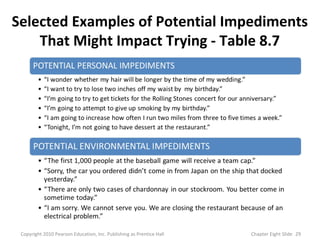
Selected Examples of Potential Impediments
That Might Impact Trying - Table 8.7
29Copyright 2010 Pearson Education, Inc. Publishing as Prentice Hall Chapter Eight Slide
Attitude-Attitude-
Toward-the-Toward-the-
Ad ModelAd Model
A model that proposes
that a consumer forms
various feelings (affects)
and judgments
(cognitions) as the result
of exposure to an
advertisement, which, in
turn, affect the
consumer’s attitude
toward the ad and
attitude toward the
brand.
30Copyright 2010 Pearson Education, Inc. Publishing as Prentice Hall Chapter Eight Slide
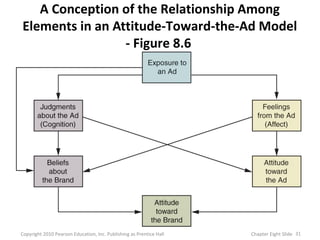
A Conception of the Relationship Among
Elements in an Attitude-Toward-the-Ad Model
- Figure 8.6
31Copyright 2010 Pearson Education, Inc. Publishing as Prentice Hall Chapter Eight Slide
Issues in Attitude Formation
• How attitudes are learned
– Conditioning and experience
– Knowledge and beliefs
32Copyright 2010 Pearson Education, Inc. Publishing as Prentice Hall Chapter Eight Slide
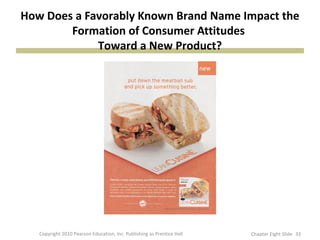
How Does a Favorably Known Brand Name Impact the
Formation of Consumer Attitudes
Toward a New Product?
33Copyright 2010 Pearson Education, Inc. Publishing as Prentice Hall Chapter Eight Slide
There is Stimulus Generalization From the Lean
Cuisine Brand Names to the New Product.
34Copyright 2010 Pearson Education, Inc. Publishing as Prentice Hall Chapter Eight Slide
Issues in Attitude Formation
• Sources of influence on attitude formation
– Personal experience
– Influence of family
– Direct marketing and mass media
• Personality factors
35Copyright 2010 Pearson Education, Inc. Publishing as Prentice Hall Chapter Eight Slide
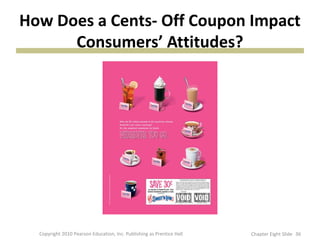
How Does a Cents- Off Coupon Impact
Consumers’ Attitudes?
36Copyright 2010 Pearson Education, Inc. Publishing as Prentice Hall Chapter Eight Slide
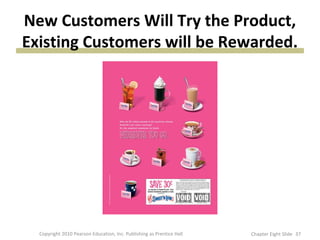
New Customers Will Try the Product,
Existing Customers will be Rewarded.
37Copyright 2010 Pearson Education, Inc. Publishing as Prentice Hall Chapter Eight Slide
Strategies of Attitude Change
38Copyright 2010 Pearson Education, Inc. Publishing as Prentice Hall Chapter Eight Slide
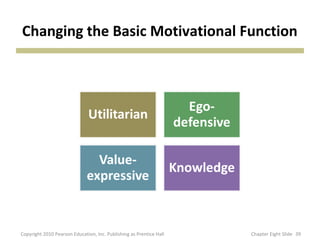
Changing the Basic Motivational Function
39Copyright 2010 Pearson Education, Inc. Publishing as Prentice Hall Chapter Eight Slide
Why and How Does This Ad Appeal to
the Utilitarian Function?
40Copyright 2010 Pearson Education, Inc. Publishing as Prentice Hall Chapter Eight Slide
The Product is Green and Works as
Well or Better than Other Products.
41Copyright 2010 Pearson Education, Inc. Publishing as Prentice Hall Chapter Eight Slide
Which Lifestyle- Related Attitudes Are
Expressed or Reflected in This Ad?
42Copyright 2010 Pearson Education, Inc. Publishing as Prentice Hall Chapter Eight Slide
Healthy Eating and Snacking Lifestyle
43Copyright 2010 Pearson Education, Inc. Publishing as Prentice Hall Chapter Eight Slide
How Does This Ad Provide Information to Establish
or Reinforce Consumer Attitudes?
44Copyright 2010 Pearson Education, Inc. Publishing as Prentice Hall Chapter Eight Slide
It Raises the Question About UVA Rays and
then Provides Information on Sun Protection.
45Copyright 2010 Pearson Education, Inc. Publishing as Prentice Hall Chapter Eight Slide
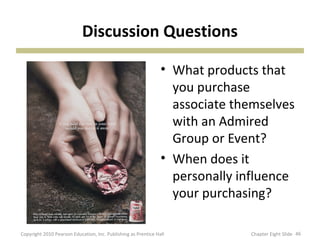
Discussion Questions
• What products that
you purchase
associate themselves
with an Admired
Group or Event?
• When does it
personally influence
your purchasing?
46Copyright 2010 Pearson Education, Inc. Publishing as Prentice Hall Chapter Eight Slide
How Is Fiji Water’s Link to an Environmental Cause
Likely to Impact Consumers’
Attitudes Toward Its Product?
47Copyright 2010 Pearson Education, Inc. Publishing as Prentice Hall Chapter Eight Slide
They Might Have a More Favorable Attitude.
48Copyright 2010 Pearson Education, Inc. Publishing as Prentice Hall Chapter Eight Slide
Attitude Change
• Altering Components of the Multiattribute
Model
– Changing relative evaluation of attributes
– Changing brand beliefs
– Adding an attribute
– Changing the overall brand rating
• Changing Beliefs about Competitors’
Brands
49Copyright 2010 Pearson Education, Inc. Publishing as Prentice Hall Chapter Eight Slide
How Is This New Benefit Likely to Impact
Consumers’ Attitudes Toward the Product?
50Copyright 2010 Pearson Education, Inc. Publishing as Prentice Hall Chapter Eight Slide
The Consumer Will Have a More Positive
Attitude Overall from the New Attribute.
51Copyright 2010 Pearson Education, Inc. Publishing as Prentice Hall Chapter Eight Slide
How Is the Absence of an Ingredient Likely to
Lead to a Favorable Attitude Toward a
Product?
52Copyright 2010 Pearson Education, Inc. Publishing as Prentice Hall Chapter Eight Slide
When It Was An
Unfavorable Attribute
53Copyright 2010 Pearson Education, Inc. Publishing as Prentice Hall Chapter Eight Slide
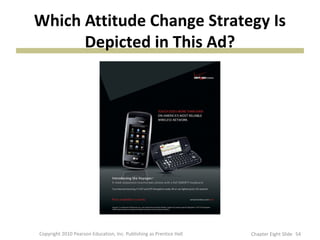
Which Attitude Change Strategy Is
Depicted in This Ad?
54Copyright 2010 Pearson Education, Inc. Publishing as Prentice Hall Chapter Eight Slide
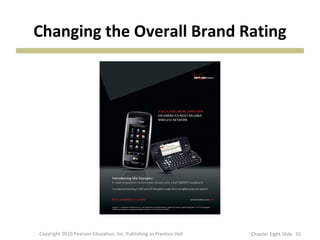
Changing the Overall Brand Rating
55Copyright 2010 Pearson Education, Inc. Publishing as Prentice Hall Chapter Eight Slide
How Is Valvoline’s Attempt to Change Attitudes
Toward a Competing Brand Likely to Impact Attitudes
Toward Its Own Brand?
56Copyright 2010 Pearson Education, Inc. Publishing as Prentice Hall Chapter Eight Slide
By Showing Better Wear Protection
57Copyright 2010 Pearson Education, Inc. Publishing as Prentice Hall Chapter Eight Slide
ElaborationElaboration
LikelihoodLikelihood
ModelModel
(ELM)(ELM)
Customer attitudes are
changed by two
distinctly different
routes to persuasion:
a central route or a
peripheral route.
58Copyright 2010 Pearson Education, Inc. Publishing as Prentice Hall Chapter Eight Slide
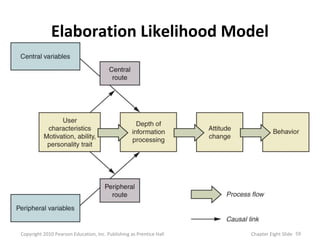
Elaboration Likelihood Model
59Copyright 2010 Pearson Education, Inc. Publishing as Prentice Hall Chapter Eight Slide
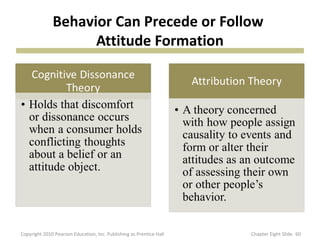
Behavior Can Precede or Follow
Attitude Formation
60Copyright 2010 Pearson Education, Inc. Publishing as Prentice Hall Chapter Eight Slide
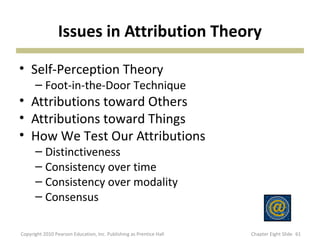
Issues in Attribution Theory
• Self-Perception Theory
– Foot-in-the-Door Technique
• Attributions toward Others
• Attributions toward Things
• How We Test Our Attributions
– Distinctiveness
– Consistency over time
– Consistency over modality
– Consensus
61Copyright 2010 Pearson Education, Inc. Publishing as Prentice Hall Chapter Eight Slide
All rights reserved. No part of this publication may be reproduced, stored in a
retrieval system, or transmitted, in any form or by any means, electronic,
mechanical, photocopying, recording, or otherwise, without the prior written
permission of the publisher. Printed in the United States of America.
Copyright © 2010 Pearson Education, Inc. Publishing as
Prentice Hall
62Copyright 2010 Pearson Education, Inc. Publishing as Prentice Hall Chapter Eight Slide

Chapter 8 Consumer Behavior

  • 1.
    Consumer Attitude Formation andChange CHAPTER EIGHT
  • 2.
    Learning Objectives 1. ToUnderstand What Attitudes Are, How They Are Learned, as Well as Their Nature and Characteristics. 2. To Understand the Composition and Scope of Selected Models of Attitudes. 3. To Understand How Experience Leads to the Initial Formation of Consumption-Related Attitudes. 4. To Understand the Various Ways in Which Consumers’ Attitudes Are Changed. 5. To Understand How Consumers’ Attitudes Can Lead to Behavior and How Behavior Can Lead to Attitudes. Copyright 2010 Pearson Education, Inc. Publishing as Prentice Hall 2Chapter Eight Slide
  • 3.
    What Is YourAttitude Toward the Product Advertised? What Is Your Attitude Toward the Ad Itself? Are the Two Attitudes Similar or Different? 3Copyright 2010 Pearson Education, Inc. Publishing as Prentice Hall Chapter Eight Slide
  • 4.
    You May HaveLiked the Product but Disliked the Ad or Vice Versa 4Copyright 2010 Pearson Education, Inc. Publishing as Prentice Hall Chapter Eight Slide
  • 5.
    Attitude A learned predisposition to behavein a consistently favorable or unfavorable manner with respect to a given object. 5Copyright 2010 Pearson Education, Inc. Publishing as Prentice Hall Chapter Eight Slide
  • 6.
    What Are Attitudes? •The attitude “object” • Attitudes are a learned predisposition. Predisposition means you have something in your mind; a thought • Attitudes have consistency • Attitudes occur within a situation 6Copyright 2010 Pearson Education, Inc. Publishing as Prentice Hall Chapter Eight Slide
  • 7.
    Four functions ofattitude • Utilitarian-attitude object serves some utility eg.I like Imran khan since I believe he will reduce taxes • 2)Value Expressive- the attitude object expresses ones values- e.g.I like body shop because the company doesn’t use animal testing • 3)Knowledge- attitude object reduces uncertainty and gives us comot of knowing e.g.I love Time because it keeps me updated with the stars of film industry • 4)Ego-Defensive- attitude object helps us protect our ego- e.g.I don’t like that student because he misbehaved with me 7
  • 8.
    • Tri componentAttitude Model • Multi attribute Attitude Model • -Attitude towards the object • -Attitude towards the behaviour model • - theory of reasoned action The Trying to consume Model Attitude toward the Ad Model 8
  • 9.
    A simple representationof the tri componenet attitude model • Cognition, Affect, conation 9
  • 10.
    • Cognitive component–beliefs The knowledge and perceptions that are acquired b a compination of direct experience with the attitude object and related information from various sources • Affective component - feelings/emotion A consumers emotion or feelings about a particular product or brand. Even people are branded • Conative component – intention The likelihood or tendency that an individual will undertake a specific action or behaviour in a particular way with regard to the attitude object 10
  • 11.
    ATTITUDE HIERARCY • A)The learning hierarchy(rational hierarchy) THINK-> FEEL – > Act • B)Emotional Hierarchy Feel then think then act • C)The Low Involvement Hierarchy ACT then FEEL then THINK 11
  • 12.
    Attitude Hierarchy • A)The Learning Hierarchy(High involvement) • B)Emo hierarchy(high involvement)- Bought a product on sale and realised it wasn’t worth it and now you’re not happy • C) Low involvement hierarchy(low involvement)Grocery shopping where you buy something due to impulse buying e.g. chewing gum cause of no change, then you taste and develop cognitive processes • Every single person has a different attitude so it differs for everyone person 12
  • 13.
    What Information DoesThis Ad Provide to Assist Consumers in Forming Attitudes Toward the Saturn Vue Hybrid? 13Copyright 2010 Pearson Education, Inc. Publishing as Prentice Hall Chapter Eight Slide
  • 14.
    It is Stylish,Safe, and Good for the Environment 14Copyright 2010 Pearson Education, Inc. Publishing as Prentice Hall Chapter Eight Slide
  • 15.
    Structural Models ofAttitudes • Tricomponent Attitude Model • Multiattribute Attitude Model • The Trying-to-Consume Model • Attitude-Toward-the-Ad Model Copyright 2010 Pearson Education, Inc. Publishing as Prentice Hall 15Chapter Eight Slide
  • 16.
    Cognition A Simple Representationof the Tricomponent Attitude Model - Figure 8.3 16Copyright 2010 Pearson Education, Inc. Publishing as Prentice Hall Chapter Eight Slide
  • 17.
    The Tricomponent Model •Cognitive • Affective • Conative The knowledge and perceptions that are acquired by a combination of direct experience with the attitude object and related information from various sources Components 17Copyright 2010 Pearson Education, Inc. Publishing as Prentice Hall Chapter Eight Slide
  • 18.
    The Tricomponent Model •Cognitive • Affective • Conative A consumer’s emotions or feelings about a particular product or brand Components 18Copyright 2010 Pearson Education, Inc. Publishing as Prentice Hall Chapter Eight Slide
  • 19.
    The Tricomponent Model •Cognitive • Affective • Conative The likelihood or tendency that an individual will undertake a specific action or behave in a particular way with regard to the attitude object e.g. Components 19Copyright 2010 Pearson Education, Inc. Publishing as Prentice Hall Chapter Eight Slide
  • 20.
    Discussion Questions • Explainyour attitude toward your college/university based on the tricomponent attribute model. • Be sure to isolate the cognitive, affective, and conative elements. 20Copyright 2010 Pearson Education, Inc. Publishing as Prentice Hall Chapter Eight Slide
  • 21.
    MultiattributeMultiattribute AttitudeAttitude ModelsModels Attitude models that examinethe composition of consumer perceptions and assessment of key attributes or beliefs held with regards to a particular attitude object. 21Copyright 2010 Pearson Education, Inc. Publishing as Prentice Hall Chapter Eight Slide
  • 22.
    Multiattribute Attitude Models •The attitude-toward- object model • The attitude-toward- behavior model • Theory-of-reasoned- action model • Attitude is function of the presence of certain beliefs or attributes. • Useful to measure attitudes toward product and service categories or specific brands. • According to this model,consumer attitude towards a product or a specific brand of a product is a function of the presence(or absence) and evaluation of certain product- specific beliefs and of attributes Types 22Copyright 2010 Pearson Education, Inc. Publishing as Prentice Hall Chapter Eight Slide
  • 23.
    Multiattribute Attitude Models •The attitude-toward- object model • The attitude-toward- behavior model • Theory-of-reasoned- action model • Is the attitude toward behaving or acting with respect to an object, rather than the attitude toward the object itself • Corresponds closely to actual behavior • It proposes that a consumer’s attitude towards a specific behabiour is a function of how strongly he or she believes that action will lead to a specific outcome(either fav or unfav) • It corresponds more closely with the actual behavior than does the attitude toward the object model. Types 23Copyright 2010 Pearson Education, Inc. Publishing as Prentice Hall Chapter Eight Slide
  • 24.
    Consumer Characteristics, Attitude, andOnline Shopping 24Copyright 2010 Pearson Education, Inc. Publishing as Prentice Hall Chapter Eight Slide
  • 25.
    Multiattribute Attitude Models •The attitude-toward- object model • The attitude-toward- behavior model • Theory-of-reasoned- action model • Includes cognitive, affective, and conative components • Includes subjective norms in addition to attitude Types 25Copyright 2010 Pearson Education, Inc. Publishing as Prentice Hall Chapter Eight Slide
  • 26.
    A Simplified Versionof the Theory of Reasoned Action - Figure 8.5 Copyright 2010 Pearson Education, Inc. Publishing as Prentice Hall 26Chapter Eight Slide
  • 27.
    Discussion Question • Nowuse the theory of reasoned action to describe your attitude toward your college/university when deciding on which school to attend. 27Copyright 2010 Pearson Education, Inc. Publishing as Prentice Hall Chapter Eight Slide
  • 28.
    Theory ofTheory of TryingtoTrying to ConsumeConsume An attitude theory designed to account for the many cases where the action or outcome is not certain but instead reflects the consumer’s attempt to consume (or purchase). 28Copyright 2010 Pearson Education, Inc. Publishing as Prentice Hall Chapter Eight Slide
  • 29.
    Selected Examples ofPotential Impediments That Might Impact Trying - Table 8.7 29Copyright 2010 Pearson Education, Inc. Publishing as Prentice Hall Chapter Eight Slide
  • 30.
    Attitude-Attitude- Toward-the-Toward-the- Ad ModelAd Model Amodel that proposes that a consumer forms various feelings (affects) and judgments (cognitions) as the result of exposure to an advertisement, which, in turn, affect the consumer’s attitude toward the ad and attitude toward the brand. 30Copyright 2010 Pearson Education, Inc. Publishing as Prentice Hall Chapter Eight Slide
  • 31.
    A Conception ofthe Relationship Among Elements in an Attitude-Toward-the-Ad Model - Figure 8.6 31Copyright 2010 Pearson Education, Inc. Publishing as Prentice Hall Chapter Eight Slide
  • 32.
    Issues in AttitudeFormation • How attitudes are learned – Conditioning and experience – Knowledge and beliefs 32Copyright 2010 Pearson Education, Inc. Publishing as Prentice Hall Chapter Eight Slide
  • 33.
    How Does aFavorably Known Brand Name Impact the Formation of Consumer Attitudes Toward a New Product? 33Copyright 2010 Pearson Education, Inc. Publishing as Prentice Hall Chapter Eight Slide
  • 34.
    There is StimulusGeneralization From the Lean Cuisine Brand Names to the New Product. 34Copyright 2010 Pearson Education, Inc. Publishing as Prentice Hall Chapter Eight Slide
  • 35.
    Issues in AttitudeFormation • Sources of influence on attitude formation – Personal experience – Influence of family – Direct marketing and mass media • Personality factors 35Copyright 2010 Pearson Education, Inc. Publishing as Prentice Hall Chapter Eight Slide
  • 36.
    How Does aCents- Off Coupon Impact Consumers’ Attitudes? 36Copyright 2010 Pearson Education, Inc. Publishing as Prentice Hall Chapter Eight Slide
  • 37.
    New Customers WillTry the Product, Existing Customers will be Rewarded. 37Copyright 2010 Pearson Education, Inc. Publishing as Prentice Hall Chapter Eight Slide
  • 38.
    Strategies of AttitudeChange 38Copyright 2010 Pearson Education, Inc. Publishing as Prentice Hall Chapter Eight Slide
  • 39.
    Changing the BasicMotivational Function 39Copyright 2010 Pearson Education, Inc. Publishing as Prentice Hall Chapter Eight Slide
  • 40.
    Why and HowDoes This Ad Appeal to the Utilitarian Function? 40Copyright 2010 Pearson Education, Inc. Publishing as Prentice Hall Chapter Eight Slide
  • 41.
    The Product isGreen and Works as Well or Better than Other Products. 41Copyright 2010 Pearson Education, Inc. Publishing as Prentice Hall Chapter Eight Slide
  • 42.
    Which Lifestyle- RelatedAttitudes Are Expressed or Reflected in This Ad? 42Copyright 2010 Pearson Education, Inc. Publishing as Prentice Hall Chapter Eight Slide
  • 43.
    Healthy Eating andSnacking Lifestyle 43Copyright 2010 Pearson Education, Inc. Publishing as Prentice Hall Chapter Eight Slide
  • 44.
    How Does ThisAd Provide Information to Establish or Reinforce Consumer Attitudes? 44Copyright 2010 Pearson Education, Inc. Publishing as Prentice Hall Chapter Eight Slide
  • 45.
    It Raises theQuestion About UVA Rays and then Provides Information on Sun Protection. 45Copyright 2010 Pearson Education, Inc. Publishing as Prentice Hall Chapter Eight Slide
  • 46.
    Discussion Questions • Whatproducts that you purchase associate themselves with an Admired Group or Event? • When does it personally influence your purchasing? 46Copyright 2010 Pearson Education, Inc. Publishing as Prentice Hall Chapter Eight Slide
  • 47.
    How Is FijiWater’s Link to an Environmental Cause Likely to Impact Consumers’ Attitudes Toward Its Product? 47Copyright 2010 Pearson Education, Inc. Publishing as Prentice Hall Chapter Eight Slide
  • 48.
    They Might Havea More Favorable Attitude. 48Copyright 2010 Pearson Education, Inc. Publishing as Prentice Hall Chapter Eight Slide
  • 49.
    Attitude Change • AlteringComponents of the Multiattribute Model – Changing relative evaluation of attributes – Changing brand beliefs – Adding an attribute – Changing the overall brand rating • Changing Beliefs about Competitors’ Brands 49Copyright 2010 Pearson Education, Inc. Publishing as Prentice Hall Chapter Eight Slide
  • 50.
    How Is ThisNew Benefit Likely to Impact Consumers’ Attitudes Toward the Product? 50Copyright 2010 Pearson Education, Inc. Publishing as Prentice Hall Chapter Eight Slide
  • 51.
    The Consumer WillHave a More Positive Attitude Overall from the New Attribute. 51Copyright 2010 Pearson Education, Inc. Publishing as Prentice Hall Chapter Eight Slide
  • 52.
    How Is theAbsence of an Ingredient Likely to Lead to a Favorable Attitude Toward a Product? 52Copyright 2010 Pearson Education, Inc. Publishing as Prentice Hall Chapter Eight Slide
  • 53.
    When It WasAn Unfavorable Attribute 53Copyright 2010 Pearson Education, Inc. Publishing as Prentice Hall Chapter Eight Slide
  • 54.
    Which Attitude ChangeStrategy Is Depicted in This Ad? 54Copyright 2010 Pearson Education, Inc. Publishing as Prentice Hall Chapter Eight Slide
  • 55.
    Changing the OverallBrand Rating 55Copyright 2010 Pearson Education, Inc. Publishing as Prentice Hall Chapter Eight Slide
  • 56.
    How Is Valvoline’sAttempt to Change Attitudes Toward a Competing Brand Likely to Impact Attitudes Toward Its Own Brand? 56Copyright 2010 Pearson Education, Inc. Publishing as Prentice Hall Chapter Eight Slide
  • 57.
    By Showing BetterWear Protection 57Copyright 2010 Pearson Education, Inc. Publishing as Prentice Hall Chapter Eight Slide
  • 58.
    ElaborationElaboration LikelihoodLikelihood ModelModel (ELM)(ELM) Customer attitudes are changedby two distinctly different routes to persuasion: a central route or a peripheral route. 58Copyright 2010 Pearson Education, Inc. Publishing as Prentice Hall Chapter Eight Slide
  • 59.
    Elaboration Likelihood Model 59Copyright2010 Pearson Education, Inc. Publishing as Prentice Hall Chapter Eight Slide
  • 60.
    Behavior Can Precedeor Follow Attitude Formation 60Copyright 2010 Pearson Education, Inc. Publishing as Prentice Hall Chapter Eight Slide
  • 61.
    Issues in AttributionTheory • Self-Perception Theory – Foot-in-the-Door Technique • Attributions toward Others • Attributions toward Things • How We Test Our Attributions – Distinctiveness – Consistency over time – Consistency over modality – Consensus 61Copyright 2010 Pearson Education, Inc. Publishing as Prentice Hall Chapter Eight Slide
  • 62.
    All rights reserved.No part of this publication may be reproduced, stored in a retrieval system, or transmitted, in any form or by any means, electronic, mechanical, photocopying, recording, or otherwise, without the prior written permission of the publisher. Printed in the United States of America. Copyright © 2010 Pearson Education, Inc. Publishing as Prentice Hall 62Copyright 2010 Pearson Education, Inc. Publishing as Prentice Hall Chapter Eight Slide

Editor's Notes

  • #3 Here is an outline of the topics for Chapter Eight.
  • #6 We have attitudes toward many things – to people, products, advertisements, ideas, and more. For the most part, these attitudes have been learned and guide our behavior toward the object. This web link brings you to one of many sites that helps measure attitudes via online surveys.
  • #7 It is important to understand these four concepts. The first is that we must clearly define the object which we are discussing or measuring the attitude toward. Is it a product category, a specific brand, or a particular model? The second is the agreement among researchers that attitudes are learned, either through direct experience or from others. Attitudes are consistent, they are not necessarily permanent and can change over time. We all know how our attitude can be affected by a situation – think about the times you have to eat foods that are not necessarily your favorite but they are what is available or what you are being served at a friend’s house.
  • #9 Tri component
  • #10 Affect-feelings nvolve- one Congition- the thought processes The intention to buy-conation- the intention will lead to buying behaviour- THE INTENTION TO BUY
  • #11 What comes first?? Imp question. 1)Cognition first, then affect, then conation 1Cognition—affect—conation Think---feel—intention to act Or affection—cognition—conation Or conation—cognition—affect Act –think --- feel
  • #16 These are models that attempt to understand the relationships between attitude and behavior. They will be explained in more detail on the following slides.
  • #17 The tricomponent attitude model has three components, as seen on this figure – the cognitive, affective, and conative components. Each of these will be explained in more detail in the slides that follow.
  • #18 The cognitive component is what you know or think about an object. This can be formed through direct experience or what you learn from others. The knowledge you form becomes a belief.
  • #19 How you feel about a brand, the emotions you have toward it, constitutes the affective component of the model. These feelings often tend to be overall good or bad feelings.
  • #20 The conative component describes the likelihood that you will do something in regard to the object. One of the most important is your intention to buy a certain object.
  • #21 You probably have an overall positive or negative feeling toward your university. Try to break this affective component down a bit more – what do you like and not like? You can now look to the cognitive to determine what beliefs you have about these different parts of your university. Finally, how does this influence what you do? Will you come back for a graduate degree? Recommend your little brother or sister attend? Send your children here? Donate money as an alumnus?
  • #22 Just as the name implies, these are models that breakdown overall attitude into the attributes or beliefs which form an overall opinion. There are several of these models, as you will see on the next few slides.
  • #23 According to the attitude-toward-object model, consumers will like a brand or product that has an adequate level of attributes that the consumer thinks are positive. For example, if you are buying a home, there is a list of attributes that the home must have – 2 bedrooms, 2 bathrooms, air conditioning, and a back yard. With this model, an attitude is positive for the house that has the most of these attributes.
  • #24 Instead of asking people what product they like and have positive attitudes toward, the attitude-toward-behavior model is based on how positive someone's attitude is toward acting a certain way, for instance purchasing a certain brand. The question is now how likely are you to purchase brand X rather than how highly do you rate brand X.
  • #25 This is a model that looks at people’s attitudes toward purchasing online. On the lefthand side are the consumer characteristics that tend to impact a person’s attitude toward purchasing online. Their attitude was broken down further by how they view nine benefits of online shopping, including effectiveness, convenience, information, safety, service, delivery speed, web design, selection, and familiarity with company name. In addition, the attitude leads to how a consumer will rate an online shopping experience.
  • #26 Like other models, the theory of reasoned action has the three components, cognitive (think), affective (feel), and conative (do). In this model, we also need to understand subjective norms or how a consumer is influenced by others.
  • #27 This is a figure of the theory of reasoned action. The subjective norms that are distinctive to this model are the two lower blocks on the right. A consumer has beliefs about what others think they should do and also have differing levels of how likely they will follow those beliefs, also known as their motivation to comply with the referents. This subjective norm is now combined with the consumer’s personal attitude toward a behavior to form an intention to perform a behavior. This intention may or may not lead to the actual behavior. Certain groups are very influenced by the motivation to comply with people in their group. This web link brings you to cosmogirl.com. This site for younger female teens is loaded with information to supply motivation – see if you can identify three on the homepage alone.
  • #28 This will lead you to think about the subjective norm and your attitude toward the behavior.
  • #29 The theory of trying to consume addresses the fact that many people may want to purchase but in many cases they cannot. This may occur for personal reasons, such as not having enough money, or environmental reasons, such as not being able to go to a particular store.
  • #30 There are many reasons why people do not consume even if they want to purchase a product. Table 8.7 in the text gives examples of both personal and environment impediments. How many times have these reasons stopped you from purchasing? What can marketers do to remove these impediments?
  • #31 The attitude-toward-the-ad model helps us understand how advertising impacts attitudes. The model is more thoroughly diagramed on the next slide.
  • #32 Here we see that everything begins with exposure to the ad. After this exposure, the consumer has feelings (affect) and thoughts (cognition) regarding the ad. This forms an attitude which works with beliefs about the brand to help form an attitude toward the brand.
  • #33 Attitudes are formed through learning. Recalling the concepts of classical and operant conditioning from earlier chapters, we recall that two stimuli can be paired or linked together to form a learned response. In addition, consumers can learn attitudes from rewards or outcomes from behavior. If attitudes are learned, then it is through experiences that this learning occurs. This can be from personal experience or from experiences with friends or exposure to marketing influences. Another topic studied in an earlier chapter comes into play with attitude formation. This is the consumer’s need for cognition. People will form attitudes based on the information that best suits them, information for the high need for cognition consumer, and images and spokespeople for the low need for cognition.
  • #39 Here are five strategies for attitude change. If you think about it, attitude change and formation are not all that different. They are both learned, they are both influenced by personal experience, and personality affects both of them.
  • #40 Changing the basic motivational function means to change the basic need that a consumer is trying to fulfill. Utilitarian function is how the product is useful to us. A marketer might want to create a more positive attitude toward a brand by showing all it can do. An ego-defensive function would show how the product would make them feel more secure and confident. A value-expressive function would more positively reflect the consumer’s values, lifestyle, and outlook. Finally, the knowledge function would satisfy the consumer’s “need to know” and help them understand more about the world around them. It is important for marketers to realize that they might have to combine functions because different customers are motivated to purchase their products for different reasons. Someone might buy a product because it tastes good and fills them up (utilitarian), while another thinks it is low fat and will make them healthy and therefore look better (ego-defensive).
  • #47 Marketers often associate their products with certain not-for-profit groups. Many of us buy products because of this association. For some products, we are aware of this association but still do not purchase.
  • #50 If we think analytically about a multiattribute model, we realize there are many different attributes that make up an overall attitude. As marketers, we can change the way the consumer evaluates a certain attribute. Perhaps the consumer thinks inexpensive is fine for a product, but a marketer might be able to point out that it is often worth paying a bit more for better quality. A marketer can also change the way consumers believe a brand rates on a certain attribute. Maybe a consumer thinks a brand is very expensive when in fact it is less expensive then several other brands. There may be an attribute that does not even exist. Who thought chewiness was an attribute that could even exist for a vitamin until Gummy Vites came along? Finally, we can step away from looking individually at the attribute and attempt to change the consumer’s overall assessment of the brand. We can do any of these attitude change strategies by changing beliefs of our own product or our competitor's product.
  • #59 The ELM is a much more global view of attitude change than the models reviewed on the previous slide. A more detailed description is provided in a diagram on the next slide.
  • #60 On the left-hand side of the model, we see central variables on the top and peripheral variables on the bottom. Central variables, which lead to the central route, will be effective on highly-motivated consumers. They will do the thinking necessary to understand the information they are presented. Peripheral variables, including music, spokespeople, and bright packaging, work on lower-involvement consumers. Together, or alone, they create an attitude change that results in a certain behavior.
  • #61 Up to this point, we have always had an attitude change, which led to a behavior. It is now time to consumer a behavior that might change attitude. There are two main theories that address this difference in sequencing. The cognitive dissonance theory occurs after the consumer has done something, let’s say purchase a product or accepted admission to a college. They begin to create an attitude around their behavior which is often based on dissonance or discomfort. Attribution theory is related to the question we have after a behavior of “Why did I do that?” This process of making inferences about behavior can lead to attitude formation and change.
  • #62 Here are some interesting issues in attribution theory. Self-perception theory is the inferences or judgment as to the causes of your behavior. Did something happen, like you won an award, because you were really good, because the competition was weak, or because the judges were rushed? We are constantly examining our behavior and often try to stay consistent. This is considered the foot-in-the-door technique, the fact that if you say yes to something, you will probably say yes to a similar act later on to remain consistent in your behavior. We have attribution toward others and always ask ourselves “why” about other’s acts. We question their motives. Would you believe we also have attribution toward things? Do you sometimes ask yourself, “Why do I like this software or that movie so much?” Over time, we like to test our attributions to see if they are correct. We may decide that if something happens when we use this product, it has distinctiveness. We also see if we have the same reaction to behavior over time, in different situations (modality), and if others agree. There are thousands of dating services online. This web link goes to therightstuff.com, a dating service for Ivy-league graduates only. People have a certain attribution toward others who attend the same colleges or group of colleges as themselves. Because they had this behavior (attended an Ivy League school) they must be like me.